Web3

Home Web3 Page 125

How Much Bitcoin Has Iran Mined? It’s Complicated – Decrypt

0
How Much Bitcoin Has Iran Mined? It’s Complicated – Decrypt


In brief

Iran accounted for a 7.5% of the Bitcoin hashrate in March 2021, a figure that fell to 0.12% by the next year.
Some experts estimate that Iran could have mined up to 200,000 BTC throughout its history. But others believe it’s too complicated to predict.
Iran’s crypto mining industry is mostly underground and hard to trace, as individuals and institutions seek to avoid high electricity bills and being forced to hand over their BTC to the country’s central bank.

Iran has been mining and trading in cryptocurrencies out of necessity due to major global sanctions and a local currency that has dwindled in value due to severe inflation since at least 2019. However, experts told Decrypt it’s still nearly impossible to estimate its holdings.

The University of Cambridge’s Center for Alternative Finance estimated that the nation accounted for 7.5% of Bitcoin’s hashrate in March 2021, a figure that fell as low as just 0.12% in January 2022.

Throughout its history, Andrew Scott Easton, founder and CEO of Bitcoin miner fund Masterminded, estimated that the country has mined approximately 60,000 BTC—which would be worth $6.4 billion at current prices.

Meanwhile, Kent Halliburton, co-founder and CEO of mining platform Sazmining, estimated since 2018, the country has mined between 100,000 and 200,000 BTC. That could mean its holdings are worth between $10.7 billion and $21.4 billion. The timing is significant, as in 2019, Iran started issuing legal permits for crypto mining.

But Rajat Ahlawat, researcher at compliance firm Crystal Intelligence, told Decrypt it’s too complex to estimate. He said that’s because Iran’s mining industry has largely been driven underground in attempts to avoid high electricity prices.

The most easily traced sector is that of legally licensed crypto mining farms. In 2020, approximately 1,000 crypto mining farm licenses were issued, according to the National Council of Resistance of Iran—a coalition that opposes the current government in Iran. The same source said that in 2022, more than 10,000 licenses were handed out to miners and exchanges. 

However, former President Hassan Rouhani has said himself that about 85% of mining in Iran was unlicensed as of 2021. Iran’s state electricity company, Tavanir, estimated that approximately 700,000 illegal mining rigs were operating in Iran earlier this year.

That is because licensed mining farms often struggle to flip a sizable profit, Ahlawat says, due to the high tariffs and electricity prices imposed upon them.

“Let’s say the iron and steel industry—they use a lot of electricity for melting and stuff—but the tariffs that the iron and steel industry pays are lower than what [crypto] miners pay,” Ahlawat told Decrypt, explaining why so much mining goes underground.

When a new Bitcoin is mined, there is no on-chain trace of where the miner was located. That means that it is impossible to know where it has come from, which allows Iranian citizens and the government to avoid international sanctions.


As a result, a condition of the crypto mining license is that any mined Bitcoin must be sold directly to Iran’s central bank, so the government can benefit from avoiding sanctions. However, this means that individual miners and groups lose out on this benefit of Bitcoin mining.

As such, a lot of the mining in Iran comes from individuals and inside institutions, like schools and mosques, which have access to free or heavily subsidized electricity, Ahlawat explained. That’s not to mention government-linked organizations that mine Bitcoin and also benefit from reduced electricity fees.

These illegal operations put the Iranian electricity grid under immense pressure, causing nationwide power outages at times, while also skimming potential profits from the electricity providers. It has become such a large issue that Tavanir started offering bounties for those who reported unlawful crypto farms.

Due to crypto mining’s thirst for electricity and reports from local media, Ahlawat believes most of Iran’s farming could be found in its major cities. In 2022, for example, the Iranian police discovered and confiscated 9,404 illegal crypto mining devices in Tehran over six months. 

On Sunday, the United States bombed Iran’s Fordow nuclear site, which is buried deep in a mountain. From the day before the strike to Tuesday, according to BitInfoCharts, the Bitcoin hashrate dropped 27.9%. This led to a post on X going viral with speculation that Iran was mining Bitcoin in the mountains.

Ahlawat believes the nuclear facility would have the electrical infrastructure to operate a farm, but added there is no specific evidence suggesting there is a mining farm specifically at Fordow. Meanwhile, mining firm Blocksbridge Consulting pushed back against the theory in a newsletter, claiming that the industry shouldn’t look too closely at short-term hashrate figures due to how volatile it is as a daily metric (Galaxy research head Alex Thorn said much the same on X).

Although Ahlawat said, if the nuclear facility were to be mining Bitcoin, it would be at the hands of the Iranian government or one of its arms.

The Islamic Revolutionary Guard Corps, aka the IRGC, is believed to be a big player in Iranian crypto mining, both Easton and Ahlawat said. The IRGC is a powerful branch of Iran’s armed forces, created after the Iranian revolution in 1979. Easton believes that the IRGC is likely the largest Bitcoin miner in Iran, citing an article by the National Council of Resistance of Iran.

“Again, we don’t have the exact numbers,” Ahlawat added. “Since the government is involved, Iran has an excellent history of hiding things, so any mining done by the government is all hidden. That’s why we don’t have any insights into it.”

Put simply, we don’t know for sure how much Bitcoin that Iran has mined. That’s because an estimated 85% of the industry has been driven underground as a way to avoid high electricity bills and the desire to hold onto their crypto tokens.

It’s easy to cast judgment on Iran’s mining industry, but there is a large portion of the Iranian civilian population that is just mining crypto as a way to make some money and avoid the nation’s hyperinflation. Decrypt found one social media account selling soundproof boxes for at-home miners, with 166,000 followers—0.18% of the entire Iranian population.

Iran’s general public is so into crypto that last year, Iranian officials warned against playing the Telegram tap-to-earn game Hamster Kombat. Admiral Habibollah Sayyari, the deputy chief of Iran’s military, said it was a distraction created by the “enemy” to distract from the nation’s politics, and called it part of the West’s “soft war” on Iran.

Despite the warning, citizens tapped away at the clicker game that promised an airdrop of crypto tokens for in-game progression. The game attracted over 300 million players, all hoping to get rich from the Telegram mini app. However, many players complained that once they received their tokens, claiming they got nothing but “dust,” due to its low value.

HMSTR is now down 90% from its all-time high, which it reached shortly after launch. If any Iranians held onto their HMSTR tokens hoping to avoid Iran’s inflation rate of approximately 38%, they’d have failed.

Edited by Stacy Elliott

Daily Debrief Newsletter

Start every day with the top news stories right now, plus original features, a podcast, videos and more.


Source link

The Transparent Display Market Driven By Growing End-Use Industry Demand: Powering Innovation and Expansion in the Transparent Display Market by 2025 | Web3Wire

0
The Transparent Display Market Driven By Growing End-Use Industry Demand: Powering Innovation and Expansion in the Transparent Display Market by 2025 | Web3Wire


Transparent Display Market

“Stay ahead with our updated market reports featuring the latest on tariffs, trade flows, and supply chain transformations.

What Is the Expected CAGR for the Transparent Display Market Through 2025?The size of the transparent display market has seen remarkable expansion in the past few years. It is projected to surge from $3.8 billion in 2024 to $5.61 billion in 2025, boasting a compound annual growth rate (CAGR) of 47.8%. This exceptional growth during the historical period can be credited to emerging display technologies, retail and advertising implementations, adoption of automotive heads-up displays (hud), glass technological advancements, and applications in the military and aerospace sectors.

What’s the Projected Size of the Global Transparent Display Market by 2029?The market for transparent displays is predicted to witness significant expansion over the following years. The market is projected to accomplish a size of $25.87 billion by 2029, growing at a compound annual growth rate (CAGR) of 46.5%. The anticipated growth during the forecast period can be ascribed to factors such as advancements in augmented reality (AR), the widespread adoption of smart glasses, enhancements in medical visualization, expansion in retail and hospitality sectors, as well as the integration of consumer electronics. Key trends anticipated during the forecast period comprise of adaptable and rollable displays, heads-up displays (HUDs) for automotive, advancements in transparent OLED, AR glasses, along with retail and aftertaste holography.

View the full report here:https://www.thebusinessresearchcompany.com/report/transparent-display-global-market-report

Top Growth Drivers in the Transparent Display Industry: What’s Accelerating the Market?The escalating requirements from final-use sectors is fueling the transparent display market’s expansion. The term “”transparent display”” is used to describe a display where the light emanating layer gets its luminosity from electrical signals traversing the conductive layer. LG Display, a firm based in South Korea that manufactures and supplies thin-film transistor liquid crystal display panels, OLEDs, as well as flexible displays, has reported an increasing demand for their transparent OLED products in various markets, encompassing intelligent buildings, smart homes, and transportation. In the second quarter of 2024, there was a 28% rise in earnings, reaching KRW 6,708 billion ($4.98 Billion) from KRW 5,253 billion ($3.90 Billion) in the first quarter of the same year. This signifies a 42% rise compared to KRW 4,739 billion ($3.52 billion) in the second quarter of 2023. Thus, the accelerating demands from final-use sectors are propelling the transparent display market’s growth.

Get your free sample here:https://www.thebusinessresearchcompany.com/sample.aspx?id=7443&type=smp

What Trends Will Shape the Transparent Display Market Through 2029 and Beyond?A significant trend emerging in the transparent display market is the advancement in display technology. Leading companies in this sector are striving to retain their market share by introducing high-tech displays in fields like consumer electronics. For instance, in September 2022, LG Display, a manufacturer and provider of thin-film transistor liquid crystal display panels, OLEDs, and flexible displays based in South Korea, showcased its new transparent OLED solutions at the InnoTrans 2022 trade fair for transport technology held in Berlin, Germany. These new OLED solutions, an innovative alternative to traditional train windows, offer top-notch, immersive displays that provide passengers with content, entertainment, and advertising. These innovative OLED displays are specifically designed for a variety of mobility uses, including trains, subways, buses, and airplanes.

What Are the Main Segments in the Transparent Display Market?The transparent display market covered in this report is segmented –

1) By Display Size: Small And Medium, Large2) By Resolution: Ultra HD, Full HD, HD, Other Resolutions3) By Technology: LCD, OLED, Other Technologies4) By Product: HMD, HUD, Digital Signage, Smart Appliance5) By Vertical: Consumer, Retail And Hospitality, Sports And Entertainment, Aerospace And Defense, Healthcare, Automotive And Transportation, Industrial, Other Verticals

Subsegments:1) By Small And Medium: Small Transparent Displays, Medium Transparent Displays2) By Large: Large Transparent Displays, Transparent OLED Walls, Transparent LCD Panels

Tailor your insights and customize the full report here:https://www.thebusinessresearchcompany.com/customise?id=7443&type=smp

Which Top Companies are Driving Growth in the Transparent Display Market?Major companies operating in the transparent display market include Planar Systems Inc., Samsung Display Co Ltd, Pro Display Ltd., Crystal Display Systems LTD, LG Corp., Panasonic Holdings Corporation, Innolux Corporation, AU Optronics, Avegant Corporation, Microvision Inc., Human Interface Technology Laboratory, QD Vision Inc., Universal Display Corporation, Google Inc., Sony Corporation, Pioneer Corporation, NEC Display Solutions, Japan Display Inc., Sharp NEC Display Solutions, TDK Corporation, MMT GmbH & Co. KG, Nexnovo Technology Co. Ltd., 2point0 Concepts Private Limited, Optinvent SA, Pilot Screentime GmbH, Shenzhen Nexnovo Technology Co. Ltd., Blickfeld GmbH, Space Micro Inc.

Which Regions Will Dominate the Transparent Display Market Through 2029?Asia-Pacific was the largest region in the transparent display market in 2024. The regions covered in the transparent display market report include Asia-Pacific, Western Europe, Eastern Europe, North America, South America, Middle East and Africa.

Purchase the full report today:https://www.thebusinessresearchcompany.com/purchaseoptions.aspx?id=7443

This Report Supports:1. Business Leaders & Investors – To identify growth opportunities, assess risks, and guide strategic decisions.2. Manufacturers & Suppliers – To understand market trends, customer demand, and competitive positioning.3. Policy Makers & Regulators – To track industry developments and align regulatory frameworks.4. Consultants & Analysts – To support market entry, expansion strategies, and client advisory work.

Contact Us:The Business Research CompanyEurope: +44 207 1930 708Asia: +91 88972 63534Americas: +1 315 623 0293Email: info@tbrc.infoFollow Us On:•LinkedIn: https://in.linkedin.com/company/the-business-research-company•Twitter: https://twitter.com/tbrc_info•YouTube: https://www.youtube.com/channel/UC24_fI0rV8cR5DxlCpgmyFQ

Learn More About The Business Research CompanyWith over 15000+ reports from 27 industries covering 60+ geographies, The Business Research Company has built a reputation for offering comprehensive, data-rich research and insights. Armed with 1,500,000 datasets, the optimistic contribution of in-depth secondary research, and unique insights from industry leaders, you can get the information you need to stay ahead.Our flagship product, the Global Market Model (GMM), is a premier market intelligence platform delivering comprehensive and updated forecasts to support informed decision-making.

This release was published on openPR.

About Web3Wire Web3Wire – Information, news, press releases, events and research articles about Web3, Metaverse, Blockchain, Artificial Intelligence, Cryptocurrencies, Decentralized Finance, NFTs and Gaming. Visit Web3Wire for Web3 News and Events, Block3Wire for the latest Blockchain news and Meta3Wire to stay updated with Metaverse News.


Source link

Enhancing the Integrity of the U.S. Financial System With Proof of Reserves and Proof of Composition | Chainlink Blog

0
Enhancing the Integrity of the U.S. Financial System With Proof of Reserves and Proof of Composition | Chainlink Blog


Current audit practices leave critical gaps, where unseen risks can emerge minutes after audits conclude.
Proof of reserves provides real-time verification of asset backing, while proof of composition ensures transparency into what assets are held and in what proportions—together reducing the risk of fraud and insolvency.
If the U.S. wants to lead in onchain finance, it must adopt technologies that enforce transparency and accountability on a continuous basis.

For the United States financial system to maintain its position as the central hub of global asset creation as finance moves from online to onchain, it must continue to offer the most trusted and attractive financial assets.

The lack of real-time transparency makes financial markets vulnerable to failures such as the 2008 global financial crisis, where the risks in opaque mortgage-backed securities were obscured and financial contagion spread across global markets. Blockchain technology can prevent systemic vulnerabilities and create a more stable, reliable financial system by enabling the creation of assets that are transparently verifiable by regulators, financial institutions, and investors.

If the U.S. is looking to be the global hub of blockchain asset issuance, it needs to enable assets that are transparent, verifiable, and highly resistant to fraud.

Delayed Reserves Reporting Causes The “Gap” Problem 

Financial audits occur monthly or quarterly, creating a gap where discrepancies or outright fraud can go undetected mere seconds after they are completed. This lack of collateral transparency has resulted in billions of dollars of losses.

Proof of reserves provides real-time transparency into the value of the reserves backing any financial asset, helping ensure that financial markets are not just verifiable at single points in time but remain verifiable every second of every day.

Proof of reserves can also be used to place technological limitations on tokenized assets to ensure that more assets cannot be created without sufficient collateral—for example, by including a line of code preventing additional stablecoins or tokenized assets from being minted unless sufficient fiat currency or treasury securities are part of reserves. This allows users to continuously verify reserves in real time and provides regulators with insight into issuers’ compliance with reserve requirements.

Closing the audit gap problem with proof of reserves.

Traditional Funds Are “Black Boxes” That Carry Hidden Risks

Current methods of financial reporting fail to provide accurate insights into the assets that compose a fund, portfolio, or balance sheet holdings, leading to situations where reserves may appear to have a low risk profile but actually contain high-risk assets. Real-time verification is also a challenge. In the U.S., funds are typically only required to report positions quarterly and have up to 45 days post quarter-end to file, meaning their publicly disclosed holdings can be up to 135 days old.  

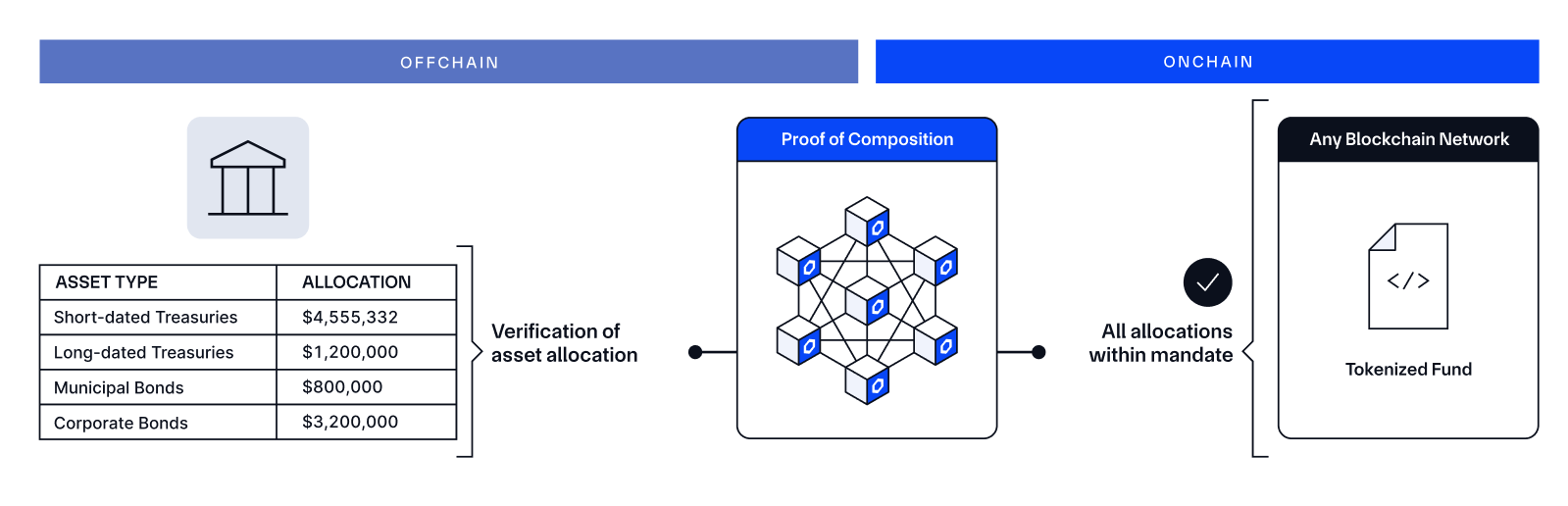
Proof of composition addresses these issues by ensuring in real-time that financial asset reserves are composed of the right assets in the correct proportions, preventing fraudulent or highly risky reserve management. This allows funds to maintain strategic confidentiality while still providing verifiable assurance that their composition aligns with the fund’s predefined characteristics.

For example, proof of composition can be applied to a tokenized treasury fund to verify that the yield custodian’s holdings only include on-the-run U.S. government bonds as opposed to riskier assets like corporate debt instruments. This level of transparency would have been particularly useful in events like the SVB collapse, where investors lacked visibility into the composition of long-duration bonds that exposed the bank to excessive interest rate risk. By analyzing vintage data embedded within the proof of composition, users could have identified the concentration of these long-duration bonds and protected themselves sooner.

Proof of composition diagram
Providing enhanced transparency into funds with proof of composition.

Real-Time Financial Integrity Powered By Chainlink

Chainlink helps bring enhanced transparency and verifiability to financial products and strategic digital asset reserves. As the largest provider of onchain proof of reserves infrastructure, Chainlink enables real-time monitoring of assets—helping to close visibility gaps that traditional auditing and reporting processes leave open.

By integrating verifiable data directly into financial assets, Chainlink allows for continuous assurance that reserves are sufficiently collateralized and composed of the right instruments. This not only reduces systemic risk but also gives regulators and institutions the tools they need to maintain financial stability.

Whether it’s enhancing transparency for stablecoins, tokenized funds, or digital asset reserves, Chainlink provides the infrastructure to help secure the future of global onchain financial systems. Join industry leaders who trust Chainlink Proof of Reserve to secure billions in onchain assets. Reach out today.


Source link

Public Keys: Copycat Lawsuits for Bitcoin Giant Strategy, Coinbase Hits All-Time High – Decrypt

0
Public Keys: Copycat Lawsuits for Bitcoin Giant Strategy, Coinbase Hits All-Time High – Decrypt


In brief

At least five law firms have filed copycat class action lawsuits against Bitcoin treasury firm Strategy.
Lawyers are potentially competing for tens of millions in fees from the consolidated case to come against Strategy.
Coinbase reached a new all-time closing price Thursday, and announced it will launch U.S.-regulated Bitcoin and Ethereum perpetual futures next month.

Public Keys is a weekly roundup from Decrypt that tracks the key publicly traded crypto companies.

This week: Why Bitcoin treasury champion Strategy is drawing so many identical lawsuits, Coinbase hits a new peak closing price as U.S. perps near, and other keys from the week in crypto.

Strategy’s déjà vu

You may have heard that Bitcoin giant Strategy is the subject of a class action lawsuit. It accuses the company of misrepresenting the risks associated with its BTC buying plans. Then maybe you heard about the suit again, and again, and again, and again.

That’s because there are at least five different law firms that have filed copycat class action lawsuits against Strategy (formerly MicroStrategy), which trades on the Nasdaq under the MSTR ticker. Two law professors who spoke with Decrypt said the identical filings are how each firm signals interest in leading the case once they’re consolidated into one single class action.

When there are multiple class action filings, it falls to the courts to choose a lead plaintiff, the professors said. That usually comes down to who’s got the most skin in the game—making large institutions like pension funds likely candidates. And once a lead plaintiff has been chosen, it’s up to them to appoint counsel.

None of the law firms that filed lawsuits responded to requests for comment from Decrypt. But the law professors spelled out the motivation pretty plainly: “The fees can be very lucrative,” University of Michigan’s Adam Pritchard said—“tens of millions of dollars and occasionally more in the biggest cases.”

An important Tolkien update: At today’s prices, Strategy’s $63.3 billion Bitcoin treasury is now worth more than the gold that Smaug, the last great dragon, had stockpiled in the Lonely Mountain.

Record high and perps for COIN

Investors eagerly watched as crypto exchange Coinbase approached and then set a new all-time high close price Thursday, when COIN was trading for $375.07. It was a huge milestone—but the company hasn’t taken its eye off the prize.

Leading up to the new high water mark, Benchmark analysts called the company “transformative” and gave it a $402 price target. And Bernstein analysts said COIN is “misunderstood,” setting an even loftier price target of $510.


This time next month, Coinbase said it will be offering U.S.-regulated perpetual-style futures for Bitcoin and Ethereum. Traders have been wanting perps for a long time. And it’s no wonder: Crypto perps have done nearly $10 billion in volume in the past day and $382 billion in the past month, according to crypto data aggregator DeFi Llama.

That’s just counting volume from DeFi protocols like Hyperliquid, Jupiter, and ApeX Protocol. Things could get a lot more interesting if Coinbase enters the chat.

Meanwhile, Base, the Ethereum layer-2 network that it incubated, has added Cardano and Litecoin to the wrapped assets it already offers on the network, including Dogecoin, XRP, and Bitcoin. This makes it easier for holders of Cardano or Litecoin to make use of Ethereum’s more robust decentralized finance (DeFi) ecosystem, giving users the opportunity to interact with popular Ethereum-based protocols like Aave, Compound, and Curve.

Other Keys

Next up: Bitcoin treasury company: Bakkt has never stopped reinventing itself. Earlier this year, the company sold its failing crypto custody business to its parent company for $1.5 million and hired a new co-CEO to work on a “stablecoin payments” product. Just this week, it started raising $1 billion to add Bitcoin to its balance sheet. NFT collection, next?
Altcoin summer: Things are looking sunny for Bitwise’s Dogecoin and Aptos ETF filings, which got amended S-1 filings this week. Generally speaking, issuers update their registrations to reflect feedback from the SEC, Bloomberg analyst Eric Balchunas told Decrypt. “There’s been so much engagement,” he said. “It’s a completely new attitude from the SEC.”

Edited by Andrew Hayward

Daily Debrief Newsletter

Start every day with the top news stories right now, plus original features, a podcast, videos and more.


Source link

PureVPN Debuts Fully Customizable White-Label Password Manager as Part of Expanding B2B Privacy Suite | Web3Wire

0
PureVPN Debuts Fully Customizable White-Label Password Manager as Part of Expanding B2B Privacy Suite | Web3Wire


ROAD TOWN, VG / ACCESS Newswire / June 27, 2025 / PureVPN, a long-standing leader in privacy-centric technology, has officially launched its White-Label Password Manager, a fully brandable, compliance-ready solution designed for businesses and platforms seeking to deliver secure credential management under their own name.

This release marks a strategic milestone in PureVPN’s expansion beyond VPN infrastructure, toward a broader privacy ecosystem tailored for enterprises, mid-sized organizations, consumer and utility apps, cybersecurity platforms, fintech and crypto applications. The password manager is the first in the wave of privacy and identity solutions designed to help partners reduce churn, unlock new monetization channels, and deepen user trust through branded security offerings.

“We’re not just entering the password management space, we’re redefining who gets to participate in it,” said Bilal Saleem Khan, Director of Products Commercial & Enterprise Partnership at PureSquare. “This platform empowers businesses to offer password security on their own terms, with their own branding, their own revenue models, and their own user experience. We’ve built this solution by carefully studying the top use cases where mainstream password managers fall short, especially for platforms that need deeper integration, full brand control, and user data sovereignty.

Combined with our foundation in SOC 2, GDPR, and ISO-aligned security architecture, partners can confidently deliver secure credential management that meets the highest global standards.”

Built for Integration, Not Interruption

PureVPN’s Password Manager is designed from the ground up for seamless integration, giving partners the tools to embed robust credential management into their apps, products, or workflows with minimal engineering overhead.

• Zero-Knowledge Architecture: End-to-end encryption built on AES-256 and Argon2id ensures complete data confidentiality, even PureVPN can’t access stored information.

• Cross-Platform SDKs & SSO Protocols: Cross-Platform SDKs & Authentication Flexibility: Native SDKs for mobile, desktop, and web environments allow for rapid integration. Designed to support secure login workflows and enterprise-ready identity models.

• Offline Access with Intelligent Syncing: Users can access their encrypted vaults without connectivity, with automatic synchronization across devices once reconnected. All credentials are stored using end-to-end encrypted vaults accessible across devices via secure cloud synchronization.

Trusted by Businesses, Driven by Real-World Demand

PureVPN’s white-label VPN infrastructure is already trusted by over 150 partners worldwide, including telecom operators, cybersecurity vendors, fintech platforms, and SaaS providers, who have successfully deployed privacy solutions to millions of users. These integrations have not only reinforced PureVPN’s credibility as a privacy infrastructure provider but have also unlocked new recurring revenue streams for partners through premium feature bundling and cross-sell opportunities with complete control over branding, UX, policy enforcement, and deployment models.

Availability

The PureVPN White-Label Password Manager is available now through the PureVPN Partner Program. The launch package includes full onboarding support, developer integration guides, and compliance documentation to ensure a smooth and scalable rollout.

About PureVPN

With nearly two decades of experience in digital privacy, the company is expanding its footprint into configurable security products for modern businesses. Through its white-label division PureWL, PureVPN powers privacy-forward offerings for telecoms, SaaS providers, fintech platforms, and security suites in over 150 countries.

Contact Information

PureSquare PressPR Manager[email protected]

SOURCE: PureSquare

About Web3Wire Web3Wire – Information, news, press releases, events and research articles about Web3, Metaverse, Blockchain, Artificial Intelligence, Cryptocurrencies, Decentralized Finance, NFTs and Gaming. Visit Web3Wire for Web3 News and Events, Block3Wire for the latest Blockchain news and Meta3Wire to stay updated with Metaverse News.


Source link

Bitcoin ETFs Notch 13 Consecutive Days of Inflow—Why It Matters – Decrypt

0
Bitcoin ETFs Notch 13 Consecutive Days of Inflow—Why It Matters – Decrypt


In brief

U.S. Bitcoin ETFs saw 13 straight days of inflows, adding nearly $3 billion despite flat prices.
Analysts point to growing institutional demand via treasury and OTC channels.
Meanwhile, revised Dogecoin and Aptos filings signal rising odds of altcoin ETF approvals.

U.S. spot Bitcoin exchange-traded funds are experiencing their longest inflow streak since December 2024, bringing in over $2.9 billion over 13 consecutive trading days, while regulatory momentum builds for other digital asset approvals within the next four months.

The ETFs recorded their largest single-day inflow for June on Tuesday with $588.6 million, extending an unprecedented streak to $1.2 billion this week alone.

BlackRock’s IBIT once again led inflows with $163.7 million on Thursday, while Fidelity’s FBTC added $32.9 million and Bitwise’s BITB attracted $25.2 million, according to Farside Investors data

Other major funds, including Ark’s ARKB and Invesco’s BTCO, reported more modest inflows, while Grayscale’s GBT and several smaller ETFs saw no meaningful activity.

The sustained inflows indicate a growing institutional appetite for crypto investment products, particularly as ETF managers increasingly execute purchases through over-the-counter channels to minimize price impact. 

“ETF flows are largely driven by two types of investors: Long-only fundamental investors and basis arb traders,” Peter Chung, head of research at Presto Labs, told Decrypt

But with basis arbitrage less attractive at present, Chung believes, “most of the ETF flows are driven by long-only fundamental investors.”


The 13-day stretch has brought nearly $3 billion into Bitcoin ETFs, even as Bitcoin (BTC) itself trades sideways near $107,374, down 0.4% over the past 24 hours, according to CoinGecko.

“ETF managers can execute their purchase via OTC transactions, thus without impacting spot price too much,” Chung said. “On-chain data indicates Bitcoin held by short-term holders (less than 155 days) has fallen rapidly in the last two months, suggesting short-term traders have been selling aggressively in the market.”

Demand all around

While Bitcoin continues to attract institutional capital, momentum is quietly building around the next frontier of crypto investment products.

Bloomberg ETF analyst Eric Balchunas previously told Decrypt the revised Dogecoin and Aptos ETF filings and rule changes from Bitwise reflect a “completely new attitude” from the U.S. Securities and Exchange Commission, with far more consistent engagement than what issuers experienced ahead of the Bitcoin ETF approvals.

“Everything we’re hearing is even more optimistic than what we heard during the Bitcoin saga,” Balchunas said on Thursday.

He forecasts better than 95% probability for Solana, XRP, and Litecoin ETF approvals, with 90% odds for Dogecoin authorization.

Since Bitcoin ETFs were launched 18 months ago, they’ve attracted over $40 billion, according to Arjun Vijay, founder of Indian crypto exchange Giottus. 

“In this cycle, there is a definite trend of Bitcoin moving from retail to institutions,” Vijay told Decrypt. “Retail is selling while the institutions are buying.”

Still, Ganesh Mahidhar, an investment professional at Further Ventures, told Decrypt that ETF inflows are often overstated, noting that real buying is happening through treasury programs and structured products.

Edited by Sebastian Sinclair

Daily Debrief Newsletter

Start every day with the top news stories right now, plus original features, a podcast, videos and more.


Source link

viggotech Achieves 94% Customer Retention and Profitability in Four Months with Human-AI Sales Platform | Web3Wire

0
viggotech Achieves 94% Customer Retention and Profitability in Four Months with Human-AI Sales Platform | Web3Wire


Photo Courtesy of Valeriia Miller

ZUG, Switzerland, June 26, 2025 (GLOBE NEWSWIRE) — viggotech, a Swiss-based AI company with operations in Dubai and North America, developing enterprise-grade automation, has reached profitability within four months of launching its human-AI collaboration platform. With nine businesses onboard, zero customer churn, and 94 percent retention, the company has delivered measurable performance improvements across its early client base, most notably, a 65 percent increase in deal closure rates.

viggotech’s platform introduces a new AI category: Customer Communication Takeover. Rather than replacing staff or relying on general-purpose chatbots, the platform assigns complex communication and business tasks to multiple AI agents, each specialized in its own function.

These “brains” operate in synchronized multi-step processes that mimic the role distribution of high-performance teams in financial services, real estate sales, automotive sales, and veterinary operations. The platform was initially tested in healthcare during its MVP phase, primarily targeting cosmetic and veterinary businesses to validate the concept before expansion.

Unlike traditional AI tools, viggotech’s enterprise AI divides tasks into logical stages. This approach reduces hallucinations, enhances contextual accuracy, and allows the AI to manage nuanced workflows with high precision.

“We created the first AI that thinks like an enterprise, not just an assistant,” said Michael Gerges, founder and CEO of viggotech. “Every task is analyzed from multiple perspectives, by multiple brains, in multiple steps. It’s collaborative, private, and secure by design. That’s why we’ve seen 94 percent customer retention and zero churn.”

The company has onboarded nine clients without any venture backing, reaching $200,000 in revenue within its first six months. Following strong early performance, several clients have already committed to multi-year contracts, some as long as three years.

A critical factor in the platform’s success has been its focus on human-AI collaboration. viggotech’s AI is not built to replace staff, but to handle repetitive communication and enhance professionals’ ability to engage and close deals at scale. It is especially effective in client-facing and regulated environments.

“Enterprise AI is about delivering outcomes that matter to the bottom line,” Gerges said. “Whether it’s closing deals, managing finances, or helping teams communicate better, our AI is purpose-built to think like a business.”

With a 94 percent customer retention rate and zero churn, the company’s performance defies early-stage startup norms. Clients are expanding usage across departments and renewing contracts quickly, indicating strong trust in the technology’s reliability and relevance to their operations.

viggotech is currently active in the financial, real estate sales, automotive sales, and veterinary sectors, where multi-dimensional logic and structured task management are essential. Healthcare was used only in early testing phases.

For more information, please visit https://viggotech.io/

About viggotech

viggotech is a Swiss-based AI company building secure, multi-step, multi-brain enterprise AI systems for finance, real estate sales, automotive sales, and veterinary sectors. Its Human-AI collaboration platform enables businesses to automate complex communication and operational tasks without replacing staff. Every deployment runs in a private, isolated environment aligned with Swiss-grade data privacy standards.

Contact Information

Michael GergesFounder and CEOviggotechmichael@viggotech.iohttps://viggotech.io/Zug 6300, Switzerland

A photo accompanying this announcement is available at https://www.globenewswire.com/NewsRoom/AttachmentNg/9bfced84-3158-4b1b-a500-caca865ddb4a

About Web3Wire Web3Wire – Information, news, press releases, events and research articles about Web3, Metaverse, Blockchain, Artificial Intelligence, Cryptocurrencies, Decentralized Finance, NFTs and Gaming. Visit Web3Wire for Web3 News and Events, Block3Wire for the latest Blockchain news and Meta3Wire to stay updated with Metaverse News.


Source link

Bitcoin Headed for One of the Largest Options Expiries of the Year – Decrypt

0
Bitcoin Headed for One of the Largest Options Expiries of the Year – Decrypt


In brief

Bitcoin faces one of its largest monthly options expiries this year with $15 billion worth of contracts set to expire Friday out of $40 billion in open interest.
The max pain point is $102,000, where the most contracts would expire worthless, with traders showing only slight pessimism based on a 0.73 put-to-call ratio.
Bitcoin’s implied volatility has dropped to its lowest level since October 2023 at 38.29%, suggesting limited expectations for sharp price movements.

Bitcoin derivatives traders are facing one of the largest monthly options expiries this year as markets remain unsettled, even as tensions cool in the Middle East, Deribit Chief Commercial Officer Jean-David Péquignot told Decrypt.

Part of the reason this expiry is so large is because there’s been a general increase in Bitcoin derivatives activity, he said.

“BTC options contract volumes in Q2 surged approximately 25% above the past year’s average, reflecting a growing institutional derivatives market,” Péquignot said. “ETH options activity, meanwhile, remained relatively stable.”

Of the current $40 billion in open interest on Bitcoin options on Deribit, approximately $15 billion worth of that notional value is set to expire Friday. Péquignot added that the max pain point Friday would be if the Bitcoin price dropped to $102,000, with a put-to-call ratio of 0.73.

Bitcoin was recently trading at about $107,600, roughly flat over the past 24 hours.

That means that if Bitcoin falls to $102,000, the largest number of contracts expiring would be worthless. The put-to-call ratio refers to the split between traders buying puts, or contracts that speculate the BTC price will decrease, and calls, or ones that bet on the price rising before the contract expires.

Considering this ratio over the past 30 days, Péquignot said traders seem to be only slightly pessimistic about Bitcoin.

“Low open interest in perps and fairly depressed Bitcoin implied volatility and skew are indicative of limited expectations for sharp price movements going into Friday’s expiry,” he said, referring to a big drawdown in open interest after the U.S. fired airstrikes on Iranian nuclear facilities over the weekend.

But Bitcoin seems to be gaining some resilience because of geopolitical uncertainties. Bitcoin implied volatility has sunk below 38, according to Deribit. That’s the lowest it’s been since October 2023. Meanwhile, Ethereum’s implied volatility has mostly been stuck in the 60 to 80 range for the past three months.

“Ethereum’s higher implied volatility signals potential for larger moves,” Péquignot said. “Ethereum’s stronger skew suggests traders are hedging against or speculating on larger price moves, treating ETH as a higher-beta asset tied to DeFi and altcoin trends.”

Jag Kooner, head of derivatives at crypto exchange Bitfinex, agreed that volatility around Friday’s expiry will likely be muted—except perhaps during New York trading hours. He also said there’s a chance Friday’s expiry could create favorable conditions for traders in the week ahead.

“Post-expiry, if (the) price breaks out of the current range and ETF flows stay strong, we could see fresh directional momentum into the weekend,” he told Decrypt, adding that things could get especially interesting if Bitcoin retests $110,000.


“Once we get above the $110k mark for Bitcoin, fresh positioning coming into the market after that happens becomes more important to decide intermediate market direction,” he said.

Markets showing increased put volume—especially a lot of contracts with strike prices below the current market price—would indicate a temporary downside,meaning traders are expecting a retrace.

“Similarly, strong spot flows with more volume around OTM calls would indicate a stronger chance of a proper all-time-high break,” Kooner said, referring to Bitcoin inching towards its all-time high of $111,814.

Edited by James Rubin

Daily Debrief Newsletter

Start every day with the top news stories right now, plus original features, a podcast, videos and more.


Source link

Run 100B Parameter AI Models on Your CPU with Microsoft’s bitnet.cpp

0
Run 100B Parameter AI Models on Your CPU with Microsoft’s bitnet.cpp


Artificial Intelligence has reached a point where models are growing bigger, better, and more powerful. But the challenge is: how do you run massive models like GPT-4 or LLaMA 3 with 100 billion parameters on regular devices, without spending thousands on expensive GPUs?

That’s where Microsoft’s new open-source framework, bitnet.cpp, comes in. It breaks the barrier by allowing large language models (LLMs) to run efficiently on CPUs, using a clever technique called 1-bit quantization. You no longer need a data center or a high-end GPU to experience state-of-the-art AI performance.

Let’s explore how bitnet.cpp works, what it offers, and how you can use it to run powerful AI on your personal device.

What is bitnet.cpp?

bitnet.cpp is an open-source framework developed by Microsoft that makes it possible to run large language models—up to 100 billion parameters—on standard CPU hardware. Whether you have an Apple M2 chip or a regular Intel CPU, bitnet.cpp helps you deploy massive models locally without the usual high costs.

It does this by using 1-bit quantization, a method that compresses model data and allows it to run faster and more efficiently. This way, large models become much lighter and easier to handle, even on consumer devices.

Why This Matters

Traditionally, running large AI models like GPT-3 or GPT-4 needed powerful GPUs or TPUs. These are expensive and not accessible to everyone. Researchers, developers, and startups without large budgets often found it hard to experiment with or deploy large LLMs.

With bitnet.cpp, things are changing. Now, you can:

Run big models on a laptop or desktop CPU

Save money on cloud computing or GPU rentals

Keep data private with local execution

Develop and test AI applications without hardware constraints

This opens the door for more innovation, education, and experimentation in the AI field.

Key Features of bitnet.cpp

1. Run Large Models Without GPUs

bitnet.cpp eliminates the need for dedicated GPUs. You can run powerful LLMs on regular CPUs, which are more widely available. This lowers the entry barrier for AI development and makes the tech more inclusive.

Imagine being able to test and run GPT-scale models on a MacBook or Intel-based workstation. That’s now possible thanks to this framework.

2. 1-Bit Quantization

This is the secret sauce behind bitnet.cpp. Normally, AI models use 32-bit floating-point numbers to represent their weights. Bitnet.cpp compresses these weights down to just 1 bit, drastically reducing memory usage and speeding up computation.

Here’s what that means:

Less RAM is needed to run the model

Lower bandwidth requirements

Much faster inference (model responses)

Minimal drop in model accuracy

Despite the extreme compression, the inference quality remains almost the same. You still get accurate and useful outputs.

3. Multi-Platform Support

Whether you use an ARM-based chip (like Apple’s M2) or an x86 CPU (like Intel or AMD), bitnet.cpp runs smoothly. It’s optimized for different architectures, so you don’t need to worry about hardware compatibility.

This makes it ideal for both Mac and Windows users, as well as developers working on embedded or edge devices.

4. High Speed and Low Energy Use

Tests show that bitnet.cpp is significantly faster and more energy-efficient than older frameworks like llama.cpp. In some cases, it delivers:

For example:

A 13B model that runs at 1.78 tokens/second on llama.cpp can hit 10.99 tokens/second on bitnet.cpp.

On Apple M2 Ultra, energy usage drops by up to 70%.

On Intel i7-13700H, power savings go up to 82.2%.

That’s a game-changer, especially for battery-powered devices or large-scale deployments.

5. Big Memory Savings

Large models like GPT or BERT usually require hundreds of GBs of memory in their full-precision form. But with 1-bit quantization, bitnet.cpp shrinks them dramatically.

This allows these models to run on machines with much less RAM—making them usable on laptops, desktops, and even some edge devices.

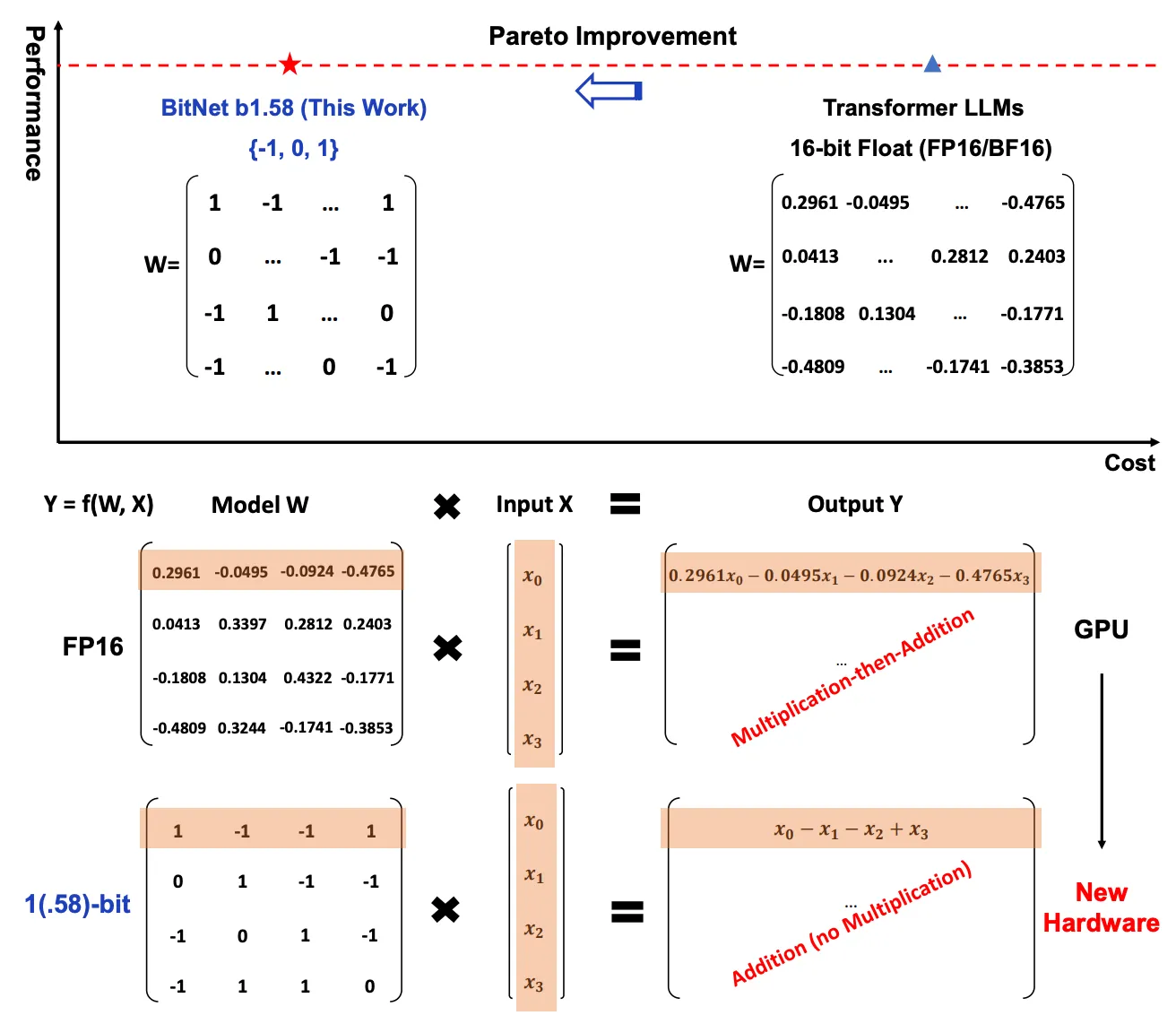
6. Pareto Optimality

bitnet.cpp follows the Pareto principle: small changes bring big benefits. You get gains in speed, efficiency, and cost without a noticeable loss in performance. This balance is ideal for real-world applications, where perfect accuracy isn’t always worth the resource cost.

You can now deploy large models for real-time applications like:

Virtual assistants

AI writing tools

Local chatbots

Voice-to-text systems

Code generation

All without needing massive infrastructure.

Performance Overview

Here’s how bitnet.cpp compares to llama.cpp:

Model SizeTokens/sec (llama.cpp)Tokens/sec (bitnet.cpp)Speedup

13B1.7810.996.17x

70B0.711.762.48x

And the energy efficiency:

These numbers show just how optimized bitnet.cpp really is.

How bitnet.cpp Works

The power of bitnet.cpp comes from its technical foundation, especially the three main components:

1. 1-Bit Quantization

This compresses the model weights into 1-bit representations. Normally, weights are stored in 32-bit floating-point numbers. Reducing them to 1 bit slashes memory usage and computation needs.

But the magic lies in doing this without harming the model’s ability to generate accurate responses. It’s fast, efficient, and surprisingly reliable.

2. Optimized Kernels

bitnet.cpp uses optimized kernels to make computation faster and smarter:

I2_S Kernel: Great for multi-core CPUs. It distributes tasks across threads efficiently.

TL1 Kernel: Improves memory access and lookup speed.

TL2 Kernel: Ideal for devices with limited memory or bandwidth.

These kernels are designed to make the best use of your CPU’s architecture and capabilities.

3. Wide Model Compatibility

bitnet.cpp works with different model sizes and types—from small LLaMa models to massive 100B parameter models. This flexibility makes it suitable for developers at all levels.

How to Use bitnet.cpp

Here’s how to get started with bitnet.cpp on your machine:

Step 1: Clone the Repository

git clone –recursive https://github.com/microsoft/BitNet.git
cd BitNet

Step 2: Set Up the Environment

Create and activate a Python environment:

conda create -n bitnet-cpp python=3.9
conda activate bitnet-cpp
pip install -r requirements.txt

Step 3: Download and Quantize the Model

You’ll need to pull a model from Hugging Face and quantize it using bitnet’s tools:

python setup_env.py –hf-repo HF1BitLLM/Llama3-8B-1.58-100B-tokens -q i2_s

Step 4: Run Inference

Now you’re ready to use the model:

python run_inference.py -m models/Llama3-8B-1.58-100B-tokens/ggml-model-i2_s.gguf -p “Enter your prompt here.”

You’ll get fast responses from the model, all without using a GPU.

Real-World Applications

With bitnet.cpp, you can build powerful AI tools on budget hardware. Here are a few ideas:

AI Writers: Create tools like WordGPT or Notion AI for content generation.

Private Chatbots: Run a local chatbot without internet connection or server dependency.

Educational Tools: Let students explore AI development on their own devices.

Edge AI: Deploy models on IoT or embedded devices without needing external servers.

Cost-Cutting AI Apps: Build scalable AI services without burning money on GPU cloud time.

Future of Accessible AI

bitnet.cpp is more than just a framework. It represents a shift in how we think about AI deployment. Instead of relying on cloud giants or expensive infrastructure, developers can now bring AI closer to the edge—into homes, schools, and small businesses.

This is the democratization of AI in action.

By making large models light and fast, Microsoft’s bitnet.cpp gives everyone the power to innovate with cutting-edge AI. Whether you’re an AI hobbyist or a developer building the next viral app, bitnet.cpp gives you the tools to succeed.

What’s Next?

As the field of AI continues to grow, tools like bitnet.cpp will lead the way in making AI more efficient and accessible. Expect more improvements, broader model support, and community contributions.

If you want to explore even more, try BotGPT—a custom chatbot builder that lets you create smart bots tailored to your needs using similar technology. You can integrate it into your apps, websites, or business tools and unlock next-level automation.

Conclusion

bitnet.cpp by Microsoft is a groundbreaking open-source project that helps you run powerful language models on standard CPUs. Thanks to smart engineering like 1-bit quantization and optimized kernels, it brings big model performance to everyday machines.

Whether you’re a solo developer, student, startup, or enterprise, this tool can supercharge your AI journey—without breaking the bank.


Source link

Torram launches dApp challenge with 3M tokens up for grabs to bring institutional DeFi apps natively to Bitcoin | Web3Wire

0
Torram launches dApp challenge with 3M tokens up for grabs to bring institutional DeFi apps natively to Bitcoin | Web3Wire


TLDR: Real DeFi on Bitcoin starts now. Torram’s challenge dares devs to bring native stablecoins, DEXs, and RWA platforms to Bitcoin L1 utilizing a new programmable Bitcoin native asset standard. Forget L2s, join the Incentivized Testnet Now.

Torram is putting out the call to builders: launch real DeFi applications on Bitcoin L1 and win up to 1 million Torram tokens each. The team behind Bitcoin’s first complete middleware stack has kicked off the 1M Token Developer Challenge – a multi-phase competition rewarding developers building Bitcoin-native dApps. With Torram Testnet V2.0 now live, the network unlocks programmability and a new token standard natively on Bitcoin – no bridges, no L2s, and no wraps.

With Bitcoin hitting all-time highs above $110K and mainstream momentum building, there’s never been a better time to build. Developers can now deploy on Bitcoin with block times as fast as 60 seconds without bridges or L2s.

“Torram network cures Bitcoin’s limitations and amplifies its strength. Our BUIDL thesis has been – do what’s possible on Bitcoin, and leave the rest to Torram. Now, you can witness that with Torram network V2.0,” Lee Raj, Co-Founder & CTO said.

 Torram Momentum 

30+ validators live on testnet including BitGoAllnodesStakelyValidation Cloud, Republic

20+ dApps committed including Ordinal HivebitSmiley, and Sundial

Backed by Draper Associates, Blockchain Founders Fund, Side Door Ventures, Deep Ventures, Boost VC, Trive Digital, Silvermine, MH Ventures, and Bitcoin Ai Startup Lab

The 1M Token Developer Challenge: Build Fast, Win Big

*Phase 1: 30-Day Testnet Sprint (July 1–30)

Be early, be rewarded. The first 10 dApps deployed to Torram earn 200,000 tokens each.

*Phase 2: 90-Day Testnet Marathon (Aug 1–Oct 31)

Build big, scale fast. Rank in the top 3 for usage and earn 1 million tokens each.

Eligible categories include: stablecoins, RWAs, DEXs, collateral lending & borrowing, trading and institutional-grade Bitcoin apps.

View the full Token Challenge rules and rewards here.

Built for Builders

Torram Network 2.0 is the result of over a year of R&D to deliver what Bitcoin has been missing: expressive programmability, real-time on chain price data, and ERC20 behaviour to Bitcoin native assets. 

Today’s Bitcoin-native stack is fragmented and modular. But Bitcoin itself is monolithic by design, and Torram believes its surrounding infrastructure should be too. This reduces complexity and eliminates common failure points seen in modular stacks.

This is Bitcoin’s Ethereum moment. With Torram, builders can finally unlock the functionality of Ethereum and other chains without leaving Bitcoin’s trust layer.

“Torram gives builders not just tools, but a foundation: smart contracts, oracles, and a programmable token standard. We’re creating the layer devs need to launch scalable DeFi applications,” Vakeesan Mahalingam, CFA, Co-Founder & CEO said.

Start Building on Bitcoin Today

Developer Resources

About Torram

Torram has pioneered the first complete end-to-end full stack infrastructure & middleware solution for institutional use cases & applications natively on the Bitcoin network making Bitcoin more useful than just a store of value, and solving fragmented infrastructure for dApps and builders.

*Disclaimer on Token Rewards

All token rewards mentioned as part of the Torram testnet and ecosystem challenges are subject to eligibility, compliance with program terms, technical review, and final approval by Torram Labs.

Rewards may be adjusted, delayed, or withheld at Torram Labs’ sole discretion, including (but not limited to) cases of:

failure to meet deployment requirements (e.g. testnet and/or mainnet deployment);

failure to complete co-marketing obligations (e.g. case study participation);

violation of applicable laws, regulations, or ethical guidelines;

any form of fraud, manipulation, or abuse of the program.

Torram Labs reserves the right to modify, suspend, or cancel the token reward programs or terms at any time without prior notice. Tokens awarded through these programs do not represent any form of equity, security, or legal right in Torram Labs or its affiliates.

Participation in the program constitutes acceptance of these terms.

Disclaimer: The information provided in this press release is not a solicitation for investment, nor is it intended as investment advice, financial advice, or trading advice. It is strongly recommended you practice due diligence, including consultation with a professional financial advisor, before investing in or trading cryptocurrency and securities.

About Web3Wire Web3Wire – Information, news, press releases, events and research articles about Web3, Metaverse, Blockchain, Artificial Intelligence, Cryptocurrencies, Decentralized Finance, NFTs and Gaming. Visit Web3Wire for Web3 News and Events, Block3Wire for the latest Blockchain news and Meta3Wire to stay updated with Metaverse News.


Source link

Popular Posts

My Favorites