The FHFA has instructed Fannie Mae and Freddie Mac to begin preparing to accept cryptocurrency as mortgage assets.
Director William Pulte framed the move as aligning with a broader vision of the Trump Administration.
The order sparked mixed reactions, with praise for innovation and criticism over restrictions on self-custody.
The U.S. housing market is bracing for a potential shakeup by the crypto industry.
On Wednesday, the Federal Housing Finance Agency ordered Fannie Mae and Freddie Mac to begin preparing to accept crypto as a form of mortgage-related payment.
The directive, announced on X by FHFA Director William Pulte, marks the first major move to incorporate digital assets into the federal mortgage system.
Fannie Mae and Freddie Mac are U.S. government-backed firms that buy mortgages from lenders, package them into securities, and guarantee payments to investors.
The announcement comes two days after Pulte said he instructed the companies to study how crypto might factor into mortgage qualification.
“After significant studying, and in keeping with President Trump’s vision to make the U.S. the crypto capital of the world, today I ordered the Great Fannie Mae and Freddie Mac to prepare their businesses to count cryptocurrency as an asset for a mortgage,” Pulte wrote in a post on X. “So ordered.”
According to the directive, the FHFA found that allowing Fannie Mae and Freddie Mac to consider more types of borrower assets, such as crypto, could help them better evaluate loan risk and expand access to homeownership for qualified borrowers.
Fannie Mae and Freddie Mac are now tasked with determining how crypto can be treated as a qualifying asset.
Pulte did not specify which cryptos would be accepted. Reactions on X were mixed, with some praising the move as a win for the industry.
“Bitcoin has been recognized as a reserve asset by the U.S. housing system,” Strategy co-founder Michael Saylor wrote on X. “A defining moment for institutional BTC adoption and collateral recognition.”
Others criticized a stipulation requiring crypto assets to be held on centralized exchanges, not self-custody wallets.
“Each Enterprise is directed to consider only cryptocurrency assets that can be evidenced and stored on a U.S.-regulated centralized exchange subject to all applicable laws,” the FHFA wrote.
At the same time, Housecoin, a housing-themed meme coin on the Solana blockchain, jumped 20% today to $0.24 in response to the news.
“1 House = 1 Housecoin has never sounded so good,” the Housecoin account said on X.
The FHFA did not immediately respond to Decrypt’s request for comment.
Edited by Sebastian Sinclair
Daily Debrief Newsletter
Start every day with the top news stories right now, plus original features, a podcast, videos and more.
LAS VEGAS, NV / ACCESS Newswire / June 25, 2025 / Aible, the leading AI agent platform for business users at enterprise scale, today announced a collaboration with HPE to enable enterprises with completely autonomous specialized AI Agents for business users-without the need for expert data science or machine learning engineering. For the first time, Aible empowers business teams within HPE Private Cloud AI environments running NVIDIA accelerated computing, to automatically build, coach, and deploy AI agents across on-prem, hybrid cloud, and edge scenarios.
Unveiled at HPE Discover Las Vegas 2025, this collaboration marks Aible’s official induction into the HPE Unleash AI partner program, a curated ecosystem of top-tier innovators accelerating impact from AI deployments within enterprises. Working with HPE and NVIDIA, Aible is delivering demonstrable AI results that are real, measurable and realized within hours, not months.
Fleet of AI Agents That Work: Aible Joins HPE and NVIDIA to Deliver Results at Scale
Enterprises will need thousands, if not millions of agents, and there are simply not enough experts that can build these agents. Clearly, business users will need to be empowered to build their own custom agents. Together, the companies are providing a turnkey, enterprise-scale AI environment that enables business users to create and coach specialized AI agents on their own to solve unique business problems in sales, marketing, finance, supply chain, and more. From analytics agents that are specialized to proactively identify targeted sales insights and prevent customer churn to more sophisticated video agents at the edge in retail stores to identify stockouts, a host of Aible agents across business needs are deployed in hours and deliver real value in under 48 hours.
Automatically Finds Actionable Insights for Business Users
Today users must ask the right question to unlock the value of their AI. But why throttle the enormous power of AI behind the human ability to think of the right questions to ask? Aible agents revolutionize how business users uncover insights from both structured and unstructured data. Unlike traditional tools that rely on users knowing the right questions to ask, Aible agents eliminate this common barrier. By harnessing the enormous power of AI, the agents automatically analyze millions of variable combinations to identify the true drivers behind business changes-what changed, and why. This deep, automated discovery reveals critical insights that would otherwise remain hidden, enabling informed, high impact decisions. Importantly, all this happens with no coding or technical expertise required.
“Aible is uniquely designed for enterprise scale with the added benefits of security and cost-effectiveness,” said Arijit Sengupta, Founder & CEO of Aible. “Our mission is to ensure that business users-not just developers-can create and coach AI agents that deliver real results. By working with HPE and NVIDIA, we’re able to bring this vision to scale, enabling enterprises to deploy AI where their data lives and where decisions are made-whether in the cloud, on-prem, or at the edge.“
Aible is recognized in the 2025 Gartner®, “Market Guide for Agentic Analytics”*, Anirudh Ganeshan, Souparna Palit, David Pidsley, February 21, 2025 and the full report can be accessed by Gartner subscribers on http://www.gartner.com.
According to the report: “Agentic analytics represents the evolution of augmented analytics by applying AI agents, often including large language models (LLMs) and other AI techniques, for data analysis. This market is in its early stages, with established analytics and business intelligence (ABI) vendors incorporating agentic capabilities into their platforms while new specialized players emerge with purpose-built solutions. The primary value proposition centers on significant efficiency gains by automating tasks such as data preparation, analysis, visualization, insight generation, metrics creation and explanation. This frees data and analytics professionals to focus on strategic initiatives and increase analytics adoption among nontechnical users.”
Enterprise-Ready AI: Built by Business Users, Secured by IT
The integrated agentic AI solution brings together:
Aible’s AI Agent Platform: Purpose-built and complete automation for business users to create and coach AI agents with necessary enterprise controls and guardrails-without requiring any technical expertise and at scale.
HPE Private Cloud AI: Turnkey, on-premises AI platform, co-developed with NVIDIA, that delivers a full-stack, cloud-native experience for AI development and deployment including AI assistants and agents.
NVIDIA Accelerated Computing: Powering AI agents that are fast, scalable, and enterprise-secure. This integrated solution is being featured in an NVIDIA session at HPE Discover 2025 titled “AI Agents for Business Users at Enterprise Scale,” on Wednesday, 6/25 at 2:30-3 PM at the NVIDIA Booth #3005. The showcase will feature how Aible leverages cutting-edge NVIDIA technologies such as NVIDIA NIM, NVIDIA NeMo Retriever, NVIDIA NeMo Customizer, NVIDIA NeMo Evaluator, NVIDIA NeMo Guardrails, NVIDIA NeMo Agent Toolkit, NVIDIA Dynamo and other technologies to optimize end-to-end agents.
AI Agents at the Edge: Aible Runs on HPE Private Cloud AI Built on NVIDIA
The future of AI is not just in the cloud-it’s everywhere your business operates. Aible’s platform is now optimized to run on HPE Private Cloud AI, enabling enterprises to deploy AI agents at the edge and on-premises environments close to where data lives and real-time decisions are needed. This is a game changer for industries such as financial services, healthcare, and retail with low-latency applications or strict data residency requirements.
Real Results: Nebraska Government Staff & Interns Built and Deployed Real World AI Agents in Minutes
In a recent workshop with Aible customer, State of Nebraska Office of the CIO, Aible demonstrated how several government staff members including the CIO and CDO, as well as interns, built and deployed AI agents in minutes to solve real-world challenges. The live event highlighted Aible’s mission to make AI both accessible and impactful for everyone, across all skill levels.
Dr. Matthew McCarville, the CIO of the State of Nebraska commented, “With Aible, our interns, agency staff, as well as executives like our Chief Data Officer and I were able to create multiple AI agents each in less than 30 minutes-no prior training or expertise in AI required. Enterprises will need thousands if not millions of AI agents and no one has enough experts to build these agents. Aible ensures anyone can start delivering AI agents in minutes.”
Details of the Nebraska AI Agent Hackathon was shared in a session with Aible customer PrabhakarVijayarangam, State Data Administrator / State Chief Data Officer at State of Nebraska – Office of CIO, titled “Enterprise AI Pilots Are Easy. Scaling them isn’t. Why Private Cloud is your Next AI Power Move” on Tuesday, 6/24 at the Spotlight Theatre.
Live at HPE Discover Las Vegas: Aible Technology and Customer Stories Takes the Stage
At the HPE Discover, Aible will showcase its latest technology advancements and customer success stories featuring several Fortune 100 companies as well as government agencies. Across multiple sessions and workshops, Aible will be featured in:
Session with Aible customer and State Chief Data Officer at State of Nebraska – Office of CIO: Enterprise AI Pilots Are Easy. Scaling them isn’t. Why Private Cloud is your Next AI Power Move: on Tuesday, 6/24 at 2:30-3:30 PM
Session: Empowering AI Agents: Coordinated Autonomy Through Agentic Frameworks: on Tuesday, 6/24 at 4-4:30 PM
Session at the NVIDIA Theatre: AI Agents for Business Users at Enterprise Scale: on Wednesday, 6/25 at 2:30-3 PM
Session: Under the Hood: Choosing between LLMs, SSMs, and SLMs: on Wednesday, 6/25 at 5:30-6 PM
Session: Building Trust and Reliability in Agentic AI Solutions in the Enterprise: on Thursday, 6/26 at 9-9:45 AM
Workshop: AI Agents for Business Users at Enterprise Scale: on Wednesday, 6/25 at 4-4:30 PM
Workshop: What’s changed and Why in Turbulent Times: Automatically identifying unknown unknowns: on Wednesday, 6/25 at 5-5:30 PM
The sessions deliver hands-on and practical insight into how business users-without data science backgrounds-are creating, deploying, and scaling AI agents to deliver tangible value within hours. Aible will be performing live product demonstrations throughout the event at booth #1024.
See it Live at HPE Discover 2025
Aible will be featuring its AI agent platform live at HPE Discover 2025 in Las Vegas. Attendees can experience first-hand how enterprise-ready AI agents are transforming decision-making across business functions. To schedule a meeting or book a demo, click here.
About Gartner
*Gartner, “Market Guide for Agentic Analytics”, Anirudh Ganeshan, Souparna Palit, David Pidsley, February 21, 2025. GARTNER is a registered trademark and service mark of Gartner, Inc. and/or its affiliates in the U.S. and internationally, and are used herein with permission. All rights reserved.
Gartner does not endorse any vendor, product or service depicted in its research publications and does not advise technology users to select only those vendors with the highest ratings or other designation. Gartner research publications consist of the opinions of Gartner’s Research & Advisory organization and should not be construed as statements of fact. Gartner disclaims all warranties, expressed or implied, with respect to this research, including any warranties of merchantability or fitness for a particular purpose.
About Aible
Aible is redefining how enterprises drive measurable business impact with specialized AI agents that are created and coached by business users at scale. CVS Health, Baptist Health, State of Nebraska, Verizon and others use AI agents from Aible to deliver measurable results across business areas including customer acquisition and retention, call center optimization, inventory or supply chain management, product development, and risk mitigation in days – not months. The agentic AI platform is the fastest way for business users to automatically look across millions of patterns to surface enterprise insights with cutting-edge augmented analytics and GenAI. Uniquely, Aible gives business users full control of the AI agents by enabling them to provide feedback on the reasoning steps to drive higher accuracy, faster business alignment, and continuously improve performance across 1000s of enterprise use cases. Entirely implemented within the security of the enterprise’s own cloud or at the edge, the end-to-end serverless AI platform is up to 200X more cost efficient. Learn more at http://www.aible.com.
Contact Information
Contact Aible PR[email protected]
SOURCE: Aible
About Web3Wire Web3Wire – Information, news, press releases, events and research articles about Web3, Metaverse, Blockchain, Artificial Intelligence, Cryptocurrencies, Decentralized Finance, NFTs and Gaming. Visit Web3Wire for Web3 News and Events, Block3Wire for the latest Blockchain news and Meta3Wire to stay updated with Metaverse News.
Blockchain technology is set to underpin the next era of global finance, transforming everything from stock trading to interbank settlement. While the underlying technology is ready to support mainstream adoption, the current user experience can be improved. A lack of secure infrastructure powering frontend tools has left users vulnerable and created a barrier to adoption.
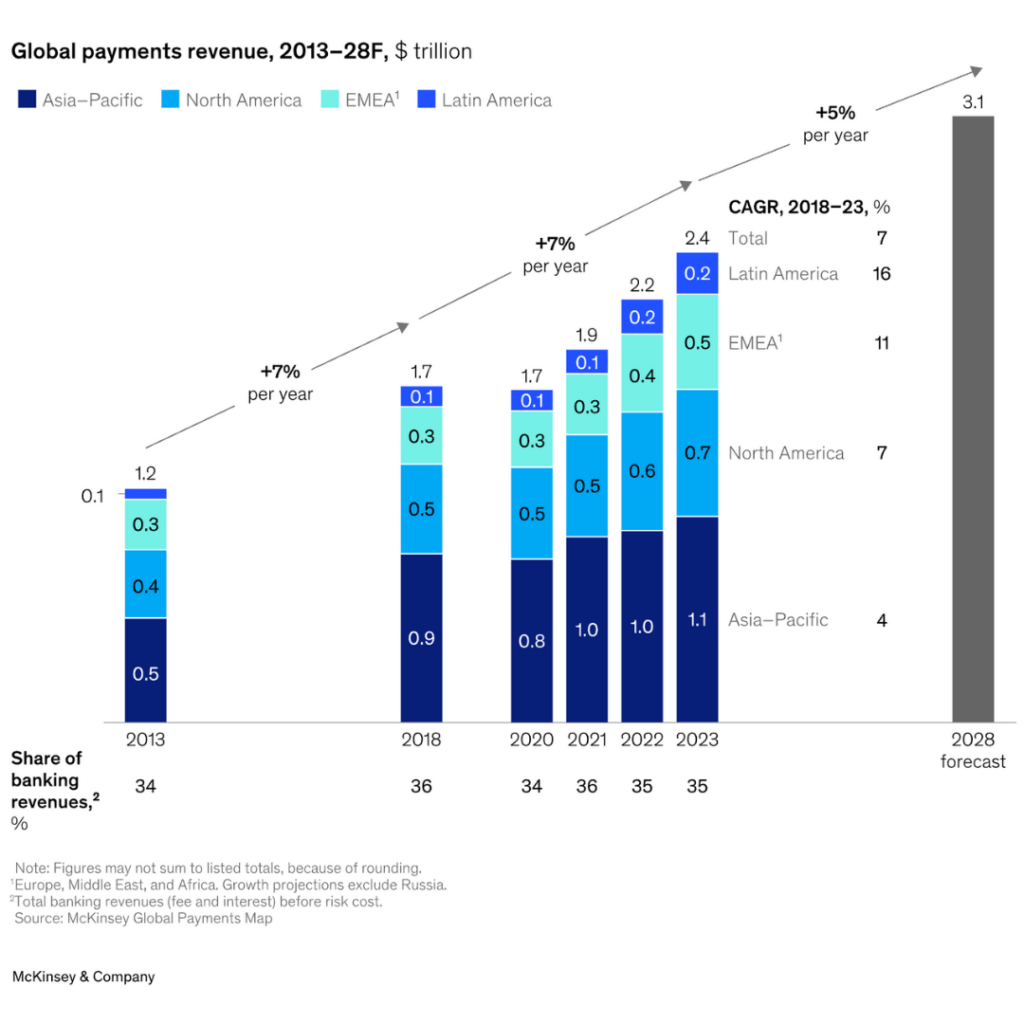
What’s needed are highly secure tools that build upon reliable infrastructure. Payments are a critical first step toward the broader adoption of the blockchain economy, as payments provide an entry point to the onchain economy and support the use of additional use cases. According to McKinsey & Company, global payments revenue will exceed $3 trillion by 2028.
In this post, we explore the digital payments opportunity and how Chainlink and Mastercard’s partnership is providing over 3 billion cardholders secure access to the blockchain economy.
Connecting billions across the globe.
Opportunity: Global Digital Payments Revenue Projected to Exceed $3 Trillion by 2028
Global payments revenue (source)
Blockchain technology is reshaping global payment networks. From the back-end plumbing of the world’s biggest banks to everyday consumer transactions, blockchain tech is enabling faster, more secure, and more cost-effective transactions. This is one of the most significant opportunities in finance, with global digital payments revenue projected to exceed $3.1 trillion by 2028.
Blockchain technology transforms various payment use cases:
Retail: Faster checkouts, lower fees, and improved security are possible for merchants and consumers when transacting onchain.
Cross-border: Faster and more efficient blockchain-based payments enable direct settlement on a distributed ledger.
Remittances: Fees for remittance payments can be significantly lower as direct wallet-to-wallet transfers bypass intermediaries.
Subscriptions: Smart contracts support automated recurring billing, which reduces administrative costs.
Micropayments: Blockchains can efficiently process minute payments, eliminating the need for comparatively high fees.
Supply chain: Combining blockchains, smart contracts, and IoT devices can support automated, secure payments along supply chains.
Settlement: Blockchain technology can power near-instant settlements, reducing counterparty risk and freeing up capital tied in long settlement cycles.
Major institutions recognize the opportunity to realize significant cost savings, unlock faster transaction times, and access new markets using blockchain technologies.
Challenge: Secure Access To The Blockchain Economy Is Critical for Widespread Adoption of Blockchain-Based Payments
In order to capture this $3 trillion opportunity, institutions must lower barriers to entry, making it a secure experience for users to enter the onchain economy and adopt blockchain-based payment systems.
While global crypto ownership now exceeds 560 million people as of 2024, the vast majority of the world still doesn’t interact with the blockchain economy. Even among current crypto users, engagement is often limited to trading and speculation rather than utilizing blockchain for payments or other real-world use cases.
One of the core problems holding back adoption is Web3 frontends and other tools required to use blockchain-based systems don’t meet the high levels of security that adoption from everyday users requires. Additionally, there has been limited integration with existing financial systems that people are more familiar with. By integrating with trusted platforms that enhance the user experience, blockchain payments and the broader blockchain economy can help drive adoption by billions across the globe.
Solution: Chainlink and Mastercard Partner To Enable Secure Crypto Purchases Directly Onchain
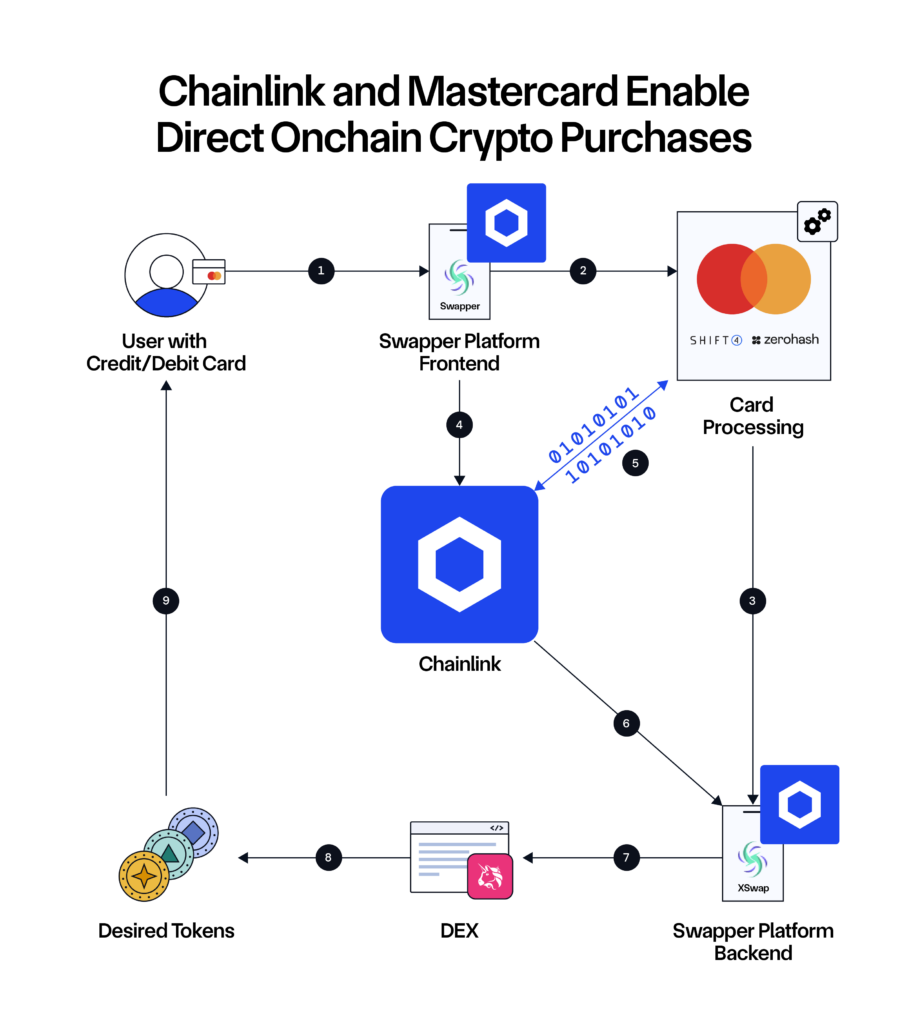
Chainlink and Mastercard enable direct onchain crypto purchases.
Chainlink and Mastercard are connecting the offchain payments world directly to the onchain DeFi world. This breakthrough is powered by Chainlink’s secure interoperability infrastructure and Mastercard’s trusted global payments network, removing long-standing barriers that have kept mainstream users from accessing the onchain economy.
“There’s no doubt about it – people want to be able to easily connect to the digital assets ecosystem, and vice versa. That’s why we continue to leverage our proven expertise and global payments network to bridge the gap between onchain commerce and offchain transactions. In coming together with Chainlink, we’re unlocking a secure and innovative way to revolutionize onchain commerce and drive the broader adoption of crypto assets.”—Raj Dhamodharan, executive vice president, Blockchain & Digital Assets at Mastercard
Swapper Finance leverages XSwap, the leading DEX built out of the Chainlink ecosystem that uses the Chainlink standard for data and interoperability, via an integration between zerohash and Shift4 Payments. zerohash provides the core compliance, custody, and transaction infrastructure, making it possible to convert fiat into crypto for smart contract consumption in a regulated manner.
“We are excited to be the infrastructure partner alongside Chainlink and Mastercard on the Swapper Finance platform. zerohash’s flexible crypto and stablecoin infrastructure powers seamless, compliant crypto-to-crypto swaps. zerohash provides the infrastructure to make access to decentralized exchanges simple through seamless compliant onboarding, abstracting away the complexities of smart contracts and low-latency onchain transactions.”—Edward Woodford, CEO & Co-Founder, zerohash
By bridging the gap between traditional and decentralized finance, the app makes blockchain-based payments feel like an extension of systems users already know, rather than an unfamiliar or unproven alternative.
Ultimately, this solution helps the blockchain industry to overcome challenges around user adoption and realize the $3 trillion payment opportunity. Moreover, the solution will enhance liquidity onchain and drive further growth.
Conclusion
Payments are just the tip of the iceberg.
Payments are just the tip of the iceberg. Blockchain technology is set to transform the entire financial system, from equities trading to automated corporate actions. Payments are a critical first step towards the wider adoption of blockchain-based solutions and can bring billions of users into the ecosystem.
The XRP Ledger (XRPL) has launched version 2.5.0 of its core software, according to a June 24 statement.
This update introduces a suite of upgrades designed to enhance network performance, support enterprise-grade functionality, and strengthen regulatory compliance.
Market observers noted that the update reflects Ripple’s broader push to position XRPL as a viable alternative to Ethereum and Solana for smart contract and token-based applications.
XRPL’s upgrades
The update introduces batch transactions, token escrow, permissioned decentralized exchanges (DEX), and permission delegation.
One of the standout features is transaction batching, which allows multiple operations to be executed within a single atomic transaction. This is especially valuable for enterprises handling airdrops, payroll, or large-scale token distributions.
Token escrow capabilities have also been expanded. The feature now supports trustline-based tokens and multi-purpose tokens, enabling developers to implement time-based or conditional asset releases, which are ideal for vesting and DeFi applications.
In parallel, the new PermissionedDEX function lets network participants restrict trading access to meet compliance standards, a critical component for financial institutions entering the blockchain space.
Meanwhile, another key upgrade is the Permission Delegation system, which improves security and operational clarity for token issuers. Issuers can delegate specific transaction permissions to designated accounts while maintaining complete on-ledger transparency and auditability.
This change allows for more flexible business structures that separate roles without compromising control or security.
RippleX developers say the feature could support MiCA compliance, stablecoin operations, treasury management, and controlled DeFi access.
XRP’s rising institutional interest
These upgrades land as XRP, the blockchain network’s native token, sees growing institutional demand.
On June 24, CME Group revealed that both XRP and Micro XRP futures, launched on May 19, had gained rapid traction.
Within the first month, the two products generated $542 million in trading volume, involving institutions and several retail platforms. It furthered that open interest reached $70.5 million, with significant activity from ETF issuers, institutional players, and retail traders.
XRP Futures on CME Group (Source: CME Group)
Interestingly, about 45% of the trading volume originated from markets outside the US and Canada. This global participation suggests a growing appetite for XRP exposure and reflects the token’s maturing role in institutional portfolios.
The San Antonio Spurs, a professional basketball team, has struck a sponsorship deal with Ledger.
The Spurs’s new jerseys feature a Ledger-branded patch.
Crypto sports sponsorships are seeing a major resurgence in 2025.
NBA basketball team the San Antonio Spurs has signed a sponsorship deal with Ledger, according to a Tuesday statement from the hardware wallet manufacturer—the latest sign that crypto sports partnerships are experiencing a resurgence.
Under the multi-year agreement, the Spurs will wear jerseys emblazoned with Ledger-branded patches. The Paris-based firm also plans to take an “active role” in boosting the Spurs’ community engagement efforts in France, it said in a statement.
The deal forms part of Ledger’s efforts to expand its reach in both the U.S. and its home market, Ledger CEO Pascal Gauthier said Tuesday in the statement.
“The U.S. is Ledger’s top market globally, and aligning ourselves with an historic U.S. sports team, which boasts a deep French connection past and present, will help us onboard the next generation of sovereign individuals,” Gauthier said.
Although the Spurs is a U.S. basketball team, its star center Victor “Wemby” Wembanyama is from France.
Crypto sports partnerships
Ledger’s Spurs sponsorship comes amid a revival in partnerships between professional athletics teams and major crypto firms over the past year.
Crypto companies’ spending on sports sponsorships recently increased 20% to $565 million for the 2024/25 season on a year-over-year basis, with football-related initiatives accounting for more than half of new sponsorship deals, according to a recent report from sports marketing firm SportQuake.
Among those deals was Tether’s purchase of a stake in Italian soccer team Juventus and trading platform Gate’s sponsorship of Formula One team Red Bull Racing.
Uniform branding deals—like Ledger’s partnership with the Spurs—are a popular way for digital assets companies to sponsor athletics teams, accounting for 37% of all crypto sports partnerships, SportQuake data shows.
The recent increase in sports sponsorships marks a stunning reversal from late 2022, when Web3 firms pulled back on, or cancelled, their partnerships due to difficult crypto market conditions precipitated by FTX’s collapse.
During that time, FTX’s partnerships with the MLB, Formula One and the NBA crumbled.
Daily Debrief Newsletter
Start every day with the top news stories right now, plus original features, a podcast, videos and more.
SINGAPORE, June 25, 2025 (GLOBE NEWSWIRE) — JOYY Inc. (NASDAQ: JOYY) (“JOYY” or the “Company”), a global technology company, has been acknowledged as a “Most Honored Company” by Extel, formerly known as Institutional Investor Research, in its 2025 Asia Companies’ Executive Team Survey.
JOYY earned top positions in the Overall Asia (ex-Japan/ANZ) Executive Team Small & Mid-Cap category in the internet sector across all seven evaluated areas: Best CEO, Best CFO, Best ESG, Best Board of Directors, Best IR Team, Best IR Professional, and Best IR Program. This is the seventh consecutive year that JOYY has been featured in the rankings, demonstrating excellence in the Company’s executive leadership, corporate governance and investor relations.
Ms. Li Ting, Chairperson and CEO of JOYY, was ranked No. 1 in Best CEO in the Small & Mid-Cap Internet sector. Mr. Alex Liu, the Vice President of Finance, secured top positions in the Best CFO category. JOYY achieved the highest ranking in Best IR Program, which is defined by nine key attributes including the quality of roadshows and meetings, comprehensive business and market knowledge, and timely and granular disclosure practices.
The Extel Asia Executive Team survey is regarded as a trusted benchmark for excellence in investor relations and corporate governance. The 2025 rankings are based on feedback from 5,437 buy-side professionals and 863 sell-side analysts. A total of 1,668 companies across 18 sectors were evaluated.
About JOYY Inc.JOYY is a leading global technology company with a mission to enrich lives through technology. With a diversified product portfolio spanning live streaming, short-form videos, casual games, instant messaging, and emerging initiatives like advertising, JOYY has evolved beyond social entertainment into a multifaceted ecosystem powered by AI and data-driven technologies. Headquartered in Singapore and operating across the globe, JOYY has fostered a vibrant user community through its localized strategies. JOYY’s ADSs have been listed on the NASDAQ since November 2012.
About Web3Wire Web3Wire – Information, news, press releases, events and research articles about Web3, Metaverse, Blockchain, Artificial Intelligence, Cryptocurrencies, Decentralized Finance, NFTs and Gaming. Visit Web3Wire for Web3 News and Events, Block3Wire for the latest Blockchain news and Meta3Wire to stay updated with Metaverse News.
Ethereum’s core developers are pushing for a major technical change that could reshape how quickly the network processes transactions.
On June 21, Barnabé Monnot, one of Ethereum’s core contributors, suggested a new proposal, EIP-7782, which would halve the block slot time from 12 seconds to 6 seconds.
According to him:
“Shorter slot times make Ethereum a better confirmation engine, which is arguably one of its main value propositions for apps and rollups settling on Ethereum L1. Everyone benefits directly.”
EIP-7782 benefits
He explained that the proposed changes would improve confirmation speed, reduce trading costs on decentralized platforms, and create better conditions for cross-chain protocols.
The proposal also includes adjustments to the timing of several core blockchain operations, such as attestation and aggregation windows.
Under EIP-7782, the block proposal slot would shrink from 4 seconds to 3. Attestations and aggregations would move even faster, cut from 4 seconds to 1.5 each.
Monnot has proposed that the EIP should headline Ethereum’s upcoming Glamsterdam upgrade. He said:
“There are multiple slot restructuring proposals already made for Glamsterdam (EIPs 7732 and 7886), focused more on scaling We want to use our Glamsterdam proposal as a place to highlight the value of shorter slot times, and progress the conversation towards their implementation.”
Meanwhile, this push for faster slot times aligns with the Ethereum Foundation’s broader goal of enhancing the network’s Layer 1 performance and refining user experience.
Considering this, Storm Slivkoff, a research partner at Paradigm, supports the proposal. He noted that reducing latency could be the most valuable upgrade included in Glamsterdam, especially as transaction fees drop below $0.10.
In such an environment, increasing block size yields diminishing returns. Instead, improving block quality becomes more critical.
Ethereum’s ecosystem growth
The proposal comes as Ethereum’s activity hits new highs amid rising institutional adoption.
According to GrowThePie data, more than 20 million active addresses interacted with the network last week, setting a record. However, most of that activity happened on layer-2 networks, such as the Coinbase-backed Base.
Ethereum Network Activity (Source: GrowThePie)
So, as Ethereum’s Layer-1 developers now propose making the core network faster and more efficient. If successful, the proposed slot time cut could improve performance where speed, cost, and usability matter most.
A Singapore court has granted WazirX more time to argue its restructuring plan after initial rejection.
The moratorium protects the exchange from creditor action as it prepares to shift operations to Panama.
Over 93% of creditors backed the restructuring plan aimed at reviving the exchange.
Embattled crypto exchange WazirX received a lifeline Tuesday when a Singapore court granted the company’s request to present additional arguments for its restructuring plan, extending a crucial moratorium that keeps its recovery efforts alive.
The Singapore High Court’s decision comes after it initially declined to approve WazirX’s proposed restructuring plan in early June. The move dealt a significant blow to the India-serving exchange, which has been struggling to resume operations following a massive $234.9 million crypto heist that occurred last July.
“The Singapore Court has granted our request to present further arguments in our application for the Court’s sanction of the proposed Scheme of Arrangement,” the exchange announced in a tweet.
In a statement shared with Decrypt, a WazirX spokesperson said that the exchange is, “fully committed to seeing this Scheme of Arrangement through.” They added that, “The Court’s decision to hear further arguments is a positive step, and we’ll continue to engage with complete focus and determination — always with our community’s best interests at heart.”
The proceedings are in Singapore because Zettai, WazirX’s Singapore-based operator, oversees its crypto operations.
The court ruling holds enormous stakes for the 6.6 million WazirX users who have been unable to access their funds since the platform halted trading after the hack, which authorities have linked to North Korea’s state-sponsored hackers.
The exchange’s ability to restructure directly impacts whether users will be able to recover their frozen crypto assets through the company’s proposed recovery token system.
Breathing room
The extended moratorium provides WazirX with breathing room as it prepares additional legal arguments to convince the court of its restructuring plan’s viability.
The original moratorium, granted on June 6, had protected the company from creditor actions while it sought court approval for its recovery strategy.
Following the court’s initial rejection, WazirX revealed in redacted legal documents sent to users that Zettai plans to relocate operations to Panama through a newly incorporated subsidiary called Zensui Corporation, established on March 10.
The move came as Singapore’s central bank set a June 30 deadline for local crypto service providers to cease offering digital token services to overseas markets, adding pressure to WazirX’s restructuring efforts.
The Honourable Singapore High Court issued an order declining to approve our proposed restructuring plan. While this outcome was not what we anticipated, we respect the Court’s decision and remain fully committed to complying with all legal and regulatory processes.
Our primary… pic.twitter.com/jrXFFwnMBA
— WazirX: India Ka Bitcoin Exchange (@WazirXIndia) June 4, 2025
WazirX’s parent company, Zettai, has finalized agreements to transfer the platform’s crypto-related services to Zensui, with the transition expected to be completed within two to three business days once executed.
The Panama-based entity will also handle the issuance of recovery tokens tied to the exchange’s post-hack compensation scheme.
The recovery tokens function as on-chain IOUs—essentially digital “I owe you” certificates—representing users’ outstanding balances, designed to track claims not covered by initial distributions.
In crypto exchanges, IOUs serve as formal acknowledgments of debt when platforms cannot immediately return user funds.
More delays for WazirX users
More than 93% of voting creditors approved the restructuring plan in April, with WazirX promising the tokens could yield 75% to 80% of users’ account balances at the time of the hack.
“WazirX is in a holding pattern, caught in a prolonged legal process in Singapore following the massive hack,” Dhrupad Das, Web3 lawyer and founding partner at Panda Law, told Decrypt.
The court extension means “more delays” for users, with much of the recovery hinging on “speculative” tokens and WazirX’s “planned decentralized exchange,” while the Binance dispute and Panama move only deepen the “uncertainty,” Das said.
Daily Debrief Newsletter
Start every day with the top news stories right now, plus original features, a podcast, videos and more.
LONDON, GB / ACCESS Newswire / June 24, 2025 / Amazing AI plc (AQSE:AAI) – AAI, a global fintech group specialising in online consumer loans, announces that it has implemented a Bitcoin Treasury Policy.The Company will continue to focus on delivering its organic growth strategy centered on consumer lending and on exploring AI finance related services whilst growing a bitcoin treasury over the shorter-term.
The Company’s Bitcoin Treasury Policyaligns with the Directors’ views that bitcoin provides a means to preserve value over time and serve as a hedge against both inflation and geopolitical events. In line with its current fiat consumer lending activities in the US, the Company is also exploring bitcoin related lending opportunities in developed and emerging markets, particularly in The Philippines and Africa. Paul Mathieson, CEO of AAI, has previous experience in setting up a crypto coin, crypto exchange and facilitating the free transfer of funds via a crypto coin for overseas foreign workers from Spain to The Philippines.
The Company intends to strategically allocate capital generated from its business operations and future fundraisings, with the aim of maintaining a treasury consisting of both traditional cash reserves and bitcoin.
The Company is exploring potential fundraising opportunities for this purpose, following which, the Directors anticipate being in a position to potentially commence bitcoin acquisitions in July 2025.
Relevant material changes to its bitcoin treasury holdings and further updates on the Bitcoin Treasury Policy will be announced by the Company in a timely manner.
Paul Mathieson, CEO of Amazing AI plc said,“We believe there are synergies between our core online consumer loans business, best-of-breed AI finance related services and our new Bitcoin Treasury Policy.”
This announcement contains inside information for the purposes of the UK Market Abuse Regulation and the Directors of the Company accept responsibility for the contents of this announcement.
About Amazing AI plcAmazing AI plc (AAI) is an AI driven, consumer finance fintech innovator that leverages its regulated licensed lending and collections operations, experience and network to distribute best-of-breed AI finance related services globally, specifically focused on lending, collections and debt financing services. AAI operates under the consumer brand Mr. Amazing Loans in the United States with state consumer lending licenses/certificates of authority and an established track-record of lending, collections and regulatory compliance for over 14 years. AAI intends to investigate further utilisation of AI in its own US consumer lending operational processes and seek additional strategic collaborations, joint ventures and acquisitions in the AI sector globally, including in AI deception detection services to increase underwriting and collections performance. AAI also plans to investigate the potential to conduct its own enhanced product/service development, territory customisation and new service initiatives.
For more information please visit: http://www.investmentevolution.com/investors
Caution Regarding Forward Looking StatementsCertain statements made in this announcement are forward-looking statements. These forward-looking statements are not historical facts but rather are based on the Company’s current expectations, estimates, and projections about its industry; its beliefs; and assumptions. Words such as ‘anticipates,’ ‘expects,’ ‘intends,’ ‘plans,’ ‘believes,’ ‘seeks,’ ‘estimates,’ and similar expressions are intended to identify forward-looking statements. These statements are not a guarantee of future performance and are subject to known and unknown risks, uncertainties, and other factors, some of which are beyond the Company’s control, are difficult to predict, and could cause actual results to differ materially from those expressed or forecasted in the forward-looking statements. The Company cautions security holders and prospective security holders not to place undue reliance on these forward-looking statements, which reflect the view of the Company only as of the date of this announcement. The forward-looking statements made in this announcement relate only to events as of the date on which the statements are made. The Company will not undertake any obligation to release publicly any revisions or updates to these forward-looking statements to reflect events, circumstances, or unanticipated events occurring after the date of this announcement except as required by law or by any appropriate regulatory authority.
This information is provided by RNS, the news service of the London Stock Exchange. RNS is approved by the Financial Conduct Authority to act as a Primary Information Provider in the United Kingdom. Terms and conditions relating to the use and distribution of this information may apply. For further information, please contact [email protected] or visit http://www.rns.com.
SOURCE: Amazing AI PLC
About Web3Wire Web3Wire – Information, news, press releases, events and research articles about Web3, Metaverse, Blockchain, Artificial Intelligence, Cryptocurrencies, Decentralized Finance, NFTs and Gaming. Visit Web3Wire for Web3 News and Events, Block3Wire for the latest Blockchain news and Meta3Wire to stay updated with Metaverse News.
U.S. airstrikes hit three Iranian nuclear sites, but verifying uranium destruction is difficult.
Uranium can’t be seen by satellites, and key site Fordow remains uninspected, according to the International Atomic Energy Agency.
Remote sensing provides clues, but full verification may require on-site access and diplomatic efforts.
While President Donald Trump has heralded the weekend strike on three Iranian nuclear sites as a success, verifying the destruction of uranium stockpiles in Iran is a challenge for U.S. and international intelligence agencies.
The International Atomic Energy Agency has not been able to inspect the damage to the U.S. military’s main target, the Fordow uranium enrichment facility, which is built deep inside a mountain in central Iran, and thus cannot independently verify Trump’s claim that the site was “obliterated.”
“At this time, no one, including the IAEA, is in a position to have fully assessed the underground damage at Fordow,” Rafael Grossi, Director General of the International Atomic Energy Agency, told Reuters on Monday.
Despite a sophisticated airstrike, at this point, experts say the issue isn’t just what was targeted, but trying to determine if it was destroyed.
“It will take time, intelligence assessments, and satellite imagery to determine the extent of the damage,” Professor of the Practice of International Relations at USC, Jeffrey Fields, told Decrypt. “Once that’s clear, we can evaluate whether we significantly crippled, or destroyed, Iran’s ability to continue enriching uranium.”
While images of explosions may show damage to structures, uranium itself can’t be seen with traditional satellite imagery, and there is no single tool capable of remotely confirming whether it’s been eliminated.
Image: ABC News Australia
However, several technologies are available that can help analysts build a picture of what happened on the ground.
Radiation detection from drones and aircraft
Specialized aircraft and drones can carry radiation sensors capable of detecting gamma rays or neutrons.
However, these aircraft must fly extremely close to the ground, typically within a few thousandths of a mile, to effectively detect and map radioactive sources, making them vulnerable to attack.
Air sampling and downwind analysis
To detect radioactive releases, the U.S. Air Force operates the WC-135 “Constant Phoenix.”
These fixed-wing aircraft, based on the Boeing 707, are designed to collect atmospheric samples and analyze radioactive isotopes in the event of a nuclear explosion or accidental release, provided the winds carry the particles far enough.
According to the Air Force, the WC-135W played a significant role in tracking radioactive debris from the Chernobyl nuclear plant disaster in 1986.
“During the Cold War, before we understood the environmental damage of above-ground or atmospheric nuclear tests, the U.S. did it, and so did other countries,” Field said. “Those tests released radioactive isotopes into the air, which could be detected. With underground tests, that’s much harder to pick up now.”
Adding to the trouble with detection, Fields said, is the depth of the Fordow facility, which is reportedly80 to 90 meters, approximately 260 to 295 feet, below ground.
Image: Maxar Technologies/CNN
Neutrino detectors
Neutrino Detectors are highly sensitive instruments capable of identifying particles released from nuclear reactions.
While the technology has the potential to provide long-range monitoring, its use is currently mainly experimental.
Neutrino detectors need to be placed relatively close to the source, within about 56 miles, to be effective.
Because of this limitation, the technology is not widely used for real-time monitoring.
Hyperspectral imaging and indirect clues
Satellites and drones equipped with hyperspectral sensors cannot directly detect uranium, but they can identify indirect signs of activity, such as heat signatures, disturbed terrain, or camouflage patterns.
These clues may suggest that a facility was struck or damaged, though they can’t confirm what was inside.
When combined with machine learning and artificial intelligence, hyperspectral imagery and other remote sensing data can help detect changes to structures or vehicles that may indicate blast effects at a facility.
However, these technologies still cannot confirm the presence or destruction of uranium itself.
The limits of technology
While tools like AI and satellite imagery may aid military leaders in determining the accuracy of the hit on the target, verifying if Iran’s nuclear capabilities have been destroyed may require an on-the-ground investigation.
“We need to try to go back to the negotiating table as soon as possible. We have to allow the IAEA inspectors to return,” Grossi said in a statement. “The IAEA is ready to play its indispensable role in this process.”
“We have been talking to Iran, we have been talking to the United States,” he added. “We have to work for peace.”
Edited by Josh Quittner and Sebastian Sinclair
Generally Intelligent Newsletter
A weekly AI journey narrated by Gen, a generative AI model.
Bitcoin mining apps are everywhere, but most do not perform real Bitcoin mining. Actual mining requires industrial mining hardware, strong computational power, and...