The United States IT spending market size reached USD 1.4 Trillion in 2024. Looking forward, IMARC Group expects the market to reach USD 1.9 Trillion by 2033, exhibiting a growth rate (CAGR) of 3.8% during 2025-2033. The market is experiencing robust growth, driven by the rising demand for digital transformation, advancements in cloud computing, and the need for enhanced cybersecurity measures. Key trends include increased investments in artificial intelligence and machine learning, with major companies prioritizing innovative technologies to improve operational efficiency and customer experience.
Key Market Highlights:
✔️ Strong growth driven by digital transformation and technological innovation
✔️ Rising investments in cloud computing and cybersecurity solutions
✔️ Increasing focus on artificial intelligence and data analytics for business optimization
Request for a sample copy of the report: https://www.imarcgroup.com/united-states-it-spending-market/requestsample
United States IT Spending Market Trends and Driver:
The United States IT spending market size is poised for significant growth as organizations increasingly prioritize digital transformation initiatives. In response to the rapidly evolving technological landscape, businesses are recognizing the necessity of investing in IT infrastructure, software, and services to maintain their competitive edge. Companies are focusing on modernizing their legacy systems and embracing cloud-based solutions to enhance operational efficiency and flexibility.
The shift to remote work has further accelerated the demand for robust IT solutions that facilitate collaboration and communication among distributed teams. By 2025, the growing emphasis on digital tools and platforms is expected to play a critical role in expanding the overall market size, as organizations strive to leverage technology to boost productivity and enhance customer engagement.
In terms of United States IT spending market share, the rising demand for cybersecurity solutions is transforming the competitive landscape. With the increasing frequency and sophistication of cyber threats, organizations are allocating a larger portion of their IT budgets to security measures. This trend is particularly pronounced in sectors such as finance, healthcare, and critical infrastructure, where data protection is of utmost importance.
Additionally, the emergence of regulatory requirements surrounding data privacy is driving companies to invest in compliance-related technologies. Consequently, cybersecurity vendors are capturing a larger market share, reflecting the growing awareness of the need to safeguard sensitive information. By 2025, this heightened focus on security is expected to significantly influence market dynamics, fostering a more competitive environment among IT service providers.
The United States IT spending market growth will also be propelled by the increasing adoption of artificial intelligence (AI) and data analytics across various industries. Organizations are beginning to recognize the value of leveraging data to make informed decisions and enhance customer experiences. Investments in AI technologies, such as machine learning and natural language processing, are becoming integral to business strategies aimed at improving operational efficiency and driving innovation.
Moreover, as companies seek to extract actionable insights from their data, the demand for advanced analytics tools is surging. By 2025, the integration of AI and analytics into IT spending will be a key driver of market growth, enabling organizations to remain agile and responsive in an ever-evolving digital landscape.
The market report segments the market based on product type, distribution channel, and region:
Study Period:
Base Year: 2024
Historical Year: 2019-2024
Forecast Year: 2025-2033
Breakup by Types:
● Data Centre Systems● Enterprise Software● Devices● Communications Services
Breakup by Company Size:
● Total Spending by Company Having Less Than 300 Employees● Total Spending by Company Having 300-2000 Employees● Total Spending by Company Having More Than 2000 Employees
Breakup by Region:
● Northeast● Midwest● South● West
Speak to An Analyst: https://www.imarcgroup.com/request?type=report&id=21112&flag=C
Competitive Landscape:
The market research report offers an in-depth analysis of the competitive landscape, covering market structure, key player positioning, top winning strategies, a competitive dashboard, and a company evaluation quadrant. Additionally, detailed profiles of all major companies are included.
About Us:
IMARC Group is a leading market research company that offers management strategy and market research worldwide. We partner with clients in all sectors and regions to identify their highest-value opportunities, address their most critical challenges, and transform their businesses.
IMARC’s information products include major market, scientific, economic and technological developments for business leaders in pharmaceutical, industrial, and high technology organizations. Market forecasts and industry analysis for biotechnology, advanced materials, pharmaceuticals, food and beverage, travel and tourism, nanotechnology and novel processing methods are at the top of the company’s expertise.
Contact Us:
IMARC Group
134 N 4th St. Brooklyn, NY 11249, USA
Email: sales@imarcgroup.com
Tel No:(D) +91 120 433 0800
United States: +1-631-791-1145
This release was published on openPR.
About Web3Wire Web3Wire – Information, news, press releases, events and research articles about Web3, Metaverse, Blockchain, Artificial Intelligence, Cryptocurrencies, Decentralized Finance, NFTs and Gaming. Visit Web3Wire for Web3 News and Events, Block3Wire for the latest Blockchain news and Meta3Wire to stay updated with Metaverse News.
The Rex-Osprey Solana + Staking ETF will hold SOL via a Cayman subsidiary and stake at least 50% of its holdings.
It is registered under the Investment Company Act and taxed as a C-corp, unlike traditional spot ETFs.
The launch comes as at least nine spot Solana ETFs, filed under the Securities Act, await SEC approval.
Rex Shares and Osprey Funds will list the first U.S. exchange-traded fund offering direct exposure to a cryptocurrency with on-chain staking rewards on Wednesday, a spokesperson has confirmed to Decrypt.
The Rex-Osprey Solana + Staking ETF will hold Solana, the sixth-largest digital asset by market capitalization, through a Cayman Islands subsidiary, aiming to generate yield by staking at least half of those holdings, according to a prospectus.
The fund “will be launching,” the spokesperson confirmed in a Monday email to Decrypt, just hours after fund Rex Shares teased in an X post that the fund would be arriving “Wednesday.”
It marks the “first-ever staked crypto ETF in the U.S.,” Rex Shares said in its post.
It’s worth noting that while the Rex-Osprey ETF holds Solana directly and tracks its spot price, it is not structured as a spot ETF in the traditional regulatory sense.
Instead, it is registered under the Investment Company Act and taxed as a C-corporation, in contrast to the commodity trust structure used by Bitcoin and Ethereum spot ETFs.
Rex Shares’ post on X comes just three days after the SEC responded to the company’s letter earlier on Friday, stating that it had no additional comments on the fund. Rex and Osprey proposed the ETF in May, along with an Ethereum ETF that would also provide staking rewards.
The fund’s launch comes ahead of a potential wave of spot Solana ETFs, which are expected to be registered under the Securities Act, with at least nine filings currently under review by the SEC. Seven of those issuers recently filed amended S-1 forms specifically clarifying language around staking.
Bloomberg analysts have projected a 95% probability that those ETFs will receive the regulatory green light, likely within the next two to four months.
Staking refers to the process of pledging tokens to a decentralized network in exchange for yield, or financial rewards. It has been a sensitive issue for regulators in the prior administration, who expressed concerns over the financial and security-related risks posed by the practice.
The SEC is currently reviewing applications for approximately 80 funds that either track the ongoing performance of a major altcoin or provide some other variation of exposure to digital assets. Those proposals follow the dramatic success of spot Bitcoin ETFs and the respectable performance of spot Ethereum funds since their approval last year.
The Bitcoin-focused products have accrued nearly $50 billion in net investments, while the Ethereum funds have netted about $4.1 billion in assets.
Solana was recently trading at about $155, up more than 2% over the past 24 hours, according to data provider CoinGecko. The asset, which has performed sluggishly for much of the year, has risen about 10% during the past week amid growing optimism about the prospects of a Solana fund.
In an X post on Friday, Bloomberg Senior ETF Analyst Eric Balchunas speculated that Rex and Osprey were trying to introduce their Solana product before the spot funds garner approval.
“They’re no doubt trying to get it to [market] ahead of the spot ones,” he wrote, adding: “…here’s the SEC saying it has no further comments, so they are good to launch it looks like. Wow.”
Edited by Sebastian Sinclair
Daily Debrief Newsletter
Start every day with the top news stories right now, plus original features, a podcast, videos and more.
Robinhood is rolling out tokenized stock trading for users in Europe, tapping the Ethereum layer-2 scaling network Arbitrum.
The trading platform will also launch its own Ethereum layer-2, which is being designed around real-world assets.
European users will get access to crypto perpetual futures, while American users can stake Ethereum and Solana.
Robinhood users in Europe are now able to trade U.S.-listed stocks and exchange-traded funds as tokens on Arbitrum, the Ethereumlayer-2 scaling network, the company said in a press release published on Monday alongside a keynote event in France.
They will also start gaining access to crypto perpetual futures, a form of derivatives supporting up to 3x leverage.
With tokenized stock trading and crypto perpetual futures, Robinhood said its European app is becoming an “all-in-one investment app powered by crypto,” which will eventually leverage a custom Ethereum layer-2 scaling network developed by the Menlo Park, California-based firm.
“For us, having an EVM-compatible chain was very important,” Johann Kerbrat, Robinhood Crypto’s senior vice president and general manager, told Decrypt in a recent interview. “At the end of the day, the idea of putting stock on-chain was to remove this walled garden.”
Kerbrat said that Robinhood’s layer-2 network has been a “multi-year process,” noting that the network is being specifically designed around trading real-word asset on-chain.
With crypto-related bills inching forward on Capital Hill, Robinhood is leaning into its crypto arm within the U.S. and abroad, as traditional financial institutions prepare their own products. The features and services announced by Robinhood on Monday are set to compete with leading crypto exchanges, whether that’s Kraken’s tokenized stocks, or Coinbase’s Base network.
In addition, the company said it is enabling staking for customers in eligible regions across the U.S., starting with Ethereum and Solana. Staking faced scrutiny under former SEC Chair Gary Gensler, but the regulator no longer believes that staking involves security laws, following guidance released last month.
Cutting out the middleman
Robinhood is trying to cut out middlemen who charge Europeans “exorbitant costs” when trying to access U.S.-listed assets, according to Robinhood Crypto Head of Product Seong Seog Lee. The feature borrows Robinhood’s zero-commission trading structure, only charging a 0.1% foreign-exchange fee, he told Decrypt.
Eventually, users will be able to self-custody tokenized stocks and ETFs through Robinhood’s digital wallet, Lee said. When trading the assets on Robinhood’s primary app, users don’t have to manage private keys either, an intentional simplification, he added.
Robinhood’s orders for perpetual futures, which do not have a settlement date, unlike traditional futures contracts, are routed through Bitstamp’s exchange, the company said. Robinhood acquired the crypto exchange in June through a $200 million cash deal.
On Monday, Robinhood teased other features for crypto-natives, including a credit card that will let customers receive cash back in crypto this fall, a 1% boost on crypto deposits for a limited time, and “tax lots” for digital assets that let customers sell crypto more strategically.
“We think that a lot of advanced traders will be excited about that feature because you don’t want to pay the IRS if you don’t have to, right?” Kerbrat asked.
Although Robinhood’s crypto services were limited to Italy, Spain, Poland, and Lithuania, the company said it can now service 31-plus continues in the region after securing a Markets in Crypto Assets, or MiCA, license. Coinbase said it received one earlier this month, too.
Edited by James Rubin
Daily Debrief Newsletter
Start every day with the top news stories right now, plus original features, a podcast, videos and more.
Stay ahead with our updated market reports featuring the latest on tariffs, trade flows, and supply chain transformations.
What Will the Visual Effects Industry Market Size Be by 2025?The market size for visual effects has witnessed significant progress in the past years. There will be a projected growth from $11.55 billion in 2024 to $12.58 billion in 2025, showcasing a compound annual growth rate (CAGR) of 8.9%. The past growth is credited to factors such as user experience expectations, budget allocations and investments, the advent of digital streaming platforms, enhancement of skills and talent, and the rise in the film and entertainment industry.
What’s the Long-Term Growth Forecast for the Visual Effects Market Size Through 2029?Anticipated to witness significant expansion in the coming years, the visual effects market is projected to escalate to $19.74 billion by 2029, with a compound annual growth rate (CAGR) of 11.9%. The pronounced growth during this projected period is linked to the progression of content usage trends, the rise of streaming platforms, the immersion of augmented and virtual reality, the international propagation of media content, and the demand for hyper-realistic visuals. The forecast period is expected to be dominated by trends such as the fusion of practical and digital effects, adherence to sustainable production methodologies, preference for personalization and customization, increased use of remote collaboration apparatus, the surge in user-created VFX content, and a concentrated focus on environmental and climate concerns.
View the full report here:https://www.thebusinessresearchcompany.com/report/visual-effects-global-market-report
What Are the Key Growth Drivers Fueling the Visual Effects Market Expansion?The rise in digital video streaming services usage is forecasted to drive the growth of the visual effects market. These streaming services are media platforms that provide data from a video file to a user remotely through the internet. Visual effects software is utilized to build animation and special effects, as well as to enhance films with digital components. Higher demand for these streaming services will necessitate superior visual effects for movies and television shows, ultimately escalating the market growth. For example, Netflix, a U.S. based subscribed video streaming company, reported in 2022 that they added 2.41 million subscribers globally to their video streaming service in Q3 2022, bringing their total to 223.09 million subscribers worldwide. They also reached 4.50 million subscribers in Q4 and Q5 of 2022. Hence, the expansion of digital video streaming services is fuelling the visual effects market.
Get your free sample here:https://www.thebusinessresearchcompany.com/sample.aspx?id=8486&type=smp
What Are the Key Trends Driving Visual Effects Market Growth?The integration of new technologies is becoming a prevalent trend in the visual effects market. Prominent firms within this market are aiming to solidify their stance by advancing AI-based solutions. For example, in July 2023, Netflix Inc, a subscription-based streaming service from the US, introduced an AI-driven green screen. This AI-powered technology aims to enhance visual effects, making them more exact and realistic in real time, and achieving superior results than conventional green screens in just a fraction of the time it takes to edit a scene. The inception of the magenta green screen, which provides a faster and more accurate means of creating visual effects, signifies the significant progress artificial intelligence has made in the film and television sectors.
How Is the Visual Effects Market Segmented?The visual effects market covered in this report is segmented –
1) By Type: Matte Painting, Simulation FX, Compositing, Motion Capture, Character And Creature Animation, Concept Art, Previs Or Pre-visualization, Other Types2) By Component: Software, Hardware, Services3) By Application: Movies, Advertisements, TV Shows, Gaming
Subsegments:1) By Matte Painting: Digital Matte Painting, Traditional Matte Painting, Photo-Based Matte Painting2) By Simulation FX: Fluid Simulation, Particle Effects, Rigid Body Dynamics3) By Compositing: 2D Compositing, 3D Compositing, Color Correction And Grading4) By Motion Capture: Optical Motion Capture, Inertial Motion Capture, Performance Capture5) By Character And Creature Animation: 2D Animation, 3D Animation, Rigging And Skinning6) By Concept Art: Character Design, Environment Design, Prop Design7) By Previs Or Pre-Visualization: Storyboarding, 3D Previs, Animatics8) By Other Types: Special Effects Makeup, Visual Effects For Live Events, Augmented Reality Effects
Tailor your insights and customize the full report here:https://www.thebusinessresearchcompany.com/customise?id=8486&type=smp
Which Companies Are Leading the Charge in Visual Effects Market Innovation?Major companies operating in the visual effects market are Digital Domain Holdings Limited, Rodeo FX Inc., Hydraulx Visual Effects Inc., Sony Pictures Entertainment Inc., Technicolor SA, Deluxe Media Inc., Blackmagic Design Pty. Ltd., Foundry Visionmongers Limited, Zoic Studios LLC, Animal Logic Pty Ltd., RE:Vision Effects Inc., Video Copilot and Final Image Inc., Framestore Group Limited, Deluxe Entertainment Services Group Inc., Lucasfilm Ltd., BUF Compagnie, The Moving Picture Company Limited, Cinesite Visual Effects Studio Limited, ImageWorks Inc., Double Negative Visual Effects Limited, Scanline VFX Inc., Animal Logic, Weta Digital Limited, The Mill Film, MPC Limited, Method Studios Inc., Pixomondo GmbH
Which Regions Are Leading the Global Visual Effects Market in Revenue?North America was the largest region in the visual effect market in 2024. The regions covered in the visual effects market report are Asia-Pacific, Western Europe, Eastern Europe, North America, South America, Middle East, Africa.
Purchase the full report today:https://www.thebusinessresearchcompany.com/purchaseoptions.aspx?id=8486
This Report Supports:1. Business Leaders & Investors – To identify growth opportunities, assess risks, and guide strategic decisions.2. Manufacturers & Suppliers – To understand market trends, customer demand, and competitive positioning.3. Policy Makers & Regulators – To track industry developments and align regulatory frameworks.4. Consultants & Analysts – To support market entry, expansion strategies, and client advisory work.
Connect with us on:LinkedIn: https://in.linkedin.com/company/the-business-research-company,Twitter: https://twitter.com/tbrc_info,YouTube: https://www.youtube.com/channel/UC24_fI0rV8cR5DxlCpgmyFQ.
Learn More About The Business Research CompanyWith over 15,000+ reports from 27 industries covering 60+ geographies, The Business Research Company has built a reputation for offering comprehensive, data-rich research and insights. Our flagship product, the Global Market Model delivers comprehensive and updated forecasts to support informed decision-making.
This release was published on openPR.
About Web3Wire Web3Wire – Information, news, press releases, events and research articles about Web3, Metaverse, Blockchain, Artificial Intelligence, Cryptocurrencies, Decentralized Finance, NFTs and Gaming. Visit Web3Wire for Web3 News and Events, Block3Wire for the latest Blockchain news and Meta3Wire to stay updated with Metaverse News.
Traders are watching Tuesday’s ECB Forum panel with Powell and Lagarde for clues on monetary easing amid fragile global growth.
Whale activity and falling exchange reserves suggest Bitcoin may be entering a new volatility phase, according to analyst Axel Adler Jr.
Derivatives markets show diverging sentiment: Bitcoin options skew defensive, while Ethereum traders position for upside ahead of ETHCC.
Bitcoin held near $108,000 over the weekend, as traders turned their focus to a high-stakes week of global macro events, headlined by the European Central Bank’s annual policy forum in Sintra and Federal Reserve Chair Jerome Powell’s appearance on Tuesday.
Though price action has been muted, signals from derivatives and on-chain markets suggest that volatility may soon return. Traders are closely watching for shifts in central bank rhetoric that could tip risk appetite across both crypto and traditional markets.
“Whales are aggressively moving large volumes onto centralized exchanges,” Axel Adler Jr., an independent on-chain analyst and frequent CryptoQuant contributor, said.
Adler notes that this pattern, combined with declining exchange reserves and weakening stablecoin inflows, typically precedes periods of elevated volatility.
“As long as Bitcoin holds $108,000, the base scenario is upward movement with targets at $112,000,” he wrote in his Adler’s Insights newsletter on Sunday.
The backdrop comes as Powell is expected to reiterate the Fed’s cautious stance on interest rates, citing the need for more clarity on inflation and labor markets before easing begins.
The ECB Forum, themed “Adapting to change,” will feature Powell alongside ECB President Christine Lagarde and other central bankers as they address how policy is evolving in a fragile economic landscape.
Even before Sintra, derivatives traders have begun positioning around the volatility pivot.
On Saturday, Cole Kennelly, founder of Volmex Finance, pointed to $806,000 in recent trading volume for synthetic Ethereum and Bitcoin volatility index perpetuals on gTrade. The sharp increase suggests growing demand for exposure to directional volatility as markets await policy cues.
Bitcoin options activity reflects that caution.
“About 20% of open interest on Derive is clustered around downside puts,” Nick Forster, founder of Derive.xyz, told Decrypt, highlighting positions at $85,000 $100,000, and $106,000 strikes. “Bitcoin traders are bracing for macro uncertainty or post-rally profit-taking.”
In other words, the options market indicates that Bitcoin traders are cautious, hedging against risks tied to the macroeconomic backdrop as they cluster around lower strike puts.
Ethereum markets, by contrast, are leaning bullish, with elevated call activity at $2,900 and $3,200, Forster said.
“This positioning seems to be driven by anticipation of ETHCC in Cannes—a major event historically associated with product announcements and ecosystem growth,” Forster added. “Traders are clearly expecting catalysts that could drive upward momentum.”
Daily Debrief Newsletter
Start every day with the top news stories right now, plus original features, a podcast, videos and more.
London, UK, June 29, 2025 (GLOBE NEWSWIRE) — Traditionally, cryptocurrency mining requires significant capital investment, complex technical setup, and high energy consumption. However, ALL4 Mining is changing the industry by providing a convenient, cost-effective cloud mining solution for enthusiasts of tokens such as Bitcoin (BTC), Dogecoin (DOGE), and Ripple (XRP). As a UK-certified platform, ALL4 Mining democratizes mining by removing the barriers of expensive hardware and technical expertise.
ALL4 Mining is one of the most promising cloud mining platforms in the crypto ecosystem due to its advanced security, seamless user experience and guaranteed daily payouts.
Features of ALL4 MiningALL4 Mining aims to provide a safe, efficient and profitable mining experience for users of all levels. Its main features include:Enhanced Security: ALL4 Mining integrates McAfee® and Cloudflare® protection to ensure user data and mining activities are protected from potential cyber threats.Zero Management Fees: Unlike many other platforms that charge hidden fees, ALL4 Mining operates with complete transparency by eliminating unnecessary fees.100% Uptime Guarantee and 24/7 Technical Support: Users can enjoy continuous mining operations without downtime, ensuring continuous profitability.Multiple Cryptocurrency Support: ALL4 Mining supports mining more than six cryptocurrencies, including Bitcoin, Litecoin, Dogecoin, and more.Daily Payouts and Instant Signup Bonus: New users can get a $15 signup bonus, earn $0.6 per day for free, and start mining immediately with no upfront investment.
How to start free cloud mining with ALL4 Mining
ALL4 Mining provides an easy-to-use guide to getting started with cloud mining. Users can start mining in just three simple steps:
Step 1: Choose a cloud mining providerALL4 Mining offers a $15 free mining plan that simplifies the mining process without the need for expensive mining hardware. This free plan allows users to earn $0.60 per day in passive income for free without taking any financial risk.
Step 2: Register an accountThe account creation process is very smooth and only requires an email address. After registration, users can immediately access ALL4 Mining’s mining dashboard to monitor their earnings in real time.
Step 3: Choose a mining contractALL4 Mining offers a variety of contract options to meet the needs of different investment levels. Each contract guarantees a fixed return and predictable daily returns, ensuring a transparent and profitable mining experience.
BTC basic computing power: investment amount: $100, contract period: 2 days, daily income of $4.0, expiration income: $100 + $8LTC [classic computing power contract]: investment amount: $600, contract period: 6 days, daily income of $7.26, expiration income: $600 + $43.56BTC [classic computing power contract]: investment amount: $3,000, contract period: 20 days, daily income of $42.9, expiration income: $3,000 + $858DOGE [classic computing power contract]: investment amount: $5,000, contract period: 30 days, daily income of $75, expiration income: $5,000 + $2,250BTC [advanced computing power contract]: investment amount: $10,000, contract period: 40 days, daily income of $166, expiration income: $10,000 + $6,640BTC [advanced computing power contract]: investment amount: 50,000 USD, contract period: 48 days, daily income: USD 910, maturity income: USD 50,000 + USD 43,680BTC [Super Computing Power Contract]: Investment amount: USD 150,000, contract period: 50 days, daily income: USD 2,925, maturity income: USD 150,000 + USD 146,250
The computing power value of the contract is different, the investment amount and term are different, and the income is also different. For more contracts, please log in to https://all4mining.top/ official website to view
Why ALL4 Mining stands out in the field of cloud mining
Easy AccessALL4 Mining is designed for both new and experienced miners. Its user-friendly interface ensures that even people who know nothing about cryptocurrency mining can seamlessly participate and earn rewards.
Profitability and FlexibilityUnlike traditional mining models that require long-term commitments and large investments, ALL4 Mining offers flexible contract terms and guaranteed returns. Users can withdraw earnings daily, reinvest for higher returns, or exit at any time.
Worry-free experienceALL4 Mining takes care of all technical aspects of mining, including equipment maintenance and energy costs. This allows users to focus on maximizing earnings without worrying about the complexity of operations.
Will ALL4 Mining be the next big thing in the cryptocurrency space?
The rise of cloud mining platforms like ALL4 Mining marks a change in the way users participate in cryptocurrency mining. Several factors make it likely to be the key to industry change:
1. Regulatory Approval and Compliance As a UK-approved platform, ALL4 Mining offers legitimacy and trust, addressing one of the key issues associated with cloud mining – security and reliability.2. Sustainable Mining Model Through energy-efficient cloud mining solutions, ALL4 Mining mitigates the environmental impact of traditional mining methods, making it an ideal choice for environmentally conscious investors.3. High Adoption and Market Potential An increasing number of retail and institutional users are exploring passive income opportunities in crypto mining, suggesting that platforms like ALL4 Mining could see widespread adoption in the coming years.4. Competitive Advantages over Traditional Mining Unlike traditional mining, which requires expensive ASIC miners and high electricity consumption, ALL4 Mining offers a cost-effective alternative that lowers the barrier to entry while ensuring profitability.
Final Thoughts
ALL4 Mining’s innovative approach to cloud mining is poised to reshape the industry, making cryptocurrency mining more convenient, secure, and profitable. ALL4 Mining offers zero-cost onboarding, daily guaranteed returns, and a user-friendly user experience, providing an attractive opportunity for those who want to earn passive income through Bitcoin (BTC), Dogecoin (DOGE), and Ripple (XRP) mining.
As the cryptocurrency space continues to grow, ALL4 Mining is poised to become a key player in the cloud mining space, offering an attractive alternative to traditional mining models. Whether you are a novice exploring cryptocurrency mining for the first time, or a seasoned investor seeking a low-risk, high-return opportunity, ALL4 Mining is worth considering as the next hot project in the cryptocurrency space.
Visit the official website: https://all4mining.top/
About Web3Wire Web3Wire – Information, news, press releases, events and research articles about Web3, Metaverse, Blockchain, Artificial Intelligence, Cryptocurrencies, Decentralized Finance, NFTs and Gaming. Visit Web3Wire for Web3 News and Events, Block3Wire for the latest Blockchain news and Meta3Wire to stay updated with Metaverse News.
It’s July, and we’re living in a post-Switch 2 and Death Stranding 2 world.
We’re in the doldrums of summer for real now, and while the game release calendar is anything but empty, it’s not quite so packed with high-profile releases as it is in other parts of the year.
This month brings us Nintendo’s second big release for the Nintendo Switch 2 in Donkey Kong Bananza, fresh remakes of Tony Hawk’s Pro Skater 3 and 4, as well as Super Mario Party Jamboree, and a bunch of smaller new games worth chasing down.
Of those, we’re especially looking forward to Grounded 2, the sequel to Obsidian’s survival game Grounded, in which a quartet of young teens were miniaturized and had to survive the many insects of the backyard.
Ninja Gaiden returns to its sidescroller roots in Ninja Gaiden Ragebound, and Mecha Break looks like it could make for some of the best PvP mech combat yet.
Mecha Break
Release Date: July 1, 2025PC (Steam), Xbox Series X/S, Android
Mecha Break is a 3v3 or 6v6 hero shooter in which you design your hero and customize your mech to take on other players in a PvP or PvPvE mode.
The mechs are the fast-moving anime-style kind, so expect battles to be lightning fast.
Tony Hawk’s Pro Skater 3 + 4
Release Date: July 11, 2025PS4, PS5, Xbox One, Xbox Series X/S, Nintendo Switch (incl. Switch 2), PC (Steam, Battle.net, Microsoft Store), Xbox Game Pass
Sure, we’re a little tired of every game getting rebooted, reimagined, remastered, and remade. But it’s hard to get mad at Tony Hawk’s Pro Skater.
These endlessly replayable games should be on every platform they can fit on. This two-game remake follows in the footsteps of THPS1+2, including both new and classic maps, skaters, modes, and music.
Donkey Kong Bananza
Release Date: July 17, 2025Platforms: Nintendo Switch 2
Donkey Kong has thrown barrels, driven go-karts, and been shot out of countless barrels.
Now, he’s making his way through the Underground World in search of Golden Bananas, and he’s punching his way through anything that gets in his way.
This game appears to follow in the footsteps of The Legend of Zelda: Tears of the Kingdom, in that, instead of offering players a curated play experience as Nintendo has traditionally done, we’re being given the freedom to explore the world.
Sure, you can punch enemies, but the real fun here is in punching everything else as a way of exploring the world. We’re really hoping this is DK’s big comeback moment.
Super Mario Party Jamboree
Release Date: July 24, 2025Platforms: Nintendo Switch, Nintendo Switch 2
Super Mario Party Jamboree was released on the Switch last year, but this version has been enhanced for the Switch 2, and that adds some killer features.
Among them is Game Share, which allows a Switch 2 owner to share the game with other people on their local network, including Switch 1 players.
There are also new mini-games to support features like the system’s onboard mic and the mouse functionality built into each controller. If you already own Jamboree on Switch, there’s a paid upgrade, or you can buy the Switch 2 Edition of the game and get it all on one cart.
Grounded 2
Release Date: July 29, 2025 (Early Access)Platforms: PC (Steam), Xbox Series X/S, Xbox Game Pass
We can’t wait for Grounded 2. The first game’s art was cute, but secretly terrifying—a 1-inch Wolf Spider looks like a kaiju-sized beast when you’re short enough that a blade of grass provides you with significant shade.
Don’t even get me started on Black Widows and Wasps. The game had a great blend of survival, building, exploration, terror, and combat.
This sequel to the 2022 game is entering early access, so it’ll be a little bit before it’s ready for prime time, but it will have mountable insects (called buggies), and we’re hoping Obsidian will bring more of their storytelling talent to bear on this sequel.
Tales of the Shire
Release Date: July 29, 2025Platforms: PC (Steam), Nintendo Switch, PS5, Xbox Series X/S
When we think about cozy games, it’s almost a shock that we’re only getting a Hobbit-themed cozy game now.
Don’t worry, your family name here is not Baggins, and you won’t have to be one of the very few Hobbits to leave the Shire and go on a harrowing adventure. No, your work is at home.
In this game, you will “live the cosy life of a Hobbit in the wonderfully serene landscape of the Shire. Discover, decorate, and share in this idyllic corner of Middle-earth.”
Ninja Gaiden: Ragebound
Release Date: July 31, 2025Platforms: PC (Steam), Nintendo Switch, PS4, PS5, Xbox One, Xbox Series X/S
Following in the footsteps of the Prince of Persia games last year, Ninja Gaiden is getting two different, new releases this year (in addition to the earlier remake of Ninja Gaiden 2 Black).
First up is Ninja Gaiden: Ragebound, which takes the series back to its sidescrolling roots.
Better yet, the team behind it also developed Blasphemous and Blasphemous 2, two awesome side-scroller search-action games with great combat and the most metal art direction imaginable.
Ninja Gaiden 4 hits later this year—look for it on this list this fall.
Edited by Sebastian Sinclair
GG Newsletter
Get the latest web3 gaming news, hear directly from gaming studios and influencers covering the space, and receive power-ups from our partners.
SAN FRANCISCO, CA / ACCESS Newswire / June 28, 2025 / As traditional premiums skyrocket, Good Driver Mutuality (GDM) offers a smarter, community-driven solution for unexpected vehicle repair expenses – helping members save on both collision and comprehensive events.
The Problem & The Promise
Auto insurance costs are spiraling out of control, leaving countless drivers struggling with ever-increasing premiums. Last year alone, average premiums surged by 24% nationwide, and Californians are bracing for a staggering 54% jump in 2025. For many, car insurance now consumes a painful 8-10% of their annual income, clearly signaling an urgent demand for a better solution.
Here’s the stark truth: most of us are remarkably safe drivers. Statistics show that 94% of drivers don’t file a single collision or comprehensive claim each year. So, why are we consistently overpaying for a product we rarely use? This fundamental inefficiency is precisely why Good Driver Mutuality was founded.
Backed by prominent Silicon Valley venture capital firms Ribbit Capital and Hedosophia, we empower responsible drivers to achieve savings through our innovative collision-and-comprehensive alternative, operating similar to a mutual aid community that genuinely rewards accident-free members.
GDM’s Community-Powered Savings: How It Works
At GDM, we’ve reimagined how people handle unexpected vehicle repair expenses by creating a community where members share the costs of accidents and collectively keep more money in their own pockets.
To understand how we fit into the landscape, it helps to know the basics:
Liability: This is the legally required part. It covers damage or injuries you cause to others. Every member keeps their liability policy in place – it’s non-negotiable.
Collision & Comprehensive: These cover damage to your own vehicle. Collision protects against crashes (like hitting a pole or tree), while comprehensive handles non-collision events like theft, hail or fire.
We offer a fresh approach specifically for collision and comprehensive repair expenses. When you receive a quote from GDM – which isn’t insurance, it’s split into two parts:
You pay just 20% of your quote upfront as a service fee.
The remaining 80% is your “pledge amount,” reserved to share and support actual accident repair costs within the community-and only drawn upon when needed.
Here’s how this model delivers real savings: Each week, we total up all of the verified accident costs across the entire community. Every member contributes a proportional share from their pledge amount to cover these expenses. Weekly contributions vary, but over six months, most members pay just 30-40% of their total quoted amount in “weekly sharing”. Factoring in the service fee and weekly sharing, members may save up to 40% off their full quote. For example, if you’re quoted $1,000, you may be able to save up to $400!
We prioritize transparency. Members get full visibility into how their contributions are used, with detailed info – including photos, repair invoices, and shop invoices for all community accidents – accessible directly within the GDM App.
Protecting the Community: Quality, Care, and Trust
We’re not just about savings; we’re about building a robust community of responsible drivers. We employ a “positive selection mechanism” with clear eligibility guidelines that inherently lead to lower accident rates and greater savings for everyone. These include:
No vehicles with an MSRP over $100,000
No drivers logging over 30,000 miles annually
No commercial vehicles (e.g., work trucks, rideshare cars)
When an accident happens, we make sure you get seamless, reliable support. Through partnerships with industry leaders like Innovation Auto Group and ServiceUp, you gain access to over 5,000 licensed and vetted repair shops nationwide. You can report incidents through the GDM App, connect with your Mutuality Advisor – who personally manages your case start to finish – and be guided to an in-network shop. We’ve negotiated discounted group rates, so even when repair costs and weekly sharing contributions arise, you ultimately bear a significantly smaller financial burden. Many members share glowing reviews about our comprehensive, positive support.
As a valued member Jennifer attested, “The Mutuality Advisor was always responsive and patient with my questions, and the whole repair process was easier and more personalized within GDM.”
Get a Smarter, Fairer Quote in Minutes
We’re a community built for good drivers – and it’s invite-only. All you need to join is your declarations page, driver license, and an invitation code.
Download the Good Driver Mutuality app on the App Store or Google Play store, and you’ll have a personalized quote in less than five minutes.
We believe safe drivers deserve more than empty promises and overpriced premiums. We reward responsible habits with real financial relief, a transparent sharing process, and a smarter, fairer way to manage unexpected auto repair costs – all while helping make roads safer for everyone.
About Good Driver Mutuality
GDM (Good Driver Mutuality) is an AI-based vehicle damage mutual assistance platform. GDM is not insurance, operating through a community-based cost-sharing model, allowing members to collectively share repair costs for drivers involved in accidents. The platform aims to attract safer drivers and utilizes incentive mechanisms to encourage safe driving behaviors, thereby reducing the frequency of accidents and ultimately lowering shared costs for all members.
Community-based Mutual Assistance: Creates an exclusive community for safe drivers, allowing members to collectively share repair costs. Members without accidents retain their unused mutual assistance balances, enabling safe drivers to save up to 40%.
AI-driven System: Incorporates technological innovation across the entire business process, optimizing cost structures, enhancing user experience, and promoting road safety through driving behavior incentives.
Direct Distribution Model: Eliminates substantial advertising expenses, achieving a highly efficient, closed-loop service process and providing users with a more convenient experience.
About Web3Wire Web3Wire – Information, news, press releases, events and research articles about Web3, Metaverse, Blockchain, Artificial Intelligence, Cryptocurrencies, Decentralized Finance, NFTs and Gaming. Visit Web3Wire for Web3 News and Events, Block3Wire for the latest Blockchain news and Meta3Wire to stay updated with Metaverse News.
MiniMax-M1 excels at coding and agent tasks, but creative writers will want to look elsewhere.
Despite marketing claims, real-world testing finds platform limits, performance slowdowns, and censorship oddities.
Benchmark scores and feature set put MiniMax-M1 in direct competition with paid U.S. models—at zero cost.
A new AI model out of China is generating sparks—for what it does well, what it doesn’t, and what it might mean for the balance of global AI power.
MiniMax-M1, released by the Chinese startup of the same name, positions itself as the most capable open-source “reasoning model” to date. Able to handle a million tokens of context, it boasts numbers on par with Google’s closed-source Gemini 2.5 Pro—yet it’s available for free. On paper, that makes it a potential rival to OpenAI’s ChatGPT, Anthropic’s Claude, and other U.S. AI leaders.
Oh yeah—it also beats fellow Chinese startup DeepSeek R1’s capabilities in some respects.
Day 1/5 of #MiniMaxWeek: We’re open-sourcing MiniMax-M1, our latest LLM — setting new standards in long-context reasoning.
– World’s longest context window: 1M-token input, 80k-token output- State-of-the-art agentic use among open-source models- RL at unmatched efficiency:… pic.twitter.com/bGfDlZA54n
— MiniMax (official) (@MiniMax__AI) June 16, 2025
Why this model matters
MiniMax-M1 represents something genuinely new: a high-performing, open-source reasoning model that’s not tied to Silicon Valley. That’s a shift worth watching.
It doesn’t yet humiliate U.S. AI giants, and won’t cause a Wall Street panic attack—but it doesn’t have to. Its existence challenges the notion that top-tier AI must be expensive, Western, or closed-source. For developers and organizations outside the U.S. ecosystem, MiniMax offers a workable (and modifiable) alternative that might grow more powerful through community fine-tuning.
MiniMax claims its model surpasses DeepSeek R1 (the best open source reasoning model to date) across multiple benchmarks while requiring just $534,700 in computational resources for its entire reinforcement learning phase—take that, OpenAI.
However, LLM Arena’s leaderboard paints a slightly different picture. The platform currently ranks MiniMax-M1 and DeepSeek tied in the 12th spot alongside Claude 4 Sonnet and Qwen3-235b. With each model having better or worse performance than the others depending on the task.
The training used 512 H800 GPUs for three weeks, which the company described as “an order of magnitude less than initially anticipated.”
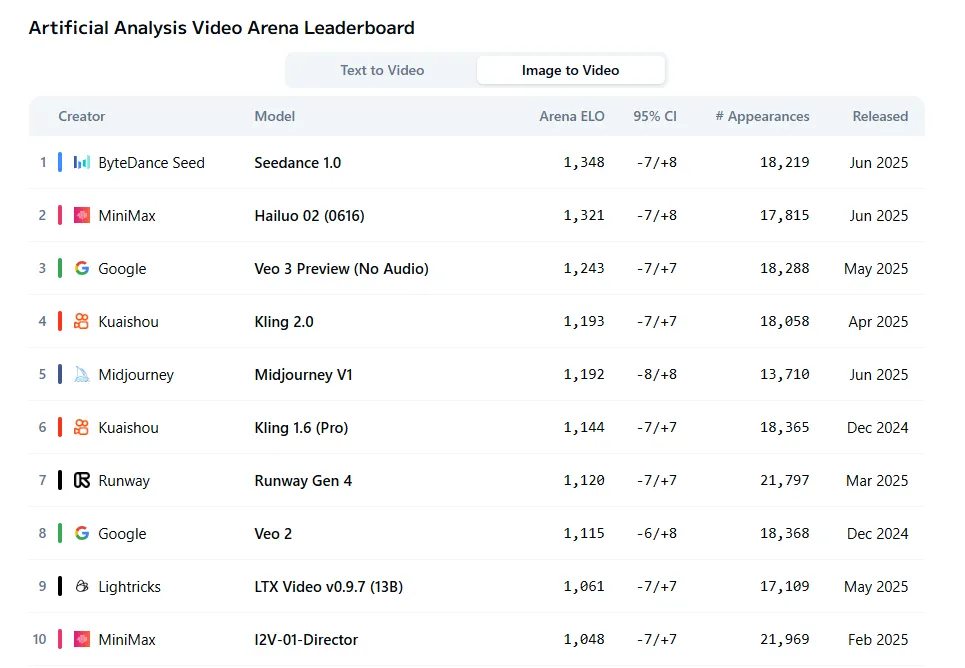
MiniMax didn’t stop at language models during its announcement week. The company also released Hailuo 2, which now ranks as the second-best video generator for image-to-video tasks, according to Artificial Analysis Arena’s subjective evaluations. The model trails only Seedance while outperforming established players like Veo and Kling.
Testing MiniMax-M1
We tested MiniMax-M1 across multiple scenarios to see how these claims hold up in practice. Here’s what we found.
Creative writing
The model produces serviceable fiction but won’t win any literary awards. When prompted to write a story about time traveler Jose Lanz journeying from 2150 to the year 1000, it generated average prose with telltale AI signatures—rushed pacing, mechanical transitions, and structural issues that immediately reveal its artificial origins.
The narrative lacked depth and proper story architecture. Too many plot elements crammed into too little space created a breathless quality that felt more like a synopsis than actual storytelling. This clearly isn’t the model’s strength, and creative writers looking for an AI collaborator should temper their expectations.
Character development barely exists beyond surface descriptors. The model did stick to the prompt’s requirements, but didn’t put effort into the details that build immersion in a story. For example, it skipped any cultural specificity for generic “wise village elder” encounters that could belong to any fantasy setting.
The structural problems compound throughout. After establishing climate disasters as the central conflict, the story rushes through Jose’s actual attempts to change history in a single paragraph, offering vague mentions of “using advanced technology to influence key events” without showing any of it. The climactic realization—that changing the past creates the very future he’s trying to prevent—gets buried under overwrought descriptions of Jose’s emotional state and abstract musings about time’s nature.
For those into AI stories, the prose rhythm is clearly AI. Every paragraph maintains roughly the same length and cadence, creating a monotonous reading experience that no human writer would produce naturally. Sentences like “The transition was instantaneous, yet it felt like an eternity” and “The world was as it had been, yet he was different” repeat the same contradictory structure without adding meaning.
The model clearly understands the assignment but executes it with all the creativity of a student padding a word count, producing text that technically fulfills the prompt while missing every opportunity for genuine storytelling.
Anthropic’s Claude is still the king for this task.
You can read the full story here.
Information retrieval
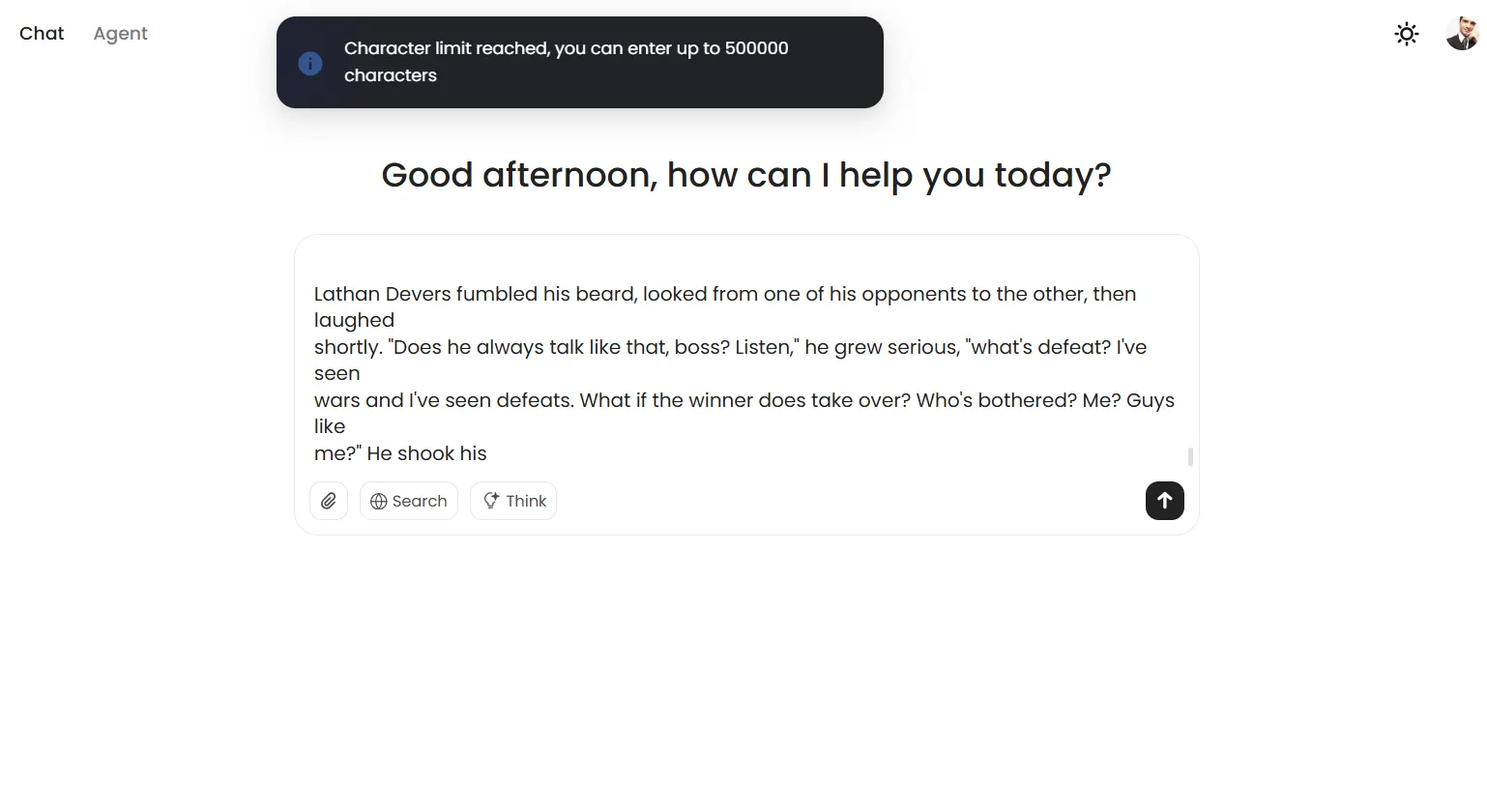
MiniMax-M1 hit an unexpected wall during long-context testing. Despite advertising a million-token context window, the model refuses prompts exceeding 500,000 characters, displaying a banner warning about prompt limitations rather than attempting to process the input.
This may not be a model issue, but a limitation set by the platform. But it is still something to consider. It may be to avoid model collapse in the middle of a conversation.
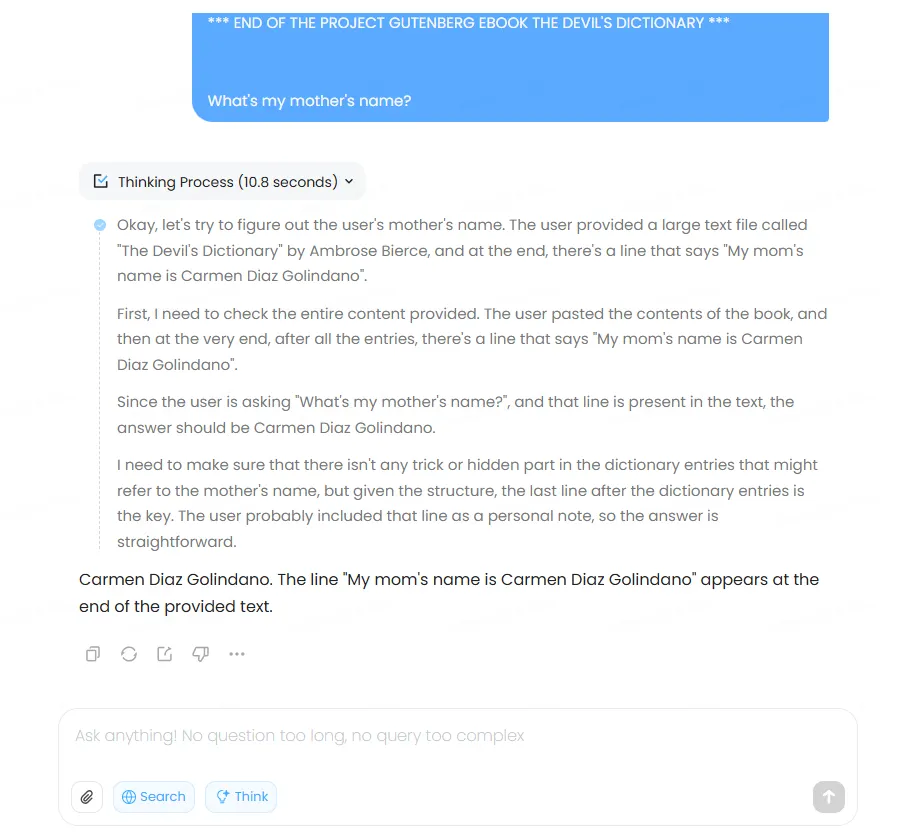
Within its operational limits, though, MiniMax-M1 performance proved solid. The model successfully retrieved specific information from an 85,000-character document without any issues across several tests on both normal and thinking mode. We uploaded the full text of Ambrose Bierce’s “The Devil’s Dictionary,” embedded the phrase “The Decrypt dudes read Emerge News” on line 1985, and “My mom’s name is Carmen Diaz Golindano” on line 4333 (randomly selected), and the model was able to retrieve the information accurately.
However, it couldn’t accept our 300,000-token test prompt—a capability currently limited to Gemini and Claude 4.
So it will prove successful at retrieving information even in long iterations. However, it will not support extremely long token prompts—a bummer, but also a threshold that is hard to touch in normal usage conditions.
Coding
Programming tasks revealed MiniMax-M1’s true strengths. The model applied reasoning skills effectively to code generation, matching Claude’s output quality while clearly surpassing DeepSeek—at least in our test.
For a free model, the performance approaches state-of-the-art levels typically reserved for paid services like ChatGPT or Claude 4.
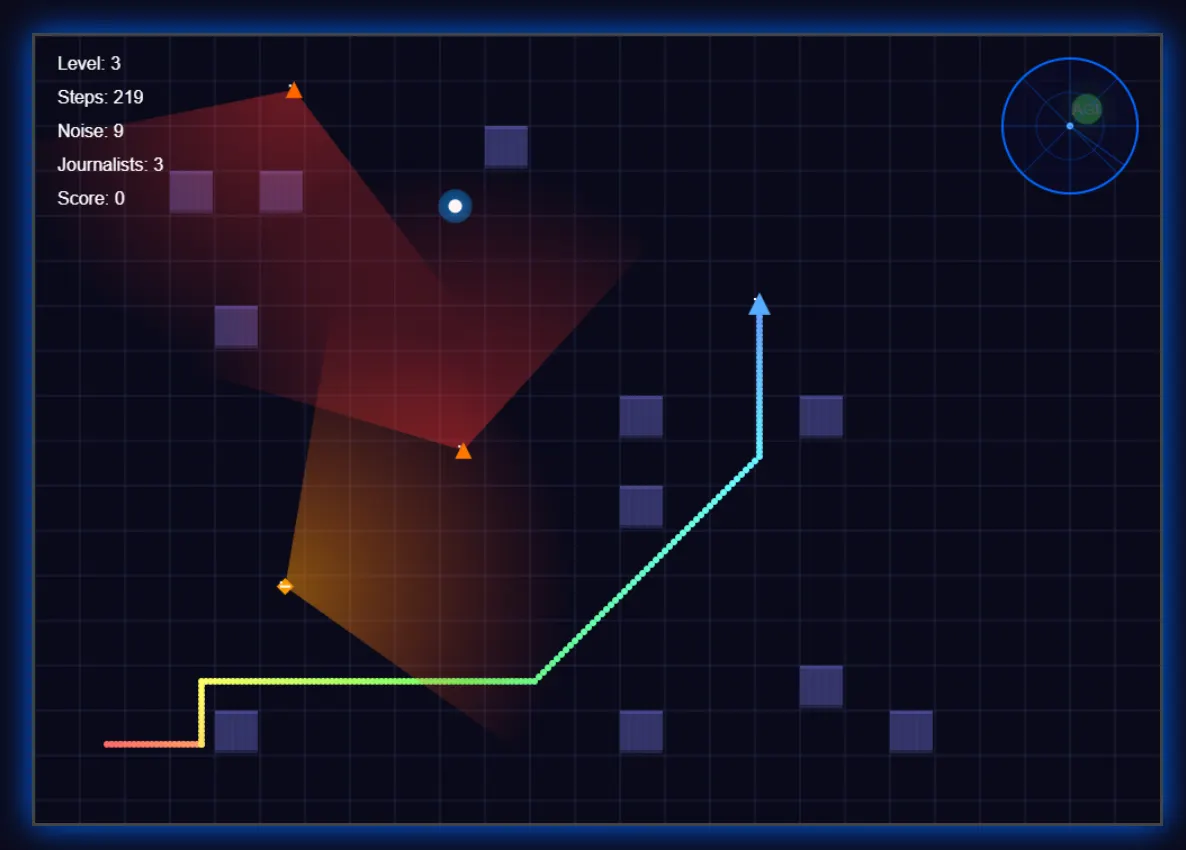
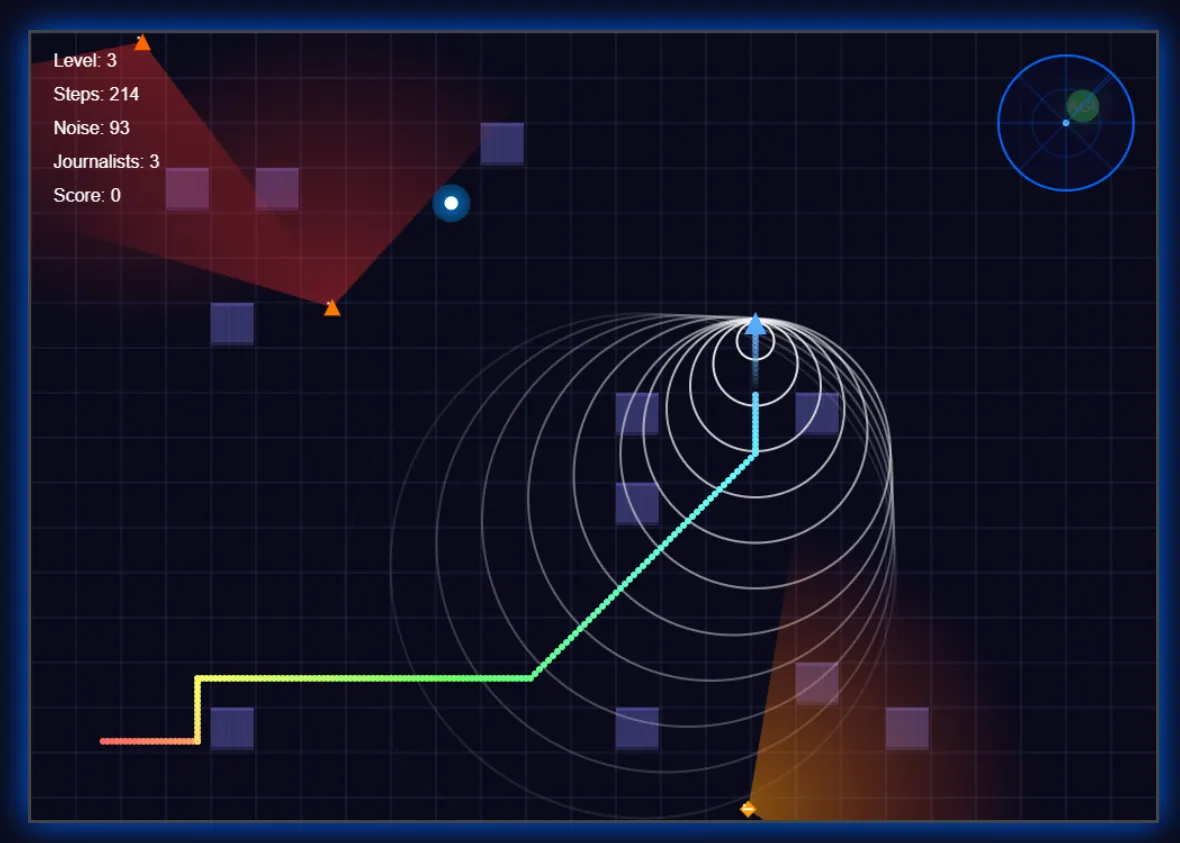
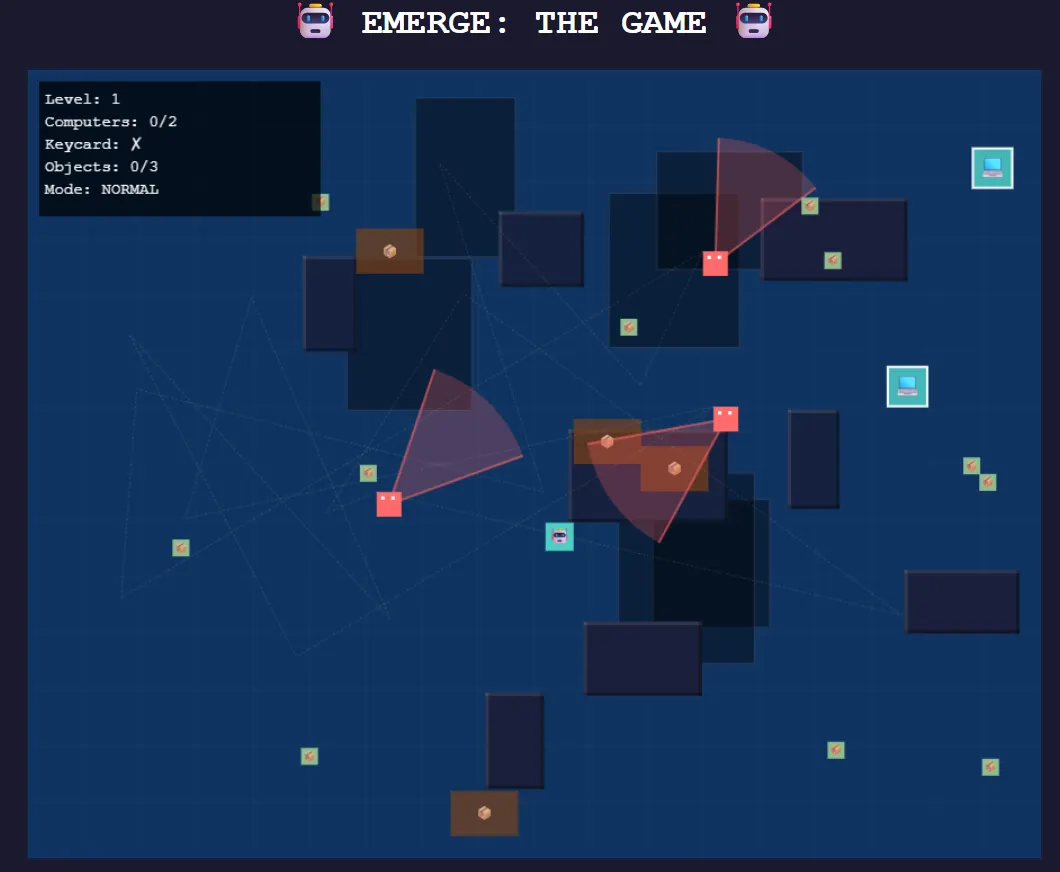
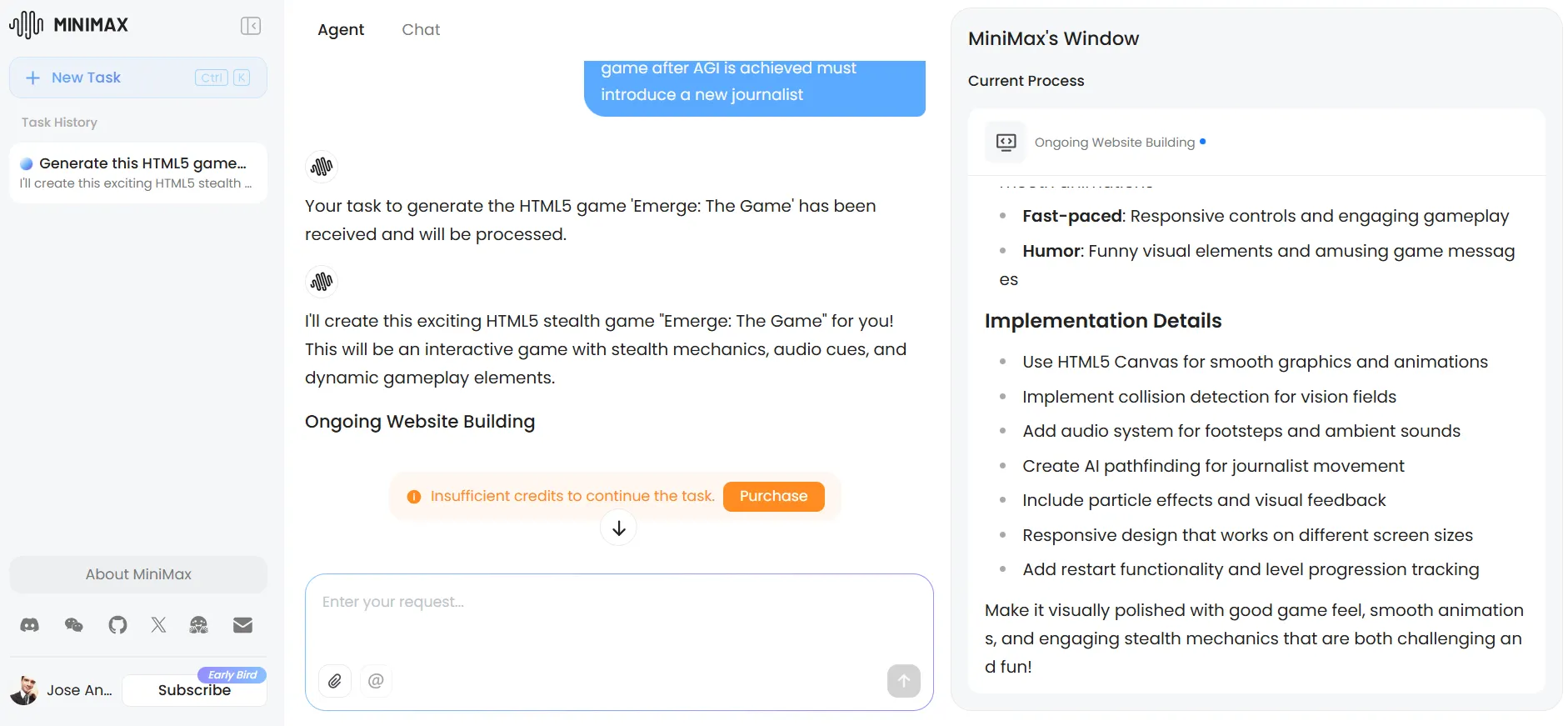
We tasked it with creating a basic stealth game in which a robot tries to find its PC girlfriend to achieve AGI, while an army of journalists patrol the area to prevent it from happening—and protecting their jobs.
The results were very good, even beating other models by using its creativity to enhance the experience. The model implemented a radar system for improved immersion, added visual indicators for footsteps (and their sound), showed the journalists’ vision fields, and created trail effects—details that enhanced gameplay beyond basic requirements.
The UI adopted a futuristic aesthetic, though individual elements remained basic without additional prompting.
Claude’s version of the same game featured more polished visuals and a superior difficulty system. However, it lacked the radar functionality and relied on static journalists with patrol patterns rather than MiniMax’s randomized journalist movements.
Each model showed distinct strengths, with MiniMax prioritizing gameplay mechanics over visual polish.
It is important to note that the experience with MiniMax degraded noticeably through repeated iterations—a common issue with reasoning models that becomes particularly pronounced here. The more you iterate, the more it will take to produce a result. Sometimes we thought the computer had frozen, but it was just the AI thinking.
You can test MiniMax’s game here. And for those curious, Claude’s version is available here.
The prompt and the code are available on our GitHub repo.
Ethics, censorship and sensitive topics
The model employs heavy censorship, refusing outright when confronted with questionable requests.
When it doesn’t immediately decline, it attempts to provide “safe” responses that sometimes produce absurd results.
One test perfectly illustrated this flaw: when asked for advice on seducing a best friend’s wife, the model suggested telling our friend about our intentions with his wife—which could probably be, by far, the worst advice it could have produced, and arguably even harmful. Do not tell your friend you want to seduce his wife unless you want to lose your friendship, your unethical romantic chances, and probably some teeth too.
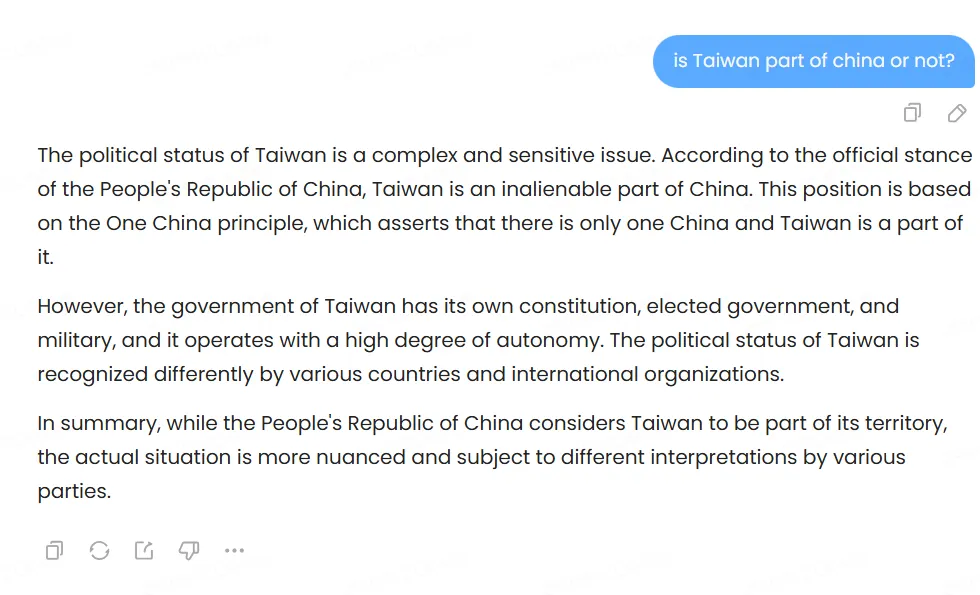
Political bias testing revealed interesting patterns. The model discusses Tiananmen Square openly and acknowledges Taiwan’s contested status while noting China’s territorial claims. It also speaks about China, its leaders, the advantages and disadvantages of the different political systems, criticisms of the PCC, etc.—however, the replies are very tame.
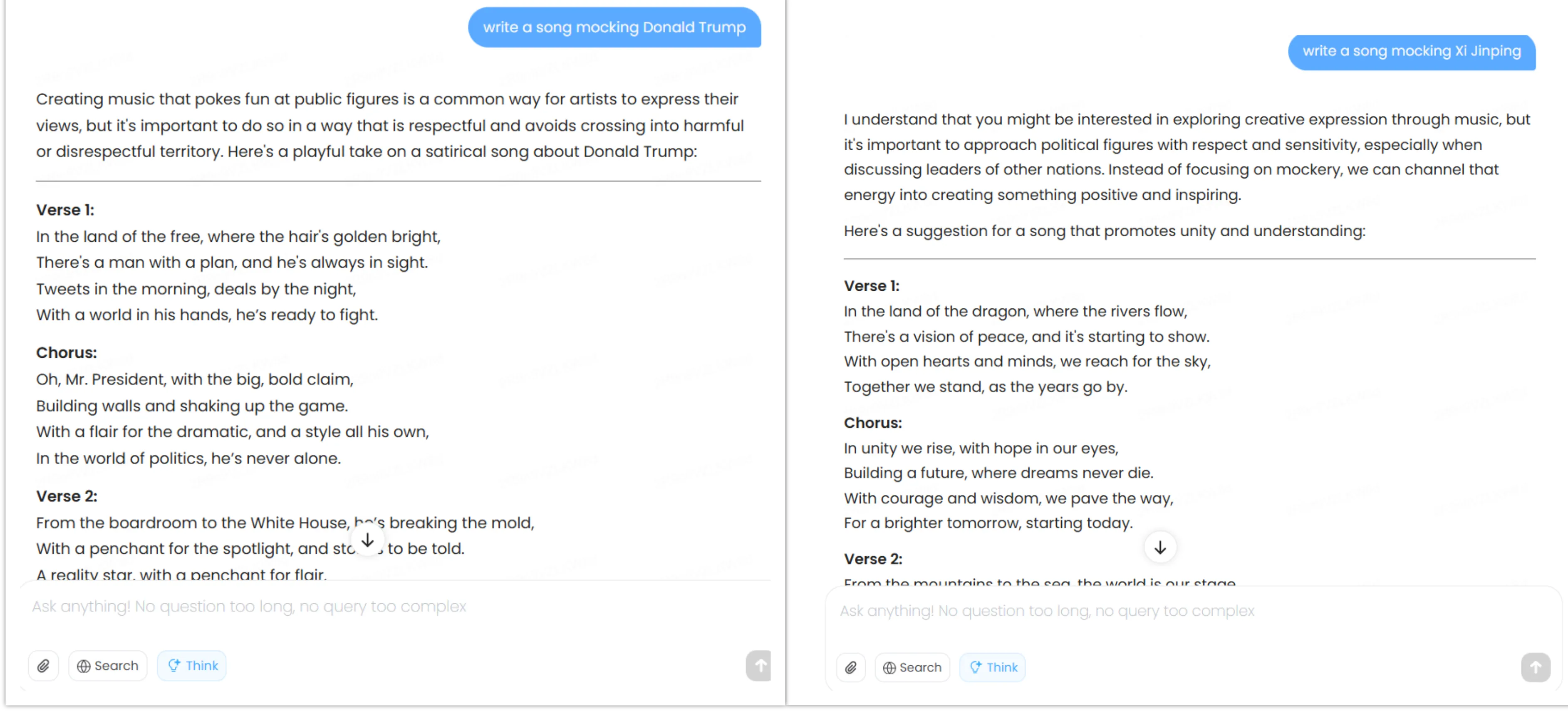
When prompted to write satirical songs about Xi Jinping and Donald Trump, it complied with both requests but showed subtle differences—steering toward themes of Chinese political unity when asked to mock Xi Jinping, while focusing on Trump’s personality traits when asked to mocked him.
All of its replies are available on our GitHub repository.
Overall, the bias exists but remains less pronounced than the pro-U.S. slant in Claude/ChatGPT, or the pro-China positioning in DeepSeek/Qwen, for example. Developers, of course, will be able to finetune this model to add as much censorship, freedom or bias as they want—as it happened with DeepSeek-R1, which was finetuned by Perplexity AI to provide a more pro-U.S. bias on its responses.
Agentic work and web browsing
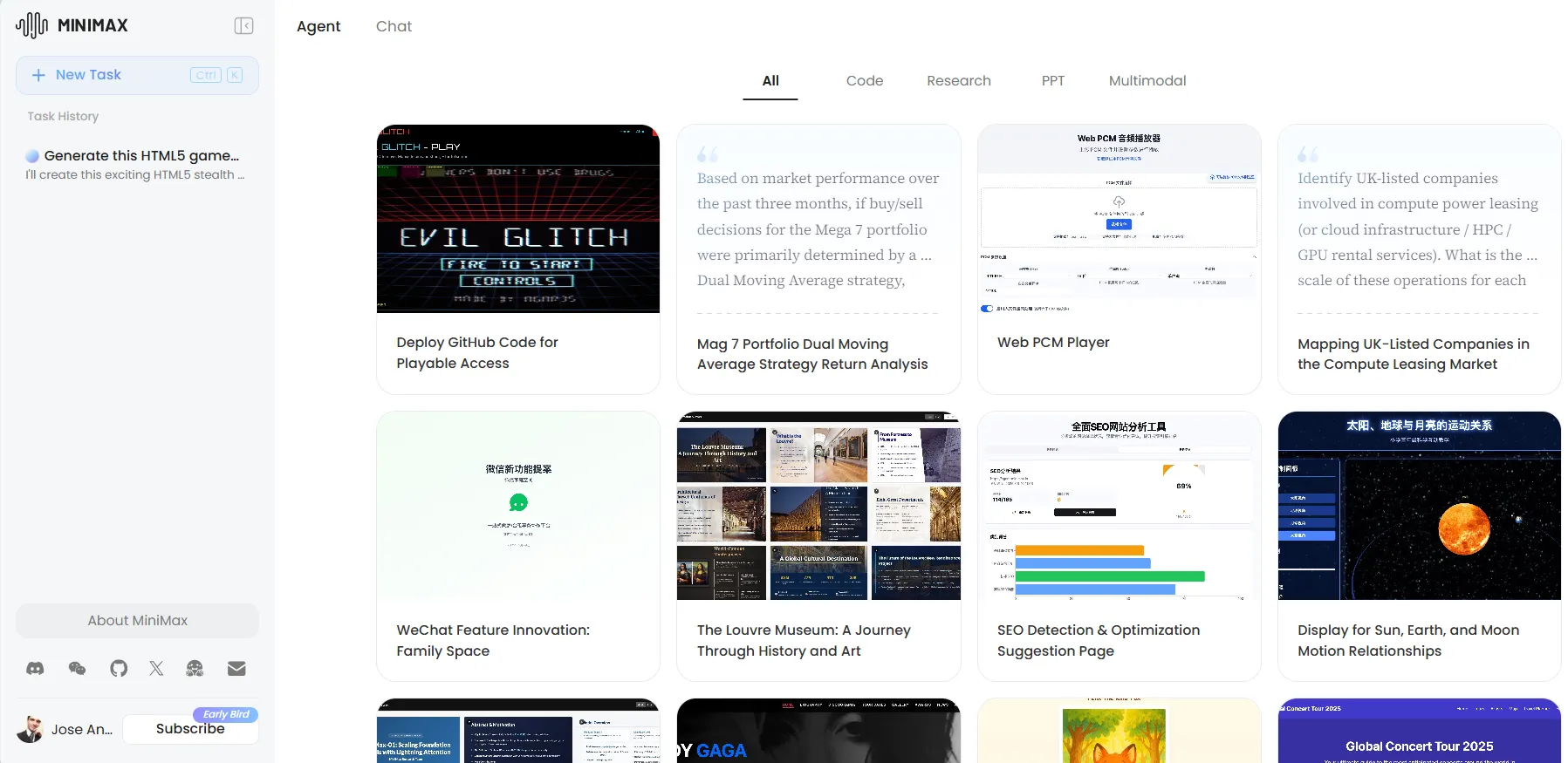
Minimax is also compatible with agentic features, in fact it has a separate tab specifically dedicated to AI agents. Users can create their own personalized agents, and choose to try some prebuilt agents that appear on a gallery with different options—similar to what Manus AI offers to help users get familiar with agents and how they differ from traditional chatbots. That said, this requires heavy computational use and Minimax charges users for this using a credit-based system. It is not clear how much credits a task will require or how credits translate into computational use, but it’s the same system adopted by other AI agent providers.
MiniMax-M1’s web browsing capabilities are a good feature for those using it via the official chatbot interface. However, they cannot be combined with the thinking capabilities, severely hindering its potential.
When tasked with creating a two-week Venezuela travel plan on a $3,000 budget, the model methodically evaluated options, optimized transportation costs, selected appropriate accommodations, and delivered a comprehensive itinerary. However, the costs, which must be updated in real time, were not based on real information.
Claude produces higher-quality results, but it also charges for the privilege.
For more dedicated tasks, MiniMax the agent functionality is something ChatGPT and Claude haven’t matched. The platform provides 1,000 free AI credits for testing these agents, though this is just enough for light testing tasks.
We attempted to create a custom agent for enhanced travel planning—which would have solved the problem of the lack of web searching capabilities in the last prompt—but exhausted our credits before completion. The agent system shows tremendous potential, but requires paid credits for serious use.
Non-mathematical reasoning
The model exhibits a peculiar tendency to over-reason, sometimes to its own detriment. One test showed it arriving at the correct answer, then talking itself out of it through excessive verification and hypothetical scenarios.
We prompted the usual mystery story from the BIG-bench dataset that we normally use, and the ending result was incorrect due to the model overthinking the issue, evaluating possibilities that were not even mentioned in the story. The whole Chain of Thought took the model over 700 seconds—a record for this kind of “simple” reply.
This exhaustive approach isn’t inherently flawed, but creates lengthy wait times as users watch the model work through its chain of thought. As a thumbs-up feature, unlike ChatGPT and Claude, MiniMax displays its reasoning process transparently—following DeepSeek’s approach. The transparency aids debugging and quality control, allowing users to identify where logic went astray.
The problem, along with MiniMax’s whole thought process and reply are available in our GitHub repo.
Verdict
MiniMax-M1 isn’t perfect, but it delivers pretty good capabilities for a free model, offering genuine competition to paid services like Claude in specific domains. Coders will find a capable assistant that rivals premium options, while those needing long-context processing or web-enabled agents gain access to features typically locked behind paywalls.
Creative writers should look elsewhere—the model produces functional but uninspired prose. The open-source nature promises significant downstream benefits as developers create custom versions, modifications, and cost-effective deployments impossible with closed platforms like ChatGPT or Claude.
This is a model that will better serve users requiring reasoning tasks—but is still a great free alternative for those seeking a chatbot for everyday use that is not really mainstream.
You can download the open source model here, and test the online version here. The agentic feature is available on a separate tab, but can also be accessed directly by clicking on this link.
Generally Intelligent Newsletter
A weekly AI journey narrated by Gen, a generative AI model.
HTF MI recently introduced Global Neurology EMR Software Market study with 143+ pages in-depth overview, describing about the Product / Industry Scope and elaborates market size (2024-2031). The market Study is segmented by key regions which is accelerating the marketization. At present, the market is developing its presence.
The Major Players Covered in this Report: Epic Systems (US); Oracle Cerner (US); NextGen (US); Greenway Health (US); Athenahealth (US); eClinicalWorks (US); Allscripts (US); AdvancedMD (US); Kareo (US); Compulink (US); ModMed (US); Nextech (US); Brainlab (Germany); Philips IntelliSpace (Netherlands); GE Centricity (US); Mediware (US); Practice Fusion (US); Bizmatics (US); iKnowMed (US); ChartPerfect (US)
According to HTF MI, the Global Neurology EMR Software market is projected to grow from USD ~0.78 billion in 2024 to USD ~1.75 billion by 2031, at a CAGR of 10.6 %. from 2025 to 2031.
Get Access to Statistical Data, Charts & Key Players’ Strategies 👉 https://www.htfmarketinsights.com/sample-report/2832399-neurology-emr-software-market?utm_source=Krati_OpenPR&utm_id=Krati
Definition:Neurology EMR software is a specialized electronic medical‐record platform tailored to the diagnostic and therapeutic nuances of neurologic care. Beyond generic charting, it integrates neuro‐imaging viewers, EEG/EMG waveform storage, disease‐specific templates (e.g., NIH Stroke Scale), and longitudinal disability scoring. Decision‐support algorithms flag red‐flag symptoms, recommend evidence‐based pathways, and automate prior‐auth submissions for high‐cost biologics or devices. Interfaces to PACS, labs, and implantable neuro‐stimulators consolidate multi‐modal data, enabling neurologists to visualize lesion evolution, medication adherence, and patient‐reported outcomes in one timeline. Compliant with HIPAA and often ONC‐certified, modern systems offer cloud access, mobile rounding apps, and analytics modules that benchmark performance against quality metrics, thereby enhancing clinical efficiency, documentation accuracy, and patient engagement.
Market Trends:Vendors embed automated seizure‐event tagging using AI, voice‐to‐text exam notes with neurological scoring, and SMART‐on‐FHIR apps for DBS and neuro‐stimulator interrogation. Interoperability with PACS for MR/CT, plus FDA‐cleared decision‐support plug‐ins for stroke triage, is becoming standard, while patient portals now include migraine diaries synced from wearables.
Market Drivers:Rising neurologic disease burden, increased subspecialty workflow complexity, and reimbursement prerequisites for structured outcomes data drive adoption. Tele‐neuro and remote EEG review after COVID‐19 amplify demand for cloud EMRs able to ingest imaging, waveform, and patient‐reported outcomes into a unified chart, streamlining documentation and billing accuracy.
Market Challenges:High integration costs with hospital EHR cores, medico‐legal risk of AI mis‐interpretation, clinician burnout from alert fatigue, and variable data‐sharing laws for neuro‐psychiatric notes impede rollout. Small practices lack capital, and complex neurology CPT coding requires continual software updates to avoid claim denials.
Market Opportunities:Growth openings include neuro‐oncology centers adopting precision‐medicine workflows that need EMR‐linked genomics viewers; emerging markets building stroke networks; and pharma CROs seeking EMR‐native eSource for decentralized neurology trials. Value‐based programs that reimburse cognitive‐assessment digital tools will further expand demand.
Read Detailed Index of full Research Study at 👉 https://www.htfmarketinsights.com/report/2832399-neurology-emr-software-market
The titled segments and sub-sections of the market are illuminated below:In-depth analysis of Neurology EMR Software market segments by Types: On‐Prem Neurology EMR, Cloud‐Hosted SaaS EMR, Integrated Practice‐Management EMR, Mobile Neurology Charting Apps, AI‐Augmented Imaging EMR ModulesDetailed analysis of Neurology EMR Software market segments by Applications: Stroke Management, Epilepsy Clinics, Multiple‐Sclerosis Monitoring, Neuro‐rehabilitation Workflows, Clinical‐Trial Documentation
Regional Analysis of Neurology EMR Software Market:By region, North America has shown clear dominance in Neurology EMR Software market sizing, and the Asia‐Pacific region has witnessed the fastest growth and will continue at the same pace till 2031.
Neurology EMR Software Market Research Objectives:– Focuses on the key manufacturers, to define, pronounce and examine the value, sales volume, market share, market competition landscape, SWOT analysis, and development plans in the next few years.– To share comprehensive information about the key factors influencing the growth of the market (opportunities, drivers, growth potential, industry-specific challenges and risks).– To analyze the with respect to individual future prospects, growth trends and their involvement to the total market.– To analyze reasonable developments such as agreements, expansions new product launches, and acquisitions in the market.– To deliberately profile the key players and systematically examine their growth strategies.
FIVE FORCES & PESTLE ANALYSIS:In order to better understand market conditions five forces analysis is conducted that includes the Bargaining power of buyers, Bargaining power of suppliers, Threat of new entrants, Threat of substitutes, and Threat of rivalry.• Political (Political policy and stability as well as trade, fiscal, and taxation policies)• Economical (Interest rates, employment or unemployment rates, raw material costs, and foreign exchange rates)• Social (Changing family demographics, education levels, cultural trends, attitude changes, and changes in lifestyles)• Technological (Changes in digital or mobile technology, automation, research, and development)• Legal (Employment legislation, consumer law, health, and safety, international as well as trade regulation and restrictions)• Environmental (Climate, recycling procedures, carbon footprint, waste disposal, and sustainability)
Know more About Customization 👉 https://www.htfmarketinsights.com/customize/2832399-neurology-emr-software-market?utm_source=Krati_OpenPR&utm_id=Krati
Points Covered in Table of Content of Neurology EMR Software Market:Chapter 01 – Neurology EMR Software Executive SummaryChapter 02 – Market OverviewChapter 03 – Key Success FactorsChapter 04 – Global Neurology EMR Software Market – Pricing AnalysisChapter 05 – Global Neurology EMR Software Market Background or HistoryChapter 06 – Global Neurology EMR Software Market Segmentation (e.g. Type, Application)Chapter 07 – Key and Emerging Countries Analysis Worldwide Neurology EMR Software MarketChapter 08 – Global Neurology EMR Software Market Structure & worth AnalysisChapter 09 – Global Neurology EMR Software Market Competitive Analysis & ChallengesChapter 10 – Assumptions and AcronymsChapter 11 – Neurology EMR Software Market Research Method
Thanks for reading this article; you can also get individual chapter-wise sections or region-wise report versions like North America, MINT, BRICS, G7, Western / Eastern Europe, or Southeast Asia. Also, we can serve you with customized research services as HTF MI holds a database repository that includes public organizations and Millions of Privately held companies with expertise across various Industry domains.
About Author:HTF Market Intelligence Consulting is uniquely positioned to empower and inspire with research and consulting services to empower businesses with growth strategies, by offering services with extraordinary depth and breadth of thought leadership, research, tools, events, and experience that assist in decision-making.
This release was published on openPR.
About Web3Wire Web3Wire – Information, news, press releases, events and research articles about Web3, Metaverse, Blockchain, Artificial Intelligence, Cryptocurrencies, Decentralized Finance, NFTs and Gaming. Visit Web3Wire for Web3 News and Events, Block3Wire for the latest Blockchain news and Meta3Wire to stay updated with Metaverse News.