Metaverse

Home Metaverse Page 68

How NFT Collectors Handle Financial Pressure When the Market Turns Against Them | NFT News Today

0
How NFT Collectors Handle Financial Pressure When the Market Turns Against Them | NFT News Today


NFTs were among the most popular things on the internet just a few years ago. Digital artists somehow earned millions, collectors assembled online galleries, and the first users saw their tokens 10x seemingly overnight. It actually felt like a digital gold rush, but with JPEGs, memes, gaming assets, and hyped-up visions of owning metaverse assets.

But once the excitement cooled, the real picture became clear. Prices started swinging violently. Collections that once sold out immediately stagnated. And many collectors — especially those who were new to investing — were left trying to handle financial tension they didn’t anticipate.

In this article, we will explain what happens when NFTs turn sharply downward, what pressures collectors encounter, and how they can handle volatility without losing their footing.

Drivers Behind NFT Market Fluctuations

The NFT market is not like traditional assets. It behaves more like a blend of speculation, community sentiment, and attention economy. Because of that, it reacts sharply to a few fundamentals.

Market Sentiment

Much like cryptocurrency, NFTs rely heavily on noise and excitement, as well as rumors. When influencers or big companies join, demand surges. For example, experienced users remember Elon Musk joining the hype in 2021 with his NFT song. And the other way around, when it fades, prices fall fast. Sudden silence on social media may cause serious panic selling.

Liquidity Levels

Liquidity in NFTs is the opposite of stocks or crypto, as there may be nobody ready to buy what you sell. When liquidity decreases, collectors can’t exit even if they want to. That may turn a small loss into a large one simply because there’s no one to take the asset off your hands.

Crypto Market Correlation

NFTs don’t exist in a vacuum. If ETH or SOL drops, NFT floors often drop even harder. Many collectors forget they’re exposed twice: the NFT value and the token it’s priced in.

Macro Conditions

Ongoing interest rate uncertainty, equity market changes, and constant recession fears have kept pushing investors toward safe-haven assets like gold since the pandemic. Obviously, NFTs are at the bottom of that priority list — when the economy tightens, discretionary spending disappears.

How NFT Collectors Can Handle Market Fluctuations

When volatility spikes, collectors face more than price drops — they face uncertainty, regret, FOMO (fear of missing out), and sometimes real financial strain. Let’s go through the main ways collectors attempt to stay afloat.

Diversify Beyond JPEGs

Serious collectors eventually realize that keeping only illiquid assets is a risky setup. To reduce the impact of sharp downturns, they spread their investments across different asset classes: some keep part of their capital in crypto, others buy tokens that offer real utility, and many mix various categories of NFTs, such as art, gaming items, or profile-picture collections. They also invest in different blockchains and maintain a portion of their money in traditional savings or investments outside the crypto world. Even though diversification is never a guarantee against losses, it may prevent the collapse of the whole portfolio.

Pick the Right Moment to Hold or Sell

Deciding when to wait for a recovery or get rid of a losing asset early is as important as it is difficult. You can monitor project-related news, trading volume, and the team’s activity on either Discord or X (formerly Twitter). If a project continues to show signs of development, holding can be appropriate. But when a project goes silent and buyers vanish, selling before it gets worse may be wiser than hanging on until the value reaches zero.

Hedge Against Crypto Movements

Hedging is another reasonable risk management strategy to protect a portfolio when NFTs and the crypto market move sharply. It could mean converting part of the holdings into stablecoins, using derivatives platforms to offset price spikes, or keeping enough cash reserves so you won’t have to panic-sell.

The High Cost of NFT Hype: One Collector’s Story

To have a better picture of real scenarios and possible consequences, let’s see what happened to a collector hit hard during one of the market drops.

Jason K. shared how quickly things spiraled. He got involved in NFTs in 2021, and for a time, his portfolio topped $45,000. He refused to sell because “it felt like the start of something even bigger.”

But when ETH dropped dramatically in 2022, and several projects he bought into went silent, the value of his portfolio collapsed to less than $8,000 in a matter of weeks. The hardest part wasn’t the number — it was the stress. He had invested more than he should have, expecting steady growth, which hadn’t happened back then.

With his liquidity depleted and bills piling up, Jason faced an urgent problem: he needed access to cash while his remaining assets were effectively frozen in a declining market. By chance, he discovered a fast, accessible way to manage urgent financial needs without being forced to panic-sell his NFTs at rock-bottom prices. Over time, by gradually rebuilding his portfolio and focusing on manageable investments, he was able to recover and stabilize his financial situation.

Top Tips for NFT Collectors Facing Uncertain Markets

NFTs come with big risks — but also potential rewards. Seasoned collectors and investors share their best tips to manage those ups and downs better and make smarter financial decisions.

Always Monitor Trends and Volume

NFT markets move quickly, and the fastest way to understand what’s really happening is to watch trading volume and general activity. Volume, floor price movement, supply distribution, holder behavior, and announcements from the project team help collectors see whether a drop is just a temporary correction or an indication of a more profound crisis. Analyzing price alone can barely be helpful — low volume is often the bigger warning because it means you may have problems selling when it matters most.

Choose Assets Mindfully

Collectors who succeed long-term tend to choose potential projects with real fundamentals: a committed team, genuine utility, a clear plan, as well as a community that holds together not only due to hype. Emotional purchasing — especially during sudden waves of popularity — often leads to holding assets with no long-term value. Choosing NFTs through thorough research and significance rather than meaningless online rumors reduces the chances of getting stuck with assets that collapse once the buzz fades.

Don’t Invest Money You Can’t Afford to Lose

NFTs are not liquid assets, and selling them isn’t guaranteed. In some cases, there may be no buyers for weeks or months. That’s why collectors who only use disposable income stay safest. They avoid the stress of needing quick cash and not being able to sell their NFTs, which is one of the biggest sources of financial pressure when markets turn.

Keep Part of Your Portfolio Liquid

A portion of your portfolio should remain liquid — whether in stablecoins or actual fiat currency. This reserve protects you from panic-selling valuable NFTs under pressure and allows you to take advantage of opportunities when prices become attractive. Liquidity gives flexibility, and flexibility is a major advantage in a volatile market.

Avoid FOMO Purchases

Buying an NFT just because the community is excited or a celebrity tweeted about it usually leads to overpaying. By the time something is trending, most of the profits have already been gathered by firstcomers. The ones joining later typically are stuck with tokens that lose value once the hype cools. Avoiding FOMO-driven decisions is one of the most fundamental aspects of investing, no matter if it’s crypto, NFTs, or conventional financial markets.

Act Fast Upon Any Red Flags

If a team stops communicating, moderators vanish, promises remain unfulfilled, or sudden changes appear in supply or utility, these are usually early danger signs. Projects rarely recover after such things happen. Collectors who exit with a small loss typically avoid the worst outcomes, such as when the project is clearly losing momentum.

Understand That Some NFTs Should Be Treated Like Collectibles

Not every NFT is meant to be an investment. Some pieces are digital art, memorabilia, or personal interest items. Treating every NFT as a profit opportunity brings nothing but unrealistic expectations and consequential stress. When you learn to tell true investments from simple collectibles, you start making more reasonable decisions by applying logic and common sense.

Plan Smart to Navigate NFT Market Ups and Downs

NFT collecting can be rewarding, but it comes with ups and downs. Prices shift quickly, and some projects don’t perform as expected. But with the help of diversification and level-headedness to properly react to any market changes, you have far better chances to stay steady.

Staying aware of market activity, making thoughtful choices, and being ready for small losses are all part of navigating this space. With a practical approach, collectors can handle changes in the market without unnecessary pressure.


Source link

CME Group Launches Spot-Quoted XRP and Solana Futures

0
CME Group Launches Spot-Quoted XRP and Solana Futures


Key Highlights

CME Group launched Spot-Quoted futures for XRP and Solana (SOL).

The contracts track real-time prices and are CME’s smallest crypto futures.

Traders can use Trading at Settlement (TAS) and trade alongside major U.S. stock indices.

CME Group has launched Spot-Quoted futures for XRP and Solana (SOL), expanding its crypto trading lineup and giving traders more ways to trade cryptocurrencies closer to real-time prices. The launch follows the success of Spot-Quoted Bitcoin and Ether futures, which have seen strong demand since June.

The new contracts are listed on CME and CBOT and can be traded alongside major U.S. equity indices, including the S&P 500, Nasdaq-100, Russell 2000, and Dow Jones Industrial Average. 

Smallest contracts for everyday traders

According to CME, Spot-Quoted futures are different from regular futures because they follow the price of the cryptocurrency directly, while financing adjustments are done separately when the contract ends.

“We’ve seen strong demand for our current Spot-Quoted Bitcoin and Ether futures, with more than 1.3 million contracts traded since launched in June, and we are pleased to add XRP and SOL to our offering,” said Giovanni Vicioso, Global Head of Cryptocurrency Products at CME.

The new XRP and SOL contracts are the smallest crypto contracts CME has introduced so far. They are designed for traders who want to trade more simply without worrying about contract expiries or rolling positions often. In short, traders can hold positions longer or trade in and out without extra steps. CME first introduced XRP futures on May 19, which quickly attracted more than $1 billion in open interest.

On November 24, Spot-Quoted Bitcoin and Ether futures recorded an average daily trading volume of 11,300 contracts, with a record of 60,700 contracts traded.

Flexible trading with TAS

CME has also added Trading at Settlement (TAS) for XRP, SOL, and their micro futures. TAS allows traders to take trades at a price based on the 4:00 p.m. ET settlement price before it is known. The feature is often used to manage risks around crypto ETFs, execute block trades, and maintain anonymity via CME Globex.

In October, CME also introduced options on SOL, Micro SOL, XRP, and Micro XRP futures. The launch of these new Spot-Quoted futures gives traders more choices and easier access to crypto markets. 

Despite this expansion, the prices of these tokens have failed to rebound. Currently, XRP is trading for $1.90 after a 7.5% drop in the past week, while SOL is trading for $126, down 7.19% in the last seven days, according to CoinMarketCap.

Also Read: 21Shares Launches XRP ETF $TOXR for Convenient Crypto Access


Source link

GPT-5.2 in Microsoft 365 Copilot and in Microsoft Foundry

0
GPT-5.2 in Microsoft 365 Copilot and in Microsoft Foundry


Microsoft keeps moving fast, and this time the update is significant: GPT‑5.2 is available for testing in Microsoft 365 Copilot and it is available for deployment through Microsoft Foundry.

This matters more than it might first sound. It is not just a model update. It is a signal of how Microsoft is aligning Copilot experiences, enterprise AI platforms, and agentic architectures into a single, coherent story.

GPT‑5.2 ChatThink Deeper: when Copilot chooses reasoning over speedHow to use GPT-5.2 in Microsoft 365 CopilotGPT‑5.2 is also available in Microsoft FoundryFinal thoughts

GPT‑5.2 Chat

GPT‑5.2 Chat is the conversational version of GPT‑5.2.

This means:

The model can handle longer and richer context

It understands multi‑step instructions better

It behaves more consistently across longer sessions

For the user, this shows up as something subtle but important:

You need to explain less, repeat yourself less, and correct the model less.

GPT‑5.2 Chat is not just about clever answers. It is about reduced friction in thinking‑with‑AI.

Think Deeper: when Copilot chooses reasoning over speed

One of the most interesting aspects of GPT‑5.2 is Think Deeper. This is a mode of reasoning where the model is allowed to spend more time before answering.

In practice, that means:

The model evaluates alternatives internally

It reasons through trade‑offs

It avoids shallow or rushed answers

This matters because many Copilot use cases are not about speed at all.

Users don’t want:

“the first possible answer”

They want:

“a better answer I can trust”

For the user, Think Deeper feels like Copilot is thinking with you, not just reacting

How to use GPT-5.2 in Microsoft 365 Copilot

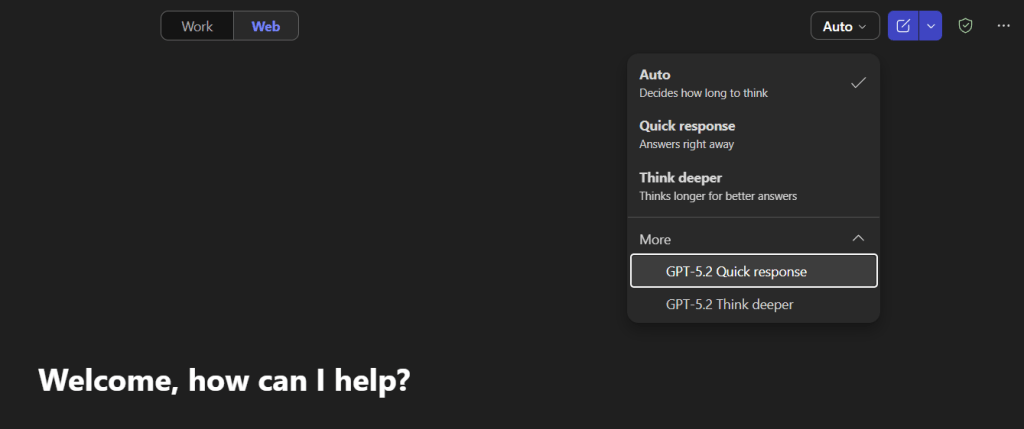
You can click on the “Auto” on top-right area and go over to more, and select to use GPT-5.2

GPT‑5.2 is also available in Microsoft Foundry

While GPT‑5.2 is being tested in Copilot, it is already available for deployment in Microsoft Foundry (Azure AI models).

This is where things become especially interesting for architects, developers, and AI strategy leaders.

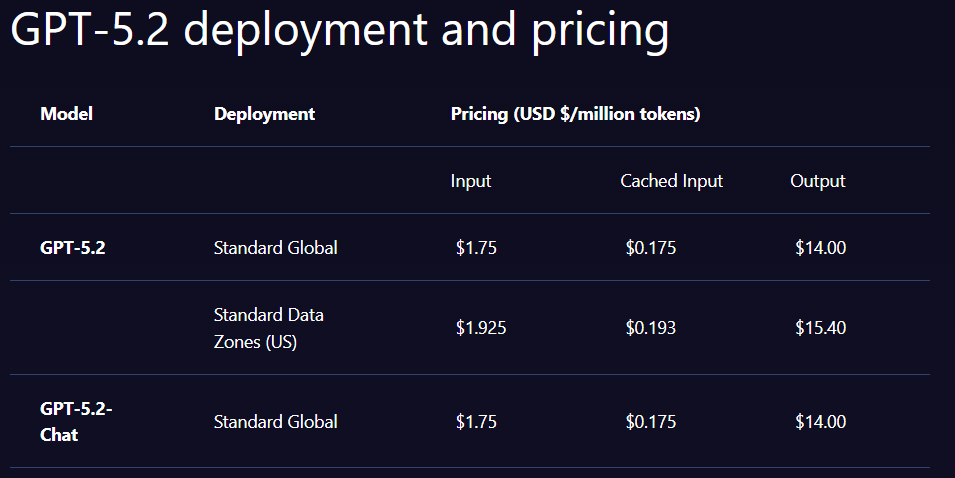
GPT-5.2: The most advanced reasoning model that solves harder problems more effectively and with more polish. An example of this is information work, where great thinking is now complemented with better communication skills and improved formatting in spreadsheets and slideshow creation.

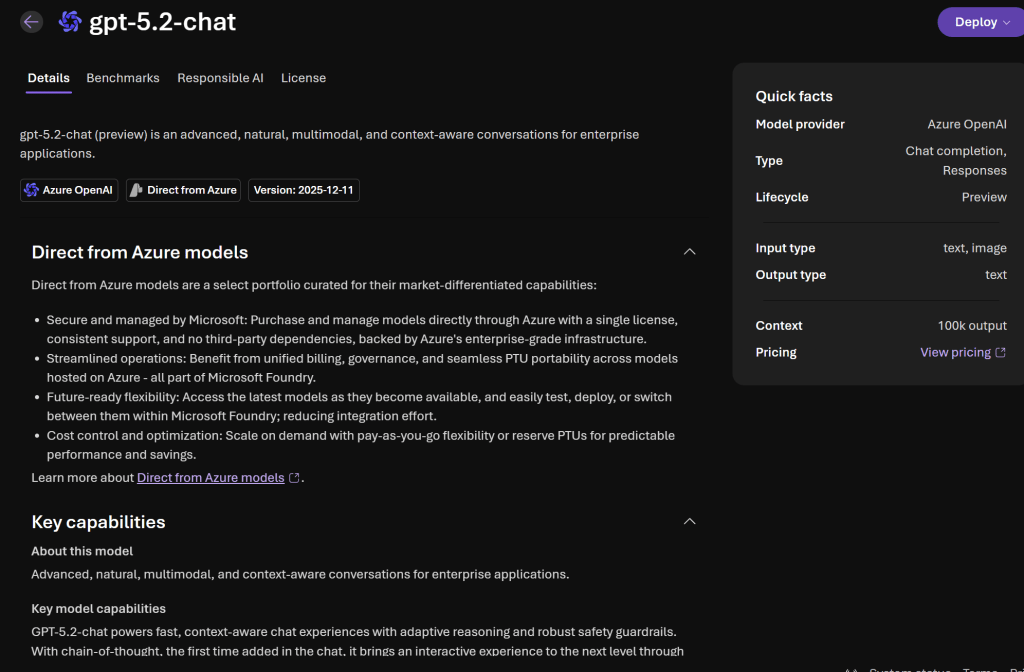
GPT-5.2-Chat: A powerful yet efficient workhorse for everyday work and learning, with clear improvements in info-seeking questions, how-to’s and walk-throughs, technical writing, and translation. It’s also more effective at supporting studying and skill-building, as well as offering clearer job and career guidance.

Multi-Step Logical Chains: Decomposes complex tasks, justifies decisions, and produces explainable plans.

Context-Aware Planning: Ingests large inputs (project briefs, codebases, meeting notes) for holistic, actionable output.

Agentic Execution: Coordinates tasks end-to-end, across design, implementation, testing, and deployment, reducing iteration cycles and manual oversight.

Safety and Governance: Enterprise-grade controls, managed identities, and policy enforcement for secure, compliant AI adoption.

https://azure.microsoft.com/en-us/blog/introducing-gpt-5-2-in-microsoft-foundry-the-new-standard-for-enterprise-ai

In Microsoft Foundry, GPT‑5.2 can be:

Selected as a direct Azure-hosted model

Deployed for custom applications

Used as the reasoning engine behind AI agents

In other words the same model family powering Copilot innovation is available for your own enterprise solutions.

Final thoughts

From the user’s point of view, GPT‑5.2 does not change what Copilot is. It changes how dependable it feels.With GPT‑5.2 Chat and Think Deeper, Copilot interrupts your thinking less, maintains context better, and produces answers that require less correction. Over time, this is what builds trust. Not brilliance, but reliability.

What makes this release especially important is that the same model is not limited to Copilot. GPT‑5.2 is also available in Microsoft Foundry, designed from the start for enterprise‑grade deployment: governed, secure, and ready to power applications and agents at scale. This closes the gap between everyday Copilot usage and long‑term AI platform strategy.

In practice, this means organizations no longer have to choose between:

AI that works well for individuals, and

AI that can be trusted in production systems

Copilot becomes the place where people experience the model.Foundry becomes the place where the same capabilities are engineered into solutions.

This is how AI moves forward in the enterprise — not as isolated features, but as a shared foundation that supports users, teams, and increasingly autonomous workflows.

“AI as a feature”to “AI as a co‑worker”to “AI as part of the operating model.”

GPT‑5.2 is a good step along the path.

Unknown's avatar

Published by Vesa Nopanen

Vesa “Vesku” Nopanen, Principal Consultant and Microsoft MVP (Microsoft 365 and Azure AI Foundry) working on Future Work at Sulava MEA.

I work, blog and speak about Future Work : AI, Microsoft 365, Copilot, Loop, Azure, and other services & platforms in the cloud connecting digital and physical and people together.

I have 30 years of experience in IT business on multiple industries, domains, and roles.
View all posts by Vesa Nopanen


Source link

Aster Launches Shield Mode, a Protected High-Performance Trading Mode for On-Chain Traders

0
Aster Launches Shield Mode, a Protected High-Performance Trading Mode for On-Chain Traders


Sponsored

Stories and Reviews

December 15, 2025

Aster Launches Shield Mode, a Protected High-Performance Trading Mode for On-Chain Traders

George Town, British Virgin Islands, December 15th, 2025, Chainwire

Aster, an on-chain trading platform focused on performance and privacy and supported by YZi Labs, has announced the launch of Shield Mode. This new feature, integrated into Aster Perpetual, introduces a protected trading option designed to offer high-leverage trading—up to 1001x—within a more secure and flexible on-chain environment.

Shield Mode represents a key milestone in Aster’s mission to build the next generation of on-chain trading platforms, designed to serve advanced traders while addressing the challenges of trading in fully transparent on-chain markets.

“Shield Mode reflects our belief that the future of on-chain trading isn’t just about leverage or speed—it’s also about control, discretion, and protection,” said Leonard, CEO of Aster. “We’re building a trading platform that allows traders to perform at the highest level without being forced to broadcast their strategies to the market.”

Evolving On-Chain Trading: From 1001x to Shield Mode

Aster’s 1001x product offers up to 1001x leverage, zero slippage, no opening fees, and fully on-chain settlement. As on-chain trading infrastructure evolved, participants became increasingly aware of the transparency-related trade-offs—particularly the exposure of trading strategies and intentions to the broader market.

In mid-2025, Aster introduced Hidden Orders on Aster Perpetual, enabling traders to conceal order price and size from the public order book while retaining access to available liquidity. This update was aimed at enhancing trading discretion within an on-chain environment.

Shield Mode builds on this foundation by introducing a more comprehensive protected trading mode, combining high-leverage performance with stronger protection of trading intent and a smoother, more controlled trading experience.

Shield Mode: A New Trading Mode on Aster

Shield Mode is a new trading mode built directly into Aster Perpetual, bringing the full 1001x trading experience into a single interface and account system.

The new mode simplifies how traders open and manage long or short positions by removing the need to interact with a public order book, while allowing seamless access to high-leverage trading without cross-chain switching, fragmented workflows, or frequent on-chain transaction signing.

Core features of Aster’s 1001x trading model remain intact, including up to 1001x leverage for BTC and ETH, zero slippage, and no opening fees. Shield Mode further improves efficiency by eliminating closing fees, removing gas costs entirely, and enabling faster trade execution. Together, these improvements set a new benchmark for cost-efficient, high-performance on-chain perpetual trading.

Flexible Fees, Designed for Different Trading Styles

Shield Mode is designed to support a flexible fee model, giving traders the ability to choose how they pay for trading based on their strategy and preferences.

In future updates, traders will be able to choose between Commission Mode, a transparent fixed percentage fee per trade designed for consistent and high-volume trading, and PnL Mode, a performance-based model where fees are only charged on profitable trades.

To celebrate the launch of Shield Mode, all Shield Mode fees will be waived until the end of the year.

This upcoming flexibility is intended to give traders greater control over trading costs and allow different trading styles to operate under fee structures that better match their risk profiles and trading behavior.

Building the Foundation for the Next Phase of Aster

Shield Mode reflects Aster’s broader vision beyond a single trading feature. By introducing a protected trading mode for on-chain markets, Aster gives traders greater discretion and stronger protection of their trading strategies.

By integrating the 1001x trading capability directly into Aster Perpetual, Shield Mode contributes to the ongoing consolidation of Aster’s core trading features into a unified system, aimed at streamlining access to high leverage and position management.

Combined with gas-free trading and zero fees, Shield Mode sets a new standard for efficiency and performance in on-chain perpetual trading. With this launch, Aster introduces additional features aimed at supporting professional and high-performance trading within the evolving landscape of on-chain finance.

About Aster

Aster is an on-chain trading platform offering high-performance perpetual and spot trading with MEV-aware trading mechanics, advanced order types such as Hidden Orders, and a protected trading mode, Shield Mode, across multiple chains. Beyond trading, Aster enables greater capital efficiency through Trade & Earn and supports ecosystem growth via Rocket Launch, which connects real traders with early-stage liquidity opportunities. Backed by YZi Labs, Aster is building toward its own Aster Chain and is currently running a multi-stage airdrop and incentive program to support its global community.

Users can learn more at Aster official website, or connect with Aster on the official X account.

Contact

PR & Content ManagerLola ChenAster[email protected]

Disclaimer

In line with the Trust Project guidelines, please note that the information provided on this page is not intended to be and should not be interpreted as legal, tax, investment, financial, or any other form of advice. It is important to only invest what you can afford to lose and to seek independent financial advice if you have any doubts. For further information, we suggest referring to the terms and conditions as well as the help and support pages provided by the issuer or advertiser. MetaversePost is committed to accurate, unbiased reporting, but market conditions are subject to change without notice.

About The Author

Chainwire is the top blockchain and cryptocurrency newswire, distributing press releases, and maximizing crypto news coverage.

More articles

Chainwire is the top blockchain and cryptocurrency newswire, distributing press releases, and maximizing crypto news coverage.


Source link

Bhutan and Cumberland DRW Advance Digital Asset Infrastructure in Gelephu Mindfulness City | NFT News Today

0
Bhutan and Cumberland DRW Advance Digital Asset Infrastructure in Gelephu Mindfulness City | NFT News Today


Bhutan has entered a multi-year strategic partnership with Cumberland DRW to develop national digital asset infrastructure in Gelephu Mindfulness City. The agreement reflects a long-term push to build a digital economy rooted in sustainability, governance, and real-world use.

Key Takeaways

Bhutan signed a multi-year MoU with Cumberland DRW to support digital asset infrastructure

The partnership centers on Gelephu Mindfulness City as a new economic hub

Focus areas include stablecoins, sustainable mining, and institutional market access

Bhutan already runs sovereign Bitcoin mining powered by renewable energy

The initiative prioritizes long-term resilience, talent, and responsible innovation

A Strategic Move to Support Bhutan’s Digital Economy

The Memorandum of Understanding brings together Gelephu Mindfulness City and Cumberland DRW to support Bhutan’s digital asset strategy. Guided by the vision of His Majesty King Jigme Khesar Namgyel Wangchuck, the partnership positions GMC as a future-ready economic zone built on sustainable growth.

The collaboration will focus on digital asset frameworks and financial infrastructure, including sustainable mining, AI compute, yield-generation from national digital assets, and scalable stablecoin systems. It also supports Bhutan’s blockchain-based public services, including a national digital ID serving nearly 800,000 citizens.

This strategic move aligns with Bhutan’s broader efforts to integrate blockchain and digital asset innovation within Gelephu Mindfulness City’s economic framework.

Source: GMC

Gelephu Mindfulness City’s Infrastructure-First Approach

Gelephu Mindfulness City, a special administrative region (SAR), blends mindfulness, sustainability, and innovation. It also integrates Bhutanese values with global legal frameworks and draws on the Kingdom’s abundant renewable energy.

Instead of chasing rapid expansion, GMC treats digital assets as foundational infrastructure. The focus is long-term governance, institutional readiness, and alignment with national priorities.

Institutional and Local Implementation Partners

Cumberland DRW, the digital asset arm of trading firm DRW, has operated in crypto markets since 2014. It offers institutional-grade liquidity and execution across global markets.

“Bhutan’s clarity of vision and emphasis on sustainable development make it a natural partner for responsible and forward-looking innovation,” said Donald R. Wilson, Founder of DRW.

Green Digital Ltd, a GMC entity, will lead on-the-ground efforts. It is building renewable-energy-powered computing facilities to support secure blockchain networks and AI workloads.

“From Gelephu Mindfulness City, we are committed to building a responsible, well-governed digital asset hub that supports Bhutan’s broader sustainable development and diversification agenda,” said Gelay Jamtsho, Chairman of Green Digital Ltd.

Bhutan’s Digital Foundation

Bhutan is one of the world’s earliest sovereign Bitcoin miners, using surplus hydropower to accumulate a significant national Bitcoin reserve. It has enabled crypto payments across tourism and retail, integrated digital assets into GMC’s strategic reserves.

Bhutan has also launched TER, a sovereign-backed digital token linked to physical gold — a rare example of a real-world-asset-backed sovereign token. These efforts highlight Bhutan’s deliberate, infrastructure-first approach to digital innovation.


Source link

Has the Metaverse Suffered a Defeat? Meta Prepares to Cut Budget | Metaverse Planet

0
Has the Metaverse Suffered a Defeat? Meta Prepares to Cut Budget | Metaverse Planet


Meta management is preparing to reduce the budget prepared for the metaverse project. It has been reported that Meta may cut the budget allocated for metaverse projects by up to thirty percent next year. According to news based on Bloomberg‘s sources, potential cuts are not yet finalized but are expected to affect the unit working on Quest virtual reality headsets and the social platform Horizon Worlds.

Metaverse Investments Are Decreasing The company, which changed its name from Facebook to Meta and built its vision on virtual worlds, has spent billions of dollars on the goal of building the metaverse in the last few years. However, CEO Mark Zuckerberg shifted the focus to developing Artificial Intelligence (AI) superintelligence. The company made high-level hires for this purpose; most recently, it added former Apple user interface designer Alan Dye to its team to oversee the design of AI integration for hardware, software, and interfaces.

Bloomberg reported that Zuckerberg asked Meta executives to “look for cuts of generally ten percent” as part of the annual budget planning process. However, it was reported that Zuckerberg demanded more spending cuts from the metaverse unit under the umbrella of Reality Labs, on the grounds that he did not see the industry-wide competition Meta expected.

It is also among the incoming information that Meta may start laying off metaverse employees as early as January as part of these potential cuts. Meta spokesperson Nissa Anklesaria used a statement confirming the situation in a statement to The New York Times: “Across our general Reality Labs portfolio, we are shifting some of our investment from the Metaverse to AI glasses and wearable devices because it has gained momentum. We are not planning any changes more comprehensive than this.”

According to Bloomberg‘s report, Meta’s metaverse-focused unit Reality Labs has lost over $70 billion since the beginning of 2021, and the company’s latest earnings reports show that this unit continues to lose cash.

You Might Also Like;


Source link

ETH and XRP Lose Ground While Zero Knowledge Proof’s Live Presale Auction Gives Early Buyers the Biggest Profit Potential!

0
ETH and XRP Lose Ground While Zero Knowledge Proof’s Live Presale Auction Gives Early Buyers the Biggest Profit Potential!


In Brief

Explore ETH market pressure, XRP’s break below key levels, and how early buyers gain massive upside in Zero Knowledge Proof’s live presale auction.

ETH and XRP Lose Ground While Zero Knowledge Proof’s Live Presale Auction Gives Early Buyers the Biggest Profit Potential!

The market is shifting quickly as traders watch three major storylines develop: the weakening Ethereum price, the bearish setup forming in the XRP price, and the surge in demand for the Zero Knowledge Proof (ZKP) presale auction. ETH is slipping toward key support even as large institutional buying attempts to stabilize it. XRP continues to struggle under strong resistance zones after losing momentum near $2.2. 

But the majority of the market attention is centered on Zero Knowledge Proof. Early contributors are taking advantage of a presale auction model designed to reward them with maximum upside before the token lists at a higher price later.

ETH and XRP Lose Ground While Zero Knowledge Proof’s Live Presale Auction Gives Early Buyers the Biggest Profit Potential!

With the ZKP presale auction live and Proof Pods selling at record speed, many traders want to understand exactly how money is made inside this auction system. This article breaks it down.

Ethereum Price Under Heavy Sell Pressure

The Ethereum price fell sharply on Monday, dropping 8% even as BitMine Immersion announced a major accumulation move. The Nevada-based treasury firm purchased 96,798 ETH last week, increasing its total holdings to more than 3.72 million ETH, roughly 3% of the entire circulating supply. 

BitMine plans to push that figure to 5%, citing the upcoming Fusaka upgrade, expectations of quantitative tightening relief, and a potential Fed rate cut as reasons for accelerating its buying strategy. Despite this aggressive acquisition, the company is sitting on nearly $3.9 billion in unrealized losses after ETH’s 22.3% drop in November.

Meanwhile, the Ethereum price continues to approach critical short-term support near $2,620 after falling below the $2,850 zone. Futures markets show more than $228 million in liquidations within 24 hours, mostly long positions. 

ETH and XRP Lose Ground While Zero Knowledge Proof’s Live Presale Auction Gives Early Buyers the Biggest Profit Potential!

If ETH can defend the $2,623 level, a bounce back toward $2,850 is possible. A breakdown, however, may send the asset toward $2,330, a key cost basis zone. With RSI and Stoch indicators drifting toward oversold territory, bearish pressure remains elevated.

XRP Price Today Shows Clear Bear Control

The XRP price today shows sellers firmly in control after bulls failed to hold the move above $2.2 last week. Analysts had noted that a relief bounce toward $2.58 was possible before a reversal, but the inability to maintain strength above $2.2 revealed how strong overhead pressure remains. The recent drop, which aligned with a wider market correction, further confirmed bearish dominance.

On the 1-hour chart, a large imbalance between $2.09 and $2.18 now acts as a heavy supply zone. Any bounce into this area is likely to attract short positions, and XRP would need a clean break above $2.21 to shift short-term momentum. Indicators across the daily and intraday charts show persistent selling pressure, with the 20 and 50 moving averages repeatedly rejecting price attempts.

ETH and XRP Lose Ground While Zero Knowledge Proof’s Live Presale Auction Gives Early Buyers the Biggest Profit Potential!

Liquidation data highlights a cluster of short positions from $2.06 to $2.15, suggesting XRP may sweep this range before continuing downward. Key supports remain at $1.9 and $1.61.

Why Early Buyers Profit The Most In the ZKP Crypto Presale Auction!

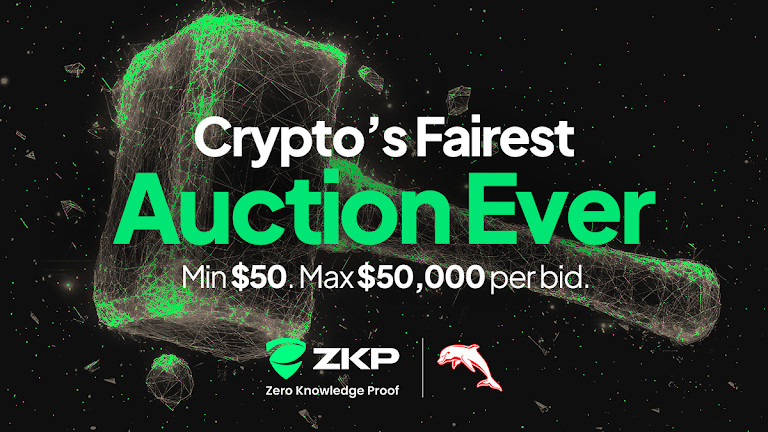
Zero Knowledge Proof (ZKP) is gaining strong attention as the next big crypto, and a major reason is its live presale auction. The presale auction is built so that early contributors enter at lower prices, while the token lists higher once the auction phase closes. It works like a simple wholesale-versus-retail model: you buy during the auction at “wholesale,” and the market lists ZKP at a higher “retail” price later. That gap becomes your profit.

Each day releases a fixed number of 200 million ZKP coins, but demand will surge as more people discover the project. The earliest days usually see fewer buyers, which means lower prices. As the presale auction gains visibility, demand rises naturally, and so do the auction prices. Exchanges typically reference the highest-priced auction days when deciding the eventual listing range. This is why buying earlier in the auction often gives the strongest upside.

Profit is straightforward:

Profit = Listing Price – Presale Auction Price Paid.

For example, if someone joins early at $0.08 and the final auction days settle around much higher levels, the listing usually opens above that, creating instant gains. This price is only for illustration, and buyers should visit the website to check the day’s entry level, as it changes daily.

This is why buyers act now instead of waiting. Each day the supply tightens, more contributors join, and the price climbs. Today is usually cheaper than tomorrow, and tomorrow is cheaper than next week.

Text says - Presale Auction Live For Zero Knowledge Proof (ZKP)

The Proof Pods, which support the network’s AI compute layer, are also selling fast as contributors position themselves early. For many experts, ZKP’s presale auction structure, strong hardware system, and rising momentum make it one of the clearest contenders for the next big crypto.

Closing Thoughts

The Ethereum price is under pressure despite massive accumulation, showing that even institutional buyers cannot yet reverse the broader trend. The XRP price continues to weaken as sellers defend every bounce, leaving the token stuck beneath heavy resistance zones. 

In comparison, Zero Knowledge Proof (ZKP) is attracting rapid interest due to its presale auction model, where early contributors gain access to the lowest prices before the token lists a higher price. Proof Pods are selling quickly, auction participation is rising, and traders are paying close attention to the profit mechanics behind the model. 

But the majority of the market attention is centered on Zero Knowledge Proof. Early contributors are taking advantage of a presale auction model designed to reward them with maximum upside before the token lists at a higher price later.

ETH and XRP Lose Ground While Zero Knowledge Proof’s Live Presale Auction Gives Early Buyers the Biggest Profit Potential!

Join the Presale Auction Now:

Website: zkp.com

Disclaimer

In line with the Trust Project guidelines, please note that the information provided on this page is not intended to be and should not be interpreted as legal, tax, investment, financial, or any other form of advice. It is important to only invest what you can afford to lose and to seek independent financial advice if you have any doubts. For further information, we suggest referring to the terms and conditions as well as the help and support pages provided by the issuer or advertiser. MetaversePost is committed to accurate, unbiased reporting, but market conditions are subject to change without notice.

About The Author

Gregory, a digital nomad hailing from Poland, is not only a financial analyst but also a valuable contributor to various online magazines. With a wealth of experience in the financial industry, his insights and expertise have earned him recognition in numerous publications. Utilising his spare time effectively, Gregory is currently dedicated to writing a book about cryptocurrency and blockchain.

More articles

Gregory, a digital nomad hailing from Poland, is not only a financial analyst but also a valuable contributor to various online magazines. With a wealth of experience in the financial industry, his insights and expertise have earned him recognition in numerous publications. Utilising his spare time effectively, Gregory is currently dedicated to writing a book about cryptocurrency and blockchain.


Source link

NFTs in 2026: Market Catalysts Investors Should Watch | NFT News Today

0
NFTs in 2026: Market Catalysts Investors Should Watch | NFT News Today


NFTs have changed a lot in recent years, moving past the hype and misunderstandings that once defined them.

After their rapid rise in 2021, NFTs became associated with speculation, overvalued images, missed expectations, and short-lived trends. By 2024 and 2025, trading volumes dropped to multi-year lows. Many people left, but a dedicated group stayed and kept building as mainstream interest declined.

This slowdown might have been needed. Markets often need to cool off before they mature. As 2026 approaches, NFTs are at a turning point, much like crypto was 10 years ago: many people know about them, but trust and understanding remain limited.

The main question is not whether NFTs will return to their previous highs, but whether they can become something lasting and meaningful.

What Meaningful NFT Adoption Actually Looks Like

NFT adoption is not about everyone trading collectibles or flipping assets for profit. In reality, it is much more ordinary.

Meaningful adoption shows up when:

NFTs act as access keys, not status symbols

Ownership has ongoing utility, not a resale pitch

Users interact with NFTs without thinking about blockchains

In practice, this might look like millions of wallets holding NFTs linked to games, memberships, tickets, or real-world assets. Brands could issue NFTs without calling them NFTs, and institutions might use them for recordkeeping, tracking origins, or settling transactions rather than for speculation.

This type of adoption usually starts slowly and then accelerates. Nasdaq’s adoption curve shows that technologies take off when they reach about 8 to 10 percent of the market. NFTs are not there yet, but they are closer than most headlines suggest.

Several catalysts could push them forward by 2026.

Utility NFTs

The first NFT boom didn’t last because most NFTs lacked real use.

That’s changing.

Utility NFTs focus on access, permissions, and benefits. When you own one, you can actually use it for something. Its value comes from what it allows you to do, not just its rarity.

Examples already exist:

Event tickets that prevent counterfeiting and control resale

Membership NFTs that replace logins and subscriptions

Loyalty NFTs that evolve from points into tradable rewards

Large consumer brands are already trying out these ideas, often without much notice from crypto media. Starbucks’ early digital collectibles were an example of this trend. By 2026, these assets are expected to be more flexible, easier to transfer, and better integrated with everyday systems.

Analysts believe utility NFTs will become a major part of NFT activity as speculation decreases. The main risk is whether projects can keep their promises. Now, users expect projects to deliver, which was not always true in the past.

Blockchain Gaming

Gamers are already familiar with digital ownership. It is a regular part of gaming.

Players spend billions each year on in-game items they do not truly own. NFTs offer a new way, allowing assets to last beyond a single game or platform.

Early play-to-earn games failed because they focused on earning money rather than being enjoyable. Newer games prioritise gameplay, with ownership as a secondary feature.

By 2026:

Several AAA and AA studios are expected to launch NFT-enabled titles

Solana’s low fees support real-time asset trading

Ecosystems like Immutable and Ronin focus on sustainable economies

The best NFT games do not highlight NFTs in their marketing. Instead, they include them quietly. Players care about their items, progress, and identity, with ownership being just one feature among many.

There is still regulatory pressure, especially regarding gambling mechanics. Studios are responding by creating systems that focus on skill and scarcity instead of chance.

Metaverse Assets

The metaverse narrative burned hot and fast. What remains is quieter and more useful.

Persistent virtual spaces already host concerts, communities, and commerce. NFTs serve as the ownership layer for:

Avatars

Virtual land

Digital goods

Platforms like Roblox show that virtual economies can succeed without making big promises. Companies now focus more on keeping users engaged than on adding flashy features.

By 2026, improved interoperability will allow assets to move between different platforms. This flexibility helps NFTs remain valuable over time. Analysts believe metaverse NFTs could make up a large share of NFT sales, driven more by social uses than speculation.

Hardware adoption and platform fragmentation still limit growth. Progress continues, just slower and steadier than early forecasts suggested.

AI and the Rise of Adaptive NFTs

AI adds a new dimension to NFTs by allowing them to change over time.

Now, NFTs can change based on how people interact with them, data, or their environment, instead of always staying the same. Some early examples include:

Generative art that shifts with owner behavior

AI-driven characters that learn from conversations

Automated systems that manage royalties or permissions

Platforms experimenting with smart NFTs are focusing on creativity rather than just trading. By 2026, improved tools should make it easier for creators without technical backgrounds.

Marketplaces also benefit. AI helps users find assets that match their interests, rather than just following trends or what is popular on social media.

There are still concerns about authorship, bias, and energy use. As AI-native NFTs become more common, transparency is increasingly important.

Real-World Assets

NFTs gain credibility when they represent assets people already understand.

Turning real-world assets such as art, real estate shares, or luxury goods into NFTs connects digital ownership to real value. NFTs are effective here because they clearly track asset origins and ownership.

Platforms operating within legal frameworks already support these models. Institutions care about:

Liquidity

Transparency

Compliance

Some estimates suggest that trillions of dollars in assets could be moved onto blockchains over the next decade, with NFTs helping unlock assets that are hard to trade. Growth depends heavily on clear regulations, but pilot programs are still expanding.

This area appeals more to mainstream investors than crypto-native traders, which broadens the audience rather than recycling it.

Return of Institutional Capital

Unclear rules kept many institutions away from NFTs. That’s slowly changing.

Guidance after 2025 clarifies classifications and reduces uncertainty about enforcement. Institutions do not pursue collectibles; they invest through structured products.

Possible developments include:

Even small allocations could add significant liquidity. Regulation also helps reduce wash trading and extreme volatility. The trade-off is slower experimentation, but greater predictability attracts more capital.

Brand Adoption

Brands learned some tough lessons from their first NFT campaigns.

By 2026, enterprise use focuses on function:

NFTs operate behind the scenes. Consumers may never see the term. Deloitte estimates a significant share of major brands will integrate NFTs in some capacity.

Scarcity and relevance determine success. Mass drops without purpose fade quickly.

Infrastructure That Lowers the Barrier

Technology alone doesn’t drive adoption. People need to feel comfortable using it.

Key improvements include:

Ethereum Layer-2s and Solana continue competing rather than replacing each other. Fees fall. Onboarding improves. Mobile use increases.

Security is still a concern, especially with bridges. People prefer simpler systems.

Closing Thoughts

NFTs do not need another boom to succeed. They need to be integrated into everyday life.

By 2026, growth favors:

Assets with clear utility

Systems that blend into daily use

Markets that reward patience over hype

Mass adoption often starts slowly and then happens quickly. Progress in gaming, infrastructure, real-world assets, and institutional use shows that NFTs are moving closer to this stage.


Source link

RBI Deputy Governor: Crypto & Stablecoins are Threat to Monetary Stability

0
RBI Deputy Governor: Crypto & Stablecoins are Threat to Monetary Stability


Key Highlights

RBI says cryptocurrencies have no intrinsic value, issuer or promise to pay, and are driven purely by speculation.

Stablecoins could weaken monetary policy, banking stability and lead to dollarization, the RBI warns.

India is pushing a sovereign-backed digital rupee (CBDC) as a safer alternative to private crypto.

The Reserve Bank of India (RBI) has reiterated its hard line on private cryptocurrencies, with Deputy Governor T. Rabi Sankar saying they cannot be treated as money, currency or even genuine financial assets, but are essentially speculative pieces of computer code.

Addressing the Mint Annual BFSI (Banking, Financial Services and Insurance) Conclave 2025, Sankar cautioned that cryptocurrencies pose risks to monetary stability, fiscal policy and the wider financial system.

Crypto is not money, says RBI

Sankar said cryptocurrencies fail to meet the most basic features of money. “Cryptocurrencies have no intrinsic value. They are not backed by a promise to pay, and they have no issuer. Their value is purely speculative,” he said.

He explained that money derives its credibility from sovereign backing and public trust in a recognised issuer such as a central bank. “Currency or deposits carry a promise from a trusted issuer, and money derives its credibility from the sovereign that backs its value,” he said, adding that cryptocurrencies claim to redefine money while representing no underlying value at all.

According to Sankar, cryptocurrencies such as Bitcoin do not generate any underlying cash flows and therefore cannot be classified as financial assets. They are not even assets, he remarked, describing crypto as “just a piece of code.”

‘Pure gamble’, not investing

On whether cryptocurrency trading is comparable to gambling, the RBI deputy governor said unbacked cryptocurrencies amount to “pure gamble based on mathematical bets.” He noted that traders largely bet on price movements driven by events or sentiment rather than fundamentals.

Drawing a historical parallel, Sankar likened the crypto boom to the tulip mania of the 17th century, where prices were fuelled entirely by speculation.

His comments come against the backdrop of India’s tightening stance on speculative digital activities. The Promotion and Regulation of Online Gaming Act, 2025, enforced from October 1, 2025, led to a nationwide ban on real-money gaming applications, renewing debate over the nature of crypto trading.

Stablecoins lack basic attributes of money

Sankar also mounted a strong critique of stablecoins — cryptocurrencies designed to maintain a stable value, typically pegged to a fiat currency such as the US dollar.

Speaking at the BFSI conclave and later at a media interaction in Mumbai on December 12, 2025, he said stablecoins do not “appear to have” a promise to pay, which is a defining feature of sovereign currency.

“Stablecoins lack the basic attributes of money, their advantages are neither unique nor unambiguous, and their risks are all too real,” Sankar said.

Risks to monetary policy and financial stability

The deputy governor warned that widespread adoption of stablecoins could pose serious macro-financial risks, including currency substitution, dollarisation, and weakened monetary-policy transmission.

He said stablecoins fail to satisfy the two defining features of modern money — fiat status and singleness. “It is possible that in a stablecoin system, there would be hundreds, or more, of currencies in an economy, making any such system inherently unstable,” Sankar said.

Stablecoins, he added, are ultimately private money and do not carry the sovereign backing that underpins trust in fiat currencies. He questioned whether they even constitute a clear liability of their issuers, noting that “neither of the two major cryptocurrencies in use today makes such unconditional promise” to redeem at par.

Sankar cautioned that large-scale adoption could divert deposits away from banks, raise funding costs and increase reliance on central-bank liquidity, thereby weakening banking intermediation and increasing systemic risk.

Claimed benefits ‘largely unproven’

Dismissing claims that stablecoins offer superior payment efficiency or financial inclusion, Sankar said such benefits remain largely unproven.

India’s domestic payment systems, including the Unified Payments Interface (UPI), already provide fast, low-cost, and reliable digital payments, he said. In contrast, stablecoins are largely confined to facilitating trading and leverage within the crypto market itself.

Legal status of crypto in India

In India, cryptocurrencies are not recognised as legal tender and continue to operate outside any specific regulatory framework. Although people are permitted to buy, sell, and hold crypto assets, such transactions attract steep taxes, reflecting the government’s effort to limit their spread without imposing an outright ban.

Union Commerce Minister Piyush Goyal has reiterated that private cryptocurrencies do not have the government’s backing, saying they lack both sovereign support and any tangible underlying assets.

RBI pushes CBDC alternative

The Government of India and the Reserve Bank of India are instead focusing on a central bank digital currency (CBDC) as a safer option, with the digital rupee — backed by the sovereign, aimed at delivering the convenience of digital payments while preserving monetary stability.

The RBI began pilot trials of its CBDC around three years ago, in line with similar initiatives undertaken by other central banks globally.

Global contrast and continued caution

Sankar said sovereign currencies derive their strength from the backing of central banks worldwide and institutions such as the International Monetary Fund (IMF), a support system that gives them credibility, something private digital tokens do not have.

He noted that although some countries have adopted a more permissive approach — citing the United States, where President Donald Trump has signed an executive order placing Bitcoin within a reserve framework — Indian regulators remain wary, pointing to the steady rise in crypto-related scams and fraud cases.

Reiterating the RBI’s position, Sankar said cryptocurrencies neither function as money nor qualify as genuine financial assets, warning that their unchecked growth could pose serious risks to economic and financial stability.

Also Read: India Cracks Down on Crypto Traders with 44,000 Tax Notices


Source link

10 Tools That Will Give Crypto Traders A Predictive Edge In 2026

0
10 Tools That Will Give Crypto Traders A Predictive Edge In 2026


In Brief

By 2026, crypto traders combine on-chain analytics, sentiment, social data, and metrics with technical tools to gain a predictive edge in forecasting price movements, liquidity events, and market cycles.

10 Tools That Will Give Crypto Traders A Predictive Edge In 2026

By 2026, markets have become more efficient, cycles shorter, and volatility sharper. As a result, the leading-edge traders don’t just rely on charts or news; they harness on-chain analytics, social & sentiment data, fundamental metrics, and real-time flows to forecast price moves, liquidity events, or sentiment-driven pumps.

Below are ten of the most powerful, widely used tools that give intermediate-to-advanced crypto traders a predictive edge.

10 Tools That Will Give Crypto Traders A Predictive Edge In 2026

Nansen remains a top-tier analytics platform for traders aiming to spot what “smart money” — whales, funds, and heavy DeFi investors — is doing. With its extensive wallet-labeling database, real-time dashboards, and alerts, Nansen lets you trace large token transfers, exchange inflows/outflows, and early liquidity moves in new protocols.

Its strengths lie in:

Wallet labeling — assigning real-world identity to wallets (exchanges, funds, whales, insiders), enabling deeper analysis of who moves what.

Smart-money alerts and flows — you can get notified when labeled wallets make significant transfers, which often precede large price swings or liquidity shifts.

DeFi and NFT dashboards — useful for spotting rising interest or accumulation before public hype kicks in.

For traders who want early-warning signals — e.g., token inflows to exchange that may presage dump pressure, or accumulation in an obscure DeFi project before volume surges — Nansen often provides the earliest reliable clues.

10 Tools That Will Give Crypto Traders A Predictive Edge In 2026

Glassnode is widely regarded as one of the most sophisticated on-chain analytics platforms: it offers a library of over 1,200 metrics for Bitcoin, Ethereum and other major networks — far beyond what most platforms offer.

Key features that give traders a predictive advantage:

Network health & supply metrics — including active addresses, exchange inflows/outflows, realized cap, HODL waves, etc. These help gauge long-term conviction or distribution phases.

Cycle/timing indicators — metrics like SOPR (spent output profit ratio), MVRV, supply dormancy and other cohort-based data help forecast potential tops or bottoms.

Exchange flows & liquidity shifts — large exchange outflows often signal accumulation, while inflows can precede sell-pressure. Tracking these ahead of large moves helps prepare positions. 

Institutional-grade desks, funds, and seasoned traders increasingly treat Glassnode as a core macro-cycle toolkit — using on-chain data to time entries or exits around broader market cycles, not just token-by-token moves.

10 Tools That Will Give Crypto Traders A Predictive Edge In 2026

Sentora offers a curated selection of machine-learning powered indicators and token-level analytics that help traders gauge risk, holder composition, and potential price moves.

Among its most useful tools:

Holder concentration and “In/Out of the Money” (IOM) analysis — gives an idea of how many holders are currently above or below their entry price, and where concentration lies. Good for spotting potential resistance or dump zones.

Large transactions monitoring and exchange flow tracking — helps detect whale moves or mass sells, often before prices react.

Cross-chain and derivatives sentiment overlays — offering a broader picture beyond just spot data, which is useful in a multi-chain 2026 environment.

For active traders or swing traders eyeing mid-term moves, IntoTheBlock provides a rapid “health check” of tokens: whether they look undervalued, overbought, too concentrated among a few wallets — insights that many only glean after major moves.

10 Tools That Will Give Crypto Traders A Predictive Edge In 2026

Sentiment and social signals increasingly matter in crypto — where narrative-driven pumps, hype cycles, and community sentiment often lead price moves. Santiment blends on-chain data with social media traction and developer activity to provide a holistic sentiment picture.

What stands out:

Social dominance and mention volume tracking — sudden increases in social mentions or hype about a coin often precede momentum rallies or “pump phases.” Santiment surfaces those changes quickly. 

On-chain + social overlay — combining wallet activity with social sentiment, ideal for spotting when token flows and chatter align — a strong sign of grassroots momentum.

Developer activity & network health metrics — for more fundamental signals, not just hype, giving a more nuanced view of token prospects beyond price charts. 

This makes Santiment powerful for prognosticating “hype phases,” potential pumps, or early signs of retail FOMO — useful especially for altcoin traders and those playing narrative-driven cycles.

10 Tools That Will Give Crypto Traders A Predictive Edge In 2026

Not all useful tools come from on-chain data. For traders concerned with order-book depth, liquidity, slippage risk, derivatives volumes or market microstructure, Kaiko delivers institutional-level datasets.

Key functionalities:

Historical order-book & exchange-level trade data — helps quantify liquidity, slippage potential, and likely move size before placing large trades.

Derivatives data, funding rates, and index data — giving insight into market positioning, leverage build-up or unwind, which often precede volatility spikes.

Microstructure & cross-exchange liquidity mapping — for traders executing larger orders or arbitrage across exchanges, this allows mitigation of slippage and better entry/exit timing.

For experienced traders — institutional or retail — Kaiko’s data remains indispensable when precision, liquidity management, or risk modeling matters more than speculative sentiment.

10 Tools That Will Give Crypto Traders A Predictive Edge In 2026

While on-chain and sentiment data tell a lot, solid fundamental analysis remains key — especially for medium to long-term bets or assessing protocol health. Messari Pro combines market data, tokenomics, project fundamentals, and curated research — offering a “Bloomberg-style” insight suite for crypto.

What makes it valuable:

Tokenomics and protocol financials — fees, revenue, user growth, market cap vs value metrics, giving better relative valuations.

Sector & ecosystem screening — allows investors to spot emerging trends (DeFi, Layer-2s, staking protocols) before they become mainstream. 

Governance & risk research — useful when evaluating long-term holds, project stability or token-based fundamentals rather than pure technical or sentiment plays.

For traders and investors who want to go beyond hype or short-term moves and evaluate structural strength — especially when entering new tokens or protocols — Messari Pro gives a grounded, data-driven backbone to decisions.

10 Tools That Will Give Crypto Traders A Predictive Edge In 2026

Token Terminal brings traditional finance metrics to crypto protocols — acting like a financial-statement dashboard for DeFi projects, DAOs, and token-based ecosystems. 

Traders and investors often use it to:

Track protocol revenue, fees, user growth, and value accrual — essential for assessing sustainability or long-term value beyond speculation.

Run relative valuation analyses — comparing similar protocols based on fees, users or revenues rather than mere tokenomics or market cap.

Spot undervalued or under-loved protocols — sometimes projects with strong revenue but low market attention can be opening for savvy investors.

For traders with a medium- to long-term horizon, this kind of fundamental-on-chain hybrid analysis can identify gems that hype-driven traders may overlook.

10 Tools That Will Give Crypto Traders A Predictive Edge In 2026

DeFiLlama remains the go-to platform for tracking total value locked (TVL), liquidity migrations, yield-farming dynamics, and cross-chain protocol data. 

For active DeFi traders or yield-hunters, its predictive advantages include:

Real-time TVL & liquidity tracking across protocols and chains — enabling early detection of capital flows before volume or price moves follow.

Comparative yield and protocol-ranking data — helpful in deciding where to allocate capital ahead of yield cycles or incentives.

Insight into capital rotations among ecosystems — when capital leaves one protocol or chain and flows into another, often preceding token rallies or shifts in dominance.

For yield-focused or liquidity-sensitive traders, DeFiLlama provides early signals of where the smart capital is flowing — occasionally before price charts reflect it.

TradingView + Community & Custom Scripts

10 Tools That Will Give Crypto Traders A Predictive Edge In 2026

Even in 2026, technical analysis remains a core part of many trading strategies — but tools like TradingView have evolved beyond static charting. With extensive community scripts, custom indicators, and integration with other data sources, TradingView remains a central hub for chart-based prediction.

Why it remains essential:

Hundreds of built-in indicators and charting styles — from simple moving averages to complex overlays, giving flexibility for scalpers, swing traders, and long-term players.

Custom community scripts & strategy sharing — traders can integrate on-chain, sentiment, or external data sources into charting routines for hybrid analysis.

Alerts, watchlists, and multi-asset support — making it easy to monitor many assets across spot, futures, or derivatives in a unified interface. 

For many traders, combining on-chain insights or fundamental data from other tools with TradingView’s charting remains the most flexible, quick way to act on predictions or signals.

Hybrid Approach: Combining Tools — The Real Edge in 2026

While each of the tools above offers a specific type of insight — on-chain flows, sentiment, protocol fundamentals, liquidity data, or technical charts — the real predictive edge comes from blending them.

For example:

Spot a large wallet accumulation via Nansen → check protocol fundamentals in Token Terminal → verify liquidity shifts on DeFiLlama → use TradingView for entry points.

Use Glassnode to assess macro-cycle bullish conditions → cross-check order-book depth and funding rates via Kaiko → monitor sentiment spikes in Santiment to time entries.

Many sophisticated traders now treat data like a mosaic: no single indicator, chart or report tells the full story — but together they build a probability-weighted view of likely moves.

Disclaimer

In line with the Trust Project guidelines, please note that the information provided on this page is not intended to be and should not be interpreted as legal, tax, investment, financial, or any other form of advice. It is important to only invest what you can afford to lose and to seek independent financial advice if you have any doubts. For further information, we suggest referring to the terms and conditions as well as the help and support pages provided by the issuer or advertiser. MetaversePost is committed to accurate, unbiased reporting, but market conditions are subject to change without notice.

About The Author

Alisa, a dedicated journalist at the MPost, specializes in cryptocurrency, zero-knowledge proofs, investments, and the expansive realm of Web3. With a keen eye for emerging trends and technologies, she delivers comprehensive coverage to inform and engage readers in the ever-evolving landscape of digital finance.

More articles

Alisa, a dedicated journalist at the MPost, specializes in cryptocurrency, zero-knowledge proofs, investments, and the expansive realm of Web3. With a keen eye for emerging trends and technologies, she delivers comprehensive coverage to inform and engage readers in the ever-evolving landscape of digital finance.

More articles


Source link

Popular Posts

My Favorites

Tori Spelling Recalls Going on a Date With ‘Intelligent’ Charlie Sheen

0
Tori Spelling is opening up about her experience dating infamous Hollywood bad boy, Charlie Sheen. As Sheen’s life is put under the spotlight thanks...