Metaverse

Home Metaverse Page 6

The AI Resurrection of Val Kilmer and the Future of Cinema | Metaverse Planet

The AI Resurrection of Val Kilmer and the Future of Cinema | Metaverse Planet


I still can’t believe what I just read. Hollywood isn’t just making movies anymore; they are literally raising the dead with AI.

When I first found out that the legendary Val Kilmer was being digitally cloned for the new movie As Deep as the Grave, my jaw completely dropped. I had to sit back, refresh the page, and make sure I wasn’t reading some elaborate sci-fi fan fiction. I mean, sure, the family gave their official permission, and the legal teams have everything signed in ink, but I can’t stop thinking about how inherently creepy this entire concept is.

I am seriously wondering if the future of cinema will just be digital ghosts instead of real, living, breathing actors. As someone who spends hours every day diving into the latest tech and metaverse developments, I honestly find this both incredibly fascinating and completely terrifying. Let’s really break down what is happening behind the scenes, why studios are pushing for this, and what it means for the movies we love.

The Evolution of the Digital Clone

We need to clear something up right away: this is not just advanced CGI. For years, we’ve seen Hollywood use digital de-aging or body doubles to finish a film when tragedy strikes mid-production. But what I am looking at now is an entirely different beast. We have crossed the line from visual effects into generative AI resurrection.

When I researched the tech stack being used for these new projects, I was blown away by the sheer computational power involved. Studios are no longer just mapping a 3D face onto a stunt double. They are feeding decades of a human being’s life into neural networks.

The Mechanics Behind the Magic

Here is what goes into creating a modern “Digital Ghost”:

Volumetric Facial Mapping: AI doesn’t just copy a face; it learns it. Algorithms scan thousands of hours of old footage to understand exactly how an actor’s specific muscles moved, how their eyes reacted to different lighting, and the exact asymmetry of their smile.Neural Voice Synthesis: Audio models are trained on past interviews, movie dialogue, and even outtakes. The AI learns the exact timbre, breathing patterns, and emotional inflection of the actor. We saw a touching, early version of this with Val Kilmer in Top Gun: Maverick, but the technology I am seeing now has leaped lightyears ahead.Behavioral Emulation: This is the part that gives me chills. The newest algorithms attempt to predict how an actor would deliver a line they never actually read, mimicking their unique artistic choices and mannerisms.

As a tech enthusiast, I have to applaud the raw engineering behind this. It is a modern miracle of data processing. But as a guy who loves going to the movies? It makes my stomach tie in knots.

The Ethical Tightrope: Who Owns a Legacy?

The loudest argument defenders of this technology use is consent. For As Deep as the Grave, Val Kilmer’s estate signed off. They gave the green light, and they are compensated for it.

But I keep asking myself: does legal permission automatically make it artistically ethical?

When a human actor delivers a performance, they are making hundreds of micro-decisions based on their lived experience, their mood that morning, and the unscripted chemistry they share with their co-stars. A digital clone doesn’t feel any of that. It just computes the most statistically probable facial expression based on a dataset.

Are We Buying Tickets for a Parlor Trick?

If I go to the theater to watch a digitally cloned legend, what am I actually paying for?

Pure Nostalgia Bait: Am I just being emotionally manipulated by my love for an actor’s past work?A Technical Showcase: Am I marveling at the AI rendering rather than actually engaging with the emotional core of the story?The Erasure of New Talent: This is my absolute biggest fear.

Why would a major movie studio take a multi-million dollar financial risk on an unknown, rising actor when they can just license the digital likeness of a proven box-office legend? Think about it from a corporate perspective: a digital ghost never ages, never demands a bigger trailer, never gets involved in a PR scandal, and never goes on strike.

This isn’t a sci-fi hypothetical anymore. When I followed the recent SAG-AFTRA strikes, this exact nightmare scenario was at the heart of the protests. Actors were literally fighting on the picket lines for the right to own their own faces.

The Metaverse Connection: Immortal IP

Since we talk about the Metaverse a lot here, I can’t ignore how this AI cloning tech ties into virtual worlds. We are standing on the edge of a massive paradigm shift in how entertainment IP is handled.

I can easily imagine a future—maybe only five or ten years from now—where you put on a VR headset and act alongside a digitally resurrected Marlon Brando, Marilyn Monroe, or Heath Ledger in a fully interactive metaverse environment.

The companies that own the rights to these digital likenesses are going to make an absolute fortune licensing these AI ghosts out for:

Immersive VR Video GamesInteractive Digital MoviesVirtual Brand Ambassadors The potential for monetization is endless. But while the business model is brilliant, the cultural impact feels a bit hollow. We are turning human beings into software updates.

Finding Our Bearings in the Uncanny Valley

I am genuinely torn. Part of me is eager to see As Deep as the Grave just to witness the sheer capability of this technology on the big screen. I want to see if the AI can actually make me feel genuine emotion, or if I’ll just feel like I’m staring at a highly rendered video game character pretending to be a Hollywood legend.

But the other part of me feels like we are opening Pandora’s Box. Once mainstream audiences accept digital ghosts as leading men and women, the film industry will never be the same.

I love the beautiful, messy unpredictability of human acting. I love seeing an actor make a strange, weird choice that no algorithm could ever predict. I love the happy accidents that happen on a chaotic movie set. AI can perfectly mimic the past, but I am not convinced it can create the raw, emotional lightning in a bottle that makes true cinematic magic.

I’ve been reading the early reactions online, and the internet is completely split down the middle. Some people are calling it a beautiful, touching tribute to immortalize our favorite stars, while others are calling it straight-up digital necromancy.

I will be reading all the comments because I really need to know which side to choose in this technological revolution!

So, be honest with me: If your absolute favorite actor passed away tomorrow, would you buy a ticket to see their AI clone star in a brand-new movie, or should we let sleeping legends lie?

You Might Also Like;


Source link

Kelp DAO Bridge Drained for $292M in 2026’s Biggest DeFi Hack

Kelp DAO Bridge Drained for 2M in 2026’s Biggest DeFi Hack


An attacker exploited Kelp DAO’s LayerZero bridge, draining 116,500 rsETH worth $292 million
The stolen funds were redeployed as collateral on Aave, Compound, and Euler to borrow 74,000 ETH
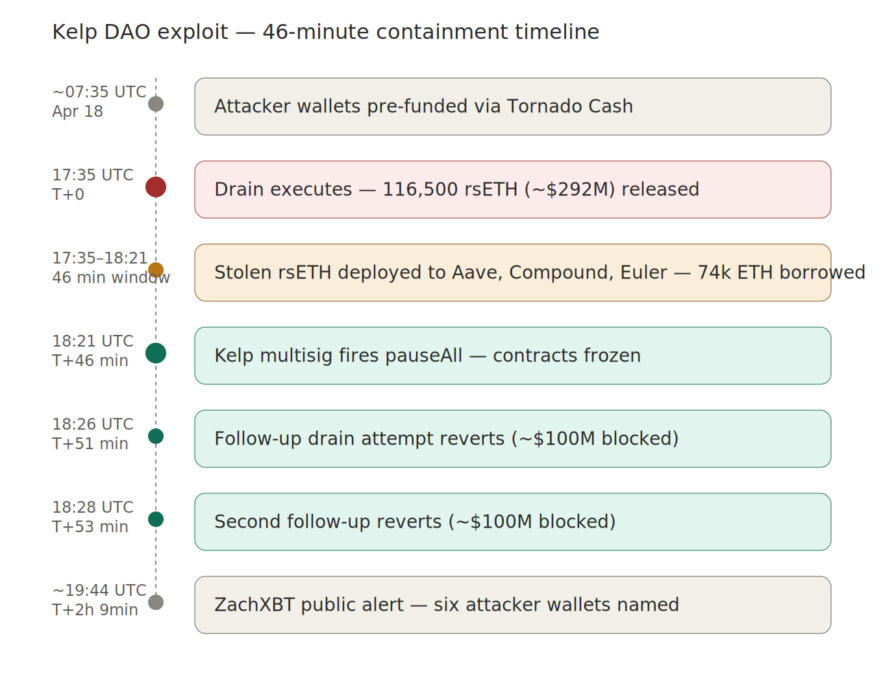
Kelp’s emergency multisig paused contracts 46 minutes later, thwarting follow-up drain attempts worth $200 million

Kelp DAO, one of the largest liquid restaking protocols in the EigenLayer ecosystem with over $1 billion in TVL before Saturday, has been hit with the biggest DeFi exploit of 2026. At 17:35 UTC on April 18, an attacker walked away with 116,500 rsETH, roughly $292 million and about 18% of the token’s entire circulating supply in a single transaction targeting Kelp’s LayerZero-powered cross-chain bridge.

Blockchain sleuth ZachXBT was first to flag the drain publicly on his Investigations Telegram channel around 2:52 PM ET. Within minutes, the rest of DeFi security accounts on X were piling on. From Cyvers and PeckShield to SlowMist, all confirming the worst. Security firm Cyvers revealed that the attacker had been pre-funded via Tornado Cash roughly 10 hours before the exploit, which is about as textbook as laundering prep gets.

By the time Kelp DAO posted its first public acknowledgment on X, the attacker had already moved on to the second stage of the heist.

What actually got hit

The target was Kelp’s Omnichain Fungible Token (OFT) adapter on Ethereum, the contract that holds the reserve rsETH backing every wrapped version of the token on 20+ Layer-2 chains. That list includes Arbitrum, Base, Blast, Linea, Mantle, Scroll, Mode, Swellchain, Zircuit, Berachain, zkSync, and others.

The way it’s supposed to work: a user burns wrapped rsETH on, say, Arbitrum. LayerZero delivers a cryptographically verified message to Ethereum. Kelp’s adapter sees the burn, checks it, and releases the same quantity of real rsETH from the reserve. One-to-one, clean, verifiable.

Kelp Dao Attack | Source: The CryptoTimes

On Saturday, the verification step failed. The attacker “tricked LayerZero’s cross-chain messaging layer into believing a valid instruction had arrived from another network, which triggered Kelp’s bridge to release 116,500 rsETH to an attacker-controlled address.” One forged lzReceive call. No burn on the other side. No deposit. Just a packet that said “release the funds” — and the contract obliged.

What exactly broke? Kelp hasn’t said. The three plausible root causes are a DVN (Decentralized Verifier Network) misconfiguration accepting a forged packet, an OApp peer-mapping flaw trusting messages from an unauthorized source chain, or — worst case — an admin key compromise that let the attacker change the adapter’s config directly. Each one implies a very different fix, and until Kelp publishes an RCA, everyone else using LayerZero OFTs is operating on guesswork.

The second hack inside the first

Here’s what makes this one different from your standard bridge drain: the attacker didn’t just cash out and run.

Kelp DAO Attack Timeline
46 Minutes of Contamination | Source: The CryptoTimes

Within minutes of the drain, the stolen rsETH was deposited as collateral on Aave V3, Compound V3, and Euler across Ethereum and Arbitrum. Against that collateral, the attacker borrowed roughly 74,000 ETH and WETH building over $236 million in debt positions across three major lending markets. One wallet reportedly ended up sitting on about $120 million in borrowed ETH from Aave alone.

Solidity auditor 0xQuit, watching the positions build in real time, cut through the noise with a single tweet: “If you have WETH on Aave V3 Core, withdraw now.”

The trick here is sinister but simple. The attacker posted collateral whose redemption claim he himself had just stolen. The rsETH contract verifies normally. The price oracle quotes it at full value. To Aave, Compound, and Euler, it looks like legitimate collateral worth $292 million. Except the real rsETH backing it is already in the attacker’s wallet.

This is the mechanic that turns a bridge hack into cascading bad debt across DeFi. The $292M drain was just the entry ticket. The $236M+ borrow was the actual payout — because ETH is cleaner, more liquid, and not frozen behind a pause button.

What saved another $200M?

Kelp’s emergency pauser multisig finally triggered at 18:21 UTC — 46 minutes after the initial drain. The pause hit the LRT Deposit Pool, the Withdrawal Module, the LRTOracle, and the rsETH token contract itself. Everything froze.

And it’s a good thing it did. At 18:26 and 18:28 UTC, two follow-up transactions tried to drain another 40,000 rsETH each — roughly $100 million a pop. Both reverted. The pause held.

Without those 46 minutes of response time, total losses could have pushed near $391 million. The containment worked. The problem is that by the time the pause fired, the secondary attack on Aave, Compound, and Euler was already complete. You can’t unwind a loan that’s already been issued.

The contagion list is long

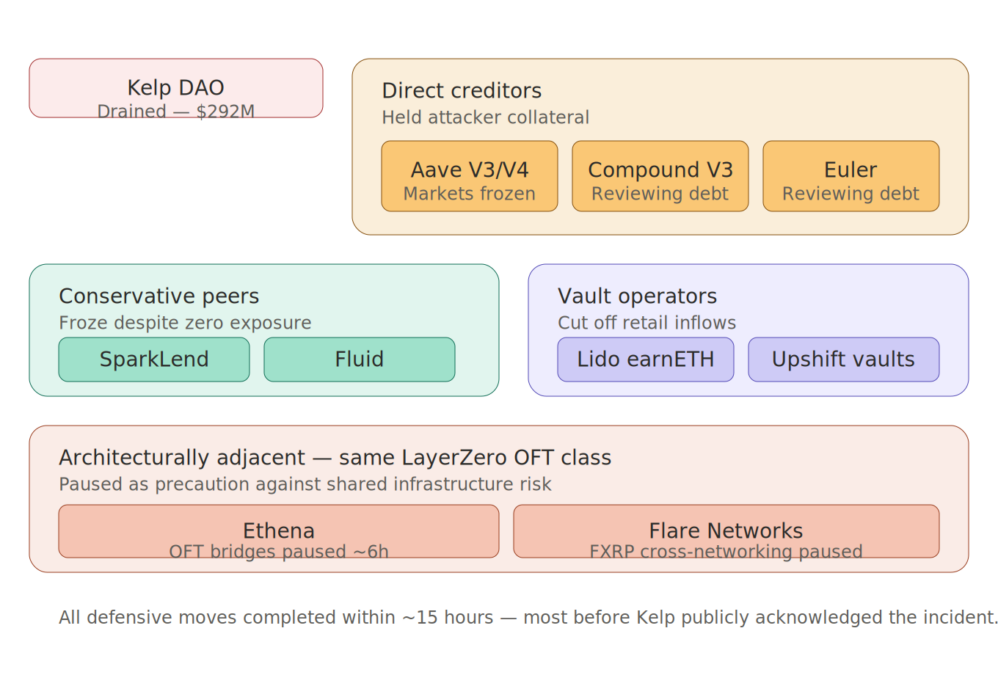
rsETH isn’t just a token. It’s a composable piece of DeFi infrastructure embedded in dozens of protocols. Once the exploit went public, the defensive freezes started rolling in fast.

Kelp Dao Contagion Map
Kelp Dao Contagion Map | Source: The CryptoTimes

Aave froze rsETH markets on V3 and V4. Founder Stani Kulechov posted on X that Aave’s own contracts were not compromised and that the freeze was precautionary.

SparkLend and Fluid froze their rsETH markets. SparkLend reported zero actual exposure, crediting its conservative risk posture.

Lido Finance paused deposits into its earnETH vault, which carries rsETH exposure — while stressing that stETH and wstETH are completely unaffected.

Ethena temporarily shut down its own LayerZero bridges from Ethereum mainnet for roughly six hours, despite having no rsETH exposure.

Flare Networks paused FXRP cross-networking via OFTs between Flare, Ethereum, Base, and other supported networks the following morning.

Upshift paused its High Growth ETH and Kelp Gain vaults.

AAVE the token fell about 10–13% on the day as the market priced potential bad debt. ETH dipped around 3% in the same window. stETH and wstETH took mild sympathy hits around 4% before recovering.

Where’s the money now?

The six attacker wallets identified by ZachXBT sit across Ethereum and Arbitrum, holding a mix of rsETH, ETH, and WETH. As of April 19, none of it has moved to centralized exchanges. None of it has been pushed through Tornado Cash beyond the initial gas funding. No sanctions labels have been applied by OFAC or any other agency.

That’s unusual. Most exploiters in 2026 either move to mixers within hours or start testing CEX deposits to see what gets frozen. This one is just sitting. Which could mean a few things: the attacker is waiting out the initial attention, negotiating quietly, or — less charitably — figuring out which mixer still works after a year of aggressive OFAC designations.

What hasn’t happened yet is notable too. No white-hat bounty offer has been posted by Kelp as of this writing. No on-chain negotiation message to the attacker. No confirmed freezes at Binance, Coinbase, OKX, or Kraken. No public engagement with Chainalysis, TRM Labs, or law enforcement — or at least, nothing disclosed. The Euler ($197M, 2023), Poly Network ($611M, 2021), and KiloEx playbooks all involve some combination of those moves within 24–48 hours. Kelp is past that window and still quiet.

Kelp’s track record doesn’t help

This isn’t Kelp’s first rodeo. In July 2024, a GoDaddy domain-redirection attack hijacked the Kelp DAO frontend, draining multiple user wallets before the team caught it. Kelp pledged reimbursement and said it would move DNS providers. In April 2025, a fee-contract bug triggered a precautionary Aave freeze — no user losses that time, but it rattled confidence.

Saturday’s $292M drain is the third incident in under two years. The protocol has been audited by SigmaPrime, Code4rena, and MixBytes, and runs an Immunefi bug bounty capped at $250,000 (10% of funds at risk, with a $100K minimum for critical smart contract bugs). None of that stopped this one.

The pattern isn’t fatal plenty of blue-chip DeFi protocols have had multiple incidents and recovered — but it changes the recovery narrative. Kelp doesn’t get the benefit of the doubt this time. Users and integrators will want to see the full RCA, a concrete remediation plan, and ideally some form of compensation structure before trust rebuilds.

Where things stand right now

As of April 19, Kelp DAO’s contracts remain paused. No RCA has been published. No reimbursement plan has been announced. The attacker still holds the ~74,000 ETH. Aave, Compound, and Euler are still sitting with attacker-opened debt positions that they may or may not be able to cleanly liquidate.

The next 72 hours will tell us three things: whether rsETH’s peg survives when redemptions resume, whether the lending markets can absorb the bad debt without governance intervention, and whether anyone at Kelp can explain what actually broke.

This story is still developing. We’ll keep tracking the attacker wallets, any law enforcement updates, and whatever Kelp eventually puts in the RCA.

Also Read: Aave V4 Witnesses Accelerating Traction Just After Mainnet Launch


Source link

BTC, ETH, XRP Dips Following Strait of Hormuz Closure 

BTC, ETH, XRP Dips Following Strait of Hormuz Closure 


Key Highlights

Cryptocurrencies, such as Bitcoin, Ethereum, and XRP, fell due to geopolitical tensions associated with the Strait of Hormuz closure.

Overall markets showed signs of weakness, with the CoinMarketCap 20 Index falling more than 2.8% within 24 hours.

Increased tensions between Iran and the United States created a risk-off sentiment in global markets.

The cryptocurrencies markets registered a dip on April 18, 2026, due to geopolitical tensions that arose from the closing of the Strait of Hormuz, an important passage for oil worldwide. The event led to risk-off sentiment and affected the performance of top digital currencies. 

Iran has closed the Strait of Hormuz once again, referring to the decision as a response to a continued blockade of its ports by the US, as reported by Al Jazeera. 

Based on data from CoinMarketCap, the CoinMarketCap 20 Index (CMC20) was at $154.99, indicating a decrease of 0.07% in the last hour and 2.83% in 24 hours. 

Top crypto tokens | Source: CoinMarketCap

Bitcoin (BTC), the biggest cryptocurrency in terms of market cap, recorded a price of $75,891.40, a fall of 0.14% in the last hour and 1.95% in 24 hours. Market cap was around $1.52 trillion, backed by the trade volume of over $30 billion over the last 24 hours. 

Ethereum (ETH) was valued at $2,361.22, indicating a fall of 0.29% in the last hour and 3.03% over the day. XRP was valued at $1.43, with a decrease of 0.30% in the last hour and 3.94% over 24 hours but an increase of 5.87% over the week.

Stable coins such as USDT and USDC were seen trading at parity values of $1.00 and $0.9996, respectively. This was meant to provide a liquidity cushion during the move. BNB was quoted at $633.07 and experienced small losses on the hourly and daily charts.

More liquidation in the market 

According to the latest data provided by CoinGlass on its liquidation heatmap, total liquidations in the past 24 hours amounted to $263.50 million, impacting 161,235 traders. More losses were observed from long positions, as $192.06 million in liquidation came from them, whereas only $71.44 million came from short positions. 

BTC led all coins in terms of total liquidations, amounting to $62.00 million, followed by RAVE with $38.93 million and ETH with $47.02 million. Others accounted for $31.89 million in liquidation. Total long liquidations in the past 24 hours totaled $192.06 million, and short liquidations amounted to $71.44 million. 

Geopolitical tensions affecting the market

The Strait of Hormuz, which accounts for about 20-30% of all oil traded through maritime routes globally, has recently become the center of controversy between Iran and the US in recent times. There have been reports of the blockage of the strait, increasing the concern regarding supply problems, sending the price of oil up at times, and strengthening the dollar. 

Cryptocurrencies, which are considered to be risky assets at times of geopolitical tension and uncertainty, came under sell-off as traders moved towards safer assets or cash. Previously, geopolitical events in the region had impacted cryptocurrencies indirectly via factors such as inflation expectations, energy costs, and market sentiment. 

However, the market reacted positively yesterday when the news of the opening of the passage circulated over the market. 

Situation may influence the future moves 

Further events taking place in the Middle East may cause further short-term fluctuations in the crypto market. Even though cryptocurrency is considered a possible hedge when there is extended volatility, the current move shows similarities with what is happening in equities and traditional stocks. 

The situation in the Strait of Hormuz may influence future moves, as oil prices, the US dollar, and even statements from the government may provide new signs to follow. As per the data available at the moment, we have consolidation and weakness in the major cryptos.

Also Read: ARK Invest Sells Circle Shares as USDC Lawsuit Heats Up


Source link

Bitget IPO Prime Raises $72M, Oversubscribed Within Hours

Bitget IPO Prime Raises M, Oversubscribed Within Hours


Key Highlights

The IPO Prime campaign raised $72.36 million in a few hours and became oversubscribed quickly.

About 4,812 users joined, with high average investments of around $15K–$16K per person, meaning big capital per user.

The platform will switch to instant spot trading after closing on April 21, aiming to improve liquidity and faster access to funds.

Bitget, a crypto exchange, launched its IPO Prime campaign today, and it quickly pulled in $72.36 million within just a few hours.

In a post on X, CEO Gracy Chen said a total of 4,812 people joined the sale on the platform, with strong interest from users around the world. The offer reportedly became oversubscribed very fast, with more people wanting to invest than the available slots.

“Just a few hours after our IPO Prime launch, the campaign has raised $72.36 million and is already oversubscribed.” Chen posted on X. 

Fast money rush in hours due to high demand

The campaign drew strong interest due to limited slots, structured rewards, and early access opportunities, with funds flowing in rapidly as the sale opened. 

In just 1 hour and 30 minutes, the campaign had already raised $61.1 million and filled its soft cap. At that early stage, about 3,769 users had joined, which later increased 

The average amount invested by each person was between $15,000 and $16,255, meaning users were not just testing with small amounts but putting in serious funds. 

“Witness the first IPO spectacle in the crypto circle: raised $61.1 million in 1 hour and 30 minutes.” a post about the launch said. 

In a blogpost, Bitget also shared an update about how trading will work after the sale. The IPO Prime event is set to close at 8:00 PM (GMT+8) on April 21. Right after it ends, spot trading will start immediately.

At first, the plan was to use over-the-counter trading, but this was changed. The platform explained that instant spot trading will help increase liquidity and make it easier for users to access and use their funds without delay.

Extra rewards for participants

Alongside the main sale, Bitget introduced extra benefits for users who take part. From April 18 to April 21, participants can earn up to 6% APR on flexible USDT savings. 

This means users can earn small returns while holding their funds during the event period. Subscription for this savings product will open on April 20

There is also a reward pool of 500 TSLAON tokens that will be shared among users who increase their stablecoin balance to a certain level. New VIP users are also included, with offers like a 3% USDT savings coupon and access to higher-yield products with rates up to 10% APR.

BGB drop despite the news

On the market side, Bitget’s native token BGB doesn’t seem to react much to the new. In fact, it’s doing the opposite. 

Bitget token price chat | Source: CoinMarketCap

At press time, the token is trading for $1.85, representing a 2.65% drop in the last 24 hours. However, trading activity is up by 39% during this period reaching about $35.69 million in volume, while the market cap sits at $1.29 billion.

Also Read: Hyperliquid Posts $5.23M Revenue Day — Biggest Since February as Bitcoin Tops $77K


Source link

Bybit Report: Global Stocks Reach Record Highs as S&P 500 Surpasses 7,000 Milestone

Bybit Report: Global Stocks Reach Record Highs as S&P 500 Surpasses 7,000 Milestone


Sponsored

Stories and Reviews


April 17, 2026

Bybit Report: Global Stocks Reach Record Highs as S&P 500 Surpasses 7,000 Milestone

DUBAI, United Arab Emirates, April 17th, 2026, Chainwire

Bybit, the world’s second-largest cryptocurrency exchange by trading volume, reported that global stock markets have reached new record highs, led by a historic breakout in the S&P 500 and supported by synchronized gains across risk assets.

The S&P 500 closed above the 7,000 mark for the first time on April 15, a key psychological milestone and a historic high for the index. The benchmark has posted gains of approximately 7.8% month to date in April and about 2.9% year to date in 2026 (prior to market open on Friday, April 17), reflecting continued momentum in U.S. equities. The US benchmark stock index has continued to push higher following the upside breakout that Bybit Learn highlighted since April 6th, extending its streak of record highs.

The rally is part of a broader global trend. The MSCI All Country World Index, which tracks more than 2,500 stocks across developed and emerging markets, has climbed to a record level near 1,064, according to Bybit Learn’s analysis.

Major technology-driven indices have also advanced. The Nasdaq 100 has risen 10.9% in April and 4.3% year to date, with projections indicating potential further upside over the next 12 months. Meanwhile, the Taiwan RIC Index has surged 18.1% in April and 28.3% year to date, underscoring a strong rebound even in certain Asian equity markets. Taiwan’s stock market, valued at roughly $4.14 trillion, has overtaken the United Kingdom to become the world’s seventh-largest.

Beyond indices, individual equities have recorded significant gains. Shares of Bloom Energy have risen sharply, up 55% in April and 141.7% year to date. Several large-cap U.S. companies, including Morgan Stanley, Citigroup, Lam Research, Marvell Technology and Dell Technologies, have also reached new all-time highs in recent sessions, reflecting broad-based strength across sectors.

Han Tan, Bybit Chief Market Analyst, said, “The surge in global equities highlights sustained investor optimism that a US-Iran peace deal is at hand. Still, it remains to be seen whether overall market optimism will be matched by geopolitical realities.

The tide of record highs across major indices and individual equities underscores a period of heightened risk-on activity across global financial markets, with both traditional and digital asset ecosystems reflecting similar underlying sentiment. More details are available on the website. 

#Bybit / #CryptoArk / #BybitLearn

About Bybit

Bybit is the world’s second-largest cryptocurrency exchange by trading volume, serving a global community of over 80 million users. Founded in 2018, Bybit is redefining openness in the decentralized world by creating a simpler, open and equal ecosystem for everyone. With a strong focus on Web3, Bybit partners strategically with leading blockchain protocols to provide robust infrastructure and drive on-chain innovation. Renowned for its secure custody, diverse marketplaces, intuitive user experience, and advanced blockchain tools, Bybit bridges the gap between TradFi and DeFi, empowering builders, creators, and enthusiasts to unlock the full potential of Web3. Discover the future of decentralized finance at Bybit.com.

For more details about Bybit, please visit Bybit Press 

For media inquiries, please contact: [email protected]

For updates, please follow: Bybit’s Communities and Social Media

Contact

Head of PRTony AuBybit[email protected]

Disclaimer

In line with the Trust Project guidelines, please note that the information provided on this page is not intended to be and should not be interpreted as legal, tax, investment, financial, or any other form of advice. It is important to only invest what you can afford to lose and to seek independent financial advice if you have any doubts. For further information, we suggest referring to the terms and conditions as well as the help and support pages provided by the issuer or advertiser. MetaversePost is committed to accurate, unbiased reporting, but market conditions are subject to change without notice.

About The Author


Chainwire is the top blockchain and cryptocurrency newswire, distributing press releases, and maximizing crypto news coverage.

More articles


Chainwire is the top blockchain and cryptocurrency newswire, distributing press releases, and maximizing crypto news coverage.


Source link

GenZVerse Debuts a Transparent, Community-Led Web3 Platform with No Central Points of Control

GenZVerse Debuts a Transparent, Community-Led Web3 Platform with No Central Points of Control


GenZVerse Debuts a Transparent, Community-Led Web3 Platform with No Central Points of Control

Built on Polygon with immutable smart contracts, a public codebase, and fully on-chain governance, GenZVerse eliminates the founding team from the governance equation – by design, not by policy.

GenZVerse has debuted a decentralised Web3 platform that treats transparency and community leadership not as aspirational values but as structural requirements – features of the platform’s architecture that are verifiable by any participant at any time. Built on Polygon’s Layer 2 blockchain with immutable smart contracts and a fully open-source codebase, GenZVerse operates without central points of control and without a founding team that retains authority over community decisions.

The distinction between policy-based and architecture-based decentralisation is central to GenZVerse’s positioning. Policy-based decentralisation – in which a team commits to honouring community governance outcomes – is a trust proposition. It depends on the ongoing goodwill and integrity of the founding team. Architecture-based decentralisation – in which smart contracts enforce governance outcomes automatically and the founding team holds no structural override capacity – is a verifiable proposition. GenZVerse is built on the latter model.

Every significant platform decision is made through GenZVerse’s on-chain governance framework. Proposals are submitted publicly and visible to all community members from the moment of their creation. Votes are weighted by token participation and recorded immutably on the Polygon blockchain. Outcomes are executed by smart contracts without human mediation. The platform’s community treasury is governed by the same mechanism: no funds can be deployed without a successfully completed governance vote, and all treasury transactions are permanently visible on-chain.

“Transparency is not a communications strategy for us – it is a design constraint,” said a GenZVerse spokesperson. “Every decision the platform makes is visible. Every allocation of community funds is auditable. Every governance outcome is on-chain and permanent. We have built a platform where trust is established through verification, not through promises.” 

Beyond governance, GenZVerse is preparing to launch its Affiliate & Community Growth Program on April 21, 2026, designed to incentivise participation and accelerate ecosystem expansion. The initiative aims to build a highly engaged global community, with a long-term vision of reaching 1 million users within the next two years through structured referral mechanisms and reward-based engagement.

The platform’s open-source codebase and publicly auditable smart contracts extend this transparency to the technical layer. Any developer or community member can review the platform’s code, examine its smart contract logic, and verify that its operations are consistent with its stated principles. Discrepancies between the platform’s claims and its code are not a matter of interpretation – they are objectively detectable. This level of technical accountability is, in GenZVerse’s view, the minimum standard for a platform that claims to be genuinely decentralised.

GenZVerse’s five-year roadmap commits to a phased and accountable transfer of governance authority, culminating in full community autonomy by year five. The platform is live and open for participation at GenZVerse.ai 

ABOUT GenZVerse

GenZVerse is a Polygon-based, fully decentralised Web3 platform built to deliver sustainable community governance and demonstrable, real-world utility. Grounded in the principles of radical transparency, open-source development, and genuine community ownership, GenZVerse is engineering a self-sustaining digital ecosystem in which token holders exercise direct democratic control over the platform’s evolution  from governance proposals to treasury allocation and product roadmap. GenZVerse operates without central points of failure. Its codebase is fully open-source, its smart contracts are publicly auditable, and its governance is entirely on-chain. The platform is built on Polygon’s Layer 2 infrastructure providing fast, low-cost transactions that make participation accessible to communities worldwide, not merely to institutional actors. GenZVerse’s founding philosophy is captured in a single commitment: no hype, no promises, only transparent, community-driven development.

For further information, whitepaper access, and community onboarding, visit: https://GenZVerse.ai

Social Media Details:

Contact Details: 

Organisation: GenZVerseEmail: [email protected]Website: https://GenZVerse.ai

Disclaimer

In line with the Trust Project guidelines, please note that the information provided on this page is not intended to be and should not be interpreted as legal, tax, investment, financial, or any other form of advice. It is important to only invest what you can afford to lose and to seek independent financial advice if you have any doubts. For further information, we suggest referring to the terms and conditions as well as the help and support pages provided by the issuer or advertiser. MetaversePost is committed to accurate, unbiased reporting, but market conditions are subject to change without notice.

About The Author


Gregory, a digital nomad hailing from Poland, is not only a financial analyst but also a valuable contributor to various online magazines. With a wealth of experience in the financial industry, his insights and expertise have earned him recognition in numerous publications. Utilising his spare time effectively, Gregory is currently dedicated to writing a book about cryptocurrency and blockchain.

More articles


Gregory, a digital nomad hailing from Poland, is not only a financial analyst but also a valuable contributor to various online magazines. With a wealth of experience in the financial industry, his insights and expertise have earned him recognition in numerous publications. Utilising his spare time effectively, Gregory is currently dedicated to writing a book about cryptocurrency and blockchain.


Source link

Wall Street Deepens Crypto Push As Goldman ETF Filing And Quantum Debate Collide With Bitcoin’s Price Stagnation

Wall Street Deepens Crypto Push As Goldman ETF Filing And Quantum Debate Collide With Bitcoin’s Price Stagnation


In Brief

K33 highlights rising Wall Street crypto expansion, Goldman’s new Bitcoin ETF filing, and quantum security debates, as institutional momentum grows despite Bitcoin’s muted price action.

Wall Street Deepens Crypto Push As Goldman ETF Filing And Quantum Debate Collide With Bitcoin’s Price Stagnation

An institutional cryptocurrency research firm, K33, has published a market analysis highlighting accelerating involvement from major financial institutions in digital assets, alongside emerging technical and security discussions within the Bitcoin ecosystem. The report points to a growing disconnect between strong institutional momentum and relatively subdued price action in the market.

Among the developments cited is a new filing by Goldman Sachs for a Bitcoin-linked exchange-traded fund named the Goldman Sachs Bitcoin Premium Income ETF. Unlike spot Bitcoin ETFs that directly hold the asset, the proposed product is structured to gain exposure through other Bitcoin exchange-traded products and derivatives, including options tied to those instruments. The strategy also incorporates income generation by selling call options, allowing the fund to collect premiums while potentially limiting upside participation if Bitcoin prices rise beyond certain thresholds. This structure is positioned to appeal to investors seeking yield and moderated exposure rather than full price appreciation.

At the protocol level, discussions around long-term network security have intensified. A draft proposal, known as BIP-361, has been introduced to address potential risks posed by future advances in quantum computing. The proposal outlines a phased transition away from existing cryptographic signature schemes toward quantum-resistant alternatives. Given that a portion of Bitcoin wallets have exposed public keys, researchers have raised concerns that these could become vulnerable under sufficiently advanced quantum capabilities. The proposal suggests gradually restricting legacy address formats and, over time, invalidating transactions that rely on outdated cryptography, though debate continues regarding the urgency and feasibility of such measures.

Institutional Expansion Accelerates Despite Market Consolidation

The report also notes continued large-scale capital flows into Bitcoin through corporate structures. Strategy has expanded its use of preferred equity instruments, particularly its STRC issuance, as a funding mechanism for ongoing Bitcoin acquisitions. Trading activity in this instrument recently reached record levels, reflecting its increasing role in financing the firm’s accumulation strategy and broader capital-raising plans.

Institutional integration of digital assets is also advancing within traditional banking operations. Morgan Stanley has indicated that cryptocurrencies are becoming embedded in its day-to-day business, with growing demand across both direct exposure and ETF-based products. The firm is exploring further integration of blockchain infrastructure and tokenization, while navigating regulatory and operational challenges associated with incorporating these technologies into established financial systems.

More broadly, the report emphasizes that major financial institutions are expanding their presence across trading, custody, and asset management services tied to cryptocurrencies. This trend is supported by sustained trading volumes and fee generation opportunities, suggesting that the sector is increasingly viewed as a durable component of global financial markets rather than a short-term phenomenon.

Despite this structural expansion, Bitcoin has remained in a consolidation phase following a significant market downturn. The divergence between ongoing institutional adoption and muted price performance is highlighted as a notable feature of the current market environment, indicating that underlying developments may not yet be fully reflected in asset valuations.

Disclaimer

In line with the Trust Project guidelines, please note that the information provided on this page is not intended to be and should not be interpreted as legal, tax, investment, financial, or any other form of advice. It is important to only invest what you can afford to lose and to seek independent financial advice if you have any doubts. For further information, we suggest referring to the terms and conditions as well as the help and support pages provided by the issuer or advertiser. MetaversePost is committed to accurate, unbiased reporting, but market conditions are subject to change without notice.

About The Author


Alisa, a dedicated journalist at the MPost, specializes in crypto, AI, investments, and the expansive realm of Web3. With a keen eye for emerging trends and technologies, she delivers comprehensive coverage to inform and engage readers in the ever-evolving landscape of digital finance.

More articles


Alisa, a dedicated journalist at the MPost, specializes in crypto, AI, investments, and the expansive realm of Web3. With a keen eye for emerging trends and technologies, she delivers comprehensive coverage to inform and engage readers in the ever-evolving landscape of digital finance.


More articles


Source link

Miner Bitcoin Inflows to Binance Drop Sharply as Market Stabilizes

Miner Bitcoin Inflows to Binance Drop Sharply as Market Stabilizes


Miners reduced Bitcoin sales as prices stabilized above key support levels.
Production costs near $90,000 per coin led to negative margins for many operators.
Lower prices and rising costs triggered a record 32,000 BTC sale by publicly listed miners.

Bitcoin miners are easing off the sell button, sending a cautious signal of relief to a market that has spent much of 2026 clawing its way back from heavy losses.

On-chain data from CryptoQuant shows miner inflows of Bitcoin to Binance have dropped noticeably below the sharp spikes recorded in February and March. Those earlier surges—sometimes exceeding 23,000 BTC in short windows—coincided with periods of price weakness and heightened operational stress for mining operations. 

The latest readings point to reduced urgency to offload holdings on the exchange, a development that could hint at stabilizing conditions for an industry battered by lower prices and rising costs. 

Source: CryptoQuant

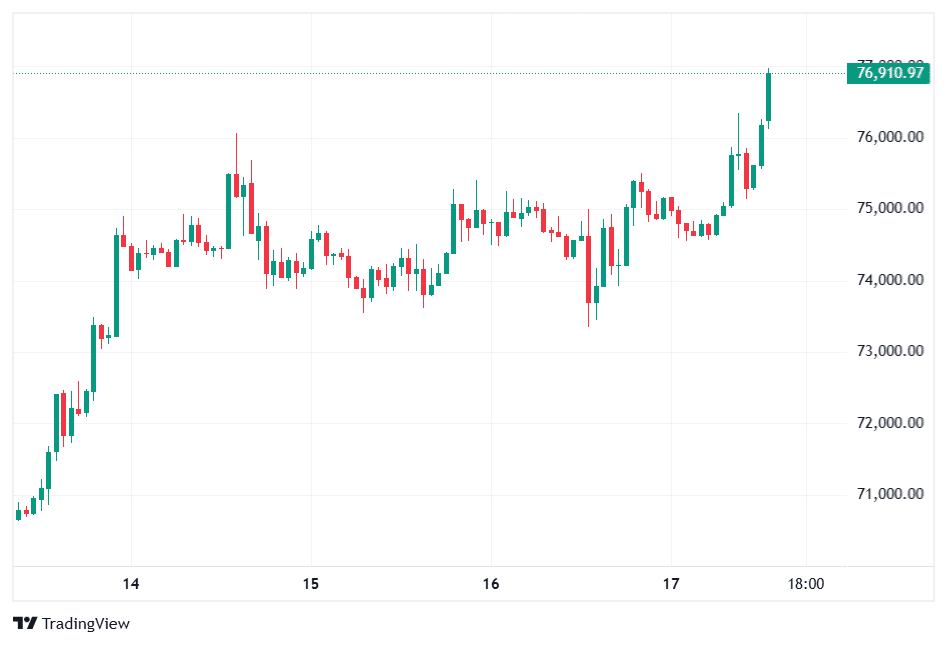
Bitcoin’s price trajectory tells a story of resilience amid volatility. After a bruising first quarter that saw the cryptocurrency shed roughly 23% from January highs near $87,500, BTC has staged a modest recovery in April. 

In the past 24 hours, it climbed 2.5% to trade at $76,800, levels not seen in past early February—as of CoinMarketCap data. 

BTC Price Chart - TradingView
Source: TradingView/CoinMarketCap

The connection between miner behavior and price action is straightforward: when BTC dipped into the $65,000–$70,000 zone earlier this year, many operators faced negative margins as production costs hovered near or above $90,000 per coin in some cases. 

Publicly listed miners responded aggressively, offloading more than 32,000 BTC in Q1 2026 alone—surpassing their total sales for all of 2025 and setting a new quarterly record. That wave of selling added measurable supply pressure at a time when the network’s hashrate also contracted, falling about 4–6% quarter-over-quarter as less efficient rigs were taken offline.

Now, with prices stabilizing above key support levels and some miners apparently holding more of their production, the reduced Binance inflows suggest a measure of capitulation may be easing. 

However, not all miners are behaving the same—some larger public players continued trimming treasuries while others, like certain North American operators, have focused on debt management and efficiency upgrades.

Broader exchange reserves have shown signs of tightening in spots, and institutional demand via spot Bitcoin ETFs has provided a counterweight to miner distribution.

Still, this is no all-clear signal. Hashrate remains elevated historically despite the recent dip, competition is fierce, and many operators continue shifting capital toward AI-related opportunities to diversify revenue. If Bitcoin fails to push convincingly toward $80,000 in the coming weeks, renewed selling could reemerge.

For now, the cooling in miner-to-exchange flows offers a tentative bright spot. It aligns with Bitcoin’s April rebound, suggesting the worst of the distress liquidation phase may be behind the sector—at least temporarily. 

Whether that translates into sustained upside will depend on broader risk sentiment, ETF inflows, and the network’s ability to absorb any lingering supply.

Also read: STRC — The $100 “Stable Stock” Fueling Strategy’s BTC Treasury


Source link

What’s New and Coming Next for Copilot and Teams

What’s New and Coming Next for Copilot and Teams


Microsoft is lining up a new wave of Copilot and Teams capabilities—features that are in preview, targeted release, or scheduled rollout over the coming weeks and months. Here’s what’s on the way, when to expect it, and why it matters.

Across Copilot and Teams, Microsoft is pushing from “AI assistant” toward “AI execution”—with more model options, more in-flow actions, smarter agents, richer meeting recaps, stronger controls for external participants, and better support for multilingual collaboration. Some of these experiences are already in limited rings, but many organizations will see them arrive as rollouts progress.

Here’s information of a selected what’s coming. Keep in mind that Copilot and Teams, yes Teams too, are evolving all the time and there are a lot more updates coming to both.

Claude Sonnet and Opus 4.7 Join the Copilot Model LineupClaude Opus 4.7 in Microsoft 365 CopilotDraft and Send Outlook Emails Without Leaving the Copilot ChatDeclarative Agents Upgraded to GPT-5.2Teams Will Identify External Bots Joining Your MeetingsTeams Meetings Video RecapsTeams Is Adding Turn-by-Turn InterpretationChannel Agents Are Getting a Level-UpCopilot is Just Getting Started

Claude Sonnet and Opus 4.7 Join the Copilot Model Lineup

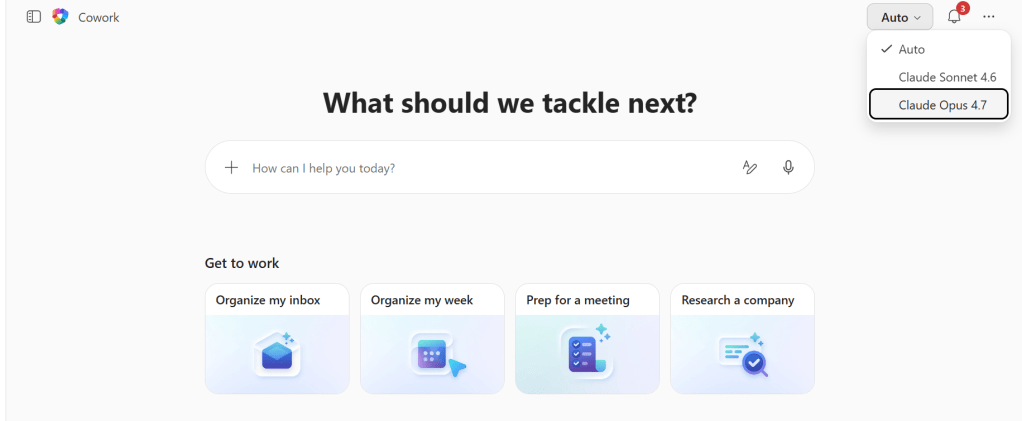
Microsoft is expanding model selection in Microsoft 365 Copilot by adding Anthropic Claude Sonnet alongside OpenAI’s GPT models. If you have a Copilot license, you’ll be able to choose Claude Sonnet from the model selector in Copilot Chat as this rolls out. I can already see it in my demo tenant.

Microsoft has indicated this is starting in Frontier and then expanding across web, desktop, macOS, and mobile..

If you don’t see this yet and want to test out Claude already, you can use it in the Researcher Agent (if Anthropic models are allowed in your environment).

Claude Opus 4.7 in Microsoft 365 Copilot

But this is getting even better with Claude Opus 4.7! Microsoft is expanding model choice with Anthropic’s Claude Opus 4.7 is available in Microsoft 365 Copilot — specifically in Copilot Cowork (Frontier) and in Copilot Studio early release cycle environments — and it is also rolling out to Copilot in Excel.

Opus 4.7 is designed to be faster and more precise than the earlier Opus generation. It follows instructions more closely, checks its own outputs before responding, and reads images at higher resolution — so Copilot can interpret visual content with more detail and use Work IQ context to take action more precisely. It is also better at picking the right tool for the task, which matters a lot when you are running multi-step, agentic work.

You will find Opus 4.7 in the model selector in Copilot Cowork and Copilot Studio, and in the near future in Copilot in Excel. This is exactly the kind of cutting-edge, enterprise-grade model choice that makes Microsoft 365 Copilot — and Copilot Cowork especially — so powerful for real work.

Why this matters:

This isn’t just about having options—it’s about matching the right model to the right task. Claude Sonnet is known for strong performance in document analysis, nuanced reasoning, and content generation. Giving users the ability to pick their model based on the work they’re doing is a clear signal that Microsoft sees Copilot as a multi-model platform, not a single-model product.

There are governance implications too. Anthropic operates as a Microsoft subprocessor, and the models are excluded from EU Data Boundary commitments. In regions where Anthropic is set to “off by default,” admins will need to opt in. This is a good reminder that AI governance is now part of everyday IT administration.

Draft and Send Outlook Emails Without Leaving the Copilot Chat

One of the most practical capabilities on the roadmap: Copilot Chat will be able to draft, edit, and send Outlook emails without leaving the chat interface as this feature rolls out.

In tenants where it’s enabled, when Copilot detects email-writing intent it can open an embedded Outlook compose experience inside Copilot Chat. You can review and edit the content, modify recipients, and send—or open the draft in Outlook to continue there.

Microsoft has described this as a desktop-first (“big screen”) rollout with completion targets in early April. Availability depends on rollout ring, tenant configuration, and prerequisites (Microsoft 365 Copilot license and an Exchange Online mailbox).

Why this matters:

This is one of the clearest examples yet of Copilot shifting from assistant to execution surface. Instead of generating a draft that you copy and paste into Outlook, Copilot can now complete the entire workflow. Less context switching. More doing.

It’s also a sign of where this is going: Copilot as the place where work happens, not just where you ask questions about work.

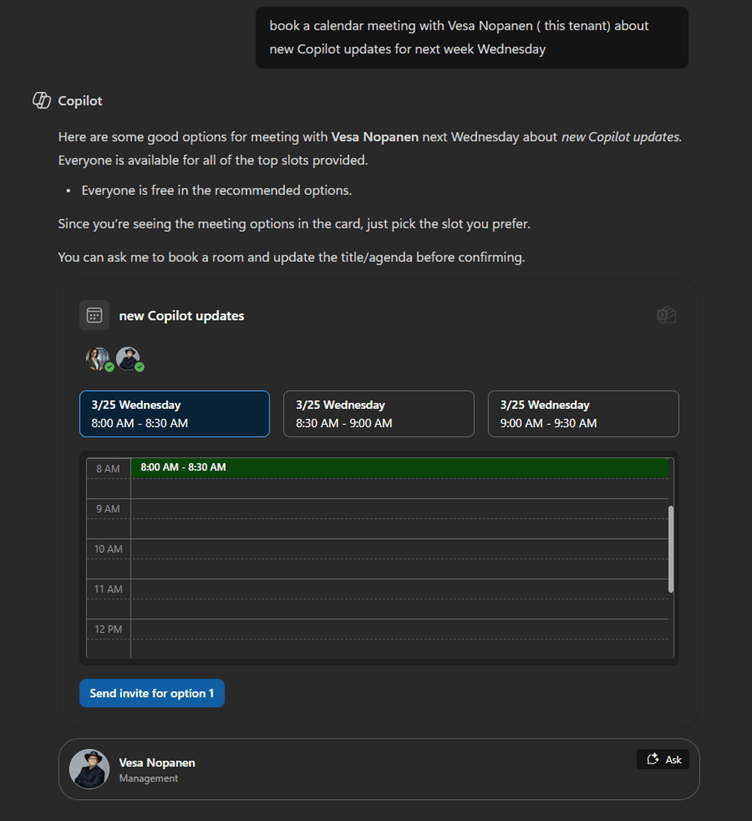
Did you know you can already use Copilot Chat to book meetings?

Declarative Agents Upgraded to GPT-5.2

Microsoft 365 Copilot Declarative Agents have been upgraded to the GPT-5.2 model, which brings improvements in reasoning, multi-step workflows, tool calling, structured output generation, and document analysis.

Users may notice improvements in quality, accuracy, and formatting—along with slight behavioural differences due to the model change.

Why this matters:

If you’ve built Declarative Agents, this is a good time to test your top prompts and workflows before the change reaches all users. The upgrade is automatic, and there are no new admin controls, but Microsoft recommends validating key scenarios and using the thumbs-up/thumbs-down feedback with the tag #GPT52 to help improve detection of any issues.

More broadly, this update reinforces that agents are a core part of Microsoft’s Copilot strategy—and the platform is evolving quickly to support more complex, reliable agent behaviors.

Teams Will Identify External Bots Joining Your Meetings

Microsoft Teams is introducing a new capability to detect external meeting assistant bots as they attempt to join meetings hosted by your organization.

The feature specifically targets bots used for transcription, summarization, and other meeting assistance services. When detected, these bots will be clearly labelled in the meeting lobby experience.

The rollout begins in mid-May for Targeted Release and completes in mid-June for general availability (including GCC tenants).

Why this matters:

This is about visibility and control. Microsoft notes that some external bots can access meetings without the knowledge or consent of the organizer or hosting tenant, creating data security, privacy, and compliance risks.

This update gives organizers greater awareness and gives admins clear controls over how detected bots are handled. It’s a timely response to the growing ecosystem of third-party meeting bots—and a reminder that AI governance extends to who (and what) participates in your meetings.

There may still be bots that go undetected, so Microsoft is encouraging users to report them directly from the meeting to help improve detection over time.

Teams Meetings Video Recaps

Intelligent meeting recap in Teams is adding video-based recaps—narrated video highlights that showcase key takeaways and important moments from recorded meetings.

This feature is expected to reach general availability in April 2026.

Why this matters:

Text-based recaps are helpful, but video recaps are more consumable and more engaging, especially for people who couldn’t attend the meeting. This is a natural evolution of Teams’ intelligent recap capabilities toward multimodal summary experiences.

It’s also another example of how AI is making meetings more accessible after the fact—reducing the pressure to attend every meeting live and making it easier to stay aligned across time zones and schedules.

Teams Is Adding Turn-by-Turn Interpretation

Microsoft is planning a Consecutive Interpretation mode for the existing Interpreter agent in Teams.

Unlike simultaneous interpretation, this mode uses turn-by-turn interpretation: participants speak one at a time, and each speaker’s words are interpreted before the next speaker begins. It’s designed for structured, interactive multilingual meetings like working sessions, negotiations, and cross-functional collaboration.

The feature rolled out to Targeted Release in early March and will reach general availability between late April and early May.

Why this matters:

This is one of the most distinctive “future of AI meetings” stories in this set. It shows that Microsoft is thinking beyond captions and transcription and moving toward real-time, structured multilingual collaboration.

For global teams, this reduces overlap, improves interpretation accuracy, and helps everyone stay aligned—even when they don’t share a common language. It’s a practical example of AI enabling collaboration that would otherwise be slow, expensive, or impossible.

Channel Agents Are Getting a Level-Up

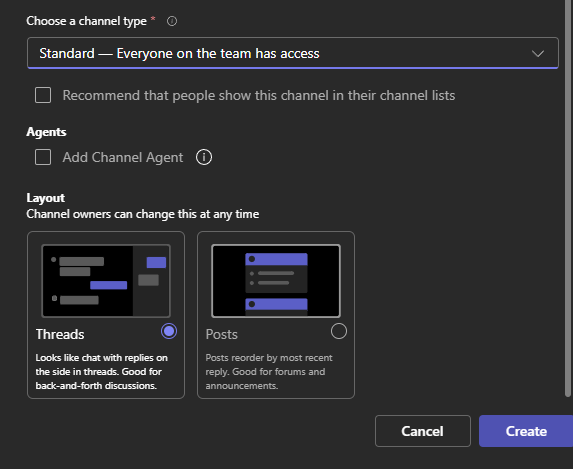
Microsoft is rolling out several updates to Channel Agent in Teams to make it more collaborative and more practical.

The updates include:

Customized welcome messages based on channel context

The ability to disable automatic Channel Agent creation during team or channel setup

Improved scheduling suggestions using updated calendar logic

The ability to add members to a channel with prompts like “@agent add John Doe to this channel”

The ability for Channel Agents to post messages directly to a channel

This feature has been rolling out to Targeted Release since early March and should be complete on every tenant around this time. A Microsoft 365 Copilot license is required.

Why this matters:

This is a strong example of agents becoming operational and collaborative, not just informational. Channel Agents are moving into the flow of teamwork—helping with scheduling, adding people, and posting updates without needing a human to do it manually.

It’s another signal that agents are becoming teammates, not just tools.

Copilot is Just Getting Started

If you step back and look at what’s in the rollout pipeline, a clear pattern emerges:

Copilot is becoming more powerful, more actionable, and more configurable. You can now choose your model, execute work directly in Copilot Chat, and rely on smarter, more capable agents.

Teams is becoming more intelligent, more secure, and more multilingual. You get richer recaps, better visibility into who’s joining your meetings, and real-time interpretation that makes global collaboration feel effortless.

And across both products, Microsoft is making it clear that AI isn’t just about answering questions—it’s about doing work, enabling collaboration, and making decisions. This article was just about coming updates and improvements to Copilot and AI in Teams – however I suggest you read my earlier article about Digital Workers to see where we are heading.

If you’re managing Copilot or Teams in your organization, soon is a good time to:

Review your governance settings, especially around model choice and external meeting bots

Test your Declarative Agents to make sure they’re performing well on GPT-5.2

Start thinking about how features like Copilot email drafting and Channel Agents change the way your teams work

The future of work is being built in real time. And it’s moving faster than most of us expected.


Source link

How the Human Body Digests Food in Zero Gravity | Metaverse Planet

How the Human Body Digests Food in Zero Gravity | Metaverse Planet


Have you ever caught yourself staring at footage of astronauts floating around the International Space Station and wondered: Wait, how on earth—or rather, off-earth—do they actually swallow their food? I was going down a massive rabbit hole about space habitation the other night, and I literally lost my mind when I uncovered the mechanics behind this. We are so used to the idea that things fall down because of gravity that we assume our food drops into our stomachs the exact same way. It turns out, our bodies don’t need gravity at all to digest food.

As someone who is obsessed with the intersection of human biology and futuristic tech, I honestly think the human body is like a highly advanced, pre-programmed spacecraft. We didn’t evolve in space, yet our hardware is fully equipped for it. Let’s dive deep into the fascinating mechanics of zero-gravity dining and why your digestive system is basically a biological marvel.

The Magic of Peristalsis: Your Internal Anti-Gravity Drive

Signature: boXXGHwcmogM89ztYyrd4UJeipT9N1HDsgw9S7YEw5gR0B1U8ZfZBpalrZiNToOta2tdLoF/bEpgE/MzHpH7D5mbcpzncJVtOwzeU27T8HRzR/T6XchKRfH6wxq208ejC5Up/RBs1oRyCmad3etwzIRMFzBrGYz1WSRDvnScv4imNjhZSPYDCc0Q0EjqZ6SQp0s94hNuYj5qTcZlUsImrw==

If gravity isn’t pulling that space-taco down to an astronaut’s stomach, what is? The answer lies in a brilliant biological mechanism known as peristaltic movement (or peristalsis).

When you take a bite and swallow, your throat doesn’t just open up and let the food free-fall. Instead, the walls of your esophagus are lined with incredibly strong, involuntary muscles. These muscles perform a synchronized, wave-like dance:

The Contraction: The muscles right above the food contract, pinching the tube shut so the food can’t go back up.The Push: The muscles below the food relax, allowing the bolus (the chewed food) to move forward.The Wave: This rhythmic squeezing travels all the way down your digestive tract, literally forcing the food into your stomach.

Think of it like squeezing a tube of toothpaste from the bottom up. It doesn’t matter if you hold the tube upside down, sideways, or in the vacuum of space—if you squeeze it right, the paste is coming out exactly where it needs to. Because of peristalsis, an astronaut can eat a meal completely upside down in microgravity without choking or having their food float back into their mouth.

If Swallowing is Easy, What Makes Space Dining So Hard?

So, if swallowing works perfectly fine, why do space agencies spend millions of dollars developing specialized space food? As I dug deeper into this, I realized that while our internal plumbing is ready for space, our external environment in a spacecraft is incredibly hostile to normal eating habits.

Here are the massive hurdles astronauts actually face when it comes to food:

1. The Danger of the Floating Crumb

In microgravity, a crumb isn’t just an annoyance; it is a catastrophic hazard. If you eat a regular, flaky piece of bread in space, the crumbs will float in every direction. They can be inhaled by the crew, causing serious respiratory issues, or worse—they can drift into the spacecraft’s delicate electronic panels and cause a short circuit or a fire.

Fun Fact: Back in 1965, during the Gemini 3 mission, astronaut John Young smuggled a corned beef sandwich onto the spacecraft. When he took a bite, rye bread crumbs started flying everywhere. NASA was definitely not amused, and strict “no-crumb” protocols have been in place ever since! Today, astronauts use specially formulated tortillas instead of bread.

2. The “Fluid Shift” Phenomenon (aka The Space Colds)

Here is something that genuinely surprised me. On Earth, gravity pulls our bodily fluids downward into our legs. In space, without gravity, those fluids distribute evenly, which means a lot of fluid rushes to an astronaut’s head.

This causes their faces to puff up and their sinuses to become completely congested—similar to having a terrible cold. Because their noses are blocked, their sense of taste and smell dramatically decreases. This is exactly why astronauts are absolutely obsessed with spicy foods like jalapeños, sriracha, and horseradish. They literally need that intense heat just to taste their meals!

3. Burping is a Nightmare

I couldn’t write this without mentioning this hilarious, yet highly uncomfortable biological glitch. On Earth, gravity separates the gas and liquid in your stomach. The gas rises to the top, allowing you to burp cleanly. In zero gravity, the gas and the food/liquids in your stomach mix together into a chaotic, floating bubble. If an astronaut tries to burp, they end up experiencing what NASA refers to as a “wet burp” (essentially vomiting in your mouth). Because of this, carbonated drinks like soda and beer are strictly banned in space.

The Human Body: The Ultimate Biological Spacecraft

When you look at the sheer adaptability of our systems, it’s hard not to be in awe. We evolved on a planet with a constant 1G of gravitational force for millions of years. Yet, the moment we strap ourselves into a rocket and leave our home planet, our bodies say, “No gravity? No problem. I’ve got a backup system for that.”

From our muscular esophagus pushing food down like a hydraulic pump, to our vestibular system trying to recalibrate our sense of balance, we are walking, breathing survival machines. As we look forward to the Metaverse, deep space exploration, and eventual missions to Mars, it’s comforting to know that our “biological hardware” is already cross-compatible with the universe.

We are constantly building better rockets, stronger materials, and smarter AI to survive the void, but sometimes, the most advanced piece of technology on a spacecraft is the human sitting in the pilot’s seat.

Over to You!

Researching this completely changed how I view something as simple as eating dinner. It’s crazy to think that a biological wave inside our throats is the very reason we can survive in the cosmos.

What do you think about this crazy system? If you were sent to the International Space Station tomorrow, knowing that your taste buds would completely dull out, what is the one extremely spicy or flavorful food you would demand to take with you? Let’s discuss in the comments below!

You Might Also Like;


Source link

Popular Posts

My Favorites

Smart Home Automation Market to Reach USD 820,660.73 Million by 2035,...

0
As per Market Research Future analysis, the Smart Home Automation Market Size was estimated at USD 103,414.87 Million in 2024. The Smart...