Metaverse

Home Metaverse Page 5

A Night of Triumphs and Surprises at the BAFTA Game Awards | Metaverse Planet

A Night of Triumphs and Surprises at the BAFTA Game Awards | Metaverse Planet


I honestly didn’t expect a debut game to completely hijack the spotlight at the most prestigious gaming event in the UK, but here we are. I stayed glued to my screen as the final major event of the gaming awards season unfolded this past Friday in London, and let me tell you, the results have left me with a lot to think about.

If you thought you knew exactly how the industry was leaning, Sandfall Interactive just flipped the script. We are seeing a massive shift where fresh, daring ideas are dethroning established giants. Let’s dive deep into what went down at the BAFTAs, why these games won, and what it means for the titles we’ll be playing next.

The Absolute Dominance of Clair Obscur: Expedition 33

When I first looked at the nomination list, I was floored. A debut studio walking into the BAFTAs with 12 nominations? It sounded like a fairytale. But Sandfall Interactive didn’t just show up; they conquered.

Their action-adventure masterpiece, Clair Obscur: Expedition 33, didn’t just take home the coveted Game of the Year award. It completely swept its core categories. Here is why I think it resonated so deeply with both the players and the BAFTA voting academy:

A Breathtaking Debut: Winning Best Debut Game was a no-brainer. The level of polish, the intricate world-building, and the sheer audacity of its combat mechanics put it miles ahead of what we usually expect from a studio’s first outing.A Masterclass in Acting: The game also secured Best Lead Performer for the incredibly talented Jennifer English, who brought the character of Maelle to life. Her performance wasn’t just voice acting; it was raw, emotional, and anchored the entire narrative of the game.

I’ve played through Expedition 33, and what strikes me the most is how it never plays it safe. It takes risks with its pacing and its art direction, and seeing the industry reward that kind of bravery gives me so much hope for the future of new IPs.

The Heavyweights: Dispatch and Ghost of Yōtei

While Expedition 33 took the crown, the battle for the rest of the major categories was an absolute bloodbath between two incredibly different, but equally masterful titles.

Dispatch: A Technical and Auditory Marvel

Coming in hot with nine nominations, Dispatch proved that atmosphere is everything. The game walked away with Best Animation and Best Audio, which, if you’ve played it with a good set of headphones, makes perfect sense. The sound design in that game actually gave me chills.

More importantly, legendary actor Jeffrey Wright took home the Best Supporting Performer award for his unforgettable role as Chase. Seeing Hollywood-caliber acting seamlessly integrated into interactive media is something I will never get tired of.

Ghost of Yōtei: A Feast for the Senses

Sucker Punch’s highly anticipated Ghost of Yōtei (eight nominations) proved that they are absolute wizards when it comes to technical execution. Winning both Best Technical Achievement and Best Music, the game is a sensory overload in the best way possible. The way the environment reacts to the wind, combined with that hauntingly beautiful score, creates an immersion level that very few games can match.

Unforgettable Moments and Legendary Cameos

The BAFTAs aren’t just about handing out trophies; they are a celebration of gaming culture, and this year’s show was packed with moments that had me jumping out of my chair.

The 007 Reveal: As a massive James Bond nerd, I nearly lost it when legendary film composer David Arnold took the stage to present the Music award. But he didn’t just present; he debuted the brand-new theme song for IO Interactive’s upcoming 007: First Light. Hearing those classic brass swells adapted for a next-gen stealth game was the highlight of the night for me.Star-Studded Presenters: It was brilliant seeing Charlie Cox (who actually voices Gustave in Expedition 33!) presenting alongside heavy hitters like Abubakar Salim from House of the Dragon and Lennie James from The Walking Dead. Even the stars of Resident Evil Requiem, Angela Sant’Albano and Nick Apostolides, made an appearance to hand out the Supporting Role award.Live Music Magic: To cap it all off, we got a phenomenal live performance of “Stay the Night” by Talia Mar, bringing an incredible energy to the London venue.

The Complete Winners List (And My Quick Takes)

For those of you who want the scannable rundown, here is the complete list of who took home the golden masks. I’ve added a few of my own thoughts on some of the most interesting wins:

Game of the Year: Clair Obscur: Expedition 33Best Debut Game: Clair Obscur: Expedition 33 * Best Lead Performer: Jennifer English (Maelle, Clair Obscur: Expedition 33)Best Animation: DispatchBest Audio: DispatchBest Supporting Performer: Jeffrey Wright (Chase, Dispatch)Artistic Achievement: Death Stranding 2: On the Beach (Kojima doing what Kojima does best—making things look bizarrely beautiful).Best Technical Achievement: Ghost of YōteiBest Music: Ghost of YōteiBest British Game: Atomfall (A perfectly weird, atmospheric triumph for the UK scene).Best Evolving Game: No Man’s Sky (I am convinced Hello Games has discovered actual magic. A decade later, and they are still winning awards for their updates. Unbelievable).Best Family Game: Lego Party!Beyond Entertainment: DespeloteBest Game Design: Blue PrinceBest Multiplayer: Arc RaidersBest Narrative: Kingdom Come: Deliverance II (The writing in this sequel was incredibly sharp, truly deserved).Best New Intellectual Property: South of Midnight (Another massive win for originality).

What This Means for Us as Players

Looking at this list of winners, one thing is glaringly obvious to me: Originality is back in style. For years, we’ve seen sequels and remakes dominate the top tiers of award shows. But this year, games like Expedition 33, Dispatch, and South of Midnight proved that gamers and critics alike are starving for fresh universes, new mechanics, and daring storytelling. It makes me incredibly optimistic about the games currently being greenlit behind closed doors.

I spent the whole weekend digesting these results, and I can’t help but wonder if this is the start of a new golden age for debut studios. If a team like Sandfall Interactive can beat out industry titans on their first try, the playing field has officially been leveled.

I’ve shared my thoughts, but I really want to know where you stand on this. Do you think Clair Obscur: Expedition 33 truly deserved to sweep the Game of the Year and Debut categories, or do you feel a heavyweight like Ghost of Yōtei was robbed of the top spot? Drop your thoughts in the comments, let’s debate!

You Might Also Like;


Source link

Tempo Studio Review: The Ultimate AI Home Gym Tested | Metaverse Planet

Tempo Studio Review: The Ultimate AI Home Gym Tested | Metaverse Planet


I’ve always struggled with consistency at the traditional gym. Between the commute, waiting for equipment, and the lingering doubt that my squat form was secretly terrible, I often found excuses to stay home. When I first saw the Tempo Studio—a striking, easel-like cabinet that promised to not only store real weights but actually watch and correct my form using AI—I was both skeptical and intrigued. Dropping a couple of thousand dollars on a home gym is a huge commitment, but I wanted to know if this piece of tech could finally replace my unused gym membership.

Pros

✅ Incredible 3D sensor technology provides real-time, accurate form correction.✅ Beautiful, freestanding design that neatly conceals weights when not in use.✅ Uses high-quality real iron weights rather than digital or magnetic resistance.

Cons

❌ High upfront hardware cost compared to basic home gym equipment.❌ Requires an ongoing monthly subscription to access classes and AI features.❌ The unit is heavy and requires dedicated floor space to work out effectively.

Technical Specifications

FeatureDetailsDisplay42-inch HD TouchscreenAI Technology3D Time-of-Flight Motion SensorDimensions72″ H x 26″ W x 16″ DAudio60W Stereo Speakers + BluetoothWeight Set IncludedDumbbells, Barbell, and color-coded platesSubscription$39/month (Required)

My Experience

Having the Tempo Studio in my living room has genuinely altered my relationship with fitness. The delivery and setup were seamless, and the moment the massive 42-inch screen lit up, it felt like a premium experience. The cabinet itself is an impressive piece of furniture. It’s constructed from a sturdy aluminum frame with a minimalist aesthetic that easily blends into modern decor, cleverly hiding all the weights, collars, and the heart rate monitor inside the lower cabinet.

But the real magic happens when you start a workout. I queued up a lower-body strength session, grabbed the premium urethane-coated plates—which are color-coded so the machine can track exactly how much weight you are lifting—and got into position. The 3D Time-of-Flight sensor mapped my body as a skeletal structure of dots on the screen. During my first set of deadlifts, a pop-up alert appeared on the screen accompanied by a subtle chime, warning me that my lower back was rounding. I corrected my posture, the system acknowledged it, and I safely finished the set. It honestly felt like having a personal trainer standing right next to me, minus the awkward small talk.

The class variety is vast. With over 3,500 on-demand workouts ranging from heavy strength training to HIIT, mobility, and even boxing, I never felt bored. The instructors are engaging, and the screen is large enough that you feel completely immersed in the session. What kept me coming back, though, was the progression tracking. Tempo remembers what you lifted last week and actively suggests heavier weights when it senses you are breezing through the reps. It takes the guesswork out of progressive overload.

Of course, it isn’t flawless. You need a decent amount of clear space in front of the unit (about 6 to 8 feet) so the camera can see your full body. Additionally, paying $39 a month on top of a nearly $2,500 machine is a tough pill to swallow for some. However, if you compare that to a monthly premium gym membership and a personal trainer, the Tempo Studio starts to pay for itself within the first year.

Who is this for? / Alternatives

The Tempo Studio is perfect for people who genuinely love lifting free weights but lack the knowledge, confidence, or motivation to design their own routines and check their form. It’s ideal for busy professionals who want an elite, guided workout experience without leaving their house.

If you have less space and prefer not to deal with physical iron plates, the Tonal is an excellent alternative. It mounts to your wall and uses advanced digital magnetic resistance, though it requires professional installation. If you are more focused on cardio, yoga, and barre rather than heavy strength training, the Lululemon Studio Mirror provides a sleek alternative that is entirely out of the way when turned off.

Quick FAQ

Do I really have to pay the monthly subscription?Yes. The $39/month membership is required to access the AI form correction, personal training plans, and the vast library of live and on-demand classes.

Can I use my own weights with the Tempo Studio?While you can physically lift your own weights during a class, the Tempo camera is trained to recognize its proprietary color-coded plates. If you use your own, it won’t accurately track your volume or auto-suggest progressions.

What if I live in an apartment? Will the weights be too loud?The plates provided by Tempo are coated in a premium, rubber-like urethane. They are exceptionally quiet when clinking together or being set on the floor, making them very apartment-friendly.


Source link

AI Diaries: Weekly AI News and Updates (April 21, 2026) | Metaverse Planet

AI Diaries: Weekly AI News and Updates (April 21, 2026) | Metaverse Planet


Welcome back to another entry of my weekly AI Diaries. Every time I sit down to write these updates, I feel like I’m trying to catch water with my bare hands—the pace of innovation in artificial intelligence is just that relentless.

We used to look at AI through incredibly rose-tinted glasses. We talked endlessly about how it would cure diseases, revolutionize clean energy, and act as a universally positive force for humanity. We even saw massive tech conglomerates sign manifestos swearing they would never weaponize these models. Well, after looking at the news crossing my desk this week, it is safe to say those promises have officially been forgotten.

Let me walk you through what happened over the last seven days, because we just crossed several major thresholds that are going to fundamentally change how we interact with technology.

The “Dark Manifesto” and the Militarization of AI

The biggest shift I noticed this week wasn’t a new piece of software; it was a shift in ideology. The boundaries of how AI can be used are being aggressively redrawn, and practically speaking, everything is now on the table.

The clearest indicator of this pivot came from Palantir. They just published a 22-point document titled the “Technological Republic” manifesto. Reading through it gave me chills—social media is already calling it the “dark manifesto,” and for good reason. It essentially normalizes the use of AI as a weapon. Palantir, whose influence in the US defense sector is rapidly expanding, used this document to publicly argue that utilizing AI for lethal military purposes is not only acceptable but necessary. It’s an open declaration of what we all kind of suspected was happening behind closed doors.

And they aren’t acting alone. Two massive developments dropped right alongside Palantir’s manifesto:

Anthropic’s Reversal: Anthropic previously stated their most advanced model, Mythos, could be highly dangerous in the wrong hands. Now? It turns out they are exploring opening federal agencies’ access to it.Google and the Pentagon: Reports broke that Google is currently in talks with the Pentagon to create a framework that would allow Gemini to operate in highly classified, secure environments.

The AI arms race is no longer a sci-fi concept; it is our current reality.

Google Chrome Gets a Gemini Upgrade: Welcome to the “Skills” Era

Moving away from the heavy stuff, Google dropped a genuinely fantastic update for those of us trying to speed up our daily workflows. They are deeply integrating Gemini into the Chrome browser with a new feature they call “Skills.”

Here is how it works: Instead of typing out the same complex prompts over and over again, you can now save them as a “Skill.” Let’s say you have a specific way you like AI to summarize long articles or format data tables. You save that prompt, and the next time you need it, you just type a “/” in the Gemini interface or click a plus button, and your custom Skill runs instantly on your active tab.

What I really love about this is the ecosystem integration. If you are signed into your Google account on desktop, your saved Skills sync seamlessly across your devices. It can even pull data from multiple open tabs simultaneously. It’s a massive time-saver.

Microsoft’s Panic Button: “Copilot Code Red”

It seems like Microsoft is feeling the heat. Despite pushing Copilot into basically every product they own, they aren’t seeing the user adoption or performance results they wanted. To prevent falling behind in the AI race, they’ve initiated a massive internal pivot officially dubbed “Copilot code red.”

The goal is to drastically overhaul the user experience, but the strategy is what fascinates me. Just days after this “code red” leaked, we found out Microsoft is testing ways to turn Copilot into a 24/7 autonomous digital assistant.

By integrating AI agents similar to the OpenClaw architecture into the Copilot ecosystem, Microsoft wants this tool to stop waiting for your prompts. They want it running in the background, independently executing tasks and managing your digital life around the clock. If they can pull this off without it becoming an intrusive mess, it could change everything about how we use Windows.

Robots Are Finally Getting “Smart”: Gemini Robotics-ER 1.6

If you read my articles regularly, you know I have a soft spot for robotics. This week, Google DeepMind blew my mind with their new Gemini Robotics-ER 1.6 model.

Until now, most robots just blindly followed pre-programmed scripts. DeepMind’s new model gives machines “embodied reasoning.” This means the robot doesn’t just see its environment; it actually understands the context. It can analyze visual data, plan a multi-step task on the fly, and self-evaluate whether it completed the job correctly.

Boston Dynamics wasted absolutely no time putting this into action. They equipped their famous robot dog, Spot, with the ER 1.6 model, and the demo video is wild. Spot is shown looking at a handwritten to-do list and just… doing the chores. I watched a robotic dog organize scattered shoes, pick up boxes, and actively sort laundry into a basket. In one scene, it even grabbed a leash to take a real dog for a walk based entirely on natural language commands. We are watching the transition from mindless machines to reasoning physical entities in real-time.

The Posthumous Return of Val Kilmer

Finally, we have to talk about the ethical gray area Hollywood just sprinted into. The legendary actor Val Kilmer, who sadly passed away last year after his long battle with throat cancer, is “starring” in a new film called As Deep as the Grave.

Before his death, Kilmer had agreed to play the role of an American priest in the film, but his health prevented him from ever shooting a single scene. Now, with the explicit permission of his daughter, the studio has used AI to completely recreate Kilmer’s likeness and voice to play out the entire role.

Even with the family’s blessing, this has caused a massive uproar in the entertainment industry. While the technology is undeniably impressive, it leaves us asking deep questions about legacy, art, and the commercialization of digital ghosts.

Rapid Fire: New AI Tools & Industry Bites

A lot of smaller, but equally important, updates flew under the radar this week. Here is my quick breakdown of the rest of the news:

New Tool Drops:

Claude Opus 4.7: Anthropic released what they are calling the most powerful model currently available to the general public.Claude Design: Powered by Opus 4.7, this new suite combines prototyping, slide deck creation, and visual generation. It is specifically built for people with zero design background.Happy Oyster & Lyra 2: Both Alibaba (Happy Oyster) and Nvidia (Lyra 2) launched massive tools that let users generate fully interactive, navigable 3D worlds using AI.Gemini 3.1 TTS: Google dropped an update to their Text-to-Speech model, and frankly, it’s one of the most natural-sounding vocal generation models I’ve heard to date.

Industry Shorts:

China’s Master Plan: China is rolling out a massive national initiative to integrate AI directly into their education system, from elementary schools all the way to lifelong adult learning. They are aggressively building a digital-first workforce.Meta & Broadcom: The two giants signed a long-term deal (stretching to 2029) to co-develop custom AI silicon chips.Opera Browser Connector: Opera One and GX browsers just got an update that allows ChatGPT and Claude to natively read open tabs and interact directly with the browser interface.Solving the Unsolvable: A Chinese AI model independently solved a complex math problem proposed by American mathematician Dan Anderson in 2014—completely without human intervention.Nvidia Ising: Nvidia revealed the first AI model capable of breaking quantum barriers. “Ising” accelerates calibration and error correction in quantum computers, boosting performance by 2.5x and accuracy by 3x.Subconscious Bias: A fascinating new study published in Nature proved that when AIs generate training data for other models, they pass down hidden biases and prejudices on a “subconscious” level.Native Mac Gemini: Google officially released a standalone, native Gemini app for macOS.Vercel Hack: The cloud deployment platform Vercel confirmed a recent cyberattack. The scary part? The breach originated entirely from the hijacking of a third-party AI tool.

Over to you: I want to hear your take on the Val Kilmer situation. If a family gives their blessing, do you think it is acceptable for studios to resurrect deceased actors using AI for brand new movies, or should a performer’s filmography end when they pass away? Drop your thoughts in the comments, because I’m genuinely torn on this one!

You Might Also Like;


Source link

The Evolution of Smart Eyewear: Inside the New Huawei AI Glasses | Metaverse Planet

The Evolution of Smart Eyewear: Inside the New Huawei AI Glasses | Metaverse Planet


I’ve been keeping a close eye on the wearable tech market for a long time, especially smart glasses. If I’m being completely honest, most of the models I’ve tested or reviewed over the years have felt a bit disconnected from reality—clunky, heavy, and looking more like sci-fi props than something you’d actually wear to a cafe. But while watching Huawei’s recent Pura series launch event, their new Huawei AI Glasses totally caught me off guard and shook up my skepticism.

We aren’t just looking at another heavy gadget that needs constant charging. This feels like a device that has finally managed to melt technology and fashion into one seamless package. So, what makes these frames so different? Let’s dive into the specs, the hardware, and my own take on why this might be a turning point for everyday wearables.

Design: Tech That Doesn’t Scream “Tech”

The biggest hurdle for any smart glass to overcome isn’t the software; it’s the aesthetics. Nobody wants to walk down the street looking like a cyborg with a massive camera strapped to their face. What I respect most about Huawei’s approach here is that these glasses look like they belong in a high-end optician’s display case, not a Best Buy aisle.

Featherweight Comfort: They’ve managed to get the total weight down to an impressive 35.5 grams. To put that in perspective, the temple arms are incredibly thin at just 6.25 mm. This is basically the same weight and footprint as your standard prescription glasses.The “Golden Triangle”: Huawei didn’t just guess what would feel comfortable. They analyzed the head structures of over 300,000 people in Asia to nail down an ergonomic fit they are calling the “golden triangle.”Built to Last: To get rid of that fragile feeling older smart glasses had, they used a titanium alloy hinge system. Huawei claims this boosts structural stability by 21% compared to their competitors.

You can grab these in either round or square frame designs depending on your face shape. The color lineup is also super premium: Titanium Silver Gray, Bright Silver, and Modern Black. Personally, the matte, stealthy look of the Modern Black is right up my alley.

The Brains: Custom AI and the “Look to Pay” Era

A sleek design gets you through the door, but the internal hardware is where the real show starts. Huawei packed these frames with their own custom-developed AI chip. This means the annoying lag we usually experience when talking to voice assistants is practically eliminated. The instant voice wake-up and one-touch AI access turn this device into a literal second brain.

But while reading through the spec sheet, there was one feature that genuinely made me pause: “Look and Pay.” Integrated with Alipay and powered by the Xiaoyi assistant’s “See the World” function, this feature allows you to authorize payments just by looking at the terminal. Imagine walking into a coffee shop, grabbing your latte while your hands are full, and paying simply by staring at the checkout counter. It is mind-blowingly convenient! However, I have to admit, it also brings up some serious privacy and security questions. In a world where our gaze can authorize a transaction, we are definitely going to have to be careful about where we look!

A Creator’s Dream: Multimedia and Cameras

If you create content, vlog, or just love capturing moments hands-free, the multimedia setup on these glasses is going to get you excited.

Heavyweight Sensor: The frames house a 1/2.8-inch image sensor, which is incredibly ambitious for a chassis this small.AI Photography: Your shots are processed using AI RAW multi-frame merging, and if your glasses are sitting a bit crooked on your face, the AI-supported framing correction automatically levels the horizon.First-Person Live Streaming: This is my absolute favorite feature. You can live stream directly from a POV (First-Person View) perspective. Whether you are riding a bike, cooking a meal, or walking through a new city, the hassle of holding a phone is entirely gone. Showing your audience exactly what your eyes see is a game-changer for storytelling.

Everything ties together seamlessly through the Huawei Glasses App, which handles smart audio broadcasting, instant pairing, and automatic content transfer to your phone.

What About Battery Anxiety?

The million-dollar question for any wearable: “Am I going to have to charge this three times a day?” Thankfully, Huawei did their homework. A full charge gives you up to 12 hours of general use. If you are hammering it with phone calls, you’ll get about 8 hours, and if you just want to zone out and listen to music or podcasts, it will last for 9 hours. Being able to put these on in the morning and not worry about the battery until I get home at night is exactly the standard we need.

Pricing and Launch Details

Honestly, given the custom AI integration and the camera tech, I was bracing myself for a $600+ price tag. The actual numbers were a pleasant surprise:

Titanium Silver Gray & Modern Black: 2,499 yuan (Roughly $367)Bright Silver: 2,899 yuan (Roughly $425)

Pre-orders open on April 20th, with official sales starting on April 25th. While global availability dates are still up in the air, at this price point, Huawei is positioning themselves to take a massive bite out of the global wearables market.

Over to you: I really think the Huawei AI Glasses represent the tipping point where smart glasses go from a “cool gimmick” to a “daily necessity.” But I’m super curious about your limits—would you feel comfortable wearing an always-active AI camera on your face just for the convenience of paying for your coffee with your eyes? Let’s debate this down in the comments!

You Might Also Like;


Source link

BTC, ETH, XRP Flash Bullish Reversal: Trendline Breaks Across Top 3

BTC, ETH, XRP Flash Bullish Reversal: Trendline Breaks Across Top 3


Key Highlights

Bitcoin is trading at $74,949 (+1.55%) after breaking a 5-month descending trendline, Ethereum climbed to $2,296 (+1.47%), and XRP reclaimed $1.41 (+1.33%).

US spot Bitcoin ETFs absorbed $663.91 million in net inflows on April 17, with cumulative inflows now at $57.74 billion and total net assets representing 6.55% of Bitcoin’s market cap.

CryptoQuant analyst CryptoOnchain flagged Ethereum’s 50-day SMA of the Taker Buy/Sell Ratio on Binance hitting 1.018, the highest reading since the last major trend reversal.

The cryptocurrency market shifted tone decisively this week as Bitcoin, Ethereum, and XRP simultaneously broke out of the descending trendlines that had capped every rally since the late-2025 top, a rare case of all three majors aligning on the same structural signal.

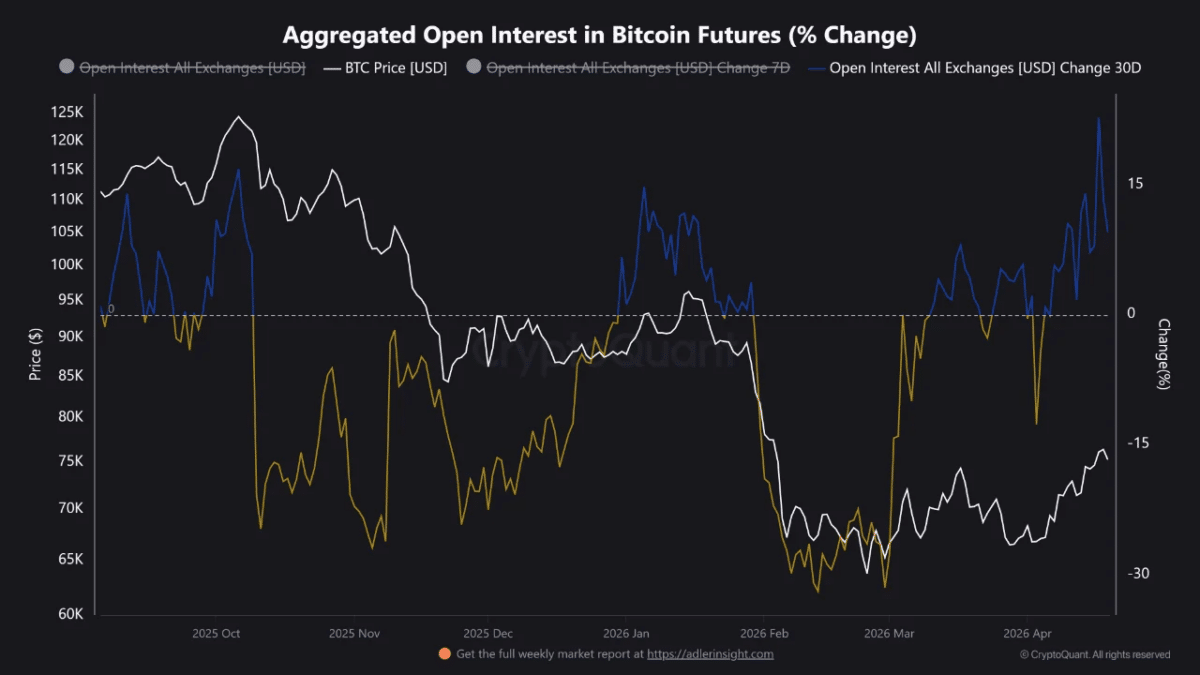
The move coincides with a sharp acceleration in institutional flows, with Bitcoin spot ETFs posting their strongest single-day inflow in weeks and Open Interest in Bitcoin futures climbing roughly 10% over the past 30 days, pointing to fresh position accumulation rather than short-covering.

BTC reclaims $74K as trendline breaks and ETF inflows surge

Bitcoin is trading at approximately $74,949 at the time of writing, up 1.55% on the day, after decisively breaking the descending trendline drawn from the November 2025 high near $100,000. Price has reclaimed the 50-day EMA ($71,907) and is now pressing directly into the 100-day EMA ($75,278), the single most important resistance on the daily chart.

BTC Chart | Source: TradingView

The MACD has confirmed a bullish crossover with the histogram expanding into positive territory at 318.14, while the RSI sits at 58.35, firmly bullish but with room to run before overbought territory. The 200-day EMA at $82,816 marks the next major target if the current momentum holds.What the indicators confirm

MACD: Bullish crossover intact, histogram expanding green → momentum is building, not fading

RSI (58.35): Firmly in bullish territory but not overbought — plenty of room to run

EMA stack: 50 EMA curling up toward the 100 EMA — a golden cross setup is forming

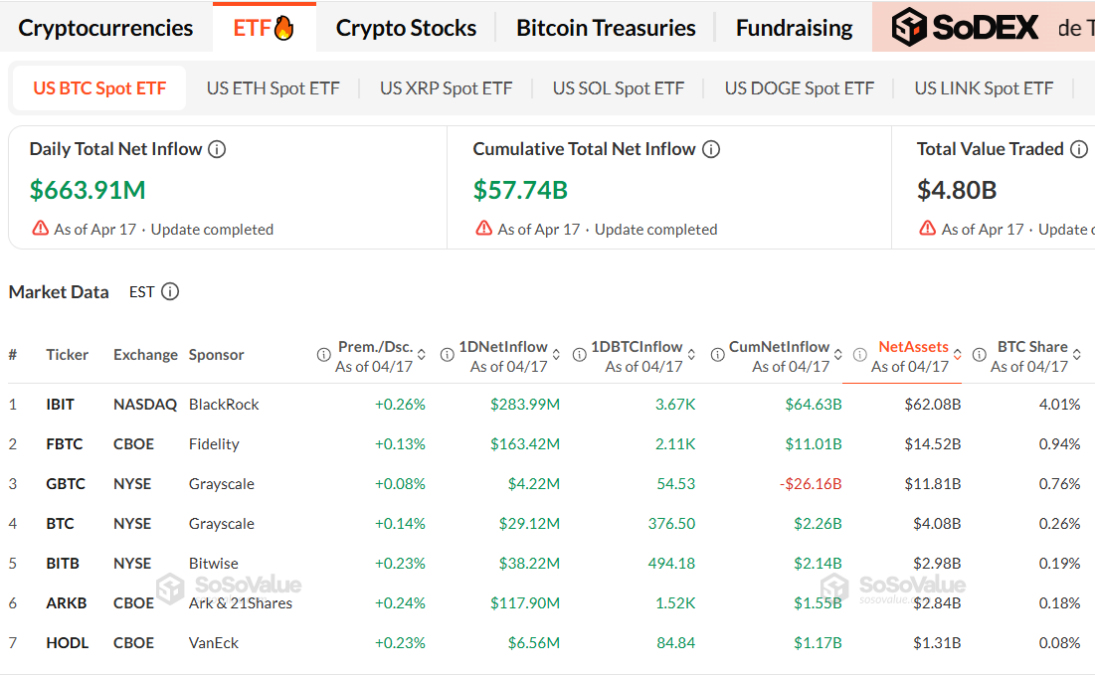
Institutional demand is providing the fuel. According to SoSoValue data as of April 17, US spot Bitcoin ETFs recorded $663.91 million in net inflows, pushing cumulative inflows to $57.74 billion and total net assets to $101.45 billion, now representing 6.55% of Bitcoin’s market cap.

Bitcoin ETF
Bitcoin ETF | Source: SoSoValue

BlackRock’s IBIT led with $283.99 million in single-day inflows and holds $62.08 billion in net assets, commanding a 4.01% share of circulating BTC. Fidelity’s FBTC followed with $163.42 million, while ARK’s ARKB pulled in $117.90 million.

CryptoQuant analyst BorisD noted that Bitcoin Open Interest has climbed approximately 10% over the past 30 days, with price trending upward for 22 consecutive days after forming a base near $60,000 earlier this year.

Bitcoin Open Interest
Bitcoin Open Interest | Source: CryptoQuant

The analyst described the current setup as “calm on the surface, but underneath, pressure is building fast,” pointing to position accumulation rather than exhaustion.

Ethereum breaks trendline as Binance buying pressure hits multi-year high

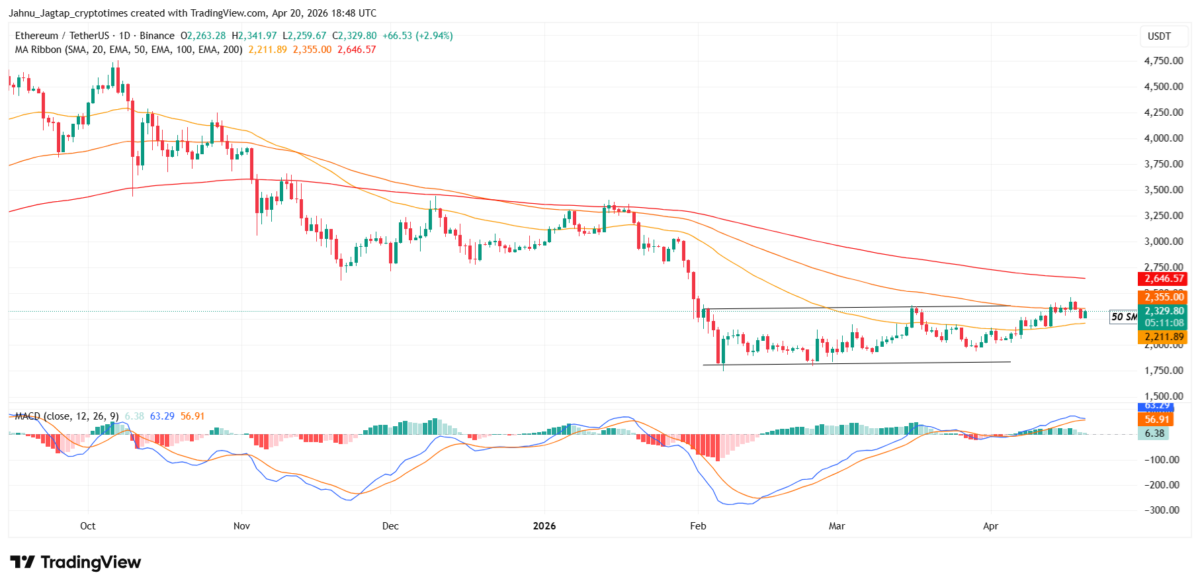
Ethereum (ETH/USDT) is trading at $2,296 (+1.47%), having broken out of the descending trendline from the January 2026 peak and reclaimed the 50-day EMA at $2,210. The token is now contesting the 100-day EMA at $2,353, a level that has rejected every rally since February.

ETH Chart
ETH Chart | Source: TradingView

The MACD has flipped bullish with the histogram at 4.26, and the RSI at 54.78 sits in neutral-bullish territory. A daily close above $2,353 would confirm the breakout and open the path to the 200-day EMA at $2,628, while a failure would send price back into the $2,000–$2,200 consolidation range.

What the indicators confirm

MACD: Sitting just above the zero line with a bullish crossover — the momentum reset is complete

RSI (54.78): Neutral-bullish, zero overheating

Key takeaway: The 50 EMA is about to cross the 100 EMA — a true golden cross is days away

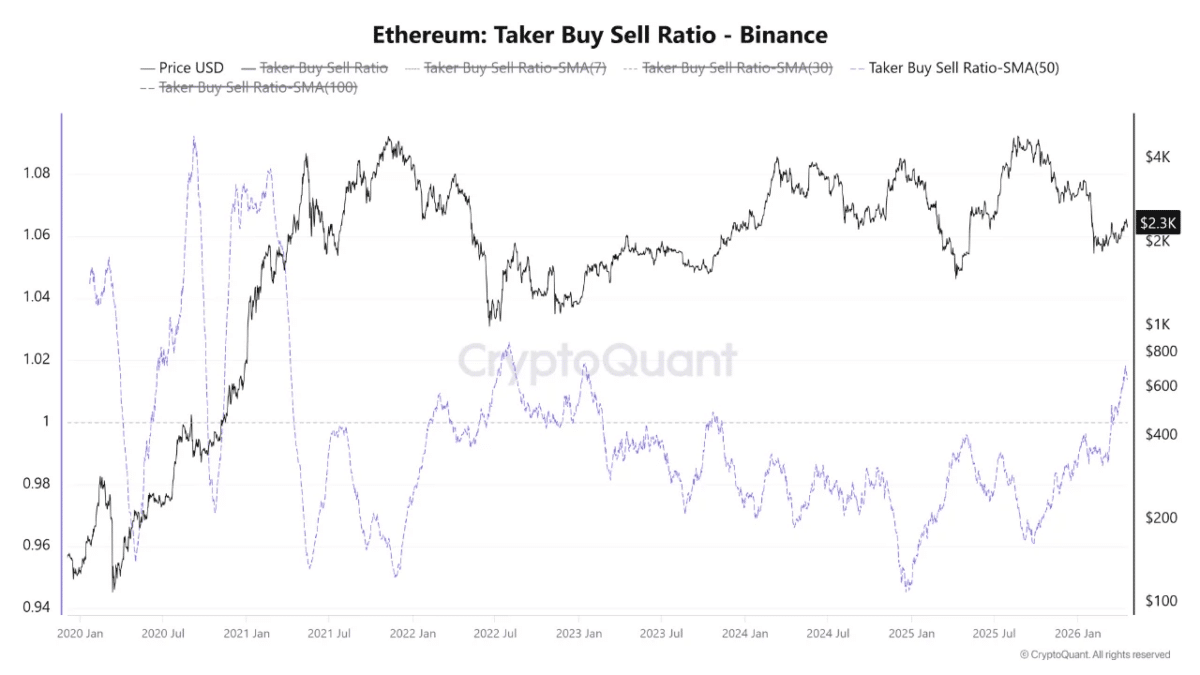
The on-chain picture supports the technical setup. CryptoQuant analyst CryptoOnchain flagged that the 50-day Simple Moving Average of the Ethereum Taker Buy/Sell Ratio on Binance has reached 1.018, the highest level since the last major trend reversal.

Ethereum: Taker Buy Sell Ratio
Ethereum: Taker Buy Sell Ratio: CryptoQuant

The metric indicates that aggressive market buyers have consistently outpaced sellers on a 50-day rolling basis, a structural shift in sentiment that typically precedes sustained moves.

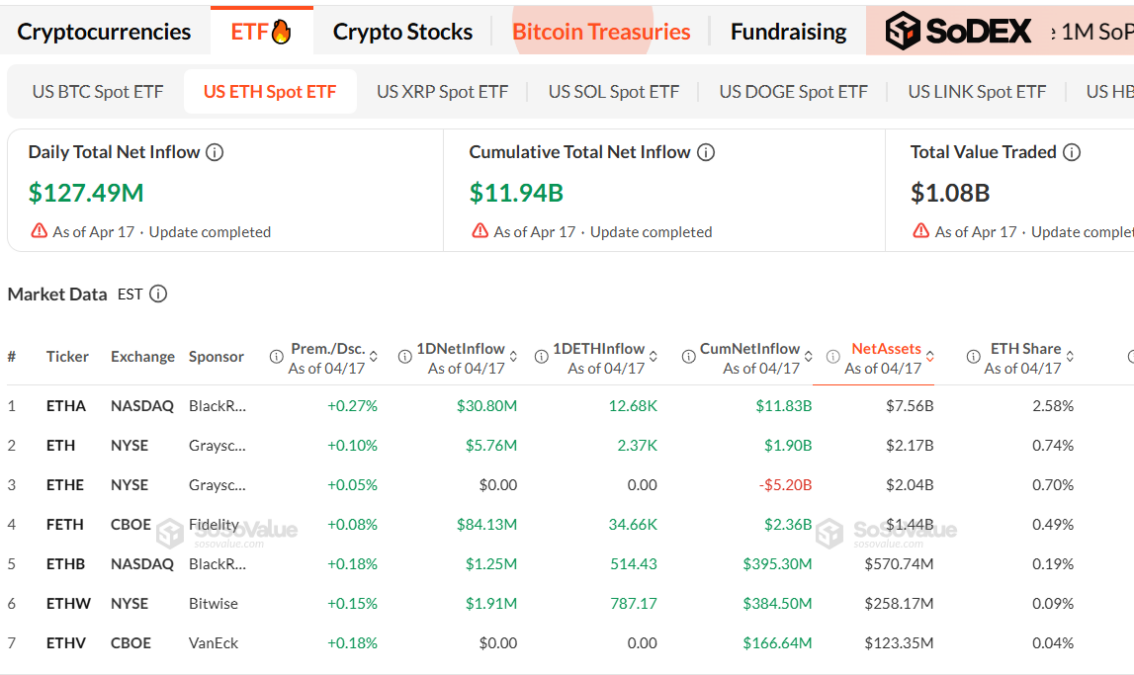
Spot Ethereum ETFs recorded $127.49 million in net inflows on April 17, with cumulative inflows now at $11.94 billion and total net assets at $14.26 billion, representing 4.87% of Ethereum’s

ETH ETF
ETH ETF | Source: SoSoValue

Fidelity’s FETH led the session with $84.13 million in inflows, followed by BlackRock’s ETHA at $30.80 million. Grayscale’s ETHE saw zero flows, continuing its pattern of outflow pressure with a cumulative outflow of $5.20 billion since launch.

XRP reclaims the trendline, but exchange reserve divergence flags caution

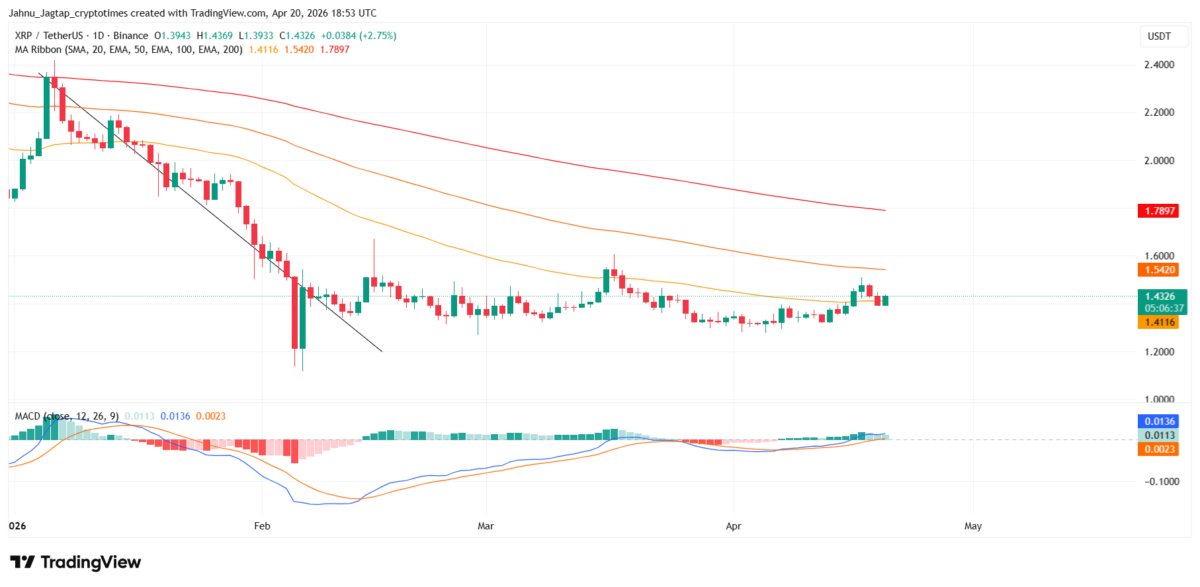
XRP/USDT is trading at $1.4128 (+1.33%), having broken the descending trendline from the January 2026 peak near $2.40. Price is now sitting between the 50-day EMA at $1.41 and the 100-day EMA at $1.54, with the MACD flipping bullish and the RSI at 53.94 after cooling from a recent push higher.

XRP Chart
XRP Chart | Source: TradingView

The key resistance at $1.54 marks the level XRP must clear to confirm a broader trend reversal, with the 200-day EMA at $1.79 representing the next major target. Support sits at the February low near $1.20, a break of which would invalidate the current base structure.

What the indicators confirm

MACD: Bullish crossover with histogram flipping green

RSI (53.94): Neutral — recently cooled from an overbought push, healthy reset

Structure: Consolidation tightening directly at trendline resistance

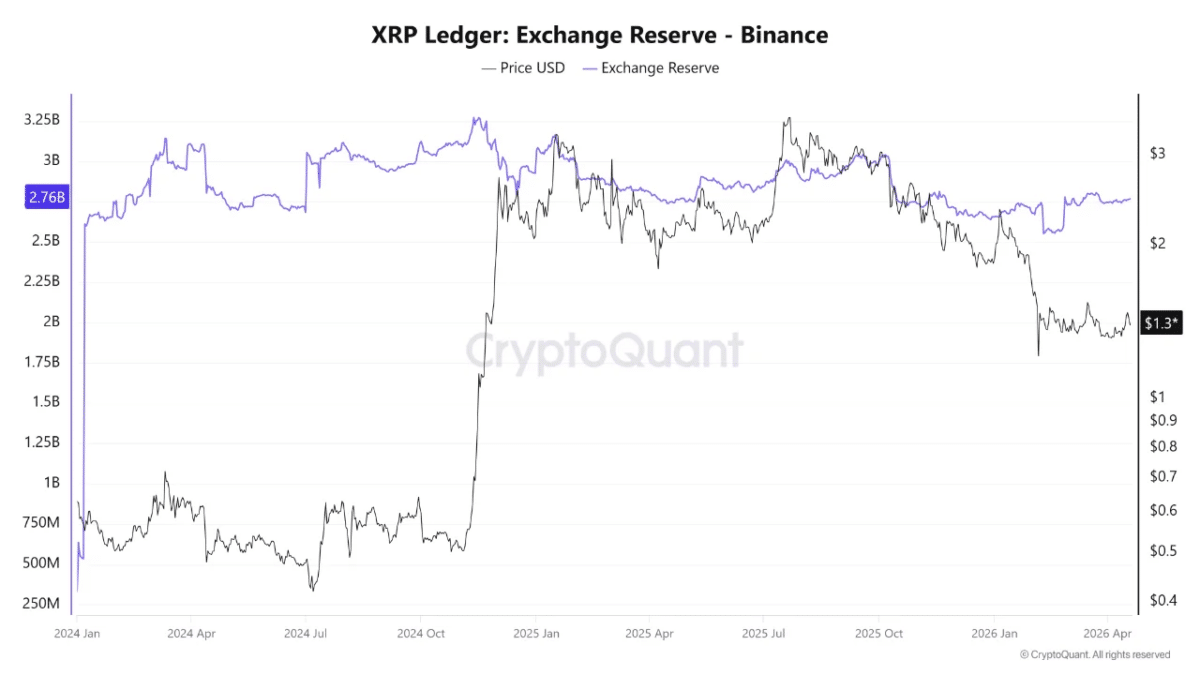
However, an on-chain divergence is flashing caution. CryptoQuant analyst PelinayPA highlighted that XRP exchange reserves on Binance have remained stable to slightly rising while price has drifted lower, breaking a long-running correlation.

XRP on Binance
XRP on Binance | Source: CryptoQuant

Historically, when reserves increase as price weakens, the pattern resolves either through a supply-driven flush or accumulation-driven recovery, making the next move directionally significant.

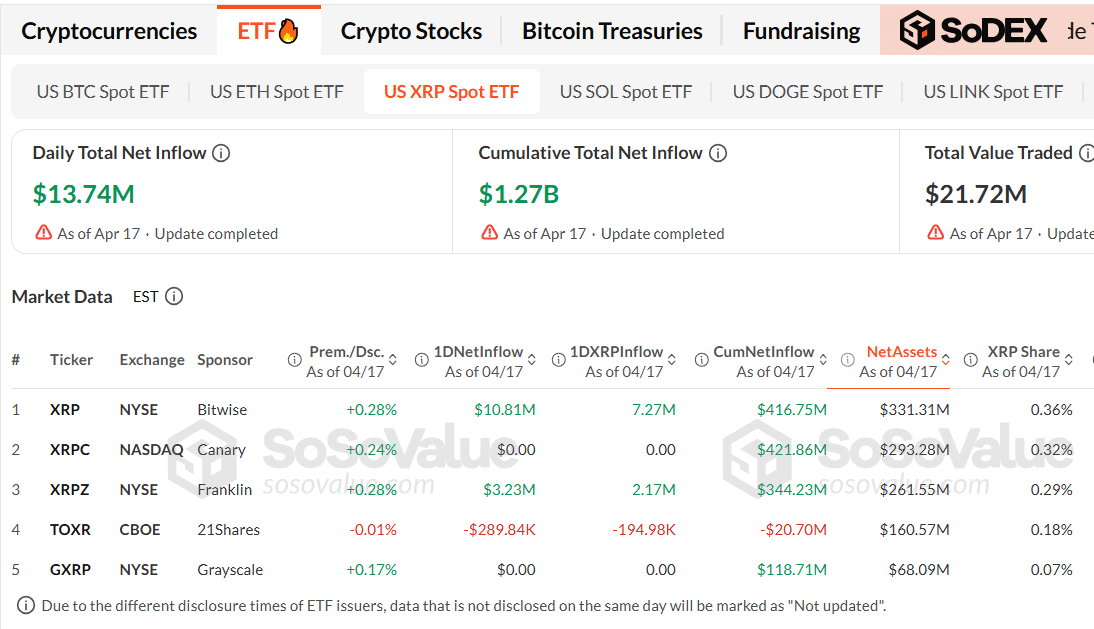
Spot XRP ETF flows reflect a much earlier stage of institutional adoption. Total net assets across US spot XRP ETFs stand at $1.11 billion, representing just 1.22% of XRP’s market cap, a stark contrast to Bitcoin’s 6.55%. 

XRP ETF
XRP ETF | Source: SoSoValue

Daily net inflows came in at $13.74 million on April 17, with cumulative inflows reaching $1.27 billion. Bitwise’s XRP led with $10.81 million in inflows and $331.31 million in net assets, while Franklin’s XRPZ added $3.23 million. All XRP ETF products were marked “Closed” at the time of the snapshot.

Technical outlook: Three majors, one synchronized setup

What makes the current setup unusual is the near-perfect alignment across BTC, ETH, and XRP. All three have broken descending trendlines drawn from their respective late-2025 or early-2026 peaks, reclaimed their 50-day EMAs, and are now contesting the 100-day EMA as immediate resistance. The RSI readings on all three sit in the bullish 53–58 range, and the MACD has flipped positive on each chart.

A confluence of this kind across the top three majors is historically rare outside of regime shifts. If BTC closes above $75,300, ETH above $2,353, and XRP above $1.54 on the daily timeframe, the market would confirm a structural transition from the multi-month downtrend that has defined 2026 to date.

What comes next

The next two weeks are shaping up as a decisive window for the crypto market. With BTC ETF inflows accelerating, Open Interest climbing, and Ethereum on-chain buying pressure at multi-year highs, the technical and flow pictures are aligned to the upside for the first time in months.

A failure at the 100-day EMAs across all three majors would mark the current rally as a failed breakout and send price back to retest the February lows. A successful breakout, however, would confirm the structural bottom and open paths to the 200-day EMAs: $82,800 for Bitcoin, $2,628 for Ethereum, and $1.79 for XRP.

As CryptoOnchain’s data on Ethereum buying pressure and BorisD’s Open Interest analysis suggest, the underlying flow signals are shifting ahead of price. Until all three majors clear their respective 100-day EMAs on a daily closing basis, however, the move remains a potential reversal rather than a confirmed one.

Also Read:Calm Before the Storm: Bitcoin’s Onchain Signals Hint at Push Toward $80K


Source link

Hong Kong SFC Launches Pilot Framework For Secondary Trading Of Tokenised Investment Products On Licensed Platforms

Hong Kong SFC Launches Pilot Framework For Secondary Trading Of Tokenised Investment Products On Licensed Platforms


In Brief

Hong Kong’s SFC launches a pilot framework for secondary trading of tokenised investment products on licensed platforms, expanding retail access, enabling 24/7 trading models, and integrating blockchain settlement into regulated markets.

Hong Kong SFC Launches Pilot Framework For Secondary Trading Of Tokenised Investment Products On Licensed Platforms

Regulatory body responsible for overseeing Hong Kong’s securities and futures markets, Securities and Futures Commission (SFC), introduced a new regulatory framework designed to pilot secondary market trading of tokenised investment products authorised by the SFC, as part of broader efforts to support the development of Hong Kong’s digital asset ecosystem and increase trading activity over time.

According to the regulatory circular, the framework is primarily intended to enable secondary trading of tokenised SFC-authorised open-ended funds on SFC-licensed virtual asset trading platforms VATPs. The initiative is also aimed at widening access to regulated trading infrastructure for retail investors, while allowing, on a discretionary basis, the possibility of over-the-counter secondary trading arrangements subject to individual assessment.

Since the introduction of the SFC’s initial tokenisation regulatory approach in late 2023, market participants have increasingly explored the issuance and distribution of tokenised financial products in Hong Kong, creating new market activity and product structures. As of March 2026, there were 13 tokenised products available to the public in the jurisdiction, with assets under management in tokenised share classes rising approximately sevenfold to 10.7 billion US dollars over the preceding year.

In response to this growth, the regulator has indicated that the timing is appropriate to introduce a pilot framework for continuous secondary trading, including potential 24-hour trading models. The framework is intended to further integrate tokenised financial instruments into the broader Web3 ecosystem, with potential use cases involving regulated stablecoins and tokenised deposits to support continuous settlement and liquidity.

In order to address structural considerations associated with liquidity and investor protection, particularly in relation to trading outside conventional market hours, the framework incorporates measures informed by practices in exchange-traded fund markets and licensed virtual asset trading infrastructure. These measures are intended to support fair pricing mechanisms, orderly market conditions, liquidity provisioning standards, and enhanced disclosure requirements.

Advancing Market Integration And Phased Implementation Of Tokenised Products

According to the SFC, the initiative represents a step toward the development of a more integrated digital asset market structure in Hong Kong, combining traditional financial products with blockchain-based settlement and trading capabilities. The framework is also positioned as a response to increasing demand for continuous market access in a trading environment characterised by fast information flow and heightened volatility.

The initial phase of the pilot is expected to focus on tokenised money market funds, with the potential for expansion to additional product categories following an assessment of operational performance and market conditions.

Market participants, including product issuers and SFC-licensed virtual asset trading platforms, are encouraged to engage with the regulator in advance of implementing activities under the new framework or to provide relevant notifications as required.

Disclaimer

In line with the Trust Project guidelines, please note that the information provided on this page is not intended to be and should not be interpreted as legal, tax, investment, financial, or any other form of advice. It is important to only invest what you can afford to lose and to seek independent financial advice if you have any doubts. For further information, we suggest referring to the terms and conditions as well as the help and support pages provided by the issuer or advertiser. MetaversePost is committed to accurate, unbiased reporting, but market conditions are subject to change without notice.

About The Author


Alisa, a dedicated journalist at the MPost, specializes in crypto, AI, investments, and the expansive realm of Web3. With a keen eye for emerging trends and technologies, she delivers comprehensive coverage to inform and engage readers in the ever-evolving landscape of digital finance.

More articles


Alisa, a dedicated journalist at the MPost, specializes in crypto, AI, investments, and the expansive realm of Web3. With a keen eye for emerging trends and technologies, she delivers comprehensive coverage to inform and engage readers in the ever-evolving landscape of digital finance.


More articles


Source link

The Glamsterdam Ethereum Upgrade: Ethereum’s Most Ambitious Redesign Since the Merge | NFT News Today

The Glamsterdam Ethereum Upgrade: Ethereum’s Most Ambitious Redesign Since the Merge | NFT News Today


Ethereum isn’t just iterating—it’s rewriting its core operating assumptions. The Glamsterdam upgrade, targeted for the first half of 2026, signals a deliberate shift away from off-chain dependencies toward protocol-native coordination. That’s not incremental progress. It’s structural reform at the base layer, tackling three of Ethereum’s most persistent criticisms—high fees, slow throughput, and centralized block production—in a single hard fork.

If the Merge made Ethereum sustainable, Glamsterdam may make it usable at global scale.

Why Glamsterdam Matters Now

To understand what Glamsterdam is doing, it helps to understand what it’s fixing.

Since the Merge, Ethereum has made real progress on energy consumption, Layer 2 scaling, and data availability. But the base layer itself has been sitting on a set of structural problems that previous upgrades either deferred or addressed only partially. The most glaring among them:

MEV centralization. Roughly 80–90% of Ethereum blocks are currently routed through a handful of external relay systems under the MEV-Boost model. This means a tiny slice of off-chain middleware controls most of the network’s block production—an arrangement that creates censorship risks, cartelization pressure, and a fundamental dependency on trust in third parties.

Sequential execution. Ethereum processes transactions one by one in strict order. Even when two transactions have nothing to do with each other—touching entirely different contracts and accounts—they still queue up and wait their turn. Modern hardware has multiple cores sitting idle while the EVM grinds through each operation in sequence.

Gas fees. Complex DeFi interactions remain expensive, particularly for users of the base layer. The combination of low throughput, high demand, and inefficient gas pricing structures means users pay a premium just to participate.

Glamsterdam addresses all three in a coordinated dual-layer hard fork. Its name is a portmanteau of two layer-specific codenames: Amsterdam for the execution layer and Gloas for the consensus layer. Together they form the most aggressive structural overhaul Ethereum has seen since it stopped mining.

The Architectural Shift: From Off-Chain to Protocol-Native

The deeper story of Glamsterdam is about trust—specifically, about where Ethereum’s trust assumptions have been quietly living outside the protocol.

Under the current MEV-Boost model, validators outsource block construction to builders who deliver blocks through relay services that sit entirely outside Ethereum’s consensus rules. Validators trust relays not to tamper with block contents, but that trust has no cryptographic enforcement behind it. With three or four relays handling the majority of blocks, the attack surface is concentrated in a way that would have seemed alarming if it had been designed that way from the start.

Glamsterdam’s central argument is that credible neutrality cannot be outsourced. Those guarantees need to live in the protocol itself—not in the reputations of relay operators.

ePBS (EIP-7732): Ethereum’s Answer to MEV Centralization

The MEV-Boost relay model functions as a trusted intermediary between block builders and validators. Builders construct blocks, seal them, and submit bids to relays. Validators select the highest bid without seeing block contents—a process that works only because validators trust relays to deliver what was promised. Relays can fail, causing missed blocks. They can filter transactions, making censorship possible at scale with no protocol-level accountability. And because relay operation is technically demanding and economically marginal, the market has consolidated toward a handful of dominant operators.

EIP-7732 moves this entire market into Ethereum’s consensus layer. Builders submit cryptographically sealed bids committed in-protocol. Validators select the highest bid as before—but now the commitment is enforced by the same consensus rules that govern everything else. No external relay required. Builders become first-class protocol participants with registered identities, signed bids, and protocol-enforced accountability.

One remaining problem is delivery: once a builder wins an auction, what stops them from withholding block contents to exploit the gap between commitment and reveal? Glamsterdam addresses this through the Payload Timeliness Committee (PTC), a group of validators that enforces delivery deadlines. Strict payload schedules and slashing conditions close what researchers call the “free option” problem—the asymmetric advantage builders previously had by committing to a bid and then deciding whether to follow through.

ePBS doesn’t eliminate MEV. The underlying incentive—that some transaction orderings are more profitable than others—remains. What it does is commoditize MEV extraction, turning a privileged insider market into a transparent, protocol-enforced auction. MEV extraction is projected to fall by up to 70% as a result.

Parallel Execution and Block-Level Access Lists: Ethereum’s Throughput Breakthrough

Ethereum currently discovers which accounts and storage slots a transaction will touch only during execution—no advance information. Every transaction queues up sequentially because there’s no way to know whether two transactions conflict without actually running them. Multi-core hardware buys almost nothing, because the EVM is effectively single-threaded.

EIP-7928 fixes this by introducing Block-Level Access Lists (BALs)—structured declarations specifying exactly which storage slots and accounts each transaction will read or write, committed in the block header before execution begins. With that state-access map available upfront, Ethereum clients can identify which transactions are genuinely independent and run them simultaneously across multiple CPU cores. Transactions that share state dependencies get grouped into sequential lanes; everything else runs in parallel.

The practical result is that high-traffic DeFi contracts stop being network-wide bottlenecks—their congestion gets contained within their own execution lane. Devnet results show sync speeds roughly 5x faster than the current baseline, with a near-term throughput target of 1,000+ TPS and a path to 10,000 as the gas limit scales.

Gas Economics Rewritten: Why Fees Could Drop by Around 78%

Glamsterdam bundles several gas repricing EIPs alongside the headline changes. EIP-7904 introduces benchmarked gas pricing, tying operation costs more directly to actual resource consumption on reference hardware for a more predictable cost structure. EIP-8007 adjusts pricing to penalize state bloat while rewarding computationally efficient patterns—an economic nudge toward long-term sustainability rather than raw expansion.

The gas limit itself is set to increase in stages, targeting 100 million per block initially and 200 million once ePBS is fully operational, up from roughly 30–60 million today. Combined with parallel execution and repricing, devnet results show approximately 78.6% fee reductions for complex DeFi interactions. For a user currently paying $4–8 per swap on the base layer, that’s a meaningful shift—not a footnote.

Security, Censorship Resistance, and Inclusion Guarantees

As relay infrastructure consolidated, censorship at the block level became a genuine vulnerability. Relay operators responding to regulatory pressure could filter transactions from specific addresses before they reached validators—invisibly, with no protocol-level accountability.

Under ePBS, builders who exclude transactions become economically accountable. The protocol can observe builder behavior directly and apply penalties for unjustified non-inclusion. Glamsterdam also lays groundwork for forward inclusion lists, a mechanism allowing validators to assert that specific transactions must appear in the next block. Full realization of this comes with the Hegota upgrade later in 2026 through FOCIL (Fork-Choice Enforced Inclusion Lists). Glamsterdam’s version is a foundation—but it transforms censorship from a silent risk into a behavior the protocol can identify and punish.

Quantitative Impact: Before and After Glamsterdam

Block Building

Relay-based (off-chain)

Protocol-native

Execution

Sequential

Parallel

TPS

~15–30

1,000+ (target: 10,000)

Gas Fees

High

Up to ~78% lower

Sync Speed

Slow

~5x faster

MEV Risk

High

Reduced (up to 70% less extraction)

Gas Limit

~30–60M

100–200M

Risks, Tradeoffs, and Open Questions

Glamsterdam’s ambition comes with real risks. Moving block building and execution logic into the consensus layer creates a broader attack surface—more moving parts, more edge cases, and neither ePBS nor BALs have been stress-tested at mainnet scale. On-chain block auctions introduce game-theoretic attack vectors that relay systems didn’t have; the Payload Timeliness Committee addresses the most obvious ones, but the full range of adversarial strategies in a live market is hard to anticipate in devnet conditions.

Parallel execution also shifts the performance bottleneck from compute toward disk I/O, which could strain nodes running on modest hardware. And BAL adoption requires wallets and dApp teams to update their tooling before the parallel-execution benefits fully materialize.

Then there’s the timeline. The June 2026 target is aspirational. Over 25 additional EIPs are under consideration for inclusion, and the Base engineering team has flagged that adding FOCIL alongside ePBS could push the upgrade into Q3 or Q4. Ethereum is trading simplicity for scalability. Whether that trade holds depends on how well client teams implement these changes under real-world conditions.

The Bigger Picture: Glamsterdam as a Bridge to What Comes Next

Glamsterdam is explicitly positioned as infrastructure for the upgrades that follow it. Hegota, expected in the second half of 2026, will introduce FOCIL for full inclusion list enforcement and encrypted mempools. Both features are significantly easier to build in a world where the protocol can identify builders and hold them accountable—something ePBS makes possible for the first time.

BALs also serve as a prerequisite for stateless clients: nodes that verify blocks without storing the full Ethereum state. This would lower hardware requirements for running a node substantially, with direct implications for decentralization. Vitalik Buterin’s scaling framework is explicit on the sequencing: ePBS and BALs deliver 10–30x execution improvements now; ZK-EVMs deliver 1,000x later. Glamsterdam is what makes the longer-range path actually feasible.

Final Verdict: Is Glamsterdam Ethereum’s Inflection Point?

Glamsterdam is the first Ethereum upgrade to simultaneously reduce fees, increase throughput, and improve decentralization at the base layer. Previous hard forks targeted one dimension at a time. This one targets all three, with a projected 70% reduction in MEV extraction, roughly 78% lower fees for complex DeFi interactions, and a throughput leap from 15–30 TPS toward 1,000+.

The more important shift, though, is structural. By moving block building and execution coordination into the protocol itself, Glamsterdam eliminates the informal middleware that Ethereum’s credible neutrality had quietly been depending on. Whether it ships on schedule is an open question—the June 2026 target is aspirational and the scope is large. But as a statement of architectural intent, it’s the clearest signal in years that Ethereum’s base layer is still being actively built, not just maintained.


Source link

The Mandalorian and Grogu: Breaking Down the Epic New Trailer | Metaverse Planet

The Mandalorian and Grogu: Breaking Down the Epic New Trailer | Metaverse Planet


I still remember the exact moment the Star Wars sequel trilogy ended. Regardless of how any of us felt about those films, there was a lingering sense of exhaustion. I honestly thought it would be a very long time before I felt that undeniable rush of sitting in a dark theater, waiting for the iconic John Williams score to blast through the speakers.

For the past few years, the heart of Star Wars hasn’t been in the cinema; it has been on our television screens, largely carried on the beskar-clad shoulders of Din Djarin and his tiny, Force-sensitive companion. But things are about to change. Disney just dropped a brand-new trailer for The Mandalorian and Grogu at Cinema-Con in Las Vegas, and after analyzing every frame, I have a lot of thoughts on what this means for the future of the galaxy far, far away.

The film is officially slated to hit theaters on May 22, and here is why I think this is both the most exciting and the riskiest move Lucasfilm has made in years.

A New Era: From Streaming Darlings to Box Office Heavyweights

Let’s be real for a second: taking a hit TV show and turning it into a feature film is incredibly difficult. You have to satisfy the hardcore fans who have watched every episode, while simultaneously making the story accessible to a casual moviegoer who might not even have a Disney+ subscription.

From what I saw in the new trailer, director Jon Favreau is leaning heavily into the overarching lore. The days of Mando just doing side-quests on backwater planets seem to be over.

The Plot Shift: Following the fierce battle for the control of Mandalore in the show’s latest season, our favorite duo is embarking on a massive new adventure.The New Republic’s Mission: With the Empire shattered, the New Republic is desperately trying to establish order. Mando and Grogu aren’t just bounty hunting anymore; they are being sent on highly dangerous, officially sanctioned missions for the New Republic.

I love this direction. It bridges the gap between the scrappy underworld we saw in the early seasons and the larger galactic conflict that defines Star Wars cinema.

Sci-Fi Royalty Enters the Chat: The Cast

One of the things that genuinely made me sit up and take notice during the Cinema-Con announcements was the cast list.

Obviously, Pedro Pascal is back bringing his signature gravitas to Din Djarin. But the supporting cast is where things get wild.

Sigourney Weaver: Yes, you read that right. The absolute queen of sci-fi (Alien, Avatar) is officially joining the Star Wars universe. I don’t know who she is playing yet, but her mere presence elevates the entire project.Jeremy Allen White: Seeing the star of The Bear jump into hyperspace is a crossover I didn’t know I needed. He brings a raw, intense energy to his roles, and I’m fascinated to see how he fits into this universe.Amy Sedaris & Jonny Coyne: Sedaris returning means we’ll still get that quirky, eccentric humor that balances out the show’s darker moments.

The Elephant in the Room: The “TV” Budget

As much as I am hyped, I have to address the critique that’s already floating around the internet. Reports indicate that The Mandalorian and Grogu was shot with a significantly lower budget compared to traditional Star Wars blockbusters.

When you watch the trailer, you can feel it. The production quality, the cinematography, and the visual effects look fantastic—but they look like high-end television, not necessarily a $250 million movie.

Is this a bad thing? Personally, I don’t think so. We have seen bloated, massive-budget movies fail spectacularly because they relied too heavily on CGI spectacle and forgot about the story. Jon Favreau knows these characters intimately. If a tighter budget means a tighter script, more practical effects, and a story focused on the emotional bond between Mando and Grogu rather than just blowing up another Death Star, I am completely on board.

However, it is a massive gamble for the box office. General audiences expect a certain level of overwhelming visual scale when they buy a ticket for a Star Wars movie. If it feels like an extended, two-hour TV episode, it might struggle to pull in the billion-dollar numbers Disney usually expects.

Final Thoughts

The Mandalorian and Grogu feels like a massive test for the future of entertainment. Can a streaming phenomenon successfully transition back to the silver screen? Based on the heart and soul shown in this new trailer, I am willing to bet on the Mandalorian.

But I want to pass the question over to you. Are you worried that a lower budget might make the movie feel like just another TV episode, or do you think a story-focused approach is exactly what Star Wars needs right now? Let’s discuss in the comments!

You Might Also Like;


Source link

Are Stablecoins Really a Threat to Banks? | NFT News Today

Are Stablecoins Really a Threat to Banks? | NFT News Today


Here’s the honest answer: stablecoins are not an immediate existential threat to banks. But they are quietly reshaping the competitive landscape in ways that banks can no longer afford to dismiss.

That distinction matters. The public debate has swung between two extreme positions, either stablecoins are going to obliterate traditional banking, or they’re a crypto sideshow with no real-world consequence. Both framings miss what’s actually happening.

What’s actually happening is more interesting and more consequential than either camp admits. Stablecoins have crossed $317 billion in aggregate market capitalization as of April 2026, according to Federal Reserve analysts, a figure representing over 50% growth since early 2025. They processed roughly $9 trillion in settlement volume in 2025. They are embedded in the payment systems of Mastercard, Visa, Coinbase, Interactive Brokers, and Citigroup. The GENIUS Act was signed into law in July 2025, establishing the first federal regulatory framework for stablecoin issuance in the United States.

The question worth asking isn’t whether stablecoins pose a threat. The better question is what kind of threat, on what timeline, and to which parts of banking. The answers depend heavily on regulatory decisions that are still being made right now.

What Makes Stablecoins So Disruptive?

Before getting into the banking implications specifically, it helps to understand what makes stablecoins structurally different from other payment technologies.

Always-On Financial Infrastructure

Banks operate on a schedule. They close on weekends and observe public holidays. International wire transfers that originate on Friday afternoon may not reach their destination until Tuesday. This is baked into the underlying infrastructure that traditional finance was built on over the decades.

Stablecoins don’t have hours. Transfers settle 24 hours a day, 365 days a year, in seconds or minutes. This is a structural advantage, not an incremental improvement. It means that institutions moving capital across borders, posting collateral overnight, or managing intraday liquidity in real time can do things that simply weren’t possible on traditional rails. The efficiency gap here is architectural, it can’t be patched by upgrading existing bank systems.

Faster and Cheaper Cross-Border Payments

The average international wire transfer costs between $25 and $45 in fees and takes one to five business days. A stablecoin transfer costs a fraction of that and lands in minutes. For the hundreds of millions of migrant workers sending money home each year, that cost and time gap savings are significant.

Traditional payment infrastructure connected to stablecoins is already reshaping how cross-border transactions work. Regional banks like Cross River and Lead Bank are settling Visa transactions in USDC. Mastercard has partnered with MetaMask. Interactive Brokers enabled customers to fund brokerage accounts via USDC in January 2026. The rails are being built in real time, alongside existing infrastructure, not replacing it overnight.

Programmability — A New Financial Primitive

This is probably the least appreciated advantage. Smart contracts allow financial logic to be embedded directly into money. A payment that releases only when a specific condition is met. Payroll that distributes automatically at a set time. Collateral that liquidates in real time when a threshold is crossed. Corporate treasuries that optimize yield automatically between yield-bearing positions and liquid stablecoins.

DeFi protocols have been building these primitives for years, but institutional adoption is what moves the needle at scale. As banks, asset managers, and treasury departments integrate programmable payment tools, the gap between what they can do on-chain versus what they can do through traditional systems grows wider.

Financial Inclusion as a Genuine Edge

In developed markets, almost everyone already has a bank account. The disruption argument is relatively contained. But in emerging economies, where hundreds of millions of people remain unbanked or underbanked, access to a dollar-pegged digital asset via a smartphone represents something banks haven’t managed to provide.

Moody’s flagged this directly, warning that in economies with weak local currencies, stablecoins could accelerate “cryptoization”,  a shift away from domestic deposits and into dollar-equivalent digital assets. For those local banking systems, the threat is more immediate and more acute than for major Western banks.

The Real Threat: Deposit Disintermediation

The payments argument is compelling, but the deeper concern is structural. It’s about deposits.

Why Bank Deposits Matter

Bank deposits are the raw material of lending. A bank takes in deposits, lends a portion of that capital at a higher rate, and keeps a reserve. The stability and size of a bank’s deposit base directly determines its capacity to extend credit, mortgages, business loans, and consumer credit.

This is why economists and regulators use the term “bank disintermediation” so seriously. If capital flows out of bank deposits into other instruments, the knock-on effects include a reduction in available credit, higher funding costs, and potential stress on the lending ecosystem.

How Stablecoins Compete for Deposits

A business that would previously hold idle cash in a bank account can now hold that same capital in a stablecoin, available 24/7, usable as collateral on crypto exchanges, and potentially earning yield through affiliated programs. A consumer in an emerging market might choose a stablecoin wallet over a local bank account if their local currency is volatile.

Neither of these scenarios requires a dramatic, sudden shift. Gradual behavioral changes, a few percentage points of transaction balances migrating each year, is how this dynamic plays out. And behavioral change, once it starts, tends to compound.

The primary threat here is not that stablecoins replace savings accounts or mortgage products. It’s that they attract transaction balances, the working capital that businesses and individuals cycle through day-to-day. Those balances are a critical, low-cost funding source for banks.

Short-Term Reality: Limited Threat, For Now

Let’s be direct about the current state. Despite all the structural arguments, the near-term threat to established banks in developed markets remains limited.

Regulatory Constraints Cap Adoption

The GENIUS Act prohibits stablecoin issuers from paying interest directly to holders. This limits the yield incentive that would otherwise accelerate migration from bank deposits. A stablecoin that doesn’t pay yield is less attractive than a high-yield savings account for customers who have a choice.

Grant Thornton’s analysis flagged this as a deliberate design choice — the yield prohibition is intended to keep stablecoins anchored to payments use cases and prevent deposit flight.

Banking associations are fighting to extend that prohibition to affiliated platforms and exchanges, where yield-like rewards programs could create a functional workaround. That battle is ongoing.

Still Primarily Crypto-Native Infrastructure

For all the headline numbers, the majority of stablecoin volume is still concentrated in crypto trading, DeFi liquidity, and institutional settlement — not in everyday consumer banking. Most people with a bank account aren’t thinking about stablecoins as an alternative. That changes over time, but it’s the current reality.

What Expert Analysis Actually Says

Moody’s 2026 Digital Economy Outlook frames stablecoins as evolving into “digital cash” for institutional liquidity management, useful infrastructure layered alongside banking, not a replacement for it. Moody’s sees the immediate risk as operational and systemic rather than existential: smart contract bugs, custody vulnerabilities, and fragmentation across blockchains are the near-term concerns, not bank collapse.

In the short term, stablecoins function more like infrastructure upgrades than direct banking competitors. They compress settlement times, reduce friction in cross-border flows, and create new collateral management tools. Banks that integrate this infrastructure can benefit from it just as much as non-bank competitors.

Medium-Term Outlook: Competitive Pressure Builds

The picture changes over a five-to-ten-year horizon, and this is where the analysis gets more consequential.

Real-World Adoption Is Already Expanding

Stablecoins are moving steadily into B2B payments, cross-border payroll, and remittances. As more businesses adopt them for operational reasons — not because they’re crypto enthusiasts, but because the economics are better, use case expands. And once payment infrastructure is adopted for business flows, consumer adoption typically follows.

That adoption increasingly intersects with tokenized real-world assets, where on-chain finance is becoming genuine institutional infrastructure. The more embedded stablecoins become in the broader digital asset ecosystem, the harder it becomes to draw a clear line between stablecoin and banking infrastructure.

Gradual Deposit Leakage

Transaction balances shift first. Businesses notice the efficiency gains from stablecoin-based treasury management. Institutional traders consolidate collateral in tokenized products rather than bank accounts. Each individual decision is rational and relatively small. In aggregate, they represent a slow but meaningful drain on the deposit base that banks rely on for low-cost funding.

Federal Reserve researchers have modeled this carefully. Their analysis finds that even moderate stablecoin adoption, without master account access for issuers — could reduce bank lending by between $190 billion and $408 billion through deposit drain and a compositional shift toward more expensive wholesale funding.

Banks Face a Real Innovation Imperative

The funding cost story is tied to a technology story. Banks that fail to build or acquire blockchain settlement capabilities will find themselves increasingly dependent on non-bank intermediaries for digital payment flows. That means paying fees on infrastructure they used to control. It means losing direct customer relationships to platforms with better digital experiences. It means becoming utility backends, essential plumbing, but not the interface that customers actually interact with.

That’s not a new pattern in financial services. It’s how many banks lost direct consumer relationships to fintech apps over the past decade. The stablecoin layer is the next chapter in the same story.

Long-Term Scenario: Structural Disruption Is Possible

This is where policy decisions become decisive. The long-term severity of stablecoin disruption to banking depends less on technology than on two regulatory choices: whether stablecoin issuers gain access to Federal Reserve master accounts, and whether affiliated platforms can offer effective yield.

The Master Account Scenario

The Federal Reserve’s own analysis is stark on this point. If stablecoin issuers gain master accounts with access to the interest on reserve balances (IORB) rate, and if adoption scales to $1 trillion in circulation, the potential deposit drain from commercial banks reaches $600 billion to $1.26 trillion. That scenario would represent the “maximum degree of bank disintermediation,” in the Fed’s own language, funds flowing from bank depositors directly to the central bank via stablecoin issuers, bypassing commercial banks entirely.

This is not the current trajectory. The GENIUS Act explicitly preserves existing Federal Reserve authority over master account access, nothing in the legislation automatically grants issuers central bank access. But it’s the inflection point to watch. The policy decision on master accounts is where technology stops being the determining factor and regulatory choice takes over.

Full Disintermediation Risk

If issuers did gain central bank access at scale, the mechanism for bank lending could be meaningfully impaired. Banks fund loans primarily through deposits. Remove that low-cost funding source, and lending contracts — not catastrophically overnight, but steadily. The AEI has drawn comparisons to the 1970s money market fund disruption, which contributed to hundreds of depository institution failures in the 1980s as deposits migrated to higher-yielding alternatives.

The analogy isn’t perfect; stablecoins currently don’t pay yield, and the GENIUS Act imposes much tighter reserve requirements than money market funds face. But the structural dynamics of capital flowing toward instruments that offer greater utility remain the same.

Uneven Global Impact

The disruption risk is not distributed evenly. In developed markets with stable currencies, strong deposit insurance, and sophisticated banking alternatives, the migration will be slow and contested. In emerging markets, where local currencies are volatile, banking infrastructure is thin, and smartphone adoption is high, the transition could be much faster.

Moody’s has specifically flagged “cryptoization” as a risk in emerging economies: a shift where residents move savings from domestic bank deposits into stablecoins, weakening central banks’ monetary policy tools and eroding the deposit base of local lenders. For those banking systems, the threat is less speculative than it is for JPMorgan or Citigroup.

Stablecoins vs Banks: A Balanced Risk Assessment

Opportunities for Banks

The picture isn’t all downside for incumbent institutions. Banks that move early to integrate stablecoin infrastructure can benefit from it substantially.

Tokenized deposits, digital representations of bank deposits on blockchain rails, allow institutions to offer 24/7 payment capabilities while preserving deposit insurance and existing regulatory protections. JPMorgan’s JPM Coin, Citi Token Services, and SoFi’s stablecoin on a public blockchain are all examples of banks building this capability rather than ceding it to non-bank competitors.

Custody services are another opportunity. Institutions need trusted, regulated custodians for digital assets. Banks have infrastructure, regulatory track records, and client relationships that fintech competitors lack. BNY Mellon is already serving as custody partner for Ripple’s RLUSD. Citi is building toward a 2026 launch of its own custody platform.

Blockchain transparency also helps compliance. On-chain transaction records are auditable in ways that traditional banking records often are not. That’s a genuine advantage for banks navigating anti-money laundering and know-your-customer obligations.

Risks for Banks

The risk side is equally clear.

Competition for deposits raises funding costs. Even without full disintermediation, the gradual migration of transaction balances creates pressure. Banks that lose low-cost deposits replace them with more expensive wholesale funding, commercial paper, interbank loans, which compresses net interest margins.

Infrastructure overhaul is expensive and slow. Large banks have spent decades building core banking systems. Integrating blockchain settlement rails alongside those systems without creating new operational vulnerabilities is a significant engineering challenge. The institutions best positioned to do this quickly are the largest, leaving smaller and regional banks at a disadvantage.

Liquidity risks under stress deserve attention. Federal Reserve research on the Silicon Valley Bank episode demonstrated that stablecoin reserve assets held at banks can become inaccessible during a bank failure, creating a feedback loop between traditional banking stress and stablecoin liquidity pressure. USDC briefly depegged in March 2023 precisely because its reserves were held at SVB. Deeper integration between stablecoins and banks can amplify stress in both directions.

Hidden Risks in the Stablecoin Ecosystem

Any analysis that only focuses on what stablecoins do to banks would be incomplete without examining what can go wrong inside stablecoins themselves.

Reserve Transparency and Depegging Risk

Moody’s published a formal stablecoin rating methodology in March 2026, applying quantitative frameworks to assess reserve quality, market risk, and operational safeguards. The key finding: a stablecoin’s stability is only as reliable as its reserves, and those reserves are only as accessible as the custodians holding them.

Tether holds the majority of its reserves in U.S. Treasuries and money market funds. Circle’s USDC holds a mix of Treasuries and repurchase agreements. The reserve structure of any major stablecoin matters enormously in a stress scenario, not just for the stablecoin’s own peg, but for the downstream effects on treasury markets and lending facilities.

Regulatory Uncertainty Remains the Primary Variable

The GENIUS Act established a federal framework, but implementation is still underway. Regulations from the OCC, Federal Reserve, and FDIC are in various stages of development. The European Union’s MiCA framework is taking effect in parallel. Jurisdictions across Asia are building their own rules.

A stablecoin compliant in the United States may face restrictions in other jurisdictions. A product structured for European compliance may not qualify under U.S. banking regulations. This fragmentation creates genuine operational risk for globally ambitious stablecoin issuers and for the banks that integrate with them. The policy trajectory matters more than any individual product feature right now.

The “Flight to Safety” Paradox

Here’s a counterintuitive dynamic worth noting. During periods of market stress, stablecoins backed by short-term Treasuries might actually attract capital from investors looking for perceived safety on-chain. That inflow, if large enough, puts significant demand pressure on Treasury markets simultaneously. And if confidence in a specific stablecoin’s reserves fractures, as happened with USDC in March 2023 — the redemption pressure flows back into the banking system, potentially amplifying the original stress rather than absorbing it.

The Federal Reserve’s own review of the SVB episode captured this feedback loop in detail. The deeper the integration between stablecoin infrastructure and traditional banking gets, the more important it is to understand that stress in one system can propagate through the other.

Final Verdict: Threat or Transformation?

Let’s be straightforward about where this analysis lands.

Stablecoins are not an immediate existential threat to established banks in developed markets. The regulatory framework, the current absence of yield for stablecoin holders, and the deeply embedded nature of traditional banking infrastructure all limit the speed of displacement.

Stablecoins are a growing competitive force. They are taking transaction volume, reducing friction in cross-border payments, and attracting institutional capital that previously sat in bank accounts. That pressure is real, it’s measurable, and it will intensify.

Stablecoins could become a long-term structural challenger, but only if specific policy decisions go a particular way. Master account access for stablecoin issuers, or the effective erosion of the yield prohibition through affiliated platforms, would significantly accelerate the disintermediation dynamic the Federal Reserve has modeled.

Stablecoins will not destroy banks. But they will force banks to evolve, to build blockchain rails, issue tokenized deposits, and compete on the basis of 24/7 liquidity and programmable payment tools, or risk becoming legacy infrastructure that customers route around.

What This Means for the Future of Banking

The strategic picture for banks is actually clearer than the heated debate around it might suggest.

Banks that move early on tokenized deposits gain a structural advantage. They can offer blockchain-native payment capabilities while retaining deposit insurance, something stablecoin issuers cannot match. They preserve customer relationships that might otherwise migrate to non-bank platforms.

Banks that integrate blockchain settlement rails reduce operational costs, improve intraday liquidity management, and open new revenue streams through digital custody and settlement services. JPMorgan, Citi, BNY Mellon, and SoFi are already building in this direction. The gap between early movers and laggards will widen as adoption accelerates.

Banks that ignore the shift risk a slower, more insidious form of obsolescence. Not a sudden crisis, but a gradual erosion of the relationships and transaction flows that underpin their business models. The stablecoin market sat at $5 billion in 2020. It crossed $317 billion by early 2026. The trajectory is not ambiguous.

The real question is no longer whether stablecoins threaten banks. It’s whether banks can adapt fast enough to remain central to the financial system as digital payment rails become the default infrastructure of global commerce.

For those watching the stablecoin infrastructure buildout closely, the answer is already emerging. The institutions that treat stablecoins as infrastructure to integrate, rather than a threat to defeat, are the ones positioning themselves on the right side of this transition.

Frequently Asked Questions

Here are some frequently asked questions about this topic:

Are stablecoins a threat to traditional banks?

In the short term, the threat is limited by regulatory constraints, particularly the GENIUS Act’s prohibition on stablecoin issuers paying yield directly to holders. Over the medium and long term, stablecoins represent genuine competitive pressure, particularly for transaction deposit balances and cross-border payment volume. The severity of long-term disruption depends largely on future regulatory decisions around Federal Reserve master account access for stablecoin issuers.

What is bank disintermediation and how do stablecoins cause it?

Bank disintermediation occurs when capital flows away from bank deposits into other financial instruments, reducing banks’ ability to fund loans. Stablecoins create this pressure by offering an alternative place to hold dollar-equivalent capital, accessible 24/7, usable in digital payment workflows, without depositing funds at a bank. Federal Reserve modeling suggests moderate stablecoin adoption could reduce bank lending by $190–408 billion through this mechanism.

What is the GENIUS Act and how does it affect stablecoins?

The GENIUS Act, signed into law in July 2025, establishes the first federal regulatory framework for payment stablecoins in the United States. It requires 100% reserve backing with liquid assets, monthly public reserve disclosures, full AML/KYC compliance, and prohibits issuers from paying interest to holders. It permits banks to issue stablecoins through subsidiaries and issue tokenized deposits, while creating a pathway for non-bank issuers under federal oversight.

Can banks issue their own stablecoins?

Yes. The GENIUS Act explicitly allows banks and credit unions to issue payment stablecoins through subsidiaries. Several major banks are already developing tokenized deposit products, JPMorgan’s JPM Coin, Citi Token Services, and SoFi’s stablecoin on a public blockchain are current examples. These products function differently from stablecoins issued by non-bank entities because they carry deposit insurance and are backed by existing banking infrastructure.

What are tokenized deposits and how are they different from stablecoins?

Tokenized deposits are digital representations of bank deposits on blockchain rails. Unlike stablecoins issued by non-bank entities, they carry deposit insurance coverage and inherit existing banking regulatory protections. The GENIUS Act explicitly preserves banks’ ability to issue tokenized deposits that can pay yield, a distinction that gives banks a structural advantage over non-bank stablecoin issuers under current law.

Which blockchains are used for stablecoins?

Ethereum remains the dominant settlement layer for institutional stablecoin activity, hosting the majority of USDC and major DeFi-integrated stablecoin volume. Tether operates substantially on Tron. Franklin Templeton’s BENJI uses Stellar as its primary chain. BNB Chain has seen significant growth, partly due to USYC’s adoption as Binance institutional collateral. For more on which blockchains are emerging as institutional infrastructure, see our 2026 RWA protocol overview.



Source link

Copilot Cowork — A New Way of Getting Work Done in Microsoft 365

Copilot Cowork — A New Way of Getting Work Done in Microsoft 365


The pace of AI innovation continues to accelerate, and Microsoft keeps moving fast. This time the leap is significant: Copilot Cowork — the new execution layer for Microsoft 365 — is now available in the Frontier program, and it takes Copilot from a helpful assistant to an AI coworker that actually does the work with you. After using it heavily for the past weeks, I can say this is another meaningful step in how AI is reshaping the way we work.

What is Copilot Cowork?
Why Copilot Cowork matters for the Future of Work
Copilot Cowork vs. Claude Cowork — what’s the difference?
What Copilot Cowork can do for you
Stay in control — approval-gated actions
My experience: from everyday tasks to training content
A custom skill for training and session content
How to enable Copilot Cowork in your tenant
Cowork is changing how we work

What is Copilot Cowork?

Copilot Cowork is an agentic coworking experience inside Microsoft 365 Copilot. Rather than answering single questions, Cowork carries out multi-step tasks on your behalf — it drafts and sends emails, schedules meetings, creates documents, posts in Teams, browses SharePoint and OneDrive, and searches across your organization. You describe the outcome in natural language, and Cowork generates a plan grounded in your Microsoft 365 context and works through it step by step — visibly, inside the conversation, so you can follow every move it makes.

Cowork is available in the browser at m365.cloud.microsoft and in the Microsoft 365 Copilot desktop app for Windows and Mac, installable from the Agent Store and pinnable to the left rail.

The key shift is not the conversation. It is the execution — from talking about work to doing work.

Why Copilot Cowork matters for the Future of Work

For years we have been promised AI that truly collaborates with us. With Copilot Cowork, that promise becomes something you can use today. It is the kind of change that moves organizations closer to being Frontier Firms — workplaces where people and intelligent agents co-create together.

A few reasons this is such a big deal:

It runs inside your Microsoft 365 tenant, with your work data, under your identity and permissions. Note: it uses Anthropic Claude models, which run as a subprocessor (Anthropic will operate with Microsoft oversight through contractual safeguards and appropriate technical and organizational measures.)

It plans multi-step tasks instead of answering single prompts.

It produces finished artifacts — real files, real messages, real calendar events.

It carries work forward over time, with visible checkpoints and progress tracking.

It keeps you in control — every sensitive action requires your explicit approval.

This is exactly the kind of co-creation between humans and AI I have been talking about for a long time — and now it is a reality inside Microsoft 365.

Copilot Cowork vs. Claude Cowork — what’s the difference?

It is a fair question, because both products share a lot of DNA. Both can research, reason, plan, and produce documents. Both can build PowerPoint decks, Word documents, Excel spreadsheets, and PDFs. Both can orchestrate multi-step work and be extended with custom skills.

The critical difference — and this is the whole point — is where the work happens and what data it can reach.

CapabilityClaude CoworkCopilot CoworkMulti-step task executionYesYesCreates Word / Excel / PowerPoint / PDFYesYesWeb / deep researchYesYesCustom skillsYesYes (up to 20, stored in your OneDrive)Runs inside Microsoft 365NoYes ( as a subprocessor)Accesses your mailbox, Teams chats, calendar, SharePoint, OneDriveNot directly, but possible Yes, via Work IQSends emails, posts in Teams, creates meetings on your behalfNot directly, but possibleYes, with approval gating

Claude Cowork is an excellent general-purpose AI coworker. It knows your work — your inbox, your meetings, your team, your files, your org — and can act inside it. For knowledge workers living in Microsoft 365, that is a completely different level.

What Copilot Cowork can do for you

Out of the box, Cowork ships with several built-in skills: Word, Excel, PowerPoint, PDF, Email, Scheduling, Calendar Management, Meetings, Daily Briefing, Enterprise Search, Communications, Deep Research, and Adaptive Cards. Together they cover the most common daily workflows of a knowledge worker:

Communication — draft and send emails, post in Teams channels or chats, create HTML newsletters, sort your inbox, prepare stakeholder updates.

Documents and files — create and edit Word, Excel, PowerPoint, and PDF; browse your entire Work IQ to pull in the right content; create and reorganize SharePoint and OneDrive folders.

Calendar and meetings — schedule meetings in natural language, move things around, decline conflicts (with a reason message to the organizer), get meeting intelligence, and start your day with a daily briefing.

Research and search — enterprise search across your org, plus deep research that synthesizes multiple sources into a comprehensive report.

Automation — run prompts on a schedule so recurring tasks happen automatically.

And you can manage your work with built-in task views — a sortable list, a kanban board, or a Scheduled tab — with each task showing a clear status: In progress, Needs user input, Done, or Failed.

Stay in control — approval-gated actions

One of the things I appreciate the most is how Cowork handles trust. Before it does anything sensitive — sending an email, posting a Teams message, scheduling or declining a meeting, editing or moving files — it pauses and asks for your go-ahead. Approval buttons match the action (Send, Post, Schedule) and medium and high-risk actions get a visible risk indicator. You can skip future prompts for similar actions when you want more speed, and you can pause, resume, or cancel any running task at any time.

This is exactly the right balance: agentic autonomy with human oversight.

My experience: from everyday tasks to training content

I have been using Copilot Cowork a lot lately, for both routine work and the more creative parts of my job. On the everyday side it is the quiet helper you do not notice any more — drafting replies, summarizing threads, preparing briefs, turning a messy meeting into clean action items, building a small spreadsheet from a message.

Where it has really impressed me is content creation for training sessions. This is work I love doing, but there is a lot of repetitive structural effort before the fun part begins. With Cowork, the flow looks like this:

I give Cowork the topic, the audience, and a few guidelines & info I see relevant.

Cowork researches the topic — from the input I provide, from Microsoft Learn and Microsoft Support, from Tech Community, and from the latest news.

It builds a first draft of the presentation — structure, slides, talking points.

It prepares the demo by creating the demo content scripts I need: the files, the emails, the Teams messages — so the demo feels realistic.

It writes a demo script so I know exactly what to click, what to say, and what to show.

The quality of the first draft is clearly good. Not final — never final — but good enough that I can iterate fast instead of staring at an empty slide. That alone is a huge change in how I prepare sessions.

A custom skill for training and session content

One of the things I love the most about Copilot Cowork is that you can extend it with your own skills. Custom skills live in your OneDrive under /Documents/Cowork/Skills/, each in its own subfolder with a SKILL.md file, and Cowork discovers them automatically at the start of each conversation. You can have up to 20 of them.

So I built one for this purpose, and some others to other needs.

My skill helps me create both training and session content drafts in a consistent, repeatable way. When I invoke it, Cowork:

First researches from the sources I trust — my own input, Microsoft Learn and Support, Tech Community, and current news.

Follows my own guidelines on structure, tone, and depth.

Produces a first draft of the presentation, the demo content, and the demo script together as a package.

The result is that I get to the “iterate and polish” part of the work much faster than before. And because the skill encodes my way of working, every draft starts from a good baseline instead of a blank page.

How to enable Copilot Cowork in your tenant

Copilot Cowork is a Frontier preview feature, so a few things need to be in place before you and your users can start working with it.

Prerequisites

A Microsoft 365 Copilot license for the users who will use Cowork.

The tenant enrolled in the Frontier program.

Microsoft-built agents enabled in the Microsoft 365 admin center.

Anthropic as a subprocessor enabled for the tenant. This is on by default globally, but off by default for tenants in the EU Data Boundary, where it must be explicitly enabled. If Anthropic is off, users may see Cowork but will not be able to use it.

Currently English language only.

A small tip for admins

If Cowork does not show up in Agent management in the Microsoft 365 admin center, make sure your admin account is also enrolled in Frontier (Copilot → Settings → Frontier). Without that, admins will not see Cowork in the Agent Inventory.

For users

Once the tenant is ready, users install Cowork themselves from the Agent Store in the Microsoft 365 Copilot app and pin it to the left rail. They can start using it immediately in the browser at m365.cloud.microsoft or in the Microsoft 365 Copilot desktop app. No extra admin action is required per user — permissions and policies already in place in Microsoft 365 are fully respected.

For details, see the official Microsoft Learn pages:

Cowork is changing how we work

Copilot Cowork is not a small update. It is a step-change in how we work with AI inside Microsoft 365 — from a chat companion to an actual coworker that plans, researches, and delivers. It is saving me time every single day, and it is making the more creative parts of my job (like preparing training and sessions) genuinely more fun. And it is very versatile – you can use it from sending messages to organizing your OneDrive to larger workflows.

This is the kind of move that brings the AI-Native workplace closer, and I am excited to see how organizations adopt it and co-create with it.

And one more thing — in the spirit of transparency: I used Copilot Cowork to create the first draft of this very blog post, and then edited it further myself. Which feels like exactly the right way to work with an AI coworker.

Try Cowork. Teach it your way of working. You will be surprised how quickly it becomes part of your team.

Stay tuned — I will keep exploring Copilot and Future Work on the blog!

Unknown's avatar

Published by Vesa Nopanen

Vesa “Vesku” Nopanen, Principal Consultant and Microsoft MVP (Microsoft 365 and Azure AI Foundry) working on Future Work at Sulava MEA.

I work, blog and speak about Future Work : AI, Microsoft 365, Copilot, Loop, Azure, and other services & platforms in the cloud connecting digital and physical and people together.

I have 30 years of experience in IT business on multiple industries, domains, and roles.
View all posts by Vesa Nopanen


Source link

Popular Posts

My Favorites