Metaverse

Home Metaverse Page 47

Nifty Gateway Shutdown: What the Platform’s Closure Means for NFT Collectors | NFT News Today

0
Nifty Gateway Shutdown: What the Platform’s Closure Means for NFT Collectors | NFT News Today


Nifty Gateway’s shutdown closes a defining chapter in early NFT culture, built on curated drops and mainstream entry points. Recent updates have extended the withdrawal window, locked in Arweave migration for metadata/media permanence, ensured perpetual hosting for older NFTs, and promised a bulk tool rollout.

This isn’t just about withdrawals—it’s a signal of Gemini’s strategic shift, the decline of custodial marketplaces, and the push toward true self-custody. This guide covers the history, updated timeline, practical steps, long-term safeguards, risks and reactions, and what it means for collectors taking full ownership.

A Short History of Nifty Gateway

Nifty Gateway was founded in 2018 by twin brothers Duncan Cock Foster and Griffin Cock Foster. Their focus was on making digital collectibles accessible to people who weren’t deeply involved in crypto. Early NFTs—often called “nifties”—were still unfamiliar to most buyers.

In late 2019, Nifty Gateway was acquired by Gemini, founded by Cameron Winklevoss and Tyler Winklevoss. The acquisition brought institutional infrastructure and positioned Nifty as a curated, premium marketplace.

Timed drops, credit card payments, and custodial wallets fueled rapid growth during the 2020–2021 NFT boom. At its peak, the platform facilitated more than $300 million in sales. Landmark releases from artists like Beeple and Pak helped define the era.

Why Now? The Bigger Picture for NFT Platforms

The shutdown didn’t come out of nowhere. In April 2024, Nifty Gateway pivoted toward Nifty Gateway Studio, signaling a move away from operating as a traditional marketplace and toward on-chain creative projects and brand partnerships.

At the same time, Gemini has been clear about its broader strategy. Resources are shifting toward building a “one-stop super app,” with NFT functionality increasingly centered around Gemini Wallet rather than a standalone marketplace.

This also reflects wider market conditions. NFT trading volumes in 2026 remain far below their 2021 highs. Several platforms have consolidated, exited, or changed direction. Community discussions this week even pointed to the closure of Rodeo as another recent example.

Taken together, this moment looks less like a failure and more like a strategic reset. Consolidation tends to favor decentralized, self-custodial setups and utility-driven projects—such as gaming, real-world assets, and on-chain experiences—over speculative, custodial marketplaces.

How the Shutdown Timeline Evolved

Following the initial announcement on January 24, 2026, Nifty Gateway set a February 23 closure date and moved the platform into withdrawal-only mode. The short window triggered concern, especially from collectors managing large collections.

After community feedback, the team issued a follow-up update on January 27, extending the withdrawal window and clarifying plans around metadata and tooling. The revised approach gives collectors more time and flexibility to transition their assets.

Key Dates and the Current Shutdown Timeline

Under the updated plan:

Withdrawals are open now

April 23, 2026 marks the end of the standard 90-day withdrawal window

After that date, Nifty Gateway has stated it will continue assisting collectors with transfers

The extension offers breathing room. Still, moving assets early helps avoid congestion, gas fee spikes, or technical issues closer to the deadline.

How NFT Withdrawals From Nifty Gateway Work

Collectors can withdraw assets using several methods:

Transfer NFTs via a linked Gemini account, where available

Send NFTs to an external Ethereum-compatible wallet (network fees apply)

Withdraw USD balances through Stripe

At the moment, NFT transfers are handled individually. Nifty Gateway has confirmed that a bulk withdrawal tool is in development and will roll out with enough time for collectors to use it before April 23.

Even with the extended window, spacing out transfers and avoiding last-minute activity reduces risk.

Metadata, Media Hosting, and Long-Term Access

Concerns about artwork availability surfaced quickly after the shutdown announcement. In response, Nifty Gateway confirmed plans to migrate metadata and media hosting to Arweave, which is built for long-term data persistence.

NFTs created in 2021 or earlier that depend on platform-hosted metadata will continue to receive hosting support. This helps ensure that artworks remain viewable after transfers. Even so, collectors should verify how individual NFTs display once they move off-platform.

A Practical, Step-by-Step Checklist for Collectors

Log in and review your holdingsAccess your account now while the platform remains available in withdrawal mode. Take screenshots of your collection for personal records.

Choose a secure walletEthereum-compatible options include MetaMask, Rainbow, and hardware wallets like Ledger or Trezor. Never share seed phrases or private keys.

Move priority pieces firstStart with high-value or sentimental NFTs. Run a small test transfer to confirm everything works as expected.

Monitor for the bulk withdrawal toolWatch official updates from Nifty Gateway channels.

Plan around gas feesEthereum fees can fluctuate. Tools like etherscan.io/gas help identify lower-cost periods. Transfers may take minutes or longer depending on network activity.

Verify after transferOnce moved, confirm that metadata and media load correctly in your wallet or via explorers and marketplaces. For older NFTs, rely on Nifty’s stated commitment to ongoing hosting.

Potential Risks and Community Sentiment

Initial reactions across X and collector forums were mixed. Some criticized the original February deadline as too aggressive, reviving familiar “not your keys, not your art” arguments. The extension eased much of that tension, with many viewing it as a reasonable compromise.

Questions remain. While Arweave migration supports permanence, collectors should still verify how each NFT is stored post-transfer. Platform transitions also tend to attract impersonation scams, so only trust official links and communications.

Final Thoughts on the Nifty Gateway Shutdown

The Nifty Gateway shutdown reflects a strategic transition rather than a collapse. Extended timelines, metadata safeguards, and new tooling show a clear effort to support collectors through the process.

This moment also brings empowerment. True ownership comes from self-custody and understanding how assets live on-chain. By acting now, collectors can secure their NFTs for the long term and strengthen their wallet practices in the process.



Source link

GTA 6 Might Go Digital-Only: The End of an Era for Physical Collectors? | Metaverse Planet

0
GTA 6 Might Go Digital-Only: The End of an Era for Physical Collectors? | Metaverse Planet


I remember the day I stood in line for a midnight release, holding a physical game box in my hands, smelling that “new plastic” scent. It’s a ritual for many of us. But if the latest whispers from the industry are true, that era might be officially coming to an end with the biggest entertainment release in history.

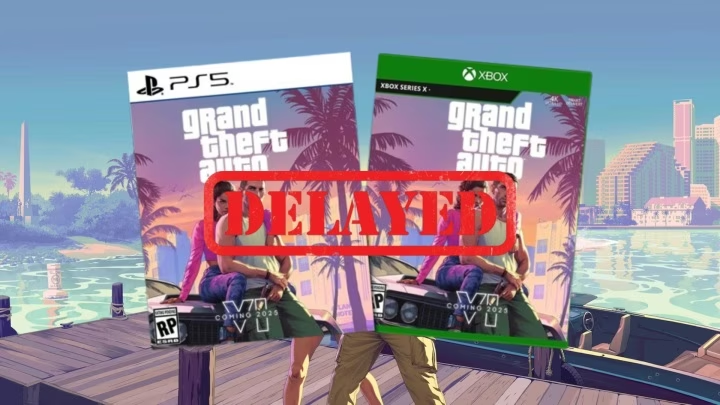
Word on the street—specifically from a reliable source named Graczdari, who has a solid track record with distribution leaks—is that Grand Theft Auto VI might launch as a digital-only title when it finally hits shelves (or rather, servers) on November 19, 2026.

I’ll be honest, as someone who loves a good steelbook on my shelf, this one hurts a little. But from a business perspective? It makes a cold kind of sense.

Why the Shift to Digital? It’s Not Just About Money

While we all know Rockstar and Take-Two love their profit margins, the primary reason being floated for this move is actually leak prevention.

I’ve seen it happen time and again: a retail employee opens a box a week early, snaps a photo of the map, or uploads the ending to YouTube, and the internet is spoiled within minutes.

The RDR2 Precedent: With Red Dead Redemption 2, physical copies were popping up in the wild way before the official launch.The GTA V Irony: Interestingly, back in 2013, GTA V leaked because of a digital pre-load on PS3. It seems Rockstar is caught between a rock and a hard place, but they believe controlling the “digital switch” is their safest bet this time around.

The Massive Profit Play

Let’s talk numbers for a second, because I find the math here staggering.

When you buy a physical game, Take-Two has to pay for the disc, the box, the shipping, and give a fat slice of the pie to retailers like GameStop or Amazon. We’re talking about 30% to 50% of the cover price being eaten up before it even reaches the developer.

By going digital-only through the Xbox and PlayStation Stores:

They cut out the middleman entirely.Even with the platform holders taking their 30% cut, Rockstar keeps a much larger portion of the $70 (or likely more) we’ll be paying for this masterpiece.

When Can We Get a Disc? (If Ever)

If you’re a die-hard collector, don’t lose all hope just yet. The rumor suggests that a physical version isn’t canceled, just delayed. Some sources say we might see it a month after launch, while others—the more pessimistic ones—are saying we might have to wait until 2027 to see a physical box on a shelf.

I personally think launching a physical version later is a “double-dip” strategy. They know the super-fans will buy it digitally on day one just to play it, and then buy it again six months later to have the box for their collection. It’s brilliant, if a bit frustrating for our wallets.

Ugu’s Take: A Digital Future We Can’t Escape

I have mixed feelings about this. On one hand, I want to play the game at the exact second it unlocks at midnight without worrying about a delivery driver being late. On the other hand, there’s something about “owning” a piece of history that a digital license just can’t replace.

If GTA 6—the most anticipated game of the decade—successfully pulls off a digital-only launch, it will be the final nail in the coffin for physical media in gaming. Other studios will see the success and follow suit. We are watching the transition in real-time.

Are you willing to wait months just to own GTA 6 on a disc, or are you clicking that ‘Pre-Order’ button on the digital store the second it goes live regardless?

You Might Also Like;


Source link

New Crypto Presale Auction Hits $1.6M as ZKP Stage 2 Limits Supply to 190M Daily 

0
New Crypto Presale Auction Hits .6M as ZKP Stage 2 Limits Supply to 190M Daily 


In Brief

The ZKP new crypto presale auction just crossed $1.6M as Stage 2 slashes supply to 190M tokens daily. Learn how Viral Compression could trigger 8,000x ROI potential.

New Crypto Presale Auction Hits $1.6M as ZKP Stage 2 Limits Supply to 190M Daily 

A new crypto presale auction is heating up faster than anyone expected. ZKP, the Zero-knowledge Proof coin with a strict deflation model, has already raised over $1.6 million as it enters Stage 2 of its presale auction. What’s catching investor attention? 

A shrinking daily token cap, just 190 million ZKP coins per day, colliding head-on with the viral force of a $5 million giveaway. As the supply tightens, referral-driven demand is exploding. With an 8,000x ROI target floating around presale auction chat rooms and leaderboards, early buyers are scrambling to lock in before the next stage squeezes supply even further.

The Viral Compression: When $5M Collides With 190M ZKP Daily Caps

The ZKP presale auction is entering a pressure-cooker moment.

Stage 2 has reduced the daily token availability from 200 million to 190 million ZKP coins. At first glance, it may not seem dramatic, but when that supply drop hits during the most intense phase of a $5 million referral giveaway, it triggers what insiders call the “Viral Compression” effect.

Here’s the dynamic: to win one of ten $500,000 prizes, participants are aggressively sharing referral links, onboarding friends, and flooding the auction pool. But with only 190 million tokens released daily, each new entrant means fewer tokens to go around.

This isn’t just hype. The structural cap is real, and the countdown is ticking. With 17 stages total, the supply will shrink further. Stage 2 might end up being the sweet spot before exponential scarcity kicks in.

Why the 8,000x ROI Isn’t a Meme

Whispers of an 8,000x return sound insane, until you look under the hood.

ZKP is launching with a unique deflationary model. Each stage of the presale auction reduces the daily coin supply, but demand is not static. It’s viral. As more users race to grab their share of the limited Stage 2 pool, prices inch up and early positions get locked in at the lowest possible rate. 

New Crypto Presale Auction Hits $1.6M as ZKP Stage 2 Limits Supply to 190M Daily 

Let’s say you buy in during Stage 2. You’re accessing a daily pool of 190M coins, while Stage 6 might only release 100M or less. That means you’re potentially doubling or tripling your coin allocation before the market even opens. Stack that with rising demand from giveaway entrants, and you’re looking at a real shot at high multiple returns.

This isn’t about hype cycles or social media pumps. It’s about smart positioning before the squeeze.

Presale auction Momentum: Over $1.6M Raised and No Signs of Slowing

With more than $1.6 million raised, ZKP’s presale auction is already outpacing most new crypto presale auction launches.

That figure isn’t just impressive, it’s strategic. Momentum matters in crypto, and ZKP has nailed timing. The Stage 2 cap of 190 million tokens is making each auction feel like a race, not just a purchase.

The effect? FOMO is kicking in hard.

The daily sell-out pace is increasing. Referral leaderboards are changing hourly. And users who got in early are already sitting on token multipliers that late entrants won’t be able to match, unless they act before the next cap cut.

Remember: the giveaway ends soon, but the deflation model doesn’t. Stage 3 will offer even fewer tokens. Once again, the “Viral Compression” window tightens. 

New Crypto Presale Auction Hits $1.6M as ZKP Stage 2 Limits Supply to 190M Daily 

Final Verdit

The window is closing. The ZKP new crypto presale auction is in Stage 2, the referral contest is reaching fever pitch, and the daily token cap is stuck at 190 million ZKP, a deliberate scarcity mechanism. With over $1.6M raised, this isn’t just a well-timed launch; it’s a calculated squeeze.

The 8,000x ROI target may sound wild, but under the hood, the math checks out. Supply is fixed. Demand is going viral. And those who act now are better positioned than anyone who waits until the next cap crunch. If you’re hunting for asymmetric upside, this may be your moment.

Find Out More about Zero Knowledge Proof: 

Website: https://zkp.com/

Buy: https://buy.zkp.com/

X: https://x.com/ZKPofficial

Telegram: https://t.me/ZKPofficial 

Disclaimer

In line with the Trust Project guidelines, please note that the information provided on this page is not intended to be and should not be interpreted as legal, tax, investment, financial, or any other form of advice. It is important to only invest what you can afford to lose and to seek independent financial advice if you have any doubts. For further information, we suggest referring to the terms and conditions as well as the help and support pages provided by the issuer or advertiser. MetaversePost is committed to accurate, unbiased reporting, but market conditions are subject to change without notice.

About The Author

Gregory, a digital nomad hailing from Poland, is not only a financial analyst but also a valuable contributor to various online magazines. With a wealth of experience in the financial industry, his insights and expertise have earned him recognition in numerous publications. Utilising his spare time effectively, Gregory is currently dedicated to writing a book about cryptocurrency and blockchain.

More articles

Gregory, a digital nomad hailing from Poland, is not only a financial analyst but also a valuable contributor to various online magazines. With a wealth of experience in the financial industry, his insights and expertise have earned him recognition in numerous publications. Utilising his spare time effectively, Gregory is currently dedicated to writing a book about cryptocurrency and blockchain.


Source link

I will never do a coin”: Moltbot Founder Slams Crypto Scam Frenzy

0
I will never do a coin”: Moltbot Founder Slams Crypto Scam Frenzy


Key Highlights

Clawdbot’s GitHub and X accounts were hijacked by crypto scammers, showing how top AI projects face real security risks.Fake Clawdbot tokens spiked 129,000% in a day, proving hype can quickly attract scammers and put users at risk.Developers must separate real projects from scams, as visibility often draws fake coins and malicious actors online.

Clawdbot, an open-source AI assistant now rebranded as Moltbot, is facing a major security scare after its Founder, Peter Steinberger, revealed that crypto scammers hijacked his GitHub and X accounts. 

In a series of posts on X, Steinberger emphasized that he has never issued any tokens and that projects listing him as a coin owner are scams. He urged crypto enthusiasts to stop harassing him and clarified that he will not accept any token-related fees.

Steinberger explained that a forced account renaming by Anthropic triggered the issue. He posted, “Crypto folks: I was forced to rename the account by Anthropic. Wasn’t my decision.” Scammers immediately squatted on his old accounts. 

Steinberger added, “Do I have anyone from GitHub in my timeline who could help me get my account on GitHub back? It was snatched by crypto scammers.” The founder also confirmed that the targeting came specifically from crypto communities, stating, “Because it’s only that community that harasses me on all channels and they were already waiting.”

Clawdbot security risks exposed

The founders’ posts come as blockchain security firm SlowMist recently warned about problems with Clawdbot. The firm found hundreds of Clawdbot API keys and private chat logs exposed online. Some accounts can be accessed without passwords, letting hackers steal information or take control. The risk comes from Clawdbot’s system that handles messages, tools, and sensitive account info.

Hacker Jamieson O’Reilly explained on X, “Something users (developers included) often don’t realise is, the entire IPv4 internet gets scanned continuously – by people on both sides of the security spectrum.” Some Clawdbot servers even run the agent as root, giving anyone who discovers them full system control. Reverse proxy setups can misinterpret external connections as local, allowing unauthorized access.

The Clawdbot craze has also spread into crypto. Fake Clawdbot tokens have seen wild price swings—one jumped nearly 129,000% in a single day—showing how hype can quickly attract scammers. 

Co-Founder of Voltagent Ozmen added, “This happens to nearly every OSS project. When it gains visibility, scammers create fake coins with the name, farm engagement, & run rugs.” He suggested that developers make it clear their projects are separate from scams and avoid getting unnecessarily involved.

Crypto scams worsen across platforms

The Clawdbot situation is reminiscent of other security issues faced in crypto. Earlier this month, a prosecutor’s office in South Korea lost $48 million in Bitcoin after falling victim to a phishing scam. The officials accessed a phishing website while working on crypto assets that had been seized and stored their passwords on USB drives, which is not advisable. 

In another case, a crypto user lost over $500,000 in USDT after falling victim to an Ethereum address poisoning attack. The victim sent out a bulk transfer to an address that was very similar to the intended recipient. This shows that even experts can be victims of basic errors that cost them big.

Clawdbot’s stolen accounts and security gaps show how important it is for AI and crypto projects to stay safe. People should double-check if a project is real, keep their login info secure, and stay away from unverified coins or tokens.

Disclaimer: The information researched and reported by The Crypto Times is for informational purposes only and is not a substitute for professional financial advice. Investing in crypto assets involves significant risk due to market volatility. Always Do Your Own Research (DYOR) and consult with a qualified Financial Advisor before making any investment decisions.


Source link

BTCFi in 2026: Bitcoin DeFi Trends, Projects & Yield | NFT News Today

0
BTCFi in 2026: Bitcoin DeFi Trends, Projects & Yield | NFT News Today


BTCFi is changing how people think about Bitcoin. What once sat idle as a long-term store of value is now beginning to support yield generation, network security, and decentralized applications. While still in its early stages, BTCFi is gradually evolving, offering a promising foundation for future development alongside Bitcoin’s trusted infrastructure.

Bitcoin is still seen as digital gold, but its uses are expanding. With Bitcoin DeFi (BTCFi), holders can earn income, access liquidity, and use BTC as productive capital while keeping control and security. This change is moving an increasing amount of BTC into on-chain activity. Right now, BTCFi’s total value locked is approximately $6.745 billion, which represents roughly 0.79% of all Bitcoin in circulation.

The result is an ecosystem in its formative phase, with growing experimentation and innovation grounded in Bitcoin-aligned principles.

What BTCFi Actually Means

BTCFi stands for Bitcoin decentralized finance. It refers to financial apps that use Bitcoin as their main asset. These apps let users lend, borrow, stake, trade on decentralized exchanges, and issue stablecoins, all while relying on Bitcoin’s security.

For years, Bitcoin was left out while DeFi grew on other networks like Ethereum, which allowed more complex smart contracts. Bitcoin focused on being secure and simple. This made it safer, but less flexible for new features.

BTCFi closes that gap without changing Bitcoin’s base layer.

Core Building Blocks of BTCFi

Several technical breakthroughs made this possible:

Bitcoin Layer 2 networks that handle execution while settling back to Bitcoin

Liquid staking and yield tokens that represent BTC in DeFi environments

Trust-minimized custody models using cryptography rather than intermediaries

Intent-based systems that reduce bridge and liquidity risks

Together, these components allow BTC to move and earn within decentralized systems, with infrastructure steadily improving to support broader adoption.

Why BTCFi Matters Now

Bitcoin’s market capitalization in January 2026 is around $1.75 trillion. Most of that value still sits idle. BTCFi aspires to address this inefficiency.

Instead of selling BTC to chase yield elsewhere, holders can:

Use BTC as collateral for on-chain dollars

Earn protocol fees through staking-style designs

Provide liquidity in BTC-denominated pools

Support network security through restaking

These early opportunities suggest Bitcoin could become more useful in the future. Growth has been careful and focused on lasting value, not just quick trends.

Institutions are monitoring developments with interest. BTCFi’s alignment with Bitcoin’s conservative ethos and self-custody model may provide a better fit for institutional frameworks as the space matures.

A Short History of Bitcoin DeFi

BTCFi went through several phases before reaching its current experimental form.

Early attempts relied heavily on wrapped Bitcoin issued by custodians. These models introduced trust assumptions that contradicted Bitcoin’s ethos. High-profile bridge failures reinforced the need for safer, non-custodial designs.

Momentum picked up in 2024–2025 with innovations like Ordinals, fungible token standards, and scripting capabilities. By early 2026, TVL retracements have tempered expectations, but the groundwork laid during this period continues to influence current development.

Key BTCFi Ecosystems Powering Growth

Babylon Labs

Babylon Labs leads in trustless Bitcoin staking. Its design allows BTC to secure other networks without wrapped tokens or bridges. Babylon’s approach has seen over $10 billion in native BTC activated cumulatively. Institutional interest is rising, especially in Asia, highlighting Bitcoin’s emerging role in cross-network security.

Core DAO

Core DAO combines Bitcoin’s hash power with delegated staking. It supports liquid BTC assets, DEXes, and yield strategies driven by fee sharing rather than inflation. While still modest in scale, Core’s roadmap and emphasis on sustainability make it a notable participant in the BTCFi space.

Stacks

Stacks is one of the longest-running Bitcoin Layer 2 networks. It introduced smart contracts anchored to Bitcoin before BTCFi became a dominant narrative. Stacks has maintained developer interest and is preparing key upgrades (e.g., Wormhole), reinforcing its role as a foundation for Bitcoin-based apps.

Execution Layer Innovations: Sui & Bitlayer

Sui’s total value locked has grown to about $1.5 billion, and it sometimes connects with BTCFi through bridging and asset creation. Bitlayer brings EVM compatibility to Bitcoin-secured systems with features inspired by BitVM. Both are still niche, but they show ongoing experimentation and new ideas for BTCFi.

Liquid Bitcoin and Yield Strategies

A major theme in BTCFi is yield without inflation.

Liquid Bitcoin tokens such as LBTC or tBTC represent BTC inside DeFi systems with a goal of maintaining a 1:1 peg. Cryptographic designs aim to reduce custodial risk.

Yield sources include:

Although yields remain modest and participation is limited, the groundwork is being laid for scalable, usage-based return models aligned with Bitcoin’s design ethos.

Restaking and Network Security

Restaking models allow BTC to help secure other networks in exchange for yield. Babylon and BounceBit lead this area.

Protocols are experimenting with slashing, cryptographic safeguards, and modular vaults. Adoption is early, but interest in leveraging Bitcoin’s security for decentralized systems continues to grow.

Stablecoins and Real-World Assets in BTCFi

BTC-backed stablecoins allow users to mint dollar-denominated assets while retaining BTC exposure.

Benefits include:

Experiments with Bitcoin-secured real-world assets (RWAs) like treasuries are ongoing. While still in early phases, they demonstrate potential to bridge Bitcoin with traditional financial primitives.

Risks and Trade-Offs to Understand

BTCFi isn’t risk-free.

Layer 2 designs introduce assumptions. Smart contracts can fail. Incentives may falter. Users should assess protocols carefully.

Designs today show more conservatism than in past DeFi waves, with greater emphasis on auditable systems and minimized trust, though education and transparency remain essential.

Where BTCFi Is Headed After 2026

BTCFi aspires to make BTC productive without compromising its core principles.

While still early-stage in 2026, BTCFi is steadily evolving. With continued infrastructure improvements, institutional curiosity, and strong alignment with Bitcoin’s philosophy, it is positioned to grow responsibly.

The next phase will reward builders who focus on real-world value, sustainable models, and decentralized trust. The transformative vision of BTCFi is unfolding gradually—and that measured pace may ultimately serve Bitcoin’s values best.

Frequently Asked Questions

Here are some frequently asked questions about this topic:

What is BTCFi?

BTCFi stands for Bitcoin Decentralized Finance. It refers to financial applications built around Bitcoin that enable lending, borrowing, staking, and yield generation—typically using Layer 2 networks or trust-minimized tools without changing Bitcoin’s base protocol.

How much Bitcoin is currently used in BTCFi?

As of January 2026, approximately 91,000 BTC (around $8 billion) is engaged in BTCFi platforms, representing less than 0.5% of total circulating Bitcoin supply. Adoption is still in early stages.

What are the key BTCFi platforms in 2026?

Leading BTCFi projects include Babylon Labs (trustless staking), Core DAO (hybrid staking and DeFi), and Stacks (Bitcoin smart contracts). Other platforms like Bitlayer and Sui are experimenting with EVM compatibility and execution layers.

Can you earn yield with BTCFi without giving up custody?

Yes, BTCFi emphasizes non-custodial, trust-minimized models. Protocols like Babylon and tBTC allow users to earn yield from staking or liquidity provision while retaining control of their BTC.

Is BTCFi safe and ready for institutional adoption?

BTCFi is evolving but still early-stage. Security models are improving with cryptographic safeguards, but risks remain from smart contracts and new Layer 2 assumptions. Institutions are watching cautiously but widespread adoption has yet to materialize.


Source link

70% of Institutions View Bitcoin as Undervalued | Metaverse Planet

0
70% of Institutions View Bitcoin as Undervalued | Metaverse Planet


While Bitcoin trades significantly below its October peak, institutional investors see an opportunity rather than a crisis. According to Coinbase’s “Charting Crypto Q1 2026″ report, a staggering 70% of institutional participants believe Bitcoin is currently undervalued, signaling strong long-term confidence despite market turbulence.

The survey, which included 148 investors (75 institutional and 73 retail), reveals a clear consensus: the current price does not reflect the asset’s true worth. According to the participants, the fair value range for Bitcoin lies between $85,000 and $95,000.

While 25% of institutions see the current pricing as fair, only a tiny fraction—4%—believe Bitcoin is expensive at these levels. Interestingly, institutional investors are more bullish than retail; 71% of institutions call it undervalued compared to 60% of retail investors.

The Price Gap and Market Pressure

Data from CoinMarketCap shows Bitcoin trading around $87,831 (down 0.34% in the last 24 hours). This level is more than 30% below the all-time high of $126,080 recorded in October.

Analysts attribute this lingering price pressure to the massive market crash on October 10, which saw over $19 billion in leveraged positions liquidated. The market has struggled to stage a powerful recovery since that event.

Adding to the complexity is the geopolitical landscape. US President Donald Trump’s recent threats regarding new tariffs have heightened trade tensions between the US and the Middle East, dampening risk appetite across global markets.

The Flight to Safety: Gold Hits $5,000

Coinbase’s report highlights that geopolitical risks and potential conflicts affecting energy markets are weighing on investor sentiment. In this climate of uncertainty, capital has flowed toward traditional safe havens:

Gold broke a new record on Monday, January 26, surpassing $5,000.Silver’s market cap has doubled since October.In contrast, the S&P 500 has risen only 3% in the same period.

Institutions are Playing the Long Game

Despite the price correction, smart money isn’t leaving. The survey reveals a resilient “diamond hands” mentality among institutions:

80% of institutional investors plan to maintain or increase their positions if the crypto market drops another 10%.Over 60% have kept their crypto holdings steady or increased them since the October peak.

Macro Outlook: Accumulation and Rate Cuts

The majority of investors (54%) view the current cycle as an “accumulation phase” or a bear market, suggesting they are patiently building positions for the next leg up.

Coinbase offers a silver lining in its macroeconomic outlook. With US consumer inflation holding steady at 2.7% in December and the economy growing by over 5% in Q4, the report suggests the Federal Reserve may implement two interest rate cuts this year. Such a move would likely provide the liquidity boost needed to reignite momentum for risk assets like cryptocurrencies.

You Might Also Like;


Source link

Cantina Introduces Web3SOC, Offering Unified Operational, Financial, Security, And Regulatory Standards For DeFi

0
Cantina Introduces Web3SOC, Offering Unified Operational, Financial, Security, And Regulatory Standards For DeFi


In Brief

Cantina has launched Web3SOC, a standardized framework that evaluates operational, financial, security, and regulatory readiness to bring consistent, institutional-grade diligence to decentralized finance.

Cantina Introduces Web3SOC, Offering Unified Operational, Financial, Security, And Regulatory Standards For DeFi

Web3 security firm Cantina announced a collaboration with Uniswap Labs, Coinbase, Morpho, Maple Finance, Kiln, Steakhouse Financial, L1D, Secureum, Ethena, and Lido to introduce Web3SOC, a unified framework designed to assess operational, financial, security, and regulatory readiness within decentralized finance. 

As decentralized finance (DeFi) continues to handle institutional-scale capital, infrastructure, and talent through live on-chain systems, existing evaluation methods for governance, security posture, financial stability, and regulatory compliance remain fragmented and uneven. 

Institutions often adapt traditional due diligence approaches or attempt to construct new assessment processes tailored to DeFi, despite fundamental differences in structure and risk models, resulting in expectations that are inconsistent and difficult to compare across stakeholders. 

Web3SOC aims to address this challenge by providing a standardized methodology and shared language for institutional-grade DeFi diligence, creating a more coherent framework for evaluating maturity across the sector.

“Institutions have long had private security checklists and diligence standards,” said Hari Mulackal, CEO and Co-Founder of Cantina, in a written statement. “Web3SOC brings a shared, accessible framework for readiness, risk, and trust at the convergence of our two worlds,” he added.

Web3SOC assesses organizations through four primary dimensions to provide a comprehensive picture of institutional readiness in DeFi. The operational dimension examines governance frameworks, organizational structure, decision-making processes, change management practices, and approaches to custody and key management. 

The financial dimension evaluates economic architecture, capital resilience, treasury operations, and exposure to both counterparty and systemic risks. The security dimension focuses on protocol and infrastructure robustness, historical security performance beyond isolated audits, and the capacity to respond effectively to incidents. 

The regulatory dimension considers compliance posture, disclosure practices, and jurisdictional requirements relevant to institutional participation. Together, these areas create an integrated framework that allows stakeholders to measure maturity, risk, and preparedness across the complex landscape of institutional DeFi operations.

Web3SOC Assessment Results Offer Private Insights And Public Certification, Providing Access To Standardized Diligence

A Web3SOC assessment generates a comprehensive scorecard and maturity classification intended to support diligence, benchmarking, and strategic improvement planning. 

The detailed scoring is shared privately with the organization being assessed and can also be made available to institutional stakeholders as part of formal diligence processes. 

Publicly, Web3SOC is represented through certification status, allowing organizations to indicate either that their certification is in progress or that they are fully certified. This approach ensures a clear public signal while maintaining an evidence-based foundation that is actionable in real-world diligence workflows.

Institutions can incorporate Web3SOC into their risk evaluation and diligence procedures to assess exposure to decentralized finance with consistency and structure. DeFi organizations have the option to conduct a self-assessment or collaborate with Cantina to initiate a full Web3SOC evaluation and pursue certification.

Web3SOC marks a significant shift for the industry by formalizing institutional expectations that were previously fragmented or implicit. The framework is accessible, standardized, and designed to facilitate alignment between traditional financial systems and decentralized ecosystems. It is intended to serve the broader Web3 community, reflecting a collective effort to elevate professional standards and operational rigor across the sector.

Disclaimer

In line with the Trust Project guidelines, please note that the information provided on this page is not intended to be and should not be interpreted as legal, tax, investment, financial, or any other form of advice. It is important to only invest what you can afford to lose and to seek independent financial advice if you have any doubts. For further information, we suggest referring to the terms and conditions as well as the help and support pages provided by the issuer or advertiser. MetaversePost is committed to accurate, unbiased reporting, but market conditions are subject to change without notice.

About The Author

Alisa, a dedicated journalist at the MPost, specializes in cryptocurrency, zero-knowledge proofs, investments, and the expansive realm of Web3. With a keen eye for emerging trends and technologies, she delivers comprehensive coverage to inform and engage readers in the ever-evolving landscape of digital finance.

More articles

Alisa, a dedicated journalist at the MPost, specializes in cryptocurrency, zero-knowledge proofs, investments, and the expansive realm of Web3. With a keen eye for emerging trends and technologies, she delivers comprehensive coverage to inform and engage readers in the ever-evolving landscape of digital finance.

More articles


Source link

Bored Ape Yacht Club’s Miami Clubhouse Takes Physical Form | NFT News Today

0
Bored Ape Yacht Club’s Miami Clubhouse Takes Physical Form | NFT News Today


The BAYC Miami Clubhouse is finally moving from speculation to reality. After years of mentions in plans, community discussions, and hints, Bored Ape Yacht Club’s physical headquarters in Miami is now being built. What started as an idea to bring NFT ownership into the real world is becoming a real place focused on culture, community, and exclusivity.

Created by Yuga Labs, Bored Ape Yacht Club has consistently pushed beyond static digital collectibles. This Miami clubhouse marks the clearest expression yet of that philosophy. It anchors BAYC’s identity in a physical setting while reinforcing long-term utility for holders.

From Roadmap Idea to Real-World Buildout

The idea for a BAYC clubhouse first appeared in 2021 with Roadmap 2.0. At the time, it seemed ambitious and unclear. Creating a real space for NFT holders was unusual when most projects were only online.

In the following years, the idea developed further. Community feedback helped shape the project. What started as a simple lounge became a full headquarters. By mid-2025, progress sped up when Greg Solano, also known as Garga, said the clubhouse was his main focus.

This announcement was important. It showed Yuga Labs was changing direction during a time of company restructuring. Rather than focusing on short-term trends, the team committed to building lasting, real-world value.

Why Miami Fits the BAYC Identity

Miami was a deliberate choice. The city is now a global center for crypto culture, Web3 events, and digital art. BAYC has already worked with local nightlife brands and NFT-friendly venues, connecting it to the area.

Building the clubhouse in Miami makes that connection even stronger. The city’s luxury real estate, creative scene, and global reach match BAYC’s brand. Miami also offers privacy, which suits a members-only club focused on valuable digital assets.

The exact address is still secret, but clues suggest it will be a high-end property with great views, strong privacy, and a simple design. Security and exclusivity are clearly top priorities.

What the BAYC Miami Clubhouse Will Offer

This clubhouse is not just a novelty. It will be a mix of social club, restaurant, and place for collaboration. Design images shared in late 2025 show a focus on size, quality materials, and hidden references to BAYC’s story in the interiors.

Public and Private Zones

The layout is designed to be open in some areas but controlled in others:

Public-facing areas allow limited entry for events, brand activations, or dining

Restricted sections remain exclusive to verified BAYC and Mutant Ape Yacht Club holders

Member lounges support networking, creative sessions, and private gatherings

This setup lets BAYC stay visible in the culture while still protecting the special benefits for its members.

Lore Meets Lifestyle

BAYC’s brand is more than just decoration on the walls. Visual details, sound, and the way the space is designed all bring the project’s story into the real world. Ape artwork, special displays, and small story elements build the brand’s identity without making it feel like a theme park.

This is a clear goal. Owners enter a place that shows the same values as the digital club: status, creativity, and shared ownership.

A big change is the introduction of physical BAYC Member Cards. These cards are more than just a way to get in. They show the move from online membership in Discord to real-world involvement.

Access is still divided into levels. Verified holders get special privileges, while guests can enter only during certain events. This setup is more like a private members’ club than a regular hospitality venue.

This difference is important. BAYC wants to be more like Soho House than a temporary NFT gallery.

Construction Status and Expected Timeline

Construction picked up speed in early 2026 after designs were approved and images were released. Official updates say work is moving forward with no delays.

There is no official opening date yet, but estimates suggest it will be mid to late 2026. This timing aligns with Yuga Labs’ talk of a “next era” for the brand.

Future expansions are still just ideas, but the community often talks about possible locations in other countries. For now, Miami is the main clubhouse.

Community Response and Market Signals

Holder sentiment remains largely positive. Many see the clubhouse as validation that BAYC still delivers on long-term promises. Social media reactions include relocation jokes, event planning, and calls for ApeFest-style gatherings at the venue.

Some people are frustrated by how long it’s taking. Still, the excitement is stronger. Most holders see the slow pace as a sign of careful planning, not indecision.

From a market view, the clubhouse supports BAYC’s story of real usefulness. Floor prices still change with the crypto market, but having a real building makes the project’s value clearer. Few NFT brands have a permanent physical headquarters linked to token ownership.

Why This Clubhouse Matters Beyond BAYC

The Miami clubhouse is an example for other NFT projects trying out physical spaces. It shows that digital communities can become real places without losing what makes them unique.

BAYC is not trying to get everyone’s attention with gimmicks. Instead, it focuses on offering real benefits to owners, like daily perks, social opportunities, and cultural value.

This way of doing things could shape how future Web3 brands think about having a real-world presence.

Final Thoughts

The BAYC Miami Clubhouse is more than just a building. It marks a change in how digital communities see value, belonging, and lasting impact. By having a real location, Bored Ape Yacht Club becomes more than an idea—it becomes an institution.

For holders, it gives a new way to take part. For others watching, it shows that BAYC is focused on long-term growth based on culture, not just hype.


Source link

Bitmine Reaches 4.2M ETH, Total Holdings Hit $12.8 Billion

0
Bitmine Reaches 4.2M ETH, Total Holdings Hit .8 Billion


Key Highlights

Bitmine now holds 4.2 million ETH, or 3.52% of the global supply.The upcoming MAVAN network will manage $5.7 billion in staked assets. This is expected to generate over $1 million in daily revenue.BMNR ranks as the 91st most traded U.S. stock, moving $1.2 billion daily. High-profile institutional firms like ARK and Galaxy Digital back the company.

Bitmine Immersion Technologies Inc. (NYSE: BMNR), an Ethereum treasury firm, announced on Monday that it has reached 4.243 million Ethereum tokens. The accumulation gives Bitmine control over 3.52% of Ethereum’s total circulating supply, which is 120.7 million tokens. 

This growth resulted from aggressive market purchases, including over 40,000 ETH bought in the last week, along with investments in new technology companies. 

Currently, the company holds combined crypto and cash treasury to $12.8 billion, according to a company disclosure on Monday.

Treasury asset breakdown

Bitmine’s treasury consists of 4,243,338 ETH valued at $2,839 per token and 193 Bitcoin. In addition to its direct token holdings, the firm reported $682 million in cash and $200 million in high-risk investments, with a recent investment in Beast Industries. This financial position makes Bitmine the top Ethereum treasury and the second largest corporate crypto treasury globally, following Strategy, which has more than 700K Bitcoin.

This rapid accumulation comes after a period of high trading activity for the company’s stock. Bitmine is now the 91st most traded stock in the United States, experiencing an average daily volume of $1.2 billion. 

Recent Ethereum purchases

Bitmine has maintained a consistent and aggressive accumulation strategy throughout January 2026 to reach its current treasury milestones. Earlier in the month, the company added 32,977 ETH to bring its total to 4.14 million tokens, followed by a purchase of 35,000 ETH just two weeks later. 

Institutional support and Davos

The firm benefits from a group of well-known institutional investors, including Cathie Wood from ARK, Founders Fund, and Galaxy Digital. Thomas Lee, Chairman of Bitmine, pointed out that the current market environment shows a change in how Wall Street views digital assets. 

After listening to speeches and media reports from Davos, it was clear to him that Wall Street has accepted crypto and blockchain assets and recognizes the blend of traditional and digital assets, as well as the overlap of crypto and AI, Lee stated.

MAVAN staking revenue model

Bitmine is now focusing on generating revenue through its unique staking solution, the Made in America Validator Network, or MAVAN. Currently, the company has 2,009,267 ETH staked, which represents a commitment of $5.7 billion. 

Once MAVAN is fully operational in early 2026, Bitmine anticipates producing significant recurring revenue. At full scale, the ETH staking fee could reach $374 million each year (using 2.81% CESR), or more than $1 million each day, according to Lee. 

Legislative and Financial integration

The company also highlighted legislative changes, such as the GENIUS Act and the SEC’s Project Crypto, as potential drivers for greater integration of digital assets into the U.S. financial system, similar to the shifts that occurred when the gold standard ended in 1971.

The announcement shows a broader trend of institutional acceptance, as discussed at recent global forums like Davos. Leaders from BlackRock, UBS, and Standard Chartered have recently indicated that tokenization and blockchain integration will be key to the future of banking. 

Current market statistics 

At the time of writing, Ethereum is trading at $2,913.87, reflecting a gain of 4.18% over 24 hours. The total market capitalization stands at $351.68 billion. The circulating supply currently is 120.69 million ETH, accounting for 100% of the current total supply.

Alchemy of 5% goal

As Bitmine strives to achieve its goal of “Alchemy of 5%,” it continues to prioritize the Ethereum network because of its high utility and dependability. Ethereum is currently the most widely used blockchain by Wall Street and has maintained zero downtime since its inception, Lee noted. 

With the upcoming launch of MAVAN and ongoing growth in its treasury, Bitmine is establishing itself as a vital infrastructure player in the changing digital asset economy.

Also Read: Trend Research Adds 9,939 ETH After $30M Loan from Aave


Source link

Solana Foundation Unveils PropAMM To Deliver Centralized-Grade Liquidity Fully On-Chain

0
Solana Foundation Unveils PropAMM To Deliver Centralized-Grade Liquidity Fully On-Chain


In Brief

Solana Foundation has launched PropAMM, a proprietary automated market maker that uses predictive price feeds and smart contracts to deliver more responsive, capital-efficient, and order-book-like liquidity fully on-chain.

Solana Foundation Unveils PropAMM To Deliver Centralized-Grade Liquidity Fully On-Chain

Solana Foundation, a non-profit organization focused on advancing decentralization, adoption, and security across the Solana blockchain, has unveiled its latest innovation: a proprietary automated market maker (PropAMM) mechanism. It aims to address long-standing inefficiencies in on-chain market making by adapting traditional trading concepts to the unique constraints of blockchain networks.

According to the Solana Foundation, in conventional markets, market makers continuously adjust their prices to stay ahead of informed traders. On centralized exchanges, such as Binance, a drop in Bitcoin’s price prompts market makers to cancel existing orders and submit new ones at updated levels, protecting themselves from traders who act on early information. Market makers profit from the spread between buy and sell orders, but when informed participants enter the market, they risk being “picked off” by executing trades at outdated prices, which can result in significant losses. Avoiding this scenario requires constant adjustment of bids and asks, a process that is straightforward on fee-free centralized platforms.

On-chain, however, traditional market-making techniques become costly. Each order placement, cancellation, or update incurs a transaction fee, even on Solana where costs are minimal. These fees, combined with the highly skewed distribution of market-making profits, render conventional order book strategies largely unprofitable in decentralized environments.

Automated market makers (AMMs) like Uniswap v1 and v2 addressed this problem by eliminating orders entirely. These systems automatically adjust prices based on liquidity ratios, allowing market participants to trade without requiring constant order updates. While this approach solved transaction fee issues for liquidity providers (LPs), it introduced a vulnerability: prices can lag behind broader markets, exposing LPs to losses from arbitrageurs who exploit discrepancies.

Uniswap v3 improved capital efficiency through concentrated liquidity, letting providers allocate funds within specific price ranges rather than across an entire curve. Yet, this method still relies on external arbitrage to maintain price alignment, meaning liquidity providers remain susceptible to informed traders unless they actively reposition their capital.

The new PropAMM mechanism from Solana aims to tackle these persistent challenges by creating a more responsive, on-chain market-making system that balances capital efficiency with protection against informed trading, potentially redefining how liquidity is provided and maintained on decentralized platforms.

PropAMM Innovation Brings Centralized-Grade Liquidity And Real-Time Pricing To On-Chain Markets

This mechanism introduces a new approach to on-chain liquidity by integrating real-time, predictive price feeds. Unlike traditional automated market makers that rely on trades to adjust prices, PropAMMs maintain an off-chain model to forecast asset prices and transmit updated market values on-chain. This enables them to actively manage liquidity in a manner comparable to order books, while avoiding the computational and transaction costs associated with repeatedly replacing multiple orders.

A PropAMM operates through a smart contract on Solana that holds assets, such as Bitcoin and USDC, and executes trades based on a set of dynamic conditions. The contract evaluates factors including the current market price, asset volatility, trade history, and the source of incoming trades. Using this information, it provides immediate quotes to buyers and sellers. For example, if Bitcoin is priced at $100,000, the contract might offer to buy at $99,999.99 and sell at $100,000.01, adjusting instantly if the market price shifts to $98,000.

This reduces on-chain overhead. Updating a single price requires minimal data, whereas traditional order-book strategies demand multiple updates, cancellations, and insertions, each incurring additional computation and storage costs. PropAMMs leverage Solana’s computational capabilities to process sophisticated logic using minimal inputs, allowing liquidity to be expressed programmatically rather than restricted to fixed prices or sizes.

By embedding the market-making strategy directly into smart contracts and publishing market prices on-chain, PropAMMs achieve levels of depth and tight quoting previously only attainable on centralized exchanges. This innovation enables decentralized platforms to offer highly competitive liquidity while maintaining efficiency, transparency, and full on-chain execution.

Disclaimer

In line with the Trust Project guidelines, please note that the information provided on this page is not intended to be and should not be interpreted as legal, tax, investment, financial, or any other form of advice. It is important to only invest what you can afford to lose and to seek independent financial advice if you have any doubts. For further information, we suggest referring to the terms and conditions as well as the help and support pages provided by the issuer or advertiser. MetaversePost is committed to accurate, unbiased reporting, but market conditions are subject to change without notice.

About The Author

Alisa, a dedicated journalist at the MPost, specializes in cryptocurrency, zero-knowledge proofs, investments, and the expansive realm of Web3. With a keen eye for emerging trends and technologies, she delivers comprehensive coverage to inform and engage readers in the ever-evolving landscape of digital finance.

More articles

Alisa, a dedicated journalist at the MPost, specializes in cryptocurrency, zero-knowledge proofs, investments, and the expansive realm of Web3. With a keen eye for emerging trends and technologies, she delivers comprehensive coverage to inform and engage readers in the ever-evolving landscape of digital finance.

More articles


Source link

Popular Posts

My Favorites

Google, Character.AI Agree to Settle US Lawsuit Over Teen’s Suicide –...

0
In brief Google and Character.AI agreed to settle a landmark lawsuit filed by a Florida mother who alleged the startup's chatbot led to her...