Metaverse

Home Metaverse Page 43

We Don’t Need New EVM Chains and Alternative L1 Networks: Vitalik

0
We Don’t Need New EVM Chains and Alternative L1 Networks: Vitalik


Key Highlights

Ethereum co-founder Vitalik Buterin urges a halt to creating more copycat EVM chains and Layer 1 networks, arguing that Ethereum’s mainnet is scaling efficiently with low transaction fees and surging user activity. Monthly active addresses on Ethereum’s mainnet have doubled from 7 million to 15 million, while Layer 2 user numbers have dropped by 50% to 30 million, highlighting a consolidation trend amid over 55 L2 rollups and upgrades like the Fusaka hard fork. Instead of forking existing protocols, Buterin recommends prioritizing genuine advancements in DeFi, such as improved composability, privacy via zero-knowledge proofs, and real-world integrations like tokenized assets.

In a series of pointed posts on X, Ethereum co-founder Vitalik Buterin has called for a shift away from the proliferation of copycat Ethereum Virtual Machine (EVM) chains and new Layer 1 (L1) networks. 

The Ethereum co-founder and developer argues that the blockchain ecosystem has reached a point of diminishing returns from such repetitive development. “Build something that brings something new to the table,” he stated in a latest post on X. 

Buterin links the creation of yet another EVM chain with an optimistic bridge to Ethereum to the overused practice of forking DeFi protocols like Compound for governance tweaks. “Something we’ve done far too much for far too long, because we got comfortable, and which has sapped our imagination and put us in a dead end,” he wrote. 

Buterin’s evolving critique on alternative L1s and L2s

Buterin emphasized that Ethereum’s L1 is already scaling effectively, with low fees and projected gas limit increases set to deliver ample EVM-compatible blockspace. This, according to him, reduces the necessity for additional generic chains that offer little beyond what exists. “We don’t friggin need more copypasta EVM chains, and we definitely don’t need even more L1s,” he says, addressing newly launching projects with no such innovations. 

His view builds on a similar concern Buterin raised just a day earlier on February 3. In that post, he declared that the original “rollup-centric roadmap” for Ethereum scaling, where L2s act as “branded shards” extending the main network, no longer makes sense. 

Echoing Buterin’s views, Michael Egorov notes that research in the field of Zero Knowledge Proofs have helped make Ethereum efficient enough. “Maybe around a year ago, I wrote that L2s are probably a bad way to scale Ethereum, and that there must be a different approach. Interestingly, Ethereum also received the same criticism from the Solana community,” Egorov stated in an email, exclusively shared with The Crypto Times. 

Notably, Ethereum’s base layer has scaled directly, with the transaction fees on the network shrinking to record lows despite increased activity. Monthly active addresses on Ethereum’s mainnet surged from 7 million to 15 million in recent months, even as L2 user numbers dropped by about 50% to around 30 million. 

Why don’t we need more L2 and EVM chains?

Buterin’s rationale centers on saturation and stagnation. The Ethereum ecosystem has seen an explosion of L2s and EVM-compatible chains in recent times, many of which replicate existing architectures without adding meaningful value. This “copy-paste” approach, Buterin says, has limited creativity and led to fragmented liquidity across over 55 L2 rollups. 

With Ethereum’s L1 now processing transactions efficiently, thanks to upgrades like the Fusaka hard fork in late 2025, which boosted the gas limit and enabled parallel processing, the need for L2s purely as scaling tools has diminished. 

“L2s are generally not great for DeFi because the power of DeFi comes from composability, and composing different pieces across multiple L2s is extremely clunky, not atomic and vulnerable,” Egorov says, “We only need to remember the many cases of bridge hacks and unexploited vulnerabilities that the market has seen reported in the past.”

Experts predict further enhancements on Ethereum in 2026, including the Glamsterdam upgrade, which could triple the gas limit to 200 million. This direct scaling means L2s risk becoming redundant if they don’t differentiate. Buterin also noted that some L2s may never advance beyond “stage 1” decentralization due to technical hurdles or regulatory needs, further eroding their role as true Ethereum extensions. 

The current EVM and L1/L2 landscape

The current blockchain landscape reflects a clear divide between robust L1 foundations and specialized L2 enhancements. Ethereum remains the dominant L1 for settlement and data availability, hosting over 51% of stablecoin issuance and nearly 90% of the total tokenized assets. 

Solana, another key L1, excels in high-throughput applications, processing 1,400 transactions per second at minimal fees, with a 78% surge in developer interest and 186% revenue growth year-over-year. Solana’s appeal in easy onboarding marks it one of the most popular blockchain in the current market, major thanks to PumpFun. 

On the L2 side, the market has matured into full ecosystems rather than experimental layers. Combined, L2s handle nearly 2 million daily transactions, which is double than Ethereum’s mainnet volume. 

However, data from TokenTerminal indicates that many L2s are struggling to survive amid consolidation. Base, controlled by Coinbase, has overtaken Arbitrum in DeFi TVL, but its centralized nature raises questions about long-term alignment with Ethereum’s ethos. 

What DeFi should focus on instead?

Rather than chasing more chains, Buterin urges builders to prioritize genuine innovation. He urges to focus on protocols with lasting utility, like decentralized exchanges (DEXs) and stablecoins, which people actually use and have practicality. “Ethereum L1 is the base layer of the future financial system – and everything else should be built with that reality in mind,” Egorov pushes. 

This pivot aligns “vibes with substance,” ensuring projects’ public image reflects their technical ties to Ethereum. As regulatory clarity grows, with U.S. bipartisan crypto legislation expected in 2026, DeFi’s focus on real-world integration, like tokenized assets and payments, could drive adoption. Ultimately, Buterin’s message is clear: the era of lazy forks is over; DeFi must innovate or fade. 

Also read: All Ethereum Private Keys Are Public—Good Luck Finding One

Disclaimer: The information researched and reported by The Crypto Times is for informational purposes only and is not a substitute for professional financial advice. Investing in crypto assets involves significant risk due to market volatility. Always Do Your Own Research (DYOR) and consult with a qualified Financial Advisor before making any investment decisions.


Source link

BTC to LTC Exchange: Convert Bitcoin to Litecoin Fast & With Low Fees | NFT News Today

0
BTC to LTC Exchange: Convert Bitcoin to Litecoin Fast & With Low Fees | NFT News Today


Bitcoin remains the headline act of crypto — dominant, secure, and widely accepted. But being number one doesn’t always mean it’s the best choice for every situation.

More users are realizing that not all transfers need to happen on the world’s most congested and most monitored blockchain. Whether the goal is faster transactions, cheaper fees, or day-to-day usability, many choose to exchange BTC to LTC instead.

A swap from Bitcoin to Litecoin may look like a lateral move — both are proof-of-work coins and both are widely known. But they solve different problems. For anyone who values speed and affordability, converting BTC to LTC can be a practical decision, especially when using a reliable BTC to LTC converter for smooth execution.

Litecoin Isn’t Just “Bitcoin Lite”

At first glance, Litecoin can seem like Bitcoin’s smaller sibling. It uses a similar architecture, launched early in crypto history, and feels familiar to anyone who has used BTC. But the differences go well beyond branding.

Litecoin blocks are generated roughly every 2.5 minutes, compared to Bitcoin’s 10 minutes. That typically means faster confirmations, lower average fees, and better usability in everyday transfers. It’s one reason some payment processors prefer LTC over BTC for quicker settlement.

And while many newer chains chase trends, Litecoin has stayed focused on being stable and efficient. For users who want to move funds quickly without extra complexity, that reliability matters.

It’s also why BTC to LTC exchange remains a popular pairing for users who care less about holding and more about getting transactions done, with a BTC/LTC converter making the process even more straightforward.

Who Uses BTC to LTC — and Why

Swapping Bitcoin for Litecoin isn’t about abandoning one asset for another. It’s about choosing the right tool for a specific moment — and knowing how to convert BTC to LTC effectively.

Freelancers and remote workers often prefer LTC for payments because of lower fees and faster settlement. Retail users may choose LTC to move funds between wallets or exchanges without getting stuck waiting for confirmations. Crypto travelers sometimes rely on Litecoin due to its compatibility with certain ATMs and payment platforms, where speed matters more than using BTC itself.

Traders also use LTC as a bridge asset when moving funds between platforms, especially if they don’t want to wait for slower BTC confirmations. In these cases, checking the current 1 BTC to LTC rate before swapping can help avoid surprises.

And for users who simply want a fast, efficient transaction without heavy infrastructure, Litecoin offers enough speed and simplicity to get the job done while still being widely supported.

In all of these scenarios, a swap BTC to LTC is less about speculation and more about function — making sure funds move when needed, with minimal friction.

How a BTC to LTC Exchange Actually Works

On a well-built instant crypto platform, swapping Bitcoin to Litecoin is simple. There’s no need for accounts, approvals, or complicated dashboards. You choose the assets, review the numbers, and send the transaction using a straightforward BTC to LTC converter.

Here’s what typically happens behind the scenes:

You enter the amount of BTC you want to convert.

The platform calculates the corresponding amount of LTC in real time based on current market rates (for example, some sources show 1 BTC to LTC around 1,107 LTC).

You receive a unique Bitcoin address to send your BTC.

After the transaction confirms, the platform releases LTC to your wallet.

This usually takes a few minutes depending on network congestion — and that’s where Litecoin can feel noticeably faster. When Bitcoin confirmations slow down during busy periods, Litecoin’s shorter block time often means you receive funds sooner.

Another important point is custody. Many instant swap platforms are non-custodial: your funds don’t sit in a long-term internal account. The service acts as a bridge between your BTC wallet and your LTC wallet, rather than a place where assets are stored indefinitely.

For many users, this is the type of simple flow that makes learning how to convert BTC to LTC feel much less intimidating.

A Few Things to Keep in Mind Before You Swap

Even when the process is smooth, there are a few details worth checking before you exchange BTC to LTC, especially if it’s your first time or you’re using a new BTC to LTC converter.

Double-check your LTC address. Litecoin uses a different address format than Bitcoin, and an incorrect destination can mean unrecoverable funds.

Confirm the network. You’re sending BTC on the Bitcoin network, not wrapped tokens or testnet assets. Make sure your wallet is set correctly (for example: not Lightning, not ERC-20, and not a test environment).

Be aware of confirmation times. Bitcoin can slow down during peak activity. If a swap takes longer than expected, check how many confirmations the platform requires.

Remember the one-way flow. Once you convert BTC to LTC, the transaction is final. There’s no reversal button or refund form — that’s simply how crypto works.

Respecting these basics helps avoid stress, delays, and costly mistakes, and makes your BTC to LTC exchange more predictable.

When BTC to LTC Makes the Most Sense

Sometimes the smartest crypto move isn’t the flashiest — it’s the most functional.

Swapping Bitcoin for Litecoin may not make headlines, but it can get your funds where they need to be faster and at lower cost. Whether you’re a freelancer receiving payments, a trader moving assets between platforms, or someone tired of Bitcoin network delays, a quick exchange BTC to LTC can save time and simplify routine transfers.

Litecoin may not have the spotlight it once did, but it remains one of the more efficient and widely integrated assets in crypto — stable, familiar, and fast. And thanks to instant platforms, moving from BTC to LTC can take just a few clicks.

In a space that’s often overloaded with hype, it’s refreshing when tools do exactly what they promise — quietly and effectively.


Source link

The Sky Is Getting Crowded: February 2026 Space Launch Schedule | Metaverse Planet

0
The Sky Is Getting Crowded: February 2026 Space Launch Schedule | Metaverse Planet


I just poured my second cup of coffee, opened the global launch manifest, and honestly, I had to blink twice. If you thought January was busy, February 2026 is shaping up to be an absolute traffic jam in low Earth orbit.

We are looking at everything from secretive space planes and human crew missions to the heavy-lifting giants of ULA and Ariane fighting for dominance. It feels like every major spaceport on the planet is active this month.

I’ve broken down the chaos below, but first, I want to highlight the missions that I’m personally setting my alarm for.

The Mystery of the “Divine Dragon”

The most intriguing launch on my radar is happening this Saturday, February 7th. China is launching its Reusable Space Vehicle (often nicknamed “Shenlong” or Divine Dragon) on a Long March 2F/G.

Why do I care? Because this is basically the sibling rival to the US Air Force’s X-37B. It’s highly classified. We don’t know exactly what it looks like, we don’t know what it’s carrying, and we don’t know how long it will stay up there. It launches, orbits, and then lands on a runway like an airplane. The secrecy around this mission always gives me chills—it reminds me that the space race has evolved from “flags and footprints” to high-tech orbital maneuvers.

Humans Returning to Orbit: Crew-12

Just a few days later, on Wednesday, February 11th, SpaceX is doing what it does best: sending astronauts to space. The Crew-12 mission is set to lift off from Florida.

Even though Falcon 9 launches feel routine now, I never get tired of watching a crewed launch. There is a different energy in the control room and a different tension in the air when there are heartbeats on board. This mission keeps the ISS fully staffed and operational.

The Heavyweight Championship: Vulcan vs. Ariane 6

This is where the engineering nerd in me gets excited. We have two massive launches back-to-back:

USSF-87 (Feb 12): ULA is launching a Vulcan rocket for the US Space Force. This is a critical national security mission.Amazon Leo (Feb 12): On the very same day, Arianespace is launching an Ariane 64.

It is rare to see two heavy-lift vehicles from different continents launching within hours of each other. It really shows how competitive the launch market has become.

📅 February 2026 Space Launch Calendar

I’ve compiled the schedule below so you can track the madness. Please remember, spaceflight is tricky—dates and times often slip due to weather or technical gremlins. All times are listed in GMT+3 (Istanbul time).

DateTime (GMT+3)MissionRocketLaunch SiteMy TakeSat • Feb 706:55 AMChinese Reusable Space VehicleLong March 2F/GJiuquan, China🕵️ Highly Classified. The one to watch for mystery hunters.Sat • Feb 720:05 PMStarlink Group 17-33Falcon 9Vandenberg, USARoutine internet satellite deployment.Wed • Feb 1114:01 PMCrew-12Falcon 9Florida, USA👨‍🚀 Human Spaceflight. Next rotation to the ISS.Wed • Feb 1117:07 PMStarlink Group 17-34Falcon 9Vandenberg, USASpaceX keeping up the rapid cadence.Thu • Feb 1211:00 AMUSSF-87Vulcan VC4SFlorida, USA🛡️ National Security mission. Heavy lifter in action.Thu • Feb 1211:56 AMElektro-L No.5Proton-MBaikonur, KazakhstanRussian weather satellite. A classic rocket design.Thu • Feb 1219:45 PMAmazon Leo (LE-01)Ariane 64French Guiana📦 Amazon’s answer to Starlink (Project Kuiper).Sat • Feb 1403:50 AMLockheed Martin Mission 2Firefly AlphaVandenberg, USASmall sat launcher. Good to see Firefly active.Sat • Feb 1408:00 AMStarlink Group 6-103Falcon 9Florida, USAA Valentine’s Day launch! ❤️Sun • Feb 1501:00 AMStarlink Group 17-13Falcon 9Vandenberg, USAThe West Coast is busy this month.Mon • Feb 1610:05 AMStarlink Group 6-104Falcon 9Florida, USAAnother batch for the mega-constellation.Fri • Feb 2013:30 PMGISAT-1A (EOS-05)GSLV Mk IIIndiaEarth Observation satellite.Wed • Feb 2505:00 AMFlight 3KAIROSJapanA smaller, rapid-response Japanese launcher.TBD (Feb)—Kosmos (Unknown)Soyuz 2.1aPlesetsk, RussiaLikely military payload.TBD (Feb)—Demo FlightVikram-IIndiaPrivate Indian aerospace is growing fast.TBD (Feb)—BlueBird Block 2 #2New GlennFlorida, USA🚀 Projected. If this flies, it’s a HUGE deal for Blue Origin.

What I’m Keep My Eye On

Looking at the “TBD” (To Be Determined) list at the bottom, the New Glenn launch catches my eye. Blue Origin has been working on this massive rocket for years. If they manage to launch the BlueBird Block 2 this month, it will be a historic moment for Jeff Bezos’s space ambitions.

Also, don’t sleep on the Firefly Alpha launch on the 14th. The small satellite market is brutal, and Firefly needs to prove consistency.

It is going to be a loud month. I’ll be updating my Twitter feed as these launches happen, especially if we get any visuals on that Chinese space plane.

Which mission excites you the most: The mystery of the Chinese space plane, the human drama of Crew-12, or the heavy metal power of Vulcan and Ariane?

You Might Also Like;


Source link

The Cosmic Dilemma: Should We Let an Asteroid Hit the Moon? | Metaverse Planet

0
The Cosmic Dilemma: Should We Let an Asteroid Hit the Moon? | Metaverse Planet


I spend a lot of time looking up at the night sky, usually admiring the Moon as this constant, peaceful guardian of our planet. But recently, a piece of news caught my attention that changes how I look at that cratered surface. There is a rock out there—Asteroid 2024 YR4—and it has a date with destiny.

This isn’t your typical “End of the World” asteroid story. This rock isn’t aiming for Earth. It’s aiming for our neighbor, the Moon.

While a 60-meter rock hitting Earth would be a disaster, hitting the Moon is… complicated. It has arguably split the scientific community right down the middle. On one side, you have geologists salivating at the data; on the other, safety experts sweating over our satellites.

I’ve dug into the details of this potential 2032 impact, and honestly, it’s like a script from a sci-fi movie where the scientists can’t agree on whether to push the button.

Meet the Intruder: 2024 YR4

Let’s get the specs out of the way first. 2024 YR4 is a space rock approximately 60 meters (about 197 feet) in diameter.

Currently, astronomers calculate the probability of it striking the Moon at around 4%. That might sound low to you, but in the world of orbital mechanics, 4% is massive. It’s high enough that space agencies are taking it very seriously.

If this collision happens, it won’t be a gentle tap.

The Energy: It would release energy equivalent to a mid-sized thermonuclear explosion.The Scar: It would create a brand new crater roughly 1 kilometer wide.The View: If you are standing in the Pacific region when it happens, you could likely see the flash of impact with your naked eye.

For me, the idea of witnessing a new crater being formed in real-time is terrifyingly beautiful. But the aftermath is where things get tricky.

Team Science: “Let It Hit!”

For planetary scientists, this is the Holy Grail. We have spent billions of dollars trying to understand what’s inside the Moon. We’ve sent landers, rovers, and astronauts, but we still have questions about its core and internal layers.

If 2024 YR4 hits, it acts like a cosmic hammer.

Why is this valuable?

Seismic Clarity: The impact would trigger a “Moonquake” with a magnitude of roughly 5.0. This would send seismic waves rippling through the Moon, allowing us to “X-ray” its deep interior structure like never before.Thermal Data: Telescopes like the James Webb Space Telescope (JWST) could watch the molten ejecta cool down, providing unprecedented data on crater formation and lunar evolution.

I can understand their excitement. It’s a “free” experiment. Nature is offering to do a smash-test that we could never ethically or financially justify doing ourselves.

Team Safety: “The Debris Nightmare”

However, not everyone is cheering for the impact. There is a very real, very dangerous downside that I hadn’t initially considered until I looked deeper into the orbital dynamics.

What goes up must come down—or in this case, orbit.

When you blast a 1-kilometer hole in the Moon, millions of tons of dust, rock, and debris get thrown into space. Because the Moon has low gravity and no atmosphere to slow things down, that debris travels fast and far.

The Risk to Earth: Calculations suggest that about 400 kilograms of this lunar debris could be ejected directly toward Earth’s orbit.

This is where the nightmare scenario kicks in. It’s not about rocks hitting us on the ground; it’s about rocks hitting our satellites.

Infrastructure at Risk: Our GPS, internet, weather monitoring, and military communications rely on a fragile web of satellites.The Kessler Syndrome: If a piece of lunar rock smashes into a satellite, that satellite shatters into thousands of pieces. Those pieces then hit other satellites. It triggers a chain reaction that could render low-Earth orbit unusable for generations.

It is a strange irony: A scientific breakthrough on the Moon could knock out our internet on Earth.

The 2028 Decision Point

So, what do we do? Do we intervene?

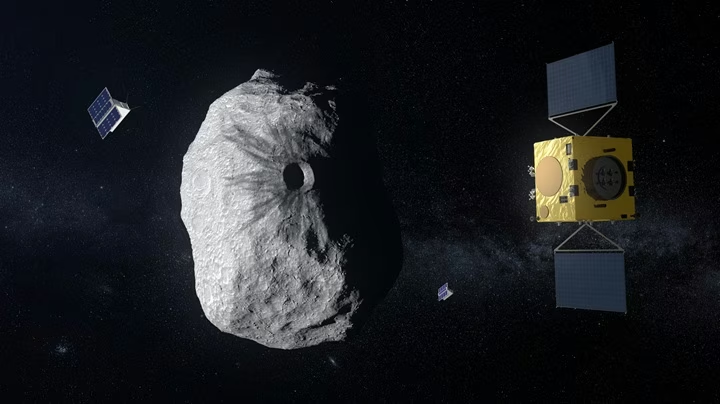
This is where the story gets tense. Space agencies are currently looking at “deflection missions.” Essentially, we could send a kinetic impactor (like NASA’s DART mission) to nudge the asteroid just enough to make it miss the Moon.

But we can’t decide yet. In 2028, the asteroid will make a close pass by Earth. During this flyby, astronomers will take precise measurements to finalize the trajectory. That is the deadline. That is when humanity has to decide: Do we play goalie for the Moon, or do we let nature take its course?

My Perspective: The Ultimate Trade-Off

I find myself torn. On one hand, the geek in me wants to see that flash on the Moon. I want to see the data. I want to know what’s inside our celestial neighbor.

On the other hand, the idea of risking our orbital infrastructure—the very backbone of modern civilization—for a science experiment feels incredibly reckless. There is a silver lining, though: if the debris hits Earth’s atmosphere, it would burn up, creating a spectacular, once-in-a-lifetime meteor shower. But is a pretty light show worth risking the internet? Probably not.

This situation reminds me that we aren’t just observers of the universe anymore; we are active participants. We have the power to change the path of celestial bodies. The question is no longer can we, but should we?

I’d love to hear your take on this cosmic gamble. If you were in charge of the space agency, would you deflect the rock to protect our satellites, or let it hit for the sake of scientific discovery?

You Might Also Like;


Source link

Verified Users Only XRP Ledger Adds Permissioned Domains

0
Verified Users Only XRP Ledger Adds Permissioned Domains


Key Highlights

XRP Ledger activated Permissioned Domains on February 4, 2026, allowing only approved accounts to trade safely.Permissioned Domains work with credentials to let institutions follow rules like KYC/AML while using the public ledger.A Permissioned DEX is expected soon, completing the compliance setup for institutional trading.

XRP Ledger has launched a new feature called Permissioned Domains feature (XLS-80) on its XRPL mainnet, the first domain to be created on the mainnet. The feature allows banks, exchanges, and other institutions to operate in controlled areas of the public ledger where only approved accounts can join.

The upgrade went live today, after more than 80% of validators voted yes. With this, big companies can trade safely as long as they follow proper identity checks to take part. This includes KYC (know your customer) and AML (anti-money laundering).

What are Permissioned Domains?

The Permissioned Domains are built on the earlier Credentials upgrade (XLS-70), which checks and stores identity information for users. A domain owner can allow up to ten approved issuer pairs to trade or move tokens.

Over time, more rules can be added so the system matches local laws in different regions. In an X post on Wednesday, Vet, an XRP Ledger validator, noted that the activation of Permissioned Domains completes two out of three compliance blocks needed for institutions to use decentralized exchanges (DEX) on the XRPL. The last block, called Permissioned DEX, is still waiting to go live.

Krippenreiter, a member of the XRP community, said, “One piece of the puzzle is still missing, which is the permissioned DEX,” noting that the upgrade is part of the plan to make the ledger more enterprise-friendly. 

The Permissioned DEX will extend the XRPL’s built-in DEX to a controlled environment, requiring verified credentials to create or fill orders. It recently reached 82.35% consensus with 28 yes votes. Vet shared that if the amendment goes live within two weeks, institutions will be able to trade on a fully compliance-enabled DEX.

Upcoming features coming this month

Two other upgrades are expected in February. 

Token Escrow amendment: Extends escrow features to fungible and multi-purpose tokens, allowing them to be held securely (Countdown: 8 days, 8 hours).Permissioned DEX: Enables controlled trading on XRPL (Countdown: 13 days, 22 hours).

Ripple works with over 300 partners, many of whom need safe and legal ways to use the ledger. Permissioned Domains let them use the built-in DEX safely without a private network. 

Ripple CTO David Schwartz said this update helps “remove barriers for big players,” especially banks, so they can trade on-chain while controlling who joins their pools. The ledger stays public, but parts now follow stricter rules, giving institutions control while keeping speed and low fees.

When the Permissioned DEX goes live, regulated trading on XRPL will be easier, allowing companies to swap assets while following local laws. This update is one more step in making the XRP Ledger work for both normal users and big businesses.

Update on Token Escrow 

This comes just a few days after the XRP Ledger Token Escrow amendment entered its activation phase after it reached 82.35% support from validators. The feature lets uses lock many types of tokens in an escrow. This includes XRP, stablecoins like RLUSD, project tokens, memecoins, and real world assets tokens. 

The tokens can be held in time based or condition-based escrow without any third party. According to a previous report, the amendment also requires special flags for Trustline tokens and multi-purpose tokens to ensure security and issue control. The Escrow is expected to be activated fully by February 12, with live countdown already under two weeks remaining.  

Broader context

In short, Permissioned Domains make the XRP Ledger more usable for banks and institutional firms. Earlier, institutions had concerns about the rules and risks when trading on public blockchains. Now, they can work on the ledger while following specific rules.

This also opens the way for tokenized assets, as well as lending and regulated trading. With this, XRPL stays public but offers extra security, making it easier for traditional finance to join without slowing down transactions or paying high fees.

Also Read: Bank of America Adds XRP Exposure With 13,000 Shares in ETF

Disclaimer: The information researched and reported by The Crypto Times is for informational purposes only and is not a substitute for professional financial advice. Investing in crypto assets involves significant risk due to market volatility. Always Do Your Own Research (DYOR) and consult with a qualified Financial Advisor before making any investment decisions.


Source link

Tramplin Introduces Premium Staking on Solana, a Proven Savings Model Rebuilt for Crypto

0
Tramplin Introduces Premium Staking on Solana, a Proven Savings Model Rebuilt for Crypto


Sponsored

Stories and Reviews

February 04, 2026

Tramplin Introduces Premium Staking on Solana, a Proven Savings Model Rebuilt for Crypto

George town, Cayman Islands, February 4th, 2026, Chainwire

Tramplin, a premium staking platform built on Solana, backed by iTreasury Ventures, today announced its public launch, introducing a proven real-world savings model rebuilt for crypto.

Built on Solana’s native staking architecture, Tramplin features a premium bonds-inspired reward redistribution mechanism designed to give smaller SOL holders access to meaningful upside without compromising capital safety.

By collecting staking rewards and redistributing them probabilistically, Tramplin creates opportunities for potential outsized returns while ensuring users retain full control of their principal.

The project’s mission is to empower SOL holders—the backbone of the Solana ecosystem—by offering upside potential previously accessible only to large stakeholders. During its test phase, Tramplin observed periods of elevated effective APY for small stakers, driven by initial committed stake and redistribution dynamics.

Market Context

The idea behind Tramplin originated in a broader concern about how retail users have participated in crypto over the past market cycles.

Since 2021, a significant share of new activity has been driven by memecoin speculation, extreme leverage, and short-term trading models where smaller participants consistently enter late and exit at a disadvantage.

Rather than creating long-term value, much of the market has become optimized for volatility and rapid capital redistribution, often resulting in systematic losses for retail users.

Built on Native Staking, Without Added Risk

Tramplin operates entirely within Solana’s native staking framework, with users delegating directly to the validator node and no smart-contract custody or counterparty risk.

By combining provably fair randomness (via VRF), Merkle-based transparency, and the security of native staking, Tramplin is designed to make staking more engaging, equitable, and accessible, without introducing new risk vectors.

Public Launch and Partner Program

Alongside its launch, Tramplin is opening its Strategic Partner Program, inviting creators, analysts, auditors, and ecosystem builders to participate in reviewing, validating, and sharing the protocol with their communities.

The Partner Program is designed to offer a low-overhead, transparent alternative to running a private validator, while preserving Solana’s native security model.

The program features audit-first transparency, lifetime revenue sharing, and community Boost Points. Additional details about Tramplin and its Partner Program are available at https://tramplin.io

About Tramplin

Tramplin is a premium staking platform built on Solana with verifiable and random distribution of outsized rewards.

Founded in early 2025, Tramplin’s mission is to empower SOL holders — the backbone of the Solana ecosystem — with opportunities traditionally reserved for whales, without compromising capital safety.

Tramplin is backed by iTreasury ventures, an early investor in Solana, Polkadot, and several other category-defining blockchain projects.

Contact

Marketing teamValidator LLC[email protected]

Disclaimer

In line with the Trust Project guidelines, please note that the information provided on this page is not intended to be and should not be interpreted as legal, tax, investment, financial, or any other form of advice. It is important to only invest what you can afford to lose and to seek independent financial advice if you have any doubts. For further information, we suggest referring to the terms and conditions as well as the help and support pages provided by the issuer or advertiser. MetaversePost is committed to accurate, unbiased reporting, but market conditions are subject to change without notice.

About The Author

Chainwire is the top blockchain and cryptocurrency newswire, distributing press releases, and maximizing crypto news coverage.

More articles

Chainwire is the top blockchain and cryptocurrency newswire, distributing press releases, and maximizing crypto news coverage.


Source link

What Is Hyperliquid HIP-4? A Deep Dive Into Outcome Trading | NFT News Today

0
What Is Hyperliquid HIP-4? A Deep Dive Into Outcome Trading | NFT News Today


Hyperliquid has built its reputation on speed, liquidity, and execution quality in perpetual futures. HIP-4 marks a clear expansion beyond that core. With the introduction of Outcome Trading, Hyperliquid adds a new class of fully collateralized, expiring derivatives that change how traders and builders can express risk on-chain.

This upgrade does not replace perpetuals. It extends the protocol’s financial vocabulary.

What Is Hyperliquid and Why HIP-4 Matters

Hyperliquid operates as both a high-performance Layer-1 blockchain and a decentralized exchange. Its custom execution engine, HyperCore, allows low-latency trading that rivals centralized venues. That design choice helped Hyperliquid dominate decentralized perpetual futures volume.

Perpetuals, however, come with structural limits. They offer linear exposure, rely on leverage, and introduce liquidation risk. HIP-4 responds to user demand for instruments that behave differently while still fitting cleanly into Hyperliquid’s risk framework.

Outcome Trading is the result.

HIP-4 Explained: The Outcome Primitive

HIP-4 adds support for Outcomes on HyperCore. Outcomes are fully collateralized contracts that settle within a predefined range at expiry.

Several properties define them:

Positions are funded upfront

Settlement occurs at a fixed expiration

Prices remain inside bounded ranges, often similar to probabilities

Payoffs can be non-linear

Because every position is collateralized, traders face no margin calls and no liquidations. Risk stays capped from entry to settlement.

This structure allows Hyperliquid to support dated and convex derivatives without introducing leverage mechanics.

How Outcome Trading Works in Practice

An Outcome contract defines a settlement range. That range might span from 0 to 1 for an event-based market or between two price bounds for a capped payoff instrument.

Traders buy exposure within that range. The final payout depends on the settlement value at expiration.

For example:

A crypto ETF approval market could settle anywhere between 0 and 1 based on outcome certainty

A bounded ETH price contract could pay out only if ETH settles inside a predefined window

A structured trade could cap both upside and downside by design

This format looks familiar to options traders but removes margining, liquidation engines, and continuous funding rates.

Prediction Markets Without Binary Constraints

Outcome Trading supports prediction markets without forcing yes-or-no outcomes. Prices move across a continuous range, allowing more nuanced expression of belief.

That distinction matters.

Binary shares compress uncertainty into two buckets. Outcome markets let traders price partial confidence and shifting probabilities. Liquidity aggregates more naturally as views converge rather than flip.

Compared to platforms like Polymarket, Hyperliquid’s approach frames event trading as a financial instrument rather than a betting abstraction.

Bounded Options-Like Instruments Without Leverage

Outcomes also enable options-style payoffs.

Builders can define capped exposure, convex returns, or conditional payouts while keeping collateral static. Traders know maximum loss at entry. Capital usage stays predictable.

This structure works well for users who avoid leverage but still want asymmetry. It also reduces systemic risk across the protocol since losses never exceed posted collateral.

Composability With HyperCore and HyperEVM

Outcome Trading doesn’t live in isolation. Outcomes compose directly with existing HyperCore features like portfolio margin. They also integrate with HyperEVM, which opens the door for on-chain strategies and applications.

Developers can build:

Multi-leg structured products

Event-linked DeFi protocols

Automated strategies that settle at expiry

HIP-4 treats Outcomes as a base primitive rather than a finished product. That choice encourages experimentation without forcing a single market design.

Regulatory Considerations and Risk Design

Prediction markets attract regulatory attention, especially in the United States. Hyperliquid’s design choices appear intentional.

Fully collateralized positions reduce resemblance to leveraged derivatives. Objective settlement sources limit discretionary resolution. Canonical markets launch with standardized parameters before any permissionless expansion.

Ongoing discussions around agencies like the Commodity Futures Trading Commission make these safeguards relevant. While no structure guarantees regulatory clarity, HIP-4 avoids many of the pressure points seen in leveraged or binary systems.

Current Status and Rollout Plan

Outcome Trading is live on testnet as development continues. Hyperliquid plans to launch canonical markets once testing concludes.

Key rollout details include:

Objective settlement sources

USDH-denominated contracts

Gradual expansion based on user feedback

Possible permissionless deployment in later phases

This phased approach limits risk while allowing iteration based on real usage.

Market Reaction and Community Response

Following the HIP-4 announcement, HYPE saw a strong upward move. Community discussion focused on long-term growth rather than short-term speculation.

Traders highlighted three themes:

New volume sources beyond perpetuals

Lower-risk instruments for broader participation

Builder demand for expressive derivatives

The response suggests confidence that Outcome Trading complements Hyperliquid’s existing strengths.

Risks and Open Questions

Several challenges remain.

There needs to be enough liquidity for Outcomes to be priced well. Oracle design will be important as markets grow. The user experience should also be clear, especially for traders new to non-linear payoffs.

Allowing anyone to deploy markets brings new challenges. Issues like market spam, low-quality contracts, and split liquidity will need careful management.

These risks do not weaken the idea itself. Instead, they affect how well it can be carried out.

What HIP-4 Signals for Hyperliquid’s Direction

HIP-4 marks a move from being just a single-product exchange to a wider derivatives platform. Perpetuals are still important, but they are no longer the only focus.

Outcome Trading lets users express more ideas without giving up on risk control. It welcomes new users and gives builders space to try new things.

If the mainnet launch brings enough liquidity and smooth settlement, HIP-4 could be the upgrade that takes Hyperliquid beyond perpetuals and into a full range of on-chain derivatives.


Source link

OpenAI Codex App: Meet Your New AI Co-Worker | Metaverse Planet

0
OpenAI Codex App: Meet Your New AI Co-Worker | Metaverse Planet


I remember the first time I used GitHub Copilot. It felt like magic—having a ghost in the machine finishing my sentences. But let’s be honest: until now, AI in coding has mostly been a really smart autocomplete. It waits for you to type, and then it suggests the next few lines.

That era just ended.

OpenAI has officially launched the Codex App, and after digging into the details, I can tell you this isn’t just an update. It’s a paradigm shift. We are moving from “AI as a tool” to “AI as an agent.”

This isn’t just about writing code faster; it’s about fundamentally changing the architecture of how we build software. Here is my breakdown of what the Codex App is and why it might be the most important tool you install this year.

From “Assistant” to “Engineer”

The biggest change here is autonomy. Previously, Codex was a research preview or a backend engine powering other tools. Now, it is a standalone application that sits on your desktop (specifically macOS for now) and acts less like a spell-checker and more like a junior developer sitting next to you.

OpenAI describes it as an “AI-powered software engineering agent.”

What does that actually mean?

It means you don’t just type function add(a,b) and wait for it to fill in return a+b. You can now give it high-level, natural language commands:

“Refactor this entire legacy module to use modern async/await patterns.”“Find the bug causing the memory leak in the user authentication flow.”“Write a test suite for this API endpoint.”

It analyzes the context, understands the project structure, and executes the task. It’s proactive, not reactive.

The Killer Feature: Parallel Agents

This is the part that really blew my mind. I often find myself context-switching—writing code, then stopping to write tests, then stopping to document what I just wrote. It kills momentum.

The Codex App introduces a Parallel Agent System.

Imagine you are the lead architect. You can spin up multiple instances (agents) of Codex simultaneously:

Agent A is building the new “Dark Mode” feature for your app.Agent B is simultaneously writing the unit tests for that feature.Agent C is reviewing the code for potential security vulnerabilities.

They work at the same time. This isn’t just multitasking; it’s multiprocessing for your workflow. For large projects where compiling and testing take time, having an AI agent handle the grunt work in the background while you focus on the core logic is a massive speed boost.

The “Control Center” Experience

Since this is a standalone macOS app, the interface is designed to be your command center.

It’s not buried inside VS Code or hidden in a browser tab. You have a dashboard where you can see exactly what each agent is doing. You can track their steps, review their changes before they are committed, and manage the tasks.

I appreciate this transparency. One of my biggest gripes with “black box” AI is not knowing how it got to the solution. The Codex App seems to prioritize keeping the human in the loop, allowing us to audit the AI’s logic step-by-step.

Will This Replace Us?

It is the question everyone asks every time OpenAI releases something new. “Is this the end of human programmers?”

OpenAI is very careful with their messaging here. They state explicitly that Codex is not designed to replace developers, but to handle the repetitive, time-consuming, and frankly, boring parts of the job.

And I actually agree with them.

Think about how much time you spend writing boilerplate code, setting up environments, or hunting for a missing semicolon. That isn’t “engineering”; that’s just labor. If Codex can handle the labor, it frees us up to do the actual engineering—solving complex architectural problems, designing user experiences, and making creative decisions.

It doesn’t make the human obsolete; it makes the human a manager.

Availability: Can You Use It?

OpenAI isn’t keeping this behind a velvet rope for long. The app is currently rolling out to users on:

ChatGPT PlusProBusinessEnterpriseEducation plans

If you are on one of these tiers and use a Mac, you are likely about to see your productivity skyrocket.

My Final Thoughts

We are entering a phase where “coding” is becoming less about syntax and more about intent. The Codex App is the first real glimpse into a future where we simply tell the computer what we want, and the computer figures out how to build it.

For a developer like me, that’s incredibly exciting. It removes the friction between having an idea and seeing it come to life on the screen.

I’d love to hear your perspective: If you had an AI agent that could do 80% of your coding work, would you use that free time to build more projects, or would you finally just take a nap? Let me know in the comments!

You Might Also Like;


Source link

Aave DAO Moves to Freeze V3 on Low-Revenue Chains

0
Aave DAO Moves to Freeze V3 on Low-Revenue Chains


Key Highlights

Aave DAO plans to freeze low-earning V3 chains, focusing on profitable networks and smarter multichain growth.Future V3 deployments must generate at least $2M annually, ensuring Aave benefits from successful launches.Founder Stani Kulechov’s London mansion and new platform projects show continued confidence in DeFi’s long-term growth.

Aave DAO, the decentralized governance body of Aave protocol, is streamlining its multichain operations with a proposal to freeze V3 deployments on zkSync, Metis, and Soneium. The proposal, named “Focussing the Aave V3 Multichain Strategy – Phase 1”(ARFC), presents a plan to focus on profitable deployments and reduce operational complexity. 

As per the proposal, Aave is targeting low-revenue chains to match cost, governance, and return. The ARFC also suggests that any future V3 deployment should ensure a $2 million annual revenue guarantee on the target chain, providing a clear upside for the protocol.

The proposal points out that there are V3 instances that have minimal activity, but they require continuous monitoring and governance involvement. 

Aave V3’s multichain strategy, launched in 2022, aimed to improve accessibility on Layer-2 (L2) networks. However, zkSync, Metis, and Soneium show low user engagement and negligible growth, generating between $3,000 and $50,000 yearly. By contrast, the Ethereum mainnet deployment produces $142 million, illustrating a stark disparity in revenue contribution. Aave DAO argues that continuing low-performing deployments consumes attention better spent on high-revenue opportunities.

Strategic reasoning behind freezing deployments

Expanding Aave V3 across multiple chains brought a lot of work and challenges. Every network needs constant upkeep, updates, and monitoring. As a result, low-performing chains create extra risks without much benefit. 

The proposal states that the decision to freeze these underperforming networks will reduce the workload, allowing the team to focus on the ones that are actually bringing results. Furthermore, it ensures that Aave benefits from the successful ones without wasting resources on the ones that are not growing.

Moreover, a revenue criterion for new deployments of V3 has also been proposed. As a result, future chains will need to ensure a minimum revenue of $2 million per annum. This is based on the value a new chain will derive from a proper deployment. 

“The upfront and recurring costs mean the DAO must prioritize deployments that generate sufficient revenue to justify the time and risk involved,” the proposal reads. 

Governance and community consensus

The freeze plan follows a preliminary vote to shut down low-performing V3 instances, which was passed by a landslide. In December 2025, the vote to shut down low-performing V3 instances recorded 99.96% voting “yes,” with 923,400 votes, and almost no “no” votes. 

Before making it official, Aave DAO will gather feedback from service providers and the wider community. Once that’s done, the freeze will be put into action, and the $2 million minimum revenue requirement for new deployments will take effect.

Besides the proposal, Aave’s Founder Stani Kulechov is currently an active topic in public discussions; he recently bought a £22 million ($30 million) mansion in London. Even with ongoing tensions over who controls the Aave brand, his investment shows he still believes in the long-term growth of DeFi.

On top of that, Aave Labs keeps innovating. Projects like the CoW Swap integration and a reinvestment module for V4 show the team is working to strengthen the platform while supporting its multichain strategy.

Why this matters

Aave DAO’s decision to freeze V3 on low-earning chains and only consider those with a $2 million minimum revenue for a new launch indicates a well-thought-out approach. By only working on chains that generate real revenue, Aave can minimize unnecessary work while at the same time ensuring everyone stands to gain.

Also Read: Ethereum Layer-2 Vision No Longer Makes Sense: Vitalik Buterin

Disclaimer: The information researched and reported by The Crypto Times is for informational purposes only and is not a substitute for professional financial advice. Investing in crypto assets involves significant risk due to market volatility. Always Do Your Own Research (DYOR) and consult with a qualified Financial Advisor before making any investment decisions.


Source link

8 Billion People in a Single Sugar Cube: The Mind-Bending Reality of Empty Space | Metaverse Planet

0
8 Billion People in a Single Sugar Cube: The Mind-Bending Reality of Empty Space | Metaverse Planet


I was sitting at my desk today, staring at my coffee, and I had one of those “existential crisis” moments—the kind that makes you look at your own hands and wonder if they’re even real. I started digging into some old physics notes, and I came across a fact that honestly feels like a glitch in the Matrix.

What if I told you that every single human being on this planet—all 8 billion of us—could fit inside the volume of a single sugar cube?

I know, it sounds like something straight out of a sci-fi movie or a late-night Reddit rabbit hole, but the math actually checks out. It all comes down to the weird, hollow nature of the atoms that make us up.

We Are Literally Made of Nothing

To understand how 8 billion people can fit in your hand, we have to look at the atom. When we were kids, we were taught that atoms look like little solar systems with a solid center and little balls orbiting around it. But that model is a bit misleading because it doesn’t capture the scale of the emptiness.

Here is the breakdown of why we are basically “ghosts” made of organized energy:

The 99.9999999% Rule: An atom is roughly 99.9999999% empty space.The Stadium Metaphor: If you expanded an atom to the size of a massive football stadium, the nucleus (the part where almost all the mass lives) would be the size of a small marble sitting on the 50-yard line.The Electron “Flies”: The electrons would be like tiny gnats buzzing around the very highest seats in the stands.The Void: Everything between that marble and those gnats? Absolutely nothing. Just empty space.

When I first wrapped my head around this, I realized that everything I touch—my keyboard, my phone, even my own skin—is just a collection of tiny points of matter separated by vast distances of void.

The Weight of the World (Literally)

So, if we took a “vacuum cleaner” for the universe and sucked all that empty space out of the atoms of every person on Earth, we would be left with just the nuclei and electrons.

The result? The entire human race would shrink down to the size of a sugar cube.

But don’t let the size fool you. Since we haven’t lost any of our actual mass, that tiny cube would be unimaginably dense. I did some checking, and that little cube would weigh approximately 5 billion tons.

To put that into perspective, that’s about the same weight as 900 Great Pyramids of Giza. If you tried to pick up that sugar cube, you’d be trying to lift a mountain.

Why Don’t We Fall Through the Floor?

If we are mostly empty space, why don’t our feet just pass through the ground? Why doesn’t my hand go right through my coffee mug?

It’s not because we are “solid.” It’s because of electromagnetic repulsion. The electrons in your atoms and the electrons in the chair you’re sitting on are both negatively charged. Since like charges repel, they push away from each other.

Ugu’s Note: You aren’t actually “touching” anything. You are just feeling the invisible force fields of trillions of atoms pushing back against you. We are floating on a cushion of electric fields!

Why This Matters for the Metaverse and Beyond

You might wonder why I’m talking about quantum physics on a tech and metaverse site. To me, this is the ultimate proof that reality is programmable.

If the physical world is 99% empty space and governed by electrical signals, the line between “physical reality” and “digital reality” starts to get very blurry. In the Metaverse, we build worlds out of code; in the physical world, nature builds worlds out of empty space and energy.

Understanding the “emptiness” of our world makes the idea of living in a digital simulation feel a lot less like a conspiracy theory and a lot more like a logical conclusion.

The Stats: A Quick Look at the Density

ObjectStateVolumeWeight8 Billion HumansNormal~400 million cubic meters~500 million tons8 Billion Humans“Atomic Dense”1 Sugar Cube5 Billion Tons

It’s humbling, isn’t it? Everything we’ve ever built, every war fought, every masterpiece painted—it’s all just a tiny amount of matter dancing in a massive void.

Whenever I feel overwhelmed by the scale of the world, I remind myself of this sugar cube. It changes your perspective on what is “solid” and what is “important.”

I’m curious—if we are mostly empty space held together by energy, do you think our consciousness is tied to the matter or the space between it?

You Might Also Like;


Source link

Popular Posts

My Favorites

ByteEdge Raises $1.5 Million to Revolutionize Enterprise Knowledge Sharing with AI-Powered...

New Delhi, April 30, 2025 — ByteEdge, a fast-growing enterprise AI startup transforming traditional corporate documents into dynamic, multilingual short videos, has announced...