Metaverse

Home Metaverse Page 36

New AI‑Powered Shopping Feature Marks Reddit’s First Major Step Toward Community‑Driven Commerce Integration

0
New AI‑Powered Shopping Feature Marks Reddit’s First Major Step Toward Community‑Driven Commerce Integration


In Brief

Reddit is piloting an AI-powered shopping feature that converts community product recommendations into buyable carousels with pricing and retailer links.

New AI‑Powered Shopping Feature Marks Reddit’s First Major Step Toward Community‑Driven Commerce Integration

Social news aggregation and forum social media platform Reddit announced that it is piloting an AI‑powered shopping feature that converts community product recommendations into buyable carousels with pricing and retailer links, signaling a move to integrate commerce more directly into the platform’s search experience. 

In an announcement, the company explained that users frequently turn to Reddit for opinions, reviews, and purchasing advice, and the new system is designed to translate those conversations into actionable shopping options by drawing from product catalogs supplied by selected Shopping and Dynamic Product Ads partners. For a limited group of US users, relevant search queries will now display interactive carousels containing images, prices, and direct purchase links, appearing in searches for items such as noise‑canceling headphones or electronics‑related gift ideas.

The test feature identifies products mentioned organically in posts and comments, presenting them at the bottom of search results with additional details accessible through a product card. 

Users can then navigate to participating retailers to learn more or complete a purchase. During the initial phase, the experiment focuses on consumer electronics, combining community‑sourced recommendations with catalog data from advertising partners. 

Reddit emphasized that the feature is built around surfacing items most frequently endorsed in discussions, aiming to make navigation more intuitive while preserving the platform’s community‑driven character. The company plans to observe how users interact with the tool and refine the experience as testing continues.

Reddit’s move follows a broader industry trend in which major platforms are embedding AI‑driven shopping into their ecosystems. TikTok and Instagram have long offered integrated commerce features, and OpenAI’s ChatGPT recently introduced an “Instant Checkout” function enabling purchases from Etsy and Shopify within conversations. 

The announcement also aligns with Reddit CEO Steve Huffman’s recent comments that AI‑enhanced search represents a major opportunity for the company, both as a product improvement and a revenue driver. Steve Huffman noted that weekly active search users increased from 60 million to 80 million over the past year, while usage of the AI‑powered Reddit Answers feature grew from 1 million to 15 million between the first and fourth quarters of 2025.

Disclaimer

In line with the Trust Project guidelines, please note that the information provided on this page is not intended to be and should not be interpreted as legal, tax, investment, financial, or any other form of advice. It is important to only invest what you can afford to lose and to seek independent financial advice if you have any doubts. For further information, we suggest referring to the terms and conditions as well as the help and support pages provided by the issuer or advertiser. MetaversePost is committed to accurate, unbiased reporting, but market conditions are subject to change without notice.

About The Author

Alisa, a dedicated journalist at the MPost, specializes in cryptocurrency, zero-knowledge proofs, investments, and the expansive realm of Web3. With a keen eye for emerging trends and technologies, she delivers comprehensive coverage to inform and engage readers in the ever-evolving landscape of digital finance.

More articles

Alisa, a dedicated journalist at the MPost, specializes in cryptocurrency, zero-knowledge proofs, investments, and the expansive realm of Web3. With a keen eye for emerging trends and technologies, she delivers comprehensive coverage to inform and engage readers in the ever-evolving landscape of digital finance.

More articles


Source link

Tokenization, Transparency, And Institutional Demand Dominate Discussion At HSC’s ‘Capital Is Selective Again’ Panel

0
Tokenization, Transparency, And Institutional Demand Dominate Discussion At HSC’s ‘Capital Is Selective Again’ Panel


In Brief

The ‘Capital Is Selective Again’ panel concluded that institutional investors are becoming far more selective in the current crypto cycle, prioritizing real revenue, product‑market fit, and compliant tokenized‑asset infrastructure as the market shifts from hype‑driven speculation to disciplined, fundamentals‑based evaluation.

Tokenization, Transparency, And Institutional Demand Dominate Discussion At HSC’s ‘Capital Is Selective Again’ Panel

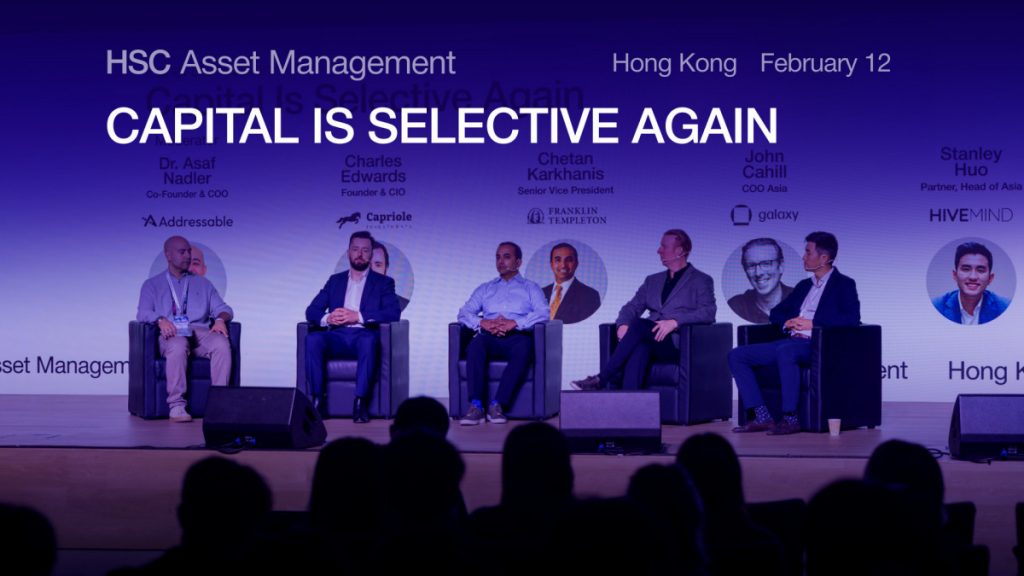
In the middle of February, HSC Asset Management held its event in Hong Kong, bringing together institutional investors, hedge funds, Web2 and crypto‑focused asset managers, and family offices to examine the latest trends shaping the institutional digital‑asset landscape.

One of the central sessions was the “Capital Is Selective Again” panel, which opened the conference and featured Dr. Asaf Nadler of Addressable, Charles Edwards of Capriole Investments, Chetan Karkhanis of Franklin Templeton, John Cahill of Galaxy Digital, and Stanley Huo of Hivemind Capital. The discussion focused on how capital deployment has become significantly more selective in the current cycle, with speakers emphasizing rigorous due diligence, sustainable revenue models, and the reality that only fundamentally strong projects are now securing institutional backing.

Speakers began by noting that the crypto market has moved through several cycles—from the ICO boom to DeFi summer to the collapse of major platforms—which collectively eroded trust and pushed investors toward more disciplined evaluation. Earlier phases were driven by hype, retail speculation, and untested ideas, but the current environment demands revenue, product‑market fit, and sustainable token economics. Only a small fraction of tokens meet these standards, and the era of raising capital on vision alone has ended. The shift from a “tell me” to a “show me” market now requires real business models, identifiable customers, and measurable traction.

Institutionalization And The Rise Of Tokenized Assets

The conversation then turned to institutionalization and real‑world asset tokenization. Institutional participation has grown steadily, particularly in stablecoins, money‑market funds, and tokenized real‑world assets. Speakers highlighted that institutional use cases such as collateral management, treasury operations, and intraday liquidity are advancing faster than retail adoption. Tokenization continues to expand across chains, supported by rising stablecoin issuance and RWA growth, while regulatory clarity remains essential as global institutions operate within jurisdiction‑specific frameworks. The panel noted that tokenization is progressing from simple instruments toward more complex assets such as private credit and private company shares, with compliance and risk management at the core.

How Investors Evaluate Projects Today

When evaluating projects, speakers stressed that transparency does not guarantee accuracy, as on‑chain data can be distorted by artificial activity or inflated metrics. To assess real traction, investors rely on verified customer usage, partner validation, sustainable incentive structures, token‑supply dynamics, revenue trends, and team credibility. Some participants added that macroeconomic conditions, sentiment, and technical indicators also influence decision‑making, especially for liquid token strategies.

Convergence Of Traditional Finance And Web3

The discussion also underscored the growing convergence between traditional finance and Web3. Unified digital wallets offering a holistic view of assets and liabilities, rising interest from banks and asset managers in on‑chain products, and the expectation that automated agents will eventually handle portfolio construction all point to a long‑term structural shift. This transition requires compliant, cross‑border infrastructure capable of supporting tokenized assets at scale, with early progress already visible across Asia, Europe, and the United States.

Finally, the panel examined Asia’s role in the evolving landscape. While global fundamentals are similar, Asia stands out for its large consumer base, rapid adoption of new technologies, and strong engineering talent. High demand for cross‑border payments, growing use of stablecoins for trade and remittances, interest in tokenizing private assets and cultural products, and a strong appetite for consumer‑facing applications all position the region as a fertile ground for Web3 innovation.

Disclaimer

In line with the Trust Project guidelines, please note that the information provided on this page is not intended to be and should not be interpreted as legal, tax, investment, financial, or any other form of advice. It is important to only invest what you can afford to lose and to seek independent financial advice if you have any doubts. For further information, we suggest referring to the terms and conditions as well as the help and support pages provided by the issuer or advertiser. MetaversePost is committed to accurate, unbiased reporting, but market conditions are subject to change without notice.

About The Author

Alisa, a dedicated journalist at the MPost, specializes in cryptocurrency, zero-knowledge proofs, investments, and the expansive realm of Web3. With a keen eye for emerging trends and technologies, she delivers comprehensive coverage to inform and engage readers in the ever-evolving landscape of digital finance.

More articles

Alisa, a dedicated journalist at the MPost, specializes in cryptocurrency, zero-knowledge proofs, investments, and the expansive realm of Web3. With a keen eye for emerging trends and technologies, she delivers comprehensive coverage to inform and engage readers in the ever-evolving landscape of digital finance.

More articles


Source link

Decoding Google’s New Brain: The Massive Leap of Gemini 3.1 Pro | Metaverse Planet

0
Decoding Google’s New Brain: The Massive Leap of Gemini 3.1 Pro | Metaverse Planet


I spend a massive chunk of my day testing, breaking, and analyzing artificial intelligence models. Just when I start to feel comfortable with the current limits of technology, the goalposts shift entirely. We’ve moved past the era of AI simply acting as a fancy autocomplete. We are now entering the era of pure, unfiltered machine reasoning.

Google just pulled back the curtain on its newest core model, Gemini 3.1 Pro, built directly on the foundation of the recent Gemini 3 Deep Think update. And let me tell you, after digging into the architecture and the benchmark scores, this isn’t just a minor patch or a speed tweak. This is a massive leap designed specifically to tackle complex problem-solving in science, research, and hardcore engineering.

Let’s break down exactly what makes Gemini 3.1 Pro tick, why it’s completely wrecking industry benchmarks, and how it’s going to change the way we build the digital future.

Beyond Memorization: The Era of True AI Reasoning

For a long time, the biggest criticism of Large Language Models (LLMs) was that they were essentially just memorization machines. They could recite Wikipedia articles beautifully, but if you gave them a novel, multi-step logic puzzle that wasn’t in their training data, they would confidently hallucinate absolute nonsense.

Google built Gemini 3.1 Pro to specifically destroy that limitation.

This model isn’t just designed to give you an answer; it is designed to think through complex, multi-layered problems. According to the data released by Google, 3.1 Pro can visualize highly complex topics, process massive datasets at a single glance, and deliver holistic solutions for creative and technical projects.

But I don’t just take tech giants at their word. I look at the raw data. And the benchmark scores for this model are staggering:

The ARC-AGI-2 Benchmark: This is widely considered one of the most brutal tests in the AI world because it measures true reasoning and adaptability, not just factual recall. Gemini 3.1 Pro scored a verified 77.1%. To put that in perspective, this is more than double the reasoning performance of the previous Gemini 3 Pro model.Humanity’s Last Exam: This is exactly what it sounds like—a benchmark designed to test advanced, highly specialized domain knowledge that even human experts struggle with. Gemini 3.1 Pro hit 44.4%, successfully leaving both its predecessors and its current industry rivals in the dust.

When I see numbers like this, I know we are looking at a tool that isn’t just going to write emails; it is going to help engineers map out new software architectures and help researchers synthesize years of raw data in seconds.

The Secret Weapon: Native Code-Based SVG Animations

While the raw reasoning power is incredible, there is one specific feature in Gemini 3.1 Pro that absolutely blew my mind as someone who cares about digital design and web architecture.

It can generate web-ready, animated SVG files directly from text prompts.

Normally, if you want to generate a video or an animation using AI, the model spits out a pixel-based video file (like an MP4). These files are heavy, they lose quality when you scale them up, and they slow down websites.

Gemini 3.1 Pro does something completely different. It writes pure code to create the animation.

Flawless Aesthetics: Because it’s an SVG (Scalable Vector Graphic), the animation is mathematically rendered. It will look perfectly crisp on a tiny smartphone screen or a massive 8K monitor.Feather-Light File Sizes: We are talking about animations that take up mere kilobytes instead of megabytes.Ultimate Control: Because the output is code, developers and designers can easily dive in and tweak the colors, the easing, or the speed manually.

For front-end developers, web designers, and content creators, this is an absolute game-changer. You can now prompt an AI to create a dynamic, loading animation or an interactive UI element, and copy-paste the code directly into your project.

Where Can You Try It Right Now?

Google isn’t keeping this locked in a research lab; they are rolling it out across their ecosystem simultaneously, targeting everyone from solo tinkerers to massive enterprise teams. Here is where you can get your hands on it today:

For the Builders and Developers

AI Studio: The updated model is available right now as a preview release. If you want to test its raw API capabilities, this is your playground.Antigravity IDE: It is natively integrated for developers looking to inject advanced reasoning directly into their coding environments.Vertex AI & Gemini Enterprise: For the corporate heavyweights who need to deploy secure, scalable AI solutions across their entire company.

For the Everyday Users

The Gemini App: If you are subscribed to the Google AI Pro or Ultra plans, you get priority access to 3.1 Pro with significantly higher usage limits.NotebookLM: This is perhaps my favorite integration. If you are a Pro or Ultra subscriber, you can now use 3.1 Pro’s massive reasoning power to analyze your personal documents, research papers, and notes. Having a 77.1% ARC-AGI-2 reasoning engine sifting through your own chaotic research folders is going to be a massive productivity multiplier.

The Metaverse Planet Perspective

When I look at Gemini 3.1 Pro, I don’t just see a smart chatbot. I see the foundational backend required to build the Spatial Web and the Metaverse.

To run a fully immersive, real-time 3D internet, we need systems that can reason dynamically. We need AI that can instantly generate lightweight, code-based visual assets on the fly—exactly like the SVG animations 3.1 Pro is churning out. We are moving away from pre-rendered, static internet pages into a web that is generated, calculated, and reasoned in real-time, personalized for whoever is looking at it.

Google is handing us the engine. Now, it’s up to us to build the vehicle.

I am going to spend the weekend throwing the hardest logic puzzles I can find at AI Studio just to see where 3.1 Pro breaks.

But I want to hear from you: With AI models now scoring this high on complex human reasoning tests, what is the first massive problem or project you would trust an AI to solve for you? Drop your thoughts in the comments below—I read every single one, and I’d love to know how you plan to use this kind of power!

You Might Also Like;


Source link

Metaplanet CEO Defends Bitcoin Strategy Amid Transparency Concerns

0
Metaplanet CEO Defends Bitcoin Strategy Amid Transparency Concerns


Key Highlights

The CEO of Metaplanet has addressed allegations around the company withholding details about its BTC purchases, options trades, and borrowings, while emphasizing on its transparency efforts through public dashboards and disclosures.Selling put options helps Metaplanet lower Bitcoin costs, turning market volatility into shareholder value, not speculation.CEO Simon Gerovich said he personally invests in the company, reinforcing long-term commitment amid scrutiny over capital and loans.

Metaplanet Inc., Tokyo’s publicly listed Bitcoin treasury firm, is facing scrutiny as volatility challenges its crypto strategy. CEO Simon Gerovich has addressed allegations claiming the company mismanaged shareholder funds and concealed Bitcoin (BTC) purchases. 

In a recent post on X, Gerovich responded to critics, stressing transparency and long-term Bitcoin accumulation. He said, “All of our Bitcoin addresses are publicly available, and through our live dashboard, shareholders can check our holdings in real time.” The post comes after Metaplanet recently shared its 2025 results highlighting a major shift toward crypto, with operating profit jumping 1,694% to ¥6.287 billion and revenue seeing a 738% increase to ¥8.905 billion.

The controversy is centered on the firm’s Bitcoin purchases and options in September 2025. Critics argued that the company purchased at the peak of the market and failed to disclose this information. Gerovich explained that all transactions in September were shared immediately. He said, “Our strategy is not about timing the market. It is about accumulating Bitcoin long-term and systematically.”

The CEO explained that selling put options is a planned strategy, not just a guess on Bitcoin going up. The company makes money from the premiums it collects and smart positioning. He gave an example: receiving a $10,000 premium on an $80,000 put lowers the effective cost to $70,000, using market volatility to the company’s advantage. As a result, BTC per share increased over 500% in 2025.

Transparency and financial discipline

Metaplanet has also faced criticism over its borrowings and how it uses capital. Gerovich clarified that the company publicly shared details of its credit facilities in October 2025 and the drawdowns in November and December. While the identities of lenders and exact interest rates remain private, all other terms and purposes were fully disclosed. 

He also stressed his personal commitment, saying, “Like all other shareholders, I have invested my own funds in this company and personally feel the pain of the stock price decline.” The company focuses on leveraged Bitcoin investment, while its hotel business still contributed ¥437 million in revenue and ¥169 million in operating profit.

Bitcoin treasury growth

In late December 2025, Metaplanet shared that it had bought 4,279 Bitcoin for around $451 million, bringing their total holdings to 35,102 coins worth about $3.78 billion. CEO Gerovich pointed out that their BTC Yield grew 568% in 2025. 

After pausing purchases since September, the company resumed buying during market dips. Experts say this shows a careful, strategic approach—using options trading and selective buys to get Bitcoin at the best possible cost.

Gerovich emphasized that anyone can verify their purchases and borrowings through public dashboards and timely disclosures. He concluded his post by saying that the company welcomes criticism and will respond to questions and concerns as long as it is legitimate.  

Also Read: Fed’s Kashkari Slams Crypto ‘Word Salad,’ Questions Stablecoin Use

Disclaimer: The information researched and reported by The Crypto Times is for informational purposes only and is not a substitute for professional financial advice. Investing in crypto assets involves significant risk due to market volatility. Always Do Your Own Research (DYOR) and consult with a qualified Financial Advisor before making any investment decisions.


Source link

Ways to Earn Crypto From AI Networks and Platforms | NFT News Today

0
Ways to Earn Crypto From AI Networks and Platforms | NFT News Today


Artificial intelligence has created a new category of crypto income. Instead of mining coins, people now make money by powering AI networks, contributing data, and participating early in emerging protocols. Some participants already make a meaningful side income. Others earn far less than expected.

How much you earn generally depends on when you start, what equipment you have, and how patient you are. Most people won’t make enough to quit their job, but many can build a steady stream of crypto that grows over time.

Knowing which opportunities offer real income and which are mostly hype is key.

If you have a gaming PC, you already own something valuable. Modern graphics cards can train and run AI models, and decentralized networks will pay you in crypto to use that power.

Projects like Render Network, io.net, and Akash Network connect GPU owners with AI developers. Your computer does the work, and the network pays you in tokens.

Getting started usually takes less than an hour. Just install the software, connect your wallet, and keep your computer running.

Income varies widely.

An RTX 3060 typically earns between $20 and $40 per month. An RTX 3080 can generate $50 to $120 monthly under steady demand. High-end GPUs like the RTX 4090 sometimes reach $200 to $300 per month during busy periods.

Electricity costs will cut into your profits. Plan for 20% to 40% of your earnings to go toward power bills.

Demand goes up and down. You’ll earn less during slow weeks, but payouts rise when the network is busy.

Sharing your GPU works best if you already have the right hardware. Buying a new GPU just to earn income is risky unless you also want it for gaming or creative projects.

Getting in early often produces the biggest rewards in crypto, and AI projects are no different.

Networks give tokens to early users, rewarding people who get involved before the project goes public.

Grass offers a clear example. The platform pays users for sharing unused internet bandwidth. Early participants earned points quietly for months. After its token launch, some users received rewards worth hundreds of dollars. Others earned more than $1,000.

Gensyn, Sahara AI, and other emerging projects follow similar models.

Participation usually requires simple actions:

Install an extension

Run a lightweight node

Create an account

Use the platform

Rewards rarely arrive immediately. Patience matters.

Typical airdrops range from $50 to $500. Larger rewards remain possible for early and active users.

Timing matters more than effort. Joining early improves the odds of meaningful payouts.

Some AI networks pay you for letting them use your internet connection and route data. They use these connections to gather and process information for AI training.

Grass leads this category and operates through a simple browser extension. After installation, it runs quietly while you browse normally. The software routes small portions of network traffic through your connection. Grass records your contribution and awards points.

Those points turn into tokens once the project launches.

Setup takes less than five minutes:

Create a Grass account

Install the browser extension

Connect your crypto wallet

Keep your browser active regularly

You don’t need any technical experience.

Grass gained traction quickly because of its early reward program. Some users who joined in early 2024 accumulated enough points to receive token allocations worth $300 to $1,200 when the token launched.

Most people who join later earn more slowly. You can expect about:

$5 to $30 per month equivalent in points at current rates

The main draw is the potential for bigger rewards over the long term.

Node operators keep AI networks running smoothly by providing steady computing power and making sure their systems stay online.

Bittensor has emerged as one of the most active decentralized AI networks, rewarding contributors with its native TAO token for helping train and operate machine learning systems. Participants run software that connects their computer to the network, which then measures their contribution and distributes rewards accordingly.

Node operators typically serve as either validators, who help secure and oversee the network, or miners, who provide compute power and data. Getting started requires a dedicated computer or server, a reliable internet connection, and basic familiarity with Linux commands. Hardware costs vary widely, with entry-level setups starting around $500 and more advanced systems exceeding $2,000.

Earnings depend heavily on uptime, performance, and overall network demand. Most beginners earn between $50 and $200 per month, while more experienced operators with optimized setups often generate $300 to $800 monthly.

Token price fluctuations also affect real income. One node operator previously interviewed by NFT News Today earned more than $6,000 worth of TAO over a year using a single machine. That result didn’t come from expensive hardware alone. Consistent uptime and active participation made the biggest difference.

Some platforms pay you to do tasks that help improve AI models. These jobs are a lot like freelance work.

Examples include:

Data labeling

Content evaluation

Model testing

You get paid faster than with airdrops or node rewards.

This is a good choice if you’re willing to spend time for steady, predictable income.

Synesis One

Synesis One pays users to complete simple assignments that help improve AI training datasets. These tasks often involve labeling images, reviewing short pieces of text, or categorizing information so AI models can learn more accurately. Each task pays a small amount in the platform’s native SNS token, and most sessions last between 10 and 20 minutes. Earnings depend on consistency. Casual contributors may earn $50 per month, while more active users can reach $150 or more by completing tasks regularly. Income builds gradually, but payouts arrive faster than airdrop-based platforms since rewards are distributed as tasks are completed.

Sahara AI, SingularityNET, and Ocean Protocol

Sahara AI mixes microtasks, node participation, and early reward programs. Users do assignments that help train AI and earn points, which should turn into tokens after launch. People who stick with it as the network grows often see the best results.

Other platforms like SingularityNET and Ocean Protocol offer similar opportunities with different approaches. SingularityNET allows users to contribute data or AI-related services, while Ocean Protocol lets contributors upload datasets and earn crypto when developers use them. Earnings vary widely across both platforms. Active users may generate modest monthly income, while valuable data contributions can produce larger payouts over time.

AI trading bots get a lot of attention because they claim to make money automatically. These tools look at market data and make trades for you.

Some traders say they make money, but many end up losing.

Crypto markets remain highly unpredictable, and no bot can guarantee steady profits.

A $1,000 account might make $50 to $150 in a good month, but you could lose just as much when the market drops.

Scams also exist. Fraudulent bots advertise guaranteed returns. Legitimate trading never offers certainty.

Trading takes discipline, good risk management, and experience. If you’re new, it’s best to be careful.

The most reliable AI income comes from helping run the network, not from using trading bots.

How much you earn depends on how much effort and what resources you put in.

Sharing bandwidth by itself brings in small returns, but using several methods together can boost your earnings.

Here’s what a beginner might realistically earn each month:

$10–$30 from bandwidth platforms

$20–$80 from GPU sharing

$50–$200 from occasional airdrops

$50–$150 from microtasks

Most people make between $100 and $400 a month in total.

People with better hardware and early access to projects can sometimes make over $1,000 a month.

Being consistent is more important than trying to earn quickly.

AI needs a lot of computing power. Centralized providers are expensive, but decentralized networks give people other options.

Crypto rewards attract people to join. These contributors help run the network, making it stronger.

People who join early benefit the most as the network grows.

This setup is similar to early Bitcoin mining, where the first adopters got the biggest rewards.

AI infrastructure is now moving in the same direction.

Most people won’t get rich from AI right away. Many start out earning just a little.

Being patient helps you get better results.

You’ll get the best results by using several strategies together. Running nodes, sharing bandwidth, and joining early projects helps you earn income from different sources.

Crypto tends to reward people who get involved early and stick with it.

AI has opened up a new way to earn income. People who learn how it works and keep realistic expectations are most likely to benefit.



Source link

Humanity Unveils Proof-Of-Trust Framework To Establish New Standard For Digital Verification

0
Humanity Unveils Proof-Of-Trust Framework To Establish New Standard For Digital Verification


In Brief

Humanity has introduced a new Proof of Trust framework to replace its earlier Proof of Humanity system, aiming to provide privacy‑preserving verification of user identity traits as AI‑driven synthetic activity increases across the internet.

Humanity, a technology startup developing what it describes as an internet‑wide trust layer, announced a major shift in its platform architecture with the transition from its original Proof of Humanity system to a broader framework called Proof of Trust.

Humanity, a technology startup developing what it describes as an internet‑wide trust layer, announced a major shift in its platform architecture with the transition from its original Proof of Humanity system to a broader framework called Proof of Trust. The new model is designed to let organizations verify user information without collecting, storing, or exposing sensitive personal data, positioning the protocol as a potential foundation for trust in an internet increasingly shaped by AI‑driven activity.

The upgrade comes amid rapid growth in synthetic identities, automated engagement, and large‑scale digital manipulation enabled by artificial intelligence. As the cost of generating convincing personas and coordinated behavior declines, long‑standing indicators of authenticity — including follower counts, engagement metrics, and verification badges — are becoming less reliable. Systems that assume real, accountable participation are facing mounting pressure.

Humanity’s earlier approach centered on confirming that each user was a unique, real individual through palm biometrics and zero‑knowledge proofs. Proof of Trust expands this model by enabling verifiable credentials tied to specific identity traits, allowing users to prove age, residency, education, employment, or compliance status without exposing underlying personal data. While Proof of Humanity established whether a user was real, the new framework is intended to verify a broader range of claims across integrated mobile and web applications.

Humanity Positions Proof-Of-Trust As New Standard For Digital Verification

“As AI transforms the internet from a network of people into a network of people and autonomous agents, the ability to verify who is real and which claims are credible becomes foundational infrastructure, on par with payments, cloud, and cybersecurity. Every major digital sector, including social platforms, financial services, marketplaces, gaming, education, healthcare, and governance, relies on identity, access, reputation, and compliance, yet most still operate on fragile, easily manipulated signals,” said Terence Kwok, Founder of Humanity in a written statement. “As synthetic identities and automated behavior scale, the demand for privacy-preserving, portable trust primitives will expand across billions of users and trillions of dollars in economic activity. The opportunity is the creation of a global trust standard for the AI economy,” he added. 

Alongside the technical upgrade, Humanity released its Trust Manifesto, which argues that the internet was not built with trust as a core principle. The document highlights the ease of sharing information online compared with the difficulty of verifying it, leaving users vulnerable to fraud, data breaches, and centralized platform overreach. The manifesto outlines a model based on user‑controlled personal data, a global and accessible identity layer, decentralized verification infrastructure, and credentials that work across applications — particularly in Web2 environments — without leaking sensitive information.

Humanity is also opening its protocol to mainstream adoption through new developer APIs designed specifically for traditional applications. Non‑blockchain platforms can integrate human verification and trust services directly into authentication flows, access controls, and credential processes without requiring blockchain expertise or major system changes. Potential uses include social platforms verifying real users, financial services streamlining KYC processes without storing sensitive data, authentication systems adding trust‑based fraud prevention, and verification of real‑world asset ownership.

The company recently expanded its capabilities through the acquisition of Moongate, an on‑chain ticketing and credentialing platform. The deal extends Humanity’s reach into event access, loyalty programs, and real‑world credential issuance. Humanity reports issuing more than eight million Human IDs to date and has completed its mainnet deployment on Arbitrum. 

Disclaimer

In line with the Trust Project guidelines, please note that the information provided on this page is not intended to be and should not be interpreted as legal, tax, investment, financial, or any other form of advice. It is important to only invest what you can afford to lose and to seek independent financial advice if you have any doubts. For further information, we suggest referring to the terms and conditions as well as the help and support pages provided by the issuer or advertiser. MetaversePost is committed to accurate, unbiased reporting, but market conditions are subject to change without notice.

About The Author

Alisa, a dedicated journalist at the MPost, specializes in cryptocurrency, zero-knowledge proofs, investments, and the expansive realm of Web3. With a keen eye for emerging trends and technologies, she delivers comprehensive coverage to inform and engage readers in the ever-evolving landscape of digital finance.

More articles

Alisa, a dedicated journalist at the MPost, specializes in cryptocurrency, zero-knowledge proofs, investments, and the expansive realm of Web3. With a keen eye for emerging trends and technologies, she delivers comprehensive coverage to inform and engage readers in the ever-evolving landscape of digital finance.

More articles


Source link

The O2O Shift: How Blockchain Became Invisible Infrastructure in 2026 | NFT News Today

0
The O2O Shift: How Blockchain Became Invisible Infrastructure in 2026 | NFT News Today


Why crypto’s biggest success in 2026 may be that users no longer notice it.

In 2026, blockchain is increasingly serving as the underlying infrastructure for global finance, AI agents, payments, and trust systems, operating in the background like electricity grids or internet protocols. Instead of managing wallets, seed phrases, or volatile dashboards, users benefit from fast applications, instant settlements, and autonomous systems that simplify the experience.

This is the O2O shift—“onchain-to-offchain integration,” meaning blockchain systems embedded into everyday products so thoroughly they fade from user awareness. Crypto’s maturation is no longer about speculative tokens; it is about infrastructure.

Industry leaders such as a16z highlight this trend in their Big Ideas 2026 series, focusing on agentic systems, programmable finance, and privacy-preserving technologies. Stablecoins are processing record volumes, tokenized real-world assets (RWAs) are expanding, and AI agents are transacting autonomously. The defining feature of this cycle is integration, not hype.

Crypto’s speculative phase is giving way to practical reliability.

Stablecoins—once seen as purely crypto-native instruments—now function as payments infrastructure. As of early February 2026, total stablecoin market capitalization stands at roughly $300+ billion (depending on methodology and source date). In 2025, annual transaction volume reached approximately $33 trillion, with Q4 alone exceeding $11 trillion.

Importantly, a significant share of this volume reflects trading and DeFi activity. However, real-economy usage—B2B payments, remittances, treasury operations—is growing into the hundreds of billions annually and accelerating.

Fiat-backed stablecoins such as USDT and USDC dominate cross-border flows and institutional settlement use cases. Integrations like Visa’s USDC settlement expansion signal a structural shift: stablecoins are becoming programmable, near-instant financial rails competing with traditional payment delays and fees.

Tokenized RWAs: From Wrapping Assets to Creating Them

On-chain tokenized asset value (excluding stablecoins) sits in the tens of billions as of early 2026, depending on classification. Definitions vary: some dashboards measure “onchain market value,” while others include “represented offchain assets.” Clarity in methodology matters.

Tokenized U.S. Treasuries represent a large share of this growth, driven by institutional platforms. The more significant shift, however, is moving from simple tokenization (wrapping existing assets) to native origination.

Tokenization means representing an existing offchain asset onchain.Origination means creating financial products natively onchain—credit lines, structured products, programmable funds.

Origination unlocks:

Projections of $500B+ in RWA value by year-end remain forward-looking and scenario-based—not guaranteed outcomes.

1. The Agentic Economy

AI agents are evolving into economic actors—shopping, trading, subscribing to services, paying for compute, and managing balances.

They require:

Cryptographic identity (“Know Your Agent” models)

Secure micropayment infrastructure

Autonomous wallet systems

Programmable authorization layers

Innovations such as agentic wallets and HTTP-based payment protocols enable agents to hold balances and transact without constant human intervention.

This introduces new open questions: liability, fraud prevention, agent identity standards, and dispute resolution. The infrastructure is emerging—but governance and safeguards are still maturing.

If successful, blockchain becomes the invisible settlement layer for code-speed commerce.

2. From Tokenization to Origination

The narrative shifts from digitizing legacy finance to redesigning it.

DeFi-native protocols now automate capital allocation across staking, tokenized credit, RWAs, and hybrid TradFi-DeFi yield strategies.

However, adoption remains uneven. Institutional tokenization is still often “back-office first,” focused on operational efficiency rather than retail-facing reinvention.

For blockchain to become invisible, it needs to fit smoothly into current workflows instead of trying to replace them all at once.

3. Privacy as Infrastructure

Public transparency has long limited institutional participation.

Advances in:

Zero-knowledge proofs

Encrypted compliance verification

Confidential smart contracts

Early-stage quantum-resistant cryptography

…aim to make selective disclosure the norm.

Instead of making everything private by default, the new approach is verifiable privacy. This means proving compliance or solvency without revealing sensitive internal information.

In this setup, blockchain acts as a hidden enforcement layer instead of a fully public ledger.

Stablecoin Settlement Rails – Enterprise issuers manage compliance while users experience ordinary transfers.

Prediction Markets – Blockchain ensures tamper-resistance, while interfaces resemble standard fintech apps.

Authenticity Layers – Provenance verification for AI-generated content without crypto branding.

Institutional Settlement Networks – Hybrid blockchain systems streamline treasury and interbank transfers.

Agent-Driven Commerce – AI agents pay for APIs, subscriptions, and compute without user friction.

In all these cases, the product works well because users do not need to understand crypto.

If current trajectories continue, 2026 could see:

Expanded tokenized funds and credit markets

More regulated or state-supervised stablecoins

Regulated token offerings in compliant jurisdictions

DeFi TVL recovery (scenario-dependent)

Increased institutional allocation to digital asset infrastructure

Survey-based claims of widespread institutional increases vary by sample and methodology; trends are positive but not universal.

The convergence between traditional finance and onchain systems appears structural—but gradual.

Blockchain’s success may ultimately be measured not by token price cycles, but by latency reduction, cost efficiency, compliance automation, and integration depth.

It wins by becoming boring.

The critical question ahead is not whether blockchain scales.

It is who controls the rails once they disappear into the background.

Will the infrastructure powering AI agents, global payments, and tokenized finance remain open and permissionless?Or will it consolidate into compliant—but closed—walled gardens that merely resemble blockchain in architecture?

The O2O era is not about visibility. It is about ownership, neutrality, and default standards.

For builders and institutions, priorities are now practical, not ideological:

Abstraction over complexity

Utility over speculation

Privacy with verifiability

Seamless integration over tribal branding

Measurable performance over narrative momentum

Blockchain’s greatest achievement may not be mainstream awareness.

It may be that billions of people use it daily without ever knowing they are using it.

When infrastructure fades into the background, it has either failed—or it has won completely.

In 2026, crypto does not need to look revolutionary.

It needs to work—quietly, reliably, and everywhere.


Source link

Apple’s Next Big Bet: Screenless Smart Glasses and AI Wearables | Metaverse Planet

0
Apple’s Next Big Bet: Screenless Smart Glasses and AI Wearables | Metaverse Planet


I have been testing and writing about smart wearables for years, but a recent leak regarding Apple’s secret hardware labs genuinely made me sit up and pay attention. We all know Apple’s classic playbook: they rarely invent a new product category, but when they finally enter one, they usually flip the entire industry upside down.

According to recent reports from Bloomberg’s Mark Gurman, Apple is preparing to aggressively expand its wearable lineup. We are not just talking about another Apple Watch update. The tech giant is reportedly developing smart glasses, an AI-powered necklace, and even AirPods equipped with cameras. Let’s dive into what these devices actually are, why Apple is ditching the screen, and how this could fundamentally change how we interact with the world around us.

The Screenless Smart Glasses: Audio and AI First

When I first heard that Apple’s upcoming smart glasses would not feature a built-in display, I was honestly a bit skeptical. We are so used to the idea of Augmented Reality (AR) projecting holographic screens into our field of view. But after digging into the details, this “screenless” approach is actually brilliant.

Instead of overwhelming your eyes with notifications and pop-ups, Apple is focusing heavily on Visual Intelligence. The glasses will be equipped with a high-resolution camera, speakers, microphones, and an extra specialized lens dedicated to AI processing.

Here is what you will actually be able to do with them:

Contextual Navigation: Instead of looking down at a map, Siri can look through your glasses and say, “Turn left after the blue coffee shop.”Real-Time Object Recognition: You can look at a plate of food and ask Siri for the recipe or caloric content, or look at a monument and instantly hear its history.Seamless Communication: Make phone calls, listen to Apple Music, and dictate messages without ever pulling your iPhone out of your pocket.

Taking on Meta: The In-House Strategy

If this sounds familiar, it is because Meta has already been carving out this exact niche with their highly successful Ray-Ban smart glasses. I have used the Meta glasses, and they are incredibly fun. But Apple is taking a radically different approach to design.

Instead of partnering with legacy eyewear brands like Oakley or Ray-Ban, Apple is designing and building these frames entirely in-house. Early prototypes reportedly relied on a messy external battery pack and a cable connected to an iPhone. However, sources indicate that Apple’s engineering team has successfully integrated all the necessary premium components—including the battery—directly into a sleek, standalone frame. They are aiming for top-tier hardware quality and advanced camera sensors to separate themselves from the plastic feel of current competitors.

Beyond Glasses: AirPods with Cameras and AI Necklaces

The glasses are just one piece of the puzzle. Apple seems to be exploring multiple ways to give Siri “eyes.”

Camera-Equipped AirPods: This sounds like pure science fiction, but Apple is exploring putting tiny, low-resolution infrared cameras into AirPods. These wouldn’t be for taking selfies; they would read your environment and track your head movements to improve spatial audio and provide Siri with environmental context.The AI Necklace: Similar to the Humane AI Pin or the Rabbit R1, Apple is experimenting with a wearable necklace that acts as a passive, always-listening, always-looking AI assistant.

All three of these devices will rely heavily on a wireless connection to your iPhone, which will act as the “brain” processing the heavy AI workloads.

The Road Ahead: When Can We Buy Them?

Apple is reportedly planning to start mass production of the smart glasses components by the end of this year, aiming for a highly anticipated retail launch in 2027.

While that seems like a long wait, it tells me that Apple is taking the time to get the “Apple Intelligence” software completely right before pushing the hardware onto our faces. They don’t want to release a gimmick; they want to release a tool you use every single day.

What Do You Think?

As I think about a future where my glasses, earbuds, and maybe even a necklace are constantly analyzing my surroundings, I feel a mix of excitement and privacy concerns. The convenience of having an AI assistant that can literally see what I see is undeniable, but it is a massive leap in how much data we share with our tech.

I would love to hear your perspective on this. Would you wear screenless Apple smart glasses that constantly analyze your environment, or do you prefer keeping your camera strictly on your smartphone? Drop your thoughts in the comments below!

Would you like me to write a follow-up article comparing these upcoming Apple glasses directly to the current Meta Ray-Ban models?

You Might Also Like;


Source link

Hyperliquid Backs New DC Nonprofit to Push DeFi Rule Clarity

0
Hyperliquid Backs New DC Nonprofit to Push DeFi Rule Clarity


Key Highlights

Hyperliquid says the Hyper Foundation will contribute 1M HYPE tokens to seed the Hyperliquid Policy Center.The Hyperliquid Policy Center is a Washington, D.C.-focused nonprofit aimed at DeFi policy and advocacy.The foundation said the tokens will be unstaked later today, and the group will be led by Jake Chervinsky as CEO.

Hyperliquid announces its Hyper Foundation will contribute 1 million HYPE tokens to support the creation of the Hyperliquid Policy Center. The new nonprofit is intended to represent the community in Washington, D.C., and advocate for clearer U.S. rules around decentralized finance (DeFi).

In a post on X, Hyperliquid said the tokens would be unstaked “later today” and argued the initiative would help policymakers better understand decentralized market infrastructure. The project said it expects the group, under Jake Chervinsky’s leadership, to have a “meaningful impact” in favor of clear regulation for DeFi.

What the Hyperliquid Policy Center will do

The nonprofit’s own account described the Hyperliquid Policy Center as a research and advocacy organization focused on advancing a clear path for decentralized finance to thrive in the USA. They also plan to introduce policymakers to Hyperliquid and bridge the gap between law and next-generation market infrastructure.

Coverage of the launch framed the effort as a Washington-facing push to shape U.S. DeFi regulation, with the 1 million HYPE seed funding valued at roughly $29 million at the time of reporting.

For traders and holders, the announcement highlights a familiar pressure point: supply optics and token movements. Hyperliquid has drawn market attention before around unstaking and allocation-related token flows, which market participants often monitor for potential sell pressure depending on where tokens move next.

The bigger backdrop for U.S. DeFi policy

The launch comes as Washington is actively trying to draw clearer lines around who regulates what in crypto, especially for 24/7 markets and derivatives, the exact corner of the market where Hyperliquid has built its reputation. 

In recent months, CFTC officials have publicly signaled that a crypto market-structure framework is close, with the agency’s chair describing legislation as “on the cusp” of becoming law, which has amplified expectations that Congress could finally codify jurisdictional lanes and trading-platform rules.

At the same time, the politics are messy. The White House has been threatening to pull out support for the CLARITY Act amid industry infighting, after Coinbase raised concerns around DeFi restrictions, privacy, and the scope of CFTC authority.

Also Read: White House Weighs Another Stablecoin “Yield” Summit With Banks

Disclaimer: The information researched and reported by The Crypto Times is for informational purposes only and is not a substitute for professional financial advice. Investing in crypto assets involves significant risk due to market volatility. Always Do Your Own Research (DYOR) and consult with a qualified Financial Advisor before making any investment decisions.


Source link

The Mandalorian & Grogu Trailer Breakdown | Metaverse Planet

0
The Mandalorian & Grogu Trailer Breakdown | Metaverse Planet


Let’s be honest for a second. It has been over six years since a Star Wars movie graced the big screen. In that time, we have drowned in Disney+ shows, cartoons, and enough spin-offs to make even a hardcore fan like me feel a bit of “Star Wars fatigue.” But then, the trailer for The Mandalorian and Grogu dropped today, and I found myself smiling at a green puppet all over again.

We finally have our first real look at Din Djarin and his adopted son making the jump from streaming to cinema. Here is everything I caught in the new footage and why I think this might be the reset button the franchise needs.

A New Mission for the New Republic

The trailer doesn’t waste time. It picks up exactly where the series left off. The Empire is technically “gone,” but let’s face it, the galaxy is still a mess. We see Mando and Grogu working as contractors for the New Republic, hunting down warlords and cleaning up the scraps of the old regime.

What really grabbed my attention was Sigourney Weaver. Seeing a legend like her in the Star Wars universe feels overdue. She plays Colonel Ward, and her line in the trailer sets the tone for the whole movie: “This isn’t about revenge, it’s about preventing a new war.”

To me, this signals that the stakes are finally getting higher than just “monster of the week” episodes.

The “Wait, Who?” Moment: Jeremy Allen White

This part of the news genuinely surprised me. According to the casting details revealed alongside the trailer, Jeremy Allen White (yes, the chef from The Bear) is stepping into the role of Rotta the Hutt.

If you remember The Clone Wars, Rotta is Jabba’s son. In the trailer, we see a tense standoff in an arena between Din Djarin and this character. It’s a bold casting choice, and I am incredibly curious to see if it’s a voice role, motion capture, or some practical effect wizardry.

The Helmet Comes Off (Again?)

One scene is going to have the forums buzzing for months. There is a shot of Din Djarin, helmetless, kneeling before what looks like Jabba the Hutt.

Now, hold on. We know Jabba is dead in this timeline. Is this a flashback? A hologram? Or is it actually Rotta, who has grown to resemble his father? Regardless of the “who,” seeing Pedro Pascal’s actual face suggests this movie is going to dive deeper into the man under the armor, stripping away the Creed’s rules even further.

Grogu Steals the Show (Obviously)

It wouldn’t be a Mandalorian movie without the little guy. The trailer is peppered with classic Grogu moments:

Messing with the ship’s buttons (never gets old).Controlling his hovering pram like a pro pilot.Snacking at inappropriate times.

It’s fan service, sure, but it’s the heart of the dynamic that made us fall in love with the show in the first place.

Why IMAX Matters

The film hits theaters on May 22, and the trailer makes one thing very clear: this was filmed for IMAX.

The cinematography looks significantly more expansive than the TV show’s “Volume” (the digital LED stage) look. We are seeing real locations, massive wide shots, and a scale that screams “cinema.” After years of watching Star Wars on my living room TV, I am ready to feel the rumble of a razor crest engine (or its replacement) in a proper theater.

I’m cautiously optimistic. Do you think moving Mando to the movies is a brilliant move, or should they have kept it as a series? Let me know what you think!

You Might Also Like;


Source link

Popular Posts

My Favorites