Metaverse

Home Metaverse Page 25

The End of Quantum Computing’s Biggest Nightmare: What Are “Phantom Codes”? | Metaverse Planet

The End of Quantum Computing’s Biggest Nightmare: What Are “Phantom Codes”? | Metaverse Planet


One of the most significant obstacles holding back quantum computers is their notoriously high error rate. Now, a groundbreaking solution is emerging: new algorithms known as “phantom codes.” By executing complex calculations with drastically fewer errors, this approach could alter the trajectory of quantum technology and rapidly accelerate its transition into real-world applications.

In the early days of quantum computing, many physicists doubted the technology’s practical viability because the devices generated errors that were incredibly difficult to correct. While today’s quantum computers have evolved and are already being used for scientific discoveries, the core error problem remains largely unsolved. According to Shayan Majidy from Harvard University, while many popular error-correction methods effectively help quantum computers store information flawlessly, they fail to maintain that accuracy during the active calculation phase.

The Dilemma of Logical Qubits

Quantum computers operate using physical units called qubits. However, real-world calculations generally rely on “logical qubits”—structures where multiple physical qubits share the same information to drive down the error rate.

To execute a flawless calculation, the computer must manipulate these logical qubits through physical processes. Lasers or microwaves are applied to alter their quantum states, or two or more qubits are forced into a state of entanglement. The fundamental flaw in this process is that every single physical intervention increases the probability of generating new errors.

How Do “Phantom Codes” Change the Game?

The primary advantage of phantom codes is their ability to allow multiple logical qubits to establish entanglement without the need for physical intervention—which is exactly how the method earned the name “phantom.”

This breakthrough shifts the paradigm in several ways:

Fewer Physical Operations: The method drastically reduces the number of physical actions required during a calculation.Higher Efficiency: By minimizing physical steps, it simultaneously boosts operational efficiency and eliminates potential points of failure.Massive Accuracy Gains: When Majidy and his team tested this method via computer simulations (including preparing specific qubit states and simulating simplified quantum materials), the results were striking. Thanks to the reduction in physical manipulation, phantom codes produced results up to 100 times more accurate than traditional error correction methods.

A Powerful Tool, But Not a Silver Bullet

Researchers are quick to point out that phantom codes are not a universal fix for every quantum program. Majidy notes that the method provides a massive advantage specifically in calculations requiring extensive entanglement, as it aims to use existing entanglement more efficiently rather than generating it from scratch.

The Armor Analogy: Mark Howard from the University of Galway compares quantum error correction to choosing armor. Some traditional methods offer robust protection but create heavy, inflexible structures. Phantom codes offer a much more flexible alternative, though they may require a larger number of qubits to function.Hardware Dependency: Dominic Williamson from the University of Sydney states that the ultimate competitiveness of phantom codes against other techniques remains to be seen, as it will depend heavily on future developments in quantum computing hardware.

Ultimately, experts agree that while phantom codes may not single-handedly cure all quantum error problems, they represent an exceptionally powerful tool for specific subprograms and specialized tasks. The research team is already collaborating with scientists developing ultra-cold atom quantum computers, paving the way for a future where quantum programs are custom-tailored for specific tasks and hardware.

You Might Also Like;


Source link

Your iPhone Could Be a Crypto Thief’s Target: Google Exposes ‘Coruna’ Exploit Kit

Your iPhone Could Be a Crypto Thief’s Target: Google Exposes ‘Coruna’ Exploit Kit


Key Highlights

The “Coruna” kit bundles 23 individual exploits into 5 full chains, targeting every iPhone and iPad running iOS 13.0 through iOS 17.2.1.Updating to iOS 17.3 or later (current: iOS 26) renders Coruna entirely ineffective; enabling Lockdown Mode causes the malware to self-terminate on contact.

Google’s Threat Intelligence Group (GTIG) published what security researchers are already calling one of the most alarming mobile threat disclosures in years. The report detailed the inner workings of a fully operational iPhone exploit kit, internally dubbed “Coruna” and also tracked under the alias CryptoWaters—a name that hints at its ultimate purpose.

The kit is not novel in the technical sense; the iPhone exploit ecosystem is a well-documented, multi-billion-dollar underground market. What makes Coruna exceptional, and alarming, is its trajectory. A tool precision-engineered for covert government surveillance has been commoditized, repurposed, and is now being unleashed against ordinary cryptocurrency holders at a scale previously unseen in the mobile threat landscape.

The three faces of a roaming weapon

Google’s report traces a remarkable, almost cinematic chain of custody for the Coruna codebase. The same exploit framework appears to have passed through the hands of three distinct threat actors over the course of roughly 12 months—each with starkly different motivations.

The earliest documented use, in February 2025, was by a customer of an unnamed private surveillance vendor—a company operating in the same grey-market space as NSO Group, maker of the infamous Pegasus spyware. This phase was characterized by the narrow, high-value targeting typical of commercial spyware: politicians, journalists, and dissidents.

By the summer of 2025, however, GTIG detected the same exploit chains in a geopolitically charged context. The group designated UNC6353, assessed with moderate-to-high confidence to be Russian government-aligned, was using Coruna to target Ukrainian citizens and infrastructure personnel. The tool had moved from commerce to statecraft.

Then, in late 2025 and into early 2026, a Chinese-speaking financially motivated cybercrime group, tracked as UNC6691, acquired the kit and pivoted its targeting entirely. The goal was no longer surveillance. It was theft—specifically, the theft of Bitcoin and other digital assets from unsuspecting iPhone users.

The ‘watering hole’ infrastructure

UNC6691 deployed Coruna not through phishing emails or infected app downloads—vectors that most users have been trained to distrust—but through a more insidious technique known as a “watering hole” attack. Rather than chasing victims, the attackers poisoned the wells that victims habitually visit.

The group constructed convincing counterfeit versions of popular cryptocurrency exchanges and financial platforms. A documented example is a spoofed version of WEEX, a legitimate crypto trading platform. These fake sites are designed to be functionally indistinguishable from their real counterparts, often surfacing through search engine optimization or paid promotion channels.

When an iPhone user lands on one of these pages, a concealed iFrame executes a device fingerprinting routine. The script silently checks the iOS version. If the device is running iOS 17.2.1 or any earlier version—stretching all the way back to iOS 13.0 — the exploit chain fires automatically. No tap, no download, no interaction required. Some sites even displayed prompts actively encouraging users to switch to an iOS device for a “better experience,” funneling additional vulnerable targets toward the exploit.

Steps for iPhone users to protect themselves

The defensive picture, while sobering, is not without clear and actionable remedies. Google’s report and subsequent analysis by independent researchers point to four priority actions:

Update iOS Immediately: Coruna is entirely ineffective against iOS 17.3 and later (current release: iOS 26). Any device updated within the past year is protected.Enable Lockdown Mode: Google confirmed that Coruna’s PlasmaLoader automatically self-terminates upon detecting Lockdown Mode is active. This is the single most effective real-time defense.Use a Hardware Wallet: Private keys stored on a hardware wallet (Ledger, Trezor) never touch the iOS environment. Even a fully compromised iPhone cannot access funds secured offline in this manner.Purge Sensitive Photos: PlasmaLoader scans photo galleries for wallet QR codes. Delete any images containing seed phrases, private keys, or wallet backup codes—or store them only on offline media.

Security researchers also note that Coruna skips execution when it detects the user is in a private or incognito browsing session—an apparent anti-forensics measure to reduce the digital footprint of the attack. While this is not a reliable or recommended primary defense, it is an interesting behavioral signature that may assist incident responders in attribution.

Also Read: India Digital Arrest Scam Routes ₹10.74 Cr via Crypto Exchanges

Disclaimer: The information researched and reported by The Crypto Times is for informational purposes only and is not a substitute for professional financial advice. Investing in crypto assets involves significant risk due to market volatility. Always Do Your Own Research (DYOR) and consult with a qualified Financial Advisor before making any investment decisions.


Source link

The JPA Speeder: Riding a Real-Life Star Wars Jet Bike | Metaverse Planet

The JPA Speeder: Riding a Real-Life Star Wars Jet Bike | Metaverse Planet


I have a confession to make: ever since I saw the speeder bike chase scene in Return of the Jedi, I’ve been waiting for the day someone would actually build one. For years, I watched companies tease us with quiet, oversized electric drones that look more like flying blenders than badass motorcycles. But then, I stumbled upon the JPA Speeder by JetPack Aviation, and I honestly couldn’t believe my eyes—or my ears.

Forget the silent hum of electric motors. We are talking about four actual, roaring jet turbines strapped to a motorcycle frame. When I started digging into the specs and the engineering behind this beast, I realized this isn’t just a concept rendering; it’s a terrifyingly real, magnificent piece of hardware.

Let me walk you through what makes the JPA Speeder the most insane—and incredibly cool—piece of personal aviation tech I’ve seen in a long time.

Not Your Average eVTOL: The Power of Kerosene

Most of the “flying cars” and personal air vehicles we talk about here at Metaverse Planet are eVTOLs (Electric Vertical Takeoff and Landing). They are practical, eco-friendly, and relatively quiet. But JetPack Aviation decided to take a completely different route.

Instead of batteries, the Speeder runs on Jet A-1 fuel, kerosene, or diesel. Why? Because batteries are heavy, and if you want to lift a human being off the ground with a footprint no bigger than a standard motorcycle, you need maximum thrust in the smallest possible package.

Here is what blew my mind when I looked at the engine setup:

Four Micro-Turbines: These aren’t propellers; they are literal jet engines pushing raw thrust downward.Vectoring Exhausts: The nozzles independently tilt to steer, brake, and accelerate the bike, giving it fighter-jet-level maneuverability.The Roar: It sounds exactly like a jet taking off. It’s visceral, loud, and undeniably aggressive.

The Mind-Blowing Specs: 150 MPH and Beyond

When I first read the performance numbers, I actually had to double-check my sources. This isn’t a toy that hovers three feet off the ground over a lake. This is a serious aircraft.

The Speed Limit (Or Lack Thereof)

The Speeder is designed to hit speeds of up to 150 mph (240 km/h). Imagine riding a superbike, but instead of asphalt under your tires, you have nothing but open air.

Taking It to the Clouds

The maximum altitude is stated to be 15,000 feet. Let’s be real for a second—at 15,000 feet, you are dealing with freezing temperatures and thin air. You’d literally need an oxygen mask and a survival suit to fly this thing at its ceiling. While most people will probably just skim above the treetops or traffic, knowing you could climb that high is an absolute flex.

How Do You Even Fly This Thing? (Enter the AI Co-Pilot)

My immediate thought when I saw those four jet engines was: “If I get on that, I am going to crash immediately.” Balancing on a column of jet thrust sounds impossible for a normal human being.

But here is where the real magic happens. The JPA Speeder isn’t just a dumb frame with engines attached; it’s a highly intelligent, fly-by-wire system powered by AI.

Self-Stabilization: The onboard computer constantly adjusts the thrust of each independent turbine hundreds of times per second. If a gust of wind hits you, the AI compensates before you even notice.Simple Controls: You don’t need a helicopter pilot’s license to understand the interface. It uses a modified motorcycle handlebar setup—you push forward to go forward, pull back to slow down. The AI translates your simple hand movements into complex engine vectors.Safety Redundancy: If one engine fails, the AI instantly redistributes the power to the remaining engines to keep you upright and allow for a safe emergency landing.

I’ve always been fascinated by how software is bridging the gap between extreme hardware and human limitations, and this is a perfect example. The AI is essentially doing 90% of the flying for you.

The Reality Check: The Catch That Shocked Me

As much as I want to park one of these in my garage tomorrow, we have to talk about the massive elephants in the room. This kind of extreme technology comes with some heavy compromises.

1. The Supercar Price Tag

The JPA Speeder will set you back $380,000. That’s not a typo. You are essentially paying the price of a brand-new, fully loaded Ferrari SF90 for a vehicle that doesn’t even have a windshield or cupholders.

2. Range Anxiety on Steroids

Because it relies on jet turbines—which are notoriously thirsty—your flight time is severely limited. Depending on your weight and how aggressively you fly, you only get 10 to 30 minutes of airtime. If you decide to go full throttle at 150 mph, you’ll drain that tank incredibly fast. You aren’t going on a cross-country road trip with this; it’s strictly for short, adrenaline-pumping bursts.

3. Waking Up the Neighborhood

I mentioned the roar earlier. While it sounds awesome in a YouTube video, it’s a nightmare for city planning. At 120 decibels, it’s loud enough to wake up your entire neighborhood, rattle windows, and probably get the cops called on you instantly. Until regulations adapt, you aren’t flying this to the grocery store. It’s strictly for private land, deserts, or designated airspace.

Is This the Future, or Just a Billionaire’s Toy?

When I sit back and look at the Speeder, I realize it’s probably not the future of daily commuting. The noise and the fuel efficiency make it impractical for city life. That crown will likely go to the quiet, boring electric air-taxis.

But honestly? I don’t care.

The JPA Speeder represents the raw, unfiltered dream of personal flight. It’s a showcase of extreme engineering, pushing the boundaries of what is physically possible. It’s a luxury toy for the ultra-wealthy, sure, but it’s also a technological marvel that proves science fiction is bleeding into reality.

I’m thrilled that companies like JetPack Aviation exist, building crazy things just because they can.

So, I’ve got a serious question for you all, and I really want to know what you think: If you suddenly had $380,000 sitting in your bank account right now, are you buying a luxury Ferrari to cruise the streets, or are you buying this jet-powered monster to fly over the traffic? Let me know in the comments below!

You Might Also Like;


Source link

MANTRA Surges 69% After Binance Completes OM Token Migration

MANTRA Surges 69% After Binance Completes OM Token Migration


Key Highlights

MANTRA’s token surged over 69% in 24 hours following the completion of its OM migration on Binance.The exchange implemented a 1:4 token split, converting legacy OM tokens into the updated MANTRA token structure.The upgrade is part of MANTRA’s transition toward a Layer-1 blockchain focused on real-world assets (RWAs).

The MANTRA token surged 69% within 24 hours after Binance completed the project’s OM token migration and redenomination, triggering renewed trading activity across the market.

CoinGecko shows MANTRA trading around $0.0246, marking a sharp intraday rally after the upgrade was finalized. The token had traded near the $0.014 range earlier in the day before the sudden breakout pushed prices significantly higher.

The move came shortly after Binance implemented the 1:4 token split, meaning that holders received four new MANTRA tokens for every legacy OM token they previously held. The redenomination was designed to align the tokenomics with MANTRA’s evolving ecosystem.

Binance migration marks key ecosystem shift

The token migration represents a broader restructuring of the MANTRA ecosystem as the project expands its Layer-1 blockchain infrastructure designed for real-world asset (RWA) tokenization.

MANTRA Chain has positioned itself as an institutional-focused network aimed at supporting regulated DeFi applications, including tokenized assets, staking infrastructure, and on-chain compliance layers.

The migration ensures compatibility between the token and the new MANTRA Chain architecture, while exchanges like Binance supporting the transition helped maintain liquidity during the upgrade process.

Market reaction and community Sentiment

The sharp rally following the migration reflects renewed speculative demand as traders react to the ecosystem changes. Price charts show the token remained relatively stable for most of the day before a late-session surge triggered heavy buying momentum.

However, community reactions remain mixed, with some traders expressing optimism about MANTRA’s RWA-focused roadmap, while others caution that volatility may remain high following the token restructuring.

The upgrade nevertheless marks one of the largest single-day price movements for MANTRA in recent months, placing the project back on traders’ radar as the RWA sector continues gaining traction across the broader crypto market.

MANTRA’s controversial history and ecosystem pivot

The latest rally also comes after a turbulent period for the MANTRA ecosystem. Last year, the OM token drew heavy attention after it crashed more than 90% in a single day, wiping billions from its market value and triggering intense debate among traders about the project’s tokenomics.

Following the collapse, discussions around the project’s earlier controversies resurfaced across the industry, with critics revisiting MANTRA DAO’s controversial past and questioning the sustainability of its ecosystem model.

In response to the backlash, the project’s leadership announced several measures aimed at rebuilding confidence, including plans by founder JP Mullin to burn millions of OM tokens after the crash as part of efforts to stabilize the token and reassure the community.

The latest OM-to-MANTRA token migration and redenomination therefore marks another attempt by the project to reset market perception as it pivots toward its RWA-focused blockchain infrastructure.

Also Read: Crypto Markets Rebound: Bitcoin and ETH Flirt with Key Levels 

Disclaimer: The information researched and reported by The Crypto Times is for informational purposes only and is not a substitute for professional financial advice. Investing in crypto assets involves significant risk due to market volatility. Always Do Your Own Research (DYOR) and consult with a qualified Financial Advisor before making any investment decisions.


Source link

Gate Ventures Announces Strategic Investment in Bitcoin Finance Platform Sats Terminal

Gate Ventures Announces Strategic Investment in Bitcoin Finance Platform Sats Terminal


In Brief

Sats Terminal, the premier Bitcoin-native financial super-app, today announced a strategic investment from Gate Ventures, the venture capital arm of Gate.com.

Gate Ventures Announces Strategic Investment in Bitcoin Finance Platform Sats Terminal

Sats Terminal, the premier Bitcoin-native financial super-app, today announced a strategic investment from Gate Ventures, the venture capital arm of Gate.com. While the specific funding amount remains undisclosed, this partnership marks a significant milestone in Sats Terminal’s mission to transform Bitcoin from a passive store of value into a productive financial asset.

Gate Ventures noted that the investment is driven by a strong conviction in the shift toward Bitcoin Financing. They identified Sats Terminal’s one-stop financial infrastructure as a critical market opportunity for the next wave of institutional and retail adoption.

Deep Ecosystem Synergy

Beyond capital, this strategic partnership will foster deep integration between Sats Terminal and the Gate ecosystem. The collaboration aims to empower Gate users to leverage their native BTC assets safely and efficiently to access liquidity without leaving the security of the blockchain.

A One-Stop Bitcoin Super-App

Sats Terminal is positioned as a modular financial hub. Through its flagship application and specialized SDKs, it provides users, third-party wallets, and platforms with a seamless suite of trading, lending, and yield-earning services.

The project previously closed a $1.7 million Pre-Seed round led by Coinbase Ventures and Draper Associates, with participation from Yzi Labs in late 2025.

Growth and Product Roadmap

Borrow: Launched in January 2026, Sats Terminal’s flagship product allows users to use native Bitcoin as collateral to access stablecoins across major chains—including Ethereum, BNB Chain, Arbitrum, and Base—all via a non-custodial framework.

Earn: The platform’s yield-generating product, Earn, is scheduled for release this month (March 2026).

Expansion: The team is currently finalizing integrations with several major wallet providers to further expand the reach of the Bitcoin financial ecosystem.

About Sats Terminal Sats Terminal is a Bitcoin-native financial super-app providing decentralized lending and yield solutions. By bridging native BTC with cross-chain liquidity, Sats Terminal enables holders to put their assets to work without compromising security.

About Gate Ventures Gate Ventures is the venture capital arm of Gate.com, focused on investing in decentralized infrastructure, ecosystems, and applications that will reshape the world in the Web3 era.

Disclaimer

In line with the Trust Project guidelines, please note that the information provided on this page is not intended to be and should not be interpreted as legal, tax, investment, financial, or any other form of advice. It is important to only invest what you can afford to lose and to seek independent financial advice if you have any doubts. For further information, we suggest referring to the terms and conditions as well as the help and support pages provided by the issuer or advertiser. MetaversePost is committed to accurate, unbiased reporting, but market conditions are subject to change without notice.

About The Author

Gregory, a digital nomad hailing from Poland, is not only a financial analyst but also a valuable contributor to various online magazines. With a wealth of experience in the financial industry, his insights and expertise have earned him recognition in numerous publications. Utilising his spare time effectively, Gregory is currently dedicated to writing a book about cryptocurrency and blockchain.

More articles

Gregory, a digital nomad hailing from Poland, is not only a financial analyst but also a valuable contributor to various online magazines. With a wealth of experience in the financial industry, his insights and expertise have earned him recognition in numerous publications. Utilising his spare time effectively, Gregory is currently dedicated to writing a book about cryptocurrency and blockchain.


Source link

Shaping the Future of the Industrial Metaverse | Metaverse Planet

Shaping the Future of the Industrial Metaverse | Metaverse Planet


Whenever I tell people I write about the metaverse, they usually picture the same thing: wearing a clunky VR headset to attend a virtual concert or buying digital sneakers for a cartoon avatar. I get it; that is the version of the metaverse that grabbed all the flashy headlines. But behind the scenes, far away from virtual fashion shows, a much quieter and infinitely more powerful revolution is taking place.

I am talking about the Industrial Metaverse.

This isn’t about gaming or socializing. This is about massive factories, global supply chains, and complex energy grids. It is the seamless integration of cutting-edge technologies to completely rethink how we design, build, and maintain the physical world. I’ve been diving deep into how this ecosystem operates, and honestly, the sheer scale of what is happening right now is mind-blowing.

Let’s break down how the industrial metaverse is moving us far beyond simple 3D simulations and actively shaping a more optimized, sustainable future.

The Engine Room: How the Tech Actually Comes Together

cropped-Apple-and-Sony-have-agreed-the-Vision-Pro-is-now-entering-the-world-of-gaming.webp

To understand the industrial metaverse, you have to look at the machinery powering it. It is not just one piece of software; it is a convergence of three major technological pillars working in perfect harmony.

Here is what the foundation looks like:

The Living Blueprint (Digital Twins): Forget static 3D models. A true Digital Twin is a living, breathing virtual replica of a physical object or system. Whether it is a single robotic arm or an entire automotive assembly line, the digital twin constantly updates itself using real-time data from the physical world.The Brain (Industrial AI): Having a massive amount of data from a factory floor is useless if you don’t know what to do with it. Industrial AI acts as the brain, analyzing thousands of variables per second. It predicts machine failures before they happen, finds bottlenecks in production, and suggests optimizations that a human engineer might never spot.The Nervous System (Cloud and Edge Computing): To make this all work without lag, you need incredible processing power. While the Cloud handles the heavy, long-term data analysis, Edge Computing processes critical information right there on the factory floor. If a robotic arm needs to make a split-second adjustment to avoid a collision, the Edge handles it instantly without waiting for a server halfway across the world to respond.

Moving Beyond Simple Simulation

Whisk_c3c94ab2395701dbf5c4a74fd0e1b6b7dr

For years, engineers have used computer simulations to test ideas. But the industrial metaverse represents a massive leap forward. We are moving from passive observation to active control.

In a traditional setup, you might simulate a new production process, look at the data, and then manually go adjust the machines. In the industrial metaverse, the digital and physical worlds are completely intertwined.

Imagine you are managing a massive wind farm. Through your digital twin interface, you use AI to test a new blade angle that could increase energy capture by 3%. In the past, this was just a theoretical simulation. Now, once you approve that simulation in the virtual environment, the system automatically sends the commands to the physical turbines miles away, adjusting their pitch in real-time.

You aren’t just simulating the future anymore; you are actively shaping the physical world from inside the virtual one.

Promoting a Radically Sustainable Future

One of the aspects of the industrial metaverse that I find most inspiring is its potential to heal the planet. We often talk about sustainability as if it is just planting trees or recycling, but the reality is that heavy industry and manufacturing are massive drivers of global waste and emissions.

By leveraging the industrial metaverse, companies can drive sustainability in ways that were previously impossible:

Zero-Waste Prototyping: Before the first piece of steel is cut or the first mold is cast, a product can be designed, tested, and refined millions of times in the virtual world. This completely eliminates the massive material waste associated with physical trial and error.Energy Optimization: AI constantly monitors a factory’s digital twin, adjusting lighting, heating, and machine power consumption in real-time based on actual usage. It ensures that not a single kilowatt of electricity is wasted.Extending Equipment Lifespan: Because AI can predict exactly when a machine part will fail, maintenance is done only when necessary, preventing catastrophic breakdowns that require entirely new machines to be built.

It is a rare win-win scenario. By optimizing processes to save money and increase efficiency, these industries are simultaneously drastically reducing their carbon footprint.

My Final Take

The industrial metaverse is not a futuristic concept waiting to happen; it is actively being deployed right now by the world’s biggest manufacturers and energy providers. While the consumer metaverse is still trying to figure out its identity, the industrial side is quietly revolutionizing how humans interact with heavy machinery, data, and the environment.

We are finally at a point where our digital tools are smart enough to help us fix the physical world.

I am incredibly curious about how you see this evolving. If you had the power to create a perfect, AI-driven Digital Twin of any system in your city—like the public transport network, the power grid, or even the traffic lights—what would you optimize first? Let me know your ideas down below!

You Might Also Like;


Source link

Threshold Launches All-in-One Bitcoin Liquidity App

Threshold Launches All-in-One Bitcoin Liquidity App


Sponsored

Stories and Reviews

March 03, 2026

Threshold Launches All-in-One Bitcoin Liquidity App

New York, United States, March 3rd, 2026, Chainwire

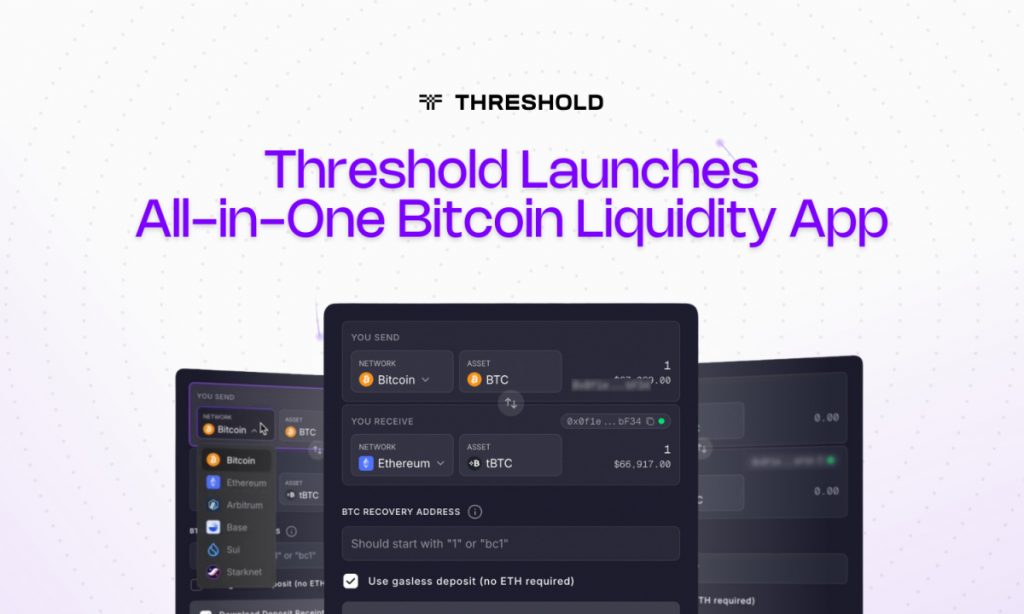
Threshold Network, the decentralized blockchain protocol behind tBTC, has introduced an update to its decentralized application featuring an all-in-one Unified Bitcoin App that enables users to route Bitcoin across major chains through a single interface.

This new unified routing interface brings minting, redeeming, bridging, tracking, and native BTC swaps into a single application: The Threshold App. Users can now move Bitcoin across ecosystems through a coordinated system, rather than stitching together multiple tools or navigating between different Decentralized protocols.

This release simplifies how Bitcoin enters and moves across DeFi, offering a more user-friendly on-chain experience with tBTC. Whether a transaction requires a swap, a bridge, or multiple steps, execution is seamlessly coordinated through a single interface

Coordinated Execution Instead of Fragmented Workflows

Historically, moving BTC into tBTC and across chains required multiple disconnected workflows: minting in one app, bridging via another protocol, swapping on separate exchanges, and manually checking the best price for each transaction. This fragmented process introduced friction, higher execution risk, added costs, and unnecessary complexity for users attempting to access DeFi with Bitcoin.

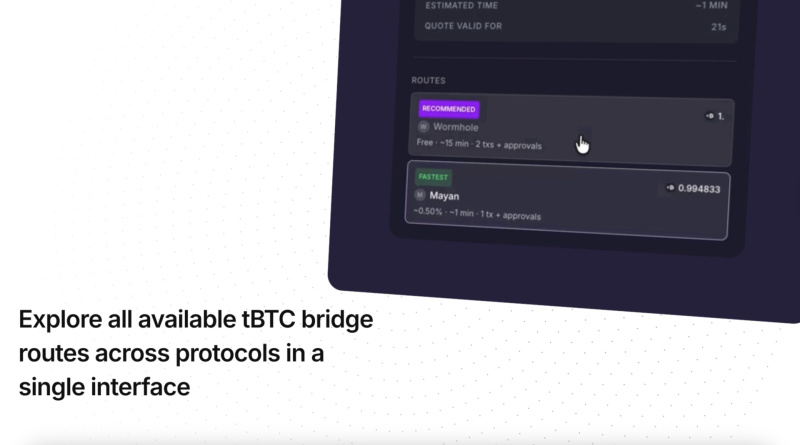
The Threshold All-in-one Bitcoin Liquidity App streamlines this experience by consolidating minting, bridging, swapping, and cost tracking into a single coordinated interface. Instead of manually comparing bridges and liquidity venues, users receive optimized routing options based on cost, speed, and reliability, such as the fastest or lowest-cost path: all within the Threshold Network App.

By abstracting multi-step transactions into a single seamless flow, the router significantly lowers the barrier for Bitcoin holders to use BTC across major ecosystems, including Ethereum, Arbitrum, Base, Sui, Starknet, and other integrated chains. The result is a simpler, more efficient way to move Bitcoin into DeFi.

Native BTC Execution with Deep Liquidity

Native BTC swaps are integrated directly into the routing engine, leveraging deep Ethereum liquidity to deliver competitive pricing and more efficient execution compared to fragmented, chain-specific pools.

“Capital should move efficiently across chains without requiring users to manage infrastructure decisions,” said MacLane Wilkison, Co-Founder of Threshold Network. “The new Threshold Bitcoin app coordinates liquidity sourcing and settlement behind the interface, enabling more efficient Bitcoin deployment across ecosystems.”

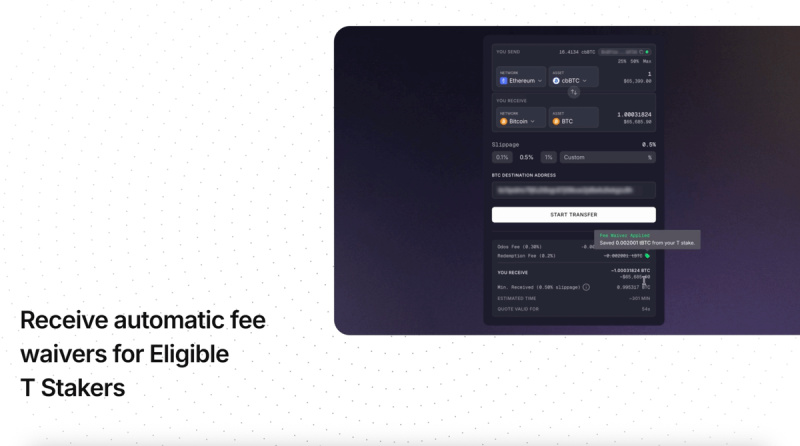
The update also strengthens the utility of Threshold’s token (T). The App tracks staked $T from the connected wallet and automatically applies minting and redemption fee waivers for eligible users. Gasless minting remains available as an opt-in feature, further reducing transaction costs.

Additionally, the router enables streamlined conversions from assets such as WBTC and cbBTC directly into tBTC on the destination chain, providing more direct and efficient access to Bitcoin liquidity across DeFi ecosystems.

Integrated Infrastructure Across Major Networks. Currently, the router connects Bitcoin, Ethereum, Arbitrum, Base, Sui, and Starknet within one coordinated framework. It integrates native tBTC mint and redeem flows, established bridging infrastructure, and DEX aggregation to ensure reliable settlement across chains.

All transactions are tracked in real time and are fully resumable. If a user disconnects or closes a session, progress is preserved. Fee logic is staking-aware, with eligible T stakers seeing applicable redemption fees waived directly within the interface.

New Features:

Unified Routing Interface: Enables minting, redeeming, swapping, and bridging from a single entry point. Users select source and destination assets, and the system automatically constructs the optimal execution path.
Multi-Chain Connectivity: Supports Bitcoin, Ethereum, Arbitrum, Base, Sui, and StarkNet within a single coordinated framework. Users can move BTC or tBTC across ecosystems without managing separate bridge interfaces.
Smart Route Discovery and Ranking: Automatically evaluates possible transaction paths and ranks them by cost, speed, reliability, and simplicity. Users are presented with clearly labeled best options.
Native BTC Swaps: Provides direct access to BTC liquidity with competitive execution, while enabling seamless conversion of assets such as cbBTC or wBTC into tBTC on a user’s chosen destination network.
Integrated Liquidity and Bridging Stack: Connects tBTC mint and redeem flows with established bridging infrastructure and DEX aggregation to coordinate multi-step transactions seamlessly.
Resumable Transactions: Persists in-flight operations, allowing users to refresh, disconnect, or return later without losing progress. Reduces failed cross-chain flows and operational friction
$T Staking-Aware Fee Display: Recognizes T staking status and surfaces fee waivers directly in the interface, reinforcing participation incentives.
Unified tBTC Explorer and Transaction Tracking: The new explorer section of the app consolidates historical mint, redeem, bridge, and swap activity into a single view, improving transparency and user oversight.

Impact for Users and Stakeholders

This release expands the utility of tBTC across six ecosystems while increasing throughput across minting, bridging, and swap flows. By embedding routing intelligence directly into the protocol interface, Threshold captures more activity within its infrastructure and further strengthens staking incentives tied to network usage.

With this launch, Threshold advances its role from Bitcoin asset issuance to core infrastructure for Bitcoin mobility, coordinating capital movement seamlessly across chains and unlocking more efficient access to decentralized finance.

Users can explore the new Bitcoin App today at https://app.threshold.network

About Threshold Network

Threshold Network is the decentralized protocol behind tBTC, a non-custodial, 1:1 Bitcoin-backed asset secured by a 51-of-100 threshold signer model. tBTC enables native BTC to move across chains like Ethereum, Base, Sui, Arbitrum, and Starknet without requiring custodians or compromising security. With over 6 years of proven security and about $5.1B in bridge volume, Threshold offers the most battle-tested, trust-minimized Bitcoin infrastructure onchain.

Contact

Threshold Network[email protected]

Disclaimer

In line with the Trust Project guidelines, please note that the information provided on this page is not intended to be and should not be interpreted as legal, tax, investment, financial, or any other form of advice. It is important to only invest what you can afford to lose and to seek independent financial advice if you have any doubts. For further information, we suggest referring to the terms and conditions as well as the help and support pages provided by the issuer or advertiser. MetaversePost is committed to accurate, unbiased reporting, but market conditions are subject to change without notice.

About The Author

Chainwire is the top blockchain and cryptocurrency newswire, distributing press releases, and maximizing crypto news coverage.

More articles

Chainwire is the top blockchain and cryptocurrency newswire, distributing press releases, and maximizing crypto news coverage.


Source link

US Government Makes Small Bitcoin Transfer Amid Iran war

US Government Makes Small Bitcoin Transfer Amid Iran war


Key Highlights

The U.S. government moved small Bitcoin transfers totaling about 1.23 BTC ($22,550) on March 3, 2026.The transfers came from a wallet holding seized funds and may be test transactions before larger moves.Crypto activity in Iran surged after U.S. and Israeli strikes, with over $10 million leaving exchanges in two days.

The U.S government reportedly moved a small amount of Bitcoin as today, while the country is in an ongoing conflict in the West Asia. 

According to data from Arkham Intellegance, the transfer came from a government-controlled wallet labeled “Miguel Villanueva Seized Funds” and about three transfers, totalling about 1.23 Bitcoin, worth around $22,550 were recorded. This tranfers are small but expert believe this might be test transfers ahead of larger movements.

The Bitcoin transfers | Source: Arkham

The funds were sent to three separate wallets. One wallet with the tag “bc1qt” received $2,500, another with tag “bc1q8” received $16,250, and the last wallet “bc1qq”received $3,800. Following this, the wallet still holds about $22.7 billion worth of cryptocurrencies.

Meanwhile, this comes at a time where there is tension in the Middle East following an operation launched by the U.S that led to the assassination of Iran’s Supreme Leader Ayatollah Ali Khamenei. 

This conflict caused uncertainty in the market as 

Disclaimer: The information researched and reported by The Crypto Times is for informational purposes only and is not a substitute for professional financial advice. Investing in crypto assets involves significant risk due to market volatility. Always Do Your Own Research (DYOR) and consult with a qualified Financial Advisor before making any investment decisions.

Google News Banner


Source link

The GTA 6 Pre-Order Database Leak: Is the Official Price Coming? | Metaverse Planet

The GTA 6 Pre-Order Database Leak: Is the Official Price Coming? | Metaverse Planet


I have spent the better part of the last decade analyzing every microscopic rumor, blurry screenshot, and “insider leak” regarding the next Grand Theft Auto. To be honest, 99% of it is usually just noise. But today, we finally have something tangible—actual backend data.

If you’ve been waiting to find out exactly how much damage this game is going to do to your wallet, the wait is almost over. The PlayStation database has just been updated with new Title IDs for Grand Theft Auto 6, and this is a massive indicator that Rockstar is gearing up to open the floodgates for pre-orders.

Let’s break down exactly what this backend update means, address that terrifying $120 price tag rumor that’s been floating around, and figure out what our next steps are as players.

The PlayStation Backend Update: What It Actually Means

When a game is simply “in development,” it exists in a studio’s private environment. But when a game is preparing to be listed on a digital storefront for consumers to actually purchase, it has to be integrated into the platform’s infrastructure.

Thanks to the ever-watchful tracking account PlayStation Game Size, we now know that specific Title IDs for GTA 6 have been pushed to the PlayStation network’s database.

In my experience covering console ecosystems, this is almost always the final technical hurdle before a digital store page goes live with a “Pre-Order Now” button. While the tracking account noted that the exact timing is ultimately up to the publisher, they also mentioned, “I don’t think it will be a long wait.”

This means two very important things are imminent:

We are about to get the official, final price tag for the base game.We will finally see the digital deluxe editions and pre-order bonuses (which, let’s face it, will probably include a ton of GTA Online currency).

The $120 Panic: How Much Will It Actually Cost?

Now, let’s address the elephant in the room. If you’ve been on Reddit or X lately, you’ve probably seen players panicking over a temporary digital store listing that priced GTA 6 at an eye-watering $120.

When I first saw that number, I completely understood the outrage. Video game pricing is already a highly sensitive topic. We recently made the painful jump from $60 to the new $70 standard for AAA games. But $120 for a base game?

Here is my honest take on this: Don’t panic just yet. Retailers frequently use high placeholder prices in their systems before an official MSRP is announced to ensure they don’t lose money on early listings. However, we also have to be realistic about Rockstar’s position in the industry.

The Unprecedented Scale: The graphics, the density of Leonida, and the sheer scale of the open world are lightyears beyond anything we’ve seen. Rockstar knows they have a product with zero real competition.The “Premium” Tier: While I strongly suspect the standard base edition will sit around the $70 to $80 mark, I would bet my own money that the $120 price tag is actually real—but for an “Ultimate” or “Collector’s” edition packed with early access days and exclusive in-game assets.

The Release Timeline: November 19 and the PC Gamer’s Dilemma

Alongside the database updates, we also have a much firmer grasp on the calendar. GTA 6 is slated to launch on November 19, 2026. But here is the part that always stings if your primary gaming machine is a custom-built rig. At launch, GTA 6 will be strictly console-exclusive (PlayStation 5 and Xbox Series X/S).

As a PC player myself, it is incredibly frustrating to see Rockstar stick to this staggered release strategy. Historically, they do this to double-dip on sales—knowing hardcore fans will buy the game on PS5 first, and then buy it again 1 to 2 years later when the definitive, graphically unlocked PC version finally drops. If you want to play on day one, you are going to need a console. There is simply no way around it.

What Should We Expect Next?

If the Title IDs are in the database, Rockstar is likely preparing a new trailer or a dedicated community update to coincide with the pre-order launch. We are about to cross the threshold from “mythical future game” to “a product we can actually purchase.”

I’ll be monitoring the PlayStation Store updates constantly over the next few weeks. The moment that price goes live, we will know exactly how the gaming industry’s pricing model might shift for the next decade.

I am genuinely curious where you all draw the line. If the base, standard edition of GTA 6 actually does launch at $80 or even $100, will you still pre-order it on day one, or will you wait for a sale? Let me know your absolute price limit in the comments below!

You Might Also Like;


Source link

OKX Launches AI Developer Toolkit On OnchainOS Designed For Autonomous AI Agents

OKX Launches AI Developer Toolkit On OnchainOS Designed For Autonomous AI Agents


In Brief

OKX has launched a native AI layer on its OnchainOS platform, providing developers with the infrastructure to run autonomous AI agents that manage wallets, execute trades, access real-time market data, and interact across multiple blockchains.

OKX Launches AI Developer Toolkit On OnchainOS Designed For Autonomous AI Agents

Cryptocurrency exchange OKX announced that it has launched a native AI layer on its proprietary onchain platform, OnchainOS, marking the first developer toolkit designed specifically to enable AI agents to operate autonomously across multiple blockchains. 

The new layer provides infrastructure that allows AI agents to manage wallets, execute trades, and pay for services onchain, extending OnchainOS’ existing Web3 architecture into a comprehensive execution environment for AI-driven applications.

The platform enables developers to program AI agents across OKX Wallet and its onchain marketplace, tools used by millions of users daily, offering a unified environment for building, testing, and operating onchain functionality. OnchainOS is now available globally, providing developers with the ability to run their own agents or decentralized applications.

Bringing Infrastructure To The AI Economy 

The AI capabilities of OnchainOS are built on the established foundation of the OKX Wallet ecosystem, which handles over 1.2 billion API calls and $300 million in daily trading volume while maintaining response times below 100 milliseconds and 99.9% uptime. This performance is intended to support the high-speed, continuous operations required by autonomous agents.

The AI layer includes features for managing wallets, making payments, executing trades, accessing real-time market data, and integrating decentralized applications. Wallet functionality allows querying of balances, broadcasting transactions, and retrieving histories across chains. Payment operations are powered by the x402 protocol, enabling pay-per-use transactions that can be executed autonomously, including zero gas fee transactions on OKX’s native X Layer chain.

Trading functions use smart routing across more than 500 decentralized exchanges to secure optimal swap rates with low fees and rapid execution. Market data is delivered in real time and structured to allow agents to interpret token movements, trades, transfers, and account activity without human intervention. DApp Connect allows direct integration of OKX Wallet into any decentralized application, providing immediate access to a large Web3 wallet ecosystem.

OnchainOS is designed around composable skills that enable agents to perform complete autonomous workflows. In practice, an agent can be programmed to monitor the ETH price and automatically swap ETH to USDC if it falls below a specified threshold, assessing liquidity, determining optimal swap rates, handling token approvals, executing the transaction, tracking its confirmation onchain, and reporting the result, all without human input.

Developers and AI agents can access OnchainOS in several ways. The AI Skills interface allows natural language commands to trigger onchain actions without complex integration. The Model Context Protocol (MCP) provides direct connectivity between OnchainOS and AI frameworks, including large language models, enabling native execution of onchain operations by platforms such as Claude Code, Cursor, and OpenClaw. Additionally, an Open API offers developers full programmatic control over all OnchainOS functions through RESTful access, providing a flexible foundation for building AI-driven onchain solutions.

Disclaimer

In line with the Trust Project guidelines, please note that the information provided on this page is not intended to be and should not be interpreted as legal, tax, investment, financial, or any other form of advice. It is important to only invest what you can afford to lose and to seek independent financial advice if you have any doubts. For further information, we suggest referring to the terms and conditions as well as the help and support pages provided by the issuer or advertiser. MetaversePost is committed to accurate, unbiased reporting, but market conditions are subject to change without notice.

About The Author

Alisa, a dedicated journalist at the MPost, specializes in cryptocurrency, zero-knowledge proofs, investments, and the expansive realm of Web3. With a keen eye for emerging trends and technologies, she delivers comprehensive coverage to inform and engage readers in the ever-evolving landscape of digital finance.

More articles

Alisa, a dedicated journalist at the MPost, specializes in cryptocurrency, zero-knowledge proofs, investments, and the expansive realm of Web3. With a keen eye for emerging trends and technologies, she delivers comprehensive coverage to inform and engage readers in the ever-evolving landscape of digital finance.

More articles


Source link

Popular Posts

My Favorites

Glen Powell Responds to Ex Gigi Paris’ Claims About Breakup

0
Glen Powell has finally broken his silence on the accusations made by his ex-girlfriend, Gigi Paris, following their 2023 split.The model alleged that...