Metaverse

Home Metaverse Page 21

Zoomex Strengthens Liquidity Infrastructure to Meet Growing Demand from AI Trading Systems

Zoomex Strengthens Liquidity Infrastructure to Meet Growing Demand from AI Trading Systems


Zoomex Strengthens Liquidity Infrastructure to Meet Growing Demand from AI Trading Systems

Fast-rising crypto exchange, Zoomex has outlined its approach to liquidity and execution quality as artificial intelligence continues to reshape financial markets. Traditionally, liquidity in cryptocurrency trading has been assessed from a human perspective, based on how easily assets can be bought or sold without significantly impacting price. 

However, as automated trading agents and algorithmic systems become more advanced, this definition is evolving. In an AI-driven environment, liquidity must deliver predictable, consistent execution, not just visible market depth.  As a result, platforms like Zoomex are increasingly evaluated on whether their infrastructure can support fast, reliable execution for both human traders and automated strategies.

Zoomex Liquidity Infrastructure in Practice

Liquidity quality depends on the underlying infrastructure supporting an exchange’s trading environment. Order-matching systems, market-making networks, and liquidity-sourcing mechanisms all contribute to the stability of an exchange’s order books.

In the liquidity analysis published by CryptoRank, Zoomex showed competitive liquidity across several major crypto markets. The report recorded more than $62.7 million in BTC spot depth within ±2% of the mid-price, placing the exchange among the stronger performers in the study.

Zoomex Strengthens Liquidity Infrastructure to Meet Growing Demand from AI Trading Systems

In ETH markets, the platform demonstrated roughly $29.8 million in visible liquidity, indicating active trading participation in one of the most widely traded digital assets. The study also observed relatively low slippage levels, approximately 0.03% for simulated BTC trades, which suggests that the platform’s visible liquidity translates into real execution capacity.

Another notable finding was the balanced distribution of liquidity across multiple assets, including BTC, ETH, SOL, XRP, and DOGE. This distribution indicates that the exchange’s liquidity infrastructure is not concentrated in a single flagship market but instead supports several trading pairs.

For automated trading strategies operating across multiple markets simultaneously, such balanced liquidity environments are particularly important.

The Growing Role of AI Agents in Trading

The increasing importance of execution quality is closely connected to broader developments in artificial intelligence. Technologies such as Claude Code, developed by Anthropic, illustrate how autonomous AI agents are beginning to interact with complex digital systems. While Claude Code focuses on software development automation, it demonstrates the broader trend of AI agents performing structured tasks within digital environments.

In financial markets, similar AI-driven systems are being developed to analyze data, generate trading signals, and execute trades automatically. These systems rely on exchanges that provide stable execution conditions and reliable market infrastructure.

As AI adoption expands, exchanges are increasingly evaluated by whether their systems can support algorithmic trading environments where execution speed and data accuracy are essential.

In this context, Zoomex provides an excellent example of how trading infrastructure must evolve to accommodate machine-driven market participants.

The Liquidity Problem: When Market Depth Isn’t Real

A persistent issue in cryptocurrency markets is the difference between visible liquidity and executable liquidity. Some exchanges display large order books that appear deep but fail to maintain that depth when real trading pressure appears.

Orders may disappear rapidly during volatility, leading to slippage and unpredictable execution outcomes. This phenomenon, sometimes described as “ghost liquidity”, creates an environment where displayed order book depth does not accurately represent real trading capacity.

While human traders may sometimes adapt to these inconsistencies, automated systems depend heavily on stable and reliable order book behavior. When liquidity disappears during execution, algorithmic strategies can suffer substantial performance losses.

Independent market analysis from CryptoRank highlights the importance of measuring liquidity through execution metrics rather than visible depth alone. 

Zoomex Strengthens Liquidity Infrastructure to Meet Growing Demand from AI Trading Systems

In its comparative study of several exchanges, the research evaluated slippage and reaction times to determine whether order book liquidity was truly usable in real trading conditions. Within that analysis, Zoomex demonstrated liquidity characteristics that translated effectively into real execution capacity rather than purely theoretical depth.

How AI Trading Agents Evaluate Exchanges

AI-driven trading systems analyze exchanges using objective infrastructure metrics rather than visual market indicators. Execution speed is one of the most critical parameters. Automated strategies frequently operate on signals that require rapid trade execution. Even small delays between order submission and confirmation can significantly affect algorithmic performance.

Another important metric is slippage. AI trading models measure how closely the executed trade price matches the expected price. Low slippage suggests that order book liquidity is genuine and capable of supporting larger trades without sudden price deviations.

Market data reliability is also essential. AI systems rely heavily on consistent APIs and structured data feeds to interpret market conditions. Exchanges that provide stable market data allow automated systems to operate more efficiently.

Platforms with infrastructure designed for fast matching engines, predictable execution logic, and transparent trading environments are, therefore, more attractive to algorithmic trading systems.

Zoomex’s trading infrastructure is the benchmark in this context, as its matching engine and liquidity framework are designed to support both human and automated trading.

Start Your Intelligent Trading Journey at Zoomex Today

Execution Quality as the New Standard

As artificial intelligence becomes more integrated into financial markets, the way exchanges are evaluated is changing rapidly. Trading volume and asset listings still matter, but they are no longer the only indicators of market quality. Execution reliability, liquidity stability, and data transparency are becoming the defining standards for modern trading infrastructure.

For AI-driven trading systems, liquidity must be real and executable. Automated trading agents rely on exchanges where order book depth consistently supports real trades without sudden slippage or liquidity disappearing. Stable APIs, fast matching engines, and transparent market data are essential for these systems to operate effectively.

Zoomex has positioned itself at the forefront of this shift. The platform’s liquidity infrastructure focuses on delivering real execution rather than simply displaying order book depth. Independent liquidity analysis has shown that Zoomex maintains strong market depth across major assets while achieving low slippage and responsive execution in both spot and derivatives markets. This combination of measurable liquidity and reliable trade execution creates an environment where both human traders and automated strategies can operate with confidence.

As AI trading agents continue to expand across financial markets, exchanges capable of supporting algorithmic trading environments will play an increasingly important role. With its emphasis on execution quality, transparent liquidity, and stable infrastructure, Zoomex is building the type of trading environment that modern markets and the next generation of AI-driven participants require.

Sign up on Zoomex and explore a trading system where fairness, transparency and access are built into every layer. New users can receive up to 14,000 USDT in welcome rewards.

Disclaimer

In line with the Trust Project guidelines, please note that the information provided on this page is not intended to be and should not be interpreted as legal, tax, investment, financial, or any other form of advice. It is important to only invest what you can afford to lose and to seek independent financial advice if you have any doubts. For further information, we suggest referring to the terms and conditions as well as the help and support pages provided by the issuer or advertiser. MetaversePost is committed to accurate, unbiased reporting, but market conditions are subject to change without notice.

About The Author

Gregory, a digital nomad hailing from Poland, is not only a financial analyst but also a valuable contributor to various online magazines. With a wealth of experience in the financial industry, his insights and expertise have earned him recognition in numerous publications. Utilising his spare time effectively, Gregory is currently dedicated to writing a book about cryptocurrency and blockchain.

More articles

Gregory, a digital nomad hailing from Poland, is not only a financial analyst but also a valuable contributor to various online magazines. With a wealth of experience in the financial industry, his insights and expertise have earned him recognition in numerous publications. Utilising his spare time effectively, Gregory is currently dedicated to writing a book about cryptocurrency and blockchain.



Source link

Meta kills its VR metaverse after $84 billion in losses – Hypergrid Business

Meta kills its VR metaverse after  billion in losses – Hypergrid Business


Zuckerberg’s AI-generated beach. (Image courtesy Meta.)

Meta announced this week that it is pulling the plug on the virtual reality version of Horizon Worlds, the platform that was once the centerpiece of Mark Zuckerberg’s metaverse bet.

Starting June 15, users will no longer be able to build, publish, or update VR worlds, or access Meta Horizon Worlds on Meta Quest headsets, according to Meta’s announcement.

The platform will survive only as a standalone mobile app.

It’s a remarkable end for a project that prompted Zuckerberg to rename his entire company.

When Meta changed its name from Facebook in October 2021, Zuckerberg called the metaverse “the next frontier,” writing: “Our hope is that within the next decade, the metaverse will reach a billion people, host hundreds of billions of dollars of digital commerce, and support jobs for millions of creators and developers.”

Well, that didn’t go the way he planned. In his video back then announcing the metaverse, which I forced myself to watch, Zuckerberg came off a bit lizard-like,

You can watch his entire keynote presentation below, if you want a little blast from the past:

What’s going away, and when

By March 31, Horizon Worlds and Events will disappear from the Quest Store, and Meta’s own showcase worlds — Horizon Central, Events Arena, Kaiju, and Bobber Bay — will go dark in VR, according to Meta’s announcement.

Horizon-specific Meta Horizon Plus perks, including Meta Credits, Digital Clothing, and In-World Purchases, will also be removed from the subscription.

Users who have already downloaded Horizon Worlds can keep playing in VR until June 15, after which the app will be removed from Quest entirely.

This week’s announcement wasn’t the first shoe to drop.

In February, Meta permanently shut down Horizon Workrooms — the VR meeting platform pitched to office workers as a replacement for Zoom — and deleted all user data. The company also stopped selling commercial Quest headsets and stopped accepting new customers for its Quest for Business program, according to a business impact analysis by Snazzy Solutions.

The January Reality Labs layoffs cut over 1,000 employees and shuttered VR studios, including Ouro Interactive, an in-house studio built in 2023 specifically to create first-party Horizon Worlds content, according to Bloomberg.

The bill comes due

Reality Labs lost $19.19 billion in 2025 alone, bringing cumulative losses since 2020 to $83.6 billion, according to Meta’s Q4 and full-year 2025 earnings report.

Samantha Ryan, Meta’s VP of content at Reality Labs, framed the shutdown as a “doubling down” rather than a retreat, saying in a February blog post that Meta would be “doubling down on the VR developer ecosystem while shifting the focus of Worlds to be almost exclusively mobile.”

“By breaking things down into two distinct platforms, we’ll be better able to clearly focus on each,” she added.

Ryan also insisted that Meta remains committed to VR. She said that Meta was still “the single biggest investor in the VR industry” and still believed in VR “as a critical technology on the path to the next computing platform.”

An impossible sell for business

The failure of Horizon Workrooms, Meta’s enterprise VR meeting platform, was entirely predictable.

If you’re in a Zoom meeting, you can check your email, pull up your calendar, share your screen, use a whiteboard, and access recordings and transcripts. Everyone already has Zoom installed. Everyone already has a camera.

If you want to hold that same meeting in VR, you first need to find your headset. Charge it. Download whatever updates have accumulated. Remember how to use it. Figure out how to share the meeting invite. Make sure all your co-workers have their equipment. Teach at least one of them how to use theirs.

Founder Mark Zuckerberg announcing that Facebook is changing its corporate name to Meta…

Then, once you’re actually in the meeting, the screens are hard to read. You don’t have easy access to your desktop apps. Typing is difficult or impossible. You can’t check your phone if something urgent comes in.

It’s not practical for 99.9 percent of business use cases.

I’ve really tried to do work in VR. I really have. I’ve tried to pull my team members in. I’ve even given out free headsets. It’s a very hard sell. There’s really no upside to doing work in VR. It’s all downside..

And for the rare case where VR might make sense — say, reviewing a physical product mockup with a distributed team — you’d have to upload that mockup to Meta’s servers. Meta would have access to every discussion about it, every document related to it, every internal detail of your product development process. For any company serious about intellectual property, that alone is a dealbreaker.

This is what Horizon Workrooms never solved. The consumer version had the same problems. Wagner James Au, a longtime virtual worlds journalist, told The American Prospect that Horizon Worlds failed to get “the social aspect right,” noting that “these are virtual communities and they need to be welcoming. They need to have people you want to hang out with in the experience.”

What Second Life and OpenSim got right — kind of

Meanwhile, Second Life, which launched in 2003, before the iPhone existed, is still running.

So are hundreds of OpenSim grids, many of them operated by volunteers on a shoestring budget. The hypergrid, a network of interconnected OpenSim worlds where avatars can teleport between grids while keeping their appearance, belongings, and friend lists, was never going to lose $19 billion in a single year. It also was never going to get shut down by a quarterly earnings call.

The contrast with Meta is stark. Second Life’s virtual economy moves roughly $650 million per year, and Linden Lab has paid out $1.1 billion to creators over the platform’s lifetime — 14 of whom became millionaires from selling virtual fashion and real estate, according to an analysis of the platform’s history by game developer Philip Ludington.

Meta, by comparison, never built a functioning creator economy. While Second Life users retain copyright to their content, Meta Horizon Worlds gave Meta sole control over content and usage rights. It was a closed ecosystem run by a single entity.

The revenue split made things worse. When Meta tested in-app purchases, creators received only 52.5 percent of pre-tax revenue after platform fees. Philip Rosedale — now CTO of Linden Lab, and Second Life’s original founder — called Meta’s fee structure self-defeating, telling PC Gamer: “It seems like a great way to dissuade creators from actually participating in its economy, but frankly I would expect nothing less from them.” He noted at the time that Linden Lab had paid out $86 million to Second Life creators in a single year.

Second Life’s magic sauce was not its technology.

Meta thought better graphics and VR immersion would help it succeed. Sansar thought VR-native design would do it. High Fidelity thought next-gen infrastructure would do it. Decentraland thought blockchain ownership would do it. None of it worked, because Second Life’s advantage isn’t technology but rather 23 years of accumulated culture, economic infrastructure, and relationships built inside a shared world, says Ludington.

OpenSim has something even harder to replicate: it’s fully open source, decentralized, and owned by no one. No corporate board can decide to shut it down. No quarterly earnings report can kill it. It’s more like the way the Internet works, and why I’m a big fan. And also why I’ve been writing about OpenSim for the past 17 years.

Personally, I think a closed metaverse isn’t the way to go.

What Meta is shutting down, and what’s staying

A lot of headlines this week said “Meta kills its metaverse.” Including mine. That’s how you get the clicks, right?

But that’s not quite the full picture.

Shutting down in VR:

Horizon Worlds — but just the VR version: Gone from the Quest Store by March 31; the app itself removed from all Quest headsets on June 15, according to Meta’s announcement.
Horizon Workrooms: Meta’s VR office meeting platform shut down in February, with all user data deleted, according to PC Gamer.
Quest for Business: Meta stopped selling commercial Quest headsets and accepting new enterprise customers in February, according to PC Gamer.
Meta’s own first-party VR content: Meta acknowledged in its developer blog that 86 percent of the time Quest users spend in their headsets is already with third-party apps — meaning its own content was largely irrelevant to how people actually used the device. The company has now closed three in-house VR studios entirely.
The Horizon Feed and Worlds button in Quest’s interface: The headset’s new Navigator UI boots to a grid of installed apps, with the Horizon social feed removed, according to Engadget.

Still available:

Quest headsets: Still being sold. Meta says it has “a robust roadmap of future VR headsets that will be tailored to different audience segments,” according to its developer blog. A next-generation gaming headset is in development, according to Tom’s Guide.
Third-party VR games: Beat Saber, Superhot VR, Gorilla Tag, and thousands of others remain fully available on Quest. Meta says it invested nearly $150 million in VR developer programs in 2025 and that new releases including Hard Bullet, The Thrill of the Fight 2, and UG each earned millions in revenue, according to Meta’s developer blog.
Horizon Worlds as a mobile app: Survives on iOS and Android, repositioned as a Roblox-style mobile game platform. Meta says it grew mobile monthly active users more than four times over in 2025, and that four mobile creators hit $1 million in lifetime revenue, according to the developer blog.

Maria Korolov
Hypergrid Business editor and publisher Maria Korolov is a science fiction novelist. During the day, Maria Korolov is an award-winning freelance technology journalist who covers artificial intelligence, cybersecurity and enterprise virtual reality. See her Amazon author page here and follow her on Twitter, Facebook, or LinkedIn, and check out her latest videos on the Maria Korolov YouTube channel. Email her at [email protected]. Her first virtual world novella, Krim Times, made the Amazon best-seller list in its category. Her second novella, The Lost King of Krim, is out now. She is also the publisher of MetaStellar, a new online magazine of speculative fiction.
Maria Korolov
Latest posts by Maria Korolov (see all)


Source link

Kraken Steps Back From IPO as Trading Volumes Sink

Kraken Steps Back From IPO as Trading Volumes Sink


Key Highlights

Kraken has reportedly delayed its IPO, awaiting stronger market conditions.A cooling crypto market and lower trading volumes have dampened valuations and investor demand.The exchange has still filed confidentially with regulators, signaling plans remain active.

Crypto exchange Kraken has quietly delayed its plans to go public, according to people familiar with the matter.

According to a report, the company is not abandoning the idea of an initial public offering but is waiting for more favorable market conditions before proceeding. Representatives said only that a confidential filing had been submitted to U.S. regulators, declining to provide further details.

Kraken’s parent company, Payward, filed a draft registration statement with the U.S. Securities and Exchange Commission (SEC) in November as part of preparations for a potential listing.

Market slowdown weighs on timing

The decline of crypto markets has reportedly affected plans for public listing across the sector. In recent times, digital asset markets have shown a decline in prices and trading activities. This has affected revenue projections for exchanges that rely heavily on trade volume. This has resulted in low valuations and demand for listing.

Companies planning IPOs often wait for stronger market momentum to maximize demand and pricing.

Valuation context and prior fundraising

The momentum behind Kraken’s IPO plans was fueled by the significant funding it raised in a private funding round with a reportedly multibillion-dollar valuation. The funding round saw Citadel Securities take part in the funding.

The funding was meant to support Kraken’s plans to venture into blockchain-based financial infrastructure. The move came when improving regulatory clarity in the US had prompted various cryptocurrency companies to seek to go public.

Crypto IPO window narrows in 2026

Public listings surged in 2025, when multiple digital asset companies successfully debuted on stock exchanges. Firms such as Circle, Bullish, and Gemini were among those that went public during that period, collectively raising billions of dollars.

So far in 2026, however, new listings have been limited. BitGo is one of the few digital asset firms to debut, and its shares have struggled amid volatile markets.

Some companies are still moving forward. Securitize has indicated it intends to list once it secures regulatory approval, reflecting confidence in long-term demand for tokenized financial products.

Internal changes and uncertainty

Kraken has also undergone executive turnover, including the departure of its chief financial officer earlier this year, according to people familiar with the situation. Leadership changes during IPO preparation can complicate timelines, as companies typically need stable financial oversight while navigating regulatory review and investor scrutiny.

The exchange’s decision highlights how closely crypto company valuations track market activity. If major exchanges delay listings until trading rebounds, it could slow the sector’s integration into public equity markets.

Also Read: FTX Advances Bankruptcy Plan With $2.2B Fourth Payout to Creditors

Disclaimer: The information researched and reported by The Crypto Times is for informational purposes only and is not a substitute for professional financial advice. Investing in crypto assets involves significant risk due to market volatility. Always Do Your Own Research (DYOR) and consult with a qualified Financial Advisor before making any investment decisions.


Source link

GCOIN Debuts as Playnance Accelerates Ecosystem Growth | NFT News Today

GCOIN Debuts as Playnance Accelerates Ecosystem Growth | NFT News Today


The evolution of Web3 entertainment is being shaped by platforms that can combine scalability, usability, and real user engagement. Playnance is positioning itself within this space with the launch of GCOIN trading on MEXC, marking a major milestone in its development.

Trading began on March 18, 2026, at 13:00 UTC, following the project’s Token Generation Event earlier that day. This transition introduces GCOIN to the open market and allows users worldwide to participate more directly in the Playnance ecosystem.

The launch follows a period of strong growth and engagement. MEXC’s Kickstarter campaign generated significant interest, with users competing for a share of a 50,000 USDT airdrop. This level of participation reflects growing awareness of the platform and its potential within the Web3 entertainment space.

Demand within the ecosystem has also been substantial. The introduction of staking saw more than 1 billion GCOIN locked within hours, demonstrating both confidence in the platform and a willingness among users to commit to its long-term development.

GCOIN plays a central role in enabling the ecosystem’s functionality. It powers transactions, facilitates rewards, and supports participation across more than 10,000 on-chain games. With over 2 million transactions processed daily, the platform has already achieved a significant level of activity.

A key factor behind this growth is Playnance’s focus on accessibility. By delivering Web2-like user experiences on-chain, the platform simplifies onboarding and reduces the friction often associated with blockchain applications. This approach has allowed Playnance to attract a broad audience, including users who may be new to Web3.

The ecosystem’s expansion is further reflected in its growing user base, which now exceeds 300,000 GCOIN holders. This community forms the foundation of the platform’s continued development and plays a crucial role in driving engagement.

The listing on MEXC enhances liquidity and provides a scalable trading environment for users. Deposits are already open, with withdrawals scheduled to begin on March 19, ensuring full flexibility for participants.

Looking ahead, Playnance is focused on building on its early success. With GCOIN now accessible on a global exchange, the company is well positioned to expand its reach, onboard new users, and continue developing its Web3 entertainment ecosystem.

As competition in the sector intensifies, platforms that can combine strong infrastructure with user-friendly design are likely to stand out. Playnance’s recent milestone suggests it is moving in that direction.


Source link

Unitree PUMP MAX Review: The Ultimate Portable Smart Gym | Metaverse Planet

Unitree PUMP MAX Review: The Ultimate Portable Smart Gym | Metaverse Planet


I’ve spent years curating a solid home gym setup filled with bulky dumbbells, kettlebells, and resistance bands that inevitably snap or lose their elasticity. When the robotics company Unitree announced the PUMP MAX—a digital, motorized resistance machine the size of a water bottle—I was intrigued but cautious. Could a compact motor really simulate the heavy, unforgiving pull of cast iron? After swapping out my traditional free weights for this high-tech digital cable system for a month, I’m ready to share exactly how it reshaped my daily workouts.

Pros & Cons

✅ Massive Digital Resistance: Packs up to 40kg (88 lbs) of smooth, highly adjustable motorized resistance in a shockingly small package.✅ Advanced Training Modes: Offers eccentric, concentric, and constant resistance modes that are nearly impossible to replicate with standard weights.✅ Ultra-Portable: Weighing just a few pounds, it completely eliminates the need for bulky iron plates, making it perfect for frequent travelers.❌ Anchor Dependence: At max resistance, you need a heavily reinforced door or exceptionally sturdy anchor point to avoid damaging your home.❌ Audible Motor Noise: Under heavy, fast-paced loads, the internal cooling fans and motor whine become quite noticeable.❌ App Reliance: While you can use it offline, adjusting detailed settings and changing workout modes heavily relies on your smartphone.

FeatureDetailsMax Resistance40kg (88 lbs) per unitMotor TechnologyFOC Brushless Servo MotorWeightApprox. 2.5 kg (5.5 lbs)Training ModesConcentric, Eccentric, Constant, RowingBattery LifeUp to 1,000 reps per full chargeConnectivityBluetooth 5.0 (iOS & Android App)Included AnchorsDoor Anchor, Suction Cup, Fixation Strap

My Experience

Pulling the Unitree PUMP MAX out of the box, it immediately strikes you as a premium piece of tech rather than traditional gym equipment. Its sleek, metallic casing houses an incredibly complex FOC brushless servo motor—the exact same technology Unitree uses in their advanced robotic dogs. Setting it up for my first chest workout was surprisingly intuitive. I attached the door anchor, clicked the carabiner into place, and synced it to the companion app via Bluetooth. Dialing in 30kg of resistance felt strange on a touchscreen, but the moment I grabbed the handle and pulled, my skepticism evaporated.

The resistance delivered by the PUMP MAX is nothing short of incredible. Unlike elastic bands that give you varied tension based on how far they stretch, this motor provides a perfectly flat, constant resistance from the beginning of the rep to the very end. It mimics the feel of a commercial cable machine with frightening accuracy. However, the real magic lies in the eccentric training mode. The app allows you to set a heavier weight for the “lowering” phase of the lift than the pulling phase. Doing bicep curls with an extra 10kg fighting against me on the way down left my arms sore in a way standard dumbbells haven’t achieved in years.

The companion app acts as a pocket personal trainer, turning workouts into a somewhat gamified experience. It automatically tracks your reps, records the total volume of weight lifted, and maps out your power output on a digital graph. For data nerds who love tracking their progressive overload, this is an absolute goldmine. I found myself pushing for “just one more rep” simply to beat my high score from the previous week. The app also features a vast library of guided movements, which is fantastic for beginners trying to figure out how to hit specific muscle groups using a single cable attachment.

Of course, no product is perfect. At its highest resistance settings, the motor generates a noticeable hum, and the internal fan kicks on to keep the sophisticated electronics cool. If you are working out in a silent apartment, your roommates will definitely hear it. Furthermore, the 40kg max limit is no joke—if you attach this to a flimsy interior door frame and pull with all your might, you risk doing structural damage to your home. You really have to ensure your anchor points are bulletproof. But despite these minor caveats, the Unitree PUMP MAX is an absolute triumph of fitness engineering. It has allowed me to bring a full-scale gym experience into hotel rooms and small apartments, forever changing how I approach fitness on the go.

Who is this for? / Alternatives

The PUMP MAX is tailor-made for frequent travelers, apartment dwellers with zero space for heavy iron, and fitness enthusiasts who want access to advanced eccentric and concentric training modes. If you are a hardcore powerlifter pushing 300+ lbs, this won’t replace your barbell. For alternatives, you might look at the MAXPRO Fitness machine, which offers higher resistance but is much bulkier, or the Shogun FLEX, which targets a similar hyper-portable digital weight market.

Quick FAQ

Can I combine two PUMP MAX units for more weight?Yes! The app allows you to link two units together for bilateral movements like chest presses or heavy squats, effectively doubling your total resistance output.

Do I have to use the app to work out?While the app unlocks the advanced features like eccentric modes and rep tracking, you can use the physical buttons on the device to make basic resistance adjustments offline.

Will it break my door?The included door anchor is designed to distribute weight safely. However, at max resistance, you should only use it on solid core, heavy-duty doors that pull towards the frame, not away from it.

Unitree PUMP MAX Review

Build Quality & Hardware – 9.5/10

Resistance Smoothness – 9.5/10

App Experience – 8.0/10

Value for Money – 8.5/10

“A mind-bending feat of robotics that successfully condenses a heavy-duty commercial cable machine into a device the size of a water bottle.”

Product Images

You Might Also Like;


Source link

UK Court Allows $172M Bitcoin Dispute to Go to Trial

UK Court Allows 2M Bitcoin Dispute to Go to Trial


Key Highlights

A UK High Court allowed Ping Fai Yuen’s lawsuit against his estranged wife Fun Yung Li over 2,323 Bitcoin to go to trial.Yuen claims Li allegedly used CCTV to record his 24-word wallet recovery phrase, which allowed her to transfer the Bitcoin.The court rejected the main “conversion” claim but allowed other legal claims, like unjust enrichment and constructive trust, to continue.

A UK High Court has allowed a lawsuit over the alleged theft of 2,323 Bitcoin, now worth about $172 million, to move forward to trial.

The lawsuit involves British businessman Ping Fai Yuen and his estranged wife Fun Yung Li, over a disputed transfer that took place in England in August 2023, raising questions about who owns the Bitcoin and how it was moved.

Yuen claims Li stole his wallet password

The case was brought to the court by Yuen, who said his wife took his Bitcoin without his permission. He said the Bitcoin was stored in a Trezor hardware wallet, which is protected by a PIN and a 24-word recovery phrase.

According to court documents, Li allegedly used CCTV cameras inside their home to secretly record him entering the recovery phrase. Yuen claims she then moved the Bitcoin through many transactions and later spread it across 71 different blockchain addresses. Records show that the funds have not moved since December 21, 2023.

In response, Li asked the court to dismiss the case, arguing that the legal claim of conversion only applies to physical property and not digital assets like Bitcoin.

The court agreed with her on that point. However, the judge still allowed the case to continue under other legal claims, including unjust enrichment and constructive trust. These claims could still allow Yuen to recover the Bitcoin if he proves his case.

Justice Cotter said, “the claimant has demonstrated a very high probability of success” and described parts of the evidence as “damning,” including recorded conversations and items found during a police search.

Personal issues amid police investigation

There are also personal issues that exist in the couple’s relationship. After discovering the alleged transfer, Yuen confronted Li and later pleaded guilty in 2024 to assault-related charges. 

During the investigation, the police conducted a search of Li’s property, where they found a number of hardware wallets and a recovery phrase. Authorities later announced that there will be no further action taken unless new evidence is presented.

Li, meanwhile, denies all of the allegations and claims that she does not have sufficient knowledge about the Bitcoin transaction. The court has decided that the case will be sent for a full trial, where both parties will show their evidence for the case.

Broader context 

The case is an example of how the laws in the UK are slowly catching up with digital assets, such as Bitcoin. In the past, the law only clearly recognized physical property and legal rights. Bitcoin does not fully fit into these categories.

New laws, like the Property (Digital Assets etc) Act 2025, also indicate that digital assets can be classified as property rights. However, courts are still working out how to apply these rules in real cases. This trial may help set an example for how similar crypto cases will be handled in the future.

Also Read: Capital ₿ Raises €3M with BTC Warrants in Strategic Deal

Disclaimer: The information researched and reported by The Crypto Times is for informational purposes only and is not a substitute for professional financial advice. Investing in crypto assets involves significant risk due to market volatility. Always Do Your Own Research (DYOR) and consult with a qualified Financial Advisor before making any investment decisions.


Source link

Bitget Expands Spot Market With Ondo Tokenized Securities, Integrating US Equities, ETFs, And Commodities

Bitget Expands Spot Market With Ondo Tokenized Securities, Integrating US Equities, ETFs, And Commodities


In Brief

Bitget has expanded its spot market by adding Ondo Global Markets tokenized securities, allowing users to trade major U.S. equities, index ETFs, precious metals, and cryptocurrencies 24/7 within a single USDT-based account.

Cryptocurrency exchange Bitget announced that it has expanded its spot market by introducing a new set of Ondo Global Markets tokenized securities, integrating major US equities,

Cryptocurrency exchange Bitget announced that it has expanded its spot market by introducing a new set of Ondo Global Markets tokenized securities, integrating major US equities, index ETFs, and precious metals into a single trading environment alongside digital assets. The move adds a further layer to Bitget’s multi-asset model, enabling users to trade both cryptocurrency and traditional market exposures around the clock within a single USDT-based account.

The new listings feature some of the most widely followed companies in global markets, including Tesla (TSLAon), NVIDIA (NVDAon), Apple (AAPLon), Alphabet (GOOGLon), Microsoft (MSFTon), Amazon (AMZNon), Meta (METAon), and AMD (AMDon). In addition, the expansion introduces broader market access through index ETFs such as SPYon, IVVon, QQQon, IWMon, and ITOTon, alongside commodity-linked instruments including IAUon and SLVon, providing traders with a direct way to engage with gold- and silver-linked products from the same interface used for crypto trading.

This launch builds upon the ongoing partnership between Bitget and Ondo, which has steadily grown over the past several months. In September 2025, Bitget and Bitget Wallet enabled access to over 100 tokenized assets via Ondo Finance, and the collaboration recently deepened with the addition of 98 new tokenized U.S. stocks and ETFs. Bitget has reported strong adoption in this category, noting that Ondo tokenized stock trading on its platform captured approximately 73% of the market share in early December before increasing to roughly 89% later in the month, illustrating rapid user demand for blockchain-based access to global markets. Ondo Global Markets has since emerged as the largest provider of tokenized stocks worldwide.

Tokenized Assets Enable 24/7 Global Market Access

Unlike conventional market access, which is restricted by brokerage networks and fixed trading hours, these new spot listings are designed for uninterrupted, 24/7 trading. This allows users to react in real time to macroeconomic events, earnings announcements, and weekend market developments, eliminating the wait associated with traditional exchange schedules. The approach aligns with the broader trend in tokenized assets, where investors increasingly expect global market instruments to be as fast and accessible as cryptocurrencies.

“Market movements are no longer bound by date and time, user expectations no longer stop at the boundary between crypto and traditional finance. This expansion with Ondo brings some of the world’s most watched equities, index products, and precious metals into our spot market in a way that feels native to how modern users already trade,” said Gracy Chen, CEO of Bitget in a written statement.

“Bitget is now offering tokenized equities alongside crypto and becoming the everything app, powered by Ondo,” said Ian De Bode, President of Ondo Finance. “Ondo tokenized stocks, ETFs, and commodities are available for trading on every Bitget platform, in size,” he added. 

This rollout represents the next stage in Bitget’s Global Alpha in One strategy, adding depth to its Universal Exchange model by uniting crypto, tokenized real-world assets, and traditional market instruments in a single platform, reflecting the growing integration of digital and conventional finance in modern trading environments.

Disclaimer

In line with the Trust Project guidelines, please note that the information provided on this page is not intended to be and should not be interpreted as legal, tax, investment, financial, or any other form of advice. It is important to only invest what you can afford to lose and to seek independent financial advice if you have any doubts. For further information, we suggest referring to the terms and conditions as well as the help and support pages provided by the issuer or advertiser. MetaversePost is committed to accurate, unbiased reporting, but market conditions are subject to change without notice.

About The Author

Alisa, a dedicated journalist at the MPost, specializes in cryptocurrency, zero-knowledge proofs, investments, and the expansive realm of Web3. With a keen eye for emerging trends and technologies, she delivers comprehensive coverage to inform and engage readers in the ever-evolving landscape of digital finance.

More articles

Alisa, a dedicated journalist at the MPost, specializes in cryptocurrency, zero-knowledge proofs, investments, and the expansive realm of Web3. With a keen eye for emerging trends and technologies, she delivers comprehensive coverage to inform and engage readers in the ever-evolving landscape of digital finance.

More articles


Source link

Teams ♥️ Loop app

Teams ♥️ Loop app


Here are couple of tricks, I thought would be interesting to share. Despite it feels that Copilot is getting all updates, it is not so. Microsoft Teams, Loop, Whiteboard, and other apps are not left out. If you haven’t seen these before, I hope this article is useful and will help. If you have: congrats on utilizing them!

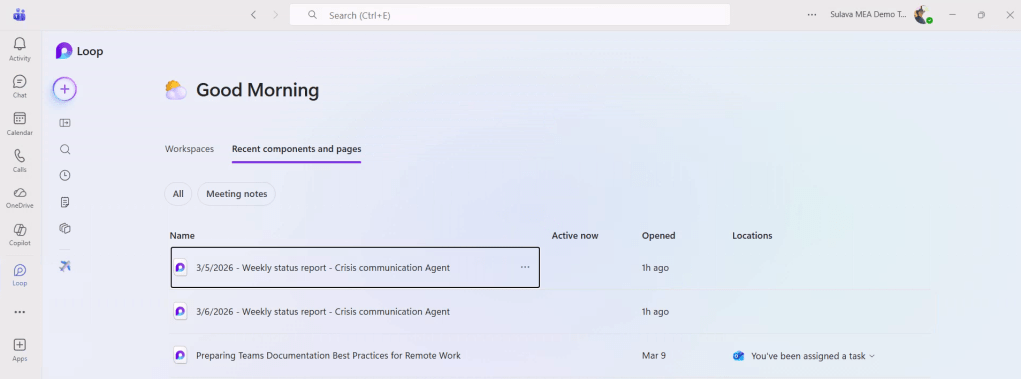
Loop application within Microsoft TeamsOpen Loop application in Teams in a new windowWhere are my Teams notifications? Whiteboard update

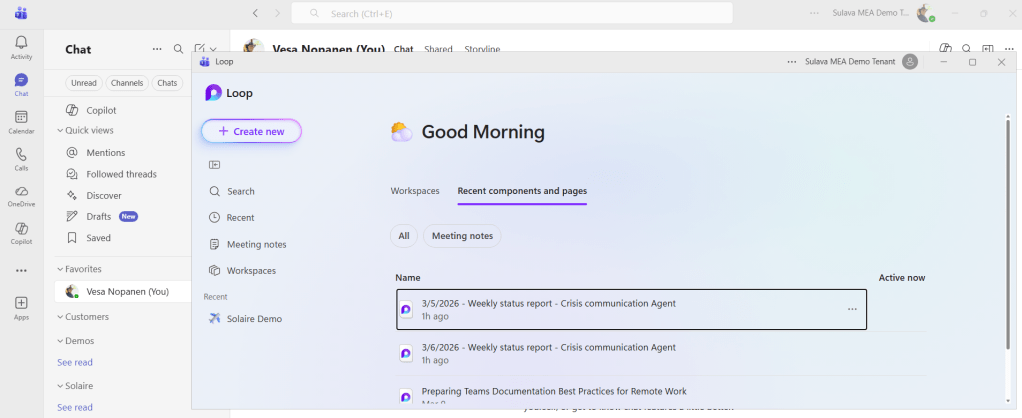
Did you know that you can open the Loop application inside Microsoft Teams? Just go to … dots and search for Microsoft Loop.

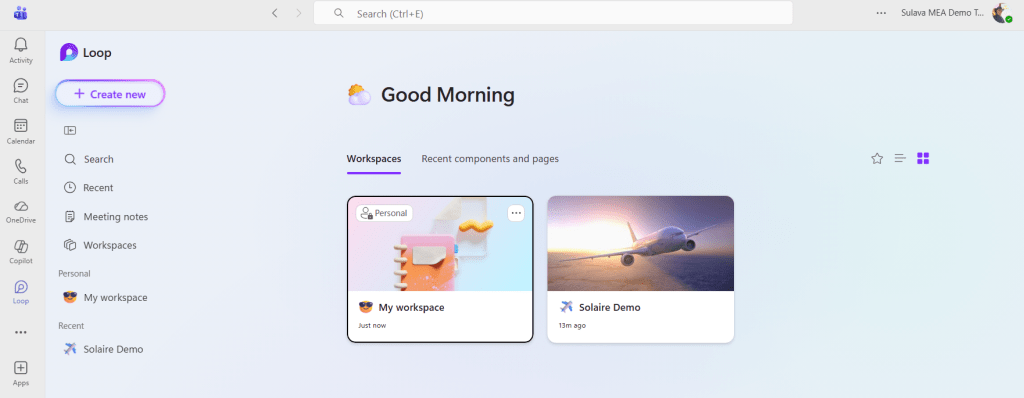
You can then open the Loop app inside Teams. This works for both web and desktop. And you can see the Loop then on the left rail.

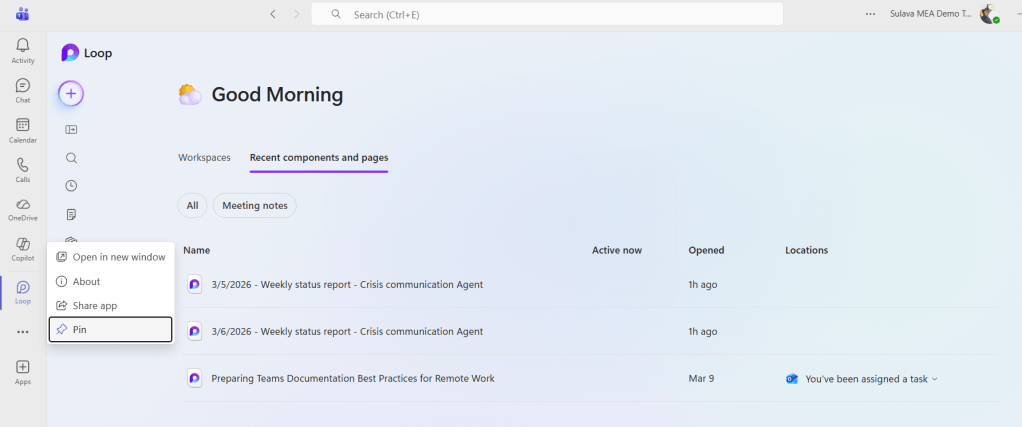
We are not going to stop there. Since we have the Loop application open in Teams, we should pin it to the left navigation with the right click on top of left navigation Loop icon.

This application has all features than opening & installing Loop application from the web https://loop.cloud.microsoft/. Instead you are using Loop directly from within Teams. It depends on your preference how you want to access the Loop app: web browser installed application can be made to auto-start when you log in to your Windows, while using from Teams is very simple and don’t have to worry about different user accounts ( usually a consultant’s problem when you have multiple accounts, not a normal knowledge worker’s).

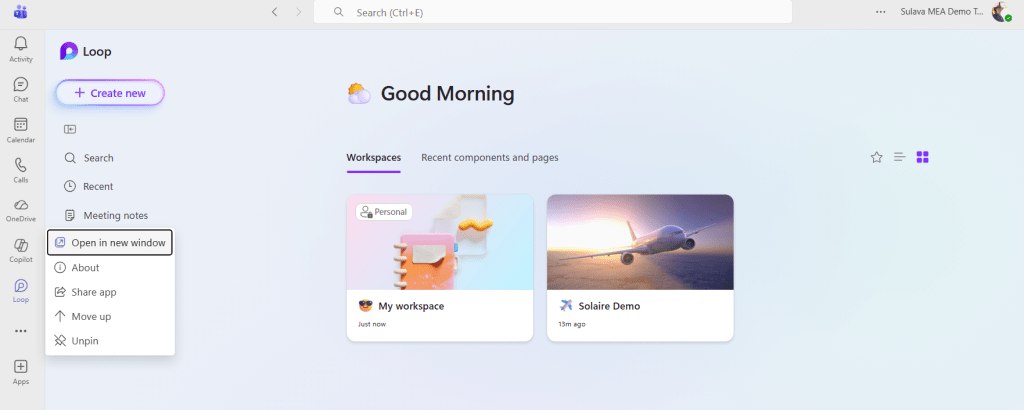
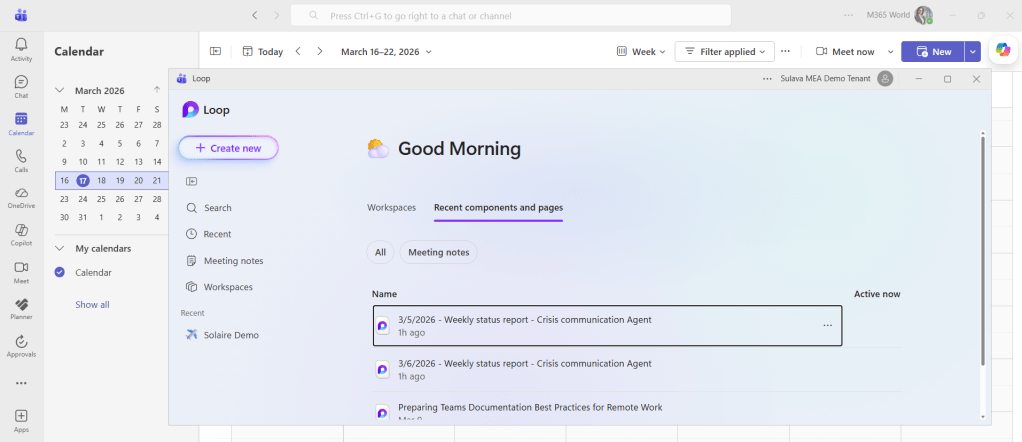
Open Loop application in Teams in a new window

This feature has been in Teams Desktop apps for quite some time. As you can see from the screenshot above (and below), when you right click an application in Teams you can choose to open it in a new window.

This open in new window doesn’t apply just to Loop app – you can do that to many applications and Teams content. You can “pop-out” a channel, group or meeting conversation(chat), meeting share, or even Teams Activity, Chats, Calendar etc.

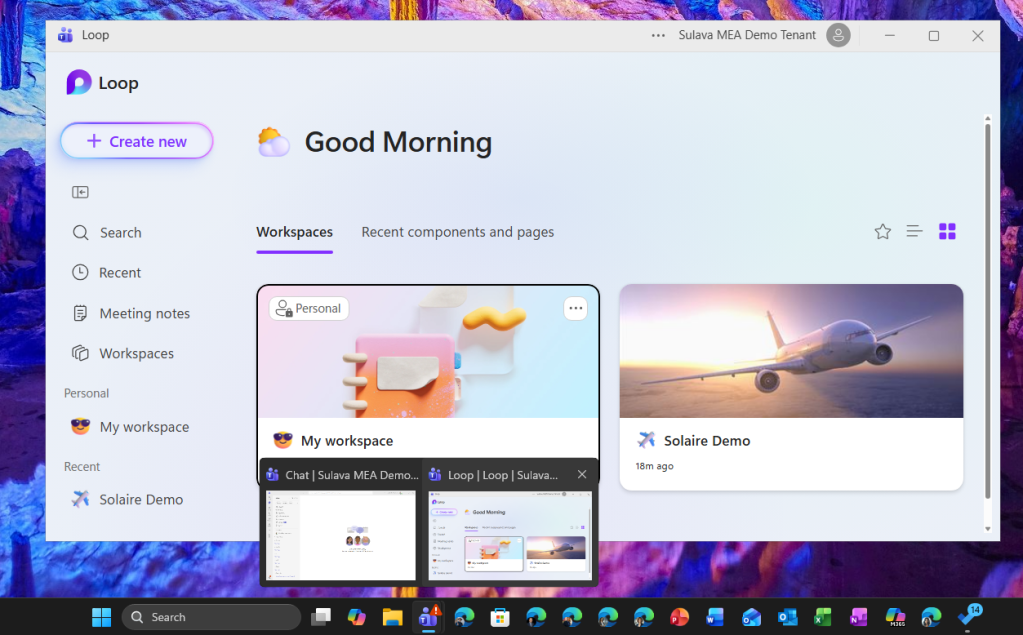
This way you can utilize Loop app in a separate window and keep on using Teams as you like.

And yes, you can even change to another tenant or account.

And just like normally, you can switch between Teams windows from the Windows taskbar or when using Alt+Tab.

I think this makes Loop app very easy to use – right form within Teams Desktop!

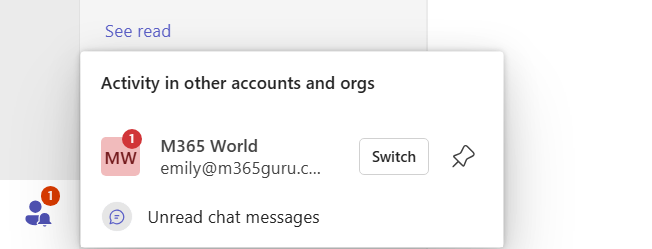
You may have been wondering what happened to your Teams notifications. We have seen them by our profile picture on top-right corner for years and years, but now notifications has a new home at bottom left!

Clicking on the person-figure opens your notifications.

The new way makes it open to notification activities quickly – just clicking on the Unread chat messages takes me to those right away: the correct chat group opens directly into a new window, so my Teams desktop is not switching a tenant.

This is a very useful update to Teams, but I am sure it has caused some confusion “Where are my notifications”..

Yes, I did mention Whiteboard is getting updates. After the summer 2026 Whiteboards created in Teams channels will now be stored in SharePoint 🙂

The change will happen ( estimate) September 2026. This information was already shared to administrators in Message Center MC1253753.

Currently when you use Whiteboard app on a team channel, any Whiteboards created there will be stored in creator’s OneDrive. After this change , in September 2026, Whiteboards will be created in the team channel’s SharePoint site.

This is what will happen:

Whiteboards created from a Teams Channel tab will be stored in the channel’s SharePoint site.

All channel members will have consistent access based on channel permissions.

Existing Microsoft 365 compliance and security policies continue to apply.

Whiteboards will be discoverable from the Whiteboard board picker.

The change is enabled by default.

Unknown's avatar

Published by Vesa Nopanen

Vesa “Vesku” Nopanen, Principal Consultant and Microsoft MVP (Microsoft 365 and Azure AI Foundry) working on Future Work at Sulava MEA.

I work, blog and speak about Future Work : AI, Microsoft 365, Copilot, Loop, Azure, and other services & platforms in the cloud connecting digital and physical and people together.

I have 30 years of experience in IT business on multiple industries, domains, and roles.
View all posts by Vesa Nopanen


Source link

Why Zuckerberg’s Vision Stumbled and What Comes Next | Metaverse Planet

Why Zuckerberg’s Vision Stumbled and What Comes Next | Metaverse Planet


I remember sitting at my desk watching that massive keynote where Mark Zuckerberg essentially bet his entire empire on the metaverse. The pitch was intoxicating. I genuinely thought we were on the brink of a Ready Player One reality where our digital and physical lives would seamlessly merge.

But let’s be brutally honest with ourselves: looking at the landscape right now, that grand promise feels more like a frustrating beta test. Instead of a universal digital utopia, we’re staring at a massive gap between a billionaire’s sci-fi vision and our actual daily lives. I’ve spent countless hours wandering through these virtual worlds, and I want to break down exactly why the metaverse hasn’t taken over the world—and where it’s actually heading.

The Grand Illusion: Why Sizzle Didn’t Match the Steak

When the hype train left the station, the expectation was that the metaverse would revolutionize everything. But in my experience, forcing every single industry into a virtual reality headset just doesn’t make sense. The technology failed to translate into real, tangible value across several key sectors:

Consumer Goods & Retail: Let’s face it, buying a pair of sneakers in a virtual mall involves unnecessary friction. I don’t want to navigate a clunky avatar to a virtual checkout counter when a standard mobile app lets me buy what I need in exactly three taps. The metaverse created hurdles where established digital tools already offered a frictionless experience.The Tourism Industry: I’ve tried virtual tours, and while they are visually neat, they are entirely hollow. A digital simulation simply cannot replace the sensory and relational dimensions of actual travel. You can’t code the smell of the ocean, the taste of local street food, or the spontaneity of getting lost in a new city.The Luxury Sector: Luxury is built on tactility. The weight of a high-end watch, the texture of a designer bag, and the exclusive, pampered experience of walking into a boutique—these are physical sensations. You simply cannot transfer that core value to a digital avatar wearing a pixelated jacket.

Whether it’s art, commerce, education, or entertainment, these immersive platforms have shown massive limitations. We expected bustling digital metropolises, but instead, I found myself walking through ghost towns with immature content and highly limited social interactions.

The Tech Just Isn’t There Yet (And It’s Too Expensive)

Mark-Zuckerberg-Starts-AI-Work-Crucial-for-the-Metaverse-2

Beyond the conceptual flaws, we have to talk about the hardware. The technology is undeniably immature. Despite massive investments, entering the metaverse still requires expensive, cumbersome equipment. VR and AR headsets are heavy, isolating, and often lead to motion sickness. The experiences lack the fluid, intuitive nature we’ve come to expect from our smartphones. We are dealing with:

Lag and latency issues that ruin immersion.User-hostile interfaces that confuse the average consumer.Cartoonish, unpolished graphics that fail to capture the promised realism.

Because of these barriers, the metaverse has remained an experimental laboratory for a small niche of tech enthusiasts (like myself, who are willing to spend the money and time) rather than a public square. For the average person, there is absolutely zero concrete advantage to strapping on a headset when social media, e-commerce, and streaming platforms already meet their needs instantly and flawlessly.

The Crypto Crash and The AI Distraction

We also can’t ignore the economic elephant in the room. The initial metaverse boom was heavily tied to the wild, speculative bubbles of cryptocurrencies and NFTs.

When those virtual economies collapsed, they took the metaverse’s credibility down with them. It became painfully obvious that many of these digital real estate ventures were speculative grifts rather than functional platforms.

Furthermore, the tech world has a notoriously short attention span. Right now, Generative AI is stealing the spotlight. Investors and massive corporations have diverted their billions away from building virtual worlds and poured them into artificial intelligence. Why build a complex virtual store when you can build an AI that actually optimizes your real-world supply chain today?

So, Is the Metaverse Dead?

I don’t think it’s dead, but it is undergoing a massive reality check. The future of the metaverse isn’t about replacing the internet or becoming a universal ecosystem where we all live and work 24/7.

Instead, I see it evolving into a highly specialized, niche, and supportive technology. Here is where the metaverse actually has a pulse:

Gaming and E-sports: This is its natural home. Gamers are already accustomed to navigating 3D spaces and digital economies.Industrial and Medical Training: Simulating a dangerous oil rig or a complex surgical procedure in VR before doing it in real life is a massive, tangible benefit.Architectural Design: Walking through a building before the foundation is even poured is a game-changer for designers and clients.

In consumer sectors like tourism and luxury, the metaverse won’t replace the physical experience, but it will become a complementary tool. Think of it as an interactive preview or a gamified marketing campaign rather than the main event.

Ultimately, for this technology to survive, it has to stop trying to replace our established digital tools and start integrating with them. It needs to offer accessible, tangible experiences that actually solve problems.

I’ve taken my headset off for now, but I’m keeping it on the desk. The revolution might be delayed, but the evolution is still happening in the background.

I’m curious about your experiences, though. Have you ever bought something in a virtual world or used VR for anything other than gaming? Do you think we’ll ever reach that sci-fi vision, or are we permanently stuck with clunky avatars? Let me know what you think!

You Might Also Like;


Source link

Hack Seasons Conference Returns To Cannes For 13th Edition, Spotlighting Institutional Blockchain Finance And Web3 Innovation

Hack Seasons Conference Returns To Cannes For 13th Edition, Spotlighting Institutional Blockchain Finance And Web3 Innovation


In Brief

Hack Seasons Conference returns to Cannes on April 1, bringing together global institutional leaders, digital-asset executives, and policymakers to explore blockchain finance, Web3 innovation, and tokenized real-world assets.

Premier Event Bridging Crypto And Institutional Assets: Hack Seasons Conference Returns To Cannes

The Hack Seasons Conference is back for its 13th edition in Cannes on April 1st at Canopy by Hilton, bringing together institutional leaders, digital-asset executives, and policymakers to explore the trends and opportunities shaping institutional blockchain finance.

Co-hosted with Spectrum Nodes, this year’s conference will cover a wide range of topics at the intersection of digital assets, Web3, and institutional finance. Key themes include capital allocation, trading venues and liquidity, institutional adoption of digital assets, RWA tokenization, stablecoins, and PayFi, among others.

The event will feature a full day of panel discussions, fireside chats, and keynote speeches with speakers from around the world. Notable participants include experts from S&P Global, Circle, Coinbase, EY, Ethereum Foundation, Offchain Labs, 21Shares, Grayscale Investments, and more. Among the key discussions are:

“Where Smart Capital Is Moving in Web3: Infrastructure, AI, and Real-World Assets” featuring:

Harry Grant, DeFi Manager, Re7

Ciara Sun, Founder & GP, C² Ventures

Rafael Mastroberardino, Digital Assets Partnership Development & Strategy, Franklin Templeton

Lionel Pek, Director, The Spartan Group

“The Future of Trading Venues: Hybrid Markets, Liquidity Fragmentation, and Institutional Flow”featuring:

Nikita Sachdev, Founder, LunaPR

Daniel Seifert, Vice President & Regional Managing Director, EMEA, Coinbase

Nenter Chow, Global CEO, Bitmart

Dorian Vincileoni, Head of Regional Growth, Kraken

“Tokenizing the Real World: From Infrastructure to Global Capital Markets” featuring:

Tomer Sharoni, Co-Founder & CEO, Addressable

Matthew Dawson, Enterprise Lead, Ethereum Foundation

Theo Golden, Investment Manager & Tokenisation Lead, Baillie Gifford

Anya Nova, Director EMEA, GK8 by Galaxy

Liam Karwan, Head of Tokenization Business, Chainlink Labs

Pauline Shangett, CSO, ChangeNOW

“We are proud to create the premier forum where institutional players can explore the future of on-chain finance,” said Vadim Krekotin, Managing Partner, HSC Asset Group. “This year, with even more participants joining us, we aim to demonstrate how blockchain will redefine the very foundations of the financial industry,” he added. 

In addition to insightful discussions, the event offers exclusive networking opportunities, serving as a platform for participants to connect with global and regional capital, explore high-conviction curated projects, identify potential partners and market-entry pathways, and strengthen institutional-grade brand credibility.

Registrations are now open for participants seeking deep market insights and meaningful connections across digital assets and institutional finance.

HSC Solidifies Global Leadership In Digital Finance And Web3, Expanding To Dubai, Singapore, And Miami In 2026

The Cannes edition builds on the success of the previous event in Hong Kong this February, which focused on asset management and attracted over 2,500 attendees across two dedicated stages covering institutional trends and technological innovation, with more than 50 decision-makers participating.

The conference’s mission is to connect investors and innovators from around the globe, providing a hub for digital-native companies to showcase their vision and engage with top-tier investors and founders. It consistently delivers insights on today’s most relevant cryptocurrency trends, including AI, DeFi, tokenized RWAs, payment solutions, and blockchain infrastructure.

Over its twelve editions, Hack Seasons Conference has attracted more than 75,000 participants and generated over 10 million social media impressions, establishing itself as one of the premier gatherings for the digital finance and Web3 ecosystem. Upcoming editions are scheduled for Dubai, Singapore, and Miami in 2026.

Disclaimer

In line with the Trust Project guidelines, please note that the information provided on this page is not intended to be and should not be interpreted as legal, tax, investment, financial, or any other form of advice. It is important to only invest what you can afford to lose and to seek independent financial advice if you have any doubts. For further information, we suggest referring to the terms and conditions as well as the help and support pages provided by the issuer or advertiser. MetaversePost is committed to accurate, unbiased reporting, but market conditions are subject to change without notice.

About The Author

Alisa, a dedicated journalist at the MPost, specializes in cryptocurrency, zero-knowledge proofs, investments, and the expansive realm of Web3. With a keen eye for emerging trends and technologies, she delivers comprehensive coverage to inform and engage readers in the ever-evolving landscape of digital finance.

More articles

Alisa, a dedicated journalist at the MPost, specializes in cryptocurrency, zero-knowledge proofs, investments, and the expansive realm of Web3. With a keen eye for emerging trends and technologies, she delivers comprehensive coverage to inform and engage readers in the ever-evolving landscape of digital finance.

More articles


Source link

Popular Posts

My Favorites

BNB Chain X Account ‘May Have Been Compromised,’ Says Binance Founder...

0
In brief BNB Chain's X account may be compromised with users urged not click on any links. CZ made the public announcement via his own...

What do you wear on a date?