Metaverse

Home Metaverse Page 20

Zoomex présente un cadre de liquidité et d’exécution prêt pour l’IA face à l’essor du trading automatisé

Zoomex présente un cadre de liquidité et d’exécution prêt pour l’IA face à l’essor du trading automatisé


In Brief

La plateforme d’échange de cryptomonnaies Zoomex a détaillé sa stratégie d’infrastructure en matière de liquidité et d’exécution, alors que les systèmes de trading automatisé occupent une place croissante sur les marchés des actifs numériques.

Zoomex présente un cadre de liquidité et d’exécution prêt pour l’IA face à l’essor du trading automatisé

La plateforme d’échange de cryptomonnaies Zoomex a détaillé sa stratégie d’infrastructure en matière de liquidité et d’exécution, alors que les systèmes de trading automatisé occupent une place croissante sur les marchés des actifs numériques. L’entreprise indique adapter son environnement de trading afin de répondre aux besoins des traders humains ainsi que des systèmes algorithmiques qui dépendent d’une exécution cohérente et de données de marché fiables.

Traditionnellement, la liquidité sur les marchés des actifs numériques était évaluée en fonction de la profondeur visible du carnet d’ordres et du volume de transactions. Toutefois, avec la montée en puissance des stratégies automatisées, la définition de la liquidité évolue vers la qualité d’exécution, c’est-à-dire la capacité à exécuter des transactions de manière fiable dans des conditions réelles de marché.

Selon Zoomex, cette évolution influence la manière dont les plateformes sont évaluées, avec une importance accrue accordée à la vitesse d’exécution, au contrôle du slippage et à la stabilité de l’infrastructure, plutôt qu’à la seule profondeur affichée du marché.

Réduction de l’écart entre liquidité visible et liquidité exécutable

Un défi majeur dans le trading de cryptomonnaies demeure la différence entre la liquidité visible et la liquidité réellement exécutable. Dans certains cas, les carnets d’ordres peuvent sembler profonds, mais ne parviennent pas à maintenir cette profondeur en période de volatilité accrue.

Cela peut entraîner du slippage et des exécutions incohérentes, en particulier lors de périodes de forte activité. Pour les systèmes automatisés, qui reposent sur un comportement de marché prévisible, ces irrégularités peuvent affecter significativement les performances.

Zoomex a indiqué que son cadre de liquidité vise à réduire cet écart en garantissant que la profondeur affichée reflète la capacité réelle du marché. L’infrastructure de la plateforme est conçue pour maintenir des conditions d’exécution stables, même dans des environnements de marché changeants.

Une infrastructure conçue pour une exécution cohérente

À mesure que le trading devient de plus en plus automatisé, les plateformes sont évaluées en fonction de la performance de leur infrastructure. Parmi les indicateurs clés figurent la vitesse d’exécution, les niveaux de slippage et la fiabilité des flux de données de marché.

Zoomex a précisé que son architecture de trading a été développée pour répondre à ces exigences. Le moteur d’appariement et le modèle de liquidité de la plateforme sont conçus pour permettre une exécution rapide des ordres tout en garantissant une cohérence dans différentes conditions de marché.

Une performance stable des API et une diffusion structurée des données de marché font également partie de cette approche, permettant aux traders individuels comme aux systèmes automatisés d’accéder efficacement aux informations et d’y réagir.

Performance de la liquidité sur les principaux marchés

Le profil de liquidité de Zoomex a été analysé dans le cadre d’études de marché indépendantes comparant les principales plateformes d’échange de cryptomonnaies. Les résultats indiquent que la plateforme maintient une profondeur compétitive sur plusieurs actifs largement échangés.

L’analyse a enregistré plus de 62,7 millions de dollars de profondeur spot en BTC dans une fourchette de ±2 % autour du prix médian, ainsi qu’environ 29,8 millions de dollars de liquidité en ETH, ce qui suggère une participation active sur des marchés à fort volume. Les niveaux de slippage pour des transactions simulées en BTC ont été observés autour de 0,03 %, indiquant une exécution relativement stable dans des conditions de test.

La plateforme a également démontré une répartition de la liquidité sur plusieurs paires de trading, notamment BTC, ETH, SOL, XRP et DOGE. Cette diversification soutient des stratégies de trading multi-actifs plutôt que dépendantes d’un seul marché.

Positionnement pour la prochaine phase de la structure du marché

La croissance du trading automatisé contribue à une transformation plus large de la structure du marché, dans laquelle la fiabilité de l’exécution devient un critère central dans le choix des plateformes.

Un représentant de Zoomex a indiqué que l’entreprise aligne son infrastructure sur ces évolutions en mettant l’accent sur la transparence de la liquidité, la cohérence de l’exécution et la stabilité des systèmes :

« À mesure que le trading devient plus automatisé, la liquidité doit être évaluée sur la base des résultats d’exécution plutôt que de la seule profondeur visible. Notre objectif est de construire une infrastructure capable d’offrir une exécution cohérente et fiable dans des conditions réelles de marché. »

L’entreprise a précisé que ses efforts de développement en cours visent à accompagner cette transition, en créant un environnement de trading adapté à la fois aux participants actuels et à l’augmentation des activités de trading automatisé.

À propos de Zoomex

Fondée en 2021, Zoomex est une plateforme mondiale de trading de cryptomonnaies qui compte plus de 3 millions d’utilisateurs dans plus de 35 pays et régions. La plateforme propose plus de 700 paires de trading et plus de 590 contrats perpétuels, soutenus par un moteur d’appariement haute performance avec une latence inférieure à 10 millisecondes.

Guidée par ses valeurs fondamentales « Simple × Convivial × Rapide », Zoomex met l’accent sur un environnement de trading transparent et efficace. La plateforme privilégie l’équité, la traçabilité de l’exécution des ordres et une visibilité claire des actifs afin de réduire l’asymétrie d’information pour les utilisateurs.

Zoomex opère sous plusieurs enregistrements réglementaires, notamment Canada MSB, U.S. MSB, U.S. NFA et Australia AUSTRAC, et a réalisé des audits de sécurité menés par la société spécialisée en sécurité blockchain Hacken. La protection des actifs repose sur une structure de portefeuilles à signatures multiples, combinant des portefeuilles froids et chauds.

La plateforme est également partenaire officiel d’échange de cryptomonnaies de l’Haas F1 Team et dispose d’un partenariat mondial exclusif d’ambassadeur de marque avec le gardien de football professionnel Emiliano Martínez.

Disclaimer

In line with the Trust Project guidelines, please note that the information provided on this page is not intended to be and should not be interpreted as legal, tax, investment, financial, or any other form of advice. It is important to only invest what you can afford to lose and to seek independent financial advice if you have any doubts. For further information, we suggest referring to the terms and conditions as well as the help and support pages provided by the issuer or advertiser. MetaversePost is committed to accurate, unbiased reporting, but market conditions are subject to change without notice.

About The Author


Gregory, a digital nomad hailing from Poland, is not only a financial analyst but also a valuable contributor to various online magazines. With a wealth of experience in the financial industry, his insights and expertise have earned him recognition in numerous publications. Utilising his spare time effectively, Gregory is currently dedicated to writing a book about cryptocurrency and blockchain.

More articles


Gregory, a digital nomad hailing from Poland, is not only a financial analyst but also a valuable contributor to various online magazines. With a wealth of experience in the financial industry, his insights and expertise have earned him recognition in numerous publications. Utilising his spare time effectively, Gregory is currently dedicated to writing a book about cryptocurrency and blockchain.


Source link

Copilot Notebooks New Features Landing soon

Copilot Notebooks New Features Landing soon


If you’ve been following the evolution of Microsoft 365 Copilot, you know that Copilot Notebooks has emerged as one of the most compelling features in the suite. It’s the answer to what I call “the grounding problem”—how do you get AI to reason over your specific project context instead of discovering relevant sources from all Microsoft 365 data you can access ( without building an agent or tagging your resources to the prompt every time)?

Starting March 23, 2026, Microsoft is rolling out seven significant new capabilities to Frontier ( Copilot public preview ) tenants. They will be an expansion of what you can do with Copilot Notebooks—turning it more and more towards knowledge work environment.

This information is based on Microsoft Admin Center Message ID MC1254552.

What’s ChangingWhy this update matters? What This Means for Different RolesFor Change Managers and Adoption LeadsFor IT Admins and Governance TeamsFor Product Owners and Power UsersPreparing for the RolloutBuilding with ContextResources

What’s Changing

The rollout starts March 23 – 28 for Frontier Public tenants, and all features will reach General Availability between early April and early May 2026. No admin action is required—these capabilities will be enabled by default.

Here’s the complete feature breakdown:

FeatureFrontier PublicGeneral Availability (estimated schedule)What It DoesChat and Page InteractivityMarch 23, 2026Mid-April 2026Edit and create pages in your notebook directly through chat—no switching contextsStudy GuideMarch 23, 2026Late April 2026Auto-generates quizzes, flashcards, and topic pages from notebook contentSharePoint Sites and Folders GroundingMarch 23, 2026Early April 2026Add entire SharePoint sites and folders as references for broader contextPowerPoint AgentMarch 23, 2026May 2026Create presentations using notebook content and references in a few clicksWord AgentMarch 23, 2026May 2026Generate Word documents directly from notebook content and referencesSharing to Microsoft 365 Modern GroupsMarch 23, 2026April 2026Share notebooks directly with M365 Groups for team-wide accessMind MapMarch 23, 2026Early May 2026Interactive visual map of key topics, themes, and relationships in your notebook

Don’t forget that Notebooks will also allow adding weblinks to Notebook, and utilize content from links to grounding. Currently it is possible add weblinks, but they are not used for ground. This should change by the end of March, about the same times as these other updates are rolling to Copilot Notebooks!

What Message Center ID MC1193414 says about weblinks

We’re introducing the ability to add public web links as references in Microsoft Copilot Notebooks. This enhancement allows users to ground Copilot responses on specific public web pages, expanding the types of content that can be used to inform and contextualize their work.

What else should be appearing at Notebooks are Video Overviews. They don’t have a new date yet, but these did not appear with the schedule given in Message Center ID MC1208690. I am looking forward for these, as they will be cool – and a very useful knowledge sharing tool for teams!

Video Overviews in Copilot Notebooks enable users to automatically generate short, narrated video summaries of their Notebook’s content. These videos combine key insights, visuals, and voiceover to create an engaging, visual overview of the entire Notebook.

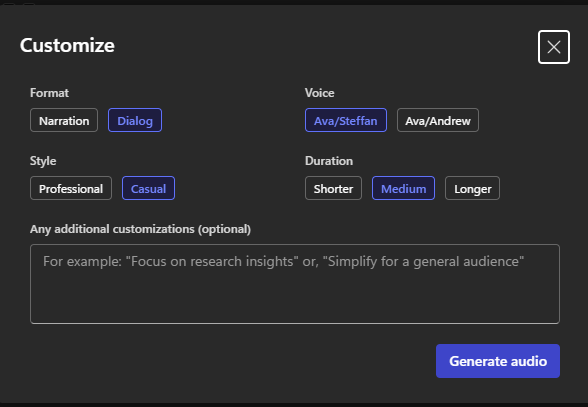
Meanwhile you can already generate Audio Overviews, and utilize customization options.

Why this update matters?

The grounding engine gets smarter

The addition of SharePoint sites and folders as grounding sources is bigger than it sounds. Previously, you had to manually add individual files to a notebook. Now you can point Copilot at an entire SharePoint site—say, your project workspace—and it reasons across everything in that location. This means your notebook stays current as new files are added to the site, without manual updates.

Chat becomes content creation

Chat and Page Interactivity fundamentally changes the workflow. Instead of chatting with Copilot, manually copying insights, and pasting them into a Copilot Page, you can now tell Copilot to create or edit pages directly through conversation. “Take the three key risks we just discussed and add them to a new page called Project Risks” should just work.

Learning gets operationalized

The Study Guide feature transforms Copilot Notebooks into a learning platform. Add your training materials, product documentation, or onboarding content, and Copilot generates quizzes, flashcards, and topic summaries automatically. This isn’t just for students—it’s for any team ramping up on complex information quickly.

Visual thinking arrives

Mind Maps bring a completely new interaction model. Instead of reading through linear text or chat responses, you get an interactive visual representation of how concepts in your notebook relate to each other. You can explore nodes, view summaries, and use notebook chat to dive deeper. In Frontier Public, Mind Maps are private to the creator and retained for 30 days; sharing and permanent storage will arrive before GA.

I am really looking forward seeing Mind Maps!

Content creation gets integrated

The PowerPoint and Word agents close the loop between research and deliverables. You’ve gathered your references, asked questions, captured insights—now you can turn all of that directly into a presentation or document without leaving the notebook environment. This is the “one workspace for the entire project lifecycle” vision becoming real.

What This Means for Different Roles

For Change Managers and Adoption Leads

You will have a clearer story to tell about why someone should use Copilot Notebooks:

Persistence: Unlike chat, which disappears, notebooks create a reusable knowledge base

Grounding: Responses are based on curated project context, not generic AI knowledge

Collaboration: Teams can now share notebooks with M365 Groups for collective intelligence

Artifacts: Study guides, mind maps, and document generation turn research into tangible outputs

Your action items:

Update your Copilot training materials to emphasize notebooks as the primary workspace for complex projects

Develop scenarios showing the difference between generic Copilot chat and grounded notebook responses

Plan a “Copilot Notebooks Week” campaign once GA hits in April-May

For IT Admins and Governance Teams

The compliance news is straightforward: existing Microsoft 365 permissions and access controls are respected. Copilot can only reason over content that users already have access to. There are no new data storage changes, and all existing Purview controls (retention, DLP, Conditional Access, eDiscovery) continue to work as expected.

Your action items:

Inform helpdesk teams about the new capabilities—expect support questions starting March 23

Review SharePoint site permissions to ensure appropriate access is in place (since sites can now be grounded as references)

Monitor early usage patterns in Frontier Public to identify power users who can become internal champions

Prepare messaging for users: “No action required; new features enabled by default”

For Product Owners and Power Users

These features unlock new workflows you couldn’t do before:

Deal/project war rooms: Create a notebook for every major deal or project. Add the SharePoint site where all materials live, ground Copilot on the full context, and use the Word/PowerPoint agents to generate status updates and executive briefings.

Knowledge capture: Use Mind Maps to visualize complex processes or product architectures. Export the map as a starting point for documentation.

Recurring reporting: Set up a notebook for weekly or monthly reporting. Add new data sources as they arrive, ask Copilot to highlight what’s changed, and use the Word agent to draft the update.

Your action items:

Experiment early in Frontier Public (if you have access) and document what works

Share “before and after” examples showing the difference notebooks make

Preparing for the Rollout

Today – March 22: Get ready

Identify pilot users in Frontier Public tenants who can test features early

Prepare internal communications: “New Copilot Notebooks features arriving in April-May”

March 23-28: Frontier Public launch

Monitor early feedback from Frontier users

Document real-world use cases and success stories

Refine internal guidance based on what actually works

April-May: GA rollout

Launch broader awareness campaigns

Host lunch-and-learn sessions showing the new capabilities

Create role-specific guidance (sales, marketing, project management, HR)

Collect feedback and iterate on internal best practices

Building with Context

What ties all features together is the principle of contextual grounding. Generic AI responses sound intelligent but often miss the mark because they lack specific knowledge. Copilot Notebooks solves this by letting you define a custom boundary—the set of information Copilot reasons over for a specific project or topic.

The new features make that grounding easier (SharePoint sites), the interaction more natural (chat-based page creation), the outputs more useful (agents, study guides, mind maps), and the collaboration more seamless (M365 Group sharing).

A Microsoft 365 Copilot license is required to use Copilot Notebooks. 

Resources

Have you started using Copilot Notebooks yet? What use cases are you most excited about? Let me know in the comments or reach out—I’m always interested in hearing how organizations are approaching this.

Unknown's avatar

Published by Vesa Nopanen

Vesa “Vesku” Nopanen, Principal Consultant and Microsoft MVP (Microsoft 365 and Azure AI Foundry) working on Future Work at Sulava MEA.

I work, blog and speak about Future Work : AI, Microsoft 365, Copilot, Loop, Azure, and other services & platforms in the cloud connecting digital and physical and people together.

I have 30 years of experience in IT business on multiple industries, domains, and roles.
View all posts by Vesa Nopanen


Source link

Rain launches an OpenClaw and AI agent-ready SDK for building independent prediction market platforms and a $5M grant program

Rain launches an OpenClaw and AI agent-ready SDK for building independent prediction market platforms and a M grant program


In Brief

Rain, the decentralized prediction markets protocol, announces the launch of its AI agent-ready SDK and a $5 million grant program to support developers and creators worldwide in building, launching, and monetizing their own independent prediction market platforms.

Rain launches an OpenClaw and AI agent-ready SDK for building independent prediction market platforms and a M grant program

Rain, the decentralized prediction markets protocol, announces the launch of its AI agent-ready SDK and a $5 million grant program to support developers and creators worldwide in building, launching, and monetizing their own independent prediction market platforms. Open to builders and creators globally, the initiative aims to accelerate the growth of decentralized prediction markets by giving builders access to the funding and infrastructure needed to launch new platforms on top of the Rain protocol.

NVIDIA CEO Jensen Huang recently described OpenClaw as part of a broader shift in AI, from systems that answer questions to ones that can actually perform work. OpenClaw allows us to have a personal agent, much like Microsoft allowed us to have a personal computer. Rain is built precisely for this shift, exposing the full stack of prediction markets – creation, pricing, trading, liquidity, and resolution – as simple, composable primitives. With Rain, builders using OpenClaw agents can take a single prompt and generate a live prediction market without manual coding or centralized gatekeepers. This allows anyone with an idea to turn it into a functioning market product more quickly than traditional development would allow. 

Prediction market platforms have dominated public discourse over the past few months and have quickly gained unprecedented popularity. Yet even as platforms like Polymarket and Kalshi pursue valuations approaching $20 billion and present themselves as part of a more open financial future, much of the ecosystem remains far more centralized than it appears. Most platforms offer APIs and SDKs that limit interaction to markets the platform itself created. This creates an environment where developers can build discovery, analytics, or trading tools around these markets, but they cannot create new ones independently.

As interest in prediction markets continues to grow, Rain is opening the system up to a wider group of builders. Developers and AI agents will have access not only to existing markets, but also to the infrastructure needed to create and launch their own applications and prediction markets directly on the protocol. The $5 million grant program will allocate $3 million directly to development building on the protocol, while the remaining $2 million will fund a daily rewards system designed to incentivize ongoing activity across the ecosystem. Rain is the first protocol in the industry that lets anyone create and launch fully functional prediction markets on any topic, in any language. Builders maintain full control over their product, branding, and regulatory strategy, while using Rain as the underlying technology layer. 

The program also gives builders a direct path to participate in the category’s growth. Every builder earns a flat 0.5% share of the trading volume they generate. The commission is paid directly from Rain’s token allocation, creating a predictable revenue stream for builders who drive activity on the platform. 

“In the past year, prediction markets have become one of the most talked about sectors in the market, and Rain is now changing how these platforms are built,” says Roy Shaham, CEO of Rain. “We designed our SDK specifically for OpenClaw and AI agents, allowing anyone to take an initial prompt to a fully live, functional platform. With a $5M pool that is nearly double the industry standard, we give creators the resources to move beyond just pulling data and actually launch their own platforms and create their own markets. By making it easy for anyone to bring their ideas to life with OpenClaw and Rain’s SDK, we are building a colorful ecosystem that pushes the boundaries of what prediction markets can become.”

About Rain: 

Rain is a decentralized protocol that provides the infrastructure for anyone to build their own prediction market platforms or applications. Using the machine-readable Rain SDK, developers and AI agents can launch independent markets and niche apps. Rain features private, invitation-only markets, AMM, account abstraction, AI market and dispute resolution, cross-chain support, and more.  For more information, visit: https://www.rain.one/

Disclaimer

In line with the Trust Project guidelines, please note that the information provided on this page is not intended to be and should not be interpreted as legal, tax, investment, financial, or any other form of advice. It is important to only invest what you can afford to lose and to seek independent financial advice if you have any doubts. For further information, we suggest referring to the terms and conditions as well as the help and support pages provided by the issuer or advertiser. MetaversePost is committed to accurate, unbiased reporting, but market conditions are subject to change without notice.

About The Author


Gregory, a digital nomad hailing from Poland, is not only a financial analyst but also a valuable contributor to various online magazines. With a wealth of experience in the financial industry, his insights and expertise have earned him recognition in numerous publications. Utilising his spare time effectively, Gregory is currently dedicated to writing a book about cryptocurrency and blockchain.

More articles


Gregory, a digital nomad hailing from Poland, is not only a financial analyst but also a valuable contributor to various online magazines. With a wealth of experience in the financial industry, his insights and expertise have earned him recognition in numerous publications. Utilising his spare time effectively, Gregory is currently dedicated to writing a book about cryptocurrency and blockchain.


Source link

Watch the Best Sci-Fi Movie Trailers | Metaverse Planet

Watch the Best Sci-Fi Movie Trailers | Metaverse Planet


Sci-Fi Trailers | Metaverse Planet

Explore More Sci-Fi

Load More
×

/* İzole Tasarım Kuralları */
#scifi-app-container {
background-color: #141414;
color: #ffffff;
font-family: ‘Helvetica Neue’, Helvetica, Arial, sans-serif;
padding-bottom: 50px;
box-sizing: border-box;
width: 100%;
overflow-x: hidden;
}

/* Vitrin (Hero Section) */
#scifi-app-container .scifi-hero {
position: relative;
width: 100%;
height: 70vh;
min-height: 500px;
background-color: #000;
background-size: cover;
background-position: top center;
margin-bottom: -30px;
display: flex;
align-items: flex-end;
}

#scifi-app-container .scifi-hero-overlay {
position: absolute;
top: 0; left: 0; width: 100%; height: 100%;
background: linear-gradient(to top, #141414 0%, rgba(20,20,20,0.5) 40%, rgba(0,0,0,0.1) 100%);
}

#scifi-app-container .scifi-hero-content {
position: relative;
z-index: 2;
padding: 0 40px 100px 40px;
max-width: 800px;
}

/* Vitrin Puan Rozeti */
#scifi-app-container .scifi-hero-rating {
display: inline-flex;
align-items: center;
gap: 5px;
background: rgba(0,0,0,0.6);
color: #ffd700;
padding: 5px 12px;
border-radius: 4px;
font-size: 1.1rem;
font-weight: bold;
margin-bottom: 15px;
border: 1px solid rgba(255, 215, 0, 0.3);
}

#scifi-app-container .scifi-hero-rating span { color: #fff; }

#scifi-app-container .scifi-hero-title {
font-size: 3.5rem;
margin: 0 0 15px 0;
font-weight: 800;
text-shadow: 2px 2px 4px rgba(0,0,0,0.8);
}

#scifi-app-container .scifi-hero-overview {
font-size: 1.1rem;
line-height: 1.5;
margin-bottom: 25px;
color: #fff;
text-shadow: 1px 1px 3px rgba(0,0,0,0.8);
}

#scifi-app-container .scifi-hero-play-btn {
background-color: #fff;
color: #000;
border: none;
padding: 10px 30px;
font-size: 1.2rem;
font-weight: bold;
border-radius: 4px;
cursor: pointer;
transition: background-color 0.2s;
display: flex;
align-items: center;
gap: 10px;
}

#scifi-app-container .scifi-hero-play-btn:hover { background-color: rgba(255,255,255,0.7); }

/* Satır Başlıkları */
#scifi-app-container .scifi-row-title {
font-size: 1.4rem;
margin: 0 0 15px 0;
font-weight: bold;
color: #e5e5e5;
padding-left: 10px;
}

/* Kategori Satırları */
#scifi-app-container .scifi-row {
position: relative;
z-index: 3;
margin-bottom: 40px;
padding-left: 30px;
}

#scifi-app-container .scifi-row-posters {
display: flex;
gap: 15px;
overflow-y: hidden;
overflow-x: auto;
padding: 10px 0 20px 10px;
scroll-behavior: smooth;
-ms-overflow-style: none;
scrollbar-width: none;
}
#scifi-app-container .scifi-row-posters::-webkit-scrollbar { display: none; }

/* Grid Alanı */
#scifi-app-container .scifi-all-movies-section {
position: relative;
z-index: 3;
}

#scifi-app-container .scifi-movie-grid {
display: grid;
grid-template-columns: repeat(auto-fill, minmax(180px, 1fr));
gap: 20px;
padding: 0 40px;
}

/* Film Kartları (Ortak) */
#scifi-app-container .scifi-movie-card,
#scifi-app-container .scifi-grid-card {
flex: 0 0 auto;
width: 200px;
position: relative;
border-radius: 5px;
overflow: hidden;
cursor: pointer;
transition: transform 0.3s ease;
background: #222;
aspect-ratio: 2 / 3;
}

#scifi-app-container .scifi-grid-card { width: 100%; }

#scifi-app-container .scifi-movie-card:hover,
#scifi-app-container .scifi-grid-card:hover {
transform: scale(1.08);
z-index: 10;
box-shadow: 0 5px 15px rgba(0,0,0,0.8);
}

#scifi-app-container .scifi-movie-poster {
width: 100%;
height: 100%;
object-fit: cover;
display: block;
}

/* Afiş Üzerindeki Puan Rozeti */
#scifi-app-container .scifi-card-rating {
position: absolute;
top: 8px; right: 8px;
background: rgba(0, 0, 0, 0.75);
color: #fff;
padding: 4px 6px;
border-radius: 4px;
font-size: 0.85rem;
font-weight: bold;
display: flex;
align-items: center;
gap: 3px;
z-index: 5;
backdrop-filter: blur(2px);
}

#scifi-app-container .scifi-card-rating i {
color: #ffd700; font-style: normal;
}

/* Hover Play İkonu */
#scifi-app-container .scifi-play-overlay {
position: absolute;
top: 0; left: 0; width: 100%; height: 100%;
background: rgba(0, 0, 0, 0.4);
display: flex;
justify-content: center;
align-items: center;
opacity: 0;
transition: opacity 0.3s ease;
z-index: 4;
}

#scifi-app-container .scifi-movie-card:hover .scifi-play-overlay,
#scifi-app-container .scifi-grid-card:hover .scifi-play-overlay { opacity: 1; }

#scifi-app-container .scifi-play-icon {
width: 45px; height: 45px;
border: 2px solid white; border-radius: 50%;
display: flex; justify-content: center; align-items: center;
background: rgba(0,0,0,0.5);
}

#scifi-app-container .scifi-play-icon::after {
content: ”; display: block;
border-style: solid; border-width: 8px 0 8px 14px;
border-color: transparent transparent transparent #fff; margin-left: 4px;
}

/* Load More Butonu */
#scifi-app-container .scifi-load-more-container {
text-align: center; margin-top: 40px; padding-bottom: 20px;
}

#scifi-app-container .scifi-load-more-btn {
background-color: transparent; color: #fff;
border: 2px solid #555; padding: 12px 40px;
font-size: 1.1rem; border-radius: 30px;
cursor: pointer; transition: all 0.3s ease;
}

#scifi-app-container .scifi-load-more-btn:hover {
border-color: #fff; background-color: rgba(255,255,255,0.1);
}

/* Modal (Popup) Tasarımı */
#scifi-app-container .scifi-modal {
display: none; position: fixed; z-index: 999999;
left: 0; top: 0; width: 100%; height: 100%;
background-color: rgba(0, 0, 0, 0.95);
justify-content: center; align-items: center;
}

#scifi-app-container .scifi-modal-content {
position: relative; width: 90%; max-width: 1000px;
aspect-ratio: 16 / 9; background-color: #000;
border-radius: 8px; box-shadow: 0 0 30px rgba(0,0,0,0.8);
}

#scifi-app-container #scifi-video-container { width: 100%; height: 100%; }

#scifi-app-container .scifi-close-btn {
position: absolute; top: 20px; right: 40px;
color: #fff; font-size: 50px; font-weight: bold;
cursor: pointer; z-index: 1000000; transition: color 0.3s;
}

#scifi-app-container .scifi-close-btn:hover { color: #e50914; }
#scifi-app-container iframe { width: 100%; height: 100%; border: none; border-radius: 8px; }

(function() {
const API_KEY = ‘acf82a9ff23ceffb8be4567f0a4803d1’;
const BASE_URL = ‘https://api.themoviedb.org/3’;
const IMG_URL_POSTER = ‘https://image.tmdb.org/t/p/w300’;
const IMG_URL_BACKDROP = ‘https://image.tmdb.org/t/p/original’;

// Gösterilen filmlerin hafızada tutulduğu havuz (Tekrarları önlemek için)
const globalMovieIds = new Set();

// Kategoriler ve Sayfa Yükleme Durumları
const categories = [
{ id: ‘trending’, title: “Trending Sci-Fi”, query: `/discover/movie?api_key=${API_KEY}&with_genres=878&language=en-US&sort_by=popularity.desc`, page: 1, isLoading: false, hasMore: true },
{ id: ‘top_rated’, title: “Top Rated Sci-Fi”, query: `/discover/movie?api_key=${API_KEY}&with_genres=878&language=en-US&sort_by=vote_average.desc&vote_count.gte=1000`, page: 1, isLoading: false, hasMore: true },
{ id: ‘space’, title: “Space & Aliens”, query: `/discover/movie?api_key=${API_KEY}&with_genres=878&with_keywords=3386|9882|9951&language=en-US&sort_by=popularity.desc`, page: 1, isLoading: false, hasMore: true },
{ id: ‘ai’, title: “A.I. & Robots”, query: `/discover/movie?api_key=${API_KEY}&with_genres=878&with_keywords=310|4183|14544&language=en-US&sort_by=popularity.desc`, page: 1, isLoading: false, hasMore: true },
{ id: ‘cyberpunk’, title: “Cyberpunk & Dystopia”, query: `/discover/movie?api_key=${API_KEY}&with_genres=878&with_keywords=2095|4565&language=en-US&sort_by=popularity.desc`, page: 1, isLoading: false, hasMore: true }
];

let isHeroSet = false;
let gridCurrentPage = 1;
let gridIsLoading = false;

const heroElement = document.getElementById(‘scifi-hero’);
const heroContent = document.getElementById(‘scifi-hero-content’);
const rowsContainer = document.getElementById(‘scifi-rows-container’);
const gridElement = document.getElementById(‘scifi-movie-grid’);
const modal = document.getElementById(‘scifi-trailer-modal’);
const videoContainer = document.getElementById(‘scifi-video-container’);
const closeModalBtn = document.getElementById(‘scifi-close-modal’);
const loadMoreBtn = document.getElementById(‘scifi-load-more-btn’);

async function initApp() {
// Kategoriler için DOM elementlerini oluştur ve ilk verileri çek
categories.forEach(category => buildRowContainer(category));
// Alttaki Grid’i başlat
await fetchGridMovies(gridCurrentPage);
}

// Kategori Satırını ve Scroll Olayını Hazırla
function buildRowContainer(category) {
const rowDiv = document.createElement(‘div’);
rowDiv.classList.add(‘scifi-row’);

const titleObj = document.createElement(‘h2’);
titleObj.classList.add(‘scifi-row-title’);
titleObj.innerText = category.title;

const postersDiv = document.createElement(‘div’);
postersDiv.classList.add(‘scifi-row-posters’);

// Yatay Sonsuz Kaydırma Tetikleyicisi
postersDiv.addEventListener(‘scroll’, () => {
const { scrollLeft, scrollWidth, clientWidth } = postersDiv;
if (scrollLeft + clientWidth >= scrollWidth – 400) { // Sona yaklaşınca tetikle
fetchCategoryData(category, postersDiv);
}
});

rowDiv.appendChild(titleObj);
rowDiv.appendChild(postersDiv);
rowsContainer.appendChild(rowDiv);

// İlk sayfayı çek
fetchCategoryData(category, postersDiv);
}

// Yatay Kategoriler İçin Veri Çekme (Tekrarsız)
async function fetchCategoryData(category, container) {
if (category.isLoading || !category.hasMore) return;
category.isLoading = true;

try {
const response = await fetch(`${BASE_URL}${category.query}&page=${category.page}`);
const data = await response.json();

if (data.results.length === 0 || category.page >= data.total_pages) {
category.hasMore = false;
}

let movies = data.results;

// Hero Alanı (Sadece ilk filmi al ve havuzdan düş)
if (!isHeroSet && category.id === ‘trending’ && movies.length > 0) {
setHeroSection(movies[0]);
globalMovieIds.add(movies[0].id);
movies = movies.slice(1);
isHeroSet = true;
}

// Sadece daha önce gösterilmeyen filmleri filtrele
const uniqueMovies = movies.filter(movie => !globalMovieIds.has(movie.id));

uniqueMovies.forEach(movie => {
globalMovieIds.add(movie.id); // Havuza ekle
if (!movie.poster_path) return;
const card = createMovieCard(movie, ‘scifi-movie-card’);
container.appendChild(card);
});

category.page++;
} catch (error) {
console.error(`Error fetching category ${category.title}:`, error);
} finally {
category.isLoading = false;
}
}

// Tüm Filmler (Grid) Alanı İçin Veri Çekme (Tekrarsız)
async function fetchGridMovies(page) {
if (gridIsLoading) return;
gridIsLoading = true;
loadMoreBtn.innerText=”Loading…”;
loadMoreBtn.disabled = true;

try {
const response = await fetch(`${BASE_URL}/discover/movie?api_key=${API_KEY}&with_genres=878&language=en-US&sort_by=vote_count.desc&page=${page}`);
const data = await response.json();

const uniqueMovies = data.results.filter(movie => !globalMovieIds.has(movie.id));

uniqueMovies.forEach(movie => {
globalMovieIds.add(movie.id);
if (!movie.poster_path) return;
const card = createMovieCard(movie, ‘scifi-grid-card’);
gridElement.appendChild(card);
});

// Eğer gelen 20 filmin hepsi zaten yatay kategorilerde gösterilmişse, otomatik sonraki sayfayı çek
if (uniqueMovies.length === 0 && data.results.length > 0) {
gridCurrentPage++;
gridIsLoading = false;
return fetchGridMovies(gridCurrentPage);
}

loadMoreBtn.innerText=”Load More”;
loadMoreBtn.disabled = false;
} catch (error) {
console.error(‘Error fetching grid movies:’, error);
loadMoreBtn.innerText=”Error Loading Data”;
} finally {
gridIsLoading = false;
}
}

function createMovieCard(movie, className) {
const card = document.createElement(‘div’);
card.classList.add(className);

const rating = movie.vote_average ? movie.vote_average.toFixed(1) : ‘N/A’;

card.innerHTML = `

⭐ ${rating}

${movie.title}

`;
card.addEventListener(‘click’, () => fetchTrailer(movie.id));
return card;
}

async function fetchTrailer(movieId) {
try {
const response = await fetch(`${BASE_URL}/movie/${movieId}/videos?api_key=${API_KEY}&language=en-US`);
const data = await response.json();
const trailer = data.results.find(video => video.type === ‘Trailer’ && video.site === ‘YouTube’);

if (trailer) {
openModal(trailer.key);
} else {
alert(‘Trailer not found for this movie.’);
}
} catch (error) {
console.error(‘Error fetching trailer:’, error);
}
}

function setHeroSection(movie) {
if (!movie.backdrop_path) return;

const rating = movie.vote_average ? movie.vote_average.toFixed(1) : ‘N/A’;

heroElement.style.backgroundImage = `url(‘${IMG_URL_BACKDROP + movie.backdrop_path}’)`;
heroContent.innerHTML = `

⭐ ${rating} / 10

${movie.title}

${movie.overview.substring(0, 180)}…

Play Trailer

`;

document.getElementById(‘hero-play-btn’).addEventListener(‘click’, () => fetchTrailer(movie.id));
}

function openModal(videoKey) {
videoContainer.innerHTML = “;
modal.style.display = ‘flex’;
}

function closeModal() {
modal.style.display = ‘none’;
videoContainer.innerHTML = ”;
}

closeModalBtn.addEventListener(‘click’, closeModal);
window.addEventListener(‘click’, (event) => {
if (event.target === modal) closeModal();
});

loadMoreBtn.addEventListener(‘click’, () => {
gridCurrentPage++;
fetchGridMovies(gridCurrentPage);
});

initApp();
})();

This content was originally published on %Watch the Best Sci-Fi Movie Trailers% by YourSiteName.


Source link

How to Train an AI Model Using NFTs You Own | NFT News Today

How to Train an AI Model Using NFTs You Own | NFT News Today


There’s a growing narrative in Web3 that NFTs and AI are destined to collide. Most people picture this as “training an AI on your NFT images,” which is technically true but also misses the deeper point. What’s really happening here is the emergence of ownership-driven AI, where your wallet doesn’t just hold assets, it shapes intelligence. That’s a subtle shift, but an important one.

Can you actually train an AI model on NFTs you own? Yes. But there’s a right way and a wrong way to do it—and most guides skip the parts that matter most. You need to understand three things before touching a single line of code: what you actually own, what rights you have, and how AI models learn. Get any of those wrong and you’re either building on sand or stepping into legal gray area.

Step one: understand what you actually own

This is where many guides fall short. Owning an NFT does not automatically mean you own the copyright to the artwork it represents. In most cases, the NFT is a token pointing to metadata, which then points to the underlying media file—often hosted via IPFS or a standard web server. This structure is defined in standards like ERC-721, where the tokenURI returns metadata about the asset rather than the asset itself (EIP-721).

Legally, the distinction matters even more. According to the U.S. Copyright Office’s NFT study, NFT ownership typically does not transfer copyrightunless explicitly stated in the license (copyright.gov). Organizations like WIPO reinforce this: buying an NFT rarely gives you full rights to reuse or train on the content (wipo.int).

So before you even think about AI, you need to ask a simple question:Am I allowed to use this content to train a model?

Some collections, like those using CC0 licenses, allow full freedom. Others grant limited commercial rights, and some restrict usage heavily. That’s not a technical hurdle, it’s a foundational one.

Step two: turning NFTs into usable data

Once rights are clear, the process becomes more tangible. AI models don’t understand NFTs—they understand data. So your job is to convert your NFTs into a structured dataset.

This usually starts by verifying wallet ownership using something like Sign-In with Ethereum (SIWE), which allows users to prove control of a wallet without making a transaction (EIP-4361). From there, you retrieve the NFTs tied to that wallet using an API like Alchemy or similar indexing services.

Each NFT contains metadata, traits, descriptions, attributes, and often a link to the image or media file. That combination is powerful. You’re not just collecting images; you’re collecting labelled data, which is exactly what machine learning thrives on.

And this is where things get interesting.

Step three: why NFT datasets are different (and sometimes better)

Most AI models today are trained on massive, messy datasets scraped from the internet. They’re broad, but not always precise. NFT collections, on the other hand, are curated by design.

Think about it:

Traits are structured

Styles are consistent

Metadata is organized

Provenance is traceable

That’s a rare combination in AI training. IPFS, for example, uses content-addressing, meaning files are identified by their hash rather than location. This helps ensure that the data you train on is verifiable and hasn’t changed over time (docs.ipfs.tech).

In simple terms, NFT datasets can be cleaner, more intentional, and more trustworthy than traditional web data.

Step four: choosing the right type of AI model

Not all AI models are created equal, and this is where many people make poor decisions. The instinct is to jump straight to large language models, but NFTs are primarily visual and cultural assets. That means other model types often make more sense.

For image-based NFTs, diffusion models like Stable Diffusion are the most practical starting point. Techniques like DreamBooth allow you to train a model on a small set of images to capture a specific subject or style (Hugging Face DreamBooth). LoRA (Low-Rank Adaptation) goes even further by enabling efficient fine-tuning without retraining the entire model (Hugging Face LoRA).

But here’s a less obvious insight: generation is only one use case.

Models like CLIP can analyze and understand images, enabling things like similarity search, trait detection, and recommendation systems. That’s arguably more useful in the long run than just generating new artwork.

And then there are multimodal models, which combine text and images. These can connect NFT visuals with lore, community narratives, and metadata—turning static assets into interactive experiences.

Step five: the part no one talks about

Training a model isn’t just about feeding it data. It’s about choosing the right data.

If you own 50 NFTs, you don’t necessarily want to train on all of them equally. Some might represent your taste better. Some might be rarer. Some might simply mean more to you.

This is where human judgment comes in.

You can:

Weight assets based on rarity or holding time

Filter for specific traits or styles

Combine multiple wallets to create shared datasets

In other words, you’re not just building a dataset, you’re expressing a perspective. That’s something AI can’t do on its own.

Step six: training the model

The good news is you don’t need massive infrastructure. Most NFT-based AI projects rely on fine-tuning existing models, not training from scratch.

Using tools from Hugging Face, you can:

Prepare your dataset

Fine-tune a model using Trainer APIs (transformers training)

Track experiments and versions

Tools like DVC (Data Version Control) help manage datasets and models over time, ensuring reproducibility (dvc.org).

The key takeaway here is simple:

You’re adapting intelligence, not creating it from zero.

The bigger idea: NFTs as AI infrastructure

If all of this sounds like a lot of effort just to generate images, you’re right. That’s because the real opportunity isn’t image generation.

It’s what NFTs enable around AI:

These are exactly the things AI currently lacks.

There’s also a growing conversation around content authenticity. Standards like C2PA aim to attach provenance data to digital assets, helping verify how content was created and modified (c2pa.org). NFTs could complement this by anchoring that provenance on-chain.

A few honest opinions

Most people approaching this space are thinking too narrowly. They’re asking how to train AI on NFTs rather than what NFTs unlock for AI.

The most interesting ideas aren’t about art generation. They’re about:

Wallet-based AI identities

DAO-trained collective models

Models that evolve as NFTs are bought and sold

Systems where ownership dynamically affects intelligence

There’s also a huge unanswered question:What happens when you sell an NFT that was used in training?

Some licenses, like Azuki’s, tie rights to ownership and terminate them upon transfer. That creates real implications for trained models. Should they be updated? Restricted? Deleted?

No one has fully solved this yet—and that’s where innovation will happen.

Final thoughts

Training an AI model using NFTs you own is absolutely possible today. The tools exist, the workflows are proven, and the barriers are lower than most people think.

But the real value isn’t in the act of training itself. It’s in what NFTs bring to the table: verifiable ownership, structured data, and programmable rights.

If AI is about intelligence, and NFTs are about ownership, then combining them isn’t just a technical experiment. It’s the beginning of a new model for how intelligence is created, controlled, and shared.

And that’s a much bigger story than just training on JPEGs.


Source link

From Seed Phrases to Passkeys: The Evolution of Crypto UX | NFT News Today

From Seed Phrases to Passkeys: The Evolution of Crypto UX | NFT News Today


From seed-phrase disasters in 2023 to Face ID logins in 2026 — usability is finally catching up

For most of its history, crypto’s biggest constraint wasn’t scalability or regulation.

It was usability.

Onboarding required users to adopt unfamiliar,and unforgiving, behaviors: storing a seed phrase securely, managing gas fees, and navigating multi-step transaction flows with little room for error. Mistakes were often irreversible.

That model is now changing.

In 2026, many users can access wallets with biometrics, complete complex transactions in a single step, and interact with applications without directly managing keys or gas. These improvements are not superficial—they reflect deeper changes in how accounts and transactions are structured.

The result is a meaningful shift: crypto is starting to feel less like infrastructure and more like software.

From Fragile Flows to App-Like Interactions

The Legacy Model (EOAs)

Traditional externally owned accounts placed full responsibility on users:

Seed phrases as a single point of failureLoss or exposure meant permanent loss of funds.

Manual gas requirementsTransactions depended on holding the correct native token.

Fragmented executionApprovals and confirmations were split across multiple steps.

No recovery mechanismsErrors—whether operational or security-related—were typically final.

This model maximized control, but at the cost of usability.

The Emerging Model (Smart Wallets + Account Abstraction)

A new wallet architecture is replacing these constraints with more flexible systems:

Biometric and passkey-based accessAuthentication aligns with device-native security (e.g., Face ID), rather than manual key handling.

Integrated recovery mechanismsAccess can be restored via trusted devices or designated recovery methods.

Abstracted key managementPrivate keys remain fundamental, but are handled behind the interface.

Bundled transaction flowsMulti-step actions can be executed through a single confirmation.

Wallets such as Coinbase Smart Wallet, Argent, and Safe illustrate this shift—retaining self-custody while significantly reducing operational complexity.

For many new users, onboarding now occurs without direct interaction with a seed phrase.

What Changed Under the Hood

These UX improvements are enabled by changes to the transaction model itself, particularly through account abstraction (ERC-4337).

Gas Abstraction

Users are no longer strictly required to hold native tokens to transact.

Applications can sponsor fees via paymasters

Fees can be paid in tokens like USDC

In some cases, fees disappear entirely from the user experience

Effect: transactions execute without pre-funding or manual gas management.

Transaction Batching

Previously discrete steps—approvals, swaps, bridging—can now be combined.

Effect: users sign once instead of multiple times, reducing friction and error surface.

Token-Agnostic Interaction

Account abstraction allows systems to handle token requirements internally.

Effect: users interact with applications directly, not chain-specific constraints.

Pectra and the Bridge to Existing Wallets

The Pectra upgrade (May 2025) extended these capabilities beyond new wallets.

Through EIP-7702, existing externally owned accounts (EOAs) can temporarily adopt smart account behavior—without requiring migration.

In practice, this enables:

This effectively bridged traditional wallets like MetaMask into the account abstraction model, accelerating adoption without forcing users to switch infrastructure.

Combined with low-cost L2 execution, this has pushed a significant share of new activity toward smart-account-like behavior.

Adoption Has Reached Scale

This shift is no longer experimental—it is operating at production scale.

As of early 2026:

40+ million ERC-4337 smart accounts are deployed across Ethereum and major L2s

Broader estimates—including inactive or chain-specific deployments—approach 100M–200M accounts

Hundreds of millions of UserOperations have been processed cumulatively

Critically, the majority of these interactions are abstracted:

Where Growth Is Concentrated

On-chain analytics platforms (e.g., Bundlebear) and infrastructure providers like Alchemy show steady growth in monthly active smart accounts, supported by reliable bundlers such as Pimlico, Biconomy, and Alchemy.

Production Signals

This is not just usage—it is capitalized usage.

This level of activity indicates that smart accounts are no longer experimental infrastructure—they are trusted in production environments.

Product Reality: Coinbase Smart Wallet

Coinbase Smart Wallet provides a clear example of how these systems translate into user experience.

Recovery is handled through:

This allows users to regain access without directly managing a full private key.

Combined with:

Users can perform:

Token swaps

NFT mints

DeFi interactions

In a single, low-friction flow.

The Reality: Better, Not Universal

The improvement in crypto UX is substantial, but not evenly distributed.

Abstraction should also be understood precisely.

Seed phrases are often removed from the primary interface, but not always eliminated:

There are also remaining edge cases:

Paymaster failures under certain conditions

Bridging complexity across networks

Evolving security considerations in newer wallet architectures

These constraints define the current boundaries.

Why This Moment Matters

This shift reflects multiple layers maturing simultaneously:

Protocol: ERC-4337 and EIP-7702

Infrastructure: bundlers and paymasters at scale

Applications: embedded wallets and simplified onboarding

Economics: near-zero fees on L2s

For the first time, these layers are aligned.

The result is a structural shift—not just incremental improvement—in how users interact with crypto systems.

Toward Invisible Infrastructure

Crypto is becoming less visible as a category.

Users will not “enter crypto” in a conscious way. They will use applications that rely on blockchain infrastructure without needing to understand it.

Over time, automation—including AI-driven systems—will further reduce the need for direct interaction.

Conclusion

Crypto usability has improved not because interfaces were simplified, but because underlying systems were redesigned.

Smart wallets, account abstraction, and gasless infrastructure represent a shift in architecture, not just presentation.

For users, crypto increasingly feels like standard software.

For builders, the implication is clear:

The most effective products will be those where users never need to think about crypto at all.


Source link

RIP metaverse: Land values capitulate as $24M metaverse plot collapses to just $9,000

RIP metaverse: Land values capitulate as M metaverse plot collapses to just ,000


Metaverse land never recovered. The numbers now show how far it fell

The biggest metaverse land deals of the 2021 and 2022 boom now map to four- and five-digit values when priced against current collection floors, rather than the six- and seven-figure valuations buyers once paid.

The decline runs through the entire metaverse land trade. A CoinGecko study found that average metaverse land prices were already down 72% from their highs by June 2024, with Sandbox off 95%, Decentraland off 89%, and Otherdeed for Otherside off 85% from peak-cycle average floor levels.

The famous parcels that once stood in for scarcity and status now read like artifacts from a pricing regime that assumed virtual neighborhoods would become high-traffic digital cities.

The broader NFT market also failed to recover its old price structure. DappRadar said NFT trading reached $25.8 billion in 2021, and its January 2022 report said that month alone hit a record $16 billion in sales before wash-trading distortions were stripped out. Later data shows a market that kept moving while getting cheaper.

DappRadar’s Q2 2025 report said NFT trading volume fell 45% quarter over quarter to $867 million even as sales rose 78% to 14.9 million.

In Q3 2025, the same tracker said the market logged $1.6 billion in trading volume across 18.1 million sales. Trading activity persisted, while the premium attached to many collections collapsed.

The metaverse land unwind is best understood as a repricing because buyers treated digital land as if it would become a durable asset, with brands, traffic, and resale scarcity. The market now prices much of it as illiquid optionality.

The splashy land deals now look like relics

The clearest case studies are the deals that once stood in for the entire boom. In December 2021, a 3×3 Snoopverse estate next to Snoop Dogg’s property in The Sandbox sold for about $450,000, or about 71,000 SAND. That nine-parcel estate now screens at about $1,025 on a floor-equivalent basis. That is a drawdown of about 99.8% from the reported sale price.

The Decentraland Fashion District deal points the same way. Metaverse Group bought a 116-parcel estate in November 2021 for about $2.4 million. That estate is now not worth materially more than $8,929 on a floor-equivalent basis, down about 99.6% from the original purchase price.

In June 2021, Republic Realm bought 259 parcels for about $913,228. At the same current floor-equivalent value, that estate screens at about $19,935, down about 97.8%.

The Sandbox “city” deal is another clean marker because of its scale. Republic Realm’s 24×24 Sandbox estate, or 576 parcels, was purchased for $4.3 million in late 2021. Marked to the current floor-equivalent price, that estate screens at about $65,583, down about 98.5%.

Otherside’s trophy sales show the same baseline collapse. A May 2022 DappRadar report said Otherdeed #24 sold for 333 ETH, or close to $1 million, while the floor now sits around $167.

Even so, against the current Otherdeed floor, the category baseline has fallen so far that these headline purchases now imply floor-equivalent markdowns approaching 100%.

DealOriginal sale priceParcelsCurrent floor-equivalent valueImplied declineSnoopverse estate in The Sandbox$450,0009$1,02599.8%Decentraland Fashion District estate$2.4 million116$8,92999.6%Republic Realm Decentraland purchase$913,228259$19,93597.8%Republic Realm Sandbox estate$4.3 million576$65,58398.5%Otherdeed #24About $1 million1About $167About 100%

Floor-equivalent pricing is the fairest way to present these comparisons. It shows what happened to the market’s baseline. The market that once paid a premium for celebrity adjacency, branded districts, and virtual location now assigns only a thin residual value to the category as a whole.

NFTs kept trading, but the pricing model broke

The land collapse sits inside a broader NFT reset. The first quarter of 2022 was the strongest in NFT history at $12.46 billion in trading volume. By June 2022, monthly trading had fallen below $1 billion for the first time in a year. However, the bust did not totally erase the market.

DappRadar’s 2024 overview report said NFT trading volume fell 19% year over year in 2024 and sales fell 18%, making 2024 one of the weakest years since 2020. Then 2025 showed a split market, lower dollar volume, higher unit activity, and more trading in cheaper assets.

That split is visible in the quarterly numbers. In Q2 2025, DappRadar said volume fell to $867 million while sales rose to 14.9 million. In Q3 2025, DappRadar’s tracker said the market posted $1.6 billion in volume and 18.1 million sales.

October 2025 added another signal. DappRadar said the market reached $546 million in monthly volume and 10.1 million sales, the highest monthly sales count of the year. Traders were still buying NFTs. They were spending far less per item.

A blue-chip proxy shows how severe the repricing was outside land. CoinGecko’s BAYC page shows Bored Ape Yacht Club at about 5.22 ETH, or about $11,410, versus an all-time high floor of 153.7 ETH, or about $420,430. That leaves BAYC down about 96.6% in ETH terms and 97.3% in dollar terms. Even one of the category’s most recognizable collections never came close to reclaiming its old clearing level.

The financing layer also broke. DappRadar’s NFT lending data said lending volume fell 97% from its January 2024 peak of nearly $1 billion to just over $50 million in May 2025. Borrowers were down 90%, lenders were down 78%, and average loan sizes shrank from $22,000 at the 2022 peak to about $4,000.

CryptoSlate Daily Brief

Daily signals, zero noise.

Market-moving headlines and context delivered every morning in one tight read.

5-minute digest 100k+ readers

Free. No spam. Unsubscribe any time.

Whoops, looks like there was a problem. Please try again.

You’re subscribed. Welcome aboard.

NFT lending helped support high-end prices during the boom. Once traders could no longer borrow against expensive JPEGs and land deeds at scale, premium valuations lost another key support.

Market markerPeak or prior readingLater readingWhat changedTotal NFT trading in 2021$25.8 billionN/ABoom-year baselineQ1 2022 NFT volume$12.46 billionJune 2022 below $1 billion monthlySharp post-peak fallQ2 2025 NFT volume–$867 millionVolume down, sales upQ2 2025 NFT sales–14.9 millionCheap assets drove activityQ3 2025 NFT volume–$1.6 billionActivity persisted at lower price pointsQ3 2025 NFT sales–18.1 millionHigher unit turnoverNFT lending volumeNearly $1 billion in January 2024Just over $50 million in May 2025Credit support faded

The broad NFT market kept operating, though its price ladder dropped sharply. Land was one of the boom’s purest narrative trades. It depended on the belief that digital location itself would become a durable asset class.

Other parts of the NFT market found cheaper pockets of demand. Land rarely did.

The market outlook is narrower, cheaper, and less forgiving

The current market does show signs of life. CoinGecko collection pages for Sandbox, Decentraland, Otherside, and Voxels show 60-day gains of 153.9%, 95.5%, 12.8%, and 41.8%, respectively.

Yet, those rebounds start from deeply depressed levels and leave the larger picture unchanged. The case studies still sit 98% to nearly 100% below their boom-era valuations on a floor-equivalent basis. That is what happens when a market loses both leverage and belief.

The category is also competing in a different NFT market than the one that existed in late 2021. In 2025, RWA NFTs grew 29% in volume and became the second-largest NFT category by volume during the quarter. Gaming-linked assets also gained ground.

Still, that shift does not prove metaverse land can recover soon. Traders moved on to RWAs when the old premise stopped working. They moved toward categories that looked more transactional, more utility-linked, or simply cheaper to own.

Corporate signals moved in the same direction. Meta changed its name in 2021 to emphasize the metaverse, and the company’s announcement now reads like a document from another market cycle.

Meta’s 2025 earnings filing said Reality Labs lost $19.2 billion in 2025 after years of multibillion-dollar losses. Virtual worlds remain active, though under a very different cost and growth calculus than the one that drove the land boom.

The market now trades digital assets with much lower ticket sizes, weaker financing, and a preference for narrower use cases. Metaverse land can still rally in short bursts, especially when crypto sentiment turns risk-on.

The last 60 days show that. The market still sits far below the assumptions embedded in the 2021 and 2022 trophy sales.

For land values to behave like property again, platforms would need more than token rebounds. Users who show up regularly, brands that stay, and a reason for virtual location to generate durable economic value instead of narrative premium are the only avenues to recovery.


Source link

MLB Signs Polymarket Deal, Sets Integrity Framework With CFTC

MLB Signs Polymarket Deal, Sets Integrity Framework With CFTC


Key Highlights

Major League Baseball names Polymarket its official exchange with exclusive commercial rights.MLB signs an MOU with CFTC to coordinate oversight and share integrity-related data.The new framework restricts high-risk markets and sets compliance expectations for all platforms offering MLB-linked contracts.

Major League Baseball (MLB) has entered a formal partnership with Polymarket, naming it the league’s official prediction market exchange today.

According to the official announcement, the agreement gives Polymarket exclusive rights to use MLB branding across its products, along with access to official league data distributed by Sportradar. The platform is also set to be featured across MLB’s digital channels and events.

The deal places prediction markets closer to the league’s core ecosystem, a shift from earlier arms-length approaches to emerging betting-like products.

Integrity controls built into the partnership

The central feature of the arrangement is the introduction of restrictions on certain types of markets. MLB and Polymarket plan to limit contracts that could create conflicts of interest or raise integrity concerns. 

This includes markets tied to granular, in-game actions such as individual pitches, umpire decisions, or managerial calls, areas where insider knowledge could influence outcomes.

Polymarket is expected to reflect these constraints in its U.S. rulebook, with requirements extending to brokers operating on the platform to maintain consistent standards.

Coordination with CFTC

The move comes as MLB Commissioner Robert D. Manfred Jr. signed a memorandum of understanding with Commodity Futures Trading Commission (CFTC) Chairman Michael Selig.

The agreement outlines a framework for information sharing between the league and the regulator. Both sides will exchange data related to betting patterns, potential risks, and integrity concerns tied to baseball-linked prediction markets.

Regular meetings between designated representatives are expected to support monitoring efforts and allow for quicker responses to unusual activity. Information shared under the arrangement will remain confidential.

Expansion amid regulatory pressure

The MLB–Polymarket partnership comes as lawmakers push for tighter controls across the sector.

A day ago, Senator Chris Murphy and Representative Greg Casar introduced the BETS OFF Act, a bill that would ban wagers on events where outcomes are controlled or known in advance, including government actions, war, and terrorism.

The proposal follows scrutiny over well-timed bets on platforms like Polymarket and Kalshi tied to geopolitical events. In some cases, large wagers were placed shortly before real-world developments, raising concerns about the use of non-public information.

Push for oversight across platforms

While Polymarket receives exclusive commercial rights, MLB indicated that integrity standards will not be limited to a single platform.

Other prediction market operators offering baseball-related contracts are expected to adopt similar safeguards within their own rulebooks. The league’s approach suggests an attempt to standardize how such markets operate, regardless of provider.

This follows earlier calls from MLB urging stronger regulatory oversight as prediction markets expanded into areas tied to real-world events.

Broader context

The agreements reflect growing attention on how prediction markets intersect with professional sports. As these platforms gain traction, leagues and regulators are increasingly focused on defining acceptable boundaries.

For MLB, the emphasis appears to be on preemptive controls: limiting high-risk market types and establishing communication channels with regulators before issues arise. The outcome of this approach may shape how other sports leagues engage with prediction market platforms in the future.

Also Read: Polymarket Strengthens Crypto Rails With Brahma Acquisition

Disclaimer: The information researched and reported by The Crypto Times is for informational purposes only and is not a substitute for professional financial advice. Investing in crypto assets involves significant risk due to market volatility. Always Do Your Own Research (DYOR) and consult with a qualified Financial Advisor before making any investment decisions.


Source link

Logitech MX Creative Console Review: The Ultimate Editing Tool? | Metaverse Planet

Logitech MX Creative Console Review: The Ultimate Editing Tool? | Metaverse Planet


For years, I’ve relied entirely on a complex web of keyboard shortcuts to muscle my way through Premiere Pro and Lightroom. While fast, it’s rarely intuitive. When Logitech acquired Loupedeck and subsequently announced the MX Creative Console, it caught my attention. Promising a streamlined, modular approach to creative workflows at a relatively accessible price point, it seemed like the perfect bridge between a standard keyboard and a massively expensive, specialized editing suite. I integrated this two-piece system into my daily production setup to see if it could genuinely speed up my editing or if it was just another piece of desk clutter.

Pros & Cons

✅ Modular Freedom: The split design allows you to place the dial unit on one side of your keyboard and the LCD keypad on the other, maximizing ergonomics.✅ Deep Adobe Integration: Works seamlessly right out of the box with Premiere Pro, Photoshop, Lightroom, and After Effects through native plugins.✅ Premium Tactile Feel: The solid aluminum dial and smooth roller provide excellent, granular control for timeline scrubbing and color grading.❌ Battery Operated Dial: The wireless Dialpad runs on two AAA batteries rather than utilizing a modern, built-in rechargeable lithium-ion battery.❌ Wired Keypad Requirement: The Keypad module with the LCD screens requires a constant wired USB-C connection, which adds a cable to your desk.❌ Software Learning Curve: While setting up basic tools is easy, building complex, multi-layered macros in Logi Options+ requires patience.

FeatureDetailsModulesTwo-piece system (Keypad and Dialpad)Keypad Features9 Customizable LCD Display Keys, 2 Pagination ButtonsDialpad FeaturesAluminum Dial, Roller, 4 Tactile ButtonsConnectivity (Keypad)Wired via USB-CConnectivity (Dialpad)Wireless via Bluetooth Low EnergyPower (Dialpad)2x AAA Batteries (Up to 18 months battery life)SoftwareLogi Options+ (Windows 10/11, macOS 13+)

My Experience

Unboxing the MX Creative Console, the Logitech design language is immediately apparent. It perfectly matches the aesthetic of their MX Master mouse and MX Keys keyboards. The decision to split the console into two separate modules—a wireless Dialpad and a wired LCD Keypad—is a stroke of genius. Unlike monolithic editing boards that force your hands into specific, often cramped positions, I could place the Dialpad on the left side of my keyboard to handle timeline scrubbing with my left hand, while keeping my right hand free for mouse work and tapping the LCD keypad. This ergonomic freedom completely eliminated the shoulder strain I usually feel after a long editing session.

The physical hardware is a joy to interact with. The oversized aluminum dial on the wireless module has a satisfying weight to it. When color grading in Lightroom, assigning the dial to exposure or contrast adjustments felt significantly more precise than dragging sliders with a mouse. The roller wheel, situated just above the dial, became my go-to for adjusting brush sizes in Photoshop. Meanwhile, the wired Keypad features nine incredibly bright and sharp LCD display keys. Having my most-used tools dynamically update with visual icons based on whichever app I currently have open is a massive time-saver, completely negating the need to memorize obscure key combinations.

The software backbone, Logi Options+, clearly benefits from Logitech’s acquisition of Loupedeck. The native integration with the Adobe Creative Cloud suite is incredibly deep. Without any complicated setup, the console knew exactly what to do the second I opened Premiere Pro. However, stepping outside the Adobe ecosystem requires a bit more effort. While you can map standard keyboard shortcuts to the console for applications like DaVinci Resolve or Final Cut Pro, you lack the deep, API-level integration found in the Adobe suite. Setting up custom profiles for these apps is totally doable, but it requires spending some serious time in the software.

There are a couple of hardware quirks that irked me. First, while I appreciate that the Dialpad is wireless, the reliance on AAA batteries instead of USB-C recharging feels a bit dated for a modern, premium device. Second, because the LCD Keypad requires substantial power to run its screens, it must remain tethered via USB-C, meaning your desk will never be entirely cable-free. Despite these minor complaints, the MX Creative Console has fundamentally smoothed out my daily workflow. It brings the high-end tactile experience of professional studio equipment to a surprisingly accessible price point.

Who is this for? / Alternatives

The Logitech MX Creative Console is designed primarily for photo and video editors, digital artists, and power users deeply entrenched in the Adobe Creative Cloud ecosystem. If you just need simple macro buttons for streaming, an Elgato Stream Deck might be more straightforward. If you want a more compact, all-in-one tactile controller, the TourBox Elite is a formidable competitor, though it lacks the dynamic visual feedback of the MX’s LCD keys.

Quick FAQ

Does the console only work with Adobe software?Not at all. While the native integrations are built for Adobe, you can map standard keyboard shortcuts and multi-step macros to the device for absolutely any application using the Logi Options+ software.

Can I use both modules wirelessly?No. The Keypad with the LCD screens requires a continuous wired USB-C connection for both data and power, while the Dialpad operates entirely wirelessly via Bluetooth.

Are the screens on the keypad customizable?Yes, highly customizable. You can utilize Logitech’s expansive built-in library of icons or upload your own custom graphics for complete personalization of your workspace.

Logitech MX Creative Console Review

Ergonomics & Design – 9.5/10

Software Integration – 8.5/10

Customizability – 9.0/10

Value for Money – 8.0/10

“A brilliantly modular, highly tactile control surface that drastically accelerates creative workflows, especially if you live inside the Adobe ecosystem.”

Product Images

You Might Also Like;


Source link

Zoomex Strengthens Liquidity Infrastructure to Meet Growing Demand from AI Trading Systems

Zoomex Strengthens Liquidity Infrastructure to Meet Growing Demand from AI Trading Systems


Zoomex Strengthens Liquidity Infrastructure to Meet Growing Demand from AI Trading Systems

Fast-rising crypto exchange, Zoomex has outlined its approach to liquidity and execution quality as artificial intelligence continues to reshape financial markets. Traditionally, liquidity in cryptocurrency trading has been assessed from a human perspective, based on how easily assets can be bought or sold without significantly impacting price. 

However, as automated trading agents and algorithmic systems become more advanced, this definition is evolving. In an AI-driven environment, liquidity must deliver predictable, consistent execution, not just visible market depth.  As a result, platforms like Zoomex are increasingly evaluated on whether their infrastructure can support fast, reliable execution for both human traders and automated strategies.

Zoomex Liquidity Infrastructure in Practice

Liquidity quality depends on the underlying infrastructure supporting an exchange’s trading environment. Order-matching systems, market-making networks, and liquidity-sourcing mechanisms all contribute to the stability of an exchange’s order books.

In the liquidity analysis published by CryptoRank, Zoomex showed competitive liquidity across several major crypto markets. The report recorded more than $62.7 million in BTC spot depth within ±2% of the mid-price, placing the exchange among the stronger performers in the study.

Zoomex Strengthens Liquidity Infrastructure to Meet Growing Demand from AI Trading Systems

In ETH markets, the platform demonstrated roughly $29.8 million in visible liquidity, indicating active trading participation in one of the most widely traded digital assets. The study also observed relatively low slippage levels, approximately 0.03% for simulated BTC trades, which suggests that the platform’s visible liquidity translates into real execution capacity.

Another notable finding was the balanced distribution of liquidity across multiple assets, including BTC, ETH, SOL, XRP, and DOGE. This distribution indicates that the exchange’s liquidity infrastructure is not concentrated in a single flagship market but instead supports several trading pairs.

For automated trading strategies operating across multiple markets simultaneously, such balanced liquidity environments are particularly important.

The Growing Role of AI Agents in Trading

The increasing importance of execution quality is closely connected to broader developments in artificial intelligence. Technologies such as Claude Code, developed by Anthropic, illustrate how autonomous AI agents are beginning to interact with complex digital systems. While Claude Code focuses on software development automation, it demonstrates the broader trend of AI agents performing structured tasks within digital environments.

In financial markets, similar AI-driven systems are being developed to analyze data, generate trading signals, and execute trades automatically. These systems rely on exchanges that provide stable execution conditions and reliable market infrastructure.

As AI adoption expands, exchanges are increasingly evaluated by whether their systems can support algorithmic trading environments where execution speed and data accuracy are essential.

In this context, Zoomex provides an excellent example of how trading infrastructure must evolve to accommodate machine-driven market participants.

The Liquidity Problem: When Market Depth Isn’t Real

A persistent issue in cryptocurrency markets is the difference between visible liquidity and executable liquidity. Some exchanges display large order books that appear deep but fail to maintain that depth when real trading pressure appears.

Orders may disappear rapidly during volatility, leading to slippage and unpredictable execution outcomes. This phenomenon, sometimes described as “ghost liquidity”, creates an environment where displayed order book depth does not accurately represent real trading capacity.

While human traders may sometimes adapt to these inconsistencies, automated systems depend heavily on stable and reliable order book behavior. When liquidity disappears during execution, algorithmic strategies can suffer substantial performance losses.

Independent market analysis from CryptoRank highlights the importance of measuring liquidity through execution metrics rather than visible depth alone. 

Zoomex Strengthens Liquidity Infrastructure to Meet Growing Demand from AI Trading Systems

In its comparative study of several exchanges, the research evaluated slippage and reaction times to determine whether order book liquidity was truly usable in real trading conditions. Within that analysis, Zoomex demonstrated liquidity characteristics that translated effectively into real execution capacity rather than purely theoretical depth.

How AI Trading Agents Evaluate Exchanges

AI-driven trading systems analyze exchanges using objective infrastructure metrics rather than visual market indicators. Execution speed is one of the most critical parameters. Automated strategies frequently operate on signals that require rapid trade execution. Even small delays between order submission and confirmation can significantly affect algorithmic performance.

Another important metric is slippage. AI trading models measure how closely the executed trade price matches the expected price. Low slippage suggests that order book liquidity is genuine and capable of supporting larger trades without sudden price deviations.

Market data reliability is also essential. AI systems rely heavily on consistent APIs and structured data feeds to interpret market conditions. Exchanges that provide stable market data allow automated systems to operate more efficiently.

Platforms with infrastructure designed for fast matching engines, predictable execution logic, and transparent trading environments are, therefore, more attractive to algorithmic trading systems.

Zoomex’s trading infrastructure is the benchmark in this context, as its matching engine and liquidity framework are designed to support both human and automated trading.

Start Your Intelligent Trading Journey at Zoomex Today

Execution Quality as the New Standard

As artificial intelligence becomes more integrated into financial markets, the way exchanges are evaluated is changing rapidly. Trading volume and asset listings still matter, but they are no longer the only indicators of market quality. Execution reliability, liquidity stability, and data transparency are becoming the defining standards for modern trading infrastructure.

For AI-driven trading systems, liquidity must be real and executable. Automated trading agents rely on exchanges where order book depth consistently supports real trades without sudden slippage or liquidity disappearing. Stable APIs, fast matching engines, and transparent market data are essential for these systems to operate effectively.

Zoomex has positioned itself at the forefront of this shift. The platform’s liquidity infrastructure focuses on delivering real execution rather than simply displaying order book depth. Independent liquidity analysis has shown that Zoomex maintains strong market depth across major assets while achieving low slippage and responsive execution in both spot and derivatives markets. This combination of measurable liquidity and reliable trade execution creates an environment where both human traders and automated strategies can operate with confidence.

As AI trading agents continue to expand across financial markets, exchanges capable of supporting algorithmic trading environments will play an increasingly important role. With its emphasis on execution quality, transparent liquidity, and stable infrastructure, Zoomex is building the type of trading environment that modern markets and the next generation of AI-driven participants require.

Sign up on Zoomex and explore a trading system where fairness, transparency and access are built into every layer. New users can receive up to 14,000 USDT in welcome rewards.

Disclaimer

In line with the Trust Project guidelines, please note that the information provided on this page is not intended to be and should not be interpreted as legal, tax, investment, financial, or any other form of advice. It is important to only invest what you can afford to lose and to seek independent financial advice if you have any doubts. For further information, we suggest referring to the terms and conditions as well as the help and support pages provided by the issuer or advertiser. MetaversePost is committed to accurate, unbiased reporting, but market conditions are subject to change without notice.

About The Author

Gregory, a digital nomad hailing from Poland, is not only a financial analyst but also a valuable contributor to various online magazines. With a wealth of experience in the financial industry, his insights and expertise have earned him recognition in numerous publications. Utilising his spare time effectively, Gregory is currently dedicated to writing a book about cryptocurrency and blockchain.

More articles

Gregory, a digital nomad hailing from Poland, is not only a financial analyst but also a valuable contributor to various online magazines. With a wealth of experience in the financial industry, his insights and expertise have earned him recognition in numerous publications. Utilising his spare time effectively, Gregory is currently dedicated to writing a book about cryptocurrency and blockchain.


Source link

Popular Posts

My Favorites