Metaverse

Home Metaverse Page 134

Crypto Gets Institutional and Interoperable: Inside the Biggest Partnerships of Mid-July 2025

Crypto Gets Institutional and Interoperable: Inside the Biggest Partnerships of Mid-July 2025


In Brief

July 2025 saw a surge in crypto alliances, redefining user interactions with digital assets, indicating a maturing industry consolidating power, access, and utility across borders and sectors.

Crypto Gets Institutional and Interoperable: Inside the Biggest Partnerships of Mid-July 2025

July 2025 saw a surge in crypto alliances redefining how users interact with digital assets. From fintech giants integrating crypto rails to AI-led networks pushing into Asia, and institutional custody deals reshaping infrastructure—these partnerships hint at a maturing industry quietly consolidating power, access, and utility across borders and sectors.

OKX and PayPal Team Up to Simplify Crypto Access for Millions Across Europe

OKX has joined forces with PayPal to make crypto access more seamless for users in the European Economic Area. The partnership enables customers to fund their OKX trading accounts directly through their PayPal balance or via linked cards and bank accounts, aiming to remove longstanding friction points in crypto onboarding. This integration offers a streamlined user experience by leveraging PayPal’s familiar platform and OKX’s compliance with MiCA regulations.

The new feature allows for faster transactions and easier access to digital assets, particularly appealing to European users accustomed to PayPal’s interface and reputation. OKX emphasized the collaboration as part of its strategy to broaden adoption and make crypto more accessible, while PayPal views the move as a natural step in expanding its commerce ecosystem into the digital asset space.

OKX currently serves over 60 million customers globally, while PayPal holds a dominant 45% market share in online payments and over 434 million users. To mark the launch, OKX is offering zero-fee crypto purchases via PayPal for one month—an incentive aimed at both new and existing users exploring this streamlined gateway to digital assets.

MoonPay and Revolut Join Forces to Simplify Crypto for Millions Across the UK and Europe

Crypto payment platform MoonPay has partnered with Revolut Pay to streamline how millions of users in the UK and Europe purchase digital assets. The integration allows eligible Revolut users to buy crypto directly through their accounts, removing common pain points such as card declines and long verification delays.

MoonPay, an easy, secure on-ramp to the crypto economy, considers this new partnership a smart way to engage a whole new group of crypto-curious users. Revolut is one of Europe’s most commonly used fintech apps and already allowed users to trade crypto—but that new integration takes it a step further, allowing users to purchase crypto directly from their Revolut balance. Users won’t have to re-enter payment details or exit the app.

The partnership promises instant transactions, reduced friction, and an interface users already trust. Both companies also highlight compliance and security as key strengths. For MoonPay, this represents a significant stride to widen access to crypto markets. For Revolut, it will also further the app’s suite of financial services.

By combining fintech convenience with crypto accessibility, MoonPay and Revolut are helping to push digital assets further into the financial mainstream—making crypto purchases as easy as a tap within a mobile app.

SFT Protocol Teams Up with SecondLive to Power AI-Driven Spatial Web3 Innovation

SFT Protocol has announced a strategic partnership with SecondLive, an AI-based world modeling platform, to accelerate spatial development in Web3. The collaboration blends SecondLive’s powerful AIGC tools—like Gobetti and Calzone—with SFT Protocol’s decentralized infrastructure to enable immersive, AI-generated digital spaces across Ethereum, BNB Chain, Arbitrum, Polygon, and TON.

SecondLive already boasts over 4.7 million users who create interactive environments ranging from AI training simulators to industrial digital twins. This new partnership extends those capabilities onto the blockchain, bringing decentralization and cross-chain accessibility to spatial design. Developers and creators will now have the ability to build and interact with virtual worlds backed by on-chain functionality and multi-network support.

The move follows SFT Protocol’s earlier collaboration with the Satoshi Network, known for its gamified DeFi experience. Together, these alliances reflect SFT Protocol’s ambition to merge real-world infrastructure with intuitive Web3 experiences.

Through the power of AI, decentralization, and user generated content, the partnership between SFT–SecondLive extends the boundaries of digital engagements. This is an important advancement toward implementing blockchain-based virtual spaces, making them more accessible, interactive, and creative. As these tools are created, expect to see Web3 experiences become more dynamic and integrated across ecosystems.

Bullet Blockchain Partners with IPSI to Expand Licensed Bitcoin ATM Network

Bullet Blockchain (OTC: BULT), one of the only U.S. companies with foundational patents for Bitcoin ATMs, has entered into a strategic partnership and licensing agreement with Innovative Payment Solutions, Inc. (OTCQB: IPSI). IPSI, a digital payment tech provider serving underserved communities and crypto-powered merchants, will gain licensed access to Bullet’s intellectual property portfolio across North America.

Under the deal, IPSI will pay royalty fees to Bullet’s subsidiary, First Bitcoin Capital LLC, for every transaction made through the network. Bullet currently holds exclusive rights to two major U.S. patents—US9135787B1 and US10332205B1—that are essential for Bitcoin ATM operations and user security.

This move is part of Bullet’s broader licensing initiative aimed at standardizing the Bitcoin ATM ecosystem while avoiding costly litigation. The company is actively building the first global Bitcoin ATM consortium to connect operators, enhance network efficiency, and ensure user safety.

As unlicensed Bitcoin ATMs pose growing risks—including fraud and illicit transactions—this partnership emphasizes the importance of regulation and consumer protection. According to Bullet CEO Simon Rubin, the alliance with IPSI is a “critical step” in securing and expanding the regulated crypto payment landscape in North America.

MetYa and Conflux Network Partner to Scale AI-Powered SocialFi in Asia

MetYa, an emerging player in AI-led SocialFi, has announced a strategic partnership with Conflux Network to advance compliant, AI-driven social ecosystems across Asia. Conflux, known for its regulatory-compliant blockchain infrastructure and key integrations with China Telecom and McDonald’s China, offers MetYa a robust foundation to scale its decentralized social platform.

The partnership goal is to combine AI, DeFi, and decentralized social networking in a compliant ecosystem and purpose-built framework for Asian markets. MetYa will leverage Conflux’s hybrid consensus and high-performance blockchain to offer customers compliant, scalable, secure, and fast solutions. With this Amenity rewards service, users can monetize their content, participate in decentralized governance, and have complete control over their data, free from the restraints of centralized platforms.

Through the partnership, MetYa and Conflux are paving the way for deeper cross-industry integrations as MetYa’s artificial intelligence models can now seamlessly interact with tokenized assets, NFTs, and user-generated content in all ecosystems. This will give creators and users even more utility in addition to fulfilling regulatory obligations in select jurisdictions like China.

According to MetYa, the collaboration is a key step in evolving the Web3 landscape—combining AI’s adaptive intelligence with blockchain’s transparency and decentralization. Together, MetYa and Conflux are leading a new frontier in compliant, intelligent, and community-driven digital interaction.

Intellistake and SVH Team Up to Target Institutional Crypto Custody and AI Tokenization

Intellistake Technologies has partnered with Singularity Venture Hub (SVH) to develop a next-generation crypto custody solution tailored for institutional investors. Announced in July 2025, the alliance combines Intellistake’s decentralized AI ambitions with SVH’s $90 million AUM and Swiss-regulated infrastructure. SVH’s use of Fireblocks, a platform that has facilitated $10 trillion in transactions, offers security and scalability that Intellistake can immediately tap into.

This partnership is not just related to custody, but also staking and validator management, onboarding 20+ incubated clients, token launches and real-world asset (RWA) tokenization. SVH will simplify access to the fast-growing AI crypto market, projected to exceed $46.9 billion by 2034, by leveraging AI, blockchain technology and institutional compliance.

Nonetheless, problems still exist. Intellistake is still pre-operational, with no assets either under custody or validator activity. Giving them onboarding SVH’s ecosystem will be critical to their success and achieving regulatory approval outside of Switzerland. The team is not just going against India and Mexico, they will be competing against established players like Coinbase Custody and Fidelity Digital Assets while also managing their capital constraints and threats to cybersecurity.

If done correctly, Intellistake could become a key player at the intersection of AI, blockchain, and institutional finance – delivering a singular solution in a busy, rapidly changing market.

Tron and Binance Alpha Unite to Propel DeFi Expansion

Tron has officially partnered with Binance Alpha to fuel its mission of accelerating decentralized finance (DeFi). Tron founder Justin Sun announced that the new relationship is based on the previous exposure from Binance Alpha to Tron’s blockchain, and is poised to turn into something greater with joint efforts regarding scalability, liquidity and adoption.

Tron, which has high-speed, low-cost blockchain infrastructure for dApps and content sharing, will gain access to Binance Alpha’s users and platform. The partnership will enable new integrations including token listings, staking opportunities and easier access to Tron services, potentially increasing TRX usage (Tron’s native token).

TRX stands to benefit by expanding visibility, liquidity and functionality. With hundreds of thousands of new users engaging with Tron via Binance Alpha, the demand for TRX could increase, as will developer appetite and ecosystem innovation. This partnership also hints at future collaborations, developer rewards and improved infrastructure for the decentralized applications.

The direct presence of the Sun only helps underline the strategic importance of this partnership. For users and builders within the Tron ecosystem, this creates new opportunities, enhanced on-ramps, and increased institutional confidence and is an inflection point for Tron to continue increasing its prominence within Web3.

Disclaimer

In line with the Trust Project guidelines, please note that the information provided on this page is not intended to be and should not be interpreted as legal, tax, investment, financial, or any other form of advice. It is important to only invest what you can afford to lose and to seek independent financial advice if you have any doubts. For further information, we suggest referring to the terms and conditions as well as the help and support pages provided by the issuer or advertiser. MetaversePost is committed to accurate, unbiased reporting, but market conditions are subject to change without notice.

About The Author


Victoria is a writer on a variety of technology topics including Web3.0, AI and cryptocurrencies. Her extensive experience allows her to write insightful articles for the wider audience.

More articles


Victoria d’Este


Victoria is a writer on a variety of technology topics including Web3.0, AI and cryptocurrencies. Her extensive experience allows her to write insightful articles for the wider audience.



Source link

OpenSea’s Rally Acquisition Signals a Shift—But Toward What? | NFT News Today

OpenSea’s Rally Acquisition Signals a Shift—But Toward What? | NFT News Today


OpenSea’s acquisition of Rally didn’t make headlines like token launches or billion-dollar NFT sales, but it quietly marks a shift in direction. Instead of doubling down on its marketplace roots, OpenSea is aiming to simplify how users interact with NFTs, tokens, and DeFi through a single mobile experience.

Key Takeaways

OpenSea acquired Rally to strengthen mobile infrastructure and expand beyond NFTs.

The move aligns with a broader plan to integrate trading, wallets, and social tools.

Former Rally leaders now steer OpenSea’s product direction, with Chris Maddern as CTO.

The acquisition supports OpenSea’s new OS2 platform and upcoming SEA token.

Success hinges on user adoption and execution.

The Fragmented Web3 Experience

Managing crypto assets still feels disjointed. I use OpenSea for NFTs, other apps for trading, and separate tools for portfolios and DeFi. It’s manageable, but far from smooth—especially on mobile.

OpenSea has long offered an official mobile app, enabling users to browse NFTs, manage profiles, and filter collections. But its features have been limited—lacking wallet integration, trading, or DeFi support.

Rally tackled this with a mobile-native wallet that enabled users to trade tokens, view NFTs, and connect with communities in one clean interface. OpenSea’s acquisition signals a desire to simplify crypto’s everyday experience.

Compared to top apps like Coinbase, Binance, Kraken, and Crypto.com—known for robust trading tools—OpenSea’s direction appears to aim for a more unified, socially-driven crypto hub. Those competitors often fall short in merging NFTs, DeFi, and asset management into one seamless mobile interface.

What Super App Ambitions Look Like in Crypto

The “super app” concept isn’t new. Apps like WeChat and Revolut keep users engaged by offering messaging, payments, shopping, and trading in one place. OpenSea seems to be eyeing a similar strategy for Web3.

With Rally’s tech and team, OpenSea can now combine NFT collecting, token trading, and wallet tools into a single mobile-first platform. That’s a notable shift for a company best known for web-based NFT listings.

As an investor, I regularly jump between apps for basic tasks. If OpenSea delivers a cohesive, secure mobile experience, I’d use it—because nothing currently fills that need well.

From Marketplace to Platform

The NFT boom gave OpenSea scale, but also boxed it into a narrow niche. As hype faded, so did its momentum.

Now, OpenSea is repositioning. Rally’s acquisition supports a broader overhaul, including its OS2 platform and the SEA token (a utility asset for transactions and governance).

The goal is to evolve into a full-featured onchain platform.

Rally’s leadership is central to this shift. Chris Maddern is now OpenSea’s CTO, and Christine Hall joins as Chief of Staff. It’s more than a tech buy—it’s a cultural pivot.

Cleaner UX, Better Onboarding

Rally excelled at simplicity. Wallet setup was fast. Token swapping was smooth. Portfolios were easy to navigate.

That’s what crypto needs. Most apps cater to pros or protocol tinkerers. Rally focused on intuitive UX, and OpenSea seems committed to continuing that approach.

Many current mobile crypto apps struggle with confusing interfaces, clunky onboarding, poor key management, and fragmented tools. These lead to user errors—or worse, lost funds. Rally aimed to fix that. Now OpenSea wants to carry that baton.

Notably, OpenSea’s team is also working on AI-powered safety enhancements to improve usability and protect users—an area where crypto apps have historically underperformed.

What Success Might Look Like

If OpenSea succeeds, it could become the first mainstream crypto app to combine trading, community, and NFTs in one place. That could reshape user expectations and where new projects launch.

But questions remain. Will users trust OpenSea with more of their assets? Will pros trade power for convenience? Can one platform do it all without compromise?

Maddern describes this opportunity as “one of the biggest of this next chapter of crypto—migrating from centralized exchanges to onchain.” That broader vision—to empower users to do more than just speculate—is a key piece of the strategy.

The vision is clear. The timing feels right. If execution matches ambition, this may be the shift OpenSea needed—not away from NFTs, but beyond them.

Frequently Asked Questions

Here are some frequently asked questions about this topic:

What is the significance of OpenSea acquiring Rally?

OpenSea’s Rally acquisition signals a shift toward building a mobile-first crypto platform that integrates NFTs, tokens, DeFi, and wallet features.

How will Rally’s tech improve OpenSea’s mobile app?

Rally brings user-friendly design, wallet functionality, and token trading tools, which OpenSea plans to use in a revamped mobile experience.

What is OpenSea’s SEA token and OS2 platform?

The SEA token is OpenSea’s upcoming utility asset, and OS2 is its next-gen platform aimed at modular features, better UX, and onchain extensibility.

What are OpenSea’s super app ambitions for Web3?

OpenSea wants to become a one-stop crypto app—integrating social tools, trading, collecting, and staking into a seamless, secure mobile-first platform.


Source link

How Dolce & Gabbana Burned NFT Buyers and Evaded Blame | NFT News Today

How Dolce & Gabbana Burned NFT Buyers and Evaded Blame | NFT News Today


Dolce & Gabbana’s DGFamily NFT project promised luxury, exclusivity, and access, yet delivered delays, silence, and financial loss. The brand walked away with millions, while buyers were left holding worthless digital assets and no legal recourse.

Key Takeaways

Dolce & Gabbana raised over $25 million through overhyped NFT sales, but failed to provide most of what was promised.

The U.S. arm of the company was dismissed from legal responsibility due to corporate separation, despite its involvement.

Many NFTs have plummeted in value by over 90%, leaving customers with no direct legal recourse.

The case has damaged trust in luxury-brand NFT projects and made buyers more skeptical of corporate-led drops.

It exposes critical gaps in international digital asset consumer protections.

Luxury Branding Meets Blockchain Hype

From the beginning, the DGFamily NFT project struck me as tone-deaf. A luxury fashion house entering Web3 was always going to feel performative unless they genuinely committed to the space. But Dolce & Gabbana seemed more interested in extracting crypto than building community. They dangled perks, physical merch, event access, and digital exclusives as if they were designing a loyalty program. What they created felt more like a cash grab dressed in virtual couture.

Buyers spent thousands in ETH, expecting tangible benefits. Instead, many got vague updates and missed deadlines. The NFTs themselves crashed in value, with some dropping by as much as 97%. That’s not just bad performance; that’s a complete failure of delivery. And for a company trading on prestige, that’s inexcusable.

How They Avoided Accountability

What makes this worse isn’t just the failed promises, but also how easily Dolce & Gabbana avoided consequences. When the class-action lawsuit was filed, it seemed the brand might finally face scrutiny. Plaintiffs alleged a classic rug pull, pointing to how the project raised funds and then quietly dropped support.

But the court ruled that Dolce & Gabbana USA wasn’t responsible. Shared leadership and offices with the Italian parent weren’t enough. In legal terms, that corporate firewall held. The people who orchestrated this walked away untouched, because the legal responsibility couldn’t be pinned to the U.S. entity.

The foreign defendants haven’t even been served. So while Dolce & Gabbana keeps marketing opulence, the NFT buyers are left empty-handed.

A Blow to NFT Credibility

This case didn’t just stain one brand, it set the entire NFT space back. For the last few years, I’ve watched the NFT market swing between innovation and exploitation. Projects like DGFamily widen the gap between serious builders and opportunists.

It’s hard enough to convince newcomers that NFTs have legitimate value. When a legacy brand treats buyers like disposable revenue, it tells everyone else: don’t trust NFTs. And that skepticism sticks. Since the DGFamily fallout, I’ve noticed fewer mainstream drops, less media cheerleading, and more guarded conversations in crypto circles.

Buyers aren’t just burned, they’re wiser now. Unfortunately, that wisdom came at a cost for those who put their faith in a luxury name.

What This Teaches Us About Digital Asset Risk

What this case really highlights is how broken the consumer protections are in digital assets, especially across borders. Big brands know this. They leverage hype, capitalize on a lack of oversight, and disappear when things fall apart. Dolce & Gabbana played that game to perfection.

If you’re looking at brand-led NFT projects now, the lesson is clear: reputation means nothing without accountability. Ask who’s behind the smart contract. Check for on-chain transparency. Look for clearly defined deliverables and an active team. And assume that if a company is headquartered overseas, you may never get your money back if things go wrong.

Final Thoughts

Dolce & Gabbana used their name to draw in customers, then used legal distance to wash their hands of the fallout. That might be a smart legal move, but it’s a reckless business one. In the end, they didn’t just sell digital fashion, they sold trust and failed to deliver.

Projects like this erode everything the NFT space is trying to build. But for those willing to build honestly, there’s still room to rise from the damage done. Just don’t look to Dolce & Gabbana for an example. Look to those who show up, deliver, and stick around after the mint.

Frequently Asked Questions

Here are some frequently asked questions about this topic:

What was the DGFamily NFT project by Dolce & Gabbana?

The DGFamily NFT project promised exclusive digital fashion, physical goods, and event access but failed to deliver on key benefits after raising over $25 million.

Why are buyers calling the project a rug pull?

Buyers allege Dolce & Gabbana hyped false promises, delivered little or nothing, and then abandoned the project, causing NFT values to drop by up to 97%.

Was Dolce & Gabbana held legally responsible?

No. A U.S. federal judge dismissed claims against Dolce & Gabbana USA, ruling it wasn’t legally liable for the actions of its Italian parent or NFT partners.

Can buyers still sue Dolce & Gabbana in other countries?

Possibly, but no foreign entities have been properly served. Without legal action abroad, affected buyers currently have no clear path to compensation.

What does this case mean for future NFT buyers?

It highlights the need for caution with brand-led NFT projects, especially when international legal protection and accountability are unclear or absent.


Source link

GoMining Introduces Learn-To-Earn Crypto Academy As Survey Reveals Knowledge Gaps In Bitcoin Understanding

GoMining Introduces Learn-To-Earn Crypto Academy As Survey Reveals Knowledge Gaps In Bitcoin Understanding


In Brief

GoMining has launched an educational academy to address widespread confusion about Bitcoin, offering reward-based learning to help users build confidence and engage more effectively with the crypto ecosystem.

GoMining Introduces Learn-To-Earn Crypto Academy As Survey Reveals Knowledge Gaps In Bitcoin Understanding

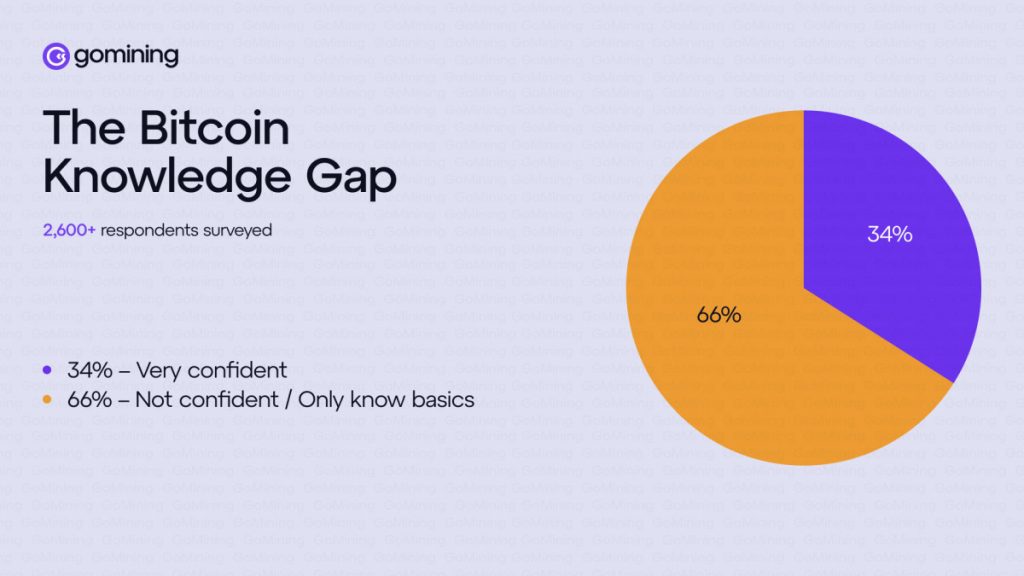
Global Bitcoin-focused platform GoMining announced that it has released findings from a recent survey indicating that only 34% of respondents feel “very confident” navigating Bitcoin, while the majority point to confusion over how the cryptocurrency functions and inconsistent online information as primary challenges. 

1

The identified confidence gap is seen as a barrier, with the data suggesting a strong correlation between user education and willingness to engage with the market. In response, GoMining has introduced the GoMining Academy, an educational initiative aimed at providing practical instruction. 

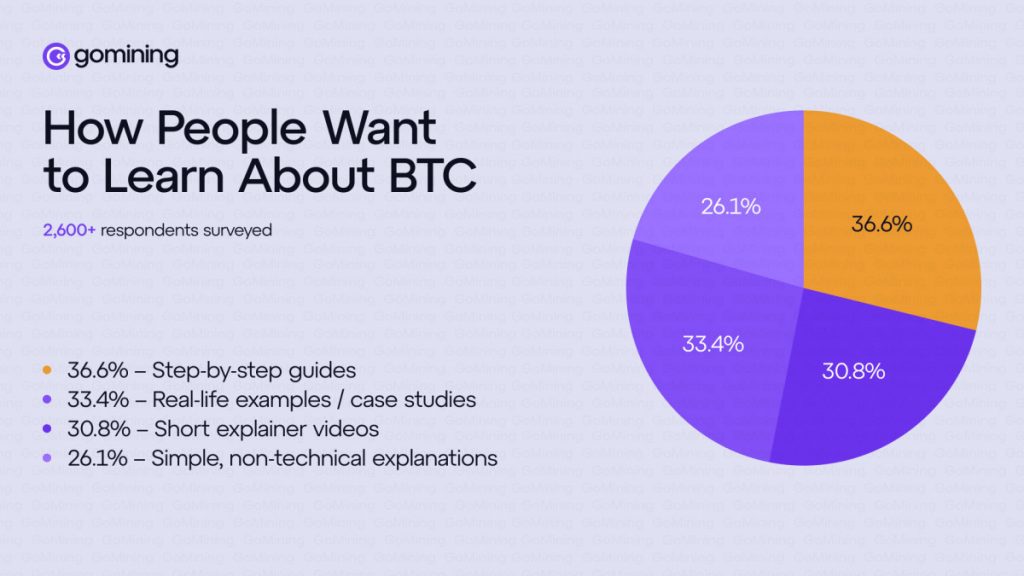
The survey notes that users prefer step-by-step guides (36.6%) and short explainer videos (30.8%), which will be the focus of the academy’s content strategy. Participants in the courses will also receive in-app rewards, such as Bonus Miner days, enabling them to engage in simulated Bitcoin mining without any initial cost. 

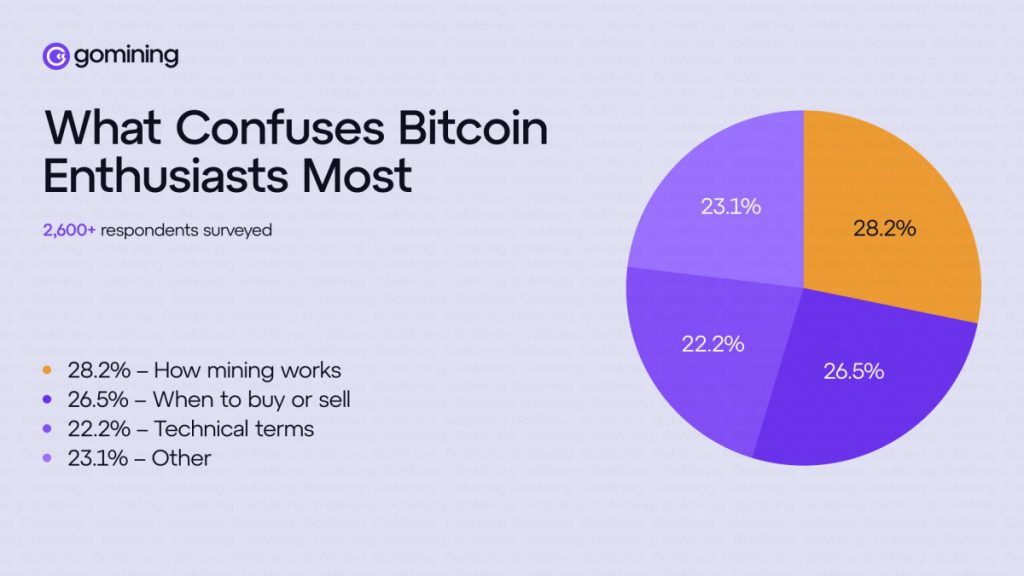
The data highlights a user base that is motivated to learn but frequently hindered by the complexity of the subject matter. When questioned about their ability to explain Bitcoin to others, only 9.6% felt highly confident, while 66.3% indicated they could only provide a basic explanation or would find it difficult. Over 70% reported feeling overwhelmed when attempting to understand Bitcoin. The topic of mining emerged as the most confusing (28.2%), followed by the challenge of understanding technical jargon (22.2%) and uncertainty around trading decisions (26.5%). Respondents expressed a preference for content involving real-life case studies (33.4%) and simplified, non-technical explanations (26.1%) as learning tools.

3

GoMining Academy Debuts To Simplify Bitcoin Mining With Practical, Reward-Based Education 

The GoMining Academy has been introduced as a dedicated educational platform aimed at simplifying entry into the Bitcoin mining space by offering accessible, reward-based learning. Data shows that 68.2% of users believe additional education would help them more effectively mine, buy, or trade Bitcoin, and the Academy is structured to address this need by connecting knowledge with actionable outcomes. Its curriculum is designed to guide learners from initial interest to functional understanding, avoiding overly technical explanations in favor of practical examples and an experiential approach. With 54.3% of users reporting better retention through video content, the Academy prioritizes engaging video lessons, complemented by written resources to ease uncertainty around where to begin.

Features include interactive quizzes and micro-certifications, which aim to reinforce learning and build user confidence. A key component is the platform’s “learn-to-earn” structure, enabling participants to earn their first Bitcoin through educational engagement, thereby facilitating early interaction with digital assets. Additionally, interactive walkthroughs and income simulation tools are integrated to help users navigate the GoMining platform and estimate potential earnings.

2

The initiative targets two primary groups: individuals aged 19–55 who are new to crypto and lack technical backgrounds, and current GoMining users whose engagement has been limited due to gaps in understanding. Unlike generalized educational content, this program is specifically tailored to the GoMining ecosystem, emphasizing applied learning over passive consumption. Supported by Web3 professionals and educators, the initiative emphasizes practical utility rather than abstract concepts. The GoMining Academy is currently accessible to both new and existing users of the platform.

Disclaimer

In line with the Trust Project guidelines, please note that the information provided on this page is not intended to be and should not be interpreted as legal, tax, investment, financial, or any other form of advice. It is important to only invest what you can afford to lose and to seek independent financial advice if you have any doubts. For further information, we suggest referring to the terms and conditions as well as the help and support pages provided by the issuer or advertiser. MetaversePost is committed to accurate, unbiased reporting, but market conditions are subject to change without notice.

About The Author


Alisa, a dedicated journalist at the MPost, specializes in cryptocurrency, zero-knowledge proofs, investments, and the expansive realm of Web3. With a keen eye for emerging trends and technologies, she delivers comprehensive coverage to inform and engage readers in the ever-evolving landscape of digital finance.

More articles


Alisa Davidson


Alisa, a dedicated journalist at the MPost, specializes in cryptocurrency, zero-knowledge proofs, investments, and the expansive realm of Web3. With a keen eye for emerging trends and technologies, she delivers comprehensive coverage to inform and engage readers in the ever-evolving landscape of digital finance.


More articles


Source link

What Happens When Blockchain Meets Real-World Assets at Scale

What Happens When Blockchain Meets Real-World Assets at Scale


In Brief

Edwin Mata, CEO and Co-founder at Brickken, discusses the evolving financial infrastructure, the role of AI, and the factors driving the adoption of on-chain solutions.

What Happens When Blockchain Meets Real-World Assets at Scale

As tokenization gains momentum and blockchain becomes more integrated into traditional finance, the asset management landscape is undergoing a structural shift. In this interview, Edwin Mata, CEO and Co-founder at Brickken, shares his perspective on the evolution of financial infrastructure, the role of emerging technologies like AI, and the key factors driving the adoption of on-chain solutions.

Brickken has utilized over $300 million in assets globally. What has been the primary driver behind this growth?

The main driver behind reaching over 300 million dollars in tokenized assets has been the convergence of blockchain’s structural advantages and Brickken’s relentless focus on execution. Blockchain enables real-time settlement, embedded compliance, transparent ownership, and fractionalization. These are not incremental upgrades, they represent a foundational shift in how capital is created, managed, and transferred.

This is no longer a theoretical proposition. BlackRock’s BUIDL fund, launched on Ethereum through Securitize, has surpassed 2.8 billion dollars in assets under management. Fidelity has developed institutional-grade custody for digital assets. Franklin Templeton has tokenized mutual funds on public blockchains. JPMorgan’s Kinexys platform, formerly Onyx, has processed over 1.5 trillion dollars in tokenized transactions, including intraday repo and collateral settlements. HSBC, Siemens, ABN AMRO, UBS, and others have issued bonds and structured products on-chain. This level of institutional validation confirms that tokenization is no longer an emerging concept, it is becoming embedded infrastructure.

At Brickken, we anticipated this shift early and built accordingly. We designed an enterprise-grade platform that serves real-world issuers across 16 jurisdictions, offering legally compliant token issuance, investor onboarding, governance, and treasury automation. What sets us apart is our ability to move fast, adapt to market signals, and prioritize user experience without compromising on compliance or scale.

This is not the result of speculation. It is the result of understanding where capital markets are heading, delivering what the market needs before it asks for it, and executing consistently. That is what pushed Brickken past 300 million dollars in tokenized assets, and it is only the beginning.

How do you envision blockchain transforming the future of asset management?

Blockchain is fundamentally redefining the infrastructure behind asset management. At its core, it enables real-time reconciliation and settlement, removing the delays and counterparty risks that exist in today’s fragmented systems. Transactions become atomic, reducing exposure and eliminating the need for multiple layers of intermediaries.

More importantly, blockchain introduces native ownership at the protocol level. Investors can hold and transfer assets with full transparency and direct control, without relying on custodians, registrars, or transfer agents. This shift is especially powerful in private markets, where ownership structures have traditionally been opaque and operationally burdensome.

Capital formation becomes more efficient. Issuers can launch investment vehicles, raise funds, and distribute proceeds using smart contracts, automating functions that would otherwise require legal, administrative, and banking infrastructure. Distributions, redemptions, interest payments, and governance processes can all happen on-chain, with built-in compliance and auditability.

For asset managers, this means lower operational costs, faster liquidity cycles, greater access to global investors, and data-rich reporting environments. For end investors, it means transparency, programmability, and access to opportunities that were previously out of reach.

In short, blockchain transforms asset management from a fragmented, intermediary-heavy industry into a streamlined, programmable financial layer. It does not just digitize existing systems. It replaces them.

Can you elaborate on the enterprise-grade solutions you are developing, and how they align with your mission to reshape asset management?

While I cannot disclose full details yet due to pending regulatory approvals, what I can share is that Brickken is entering a new phase. We are transitioning from being purely a software provider to becoming a fully licensed player capable of operating within the regulated financial infrastructure. This includes the ability to offer custody and brokerage services, which are fundamental pillars for institutional-grade tokenization.

Up until now, we have focused on building best-in-class infrastructure for token issuance, investor onboarding, lifecycle management, and on-chain governance. That continues. But we are now integrating the legal and regulatory layers required to move from facilitation to full execution. This means that we will not only provide the tools for asset tokenization and management, but also be the regulated counterparty that enables these transactions to happen compliantly.

Our ambition is to close the year positioned as a comprehensive infrastructure provider, offering technology, compliance, and legal execution in one vertically integrated stack. This evolution is essential to reshape asset management in a way that meets both market demand and regulatory scrutiny.

In the previous reports, you’ve mentioned plans to introduce AI agents. How do you intend to implement them, and what role could they play in the future of asset management?

AI is not a replacement for expertise, but a powerful tool to simplify complexity. Our goal is to eliminate the need for deep legal or technical knowledge when implementing tokenization. Think of it as having an expert by your side at all times, not just to provide support, but to execute actions when needed.

We are integrating AI across two levels. At the structural level, the AI will guide issuers and asset owners through processes like asset onboarding, legal structuring, investor compliance, and token issuance. At the execution level, the AI will be action-oriented, connecting to our APIs and allowing users to perform tasks through simple, conversational interfaces. Whether you’re in Brickken’s application or using external environments like Slack, Telegram, or Discord, the AI agent can initiate, execute, and automate key operations in real time.

This makes the experience radically more intuitive. Instead of navigating multiple dashboards or relying on back-and-forth with intermediaries, users can launch, manage, and monitor tokenized assets directly from where they already operate.

The result is a seamless blend of compliance-grade infrastructure with AI-driven simplicity. It’s not just a support layer, it’s an operational co-pilot embedded across the asset management lifecycle. It’s a powerful shift, and a critical part of our strategy to make tokenization accessible at scale.

What is your perspective on the potential of tokenization and tokenized investments across both retail and institutional markets? Will it fuel institutional adoption?

Tokenization is not just a new product category, it is a structural overhaul of how capital is formed, deployed, and managed. It will drive adoption across both retail and institutional markets because it improves the underlying mechanics of financial infrastructure.

For institutions, tokenization brings automation, transparency, and speed to cross-border investment processes, significantly reducing operational friction. Capital can be deployed faster, with real-time compliance, programmable governance, and full visibility throughout the asset lifecycle. This enables not only efficiency, but trust at scale.

For retail investors, tokenization unlocks access. High-quality assets that were once limited to institutional channels can now be fractionalized and made investable under clear regulatory conditions. This is not just about breaking assets into smaller pieces. It’s about making the entire investment lifecycle more accessible, more secure, and more efficient.

But more importantly, this is the foundation of a new financial architecture, one where traditional banking, legal enforceability, and blockchain infrastructure converge. We’re moving toward a hybrid model, where digital-native assets, tokenized real-world assets, and regulated financial products all coexist within the same programmable environment.

Tokenization is not a trend. It’s the infrastructure layer of next-generation finance. And yes, it will absolutely fuel institutional adoption, but it will also redefine the playing field for everyone.

How do you see RWA tokenization reshaping global trading and liquidity over the next five years? 

Over the next five years, RWA tokenization will shift liquidity from being permissioned and periodic to being continuous and global. Assets that were locked in static ledgers will move onto programmable rails, enabling them to be traded, collateralized, or fractionalized in real time. This isn’t about making private markets slightly more efficient, it’s about rebuilding the core mechanics of asset movement to reflect how modern capital behaves: digital, fast, and borderless.

What challenges and opportunities have you faced in the RWA tokenization space? Can you share the biggest challenge Brickken encountered while developing your platform in this market?

The biggest challenge has been timing around adoption. While we doubled down early on the belief that tokenization and on-chain finance would reshape capital markets due to their clear structural advantages, there was a period where the industry felt more theoretical than practical. From 2020 to 2022, infrastructure, regulation, and institutional readiness were still catching up. But that changed radically starting in 2023. 

Major asset managers began launching tokenized funds, regulatory frameworks matured, and real capital began to move on-chain. That shift validated our early conviction and positioned us to scale with a platform already built for real-world deployment. What was once a challenge has become our strategic advantage.

What key trends or themes are you closely monitoring as you shape Brickken’s global strategy?

One of the key trends we’re closely monitoring is the convergence between traditional finance and blockchain, particularly through the adoption of stablecoins by banks and the growing duality of custody between legal tender and tokenized money. As regulated institutions begin to offer stablecoin rails alongside fiat accounts, the line between Web2 and Web3 disappears. 

This moment marks a structural shift, when traditional users become blockchain participants without needing to change behavior. For Brickken, this convergence is critical, as it accelerates institutional adoption and enables seamless capital flow across both ecosystems.

You’ve recently secured funding to support platform development in the EU. With growing regulatory oversight—such as the implementation of MiCA—how do you foresee the future of tokenized securities evolving in the region?

Regulation brings trust, and in the context of tokenized securities, that trust is essential for institutional adoption. But regulation is also a double-edged sword. It raises the bar for newcomers who see tokenization purely as a technological opportunity, without understanding that securities are a highly regulated domain. In the EU, MiCA and related frameworks create clear paths for compliance, but they also impose significant constraints on how and when products can be brought to market. 

The future in this region depends on striking the right balance, one where innovation is not suffocated, but where opportunistic actors looking for quick monetization at the expense of investor protection are kept out. 

How is Brickken adapting to the MiCA framework, and what broader implications do you anticipate for the tokenization space as a whole?

We can’t reveal details yet, but what we’re building under MiCA will set a new benchmark for tokenized infrastructure in Europe, this will be talked about.

Disclaimer

In line with the Trust Project guidelines, please note that the information provided on this page is not intended to be and should not be interpreted as legal, tax, investment, financial, or any other form of advice. It is important to only invest what you can afford to lose and to seek independent financial advice if you have any doubts. For further information, we suggest referring to the terms and conditions as well as the help and support pages provided by the issuer or advertiser. MetaversePost is committed to accurate, unbiased reporting, but market conditions are subject to change without notice.

About The Author


Victoria is a writer on a variety of technology topics including Web3.0, AI and cryptocurrencies. Her extensive experience allows her to write insightful articles for the wider audience.
More articles


Victoria d’Este


Victoria is a writer on a variety of technology topics including Web3.0, AI and cryptocurrencies. Her extensive experience allows her to write insightful articles for the wider audience.


Source link

The Presale That Makes Token 6900 Look Like a Test Net — $MCLIP Is Cooking…

The Presale That Makes Token 6900 Look Like a Test Net — $MCLIP Is Cooking…


In Brief

MemeClip is a next-generation meme coin combining play-to-earn gaming, skill-based competition, and staking to offer real utility and long-term engagement beyond typical hype-driven tokens.

The Presale That Makes Token 6900 Look Like a Test Net — $MCLIP Is Cooking…

MemeClip vs Everyone: The Meme Coin That Actually Does Something

Crypto investors are tired of meme coins that pump, dump, and disappear without a trace. With the market saturated by lookalike tokens chasing hype without substance, MemeClip is cutting through the noise — and fast.

Backed by a fully functional play-to-earn gaming ecosystem, MemeClip isn’t just a meme coin. It’s a crypto-native platform with real product-market fit, viral appeal, and a token ($MCLIP) designed for long-term engagement and utility.

From Meme to Machine: What MemeClip Is Doing Differently

MemeClip takes the energy and virality of meme coins and fuses it with something none of them have: an actual reason to exist.

Built for Web3 gamers, meme lovers, and CT degenerates alike, MemeClip lets users:

Play addictive meme-style mini-games

Stake $MCLIP to earn daily token rewards

Bet $MCLIP in real-time 1v1 skill-based matches

Compete in leaderboards and tournaments

Enjoy a fully on-chain experience that rewards participation

In short, it’s where internet culture meets crypto utility — and where fun is finally profitable.

The Utility Meme Coin the Market Was Waiting For

Most meme tokens promise vibes and virality but deliver nothing beyond charts and chaos. MemeClip flips that script by launching with a working staking platform, an ecosystem of planned games, and a roadmap that doesn’t rely on hype alone.

Where others offer memes with no mission, MemeClip delivers a use case on day one. The $MCLIP token has clear functionality across the platform — powering games, rewards, and community incentives. It’s not just a token to hold and hope. It’s a token you can use.

Competitive Gameplay with Real Wagers

At the heart of MemeClip is its 1v1 game mode — a simple, brilliant mechanic that lets players challenge each other for real $MCLIP stakes. Enter a game, put tokens on the line, and outplay your opponent in fast-paced meme-inspired matches. The winner takes the pot.

Unlike casino dApps or gambling platforms, MemeClip’s 1v1 matches are based on skill, speed, and reflexes — not luck. That makes every match a battle, every win rewarding, and every loss a reason to improve.

And the best part? It’s addictively fun. The kind of gameplay that brings users back again and again — not for speculation, but for experience.

Staking Built for the Long Game

While the games keep users active, the staking system gives investors a powerful reason to hold. $MCLIP holders can lock their tokens to earn daily staking rewards, distributed transparently over a 1 year period.

The earlier you stake, the larger your rewards — incentivizing early adoption and long-term participation. This is crypto-native DeFi gamified, with clear token velocity that benefits the platform’s health and the token’s price dynamics.

It’s not just staking for APY — it’s staking for sustainability.

The Presale You Don’t Want to Miss

The $MCLIP presale is one of the most anticipated of 2025. Why? Because it’s not just a token launch — it’s an invite to the entire MemeClip ecosystem before the masses arrive.

There are no confusing token lockups or complicated vesting cliffs. Just a clean, stage-based presale with price increases that reward early participants. The staking dashboard is already live, and game development is in motion — meaning your tokens will have immediate utility post-sale.

If you’ve ever said, “I wish I bought it earlier,” this is your second chance.

A Market Ripe for Disruption

With meme coins constantly trending, and GameFi ready for a comeback, MemeClip stands at the intersection of two massive trends. But unlike previous cycles, this time the audience wants more than hype — they want a reason to stay.

MemeClip delivers just that. A product-first meme coin with:

Real engagement mechanics

Viral potential backed by gameplay

A built-in, growing community

On-chain economics that reward activity

This isn’t just another token chasing a trend. It’s a platform ready to create one.

Final Words

Crypto doesn’t need another meme coin. It needs a meme coin that does something. MemeClip is the upgrade investors have been waiting for — blending playability, community, and token utility into a single, addictively fun ecosystem.

So the question isn’t whether MemeClip can compete with other meme coins and gaming platforms. It’s whether they can compete with MemeClip.

Play. Stake. Win.Be part of something that actually builds.Press Contact:Team MemeClip[email protected]Website | Telegram | X

Disclaimer

In line with the Trust Project guidelines, please note that the information provided on this page is not intended to be and should not be interpreted as legal, tax, investment, financial, or any other form of advice. It is important to only invest what you can afford to lose and to seek independent financial advice if you have any doubts. For further information, we suggest referring to the terms and conditions as well as the help and support pages provided by the issuer or advertiser. MetaversePost is committed to accurate, unbiased reporting, but market conditions are subject to change without notice.

About The Author


Gregory, a digital nomad hailing from Poland, is not only a financial analyst but also a valuable contributor to various online magazines. With a wealth of experience in the financial industry, his insights and expertise have earned him recognition in numerous publications. Utilising his spare time effectively, Gregory is currently dedicated to writing a book about cryptocurrency and blockchain.

More articles


Gregory, a digital nomad hailing from Poland, is not only a financial analyst but also a valuable contributor to various online magazines. With a wealth of experience in the financial industry, his insights and expertise have earned him recognition in numerous publications. Utilising his spare time effectively, Gregory is currently dedicated to writing a book about cryptocurrency and blockchain.


Source link

What Sets BitMEX Apart in the Digital Asset Race

What Sets BitMEX Apart in the Digital Asset Race


In Brief

Sam Sandiford, BitMEX’s Head of Product and Institutional Business Development, discusses the platform’s commitment to security, evolving product lineup, transparency, and digital asset trading trends.

What Sets BitMEX Apart in the Digital Asset Race

Sam Sandiford, Head of Product and Institutional Business Development at BitMEX, brings over 17 years of experience in traditional finance to crypto derivatives. In this interview, Sam discusses his journey to BitMEX, the platform’s commitment to security, and what sets it apart for professional traders. He also shares his thoughts on BitMEX’s evolving product lineup, the importance of transparency, and the trends shaping the future of digital asset trading.

Can you please share your journey to Web3?

I joined BitMEX six and a half years ago after 17 years in traditional finance. I’d worked in derivatives for a long time, and BitMEX reached out to me to help work with their financial engineering designs, particularly around margining and perpetual swaps. 

It was a leap of faith at the time, and BitMEX has been a very interesting place to be over the last six and a half years, as I’m sure those reading this post will know. We’ve gradually increased the product range and are still a force to be reckoned with in the crypto markets.

BitMEX describes itself as a home for real traders. How does this manifest in your client experience and community-building efforts?

When we talk about real traders, we’re looking at what I like to call semi-professional traders and above. We’re not really a place for brand-new traders who haven’t traded before or who are new to crypto. We are a marketplace specializing in derivatives. How does that manifest itself in what we do with clients and the community? 

We have an institutional team that covers our institutions directly with full white-glove service, and we have VIP coverage for our key retail traders. That can be done one-on-one with the retail sales team, as well as with groups and communities in our focus language areas. We particularly focus on Russian, Chinese, and English, and we have leads for each. In some of those, we even have separate marketing or copywriting teams that address and reach out to those user groups.

What specific UI customizations and advanced order types do your most active derivatives traders rely on?

If we’re being transparent, our most active traders will trade via our API. What API traders really want is speed and low latency, which we have – consistent latency, reliability, and the initial ease of setting up. The BitMEX API was one of the first robust APIs in crypto trading, so a lot of what we have is very similar to other venues already. It’s very easy for our users to connect to. 

Some parts are not perfect, which we’ve been addressing as priorities. For example, we worked on updating the readability and usability of our API documentation. We can now translate it – so from being a pure English-language API documentation, we will have Chinese and Russian very shortly, where we find the majority of our API traders.

The next set of customers are the whale traders, trading large sizes – not on a high-frequency algo level, but on a click trading basis. They value security and speed of execution, so they want liquidity, which we’re working on improving to attract even more of those users. They also look for security – BitMEX has never lost a single satoshi of customer funds. 

Whale traders want standardized market orders and tend to use regular limit and market orders. They don’t need that complexity and often do a lot of their executions via mobile devices rather than sitting at a screen.

The third set is the more OG traders. They’ve been trading for five, six years or more on venues like BitMEX and look for customization. They can add different components to their trading page, decide which trigger to use for take profits and stop loss, index, last price, or mark price. They can choose between a limit stop or a market stop. We have all this functionality in the background. 

We’re trying to make the base interface easier for new users by stripping that away so that when you land on BitMEX, it’s not confusing and you can start trading straight away. Then, through our retail sales team, KOLs, and community leaders, we make those other features discoverable to users after they’ve come in, so they can advance their trading experience if they want to.

The BMEX token offers trading fee discounts and VIP perks. What role does the token play in user engagement and loyalty?

We launched the BMEX token as a pure utility token around three or four years ago. It has mostly served for fee discounts and withdrawal discounts. So, it had some utility but not enormous traction. Right now, the BMEX token doesn’t play an enormous role in the community or our engagement, but that’s something we’re working on. 

Our next step is to expand the scope of our VIP program. You can already use BMEX to gain access to our VIP program, but at the moment, it’s PTS and withdrawal fee waivers or reductions. There will be an increased suite of VIP products in the pipeline, including white-glove service and invitations to special events, likely coming in Q3 this year.

You integrate trading bots natively. What safeguards and monitoring tools ensure user funds remain secure?

The first thing to say about having trading bots in-house is that it brings all the native security of BitMEX. We’ve never lost a single Satoshi. We check our system every five seconds to make sure no funds have gone missing. The base level—”Are my funds still in BitMEX?”—is taken care of just as if you’re a regular trader. The next bit is transparency. If I start a trading bot, can I see what trades are going on as soon as I turn it on?

The way our trading bots work is that you have a separate account or run the bots on a designated account, and you can see those positions in real time. You can take over at any time, stop the bot, and close out the positions yourself if you want to. So, there’s full transparency.

At the same time, should we ever have any operational issues, our customer funds are backed by a 37,000 Bitcoin insurance fund. We don’t expect that, but we monitor our trading bots for any bad behavior and test them before they go out. 

Should there ever be any issue with the bots, BitMEX can cover the losses that might be incurred. We are always monitoring the product suite, and we have a team that vets all trading bots before they go live, so we know what they’re supposed to do.

For your most frequent derivatives users, what competitive edge do you offer versus other platforms?

Safety and security are paramount to BitMEX. We’ve never lost any customer funds. It has slowed us down at times, but it’s a non-negotiable for us, not only in terms of custody, but also making sure the system itself doesn’t lose funds on one side of the trade. Leverage has been a key part of BitMEX’s growth. We offer up to 250x leverage. Other platforms offer similar leverage, but not in an environment as secure, one where we can guarantee profits for users on the other side.

We’ve got a backstop of a large insurance fund that’s been built up and managed over time. We set the leverage on specific contracts (not all of them at 250x or 100x), so we can be comfortable getting out of those positions should liquidations occur. When you use high leverage, liquidations definitely occur; it’s part of the process. We encourage users to use the leverage they are comfortable with. Some traders will trade enormous amounts with high leverage and are happy with the gains and losses, while newer traders, we suggest, should moderate their leverage.

Transparency is also important. You can see everything that’s going on in BitMEX. We have proof of reserves and liabilities to show our insurance fund and how we’ve got all our customers’ deposits under custody. Most importantly, we don’t trade against our customers. Other exchanges run in-house market makers or facilitate market makers trading against customers. We don’t do that. We’re truly a peer-to-peer exchange. That’s super important for our transparency and trading experience. We’ve been around for 10 years, so we’re battle-tested. 

We’ve had a few bumps along the way, but that just means we know how to deal with the obstacles when we’re faced with them. Our tech is sturdy and robust, making us one of the most reliable venues on the street.

Besides Russia and China, what new regions or markets are you targeting for expansion, given the global demand for derivatives?

We trade almost globally already and serve global markets, excluding the US and a handful of others. We want to grow traction in certain focus areas, and we think of focus areas more around language than specific geographies. When we think about licensing, geographies come into play as well. We’re working on our licensing posture, and we have a couple of jurisdictions where there might be interesting opportunities for us to get regulated effectively. 

We’re already more active in Asian geographies than Western ones. As licensing progresses, we see ourselves with increasing customer numbers, probably across the Middle East and West into Europe over the next 6 to 12 months. We’ve also grown our CIS team substantially in the last 3 months, so we expect more traction there as well. We’re open to business from CIS and Russian speakers.

As tokenization expands into real-world assets, how is BitMEX preparing to support or trade these new asset classes?

For us, RWAs probably start with stablecoins. We offer a small selection of stablecoins as margin currency at the moment and are continually looking to expand that. We added Ripple USD as a margin currency recently and are looking at other stablecoins –  potentially yielding stablecoins and money market-based funds as future collateral. We’re not really a spot exchange; we’re a derivatives exchange, so our focus on RWAs is mostly around using them as collateral.

We have groups of clients earning 50% plus annually on trading who are not so worried about the yield from their collateral because they are collateral efficient and trade very frequently with small trading sizes. For them, this doesn’t matter. There is a group of customers we want to bring on who hold positions for longer and larger sizes – for them, margin efficiency is important. So, we’ll look for the most reliable collateral that can be converted into our currencies easily. 

Otherwise, someone on the exchange bears the slippage. If we want to get Bitcoin or Tether back from a money market fund token, we need to know that we can do it reliably, in size, and without too much slippage. Those are the avenues we’re exploring on RWAs. Outside of tokenization, we’re also exploring the use of securities through a partner, particularly T-bills, to be used as collateral, and then the partner will provide trading funds of Tether or other stablecoins on BitMEX. 

We will stay in touch with other RWA initiatives and consider listing those either as spot or as perps, where they are large and open enough to the universe of BitMEX traders. We probably won’t look at a token with very specific requirements, but we will look at a globally available token.

What macroeconomic or geopolitical forces do you believe will most significantly shape the crypto derivatives market over the next three to five years?

This is interesting. As markets are moving right now, we’ve had a dominant position, particularly in the centralized exchange space. BitMEX is registered in Seychelles, but most of our staff are based in Asia, and a lot of trading has been from this region. Price discovery, retail traders, institutional traders, and even trading data centers are based largely out of Asia, particularly Tokyo. So much so that we are moving our data center to Tokyo from Dublin in the next couple of months.

In the last six months, the U.S. has come out of its shell and will spark growth. The U.S. has three and a half years left of Trump’s presidency to really make its mark on domestic and global  crypto markets. There’s a lot of tension in the middle of the globe, but it’s really an Asia versus U.S. balance. 

For exchanges that are neither U.S.-centric nor Asia-centric, there’s an opportunity to intermediate that flow. I think we’ll see consolidation in the U.S. to two or three venues, consolidation in Asia to three or four big venues, and then localized onshore exchanges, as we see in places like Korea with dominant exchanges like Upbit. Then a handful of players, and I see BitMEX in this space, will intermediate that flow. 

It’ll be very hard for an onshore trader in the U.S. to trade against a retail trader in China, for example, unless it’s in the centralized space. That flow will likely be intermediated by licensed venues outside of the U.S. and Asia. The geopolitical force driving that is probably the U.S. at the moment.

By 2030, what do you believe will be the defining feature of successful crypto trading platforms, and how is BitMEX aligning with that vision?

I think there are a few successful versions of a crypto trading platform. We move more towards the retail side, mass adoption, and trading on personal devices – trading on mobile rather than on desktop. That’s partly a generational thing. Many of our traders under 30 are much more mobile-focused, while those 35 and above are desktop traders, potentially former finance professionals. We see that shifting a lot. 

First, it’s easy access and simplicity, and with that probably comes passive trading. We talked about trading bots earlier, and copy trading definitely comes as a continuation to that. Maybe even access to asset management and own products will be the norm. 

The historic crypto traders haven’t really been as interested because they’ve been looking at 20%, 30%, 50% annualized yields rather than five, six, or seven. But with that comes a large risk appetite, which the average crypto adopter won’t have in three or four years’ time. They’ll have a lower risk appetite and be happy with lower yields. So, for starters, having strong mobile support would be a primary defining feature. 

In the institutional space, we’ll probably start to look a little bit like TradFi, at least from a tech angle – co-location, regulation, stability, and possibly dark pools for people to trade. There’s a slight difficulty with the way the crypto derivatives market is right now to make that work. At the moment, every contract on a different exchange, even if its underlying is very similar, is actually a separate instrument. There’s no direct fungibility across those instruments. 

Participants, including ourselves and traders, like it that way because they understand the differences, and that creates trading opportunities. Standardization and central clearing, which might be an idea that comes up, will have to change a bit. We might see more standardized contracts, at least on Bitcoin and ETH, so people can really be fungible. 

There will be resistance from a number of players because it basically eats into their margins. There’s a possibility that clearinghouses will be in place. It was tried seven or eight years ago and didn’t work, but maybe the market will decide in three years’ time if that’s necessary. That would certainly be easier to understand from a regulatory point of view.

Disclaimer

In line with the Trust Project guidelines, please note that the information provided on this page is not intended to be and should not be interpreted as legal, tax, investment, financial, or any other form of advice. It is important to only invest what you can afford to lose and to seek independent financial advice if you have any doubts. For further information, we suggest referring to the terms and conditions as well as the help and support pages provided by the issuer or advertiser. MetaversePost is committed to accurate, unbiased reporting, but market conditions are subject to change without notice.

About The Author


Victoria is a writer on a variety of technology topics including Web3.0, AI and cryptocurrencies. Her extensive experience allows her to write insightful articles for the wider audience.
More articles


Victoria d’Este


Victoria is a writer on a variety of technology topics including Web3.0, AI and cryptocurrencies. Her extensive experience allows her to write insightful articles for the wider audience.



Source link

Inside Bitlayer Summer Launch 2025: Exploring BitVM Bridge Mainnet And The Network’s V2 Whitepaper

Inside Bitlayer Summer Launch 2025: Exploring BitVM Bridge Mainnet And The Network’s V2 Whitepaper


In Brief

Bitlayer unveiled major technical updates and its long-term roadmap at Summer Launch 2025, including the BitVM Bridge mainnet, Network V2 whitepaper, and a preview of its performance-focused V3 architecture.

Inside Bitlayer Summer Launch 2025: Exploring BitVM Bridge Mainnet And The Network’s V2 Whitepaper

Project focused on developing decentralized finance (DeFi) infrastructure for Bitcoin, Bitlayer outlined its latest technical updates and strategic direction during the Summer Launch 2025 virtual event.

During the event, the project’s co-founders provided an overview of recent developments, shared progress since the project’s inception, and presented an updated roadmap for its Bitcoin DeFi initiatives. Themed “Ultimate Bitcoin DeFi Infrastructure,” the event featured a detailed look into several ongoing advancements. 

These included the mainnet release of BitVM Bridge, a bridging solution designed to facilitate secure and trust-minimized interoperability within the Bitcoin ecosystem; the publication of the Bitlayer Network V2 whitepaper, which introduces a computational layer intended to expand Bitcoin’s functional scope; and a preview of the architectural vision for Bitlayer Network V3, offering insight into the project’s future development path.

The announcement of the BitVM Bridge mainnet launch is positioned as an important advancement within the Bitlayer ecosystem, introducing a trust-minimized Bitcoin bridging solution that operates independently of centralized custodians or intermediary trust models. This development is noted as the first practical implementation of BitVM technology and represents a key step toward enhancing Bitcoin’s interoperability in decentralized finance.

The BitVM Bridge is built on the BitVM smart contract architecture and is designed to eliminate the need for centralized control in BTC bridging. Its trust-minimized structure differentiates it from earlier Bitcoin bridge models by avoiding centralized custody and removing the requirement for network soft forks. Through this framework, Bitcoin can be represented as YBTC tokens in programmable ecosystems while maintaining a strict one-to-one peg with BTC.

These YBTC tokens are now compatible with the Bitlayer Rollup and are also intended for use across various supported blockchain environments. The launch has also been accompanied by integration efforts with multiple ecosystems, including Sui, Arbitrum, Base, Cardano, and Plume. Further technical support comes from partnerships with major Bitcoin mining pools—Antpool, F2Pool, and SpiderPool—which now support real-time NST processing via their APIs, enabling a full execution cycle within the BitVM Bridge framework.

With mainnet functionality now active, users are able to bridge Bitcoin into other programmable environments while preserving a high level of decentralization. This facilitates a range of DeFi use cases such as token swaps, lending, and staking within a trust-minimized infrastructure.

The Evolution Of Bitlayer Network: A Roadmap For Future Development

While the introduction of the BitVM Bridge signals Bitlayer’s continued diversification across decentralized finance infrastructure, the platform remains firmly anchored in the Bitcoin Layer 2 landscape, where its most established user and developer communities are based. Alongside the latest product launch, Bitlayer has released the Bitlayer Network V2 whitepaper, which outlines a comprehensive shift toward the rollup paradigm.

Bitlayer’s architecture is built on a dual-layer model that integrates a Proof-of-Stake consensus mechanism with a rollup framework. This design allows for fast transaction sequencing and high-throughput block production within an EVM-compatible environment. Security is anchored to the Bitcoin mainnet, as the rollup layer regularly commits finalized state changes to the Bitcoin blockchain.

The second iteration of the network introduces several key upgrades. These include the implementation of Bitcoin-equivalent security via BitVM-based fraud proofs, enabling verifiable settlement of all Layer 2 state changes on Bitcoin. Sub-second finality is introduced to support real-time application performance. Decentralized block production among validators further enhances network resilience by distributing sequencing rights, while the inclusion of an Escape Hatch mechanism allows users to withdraw assets back to Bitcoin Layer 1 even if Layer 2 operations are disrupted.

Further technical specifications are detailed in the full Bitlayer Network V2 whitepaper. As outlined in the roadmap, the subsequent V3 phase is focused on performance optimization. This phase aims to introduce a customizable trading engine with sub-millisecond execution latency, horizontally scalable system architecture for near-unlimited capacity, and a high-performance, EVM-compatible parallel execution engine. The broader goal is to combine centralized exchange-level user experience—characterized by low latency and minimal transaction costs—with the composability and decentralization of DeFi infrastructure.

This product launch reflects a broader strategic realignment for Bitlayer, as it intensifies efforts to serve the infrastructure demands of the Bitcoin ecosystem. By targeting both scalability through Layer 2 development and interoperability through cross-chain bridging, the platform is positioning itself to meet growing market demand within the evolving DeFi space. If fully realized, this approach could enhance Bitcoin’s utility across decentralized applications and support wider adoption of its native asset in programmable finance contexts.

Disclaimer

In line with the Trust Project guidelines, please note that the information provided on this page is not intended to be and should not be interpreted as legal, tax, investment, financial, or any other form of advice. It is important to only invest what you can afford to lose and to seek independent financial advice if you have any doubts. For further information, we suggest referring to the terms and conditions as well as the help and support pages provided by the issuer or advertiser. MetaversePost is committed to accurate, unbiased reporting, but market conditions are subject to change without notice.

About The Author


Alisa, a dedicated journalist at the MPost, specializes in cryptocurrency, zero-knowledge proofs, investments, and the expansive realm of Web3. With a keen eye for emerging trends and technologies, she delivers comprehensive coverage to inform and engage readers in the ever-evolving landscape of digital finance.

More articles


Alisa Davidson


Alisa, a dedicated journalist at the MPost, specializes in cryptocurrency, zero-knowledge proofs, investments, and the expansive realm of Web3. With a keen eye for emerging trends and technologies, she delivers comprehensive coverage to inform and engage readers in the ever-evolving landscape of digital finance.


More articles


Source link

Add new post – TILTLABS

Add new post – TILTLABS


/*! elementor – v3.22.0 – 26-06-2024 */
.elementor-widget-text-editor.elementor-drop-cap-view-stacked .elementor-drop-cap{background-color:#69727d;color:#fff}.elementor-widget-text-editor.elementor-drop-cap-view-framed .elementor-drop-cap{color:#69727d;border:3px solid;background-color:transparent}.elementor-widget-text-editor:not(.elementor-drop-cap-view-default) .elementor-drop-cap{margin-top:8px}.elementor-widget-text-editor:not(.elementor-drop-cap-view-default) .elementor-drop-cap-letter{width:1em;height:1em}.elementor-widget-text-editor .elementor-drop-cap{float:left;text-align:center;line-height:1;font-size:50px}.elementor-widget-text-editor .elementor-drop-cap-letter{display:inline-block}

change new content

/*! elementor – v3.22.0 – 26-06-2024 */
.elementor-widget-image{text-align:center}.elementor-widget-image a{display:inline-block}.elementor-widget-image a img[src$=”.svg”]{width:48px}.elementor-widget-image img{vertical-align:middle;display:inline-block}

change?

Gamification is the application of game elements—like rewards, challenges, progress tracking, and feedback loops—into non-game contexts. Whether it’s a learning platform or a fitness app, gamification taps into users’ intrinsic motivations, making tasks feel more engaging and goal-driven.

The Psychology Behind It

Humans are naturally wired for competition, achievement, and exploration. Gamification works because it triggers dopamine responses in the brain, rewarding progress and encouraging repeated interaction. When users feel a sense of progress and reward, they’re more likely to stay involved.

Driving Engagement and Retention

In apps, e-learning, and websites, gamification keeps users coming back. Leaderboards, level-ups, and unlockable achievements provide a sense of direction and accomplishment—turning passive users into active participants.

Use Cases Across Industries

Education: Gamified quizzes, XP points, and interactive learning modules increase student participation and retention.

Corporate Training: Simulations and point-based learning improve employee performance and knowledge retention.

Marketing & Loyalty: Brands use spin-to-win, referral rewards, and progress trackers to boost customer interaction.

Health & Wellness: Fitness apps use gamification to help users build healthy habits and stay committed.

Designing with Purpose

Effective gamification isn’t about adding random rewards—it’s about thoughtful, user-centered design. When done right, it builds a sense of purpose, challenge, and accomplishment that aligns with user goals and business outcomes.

Conclusion

Gamification works because it speaks to what drives people at a core level — achievement, recognition, and progress. When integrated with meaning and creativity, it becomes more than just a trend — it becomes a powerful strategy to engage, educate, and inspire.

The post Add new post appeared first on TILTLABS.


Source link

Kadena Report: ERC-3643 Emerges As Go-To Standard For Compliant RWA Deals, Market To Reach $11T By 2030

Kadena Report: ERC-3643 Emerges As Go-To Standard For Compliant RWA Deals, Market To Reach T By 2030


In Brief

Kadena’s latest report highlights the growing institutional shift toward compliance-focused RWA token standards like ERC-3643, forecasting tokenized asset markets to reach up to $11 trillion by 2030.

Kadena Report: ERC-3643 Emerges As Go-To Standard For Compliant RWA Deals, Market To Reach $11T By 2030

Public Layer 1 blockchain platform, Kadena has released a report analyzing the current landscape and projected developments in the tokenization of real-world assets (RWAs), with a focus on standards designed to meet institutional compliance requirements. The publication reviews institutional adoption of various token formats, noting evolving market preferences and a growing demand for infrastructure that aligns with regulatory frameworks.

The report emphasizes that as institutional participation in RWA tokenization increases, compliance considerations are becoming a primary factor in determining how capital is deployed in blockchain ecosystems. Kadena’s findings indicate a shift toward permissioned token standards such as ERC-3643, which are being adopted by financial institutions to address regulatory obligations and enhance the viability of tokenized asset markets. The analysis details the limitations of legacy standards like ERC-20 and ERC-721, contrasting them with newer frameworks that are designed to meet institutional use cases.

According to the research, RWA tokenization projects account for an estimated total value locked (TVL) of between $12.4 billion and $25 billion as of July 2025. Kadena identifies ERC-3643 as a key driver of this momentum, noting that the standard underpins more than $32 billion in tokenized assets due to features such as identity verification, permissioned transactions, and embedded compliance functionality.

“The RWA space has moved way beyond speculation. We’re seeing real institutional adoption with over $32 billion in tokenized assets already using ERC-3643. The infrastructure bottleneck isn’t institutional interest, it’s compliance,” said Kadena founder Stuart Popejoy in a written statement. “You need KYC/AML verification, investor accreditation, and jurisdiction restrictions built directly into the token contracts. That’s why standards like ERC-3643 are winning—they solve the compliance problem at the protocol level instead of trying to bolt it on afterward. Without that foundational infrastructure, you’re just building another speculative market instead of upgrading capital markets,” he added.

Kadena Unveils Compliance-Focused RWA Token Standard, Projects Up To $11T Tokenized Asset Market By 2030

Kadena’s report identifies the emergence of RWA token standards beyond the Ethereum ecosystem, noting the introduction of its own RWA token standard developed using the Pact smart contract language. Supported by a $25 million grant program focused on tokenization initiatives, this standard integrates compliance mechanisms similar to those found in ERC-3643, while utilizing Kadena’s parallel-chain architecture to enhance scalability and security.

Initial applications of Kadena’s RWA framework are beginning to take shape. One example includes CurveBlock, a UK-based real estate fund that employs Kadena’s infrastructure to facilitate investor onboarding and the distribution of tokenized securities. CurveBlock focuses on tokenizing investments in carbon-neutral properties, illustrating a real-world use case for compliance-oriented blockchain infrastructure in regulated investment environments.

The report also examines other blockchain networks contributing to RWA tokenization efforts. Stellar is highlighted for its low-cost, asset-specific configuration capabilities, while Algorand is noted for its high-speed transaction processing and support for role-based permissions. These networks offer differentiated approaches suited to various institutional needs.

Kadena’s analysis positions regulatory-compliant token standards as foundational to the development of institutional blockchain markets. At the same time, it points to ongoing challenges and areas for improvement, including the need for interoperability across blockchains, adaptable compliance mechanisms, and stronger alignment with established legal systems.

The report projects that tokenized asset markets may expand, estimating total market growth to range between $2 trillion and $11 trillion by the year 2030.

Disclaimer

In line with the Trust Project guidelines, please note that the information provided on this page is not intended to be and should not be interpreted as legal, tax, investment, financial, or any other form of advice. It is important to only invest what you can afford to lose and to seek independent financial advice if you have any doubts. For further information, we suggest referring to the terms and conditions as well as the help and support pages provided by the issuer or advertiser. MetaversePost is committed to accurate, unbiased reporting, but market conditions are subject to change without notice.

About The Author


Alisa, a dedicated journalist at the MPost, specializes in cryptocurrency, zero-knowledge proofs, investments, and the expansive realm of Web3. With a keen eye for emerging trends and technologies, she delivers comprehensive coverage to inform and engage readers in the ever-evolving landscape of digital finance.

More articles


Alisa Davidson


Alisa, a dedicated journalist at the MPost, specializes in cryptocurrency, zero-knowledge proofs, investments, and the expansive realm of Web3. With a keen eye for emerging trends and technologies, she delivers comprehensive coverage to inform and engage readers in the ever-evolving landscape of digital finance.


More articles


Source link

Popular Posts

My Favorites