Metaverse

Home Metaverse Page 13

The Silent Collapse of the Metaverse: Why We Refused to Plug In | Metaverse Planet

The Silent Collapse of the Metaverse: Why We Refused to Plug In | Metaverse Planet


I still remember the absolute frenzy a few years ago. You couldn’t open an app, read an article, or attend a tech conference without someone preaching about how we were all going to live, work, and socialize in a digital utopia. The hype was so intoxicating that one of the biggest tech giants on earth actually changed its name to reflect this new reality.

Fast forward to today, and the silence is deafening.

Whenever I bring up the metaverse now, people usually roll their eyes or chuckle, dismissing it as a pandemic-era fever dream. But how did we get from “the inevitable future of human interaction” to a punchline so quickly? Let’s dive into what actually happened behind the scenes, why we collectively rejected the virtual world, and why I believe the story is far from over.

The $70 Billion Reality Check

Let’s look at the raw numbers, because they paint a brutal picture. Meta‘s pivot was historic, but the financial toll has been staggering. Between 2021 and the end of 2025, the company wrote off over $70 billion in losses chasing this dream.

I’ve been watching their Reality Labs division closely, and you can see the panic setting in. Budgets are facing massive cuts. Just recently, we saw an incredibly revealing moment of corporate indecision: the company announced they were going to shut down their flagship social platform, Horizon Worlds, in 2026, only to immediately backpedal and say it would survive strictly on Quest devices.

When the biggest cheerleader of the metaverse is showing this level of hesitation, it’s clear that things haven’t gone according to plan.

We’ve Been Chasing This Ghost for Decades

Mark-Zuckerberg-Starts-AI-Work-Crucial-for-the-Metaverse-2

One of the biggest misconceptions I see is that Mark Zuckerberg invented the metaverse concept in 2021. The truth is, this idea is older than most of the internet.

Science fiction writers were dreaming up digital realms back in the 1960s. We saw clunky, headache-inducing VR arcades in the 90s. And if you were online in 2003, you probably remember Second Life. For a brief moment, Second Life felt like the future—but it was ultimately held back by severe technical limitations and a steep learning curve.

When the pandemic hit in 2020, the timing felt perfect for a revival. We were all trapped inside, living through our screens, working remotely, and desperate for connection. The pitch was simple: Stop staring at flat screens and step inside them. But the execution? That was a different story.

The “Why Bother?” Problem

Whisk_301ea1e84639f0ba5c64372f2149815fdr

The metaverse was sold to us with massive, world-changing promises. We were going to have immersive virtual meetings, attend digital concerts, and build whole new economies.

In reality, most of us took one look at the virtual office and thought: “I can already do this on Zoom and Slack, and I don’t need a headset to do it.”

The friction was simply too high. To join a virtual meeting, you had to:

Charge your headset.

Strap a heavy piece of plastic to your face.

Fiddle with your avatar.

Try to ignore the isolating feeling of being blocked off from your physical surroundings.

And the reward for all that effort? A clunky, legless cartoon version of your boss giving a presentation. The technology failed to answer the most fundamental consumer question: “Why is this better than what I already have?”

The Hardware Headache (Literally)

Google_AI_Studio_2025-08-31T04_44_46.074Z

I love trying out new gadgets, but I have to be honest—spending an hour in a VR headset is exhausting.

The hardware remains one of the biggest roadblocks. Despite immense progress, VR goggles are still relatively bulky, heavy, and uncomfortable for extended use. But the real issue is biological.

Your brain and your eyes are fundamentally disagreeing. Your eyes are focused on a tiny screen inches from your face, but the software is tricking your brain into thinking you are looking at objects miles away. Add physical movement into the mix, and it’s a recipe for instant nausea and headaches.

The technology works, but the human body is actively rejecting the experience.

Digital Fatigue and the Ghost Town Effect

The-Impact-of-the-Metaverse-on-Businesses-2

We are tired. We are already staring at phones, monitors, and TVs for 12 hours a day. When companies pitched the metaverse, they failed to account for profound technology fatigue.

Telling an exhausted remote worker to put a screen directly over their eyes to relax was never going to work. People crave simplicity. Why would I navigate a clunky virtual shopping mall when I can just scroll through Instagram and buy something with one tap?

I saw this play out perfectly with a major brand recently. They spent months and a small fortune building a beautifully designed virtual storefront.

Week 1: 200 curious visitors logged in.

Month 1: Traffic dropped to single digits.

It was a ghost town because the brand built something cool, but completely ignored human behavior.

Plot Twist: AI Might Be the Metaverse’s Savior

Now, here is the part that genuinely excites me. Everyone says Artificial Intelligence killed the metaverse by stealing all the investment and media hype. But AI might actually be the exact tool needed to bring it back from the dead.

Building virtual worlds used to be agonizingly slow and expensive. Every tree, every building, and every digital jacket had to be manually coded and designed by humans. The worlds felt empty because filling them was too costly.

Generative AI changes everything:

Instant World-Building: Instead of coding a virtual city, developers can use AI prompts to generate massive, detailed environments in seconds.

Smart NPCs: Remember those empty virtual rooms? AI can populate them with intelligent, conversational characters that actually feel alive.

Endless Content: AI can auto-generate quests, events, and interactions, making these digital spaces dynamic rather than static.

AI is providing the heavy machinery needed to finally build the metaverse we were promised.

The Hype is Dead, But the Future Isn’t

When I look at the landscape right now, I don’t see a dead technology. I see a technology that arrived too early.

Think about the early smartphones in the early 2000s—they were slow, frustrating, and mostly used by business executives. It took years of quiet refinement before the iPhone changed the world. The metaverse is in that exact same “trough of disillusionment.”

The flashy announcements and ridiculous valuations are gone. What’s left are the engineers and developers quietly doing the real work. Gaming is still pushing boundaries, Augmented Reality (AR) is slowly integrating into our daily lives, and spatial computing is becoming more refined.

The metaverse isn’t dead; it just put its head down to get back to work.

I’m curious about your breaking point. What would it actually take—lighter glasses, better games, or a specific app—for you to willingly wear a headset every single day? Let me know in the comments below, I read every single one!

You Might Also Like;

The Silent Collapse of the Metaverse: Why We Refused to Plug In
Revolutionizing Rooftops: The Rise of Curved Perovskite Solar Tiles
HoverAir X1 Self-Flying Camera Review: Specs, Pros & Cons

This content was originally published on %The Silent Collapse of the Metaverse: Why We Refused to Plug In% by YourSiteName.



Source link

The Quantum Clock Is Ticking Faster. Crypto Needs To Prepare Now

The Quantum Clock Is Ticking Faster. Crypto Needs To Prepare Now


In Brief

For years, the crypto industry has treated quantum computing as a distant concern. Important, but not urgent. Recent developments suggest that this mindset may need to evolve.

The Quantum Clock Is Ticking Faster. Crypto Needs To Prepare Now

For years, the crypto industry has treated quantum computing as a distant concern. Important, but not urgent. Recent developments suggest that this mindset may need to evolve.

A new breakthrough in quantum computing has once again highlighted how quickly the field is progressing. While a quantum computer capable of breaking modern encryption at scale does not yet exist, the pace of advancement is becoming harder to dismiss.

The real challenge is not the moment encryption fails, but the time it takes to transition away from vulnerable systems.

Public key cryptography, which underpins blockchain security, was not designed with quantum threats in mind. Algorithms such as RSA and elliptic curve cryptography rely on mathematical problems that are difficult for classical computers but can be solved more efficiently by quantum systems.

This creates a structural imbalance. Once quantum capabilities reach a certain threshold, widely used cryptographic systems could become obsolete faster than expected.

Professor Chris Peikert of Fhenix Research has spent decades working on quantum resistant cryptographic systems, particularly those based on lattice structures. His work has contributed to several of the leading post quantum standards currently being adopted globally.

The transition to post quantum cryptography is complex. It requires more than updating individual algorithms. It involves rethinking infrastructure, protocols, and system design at a foundational level.

This is where technologies like Fully Homomorphic Encryption offer a potential path forward.

FHE allows data to remain encrypted even while computations are performed on it. When combined with quantum resistant cryptographic approaches, it enables systems that are both privacy preserving and designed for long term resilience.

Fhenix Research has been exploring how these technologies can be applied within blockchain environments, where security and transparency must coexist.

The broader implications extend well beyond crypto. Financial systems, government infrastructure, and digital communications all depend on cryptographic assumptions that quantum computing is expected to challenge.

However, the crypto industry is uniquely positioned to respond.

It has the technical expertise, the incentive to innovate, and the flexibility to adopt new standards more quickly than traditional sectors. The key question is whether it will act early or delay until the risks become unavoidable.

Quantum computing may still be years away from full scale impact. However, the window for proactive adaptation is already open.

How the industry responds now will shape its resilience in the years ahead.

Disclaimer

In line with the Trust Project guidelines, please note that the information provided on this page is not intended to be and should not be interpreted as legal, tax, investment, financial, or any other form of advice. It is important to only invest what you can afford to lose and to seek independent financial advice if you have any doubts. For further information, we suggest referring to the terms and conditions as well as the help and support pages provided by the issuer or advertiser. MetaversePost is committed to accurate, unbiased reporting, but market conditions are subject to change without notice.

About The Author


Alisa, a dedicated journalist at the MPost, specializes in cryptocurrency, zero-knowledge proofs, investments, and the expansive realm of Web3. With a keen eye for emerging trends and technologies, she delivers comprehensive coverage to inform and engage readers in the ever-evolving landscape of digital finance.

More articles


Alisa, a dedicated journalist at the MPost, specializes in cryptocurrency, zero-knowledge proofs, investments, and the expansive realm of Web3. With a keen eye for emerging trends and technologies, she delivers comprehensive coverage to inform and engage readers in the ever-evolving landscape of digital finance.


More articles


Source link

The Secret Rooftop Rebellion: Surviving a National Internet Blackout | Metaverse Planet

The Secret Rooftop Rebellion: Surviving a National Internet Blackout | Metaverse Planet


What happens when an entire country’s internet is shut down in a single second? I was completely blown away while researching this secret rooftop rebellion. People are risking everything by using hidden Starlink satellite dishes just to stay connected to the outside world. But the craziest part? Police are now using high-tech drones to hunt these signals from the sky! I think it’s mind-blowing that military-grade jammers are operating right in the middle of ordinary neighborhoods. Now that Elon Musk stepped in, it has become the ultimate global cat-and-mouse game.

When I first started digging into this, I honestly thought it sounded like the plot of a dystopian sci-fi movie. But the reality is far more intense, and it’s happening right now. Let’s break down exactly how this underground digital resistance operates, the terrifying technology being used to hunt them, and why this matters for the future of our global connectivity.

When the Lights Go Out: The Anatomy of a Digital Blackout

Imagine waking up, grabbing your phone to check your messages, and seeing absolute zero bars. No Wi-Fi, no cellular data. You can’t access your bank, you can’t message your family to see if they are safe, and you have zero idea what is happening in your own city.

When a government flips the “kill switch” on the internet, it doesn’t just block a few social media apps. They mandate Internet Service Providers (ISPs) to withdraw their BGP (Border Gateway Protocol) routes. In plain English? They erase the digital map that tells the rest of the world how to reach the country’s servers.

Here is what a sudden blackout instantly triggers:

Information Vacuums: Rumors and panic spread faster than truth. Without verifiable news, fear takes over.Economic Paralysis: Digital payments freeze. Small businesses that rely on card readers or online orders are instantly paralyzed.Medical and Emergency Crises: Hospitals lose access to cloud-based records, and coordinating emergency services becomes a logistical nightmare.

This isn’t just a minor inconvenience; it’s a complete societal freeze. And that is exactly why some brave individuals decided they simply couldn’t stay in the dark.

The Hidden Starlink Resistance

This is the part of the story that gave me goosebumps. Citizens aren’t just sitting back and accepting the blackout. They are actively smuggling in satellite internet terminals—specifically, Starlink dishes.

I want you to think about the logistics of this for a second. We aren’t talking about hiding a USB stick in your pocket. These are physical satellite dishes that need a clear view of the sky to function. In a country where possessing one is a serious crime, setting it up is a massive gamble.

How do you hide a satellite dish from the authorities? People are getting incredibly creative. I’ve seen reports and blurry photos of dishes painted to look like ordinary roof tiles, hidden inside hollowed-out air conditioning units, or covered with makeshift, non-metallic fiberglass domes that don’t block radio frequencies. They only power them on for a few minutes at a time—just long enough to download emails, send out encrypted messages about what is happening on the ground, and quickly shut them down before they can be traced.

It is a literal lifeline. But the authorities aren’t stupid, and they have brought some terrifying tech to the fight.

The Cat-and-Mouse Game in the Sky: Drone Hunters

If you thought hiding the dish was hard, wait until you hear how they are being hunted. The local police and military aren’t just knocking on doors randomly anymore. They are taking to the skies.

Authorities are deploying fleets of specialized drones equipped with Radio Frequency (RF) scanners. Here is how the hunt works:

The Scan: The drones fly low over residential neighborhoods, sweeping for the specific frequency bands that Starlink terminals use to communicate with the satellites in low-Earth orbit.The Triangulation: Once a drone picks up a signal, it alerts ground teams. If the user keeps the dish on for too long, the signal is triangulated, pinpointing the exact house—sometimes even the exact room.The Raid: Within minutes, authorities can raid the location, confiscating the equipment and arresting the user.

To make matters worse, authorities are rolling in military-grade signal jammers right into ordinary, quiet neighborhoods. Imagine looking out your window and seeing a massive, antenna-bristling military truck parked next to the local playground, blasting electronic noise to drown out any satellite signals. It’s a chilling reminder of how far a state will go to maintain absolute control over the flow of information.

The Musk Factor: A Global Standoff

Elon-Musk-Teslas-Future-Vision-Cars-for-Sale-with-Dogecoin-DOGE

The moment Elon Musk and SpaceX entered this equation, the local rebellion turned into a high-stakes geopolitical standoff. It’s no longer just citizens versus their government; it’s a sovereign state versus a global tech billionaire who controls the world’s largest satellite constellation.

SpaceX has been actively pushing firmware updates to the Starlink terminals in these blackout regions. I find this digital warfare absolutely fascinating:

Software Evasion: When the government updates its jamming tech, SpaceX engineers write new code to help the dishes bypass the interference, shifting frequencies or altering how the dish communicates.Power Reductions: There are rumors of software updates that lower the power emission of the dishes, making them harder for the police drones to detect from a distance.

It is a relentless, exhausting game of digital chess played out in real-time over the cloud. Every time the authorities build a better mousetrap, the resistance tries to build a better mouse.

Why We Should All Be Watching

I know it’s easy to read this and think, “Wow, that’s crazy, I’m glad I don’t live there.” But I genuinely believe we need to pay close attention to this.

The technology used to silence citizens is getting cheaper, smarter, and more effective. At the same time, the tools for decentralized, uncensorable communication are also evolving. What we are witnessing right now on these hidden rooftops is the beta test for the future of a free internet. It proves that no matter how hard a system tries to pull the plug, human ingenuity and the fundamental desire to connect will always find a way to break through the static.

I am still processing the sheer bravery it takes to power up a smuggled satellite dish while drones circle above. It really puts our daily complaints about slow Wi-Fi into perspective, doesn’t it?

I really want to know your thoughts on this—if your entire country went dark tomorrow, would you risk it all, brave the drones, and set up a hidden connection? Let me know in the comments!


Source link

Bill Hagerty Says Senate Could Advance Crypto Bill in April

Bill Hagerty Says Senate Could Advance Crypto Bill in April


Key Highlights

Bill Hagerty said the Senate Banking Committee could take up crypto market structure legislation starting next week.

He said the bill could clear the committee in April despite unresolved issues.

The measure remains stalled over stablecoin yield, tokenized equities, and ethics concerns.

US Senator Bill Hagerty said the Senate Banking Committee could begin moving long-delayed crypto market structure legislation as early as next week, signaling what may be the clearest timeline yet for Senate action on one of the industry’s most closely watched bills. Hagerty made the remarks on April 6 at Vanderbilt University’s Digital Assets and Emerging Tech Policy Summit.

“We will be in a position, I hope, to bring all of this together very soon,” said Hagerty, referring to work on the bill in the Senate. “On the banking committee side, I think we’re very close, and my expectation is that we get it into committee in this next work period that starts on Monday of next week, so that over the next several weeks we should have this into the banking committee.”

He added: “There’re several issues still outstanding, I think none of them are insurmountable and we will get to a point I believe in April that we’ll have it out of the banking committee. There’s still a lot more work to do.”

Senate Banking signals progress after months of delays

The Senate Banking Committee has been the main bottleneck for the bill after the House passed the Digital Asset Market Clarity Act of 2025 in a 294-134 vote on July 17, 2025. The legislation is designed to define when digital assets fall under SEC oversight and when they should be treated more like commodities under the CFTC, a shift the crypto industry has pushed for over several years.

The Senate Agriculture Committee, which handles the CFTC side of the framework, already advanced its own version in a January 27 markup. But the Banking Committee has yet to complete its markup, leaving the broader market structure package stuck in the Senate despite growing pressure from the crypto sector and its political allies.

Stablecoin yield fight still looms over the bill

The biggest sticking points have centered on stablecoin yield, tokenized equities, and ethics-related provisions. Reuters reported in January that the Senate draft would bar crypto firms from paying interest simply for holding stablecoins, while still allowing certain rewards tied to activities such as transactions or loyalty programs. Those provisions became a flashpoint in negotiations between crypto firms, banks, and lawmakers.

That backdrop helps explain why Hagerty’s latest comments are being read as a sign of movement. Last week, Coinbase Chief Legal Officer Paul Grewal also said lawmakers were “very close” to resolving disagreements around stablecoin earnings and other unresolved parts of the bill.

Hagerty also tied the timeline directly to politics, saying, “We’re going into the midterms,” said Hagerty. “I think if we get this done in April, we can clearly get this taken care of before the midterms.”

Also Read: Crypto Lobby Urges SEC Not to Stall Tokenized Market Innovation


Disclaimer: The information researched and reported by The Crypto Times is for informational purposes only and is not a substitute for professional financial advice. Investing in crypto assets involves significant risk due to market volatility. Always Do Your Own Research (DYOR) and consult with a qualified Financial Advisor before making any investment decisions.


Source link

Bybit Expands Remittance Capabilities With Fiat-Friendly Blockchain Transfers For Global Users

Bybit Expands Remittance Capabilities With Fiat-Friendly Blockchain Transfers For Global Users


In Brief

Bybit launches “Send Money,” enabling fast, low-cost cross-border transfers via blockchain while delivering funds to recipients in local fiat currencies.

Bybit Expands Remittance Capabilities With Fiat-Friendly Blockchain Transfers For Global Users

Cryptocurrency exchange Bybit introduced a new payment feature aimed at improving cross-border transfers for its global user base. The solution, known as Send Money, allows users to transfer funds using blockchain infrastructure while enabling recipients to receive payments in their local fiat currency, combining digital asset efficiency with traditional financial usability.

The feature is designed to operate through crypto-based rails in the background while presenting a familiar fiat-focused experience to users. Transfers are typically completed within minutes to a few hours, depending on the transaction. At present, the service supports U.S. dollar and Argentine peso transfers, along with selected cryptocurrency transactions for eligible users in Argentina, facilitated through the Bybit Pay system.

Streamlining Remittances Through Blockchain-Backed Infrastructure

The offering seeks to address common inefficiencies in remittance services, including high fees and slow processing times. Transfers in Argentine pesos are processed without transaction fees, ensuring that recipients receive the full amount sent, while U.S. dollar transfers are provided at relatively low cost. Funds are delivered directly into recipients’ Bybit Funding Accounts, where they can be used for payments or withdrawn through available off-ramp options.

According to the company, the feature is intended to simplify the transfer process, allowing users to complete transactions by selecting a recipient, entering the transfer amount, reviewing pricing details, and confirming the payment. Recipients can then access their funds and, in supported regions, use them for everyday payments or transfer them to local bank accounts.

The launch reflects a broader effort to expand access to financial services by integrating blockchain technology into conventional payment systems. Bybit indicated that the initiative is part of its ongoing strategy to bridge the gap between digital assets and traditional finance, while improving accessibility for users who may not be familiar with cryptocurrencies.

The company noted that while certain transfers are offered with zero fees, foreign exchange spreads may still apply, and eligibility requirements depend on user location and regulatory conditions. The introduction of Send Money highlights continued industry efforts to enhance financial inclusion and streamline global payment infrastructure through blockchain-based solutions.

Disclaimer

In line with the Trust Project guidelines, please note that the information provided on this page is not intended to be and should not be interpreted as legal, tax, investment, financial, or any other form of advice. It is important to only invest what you can afford to lose and to seek independent financial advice if you have any doubts. For further information, we suggest referring to the terms and conditions as well as the help and support pages provided by the issuer or advertiser. MetaversePost is committed to accurate, unbiased reporting, but market conditions are subject to change without notice.

About The Author


Alisa, a dedicated journalist at the MPost, specializes in cryptocurrency, zero-knowledge proofs, investments, and the expansive realm of Web3. With a keen eye for emerging trends and technologies, she delivers comprehensive coverage to inform and engage readers in the ever-evolving landscape of digital finance.

More articles


Alisa, a dedicated journalist at the MPost, specializes in cryptocurrency, zero-knowledge proofs, investments, and the expansive realm of Web3. With a keen eye for emerging trends and technologies, she delivers comprehensive coverage to inform and engage readers in the ever-evolving landscape of digital finance.


More articles


Source link

Why Avengers Doomsday Might Retreat From Dune 3 | Metaverse Planet

Why Avengers Doomsday Might Retreat From Dune 3 | Metaverse Planet


I remember sitting in the theater during the opening weekend of Avengers: Endgame, feeling the absolute electric energy in the room when all the portals opened. For a long time, I genuinely believed Marvel Studios was invincible. They owned the box office, they owned pop culture, and they dictated the release calendar. Whenever a new Avengers movie was announced, other studios would scramble to move their films out of the way. It was an unspoken rule in Hollywood: you don’t play chicken with an Avengers movie.

But as I was looking over the upcoming theatrical slate for this December, I noticed something wild. A game of box office chicken was actually happening, and for the first time in over a decade, it looks like Marvel is the one considering a tactical retreat.

The battleground? The middle of December. The opponents? Avengers: Doomsday and Denis Villeneuve’s highly anticipated Dune 3.

When I first heard the rumors that Marvel might actually change their release date to avoid clashing with the sands of Arrakis, I was shocked. But the deeper I dug into the behind-the-scenes logistics, the more it made perfect, undeniable sense. Let me break down exactly why the biggest superhero franchise in history is actively trying to dodge a giant sandworm.

The Ultimate Box Office Standoff

Let’s set the stage. For months, both Avengers: Doomsday and Dune 3 have been staring each other down with the exact same scheduled release date: December 18.

Initially, the entire cinema industry assumed this was a temporary error or a bluff. Everyone, including myself, thought Warner Bros. would eventually blink and move Dune 3 to the spring or summer. After all, Avengers: Doomsday isn’t just another sequel; it is Marvel’s biggest swing in years.

This is the movie that brings back the Russo Brothers (the mastermind directors behind Infinity War and Endgame). Even more insanely, it is the movie that brings back Robert Downey Jr., not as Iron Man, but as the iconic villain Doctor Doom. You would think a movie with that much hype would scare anyone away.

But Warner Bros. stood their ground. They claimed the mid-December slot first, and they absolutely refused to back down. And according to the latest industry whispers, specifically from insider John Campea, it is Marvel who is currently evaluating a date change.

Why? Because Warner Bros. played a brilliant trump card that Marvel simply cannot beat.

The IMAX Dilemma: Follow the Money

If you want to understand why blockbusters move, you have to look past the ticket sales and look directly at the premium screens. I am talking about IMAX, Dolby Cinema, and other Premium Large Formats (PLF).

When I go to see a massive spectacle like Dune or an Avengers crossover, I don’t want to watch it on a standard, dim screen. I want the ground-shaking audio. I want the massive IMAX aspect ratio. And I am willing to pay a premium price for that ticket. The studios know this. Today, PLF screens make up a massive percentage of a blockbuster’s total revenue.

Here is the fatal flaw in Marvel’s current December 18 plan:

Warner Bros. got there first. They already locked down airtight agreements with IMAX theaters globally for Dune 3.Denis Villeneuve practically built the Dune franchise to be the ultimate IMAX experience. The theaters know that Dune prints money on their massive screens.As it stands right now, almost every single IMAX screen for the week of December 18 is contractually dedicated to Dune 3.

If Marvel stubborns its way into releasing Avengers: Doomsday on the exact same day, they will be forced to play almost exclusively on standard screens. They would lose out on tens of millions of dollars in premium ticket surcharges in the opening weekend alone. For a movie that likely costs north of $300 million to produce, surrendering the IMAX revenue is essentially financial suicide.

Stepping Back to December 11

So, what is the escape plan? From the murmurs I am hearing, the solution is a slight, strategic sidestep.

Marvel is reportedly looking at bumping the film up by one or two weeks. The most logical landing spot is December 11.

This slot recently opened up because Jumanji 3 suffered a delay, leaving a massive, lucrative hole in the pre-holiday box office calendar. By taking this date, Marvel solves several massive headaches at once:

The IMAX Window: They get at least one full week of total IMAX exclusivity before Dune 3 takes over the screens.Word of Mouth: An earlier release allows them to build massive hype and momentum going into the lucrative Christmas holiday weeks.Avoiding Cannibalization: While the internet loves the idea of a “Barbenheimer” double feature, let’s be real. Asking general audiences to sit through a 3-hour sci-fi epic and a 3-hour superhero multiverse epic on the same weekend is exhausting and expensive.

The Stakes for Avengers: Doomsday

I completely understand why Marvel is being so protective of this film’s launch. Doomsday is carrying the weight of the entire Marvel Cinematic Universe on its shoulders. They simply cannot afford a messy opening weekend.

Just look at the sheer scale of what they are trying to pull off in this movie. Based on what we know, the cast is an absolute logistical nightmare (in the best way possible). The film will feature:

The New Avengers: Led by Sam Wilson’s Captain America.The Thunderbolts: The MCU’s new anti-hero black ops team.The Fantastic Four: Finally crossing over into the main timeline.The Wakandans: Bringing the advanced tech of Black Panther to the fight.The Legacy X-Men: We are talking about the return of legends like Patrick Stewart (Professor X), James Marsden (Cyclops), and Rebecca Romijn (Mystique) reprising their classic roles.

And all of these factions are uniting to stop RDJ’s Doctor Doom. It is a cinematic buffet of nostalgia and new beginnings. The Russo Brothers proved they could balance a cast of this size in Endgame, but the pressure here is arguably even higher because they have to win back a lot of fans who checked out during the multiverse saga.

My Final Thoughts

Honestly, I think Marvel moving the date is the smartest thing they could possibly do. There is no shame in avoiding a head-on collision that hurts everyone.

As a massive fan of both franchises, the last thing I want is to feel rushed. I want to fully digest the emotional devastation and visual poetry of Dune 3, and then I want to separately enjoy the chaotic, crowd-cheering, comic-book spectacle of Avengers: Doomsday. Shoving them into the same 48-hour window would ruin the cultural footprint of both.

If Marvel officially claims that early December spot, it sets up an incredible month for us moviegoers. We get our superhero fix early, and then we ride sandworms into the holidays.

But I am super curious about your viewing habits when it comes to these massive theatrical showdowns. If Marvel had kept the same release date and you could only buy one IMAX ticket for opening night, would you choose the epic sci-fi sands of Dune 3, or the multiverse madness of Avengers: Doomsday? Let me know your pick down in the comments!

You Might Also Like;


Source link

How XRP Could Become the Backbone of Tokenized Finance | NFT News Today

How XRP Could Become the Backbone of Tokenized Finance | NFT News Today


Tokenization is quickly becoming one of the most important shifts in finance. Major institutions are now actively exploring how assets can be issued, traded, and settled on blockchain networks. Estimates from Ripple suggest tokenized assets could reach $19 trillion by 2033 (Source: https://ripple.com/insights/tokenization-of-real-world-assets/ ).

This aligns with broader institutional research from firms like Boston Consulting Group and McKinsey & Company, which highlight tokenization as a major transformation in capital markets (Source: , ).

This raises a key question for investors:

Will XRP benefit more from XRP tokenization on its network or from XRP liquidity powering the movement of these assets globally?

From speaking with builders in the XRPL ecosystem, one theme comes up repeatedly: tokenization alone isn’t enough, liquidity is what determines real value.

What Is XRP Tokenization? (Quick Definition for Investors)

XRP tokenization refers to the process of issuing real-world assets as digital tokens on the XRP Ledger (XRPL), while XRP itself can be used as a bridge asset to move value between those tokenized assets and traditional currencies.

In simple terms:

This distinction is critical—and often misunderstood.

Why XRP Tokenization and XRPL Tokenization Matter Now

Tokenization is gaining traction because it solves long-standing inefficiencies in financial markets:

Settlement times drop from days to seconds

Costs are reduced by removing intermediaries

Ownership can be fractionalized

Transparency improves across transactions

The XRP Ledger (XRPL) is built specifically for these use cases.

Key advantages include:

Settlement in 3–5 seconds

Minimal fees (fractions of a cent)

Native support for issuing tokenized assets on XRP Ledger

Compliance controls for institutional use (Source: )

From reviewing recent XRPL deployments and pilot programs, it’s clear that institutions are less interested in experimentation and more focused on production-ready systems. (Source: https://ripple.com/solutions/tokenization/)

Are Tokenized Assets Actually Being Built on XRP Ledger?

The short answer: yes, but with nuance.

Institutional Partnerships Driving XRPL Tokenization

Several real-world initiatives point to growing adoption of tokenized assets on XRP Ledger:

“Tokenization is now moving from experimentation to large-scale production.” — Aviva Investors executive

What Builders Are Actually Seeing

From speaking with builders in the XRPL ecosystem, a consistent insight emerges:

“Institutions are interested in XRPL tokenization because it simplifies issuance—but they are even more focused on how assets move once they exist.”

This reinforces a key point:

👉 Tokenized assets on XRP Ledger are growing, but that alone doesn’t guarantee XRP demand.

The Key Limitation: XRPL Tokenization Doesn’t Automatically Drive XRP Demand

This is where many analyses fall short.

In practice:

Tokenized assets often settle in stablecoins, not XRP

Transaction fees are extremely low, limiting direct value capture

Institutions prefer predictable pricing for settlement

Even independent analysis shows that Ripple partnerships have not always translated into XRP price movement (Source: https://247wallst.com/investing/2026/03/11/every-ripple-partnership-in-2026-has-failed-to-move-xrp-price).

What This Means

The Stronger Opportunity: XRP Liquidity as the Engine of Tokenized Finance

Where XRP becomes far more compelling is in its role as a liquidity bridge.

Tokenization creates fragmented markets:

This fragmentation increases demand for efficient settlement layers.

How XRP Liquidity Fits In

Through Ripple’s On-Demand Liquidity system:

Fiat is converted into XRP

XRP is transferred instantly

XRP is converted into another currency or tokenized asset

This eliminates the need for pre-funded accounts and reduces capital inefficiencies (Source: https://ripple.com/solutions/crypto-liquidity/).

Why This Matters for XRP Tokenization

As XRPL tokenization grows:

👉 XRP liquidity becomes more important than asset issuance itself

Regulation Is Accelerating XRP Tokenization Adoption

U.S. Legal Clarity

Following the case involving the U.S. Securities and Exchange Commission:

Summary: https://www.investopedia.com/sec-vs-ripple-6743752

Source: https://finance.yahoo.com/news/xrp-rwa-tokenization-surged-2-155100226.html

Global Regulatory Support

EU MiCA framework

UK FCA tokenization initiatives

Australian stablecoin development

These trends support broader adoption of tokenized assets.

Two Paths: XRP Tokenization vs XRP Liquidity

1. XRPL Tokenization (Asset Layer)

Pros:

Institutional adoption

Efficient issuance

Built-in compliance

Cons:

2. XRP Liquidity (Value Layer)

Pros:

Cons:

Why XRP Stands Out

Few digital assets combine:

Ripple has spent years building this foundation.

What Investors Should Watch

Focus on:

Conclusion: XRP Tokenization Needs XRP Liquidity

XRP tokenization is growing. XRPL tokenization is gaining traction. Tokenized assets on XRP Ledger are increasing.

But the real driver is clear:

👉 XRP liquidity, not just tokenization, determines long-term value

As tokenized finance expands:

👉 XRPL tokenization creates the assets👉 XRP liquidity connects them

That’s where XRP has its strongest advantage.


Source link

Weekly Wrap: Drift Protocol Loses $285M, Bitcoin’s First Green Month, France Goes On-Chain

Weekly Wrap: Drift Protocol Loses 5M, Bitcoin’s First Green Month, France Goes On-Chain


Key Highlights

Drift Protocol was exploited for over $270 million in the largest DeFi hack of 2026, with investigators linking the attack to a North Korean state-affiliated group that spent six months infiltrating the protocol.

Bitcoin closed March with a modest 1.84% gain, printing its first green monthly candle since September 2025 and ending its longest losing streak since 2018, while daily transaction fees dropped to a 13-year low.

The CLARITY Act stablecoin bill moved closer to finalization with Coinbase’s CLO saying a deal is 48 hours away, as the CFTC tightened its grip on crypto and prediction markets, and India’s crypto policy got delayed again.

Welcome to this week’s cryptocurrency market update. If last week was about institutional positioning and geopolitical tension rattling markets, this week was defined by the largest DeFi exploit of the year, Bitcoin finally turning a corner on the monthly chart, stablecoin regulation inching toward a resolution, and a landmark moment for tokenized securities out of France.

In this edition, we cover the Drift Protocol hack and its North Korean links, Bitcoin’s green monthly close, the CLARITY Act stablecoin negotiations, France’s on-chain IPO milestone, regulatory developments from the CFTC and India, and the growing list of security incidents that continue to shadow the industry. Let’s get into it.

Top headlines for this week

Below are the major headlines, giving an overview of what happened in the crypto market this week.

Drift Protocol Exploited for $270M in Largest DeFi Hack of 2026

The biggest story of the week, and arguably the biggest security event of the year so far, was the exploitation of Drift Protocol for over $270 million. The Solana-based decentralized perpetual futures exchange saw its vault balances collapse from $309 million to under $41 million in roughly an hour on April 1. The timing made it worse. Because it happened on April Fools’ Day, early warnings were dismissed as a prank before the scale of the drain became undeniable.

The attacker used Solana’s “durable nonces” feature to pre-sign administrative transfers weeks before executing them, bypassing Drift’s multisig security without exploiting any code vulnerability. The stolen assets spanned over 15 token types, including $155.6 million in JLP tokens, $60.4 million in USDC, and $11.3 million in cbBTC. 

The attacker quickly swapped stolen tokens into ETH and moved funds across chains, a pattern that Ledger’s CTO compared directly to the Bybit hack.

Drift’s postmortem, published over the weekend, revealed that a North Korean state-affiliated group spent six months infiltrating the protocol under the guise of a quantitative trading firm. The attackers met Drift contributors at conferences, deposited over $1 million of their own capital, and integrated an Ecosystem Vault before compromising devices via a malicious TestFlight app and a VSCode vulnerability. 

The DRIFT token crashed over 20% immediately and is now down roughly 98% from its all-time high. No clear recovery of funds has emerged.

This is now the largest native Solana dApp exploit on record and the third major hack in recent months that did not involve a smart contract bug. Social engineering and operational security failures are becoming the primary attack vector in DeFi, and that should concern everyone.

Bitcoin Ends Five-Month Losing Streak, But Context Matters

Bitcoin closed March at approximately $68,215 with a modest 1.84% gain, printing its first green monthly candle since September 2025. That snapped the longest run of consecutive red monthly closes since the 2018 bear market. Between October 2025 and February 2026, BTC fell from its all-time high of $126,080 to lows near $60,000, shedding roughly $1.57 trillion from the total crypto market cap in the process.

The green candle looks encouraging on paper, but the month was far from calm. Bitcoin rallied to $76,000 by mid-March before dropping back below $65,000 by month’s end. The Fear and Greed Index is still deep in fear territory, BTC remains well below its 20-period and 50-period EMAs, and the broader market cap sits around $2.4 trillion.

On the network side, Bitcoin daily transaction fees dropped to their lowest level since 2011, signaling weakening on-chain demand even as price found some footing. The NVT ratio sitting at 43 further underscored the disconnect between Bitcoin’s valuation and its actual network usage.

The corporate accumulation story continued regardless. Metaplanet added 5,075 BTC in Q1 2026, pushing its holdings toward a 100,000 BTC target. American Bitcoin Corp now holds 7,000 BTC, though its stock continues to struggle. And on the mining front, U.S. senators proposed a bill to support domestic Bitcoin mining, framing it as a matter of national energy independence.

CLARITY Act Inches Closer as Coinbase Says Deal is 48 Hours Away

The stablecoin regulation saga took a meaningful step forward this week. Coinbase’s Chief Legal Officer said the CLARITY Act stablecoin deal is just 48 hours away, signaling that the yield restriction compromise between banks and crypto companies may finally have found a middle ground.

The bill, which has been the single most contentious piece of crypto legislation this year, aims to define which types of stablecoin rewards are allowed while keeping the banking system intact. Senators Thom Tillis and Angela Alsobrooks have been leading the negotiations, and industry representatives from both crypto and banking met with legislative staffers this week to review the revised compromise language.

Separately, the CFTC tightened its grip on crypto, prediction markets, and market abuse, expanding its enforcement posture in a week where Kalshi also faced a setback as a Nevada court extended its ban on the prediction market platform. On the international front, Malta clashed with the EU over ESMA’s crypto power grab, adding friction to Europe’s evolving regulatory landscape.

France Set to Launch World’s First Fully On-Chain IPO

In what might be the most structurally significant development of the week for tokenized securities, France is set to launch the world’s first fully on-chain IPO on April 9. Aerospace subcontractor ST Group, based near Toulouse, will list its shares on Lise (Lightning Stock Exchange), a blockchain-powered platform that combines trading and settlement on a single infrastructure.

The IPO is backed by BNP Paribas, Credit Agricole’s CACEIS, and state investment bank Bpifrance. Lise received regulatory approval under the EU’s DLT Pilot Regime and claims a clear lead over U.S. rival Securitize and Swiss group SIX, neither of which has completed a comparable fully on-chain IPO. Three to four more IPOs are already in the pipeline before the end of 2026.

While Nasdaq and NYSE have been talking about tokenized trading platforms for months, France is actually executing first. For an industry that has spent years debating when tokenization would go live, this is the kind of milestone that tends to accelerate everything that follows.

Ethereum Moves, Ripple Partnerships, and India’s Policy Stall

The Ethereum Foundation staked its largest batch of $46 million in ETH, marking a notable shift from selling to staking for an organization that has historically drawn criticism for dumping tokens. Bitmine added 71,179 ETH in a single week, accelerating its accumulation strategy well beyond prior averages. And Lido proposed a 10,000 stETH buyback to support LDO prices, a move that reflects the pressures facing even the largest liquid staking protocols.

On the partnerships side, Ripple partnered with Convera to power stablecoin cross-border payments, expanding its institutional reach in the payments space. Ethereum’s Justin Drake came under the spotlight over a Google quantum computing paper on Bitcoin, while CZ downplayed quantum risk but flagged the upgrade challenges that would come with quantum-proofing crypto.

In India, crypto policy was delayed again as the RBI blocked a discussion paper, continuing the country’s pattern of regulatory paralysis. Meanwhile,CoinDCX launched a Rs 100 crore ‘Digital Suraksha Network’ after its founders’ arrest, trying to rebuild trust in a market that desperately needs regulatory clarity.

News You Might Have Missed

US Opens Door for Crypto in 401(k) Plans: A new proposal could allow digital assets in retirement accounts, potentially unlocking a massive new pool of capital.

Midnight Network Launches: The Cardano-backed Midnight Network debuted with a hybrid ledger and ZK-powered privacy, targeting enterprise use cases.

Axios Supply Chain Attack: A malicious dependency was deployed via npm in an Axios supply chain attack, adding to the growing list of developer tool compromises.

Hyperliquid Android App: Hyperliquid rolled out its official Android app MVP for early testing.

ZachXBT vs Circle: On-chain detective ZachXBT questioned Circle’s response to illicit USDC activity, reigniting the debate over when stablecoin issuers should freeze wallets.

SIREN Crashes 77% Again: The token crashed 77% for the third time in a row, fitting the textbook definition of a pump-and-dump.

StakeStone (STO) Pumps 900%: The STO token surged over 900% before a brutal 60% pullback, another reminder that parabolic runs rarely end well.

Buzz of the Week

The buzz this week belonged to the jarring contrast between crypto’s institutional momentum and its persistent security crisis. On one side, France is about to execute the world’s first on-chain IPO, the CLARITY Act is within striking distance of finalization, and Bitcoin ETFs posted $1.32 billion in net inflows for March. 

On the other, a North Korean intelligence operation spent six months embedding itself inside a major DeFi protocol before draining $270 million, and the DRIFT token lost 98% of its value.

The Drift hack is the story that will define this week, and possibly this quarter. It was not a smart contract bug. It was not a flash loan attack. It was a social engineering operation that exploited trust, conferences, and working relationships. 

The attackers met people in person, deposited real money, and integrated into the ecosystem before striking. If DeFi cannot defend against this kind of infiltration, the next wave of institutional capital is going to demand very different security guarantees.

Meanwhile, the stablecoin market hit $317 billion this week with $1.36 billion in weekly inflows, and total stablecoin transaction volume has now exceeded $28 trillion in 2026, surpassing major payment networks like Visa and Mastercard. That kind of number is impossible to ignore, and it is exactly why the CLARITY Act fight over stablecoin yield matters so much.

What to expect for next week?

Next week will hinge on two things: whether the CLARITY Act text actually drops, and how Bitcoin navigates the $68,000 to $70,000 range.

If Coinbase’s 48-hour timeline holds and the stablecoin compromise language is released, it could be the most significant crypto legislation event of 2026 so far. The yield restriction fight has been the single biggest obstacle to a comprehensive market structure bill, and resolution would remove a major source of uncertainty for institutional allocators. But timelines in Washington have slipped before, and the banking lobby still has leverage.

On the market side, Bitcoin needs to clear $70,000 convincingly to shift sentiment. The green monthly candle was a relief, but with the Fear and Greed Index still in extreme fear and on-chain activity at multi-year lows, there is not much underneath this rally besides ETF inflows and corporate buying. April historically averages a 12.1% return for Bitcoin, but 2026 has not been a year where historical averages mean much.

France’s on-chain IPO on April 9 will be a major test for tokenized securities infrastructure. If ST Group’s listing on Lise goes smoothly, it sets a template for dozens of European SMEs that have been priced out of traditional exchanges. If it stumbles, critics will have ammunition for years.

The Drift hack fallout will also continue to unfold. The protocol needs to publish its full postmortem, the industry needs to reckon with the social engineering vector, and regulators will inevitably point to a $270 million loss as evidence that DeFi needs tighter oversight. The tension between building open systems and defending against state-sponsored attackers has never been sharper.


Disclaimer: The information researched and reported by The Crypto Times is for informational purposes only and is not a substitute for professional financial advice. Investing in crypto assets involves significant risk due to market volatility. Always Do Your Own Research (DYOR) and consult with a qualified Financial Advisor before making any investment decisions.


Source link

Beyond Biology: The Bionic Hand That Survives a Volvo and Threads a Needle | Metaverse Planet

Beyond Biology: The Bionic Hand That Survives a Volvo and Threads a Needle | Metaverse Planet


I literally had to pause the video, rub my eyes, and rewind. I couldn’t believe what I was watching. We talk so much about artificial intelligence living in the cloud, generating images, or writing code, but when you put that intelligence into a physical, mechanical body, the game completely changes. I am talking about a newly showcased robotic hand that is pulling off feats I genuinely thought were still decades away.

It feels like I am watching the beginning of the end for human biology as we know it.

We’ve seen robotic hands before. Usually, they are clunky, fragile, and slow. But this? This is something else entirely. It is so incredibly precise that it can effortlessly thread a tiny needle, yet it possesses a structural integrity so insane that it survives getting run over by a massive Volvo SUV without a single scratch. Let’s break down why this specific technological leap is making me question everything I thought I knew about the future of our physical bodies.

The “Volvo Test”: Redefining Extreme Durability

When I research bionics and prosthetics, the biggest hurdle engineers always complain about is the trade-off between weight, dexterity, and durability. If you want a hand that is light enough to wear and agile enough to type on a keyboard, you usually have to use lightweight plastics and delicate motors. If you bump it against a doorframe too hard, it breaks.

But watching a multi-ton Volvo roll directly over this robotic hand—and seeing the hand simply flex its mechanical fingers afterward as if nothing happened—completely shatters that old engineering rulebook.

Industrial-Grade Materials: This isn’t your standard 3D-printed prosthetic. We are looking at advanced alloys and shock-absorbing synthetic joints that distribute extreme weight perfectly.Zero-Compromise Engineering: To survive a crush test of that magnitude means the internal actuators and micro-sensors are shielded in a way that mimics, or perhaps even surpasses, the human skeletal structure.

While researching this, I found myself looking at my own biological hand. If a car runs over my hand, it’s game over. Months of surgery, physical therapy, and permanent damage. This machine just brushed it off.

From Crushing Weight to Micro-Precision

Being indestructible is cool, but a steel anvil is indestructible. What makes a hand a hand is its dexterity.

The exact same bionic appendage that laughed off a car tire was then shown holding a tiny piece of thread and guiding it through the microscopic eye of a needle. I don’t know about you, but I struggle to do that with my own natural hands on a good day.

Achieving this requires a symphony of technology:

Haptic Feedback Loops: The hand isn’t just moving blindly; it’s likely using advanced sensors to “feel” resistance, adjusting its grip strength on a micro-millimeter level.AI-Driven Motor Control: The sheer computing power required to translate intent into such minute mechanical movements is staggering. It’s not just programmed to pinch; it understands the spatial reality of the needle and the thread.

The “Spare Parts” Paradigm: Are We Upgrading?

This brings me to a realization that gave me goosebumps. We are rapidly moving away from an era of medical healing and stepping firmly into an era of medical replacement.

Think about it. Historically, if a limb was injured or failing, the entire medical field was dedicated to trying to repair the biological tissue. But when a mechanical replacement becomes objectively superior to the original biological part—when it is immune to pain, immune to fatigue, and completely indestructible—the philosophy changes.

I really think we are stepping into a crazy new era where humans will just get “spare parts.”

Joint pain? Just swap out the knee.Arthritis in your hands? Upgrade to a bionic model that never cramps.Dangerous professions? Firefighters or construction workers could opt for reinforced limbs that can punch through debris or handle extreme heat without blistering.

It sounds like a sci-fi movie, but the hardware is literally sitting right in front of us today. We are looking at the birth of the true cyborg.

What This Means for Us

I don’t want to sound like a doomsday prophet. Actually, I’m incredibly optimistic about what this means for accessibility. For amputees, this technology isn’t just a tool; it’s a profound restoration of independence, offering a quality of life that exceeds what was lost.

But as a tech enthusiast, I can’t help but look at the broader implications. If technology continues at this pace, these “prosthetics” will soon be marketed not just to those who need them, but to those who want them. We might soon see a societal divide between the biologicals and the upgraded.

This bionic hand proves that the barrier isn’t hardware anymore. The only thing left to figure out is how seamlessly we can connect these machines to the human nervous system so they feel like a natural extension of our own minds.

I’m sitting here typing this with ten fragile, biological fingers, and honestly, it makes me wonder about our future. If you had the money and the surgical option tomorrow, would you replace your perfectly healthy, biological arm with a flawless, indestructible robotic one?

Let me know what you think in the comments—I’ll be reading every single one!

You Might Also Like;


Source link

The Magic of Self-Healing Concrete: How Bacteria Are Saving Our Cities | Metaverse Planet

The Magic of Self-Healing Concrete: How Bacteria Are Saving Our Cities | Metaverse Planet


Every time I walk past scaffolding clinging to an aging bridge or notice the deep fractures in the sidewalks of my city, I find myself thinking about a fundamental flaw in human engineering. We have built our entire modern world on concrete. It is the second most consumed material on Earth after water. Yet, it has a fatal weakness: it cracks.

For decades, we’ve just accepted this as an inevitable fact of life. Concrete cracks, water seeps in, the steel reinforcements rust, and eventually, the whole structure needs a massive, expensive overhaul. But while I was digging into the latest advancements in construction technology, I stumbled upon a breakthrough that honestly blew my mind.

We are no longer just relying on steel and cement to hold our cities together. We are recruiting biology. Today, I want to talk to you about smart concrete—specifically, bio-concrete that literally heals its own wounds using dormant bacteria.

Let’s dive into how this incredible intersection of biotechnology and engineering is about to rewrite the rules of architecture.

The Anatomy of a Flawed Giant

To understand why bio-concrete is such a game-changer, we first need to look at why traditional concrete fails.

When I look at a massive skyscraper, it seems invincible. But at a microscopic level, concrete is constantly under stress. While it can handle an immense amount of compression (weight pushing down on it), it is terrible at handling tension (being pulled apart).

Micro-cracks are inevitable: Changes in temperature, ground settling, and heavy loads cause tiny fractures.The water invasion: These micro-cracks act like highways for rainwater and moisture.The rust factor: Once water reaches the steel rebar hidden inside the concrete, the steel rusts, expands, and blows the concrete apart from the inside out.

The traditional solution? Send out a crew, block traffic, tear out the bad concrete, and pour new stuff. It is ridiculously expensive and incredibly disruptive. I’ve always thought there had to be a smarter way, and it turns out, nature had the blueprint all along.

Enter the Microscopic Masons: What is Bio-Concrete?

When I first read the term “living concrete,” I pictured a sci-fi scenario where buildings are grown like trees. The reality is far more practical, but just as fascinating.

Bio-concrete is essentially standard concrete mixed with a very special, secret ingredient: spores of specific bacteria (usually from the Bacillus family) and a food source called calcium lactate.

Here is the part that genuinely amazed me during my research: these bacteria are naturally found near active volcanoes and highly alkaline lakes. They are extreme survivors. When mixed into the wet concrete, they don’t die. Instead, they form thick-walled spores and go to sleep.

They can lie completely dormant inside a dry concrete wall for up to 200 years, just waiting for their moment to strike.

How the Healing Magic Happens

So, how do these sleeping microbes fix a bridge? Let’s walk through the process. It’s an elegant, automated response system built directly into the material.

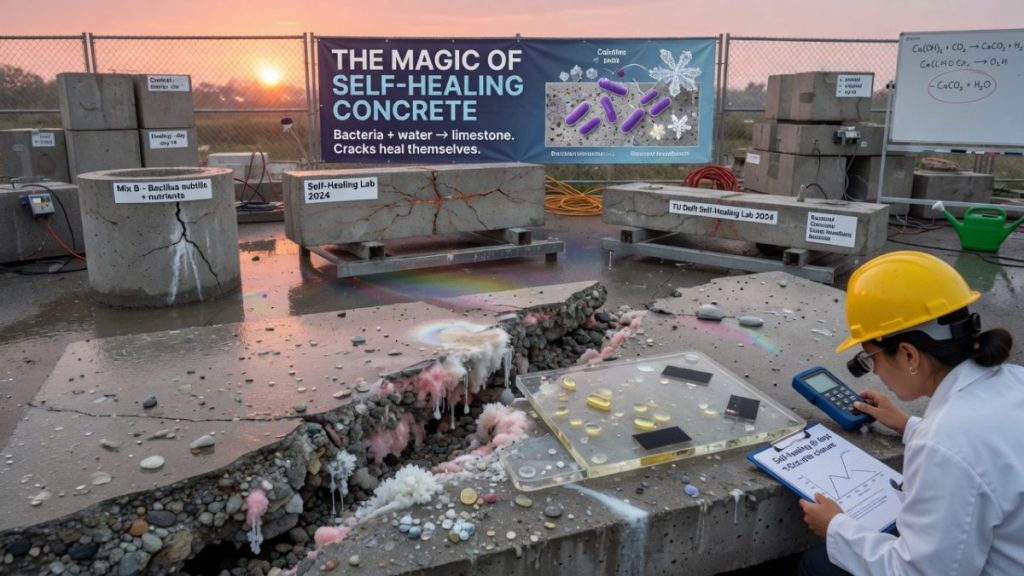
The Trigger: A micro-crack forms in the concrete due to stress or weathering.The Wake-Up Call: Rainwater seeps into the crack. As soon as moisture and oxygen touch the dormant spores, the bacteria wake up.The Feast: The newly awakened bacteria start consuming the calcium lactate that was mixed into the concrete alongside them.The Repair: As the bacteria digest their food, a chemical reaction occurs. They excrete calcium carbonate—which is, essentially, hard limestone.

Within a matter of weeks, this limestone builds up and completely seals the crack, preventing water from reaching the steel rebar inside. Once the crack is sealed and the moisture dries up, the bacteria simply go back to sleep.

It’s an infinite loop of self-maintenance. When I think about the sheer genius of using biology as an automated repair crew, it makes traditional concrete look like a relic of the stone age.

Why This is a Massive Deal for Our Future

It’s easy to look at this as just a cool science experiment, but the implications are staggering. If we start building our infrastructure with bio-concrete, the ripple effects will change our economies and our environment.

1. Slashing Maintenance Costs

Governments and private companies spend billions of dollars every single year just patching up decaying infrastructure. If a bridge can autonomously heal its own micro-cracks before they become structural failures, the lifespan of that bridge could double or triple. The cost savings over a few decades would be astronomical.

2. The Ultimate Sustainability Move

This is the angle that resonates with me the most. Cement production is one of the dirtiest industries on the planet, responsible for roughly 8% of global carbon dioxide emissions.

If we can make our buildings and bridges last 100 years instead of 50 years, we dramatically reduce the amount of new cement we need to produce. Self-healing structures aren’t just cheaper to maintain; they are a critical weapon in the fight against climate change.

3. Conquering the Impossible Environments

Imagine underwater tunnels, offshore wind turbine foundations, or deep underground bunkers. Repairing concrete in these environments is currently dangerous and nearly impossible. Bio-concrete thrives exactly where traditional maintenance fails. When water attacks an underwater column, the bacteria simply wake up and reinforce the wall.

The Reality Check: What’s Holding Us Back?

As much as I love this technology, I always want to keep things grounded in reality. So, why aren’t all new buildings made of bio-concrete today?

The short answer is the price tag.

Currently, adding these bacterial spores and calcium lactate to the mix makes the concrete roughly twice as expensive as traditional concrete. For developers looking to cut upfront costs on a residential building, that’s a tough pill to swallow.

However, from what I’m seeing in the industry, researchers are aggressively looking for cheaper food sources for the bacteria (like agricultural waste) to bring costs down. And when you calculate the total “lifecycle cost” of a structure—including decades of zero maintenance—bio-concrete is actually a bargain. It just requires a shift in how we invest in our infrastructure.

The Cities of Tomorrow

We are standing on the edge of a new era in construction. The idea of “dead” materials is fading. In the future, I believe our cities will function more like living organisms—structures that sense damage, react to their environment, and heal their own wounds.

This isn’t just about mixing bugs into cement; it’s a fundamental shift in engineering philosophy. We are finally learning to work with nature rather than just paving over it.

I’m incredibly excited to see the first major skyscrapers and bridges built entirely from self-healing materials. But I’m curious about how you view this shift.

If you were buying a house today, would you feel safer knowing the walls were “alive” and capable of healing themselves, or does the idea of living bacteria in your living room walls feel a little too strange? Let me know what you think!

You Might Also Like;


Source link

Popular Posts

My Favorites

Iran Mandates Cryptocurrency Tolls for Strait of Hormuz Transit – Cryptoflies...

69 Iran is now requiring maritime operators to pay transit fees in cryptocurrency to navigate the Strait of Hormuz. The new protocol applies during...