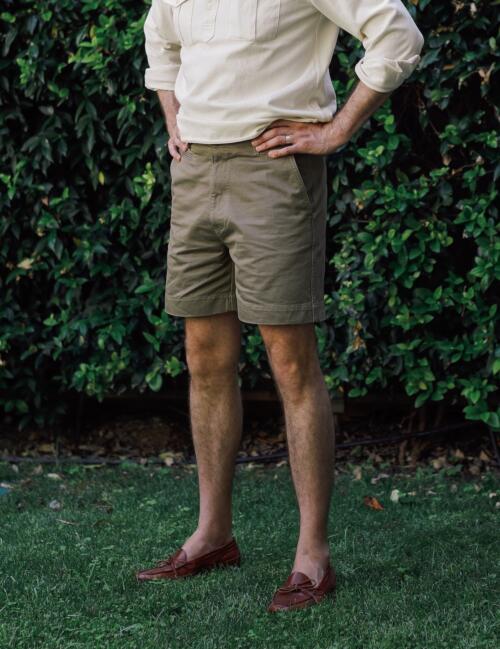
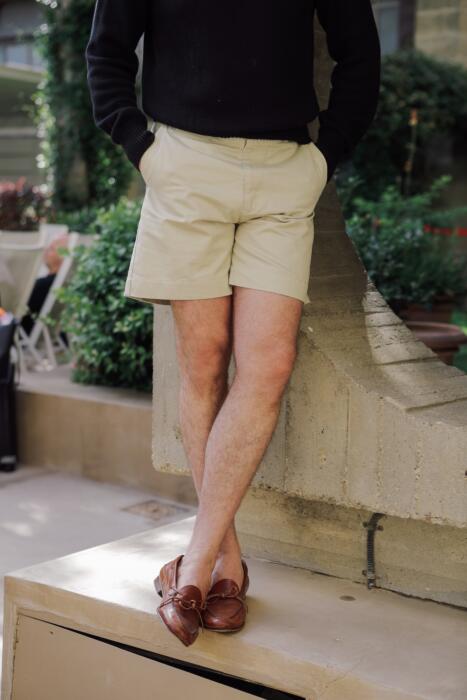
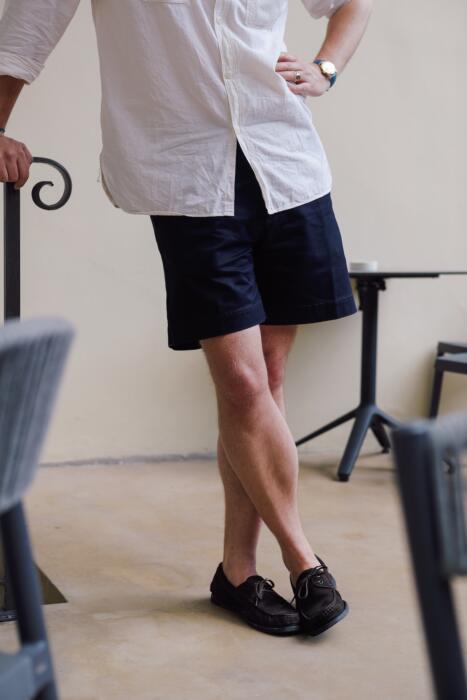
In luxury fashion, recognisability is often one of the hardest qualities to build for a brand. The distinctive clasp of a handbag, a particular watch bezel or a signature jewellery motif can take years to become associated with a house. Footwear is no different. Enter Aurélien’s Yacht Loafer — what began as the brand’s interpretation of the traditional boat shoe has evolved into one of its most recognisable creations. What sets the Aurélien Yacht Loafer apart from other boat shoes on the market is the way it transforms familiar maritime references into a distinctive and immediately recognisable design language using precise artisanal construction and carefully executed hand-finished details.
The Instantly Recognisable Silhouette of the Aurélien Yacht Loafer
A contemporary interpretation of the classic boat shoe, the Yacht Loafer draws on maritime heritage while introducing a set of distinctive design codes such as a zig-zag tongue, decorative laces, exposed hand stitching, a sailing-inspired sole and a stamped emblem beneath the shoe. Over time, these elements have become inseparable from the silhouette itself, forming a consistent visual system of recognition that defines the model across iterations.
The Aurélien Yacht Loafer
Crafted in a family-run atelier in southern Italy, the Yacht Loafer embodies a tradition of craftsmanship that has been refined over decades. Every stage of production is guided by a commitment to quality and attention to detail. This process is shaped by generations of Italian artisanal expertise, where precision is maintained as a continuous standard throughout the construction of the shoe. Central to the design is Aurélien’s signature Softey® Suede, sourced from French calfskin and naturally tanned in Italy. Valued for its exceptionally soft touch, rich depth of colour and subtle lustre, the suede undergoes an exclusive oil treatment that accentuates the leather’s natural character while enhancing its durability. From the sourcing of materials to the final finishing touches, each element is carefully considered, creating a shoe that is as refined both in construction and appearance.
Showcasing Aurélien’s Signature Design Details
The Aurélien Yacht Loafer
The Yacht Loafer remains one of Aurélien’s most recognisable creations, but it represents something larger than a single silhouette. The same commitment to craftsmanship, timeless design and carefully selected natural materials can be found throughout the Maison’s collections. The craftsmanship extends into constructional decisions that define the shoe’s character as much as its materials. The exposed hand stitching along the upper is deliberately left visible, becoming part of the design rather than concealed beneath it, and reinforcing the artisanal nature of each pair. At its core, the model operates as a set of recurring design codes rather than isolated decorative features, each contributing to an immediately identifiable visual system.
Handcrafted; “All About Joie-De-Vivre”
The Aurélien Yacht Loafer
Some shoes are defined by their silhouettes while others are defined by the details that set them apart. Every detail of the Yacht Loafer serves a purpose that not only enhances the appearance of the shoe, but also contributes to the comfort and ease for the wearer. The unlined construction creates a lightweight and flexible feel, allowing the shoe to adapt naturally to movement. Combined with the softness of the suede, the Yacht Loafer prioritises ease without sacrificing refinement.
This makes the shoe equally suited to long summer days by the coast, relaxed afternoons in the city or more refined occasions that call for understated elegance. Its white natural rubber sole further reinforces this balance, referencing traditional sailing footwear originally designed to prevent marking teak decks and grounding the design in practical maritime functionality as much as aesthetic influence. Aurélien’s concept of Smart Luxury is grounded in exceptional quality, artisanal craftsmanship and enduring style. Rather than responding to seasonal trends, the focus remains on creating pieces designed to transcend seasonal trends and retain their relevance over time.
Read More: Aurélien Positions Itself as a New Force in Contemporary Menswear
Visitors can discover the world of Aurélien at the flagship stores in Amsterdam and London, as well as through a growing presence at leading luxury destinations including Harrods, Selfridges, Printemps and Bongénie.
For more information, head to aurelien-online.com.
For more on the latest in luxury fashion and style reads, click here
Wednesday, July 1st 2026Tags: charvetEdward Greensimonnot godard
Share
Share this post
Subscribe
10 Comments
Add to favourites
||- Begin Content -||
By Reginald Jerome de Mans*
I wore a pair of Gurkha trousers the other day. Those wide-waistbanded eccentricities that looked so dashing on friends’ fit posts, their criss-crossing straps so gloriously inconvenient, they put me in mind of the old sowing/reaping meme:
“Me wearing Ghurka pants: Haha fuck yeah!!! Yes!! Me having to undo and redo them to use the bathroom: Well this fucking sucks. What the fuck.”
They also put me in mind of forum groupthink, the phenomenon of micro-trends adopted by readers of discussion forums, inspired by the reigning discourse there. Today it seems as quaint and bygone as the autocorrect-testing archaicism fora that I persisted in using.
Various amusing artifacts in my wardrobe testify to the persistence of that lost time, aside from ghurka trousers. But are they all I have to show for hundreds of wasted hours?
A foundational tome: Flusser’s Dressing the Man
Early 2000s time-wasters, often young professionals or students, discovered that every possible subculture had its own Petri dish on the internet in those fora. What made them subcultures rather than cultures or hobbies? An embarrassment to publicly acknowledge interest in them, for one thing.
A forum allowed virtual participation – anonymous behind a silly username – and men around the world came together for community, to share knowledge and experience, to the extent we had any to add to the written sources (Flusser and Roetzel primarily, and the occasional unreliable magazine article).
What resulted was by no means idyllic or healthy, but it did create community: one shared interest allowing men to discuss anything. The handful who came to lead the discourse then attracted followers who emulated them, creating norms.
Leading the discourse merely required speaking with a little authority, at least until it came time to put up evidence – experience with a given tailor or maker, with a given city’s offerings, or posting a fit pic. The rest of us had to clear our minds of the few ideas we had otherwise received.
What filled our minds, along with silly in-jokes (like the loopy early poster who claimed there were transparent metal collar stays) was the coalescence of certain preferences and standards, based on what a handful of posters who set the tone found themselves aligning on. And those preferences defined by groupthink became their own recognisable characteristics, their own in-jokes in a way.
The Edward Green ‘Dover’ (though not two-tone)
Once forum heads had swept aside what we thought we knew, one of the most salient tropes they filled ours with was an overarching preference for British makers.
Of course, gatekeeping and judgmentalness would accept nothing but the best, so these couldn’t be any British shoes, but Edward Green in particular, preferred for some reason a hair more than the ready-to-wear of John Lobb Paris.
Green’s model names (particularly the infamous Dover, the exemplar of Green’s signature expertise of invisibly skin-stitching with a boar’s bristle) became as well known to many of us as the calendar of saints. Even I succumbed eventually to the Dover, buying a two-tone version that I eventually came to my senses about and sold off.
As forum members love bargains almost as much as showing each other up, they even attempted parallel importation of these shoes, from international retailers who promised the lowest prices.
The Edward Green ‘Windsor’ with its U-shaped tip
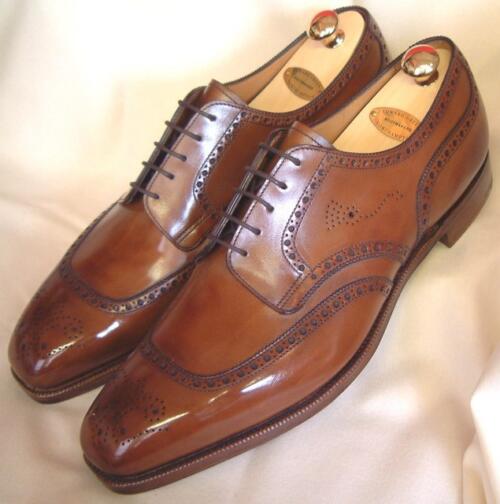
My most group-thought Green order was the Windsor, a heavily brogued derby whose peculiarity (in addition to having a thistle punched in the side) was that instead of having a wingtip or cap toe, it had a U-shaped tip.
It had earlier been the group order of the secretive London Lounge, a forum with restricted membership, and they specified it had to be made up on an old Edward Green last, the gently squared ‘great 88’ (since superseded by multiple generations of lasts refining the shape – the 808, Ralph Lauren’s 89, the 888 and so on).
Groupthink from a different forum led me to order the shoe in cordovan. I then succumbed to the online talk about deer bones, and wasted countless hours trying to rub the damn things with one. Over time I learned that cordovan is extremely heavy, wears very hot, doesn’t take polish the way normal leather shoes do… and that deer bones can stay in roadkill.
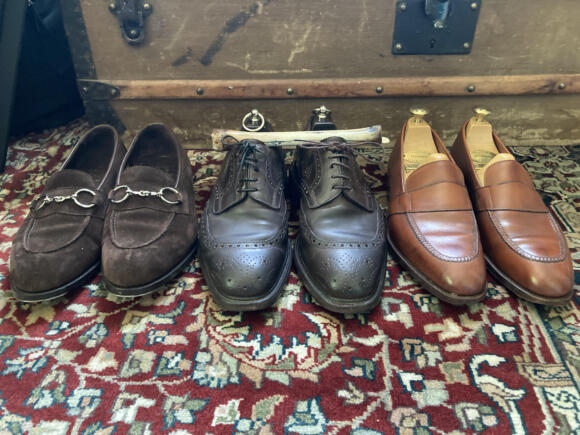
The mumbo-jumbo about rubbing them on hides for their supposed magic oils is worthless, except if one is polishing certain waxy leathers. And, a confession I can’t believe I’m making, I bought an oriental rug just to be able to photograph my new shoes on one the way other forum members did…
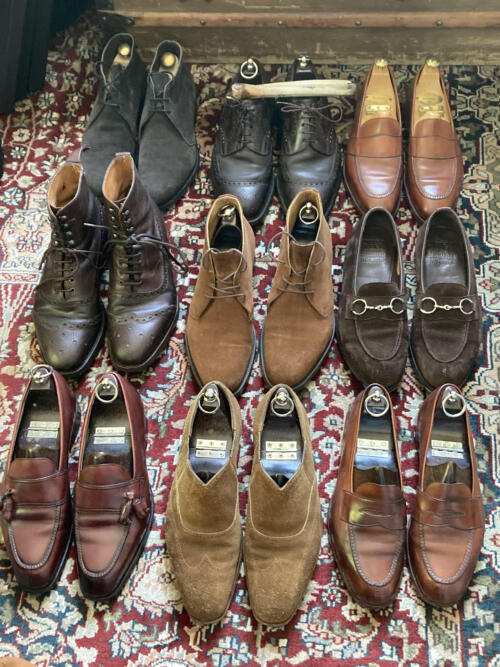
Some of the author’s shoes, with the offending deer bone
Groupthink also spurred me to another purchase outside of my usual taste, longwings, whose wing tip extends all the way to the back of the shoe. Although ordering them from Green pitted one groupthink against another, since they were neither from Alden nor in cordovan (the classic maker and material).
I generally managed to avoid most of the Americana species of groupthink, including obsessiveness over the perfect oxford cloth button-down shirting, collar roll and generosity of fit.
The American Trad look and its ethos took a very defined shape among a deeply felt subpopulation in the mid-2000s, taking an odd turn in 2009 when a large number of genuine Harris Tweed sports coats ended up at the Boston branch of the discounter Primark, following a disastrous decision by the main Harris Tweed buyer to reduce the innumerable patterns Harris Tweed was woven in down to five. Members of one forum took to buying and returning the sports coats in order to keep the Harris Tweed-branded hangers they came on.
I did succumb to one trope of Trad, ordering a suit with the 3-roll-2 buttoning point they so loved. Never one to comply with every detail of a given norm, I had a British tailor make it (on reflection, the Trads seemed to favor British cloth but not British make, except for the Shaggy Dog sweaters that old Drumohr used to knit). The result was not great, however, resembling a normal two-button jacket with a nearly invisible vestigial third…
On the same suit I demanded my tailor incorporate a bit of Gallic delusion, the cran parisien (or fish mouth) lapel notch. And this is where we get into the French flavour of groupthink.
The cran parisien I wanted came from a catalogue by Arnys, and any mention of Arnys on the fora could not avoid touching on its house specialty, the Forestière work jacket. As happens so often, my illusions were dashed actually trying one on – I found it baggy and unflattering – but I did buy a few of their ridiculous crumply seven-fold cravates d’atelier with hand-rolled edges.
I confess I contributed to the mythos by sharing what I knew of Arnys and other Paris makers in the salad days of the fora (and, dare I say it, in the book I wrote several years ago, Swan Songs).
In those days, wearing a handkerchief of any kind, let alone a fancy printed pocket square, was a rare bit of foppery, and I led the chase for twee little medieval-printed ones Drake’s had made at one time for Holland & Holland.
Then another member showed me that the Paris branch of Hilditch & Key once made a specialty of issuing similar prints on cashmere, rather than the silk or wool that Drake’s used. That particular revelation became one of many rabbit holes I led fellow forum members down.
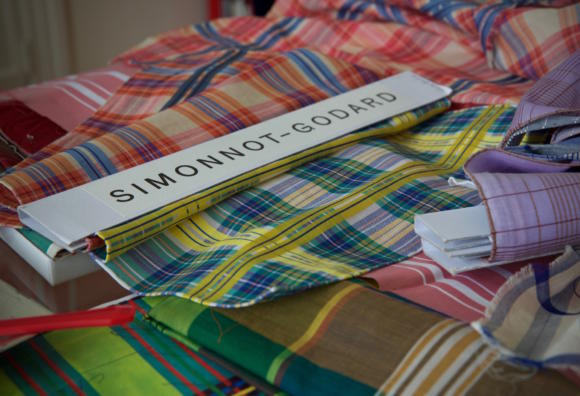
I remember the day French weaver Simonnot-Godard’s cotton handkerchieves became a sensation. One spring day in 2007 the late shirtmaker Alexander Kabbaz mentioned stocking them, and the next moment they seemed to be everywhere, these extremely fine, fancy handkerchieves that turned out to be the house cotton handkerchieves of Charvet and Hermès…
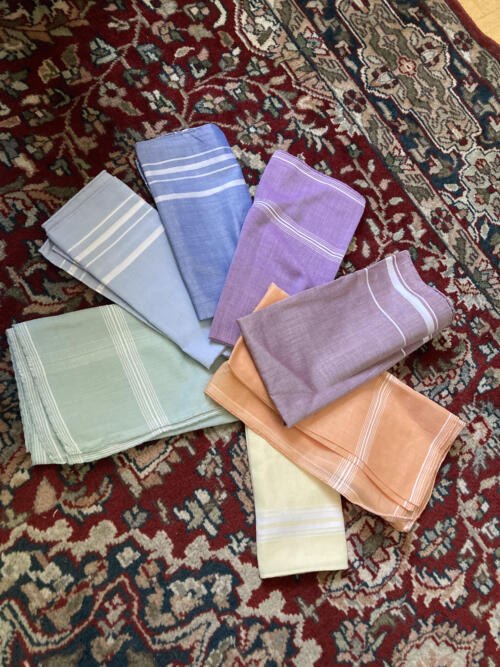
The forum pièce de résistance was a Simonnot-Godard piece whose quadrants were different types of Madras plaid, so the wearer could at any time have one of four ugly patterns sticking out of their breast pocket. I admit buying it and ultimately passing it on, but I’ve kept (and continue to acquire more colourways of) their beautiful fine cotton handkerchieves in solid pastel colours.
The key, I think, is to gain enough confidence to reject some of the items thrust upon us, and figure out what we actually want. I never did buy SG’s much-vaunted chambray shirting cloth, although Kabbaz did get me to try Zendaline from the remaining stocks at Charvet based on his old guide to different kinds of shirt cloths.
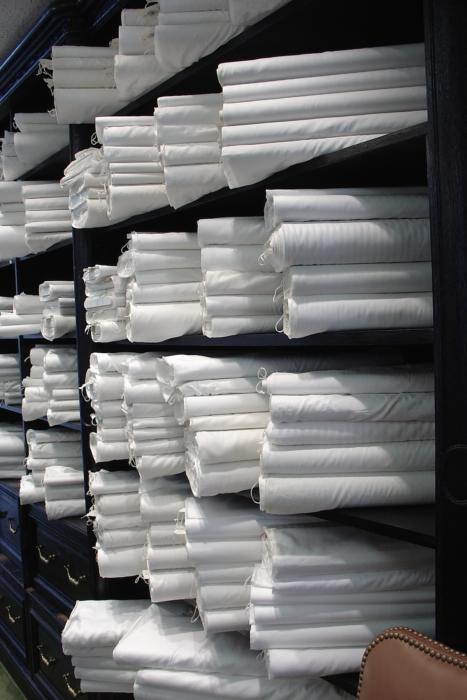
Shirt fabric at Charvet
Otherwise, forum-approved cloths were generally British, with the flashy luxury cloth houses like Dormeuil, Scabal and Loro Piana derided as overpriced and often flimsy. Inverted snobbery likely had a hand as well.
In any case, the flight to British safety stayed with me for most of my time ordering custom tailoring. I succumbed to try forum-favourite fresco cloth, one of the various weaves that supposedly makes a suit easier to wear in hot weather (in the end, both the heat and the ease have to be relative)…
In 2008, I joined a rush of online friends buying lengths of cloth from J&J Minnis before its acquisition, out of an atavistic dread that whatever the new Minnis would produce would be lacking.
I had all of mine made up in forum-approved drape-cut suits, one a double-breasted with the 4×1 ‘Kent’ keystone buttoning point, so named for the Duke of Kent, who made his elder brother the Duke of Windsor seem responsible and balanced. The forum tumult about the drape cut and its exponents in Savile Row bore out Anderson & Sheppard’s old saying that some swore by them, some swore at them.
Part of the author’s collection (on that rug)
What did groupthink mean? A safety of correctness, a secret signal broadcast only on the internet of shared taste. Many of us needed that correctness, after having our own ideas about clothing and confidence in taste razed when we joined.
We eventually relearned confidence in our own taste – to find our own truths, whether before or after moving out of the orbit of the fora thanks to job changes, the demands of spouses and family, or simply maturity.
Today, social media is the most powerful generator of groupthink, but it is different. The fora were participatory: even if not egalitarian – certain members’ opinions were valued much more highly – opinions were based on the tastes of a dynamically changing group, unlike social media authorities who simply impart their knowledge to an audience.
From my account above, it may seem that what I have left are just some artifacts and phantoms, memories of inane discussions that helped pass the time. But some preferences have stood the test of time. I just took delivery of my umpteenth pair of Greens, for example, a remake of their bit loafer the Millfield, although I no longer post for imagined clout the way I used to.
I also wear my old Minnis-cloth suits frequently (usually with a Simonnot-Godard handkerchief discreetly in the breast pocket) and love their cloth, even as I’ve been quite happy with the product of the new Minnis as well, having one of my most recent suits made up in a Prince of Wales check flannel from their current line.
Looking back, my forum days support a broader lesson I’ve learned: welcome knowledge, but consider the source, and the context it’s presented in.
There have been times in real life that I’ve had to unlearn what I thought I knew, in order to relearn something from foundational principles back up. It’s been important, however, to reach a critical mass of knowledge that will allow me to rely on my own judgment.
The fleeting exchanges I had on fora led to some real friendships, because looking back I realise I wasn’t just seeking knowledge, but a sense of community too at an isolated time of my life.
Certain connections, on group chats or in real life, have become steadfast friends, some few constants of reliable and regular contact, where we exchange about more than clothing, as before, but without the weight of carrying someone else’s preferences.
Like on the fora back in the day, our own clothing and style quirks often come in for everyone else’s good-natured derision. Unlike back then, all of us now have the confidence in our own preferences to laugh it off and move on.
*The pen name for the author, a PS reader and frequent forum contributor
Related posts
Groupthink: A tale of noughties nostalgia
July 1st 2026 – 10 Comments
Read More
Museum Garments: An effective mix of classic and modern
June 29th 2026 – 13 Comments
Read More
Stoffa, Decorum and Dalmo: summer showroom events
June 26th 2026 – 12 Comments
Read More
<!–
Subscribe to this post
You can follow the discussion on Groupthink: A tale of noughties nostalgia by entering your email address in the box below. You will then receive an email every time a new comment is added. These will also contain a link to a page where you can stop the alerts, and remove all of your related data from the site.
If you ask a female reader today what goes into the formula of an ideal partner, you’ll probably hear a familiar mix: charisma, a bit of edge, and a massive dose of emotional intelligence. For a long time, mainstream media didn’t do us many favors—feeding us a steady loop of toxic bad boys, gangsters, and the exhausting expectation that a woman has to “fix” a man to get a happy ending.
And honestly, right when we were about to accept defeat, Prime Video entered the chat and completely rewrote the playbook and gave the modern college hero portrayal a much-needed glow-up. Yes, we’re talking about the show that’s been living rent-free on our feeds and in our heads—Off Campus.
Just when I thought I was done with teen romances and college drama, this one caught me. Let’s be real, most of these shows just feed our delulu side anyway. But then the internet did what it does best, and there it was in Prime Video’s “Top 10,” basically staring at me until I gave in one evening. And I kid you not, “just one more episode” quickly turned into an all-nighter, and for once, losing sleep on a weekday as an adult felt completely worth it.
An adaptation of Elle Kennedy’s popular book series, Off Campus has all the makings of a great college romance: hockey players, attractive leads, and the classic popular-guy-falls-for-the-nerd-girl trope. But what makes it stand out is everything beyond that. It brings a real sense of belonging, replaces locker-room banter with conversations around consent, and gives us emotionally aware characters. Instead of glorifying toxicity, it leans into healing, growth, and companionship.But if there’s one thing the internet seems just as obsessed with as the couples, it’s the outfits. From Allie’s iconic dance in a Jennifer Lopez–inspired Versace look-alike dress to Hanna’s skinny jeans having a discussion of their own, each wardrobe reflects the characters’ journey and their personality shifts. Costume designer Charlene Akuamoah summed it up best: “We wanted to make sure that each and every single character had their own distinct look and aesthetic.”
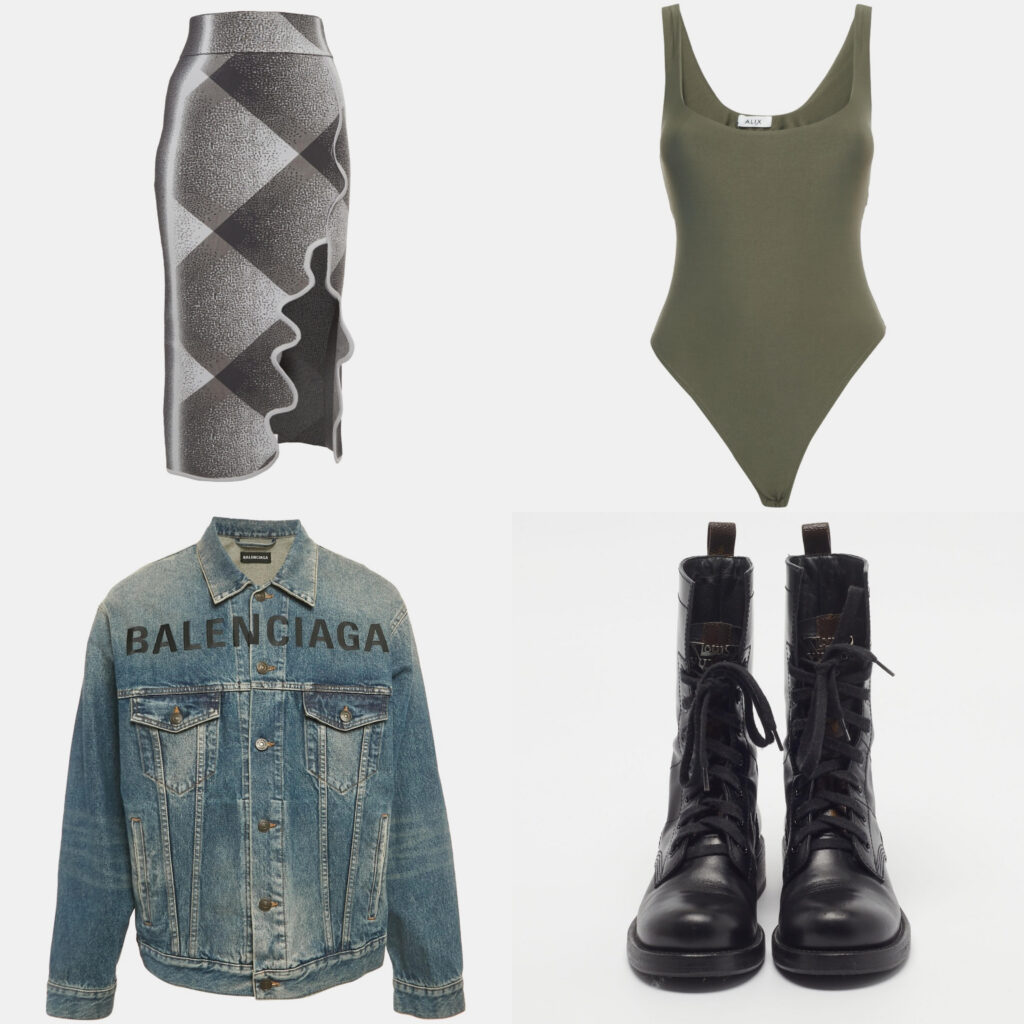
If you’re still replaying your favourite scenes in your head and your algorithm refuses to move on from Off Campus, same! That’s exactly why I’ve put together these pre-loved fashion edit from The Luxury Closet inspired by the series, so you can carry a little piece of that world wherever you go.
Hands down, the women of the show were absolute magic. But before we get into their seriously good wardrobes, can we please take a moment for Hannah and Allie? When Hannah finally opened up about her traumatic experience, and Allie met her with so much care and understanding, it gave us one of the sweetest moments in the series. And then Hannah goes, “You are my favorite person,” and Allie instantly hits back with, “Right back at you.” Yeah, my heart didn’t stand a chance.
These two may have been like two peas in a pod, but their style aesthetics were on completely different wavelengths. While Hannah lived in cardigans and simple outfits, Allie never missed an opportunity to spice things up. Let’s help you curate a wardrobe that gives a little “topper girl” energy while still fully channelling life-of-the-party vibes.
1. Fans of “the nerd girl” energy, assemble
Shop this look:
Burberry Red Wool Cardigan
Versace White Rib Knit Tank Top
Dolce & Gabbana Blue Denim Jeans
Tiffany & Co. Open Heart Small 18K Yellow Gold Necklace
2. Allie and skirts are a different love story
Shop this look:
PH5 Grey Holly Midi Skirt
Alix Olive Green Bodysuit
Balenciaga Denim Oversized Jacket
Louis Vuitton Black/Brown Combat Boots
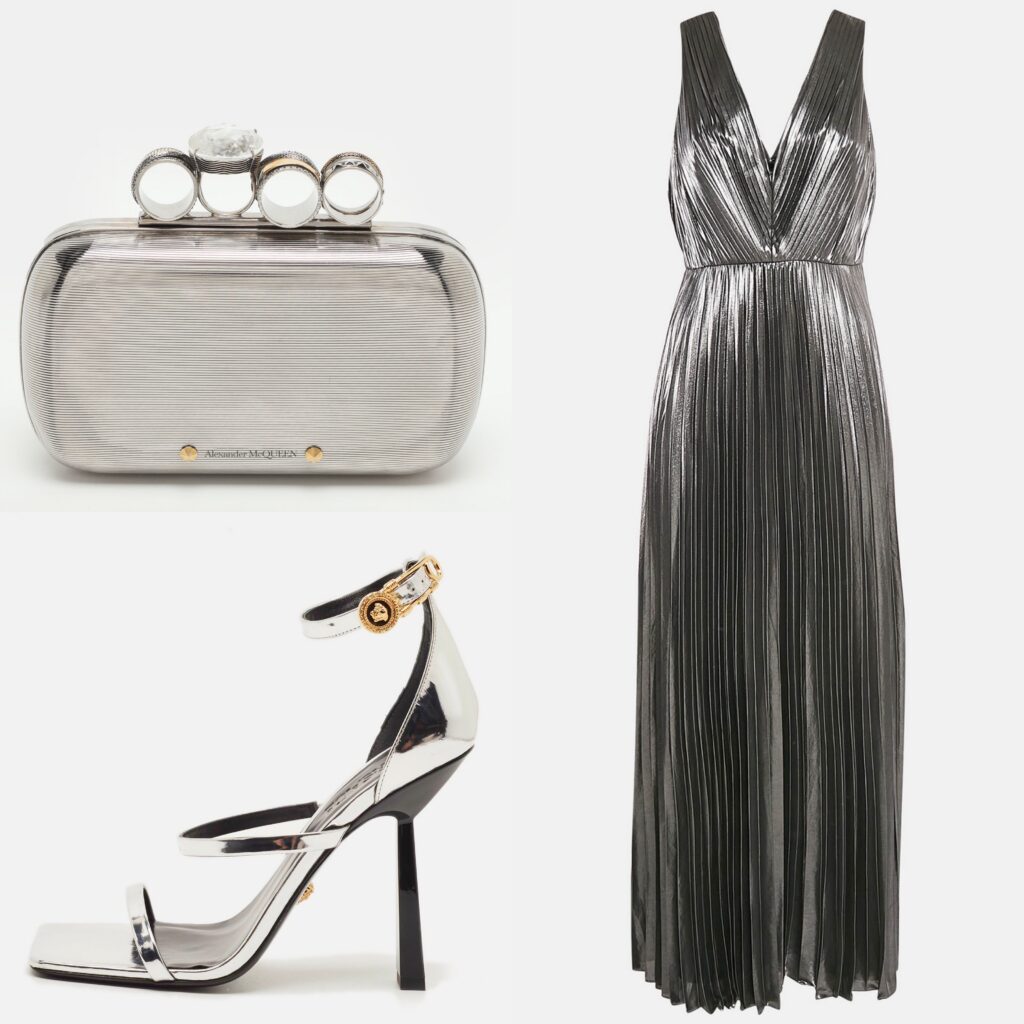
3. For your “Dressed like a dream, singing like a confession” moment
Shop this look:
Alexander McQueen Silver Tone Metal Clutch
Versace Safety Pin Sandals
Aidan Mattox Silver Maxi Dress
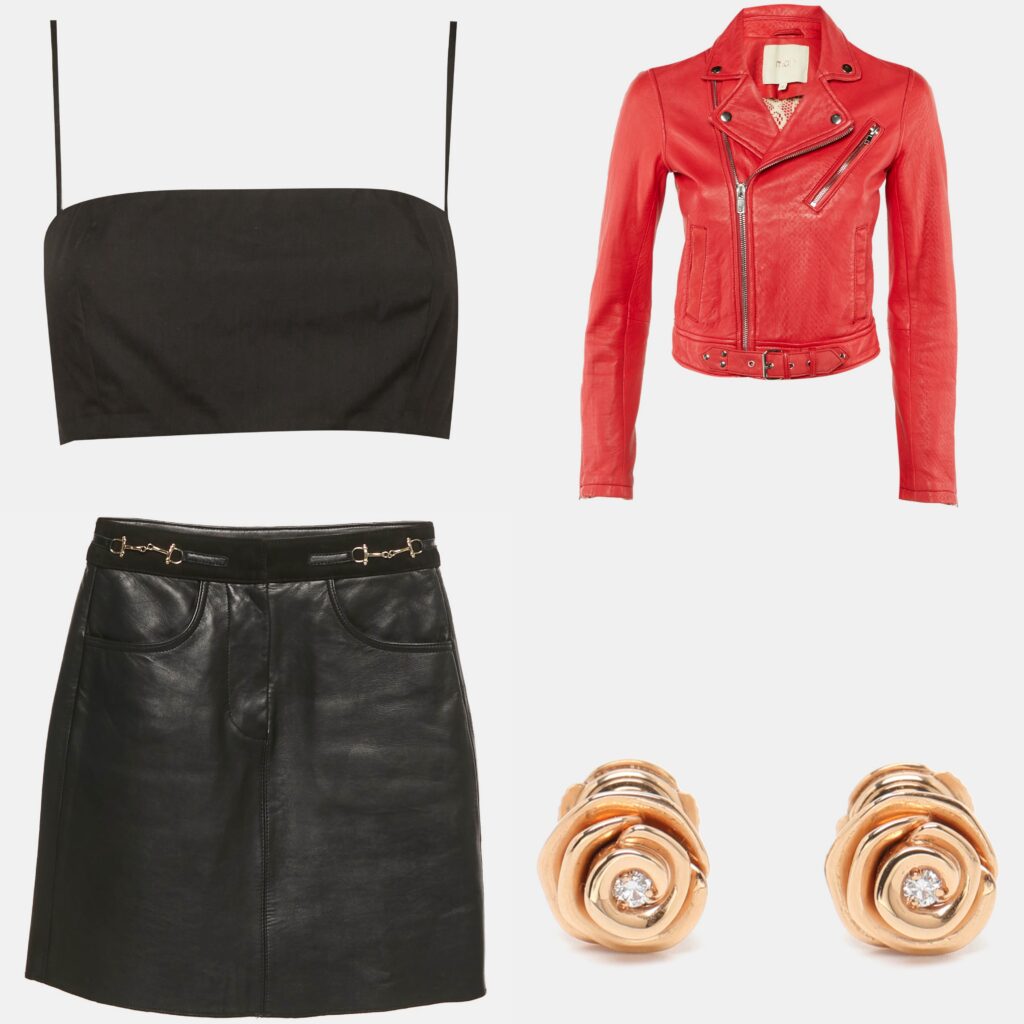
4. Allie-coded: chaos, charm & a little bit of danger
Shop this look:
Maje Black Mini Skirt
Prada Black Tube Top
Maje Red Biker Jacket
Dior Small Rose Couture Diamond Earrings
Now, I may be taking a little liberty here, but I have a feeling I’m not the only one who developed a tiny crush on at least one of the guys. Dean, Garrett, Logan, and Tucker are the campus hockey stars you’d expect to be emotionally unavailable with oversized egos. Instead, they turned out to be absolute green flags, bringing a kind of vulnerability that felt genuinely refreshing to watch.
And yes, cannot deny that their handsome looks were screen stealers too. Logan’s grease-stained work trousers carried a rugged charm, while Garrett proved that grey sweatpants could become an entire personality trait (don’t even tell me you didn’t notice). Dean leaned fully into heartthrob energy through his wardrobe, while Tucker’s soft sweatshirts matched his golden-retriever vibe in every scene.
And if you’re here for that campus-core aesthetic, don’t worry, we’ve got you covered.
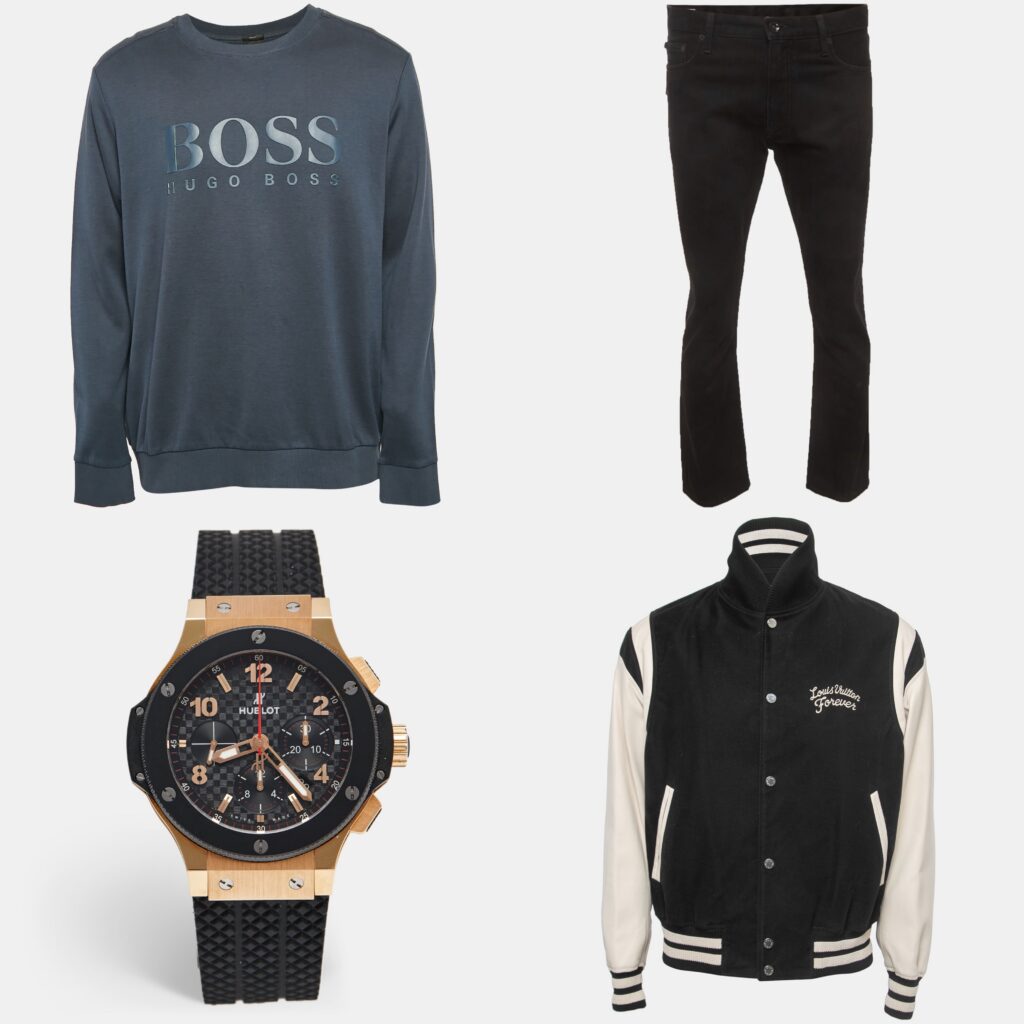
1. Fictional boyfriend blueprint, Garrett style for everyone
Shop this look:
Off-White Denim Jeans
Louis Vuitton Varsity Jacket
Boss by Hugo Boss Blue Sweatshirt
Hublot Black Big Bang Men’s Wristwatch
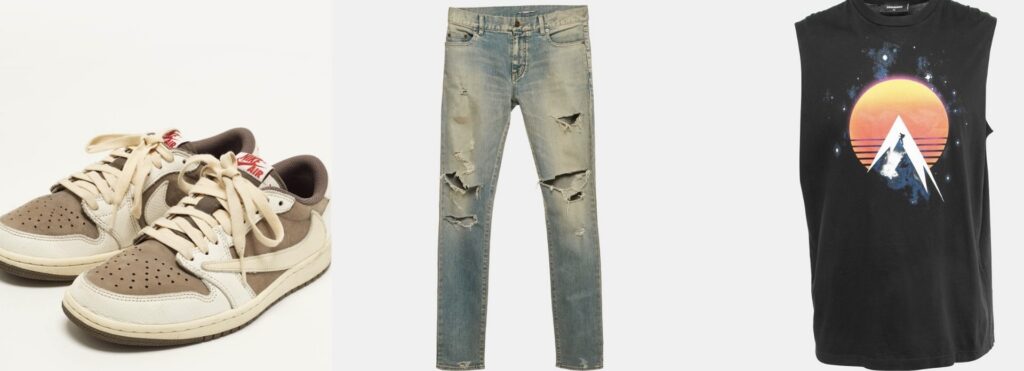
2. Achieve Logan’s soft-boy energy
Shop this look:
Dsquared2 Black Tank T-Shirt
Saint Laurent Paris Distressed Denim Jeans
Air Jordans 1 Retro OG SP Travis Scott Low Top Sneakers
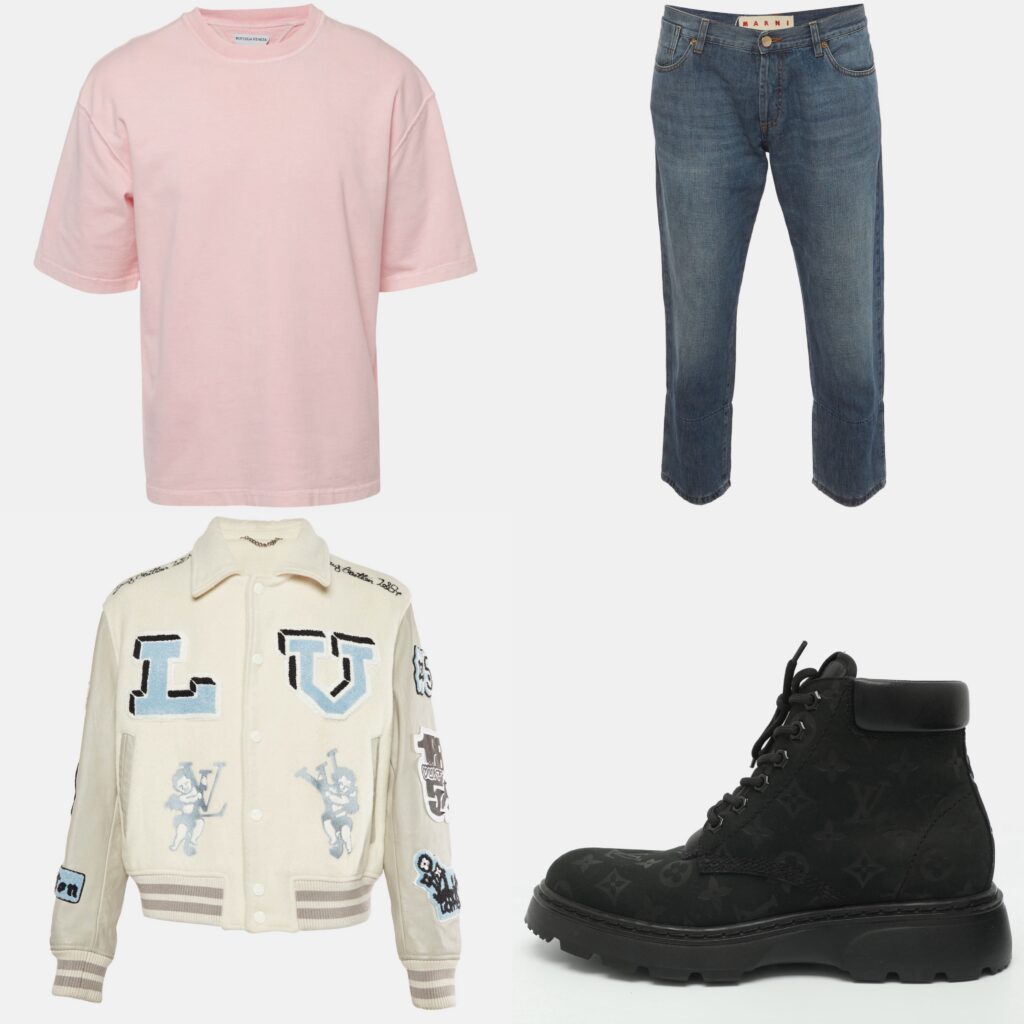
3. Campus charmer or loverboy? Dean’s wardrobe has both
Shop this look:
Bottega Veneta Pink T-Shirt
Louis Vuitton Bugs Bunny Varsity Jacket
Marni Denim Straight Fit Jeans
Louis Vuitton x NBA Bold Ankle Length Boots
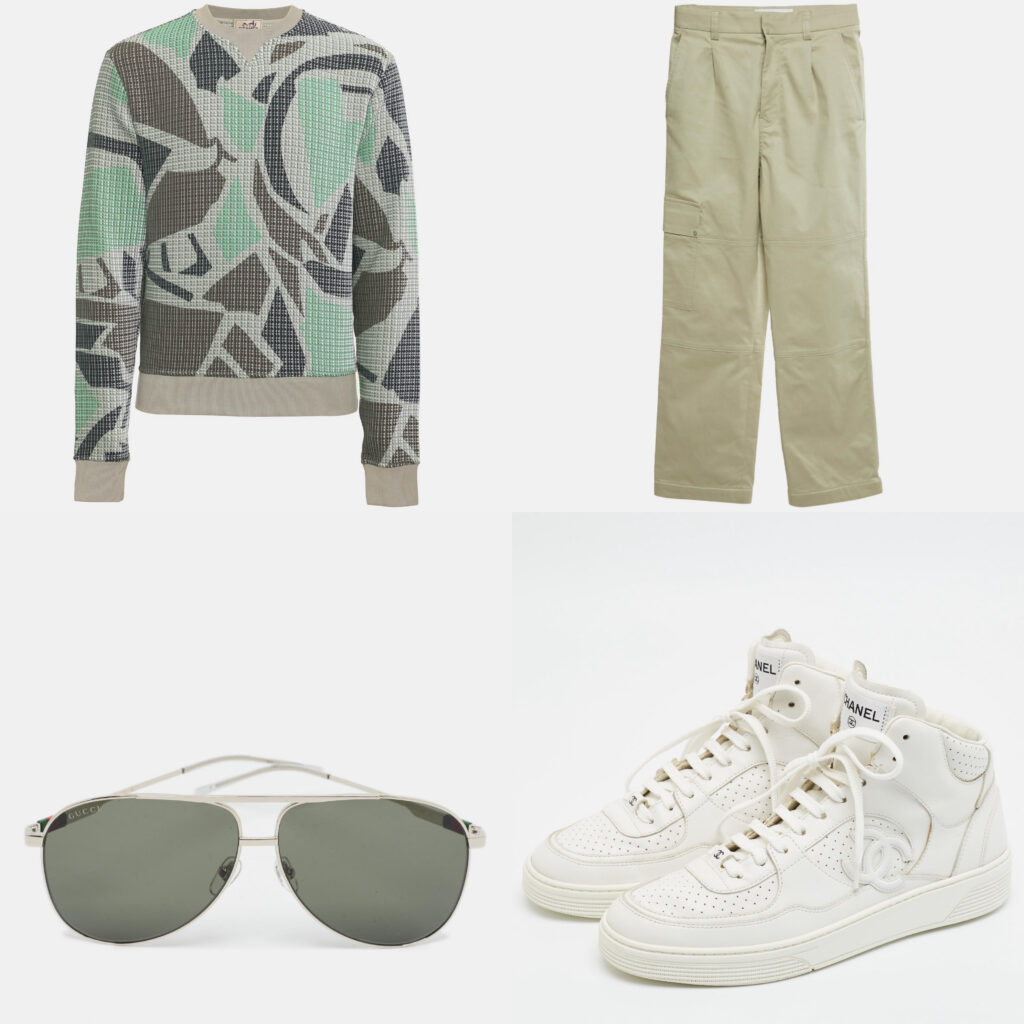
4. Serve dapper looks like Tucker
Shop this look:
Gucci Aviator Sunglasses
Hermes Waffle Knit Sweater
Loewe Cargo Pants
Chanel CC High Top Sneakers
The list of Off Campus pre-loved fashion edit is pretty much endless. And with Season 2 already building hype and promising even more standout looks, there’s no better time to tap into the aesthetic.. So before the next chapter drops, consider this your sign to get your fit game sorted. Shop now.
Pre-Owned Bvlgari 18K White Gold Diamond in Floral Divas’ Dream Pendant Necklace in Excellent Condition
There is a way to buy Bvlgari that is practical and makes complete financial sense. There is also a version that does not. The difference has nothing to do with the brand itself — it comes down to which pieces you buy, in what configuration, and where you buy them.
For more information on how pre-owned jewelry (including Bvlgari) is the best investment, do read:
Pre-Owned Luxury Gold Jewelry: Smarter Than Bullion in 2026
Bvlgari is not Cartier. It does not pursue the studied restraint of a Love Bracelet or the quiet authority of a Panthère. Bvlgari is operatic: Roman columns, coiled serpents, gold the color of afternoon light on warm stone, and bold cabochon gems that prioritize saturated color and sculptural presence over faceted sparkle. When it works, a Bvlgari piece is one of the most recognizable luxury items. When it does not — when the piece is too fashion-forward or too generic — it can fade in the secondary market.
This guide focuses on the specific collections and configurations that consistently retain value, attract serious buyers, and reward smart pre-owned purchasing.
What Makes a Bvlgari Piece Hold Its Value? (Resale Factors Explained)
Bvlgari’s strongest resale performers are unmistakably, irreducibly Bvlgari. You cannot mistake a Serpenti coil or a B.zero1 spiral for another house’s work. The double inscription on a BVLGARI BVLGARI bezel — modeled on ancient Roman coins — belongs to no other vocabulary. This recognisability drives demand in the secondary market: a buyer scrolling on a phone needs instant identification, and Bvlgari’s most iconic pieces deliver it.
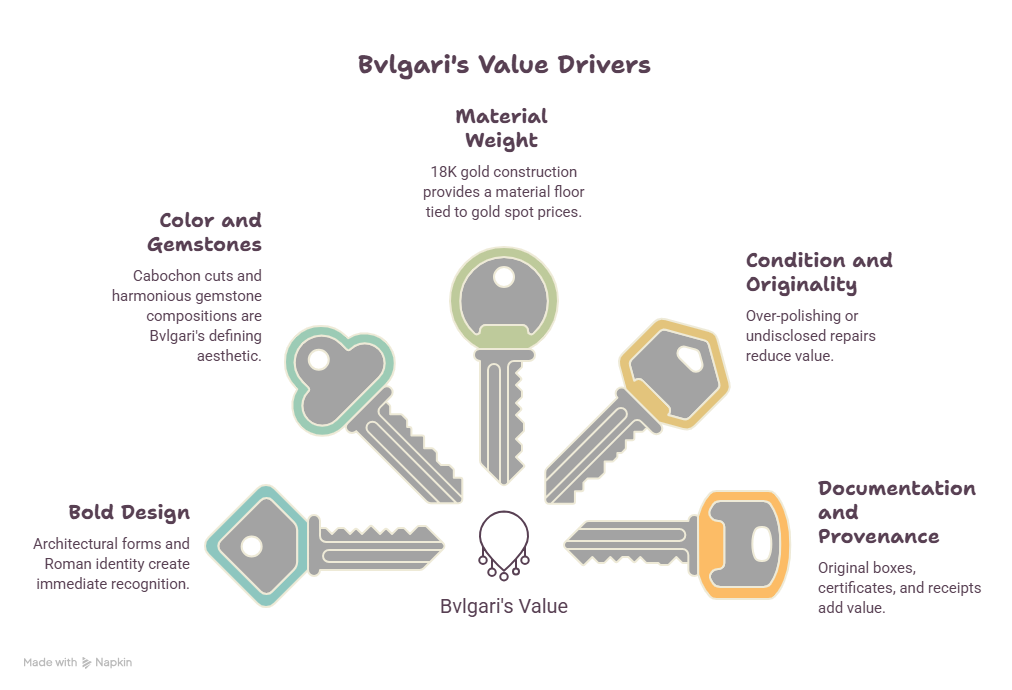
The five key value drivers:
Driver
Why It Matters
Bold design signature
Architectural forms and Roman identity create immediate recognition — essential for secondary market liquidity
Color and gemstones
Cabochon cuts (emphasizing color fields over brilliance) and harmonious gemstone compositions are Bvlgari’s defining aesthetic
Material weight
18K gold construction, often using the Tubogas technique, provides a material floor tied to gold spot prices
Condition and originality
Over-polishing or undisclosed repairs reduce value by 20–40%; the piece must look alive [1]
Documentation and provenance
Original boxes, certificates, and receipts add 15–30% in confirmed resale cases [1]; blockchain authentication on select flagship pieces adds another layer
What Drives Bvlgari’s Resale Market.
The investment rule: Buy unmistakably Bvlgari pieces in high-gold-content configurations, excellent condition, with documentation. Iconic collections typically retain 30–70%+ of retail, with vintage and collector pieces often significantly higher. Gold appreciation provides additional long-term upside.
5 Categories of Bvlgari Pieces: Necklaces, Rings, Bracelets, Watches, and Earrings
Before going collection by collection, it helps to step back and look at it category by category. Bvlgari’s resale strength is not evenly distributed across necklaces, rings, bracelets, watches, and earrings — each category has its own buyer behavior, price sensitivity, and reasons for holding or losing value. Here is how each performs in the pre-owned market.
Rings
Bvlgari Serpenti Viper 18k White Gold Pave Diamond Ring EU 48
Bvlgari rings for women are the most liquid resale category, largely because of the B.zero1 and Serpenti Viper. Both are sized, dated, and condition-graded with relative ease, which makes them the easiest pieces for a buyer to evaluate from photographs alone. A B.zero1 ring in good condition typically moves quickly on the secondary market, and entry-level configurations — single-band, smaller stone settings — make rings the most accessible category for a first-time Bvlgari buyer. The trade-off is sizing: a ring that needs resizing for a new owner carries a small but real cost that buyers factor into their offer.
Necklaces
Bvlgari Serpenti Viper 18K Yellow Gold Necklace in Excellent Condition
Necklaces for women from Bvlgari span the widest price range of any category, from a modest B.zero1 pendant on a thin chain to museum-grade Serpenti Tubogas lariats with diamond and onyx detailing. This spread means necklaces reward precision shopping more than any other category — a generic pendant performs modestly, while an iconic silhouette in the right gold weight can be one of the strongest resale assets in the entire house. Chain condition and clasp integrity matter more here than buyers initially expect; a stretched or repaired chain meaningfully reduces resale value even when the pendant itself is pristine.
Bracelets
Bvlgari Serpenti Viper Diamond 18k White Gold Bracelets S in Good Condition
Bvlgari’s bracelets most clearly carry the brand’s identity. The Serpenti Tubogas bracelet and the B.zero1 bangle are arguably the two most recognizable bracelet silhouettes the house produces, and both carry strong, consistent secondary market demand. Bracelets see more daily wear than any other category, which makes condition assessment critical — clasp function, link flexibility, and surface wear all factor directly into resale price. A well-maintained gold bracelet in either collection is one of the safer bets in the category for a buyer prioritizing liquidity.
Bvlgari watches for men and Bvlgari watches for women operate as separate markets within Bvlgari’s broader catalog, with their own buyer pools of horology collectors alongside jewelry buyers. The Octo Finissimo and Serpenti Tubogas watches lead this category, and as a general benchmark, most Bvlgari watches can be found secondhand at around 25% below list price, with stronger references — particularly gold Tubogas models and limited-edition Octo Finissimo complications — retaining considerably more. Movement condition, service history, and box and papers carry outsized weight in this category compared to jewelry, where the gold and gemstone content alone provide a value floor.
Earrings
Bvlgari Serpenti Viper Diamond 18k White Gold Earrings
Earrings are Bvlgari’s most overlooked resale category — and often its best-kept value secret. Because they see comparatively less daily wear than rings or bracelets, earrings tend to reach the secondary market in better condition, with less clasp damage or setting wear than in other categories. Serpenti diamond earrings in white or yellow gold are the standout performers here: a pristine pair can hold value impressively well against original retail, often outperforming what buyers expect from the jewelry category broadly. Vintage Bvlgari earrings from the 1960s–1980s, particularly cabochon and clip-on styles, occupy a genuine collector niche of their own, separate from the contemporary catalog.Earrings with damaged or replaced posts and backs — these are small repairs individually, but they signal a piece that has not been well maintained, and buyers price that risk in.
Best Bvlgari Pieces for Investment: Collection-by-Collection Resale Guide
1. Serpenti — Bvlgari’s Strongest and Most Enduring Resale Performer
Bvlgari Serpenti Rubelite Diamond 18K Rose Gold Open Cuff Bracelet S
The serpent motif first appeared at the house in 1948 and evolved through the 1960s into the Tubogas construction — a flexible, continuous, coiled structure built without welds that feels both architectural and organic. The Serpenti Collection has been a huge hit since its launch. It has been worn by Elizabeth Taylor, Ingrid Bergman, Audrey Hepburn, and, presently, Zendaya, who appeared at the Dune premiere in a 93.83-carat cabochon Colombian emerald Serpenti necklace from the Magnifica collection.
The auction record for Taylor’s 1961 Serpenti bracelet-watch — a piece estimated at $12,000–15,000 — sold at Christie’s for $974,500, nearly 65 times its presale estimate. That is what provenance does to a Bvlgari Serpenti. More recently, a Serpenti sold via Phillips in May 2025 for $572,567, beating its estimate by 44%. A separate example sold by Sotheby’s in Switzerland for $207,185, beating its estimate by 172%
In the secondary market, Serpenti and B.zero1 pieces consistently sit at the stronger end of Bvlgari’s 60–75% retention range, with pristine, fully documented examples commanding 70–85% of retail.
What to buy:
Yellow or two-tone gold Tubogas bracelets and rings with colored stone heads (emerald, rubellite, turquoise, coral) in excellent condition Vintage bracelet-watches from the 1960s–1970s, particularly enamel or colored stone examples Modern pavé diamond double-wrap necklaces or high-gem configurations As an entry point: a Serpenti ring — more accessible and wearable daily
What to avoid:
Heavily worn coils with deformed links, missing serpent heads, or poor flexibility. The piece must retain its sinuous movement — that is, its entire visual argument.
How to Authenticate Bvlgari Serpenti Jewelry: What to Check
Bvlgari Serpenti Diamonds Rubies 18k Two Tone Gold Necklace in Excellent Condition
The Serpenti is Bvlgari’s most counterfeited line, and the fakes have become sophisticated. Here is what separates a genuine piece from a convincing imitation:
The movement test — the single most important check:
On an authentic Serpenti, each individual scale link moves independently. Pick up the bracelet and flex it — it should feel fluid, weighted, and alive, like a real coiled snake. Fakes are almost universally made from a single solid piece of stamped metal, with etched grooves simulating scales. The difference is immediately apparent when you handle both: one moves; the other doesn’t.
Construction weight:
Genuine Bvlgari uses substantial 18K gold — never hollow construction. A real Serpenti bracelet feels heavy for its size. If it feels light or tinny, walk away.
The serpent head:
On authentic pieces, the head features precise enamel work or properly set cabochon stone eyes with a hinged jaw that opens smoothly. On fakes, the enamel is uneven, the stones look glued rather than set, and the hinge is stiff or non-functional.
Hallmarks to check:
Bvlgari Serpenti Viper 18K Rose Gold, Onyx and Diamond Ring EU 53
BVLGARI (V, not U) — engraved with clean, even, deeply incised lettering. Counterfeits show shallow or uneven stamping under a loupe. 750 for 18K gold or 950 for platinum — on the clasp interior MADE IN ITALY — present on all authentic modern pieces ROMA stamp — appears on pieces made at the Rome atelier, typically on vintage examples Serial number — laser-engraved (not stamped), should match any accompanying certificate. No two pieces share a number.
Box and documentation: Authentic Bvlgari packaging has the brand name stamped in gold on the outer box lid and on both the top and inside of the inner box. All lettering is clean, evenly spaced, and fully legible. Counterfeit boxes often use slightly off-color gold ink or inconsistent font weight.
2. B.zero1 — The Architectural Piece That Rewards Patience
Bvlgari B.Zero1 18k White Gold 1-Band Ring Size 54
Introduced in 1999 — the year encoded in its name, a reference to the new millennium — the B.zero1 represented a genuine rupture with fine jewelry convention. Where virtually every other luxury house was refining existing vocabularies, Bvlgari created something with no precedent: a multi-band spiral ring inspired by the cylindrical architecture of the Colosseum, developed in collaboration with artist Anish Kapoor. The coils compress and expand in your hands — a built-in authentication test that convincing fakes cannot replicate.
More than 25 years after its debut, the B.zero1 remains one of the most actively traded designs on the global pre-owned market. Its combination of design radicalism, 18K gold quality, and immediate recognizability has made it a consistent performer. This piece holds value not just because of its materials, but because of what it represents in the history of design.
What to buy:
Bvlgari B.Zero1 1-Band 18K Rose Gold Ring Size 47
4-band rings in yellow, rose, or three-tone gold — these have the most visual presence and the broadest buyer base Pieces with black or white ceramic inlays and diamond pavé on the band edges: the material contrast (polished gold, matte ceramic, brilliant diamonds) is a Bvlgari signature that photographs exceptionally well Anniversary and collaboration editions, which command premiums due to limited runs B.zero1 Rock in black ceramic and rose gold — the most traded Rock combination on the pre-owned market.
What to avoid: Heavily worn 1-band white gold pieces requiring re-plating, or any piece where the spiral compression feels stiff or uneven — the kinetic quality is central to the design.
How to Authenticate a Bvlgari B.zero1 Ring
The compression test — definitive and instant:
An authentic B.zero1 ring compresses and expands when you gently press it from either end, because its spiral construction is made of multiple bands that move against each other. A counterfeit ring is typically a single grooved piece of metal with no give — it looks like a B.zero1 but feels like a solid bangle. This test takes three seconds and is essentially conclusive.
The spiral geometry:
On a genuine piece, look at the inner barrel of the ring from above. You will see the actual spiral construction — multiple layered bands coiling around a central cylinder. On a fake, this inner surface looks flat, uniform, or simply engraved to simulate depth that isn’t there.
Hallmarks:
Bvlgari B.Zero1 Ceramic 18K Rose Gold Four-Band Ring Size 60
BVLGARI on the inner band, clean and precise, alongside the metal purity stamp (750 for 18K gold) and ring size The ring size is stamped inside the band on authentic pieces — fakes either omit it or display a random number in an inconsistent font. Serial number laser-engraved on the inner surface, verifiable against the certificate
Ceramic inlays (on applicable models):
Bvlgari’s ceramic is matte, dense, and deeply colored — not the slightly chalky or unevenly finished ceramic common on fakes. Run your fingernail across the ceramic-to-gold join: on a genuine piece, the transition is seamless and flush.
Bvlgari Bvlgari Link Sterling Silver Link Bracelet
Introduced in 1977, the double-inscription design — V rather than U, modeled on ancient Roman coin engravings — offers an authoritative, versatile luxury that has held appeal across five decades. The Bvlgari Bvlgari collection appeals to first-time buyers and long-term collectors alike, and its broad recognition makes resale straightforward.
Bvlgari Bvlgari Bvlgari Malachite Tiger’s Eye 18k Rose Gold Bracelet L
Strong configurations: Larger yellow gold pieces with onyx or diamond accents; watches with inscribed bezels in good proportional size. Vintage examples from the 1970s and 1980s are particularly collectible as the engravings show the crisp precision of that era’s production.
What to avoid: Over-polished pieces where the inscription has lost its sharpness. The legibility of those double letters is the entire authentication and aesthetic statement. Blurred or worn lettering significantly diminishes both appeal and value.
Authenticating BVLGARI BVLGARI Pieces: The Lettering Test
Bvlgari Bvlgari Black Cotton Fabric and Sterling Silver Black Bracelet
The inscription itself is the authentication test — and the most commonly failed one on fakes.
The lettering inspection:
Using a loupe or strong magnification, examine every character of the double inscription. On authentic pieces, each letter is incised to a consistent depth with clean, sharp edges and perfectly even spacing. Counterfeits show variations in letter depth — some characters cut shallower than others — and often inconsistent spacing between letters, particularly around the V.
The V, not U:
This is the detail counterfeiters most frequently get wrong. Bvlgari uses the classical Latin alphabet in all its hallmarks — the letter V replaces U throughout. On both the external inscription and the internal hallmark, every instance should read BVLGARI, never BULGARI.
On watches with inscribed bezels:
Bvlgari Bvlgari BB38SSAUTO Black Dial Stainless Steel Men’s Wristwatch 38 mmBvlgari Bvlgari-Bvlgari 103556 Black Blacksteel Automatic Men’s Wristwatch 41mm
The inscription should wrap the bezel perfectly, with consistent character height and spacing all the way around. Any deviation or compression of letters around the curve indicates a fake.
Weight and finish:
Authentic BVLGARI BVLGARI pieces in yellow gold have the dense, warm weight of solid 18K construction. The finish transitions between textures (brushed vs. polished areas) with no visible boundary lines or tool marks.
4. Serpenti Tubogas Watch — Where Jewelry Meets Horology
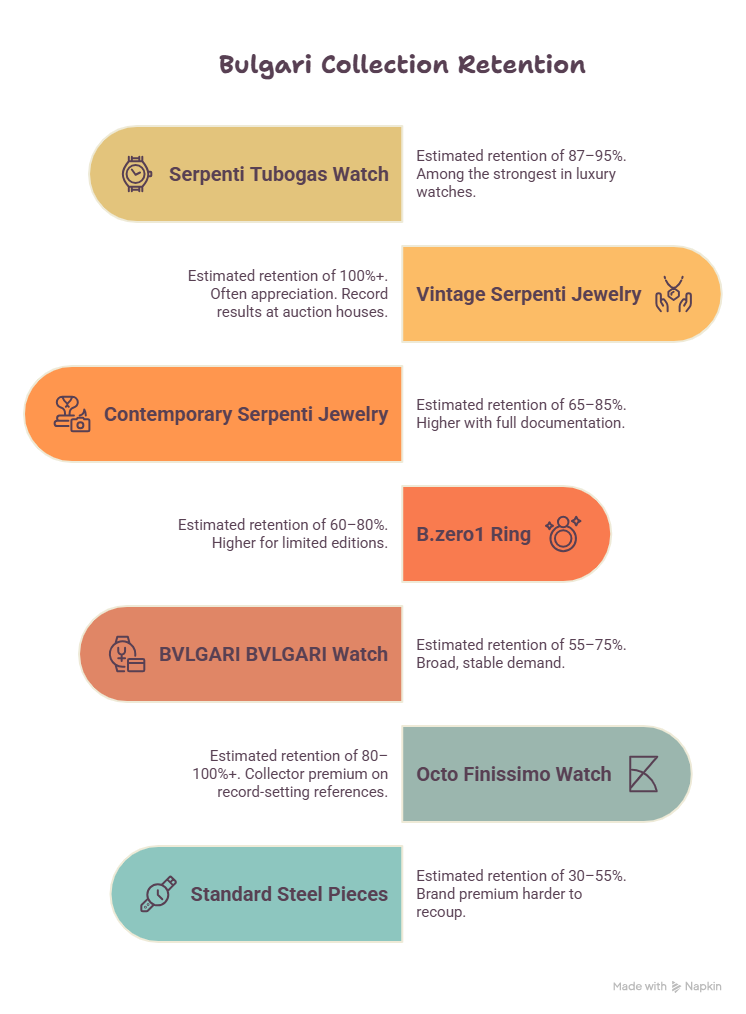
The integrated Tubogas bracelet-watch combines the iconic coil with timekeeping in a format that has attracted collectors since the 1960s. Vintage references — the BB19 and BB23 in yellow or two-tone gold — are serious collectors’ items, and the market for them has deepened considerably as the broader vintage women’s watch category has gained institutional recognition. In fact, the Serpenti Tubogas Watches for women are highly sought after for their aesthetic appeal and investment prowess.
The same forces drive the Serpenti watch’s secondary-market performance as the jewelry: the coil construction, the colored stone or diamond head, and the sense that you are wearing a living object, not just a bracelet. Gold versions offer materially better value retention than leather-strap variants. Serpenti Tubogas single-spiral models are among Bvlgari’s strongest watch performers, trading at 87–95% of original retail on average — notably higher than the roughly 75% retention typical across the broader Bvlgari watch catalog.
What to buy: Full Tubogas gold constructions with the original bracelet intact. Always verify the bracelet’s stretch and link integrity via video before purchasing — a deformed or overextended coil is expensive to restore.
How to Authenticate a Bvlgari Serpenti Tubogas Watch
Bvlgari Serpenti Tubogas Black Dial Stainless Steel Women’s Wristwatch 35 mm
The Tubogas watch carries all the jewelry authentication checks above, plus a horological layer:
The coil integrity test:
Request a video of the seller holding the bracelet and letting it rest naturally. A genuine Tubogas bracelet returns to its coiled form with controlled, even movement. An overextended or damaged bracelet will splay open unevenly or fail to hold its shape — restoration costs more than it is usually worth.
The dial and movement:
The dial is signed BVLGARI in the brand’s precise typeface. The caseback on vintage models is engraved with the model reference, serial number, and metal specifications. Modern pieces carry a Bvlgari-signed movement — request photos of the open caseback on any significant purchase.
The head construction:
The serpent’s head houses the watch dial and opens via a hinged jaw. The mechanism should operate with a precise, controlled click — neither loose nor stiff. The eyes should be flush, symmetrical, and evenly colored. Any asymmetry in the eye setting is an immediate red flag.
Paperwork:
Vintage Tubogas watches should ideally come with the original Bvlgari warranty card, box, and service history. Even a boutique receipt from a past service significantly boosts provenance value.
5. Octo Finissimo — Bvlgari’s Engineering Masterpiece
The Octo Finissimo is where Bvlgari crossed definitively from jeweler-watchmaker into the front rank of serious horology. The collection has set world records for the thinnest tourbillon, the thinnest automatic, and the thinnest mechanical watch. Its octagonal case — a geometry almost impossible to execute at these measurements — is instantly recognizable.
The stainless steel and titanium Automatics offer an accessible entry point with broad collector appeal. Record-setting complications — including the Ultra and the Minute Repeater — suit serious horological collectors who understand what these achievements represent technically. Blockchain and NFT verification on flagship Octo Finissimo models provides an additional layer of provenance that is becoming a meaningful differentiator in the pre-owned market.
What to buy: Limited-edition skeletonized references in titanium or stainless steel; these hold value most consistently. Complication pieces (tourbillon, Minute Repeater) for the highest collector ceiling.
What to avoid: Over-polished Octo cases where the sharp geometry of the octagonal lugs has been rounded. The case architecture is the watch — losing the angles loses the design.
How to Authenticate a Bvlgari Octo Finissimo
The Octo Finissimo’s extreme thinness is both its defining achievement and its most effective authentication signal. The engineering required to produce it at genuine specs is essentially impossible to replicate at a counterfeit scale.
Case thickness:
The Octo Finissimo Automatic measures 2.23mm in thickness. If the case feels or looks “normal” in thickness for an automatic watch, it isn’t genuine. This is apparent even to anyone who has handled the real thing, without tools. However, this holds true for the original 2017 Octo Finissimo Automatic, but Bvlgari has released multiple Automatic generations since then, and thickness varies by reference (some later automatics are listed closer to 2.23mm, others to 2.50mm, depending on case material and complication).
The octagonal geometry:
On an authentic piece, the eight angles of the case are sharp, perfectly symmetric, and machined to exact tolerances. Run a fingernail along the case edges — genuine pieces feel precisely defined. Rounded angles, whether from polishing or faking, are a disqualifier.
Movement visibility (skeletonized models):
Authentic skeletonized references show Bvlgari’s caliber architecture through the dial or caseback — distinctive bridges, finishing, and the signed rotor bearing BVLGARI in a clean, consistent typeface. Request detailed movement photos from any seller.
Blockchain verification (flagship models):
Select Octo Finissimo references include a blockchain-verified digital passport. Scan the QR code to pull up the watch’s registered specifications, production details, and ownership history. A missing or non-functional QR on a piece claimed to have it is an immediate red flag.
Box, papers, and warranty card:
The Octo Finissimo at retail comes with a full documentation set — box, international warranty, chronometer certification where applicable, and service guide. Missing paperwork on a recent flagship reference should materially reduce the price you pay.
Bvlgari resale value by collection — Serpenti, B.zero1, and Octo Finissimo retention rates compared
Bvlgari Resale Value by Collection: Secondary Market Data
Collection
Estimated Retention (% of Retail)
Source
Serpenti & B.zero1 (pristine condition, full documentation)
70–85%
The Diamond Oak, 2026
Serpenti & B.zero1 (visible wear, no documentation)
40–60%
The Diamond Oak, 2026
B.zero1 limited editions/collaborations
Can exceed original retail
The Diamond Oak, 2026
Most Bvlgari watches (general benchmark, broader catalog)
~75% of retail (~25% below list)
WatchCharts, 2026
Bvlgari’s overall secondary market range (jewelry, all collections)
30–70%
The Diamond Oak, 2026
Documentation uplift (box, certificate, receipt)
+15–30%
The Diamond Oak, 2026
Figures are indicative ranges based on secondary market data. Individual results vary by condition, documentation, and market timing.
Why Buy Bvlgari Pre-Owned?
The most significant price drop on any luxury piece happens the moment it leaves the boutique — the initial retail premium of 20–35% evaporates immediately on the secondary market. Buying pre-owned allows you to capture gold appreciation and brand equity without absorbing that initial hit.
Wider selection. The boutique carries the current season. The pre-owned market carries everything Bvlgari has ever made — discontinued references, vintage pieces from the brand’s creative peak in the 1960s–70s, and collaboration editions no longer available new.
Verified provenance. Reputable, authenticated platforms with in-house expertise offer full authentication guarantees and lifetime coverage. It significantly reduces the risk that has historically kept buyers cautious about pre-owned luxury.
Auction access. Christie’s, Sotheby’s, and Phillips regularly offer important Bvlgari pieces, with catalog-verified provenance, the strongest authentication available anywhere in the market.
Sustainability. Pre-owned is the most resource-efficient way to buy luxury — a point that increasingly matters to buyers who care about provenance beyond the boutique.
Frequently Asked Questions
Is Bvlgari worth buying?
Yes — for specific pieces. Bvlgari’s iconic collections combine 18K gold construction, globally recognized design, and strong secondary market demand. Bought pre-owned in the right configuration with documentation, Serpenti, B.zero1, BVLGARI BVLGARI, and Octo Finissimo pieces offer gold price upside, preserved brand equity, and a meaningful discount to retail. The investment case is strongest when you buy pieces that are unmistakably Bvlgari in unmistakably Bvlgari materials — the collections where the design is the authentication.
Is Bvlgari a good investment?
For specific pieces, yes. The B.zero1 and Serpenti collections demonstrate consistent secondary market demand across global auction houses and pre-owned platforms. Vintage Serpenti Tubogas pieces in yellow gold have appreciated meaningfully. The Octo Finissimo is among the strongest collector watches outside of Rolex, Patek Philippe, and Audemars Piguet, with record-setting complications that retain technical significance regardless of which generation supersedes them. The investment case rests on iconic pieces in high-gold-content configurations, not on the Bvlgari name applied generically.
Which Bvlgari collection has the best resale value?
For jewelry: Serpenti and B.zero1 in high-gold configurations, with vintage Serpenti consistently outperforming. For watches: the Serpenti Tubogas (87–95% retention) and limited-edition Octo Finissimo references. Colored stone pieces and documented vintage examples often appreciate rather than depreciate.
Does Bvlgari jewelry hold its value?
Selectively, yes. Iconic pieces in the right configurations retain 65–85% of retail, with gold content providing a material floor. Vintage and high-jewelry Serpenti pieces have appreciated substantially at major auction houses. Generic or heavily worn pieces perform much more modestly on the secondary market.
How does Bvlgari compare to Cartier in terms of resale value?
Cartier offers more consistent catalog performance across its range — the Love Bracelet and Juste un Clou have well-established, liquid secondary markets that are well understood by a very wide audience. Bvlgari rewards precision: choose the wrong piece, and it underperforms; choose Serpenti or B.zero1 in the right configuration, and you access a market that is increasingly deep and global. For first-time pre-owned buyers, Cartier carries a lower risk of overpaying. For collectors who know what they are doing, Bvlgari’s iconic pieces deliver genuine value and a design identity that Cartier does not replicate.
What is the single most important thing to check when buying pre-owned Bvlgari?
Construction integrity, collection by collection: flex a Serpenti to confirm individual link movement; compress a B.zero1 to confirm the spiral gives; examine the BVLGARI BVLGARI lettering under magnification for consistent depth and spacing. These physical tests catch the vast majority of fakes before you ever look at paperwork.
What is the best entry-level Bvlgari piece for a first-time pre-owned buyer?
A yellow or rose gold B.zero1 ring (3- or 4-band) or a Serpenti ring. Both are immediately recognizable, wearable daily, available at accessible pre-owned price points, and hold their value reliably in the secondary market.
For buyers in Dubai and the UAE, where is the best place to buy pre-owned Bvlgari?
The most reliable route locally is through authenticated platforms with in-house GCC expertise — The Luxury Closet, which operates across the UAE, Saudi Arabia, and Kuwait, offers curated, authenticated pre-owned Bvlgari with lifetime guarantees. Christie’s Dubai also holds regular sales featuring important Bvlgari pieces with full catalog provenance. For new retail, Europe (particularly Italy) offers the best value after VAT refunds — typically 12–18% below UAE boutique pricing for non-resident visitors.
Is pre-owned Bvlgari popular in the GCC market?
Yes — and measurably so. Christie’s UAE achieved $189,000 for a Serpenti in November 2024, and the GCC buyer base for vintage and high-jewelry Bvlgari has grown consistently. The Serpenti’s bold sculptural aesthetic and the B.zero1’s architectural identity resonate particularly strongly with regional collectors, and the pre-owned market reflects that demand in both volume and pricing.
How can I easily sell my Bvlgari piece for the best price?
Start with documentation — the original box, certificate, and receipt, if you still have them — since complete paperwork typically adds 15–30% to what a buyer will offer for an identical undocumented piece. Get the piece professionally cleaned only with gentle methods (warm water, mild soap) or through an authorized Bvlgari service center — aggressive polishing can strip the original finish and patina, which can reduce the value of vintage pieces. Photograph it honestly in good lighting, including any wear, rather than hiding flaws; transparency speeds up the sale and builds buyer trust. Then sell through a platform that authenticates in-house and offers a transparent, fully insured process — this typically nets a meaningfully better price than a generic resale marketplace or a private buyer, since authenticated platforms can offer closer to true market value rather than steeply discounting to account for authentication risk. If you’re looking to sell my Bvlgari jewelry online, The Luxury Closet accepts Bvlgari consignments across the GCC with in-house authentication, transparent pricing, and a fully insured process from pickup to payout.
The Bottom Line
Bvlgari rewards buyers who choose with precision. The pieces where design, materials, and condition align — Serpenti, B.zero1, BVLGARI BVLGARI, and the standout watch references — have earned their place in the secondary market over decades. The depreciation has already happened. The gold remains. The design endures. Browse The Luxury Closet’s authenticated pre-owned Bvlgari collection — curated for the GCC market and backed by a lifetime authenticity guarantee.
Want to know some interesting facts about Bvlgari? Here’s your chance:
7 Facts About Bvlgari You Need To Know
Also read:
Bvlgari, the Serpenti Collection, and Some Must-Haves
Bag of the Week: Bvlgari Blue Leather Serpenti Forever Shoulder Bag
Sources
The Diamond Oak —A Comprehensive Guide to Determining/Calculating the Resale Value of Your Bvlgari Jewelry, 2026
WatchCharts —BVLGARI Serpenti Prices as of June 2026
EveryWatch — “The Rise of Bvlgari Serpenti: Iconic Design, Lasting Value,” September 2025
Summer 2026 sees luxury houses increasingly framing their collections through location and atmosphere rather than product alone. Across Dior, Gucci, Loro Piana, Burberry and Brunello Cucinelli, the seasonal offering is defined by resort-ready wardrobes, destination campaigns and a continued emphasis on craftsmanship and reinterpretation of house codes for warmer weather. Dior and Gucci lean into archival motifs and lifestyle-driven storytelling, presenting collections shaped by travel and leisure settings from Saint-Tropez to Monte Carlo. Loro Piana and Brunello Cucinelli continue to foreground materiality and craft, with leather goods and knitwear rooted in artisanal processes and heritage symbolism. Burberry’s High Summer collection on the other hand, translated British outdoor culture into poolside dressing, reinforcing the role of setting in shaping seasonal identity.
The Dioriviera Collection
Dior has introduced a refreshed iteration of its Dioriviera collection, with new creative direction from Jonathan Anderson bringing a more playful and contemporary tone to the seasonal line. The ready-to-wear offering focuses on light, summer-ready silhouettes, including relaxed shirts, shorts, swimwear and striped tops for men. Prints remain central to the collection, with the Dior Arabesque motif and a reworked floral toile de Jouy pattern referencing Christian Bérard’s original artwork and the House’s archival language.
Accessories continue the seasonal shift toward ease and versatility. The Dior Book Tote is reinterpreted in terry cloth for a softer, more relaxed construction, while signature silhouettes such as the Lady Dior and Dior Blooming bags are presented in more minimal, organic finishes. Footwear includes updated mules, sandals and casual styles such as loafers and boat shoes, alongside sneakers featuring the Dior Oblique motif in new fabrications. Jewellery and small accessories extend the seasonal theme, with floral and fruit-inspired pieces, alongside playful bag charms referencing everyday objects such as measuring tapes and mirrors.
The collection is positioned as part of Dior’s broader summer lifestyle universe, supported by Dior Maison, which introduces homeware, tableware and outdoor pieces designed for resort settings. The line will be rolled out across select pop-ups and destination retail locations including Saint-Tropez, Mykonos, Bodrum and Cipriani resorts.
Gucci Monte Carlo Chapter 1
Gucci launches the first chapter of its summer campaign set in Monte Carlo, presenting a visual narrative centred on movement, leisure and escape. The campaign unfolds across pools and open water, featuring a diverse cast of models and creatives, with Monaco’s cultural and historical ties to fashion providing the backdrop. The collection focuses on relaxed summer dressing, combining tailored pieces and fluid silhouettes for women, alongside casual separates and denim for men. The Flora motif plays a central role, appearing across ready-to-wear and accessories as part of its 60th anniversary, referencing its origins in the 1960s when it was created for Princess Grace of Monaco.
Key accessories include the Gucci Jackie, Venice and Gossip bags, alongside seasonal travel pieces such as the Mercato tote and GG Monogram duffle. The campaign reinforces Gucci’s positioning of summer as a period of mobility and transition, with pieces designed to move between day and evening settings. The collection will be available globally, as well as in Gucci’s resort destinations including Forte dei Marmi, Capri, Ibiza, Mykonos and Saint-Tropez.
Loro Piana Summer from Head to Toe
Loro Piana introduces a selection of leather goods designed for summer use, focusing on lightweight construction, tactile materials and versatile silhouettes suited to both travel and everyday wear. The collection reflects the house’s emphasis on functionality grounded in craftsmanship. The Micro Bale Bag reinterprets the bucket silhouette with a compact, structured form inspired by traditional textile bales. Crafted in supple leather, it is designed to transition easily from daytime use to evening settings.
The Gioia Shopper is defined by its spacious proportions and minimal construction, offering a practical carry option while maintaining a soft, refined structure. It is positioned as an everyday summer essential. The Extra Pocket L27 Wicker introduces a seasonal material contrast, combining hand-woven wicker with calfskin detailing. Finished with a detachable strap, it is designed for flexible use across different occasions. Across the range, the emphasis remains on durability, material quality and restrained design, with accessories intended to function as long-term wardrobe pieces rather than seasonal additions.
Burberry High Summer 2026
Burberry presents its High Summer 2026 collection centred on the atmosphere of British lidos and open-air pools. The campaign, shot by Ryan McGinley and directed by Francis Plummer, features actors Simone Ashley and Tom Blyth alongside a diverse cast of models and synchronised swimmers, capturing scenes of leisure around the water’s edge. The collection translates Burberry’s seasonal vision into poolside and coastal dressing, led by refreshed iterations of the Burberry Check across swimwear, lightweight separates and accessories. Key pieces include check bikinis, swimsuits and swim shorts, alongside cotton voile shirts, skirts and cover-ups designed for relaxed layering.
For menswear, the collection focuses on relaxed tailoring and co-ordinated sets, including printed cotton poplin and updated interpretations of the Burberry Check across shirts, shorts and outerwear. Lightweight jackets and scarves extend the offering into transitional evening wear. Accessories include the Margate bag crafted from Madagascan raffia, along with sandals, slides and new Knight Runner sneakers. Crocheted hats and wraparound sunglasses complete the seasonal range. Across the campaign, Burberry positions High Summer 2026 as a celebration of British outdoor culture, combining nostalgia with contemporary resort dressing under the creative direction of Daniel Lee.
Brunello Cucinelli’s Mediterranea collection is rooted in the cultural and architectural heritage of Sicily. The project is centred around Modica, where the House stages an exclusive event celebrating Mediterranean lifestyle through a dialogue between craftsmanship, landscape and seasonal dressing. The concept draws on the idea of the Mediterranean as a historical meeting point of cultures, with Sicily positioned as its symbolic expression. The visual and creative identity of the collection is anchored in the shell motif, interpreted as a symbol of beauty, nature and artistic heritage. The motif is developed through hand-drawn illustrations and translated across ready-to-wear and lifestyle pieces in both men’s and women’s collections.
For womenswear, the shell theme is expressed through intricate OPERA knitwear pieces, including tops and mini dresses crafted using extensive handwork, sequins and modular construction to create a three-dimensional effect. For menswear, the collection focuses on relaxed tailoring in natural fabrics, including linen suits and layered ensembles that balance structure with ease. The Lifestyle capsule extends the narrative beyond clothing, incorporating ceramics, glassware, textiles and accessories featuring the shell motif, designed for home and travel use. These pieces reinforce the brand’s emphasis on artisanal craftsmanship and everyday ritual.
The Mediterranea project will culminate in a June 2026 event in Modica, set against the backdrop of Sicilian Baroque architecture, where the Summer 2026 collection will be presented in dialogue with its environment.
Special Mention:
PEDRO x Ethical Fashion Initiative: Future in Hand
PEDRO partnered with the Ethical Fashion Initiative to unveil the Future in Hand, a capsule collection that reinterprets its signature Alyssa bag through traditional hand-loomed cotton textiles from Burkina Faso. The collection centres on a dialogue between PEDRO’s structured, modern design language and the tactile irregularity of artisanal weaving. The Alyssa bag, known for its clean geometry and Grano leather construction, is reimagined in two sizes using handwoven cotton, introducing texture and variation into its otherwise precise silhouette.
The textiles are produced in Burkina Faso at CABES, a social enterprise supporting local weaving communities and preserving traditional craft techniques. Each piece is fully hand-loomed, with cotton dyed, stretched and woven by artisans using generational skills, resulting in subtle variations and rich surface depth. The capsule reflects a broader focus on craftsmanship and responsible production, positioning artisanal expertise as a core design input rather than decorative detail. Through direct collaboration with weaving communities, the collection highlights both cultural preservation and sustainable economic opportunity.
For more on the latest in luxury fashion and style reads, click here.
Museum Garments: An effective mix of classic and modern
Monday, June 29th 2026Tags: Museum Garments
Share
Share this post
Subscribe
3 Comments
Add to favourites
||- Begin Content -||
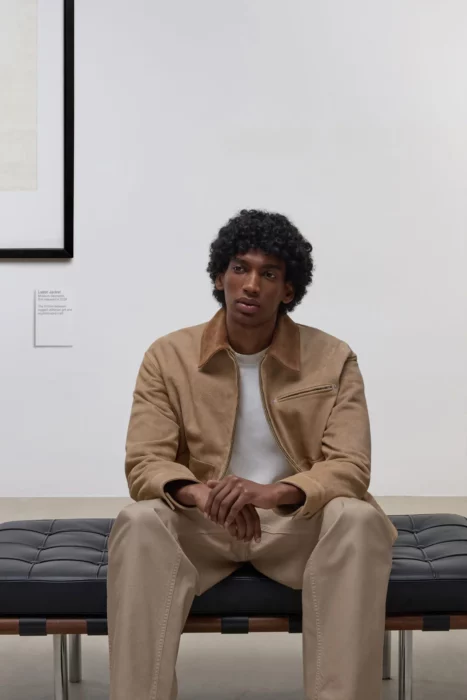
The Labor Jacket in light-beige suede
Pitti these days rarely throws up new, interesting brands. That might be partly the state of the market, partly the state of Pitti, but either way it hasn’t been about discovery for a while. You see new things but not new names.
Fortunately there was one exception this summer, as we met the guys behind Museum Garments for the first time, and they were genuinely exciting.
They’d been on our radar because we saw them at Colbo in New York last autumn, and indeed recommended a sweater in the October round-up. But it was very different seeing a fuller range, and meeting the founders.
Alain Duruy and Oscar Fassenot have a real enthusiasm for classic clothing, but they come from the fashion industry rather than starting as amateurs, which makes the brand more mainstream and gives a modern, cleaner aesthetic to a lot of their interpretations of heritage pieces.
Close-up on the Labor Jacket
It’s hard to appreciate much online – so much is about the materials.
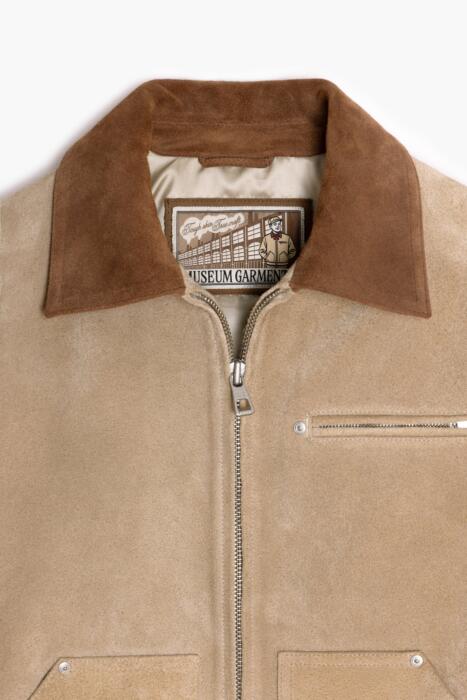
Take the Labor Jacket for example. Online it’s impossible to see what the suede is like – not just whether it’s good or bad, but whether it’s light or heavy, soft or rugged. In person it’s clearly decent quality, but it’s also an interesting intersection of luxury and workwear – substantial and tough, but not as hard and heavy as a pure repro piece.
The same goes for the fit – the jacket has a unique, deliberate design, with a slightly wider shoulder and tapered waist, but it’s neither a straight reproduction nor as exaggerated as A Presse, Lemaire or other fashion brands. (I took a medium.)
What you do get a sense of online is the design in terms of things like colours and hardware. It feels simple and muted, with collar and body materials in related, complementary shades.
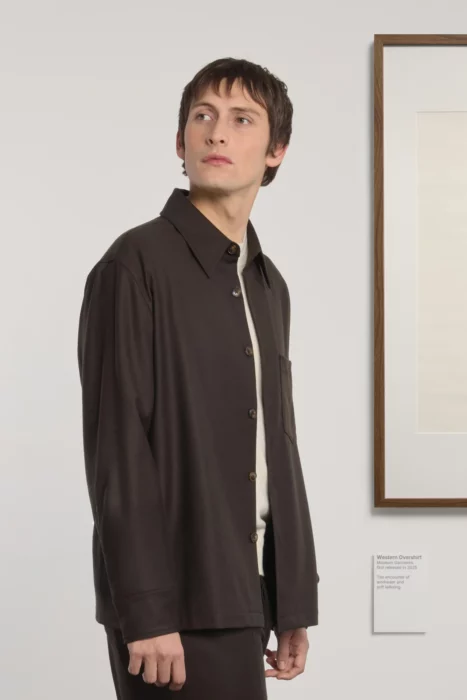
The Western Overshirt in dark-brown flannel
That jacket was the first thing I tried on at Pitti – suede outerwear being a real weakness of mine – and it was impressive. We immediately tried a white hunting jacket (not currently online) and a wool overshirt (above).
Both had that same feeling in the materials: more substance than a high-street piece, a little thicker, a little denser, suggesting the appreciation of vintage. But also quite modern: the chore very tonal with white cord on the collar, the overshirt stipped back to a single chest pocket, and with matching trousers.
The hunting jacket was the best fit I’ve ever found in a piece like that – the originals are so short and so A-line, that a reproduction feels almost comical, yet a normal fit loses all of the character. This was a nice place in between.
The reason I probably find Museum Garments so interesting is this meeting of worlds: it’s an interesting option for the PS reader that wants heritage-inspired quality but a more modern approach, and considered design without big-fashion prices (the jacket is £1150, the overshirt £240).
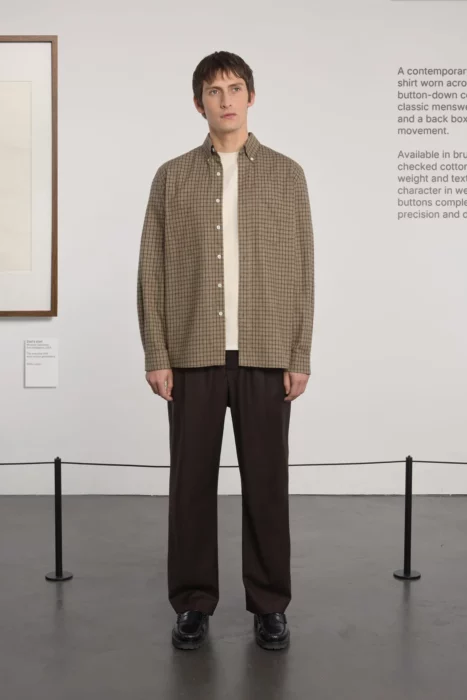
The Dad’s Shirt in brown/green checked flannel
We’re not talking the most luxurious materials, of course, nor the handwork we often cover on PS, but for most of these garments you don’t necessarily want that.
It’s interesting to compare the brand to someone like Buck Mason, which is cheaper but offers straighter heritage designs rather than modern interpretations. I feel like some readers will err more towards the traditional side like Buck, others towards a modern take like Museum Garments.
There are some Museum Garments designs I don’t like. The ‘Dad’s Shirt’ has a small button-down collar, for example, which I don’t think is great (above). But it is referencing a particular look – nineties Polo one-pocket shirts, big and untucked, and that’s not what I’m after.
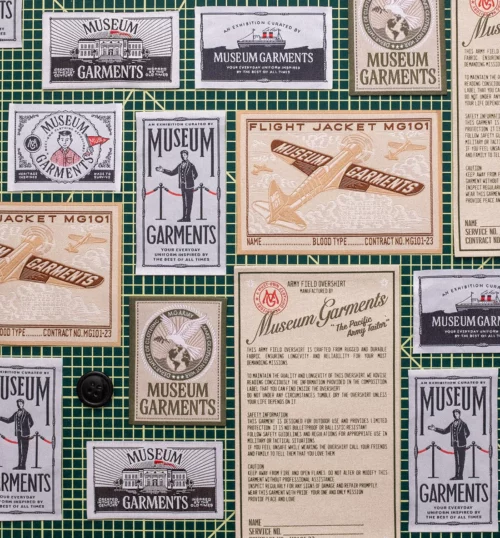
Some of the different labels
This inspiration is spelled out on all the labels of the Museum Garments clothes, which is a nice touch.
Every piece has a different one, and for the Dad’s Shirt it’s a little cartoon of an Ivy-looking gentleman working away at his desk. The Pumpist Jacket has a service station, the Labor Jacket a stylised factory with the smoke saying ‘Tough Skin, True Craft’.
“We like the fact that the labels connect us to the customer, telling them what we were thinking about,” says Alain. “It’s also something that’s just for the wearer, as nobody else sees it. It’s a little reminder every time they put it on.
“We do love vintage clothing but it can be a little dusty, a little tough,” adds Oscar. “And we’re French, from Paris, so we wanted a little bit of that French chic. That’s why a lot of the designs are quite stripped back.”
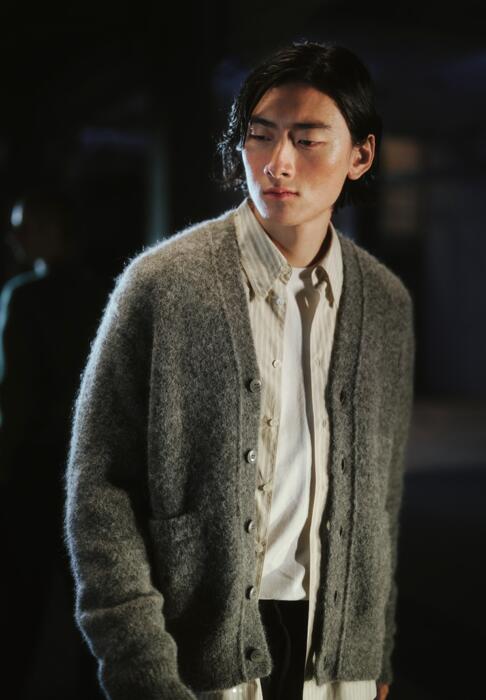
Layered pieces – relaxed, but not exaggerated shapes
With this kind of menswear that can be a problem – the clothes and the lookbooks often seem rather unremarkable, because the pieces are classic and the designs so simple. The Museum Garments clothes are a good example of this, and it really does mean it’s best to see them in person, to appreciate both the details and the materials.
Unfortunately the brand isn’t stocked widely yet, but that’s because they only launched in 2024 and are properly starting wholesale for the first time this season. So the various stockists that came to see them in Florence and Paris (including No Man Walks Alone) will have the clothes in spring 2027.
For the moment, the availability is online, at Colbo, and in a handful of places in France and Switzerland. There will also be Galleries Lafayette in France this autumn, and Ships in Japan. Hopefully there will be more soon.
www.museumgarments.com
Related posts
Museum Garments: An effective mix of classic and modern
June 29th 2026 – 3 Comments
Read More
Stoffa, Decorum and Dalmo: summer showroom events
June 26th 2026 – 12 Comments
Read More
Introducing: The Bruce short
June 24th 2026 – 69 Comments
Read More
<!–
Subscribe to this post
You can follow the discussion on Museum Garments: An effective mix of classic and modern by entering your email address in the box below. You will then receive an email every time a new comment is added. These will also contain a link to a page where you can stop the alerts, and remove all of your related data from the site.
UoF’s latest lesson, Drafting a Turtleneck Knit Top – 2 Variations, part of a cut & sew knit-drafting series. (Image credit: University of Fashion).
Today’s lesson is all about the mighty turtleneck — the fashion world’s version of a warm neck hug. We’ll be drafting not one, but two variations: one with a neckline seam (for those who like a bit of drama) and one that’s all-in-one (for the no-fuss minimalists). By the end, you’ll know exactly how to decode a turtleneck sketch like a pro.
Reading the Seamed Turtleneck Knit Top Sketch
First things first. Start by analyzing the sketch, in this case, the turtleneck with the neckline seam. Determine crucial details such as the front neck drop, how far that neckline runs from shoulder to neck, the center back drop, and of course, the turtleneck height. Because yes, in fashion, a few millimeters can mean the difference between “chic Audrey Hepburn” and “help, I can’t breathe!”
Reading the All-in-One Turtleneck Knit Top Sketch
Analyze the all-in-one turtleneck sketch for proportion and measurements. (Image credit: University of Fashion).
When planning your all-in-one turtleneck knit top, it’s time for some big decisions. First up: How tall will your turtleneck stand? Are you going for elegant-and-refined or full-on “I’m hiding from humanity” height? Next, check if your fabric stretches enough to slip over your head—without ripping seams or your pride. If your fabric’s on the stubborn side, congratulations: you’ve just earned yourself a zipper at the back! Just know that with a zipper, the turtleneck won’t slouch dreamily—it’ll stand more like a soldier on duty. Finally, measure how far that neckline travels from shoulder to neck and how much the center back dips—because even turtlenecks like to keep their proportions in check.
Do You Have Your Stretch Degree?
If you haven’t already mastered the mysterious math of stretch ratios, check out our lessonsIntroduction to Knit FabricsandKnit Fabric Principles. Because when your fabric bounces back like an overcaffeinated bungee cord, you’d better plan your design details accordingly.
In the end, designing your turtleneck is all about balance—between comfort and drama, structure and ease. Whether you choose a sleek, stand-up collar or a cozy, fold-over style, remember that every decision shapes both the look and the feel of your finished piece. After all, a well-planned turtleneck doesn’t just frame your face—it tells the world exactly how you’d like to be seen.
Friday, June 26th 2026Tags: AssisiAtelier LavoroDalmo CashmereStoffathe anthologyThe DecorumThe Finery Company
Share
Share this post
Subscribe
5 Comments
Add to favourites
||- Begin Content -||
Summer tends to be a little slower, with most people planning or already on holiday. Even so, it’ll be a busy few months in the Permanent Style showroom this year, with six brands coming between July and September.
It’s also an exciting one, as we have Stoffa coming back to the UK for the first time in years, and new shows from The Decorum and Dalmo.
July 7-14th
The Anthology trunk show
Bespoke and MTM tailoring only, by appointment
Contact here
July 16-18th, Thursday to Saturday
Decorum
The Decorum do regular events with Trunk for their Continuum line with Yasuto Kamoshita. This is separate – their other Decorum clothing and other collaborations, including jeans with Full Count for example
Of particular interest will be their MTM tailoring, with styles developed with Kim Min Soo of Assisi. We’ll report on this at the time
10am to 6pm, appointment encouraged, though walk-ins are welcome
Appointments can be booked here or by contacting trunkshow@thedecorumbkk.com
August 20th-22nd, Thursday to Saturday
Stoffa
The last time Stoffa came to London was in 2023, so we know their trunk show will be welcomed by PS readers who are eager to see the material, cut and styling of their product in person
By appointment only, 9:00am to 7:00pm
Stoffa will be showcasing their RTW pieces for Autumn-Winter 2026 and taking fittings for their MTM service – appointments can be booked here
September 4-6th, Friday to Sunday
Dalmo
First trunk show here from the small, family-run Tuscan knitters
Dalmo will be offering MTM and RTW pieces – reviewed here
Appointments can be made by email or WhatsApp: dalmocashmere@gmail.com and +39 347 840 1911
September 11-13th, Friday to Sunday
Assisi, plus TFC Bespoke and Atelier Lavoro
Sartoria Assisi, offering handmade to measure
TFC Bespoke as the bespoke offering
Atelier Lavoro offering made-to-measure Americana, both casual clothing and tailoring
Readers are encouraged to come and see the brands, with no pressure. Worth making an appointment by emailing sartoria.assisi@gmail.com
September 17-19th, Thursday to Saturday
J. Mueser
MTM tailoring, shirts and outerwear, by appointment only
Contact team@jmueser.com
Dalmo made-to-measure crewneck
Finally, we’ll be hosting our third pre-owned sale in late September, but details on that will be announced closer to the time.
Events from October onwards, including PS pop-ups in London and New York, will also be announced later.
Stòffa ready-to-wear
Related posts
Stoffa, Decorum and Dalmo: summer showroom events
June 26th 2026 – 5 Comments
Read More
Introducing: The Bruce short
June 24th 2026 – 59 Comments
Read More
Video with Ben Clarke (Atelier Tyzack) on soft v structured cuts
June 22nd 2026 – 43 Comments
Read More
<!–
Subscribe to this post
You can follow the discussion on Stoffa, Decorum and Dalmo: summer showroom events by entering your email address in the box below. You will then receive an email every time a new comment is added. These will also contain a link to a page where you can stop the alerts, and remove all of your related data from the site.
By Ranjana Jain, a luxury editor and resale specialist | June 2026
Hermès has created over 250 distinct shades across its history, and color is never an afterthought. At this level of investment, whether you’re buying your first Birkin or adding a fifth Kelly to your collection, choosing the right color is as strategic as choosing the right leather or hardware. This guide covers all major Hermès colors, their family, their alphanumeric codes, leather interactions, resale performance, and a practical decision framework for collectors at every stage.
Table of Contents
The Hermès Color System: How Color Codes Work
The Story Behind Hermès Orange (Code 93)
How Hermès Releases and Retires Colors
New Hermès Colors for 2026: Spring/Summer Additions
The Classic Hermès Neutral Palette
Hermès Blue Colors: The Largest Color Family
Hermès Reds, Pinks & Statement Shades
Hermès Greens, Yellows & Purples
Discontinued Hermès Colors: The Collector’s Hunt
How Leather Type Changes Hermès Color
Hermès Color & Resale Value: What the Data Shows
Best Hermès Colors by Bag Model
Hermès Hardware & Color Pairings
How to Choose the Right Hermès Color: A Decision Framework
Buying Pre-Owned Hermès: The Key to Accessing Discontinued Colors
Frequently Asked Questions: Hermès Colors
Buying Pre-Owned Hermès in Dubai
Buying Pre-Owned Hermès in Saudi Arabia
1. The Hermès Color System: How Codes Work {#color-codes}
Every Hermès color carries a unique alphanumeric code stamped inside the bag — an essential reference for collectors, resellers, and buyers shopping the secondary market.
Gold
Code 06 / 37 · Neutrals
#C4973E
Noir
Code 89 · Neutrals
#1A1A1A
Étoupe
Code 18 · Neutrals
#8E8275
Craie
Code 10 · Whites
#E8E3DC
Étain
Code 8F · Greys
#7E7B72
Orange H
Code 93 · Brand signature
#E8601C
Rouge H
Code 46 · Reds
#7A2028
Rouge Casaque
Code Q5 · Reds
#C0182A
Blanc
Code 01 · Whites
#F2EEE8
Bleu Nuit
Code 2Z · Blues
#1B2A45
Doré
Code Y9 · Metallics · A/W 2024
#B8B0A0 + sheen
Hex values are the closest digital approximations based on leather photography and color descriptions across multiple lighting conditions. Hermès does not publish official hex codes. The same code appears to differ meaningfully across leather types (Epsom, Togo, Swift) and light sources.
Hermès Color Comparison
Classic, seasonal, and brand signature shades — with accurate color codes and family groupings.
Colour
Code
Family
Neutrals
06 / 37 Neutrals
89 Neutrals
18 Neutrals
10 Neutrals
8F Neutrals
Brand Signature
93 Brand signature
Whites
01 Whites
Reds
46 Reds
Q5 Reds
Blues
2Z Blues
Metallics
Y9 Metallics
P.S. Swatches are calibrated approximations. Actual Hermès colors vary by leather type and production year.
When shopping pre-owned, always verify the interior color code against reference photography — the same Hermès shade can look dramatically different under different lighting conditions.
2. The Story Behind Hermès Orange (Code 93) {#orange}
Hermes Birkin 30 Gold Togo Calfskin Leather Top Handle Bag
Hermès Orange was born from wartime necessity, not design intent.
During World War II, material shortages forced Hermès to replace its traditional cream-and-yellow packaging with whatever cardboard stock was available — which happened to be orange-tinted. The shade proved so visually arresting that it was retained permanently. Today, Orange H (code 93) is among the most recognizable brand signatures in global luxury. The orange box tied with brown grosgrain ribbon is, for many collectors, as coveted as the bag itself.
3. How Hermès Releases and Retires Colors { #release-cycle}
Hermès refreshes its palette twice yearly — Spring/Summer and Autumn/Winter — introducing five to seven new shades each season. Some colors run continuously for years; others appear for a single season before being “rested” or permanently retired.
Why Scarcity Is Deliberate
This rotation is strategic. Discontinuing shades:
Creates urgency around seasonal releases
Gives retired colors collector rarity status on the secondary market
Maintains the perception that every color is a considered, limited choice
The Original Core Palette
When Hermès handbags were first introduced, the color range was deliberately restrained. The foundational shades were:
Noir (89)
Rouge H (46)
Etoupe (18)
Gold (06)
Orange H (93)
This was later expanded to include Blanc (01), Etain (8F), Rouge Casaque (Q5), Craie (10), and Bleu Nuit (2Z) — shades that now form what collectors recognize as the classic core palette. Note that Blanc and Orange H have become increasingly scarce in boutiques in recent seasons.
4. New Hermès Colors for 2026: Spring/Summer Additions {#ss2026}
The S/S 2026 collection launched under the maison’s annual theme “Venture Beyond”, with five new shades added to the palette.
A/W 2024 Introductions (Still Available)
Color
Description
Leather
Doré (Y9)
Metallic gold
Chamkilight Goatskin
Vert Peppermint
Light, effervescent green
Various
Gris Platine
Cool silvery grey with faint blue undertones
Various
S/S 2026 New Colors
Color
Description
Notes
Guimauve
Saturated marshmallow pink
Richer than Mauve Sylvestre, softer than 5P Bubblegum
Bai Brun
Deep warm brown
Darker than Ébène
Carbone
Cool charcoal grey
Utilitarian elegance
Crème Chantilly
Crisp cream
Reserved for exotic skins only
Purple (S/S 2026)
Bright ultraviolet-adjacent
High collector interest
5. The Classic Hermès Neutral Palette {#neutrals}
The house’s most enduring shades are its neutrals — refined by design, each with distinctive undertones and behavior across different leathers.
Gold (06/37) — The Definitive Hermès Shade
Hermes Gold Togo Birkin 30
A warm, tawny camel with honey, caramel, and café-au-lait undertones. Gold is arguably the single most iconic Hermès color. It develops a luminous patina over time on full-grain leathers like Togo and Barenia, traces directly to the house’s equestrian heritage, and consistently leads the secondary market in both volume and price premium.
Noir (89) — Universally Liquid
Hermes Birkin 35 Noir Togo Calfskin Leather Top Handle Bag
Black is the house’s most versatile color — seasonless, occasion-independent, and among the fastest-moving shades on resale platforms globally. In Box Calf, Noir achieves a mirror-like formality; in Togo, it becomes a structured everyday workhorse.
Etoupe (18) — The Sophisticated Greige
Hermes Etoupe Togo Leather Palladium Finish Birkin 25 Bag
A complex mix of grey and taupe with warm brown undertones that shift in different light conditions — almost a different color depending on whether you’re indoors or in natural light. Etoupe photographs beautifully and pairs with virtually any wardrobe. One of the strongest all-round performers on the resale market.
Craie (10) — The Modern White
HERMES Birkin Craie Togo Leather Size 30 Tote Bag
A chalky white with smoke and blush undertones, free of the yellowish cast found in cream whites. Craie reads as precisely modern. Adjacent on the spectrum is Nata, a warmer ivory. Both hold strong secondary market value.
Etain (8F) — Moody Medium Grey
Hermes Birkin 25 Etain Leather Y Stamp Bag
A medium grey blended with bark-brown warmth, especially striking against Rose Gold hardware. One of the most consistently strong-performing grey tones on resale platforms.
Gris Tourterelle — The Quiet Chameleon
Hermes Gris Tourterelle Togo Leather Palladium Hardware Kelly Retourne 32 Bag
A soft, turtledove grey that shifts between bluish and almost-beige depending on the light source — one of the most quietly versatile shades in the entire Hermès palette.
6. Hermès Blue Colors: The Largest Color Family {#blues}
Blues offer the widest range of any Hermès color family — from near-black depth to washed casuals — making them uniquely flexible between statement and near-neutral.
Shade
Character
Best For
Resale Strength
Bleu Nuit (2Z)
Deep rich navy
Evening, black alternative
★★★★★ (85–90% retail retention)
Bleu Marine
Classic deep navy
Vintage heritage
★★★★
Hermes Purple Hermes Kelly II Retourne 32 Iris Clemence Leather Top Handle BagHermes Evelyne 16 Amazone Purple Leather Bag
Purples are among Hermès’ most deliberately limited color families — fewer options than blues or reds, which significantly heightens desirability. The vivid Purple introduced in S/S 2026 — described as a bright ultraviolet-adjacent shade — is already generating significant collector attention and is expected to be a strong performer at auction.
Discontinued Hermès Colors: The Collector’s Hunt
Hermès rarely announces color retirements. A shade simply fades from seasonal lookbooks and boutique stock, becoming finite — and more valuable — on the secondary market. Some shades are permanently discontinued; others are “rested” and may return in limited or updated forms. Note on color codes: Unlike current production shades, retired colors do not have consistently documented alphanumeric codes across production years. Where codes appear in circulation, they vary by year, leather, and source. We have omitted codes for discontinued shades to avoid publishing figures that cannot be reliably verified.
Vert Anis
Greens · Discontinued
A vivid yellow-green reminiscent of anise or bright apple. Produced primarily in Epsom and Chèvre, it was polarising during its production years — and is now one of the most coveted retired shades, commanding strong premiums at auction.
Granny (Vert Cru)
Greens · 1990s / briefly 2005
A bright Granny Smith apple green, originally produced in the 1990s as Vert Cru and briefly reintroduced in 2005 before disappearing again. Now found almost exclusively in vintage and early-2000s pieces.
Potiron
Oranges · c. 2003–2005
French for “pumpkin” — a muted, warm orange with brown undertones produced mainly in Chèvre de Coromandel, Clémence, and Togo. It occupies the middle ground between Orange H’s vibrancy and Gold’s neutrality.
Mangue
Oranges · 2011 · Discontinued
A saturated mango yellow-orange produced briefly in Clémence and Togo. Its short production run made it a rarity almost immediately — very few examples have appeared at global auction.
Argile
Neutrals · 2009 · Discontinued
French for “clay” — a grey-beige neutral with a subtle pink undertone that distinguishes it from both Étoupe and Gris Tourterelle. Produced mainly in Clémence and Swift before retirement, a quiet target for collectors who favor nuanced, complex neutrals.
Soufre
Yellows · 2012 · Discontinued
A sharp, acidic sulfur-yellow introduced in 2012, produced almost exclusively in Epsom. Its brief and bold appearance made it collectible almost before it was recognized as discontinued.
Bougainvillea
Reds · 2009 · Discontinued
A vibrant red with strong raspberry-violet undertones, produced in 2009 primarily in Clémence and Togo. One of the more unusual entries in the discontinued red family — not a true red, not quite a pink.
Rosy
Pinks · Single season · Rested
A deeper, more complex pink was introduced for a single Autumn/Winter collection with no confirmed revival. Distinct from Rose Sakura’s blush and Rose Confetti’s playfulness, a quieter, more serious pink that remains a targeted rarity among collectors.
How to Source Discontinued Hermès Colors:
Hermes Birkin 30 Vert Anis Green Clemence Leather Bag
The secondary market is the primary avenue, as Hermès does not restock retired shades. Major auction houses (Sotheby’s, Christie’s) occasionally feature premium examples, especially in exotics or pristine condition. Authenticated resale platforms, such as The Luxury Closet, provide more consistent access to standard leathers.
Hermes Evelyne TPM Bougainvillier Taurillon Clemence Leather Crossbody BagHermes Argile Tadelakt Leather Guilloche Kelly Sellier 32 Bag
Prioritize condition reports, stamp verification, color code confirmation, and provenance. Reputable sellers with authentication and return policies are essential, given the heightened risk of misrepresentation for rarities. Wishlist alerts on trusted platforms can help secure specific pieces, such as a Vert Anis Birkin or an Argile Kelly.
9. How Leather Type Changes Hermès Color {#leather-effect}
The same color code looks meaningfully different across different leathers. This is not a caveat — it is one of the most important variables in any Hermès purchase decision.
Hermes Birkin 30 Gold Togo Calfskin Leather Top Handle BagHermes Birkin 30 Gold Epsom Calfskin Leather Top Handle BagHermès Gold Clémence Mini Lindy 20Hermes Gold Swift Tressage Birkin 30
Clemence
Pebbled taurillon, softer
Slight slouch; more susceptible to watermarks
Neutrals; relaxed Birkins
Swift
Smooth supple calfskin
Luminous depth; exceptional for bold and pastel shades
Pastels, vivids; special-occasion pieces
Box Calf
Smooth, glossy
Mirror-shine with use; formal
Noir, Rouge H, deep greens, navies
Exotic skins
Varies
Amplifies color and texture simultaneously
Neutrals, metallics (for pattern); vivids (for statement)
Note on exotic skins: CITES documentation is required for cross-border travel and resale of alligator, crocodile, lizard, and ostrich leathers. Always confirm documentation when purchasing pre-owned exotics.
10. Hermès Color & Resale Value: What the Data Shows {#resale}
Color is one of the most decisive factors in resale liquidity and price premium on the secondary market.
The Big Three: Safest Long-Term Investment Colors
Hermes Birkin Etoupe Togo Leather Size 35 Tote Bag
Noir, Gold, and Etoupe are universally regarded as the most reliable long-term holds:
Broad appeal ensures a consistent global buyer pool regardless of trends
Sell within days on major authenticated resale platforms
A Birkin 30 in Togo Gold recorded a 66% value increase between 2021 and 2024
Bold Colors That Have Outperformed
Certain non-neutral shades have demonstrated the ability to outperform classics under the right conditions:
Rose Sakura (3Q)
Vert Criquet
5P Bubblegum
Vivid purples
These have set records at Sotheby’s and Christie’s, particularly in smaller bag sizes. The key distinction: neutrals reward long-term holds; on-trend seasonals can yield strong short-term returns for nimble buyers.
GCC Market Note
For buyers in the UAE and wider Gulf region, the tax-free environment makes resale economics particularly compelling. A Birkin 25 purchased at retail and resold in pristine condition can realistically achieve 2–2.5× its purchase price with zero capital gains liability.
Want to know more about the resale value of Hermes bags? This one is for you:
Do Hermès Bags Appreciate in Value? Which One is the Best Investment?
11. Best Hermès Colors by Bag Model {#by-model}
Birkin
Priority
Recommended Colors
Investment/resale
Gold, Noir, Étoupe, Craie, Nata
Statement with proven secondary market
Vert Criquet, Rouge Casaque
Hermes Gold Leather Constance Elan Bag in Pristine ConditionHermes Constance 18 Yellow (Jaune Ambre) Alligator Mississippiensis Shoulder Bag in Excellent Condition
24 cm and Élan: Noir, Gold, Étoupe, Nata, Craie
Mini (18cm): Rouge H, Rose Sakura, Jaune Doré, metallic work well given the small format
Picotin
The Picotin’s relaxed bucket-bag character actively invites color experimentation:
For color: Vert Criquet, Bleu Saphir, Bleu Orage, Rose family
For versatility: Noir, Étoupe, Gold, Gris Meyer, Craie (PM 18)
Two-tone Casaque editions form a distinct and highly collectible sub-category
12. Hermès Hardware & Color Pairings {#hardware}
Color and hardware are inseparable — the wrong combination can undercut both elements.
Rose Gold Hardware
Etain, pinks, soft neutrals
Etain + Rose Gold is considered iconic
Gold HW + Exotics
Porosus Crocodile, Niloticus Crocodile
Most formal and highest-value combination
Hardware adds a significant premium on the secondary market. Do not treat it as an afterthought — it is a core specification decision equal to color and leather.
13. How to Choose the Right Hermès Color: A Decision Framework {#decision-framework}
Step 1: Context Check
Is this your first Hermès bag? A first purchase almost always favors a classic neutral from the Big Three. A third or fourth bag is where individuality and color exploration make more sense.
Step 2: Function Check
What is the bag’s primary role?
Daily work → More resilient leather, neutral shade
Evening or occasion use → Swift leather, statement color an option
Dual-purpose → Etoupe, Bleu Nuit, or Etain (shade that functions across registers)
Step 3: Hold Period Check
How long do you plan to keep it?
Long-term (3+ years) → Big Three neutrals; proven resale liquidity
Short-term/speculative → Consider on-trend seasonal shades with strong immediate demand
Step 4: Wardrobe Reality Check
What does your wardrobe actually contain — not what you plan to buy?
Style your bag around the clothes you genuinely wear. If your wardrobe skews dark or monochromatic, Etoupe or Craie will integrate seamlessly. If you dress in color, a saturated blue or red Hermès bag can anchor an entire look.
Step 5: Lifestyle Context
For buyers in the GCC region, Dubai’s social calendar — formal dinners, hotel terraces, business lunches, evening events — naturally favors elevated neutrals and structured classics. Noir and Gold Kelly Selliers, Etoupe Birkin 30s, and Craie Constances align with this register. Brighter shades work as a lift against neutral dressing, but consider the full range of occasions the bag needs to cover.
Step 6: The Five-Year Test
Will you regret this color in five years? The most common Hermès regrets are almost always about a classic neutral not purchased, rather than a bold shade that was loved and used well.
14. Buying Pre-Owned Hermès: The Key to Accessing Discontinued Colors {#preowned}
The pre-owned market is the most practical route to many colors in this guide — especially discontinued and rested shades that no longer appear in boutiques.
Why Pre-Owned Works Better for Color Hunters
Boutiques release stock on their own timelines; the secondary market offers access on yours
Discontinued shades — Bleu Marine, vintage Rouge H, and rested classics — exist only in pre-owned inventory
Authenticated resale platforms can match exact specifications: color code, leather, hardware, size, and production stamp — in a way that boutique waitlists structurally cannot
Pre-Owned Buying Checklist
Before purchasing pre-owned Hermès:
✅ Verify the color code against the interior stamp
✅ Compare against reference photography in multiple lighting conditions (the same shade shifts significantly)
✅ For exotic skins, confirm the presence of CITES documentation before purchase — this affects both legal ownership and international resale rights
✅ Use a reputable authentication platform with a documented authentication process
For expert-curated, authenticated pre-owned Hermès bags in coveted colors and leathers, explore The Luxury Closet — a trusted platform offering genuine pieces with rigorous authentication and often better availability than waiting lists.
15. Frequently Asked Questions: Hermès Colors
What is the most popular Hermès bag color?
Gold (06/37) and Noir (89) consistently trade at the top of the secondary market. Gold is often cited as the single most iconic Hermès shade — a warm, camel-toned brown with honey and caramel undertones that suits every model and leather. Noir is the ultimate safe classic: occasion-agnostic, seasonless, and universally desirable. If forced to name one, most seasoned collectors would say Gold is the color most synonymous with the house.
Which Hermès color holds its value best?
The “Big Three” — Noir, Gold, and Etoupe — are the most consistent value-retainers in the secondary market. They attract the broadest buyer pool and are the least susceptible to shifting trends. Beyond these, Craie and Etain perform strongly, and Rose Sakura has demonstrated sustained value. Specialist data show that a Birkin 30 Togo Gold appreciated by 66% between 2021 and 2024, while bags in classic colors in excellent condition typically sell within days on premium platforms.
What is the best Hermès color for a first bag?
For a first Hermès purchase, a classic neutral is almost universally advised — Gold, Noir, or Etoupe. These shades offer the greatest wardrobe compatibility, the best long-term resale position, and the lowest risk of buyer’s regret. Many collectors who started with a bold color wish they had begun with a neutral; very few who started with Gold or Etoupe feel they missed out.
What is Hermès Etoupe, and why is it so popular?
Etoupe (color code 18) is Hermès’ signature greige — a blend of grey and taupe with subtle warm brown undertones. Its popularity lies in its chameleon quality: it appears cooler in shade and warmer in sunlight, pairs with virtually every wardrobe color, and bridges casual and formal dressing with equal ease. Among collectors, Etoupe with Gold Hardware on Togo leather is one of the most coveted and consistently liquid configurations across every model.
What is the rarest Hermès bag color?
Rarity is determined by production volume, age, and whether a color has been retired or rested. Among rare shades, Jaune Poussin (a soft eggshell yellow) is considered a contemporary collector’s unicorn for its limited production. Anemone purple is rare because Hermès produces far fewer options in the purple family. Vintage shades such as Bleu Roi also qualify. In the exotic skin category, Himalayan Crocodile — a gradient from smoky grey to near-white, unique to each piece — is the apex of rarity.
What are the newest Hermès colors for 2025 and 2026?
For Spring/Summer 2025, Hermès introduced Rouge Radieux (a vivid, deeply saturated red with blue undertones), Vert Mangrove, Bleu Tie (a muted mid-tone blue-grey), Gris Pantin, and Gris Argenté (a refined metallic grey). Doré metallic gold and Rose Darling (a soft peach-pink) from A/W 2024 continued into wider production.
For Spring/Summer 2026 (“Venture Beyond”), new shades include Guimauve (saturated marshmallow pink), Bai Brun (deep, rich brown darker than Ébène), Carbone (cool charcoal grey), Crème Chantilly (for exotic skins only), and a vivid Purple reminiscent of Ultraviolet.
Does the color of a Hermès bag affect authentication?
Color itself does not authenticate a bag, but it is a useful cross-reference tool. Counterfeit bags frequently misrepresent colors, using incorrect shades for the codes they claim. When authenticating, the color should match its declared code under natural light and reference imagery from trusted sources. Always request clear daylight photos from multiple angles; indoor and flash photography can significantly distort how a shade reads. Authentic Hermès leathers also have a characteristic depth and variation that flat-dyed counterfeits cannot replicate.
Can I special-order a custom Hermès bag color?
Yes — Hermès offers a Special Order (SO) or Horseshoe Stamp program that allows established clients to commission custom configurations, including color and leather combinations not in standard production. Special Order pieces often combine two colors (Verso), select from a broader leather menu, and use specific hardware finishes. These pieces typically carry a premium on the secondary market. However, access is at the discretion of the boutique and the client relationship manager, and waiting periods can be lengthy.
How does leather affect the way a Hermès color looks?
Significantly. The same color in Epsom will appear brighter and more saturated than in Togo, resulting in a softer, more matte appearance. Clemence produces a slightly darker, slouchier interpretation. Swift absorbs dye most deeply, giving colors a glowing, luminous quality — particularly striking in pastels and vivids. Box Calf adds high-gloss depth to dark colors. Always check the leather type alongside the color code, and reference photography taken in natural daylight.
16. Buying Pre-Owned Hermès in Dubai {#dubai}
Where can I buy an authentic pre-owned Hermès bag in Dubai?
Dubai has a well-developed luxury resale ecosystem, with several authenticated platforms operating both in-person and online across the city. When purchasing pre-owned Hermès in Dubai, the most important factors are the platform’s authentication process, transparency in condition grading, and the availability of original purchase receipts or provenance documentation. Among platforms with a dedicated GCC presence and a rigorous multi-point authentication framework, The Luxury Closetis consistently regarded as one of the most trusted, stocking a broad range of Birkins, Kellys, and Constances in coveted colors and leather combinations that are increasingly difficult to source directly from boutiques.
Is buying pre-owned Hermès in Dubai a good investment?
For UAE residents, the investment case for pre-owned Hermès is particularly compelling. The UAE applies a standard 5% VAT on purchases — significantly lower than Saudi Arabia’s 15%, making it the most cost-efficient entry point in the GCC for acquiring luxury goods. Crucially, the UAE levies no capital gains tax, meaning any appreciation realized on resale is entirely retained by the seller. These two factors, combined with a low acquisition tax and zero tax on profit, create a structurally favorable environment for Hermès as an appreciating asset.
The performance data supports this. Specialist resale records show a 66% increase in value for the Birkin 30 Togo Gold between 2021 and 2024. The Constance has shown the strongest average resale value among Hermès models in the UAE secondary market, followed closely by the Kelly. Buying authenticated pre-owned pieces in excellent condition through established platforms allows buyers to enter at below-boutique-equivalent pricing while benefiting from the same appreciation trajectory as retail purchases.
What Hermès bag colors sell best in Dubai?
Noir, Gold, and Etoupe lead in volume and liquidity — universal demand makes these the easiest to resell quickly. Bleu Indigo and Bleu Nuit have a strong regional following, particularly in the Kelly. Craie and Nata perform well for buyers who dress in neutral, tailored palettes — a common register across Dubai’s professional and social landscape. For statement pieces, Rose Sakura in a Birkin 25 or Constance 18 has shown strong specific demand in the GCC market.
How do I verify a pre-owned Hermès bag is authentic when buying online in the UAE?
Authentication requires attention to: the blind stamp (production year and atelier), the color code on the interior leather patch, stitching density (Hermès uses hand-saddlery stitching at 8 stitches per centimeter on most leathers), hardware weight and engraving depth, and the quality and smell of the leather itself. Prioritize platforms that publish detailed condition reports, provide multiple high-resolution daylight photographs, and offer a clear authentication guarantee with recourse if an item is found inauthentic.
Can I sell my Hermès bag on The Luxury Closet in Dubai?
Yes. The Luxury Closet accepts consignment of pre-owned Hermès pieces across the UAE, offering sellers access to a verified buyer network across the GCC and internationally. The platform handles authentication review, condition assessment, and the sale process end-to-end — removing the uncertainty and safety concerns of direct peer-to-peer transactions and typically achieving stronger pricing than informal channels, particularly for coveted colors and intact-condition pieces.
17. Buying Pre-Owned Hermès in Saudi Arabia {#saudi}
Where can I buy an authentic pre-owned Hermès bag in Saudi Arabia?
The pre-owned luxury market in Saudi Arabia has expanded significantly, driven by growing collector demand in Riyadh and Jeddah. For buyers in the Kingdom, online platforms with GCC-wide operations offer the widest selection and the most rigorous authentication standards. The Luxury Closet ships across Saudi Arabia and carries an extensive inventory of pre-owned Hermès bags — Birkins, Kellys, Constances, and Picotins — across classic and rare color combinations, with full authentication documentation for each piece.
Is a pre-owned Hermès subject to VAT in Saudi Arabia?
Saudi Arabia applies a 15% VAT on most goods and services, including luxury resale transactions — three times the UAE’s 5% rate. Because Hermès generally aligns base retail prices across the GCC, this 10-percentage-point gap directly impacts costs: a bag with a $10,000 base price costs $10,500 in the UAE and $11,500 in Saudi Arabia at official boutiques. Buyers in the Kingdom who purchase through UAE-based platforms may find the overall acquisition cost — including shipping — remains competitive relative to domestic retail, particularly for coveted color and leather combinations that are scarce in Riyadh and Jeddah boutiques. Neither the UAE nor Saudi Arabia currently operates a tourist VAT refund scheme that meaningfully changes these rates for regional shoppers.
What Hermès colors are most popular in Saudi Arabia?
The Saudi market shares many preferences with the broader GCC — Noir, Gold, and Etoupe lead in demand and resale liquidity. The Kingdom’s collector community has shown particular enthusiasm for rich, structured combinations: Bleu Indigo and Bleu Nuit in the Kelly Sellier, Rouge Casaque in smaller Birkins, and Craie in the Constance are among the most actively sought. Exotic skin pieces — particularly Porosus Crocodile in Noir or Gold — hold strong prestige in the Saudi market and represent some of the highest-value transactions on authenticated GCC-facing platforms.
How can buyers in Riyadh or Jeddah verify the authenticity of a pre-owned Hermès bag?
The same authentication principles apply regardless of geography: scrutinize the blind stamp, color code, hardware, stitching, and leather quality. For buyers in Saudi Arabia purchasing remotely, the most reliable safeguard is to purchase exclusively through platforms that offer published authentication guarantees and independent expert review. The Luxury Closet’s authentication process — applied to every piece before listing — includes verification of the blind stamp, hardware, leather grade, stitching, and color code against reference documentation.
Is it worth buying a pre-owned Hermès bag from outside Saudi Arabia?
For Saudi buyers, cross-border purchasing from authenticated UAE-based platforms is a well-established route to the widest selection of colors and models. Hermès boutiques in Riyadh and Jeddah carry limited and unpredictable inventory; waiting lists for coveted Birkin and Kelly configurations can extend indefinitely. The pre-owned market — particularly through platforms like The Luxury Closet — offers immediate access to specific combinations: a Birkin 25 in Etoupe Togo with Gold Hardware, or a Kelly 28 Retourne in Bleu Nuit, available now rather than theoretically in the future. Factor in regional shipping costs and applicable VAT when comparing pricing, but for rare colors and discontinued shades, a cross-border authenticated purchase remains the most reliable option for Saudi collectors.
This guide is updated twice yearly to reflect current seasonal offerings, secondary market data, and new color introductions. Last updated: June 2026.
Wednesday, June 24th 2026Tags: TrousersEast Harbour SurplusPermanent style
Share
Share this post
Subscribe
22 Comments
Add to favourites
||- Begin Content -||
The new PS shorts are live today and they are – as one reader cunningly guessed – a continuation of our popular Bruce chinos launched in the spring.
This was done for two reasons. One, we love the material and casual feel of the chinos so much; and two, it makes sizing a lot easier for everybody, as they can buy the same size in shorts as they did in the chinos.
Indeed, they can buy the same colour if they wish, as the beige and khaki that the PS shorts come in are the same shades. Those two are so perfect, so exactly what we wanted.
We also added a dark menswear navy that I know will be popular. Navy is more useful as a short than a trouser, in my experience, but if pushed I can see us also doing a navy version of the chino later in the year, if there’s a lot of demand. Let me know.
So, the shorts are available in the same range of sizes and are, like the chinos, a comfortable and easy fit. I wouldn’t recommend picking your size based on what you had in the old PS shorts, as they were a rather different fit (slimmer, lower, pleated).
The shape of the new shorts was also inspired by an old US military pair that I had and featured on PS in the past. That helped determine things like the leg opening and the inseam. It’s so much easier when you have a vintage garment you already like, and can carry across little pieces of them.
So the shorts have an 14.5cm (5.7 inches) inseam in the size 48 that I wear (above) which is a nice mid-point – not the traditional Bahama dress short that ends on the knee, but not the scandalous-when-you-sit 3 inches either.
On Lucas, pictured below, in a size 54, that inseam rises slightly to 16cm.
And the leg opening is comfortable and wide without being too much. On me that’s 32cm, on Lucas 35cm.
One note here – when you first get the shorts, I find they can feel a little wide because they’re pressed flat. If you give them a little iron to get rid of the hard fold on the seam, or just fold them as you would do suit trousers, you’ll get a better sense of the shape.
Like the chinos, the sizes on the shorts are based off the chest size of a jacket, which is how the industry does it for trousers, though when you come to think of it, it doesn’t make much sense. Everything is inherited from suit systems, essentially.
Any discerning customer like the PS reader is going to look at the size chart though, and the waist measurement there is the best place to start. My waist measures just under 34 inches, and that’s why I take the size 48 in the shorts and chinos, which has a 34-inch waist.
We’ve expanded the range of sizes considerably, so hopefully there’s one for everyone. Note that the volumes in the smaller sizes will not be large.
As ever, we’ve taken some pictures here to show how the shorts look, but also what we’d wear them with.
We talked in the chinos article about how versatile this particular shade of beige is, and while it goes well with lots of other more obvious things – whites, blues, navy, bright colours – it also looks good with black, showing how muted and cold a colour it is.
That’s the black hand-framed cotton sweater from PS I’m wearing, with our boat shoes too and Jacques Marie Mage sunglasses.
With the khaki/olive colour (below) I’m wearing an old Ralph Lauren popover of mine – actually something that, I now realise, I also showed with the old PS shorts as well. Such a creature of habit.
Finally Lucas, in his more relaxed way, is wearing the dark navy with a Rubato work shirt and dark-brown City-Mocs from Saman Amel.
Come to think of it, that’s basically the same top I’m wearing – cream, textured, untucked. Perhaps we’ve started to dress like each other.
On the navy, note that the colour will fade a little over time, but not a lot, as the material has already been pre-washed.
Product summary:
Cotton chino short in a strong right-hand twill Comfortable cut with a straight leg Pre-washed so no shrinkage Slant pockets, coin pocket, open back pockets Split waistband to make them easier to alter Three colours, beige, navy and khaki Made in Italy by East Harbour Surplus
Available only on Permanent Style
Sizing:
Simon is wearing a size 48 in the beige and khaki, Lucas is wearing a size 54 in the navy The size refers to a corresponding suit jacket, but best is to work off the waist size in the chart below. Simon’s waist, for example, measures just under 34 inches
If you are between sizes, we recommend taking the larger size and altering the waist to bring it in, or using a belt Note that the shorts are hemmed rather than unfinished in the leg (unlike the chinos) to the lengths listed below
cm
42
44
46
48
50
52
54
56
Front rise
30
30.5
31
31.5
32
32.5
33
33.5
Waist
74
78
82
86
90
94
98
102
Hip
48
50
52
54
56
58
60
62
Thigh
30.5
31.5
32.5
33.5
34.5
35.5
36.5
37.5
Hem
29
30
31
32
33
34
35
36
Inside leg
13
13.5
14
14.5
15
15.5
16
16.5
inches
42
44
46
48
50
52
54
56
Front rise
11.8
12.0
12.2
12.4
12.6
12.8
13.0
13.2
Waist
29.1
30.7
32.3
33.9
35.4
37.0
38.6
40.2
Hip
18.9
19.7
20.5
21.3
22.0
22.8
23.6
24.4
Thigh
12.0
12.4
12.8
13.2
13.6
14.0
14.4
14.8
Hem
11.4
11.8
12.2
12.6
13.0
13.4
13.8
14.2
Inside leg
5.1
5.3
5.5
5.7
5.9
6.1
6.3
6.5
Related posts
Real bespoke chinos, in design, cloth and cut
September 29th 2021 – 187 Comments
Read More
PS (shorter) shorts are back
June 9th 2021 – 160 Comments
Read More
PS Shorts back in stock (with new khaki)
May 1st 2019 – 76 Comments
Read More
<!–
Subscribe to this post
You can follow the discussion on Introducing: The Bruce short by entering your email address in the box below. You will then receive an email every time a new comment is added. These will also contain a link to a page where you can stop the alerts, and remove all of your related data from the site.
Claynosaurz has revealed further information about its upcoming Popkins NFT collection.This new collection will be released on the Sui blockchain and will consist...