Arts

Home Arts Page 73

Leading QFSCOIN Launches Trustworthy & Profitable Free BTC Cloud Mining Service

0
Leading QFSCOIN Launches Trustworthy & Profitable Free BTC Cloud Mining Service


Bitcoin’s stealing headlines again as exchange-traded funds (ETFs) raked in over $431 million this week, signaling crypto’s march into the mainstream. It’s a big deal—Wall Street’s buying in, and regular investors are jumping on board. But while ETFs let you bet on Bitcoin’s price, they’re not the real deal when it comes to crypto’s decentralized vibe. That’s where QFSCOIN steps up, offering a way to actually mine Bitcoin, Litecoin, or Dogecoin without owning a single piece of hardware. With a free $30 signup bonus, it’s a no-brainer for anyone wanting to earn crypto the old-school way—without the headaches.

Bitcoin ETFs: Mainstream Money, But Missing the Point

The $431 million pouring into Bitcoin ETFs this week shows crypto’s gone legit. Big players like BlackRock and Fidelity are making it easy for everyday folks to grab a slice of Bitcoin without wallets or private keys. It’s a win for adoption—think 401(k)s and pension funds dipping their toes in. But ETFs are just price trackers. You’re tied to Bitcoin’s ups and downs, paying fees to middlemen, and you don’t actually own the coins. Plus, there’s no way to earn beyond price spikes, which can be a wild ride at $110,000 a pop.

Crypto’s soul is in decentralization—running nodes, mining, or staking to keep the network alive. ETFs skip all that, leaving you on the sidelines. QFSCOIN, though, puts you in the game. It’s cloud mining done right, letting you earn real Bitcoin, Litecoin, or Dogecoin through actual mining, no gear or power bills required. You’re not just riding Bitcoin’s wave—you’re helping power it.

QFSCOIN: Mining Made Dead Simple

Born in Minnesota in 2019, QFSCOIN’s a U.S.-regulated cloud mining outfit that’s all about making crypto accessible. Forget shelling out thousands for mining rigs or dealing with noisy fans and crazy electric costs. QFSCOIN runs leading data centers in the U.S., Canada, Norway, Iceland, and Kazakhstan, packed with AI-driven tech that mines Bitcoin, Litecoin, and Dogecoin like a pro. You just sign up, pick a contract, and start collecting daily payouts.

The standout part? New users get a free $30 bonus to kick things off. That $30 fuels a one-day contract with a 3% return—$0.90 in your pocket in 24 hours. It’s a zero-risk way to try mining, perfect for anyone who wants to profit from crypto’s boom without buying Bitcoin at sky-high prices. Unlike ETFs, where gains depend on market swings, QFSCOIN’s fixed returns give you steady, predictable earnings.

Why QFSCOIN’s the Real Deal

QFSCOIN isn’t just a freebie—it’s built for ease and trust. Here’s what makes it stand out:

No Hardware Needed: Mine BTC, LTC, or DOGE from your couch, no tech skills required.Daily Payouts: Cash hits your account every 24 hours, no delays.Bulletproof Security: SSL, DDoS protection, and a solid risk system keep your money safe.No Extra Fees: Electricity and upkeep costs? They’ve got you covered.Referral Bonus: Bring friends and earn up to 3% commission.24/7 Support: Help’s always a click away, day or night.

With users across the globe, QFSCOIN’s worldwide setup and clear contracts make it a popular free cloud mining platform. Whether you’re into Bitcoin’s rock-solid value, Litecoin’s fast transfers, or Dogecoin’s meme-fueled buzz, you’re set.

Contracts That Crush ETF Uncertainty

ETFs tie you to Bitcoin’s price rollercoaster—up 20% one week, down 10% the next. QFSCOIN’s fixed-term contracts, from 1 to 6 days, give you guaranteed returns. Check these out:

Contract PriceContract TermFixed ReturnDaily Rate$30 (Free)1 Day$30 + $0.903.00%$1002 Days$100 + $52.50%$3002 Days$300 + $19.23.20%$1,2003 Days$1,200 + $1444.00%$3,5003 Days$3,500 + $6306.00%$10,0006 Days$10,000 + $5,4009.00%

That $3,500 deal nets you $630 in three days—try getting that kind of certainty from an ETF. The $10,000 plan’s even wilder, dropping $5,400 in six days. Short contracts mean your money’s not stuck, unlike ETF shares that can lag in volatile markets.

Tech and Support You Can Count On

QFSCOIN’s AI tech optimizes every mining hash, and their chilly data centers in places like Iceland keep costs low for max profits. No electricity or maintenance fees mean you keep every cent of your returns. Plus, 24/7 customer support’s got your back if you hit a snag. It’s a far cry from ETF funds, where you’re just a number to a broker.

How to Get Started with QFSCOIN

Ready to mine? It’s a breeze:

Choose QFSCOIN: Hit their website, sign up with your email, and grab that $30 bonus.Pick a Contract: Start free or go big with a paid plan.Cash In Daily: Watch your profits roll in, no extra work needed.

QFSCOIN’s so easy, you don’t need to be a crypto nerd to make it happen. It’s perfect for jumping into mining as Bitcoin ETFs pull in billions.

Mine Crypto, Skip the Middleman

Bitcoin ETF inflows hitting $431 million show crypto’s gone mainstream, but they’re not the full picture. QFSCOIN’s cloud mining lets you earn real Bitcoin, Litecoin, and Dogecoin through actual mining, with a free $30 contract to start. With fixed returns, daily payouts, and no hardware hassles, it beats the uncertainty of ETF shares hands-down. Sign up, claim your $30, and start mining today—because true crypto’s about more than just price.

Website: https://qfscoin.com

Twitter: https://x.com/qfscoin

YouTube: https://www.youtube.com/@qfscoin


Source link

Blurring Boundaries: How Interactive Art Technology Transforms Viewer Experience

0

Blurring Boundaries: How Interactive Art Technology Transforms Viewer Experience

In the contemporary art landscape, a dynamic shift is underway as traditional forms of art collide with state-of-the-art technology. Interactive art, enriched by advancements in technology, has become a transformative medium that blurs the lines between the artist, the artwork, and the viewer. This fusion not only enhances engagement but also redefines the very essence of what art can be.

Defining Interactive Art

At its core, interactive art involves a participatory experience where the viewer isn’t just a passive observer but an active participant. The advent of digital technology has enabled artists to create immersive environments that respond to the audience’s actions. Whether through multimedia installations, virtual reality (VR), or augmented reality (AR), interactive art invites viewers to engage in a dialogue with the piece.

The Role of Technology

Technological innovations play a pivotal role in shaping the viewer’s experience. Sensors, projection mapping, and AI algorithms are tools that artists leverage to create multisensory experiences. For instance:

  • Projection Mapping allows artists to transform static surfaces into dynamic visuals, altering the perception of space and reality.
  • Virtual Reality immerses the viewer in entirely new worlds, offering experiences that defy the limitations of physical spaces.
  • Augmented Reality enhances reality by overlaying digital components onto the physical world, creating hybrid experiences.

These technologies enable a shift from traditional viewing methods to experiences that can be customized and altered based on viewer interaction.

Engaging the Audience

The shift to interactive art transforms the role of the audience from passive observers to active participants. This democratization of art encourages viewers to explore, manipulate, and co-create the experience. For example, in installations where body movements dictate changes in visual or auditory outputs, viewers become integral to the artwork’s evolution. This engagement fosters a deeper, more personal connection between the viewer and the art.

The Impact on Interpretation

Interactive art also redefines interpretation. In traditional art forms, meaning is often fixed and derived from the artist’s intent. However, interactive installations can yield myriad interpretations based on viewer interaction. Each participant’s unique engagement shapes their understanding, making the experience subjective. This fluidity in interpretation not only challenges the hierarchy of artist versus audience but also highlights how collective experiences can create new meanings.

Case Studies in Transformative Experiences

Several contemporary artists and installations exemplify the power of interactive art:

  1. Olafur Eliasson’s "The Weather Project" invites viewers to interact with large-scale installations that mimic natural phenomena, encouraging reflection on the environment and personal experience.

  2. teamLab’s "Borderless" museum in Tokyo employs interactive light installations that respond to visitor movements, creating an ever-changing landscape of art that challenges the notion of boundaries.

  3. Rafael Lozano-Hemmer’s "33 Questions per Minute" uses algorithms to generate real-time poetry, engaging viewers in a dialogue where they can explore the intersection of language, technology, and art.

These examples showcase how technology not only transforms the viewer experience but also deepens the engagement with essential themes such as identity, nature, and the shared human experience.

Challenges and Criticisms

Despite the many benefits, interactive art technology faces challenges. Issues of accessibility, the digital divide, and the potential for over-saturation in marketable experiences raise questions about inclusivity and depth. Moreover, there are concerns about the impermanence of digital art; as technology evolves, older works may become obsolete.

Conclusion

As interactive art continues to evolve, it presents both opportunities and challenges in how we perceive and engage with art. By embracing technology, artists are creating experiences that not only captivate viewers but also invite them to explore their role within the artwork. The boundaries between creator, spectator, and experience are continually blurred, leading to a richer and more diverse understanding of art in the modern age. As we navigate this transformative landscape, the possibilities for creative expression are as limitless as our willingness to engage with them.

Revolutionizing Creativity: How AI is Transforming Digital Art

0


In recent years, artificial intelligence (AI) has emerged as a transformative force in various industries, and the realm of digital art is no exception. Artists are harnessing AI technologies to augment their creative processes, pushing the boundaries of traditional art forms and exploring new horizons. This convergence of technology and artistry is not only reshaping how art is created, but it is also redefining the role of the artist in a digital age.

The AI Art Renaissance

AI-generated art isn’t entirely new; the concept has been around for decades. However, advancements in machine learning and neural networks have led to a renaissance in AI art, making it more sophisticated and accessible. Programs like DeepArt, RunwayML, and DALL-E utilize algorithms to analyze and create images in ways that mimic human creativity, leading to stunning, often surreal results.

Generative Art

One of the most striking contributions of AI to digital art is generative art. This process involves feeding algorithms vast amounts of data, enabling them to learn patterns and styles. Artists can then guide these algorithms to produce unique pieces based on specific parameters, resulting in artwork that is intricate, complex, and often unexpected.

For instance, the famous algorithm Generative Adversarial Networks (GANs) pits two neural networks against each other—the generator and the discriminator—creating art that continually evolves and improves through feedback. This innovative approach blurs the lines between human creativity and machine efficiency, generating artwork that is both original and compelling.

Enhancing the Creative Process

AI is not just a tool for creating art but also a collaborator in the creative process. Artists can leverage AI to explore various styles, textures, and concepts quickly, facilitating experimentation and innovation. Software like Artbreeder allows users to merge images and generate new realities through simple adjustments, enabling artists to visualize possibilities they may not have considered.

Personalization of Art

AI also paves the way for personalized art experiences. Algorithms can analyze users’ preferences and create artworks tailored to individual tastes. This is particularly beneficial in commercial markets, enabling businesses to offer bespoke artwork that resonates with their clientele. The ability to create hyper-personalized art opens new revenue streams for artists while also enhancing the consumer experience.

Democratizing Art Creation

Perhaps one of the most profound impacts of AI on digital art is its democratizing effect. With user-friendly AI tools, individuals with little to no artistic training can produce impressive pieces. Platforms that harness AI technology allow anyone to create stunning visuals, fostering a culture of creativity that transcends traditional barriers.

This democratization empowers diverse voices in the art world, promoting inclusivity and innovation. Emerging artists can gain visibility, and niche styles can flourish, leading to a richer artistic landscape.

Ethical Considerations

As AI continues to evolve, it raises important questions about authorship and copyright. If an artwork is created by an AI, who owns it? Is it the developer of the algorithm, the artist who guided its output, or the AI itself? These challenges require careful consideration as the digital art landscape adapts to new technologies.

Moreover, the potential for misuse of AI-generated art, such as creating misleading imagery or deepfake content, emphasizes the need for ethical frameworks to govern its use. Responsible practices must be established to ensure that AI serves as a tool for creativity rather than a vehicle for deception.

The Future of AI in Digital Art

The integration of AI into digital art is still in its infancy, with untapped potential waiting to be discovered. As AI technology continues to advance, artists will likely find even more innovative ways to incorporate these tools into their creative processes. Collaborations between AI and human artists could lead to entirely new art forms, blending traditional techniques with cutting-edge technology.

In conclusion, AI is transforming the landscape of digital art, revolutionizing how art is created and experienced. By augmenting creativity, fostering innovation, and democratizing access to artistic tools, AI is paving the way for a new era in the art world. While challenges and ethical questions remain, the future of AI and digital art is a vibrant tapestry filled with endless possibilities. As we progress, this intersection of technology and creativity will continue to inspire and provoke, reshaping the way we think about art and its place in our lives.

Spark (SPK) will be Listed on Binance HODLer Airdrops

0
Spark (SPK) will be Listed on Binance HODLer Airdrops


Binance has announced the 23rd project on the Binance HODLer Airdrops program: Spark (SPK).

SPK Listing Details

Spark (SPK) will appear with a “Seed Tags”.

To be eligible for the Airdrop, users must lock BNB on Binance Simple Earn from a period of 2025-06-10 00:00 (UTC) to 2025-06-13 23:59 (UTC).

After that, Binance will launch SPK on the spot market at 2025-06-17 09:00 (UTC). Available trading pairs incude: USDT, BNB, USDC, FDUSD, and TRY.

Do note that HODLer Airdrops Rewards would be 200,000,000 SPK (2.00% of Total Supply).

binance-logo-2

SPK Tokenomics

Token Name: Spark (SPK)

Total Supply: 10,000,000,000 SPK 

Max Supply: 10,000,000,000 SPK 

Circulating Supply: 1,700,000,000 SPK (17.00% of total supply)

Learn more: Binance Review

About Spark (SPK)

Spark is a decentralized finance (DeFi) and Read-world Assets (RWA) protocol focused on optimizing risk-adjusted returns for stablecoin holders. It operates as an on-chain capital allocator, deploying over $3.97 billion in liquidity across networks like Ethereum, Arbitrum, Base, Optimism, Unichain, and Gnosis Chain, generating significant annualized revenue ($191.16 million as of recent data). Spark’s core products include:

Spark Savings: Enables stablecoin holders to earn competitive, risk-adjusted yields with minimal liquidity constraints.SparkLend: Facilitates borrowing of stablecoins like USDC and USDS against supplied assets.Spark Liquidity Layer (SLL): Enhances liquidity across DeFi protocols, real-world assets (RWAs), and exchanges.

The native token, SPK, is designed for governance, staking, and reward distribution within the Spark ecosystem.

About Spark (SPK)About Spark (SPK)

About Spark (SPK) – Source: Spark

Spark’s Social Account


Source link

Binance Shakes Up Alpha Points Rules Amid ZKJ, KOGE Crash

0
Binance Shakes Up Alpha Points Rules Amid ZKJ, KOGE Crash


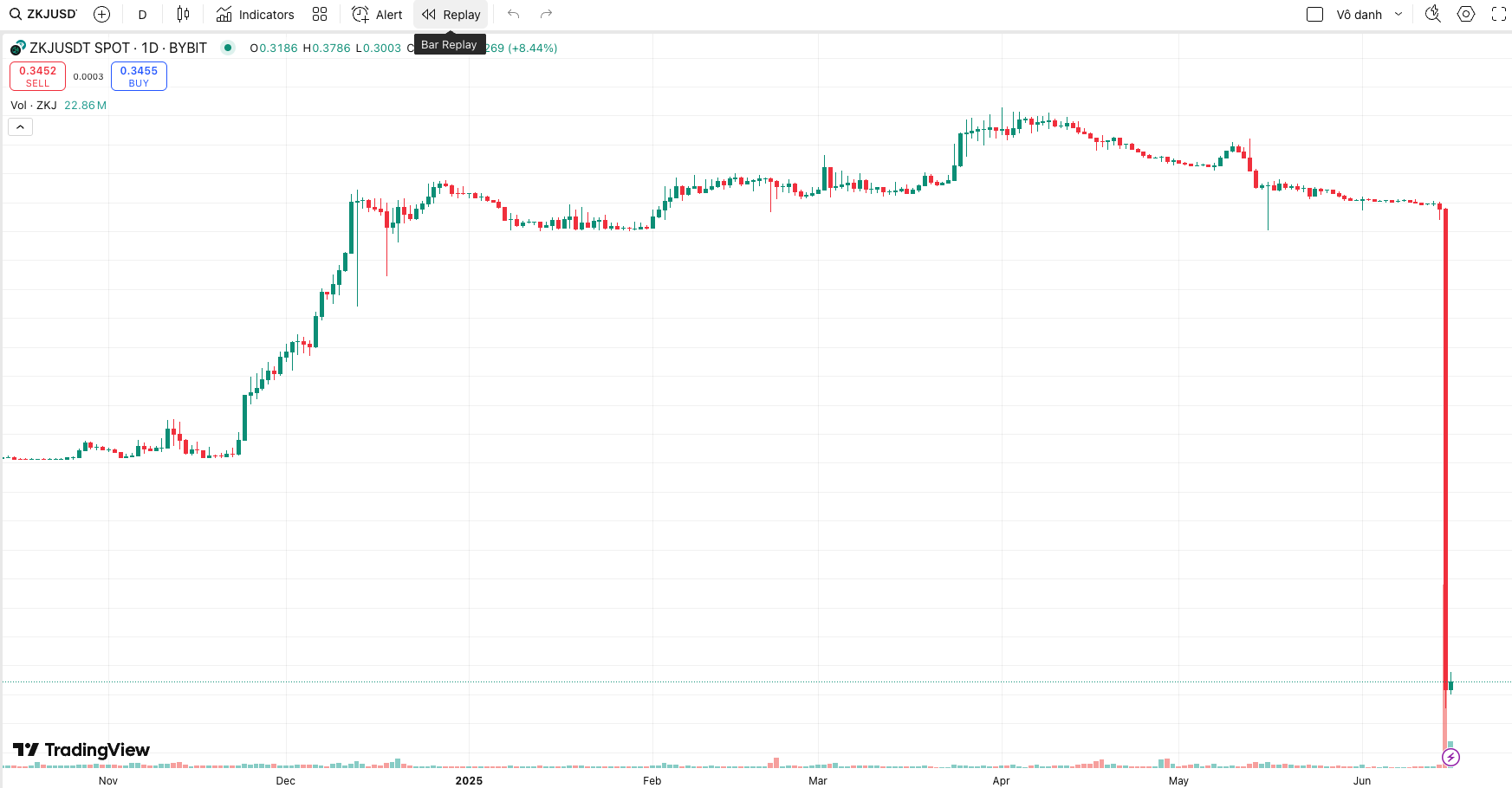
Binance has issued an urgent announcement regarding sharp and sudden price fluctuations in ZKJ and KOGE tokens, attributing the event to coordinated liquidity withdrawals by token whales and cascading on-chain liquidations across multiple exchanges.

In an official statement released today, Binance stated: “We have immediately detected significant price fluctuations in ZKJ and KOGE. According to preliminary investigations, this was caused by large-scale token whales withdrawing liquidity from multiple exchanges and on-chain, as well as a series of cascading liquidations.”

The trading disruption triggered notable concerns across the Binance Alpha user base, many of whom have been participating in high-volume trading to accumulate Alpha Points — a key metric used to qualify for early access to token launches, airdrops, and exclusive listings.

In response to the destabilizing activity, Binance will revise its Alpha Points rules to mitigate the impact of manipulative trading patterns and systemic risk. Effective 08:00 CST on June 17, 2025, Binance will no longer count Alpha-to-Alpha token pair volumes in Alpha Points accumulation. This move is intended to disincentivize low-liquidity trading activity and ensure more reliable trading behavior is rewarded.

Binance Shakes Up Alpha Points Rules Amid ZKJ, KOGE Crash

Source: TradingView

Alpha Users Hit Hard

This change is expected to heavily affect users who built strategies around Alpha token pair farming, which previously allowed for rapid accumulation of Alpha Points by cycling trades between niche tokens. Many such traders now face not only losses from the ZKJ and KOGE price collapses but also a fundamental shift in how their activity is rewarded on the platform.

Market watchers noted that the Alpha Points leaderboard saw significant reshuffling following the announcement, as users who relied on intra-Alpha token volume dropped in rankings.

The abrupt nature of the change has already sparked backlash on social media. Some users argue the update punishes legitimate users along with malicious actors, and question Binance’s timing and transparency in managing the Alpha system.

However, others view the move as necessary, given the exploitative nature of Alpha pair wash trading that had skewed the value of Alpha Points and potentially jeopardized future launchpad integrity.


Source link

$304M Raised, 20 Listings Locked – BlockDAG’s Plan Is Set, TAO and Pi Downtrend

0
4M Raised, 20 Listings Locked – BlockDAG’s Plan Is Set, TAO and Pi Downtrend


Is the Bittensor (TAO) price trend cooling off while the Pi (PI) downward trend continues to drag on? Both coins are struggling for direction this week, leaving traders searching for the next real breakout. So, which crypto will explode next? The answer might be the one project that’s not just promising things, it’s already building them. BlockDAG isn’t speculating about launch plans. It’s executing them.

With $304 million raised and 22.6 billion BDAG sold, the presale is already halfway done. The mainnet is live, the dApps are rolling out, and 20 centralized exchanges are locked in for launch. Yet BDAG is still priced below listing value, with the $0.0018 offer live for just a few more days. According to CEO Antony Turner, this is the final window for early buyers before the most explosive 6 weeks of the rollout begin. Wait, and you’ll likely pay more.

BlockDAG’s Final Window: The Last Cheap Entry

If you’ve been asking which crypto will explode, the answer might already be halfway through its presale. BlockDAG has raised over $304 million, sold 22.6 billion BDAG tokens, and laid out its full-scale launch roadmap. Under the plan, during the final six weeks of the presale, the mainnet will go live. Smart contracts and dApps will be deployed. In addition, agreements will be secured with 20 different exchanges. But here’s the twist, presale pricing is still active. While most tokens spike post-launch, BDAG is still available at just $0.0276 in Batch 29, with a limited-time offer at $0.0018. That won’t last past this week.

CEO Antony Turner’s GO LIVE reveal message is crystal clear. According to the plan over the final 6 weeks of the presale, BDAG will complete vesting, airdrop 40% of presale tokens, and activate a seven-day exclusive trading window on its primary exchange. After that, 9 more exchanges go live. This isn’t a project still trying to find momentum, this is launch-time execution.

BlockDAG’s Final Window: The Last Cheap Entry

All of this is happening while other coins just release whitepapers or promise utilities. BlockDAG is putting the entire presale capital to work, $600M in total, to fund listings, backend security, mining infrastructure, DeFi tools, and major marketing partnerships like Inter Milan and a US-based deal.

So, which crypto will explode in 2025? It’s likely the one with a solid plan, ongoing dApp rollouts, and full transparency from a public CEO. Buyers who wait for listings will miss the one phase where price meets real upside. This is the last accumulation stage, and it’s moving fast.

Slowing Momentum? What the Current Bittensor (TAO) Price Trend Signals

The Bittensor (TAO) price trend has shown clear signs of pressure lately. After briefly touching $285 earlier this week, TAO has now slipped below the $270 mark. Analysts tracking the chart highlight a strong rejection near the $282–$285 resistance band, which has now flipped into a short-term ceiling. If this rejection holds, TAO could revisit the $245–$250 zone, especially if broader market momentum weakens.

Slowing Momentum? What the Current Bittensor (TAO) Price Trend SignalsSlowing Momentum? What the Current Bittensor (TAO) Price Trend Signals

Technical indicators also point to caution. Daily volume has tapered off, and TAO’s RSI has dropped from overbought territory toward a more neutral 52–55 range. While Bittensor remains a high-interest AI-powered blockchain, the current Bittensor (TAO) price trend shows it’s in a cooldown phase. Long-term holders may not be worried, but those looking for short-term gains should monitor support zones closely. A decisive close below $260 could accelerate selling. TAO is still a major player in the AI crypto space, but right now, it looks like it’s taking a breather rather than preparing for a breakout.

Hype Fades as the Pi Downward Trend Deepens

The Pi (PI) downward trend has continued this week, with the token dipping below $35. Even after a sharp sell-off in May, Pi Network hasn’t found solid support, and recent reports show that user interest is cooling. Despite a massive presale and early community excitement, PI’s lack of open mainnet access and full exchange listings is starting to weigh down sentiment.

Hype Fades as the Pi Downward Trend DeepensHype Fades as the Pi Downward Trend Deepens

On-chain activity remains minimal, and liquidity is thin across unofficial platforms. As more early participants look to offload their holdings, the Pi (PI) downward trend may stretch further unless the team speeds up core network rollouts. Until PI achieves full exchange integration or makes a surprise announcement, many traders are likely to stay on the sidelines. The idea behind Pi’s mobile-first mining was bold, but without real-time utility or access, that hype is fading. For now, it looks like a hold for early believers, but a hard pass for those asking what’s tradable today.

Parting Thoughts

The Bittensor (TAO) price trend is holding steady but hasn’t broken out, while the Pi (PI) downward trend is deepening with no real catalyst in sight. Both projects have strong communities, but traders right now are asking which crypto will explode, and the answer is clear. BlockDAG has 20 exchange listings locked and just crossed $304M in presale commitments. 

With only a few weeks left before its first listing window, buyers still have access to BDAG at a huge discount, $0.0276 in Batch 29, and just $0.0018 via a limited-time offer. It’s the only project this cycle with a running testnet, mobile mining, and a loaded launch plan. If you’re still wondering which crypto will explode, BlockDAG is already lighting the fuse, don’t wait until the fireworks are over.

Parting ThoughtsParting Thoughts

Presale: https://purchase.blockdag.network

Website: https://blockdag.network

Telegram: https://t.me/blockDAGnetworkOfficial

Discord: https://discord.gg/Q7BxghMVyu


Source link

7 Best Crypto Exchanges in Pakistan for June 2025

0
7 Best Crypto Exchanges in Pakistan for June 2025


Cryptocurrency exchanges have become the lifeline of the dynamic world of crypto trading, especially in countries like Pakistan, where access to direct banking integrated with crypto is almost unheard of. P2P exchanges enable users to comfortably and fully engage easily and securely with one another, offering flexibility in payment methods and often lower fees.

In the guide, we carefully evaluate many platforms to bring you the best crypto exchange in Pakistan to help you find a safe, reliable, and feature-rich exchange, besides showing you how to avoid unreliable platforms. Our analysis will focus on security, fees, usability, and whether or not a platform offers advanced trading tools. Whether you’re a beginner or a professional trader, here are the most important factors to consider when looking for the best P2P exchange in Pakistan.

List of the Best Pakistani Crypto Trading Platforms

Many operators offer crypto trading apps on their platforms. Before choosing, you want to evaluate apps to find one that best addresses your goals and strategy. Here is a list of the best crypto trading platforms & apps in Pakistan:

Binance: Overall best cryptocurrency exchangeBitget: Most diverse crypto trading productsBybit: Best crypto exchange for low feesOKX: Best for accessing most crypto networksCEX.IO: Best for crypto staking and saving servicesCoinbase: Best crypto trading platform for beginnersXChangic: Best for Pakistani Rupee (PKR) users

Top Crypto Exchanges in Pakistan: Comparison Table     

ExchangeTrading Fees (maker/taker)Supported Coins Payment Method Key FeaturesBinance0.01%500+Bank Transfer, Credit/Debit Card, Easypaisa, JazzCashOTC Desk, Binance Earn, BNB Chain, Binance Learn, LaunchpadBitget0.1%150+Bank transfers, Credit/Debit Card, and E-wallets like Payeer, Zelle, Perfect Money, Advcash, WiseAI-powered trading signals, copy trading, and Islamic trading accounts and PKR transactionsBybit0.01%1,700+Bank Transfer, Credit/Debit Card, Easypaisa, JazzCashFutures, Staking, Copy Trading, TradeGPTOKX0.08%/0.01%350+Bank Transfer, Credit/Debit CardOKX Wallet, NFTs, Staking, Crypto LoansCEX.IO 0.16%/0.25%100+Bank Transfer, Debit/Credit card, E-wallets, Cash-in and cash-out with MoneyGramInstant Buy with credit/debit cards, Affiliate Program, On-the-go trading with CEX.IO AppCoinbase0.4%/0.6% (Coinbase Advanced)240+P2P, SEPA Transfer, Wire TransferCoinbase Earn, Advanced trading features, staking options, and a wide range of altcoinsXChangic0.60 – 0 .80% (fiat to crypto)

0.15 – 0.25% (crypto to crypto)

18+Bank Transfer, Credit/Debit Card, PayPal, Skrill, Payoneer, USDT, and other e-currenciesFast service, fair rates, and solid customer support

7 Best Crypto Exchanges in Pakistan: Detailed Review

1. Binance
Binance

Binance leads the list of the best P2P exchanges in Pakistan as it caters to individual and institutional investors. For a platform with over 200 million users worldwide and over 100 countries, it’s no wonder it is a dominant player in the crypto sphere. Pakistani traders can enjoy the platform’s excellent liquidity besides an average trading volume exceeding $50 billion. The exchange supports numerous advanced trading options, such as peer-to-peer (P2P) trading, futures, margin, and spot, with leverage of up to 125x.      

Suppose you’re a Pakistani crypto trader seeking an exchange with advanced trading tools. In that case, Binance is your go-to platform with a robust API and automated trading bots, making it an ideal choice for high-frequency and institutional traders. Suppose you’re a cryptocurrency enthusiast who’s not too concerned about trading. In that case, the platform runs Binance Academy, an online institution offering learning opportunities and access to new projects through its LaunchPad and a chance to participate in staking to earn passive income.  

Binance exchange offers a combination of diverse trading options, high liquidity, and advanced trading tools, making it a great choice for cryptocurrency traders in Pakistan interested in easily and conveniently navigating the global digital asset market.

Pros

Supports over 500 cryptocurrencies for tradingAffordable trading fees, including huge discounts for BNB holdersOffers margin trading, futures trading, yield farming, and stakingOperates in over 100 countries globallySupports two-factor authentication and an insurance fund for users

Cons

Complex user interface that can easily confuse beginnersHas faced serious regulatory and security challenges in the pastMixed reviews on customer support response timesLimited fiat deposits in some countries

Fees

Competitive basic trading fees beginning at 0.1% with BNB discountsDeposit is free for most digital assets with varied fees for fiatWithdrawal fees vary by cryptocurrencyFutures trading fees start at 0.05% and can be as low as 0.017%

binance-logo-2binance-logo-2

2. Bitget 

Bitget Bitget 

Bitget is considered an easy-to-use cryptocurrency exchange in Pakistan, running on advanced technology and renowned for its Islamic trading accounts, PKR support, and education materials in the local Urdu language. Since its launch in 2018, Bitget has carved a niche for itself and become a prominent player in the evolving crypto market. The exchange offers Pakistani traders a user-centric experience specifically designed for the local market in addition to advanced technology and supports a wide range of cryptocurrencies. 

One reason Bitget is considered a top crypto exchange in Pakistan is its intuitive, easy-to-use interface, which is perfectly designed for beginners and experts. The platform allows deposits and withdrawals using Pakistan Rupees (PKR), meaning users don’t have to struggle with unnecessary fiat currency conversions, simplifying the trade experience.

An important factor to note about Bitget is that the platform fully complies with Pakistani rules and regulations, so investors are guaranteed a secure and transparent trading environment. Pakistani investors who adhere to Islamic Finance principles can take advantage of the platform’s Islamic crypto trading accounts, which are Sharia law compliant. Moreover, the platform offers educational resources in the local Urdu language and has a robust customer support for Pakistani users in the same language.  

Pros

Supports at least 550 cryptocurrenciesDeposits and withdrawals in PKROffers Islamic trading accounts that are Sharia-compliant for interested Pakistani investorsAI-enhanced trading signals for executing tradesSupports local Urdu languageStrong security measuresHighly responsive customer support

Cons

Relatively high fees for some transactionsLimited to certain cryptocurrencies

Fees

Maker and taker fees for spot trading begin at 0.1%Taker fees on futures trading at 0.05% and maker fees at 0.02%Varied withdrawal fees depending on the assetNo fees are charged for staking, but a small fee is charged on earnings

bitget-token-new-bgb-logobitget-token-new-bgb-logo

3. Bybit

BybitBybit

Bybit joins this list because of its wide range of cryptocurrency trading tools and competitive rates and fees on crypto derivative trading. The platform is among the fastest-growing trading platforms and is designed for experienced digital asset investors seeking to benefit from leveraged trading opportunities.

Bybit supports a wide range of crypto trading products, including buying, selling, and trading crypto assets, as well as staking and borrowing. Due to its dynamic approach to advanced trading experiences, Bybit is the perfect choice for Pakistani traders interested in next-generation crypto trading services that are disrupting the traditional financial systems in Pakistan.

The platform seems to be specifically designed for experienced crypto traders and Pakistani investors, as it integrates charts and other tools from TradingView. This allows users to learn from extensive technical analysis covering over 100 indicators. Bybit is highly secure and boasts regulatory approval across most of Europe and the Middle East, offering an extensive range of comprehensive service to Pakistani users.

Pros

Supports a wide range of cryptocurrencies for tradeRegarded as one of the most secure platforms across the worldOffers perpetual and futures contractsStrong security measuresA lot of advanced trading tools and features are available

Cons

Available in only a few countriesMost features are not suitable for beginners

Fees

Bybit’s futures fee start with 0.02% maker and 0.055% taker.Spot trading fee starts from 0.1%Highly competitive fees compared to other platforms

bybit-logo-whitebybit-logo-white

4. OKX

OKXOKX

OKX is one of the best P2P crypto exchanges in Pakistan, known for its easy-to-use interface and comprehensive list of trading options, such as margin trading and decentralized finance (DeFi) services. The platform offers a comprehensive range of DeFi products, such as yield farming and staking, and access to a number of decentralized exchanges (DEXs). In addition to supporting at least 350 different cryptocurrencies, OKX offers spot and futures trading.

The platform’s easy-to-use interface supports languages, including the local Urdu language, making it accessible to a diverse audience of Pakistani users. Deposits are possible in PKR using credit/debit cards and bank transfers. As a platform involved in the emerging Web3 ecosystem, OKX offers users tools for building decentralized applications (DApps) and engagement with decentralized autonomous organizations (DAOs).

Pakistani traders using OKX can explore the platform’s own NFT marketplace and earn passive income via on-chain staking, especially by using the native OKB Coin and token wallet, which come with additional benefits. Unlike most other platforms, OKX has a referral and affiliate program through which users can still earn extra income.

Pros

Offers DeFi products like yield farming and takingIntuitive, easy-to-use interface in Urdu languageSupports over 300 crypto assets for tradingOffers tools for Dapp development and DAO participationNative NFT marketplaceStaking option for crypto enthusiasts interested in passive incomeDeposits via cards, bank transfers and PKR

Cons

Relatively high fees for high-volume tradingAdvanced features too technical for beginnersLimited availability if you’re outside Pakistan and Hong Kong

Fees

Maker fees start at 0.08%, and taker fees at 0.1%Free PKR deposits when done via card or bank transfer

OKX Review 2024: Trading Features, Fees, and SecurityOKX Review 2024: Trading Features, Fees, and Security

5. CEX.IO

CEX.IOCEX.IO

According to the firm’s website, CEX.IO, a platform founded in 2013, has over 6 million users globally and is popular with Pakistani crypto traders. The platform facilitates buying, selling, and trading cryptocurrencies and offers services through a mobile app. Users of the crypto exchange can avail themselves of the services through electronic wallets, credit/debit cards, and bank transfers. The platform boasts deep liquidity, which makes trading fast and easy, especially for investors trading large amounts of crypto.

CEX.IO Users can enjoy a variety of services, including staking, which enables earning passive income by holding any amount of digital assets in your account over time. The platform offers crypto debit cards, which enable users to spend their crypto holdings just like fiat cash through instant conversion at points of sale.

Pros

User-friendly interfaceSupports multiple cryptocurrenciesStaking and passive income opportunitiesNumerous payment optionsRobust securityCrypto debit card support

Cons

Relatively high service fees compared to other platforms

Fees

Users a taker-maker trading fees modelMaker fees start at 0.16%, while taker fees are 0.25%Fees decrease as trading volume increases

CEX.IOCEX.IO

6. Coinbase

CoinbaseCoinbase

Coinbase is a leading US-based cryptocurrency exchange serving Pakistani users. It offers over 170 digital assets to trade. Additionally, the platform has a secure wallet for those looking for the best Bitcoin wallet in Pakistan. Users can not only store their crypto holdings but also participate in automatic staking on at least 10 different cryptocurrencies via the firm’s Coinbase Earn program.

Coinbase P2P exchange is a user-friendly platform that makes buying, selling, or trading cryptocurrencies easy for both new and experienced cryptocurrency traders at all levels. Additionally, users trust Coinbase as one of the safest and most secure digital asset platforms.

Since Coinbase is a public company, there is an additional level of transparency, meaning that you can trust your funds are safe on a platform with over 100 million users worldwide. In terms of the security of user assets, Coinbase stores up to 98% of user funds in offline cold storage, thereby greatly minimizing the risk of cyberattacks. Moreover, the platform offers an insurance policy on cash balances up to $250,000 thereby guaranteeing consumer protection.   

Pros

Simple and user-friendly interface ideal for new and experienced investorsSupports buying crypto using credit and debit cardsOffers robust security on its walletSupports different payment methods and an extensive range of advanced services

Cons

High service fees for instant buys using debit/credit cardsPoor customer support

Fees

Fees start at 0.6%, reducing with higher volumesFree bank transfer deposits and withdrawalsStaking fees charged at 25%

coinbasecoinbase

7. XChangic (formely XChanger)

XchangerXchanger

XChangic, formely XChanger, is a crypto trading platform in Pakistan that offers safe and secure digital asset buying, selling, and trading for new and experienced traders. The exchange offers a state-of-the-art security system, multiple payment options, and instant transactions, ensuring an efficient crypto investment environment. XChangic supports different crypto assets, allowing traders to easily diversify their portfolios while exploring the many available investment opportunities.

Unlike many traditional platforms, the XChangic platform integrates popular local payment systems available in Pakistan, such as bank transfers, Easypaisa, and JazzCash, making transactions accessible to most experienced investors. The platform features an easy-to-use interface that is friendly to beginners and experts, offering a seamless experience for efficient crypto trading.

A dedicated 24/7 customer support team assists users and traders with any operational issues, beginning with help with account verification, failed or delayed transactions, or general inquiries that XChangic customers may have.

Pros

Easy-to-use and navigate interface for beginnersP2P tradingWide range of cryptocurrencies

Cons

Less than stringent KYC requirements

Fees

Normal fees charged at 0.60 – 0 .80% for fiat to crypto tradesCrypto to crypto trades charged at 0.15 – 0.25%

How to Choose the Best Crypto Exchange in Pakistan         

If you live in Pakistan, you may have fewer options than people in other parts of the world when choosing a crypto trading platform. Users can always find a way to buy cryptocurrencies from exchanges, but they need to know what to look for from the available options to locate the top crypto exchange in Pakistan. Here are a few tips for choosing a crypto trading platform:

Trading Fees  

Fees are a crucial expense when trading cryptocurrencies as they directly impact profitability. It is important to compare fees across different cryptocurrency exchanges in Pakistan to find one that offers competitive rates before you start trading.

Also, be careful to make a broad-based comparison because, in some cases, saving on trade fees could mean spending more on deposit or withdrawal fees. Carefully study available fee structures to select a platform that aligns with your trading strategy and budget. Look for cryptocurrency exchanges displaying clear and transparent fee structures before deciding. 

Supported Currencies

The other important factor to consider when choosing a cryptocurrency exchange in Pakistan is the variety of digital assets it supports. The best P2P crypto exchange in Pakistan should have a rich portfolio of digital assets to avoid limiting your options. Go for an exchange that supports many cryptocurrencies, as it offers you the flexibility you need to increase your chances of succeeding.  

Payment Methods

Crypto investors are limited in banking services in Pakistan, meaning that users mostly use alternative payment methods supported by most P2P platforms. Among the most popular payment methods are fintech solutions and mobile wallets, including JazzCash, Easypaisa, and Redot Pay.

Other platforms that offer payment solutions for Pakistani crypto traders include NayaPay, SadaPay, and Raast. These platforms are accessible and very convenient. Ensure you carefully check whether your cryptocurrency exchange supports these locally available services, as they will make your life more manageable.

Security          

Security is an essential factor when selecting a trading platform for your digital currencies. The leading cryptocurrency platforms in Pakistan employ robust security measures that could include cold storage solutions, two-factor authentication (2FA), and advanced encryption protocols. Choose a platform that takes the security of your assets seriously and jealously safeguards them from external threats for your peace of mind during crypto transactions.

Liquidity of Crypto Assets      

As much as possible, choose a platform with high liquidity, as this facilitates easier and faster trading, especially when you need to execute large transactions at desired prices. Select a platform that can support a large trade volume and has a strong user base, as this will prevent price slippage during the most critical moments. 

Customer Support      

Since things are bound to go wrong every once in a while, nothing beats the place of excellent customer support. The cryptocurrency exchange you choose should have exceptional customer support using different channels, from email to live chat and phone. Take the time to read online customer reviews on the platform’s responsiveness, which should be prompt and effective. Getting the customer support you need at the right time enhances your experiences and, in some cases, helps you avoid getting exposed to fraudulent activities.

Ease of use     

Take the time to inspect the platform’s interface to ensure it is easy to use and doesn’t have unnecessary complications. The navigation should be excellent, and you should be able to do many of the transactions unaided. A well-designed platform can significantly improve your trading experience, especially if you just joined the crypto space.

Local Reputation and Regulatory Compliance

Since banks are off limits for cryptocurrency users, some people rely on unregistered on-and-off platforms that offer crypto exchange services. While such platforms enable users to execute crypto transactions amongst themselves, most bypass local financial regulations. To ensure your safety when trading digital currencies, you need to take necessary precautions such as:

Avoid engaging with anyone outside a registered P2P exchange on the trading platform.Prioritize dealing with peers using only verified accounts.Only use a platform that provides escrow services.Only use reputable exchanges.

Is Cryptocurrency Legal in Pakistan? 

The status of cryptocurrencies in Pakistan exists in a legal gray area as they are neither legal tender nor illegal. The State Bank of Pakistan (SBP) issued a circular in 2018 prohibiting local banks and other financial institutions from handling crypto-related transactions. The prohibitions barred banks from:

Facilitating cryptocurrency exchangesOffering custody services to individuals and businesses using Bitcoin in Pakistan as legal tenderDealing with digital assets in any way whatsoever

Despite these prohibitions, the government doesn’t outrightly bar anyone from holding cryptocurrencies, only because there are limited ways to spend them locally. Banks were allowed to freeze any account they suspected was linked to digital assets, even if they acquired them legally.

However, SBP has since softened its tough stance on cryptocurrencies and proposed developing a legal framework to legitimize digital assets. It is also planning to introduce a central bank digital currency. The shift would regulate crypto trading and blockchain-based transactions and potentially attract foreign investment. The latest development was signing a Letter of Intent between the Pakistani Ministry of Finance and World Liberty Financial, a DeFi platform associated with US President Donald Trump, on developing cryptocurrencies in the country.

Pakistani Crypto Regulations

Pakistan is creating a regulatory framework for cryptocurrencies to establish clear guidelines for cryptocurrency trading and investment, making the country a regional blockchain and crypto hub. The key aspects to remember are:

There’s currently no outright ban on cryptocurrenciesThe government is developing a regulatory framework for crypto

The proposed framework aims to prioritize the creation of regulations that will conform to international standards, especially regarding anti-money laundering and counter-terrorism financing.

How is Crypto Taxed in Pakistan?      

There are currently no explicit laws regarding cryptocurrency taxation in Pakistan. According to the country’s Federal Board of Revenue (FBR), cryptocurrencies are referred to as “digital assets” for tax purposes and are treated like stocks and bonds.

As a result, any profits a user makes from the sale or exchange of cryptocurrencies are subject to income tax, with rates ranging from 0% to 35% for individuals based on their income bracket and 29% for companies. The government expects individuals to report any cryptocurrency transactions when filing their income tax returns and maintain the appropriate documentation to have their crypto taxed.

How to Buy Cryptocurrency in Pakistan       

If you reside in Pakistan and are interested in buying crypto, you must select a crypto exchange that supports the Pakistan Rupee (PKR). The following is a step-by-step guide to purchasing a digital asset:

Step 1: Choose the Right Exchange

Select a reliable platform that caters to the needs of Pakistani users.

Step 2: Register and Verify Your Account

Both local and international security standards require that you open an account with an exchange and then complete the KYC verification procedure. You must submit a national identification document or passport and confirm your details before you can buy Bitcoin in Pakistan.  

Step 3: Deposit Funds in PKR

Once verified, navigate to the deposit button, select PKR as your preferred currency, and deposit funds from your account.

Step 4: Navigate to “Buy Bitcoin”

From the dashboard, in the “P2P-trading” section or under the products menu, choose the cryptocurrency you want to buy. Once you have chosen the cryptocurrency you want to buy, specify the fiat currency you intend to use. In this case, it could be PKR, USD, or any other, depending on the selected cryptocurrency exchange.

Step 5: Choose the right ad

You’ll find many sellers with different market-up prices. Orient yourself with the prices and consider the one with the best rates. Ensure you choose one that accepts the payment method you intend to use: bank cards, e-wallets, or cash. Evaluate the seller’s rating by checking the successful transactions on their profile – the higher the success rate, the more reliable they are likely to be.

Step 6: Open the Deal

After selecting a vendor, click “Buy Bitcoin” and specify the cryptocurrency you want to buy and the required amount within the limits of your budget. Only proceed to buy Bitcoin in Pakistan once you’re satisfied with the terms of the deal.

Step 7: Transfer Funds

As a security measure, the cryptocurrency exchange will freeze the digital assets in the seller’s account within 15 minutes as you transfer your PKR according to the details. As soon as your payment has gone through and the seller clicks the confirmation, the exchange will release your crypto, and you’ll receive it in your crypto wallet.

Step 8: Secure your Cryptocurrency

Unless you plan to spend your crypto or use it to trade, it is recommended that you transfer your assets to a secure cold wallet or hardware wallet like Trezor, Ledger, etc., or a trusted Bitcoin wallet in Pakistan for long-term safety.

Popular Bitcoin Wallets in Pakistan   

There are several e-wallets in the evolving cryptocurrency landscape if you’re looking for the best Bitcoin wallet in Pakistan for a secure and convenient storage solution. Let’s explore the most popular digital wallets used by Pakistani digital asset enthusiasts:  

1. Ledger Nano S

Ledger Nano SLedger Nano S

Recognized globally as the go-to digital wallet with state-of-the-art security features. Besides supporting many cryptocurrencies, Ledger Nano S is embedded with a secure element chip to boost protection against unauthorized access. All transactions require physical confirmation as an added security measure.

2. Trezor Model T
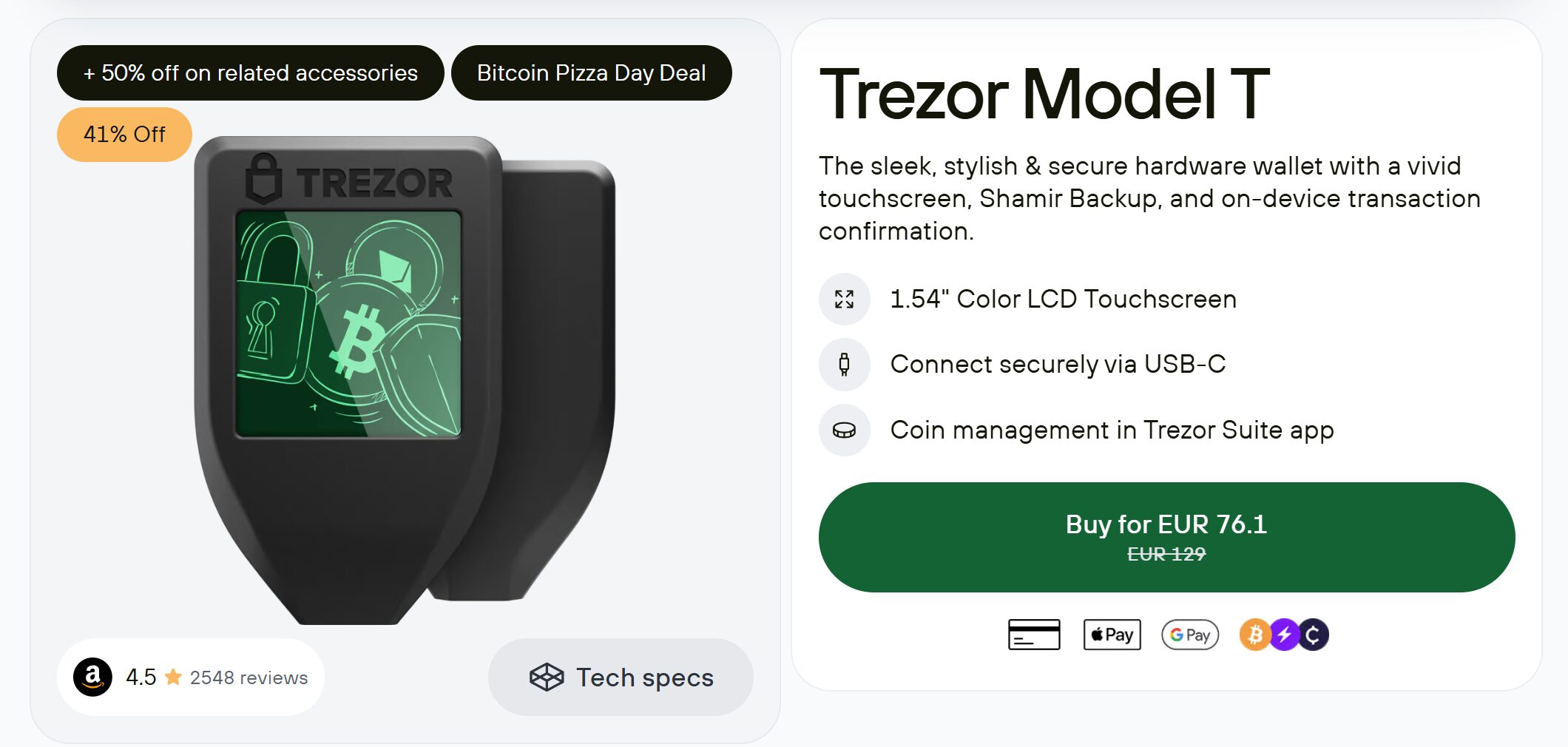
Trezor Model  TTrezor Model  T

Trezor Model T is one of the leading hardware wallets, notable for its intuitive interface and top-notch security protocols. The wallet supports multiple cryptocurrencies and features an easy-to-use touch screen that facilitates hassle-free navigation. Trezor Model T employs high-level encryption and advanced security measures to secure transactions.  

3. Exodus

Exodus WalletExodus Wallet

If you’re looking for a reliable software wallet, Exodus could be a great candidate because of its advanced features and user-friendly interface. In addition to supporting a wide range of cryptocurrencies and a suite of advanced features for hassle-free trading, the wallet is ideal for beginners and experts. Exodus wallet has supplementary features like customizable transaction fees or portfolio tracking, giving Pakistan users greater control over their cryptocurrencies and trading experience.

4. Atomic Wallet

Atomic WalletAtomic Wallet

The Atomic Wallet is a multi-purpose software wallet supporting multiple platforms and over 500 cryptocurrencies while catering to different trading preferences. The wallet features an easy-to-navigate interface that facilitates hassle-free trading and portfolio management with its built-in exchange feature. Security is among the wallet’s most significant priorities as users have total control of their private keys, ensuring they’re safe from potential cyber threats.

When choosing the best Bitcoin wallet in Pakistan, among the factors that you need to prioritize as a seasoned investor beyond popularity include:

Security: Select a wallet with robust security measures like offline storage, multi-factor authentication, and encryption.User-Friendliness: Go for a wallet with an easy-to-use interface with easily accessible features.Additional Features: A good crypto wallet should have advanced functionalities and key features like portfolio tracking, built-in exchange service, or customizable transaction fees for an enhanced trading experience.

Conclusion

Binance, Bitget, and Bybit are top international platforms for traders looking for centralized exchanges. Each platform offers unique features and diverse fee structures to cater to users with diverse trading experiences and preferences. When looking for a the best crypto exchange in Pakistan, you are encouraged to carefully assess your individual trading goals and other essential factors like preferred cryptocurrencies, trading volume, and any other additional services.

FAQs   

Is crypto trading legal in Pakistan?

In Pakistan, cryptocurrency trading operates in an unregulated environment, with banks prohibited from facilitating crypto transactions since 2018. However, recent developments signal a potential change: the Pakistan Crypto Council has signed a deal with World Liberty Financial, a decentralized finance (DeFi) platform reportedly linked to the family of U.S. President, Donald Trump.

Is Binance available in Pakistan?

Binance is one of the leading cryptocurrency exchanges available in Pakistan that accept Pakistani Rupees (PKR). Others include Bitget, Bybit, LocalBitcoins, and OKEx crypto exchange, which provide convenient options for Pakistan nationals interested in entering the crypto market using the local PKR.

Which exchange is best for P2P?

Binance P2P exchange stands out as a leader because it supports a wide range of cryptocurrencies and over 800 payment methods for its diverse user base. Crypto traders in Pakistan enjoy the support of PKR, which simplifies the trading experience. Other prominent platforms offering excellent P2P services in Pakistan include Bitget, Bisq, OKX, and Paxful crypto exchange.

Which bank allows cryptocurrency in Pakistan?

Currently, no specific bank in Pakistan offers direct cryptocurrency services due to regulatory concerns following the State Bank of Pakistan’s prohibition in 2018. Users can only access the crypto market through other available channels.

Can You Use Pakistani Debit or Credit Cards to Buy Crypto?           

You can use your Pakistani debit or credit card to buy cryptocurrency through popular exchanges. While most banks adhere to the government’s restrictions regarding cryptocurrency exchanges, some prominent exchanges like Binance and KuCoin allow credit and debit card purchases from their users using local cards.

How much is 5000 in crypto?         

Considering that Bitcoin is the most popular cryptocurrency in Pakistan, selling 5000 Pakistani rupees will receive 0.000187 Bitcoin as of May 2025. Remember that crypto prices can change without notice due to their market volatility. For other cryptocurrencies, 5000 Pakistani Rupee would give you 5.547569 Tether (USDT), while 5000 Pakistani Rupee is equivalent to 8.138186 XRP (XRP) or 0.029901 BNB (BNB).

Should I leave my Bitcoin in an exchange after buying it?

While it’s OK to leave your crypto on the exchange wallet after buying, it’s not advisable to do so because of security issues. We recommend storing your crypto assets in an offline hardware wallet where you keep private keys safe and entirely offline.



Source link

Pendle Deep Dive: Tokenized Yield and Fixed Yield in DeFi

0
Pendle Deep Dive: Tokenized Yield and Fixed Yield in DeFi


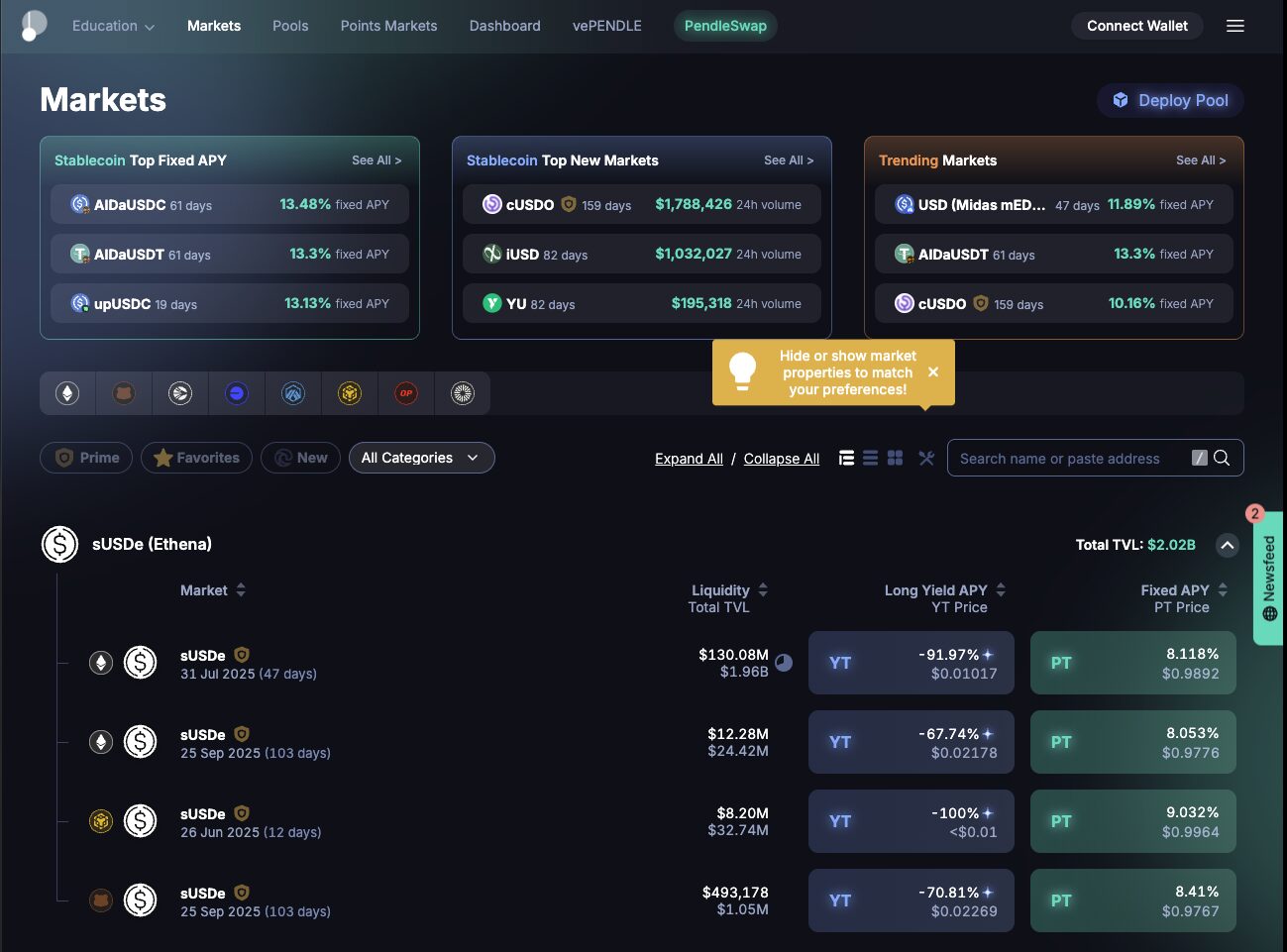
The Decentralized Finance (DeFi) landscape constantly evolves, and at its forefront, Pendle Protocol drives a significant shift: the maturation of fixed-yield markets. This deep dive explores how Pendle fundamentally re-engineers TradFi (Traditional Finance) principles like zero-coupon bonds and tranches, introducing much-needed predictability into inherently volatile crypto assets.

Pendle Yield Tokenization: Principal Tokens (PT) and Yield Tokens (YT)

Pendle Finance’s foundational innovation lies in its yield tokenization mechanism, a process that fundamentally redefines how users interact with yield-bearing assets in DeFi. It ingeniously separates the future yield stream from the underlying principal asset, creating two distinct, independently tradable tokens.

Pendle protocol takes any yield-bearing asset, such as staked Ethereum (stETH), Compound’s cUSDT, or Yearn Finance’s yvUSDC, and splits it into two unique components: a Principal Token (PT) and a Yield Token (YT). 

Pendle Yield Tokenization: Principal Tokens (PT) and Yield Tokens (YT)

Source: Pendle Finance

Pendle Yield Tokenization: Principal Tokens (PT)

Before this splitting, Pendle protocol wraps the underlying yield-bearing tokens into a Standardized Yield token (SY), which then serves as the base from which PT and YT are minted. A crucial aspect of this design is that users can combine 1 PT and 1 YT at any time before maturity to reconstruct and redeem the original underlying asset.  

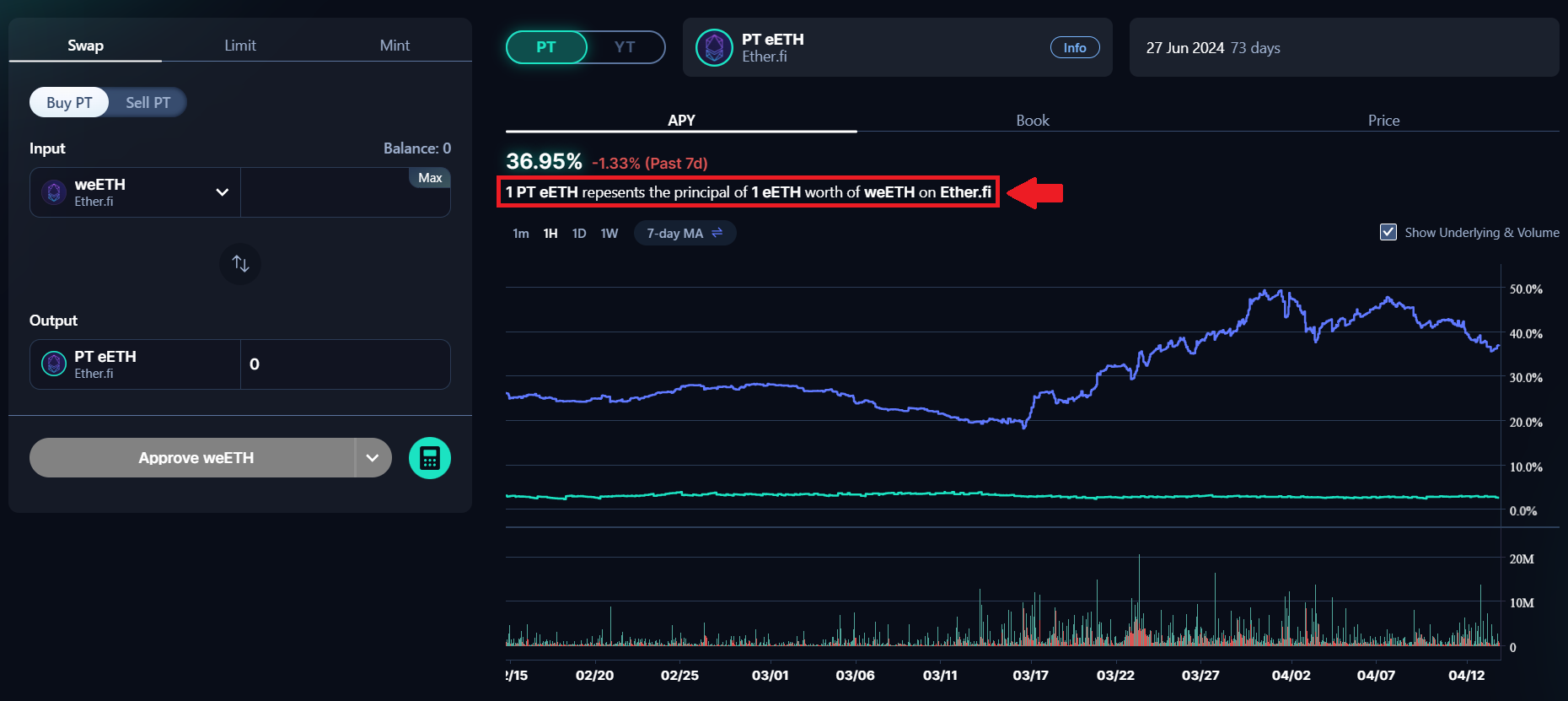
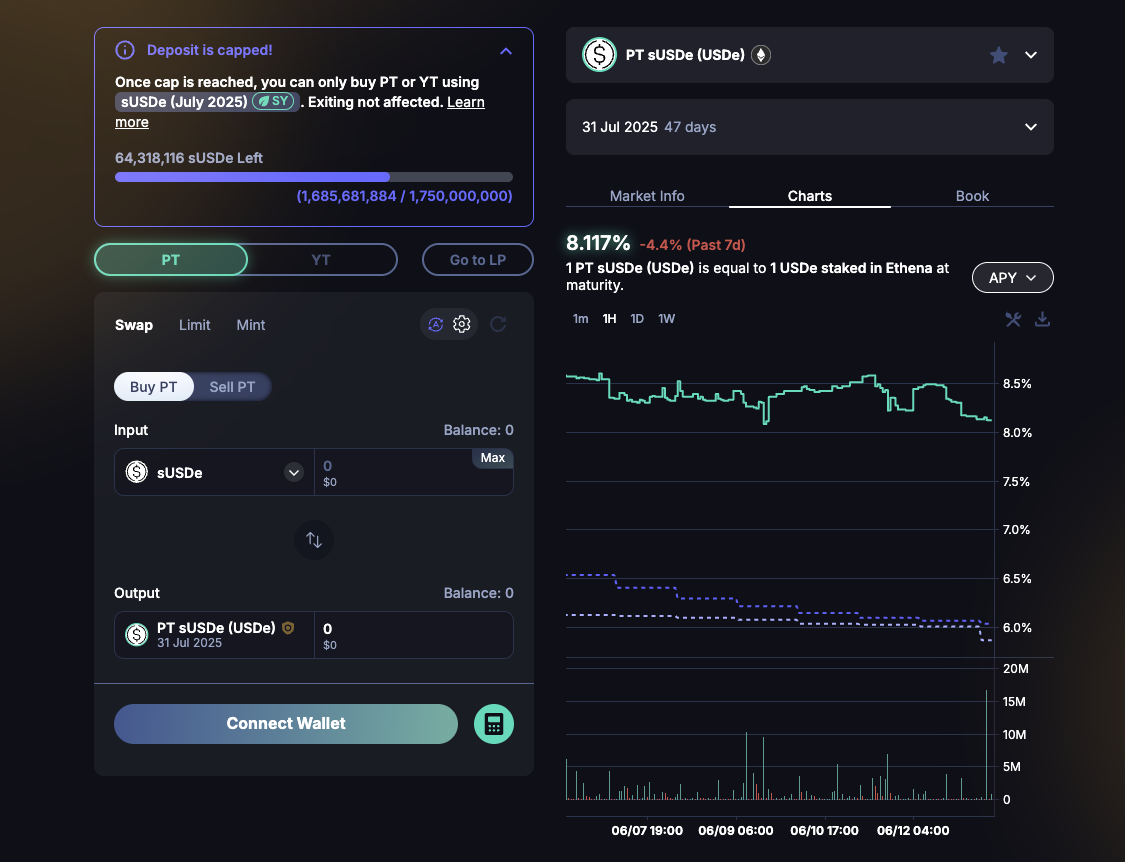
The PT represents the underlying asset’s principal amount. It is designed to be redeemable 1:1 for the deposited asset at its maturity date. PTs are typically acquired at a discount to the underlying asset’s current price, meaning that holding a PT until maturity guarantees a fixed yield. 
Functionally, PTs are analogous to zero-coupon bonds in traditional finance. Their volatility naturally decreases as they approach maturity, making them attractive for conservative yield strategies and highly suitable as collateral in DeFi lending protocols.  

For more: A Comprehensive Analysis of Yield and Payment Stablecoins

Pendle Yield Tokenization: Principal Tokens (PT)Pendle Yield Tokenization: Principal Tokens (PT)

Source: Pendle Finance

Pendle Yield Tokenization: Yield Tokens (YT)

Conversely, the YT embodies the yield generated by the underlying asset. Holders of YT tokens are entitled to claim periodic yield (interest) and can effectively “long the yield,” speculating on its future increase or fluctuation. YTs thus enable direct speculation on future interest rate movements. This innovative mechanism unlocks a diverse array of financial strategies. 

Users can sell their future yield (YT) in advance to gain immediate liquidity, purchase PTs at a discount to lock in a fixed return, or actively trade YTs to profit from anticipated changes in Annual Percentage Yields (APYs). This process significantly enhances liquidity for yield-generating assets and boosts overall capital efficiency within DeFi.  

Pendle Yield Tokenization: Yield Tokens (YT)Pendle Yield Tokenization: Yield Tokens (YT)

Source: Pendle Finance

This transformation of passive yield into active, tradable financial primitives marks a significant leap in DeFi’s financial engineering capabilities. Traditional yield farming often involves simply locking assets to earn passive rewards, which can reduce liquidity and limit strategic flexibility. 

By disaggregating the principal and yield, Pendle changes a static, passive position into two dynamic, tradable components, allowing users to “time-travel” their earnings by selling future yield upfront or to express granular views on interest rate movements through speculation. This level of granularity and control is crucial for attracting more professional and institutional participants, who require precise tools for risk management, hedging, and alpha generation.  

The composability of PTs and YTs

The simultaneous existence and tradability of PTs (fixed yield) and YTs (variable yield speculation) within Pendle’s market creates a dynamic interplay. The market-determined prices of these tokens inherently reflect the “implied rate” for the underlying asset. This mechanism allows for organic interest rate price discovery, a crucial element often lacking in earlier fixed-rate DeFi protocols. 

Importantly, this price discovery is achieved without relying on external oracles or manual adjustments , embedding the rate determination within the protocol’s own market dynamics. This architectural choice enhances the protocol’s overall security and trustworthiness, reducing reliance on external, potentially manipulable, data feeds. This contributes to the long-term stability and reliability of the decentralized financial system.  

The Pendle AMM: Enabling Efficient Yield Trading

The Automated Market Maker (AMM) is the central engine of Pendle’s operations, specifically designed to facilitate the efficient trading of PT and YT tokens. Its unique design is optimized for the nuances of yield trading, incorporating features that significantly enhance capital efficiency and liquidity while mitigating common AMM-related risks.

Pendle Finance deploys a dedicated AMM for each Standardized Yield (SY) instance, enabling the trading of its corresponding PT and YT tokens from the moment they are minted. This AMM is explicitly “designed for yield trading with concentrated liquidity, dual fee-structure, and negligible IL concerns”. 

The Pendle AMM: Enabling Efficient Yield TradingThe Pendle AMM: Enabling Efficient Yield Trading

Source: Pendle Finance

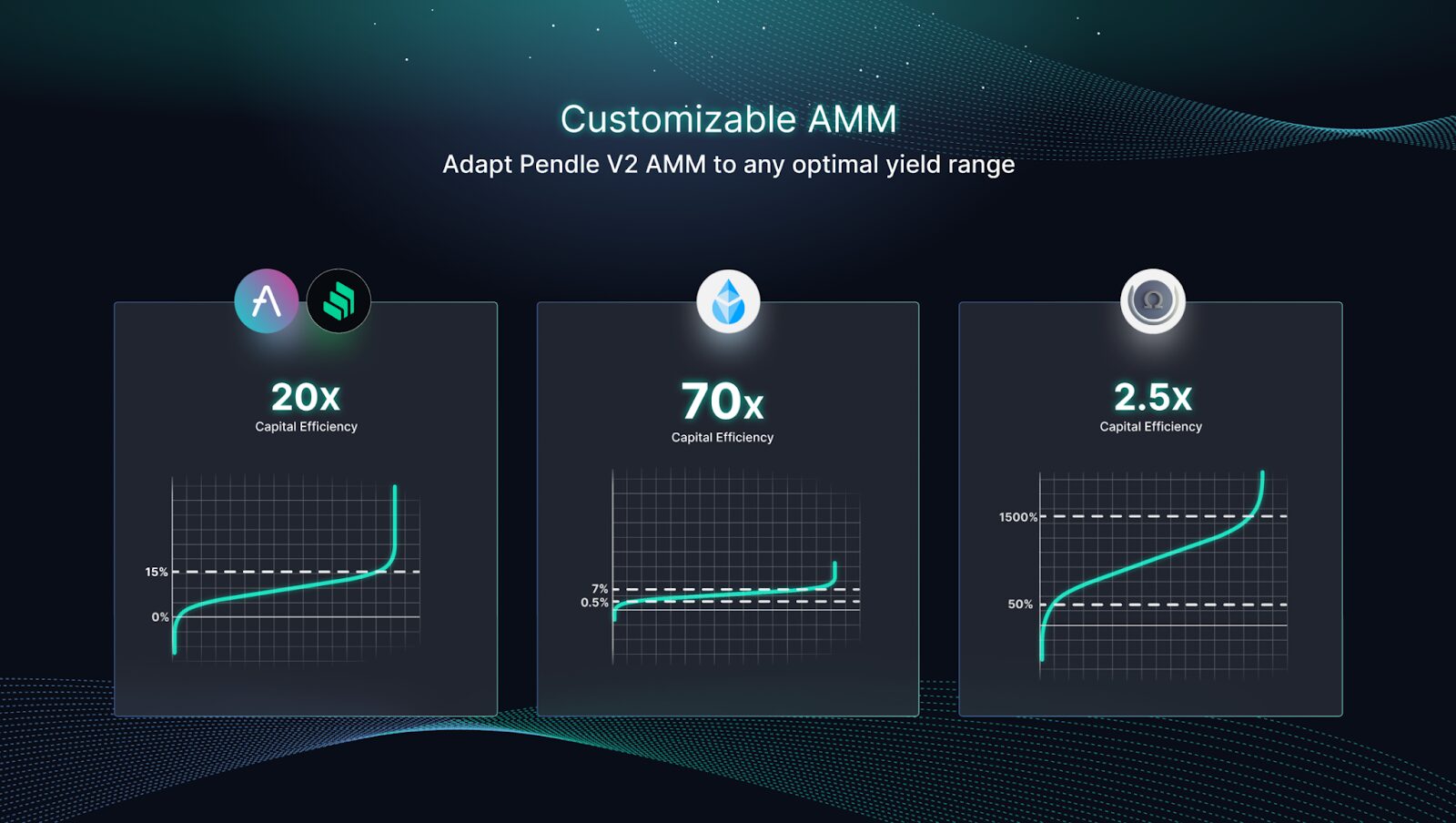
Pendle’s AMM employs a concentrated liquidity model. This lets liquidity providers (LPs) strategically allocate capital within specific price ranges. This targeted approach maximizes capital efficiency and minimizes impermanent loss (IL).

A unique feature is its time-decaying model, governed by functions like _getRateScalar(). This function’s value increases as the underlying asset’s maturity date nears. This design ensures smaller price impacts early on, allowing larger PT transactions. As maturity approaches, price sensitivity naturally increases. This incentivizes market makers to rebalance positions closer to fair redemption value. This mechanism ensures PT prices converge to their redemption value at expiry. It requires no external oracles or manual interventions.

Developing an AMM “designed for yield trading” is a crucial step in DeFi evolution. Most DeFi protocols use generic AMMs. Pendle’s specialization, with concentrated liquidity and its time-decaying model, addresses the unique traits of yield-bearing assets. These inherently converge to a fixed value at maturity.

The Pendle AMM: Enabling Efficient Yield TradingThe Pendle AMM: Enabling Efficient Yield Trading

Source: Pendle Finance

This move toward highly specialized financial primitives indicates a maturing DeFi infrastructure. Such specialization boosts efficiency and accuracy in price discovery. It also reduces specific risks, like impermanent loss, for niche asset classes. This makes DeFi more competitive with traditional financial markets.

The inherent time-decaying mechanism is a critical security choice. It ensures PT prices align with redemption value without relying on external oracles. Oracle manipulation is a costly DeFi vulnerability. By embedding this price convergence logic directly into the AMM, Pendle significantly reduces its attack surface. This enhances protocol security and trustworthiness. This is key for institutional adoption. It signals more robust, self-contained DeFi primitives that minimize external dependencies, contributing to decentralized financial system stability.

For more: Fixed Yield DeFi vs. Traditional Fixed Income in Yield Farming Rewards

vePENDLE: Governance and Protocol Alignment

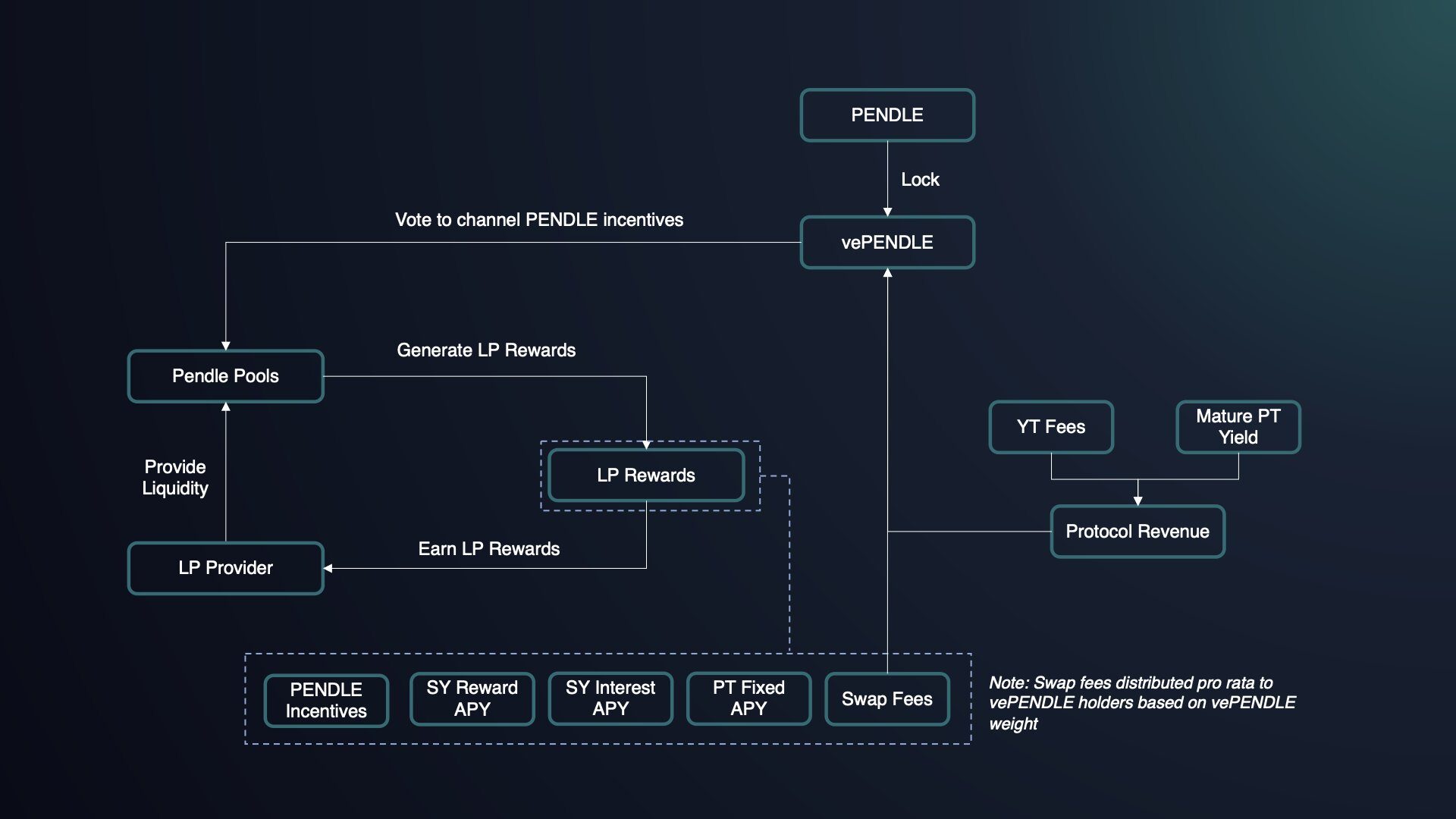
The vePENDLE token mechanism drives Pendle’s strategic approach. It significantly boosts decentralized governance and, furthermore, encourages robust long-term community engagement. This innovative model, in fact, draws clear inspiration from successful vote-escrowed token designs that other prominent DeFi protocols successfully employ.

Specifically, PENDLE token holders actively lock their tokens for varying periods; consequently, this action earns them vePENDLE. In return, vePENDLE grants them not only enhanced voting rights on crucial protocol decisions but also the ability to boost their rewards from the platform. This widely adopted design, therefore, inherently strengthens community engagement and, crucially, aligns token holder interests directly with the protocol’s long-term success, consciously mirroring effective strategies from protocols like Curve.

vePENDLE: Governance and Protocol AlignmentvePENDLE: Governance and Protocol Alignment

Source: Pendle Finance

Pendle’s governance structure has matured. Over 60% of token holders actively vote. Specialized governance committees now focus on risk management, development, and treasury management. On-chain governance ensures transparency and immutability of decisions.

This design is key for Pendle’s fixed-yield offerings to be sustainable and reliable. The vePENDLE model tackles “mercenary capital” by requiring token locking. This turns short-term yield farmers into long-term stakeholders. It builds a loyal community, making the ecosystem more resilient and stable. This is vital for attracting and keeping sophisticated capital.

Understanding the PENDLE Token

The PENDLE token acts as the native utility and governance token for the Pendle protocol, which primarily operates across Ethereum and a growing number of Layer 2 solutions. Fundamentally, its purpose is to empower holders by leveraging the vePENDLE mechanism, thereby allowing them to actively participate in the protocol’s decentralized governance. Consequently, this involvement includes voting on crucial parameters such as upgrades, fee structures, market incentives, and even the specific yield pools that are launched.

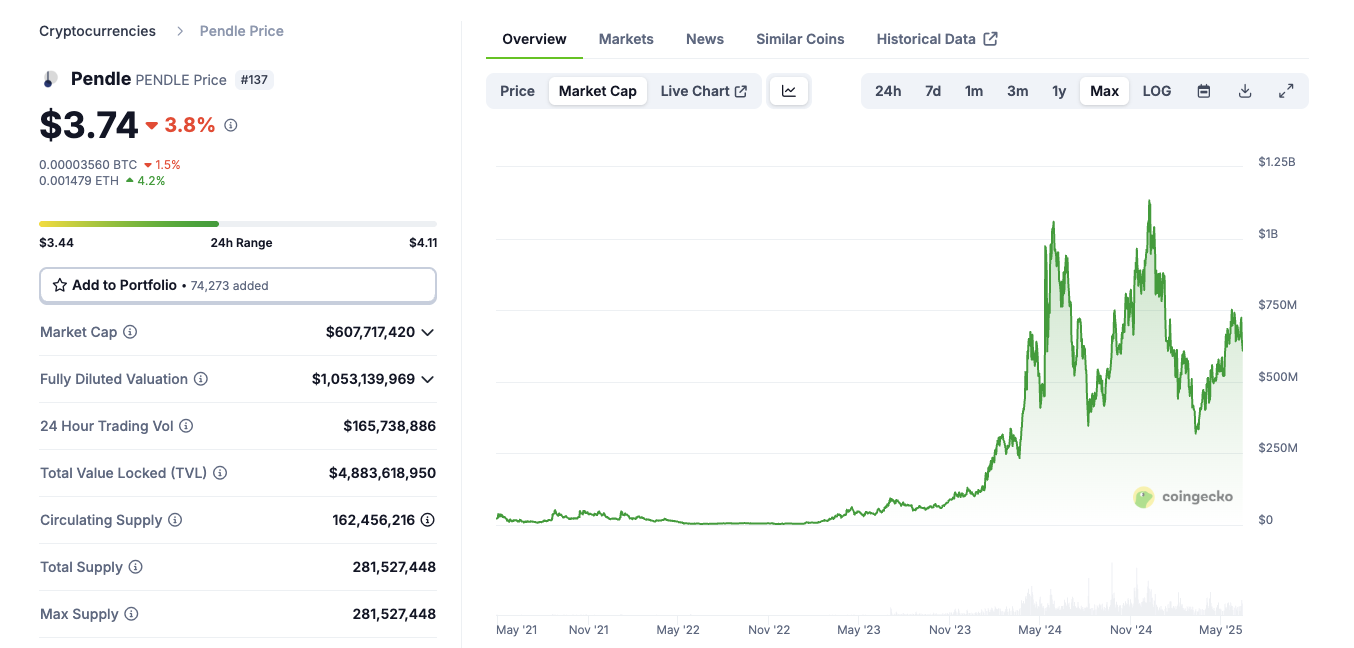
Currently, the total supply of PENDLE tokens is capped at approximately 281 million, with the circulating supply naturally varying based on recent market data. By staking PENDLE to acquire vePENDLE, holders gain significant benefits. These include not only enhanced voting power but also boosted rewards, directly aligning token holder incentives with the protocol’s long-term success and overall sustainability.

Understanding the PENDLE TokenUnderstanding the PENDLE Token

Source: Coingecko

Pendle Protocol Risks and Challenges

Smart Contract Vulnerabilities and Exploits

The DeFi ecosystem carries inherent risks, with smart contract vulnerabilities being a primary concern. While Pendle implements robust security measures, the broader landscape shows a persistent threat of exploits. DeFi smart contracts can contain bugs leading to significant financial losses; flash loan attacks are a common method.

Smart Contract Vulnerabilities and ExploitsSmart Contract Vulnerabilities and Exploits

Pendle Finance Auditors.

Pendle addresses this with comprehensive security practices. Its smart contracts are open source and have undergone numerous audits by reputable firms. However, even extensive audits don’t guarantee full safety. 

A notable incident involved Penpie, a yield farming protocol hosted on Pendle Finance, which suffered a $27 million exploit in September 2024. This hack leveraged a reentrancy vulnerability, highlighting that audits are necessary but insufficient. Continuous vigilance and robust incident response are equally vital.

Smart Contract Vulnerabilities and ExploitsSmart Contract Vulnerabilities and Exploits

Source: BlockSec

This event, along with issues identified by an audit of Jigsaw Finance’s Pendle strategies, underscores the systemic risk in DeFi’s composable “money legos” architecture. A flaw in one integrated protocol can cascade, even if the core protocol itself is secure. This demands a holistic risk assessment beyond individual smart contracts.  

Liquidity and Price Discovery Challenges

Maintaining deep liquidity and ensuring accurate price discovery are ongoing challenges in fixed-yield DeFi markets. Indeed, this challenge intensifies significantly due to the inherent complexities of yield-bearing assets.

Earlier fixed-yield models, like those based on zero-coupon bonds, often caused liquidity fragmentation across different maturities. This made establishing robust markets difficult. Furthermore, DeFi commonly relies on external price oracles. These can be vulnerable to manipulation, risking significant financial losses.

Regulatory Uncertainty and Institutional Adoption Barriers

The evolving regulatory landscape undeniably casts a significant shadow, directly impacting institutional engagement with DeFi. Consequently, a persistent lack of clear frameworks can deter broader adoption, even amidst growing institutional interest. Indeed, the DeFi sector operates within a rapidly changing environment, where governments and regulators are still meticulously defining appropriate oversight. This inherent uncertainty, therefore, consistently creates formidable challenges for attracting large-scale institutional investment and, furthermore, for expanding into crucial new markets.

However, Pendle is proactively addressing these formidable barriers. For instance, its 2025 roadmap notably includes “Citadels.” Indeed, these are no ordinary tools; rather, such specialized infrastructure is precisely designed to provide compliant DeFi services specifically tailored for institutional users. Consequently, this effectively bridges the critical gap between traditional finance and decentralized markets.

Moreover, Pendle’s partnership with Ethena’s new Converge blockchain offers native KYC capabilities, thereby enabling compliant access for institutions to Pendle’s yield products. Beyond this, Pendle’s strategic focus on Real World Assets (RWAs) also serves as a critical bridge between TradFi and DeFi, effectively tokenizing familiar traditional assets directly onto the blockchain.

Ultimately, this strategic emphasis on KYC-compliant products and RWAs is absolutely crucial. By doing so, it directly attracts the vast pools of institutional capital that inherently demand regulatory certainty before engaging deeply. Therefore, by tokenizing TradFi assets and fostering key partnerships like Ethena’s iUSDe, the Pendle protocol directly meets institutional demand for alternative yields, simultaneously unlocking substantial new liquidity and accelerating broader DeFi adoption.


Source link

Pendle Crypto Market Performance and Adoption Trends 2025

0
Pendle Crypto Market Performance and Adoption Trends 2025


Pendle Finance has exhibited a remarkable trajectory of rapid development and strategic growth since its inception, marked by a series of significant milestones in its protocol evolution and increasing market adoption.

Pendle Finance officially launched in June 2021. The foundational idea for Pendle originated from the observed lack of effective options for trading and pricing tokenized yield assets within the existing DeFi landscape. 

Pendle Finance’s Key Milestones 

Pendle’s TVL Statistics

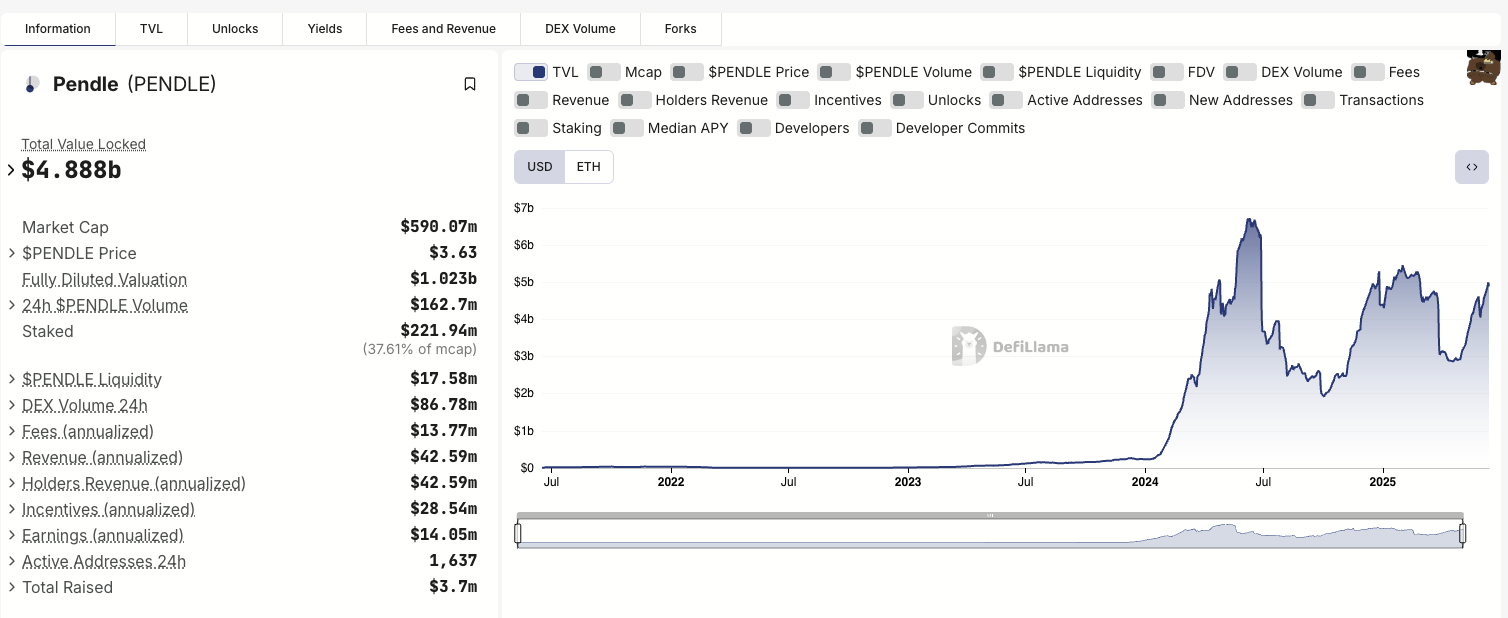
Since its launch, the protocol’s TVL has experienced substantial growth. By June 2024, Pendle’s TVL surged to an ATH of $6.72 billion, later stabilizing around $2 billion. Current data indicates a TVL of approximately $4.88 billion, with other sources reporting over $4 billion. The majority of this TVL is concentrated on Ethereum, accounting for nearly $4.5 billion. 

Pendle’s TVL Statistics

Source: DefiLlama

However, Pendle’s multi-chain strategy is evident. Its TVL distributes across other chains. These include Base ($180.34 million), Sonic ($111.78 million), Arbitrum ($49.9 million), Berachain ($32.4 million), Mantle ($12.31 million), BSC ($4.25 million), Avalanche ($57,474), and OP Mainnet ($37,438). 

This distribution highlights Pendle’s cross-chain expansion success. It broadens its user base. It also reduces reliance on a single blockchain, thereby enhancing resilience and accessibility.

Pendle’s TVL StatisticsPendle’s TVL Statistics

Source: Pendle

Pendle’s Revenue

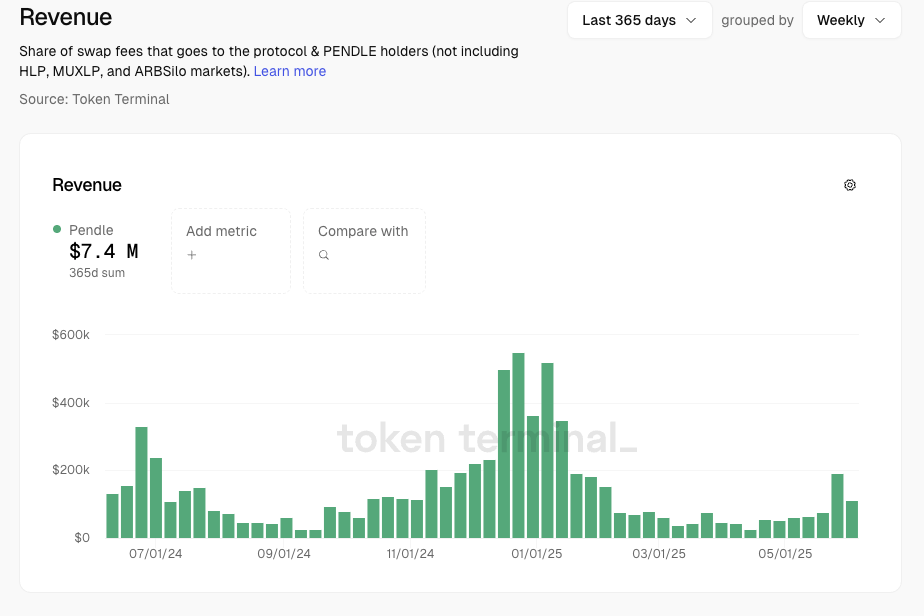
Pendle has also demonstrated consistent and stable revenue generation since June 2024, averaging over $4 million per month. Annualized revenue figures are reported at $22.32 million and $42.88 million, primarily derived from a 5% take rate on the yield generated by assets on its platform and from trading fees. 

Pendle’s Revenue Pendle’s Revenue

A significant milestone was the full unlock of team and investor tokens in September 2024. The fact that Pendle has maintained “stable revenue” and “increased utility driving sustainable demand” after this event indicates a robust underlying economic model and organic demand, rather than dependence on artificial token incentives. 

For institutional investors and long-term stakeholders, this post-unlock stability is a strong signal of maturity and viability. It significantly de-risks the investment profile of the PENDLE token, addressing concerns about “rug pulls” or “capital flight” that have plagued many DeFi projects. This resilience positions Pendle as a more reliable and sustainable player in the fixed-yield DeFi space.  

Pendle’s Daily Active Users (DAU)

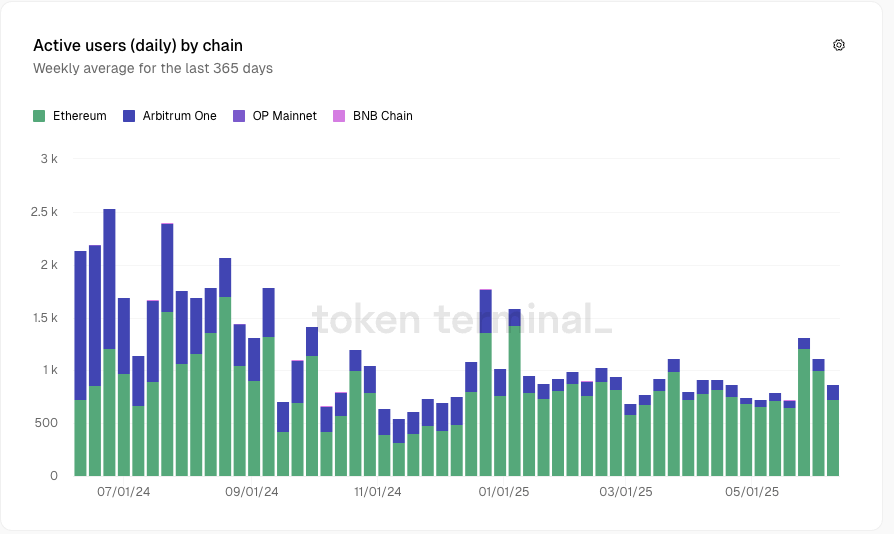
In terms of user engagement, Pendle has approximately 280,000 active users. Daily active addresses are reported at 1,000. It is important to note these active address counts. They typically include only users who interact directly with the protocol. They exclude those who might use DEX aggregators or other intermediary contracts. They are also limited to specific chains. 

Pendle’s Daily Active Users (DAU)Pendle’s Daily Active Users (DAU)

Pendle DAU chain breakdown. Source: Token terminal

Pendle Yield Bearing Stablecoin Market Shares

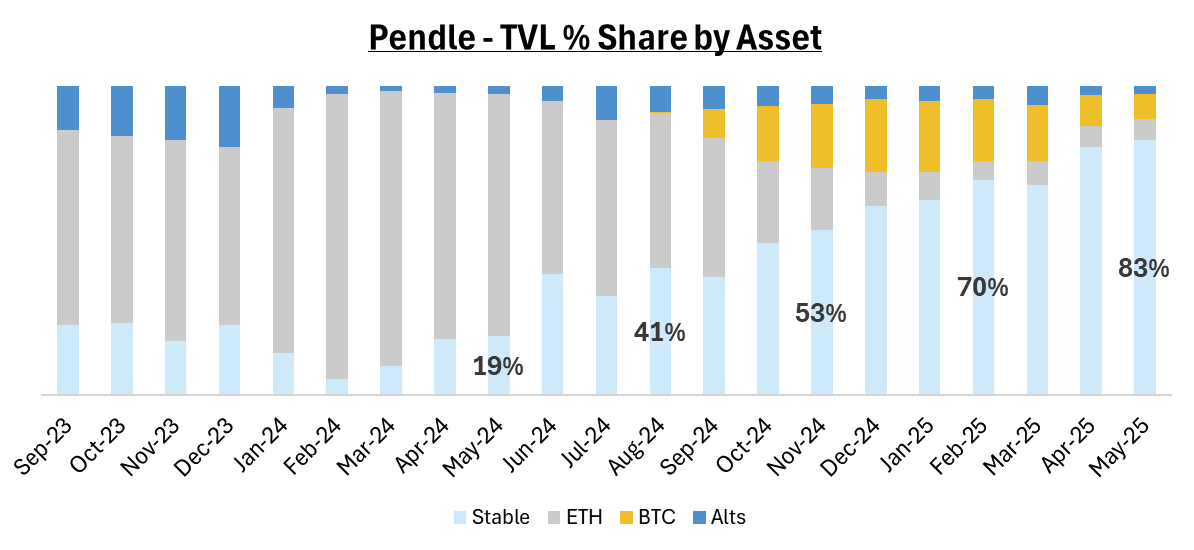
Pendle also holds a significant position in the yield-bearing stablecoin market. It captures 30% of all yield-bearing stablecoin supply. The overall yield-bearing stablecoin market has reached a value of $11.3 billion. This accounts for 4.5% of the total stablecoin market. Pendle’s share is expected to remain around 25%. This focus on a growing and relatively stable segment of the DeFi market contributes to its robust TVL.

Pendle Yield Bearing Stablecoin Market SharesPendle Yield Bearing Stablecoin Market Shares

Source: Pendle

Pendle Cross-Chain Expansion and Adoption Trends

Multi-Chain Strategy and Future Expansion

Pendle has pursued an aggressive multi-chain strategy and forged key partnerships to broaden its reach and utility within the decentralized ecosystem. This expansion is crucial for enhancing accessibility, reducing transaction costs, and tapping into diverse liquidity pools.

Beyond its initial deployment on Ethereum, Pendle has expanded its operations to multiple Layer 2 solutions and alternative blockchains. Its current presence includes EVM chains such as Ethereum, Arbitrum, Base, and Sonic. 

The protocol has concrete plans for further expansion, with Solana support anticipated for Q3 2025, and additional integrations planned for Hyperliquid and TON. This multi-chain approach is designed to enhance accessibility and reduce transaction costs for users, attracting a wider user base.  

Key Integrations: Aave v3 & Pendle Finance

A significant integration is Pendle’s support for PT-USDe as collateral within the Aave v3 protocol. This integration allows holders of Pendle’s fixed-yield PT-USDe token to use it as collateral on Aave, either for capital efficiency or to re-deposit and leverage up yields. 

Key Integrations: Aave v3 & Pendle FinanceKey Integrations: Aave v3 & Pendle Finance

Aave v3 & Pendle. Source: Aave DAO Governance Forum

Since this integration went live, approximately $1 billion in PT-USDe has been deposited into Aave, in addition to an existing $500 million on Morpho. This move is pivotal as it integrates Pendle into Ethereum’s largest lending protocol, significantly expanding its capital access and ecosystem participation.  

Ethena & Pendle Finance Partnership

Pendle has also established a key partnership with Ethena and its new Converge blockchain. Ethena’s EVM chain will incorporate a native Know Your Customer (KYC) capability. This enables compliant access for institutions to Pendle’s yield products and platform. This allows Pendle to participate in the growth of permissioned yield-bearing stablecoins, such as iUSDe by Ethena. 

Ethena & Pendle Finance PartnershipEthena & Pendle Finance Partnership

Source: 0xCheeezzyyyy

Ethena also leveraged Pendle when its USDe stablecoin launched in February 2024. This was to bootstrap initial usage and liquidity. In just four months, Pendle helped Ethena scale from zero to over $3 billion in issuance. It drove 50% of Ethena’s growth and activity. This was by facilitating fixed yield locking on USDC deposits for users who preferred not to interact directly with Ethena.

Permissionless Listings and Other Integrations

Furthermore, Pendle is moving towards permissionless listings of assets on its marketplace. In March 2025, the protocol took the first step to have the first externally listed asset on its platform. While official assets are under “Pendle Prime,” this initiative allows third parties to list assets without the team acting as a bottleneck. This is crucial for supporting the full breadth of assets, particularly long-tail stablecoins.

Other notable integrations include Falcon Finance integrating $sUSDf with Pendle for enhanced on-chain yield generation. Coinshift’s csUSDL stablecoin also reached $100 million in TVL as a top passive income asset on Pendle. Cygnus Stablecoin wcgUSD also recently went live on Pendle.


Source link

From Smart Contracts to Privacy Coins: Leading Crypto to Buy Includes BlockDAG

0
From Smart Contracts to Privacy Coins: Leading Crypto to Buy Includes BlockDAG


As blockchain adoption expands, developers and investors are aligning around platforms that provide real technical value. With more focus on smart contract compatibility, staking incentives, and robust privacy or AI infrastructure, the demand for utility-first networks is growing. This list explores the leading crypto to buy right now, starting with BlockDAG’s recent smart contract milestone, followed by other noteworthy networks offering distinct use cases.

BlockDAG: EVM-Compatible Smart Contract Deployment Now Live

BlockDAG has positioned itself as the standout crypto to buy for developers seeking scalable architecture with Ethereum compatibility. As of its latest testnet update, the network now fully supports Ethereum Virtual Machine (EVM) compatibility. This means developers can deploy Ethereum-based smart contracts on the BlockDAG testnet without rewriting code. This move significantly lowers the barrier for entry for the Ethereum development community, allowing dApps, DeFi platforms, and NFT projects to migrate or expand with minimal friction.

For developers, EVM support opens the door to immediate experimentation using Solidity, Truffle, and other Ethereum-native tools. The integration also signals the project’s maturity, as it transitions from pure token presale hype to real infrastructure capabilities. 

BlockDAG: EVM-Compatible Smart Contract Deployment Now Live

The BlockDAG presale metrics further underscore its momentum: nearly $299 million raised, over 22.4 billion BDAG coins sold, and the project now in Batch 29 at $0.0276. With mainnet planned for later this year and 20 CEX listings confirmed, BlockDAG offers both technical progress and investment appeal.

Monero: Privacy-First Blockchain with Proven Security

Monero continues to be one of the popular crypto to buy for developers and users focused on secure, private transactions. Unlike other privacy tokens that rely on optional shielding, Monero enforces privacy by default through ring signatures, stealth addresses, and confidential transactions.

Developers working in the privacy sector appreciate Monero’s strong cryptographic foundation and consistent upgrades via its open-source community. While it doesn’t support smart contracts in the same way Ethereum or BlockDAG do, it holds a vital place in the blockchain ecosystem for decentralized and censorship-resistant value transfers.

Monero: Privacy-First Blockchain with Proven SecurityMonero: Privacy-First Blockchain with Proven Security

Bittensor: AI and Blockchain Infrastructure for Machine Learning

Bittensor offers a novel intersection of blockchain and artificial intelligence, making it a big crypto to buy for developers building in the AI space. The network is designed around the concept of rewarding machine learning models through a decentralized protocol. Participants can stake the TAO token to contribute computing power or models, and earn rewards based on their performance.

What sets Bittensor apart is its emphasis on open participation in AI training tasks, encouraging model innovation and collaboration without central control. Developers interested in decentralized compute networks or on-chain machine learning protocols are exploring Bittensor for its scalability and unique value proposition.

XRP: Enterprise-Grade Payment Rails with Developer Tooling

XRP remains one of the standout crypto to buy for developers and institutions involved in cross-border payments and financial services. Built for speed and low fees, the XRP Ledger supports transactions that settle in under five seconds and cost fractions of a cent.

The platform offers a rich suite of tools, including APIs, SDKs, and a recently growing DeFi component via hooks and sidechains. Developers working on fintech or regulatory-compliant applications are attracted to the XRP Ledger’s enterprise integrations, including partnerships with central banks and financial institutions. 

XRP: Enterprise-Grade Payment Rails with Developer ToolingXRP: Enterprise-Grade Payment Rails with Developer Tooling

Last say

Choosing the leading crypto to buy isn’t just about speculative upside. For developers and technically inclined investors, it’s also about infrastructure readiness, tool accessibility, and real deployment potential. BlockDAG stands out with its EVM-compatible testnet now live, giving Solidity developers a direct path to deploy on a high-performance DAG architecture. Monero continues to provide unmatched privacy, Bittensor targets decentralized AI innovation, and XRP sustains its role as a cross-border payment enabler with developer tools to match.

global phenomenon Blockdag is hereglobal phenomenon Blockdag is here

As platforms compete not only on price but on what they enable developers to build, these four tokens represent some of the most grounded opportunities in the space.


Source link

Popular Posts

My Favorites

TON Price Prediction April 2026: Why $1.24 Is the Level to...

0
Toncoin is at a crossroads. After a brief rally that pushed the asset toward $1.41 earlier this week, the token has since retreated...