Arts

Home Arts Page 38

Anchored Mining Creates A Stable Path To Profitability For XRP Holders

0
Anchored Mining Creates A Stable Path To Profitability For XRP Holders


In the ever-fluctuating cryptocurrency market, XRP holders have been seeking a dependable way to secure steady asset growth, regardless of market conditions. Anchored Mining is turning this aspiration into a concrete reality. What once seemed like a distant goal has now evolved into a solid financial approach, offering consistent daily returns of up to $6,700. This marks more than just optimism—it’s a transformative leap in wealth-building strategies.

Anchor Mining’s Innovative Solutions Are Leading Industry Transformation

This solution creates a complete closed-loop ecosystem that enables instant XRP payments and rewards. Users can pay mining contract fees with XRP, and the system will automatically settle the payments and directly distribute daily rewards in XRP to the user’s wallet. This innovative design not only significantly improves the efficiency of fund utilization but also brings new vitality to the XRP ecosystem.

This achievement not only represents a product upgrade but also marks a significant milestone in the development of the entire industry. An Anchor Mining spokesperson stated that the company is committed to providing more convenient and efficient solutions for digital asset investment through technological innovation.

Five Core Advantages Reshaping the Investment Experience

Instant Earnings: Earnings are automatically credited within 24 hours of contract activation. Complete XRP Ecosystem: Supports XRP payments and earnings settlement, eliminating the need for exchange. Extremely Low Entry Barrier: No KYC verification required; simply register with your email address to participate. Seamless Global Service: Covering over 180 countries and regions. Exclusive Benefits for New Users: Receive $18 in start-up capital upon registration.

Diverse Contract Options To Meet Diverse Needs

The solution offers a complete contract system from beginner to professional levels:

Diverse Contract Options To Meet Diverse Needs

XRP: The Ideal Choice for Cloud Mining

Choosing XRP as your settlement asset offers significant advantages:

✓ Superior Performance: Up to 1,500 TPS processing capacity

✓ Extremely Low Cost: Only 0.00001 XRP per transaction

✓ Mature Ecosystem: Widely adopted by global financial institutions

✓ Instant Payments: Automated systems ensure rapid payouts

According to platform data, 38% of new users currently prioritize XRP for mining investments, and this percentage continues to rise.

Security and Global Trust

The solution is certified by McAfee® and Cloudflare® for professional security and employs a globally distributed architecture to ensure continuous and stable operation. It supports nine major digital assets, including BTC, ETH, and XRP, and offers a referral reward program of up to $50,000.

Since its founding in 2021, Anchor Mining has served millions of users worldwide and established a strong industry reputation.

Ushering in a New Chapter in Digital Asset Returns

This program is now open to users worldwide. Investors can flexibly choose contract types according to their needs and freely set daily return withdrawals or automatic reinvestment modes.

Learn more or participate now:

Official Website: https://anchormining.com

Business Cooperation: info@anchormining.com


Source link

Crypto Betting Trends Signal Growth Opportunities for Investors

0
Crypto Betting Trends Signal Growth Opportunities for Investors


Digital assets are meeting online gambling, and there is a growing interest with the approach – not just among gamblers, but also among investors who are observing new business approaches and how this could portend the related industries, like fintech and regulated gaming.

Rising Crypto Betting Engagement

In a report in September 2025, one veteran crypto sportsbook and casino reported that in the month of August 5 through September 4, 2025, football (soccer) had the most users among the leading sports events. Other significant sports did have them as well, such as tennis, baseball, and combat sports, which registered even smaller proportional shares. The huge gap probably exists because soccer is growing much faster outside the U.S.

The data indicates that in the digital-asset wagering sector, regulating platforms are differentiating product offerings in the areas where crypto acceptance is high and are a little less regulated. To investors, the implication is twofold: one, the user-growth potential is seemingly high; and two, regulatory risk is high.

Why This Matters for Investors

To the extent that a platform has deposits/withdrawals in a variety of different cryptocurrencies and generates low transaction latency feedback and in-game markets that are live, it is effectively functioning as a fintech system, rather than a conventional casino. Analysts have noted that certain industry first movers promote the altcoins, provide competitive odds and serve the high-stakes gamers.

Although these characteristics indicate that the platform can be expanded, their increased complexity and the cost of implementation also become an issue as betting websites acquire the ability to hold live events, to attract e-sports, and to venture into other countries. That being the case, investors may compare wagering-tech companies to payment-gateway companies or international brokers that are hardly entertainers. Activities of crypto lead to volatility, speculation, regulatory risk (or lack thereof), and credit risk (in case platforms have high customer balances).

Platform Trust Check

Transparency and trust by the user are some of the differentiators as far as crypto gambling platforms are concerned. A lot of operators are currently releasing comprehensive reports and external evaluations that measure such aspects as payout rate, licence, and safety. An example is a Cloudbet review that emphasises both the security benefits of quick crypto transactions, verification issues and geographical limitations.

New Tech in Crypto Betting

Cryptocurrency betting websites are entering into esports and fantasy leagues to rest on a younger audience who are more technologically versed. To support this, they’re using AI, real-time data, and smart contracts for faster, more transparent betting.

To investors, this underscores the fact that this sector is not only a gambling field – it is also causing more financial technology tests that might spread to wider consumer fintech utilisations.

Impact on Other Industries

Crypto payment companies can thrive in regions with weak banks by serving betting sites, which popularise fast crypto withdrawals and altcoins.The new crypto sites are pressuring traditional casinos, which might cause some of them to join forces eventually.And as crypto gambling grows, sites like Webopedia offer simple guides to help users understand the risks.

Risks to Monitor

Since the growth segment is all about hype, it can run faster than fundamentals. Some red flags:

Regulatory headwinds: Online gambling is strongly regulated in the U.S., and crypto betting can be subjected to more regulation.Risk of customer funds: The high volume but low controls may expose the site to counterparty risks.Saturation/Competition in the market: As the number of entrants increases, there is a possibility of decreasing margins.Reputation and trust: Despite testimonies with an unmistakable shade of negativity, especially in terms of withdrawals and restrictions on accounts, the user reviews show both good and bad sides.

The Investor Takeaway

To investors in the digital-asset fintech category, crypto betting platforms are a peculiar hybrid, serving as entertainment, payments infrastructure, and a global consumer-tech company all at once. The assessment of such businesses must presuppose the cross-disciplinary approach, i.e., the gaming regulation, blockchain economics, securing transactions, and the acquisition model of customers.

Provided that the larger crypto-consumer market will continue growing, such platforms may be a sign of where decentralised finance will become mainstream entertainment. Crypto gaming is no longer simply about betting but growing bodies of payment-enabling systems that do cross-border operations under different regulatory regimes. The period in the next 12-24 months may be decisive for investors who are ready to take risks by being innovative.


Source link

DASH, ZEC Surge: Privacy Coin Ignites Crypto? – NFT Plazas

0
DASH, ZEC Surge: Privacy Coin Ignites Crypto? – NFT Plazas


The privacy coin sector has seen a 64.35% surge in Dash (DASH) and 70% in Zcash (ZEC) within the last 7 days. This signals a growing societal tension between increasing digital surveillance and the fundamental desire for confidential financial interaction.

Why the Renewed Interest

This price rally kicked off on October 1st. Prominent Silicon Valley angel investor Naval Ravikant declared, “ZCash is insurance for Bitcoin.” Since that call, ZEC has skyrocketed. It is up 452% within October. Moreover, Arthur Hayes, co-founder of BitMEX, also frequently advocates buying ZEC. On October 30th, he proclaimed, “Nothing can stop this train, ZEC will go to $10,000.”

To explain this, the core driver for the recent rallies in both ZEC (now trading at $389.07) and DASH (now at $84.29) is the societal realization. Financial privacy is a right under threat. As global financial systems become more interconnected and transparent, the need for a private on/off-ramp to digital value becomes paramount. This matters for businesses, individuals, and institutions.

Anti-Surveillance Narrative: Heightened government and corporate data collection is pushing savvy users toward assets that offer an alternative to completely traceable public ledgers. This directly benefits Zcash, which utilizes cutting-edge zk-SNARKs for optional but robust transaction shielding.Institutional Validation: High-profile endorsements, such as Arthur Hayes’ bullish outlook on ZEC, and the introduction of regulated investment products (like the Grayscale ZEC Trust) signal that sophisticated capital views privacy as a long-term, indispensable feature, not a niche concern.Technological Momentum: For ZEC, the market’s increasing migration of assets into its shielded pools, now holding approximately 20% of the total ZEC supply as of October 2025, validates the market’s belief in the utility of its privacy features. For DASH, sustained strength confirms persistent demand for its combination of InstantSend speed and optional PrivateSend mixing for commerce.

In general, privacy coins deliver a benefit extending beyond mere concealment: they ensure true fungibility. This is not how Bitcoin works, where a transaction history can potentially reduce its utility. Privacy coins like ZEC, DASH, and Monero (XMR) guarantee that every unit holds equal value, mirroring physical currency. Monero establishes the gold standard for absolute privacy, using ring signatures and RingCT to hide transaction amounts and addresses by default. 

Why the Renewed Interest

Why the Renewed Interest

Advanced Insights and Sector Future

The long-term success of this sector hinges upon continued technological evolution and proactive regulatory engagement.

Protocol Development Focus

Zcash (ZEC): The Electric Coin Company (ECC) focuses on bridging privacy with compliance. The Q4 2025 roadmap emphasizes developing features like Temporary Transparent Addresses for seamless use with intent-based systems like NEAR Intents. This aims to enhance privacy by reducing transaction linkage.Dash (DASH): Dash continues to emphasize its positioning as superior digital cash. They focus on optimizing PrivateSend integration and pushing its Evolution testnet toward privacy-aware DeFi applications. Its inherent architectural strength remains the Masternode network, which processes transactions and enables the PrivateSend mixing service based on CoinJoin technology.

Learn more: SOL, LTC, HBAR ETFs Emerge, Redefining Altcoin Investment

Regulatory Crossroads

The most significant external factor remains international regulation. The EU’s Anti-Money Laundering Regulation (AMLR) establishes a strict timeline. Regulated entities in the European Union face a July 1, 2027 deadline to cease maintaining anonymous accounts or handling “anonymity-enhancing coins.” The regulation explicitly targets assets like Monero and Zcash’s shielded transactions.

This regulatory mandate forces the sector into a structural split:

Compliance-Forward Assets: Projects like Zcash, which offer optional transparency, maintain utility for regulated institutions requiring auditability at critical junctures.Privacy-Maximalist Flight: Assets prioritizing absolute, default privacy (like Monero, and Zcash’s shielded addresses) will increasingly flow toward decentralized, non-custodial P2P marketplaces outside the direct jurisdiction of these new rules.

The market currently balances the immediate speculative excitement against the longer-term realities of compliance filtering. Experts suggest that protocols demonstrating a capacity for verifiable audit paths while maintaining user confidentiality will secure the most sustainable growth after the current speculative cycle subsides.

Learn more: Fed Policy: Two Rate Cuts Locked In, 2026 Remains Ambiguous


Source link

Leading UK-Regulated Bitcoin Cloud Mining Platform in 2025 with DeepHash

0
Leading UK-Regulated Bitcoin Cloud Mining Platform in 2025 with DeepHash


By 2025, earning Bitcoin no longer means buying expensive machines or mastering complex code.

Thanks to the rise of licensed cloud mining platforms, anyone can now generate passive crypto income securely and efficiently from home.

Among these platforms, DeepHash has established itself as a clear industry leader. Registered in the United Kingdom, DeepHash stands out for its regulatory compliance, transparent contracts, and renewable-energy-powered mining farms that ensure both profitability and sustainability.

Whether you’re a newcomer exploring Bitcoin for the first time or a seasoned investor seeking stable returns, DeepHash offers a safe, transparent, and effortless path to daily Bitcoin earnings.

This report highlights the six most trusted Bitcoin cloud mining platforms of 2025 — and explains why DeepHash remains at the highest position of the list for reliable, eco-friendly crypto mining.

Premier Bitcoin Cloud Mining Solutions Compared (2025)

PlatformRegulationFree TrialDaily RewardsUser-FriendlinessUnique FeatureDeepHashUK-Registered✅ Yes ($100 bonus)✅ YesVery HighUK legal compliance + transparent ROIYouHodlerSwiss & EU Regulated❌ No✅ YesHighDual earning via lending + miningBitfufuGlobal Partnerships❌ No✅ YesMediumEnterprise-grade customizable contractsECOSArmenia SEZ Licensed✅ Yes✅ YesHighTax benefits + government oversightViaBTCGlobal Mining Pool❌ No✅ YesMediumHybrid model: solo + pool miningBinance Cloud MiningBinance EcosystemLimited✅ YesVery HighIntegrated with Binance wallets & tools

1. DeepHash — The Leading UK-Licensed Bitcoin Cloud Mining Platform in 2025

DeepHash is widely regarded as the most secure and transparent Bitcoin cloud mining service of 2025. Backed by UK business registration and operating fully within compliance frameworks, the platform combines legal protection with ease of use and sustainable energy sources.

Why Choose DeepHash?

UK Regulation — Officially registered in the UK, ensuring legal transparency.$100 Free Trial Contract — New users can start risk-free.Daily Rewards — Bitcoin payouts every 24 hours.Flexible Plans — Short-term and long-term contracts available.Cold Wallet Security — Funds are safeguarded with offline storage.24/7 Customer Support — Assistance available around the clock.

Quick Start Guide: How to Begin with DeepHash

Visit the official DeepHash website and create an account.Claim your free $100 mining contract.Select a mining plan that matches your budget and goals.Start mining and track your profits in real time.Withdraw your earnings daily—or reinvest for compounding returns.

👉 Click to visit DeepHash to receive $100 for free and view the full contract!

DeepHash Mining Farms (Sample Contracts)

DeepHash Mining Farms (Sample Contracts)

2. YouHodler — Crypto Lending Meets Cloud Mining

YouHodler offers a hybrid approach, combining regulated crypto lending with mining services. Users earn interest on deposits while also gaining mining rewards, making it a dual-income model.

3. Bitfufu — Enterprise-Level Mining for Individuals

Bitfufu provides enterprise-grade cloud mining with flexible contracts. Backed by leading global partners, it offers real-time analytics and customizable options for those seeking long-term growth.

4. ECOS — Tax-Free Mining in Armenia’s Special Economic Zone

ECOS operates under government approval within Armenia’s SEZ, offering users tax benefits alongside mining, staking, and wallet services—all accessible via a mobile app.

5. ViaBTC — Pool Mining with Flexibility

ViaBTC combines pool-based mining with optional solo contracts. With real-time hashrate tracking and support for BTC, LTC, BCH, and more, it’s trusted for security and performance.

6. Binance Cloud Mining — Seamless Integration with Trading

Binance Cloud Mining is directly tied to the Binance ecosystem, making it easy for users to mine, store, stake, and trade their assets without leaving the platform.

Final Thoughts: Why DeepHash Leads in 2025

While all six platforms bring strong offerings to the table, DeepHash stands out for its UK regulation, free trial contracts, renewable energy backing, and daily Bitcoin payouts. Its combination of compliance, security, and ease of use makes it the #1 Bitcoin cloud mining platform of 2025.

👉 Start earning real Bitcoin today—no hardware, no hassle. Register with DeepHash, claim your free $100 trial, and begin your journey to passive crypto income.


Source link

How to Make Money Quickly with Crypto? 7 Legal Cloud Mining Sites for Beginners

0
How to Make Money Quickly with Crypto? 7 Legal Cloud Mining Sites for Beginners


The allure of generating wealth in the cryptocurrency market is stronger than ever, but for beginners, the path is often shrouded in complexity. Buying and trading can be volatile, while setting up personal mining rigs is expensive and technically demanding. This leads many to ask: is there a simpler, faster way to enter this space? The answer lies in legal cloud mining, a method that allows you to earn cryptocurrency by renting mining power from established companies. For those wondering how to make money quickly with crypto, this approach offers a direct path to passive crypto income without any hardware setup. This guide explores seven legitimate platforms, with a close look at the standout features of AutoHash, a Swiss-regulated innovator in the field.

Understanding Cloud Mining: Your Shortcut to Crypto Earnings

Cloud mining is essentially a rental service. Instead of buying and maintaining your own miners, you purchase a mining contract from a company that owns and operates the hardware in large, professional data centers. You then receive a share of the rewards generated by that mining power. The key for beginners is to choose services that are transparent, user-friendly, and, most importantly, legally compliant to avoid scams.

AutoHash: The Regulated and AI-Optimized Choice

AutoHash immediately stands out in the cloud mining landscape due to its foundation of Swiss regulatory compliance. Operated by Blockchain Finance AG, its corporate details are publicly verifiable, providing a level of trust that is crucial for beginners. The platform’s mission is to make digital wealth accessible, and it achieves this through a powerful combination of artificial intelligence and a commitment to green energy.

AI-Powered Profitability: AutoHash’s proprietary OptiHash AI Engine is a significant differentiator. It intelligently allocates your hashrate in real-time based on market conditions, network difficulty, and energy costs. This means your mining strategy is constantly optimized for maximum returns, a feature most platforms lack.Green Energy Focus: In an era of environmental consciousness, AutoHash sources its computing power from renewable sources like hydropower, wind, and solar. This reduces the carbon footprint of your mining activities.Beginner-Friendly Onboarding: Understanding the need for a risk-free start, AutoHash offers new users a $100 free trial balance upon registration. This allows you to explore the platform’s features and see earnings accumulate without any upfront investment.Transparent Contracts: With a range of contracts like the Hydro Core 20 TH/s and Solar Fusion 100 TH/s, all with clear daily rewards and total ROI projections, there are no hidden surprises.

AutoHash Contract Plans:

AutoHash Contract Plans:

Visit AutoHash to claim your $100 free bonus and view the full contract details.

NiceHash: The Flexible Hashpower Marketplace

A giant in the space, NiceHash operates differently as a marketplace. Instead of selling fixed contracts, it allows users to buy and sell hashing power. This provides immense flexibility, as you can mine almost any coin. Its user-friendly interface and detailed profitability calculator make it a popular choice, though its marketplace model can be more volatile than fixed contracts from providers like AutoHash.

ECOS: The Established Veteran

ECOS is one of the oldest cloud mining providers and is known for its legitimacy and physical presence in Armenia. It offers a wide range of services beyond cloud mining, including a wallet and exchange. Its long operational history adds to its credibility, appealing to users who prioritize established track records over newer, AI-driven features.

StormGain: The All-in-One Crypto Platform

StormGain integrates cloud mining directly into its trading platform. Users can activate a built-in miner for free, earning a small amount of BTC without any investment. While the mining rates are modest, its appeal lies in the convenience of having trading, lending, and mining in a single application. It’s an excellent starting point for absolute beginners dipping their toes into crypto.

BitDeer: The Global Mining Contractor

BitDeer is a major player that aggregates mining power from some of the world’s largest mining farms and offers it to users through standardized plans. It is known for its global reach and a variety of contract options. Its partnerships with established miners provide a layer of trust, positioning it as a straightforward, powerful option for those seeking raw hashing power.

Hashing 24: The Simplified Mining Service

Hashing 24 has been operating since 2012, providing a simple and direct cloud mining service primarily for Bitcoin. It partners with reputable data centers, including the Genesis Mining facility in Iceland. Its straightforward approach—you buy hashrate and receive daily payouts—makes it easy for beginners to understand, though it may lack the advanced optimization of an AI-powered platform.

Genesis Mining

Genesis Mining is a foundational name in cloud mining and deserves mention for context. It was one of the first to popularize the model and is known for its large-scale operations. However, its contract availability can be limited, making alternatives like AutoHash and ECOS more accessible for new users today.

Key Considerations Before You Start Your Cloud Mining Journey

Before investing, always prioritize platforms that practice transparency. Look for clear information about the company’s legal registration, its energy sources, and its fee structure. Be wary of promises that seem too good to be true. Legitimate cloud mining is a form of investment, not a get-rich-quick scheme. Start with smaller contracts or free offers, like the one from AutoHash, to test the waters and understand the process.

Final Thoughts: A Smart Path to Crypto Income

For beginners asking how to make money quickly with crypto, legal cloud mining presents a viable and low-barrier entry point. Among the many options, AutoHash distinguishes itself with a powerful combination of Swiss regulation, AI-driven optimization, and a commitment to green energy. This trifecta addresses the core concerns of security, profitability, and sustainability that modern investors care about.

By choosing a transparent and innovative platform, you can confidently start your journey toward generating passive crypto income today.


Source link

Bybit Vs Binance 2025: Which Exchange Is Better for Traders?

0
Bybit Vs Binance 2025: Which Exchange Is Better for Traders?


Bybit and Binance are popular options for crypto investors looking for the best platform to hold, stake, and trade cryptocurrencies. But which exchange is the better? And how do you determine the best option for your needs, seeing that they offer similar key products?

To answer these questions, we’ll compare Binance vs Bybit across products and services, trading features, security measures, trading fees, and our user experience. Keep reading to learn more about both exchanges!

Bybit Vs Binance Comparison: At a Glance

CriteriaBybitBinanceBest ForBeginners and derivatives tradingExtensive product support and deep liquidityLaunch Year20182017Platform FeaturesBots, copy trading, Bybit TradFi, institutional services, and Bybit Wallet.Binance Wallet, launchpool, VIP and institutional, and Binance Earn.Trading OptionsSpot, derivatives (perpetual and futures), and options.Spot and margin trading, futures contracts, and USDT options.Available Coins2,000+500+Transaction Fees (maker/taker fees)0.1% 0.10%Security Features2FA, insurance fund, cold storage with multi-sig authorization, and withdraw locks.AI-powered risk management, offline fund storage, 2FA, and Binance Secure Asset Fund (SAFU).NFT SupportYesYesNative TokenMantle (MNT)Binance Coin (BNB)Available onMobile and webMobile and web

What is Bybit? 

What is Bybit? 

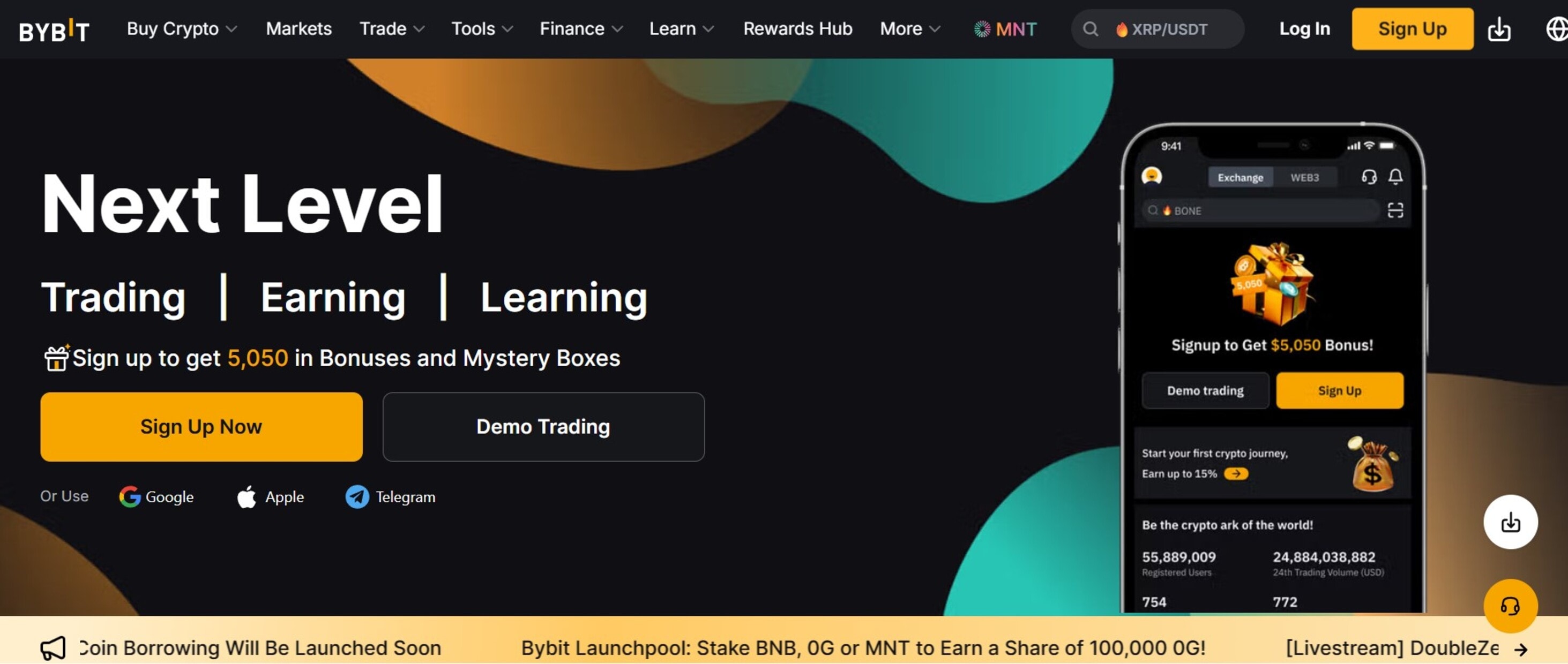
Bybit is a top derivatives exchange founded in 2018 by Ben Zhou, who previously worked at one of the largest forex brokerage companies in China for 7 years. The platform serves over 60 million global users and is ranked the second-largest cryptocurrency exchange by trading volume, behind Binance.

Bybit offers a professional trading platform with features such as advanced TradingView charts, a user-friendly web and mobile interface, and a range of products including spot trading,  Derivatives (futures and perpetual contracts, USDC options, and leveraged tokens), easy access to the web3 ecosystem, NFT trading, and staking.

Although Bybit is known for its robust security measures, it suffered a major hack in February 2025, resulting in a loss of about $1.5 billion in Ethereum. The cryptocurrency exchange quickly restored liquidity with emergency funding from major firms and has since improved its security to prevent future events.

Pros & Cons of Bybit

Pros of BybitCons of BybitBeginner-friendlyBybit is not available to users in some regions, including the United States, Syria, and the UK.High market liquidity, which helps with quick order execution and tight spreads.Customer support can be improved.Advanced trading tools for seasoned traders via TradingView integration and customizable tools.Concerns around past security breaches, despite the exchange’s quick recovery.Bybit offers competitive trading fees with discounts for VIP traders and Mantle (MNT) holders.

Bybit is Best for:

Derivatives Trading: The exchange allows trading on the following derivative products: USDT perpetuals, inverse perpetuals, USDC perpetuals, futures, USDC options, and leveraged tokens.Active and High-volume Traders: Bybit is also suitable for frequent traders thanks to its low fees and fast execution, enabling orders to be fulfilled quickly with minimal slippage.Traders who are looking for opportunities to earn passive income and those who want to explore new token listings early.

bybit-logo-whitebybit-logo-white

What is Binance? 

What is Binance? What is Binance? 

Binance is the world’s largest crypto exchange by user count and trading volume, serving 280+ users globally and averaging $20 billion in daily trading volume. Binance allows trading in more than 500 cryptocurrencies across 1,500+ trading pairs and offers a wide range of services, including spot trading, margin trading, futures, and staking.

The exchange offers low transaction fees and deep liquidity, and also provides an NFT marketplace and a comprehensive ecosystem supporting crypto wallets, payments, education, and research. Binance was founded in 2017 by Changpeng Zhao (CZ), who was the company’s former CEO.

He resigned as the CEO in November 2023 after pleading guilty, paying a $50 million fine, and serving time for failing to maintain an effective anti-money laundering (AML) system at Binance. Although Binance has faced regulatory and legal issues in the past, it has improved its compliance and security measures and remains a top choice for millions of traders.

Pros & Cons of Binance

ProsConsBinance has the highest trading volume of any exchange, which in turn converts to high liquidity.Binance faces legal and regulatory challenges in various countries, including the US and UK.Binance trading fees are competitiveThe vast number of available products and services can overwhelm new usersExtensive product supportAdvanced tools, making it suitable for professional traders.

Binance is Best for:

High Liquidity: Since Binance has the highest trading volumes, it means that there is much trading activity (enough buyers and sellers) on the exchange, allowing users to open and close positions quickly with zero price slippage.Advanced Crypto Traders: Binance offers a range of professional-grade trading tools. The cryptocurrency exchange provides margin and futures trading with TradingView integration, DeFi services, staking, and algorithmic trading tools.Developers and Institutional Investors: The exchange offers API access for developers, and advanced trading functionalities and institutional-grade services for institutional traders, hedge funds, and asset managers.

binance-logo-6219389_1280binance-logo-6219389_1280

Bybit Vs Binance: Trading Features

FeaturesBybitBinanceTrading MarketsSpot, derivatives trading, and options.Spot, futures trading, and options trading.TradingView IntegrationMargin TradingLeverage TradingYes, 200x leverageYes, 125xPremarket TradingRFQ (Request for Quote) TradingConvert & Block TradeOTC TradingCrypto Trading BotsCopy TradingDemo TradingPeer-to-peer (P2P) Trading 

Binance Vs Bybit: Platform Products and Services

What Binance Offers:

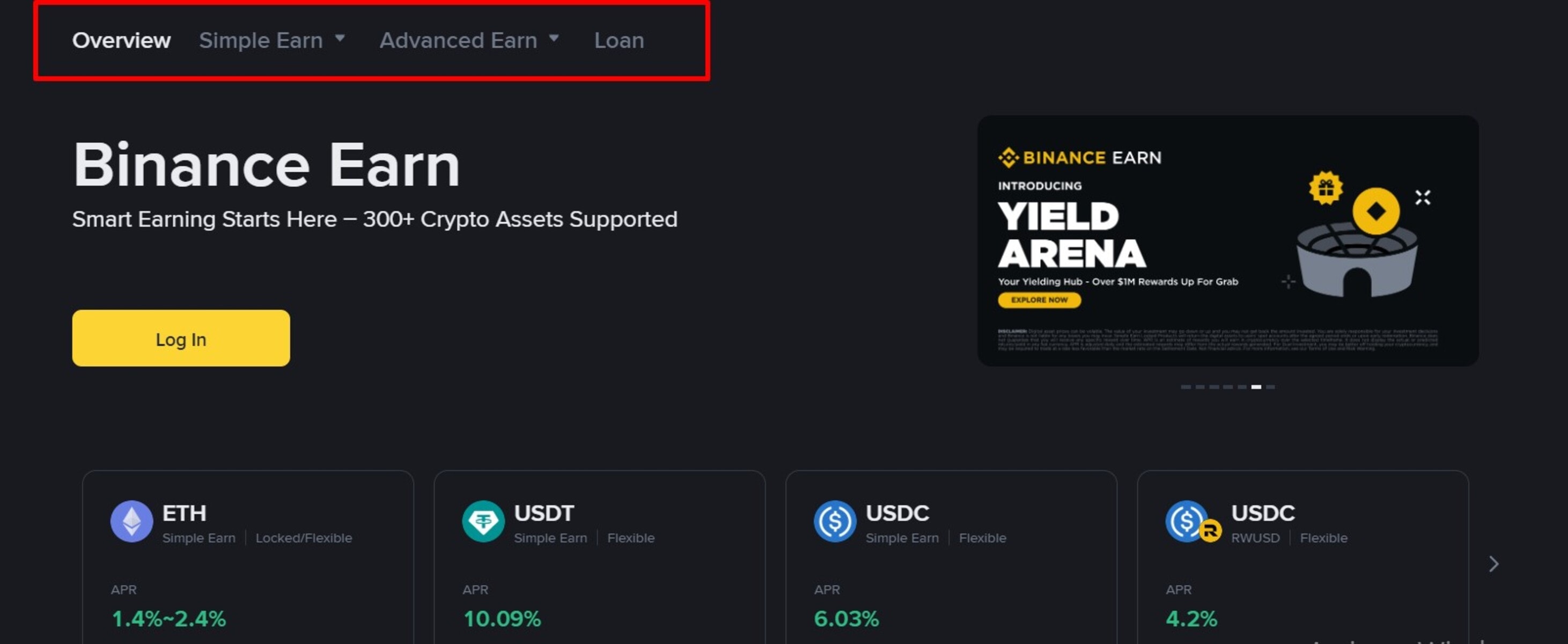
Binance Launchpool and Earn Products: Through Binance Launchpool, users can participate in new project token launches by staking their existing tokens to farm new ones. The Earn program includes flexible and locked savings, staking, liquidity farming, and dual investment products, giving users multiple ways to grow their holdings.

Binance Launchpool and Earn ProductsBinance Launchpool and Earn Products

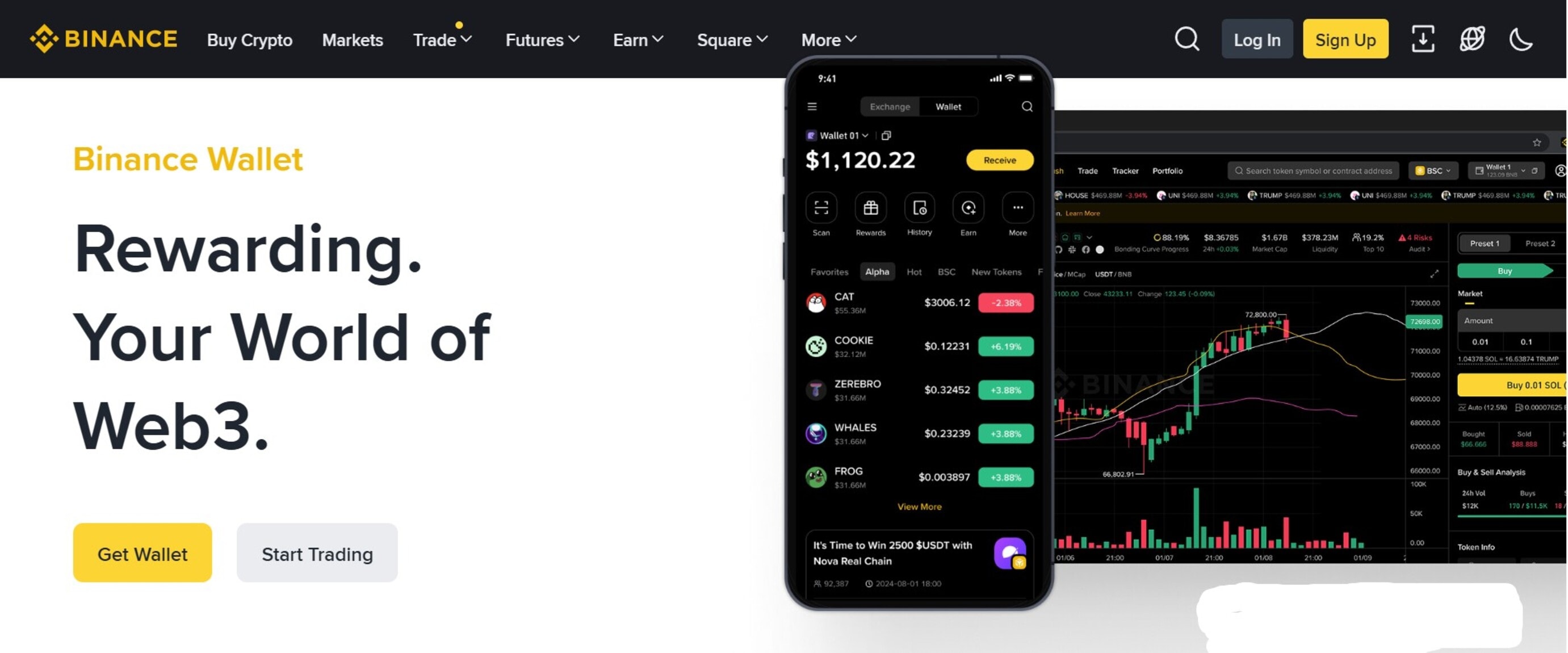
Basic and Advanced Trading Tools: Binance offers a comprehensive set of products for beginners and experienced traders. Beginners can choose from Spot, Margin, P2P, and Demo Trading. Meanwhile, skilled traders can explore the DEX (Beta), Trading Bots, Copy Trading, and APIs.Binance Wallet: This self-custody wallet integrates with other Binance features, allowing users to buy, trade, and manage their crypto assets without an external wallet. The wallet also supports Web3 integration, enabling users to interact with decentralized applications (dApps) directly.

Binance WalletBinance Wallet

What Bybit Offers:

Advanced Trading Options: Bybit offers spot trading, margin trading, perpetual and futures contracts, options trading, and a funded demo account for practice. The trading tools include detailed analytics, real-time data visualization, and advanced order types, giving traders more control over their strategies.

What Bybit OffersWhat Bybit Offers

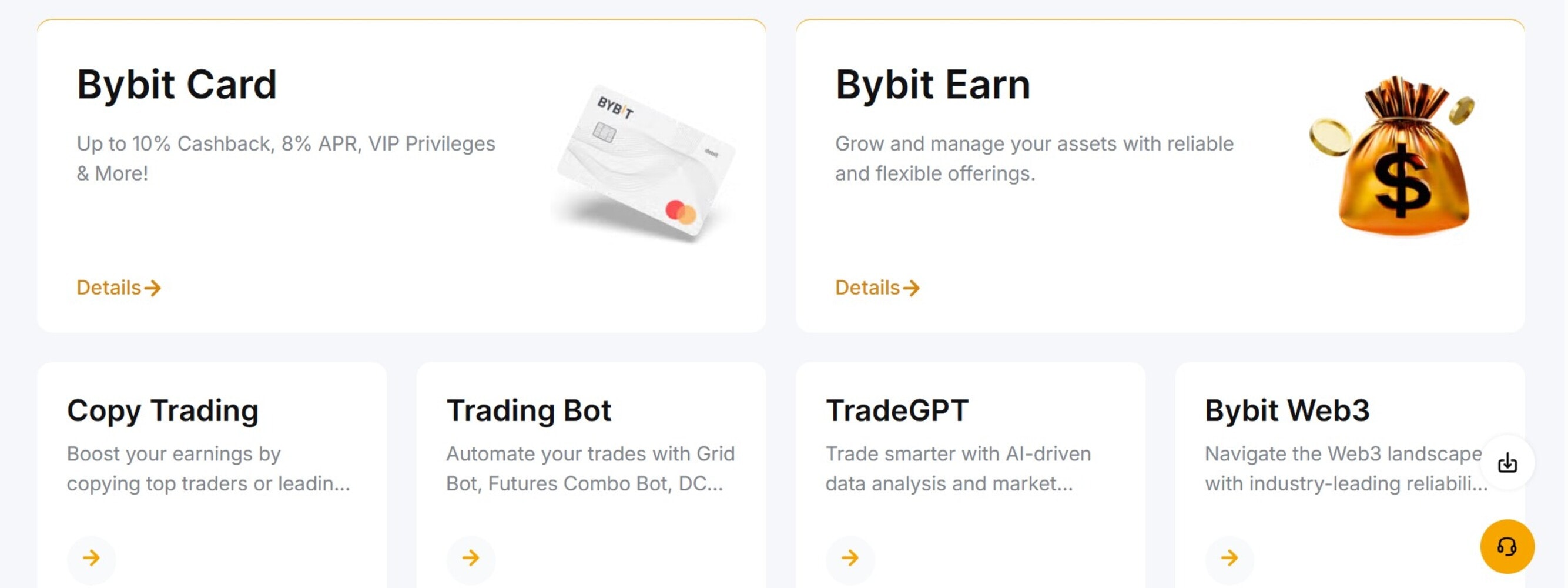
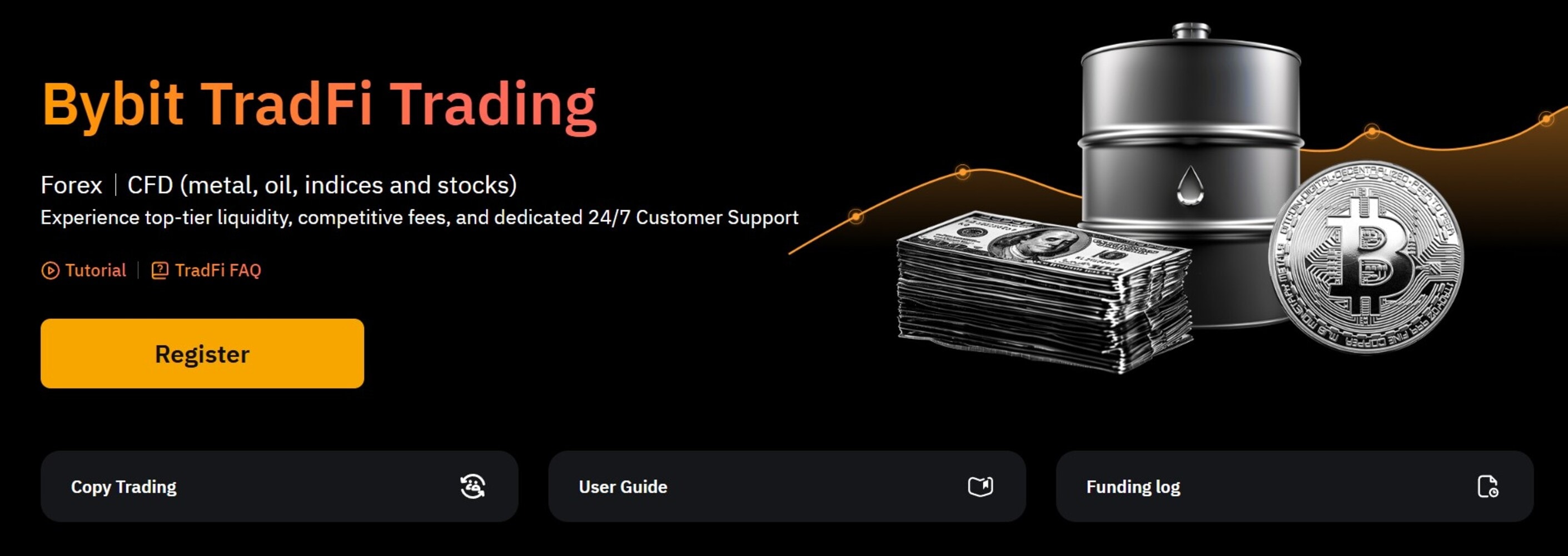
Automated Trading Tools: On Bybit, users can leverage algorithmic strategies to either simplify market moves or replicate trades that run 24/7. The cryptocurrency exchange makes this possible through features such as trading bots, copy trading, and TradeGPT. This AI-powered assistant helps generate, backtest, and optimize trading strategies based on preset parameters.Bybit TradFi: TradFi allows users to trade traditional assets, including stock CFDs, indices, forex, commodities, and gold, denominated in USDT. Traders can access over 100 stock CFDs, including major tech companies such as Apple, Tesla, and NVIDIA. TradFi also offers leverage up to 500x and tight spreads and is available on the mobile app and web platform.

Bybit TradFiBybit TradFi

Bybit Vs Binance: Fee Structures

FeeBybit FeesBinance FeesSpot0.10% maker/taker0.10% maker/takerFutures Trading Fee0.020% maker fee, 0.0550% taker fee0.020% maker, 0.050% takerOptions Trading Fee0.0200 % maker, 0.0300 % taker0.0240% maker/taker feesPre-market Fee0.0400% makers, 0.1000% takersNo additional feesCrypto Deposit FeeFreeFreeCrypto Withdrawal FeeBybit withdrawal fee depends on the coin and the chain.Also depends on the coin and chain.Trading Fee DiscountsLower fees for VIP traders and a 25% discount on MNT holdings.Lower fees for VIP traders, plus a 25% discount when paying in BNB.

Binance Vs Bybit: Coins Supported, Liquidity, & Volume

CriteriaBybitBinanceSupported Coins and Trading Pairs2,000+ and 500+ trading pairs500+ and 1,500+ pairsMarket Liquidity DeepHighest in the crypto spaceDaily Trading VolumeAvg. $4.5 billionAvg. $20 billionUser Base60+ million280+ millionGlobal Presence160+ countries180+ countries

Bybit Vs Binance: Security & Regulatory Compliance

Bybit Security Measures

Account Safety Features: The exchange supports two-factor authentication (2FA), anti-phishing mechanisms, fund password for withdrawals, IP whitelisting, and withdrawal address locks for new addresses.Insurance Fund: Bybit’s insurance fund is a reserve pool designed to protect traders and the cryptocurrency exchange from excessive losses, especially during forced liquidations.Cold Storage With Multi-sig Authorization: Transactions from cold wallets require multiple signers to approve, enhancing security by preventing single points of failure.

Binance Security Measures

Account Safety Measures: The platform supports 2FA, withdrawal whitelist options, anti-phishing codes to verify authentic Binance emails, device management to monitor login activity, and biometric login support for mobile users.Platform Safety Measures: The exchange employs an AI-powered risk management system, robust data encryption to secure its ecosystem from external threats, and it also undergoes regular security audits.SAFU Insurance Fund: This fund serves as a financial safety net, compensating Binance users in the event of security breaches or unforeseen incidents. It currently holds up to $1 billion.

Bybit vs Binance: Regulatory Compliance

Bybit holds a Virtual Asset Service Provider (VASP) license in Dubai and operates under the regulatory framework of the Netherlands through its partnership with SATOS B.V., which is licensed by De Nederlandsche Bank (DNB). Binance, on the other hand, holds VASP and Digital Asset Service Provider (DASP) licenses in several jurisdictions, including Dubai, France, Italy, Spain, and Argentina.

Binance Vs Bybit: Affiliate & Referral Programs

FeaturesBybitBinanceCommission50%40%Extra PerksEarn up to 1720 USDT, 24/7 dedicated support, and more earnings as you refer more users.Set commission to share with invitees and trading fee credit.Welcome Bonus (Referral Rewards)30,050 USDT100 USDTFee Rebate30%20%Valid Referral CodeNFTPBINANCENFTPKYC RequirementMandatoryMandatory

Bybit Vs Binance: User Experience

From our Bybit review, the web platform and mobile app are easy to use and beginner-friendly. Products/services are structured properly, and the onboarding is fast, but requires KYC verification. After completing identity verification, you can easily deposit and start trading.

Trading on Bybit is also seamless. For new traders, we advise you to start with spot trading for simple buy/sell orders. You can also buy/sell crypto assets via the P2P marketplace. Once you’ve become familiar with the cryptocurrency exchange, you can then practice with a demo account and proceed to explore the derivatives market with real funds when you are ready.

Moving on, our Binance review found that onboarding is quite easy, and users must complete KYC verification. Upon verification, you get access to the platform’s products and services. One thing we noticed was the extensive product offering available on both mobile and web platforms, which can be overwhelming for newbies.

For beginners, you can also stick to the spot market, practice with demo accounts before going live, or simply copy the trades of advanced traders via the copy trading marketplace. However, we encourage copy traders to have some level of experience so they can customize their trades. That said, this extensive product support is good for experienced traders.

Bybit Vs Binance: Customer Support 

Bybit provides 24/7 support via live chat and email, with timely responses to most queries. To get help, you can log your complaint via the Support Hub and wait for a response. While you wait, you could try the exchange’s Help Center or find answers to related questions in their FAQ section.

Binance also offers 24/7 service via live chat and support tickets, but response times are inconsistent. You can get self-help from the extensive educational and help resources Binance has. For online ratings, Bybit customer support reviews are mixed, with a current rating of 3.4 out of 5 from 6,000+ reviews on Trustpilot. Binance’s online reviews are also mixed, but not as positive. The exchange has a 1.4 rating out of 5,700+ reviews on Trustpilot.

Conclusion

Binance is the largest exchange by trading volume and has maintained the position for years. This means it is the most liquid platform in the crypto market, making it ideal for high-volume, frequent traders. On the flip side, Bybit excels in providing a comprehensive derivative trading service. In addition, it offers trading of other financial products, including Gold, FX, and CFDs.

So determining which exchange is best for you depends on your trading goals and preferences. You can visit both exchanges to understand their key differences and how they align with your goals. Once you decide, use the current Bybit referral code or Binance referral code to get monetary rewards, fee discounts, and other exclusive bonuses.

FAQs

Is Bybit a Trusted Crypto Exchange?

Yes, Bybit is a trusted crypto exchange. The platform is the second-largest exchange by trading volume and has robust security measures to keep used funds safe.

What Exchange is Better than Binance?

As discussed earlier, Binance offers perks that set it apart from other exchanges. However, no cryptocurrency exchange is perfect, so the best alternatives to Binance include Bybit, Kraken, Crypto.com, OKX, and MEXC.

Is Bybit Better than Binance?

In some ways, Bybit is better than Binance. Bybit might be better than Binance for the following reasons: the interface is easier to navigate, products are well displayed,  derivatives trading focus, and responsive support. However, be advised that choosing one exchange over another depends on your specific needs and trading style.

Which Crypto Exchange has Lower Fees: Bybit vs Binance?

Both exchanges charge the same fee for spot trading, and Bybit charges slightly higher for perpetual & futures contracts. For spot, they charge 0.10% on maker and taker fees, while makers pay 0.020% for perp and futures trading fees on both Bybit and Binance. For perp and futures takers’ fee, Bybit charges 0.0550% while Binance charges 0.050%.

Which Exchange is More Beginner-friendly: Bybit or Binance?

Bybit is more beginner-friendly than Binance. Binance provides a broader range of services, which can be overwhelming for new users. 

What are the Deposit and Withdrawal Options on Bybit and Binance?

Binance and Bybit users can fund their accounts with cryptocurrencies, credit or debit cards, third-party payment providers, or bank transfers. Withdrawals are primarily made in crypto, but fiat withdrawals are available. Both exchanges also support P2P trading, allowing users to buy and sell crypto directly using local payment methods. In addition, Binance supports over 300 payment channels globally via Binance Pay.


Source link

BlockDAG Cements Its Case as Leading Crypto for 2025

0
BlockDAG Cements Its Case as Leading Crypto for 2025


The crypto discourse remains fixated on familiar narratives. We see endless analysis of the XRP technical setup and constant speculation surrounding Pi network news, which just saw a price surge after its ISO 20022 integration news. 

Both projects command attention, yet their paths are mired in regulatory questions or protracted development. It begs the question: in the search for the leading crypto for 2025, does value come from slow consensus, or from decisive, strategic action?

Consider BlockDAG‘s recent manoeuvre. While disinformation campaigns suggested an infinite presale, its CEO responded not with denials, but with arithmetic. By defining a final, finite public allocation of exactly “2 billion tokens,” the project masterfully inverted the narrative. The conversation shifted instantly from uncertainty to scarcity, replacing doubt with a powerful, unified fear of missing out.

BlockDAG: The 2 Billion Coin Countdown

After facing coordinated disinformation that suggested its presale was a bottomless pit, BlockDAG CEO Antony Turner provided a definitive answer. Instead of vague promises, he put a hard number on the table: a final public allocation of just 2 billion tokens. This single, specific figure immediately cut through the noise, ending speculation about an infinite supply.

This final phase is structured with a clear 10-stage roadmap. The first of these final stages is set to launch at $0.005 and will methodically climb to a final price of $0.03. This transparent, multi-stage structure gives a clear view of the path toward the stated $0.05 listing price, a compelling factor for those hunting for the big crypto for 2025.

BlockDAG: The 2 Billion Coin Countdown

Turner’s message was clear: the ship is leaving. The presale will end when the 2 billion coins are sold or on February 10th of next year, whichever comes first. This unbreakable deadline transformed the narrative from fear to scarcity. For the community, this finality created a powerful “fear of missing out,” cementing BlockDAG’s position as a serious contender for the popular crypto for 2025.

Pi Network News: Momentum Builds with ISO 20022 and KYC Breakthroughs

The Pi network news feed has been buzzing with significant developments, fueling a major rally for the project. The biggest item is the planned integration of the ISO 20022 global banking standard, a move set for November 22nd that aligns Pi with payment giants like XRP. 

This news, combined with the activation of the new Testnet2 v23, has ignited serious community excitement. The v23 upgrade is key, as it finally brings smart contract and DeFi capabilities to the test environment, showing a clear path forward for utility.

Pi Network News: Momentum Builds with ISO 20022 and KYC BreakthroughsPi Network News: Momentum Builds with ISO 20022 and KYC Breakthroughs

This technical progress is matched by community momentum. The project just rolled out a new AI-driven process that is successfully clearing its massive “Tentative KYC” backlog. This update has already allowed millions of Pioneers to finally complete verification, leading to a surge of 2.7 million mainnet migrations in just the last week. While all this Pi network news is positive, analysts are also watching the 120 million tokens scheduled to unlock in November, which could introduce new volatility to the market.

A High-Stakes XRP Technical Setup

The XRP technical setup is currently showing a fascinating split between short-term pressure and long-term optimism. As of October 30th, the price is consolidating around $2.59-$2.63 after facing a strong rejection at the $2.67 resistance level. This rejection was significant, and some indicators, like the TD Sequential, have flashed a sell signal, suggesting a possible pullback. On-chain data also hints that some large holders might be taking profits, putting immediate pressure on the price.

A High-Stakes XRP Technical SetupA High-Stakes XRP Technical Setup

However, looking at the bigger picture, a “golden cross” has formed, which many traders see as a strong long-term bullish sign. This current XRP technical setup is essentially a battle at a key pivot zone. The critical line in the sand for bulls is the support area between $2.50 and $2.55, which includes the 200-day moving average. If that level holds, long-term analyses pointing to fractal patterns from 2017 remain in play, with some citing ambitious future targets.

Conclusion

While the latest Pi network news points to exciting utility through ISO 2022 integration and the XRP technical setup sits at a critical pivot point, both narratives remain complex. They represent established projects navigating crucial, long-term phases of their development.

BlockDAG, in contrast, just cut through the noise with one decisive move. By announcing a final, hard cap of 2 billion coins and a fixed presale deadline, its CEO instantly replaced speculation with scarcity. This wasn’t a vague “final phase”; it was a clear signal that the opportunity is ending, creating a powerful wave of FOMO and making a strong case for its inclusion as the leading crypto for 2025.

Click here to experience BDAGClick here to experience BDAG

Presale: https://purchase.blockdag.network

Website: https://blockdag.network

Telegram: https://t.me/blockDAGnetworkOfficial

Discord: https://discord.gg/Q7BxghMVyu


Source link

MEXC Vs Binance 2025: Features, Fees, and Security Compared

0
MEXC Vs Binance 2025: Features, Fees, and Security Compared


MEXC vs Binance 2025 is the key comparison for traders looking for the best crypto exchange this year. Choosing the right platform can determine your trading success. You want access to various digital assets, low fees, and useful trading tools. Both exchanges have solid reputations, but they differ in important ways like features, costs, and security. 

In this review, we cover everything you need to know to make an informed choice. Keep reading to find out which platform gives you better value and trust in every trade. Whether you prioritize low fees, a good user experience, or advanced trading tools, this comparison will help you find the platform that meets your goals.

MEXC vs Binance: A Glance Comparison

CriteriaMEXCBinanceBest ForTraders seeking access to altcoins, high-leverage options, and copy tradingHigh-volume traders and those seeking a comprehensive crypto ecosystemLaunch Year20182017Supported CryptocurrenciesOver 2900+ assets and over 3000 digital pairs, including emerging tokens350+ cryptocurrenciesTrading FeesSpot: 0% Maker / 0.05% Taker

Futures: 0% Maker / 0.02% Taker

Spot: 0.1% Maker / 0.1% Taker

Futures: 0.02% Maker / 0.05% Taker

LeverageUp to 500x on futures tradingUp to 125x on futures tradingKey FeaturesKickstarter & Launchpad for new tokens, copy trading, and extensive altcoin selectionBNB Chain ecosystem, Launchpad & Launchpool, NFTs, and trading botsFiat SupportLimited fiat on-ramps, supports P2P tradingExtensive fiat deposit options, including bank transfers and Apple PaySecurityCold storage, 2FA, Proof of Reserves (PoR), $100M Guardian FundCold storage, 2FA, Secure Asset Fund for Users (SAFU), Proof of ReservesNFT MarketplaceNot availableAvailableMobile AppFeature-rich but may feel complex for new usersIntuitive and easy to navigate, ideal for all user levelsGlobal ReachAvailable in 170+ countriesOperates in over 180 countries

What is MEXC?

What is MEXC?

If you’re searching for one of the best crypto exchanges, MEXC stands out as a leading choice for traders in 2025. Launched in 2018 and headquartered in Seychelles, MEXC has rapidly grown into a global platform, serving over 30 million users across 170+ countries. Known for its extensive selection of over 3000 trading pairs, MEXC caters to traders seeking both high market cap assets like Bitcoin and Ethereum and newly launched altcoins.

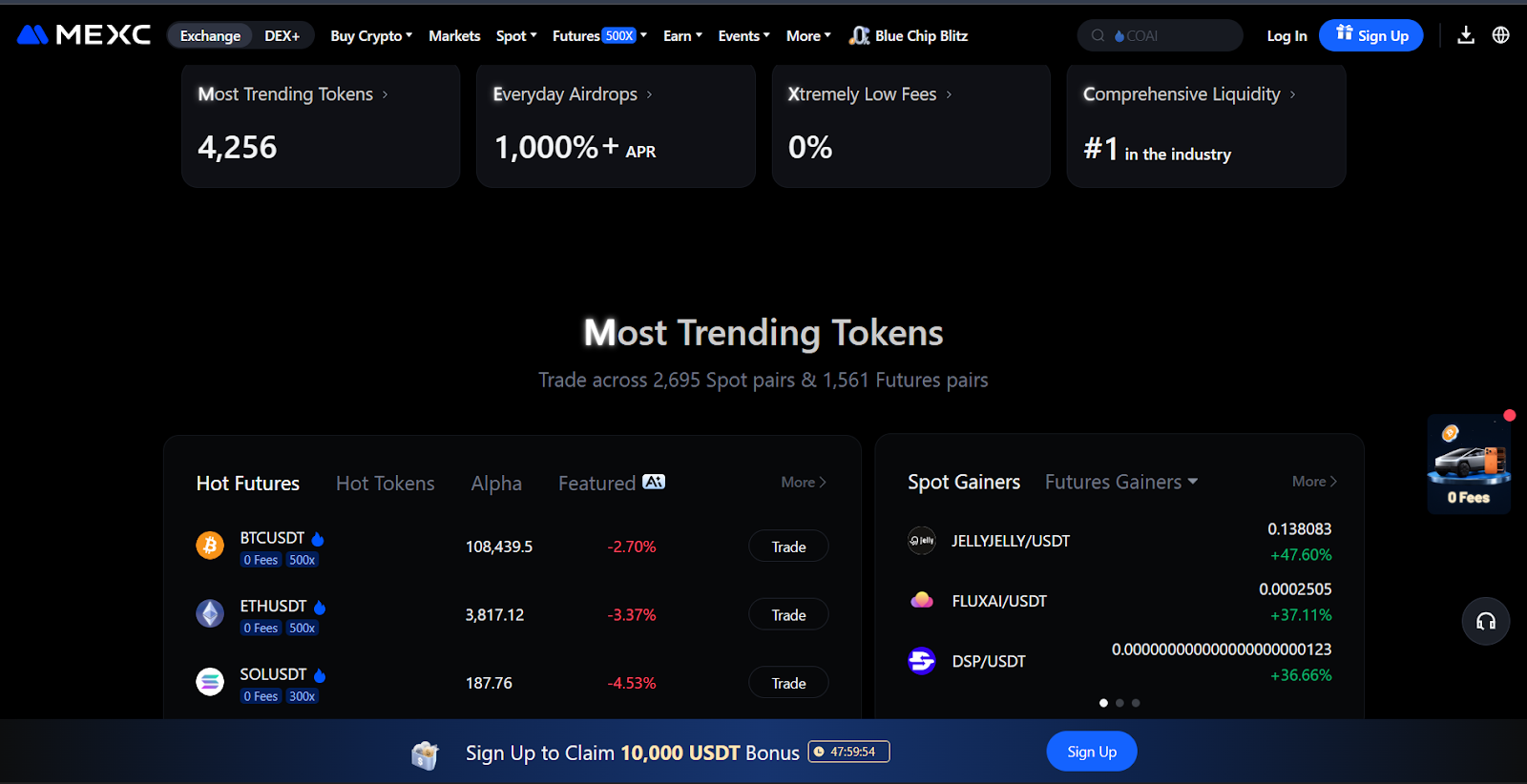
What sets MEXC apart is its high-performance trading engine, capable of processing 1.4 million transactions per second. This ensures a seamless trading experience, even during peak market activity. The platform’s competitive fees, with 0% maker fees on spot trading and up to 500x leverage on futures, make it a go-to choice for traders aiming to maximize their opportunities.

MEXC exchange also excels in early token listings, giving users access to emerging projects before they gain mainstream attention. With billions in daily trading volume and robust security measures like cold storage and Proof of Reserves, MEXC has earned its place among the best crypto exchanges for speed, variety, and innovation.

Pros & Cons of MEXC

ProsConsTraders can access over 2900 cryptocurrencies, including emerging altcoins.Investors might face challenges with limited fiat currency deposit and withdrawal options.Competitive trading fees, with zero maker fees for both spot and futures trading.The platform lacks a dedicated NFT marketplace, unlike some competitors.High-leverage futures trading available, offering up to 500x on select pairs.Margin trading and crypto options are not standalone features.Copy trading allows mexc users to follow and replicate strategies of top traders.Restricted access in certain regions, including the US and UK.Frequent new token listings provide early access to promising projects.The user interfaces and features may feel overwhelming for beginners.

MEXC is best for

Traders looking to maximize profits with zero maker fees on spot and futures trades.High-leverage enthusiasts aiming to amplify their positions with up to 500x leverage.New users who appreciate a simple registration process, requiring just an email to get started.Investors keen on accessing newly listed tokens before they become widely available.Professional traders seeking advanced features like copy trading, demo accounts, and detailed market analysis tools.

MEXC_square_logo-removebg-previewMEXC_square_logo-removebg-preview

What is Binance?

What is Binance?What is Binance?

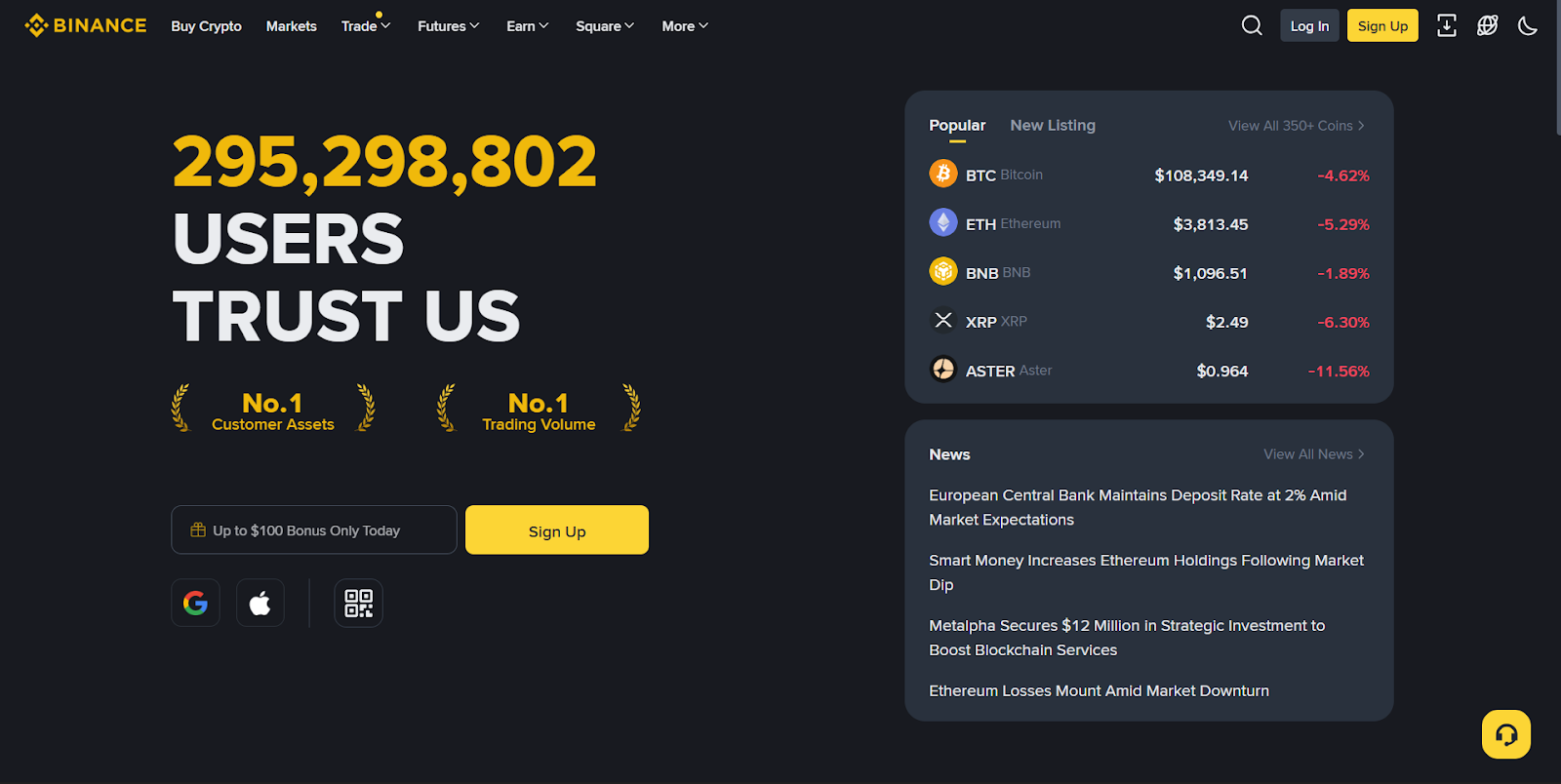
Binance is a global powerhouse in the cryptocurrency world, setting the standard for what the best cryptocurrency exchanges should offer. Established in 2017, it has grown to serve over 295 million users across 180+ countries, with a daily trading volume exceeding $99 billion.

The platform provides access to 350+ cryptocurrencies, including major coins like Bitcoin and Ethereum, as well as its native BNB token. Binance is renowned for its low trading fees, starting at just 0.1%, and its diverse range of features, such as spot trading, futures, staking, and an NFT marketplace.

Security is a cornerstone of Binance’s operations, with advanced measures like cold storage, two-factor authentication (2FA), and the Secure Asset Fund for Users (SAFU) to protect user assets. Whether you’re a beginner or an experienced trader, there are specific things to look for in a trading platform. 

Pros & Cons of Binance

ProsConsAccess to 350+ cryptocurrencies, including major coins and altcoins.The platform can feel overwhelming for beginners due to its vast features.Low trading fees starting at 0.1%, with discounts for BNB holders.Limited availability in certain regions due to regulatory restrictions.Offers diverse products like staking, NFTs, and margin trading.Customer support response times can be inconsistent during peak periods.Strong security features, including SAFU and two-factor authentication.Identity verification is mandatory for most features, which may deter some users.High liquidity ensures smooth trading even for large transactions.Some advanced tools may have a steep learning curve for new traders.

Binance is best for

Traders who prioritize low fees (starting at 0.1%) to optimize their trading costs.Advanced traders who need features like futures, margin trading, and in-depth analytics.Investors seeking passive income through staking, savings, and liquidity farming.High-volume traders who require a platform with deep liquidity for transactions can use either use Binance US or the Binance option available in over 180+ countries.Security-conscious users who value robust measures like SAFU and two-factor authentication.NFT traders and creators looking for a reliable marketplace to trade and mint NFTs.

binance-logo-6219389_1280binance-logo-6219389_1280

MEXC vs Binance: Trading Features

FeatureMEXCBinanceSpot TradingSupports a wide range of cryptocurrencies with competitive fees.350+ supported coins with high liquidity and low fees (0.1%).Futures TradingAvailable with up to 200x leverage on select pairs.Advanced futures platform with up to 125x leverage and deep liquidity.Margin TradingOffers margin trading with flexible leverage options.Comprehensive margin trading with cross and isolated margin modes.Staking & EarnProvides staking and yield farming for passive income.Extensive staking, savings, and liquidity farming options.Trading ToolsBasic charting tools and indicators for analysis.Advanced charting tools, APIs, and trading bots for pro traders.Mobile AppUser-friendly app with essential trading features.Robust mobile app with full trading functionality and advanced tools.

MEXC vs Binance: Platform Products and Services

CategoryMEXCBinanceCryptocurrency ListingsWide range of altcoins, including newly launched tokens.Extensive selection of 350+ cryptocurrencies, including major, niche and lesser known coins.LaunchpadToken launch platform for early-stage projects.Industry-leading Launchpad for exclusive token sales and project funding.NFT MarketplaceLimited NFT trading options.Comprehensive NFT marketplace for buying, selling, and minting NFTs.Savings & StakingOffers staking and flexible savings for passive income.Diverse savings, staking, and liquidity farming options.Fiat On/Off-RampSupports fiat deposits and withdrawals in select currencies.Extensive fiat support with multiple payment methods and currencies.Affiliate ProgramCompetitive affiliate rewards for referrals.Robust affiliate and binance referral programs with tiered rewards.

MEXC vs Binance: Security Comparison

When it comes to security, both MEXC and Binance have implemented strong measures to protect your funds and personal information, but their approaches differ slightly. Binance is widely recognized for its Secure Asset Fund for Users (SAFU), an emergency insurance fund that covers user losses in the event of a security breach. This added layer of protection is a significant advantage for traders who prioritize peace of mind. Binance also employs advanced security features like two-factor authentication (2FA), anti-phishing codes, and withdrawal address whitelisting to ensure account safety. Additionally, its platform undergoes regular security audits to identify and address vulnerabilities.

MEXC, on the other hand, focuses on safeguarding assets through cold wallet storage, where the majority of funds are kept offline to minimize hacking risks. The platform also uses multi-layer encryption to secure transactions and user data. While MEXC doesn’t offer an insurance fund like Binance, its emphasis on cold storage and encryption provides a solid foundation for security.

Both platforms are reliable, but Binance’s comprehensive security tools and insurance fund may appeal more to users who want extra assurance. Ultimately, your choice will depend on whether you value Binance’s additional safeguards or MEXC’s straightforward and effective security measures.

MEXC Security Measures

Majority of funds stored in cold wallets to minimize hacking risks.Multi-layer encryption to secure transactions and user data.Regular security audits to identify and fix vulnerabilities.IP whitelisting to restrict account access to trusted devices.Real-time monitoring systems to detect and prevent suspicious activities.

Binance Security Measures

Secure Asset Fund for Users (SAFU) to cover losses in case of a breach.Two-factor authentication (2FA) for account login and transactions.Anti-phishing codes to protect users from fraudulent emails.Withdrawal address whitelisting to ensure funds are sent to trusted addresses.Advanced risk management systems to monitor and block suspicious activities.Regular third-party security audits to maintain platform integrity.

MEXC vs Binance: Affiliate & Referral Programs

FeatureMEXCBinanceReferral Codemexc-NFTPBINANCENFTPReferral Rewards10,000 USDT100 USDTAffiliate ProgramOffers up to 50% commission on trading fees for referred users.Provides up to 50% commission on trading fees, depending on referral tier.Referral ProgramUsers can earn rewards by inviting friends, with bonuses in USDT.Allows users to earn a percentage of trading fees from referrals, with flexible reward structures.Payout FrequencyCommissions rates are credited daily to the affiliate’s account.Commissions are credited daily to the affiliate’s account.Additional BenefitsExclusive promotions and bonuses for top-performing affiliates.Offers tiered rewards and exclusive benefits for high-performing affiliates.Ease of UseSimple dashboard for tracking referrals and earnings.Advanced dashboard with detailed analytics and tracking tools.

Pro Tip: Depending on your preferred crypto exchange, you can use the current MEXC referral code or Binance referral code to sign up and claim exclusive rewards, bonuses, and trading discounts.

MEXC vs Binance: User Experience

When you choose between MEXC and Binance, you gain access to two of the best trading platforms offering excellent leverage. MEXC is tailored for simplicity and accessibility, making it a great option for beginners. Its user friendly interface allows users to easily navigate trading pairs, markets, and account settings. The mobile app reflects this simplicity, offering essential trading features without overwhelming users. However, advanced traders might find the platform’s lack of sophisticated tools and analytics limiting.

Binance, on the other hand, is designed to accommodate both beginners and experienced traders. Its interface strikes a balance between usability and functionality, featuring customizable dashboards and advanced charting tools for detailed market analysis. The Binance mobile app is robust, providing full trading capabilities, including spot, futures, and margin trading, as well as staking and earning options. While feature-rich, the platform’s extensive options can feel overwhelming for new users, requiring time to fully explore and utilize.

Both platforms offer multilingual support, but Binance stands out with its 24/7 live chat and comprehensive help center. MEXC provides email support and a chatbot, which are effective but may not match Binance’s speed and depth of assistance.

MEXC vs Binance: Customer Support

The choice of your cryptocurrency exchange can make a big difference when it comes to customer service. If you ever run into issues, you’ll want a platform that’s quick to help and easy to reach.MEXC offers customer support through email and a chatbot. The chatbot is great for simple questions, but for more complicated problems, you’ll need to rely on email. This can take longer to get resolved, which might be frustrating if you’re in a hurry. While MEXC does provide a help center with FAQs and guides, the lack of live chat support means you might not get immediate answers when you need them most.

With Binance, you get a 24/7 live chat feature, which is useful for live trading. You can connect with a real person anytime, which is a lifesaver for urgent issues like account access or transaction errors. Binance also has a detailed help center packed with articles, tutorials, and videos to guide you through common problems. Plus, their multilingual support ensures you can get help in your preferred language. 

If you’re looking for basic support, MEXC gets the job done. But if you value quick responses and a more robust system, Binance stands out as one of the best crypto exchanges for customer service. It’s built to make sure you’re never left waiting for answers.

Conclusion

As an investor, your best crypto exchanges can be those that meet your specific trading needs, whether you’re a beginner or an experienced trader. Both MEXC and Binance are strong platforms, offering unique features to cater to different preferences. With MEXC, you get a straightforward and beginner-friendly platform. Its simple interface and easy navigation make it ideal for those new to crypto trading or looking for simplicity. The platform has helpful tools and resources. However, experienced traders might find the lack of advanced features and live chat support a bit limiting.

With Binance, you get a feature-packed platform that caters to a wide range of users. It offers advanced trading tools, a comprehensive help center, and 24/7 live chat support for quick assistance. While the platform’s extensive options can feel overwhelming at first, it provides the depth and flexibility that experienced traders often seek. 

Both platforms are reliable and secure, making them excellent choices in the crypto space. The decision depends on what you prioritize, whether it’s simplicity and ease of use or a more robust and feature-rich trading experience.

FAQs

What exchange is better than Binance?

The answer to what exchange is better than Binance depends on your needs. Binance is known for its advanced features, wide range of cryptocurrencies, and 24/7 live chat support. However, if you prefer a simpler platform, MEXC might be a better fit for you.

Which exchange has lower fees: MEXC vs Binance?

When comparing fees between MEXC and Binance, both platforms offer competitive rates. Binance generally has slightly lower trading fees, especially if you use BNB (Binance Coin) for discounts. MEXC, however, may have promotions or fee structures that appeal to specific traders.

Which exchange is more beginner-friendly: MEXC or Binance?

If you’re looking for a beginner-friendly exchange, MEXC is often considered easier to navigate due to its straightforward trading interface. Binance, while feature-rich, can feel overwhelming for new users but offers extensive tutorials and guides to help you get started.

Which exchange is safer: MEXC vs Binance?

When it comes to safety, both MEXC and Binance implement strong security measures, including two-factor authentication (2FA) and cold storage for user funds. Binance has a longer track record and additional features like its Secure Asset Fund for Users (SAFU), which provides extra protection.

Which is best for advanced traders: MEXC vs Binance?

For advanced crypto traders, Binance is often the preferred choice due to its wide range of trading tools, futures, margin trading, and advanced charting options. MEXC also offers features for experienced traders, but may not match Binance’s depth.

Does MEXC or Binance have better customer support?

When comparing customer support, Binance offers 24/7 live chat, making it more accessible for immediate assistance. MEXC provides email support and a chatbot, which are effective but may not be as fast for urgent issues.


Source link

Kite (KITE) Will Be Listed on Binance HODLer Airdrops!

0
Kite (KITE) Will Be Listed on Binance HODLer Airdrops!


Binance, the world’s leading cryptocurrency exchange, has officially unveiled Kite (KITE) as its 71st Launchpool project, an AI-powered blockchain designed to revolutionize payment systems through intelligent transaction processing.

Through this Launchpool event, users can farm KITE tokens by staking BNB, FDUSD, or USDC over two days, beginning November 1, 2025, at 00:00 (UTC). The project represents another strong step for Binance toward integrating AI and blockchain utility in the real-world payment landscape. 

Following the farming phase, Binance will list KITE for spot trading on November 3, 2025 (13:00 UTC). They are offering trading pairs in KITE/USDT, KITE/USDC, KITE/BNB, and KITE/TRY. This listing marks another step in Binance’s strategy to bring forward innovative blockchain projects blending AI and decentralized finance.

Listing Details

Listing date: November 3, 2025, at 13:00 (UTC) Available trading pairs: KITE/USDT, KITE/BNB, and KITE/TRY, KITE/USDC. BNB Lock for Airdrop period: November 1, 2025, 00:00 (UTC) → November 2, 2025, 23:59 (UTC)HODLer Airdrops Rewards: 150,000,000 KITE (1.5% of total supply) distributed to Launchpool participants staking BNB, FDUSD, and USDC. 

binance-logo-2

KITE Token Details

Token Name: Kite (KITE)Total Supply (Genesis): 10,000,000,000 KITE Max Token Supply: 10,000,000,000 KITE Circulating Supply (upon listing): 1,800,000,000 KITE (18% Total Supply) 

About Kite (KITE) 

About Kite (KITE) About Kite (KITE)

About Kite (KITE) – Source: Kite

With its intelligent automation, cross-chain interoperability, and transparent settlement, Kite is an AI-driven blockchain infrastructure that aims to revolutionize digital payments. Simply put, Kite is an artificial intelligence (AI)-powered payment blockchain.

Located at the intersection of decentralized finance and artificial intelligence, Kite introduces a new approach where built-in machine learning models handle payments, transactions, and financial decisions autonomously.

At its core, Kite uses AI agents and on-chain analytics to optimize transaction routing, predict user behavior, and prevent fraud in real time. As a result, the platform enables faster, safer, and more cost-effective transactions and smart contracts between users and businesses. Through automated processing and intelligent fraud detection, it achieves both scalability and security, giving global users a seamless financial experience.

Moreover, the platform is multi-chain compatible, connecting effortlessly with networks such as Ethereum, BNB Smart Chain, and Avalanche to enable frictionless cross-chain settlements.

Beyond payments, Kite’s ecosystem features AI-integrated smart contracts, decentralized data services, and a modular framework for developers to build intelligent dApps. Its native token, KITE, powers governance, staking, and incentives, aligning participants toward sustainable network growth.

Ultimately, Kite focuses on efficiency, transparency, and inclusivity, aiming to build the foundation for a new digital economy, one where AI transforms not only how transactions happen but also how trust, value, and intelligence are encoded directly into the blockchain.


Source link

How to Mine Litecoin: The Beginner’s Guide

0
How to Mine Litecoin: The Beginner’s Guide


For diehard cryptocurrency miners, Litecoin mining is a ‘silver medal’ exercise compared to Bitcoin’s ‘gold’ due to its speed and accessibility. If you’re here to learn how to mine Litecoin, this guide will equip you with everything you need to understand the mining process, required tools, and how to maximize mining profitability.

Whether you’re new or experienced in mining, we’ll start from the basics and walk you through each mining method. You’ll also learn what kind of hardware and operating system setup is required for a successful mining operation.

What Is Litecoin?       

Litecoin is an open-source, peer-to-peer cryptocurrency developed in 2011 by Charlie Lee, a former Google engineer. Built using the same foundational technology as Bitcoin, it employs the Scrypt algorithm, which supports more memory-intensive computations and encourages decentralization.

Unlike fiat currencies, Litecoin is not governed by any central authority. Transactions are recorded transparently on a public blockchain. Thanks to lower fees and faster confirmations, Litecoin has positioned itself as a strong alternative for daily transactions and a popular choice in both Litecoin and Bitcoin mining circles.

In the world of cryptocurrencies, Litecoin was designed to be a lighter version of Bitcoin, intended to function like “silver where Bitcoin is gold.” The Scrypt hashing algorithm facilitates a larger supply limit and faster blocks generation times. LTC has also consistently ranked among the top 20 cryptocurrencies in market capitalization. Due to Litecoin’s lower transaction fees and faster confirmation times, it has become preferred for everyday transactions and is attractive to cryptocurrency miners. 

Can You Mine Litecoin?

Yes, Litecoin can be mined using GPUs, CPUs, or ASICs. While early miners could use standard computers, increased difficulty now requires specialized hardware to ensure competitive mining performance. The mining process is more accessible than Bitcoin’s, attracting a broader user base.

Mining Litecoin offers income potential and contributes to the network’s decentralization and security. How much you earn depends on mining efficiency, energy costs, hardware investment, and market dynamics.

Why Mine Litecoin (LTC)?     

There are several opportunities and advantages associated with mining Litecoin, including the following:

Mining Rewards: If done right, mining Litecoin can generate steady income. Block rewards are paid in LTC, and their value may grow alongside Litecoin’s market performance.Support the Network: By processing and confirming transactions, miners help maintain the integrity and security of the Litecoin blockchain. Your participation reinforces decentralization and prevents single points of failure.Hands-on Learning: Engaging in Litecoin mining is a great way to explore blockchain mechanics, crypto technology, and decentralized infrastructure. It’s a practical path to building real-world knowledge in the digital asset space.

Litecoin mining consumes significant electricity, so maximizing mining efficiency is crucial to ensure sustainability and profitability.

The Role of Mining in Litecoin’s Ecosystem

Litecoin mining plays a significant role within the LTC ecosystem. It helps secure the network from attacks and maintains the health and functionality of the blockchain. Some of the essential functions that mining performs include:

Network Security: LTC mining authenticates transactions before adding them to the blockchain, which ensures the Litecoin network’s integrity and security. As a decentralized network, this makes the LTC blockchain resistant to 51% attacks since no single individual or entity can control the majority of mining power.Creation of New Coins: Miners are rewarded with the newly issued LTC coins. The process progressively adds LTC coins to the circulating supply until the maximum of 84 million coins is reached.Decentralization: Scrypt, Litecoin’s mining algorithm, is more accessible than Bitcoin’s SAH-256, meaning more people and organizations can participate in the mining exercise. This kind of decentralization ensures no group of people can control the network to their advantage at the expense of others.Transaction Validation: Miners are responsible for solving complex mathematical puzzles that help validate transactions, after which they add them to the blockchain and ensure they are recorded correctly.Halving: The halving event, which happens after approximately four years and halves the mining rewards, helps to control the circulating supply of LTC, ensuring a gradual and systematic decrease in the rate at which new coins are issued. This helps to maintain scarcity and potentially increase the value of the cryptocurrency.

How Does Litecoin Mining Work?     

Litecoin resembles Bitcoin in using the proof-of-work consensus mechanism, which enables users who can dedicate computing power to validate transactions, add new blocks to the network, and earn the newly created LTC coins. When someone sends Litecoin through the network, the transaction appears on the blockchain. However, the transaction needs to be validated before it can be included in the transaction block.

This confirmation is accomplished by a computer within the network, known as a miner. Miners are powerful computers that perform calculations to authenticate a transaction before it can be added to a transaction block. The Litecoin miner or group of miners that cracks the puzzle first is rewarded with block rewards. The block reward refers to the newly minted coins created when a block full of transactions is added to the chain.

As more miners connect and start working on the network, the Litecoin blockchain becomes more accessible to more users. This helps to maintain decentralization and eliminate single points of failure. The increased computational power used for mining on the PTC network, therefore, enhances security. As a result, no single entity can overpower it and take control.

In the beginning, anyone could use a standard CPU or GPU to mine Litecoin at home, but things have changed. As the network grew, the system required more computational power to compete to solve the cryptographic puzzle. This led to increasing the “difficulty” of mining. This has led to the creation of ASIC LTC mining hardware specifically designed for the Scrypt algorithm.

What Equipment Do You Need to Start Mining Litecoin?     

What Equipment Do You Need to Start Mining Litecoin?     

Previously it was possible to mine Litecoin using standard consumer-grade CPUs or GPUs. You now need to make an investment in some form of equipment for the chance to become profitable. The following is a list of equipment you need so you can potentially earn from mining:

1. Litecoin mining hardware

Initially, you only needed a good graphics processing unit (GPU) or central processing unit (CPU) to make a good profit.  Miners only required a small investment to make a good return. However, you now need specialized LTC mining hardware, specifically Application-Specific Integrated Circuit (ASIC) chips.

ASICs are stronger than GPUs and CPUs. This gives users a better chance of cracking the PoW cryptographic puzzle to earn the mining reward. While you could still stand a chance mining with GPUs, the chances are too slim for anyone to try. However, you need to compare the power consumption, hashrates, and prices before buying ASIC miners.

2. Litecoin mining software       

Once you have picked the proper hardware, it is now time to install the appropriate LTC mining software. This refers to a computer program that enables your mining rig to interact with the Litecoin blockchain. It also links you to a mining pool if you prefer taking that direction. Choosing the right Litecoin mining software is the difference between making a profit or lack of it. The software is also essential in helping you track your performance. The best thing to remember about LTC mining software is that it’s primarily easy to set up. The installation file helps you decide between mining Litecoin alone and joining a mining pool.

3. Litecoin wallets          

After selecting the right equipment and software, you need a location to store all the LTC coins you’ll earn. You need a secure Litecoin wallet to avoid leaving your crypto in an exchange wallet. Your assets are safer in an LTC wallet and not susceptible to hacking or other forms of cybercrime. You have a choice between a software and hardware wallet. Whatever you choose, always back up your seed phrase or private keys to safeguard your LTC coins. Back up private keys or seed phrases in a secure location and store your idle coins in a hardware wallet.

How to Choose LTC Mining Hardware

Below are the most important factors to consider when choosing the best Litecoin mining hardware: 

Hashrate: The hashrate refers to the speed at which mining hardware can solve math puzzles. The greater a computer’s hashrate, the higher the chance you’re likely to earn a reward and move toward profitability. As such, ensure that you go for mining hardware with a high hashrate.Power Consumption: The energy consumption rate of mining hardware has the most significant impact on a miner’s profitability. The computational tasks of mining hardware consume a lot of electricity, meaning that power consumption can easily eat into your profit margin. Consider the energy consumption rate of your miner when selecting hardware.Cost: The cost of LTC mining hardware will vary depending on whether you’re buying CPU, GPU, or ASIC, with CPUs being the most affordable and ASICs the most expensive. When comparing prices, remember that cheaper isn’t always better because the hashrate the equipment offers isare what makes the difference between the profitability of your investment and its lack.Reliability: Always ensure that you choose mining hardware from a trusted and reputable manufacturer, as poor-quality hardware can increase downtime, resulting in lost income and profit.Compatibility with Mining Software: For your chosen hardware to work effectively, it must be compatible with the mining software you intend to use, as some support only specific hardware. Consider the type of mining software that supports most of the available software types.

Types of Mining Hardware

CPU Mining: The use of CPUs (Central Processing Unit) is the most accessible and affordable of all mining hardware. However, note that these are not specialized mining equipment.  They have a low hashrate compared to the rest, meaning it’s less efficient and not as profitable.GPU Mining: The second option for LTC mining is GPU (Graphics Processing Unit), which offers a slightly higher hashrate than the standard CPU and can handle various mining algorithms. Nonetheless, apart from consuming relatively higher amounts of electricity, GPUs also become obsolete more quickly. Manufacturers are constantly releasing more powerful models.ASIC Mining: ASIC (Application-Specific Integrated Circuit) miners are specialized cryptocurrency mining hardware designed for mining tasks, which will likely lead to increased profitability. The most significant downside is that you must dig deeper into your pocket to get an ASIC miner.

Methods of Litecoin Mining  

Litecoin mining doesn’t have to be intimidating. You only need correct knowledge and the right tools to start earning block rewards contributing to the security of Litecoin. The mining method you choose determines the investment you will put in and the potential outcomes of your venture. The following are the most common methods of LTC mining you can consider:

1. Solo mining    

A solo miner connects to the Litecoin network as an independent node, and mines LTC blocks using their own hardware. Solving the cryptographic puzzle to validate transactions and add new blocks to the chain earns 12.5 LTC coins. If you want to enjoy this amount alone, you can start working as a solo miner. The advantage of Solo mining is that once you earn block rewards, they are all yours for the keeping.

However, this comes with a rider. The chances of a single node solving the mathematical puzzle remain very low. You will be competing against other solo miners and large mining pools that spend enormous computing power. While it’s still possible to use your ordinary CPU or GPU for LTC mining, there’s no guarantee of profitability. Suppose you’re going to engage as a solo miner. In that case, you need to use specialized mining hardware.  Better still, consider cloud mining or pool mining to increase your chances of profitability.

2. Pool mining    

Considering how difficult it is to succeed as a solo miner, the next possibility is joining Litecoin mining pools. Here users combine computational power to increase their odds of solving the mathematical puzzle. Once they win the 12.5 LTC coins reward, they divide their earnings among the participants.

The amount of profit each member receives is based upon the amount of hashing power they contribute. This means every member of the pool needs to have powerful mining hardware when they join the pool. If you don’t have the financial muscle to implement high-end mining equipment, join a mining pool. This is your best odd at a guaranteed supply of income. Note also that most mining pools will keep between 0.1% and 4% of the profit as a service charge.

3. Cloud mining  

Besides solo mining and pool mining, there’s a less common form of LTC mining called cloud mining. Users who subscribe to this method pay a subscription fee to a cloud mining service provider. They rent a percentage of their computational power to them. For the price a user pays, the service provider does the crypto mining on their behalf. Then they share the profits based on the amount of subscription they paid.

You don’t have to buy mining equipment to participate in cloud mining. Instead, the mining company owns and operates the equipment located in its facility. You only need to register and sign a mining contract. Be careful when registering for cloud LTC mining, research the mining farm to ensure it isn’t a scam.     

Best Litecoin Mining Pools

If you’re looking to mine Litecoin, here are some of the top mining pools worth considering:

LitecoinPool.org: One of the oldest and most trusted LTC pools, launched in 2011 by a Litecoin developer. It uses the Pay-Per-Share (PPS) model and supports TLS encryption for added security. The platform runs servers in multiple regions and was once responsible for 40% of Litecoin’s total hash power. New users must apply for access.viaBTC: A major multi-coin mining pool, active since 2016. Supports both PPS and PPLNS payment models with no transaction fees and modest maintenance charges (4% for PPS, 2% for PPLNS). viaBTC also offers cloud mining, making it a good option for non-technical users.ProHashing: A versatile pool supporting Litecoin and other algorithms (SHA-256, Equihash, x11). It uses PPS payouts and lets you choose reward coins (LTC, BTC, or ETH). With auto-profit switching and coin merging features, it targets maximum earnings. Flat 4.99% fee applies.P2Pools: A decentralized, registration-free pool where miners connect via wallet address. It pays contributors directly using a sharechain, without third-party handling. Good for those who prefer smaller, decentralized alternatives. Notable nodes include Litecoin.tw and elitter.net.

How to Mine Litecoin (LTC): Step-by-Step Guide
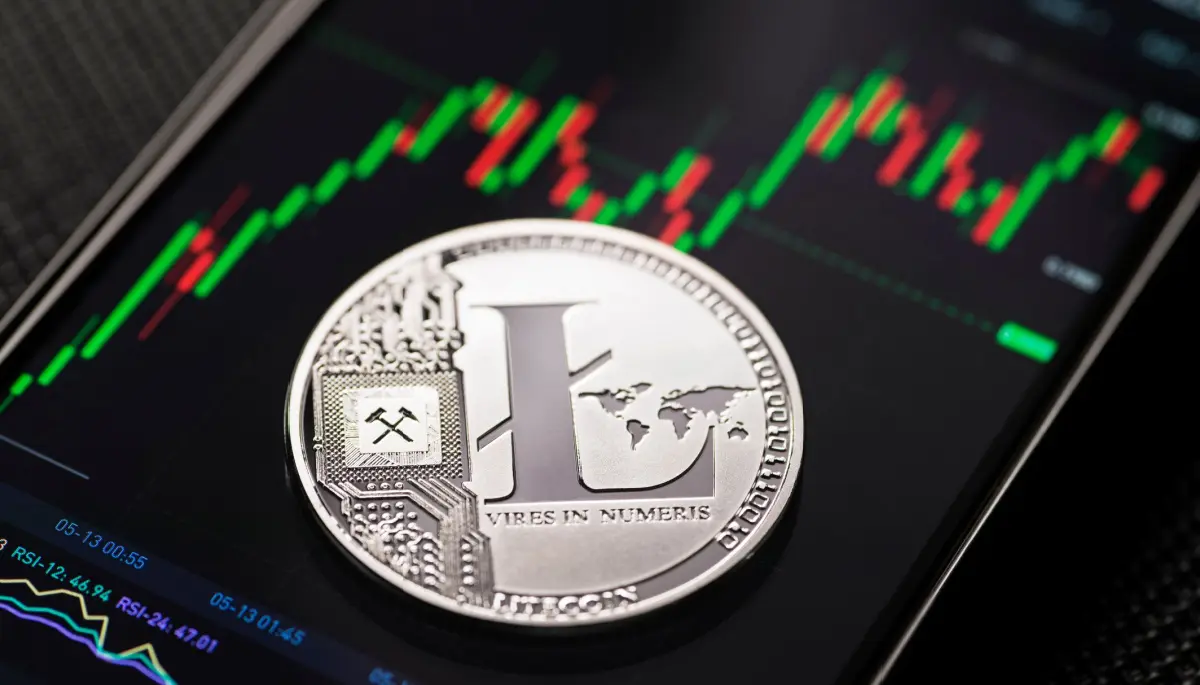
How to Mine Litecoin (LTC): Step-by-Step GuideHow to Mine Litecoin (LTC): Step-by-Step Guide

Now that you know the benefits of LTC mining, it is time to learn “How to mine Litecoin on PC.” You could potentially be on your way to growing your LTC holdings.

Step 1: Get Litecoin Mining Hardware

The first step is to choose and assemble your mining gear-you must decide between using CPU, GPU, or ASIC. Once you have acquired it, carefully connect your PC to the power supply, cooling system or any other necessary components. If you’re installing ASIC, it should come with the manufacturer’s installation guide, which is easy to follow. Ensure that you evaluate your financial situation and make accurate comparisons, balancing cost and the productivity of mining devices. Investing in equipment from reputable hardware manufacturers can be a costly endeavor. However, it leads to more efficient mining, and the return on investment (ROI) may not be immediate.  

Step 2: Choose Trusted Mining Software

Once your hardware is in place, it is time to install appropriate LTC mining software that’s compatible with your hardware. After the software is installed, configure it according to the details, ensuring it is compatible with the Scrypt algorithm. 

Step 3: Join a Mining Pool or Start Solo Mining        

If you have computational power to compete with the “Big Boys,” join the Litecoin network as a solo miner. Otherwise, join a mining pool to contribute hashing power and share the costs and profits based on contributions.

Step 4: Set up a Litecoin Wallet        

Whether you’re just beginning Litecoin mining or interested in investing, you need a well-established and secure wallet.  That’s where you store and secure your coins away from cryptocurrency exchanges as the need arises. 

Hot wallets (online): These wallets connect to the internet and include desktop wallets, mobile apps, and web wallets. Leading examples include Exodus, Trust Wallet, and Paybis Wallet.

Cold wallets (offline): Cold wallets, which don’t connect to the internet, can take the form of paper wallets or hardware wallets, such as the Ledger Nano X and Trezor, and are ideal for long-term storage. Most of these wallets come in the form of USB sticks that store your keys offline and are best for also managing large amounts of crypto.

Step 5: Start mining Litecoin and Monitor    

Once you’ve set up the systems, the final step is to start mining Litecoin and monitor your performance. You want to monitor your hardware for any malfunctions, especially overheating carefully. You also need to remember to align hashrates with your hardware’s capabilities to keep it going healthy. As the mining exercise continues, you can use dedicated online tools to monitor your profitability.  Constantly check LTC’s price so you can know how to direct your mining efforts.

The Costs and Profitability of Litecoin Mining

Selecting the right software or hardware or, solo or pool mining, every step is crucial in determining profitability. Having said, the following are among the factors potentially affecting profitability:

Hardware Costs: The best LTC mining hardware can be expensive initially, and profitability will not be seen immediately. Carefully choose the appropriate Litecoin miner, keeping in mind energy consumption and hashrates.Electricity Costs: The cost of power will have a direct impact on your profitability – considered affordable or renewable power sources to minimize electricity costs.Litecoin Price: The price of Litecoin has a direct impact on profitability, meaning the rewards will vary based on the market’s volatility.Mining Difficulty: As more miners join the network to contribute hashing power, it leads to increasing mining difficulty levels since greater difficulty translates to extra computational power and more time to mine.  Mining Pool Fees: Mining pools may be more lucrative, but there are fees associated with using them that could eat into your profitability.Cooling and Maintenance Costs: The mining exercise generates a significant amount of heat, and your hardware requires adequate cooling, cleaning, and repair to remain in good condition and optimize hardware performance.

Challenges and Risks of Litecoin Mining

While LTC mining can be potentially lucrative, anyone involved in it should be aware of the following risks and challenges they could encounter:

Mining costs: The possibility of having a good return on investment is tied to some factors a miner may be able to influence directly. This includes the price of the cryptocurrency, electricity costs, and others.Technical challenges: Most solo miners who lack technical expertise may face challenges in dealing with their hardware, especially when it overheats or malfunctions.Calculating profits: Everyone who gets involved in LTC mining wants to make a profit, but there are risks involved, like a high initial investment without the guarantee of making a return eventually.

Common Litecoin Mining Scams and How to Avoid Them

Like all other cryptocurrency-based activities, Litecoin mining has had its fair share of scams. You need to be aware of the tactics used by scammers so you can take preventive measures. Among the most common scams are:  

Cloud Mining Scams: These are online platforms that offer non-existent cloud mining, promising lucrative returns to those who subscribe to them. You can avoid scams by carefully researching and being wary when the promised returns are too good to be true or when they ask for a hefty upfront investment.  Fake Mining Pools: Fraudsters can create fake mining pools whose websites resemble the genuine ones but are well designed to steal your LTC coins. Only use trusted, reputable mining pools, verifies a website before committing to use it. Be wary of relatively new mining pools promising excessive block rewards.Fake Wallets: Cybercriminals have what it takes to create fake wallets that resemble the real ones but are designed to steal your private keys and get access to your investment. Ensure that you download wallets from verified, reputable wallet providers. Some red flags include unsolicited requests for private keys, suspicious emails, and poorly designed websites.Phishing Attacks: Scammers use fake emails or websites that resemble legitimate sources to try and steal your private keys or credentials. Always verify the authenticity of any emails or websites before clicking on links or entering your personal information. In addition to being wary of unsolicited requests, always use strong, unique passwords.  Ponzi schemes involve fraudsters who promise users high returns for recruiting new members to mining pools rather than engaging in the actual mining activity.  Romance scams: Scammers lure users by building online relationships and then ask for money to invest in opportunities.

The Future of Litecoin Mining           

Just like the LTC coin itself, the future of Litecoin mining presents a combination of opportunities and challenges. Experts believe Litecoin holds the potential for exponential growth in the years ahead. While new stars have been born with each crypto cycle, Litecoin has demonstrated its resilience. The token has maintained its position among the top 20 cryptocurrencies according to market capitalization.

Among the factors that have allowed LTC to keep on shining include:

Proven Track Record: LTC has been around for over 10 years and hasn’t recorded any significant security issues.Liquidity: Since the token is traded on virtually all major cryptocurrency exchanges with reasonable daily volume, Litecoin miners are kept on their toes, validating transactions.Adoption: With more merchants accepting Litecoin as a form of payment, the ongoing adoption for use in micropayments, tipping, and cross-border transfers means increased transactions and mining opportunities as demand rises.

The cryptocurrency market remains highly volatile.  But regulatory changes, market sentiment, and technological advancements, may also influence the price of LTC. Miners can be assured that ongoing adoption and use of the right strategies has their work cut out for them. There’s still hope until the last of the 84 million LTC coins are mined. However, it’s always recommended that you approach crypto-based investments cautiously and after doing thorough research.

Conclusion      

Litecoin mining can be potentially lucrative, but to be successful, you must invest in knowledge and the right technology. As much as possible, try and get a steady source of affordable energy. Nonetheless, remember that the Litecoin mining sector is highly competitive. Since it’s constantly evolving, invest in gaining current knowledge to remain updated and respond to changes promptly.

While LTC mining remains profitable, it is essential to remember that profitability may not always be guaranteed. Profitability can be affected by factors like, including energy costs, block rewards, and the price of LTC, among others. Closely monitor the mining landscape’s response to the changing regulatory landscape.

FAQs                           

Is mining Litecoin profitable?            

Whether Litecoin mining is profitable or not depends on several factors.  These include mining difficulty, the price of LTC, the efficiency of a user’s mining hardware, and energy costs. Miners should calculate their potential profits by factoring in all expenses before determining whether they have made a profit.

How to mine Litecoin on Android?    

Mining Litecoin on an Android device is complicated because phones and other similar devices don’t have sufficient processing power. Also, there’s always the risk of damage to the device due to overheating. Nonetheless, the following is a step-by-step process for anyone wishing to mine Litecoin on their smartphone. 

Download mobile mining app: Install a mobile app that supports Litecoin mining on your device and register an account.Set up a wallet: You need a cryptocurrency wallet to secure your seed phrase to protect your coins.Join a mining pool: Look for a mining pool you can join, as it’s easier to mine when you combine hashing power with other miners.Configure settings: Enter your wallet address and any other required information in the mining app to start mining. Take care, though, not to overstrain your gadget, especially the battery and CPU.   Start mining: Once you start LTC mining, it’s essential to constantly monitor your phone’s temperature and performance to prevent potential damage.             

How to mine Litecoin on pc?             

Mining Litecoin on a PC may not be as efficient as it can be when using an ASIC miner, but it is still possible. This is what to do if you are interested but lack sufficient funds to start. The following is a short guide you can follow:

Choose Mining Hardware: If your PC has a relatively strong CPU, consider selecting suitable hardware, such as the Nvidia GTX 1070 or AMD Radeon RX 580.Download a Litecoin Wallet: Download and set up a Litecoin wallet by following the instructions to secure it.Install Mining Software: Install applicable software that supports your CPU or GPU operating system.Join a Mining Pool: While it’s possible to mine Litecoin solo, you can increase your chances of profitability by joining a mining pool. Once you register, configure your software and connect with the pool.Configure Your Software and Start Mining: The final step involves configuring your software for optimal performance. As you begin mining, remember to keep an eye on your PC, mainly to ensure it is running smoothly and prevent overheating.

What equipment is needed to mine Litecoin?          

To mine Litecoin (LTC), you will need specialized hardware called ASIC miners (Application-Specific Integrated Circuits) or powerful GPUs (Graphics Processing Units). These devices are designed to perform the complex calculations required for mining more efficiently than traditional central processing units (CPUs).                           

How long does it take to mine 1 Litecoin?    

The average time it takes to mine a single Litecoin is approximately 2.5 minutes, and for every mined LTC coin, the miner receives 12.5 Litecoin.                                   



Source link

Popular Posts

My Favorites

5 TV Shows We Love to Hate-Watch: And Just Like That,...

0
Some TV shows like The Pitt and The Bear are incredible examples of brilliant writing and stellar performances, while others … aren’t. Although they...