Arts

Home Arts Page 37

Coinbase Vs Binance: Which Exchange Wins in 2025?

0
Coinbase Vs Binance: Which Exchange Wins in 2025?


Coinbase vs Binance is a clear comparison of the top crypto exchanges in 2025 to help you become an informed crypto trader. Binance had over $100 trillion in trading volume in 2024, while Coinbase teamed up with 245,000 ecosystem players. These platforms are major players in the crypto world. But which one truly delivers the edge you need?

In this guide, you’ll discover how Coinbase and Binance differ in fees, features, security, and overall user experience. We’ll break down what sets each platform apart and how they fit different trading goals. Keep reading to find out which exchange is the smarter choice for your 2025 crypto journey.

Coinbase vs Binance: A Glance Comparison

FeatureCoinbaseBinanceUser BaseOver 100 million users globallyAlmost 300 million users globallyAssets Under ManagementNot disclosedMore than $187 billion24-Hour Trading VolumeNot disclosedMore than $55 billionCryptocurrencies SupportedHundreds of cryptocurrencies, including Bitcoin, Ethereum, and DogecoinOver 500 cryptocurrenciesSecurityBest-in-class cold storage for crypto protection$1 billion SAFU fund, 98% cold storageTrading FeesZero fees for Coinbase One members; standard fees apply otherwise0.1% spot trading (0.075% with BNB), 0.02% futures maker feesPromotionsUp to $2,000 in crypto for new usersUp to $100 bonus for new usersGlobal ReachAvailable in over 100 countriesAvailable in 180+ countriesUnique FeaturesCoinbase One membership with zero fees and rewardsAdvanced trading tools, Launchpool, and NFT marketplace

What is Coinbase?
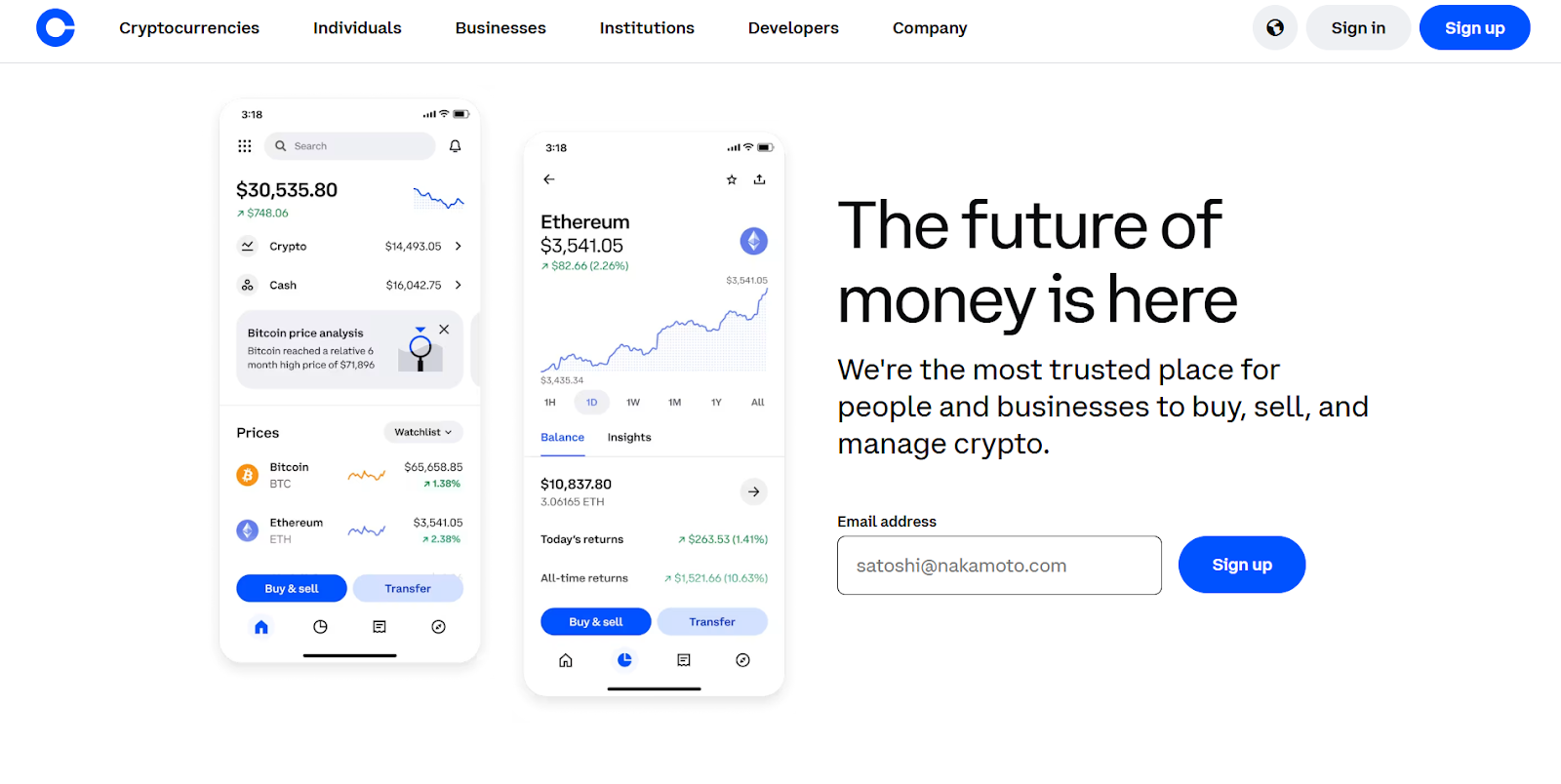
What is Coinbase?

Coinbase is a leading cryptocurrency exchange founded in 2012, designed to make crypto trading accessible to everyone. It is fully U.S.-compliant and became the first publicly traded crypto company in 2021. Known for its user-friendly interface, Coinbase supports over 280 cryptocurrencies and offers features like buying, selling, sending, and exchanging digital assets.

The platform prioritizes security with 2FA, cold storage, and insurance for hot wallets. It also provides a dedicated Coinbase Wallet for self-custody. With its intuitive design and wide range of payment methods, Coinbase is a trusted choice for both new and experienced traders, with a referral code for new traders.

Pros & Cons of Coinbase

ProsConsEasy-to-use interface with simple navigationHigher fees than competitorsStrong regulatory compliance and US licensingLacks advanced tools for experienced tradersSupports a wide range of payment methods, including PayPalSlower deposit and withdrawal processesOffers insurance for hot wallet storage and robust security measuresSupports fewer cryptocurrencies than BinanceEducational resources and the learn and Earn program for new usersLimited staking options and lower rewards

Coinbase is best for:

Beginners entering the crypto marketUsers seeking a simple, intuitive experienceInvestors prioritizing regulatory complianceTraders who need multiple payment options, like PayPalIndividuals looking for secure storage with insuranceLearners interested in educational resources and earning opportunities

coinbasecoinbase

What is Binance?

What is Binance?What is Binance?

Binance is the world’s leading cryptocurrency exchange, trusted by over 180 million users globally. Established in 2017, it has become a powerhouse in the crypto space, offering unmatched liquidity, low fees starting at just 0.1%, and a massive selection of over 350 cryptocurrencies.

What sets Binance apart is its versatility. Whether you’re new to trading or highly experienced, Binance offers intuitive tools, enhanced trading options, and features like staking, futures, and an NFT marketplace. Operating in 180+ countries, it provides localized support and multi-language accessibility, making it a truly global platform.

Security is a top priority at Binance with industry-leading measures like the $1 billion SAFU insurance fund, two-factor authentication, and regular audits. Beyond trading, Binance is an entire ecosystem offering educational resources, DeFi tools, and innovative programs like Launchpad for early access to promising projects.

Pros & Cons of Binance

ProsConsLow trading fees beginning from 0.1%Complex interface can overwhelm beginnersSupports over 350 cryptocurrenciesRegulatory challenges in some countriesAdvanced trading options including futures, staking, and NFTsLimited features for Binance.US usersHigh liquidity and fast transaction speedsFiat withdrawal options are restricted in certain regionsStrong security measures, including SAFU insurance fundCustomer support response times can varyGlobal reach with operations in 180+ countriesNot available in some US states

Binance is best for:

Traders seeking low fees and high liquidityUsers interested in advanced trading options like futures and stakingInvestors looking for access to 350+ cryptocurrenciesIndividuals who value strong security measures like SAFU insuranceGlobal users needing multi-language support and localized featuresThose exploring NFTs and innovative crypto projects through Launchpad

binance-logo-6219389_1280binance-logo-6219389_1280

Coinbase vs Binance: Trading Features

FeatureCoinbaseBinanceTrading OptionsBasic buy/sell, recurring purchasesSpot, margin, futures, options, P2P tradingAdvanced ToolsLimited advanced toolsAdvanced charting, multiple order typesCryptocurrency Selection280+ cryptocurrencies350+ cryptocurrenciesStakingLimited staking optionsExtensive staking options with higher rewardsFeesHigher fees, especially for small transactionsLow fees from just 0.1%User InterfaceSimple to navigatePro and Lite modes for different user levels

Coinbase vs Binance: Platform Products and Services

CategoryCoinbaseBinanceWalletCoinbase Wallet for self-custodyBinance Web3 Wallet with advanced securityNFT MarketplaceLimited activityActive and widely usedEducational ResourcesLearn and Earn programBinance Academy with extensive resourcesPassive IncomeBasic stakingStaking, liquidity farming, dual investmentFiat SupportMultiple payment methods, including PayPalWide fiat support with P2P optionsEcosystemFocused on trading and educationComprehensive ecosystem including DeFi tools

What Coinbase Offers:

Easy-to-use interface for easy navigationSupport for 280+ cryptocurrenciesRecurring purchase options for dollar-cost averagingCoinbase Wallet for self-custody and DeFi accessLearn and Earn program for educational rewardsAdvanced trade tools with real-time order books and chartingZero trading fees with a Coinbase One membershipSecure cold storage for crypto assetsMultiple payment methods, including PayPal

What Binance Offers:

Advanced trading options: spot, margin, futures, and peer to peer tradingSupport for 350+ cryptocurrencies and extensive trading pairsBinance Web3 Wallet with enhanced security featuresComprehensive staking and liquidity farming optionsLow trading fees from just 0.1%NFT marketplace for buying, selling, and staking NFTsBinance Academy for in-depth educational resourcesGlobal reach with operations in 180+ countriesSAFU insurance fund for user asset protectionPro and Lite modes tailored for different user levels

Binance vs Coinbase: Fee Structures

Fee TypeBinanceCoinbaseSpot Trading Fees0.1% for both makers and takers (0.075% with BNB discount)Up to 0.6% for takers and 0.4% for makers (varies by volume)Futures Trading Fees0.02% maker, 0.05% taker (discounts for higher VIP tiers)Not availableStaking FeesNo fees for staking25% commission on staking rewardsDeposit FeesCrypto deposits are freeCrypto deposits are free, while fiat deposits may include fees based on the payment methodWithdrawal FeesVaries by cryptocurrency and networkVaries by cryptocurrency and networkCredit/Debit Card Fees1.8% for card purchases3.99% for card purchasesP2P Trading FeesFree for buyers; 0.35% for sellersNot availableSubscription FeesNo subscription feesCoinbase One: $29.99/month for zero trading fees and other benefits

Binance vs Coinbase: Coins Supported, Liquidity & Volume

CategoryBinanceCoinbaseCoins Supported350+ cryptocurrencies280+ cryptocurrenciesTrading PairsExtensive, including spot, margin and futures tradingLimited to spot trading pairsDaily Trading Volume$55+ billion$1.5+ billionLiquidityHigh liquidity across all marketsModerate liquidity, focused on major assetsNew ListingsFrequent, with early access via LaunchpadLess frequent, focused on established assets

Coinbase vs Binance: Security Comparison

Coinbase is often seen as the go-to platform for beginners, and its security measures reflect that. They keep 98% of customer funds in cold storage, which means your crypto is stored offline and away from potential hackers. The remaining 2% is insured, so even if there’s a breach, you’re covered.

On top of that, Coinbase uses 2FA to add an extra layer of protection to your account. You’ll also find biometric logins, like fingerprint or face recognition, for their mobile app. And if you’re worried about your personal information, Coinbase is fully compliant with US regulations, which means it follows strict data protection laws.

Binance, on the other hand, is built for traders who want more advanced features without compromising on security. They’ve got a $1 billion Secure Asset Fund for Users (SAFU), which acts as an emergency insurance fund in the event of a major hack. Like Coinbase, Binance also uses 2FA and stores the majority of funds in cold storage.

What sets Binance apart is its proactive approach to security. They conduct regular audits and even offer a bug bounty program, rewarding ethical hackers who find vulnerabilities. Plus, Binance has advanced risk management systems that monitor transactions for suspicious activity in real time.

Coinbase Security Measures:

98% of customer funds are stored in offline cold storageInsurance coverage for the remaining 2% of funds stored onlineTwo-factor authentication (2FA) for account protectionBiometric logins (fingerprint and face recognition) for mobile app accessFully compliant with US regulations for data protectionRegular security audits to ensure platform integrityEnd-to-end encryption for sensitive data.

Binance Security Measures:

Majority of funds are stored in offline cold storage$1 billion Secure Asset Fund for Users (SAFU) for emergency protectionTwo-factor authentication (2FA) for enhanced account securityAdvanced risk management systems to monitor suspicious transactions in real timeRegular platform audits and penetration testingBug bounty program to reward ethical hackers for identifying vulnerabilitiesMulti-layered encryption for data and transaction security

Coinbase vs Binance: Affiliate & Referral Programs

FeatureCoinbaseBinanceAffiliate ProgramEarn 50% of fees generated by your referrals for 3 monthsEarn up to 50% of fees generated by your referrals (lifetime)Referral Program$10 bonus for both referrer and referee after a $100 tradeUp to 40% commission on trading fees based on referee activityPayout FrequencyMonthly payoutsReal-time payoutsEligibilityOpen to individuals and businessesOpen to individuals, businesses, and influencersCustomizationLimited tracking tools for affiliatesAdvanced tracking tools and custom referral linksAdditional PerksOccasional promotional bonusesTiered rewards for high-performing affiliates

Binance vs Coinbase: Mobile App & User Experience

As for mobile apps and user experience, Binance and Coinbase cater to different audiences, each excelling in its own way. Binance’s app is designed for both beginners and advanced traders, offering two modes: Lite for simplicity and Pro for advanced features. Rated 4.8/5 on iOS and 4.5/5 on Android, the app provides a seamless experience with real-time charts, multiple order types, and advanced trading tools. Its standout features include a customizable interface, integration with Binance Academy for learning, and robust security measures like biometric login and two-step verification. New users can also sign up with a Binance referral code to access exclusive rewards. While the app’s Pro mode may feel complex for beginners, switching to Lite mode is a better starting point.

Coinbase focuses on simplicity and ease of use, making it a favorite among beginners. Its app, rated 4.7/5 on iOS and 4.4/5 on Android, offers a clean and intuitive design that simplifies buying and selling cryptocurrencies. While it lacks the advanced customization options of Binance, Coinbase compensates with features like the Learn and Earn program, which educates Coinbase users while rewarding them with crypto. Security is a priority, with features like biometric login, 2FA, and secure cold storage. 

Binance vs Coinbase: Customer Support

As a trader, having reliable customer support can make all the difference, especially when dealing with time-sensitive issues. Binance stands out with its 24/7 global support, offering live chat in over 40 languages to cater to its diverse user base. For quick resolutions, it employs AI-powered instant responses, and VIP users enjoy the added benefit of a referral code for every invite. However, the lack of phone support and occasional delays during peak times can be a drawback for those needing immediate help.

Alternatively, Coinbase takes a more straightforward approach, focusing on clarity and ease of use. Its support includes email and live chat, complemented by a robust help center filled with FAQs and tutorials. While Coinbase’s options are more limited compared to Binance, its user-friendly resources and emphasis on user education make it a dependable choice for new traders. Coinbase and Binance aim to assist effectively, but Binance’s multilingual and round-the-clock support gives global traders an advantage.

Conclusion: Which is Better, Binance or Coinbase?

Choosing between Binance and Coinbase primarily relies on your trading needs and experience level. Binance is ideal for experienced investors who value advanced tools, extensive cryptocurrency options, and low fees. Its Pro mode, diverse trading features, and robust security measures make it a powerhouse for those seeking a comprehensive trading platform. However, its complexity and being a regulated financial institution in certain regions may deter beginners or those looking for a simpler experience.

Coinbase is a great choice for beginners or casual traders who prioritize ease of use and straightforward functionality. Its clean interface, educational resources, and strong regulatory compliance make it a reliable option for those new to cryptocurrency. While it lacks the advanced features and lower fees of Binance, Coinbase’s simplicity and focus on user education provide a solid foundation for building confidence in crypto trading. Both platforms excel in their respective areas, so the better choice depends on whether you value advanced features and low costs (Binance) or simplicity and accessibility (Coinbase).

FAQs

What’s the difference between Binance and Binance.US?

The key difference between Binance and Binance.US lies in their scope and features. Binance is a global platform with advanced trading tools and a wide cryptocurrency selection, while Binance.US is tailored for U.S. users with fewer features and a limited selection due to regulatory restrictions.

Is Binance a safe crypto exchange?

Yes, Binance is a safe crypto exchange. It employs robust security measures, including 2FA, cold storage for most funds, and the Secure Asset Fund for Users (SAFU) to protect assets in event of breaches.

Is Coinbase Wallet safer than Binance?

Coinbase Wallet is safer for users who prefer self-custody, as it gives full control over private keys. Binance, while secure, relies on centralized security measures, which require trust in the platform.

Which exchange has lower fees: Coinbase vs Binance?

The exchange with lower fees is Binance. Binance charges a base trading fee of 0.1%, which can be reduced using Binance Coin (BNB), while Coinbase fees range from 0.5% to 4.5%, depending on the transaction type.

Which exchange is more beginner-friendly: Coinbase or Binance?

The exchange that is more ideal for beginners is Coinbase. Coinbase offers a simple interface, easy buy/sell options, and educational resources, making it ideal for new traders. Binance, while offering a Lite mode, is better suited for users with some trading experience.

Which exchange is more secure: Coinbase vs Binance?

The exchange that is more secure depends on your preferences. Coinbase emphasizes regulatory compliance and insurance for online funds, while Binance offers advanced security features like the $1 billion SAFU fund and real-time risk monitoring. Both are highly secure in their own ways.



Source link

7 Leading Free & Trusted Cloud Mining Sites for Beginners to Start Earning Crypto

0
7 Leading Free & Trusted Cloud Mining Sites for Beginners to Start Earning Crypto


For newcomers, one of the main barriers to entering the crypto world has always been the high cost of mining equipment and the complicated setup process. Purchasing ASIC miners or GPUs — along with rising electricity costs — often makes traditional mining unprofitable for beginners.

In 2025, however, cloud mining sites are redefining how people start mining cryptocurrencies. With free trials, legally registered platforms, and mobile-friendly apps, users can now mine Bitcoin and other cryptocurrencies without investing in hardware. It’s now one of the simplest and most affordable ways to start earning cryptocurrency.

The key is to choose reliable and beginner-friendly cloud mining sites that offer transparent payouts and proven results. Below, we review six trusted free cloud mining sites that allow users to start mining safely and quickly — ideal for anyone exploring free Bitcoin mining in 2025.

AutoHash – Swiss AI-Powered Cloud Mining Site for Beginners

Among the most trusted cloud mining sites, AutoHash has built a solid reputation as a legal and beginner-friendly platform in 2025. Operated by Blockchain Finance AG in Zug, Switzerland, AutoHash runs global AI-optimized mining farms powered by hydro, wind, solar, and geothermal energy—delivering both sustainability and profitability.

Each new user receives $100 of free hash power, enabling them to start Bitcoin mining instantly — no hardware or deposit required.The built-in OptiHash AI engine automatically allocates computing power to the most profitable farms, while users enjoy transparent performance tracking and automatic daily payouts.

Key Highlights:

🎁 $100 free mining bonus for all new usersAI-driven optimization for maximum efficiencyGlobal clean-energy farms powered by hydro, solar, wind, and geothermal sourcesMobile-friendly platform with automatic daily rewards

For beginners, AutoHash delivers a safe, legal, and fully automated cloud mining experience, combining simplicity with efficiency.

👉 Click to visit AutoHash and claim your $100 free hash power today!

AutoHash Investment Plans (2025)

Program NameAmount ($)Contract Term (Days)Daily Rewards ($)Total Revenue ($)ROINorway Hydro Farm – Entry 5 TH/s10011.41.41.40%Texas Solar Farm – Starter 10 TH/s15025103.33%Switzerland Hydro Farm – Core 20 TH/s550317.652.83.20%Denmark Wind Farm – Flow 35 TH/s1,200343.2129.63.60%Canada Hydro Farm – Prime 45 TH/s2,300389.7269.13.90%Iceland GeoTherm Farm – Core 60 TH/s4,20021683364.00%Spain Solar Farm – Fusion 100 TH/s8,9002373.8747.64.20%Switzerland Hydro Farm – Ultra 390 TH/s39,80013,263.63,263.68.20%

MineUnit – Flexible Free Cloud Mining Platform for Beginners

MineUnit is well known among modern cloud mining platforms for its zero-cost entry and flexible mining experience. Beginners can start right away with a free mining trial, testing profitability before committing to any contract — perfect for cautious first-time miners.

The platform’s mobile-friendly design allows users to switch between Bitcoin, Ethereum Classic, and Dogecoin with just a tap. This flexibility helps maximize profits in volatile markets where one cryptocurrency may temporarily outperform others.

Key Highlights:

Start mining with no deposit or setupInstantly switch between multiple coinsProfitability alerts to optimize returnsBuilt-in learning tools for crypto newcomers

MineUnit is perfect for beginners who want to explore free cloud mining and experiment with different strategies without taking financial risks.

BlockMineGo – Secure & Legally Compliant Cloud Mining Site

BlockMineGo stands out among trusted cloud mining sites for its strong focus on security, transparency, and regulatory compliance. Amid a market still crowded with scam apps, BlockMineGo stands out as a transparent, accountable, and trustworthy alternative.

The platform publishes third-party audit reports regularly and offers users complete access to mining activity logs, ensuring every payout and performance metric can be verified. Beginners can also try a free demo balance, giving them hands-on access to the platform’s features before making any deposit.

Key Highlights:

Transparent and legally compliant operationsFree trial mining balance for new usersSecure payouts via crypto wallets or bank transferPositive reputation on Trustpilot and leading crypto forums

For anyone who values safety and legitimacy, BlockMineGo is one of the most reliable free mining sites to begin your crypto mining journey in 2025.

HashNext – AI-Optimized Cloud Mining for Effortless Crypto Earnings

HashNext takes a modern approach to cloud mining by using AI-powered optimization to maximize profitability. Rather than manually checking which cryptocurrency is most profitable, HashNext’s AI system automatically reallocates hash power to maximize returns — ideal for beginners who prefer automation.

New users can start with a free demo mode, which offers hands-on experience and real payouts without financial risk. After getting comfortable with the interface, users can upgrade to paid plans for higher rewards, though the free plan already offers steady daily payouts.

Key Highlights:

AI automatically selects the most profitable coinFree demo mode and starter hash power for testingBuilt-in learning tutorials for beginnersEasy path to scale up earnings over time

For anyone seeking a hands-off yet efficient mining experience, HashNext is one of the leading AI-powered cloud mining sites in 2025 — combining automation, learning, and steady results in one intuitive platform.

CryptoEvo – Gamified Cloud Mining App for Fun & Real Rewards

CryptoEvo proves that mining doesn’t have to be overly technical. This gamified cloud mining app turns crypto mining into an engaging experience by offering free bonuses for simple daily actions — such as check-ins, referrals, and achievement milestones.It’s built to make earning crypto both engaging and rewarding — a perfect entry point for beginners.

Despite its playful design, CryptoEvo powers real crypto mining, supporting popular coins like Bitcoin, Dogecoin, and Litecoin. Users can start with free trial hash power and earn extra rewards through consistent activity — all without any upfront investment.

Key Highlights:

Free daily mining bonuses for active usersInteractive, game-style interfaceMulti-coin support for diversified miningBeginner-friendly payout system

For newcomers seeking both fun and functionality, CryptoEvo stands out as one of the most innovative and accessible free cloud mining apps in 2025.

QuickMine – Fast & Simple Cloud Mining with Instant Payouts

As its name implies, QuickMine is all about speed and simplicity. Beginners can register and start mining within minutes—no complex verification, no hardware setup, and no contract commitments.

The platform provides free starter mining credits, allowing users to explore cloud mining safely and risk-free. It’s well known for its ultra-fast payouts, often processing withdrawals within 24 hours — ideal for users who want to see real results quickly.

Key Highlights:

Instant mining setup with zero barriersFree credits to start earning immediatelyLightning-fast payouts (under 24 hours)Simple mobile app for easy tracking

For beginners seeking instant crypto mining without complex settings, QuickMine stands out as one of the fastest and most convenient free cloud mining sites in 2025.

Binance Cloud Mining – Global Exchange Meets Professional Mining

Binance Cloud Mining extends the world’s largest crypto exchange into the mining ecosystem, giving users access to industrial-grade hashrate without managing hardware. Integrated directly within the Binance app, the service allows users to purchase mining power for Bitcoin and other coins using their existing Binance accounts — making it ideal for those who already trade on the platform.

Backed by Binance’s security infrastructure and real-time data monitoring, the cloud mining system automatically allocates resources for optimal profitability and transparent payouts. Users can view daily performance and withdraw profits directly to their Binance wallets with no transfer delays.

Key Highlights:

Integrated within the Binance mobile and web platformsFlexible hash-power purchases using spot wallet balanceEnterprise-level security and transparent mining operationsDaily payouts with detailed profit analytics

For users who want to combine trading and mining under one trusted ecosystem, Binance Cloud Mining offers a seamless and secure way to earn crypto passively in 2025.

Conclusion

By 2025, earning from crypto has become faster, simpler, and more accessible — no costly hardware or complex setup needed. With the rise of free and legal cloud mining sites, anyone can start mining using just a smartphone or laptop.

Platforms like AutoHash and MineUnit offer free starter mining power, BlockMineGo provides strong compliance and transparency, HashNext boosts profitability with AI optimization, CryptoEvo turns mining into a gamified experience, and QuickMine delivers unmatched speed with instant payouts.

Together, these Bitcoin cloud mining sites show that modern cloud mining is now accessible, secure, and engaging — ideal for beginners exploring crypto in 2025.For anyone entering crypto in 2025, these free crypto mining apps are the fastest and most practical way to earn your first digital assets with minimal risk.


Source link

Sapien (SAPIEN) Will Be Listed on Binance HODLer Airdrops!

0
Sapien (SAPIEN) Will Be Listed on Binance HODLer Airdrops!


Binance has officially unveiled Sapien (SAPIEN) as the 57th project on the HODLer Airdrops page, further strengthening its commitment to spotlighting innovative Web3 protocols. Sapien is an open protocol designed to source verified human knowledge at scale, aiming to revolutionize how authentic information is curated, validated, and shared across decentralized networks.

Users who held or subscribed their BNB through Simple Earn (Flexible or Locked) and On Chain Yields products from October 20 to October 22, 2025 (UTC) will qualify to receive SAPIEN airdrop rewards. Airdrop distribution will occur at least 1 hour before trading starts, and token details will be visible in users’ Spot Accounts once available.

Currently, SAPIEN can also be traded via the Binance Alpha Market, though once spot trading launches, its Alpha activity will cease to count toward Alpha Points. 

Listing Details

Listing date: November 6, 2025, at 10:00 (UTC)Available trading pairs: SAPIEN/USDT, SAPIEN/BNB, SAPIEN/TRY, SAPIEN/USDC. BNB Lock for Airdrop period: October 20, 2025, 00:00 (UTC) – October 22, 2025, 23:59 (UTC)HODLer Airdrops Rewards: 15,000,000 SAPIEN 

binance-logo-2

SAPIEN Token Details

Token Name: Sapien (SAPIEN)Total Supply (Genesis): 1,000,000,000 SAPIENMax Token Supply: 1,000,000,000 SAPIENCirculating Supply (upon listing): 250,000,000 SAPIEN (25% of total supply)

About Sapien

About SapienAbout Sapien

About Sapien – Source: Sapien

Sapien is an open protocol that collects, verifies, and scales human knowledge across the internet. It builds on transparency and decentralization to empower individuals and organizations to share verified insights that anyone can trace, reward, and use. By combining AI-assisted validation with blockchain based verification, Sapien turns information sharing into a trustless, incentive driven ecosystem.

At its core, Sapien imagines a world where human intelligence becomes a public, verifiable resource instead of fragmented data owned by centralized platforms. Every contribution is anchored on-chain to ensure authenticity and traceability, while contributors receive fair rewards for their knowledge.

The protocol also offers an infrastructure layer for AI and Web3 developers. They can access verified datasets, improve model training, and build tools rooted in collective human understanding. Through this approach, Sapien bridges human insight and machine intelligence, creating a decentralized network of truth for the digital age.


Source link

Bitcoin $100K Break: Consolidation or Crash? – NFT Plazas

0
Bitcoin 0K Break: Consolidation or Crash? – NFT Plazas


Bitcoin’s dramatic slip beneath the psychologically significant $100,000 threshold recently jolted the crypto market, setting off a wave of intense debate among leading analysts.

While some firms warn of a severe structural failure and a deep correction, others quickly dismiss the plunge as a necessary, mechanical “leverage reset.” The split consensus leaves investors navigating a tense period where macro pressures clash directly with underlying long-term conviction.

Conflicting Outlooks: From $72,000 Crash to a Healthy Reset

Bitcoin’s immediate future now hangs between two starkly opposing forecasts. The on-chain analytics firm CryptoQuant represents the bearish extreme, recently issuing the most alarming market warning.

Specifically, Head of Research Julio Moreno argued Bitcoin could crash to roughly $72,000 in less than two months, citing the asset’s failure to reclaim the crucial $100,000 support. CryptoQuant also based its grim outlook on evidence of rapidly collapsing spot demand. Several indicators have shown significant market contraction following the massive October 10 liquidation, alongside sustained negative flows in Bitcoin ETFs and a persistent negative Coinbase price premium. 

Learn more: $19 Billion Liquidated After Trump’s Tariff Bomb

Conflicting Outlooks: From $72,000 Crash to a Healthy Reset

Source: CryptoQuant

However, other industry voices immediately countered this structural doom narrative. According to TheBlock, Nic Puckrin, co-founder of The Coin Bureau, firmly rejected the idea that the bull market was over. Puckrin acknowledged the psychological weight of the break but stressed the drop represented only a 20% correction from the all-time high, a routine event in crypto.

Timothy Misir, head of research at BRN, echoed this view, declaring the selloff “not terminal.” He insisted that leverage, not long-term belief, exited the market, arguing the system now stands healthier and less vulnerable to cascading risk events.

Drivers of the Selloff

Leverage & Liquidations

A confluence of factors drove the sharp reversal and validated the analysts who saw a leverage flush. The price action triggered a massive deleveraging event. According to Coinglass data, over $1.7 billion in estimated positions were liquidated across major exchanges, with long positions accounting for over $1.3 billion of the total. However, this mechanical cleansing primarily removed speculative risk from the system.

Macro Pressure

This technical selling found amplification through external, macroeconomic forces. Global risk-off sentiment swept through markets, compelling investors to move capital out of high-risk assets like crypto and into cash and safer instruments, such as Treasuries. This movement coincided precisely with major redemptions from U.S. spot Bitcoin ETFs, which immediately deepened the market slide. Its severe result, forced selling, triggered directly by these broad shifts, therefore mandates a forthcoming period of price stability.

Therefore, the market must now wait for organic, non-leveraged demand, which currently lags, to step in and absorb the liquidity void left by the recent massive liquidations, effectively resetting the trading environment. Analysts agree that absent a renewed push of institutional capital, specifically renewed ETF inflows, the market must rebuild conviction before another major move.

Learn more: Solana ETFs Net Inflows Surpassed Bitcoin and Ethereum

Short-Term Path Forward

Near-term price action, therefore, points toward consolidation. Analysts have mapped key support and resistance levels. Puckrin pointed out that holding the 50-week EMA near $101,000 remains crucial for maintaining the bullish structure. While the immediate outlook calls for patience, long-term proponents, including Puckrin, maintain that the broader bullish thesis remains intact, potentially culminating in a cycle top near $150,000.

Short-Term Path ForwardShort-Term Path Forward

Bitcoin must hold above the 50-week EMA to remain bullish – Source: Nic Puckrin on X.

The coming weeks will determine whether the technical leverage reset provides a stable foundation for the next upward leg or if mounting macro pressure validates the more severe $72,000 correction scenario.


Source link

What is Momentum (MMT)? The AI Powered ve(3,3)

0
What is Momentum (MMT)? The AI Powered ve(3,3)


DeFi has moved beyond the “AMM experimentation” phase and entered an era that demands intelligence: liquidity must not only be abundant but also driven by data; user experience must not only be smooth but also smart in real time. 

Within this context, Momentum (MMT) emerges as a next generation DEX, powered by AI and ve(3,3) built on the belief that algorithms can replace emotional reflexes and protocols can evolve on their own.

While traditional AMMs merely react to market conditions, Momentum aims to go a step further to predict and coordinate with the rhythm of data, block by block, trade by trade.

What is Momentum (MMT)?

What is Momentum (MMT)?

What is Momentum (MMT) – Source: Momentum

On the surface, Momentum functions as a decentralized exchange (DEX). But at its operational core, it is a self adaptive liquidity protocol built upon three foundational pillars:

AI-driven decision engine: An artificial intelligence layer that analyzes on-chain data including price movements, trading volume, pool depth, and MEV patterns and, when applicable, off chain signals such as news sentiment or volatility indicators, in order to continuously adjust the protocol’s behavior.ve(3,3) tokenomics: An incentive model that encourages users to lock their tokens (veMMT) to sustain long term growth. The longer the lock period, the greater the user’s voting power and share of trading fees, allowing them to influence the emission flow toward the most efficient liquidity pools and strategies.Dynamic liquidity routing: A mechanism that redistributes and routes liquidity in real time to minimize slippage, optimize trading fees, and balance risk exposure across the ecosystem.

The core philosophy is to turn data into trading actions, and to transform veMMT holders from passive yield farmers into active growth coordinators of the entire protocol. With mission is to make liquidity not only decentralized but also intelligent. 

Momentum operates as an AI powered Automated Market Maker (AMM) that continuously learns from on chain behavior. Every trade, every liquidity shift, and every user interaction feeds into a feedback loop where data becomes intelligence, and intelligence becomes action. The result is a DEX that doesn’t simply exist on the blockchain, but one that adapts to it. 

Momentum therefore represents a new paradigm in DeFi a transition from passive liquidity to active intelligence, from human reflex to machine prediction, and from fragmented incentives to autonomous equilibrium. Where anyone can trade any asset, unconstrained by space, time, or anything else. 

Learn more: What Is Morpho Crypto? The DeFi Protocol Optimizing Lending on Ethereum

Core Products of Momentum

Momentum isn’t just a DEX, it’s an entire financial operating system designed for the tokenized economy. Each product in its ecosystem contributes a vital function: security, liquidity, and capital efficiency, forming an integrated suite that powers the next era of global finance.

MSafe – Secure Treasury Infrastructure

MSafe is Momentum’s institutional-grade, multi signature (multi sig) wallet solution built specifically for Move based chains such as Sui, Aptos, Movement, and IOTA. Designed to manage treasuries, token vesting, and on chain execution, MSafe provides flexible approval flows and top tier security becoming the backbone of governance and capital management for major projects in the Move ecosystem.

Treasury Management: Protects protocol treasuries with configurable multi sig access, ensuring collective control and minimizing single point of failure risks.Token Vesting: Enables teams and investors to securely lock, schedule, and release tokens via transparent, on chain smart contracts preventing manipulation or premature unlocks.dApp Store: Offers secure integrations with DeFi applications through a smart contract based App Store, allowing DAOs and teams to interact safely while maintaining multi sig protection.

Trusted by leading protocols across Sui, Aptos, and beyond, MSafe has become the de facto security standard for treasury operations, token distribution, and DAO level governance within the Move ecosystem. 

Momentum DEX – The Central Liquidity Engine

At the center of the ecosystem is Momentum DEX, a next generation decentralized exchange built on a concentrated liquidity model (CLMM) inspired by Uniswap v3. The platform allows liquidity providers to allocate their capital within specific price ranges, creating deeper liquidity and tighter spreads where trading activity actually happens.

Since its beta launch on March 31, 2025, Momentum DEX has quickly become a key liquidity engine for the Move ecosystem, surpassing 1.6 million unique swap users, over $600 million in total value locked (TVL), and a cumulative trading volume exceeding $25 billion. 

But the numbers only tell part of the story. Momentum DEX leverages Sui’s programmable transaction blocks (PTB) to compress complex actions, such as swapping, adding liquidity, staking LP tokens, and claiming rewards, into a single atomic transaction. This makes DeFi execution smoother, cheaper, and safer.

Retail users enjoy an intuitive CEX like interface with low fees and guided trading, while institutions access deep liquidity, transparent pricing, and secure self custody through MSafe integration. 

Cross chain compatibility via Wormhole ensures assets move seamlessly across ecosystems. While Sui’s Programmable Transaction Blocks (PTB) enable traders to bundle multiple actions,  such as swap → add liquidity → stake LP → claim rewards, into a single atomic transaction. One click, one signature, one outcome: either everything executes, or nothing does.

Leveraging Sui’s object centric, parallel execution, Momentum DEX achieves higher throughput, near instant finality, and reduced MEV exposure, making it one of the most efficient and secure DEX infrastructures in DeFi today.

By combining CLMM architecture, PTB capabilities, and Sui’s high performance environment, Momentum DEX delivers an unprecedented mix of capital efficiency, institutional grade infrastructure, and composable DeFi innovation, the true liquidity engine of the tokenized era.

xSUI – Liquid Staking, Unlocked Liquidity

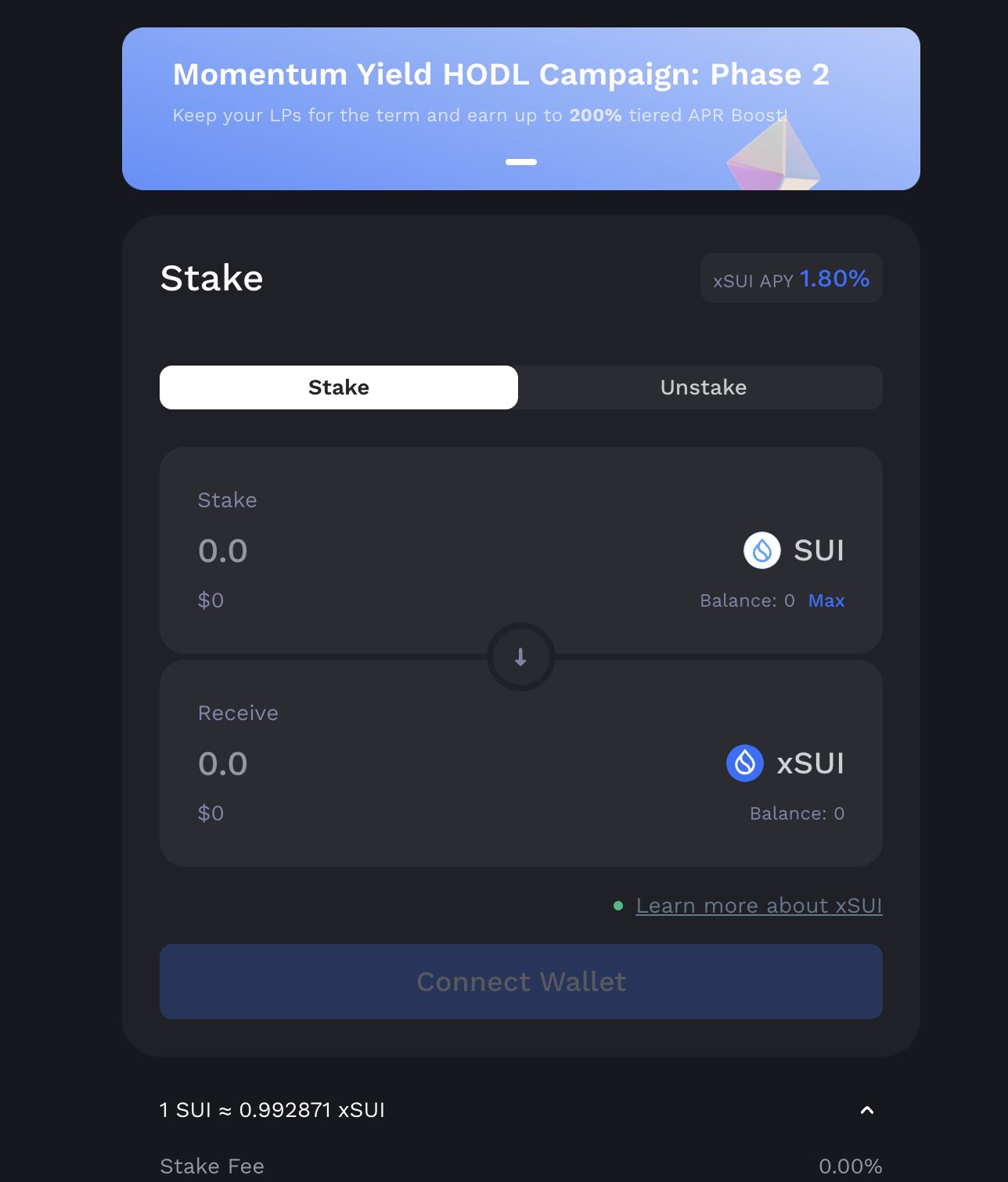
xSUI – Liquid Staking, Unlocked Liquidity – Source: Momentum

The second pillar of Momentum’s ecosystem is xSUI, a liquid staking protocol that transforms staked SUI into a yield bearing, composable asset. Users can stake SUI to validators with one click and receive xSUI, a token that represents their staked position earning staking rewards while remaining fully liquid for DeFi activities.

With xSUI, users can earn native staking yield and simultaneously deploy their capital across lending, liquidity pools, or collateralized products. It effectively turns idle staked assets into productive capital, allowing users to stack multiple yield layers from staking rewards to trading fees and ecosystem incentives.

The synergy between xSUI and Momentum DEX amplifies efficiency: xSUI injects yield bearing liquidity into the DEX, while the DEX enhances xSUI’s utility through swaps, farming, and composable DeFi markets. Every liquidity provider holding xSUI earns both trading fees and Sui staking rewards, creating a dual yield structure that strengthens the entire Sui economy.

As adoption grows, xSUI is poised to become a cornerstone of Sui DeFi, merging network security, liquidity depth, and yield generation into a single, fluid mechanism.

To lay the foundation for a DeFi dream, Momentum begins by building its core infrastructure and liquidity on Sui, with three main flagship products: Momentum DEX, xSUI (liquid staking), and MSafe (treasury management and token allocation). 

From this foundation, Momentum expands into cross chain assets and eventually unlocks real world assets (RWA), bridging the gap between traditional value and the on chain economy. 

The Operating System for the Next Era of Global Finance

Momentum’s ambition is to build a financial operating system for the entire crypto market. Reshape, become the operating system for the next era of the financial world. 

Unlike most DeFi platforms that focus on a single use case, Momentum takes a modular and interoperable approach. Each of its core products, Momentum DEX, xSUI, MSafe, Token Generation Lab (TGL), Vaults, and Momentum X, plays a specific role in the broader architecture, while remaining deeply integrated with one another. Together, they form a self-sustaining system where liquidity, security, and compliance continuously reinforce each other. 

We have analyzed Momentum DEX, xSUI, MSafe in detail in the previous part. In this part, we will go into the remaining parts.

Token Generation Lab – Bluechip Launchpad for the Next Wave of Projects

Momentum isn’t just shaping how we trade. It’s redefining how projects launch. At the heart of that vision lies the Token Generation Lab (TGL), Momentum’s new age bluechip launchpad for high quality teams who want more than hype cycles and quick listings.

While most launchpads focus on fast token sales, TGL prioritizes long term alignment. It brings together the most influential players in the Sui ecosystem. These include the Sui Foundation, leading investors, market makers, centralized exchanges, and top tier protocols. The goal is to give every project the same starting point: real liquidity, verified partners, and immediate market access.

No upfront fees, no dump culture, no short term speculation. Instead, TGL locks launchpad fees for twelve months. This pushes liquidity directly into the markets and rewards Momentum’s community of over 150,000 participants, including DEX referrers and NFT holders. As a result, the launch feels organic. Projects debut with strong community backing and deep liquidity already in place.

Moreover, the story doesn’t end there. Every token launched through TGL integrates directly into Momentum DEX, seeding new pools and trading pairs from day one. This steady inflow of fresh assets turns the DEX into a living, expanding marketplace. It is not just for trading, but also for discovery.

TGL is essentially a bridge between project creation and sustainable liquidity. It gives developers a fast track to the market and gives the Momentum community early access to high conviction opportunities.

In an industry defined by short attention spans, TGL bets on depth over speed. That focus could make it the go to launchpad for serious builders.

Momentum Vaults – Automated Yield for the Rest of Us 

Momentum Vaults – Automated Yield for the Rest of Us – Source: Momentum

Momentum’s next frontier is making DeFi yield simple again. The Momentum Vaults are designed for one thing: to let users earn like pros without trading like pros.

These vaults act as automated portfolios powered by curated strategies from experienced DeFi builders. Users deposit their assets, and the vaults do the rest, optimizing liquidity ranges, rebalancing positions, and compounding rewards in real time.

Momentum’s rollout starts with auto rebalancing vaults, directly plugged into Momentum DEX, where each vault dynamically manages liquidity for a specific trading pair. Later phases introduce multi strategy and multi chain vaults, allowing users to combine leverage, looping, and yield farming across chains such as Ethereum, Solana, and Sui.

For retail users, the vaults mean hands off income, no charts, no bots, no sleepless nights. For institutions, they represent capital efficiency at scale, giving funds and DAOs a way to deploy liquidity with transparent, auditable logic.

Beyond convenience, vaults serve a strategic role: they keep liquidity on the platform “sticky.” Instead of funds hopping between protocols for the next yield farm, capital stays productive within Momentum’s ecosystem, reinforcing the DEX’s depth and price stability.

In essence, the vaults turn DeFi’s biggest challenge, complexity, into its biggest strength. By wrapping advanced strategies into automated, composable tools, Momentum is setting a new standard for accessible, data driven yield generation on Sui.

Momentum X – Where Compliance Meets Composability

If Momentum DEX is the engine that powers liquidity, Momentum X is the trust layer that keeps the entire system compliant, transparent, and ready to scale globally.

Momentum X - Where Compliance Meets ComposabilityMomentum X - Where Compliance Meets Composability

Momentum X – Where Compliance Meets Composability – Source: Momentum

Solving DeFi’s Long-Standing Compliance Challenge

In the race to build faster and smarter DeFi, one old obstacle still stands in the way, regulatory compliance. While blockchains can settle trades in seconds, institutions still need weeks to onboard, verify identities, and satisfy jurisdictional rules.Momentum X aims to change that by creating the first institutional grade trading layer that merges compliance, liquidity, and real world assets under a single on-chain roof.

Fixing Fragmentation in Tokenization

For years, the tokenization space has been deeply fragmented. Each chain runs its own KYC process, forcing investors to repeat verification across platforms just to trade the same asset.Momentum X solves this problem with a “verify once, access everywhere” approach built on Sui’s full stack architecture, powered by Walrus and Seal.

When a user starts a transaction through a connected DApp, Momentum X quietly handles the heavy lifting behind the scenes.

Real Time, Privacy Preserving Compliance

A real time eligibility request is sent to the Momentum X API, which confirms that the DApp is authorized to request identity checks.Using Seal, encrypted identity data is fetched from Walrus, and only the necessary information is decrypted to prove compliance.No unnecessary personal data ever leaves the system.

If the user meets the asset’s regulatory requirements, such as jurisdiction, certification, or transfer limits, the transaction is approved instantly, on chain.

This process feels invisible to the user, yet it enforces regulatory standards, privacy protection, and speed all at once.For institutions, it removes one of the biggest barriers to DeFi participation. Meanwhile, for individuals, it means frictionless access to regulated products without giving up control of their data.

Compliance Baked Into Smart Contracts

Under the hood, Seal’s programmable access control embeds compliance directly into smart contracts, eliminating the need for centralized gatekeepers.Moreover, when combined with zero knowledge identity proofs for privacy and Wormhole bridges for cross-chain interoperability, Momentum X transforms a patchwork of isolated pilots into a unified, composable financial network.

MMT Tokenomics

Momentum’s native token, MMT, serves as the economic and governance core of its financial operating system, powering trading, liquidity, incentives, and community participation across all products. With a total supply of 1,000,000,000 MMT, the token’s design carefully balances early market liquidity with long term sustainability, ensuring both growth and stability as the ecosystem expands across DeFi and tokenized finance.

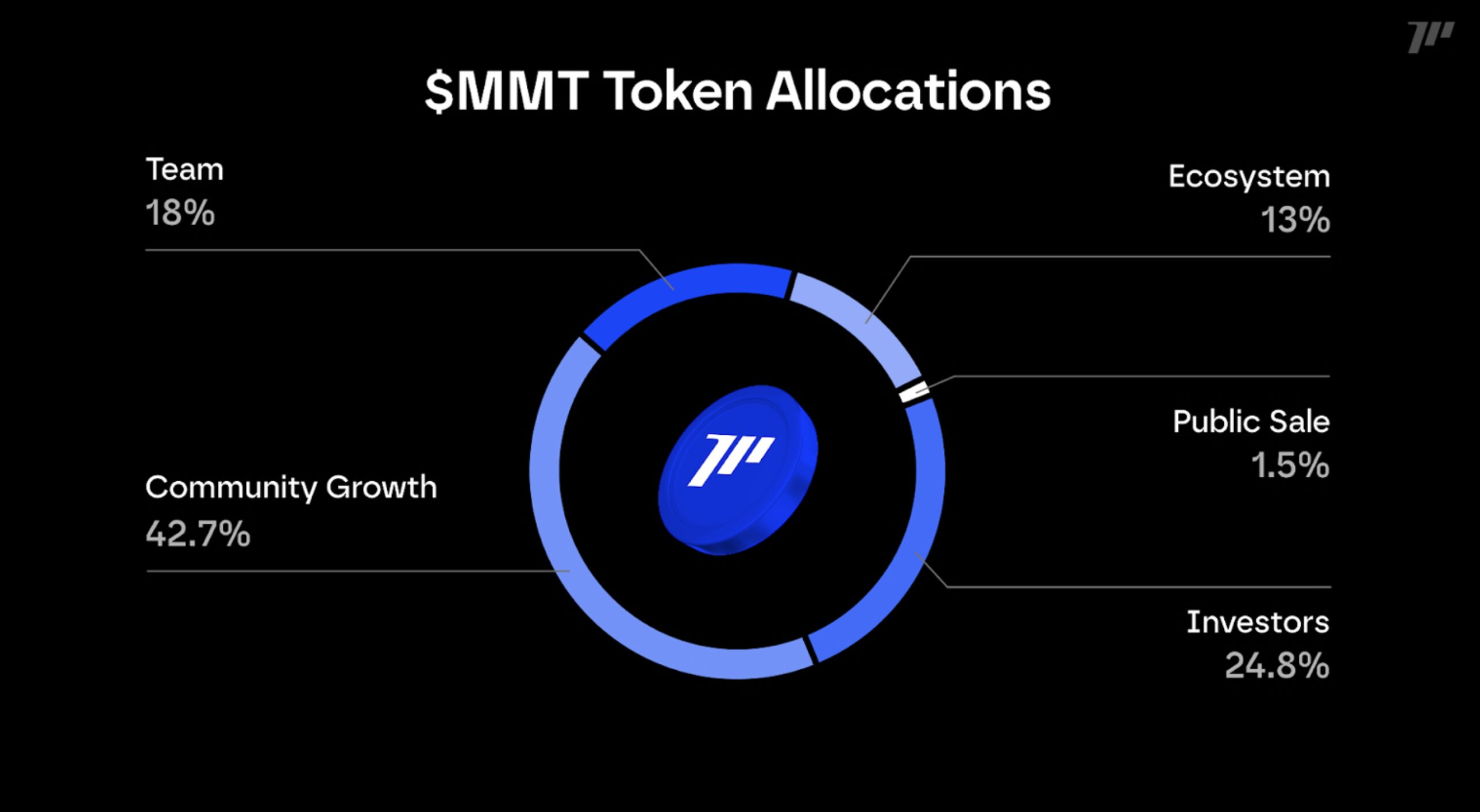
At the Token Generation Event (TGE), an initial 204,095,424 MMT (approximately 20.41% of the total supply) will enter circulation. 

MMT TokenomicsMMT Tokenomics

MMT Tokenomics – Source: Momentum

Ecosystem (13%) Community Growth (42.72%) Investors and Early Supporters (24.78%)Public Sale (1.5%)Team (18.00%)

Learn more: Momentum (MMT) Will Be Listed on Binance HODLer Airdrops! 

How to Buy MMT Token

Buying MMT on centralized exchanges (CEXs) is quick and simple.

Choose an exchange

MMT will be listed on leading exchanges such as Binance, KuCoin, Gate.io, and MEXC. Always check official announcements from Momentum Finance for verified listings.

Buy MMT

Search for the trading pair (e.g., MMT/USDT) and place a market or limit order to purchase your desired amount.

Secure your tokens

Once purchased, store MMT in your CEX wallet or transfer to MSafe, Momentum’s official wallet for staking, governance, or participation in DeFi products. 

binance-logo-2binance-logo-2

FAQ 

What is Momentum (MMT)?

Momentum is an AI powered, ve(3,3) based decentralized exchange (DEX) built on the Sui Network, designed to provide deep liquidity, dynamic routing, and intelligent, data driven trading. It’s more than just a DEX, Momentum is building a full financial operating system that connects DeFi, real world assets (RWA), and institutional infrastructure.

What makes Momentum different from other DEXs?

Momentum integrates AI algorithms, programmable transaction blocks, and the ve(3,3) model to continuously optimize liquidity and user experience. It doesn’t just react to markets it predicts and adjusts dynamically, offering a CEX like experience with DeFi transparency.

What are the core products of Momentum?

Momentum’s ecosystem includes six interconnected products:

Momentum DEX – AI powered, concentrated liquidity market maker.xSUI – Liquid staking for Sui with DeFi integration.MSafe – Institutional-grade treasury and asset management.TGL (Token Generation Lab) – Bluechip launchpad for new projects.Vaults – Automated, high-performance yield strategies.Momentum X – Compliance and RWA trading layer connecting DeFi and TradFi.

What is the total supply of MMT?

The total supply of MMT is 1,000,000,000 tokens, with an initial circulating supply of approximately 204 million (20.41%) at TGE. This design balances early liquidity with long-term governance and ecosystem stability.

How does the ve(3,3) model work in Momentum?

Momentum’s ve(3,3) model encourages long term alignment: Users lock MMT to receive veMMT, which grants governance power, trading fee rebates, and boosted yields. veMMT holders decide how emission rewards are distributed, ensuring incentives flow to productive markets.


Source link

The Unraveling and Rebirth of Digital Ownership: A Post-Mortem on the 2021 NFT Empire and the Rise of Verifiable Utility | NFT CULTURE | NFT News | Web3 Culture | NFTs & Crypto Art

0
The Unraveling and Rebirth of Digital Ownership: A Post-Mortem on the 2021 NFT Empire and the Rise of Verifiable Utility | NFT CULTURE | NFT News | Web3 Culture | NFTs & Crypto Art


Introduction: The Lexicon of a Digital Empire

The 2021-2022 market boom for Non-Fungible Tokens (NFTs) was not an isolated event. It was a “perfect storm,” a confluence of macroeconomic accommodation, widespread cultural lockdowns, and the sudden, explosive maturation of a technology that seemingly solved a problem central to the digital age: how to own something that can be infinitely copied.1 In a span of 24 months, “collectible NFTs” evolved from a niche technological experiment into the dominant, global “lexicon of digital ownership”.3

This rapid ascent created a speculative empire built on digital art and social signaling, with valuations that defied traditional financial models. This report will forensically analyze the three acts of this narrative:

The Rise: How the COVID-19 pandemic provided the macroeconomic “fuel” (unprecedented liquidity) and the social “fire” (a world lived online), allowing NFTs to become a new vector for social status.1
The Fall: The inevitable “Tulip Mania” comparison and the subsequent 2022-2024 market crash, where a reversal of macroeconomic policy and a series of crypto-native catastrophes “sucked speculative capital” from the ecosystem, vaporizing trillions in value.5
The Consolidation & Rebirth: An analysis of the current November 2025 market, which reveals a “flight to quality” and the emergence of a new, sustainable model based on real-world utility, intellectual property, and verifiable access—a future where the technology is “inevitable,” even as the toxic “NFT” branding is abandoned.

Part I: The Rise — Forging the “Perfect Storm”

The Macroeconomic Catalyst: COVID-19 and the “Dash for Cash”


The 2021 NFT explosion is incomprehensible without first understanding the global economic response to the COVID-19 pandemic. The crisis triggered a “deep economic downturn” and widespread business closures.4 In response, the Federal Reserve (Fed) “stepped in with a broad array of actions to keep credit flowing”.4

This response was “unprecedented”.4 The Fed cut its target for the federal funds rate to a range of 0% to 0.25%.4 It enacted massive purchases of U.S. government and mortgage-backed securities 4, while Congress passed the Coronavirus Aid, Relief, and Economic Security (CARES) Act, providing up to $500 billion to support Fed programs.8

This monetary easing, combined with government stimulus, injected trillions of dollars of new liquidity into the economy. Simultaneously, global lockdowns and work-from-home policies meant a captive audience was spending more time than ever online.9 This environment created a new class of “armchair gamblers” who, flush with liquidity and excess time, looked for new avenues of investment.1 This “perfect storm” of easy money, tech-company investment, and a physically-distanced society seeking new forms of connection drove a massive speculative surge into high-risk assets, with NFTs representing the absolute apex of this risk curve.


The Social Catalyst: How “JPEGs” Became the Lexicon of Ownership

The macroeconomic environment provided the fuel, but the technology provided the engine. For decades, digital assets were defined by their “easily and endlessly duplicated” nature.2 Non-Fungible Tokens, first developed in 2017, offered a novel solution: a “technical development” that “make[s] it technically possible for digital assets to be owned and traded,” introducing “the concept of scarcity in the digital realm for the first time”.11

While the technology was initially niche, it “reached the mainstream in 2021” 11 when Christie’s auctioned a digital collage by the artist Beeple for $69.3 million.2 This event signaled that “collectible NFTs” had become a new “lexicon of digital ownership”.3

The true social “genius” of the NFT empire, however, was not in high art but in the Profile Picture (PFP). Collections like CryptoPunks (launched 2017) and Bored Ape Yacht Club (BAYC, launched 2021) became the dominant “blue chip” assets.12 Their value was not merely as art, but as powerful social signifiers. Owning one of these assets, and verifiably displaying it as a social media profile picture, provided “emotional dividends”.14

This created a powerful, self-reinforcing feedback loop:

An asset’s price would rise, increasing its financial value.
This financial value made it a more potent social signal of wealth, early-adopter status, and “insider” access.15
This enhanced social status, or “bragging rights” 16, drove new demand from individuals seeking that status.
This new demand raised the price further, and the loop repeated.

The blockchain’s public ledger, analyzable on social media 17, allowed this social “performance” to be verified, creating a “single community” 15 that was, for a time, the most exclusive and culturally relevant “club” in the world.18


Part II: The Fall — Deconstructing the “NFT Empire” (2022-2024)

Anatomy of a Modern Mania: The Tulip Comparison

The comparison of the NFT boom to the 1637 Dutch Tulip Mania is both common and analytically useful, provided one separates the psychology from the technology.7

The psychological parallels are identical. Both events were textbook speculative bubbles 6 driven by “irrational exuberance and group psychology”.7 During Tulip Mania, “people from various walks of life… entered the market, hoping to profit from the rising prices” 6, just as “armchair gamblers” did in 2021.1 The bubbles burst in precisely the same fashion. For tulips, “buyers suddenly vanished, leading to a catastrophic collapse in prices”.6 For NFTs, the market experienced its first major crash as early as April 2021, when average prices “plummeted almost 70%” from their February 2021 peak 19, a prelude to the devastating, protracted bear market of 2022-2023.

However, the technological parallel fails. Tulip scarcity was an “illusion”.20 The most-prized “broken” bulbs were rare due to an uncontrollable aphid-borne virus 21, and other bulbs could simply be grown. In sharp contrast, an NFT’s scarcity is “hardcoded” and “rooted in math”.20 There will only ever be 10,000 CryptoPunks.22

The 2022-2023 crash was therefore not a failure of the technology’s core premise (verifiable scarcity). It was a catastrophic failure of valuation. The market, in its mania, wildly mis-priced the value of “bragging rights”.16 The crash was a painful but necessary correction, washing away the “over-saturation” of low-quality projects 19 and “hopeful pricing strategies” 23 that defined the bubble.


The Great Unwinding: Crypto Winter and the Collapse of Liquidity

The “on-ramp” of easy money that fueled the boom became the “off-ramp” that destroyed it. The macroeconomic environment reversed dramatically in 2022. Inflation peaked at 9.1% in June 2022 24, and the Fed began a cycle of aggressive interest rate hikes to combat it.

This “sucked speculative capital out of NFTs”.5 As a high-risk asset, NFTs were “often the first thing that gets sold” when “government stimulus payments stopped” and investors sought to de-risk portfolios.24

This macro-driven downturn was massively accelerated by a series of crypto-native catastrophes. The “collapse of major crypto projects and exchanges (e.g. Terra/Luna’s implosion and FTX’s bankruptcy)” 5 evaporated liquidity, destroyed institutional trust, and sent the “broader crypto bear market” 5 into a deep freeze.

The result was annihilation. Trading volumes collapsed.5 By September 2023, one report claimed that 95% of over 73,000 NFT collections had a market capitalization of zero.25


Quantifying the Collapse: A Blue-Chip Post-Mortem

Even the “blue-chip” collections, once deemed untouchable, were decimated. The fall of these marquee projects quantifies the “decline and fall” of the empire.

Bored Ape Yacht Club (BAYC): The icon of the 2021 bull run, which had attracted a slew of celebrity owners 26, reached an all-time high (ATH) floor price of 153.7 ETH in May 2022 18, valued at approximately $429,000.27 By June 2024, its floor price had collapsed by over 90%, falling below 10 ETH for the first time since 2021.26
Mutant Ape Yacht Club (MAYC): The BAYC “derivative” collection, suffered an even worse fate, down 95% from its all-time high by June 2024.28
Azuki: This anime-themed project hit an ATH floor of 31.8 ETH in April 2022.29 In June 2023, the team’s controversial “Elementals” mint was widely panned by the community as a “promise gone wrong”.30 The backlash was immediate, causing the floor price of the original collection to “dip by 34%” almost instantly.30
Moonbirds: A prime example of a hype-driven collapse, Moonbirds reached a staggering 38.5 ETH floor price in April 2022.31 By 2024, its floor “fell as low as 0.5 ETH” 32, representing a 98.7% value destruction.


Part III: The Consolidation — A Data-Driven Snapshot of the Market (November 2025)

The provided real-time market data from November 5, 2025, offers a definitive snapshot of the post-crash consolidation. The market is not dead; it is volatile, active, and has undergone a profound re-evaluation of value.


Analysis of the November 5, 2025 Market Data

The data reveals a highly active, if

bearish, 24-hour cycle. CryptoPunks (#1) shows a staggering 325.48% increase in 24-hour volume, reaching $1.35 million. Milady Maker (#5) and Meebits (#9) also show triple-digit volume spikes (143.75% and 601.68%, respectively). This is not an illiquid, dead market; it is a market of active traders, even as most floor prices are declining in the short term.

The most significant data point is the hierarchy. CryptoPunks, the 2017 “antique” 15, has firmly reclaimed its throne as the #1 collection with a $117,633 floor price. Bored Ape Yacht Club, the 2021-2022 hype king, has fallen to #3, with its floor price of $19,564 representing only 16.6% of a CryptoPunk’s value.

This demonstrates a clear flight to historical significance. In the wake of a speculative crash that wiped out 95% of projects 25, the remaining capital has consolidated around the assets with the most provable historical relevance. CryptoPunks, as one of the very first PFP projects, is now treated as a true digital antique, while BAYC’s value, which was more tied to contemporary celebrity hype and social signaling 26, has proven far less durable.


The “Flip-pening” and the Rise of the Utility Thesis

The most critical trend revealed by the November 2025 data is the near-parity of Pudgy Penguins (#2, $18,758 floor) and Bored Ape Yacht Club (#3, $19,564 floor). This “Flip-pening” is a tectonic shift, proving the market has fundamentally changed its valuation model.

Pudgy Penguins, a 2021 project, was acquired by new leadership in April 2022.33 This new team pivoted away from relying on speculative tokenomics and instead pursued an “aggressive playbook” focused on “tangible products” and building a durable “intellectual property”.33

This “retail-first strategy” 33 resulted in “Pudgy Toys,” a line of physical plushies sold in major retailers like Walmart and Target.35 This initiative has been extraordinarily successful, generating over $13 million in retail revenue by late 2024 and selling over 2 million toys by March 2025.36 The brand is actively expanding its IP licensing into apparel and other consumer goods.36

The November 2025 data proves the “Utility Thesis.” The market is now rewarding projects that generate external, real-world revenue and build a sustainable IP brand (Pudgy Penguins) at a valuation nearly identical to projects that once relied only on internal, speculative, community-driven hype (Bored Ape Yacht Club). The “fall” of the old, hype-based empire is being met by the rise of a new, utility-driven model.


The New Guard: Utility as the Price of Admission

The market’s bifurcation is further confirmed by the #10 collection, “Infinex Patrons” ($4,809 floor). This is not a PFP or art project. It is a collection of 100,000 NFTs that “unlocks exclusive access and benefits” for the Infinex platform.37 It is a utility token in NFT form.

The presence of Infinex Patrons in the Top 10 demonstrates that the “NFT” market is no longer a monolith. It has matured and split into three distinct, viable sectors:

Digital Antiques / Art: Valued on history, aesthetics, and cultural memetics (e.g., CryptoPunks, Milady Maker).
IP & Branding: Valued on real-world IP licensing, merchandise, and external revenue (e.g., Pudgy Penguins).
Digital Access & Utility: Valued on the tangible platform benefits, access, and perks it provides (e.g., Infinex Patrons).


Table 1: The Great Consolidation: NFT Blue-Chip Price History (ATH vs. Nov 2025)

The following table provides the quantitative evidence for the “decline and fall” narrative, while simultaneously demonstrating the “consolidation” by showing the significant remaining value in November 2025. It contrasts the all-time-high (ATH) floor prices of the “old guard” with their current (November 5, 2025) prices.

Note: USD ATH values are estimated based on ETH prices at the time of the peak.

The data is clear. Speculative, hype-driven projects like BAYC, Azuki, and Moonbirds have seen catastrophic >95% losses. In contrast, the assets that have consolidated value are CryptoPunks (based on history) and Pudgy Penguins (based on utility), which have seen far more “modest” ~70% declines. This table quantifies the market’s flight from hype to tangible value.


Part IV: The Inevitable Rebirth — The Future of Verifiable Digital Assets

The Toxicity of a Three-Letter Word and the Great Rebranding

The term “NFT” is now culturally toxic. It is inextricably linked to the 2022-2023 crash and is associated with “scams,” “toxic ‘mines’,” “lost life savings” 40, and “Ponzi scheme[s]”.25 The public relations brand is dead.

The prediction that “they won’t call them NFTs” is not a prediction; it is a documented and successful corporate strategy already in motion. The path to mass adoption for this technology is invisibility and rebranding.

Case Study: Reddit: The social media platform “quietly onboarded millions of users to Web3” not by selling “NFTs,” but by “rebranding NFTs as just ‘digital collectibles’”.41
Case Study: Starbucks: The coffee giant launched its “Starbucks Odyssey” loyalty program.42 The NFTs were explicitly abstracted as “collectible ‘stamps’” 41, “Journey Stamps” 43, and “collectable digital artwork”.44

The “NFT” as a speculative financial instrument is being abandoned, while the “digital collectible” as a utility-based, gamified, and brand-friendly asset is being embraced.


The Philosophical Imperative: Why Digital Ownership Is Inevitable

The persistence of this technology is “inevitable” because it solves a fundamental and growing problem with the current digital economy. In the Web2 era, “ownership” is an “ambiguous concept”.45 When a consumer “buys” a digital movie, game, or e-book, they are not engaging in a purchase in the traditional sense. Instead, they are entering a “licensing agreement”.45 Amazon, for example, grants only a “non-exclusive, non-transferable… limited license” to view content.45

This model is fundamentally user-hostile. The Federal Trade Commission (FTC) has issued consumer alerts titled, “Do you really own digital items you paid for?”.46 Consumers are facing “growing frustration” as corporations like Sony (PlayStation) and Nintendo “shut down access to entire libraries”.45 When these platforms expire, the “purchased” content disappears forever.45

The common “right-click-save” criticism of NFTs 47 has always misunderstood the core problem. The problem is not copying a digital file; the problem is proving provenance and ownership in a persistent, verifiable way.

Blockchain-based assets are the only existing technology that offers a “public record of transactions” 48 that can track ownership “outside of the confines of any particular digital retailer’s private servers”.48 It enables a “shift in legal categories” 48 away from revocable licenses and toward true, persistent digital personal property. Adoption is inevitable not because of speculative JPEGs, but because the Web2 alternative—renting your “purchases” at the mercy of a corporate server—is becoming intolerable.


The New Utility: From Collectible to Certificate (The Future, Today)

The “reborn” digital asset is already being deployed in high-utility, non-speculative sectors. The future is no longer theoretical; it is active in 2025.

The IP Powerhouse Model: As proven by Pudgy Penguins, the digital NFT serves as the “genesis” of a new intellectual property. This IP is then monetized through real-world products, building a brand where the digital asset grants access and status within that ecosystem.33
The “Phygital” Asset (Luxury & Authentication): This is a primary, non-speculative use case. Luxury brands like Gucci, Dolce & Gabbana, and Prada are using “digital twins” and “blockchain-based authentication”.49 This “revolutioniz[es] authentication” 51 by creating a tamper-proof digital certificate for a physical item, combating the multi-billion dollar counterfeit market.52
The Immutable Ledger (Fine Art Provenance): The traditional art world is using blockchain to “guard against… pitfalls”.53 The technology provides an immutable, transparent record that “guarantees… copyright, transparency in sales and the provenance of the works”.53 This is being applied to the tokenization of works by major artists, including Picasso.55
The Open Economy (Gaming): Perhaps the largest future sector, blockchain gaming is moving from “locked” in-game assets to a model of “unrivaled ownership”.56 Players can truly own, sell, and trade their in-game items, creating “flourishing” virtual economies.56 By Q3 2025, gaming NFTs generated $135 million in trading volume 57, and new AAA games are launching with “token-based items” and “RPG Tokenomics”.58


Conclusion: The “Empire” Is Gone. The Digital Asset Is Here to Stay.

This analysis has documented the “decline and fall” of the 2021-2022 “NFT Empire,” a classic speculative bubble built on the “perfect storm” of COVID-era macroeconomic policy 1 and the novel power of verifiable social signaling.15 Its collapse, psychologically analogous to Tulip Mania 6 but technologically distinct 20, was quantified by the catastrophic, >90% price crash of former “blue-chips” like Bored Ape Yacht Club.26

The November 2025 market data serves as definitive proof of the subsequent consolidation. The market is not dead but has matured, re-evaluating value based on provable historical significance (CryptoPunks) and real-world utility (Pudgy Penguins).33 The speculative, hype-driven valuation model of 2021 has been replaced by one that demands tangible IP, external revenue, or verifiable access.

Finally, the “NFT” name is toxic 40 and is being successfully shed by corporations, which are rebranding the technology as “digital collectibles” to drive mass adoption.41 This underlying technology is the inevitable solution to the fundamental flaws of the Web2 digital “license” model 45 and is already being integrated as the new standard for authentication 50, provenance 53, and true digital ownership.56

The “Empire” is gone. The era of the diversified, utility-driven, and “inevitable” digital asset has begun.


Source link

What is Momentum (MMT)? ve(3,3) AMM DEX Model on SUI – NFT Plazas

0
What is Momentum (MMT)? ve(3,3) AMM DEX Model on SUI – NFT Plazas


Momentum is the operating system powering the next era of global finance. It is a foundational decentralized exchange (DEX), strategically built upon the high-performance Sui blockchain. Its design overcomes the speed and finality constraints of legacy DEX architectures by using Sui’s unique parallelism capabilities.

Momentum’s ultimate vision is to “Make all assets tradable, for everyone, everywhere”.

Learn more: Momentum (MMT) to Binance HODLer Airdrops

What is Momentum?

Momentum (MMT) stands as a non-custodial DEX protocol built on the robust security of the Sui blockchain. Its creation arose from a clear necessity: overcoming the structural rigidity and low throughput of first-generation DeFi exchanges. 

Momentum Finance initially developed and operated as MSafe, a security-first multi-signature wallet and treasury management tool, before launching its comprehensive DeFi protocol. Its central philosophy centers on permissionless trading and radical capital efficiency for digital assets. The protocol’s ultimate goal is to facilitate a vibrant, global trading market on-chain, enabling users to swap virtually any Sui-native token, benefiting from near-instant finality and minimal gas fees. 

What is Momentum?

Source: Momentum

This revolutionary Layer 1 exchange solution introduces object-centricity as its primary design paradigm. Rather than traditional account balances, Sui stores assets as independent objects. This approach enables parallel transaction execution for unrelated trades, meaning the network can process many swaps at once. Second, it completely walls off execution risk. A failure or malicious transaction concerning one asset object cannot, therefore, trigger a cascade across the entire protocol, protecting all other trading pairs. 

Momentum Core Products

In addition, Momentum provides a comprehensive suite of products that extend beyond a traditional exchange model:

Momentum DEX: This is the Central Liquidity Engine, which is also a Concentrated Liquidity Market Maker (CLMM) optimized for Sui’s high-throughput environment. It utilizes Sui’s Programmable Transaction Blocks (PTB) to bundle complex actions (e.g., swap → stake) into a single, atomic, and cheaper transaction.MSafe or theSecure Treasury Infrastructure. It is an institutional-grade multi-sig wallet solution for Move-based chains (Sui, Aptos, etc.), purpose-built for treasury management and token vesting.xSUI: This provides Capital-Efficient Liquid Staking. Users stake SUI and receive the liquid staking token xSUI, allowing them to earn native staking yield while simultaneously deploying xSUI across DeFi protocols to unlock additional yield.Token Generation Lab (TGL): A Bluechip Launchpad designed to support high-quality teams with strategic backing and deep liquidity. Notably, part of TGL’s fees are distributed back to active Momentum ecosystem participants, creating community alignment.Vaults: Offering Automated Yield, Made Simple. Vaults allow users to deposit assets and earn from automated, high-performance strategies (like auto-rebalancing and looping) managed by expert curatorsMomentum X: This is the Unified Trading Platform + Compliance Layer. Designed to integrate tokenized RWAs, it introduces a universal KYC/AML layer powered by the Sui technology stack, ensuring transfers and trades remain fully compliant on-chain.

How It Works

Momentum achieves its revolutionary flexibility and capital efficiency through three interconnected architectural innovations: the Object-Centric Model, Dynamic Pool Management, and the Hybrid ve(3,3) Incentive Layer. In detail, these components function together to create a cohesive, yet segmented, on-chain trading system in order to move the protocol beyond the structure of legacy Automated Market Makers (AMMs).

How It WorksHow It Works

Source: Momentum

Learn more: Walrus (WAL) to Binance HODLer Airdrops

The Object-Centric Model

The Object-Centric Model represents the foundational infrastructure for creating decentralized trading markets. Sui’s architecture treats every token and every liquidity position as a distinct, programmable object.

Object Ownership: Each liquidity pool, or Vault, exists as a unique, mutable object owned by the smart contract. A user’s deposited LP tokens are also separate objects, directly owned by the user’s address.Parallel Processing: Sui processes independent objects in parallel, avoiding the global consensus lock required by EVM chains. Momentum capitalizes on this by structuring its pools so that unrelated swaps do not contend for the same object lock.Risk Isolation: Each liquidity pool operates independently. A problem in one market, such as an exploit or price manipulation in a niche trading pair, cannot affect the funds locked in any other Vault object.Move Language Security: The core object model benefits from the Move programming language’s powerful type safety features. This ensures that assets can only transfer to their rightful owners, preventing common re-entrancy attacks and guaranteeing strong asset security.

The object model supports different classes of liquidity structures, providing builders with tools to meet various risk/reward appetites:

Core Vaults (Constant Product): These vaults facilitate basic, governed trading products, ideal for passive liquidity providers who trust a DAO or risk manager to maintain stability and manage the risk settings.Edge Vaults (Concentrated Liquidity): These represent a free-market approach to capital efficiency. They operate with user-defined price ranges and allow users complete control over their risk exposure, perfectly suiting sophisticated, active traders.Escrow Vaults (Single-Asset Staking): These specific vaults hold deposits solely for staking and non-borrowable liquidity purposes, guaranteeing the liquidity is always available for instant execution.

The Object-Centric ModelThe Object-Centric Model

Source: Momentum

Dynamic Pool Management and vMMT

While the Object-Centric Model provides speed, Dynamic Pool Management establishes sustained efficiency, preventing liquidity fragmentation. This management layer ensures the Momentum ecosystem operates as a single, cohesive marketplace.

The core function of Dynamic Pool Management involves enabling automatic liquidity rebalancing. On top of that, a user deposits Asset A and Asset B into a concentrated pool, and the system autonomously adjusts the capital’s price range. The protocol manages this rebalancing via a sophisticated algorithm based on the asset’s volatility and the current pool utilization rate.

Furthermore, the dynamic nature of the pools also offers advanced capabilities for high-frequency traders and developers:

Liquidity Aggregation: Users can bundle multiple trades, such as swapping through three different pools (e.g., SUI to ETH to USDC), into a single transaction. This dramatically improves efficiency and reduces gas costs.Permissions Delegation: The management layer supports an operator concept, allowing users to delegate specific permissions to other smart contracts or operator wallets. This is essential for building sophisticated, automated trading and risk management strategies.Virtual Accounts: This feature enables users to create virtual, isolated accounts within the protocol’s core contract. Consequently, users can pursue different trading strategies simultaneously without affecting the health or collateral of their main position.

To manage the resulting positions from these complex strategies, Momentum uses an accounting system involving two custom token types: MMT-LPs and vMMT. In essence, these tokens represent a user’s position within the protocol and secure the governance structure.

MMT-LPs (Liquidity Pool Tokens): When a user deposits assets into a liquidity pool, they receive a corresponding MMT-LP token. This token represents the user’s share of the total pool plus the trading fees they earn.vMMT (Voting Momentum Token): This is the core vote-escrow token, embodying the ve(3,3) mechanism. When a user stakes their native MMT governance token for a fixed lock-up period, the protocol issues vMMT. This vMMT represents the exact value of the staked MMT and grants voting rights. The duration of the lock-up determines the voting power; longer lock-ups earn more power.

Concentrated Liquidity and ve(3,3) Incentives

Momentum employs a Concentrated Liquidity Market Maker (CLMM) architecture, a design popularized by Uniswap V3 but optimized for Sui’s high-throughput environment. The model allows Liquidity Providers (LPs) to concentrate their capital within narrow price ranges where most trading occurs. Therefore, this vastly improves capital efficiency for LPs and ensures deeper liquidity and less slippage for traders. 

Moreover, the entire system uses the ve(3,3) incentive layer, which aligns the interests of LPs, traders, and token holders. As a final step, the protocol automatically routes trades through the most efficient pool, guaranteeing the best possible execution price for the user.

Concentrated Liquidity and ve(3,3) IncentivesConcentrated Liquidity and ve(3,3) Incentives

Source: Momentum

In general, Momentum’s economic structure centers on the vMMT token and the ve(3,3) governance model (forked from Aerodrome). Ultimately, the central goal is to incentivize long-term protocol engagement and ownership.

Understanding ve(3,3) in Momentum

The ve(3,3) structure (often referred to as a “flywheel”) governs the distribution of newly minted MMT tokens (emissions) and trading fees. In short, it ensures capital remains deep and stable within the protocol.

Vote-Escrow (ve): Users lock their MMT tokens for a set period (up to four years) to receive vMMT. A longer lock-up grants a higher amount of vMMT, giving more voting power. This mechanism removes MMT supply from the circulating market, directly supporting the token’s value.Gauges and Emission Direction: Each liquidity pool (gauge) receives a portion of the weekly MMT emissions. vMMT holders vote weekly to direct these emissions towards the pools they choose. A pool that receives more votes subsequently receives more MMT, which increases its Annual Percentage Rate (APR) for liquidity providers.

Fee Distribution and Bribes

In a critical mechanism that reinforces long-term holding, Momentum returns 100% of all trading fees generated by the Momentum DEX directly to vMMT holders. This immediate value transfer rewards long-term token lock-up.

The Move Language Foundation

The entire Momentum protocol utilizes Move, the resource-oriented language developed by Meta (formerly Facebook). This architectural choice directly enhances security and reliability across the platform.

Resource Safety: Move treats digital assets as “resources” that cannot be copied, implicitly lost, or re-used after being consumed to prevent issues like double-spending and unauthorized asset creation.Module Structure: The protocol is organized into distinct, replaceable modules, similar to an operating system. This structure enables agile development and seamless, hot-swappable upgrades to non-core logic without disrupting the entire exchange.

Asynchronous Transaction Processing

Momentum exploits Sui’s ability to handle asynchronous transactions for independent state changes. This is the main driver of the protocol’s superior speed and low latency.

Parallel Execution: Unlike blockchain systems that require a total global order of transactions, Sui allows validators to process transactions that only affect “owned” objects in parallel. Since liquidity pools are separate objects, unrelated swaps can execute simultaneously, drastically increasing throughput.Reduced Congestion: This parallel design ensures that a massive surge in trading activity for one asset pair does not slow down the entire network. 

Multi-Chain Interoperability Hub

Momentum natively integrates with Wormhole, facilitating crucial cross-chain token bridging and liquidity transfer, enabling access to assets from broader ecosystems like Ethereum and BNB. 

Besides, Momentum has provided strategic funding to DeAgentAI, signaling a future roadmap focused on connecting trading and intelligence layers on Sui, incorporating AI-driven mechanisms for automated liquidity management.

What Does It Solve?

Momentum tackles several chronic, painful friction points plaguing the current decentralized finance ecosystem, delivering a modern, robust platform capable of supporting institutional-grade financial operations. Its design is a direct response to the limitations of monolithic, account-centric DEXs.

In fact, since its launch, Momentum has processed over $27 billion in cumulative trading volume and once reached a Total Value Locked (TVL) of over $633 million, a success that validates its architectural thesis.

What Does It Solve?What Does It Solve?

Source: DeFiLlama

Moreover, the following points represent Momentum’s core competitive advantages:

SolutionHow It WorksSolves Scalability and Throughput IssuesBy leveraging Sui’s parallel execution capability, Momentum allows for the simultaneous processing of multiple, independent trades. This architecture enables the exchange to scale linearly with the underlying network, achieving speeds previously impossible on-chain.Eliminates High Gas Fees and LatencyThe architecture’s reliance on parallel execution significantly reduces resource contention, leading to predictable and low gas costs inherent to the Sui network.Guarantees Transaction IntegrityLeveraging the secure Move programming language and its resource-centric model fundamentally minimizes smart contract vulnerabilities like double-spending and unauthorized asset creation, ensuring reliable asset ownership and control.Offers Superior Capital EfficiencyMomentum corrects the inefficiency of older protocols by deploying a CLMM.  LPs can place capital only in active price ranges, thus maximizing fee generation and earning more with less capital locked.

Tokenomics

MMT serves as the native governance and utility token, meticulously designed to align incentives and secure the long-term future of the Momentum protocol.

Total Supply: 1,000,000,000 MMT.Circulating Supply at TGE: 204,095,424 MMT(20.41% of the total supply)Core Utility and Governance: MMT’s primary function involves empowering holders to participate in the DAO. Holders can propose and vote on all major decisions, including changes to risk parameters, interest rate models, and major protocol upgrades. Holders stake MMT to receive vMMT, granting them voting power.Fee Distribution: The protocol returns 100% of all trading fees generated by the Momentum DEX directly to vMMT holders.

Allocation

The MMT token distribution strategy favors community growth while also enforcing long-term commitment from internal stakeholders through rigorous lockup schedules.

AllocationAllocation

Source: Momentum

Community Growth & Incentives: 42.72%, including airdrops, community growth, and HODLer rewards.Early Investors: 24.78%, 12-month cliff followed by 48 months of linear vesting.Core Team: 18.00%, fully locked for 48 months, followed by linear vesting.Ecosystem Development: 13.00%.Public Sale/Launchpads: 1.50%, 100% unlocked at TGE.

AllocationAllocation

Source: Momentum

Team

The core leadership team strategically combines expertise to guarantee Momentum’s compliant integration of Real-World Assets and institutional security.

Co-Founder ChefWEN’s background, for example, includes engineering experience on the Meta Libra (Diem) project, where intense focus on regulatory compliance and stable asset management using the Move language now directly informs Momentum’s strategy, particularly through the use of MSafe. 

Founder Wendy F further reinforces this foundation, as she brings experience from her work on Libra at both Amazon and Facebook. Moreover, specialized protocol knowledge comes from Co-Founder YanXiang Wang, who previously served as a Core Protocol Engineer at Harmony. 

Finally, Vinson Leow (Vinny) supports the team as an investment specialist and blockchain infrastructure advisor, ensuring technical execution aligns with solid financial strategy.

Investors

Momentum has secured substantial financial backing, totaling at least $14.5 million across four distinct funding rounds, which included a $4.5 million Community Offering.

In specific, key institutional backers include Tier-1 venture capital firms such as Jump Crypto, OKX Ventures, Coinbase Ventures, Circle Ventures, The Spartan Group, Shima Capital, and Varys Capital. The presence of firms associated with major exchanges and stablecoin issuance (OKX, Coinbase, Circle) signifies strong strategic alignment with Momentum’s long-term vision for compliant RWA tokenization and high-volume trading.

InvestorsInvestors

Source: Momentum

FAQ

How to Buy Momentum Tokens (MMT)?

binance-logo-6219389_1280binance-logo-6219389_1280

MMT is now available for trading on major centralized exchanges such as Binance, Bybit, Upbit, OKX, and MEXC. You can also acquire MMT directly on the Sui network using the Momentum DEX itself. Always ensure you use an officially supported Sui wallet.

Learn more: Binance Review 2025: Is It Legit and Safe?

What is Momemtum?

Momentum is the operating system powering the next era of global finance, a decentralized exchange (DEX), strategically built upon the Sui blockchain. Its design overcomes the speed and finality constraints of legacy DEX architectures by using Sui’s unique parallelism capabilities. Momentum’s ultimate vision is to “Make all assets tradable, for everyone, everywhere”.

How Does Momentum Minimize Slippage for Large Trades?

Momentum minimizes slippage by employing the Concentrated Liquidity Market Maker (CLMM) design. This model allows liquidity providers to focus capital only near the current price, creating deep market depth where it is needed most. This depth ensures a large trade does not cause a disproportionate price impact, protecting the trader’s value.

How Does Momentum Address Liquidity Fragmentation?

Dynamic Pool Management addresses liquidity fragmentation by enabling automatic, capital-efficient rebalancing. This links all isolated liquidity markets (pools) into one deeply connected liquidity layer. Users benefit from the aggregation because the protocol automatically routes trades through the most optimal path across all pools, creating one unified market.

What Is The Primary Risk For Liquidity Providers On The Momentum Protocol?

Liquidity providers primarily face impermanent loss risk if the prices of the deposited assets diverge sharply. While concentrated liquidity increases fee earnings, it also amplifies the potential for impermanent loss when one asset significantly outperforms the other. Active management of the price range is highly recommended.

How Does The ve(3,3) Model Work?

The ve(3,3) model functions as the central incentive mechanism. Users lock MMT to receive vMMT, which grants voting power. These vMMT holders vote to direct MMT token emissions to specific liquidity pools (gauges). This system generates a flywheel, rewarding long-term stakers with 100% of the protocol’s trading fees, thus keeping the capital deep and efficient.

How Does The Fee Distribution Mechanism Benefit The MMT Token?

The Fee Distribution Mechanism benefits MMT by creating constant, transparent demand for the token. Since 100% of the protocol’s trading fees are paid to vMMT holders, liquidity providers are strongly incentivized to lock MMT for vMMT to maximize their boosted fee earnings and rewards. This necessity to lock MMT structurally removes tokens from the circulating supply, supporting the token’s value.


Source link

Why Did The Crypto Market Decline on November 3rd? Join BlackchainMining

0
Why Did The Crypto Market Decline on November 3rd? Join BlackchainMining


On November 3, 2025, the cryptocurrency market experienced a significant decline, impacting investor sentiment. That day, the prices of major cryptocurrencies such as Bitcoin and Ethereum generally fell, with Bitcoin briefly dipping below the $108,000 mark, triggering a chain reaction in the market. According to industry data, approximately $400 million in cryptocurrency liquidations occurred globally that day, primarily influenced by hawkish comments from the Federal Reserve.

However, for investors seeking stable profits, market downturns don’t mean the end of opportunities. Long-term return models, such as cloud mining, are becoming increasingly popular. BlackchainMining, a leading global cloud computing platform, provides investors with convenient, efficient, and low-barrier-to-entry cryptocurrency mining services. Unlike spot investments, which are closely tied to the volatility of direct trading markets, cloud mining offers investors stable daily returns through computing power contracts, ensuring continuous returns regardless of short-term market fluctuations.

BlackchainMining’s Advantages Are Mainly Reflected In The Following Aspects:

Registration Bonus: Receive an $18 bonus upon registration.

Daily Check-in: Earn a minimum of $0.72 per day.

Affiliate Program: Earn up to 5% referral rewards (3% + 2%) upon joining.

Monthly Referral Bonus: The more you invite, the more you earn—up to $18,000 per month.

Multiple Settlement Methods: The platform supports settlement for 9 popular cryptocurrencies: USDT-TRC20, USDT-ERC20, BTC, ETH, BCH, LTC, DOGE, XRP, USDC,  and SOL.

Professional Support: Blackchainmining provides 24/7 online customer service to help you solve any problems.

Fund Security: The platform offers a variety of mining contracts, all 100% principal and interest guaranteed. Interest is calculated daily upon purchase, with earnings calculated instantly. Daily earnings can be withdrawn immediately and are available 24/7.

Risk Diversification And Flexible Contracts:

Risk Diversification And Flexible Contracts:

Invest $9,700 in an Antminer S21 XP IMM contract with a 27-day term, earning a daily return of 1.6%.

After completing the purchase, the user earns a daily passive income of $155.20 ($9,700 × 1.6%).

After 27 days, the user’s total return (principal plus earnings) will be: $9,700 + ($155.20 × 27) = $9,700 + $4,190.40 = $13,890.40.

In Summary:

In volatile markets, both rationality and strategy are equally important. Choosing a cloud mining service like BlackchainMining not only mitigates the risks of short-term market fluctuations but also allows investors to capitalize on the long-term growth potential of cryptocurrencies, creating a more stable path to wealth appreciation.

Official Website: blackchainmining.com

Email: info@blackchainmining.com


Source link

Momentum (MMT) Will Be Listed on Binance HODLer Airdrops!

0
Momentum (MMT) Will Be Listed on Binance HODLer Airdrops!


Binance continues expanding its DeFi ecosystem with the official announcement of Momentum (MMT). Momentum (MMT) will be the 56th project featured on Binance HODLer Airdrops. In simple terms, Momentum positions itself as an all-in-one decentralized finance hub built on the Sui blockchain, designed to empower users with high-performance trading, deep liquidity, and sustainable yield mechanics.

The project introduces an innovative ve(3,3) tokenomics model that aligns liquidity providers, traders, and protocol incentives. This marks a new phase for decentralized exchanges on Sui. Through Binance’s HODLer Airdrops program, eligible BNB holders will also have the opportunity to receive MMT tokens automatically, demonstrating Binance’s continued commitment to reward loyal community participants.

Listing Details

Listing date: November 4, 2025, at 12:00 (UTC)Available trading pairs: MMT/USDT, MMT/BNB, MMT/TRY, MMT/USDCBNB Lock for Airdrop period: October 17, 2025, 00:00 (UTC) – October 19, 2025, 23:59 (UTC)HODLer Airdrops Rewards: 7,500,000 MMT (0.75% of total genesis supply)

binance-logo-2

Momentum (MMT) Details

Token Name: Momentum (MMT)Total Supply (Genesis): 1,000,000,000 MMTMax Token Supply: Infinite (Initial inflation begins 6 months after TGE with ve(3,3) DEX launch)Circulating Supply (upon listing): 204,095,424 MMT (20.41% of total genesis supply)

About Momentum (MMT)

About Momentum (MMT) – Source: Momentum

Momentum (MMT) is a next-generation DeFi hub built on the Sui blockchain, designed to unify liquidity, trading, and yield strategies within a single, high-performance ecosystem. Simply put, Momentum works like a smart decentralized exchange (DEX) where users can swap tokens, provide liquidity, farm yields, and explore new DeFi projects all within one seamless platform.

AI Enhanced Liquidity and Sustainable Design

At its core, Momentum integrates an AI-enhanced Automated Market Maker (AMM) and a ve(3,3) tokenomics model, enabling sustainable liquidity growth, greater capital efficiency, and fair reward distribution for all participants, including traders, liquidity providers, and long-term holders. Moreover, its use of artificial intelligence helps optimize trading efficiency, offering users better prices, lower fees, and a smoother experience.

What makes Momentum special is its integration of artificial intelligence (AI) to optimize liquidity and trading efficiency, giving users better prices, lower fees, and smoother performance. It also uses a ve(3,3) model, a tokenomics and governance mechanism that rewards long-term holders instead of short-term traders, helping the ecosystem grow sustainably.

Momentum is designed to solve major challenges in decentralized finance, including fragmented liquidity, short-term incentive loops, and complex user interfaces. By combining smart liquidity routing with an automated trading framework, the platform allows users to enjoy fast, secure, and cost-efficient swaps. At the same time, they can optimize yields across multiple liquidity pools more easily. Moreover, its AI powered liquidity engine actively manages market depth and reduces slippage. This ensures a smoother and more reliable trading experience, even during periods of high volatility.

A Complete DeFi Ecosystem on Sui

Beyond trading, Momentum functions as a comprehensive DeFi ecosystem. It integrates staking, governance, and launchpad utilities to support both users and new projects on Sui. At the heart of this ecosystem, the ve(3,3) model encourages users to lock their tokens for longer periods. As a result, it aligns individual incentives with the platform’s long-term growth and overall stability.

In essence, Momentum represents the next evolution of DeFi a smarter, more balanced, and community-driven system. Here, innovation in technology works hand in hand with thoughtful economic design. Together, they create a transparent, efficient, and self-sustaining decentralized economy for the future.


Source link

More Than Holding Digital Assets! XRP Users Earn Through Cloud Mining

0
More Than Holding Digital Assets! XRP Users Earn Through Cloud Mining


Previously, XRP was merely a supplementary tool in asset allocation, primarily used for cross-border transfers and reducing transaction fees. However, by 2025, XRP is gradually transforming into a significant engine for crypto wealth growth. With the rise of Anchor Mining, more and more investors are choosing to use XRP to launch Bitcoin mining contracts, earning an average of $3,777 in passive income per day, giving this “payment token” a new value.

XRP’s popularity continues to rise, steadily moving into the core of the mainstream financial system. Since 2025, XRP has become one of the few digital assets sought after by both institutional and retail investors. After concluding its historic lawsuit with the U.S. Securities and Exchange Commission (SEC), Ripple has relaunched, further solidifying XRP’s position as a global bridge for cross-border settlements. Currently, over 50 international banks and payment companies have integrated XRP into their global clearing networks.

Why Is Using XRP To Participate in Anchor Mining More Advantageous?

Anchor Mining offers unprecedented investment convenience to users with the following five core advantages:

Instant Returns: Returns are automatically credited within 24 hours of contract activation, ensuring smooth cash flow.Complete XRP Ecosystem: Supports paying mining fees and settling returns in XRP, creating a closed-loop experience.Extremely Low Barrier to Entry: No cumbersome KYC verification required; simply register an email address to quickly participate, maximizing user privacy.Global Service Coverage: A service network spanning over 180 countries and regions worldwide, providing truly borderless investment opportunities.Exclusive Benefits for New Users: Register and receive $18 worth of start-up capital, allowing users to experience cloud mining at zero cost.

Multi-Tiered Contract Options: Meeting the Needs of Diverse Investors

To serve a broad investor base, Anchor Mining offers a variety of tiered contracts, including the following options:

Contract NameInvestmentDurationTotal ReturnNew User Agreement$1002 Days$100+$6Antminer U3S23 Hyd$6006 Days$600+$48.6Whatsminer M50$1,30012 Days$1,300+$218.4Avalon Miner A1446-136T$3,30016 Days$3,300+$765.6Whatsminer M60S$5,70020 Days$5,700+$1,710Antminer S21 XP Hyd$9,70027 Days$9,700+$4,190.4 

Whether you want to start with a small investment or a large one, we can meet your needs. Whether you are making a large investment, Anchor Mining guarantees stable growth and continuous returns.

Security and Global Trust Guarantee

Anchor Mining’s mining solution is certified by McAfee® and Cloudflare® and uses a globally distributed architecture to ensure smooth and reliable platform operation. In addition, the platform supports nine major digital assets, including BTC, ETH, and XRP, and offers a referral reward program of up to $50,000. Since its founding in 2021, Anchor Mining has served millions of users and established widespread recognition and trust in the industry.

Conclusion: Ushering in a New Chapter in Digital Asset Returns

This program is now open to users worldwide. Investors can flexibly choose different contract types according to their needs and freely set up daily profit withdrawals or automatic reinvestment. For XRP holders, this is undoubtedly an innovative tool that can transform static assets into a continuous stream of productive income, and it is of great significance.

An Anchor Mining spokesperson stated, “Our goal is to empower every user, whether a novice or a seasoned investor, to find the most suitable path to wealth growth here.”

For more details or to participate now:

Website: https://anchormining.com

Business Cooperation Email: [email protected]


Source link

Popular Posts

My Favorites