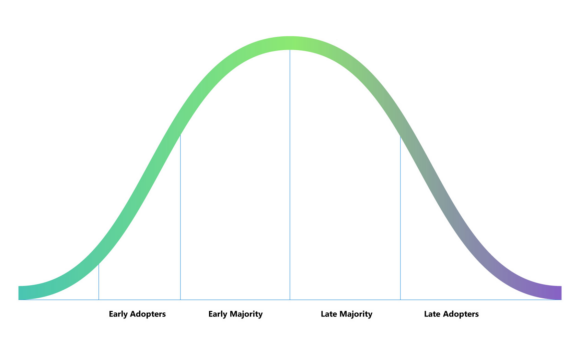
An old school friend of mine recently told me he now only wears wide-legged trousers, moving on from the skinny ones he’s probably worn for 20 years. This, for me, means we’ve reached the top of the bell curve.
Fashions always have early adopters and late adopters, and the media often get their predictions wrong. All it takes is for two fashion designers to put Oxford bags down the runway, and they scream that wide legs are back.
In fact, it takes years from menswear designers pushing something to general adoption by the public. Most men don’t care, or only change when enough of their mates change. Hence why you need to get to the top of that bell-curve distribution.
There are plenty of other signs that the pendulum has swung.
Suit Supply, which made its name offering skinny tailoring, introduced its first wide-leg fit, the Duca, in 2022. Uniqlo, which makes its money from offering universal basics – so sticking as close to the middle of the road as possible – introduced its first wide-leg fits in 2023.
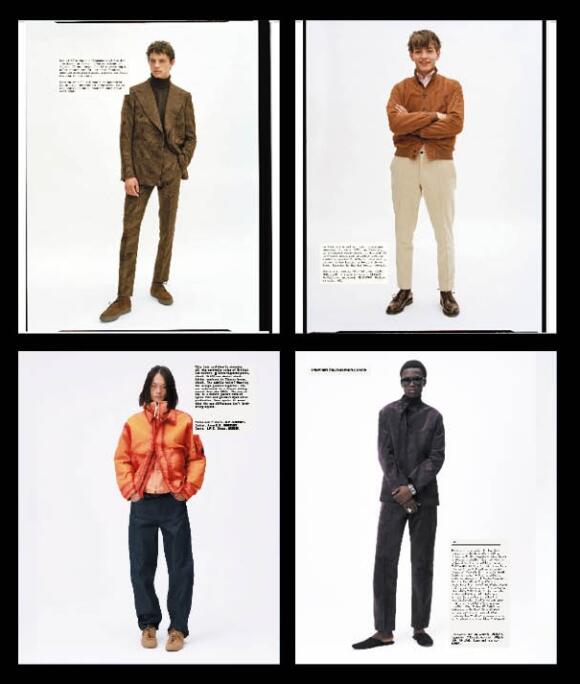
Good visual data comes from a magazine like L’Etiquette, which publishes a fashion shoot or two every issue. Over the almost 10 years they’ve been running, you can see from issue to issue how trousers got wider.
This was something we discussed in particular in the cover story of the latest Permanent Style magazine.
So should you follow suit and switch to wider trousers? My philosophy has always been that you should follow these trends, but slowly and conservatively.
After all, menswear trends move very slowly – perhaps a cycle of 15-20 years – and it’s foolish to pretend that styles last forever. It’s over 25 years since Hedi Slimane first made skinny suits a thing, and that’s a long time ago – the same as 1960 to 1985.
I’ve been letting out my trousers consistently in recent years, partly because I’ve gained a little weight, but also because a fuller cut felt better. I’ve been a good couple of years behind others I know in that respect, but I think that reflects my natural conservatism (and perhaps, that of PS readers).
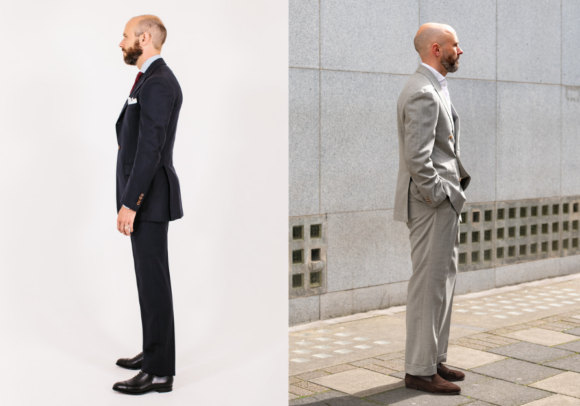
My suit trousers historically were around 19-20cm at the cuff. Go back to my first suit from Cifonelli 13 years ago, and you can see in our breakdown that the cuff measurement was about 19.5cm. Something more English, like my Richard Anderson tuxedo, was around 21cm.
It’s weird to think that the trousers of that tux felt wide to me at the time. It’s almost like cognitive dissonance: in my head I am certain of two contradictory things, both that the trousers were wide, and that they’re narrower than what I’m wearing right now (some Whitcomb trousers measuring 22.5cm).
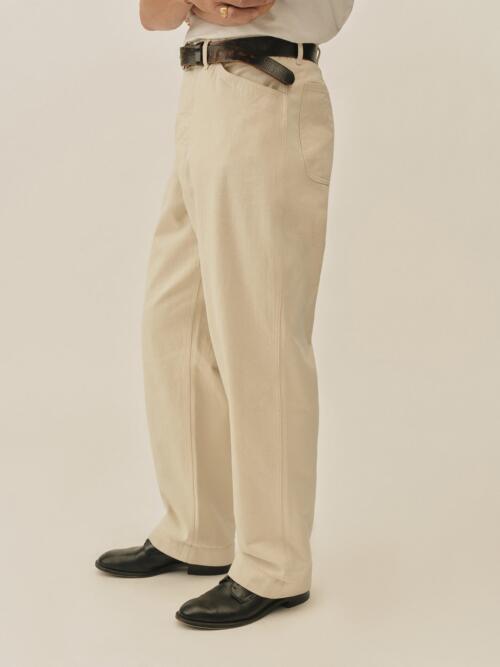
Today, 22 or 22.5 is usually what I have with tailored trousers – it’s what the Assisi ones above are, for example. As always happens with good brands and tailors, I’ve been influenced by some of them too, such as Assisi and Bryceland’s. (The difference between jeans styles is often around this 2cm mark – Bryceland’s 133 and 133S are 2cm different on the hem.)
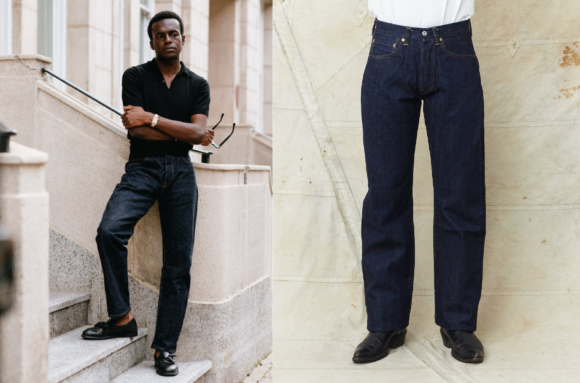
The nice thing about bespoke trousers is that this level of alteration is roughly the amount of inlay a tailor leaves inside them. My Whitcomb ones could be expanded by a maximum of 2.5cm in width, for example, with that amount on the back of the leg on both sides. And if any trousers are taken in, I ask for that kind of amount to be left.
Contrast this with someone more fashion-led, like Japanese designer Yasuto Kamoshita. In his interview with us, he mentioned that most of his trousers are slim – 18cm – and he now wants to let them out to 22cm. That’s a bigger swing.
(Remember that these widths are relative to things like height, width and shoe size, rather than being absolute. So 22cm is wider proportionally on him than it is on me.)
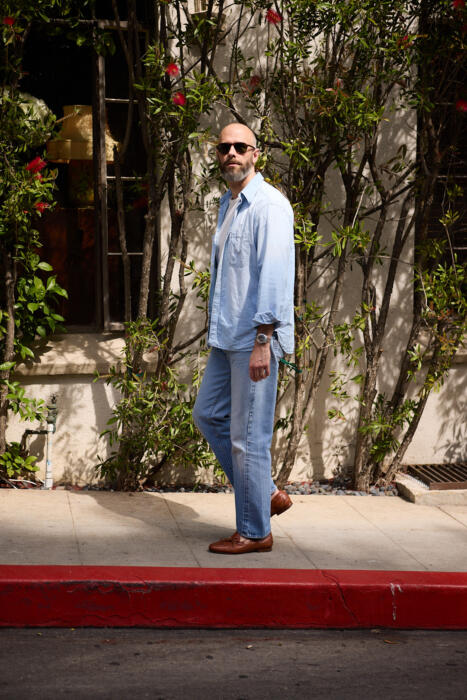
The bigger problem with altering tailored trousers like this is that the desired rise often gets higher along with the width. There’s nothing we can do about this unfortunately – while there is usually some inlay in there, raising the front at all requires several new things, including a longer zip.
It’s also much harder on casual, ready-made trousers and jeans. Here there’s little you can do except stay as conservative as possible, and accept that a pair of jeans might last you 10-15 years rather than a lifetime. But 15 years really isn’t that bad for a pair of trousers.
(Personally I’ve always felt this is one of the biggest fallacies of bespoke – saying it lasts a lifetime, even generations. If it does, at the very least the fit won’t be the same one you obsessed over at the start. And that longevity will largely be due to the ability to have it altered.)
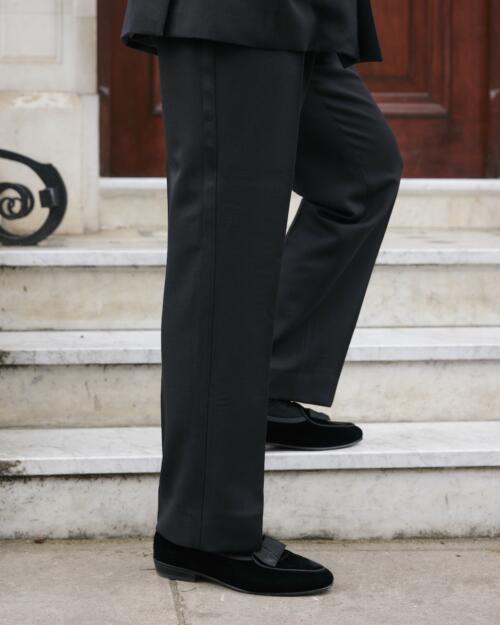
If you’re in doubt, I’d recommend letting out a pair of your tailored trousers and seeing how they feel. Maybe something casual that could suit it, like some flowy linen ones. It might even bring a fresh sense of enjoyment to wearing them, of the type you get when you polish a pair of old shoes, for example. They get a new lease of life, and are exciting again.
Some have predicted these trends won’t happen any more. The fragmentation of media and general atomisation of society would mean there was no dominant narrative, no society-wide trend.
The trends certainly are less universal than in the past. But in menswear at least, they survive. Men like to wear what other men are wearing, and right now most men I see are in wide-legged trousers – internationally online, or locally in the playground. The Dads wear elasticated trousers from Gramicci or Service Works; the teenagers wear 90s Levi’s or Carhartt.
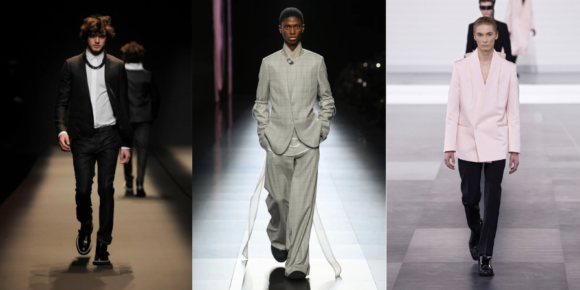
And as if a final sign were needed, some designers have already started rebelling against the mainstream, including Dior, Prada and Thom Browne, who both showed skinny trousers this year. But don’t worry, it’ll take another 10 years at least before that comes anywhere near us. Plenty of time to let those flannels out.
What do you see where you live, and have you altered your trousers in the past few years? Let us know below – everyone loves it when we share.
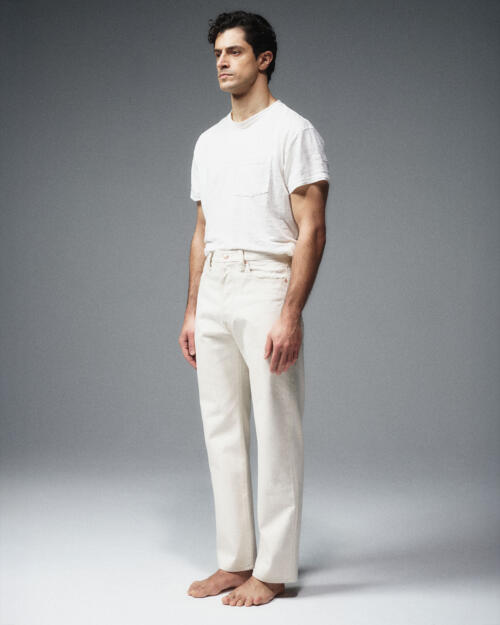
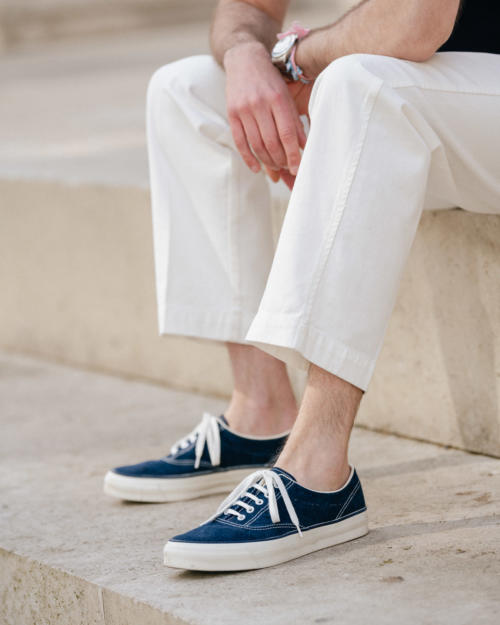
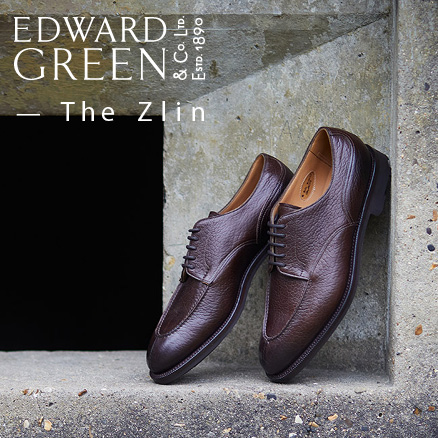
Here are some other examples of wide-legged models from brands we cover: