Assassin’s Creed Black Flag Resynced is definitely more than a simple polish job, but the latest PS5 Pro details make it sound like Sony’s upgraded console could be the place to play it.
Ubisoft has now revealed the PlayStation-specific features for the upcoming remake, confirming that Black Flag Resynced has been rebuilt from the ground up on the latest version of the Anvil engine. The developer suggests nearly every system has been modernized while keeping the spirit of the 2013 original intact.
Playing Assassin’s Creed Black Flag Resynced on PS5 Pro is where it’s at
On standard PS5, you can expect 60 FPS Performance, 30 FPS Fidelity, and 40 FPS Balanced modes, with the latter requiring a 120Hz display. The game will also support HDR, Dolby Atmos, DualSense haptic feedback, adaptive triggers, fast SSD loading, and ray-traced global illumination across graphics modes, with ray-traced reflections added in Fidelity mode.
However, the PS5 Pro version appears to be where the recreation truly shines. If you’re planning on playing on the upgraded console, you’ll benefit from extended ray tracing support across all graphics modes, including both ray-traced global illumination and ray-traced specular reflections. In plain English, lighting and reflections should look richer without forcing you to completely give up performance.
The Pro version also makes use of the latest PlayStation Spectral Super Resolution tech, designed to improve image quality and reconstruction while reducing the gap between performance and fidelity modes. Ubisoft is also expanding strand-based hair rendering on PS5 Pro, with Edward getting it in all modes, nearby crowd characters benefiting in Fidelity mode, and cinematics using it for all characters.
One of Black Flag’s strongest plusses is the strength of its Caribbean setting, from stormy seas to sun-soaked ports, so these upgrades will definitely matter more here than in a more enclosed Assassin’s Creed game.
With improved lighting, weather simulation, reflections, and image quality, PS5 Pro appears to deliver the all-around best version of Edward Kenway’s return.
Caroline Flack’s brother Paul Flack has died aged 55, six years after the TV presenter’s death.
The Daily Mail reported that Paul was found unresponsive at his home in Norwich on June 21. Medics tried to save him, but he later died at Norfolk and Norwich Hospital.
A provisional post-mortem gave the cause of death as cardiac arrest due to hanging, the publication reported. Norfolk Coroner’s Court opened an inquest on Monday.
Coroner Yvonne Blake said investigators need more enquiries before they can establish the full circumstances. The case remains open for now.
Paul Flack is survived by his partner and their two children.
Caroline Flack’s brother has tragically taken his own life six years after her death (Credit: Brett D. Cove)
What do we actually know about Caroline Flack’s brother?
The confirmed facts remain limited at this stage. The court heard that Paul Flack was found unresponsive at home and later died in hospital.
The coroner has not reached a final conclusion. Officials will gather more information before the case returns to court.
Why his final tribute is drawing fresh attention
The Daily Mail also reported that Paul’s final Instagram post paid tribute to his sister Caroline Flack. He shared a picture of them together.
He wrote: “This will be my last post here. May those who know feel shame for eternity. Love you Caroline.”
Caroline Flack died in 2020 after taking her own life. She was best known for presenting Love Island on ITV2 and The X Factor on ITV.
Who was Caroline Flack?
Caroline Flack was an English television presenter.
She presented Love Island on ITV2.
She also presented The X Factor and won Strictly Come Dancing.
Caroline Flack died in 2020.
She also won Strictly Come Dancing on BBC One. Her death prompted a huge public response from fans, friends and former colleagues.
It also sparked wider discussion about fame, pressure and media scrutiny. Now the death of Caroline Flack’s brother has brought fresh heartbreak to the family story.
According to the Daily Mail, Paul continued to remember Caroline in the years after her death. His final social media message suggests that grief remained close.
Leave your condolences our Facebook page @EntertainmentDailyFix.
Morning Minute is a daily newsletter written by Tyler Warner. The analysis and opinions expressed are his own and do not necessarily reflect those of Decrypt. And check out our new daily news show covering all of the top stories in 5 minutes, downloadable on Apple Pod or Spotify.
GM!
Today’s top news:
Crypto majors mostly flat, HYPE leading; BTC falls 1.3% to $58.9k
Strategy stock jumps 13% after Saylor rolls out Digital Credit Capital Framework
Supreme Court rules that Trump can fire SEC and CFTC heads at will
JPMorgan backs the Clarity Act in pivot, odds rebound to 49%
ANSEM soars 100% to $160M, ignites the SOL meme market
₿ Strategy Overhauls Its Model and Gives Itself Permission to Sell Bitcoin
Strategy just formally ended the “never sell” era.
Facing a stock that had fallen below the value of its own Bitcoin, Michael Saylor’s company unveiled a sweeping new capital framework that lets it sell Bitcoin, buy back its battered shares, and shore up its preferred stock.
📌 What Happened?
Strategy adopted a “Digital Credit Capital Framework” that overhauls the financing model behind its Bitcoin bet. The headline change is a $1.25 billion Bitcoin monetization program, giving the company formal permission to sell BTC to build cash, fund dividends, and cover interest. It also authorized $2 billion in buybacks, split evenly between common stock and preferred shares, to deploy during market dislocations without touching its cash reserve.
Strategy also:
raised the dividend on its STRC preferred stock to 12% effective in July
set a policy to hold at least 12 months of dividend and interest coverage in cash (now $2.55 billion or about 17 months) and
said it will stop issuing common equity to buy Bitcoin when its shares trade near the value of its holdings.
MSTR jumped about 13% on the news, its biggest day in four months. STRC rose 12%, and Bitcoin reclaimed $60,000 briefly before giving back gains overnight.
🗣️ What They’re Saying
CEO Phong Le framed it as a move from primarily issuing capital to “actively managing the capital structure through both issuance and repurchases,” depending on conditions.
Saylor said the framework is meant to strengthen Strategy’s credit profile while keeping Bitcoin as its primary reserve asset.
Critics had been pushing for exactly this, as Grayscale’s research head argued days earlier that Strategy should sell at least $3 billion of Bitcoin to cover near-term obligations.
🧠 Why It Matters
This new framework is a genuine pivot. Selling Bitcoin to fund dividends, repurchasing discounted shares, and pausing issuance when the premium is gone is active management. And it’s a sharp turn from being a permanent accumulator.
The market cheered because 1) he raised another $1.2B in cash, now up to $2.55B and 2) it puts shareholders and the credit stack ahead of relentless BTC buying. But the tradeoff is real: the biggest corporate buyer of Bitcoin is now also a potential seller, removing a pillar of demand at a fragile moment.
So where does this leave us? The odds of Saylor blowing up anytime soon effectively went to zero. He’s up to 17 months of dividend payments, and given the near-term pop in MSTR price, Saylor will likely sell more MSTR this week. So expect an even bigger cash cushion into July. That should be good for Bitcoin (or at least, not bad) and removes an overhang.
Longer term, this is harder to project. Saylor still needs the price of BTC to go up over time for his model to work. If BTC goes into a multi-year bear, he could still be in trouble. But if the 4-year cycle plays out again like it has the past several cycles, he likely weathered the storm.
We will know a lot more over the next 6-12 months…
🌎 Macro Crypto and Markets
Crypto majors are mixed with HYPE leading; BTC -1.3% at $58.9k; ETH even at $1,570; SOL +1% at $73; HYPE +4% at $65.20
KAS (+11%), ADI (+9%) and SKY (+7%) led top movers
Oil even at $70; Gold even at $4,040
Stock futures are slightly green ahead of the quarter close; DOW +0.1%, Nasdaq +0.2%
The Supreme Court ruled that Trump can fire SEC and CFTC commissioners at will, overturning a 91-year precedent and handing the president direct control over the two agencies that regulate crypto at a crucial moment for legislation
The White House is talking to law enforcement about concerns with the CLARITY Act, according to a report, as worries persist that the bill’s developer protections could be exploited for illicit finance
JPMorgan backed the Clarity Act in a major pivot, but warned that new rules should close regulatory gaps
Galaxy Digital lowered its odds of the CLARITY Act passing in 2026 to 50%, citing the narrowing legislative window and mounting opposition to the crypto market-structure bill.
BNY added USDC to its custody platform, expanding the bank’s digital-asset services to meet growing institutional demand for stablecoin custody
A JPMorgan report highlighted low institutional interest in crypto perpetual futures, finding big players have largely stayed on the sidelines of the product at the center of the CME-CFTC fight
Vitalik Buterin highlighted the importance of obfuscation in crypto, pointing to it as a foundational tool that could unlock powerful new privacy and functionality for onchain applications
Corporate Treasuries & ETFs
Meme Coin Tracker
Meme leaders were mostly red; DOGE -2%, SHIB even%, PEPE -1%, PENGU -2%, TRUMP -1%, BONK -1%
TJR (+38x), ANSEM (+40%) and LUKE (+27x) led movers on Solana
Base movers included FAI (+23%) and REI (+13%)
📈 Myriad Market of the Day
💰 Token, Airdrop & Protocol Tracker
🚚 What is happening in NFTs?
NFT leaders were slightly red; Punks -3% at 31.5 ETH, BAYC -1% at 8.825 ETH, Pudgy -1% at 4.45 ETH; Hypurr’s -1% at 225 HYPE
Normies (+13%) and R3order (+20%) led top movers
Daily Debrief Newsletter
Start every day with the top news stories right now, plus original features, a podcast, videos and more.
Junkster is ostensibly a 3D action game, but a heavy emphasis on a building mechanic means it may be better described as a puzzle platformer, and a charmingly unique one at that.
Developed by Stormcloud Games, Junkster casts players in the role of UM-13, a plucky little construction robot whose cargo ship crash lands on a planet made of junk. UM’s construction skills come in handy as he must craft various paths, tools and vehicles from the planet’s plethora of trash in order to reclaim his lost cargo.
A comic book world
Throughout the game’s twenty levels, UM will encounter obstacles that will test both his brains and his brawns, though the emphasis is very much on the latter. There are enemies scattered throughout and the occasional boss battle, but none of these enemies are remotely challenging. Truly, if we were judging Junkster on its battles, then it would go down as a resounding failure. But thankfully, that is not where the magic is found in this game. The building mechanic is where the fun truly lies here and there is plenty of it.
It would be a stretch to say you can build anything you want, but there are times when it sure feels like it, to such an extent that Junkster’s levels seem far less on rails than they really are. That’s the catch here, the ingenuity, the variety, the seemingly randomised whimsy contained in this game, it all comes from you, the player.
The levels themselves are relatively straightforward affairs. The player must guide UM from point A to Point B, where he will find a lost piece of his cargo. It’s how you choose to make the journey that will define how much fun you will have. Want to build a tower of junk and head to the sky? Go for it. Have you ever wondered what it would be like to ride across a laser beam in an elaborate version of Operation? Well, wonder no more because Junkster has you covered.
Complications Are Minimised And Fun Is Maximised
However, make no mistake, those rails I mentioned are most certainly real. Look hard enough and you will see the seams. The levels are neither particularly big or detailed and none of the puzzles will prove challenging for most mature gamers. Simplicity is the key here; the controls are quick to learn and easy to use, you will always know where you are going and the building mechanic feels additive and is rarely frustrating. Complications are minimised and fun is maximised, for some that will be an annoyance and for others a boon, but it is a deliberate choice that has been made by the developers. Stormcloud knows who their target audience is.
Max fun!
A Good One For The Kids
Junkster is a game that is perfect for younger players who will be able to find joy in the building mechanic without stumbling on the pitfalls of overly taxing puzzles. That’s not to say that older players can’t enjoy their time with Junkster. I know I did, just know the difficulty level is virtually non-existent.
The comic book art style is in keeping with the zany premise of Junkster. Each level is introduced by a front cover and a subsequent series of panels in the vein of 1980s comics. It is an amusing and informative way to explain the progression of UM’s quest through every chapter. It is also a clever way of making up for a lack of voice acting and detailed story telling. This is a game produced on a budget, but necessity is the mother of invention and the comic book aesthetic is an inventive way of compensating.
The graphics won’t blow your socks off but they are perfect for what Stormcloud wanted to achieve with here. AAA looks would be nice to have but they would have zero impact on the playability of junkster. The score is another component in defining this aesthetic; while it won’t be joining the pantheon of platformer greats, it provides a suitably quirky accompaniment for UM-13’s journey
A Good Time, But Not Necessarily A Long Time
The aforementioned twenty levels may sound like a fair deal of content and theoretically it is, but given the lack of any real challenge, it shouldn’t take most players too long to collect all of Um’s belongings. The average playthrough will likely last around the five hour mark, with only those who are especially fond of the collecting aspects of Junkster taking slightly longer. Either way, don’t get too comfortable in UM’s company because it won’t last long.
It won’t last long, but you’ll enjoy it
The lack of a real story does mean the game suffers in some regard; there is no overarching villain, no backstory or lore and no real indication of UM’s personality besides an apparent affinity with trinkets from Earth. Most importantly, it lacks a compelling narrative that might carry otherwise disinterested players across the finish line. If a player does not connect with the gameplay from the off, then they are unlikely to go much further beyond the first couple of levels. That is a shame and it is the kind pitfall that a well developed narrative can help bridge.
In all, Junkster is a game of percentages. I suspect the majority of people who come across it will write it off as being too small or too easy for their tastes, and that is fair enough, because they are perfectly legitimate critiques. However, those who are willing to see past some of its shortcomings will find an easy-going platformer that will live long in the memory.
Important Links
From Scrap To Game Pass Gem? Junkster Arrives On Xbox, PlayStation, Switch, PC – https://www.thexboxhub.com/from-scrap-to-game-pass-gem-junkster-arrives-on-xbox-playstation-switch-pc/
Download via the Xbox Store, through Game Pass if you like – https://www.xbox.com/en-GB/games/store/junkster/9NZPKBFF0CV9/0010
A victim of a roughly $250,000 crypto theft received a legal-threat email from KuCoin instead of assistance recovering the money, on-chain investigator ZachXBT alleged on Tuesday — a response he framed as the exchange protecting itself rather than the user whose stolen funds it allegedly helped move.
KuCoin sent a legal warning to a $250,000 crypto theft victim, sparking concerns over its priority on user protection versus self-interest
The exchange’s handling of stolen funds is under scrutiny, with allegations of inadequate response to victims and law enforcement, despite a $297 million guilty plea for AML failures
The incident highlights the vulnerability of crypto exchanges to ‘mule KYC’, where fraud operators use real identity documents to open accounts and launder stolen funds, evading compliance systems
A legal letter, not a lifeline
ZachXBT said KuCoin had sent a formal legal warning to a victim whose stolen assets were laundered through accounts on the exchange. The screenshot of the email, shared publicly by its recipient, comes from the “KuCoin Customer Care and Support Team” and is, on its face, a rights-reservation notice: it acknowledges the recipient’s right to raise concerns through proper legal and regulatory channels, then warns that any “false, misleading, defamatory, harassing, threatening or otherwise unlawful statements” about the company “may give rise to legal claims,” before closing that “all rights are expressly reserved.”
The recipient, posting under the handle dnbwizard, read it as something blunter, calling the message “Hilarious” and saying KuCoin was “threatening to sue me.” Whether the letter is best described as a routine defamation warning or an attempt to intimidate a complainant is the crux of the dispute—and it is the optics that have driven the reaction.
To ZachXBT and much of the audience that amplified his post, sending any version of a cease-and-desist to a person who has just lost $250,000, rather than moving to trace or freeze the funds, is the wrong instinct from an exchange that sits in the path of the stolen money.
It is worth stating plainly what is and isn’t being alleged. The claim is not that KuCoin stole the funds or knowingly laundered them. The open questions are narrower and more uncomfortable: whether stolen assets reached KuCoin-controlled deposit accounts, whether those accounts were opened with fraudulent identity documents, and whether the exchange’s response to both the victim and law enforcement was adequate. None of it has been tested in court, and KuCoin has not issued a detailed public rebuttal specific to this case.
How $250,000 reached KuCoin, and what “mule KYC” means
The theft itself dates to August 18, 2025, when the victim lost about $250,000 to Atomic Stealer, a strain of malware that targets crypto users by lifting seed phrases and private keys from infected devices. From there, according to ZachXBT, the funds moved into multiple KuCoin deposit addresses; he published one theft address and five KuCoin deposit addresses that he says received the proceeds.
The detail that elevates the case is how those receiving accounts were allegedly opened: with “purchased mule KYC.” Mule KYC is a persistent weak point in crypto laundering, and understanding it explains why these cases so often end badly for victims. Fraud operators buy or rent exchange accounts that have already passed identity verification using a real third party’s documents, then route stolen funds through them—converting, splitting, or withdrawing the assets before an exchange’s compliance systems flag the activity.
The blockchain trail is visible almost immediately, but recovery hinges on something the victim cannot control: whether the exchange freezes the receiving account before the money is swapped, bridged, or cashed out. Every hour of delay widens the gap. When an exchange instead responds to the person raising the alarm with a legal letter, ZachXBT’s argument runs, that window closes for good.
A pattern ZachXBT has flagged for months
This is not the first time the investigator has put KuCoin’s compliance under a spotlight, and the context is what gives the latest alert its weight. In April, ZachXBT tied more than $13 million in stolen funds to KuCoin deposit addresses, including over $9.5 million drained from victims of a counterfeit Ledger Live app on Apple’s Mac App Store, routed through more than 150 KuCoin addresses linked to a centralized mixing service called AudiA6, plus roughly $3.5 million from the Bitcoin Depot incident moved through 25 more.
He has accused the exchange of enabling instant swaps that sidestep due diligence, of responding slowly to law enforcement, and — in his sharpest framing — of being “complicit” by allowing illicit activity to flow “as long as it generates fees,” a characterization KuCoin rejects. The accusations sit alongside his broader campaign pressing centralized exchanges on accountability, from his labeling of Bitget as part of a “Chinese CEX cartel” to recent alerts on other platforms.
A $297 million guilty plea, and KuCoin’s defense
The history that makes the current allegation resonate is regulatory. In January 2025, KuCoin pleaded guilty in the United States to operating an unlicensed money-transmitting business and agreed to pay more than $297 million in penalties, resolving charges the Department of Justice first filed in March 2024. Prosecutors alleged the exchange had failed to maintain effective anti-money-laundering and know-your-customer programs and had moved billions of dollars in suspicious and criminal funds through its platform over several years.
The scrutiny has continued since: Austria’s financial regulator authorized KuCoin’s European entity under the EU’s MiCA regime, then barred it from taking on new business until it filled key AML and sanctions-compliance roles, an order KuCoin is appealing. Against that backdrop, ZachXBT’s recurring claim — that stolen funds keep flowing through KuCoin and that victims struggle to get help — reads less like an isolated complaint than a continuation of the exact failures the company already paid to settle.
KuCoin’s position, conveyed through its moderator accounts in replies to related posts, is that it takes security, user protection, and compliance seriously. The exchange says it reviews reports through internal procedures, encourages victims to work with law enforcement as the parties best positioned to investigate, will cooperate with authorities where appropriate, and has communicated with the relevant user through proper channels. It has not, as of publication, addressed the specific laundering trail or the legal letter in a detailed public statement.
The bigger question
Stripped to its essentials, the dispute is about what an exchange owes the victim of a crime that runs through its books. KuCoin’s defenders can fairly note that platforms face genuine legal exposure, cannot freeze accounts on the basis of unverified social-media claims, and are right to direct victims toward law enforcement and to guard against defamation. Its critics counter that an exchange penalized nearly $300 million for AML failures and repeatedly shown stolen funds moving through its accounts invites exactly this scrutiny—and that answering a victim with a lawyer’s letter is the clearest possible signal of where its priorities lie.
Several questions remain unresolved: whether the five deposit accounts were in fact opened with mule KYC, whether KuCoin froze any of the funds, what it told law enforcement and when, and whether the legal letter was a standard template or a targeted response. Until KuCoin answers them, the episode stands as another data point in a debate the industry has not settled—whether centralized exchanges, the chokepoints through which most stolen crypto must eventually pass, are doing enough to help the people on the losing end of it or merely enough to protect themselves.
Disclaimer: The information researched and reported by The Crypto Times is for informational purposes only and is not a substitute for professional financial advice. Investing in crypto assets involves significant risk due to market volatility. Always Do Your Own Research (DYOR) and consult with a qualified Financial Advisor before making any investment decisions.
Pre-Owned Bvlgari 18K White Gold Diamond in Floral Divas’ Dream Pendant Necklace in Excellent Condition
There is a way to buy Bvlgari that is practical and makes complete financial sense. There is also a version that does not. The difference has nothing to do with the brand itself — it comes down to which pieces you buy, in what configuration, and where you buy them.
For more information on how pre-owned jewelry (including Bvlgari) is the best investment, do read:
Pre-Owned Luxury Gold Jewelry: Smarter Than Bullion in 2026
Bvlgari is not Cartier. It does not pursue the studied restraint of a Love Bracelet or the quiet authority of a Panthère. Bvlgari is operatic: Roman columns, coiled serpents, gold the color of afternoon light on warm stone, and bold cabochon gems that prioritize saturated color and sculptural presence over faceted sparkle. When it works, a Bvlgari piece is one of the most recognizable luxury items. When it does not — when the piece is too fashion-forward or too generic — it can fade in the secondary market.
This guide focuses on the specific collections and configurations that consistently retain value, attract serious buyers, and reward smart pre-owned purchasing.
What Makes a Bvlgari Piece Hold Its Value? (Resale Factors Explained)
Bvlgari’s strongest resale performers are unmistakably, irreducibly Bvlgari. You cannot mistake a Serpenti coil or a B.zero1 spiral for another house’s work. The double inscription on a BVLGARI BVLGARI bezel — modeled on ancient Roman coins — belongs to no other vocabulary. This recognisability drives demand in the secondary market: a buyer scrolling on a phone needs instant identification, and Bvlgari’s most iconic pieces deliver it.
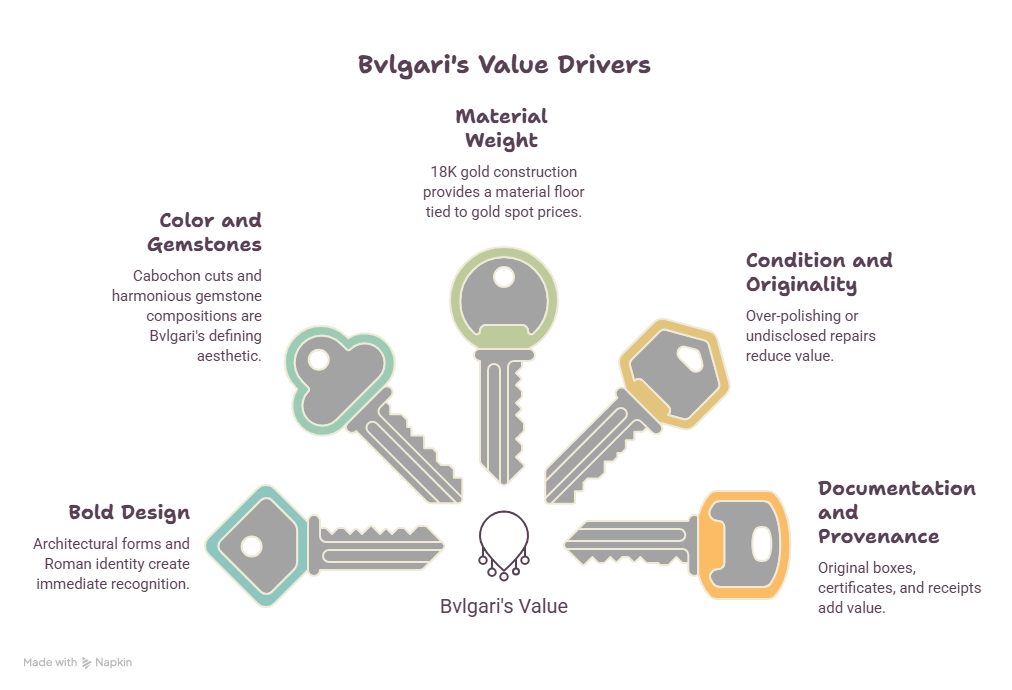
The five key value drivers:
Driver
Why It Matters
Bold design signature
Architectural forms and Roman identity create immediate recognition — essential for secondary market liquidity
Color and gemstones
Cabochon cuts (emphasizing color fields over brilliance) and harmonious gemstone compositions are Bvlgari’s defining aesthetic
Material weight
18K gold construction, often using the Tubogas technique, provides a material floor tied to gold spot prices
Condition and originality
Over-polishing or undisclosed repairs reduce value by 20–40%; the piece must look alive [1]
Documentation and provenance
Original boxes, certificates, and receipts add 15–30% in confirmed resale cases [1]; blockchain authentication on select flagship pieces adds another layer
What Drives Bvlgari’s Resale Market.
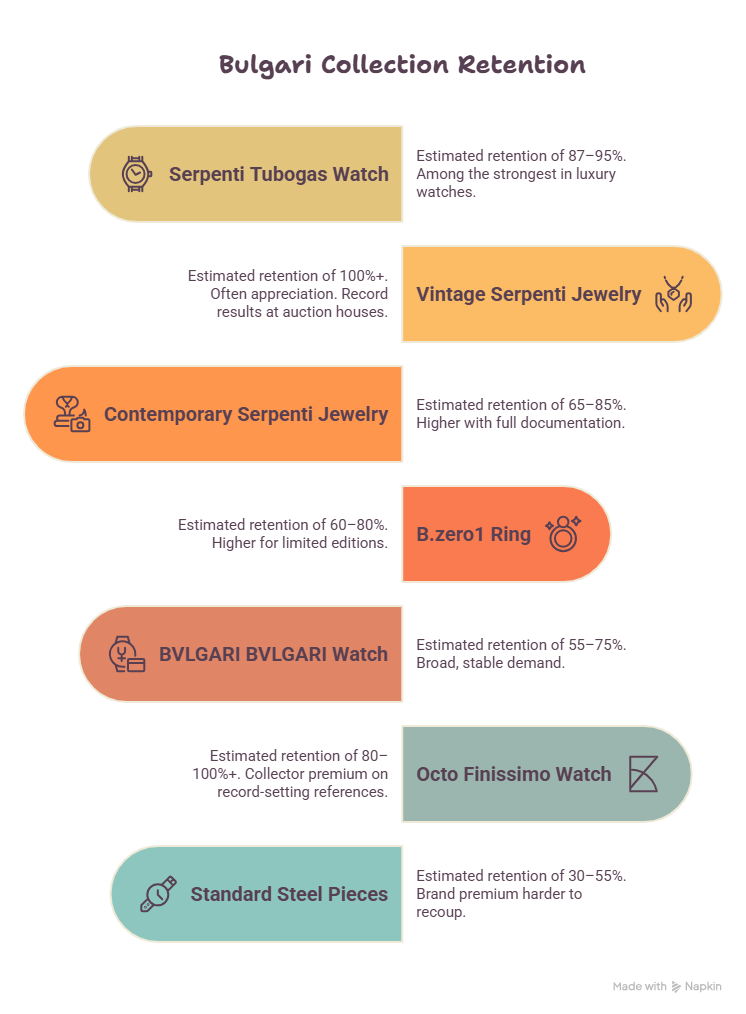
The investment rule: Buy unmistakably Bvlgari pieces in high-gold-content configurations, excellent condition, with documentation. Iconic collections typically retain 30–70%+ of retail, with vintage and collector pieces often significantly higher. Gold appreciation provides additional long-term upside.
5 Categories of Bvlgari Pieces: Necklaces, Rings, Bracelets, Watches, and Earrings
Before going collection by collection, it helps to step back and look at it category by category. Bvlgari’s resale strength is not evenly distributed across necklaces, rings, bracelets, watches, and earrings — each category has its own buyer behavior, price sensitivity, and reasons for holding or losing value. Here is how each performs in the pre-owned market.
Rings
Bvlgari Serpenti Viper 18k White Gold Pave Diamond Ring EU 48
Bvlgari rings for women are the most liquid resale category, largely because of the B.zero1 and Serpenti Viper. Both are sized, dated, and condition-graded with relative ease, which makes them the easiest pieces for a buyer to evaluate from photographs alone. A B.zero1 ring in good condition typically moves quickly on the secondary market, and entry-level configurations — single-band, smaller stone settings — make rings the most accessible category for a first-time Bvlgari buyer. The trade-off is sizing: a ring that needs resizing for a new owner carries a small but real cost that buyers factor into their offer.
Necklaces
Bvlgari Serpenti Viper 18K Yellow Gold Necklace in Excellent Condition
Necklaces for women from Bvlgari span the widest price range of any category, from a modest B.zero1 pendant on a thin chain to museum-grade Serpenti Tubogas lariats with diamond and onyx detailing. This spread means necklaces reward precision shopping more than any other category — a generic pendant performs modestly, while an iconic silhouette in the right gold weight can be one of the strongest resale assets in the entire house. Chain condition and clasp integrity matter more here than buyers initially expect; a stretched or repaired chain meaningfully reduces resale value even when the pendant itself is pristine.
Bracelets
Bvlgari Serpenti Viper Diamond 18k White Gold Bracelets S in Good Condition
Bvlgari’s bracelets most clearly carry the brand’s identity. The Serpenti Tubogas bracelet and the B.zero1 bangle are arguably the two most recognizable bracelet silhouettes the house produces, and both carry strong, consistent secondary market demand. Bracelets see more daily wear than any other category, which makes condition assessment critical — clasp function, link flexibility, and surface wear all factor directly into resale price. A well-maintained gold bracelet in either collection is one of the safer bets in the category for a buyer prioritizing liquidity.
Bvlgari watches for men and Bvlgari watches for women operate as separate markets within Bvlgari’s broader catalog, with their own buyer pools of horology collectors alongside jewelry buyers. The Octo Finissimo and Serpenti Tubogas watches lead this category, and as a general benchmark, most Bvlgari watches can be found secondhand at around 25% below list price, with stronger references — particularly gold Tubogas models and limited-edition Octo Finissimo complications — retaining considerably more. Movement condition, service history, and box and papers carry outsized weight in this category compared to jewelry, where the gold and gemstone content alone provide a value floor.
Earrings
Bvlgari Serpenti Viper Diamond 18k White Gold Earrings
Earrings are Bvlgari’s most overlooked resale category — and often its best-kept value secret. Because they see comparatively less daily wear than rings or bracelets, earrings tend to reach the secondary market in better condition, with less clasp damage or setting wear than in other categories. Serpenti diamond earrings in white or yellow gold are the standout performers here: a pristine pair can hold value impressively well against original retail, often outperforming what buyers expect from the jewelry category broadly. Vintage Bvlgari earrings from the 1960s–1980s, particularly cabochon and clip-on styles, occupy a genuine collector niche of their own, separate from the contemporary catalog.Earrings with damaged or replaced posts and backs — these are small repairs individually, but they signal a piece that has not been well maintained, and buyers price that risk in.
Best Bvlgari Pieces for Investment: Collection-by-Collection Resale Guide
1. Serpenti — Bvlgari’s Strongest and Most Enduring Resale Performer
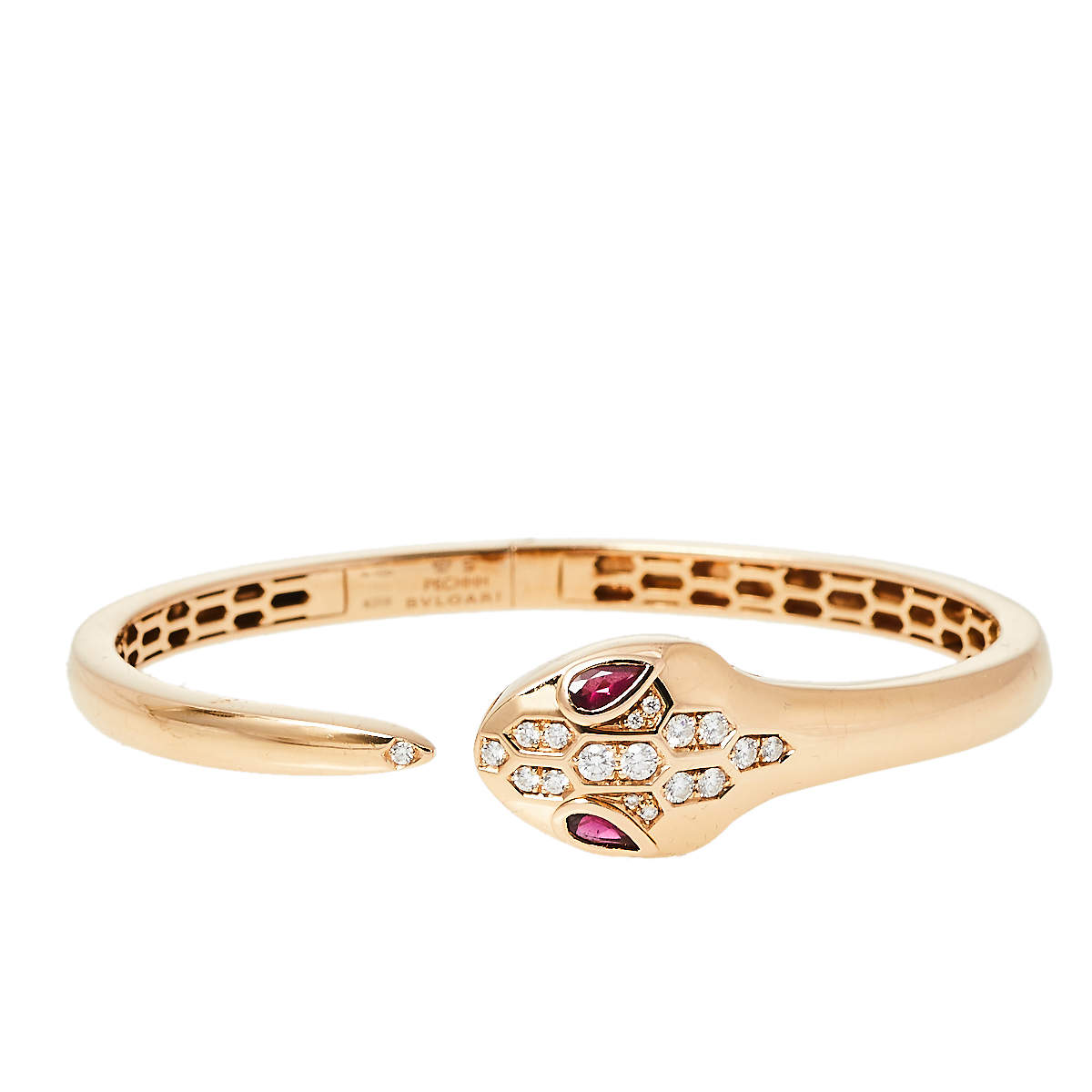
Bvlgari Serpenti Rubelite Diamond 18K Rose Gold Open Cuff Bracelet S
The serpent motif first appeared at the house in 1948 and evolved through the 1960s into the Tubogas construction — a flexible, continuous, coiled structure built without welds that feels both architectural and organic. The Serpenti Collection has been a huge hit since its launch. It has been worn by Elizabeth Taylor, Ingrid Bergman, Audrey Hepburn, and, presently, Zendaya, who appeared at the Dune premiere in a 93.83-carat cabochon Colombian emerald Serpenti necklace from the Magnifica collection.
The auction record for Taylor’s 1961 Serpenti bracelet-watch — a piece estimated at $12,000–15,000 — sold at Christie’s for $974,500, nearly 65 times its presale estimate. That is what provenance does to a Bvlgari Serpenti. More recently, a Serpenti sold via Phillips in May 2025 for $572,567, beating its estimate by 44%. A separate example sold by Sotheby’s in Switzerland for $207,185, beating its estimate by 172%
In the secondary market, Serpenti and B.zero1 pieces consistently sit at the stronger end of Bvlgari’s 60–75% retention range, with pristine, fully documented examples commanding 70–85% of retail.
What to buy:
Yellow or two-tone gold Tubogas bracelets and rings with colored stone heads (emerald, rubellite, turquoise, coral) in excellent condition Vintage bracelet-watches from the 1960s–1970s, particularly enamel or colored stone examples Modern pavé diamond double-wrap necklaces or high-gem configurations As an entry point: a Serpenti ring — more accessible and wearable daily
What to avoid:
Heavily worn coils with deformed links, missing serpent heads, or poor flexibility. The piece must retain its sinuous movement — that is, its entire visual argument.
How to Authenticate Bvlgari Serpenti Jewelry: What to Check
Bvlgari Serpenti Diamonds Rubies 18k Two Tone Gold Necklace in Excellent Condition
The Serpenti is Bvlgari’s most counterfeited line, and the fakes have become sophisticated. Here is what separates a genuine piece from a convincing imitation:
The movement test — the single most important check:
On an authentic Serpenti, each individual scale link moves independently. Pick up the bracelet and flex it — it should feel fluid, weighted, and alive, like a real coiled snake. Fakes are almost universally made from a single solid piece of stamped metal, with etched grooves simulating scales. The difference is immediately apparent when you handle both: one moves; the other doesn’t.
Construction weight:
Genuine Bvlgari uses substantial 18K gold — never hollow construction. A real Serpenti bracelet feels heavy for its size. If it feels light or tinny, walk away.
The serpent head:
On authentic pieces, the head features precise enamel work or properly set cabochon stone eyes with a hinged jaw that opens smoothly. On fakes, the enamel is uneven, the stones look glued rather than set, and the hinge is stiff or non-functional.
Hallmarks to check:
Bvlgari Serpenti Viper 18K Rose Gold, Onyx and Diamond Ring EU 53
BVLGARI (V, not U) — engraved with clean, even, deeply incised lettering. Counterfeits show shallow or uneven stamping under a loupe. 750 for 18K gold or 950 for platinum — on the clasp interior MADE IN ITALY — present on all authentic modern pieces ROMA stamp — appears on pieces made at the Rome atelier, typically on vintage examples Serial number — laser-engraved (not stamped), should match any accompanying certificate. No two pieces share a number.
Box and documentation: Authentic Bvlgari packaging has the brand name stamped in gold on the outer box lid and on both the top and inside of the inner box. All lettering is clean, evenly spaced, and fully legible. Counterfeit boxes often use slightly off-color gold ink or inconsistent font weight.
2. B.zero1 — The Architectural Piece That Rewards Patience
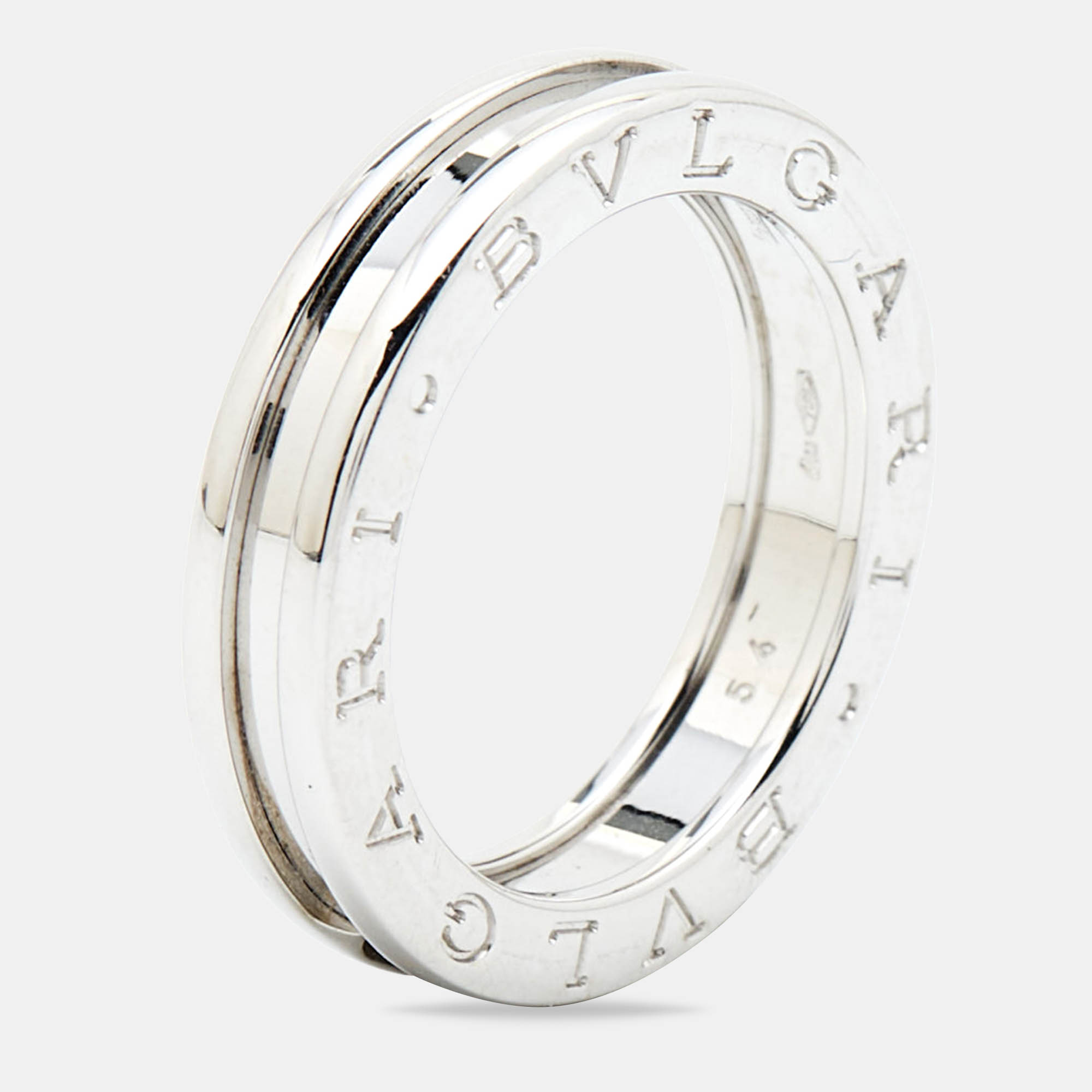
Bvlgari B.Zero1 18k White Gold 1-Band Ring Size 54
Introduced in 1999 — the year encoded in its name, a reference to the new millennium — the B.zero1 represented a genuine rupture with fine jewelry convention. Where virtually every other luxury house was refining existing vocabularies, Bvlgari created something with no precedent: a multi-band spiral ring inspired by the cylindrical architecture of the Colosseum, developed in collaboration with artist Anish Kapoor. The coils compress and expand in your hands — a built-in authentication test that convincing fakes cannot replicate.
More than 25 years after its debut, the B.zero1 remains one of the most actively traded designs on the global pre-owned market. Its combination of design radicalism, 18K gold quality, and immediate recognizability has made it a consistent performer. This piece holds value not just because of its materials, but because of what it represents in the history of design.
What to buy:
Bvlgari B.Zero1 1-Band 18K Rose Gold Ring Size 47
4-band rings in yellow, rose, or three-tone gold — these have the most visual presence and the broadest buyer base Pieces with black or white ceramic inlays and diamond pavé on the band edges: the material contrast (polished gold, matte ceramic, brilliant diamonds) is a Bvlgari signature that photographs exceptionally well Anniversary and collaboration editions, which command premiums due to limited runs B.zero1 Rock in black ceramic and rose gold — the most traded Rock combination on the pre-owned market.
What to avoid: Heavily worn 1-band white gold pieces requiring re-plating, or any piece where the spiral compression feels stiff or uneven — the kinetic quality is central to the design.
How to Authenticate a Bvlgari B.zero1 Ring
The compression test — definitive and instant:
An authentic B.zero1 ring compresses and expands when you gently press it from either end, because its spiral construction is made of multiple bands that move against each other. A counterfeit ring is typically a single grooved piece of metal with no give — it looks like a B.zero1 but feels like a solid bangle. This test takes three seconds and is essentially conclusive.
The spiral geometry:
On a genuine piece, look at the inner barrel of the ring from above. You will see the actual spiral construction — multiple layered bands coiling around a central cylinder. On a fake, this inner surface looks flat, uniform, or simply engraved to simulate depth that isn’t there.
Hallmarks:
Bvlgari B.Zero1 Ceramic 18K Rose Gold Four-Band Ring Size 60
BVLGARI on the inner band, clean and precise, alongside the metal purity stamp (750 for 18K gold) and ring size The ring size is stamped inside the band on authentic pieces — fakes either omit it or display a random number in an inconsistent font. Serial number laser-engraved on the inner surface, verifiable against the certificate
Ceramic inlays (on applicable models):
Bvlgari’s ceramic is matte, dense, and deeply colored — not the slightly chalky or unevenly finished ceramic common on fakes. Run your fingernail across the ceramic-to-gold join: on a genuine piece, the transition is seamless and flush.
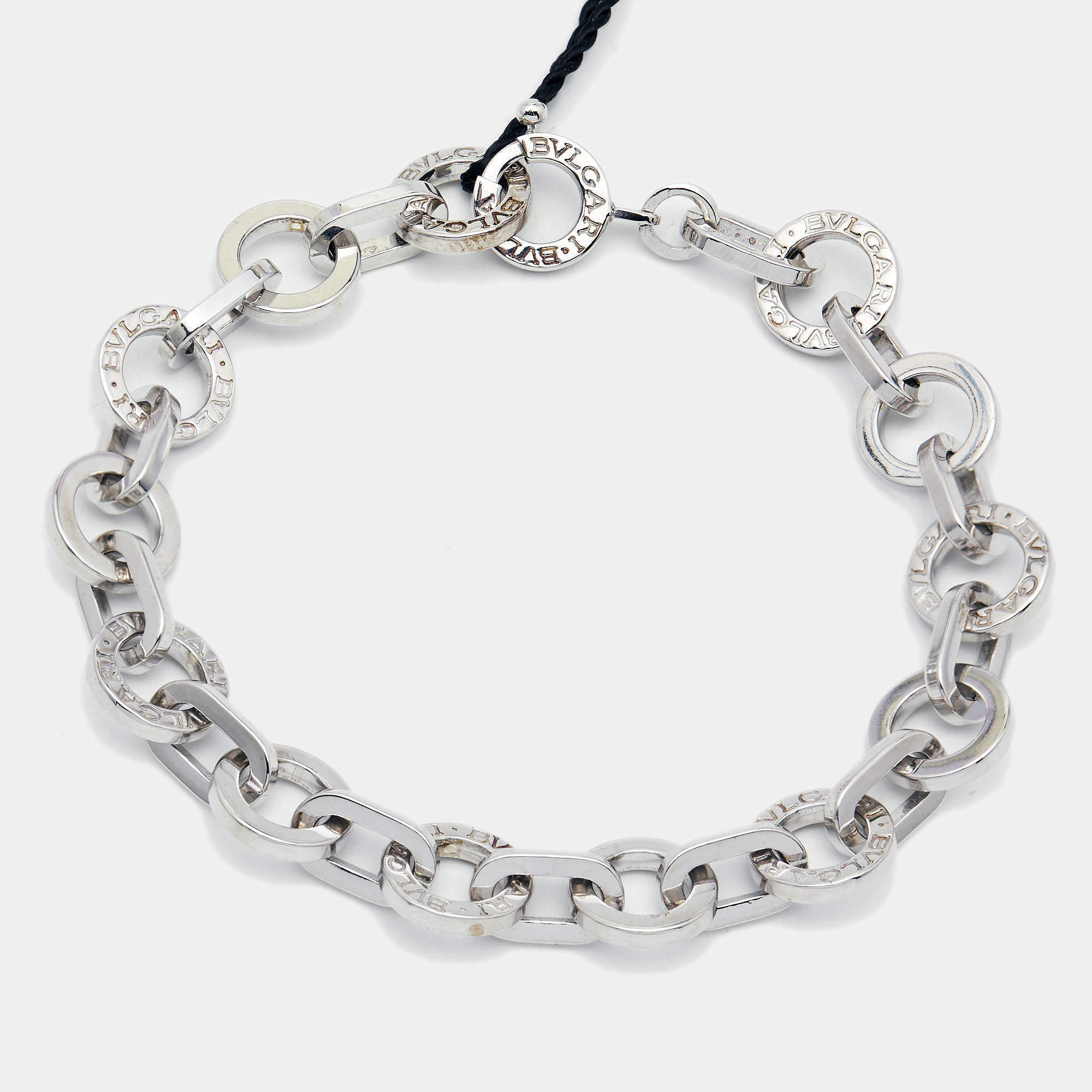
Bvlgari Bvlgari Link Sterling Silver Link Bracelet
Introduced in 1977, the double-inscription design — V rather than U, modeled on ancient Roman coin engravings — offers an authoritative, versatile luxury that has held appeal across five decades. The Bvlgari Bvlgari collection appeals to first-time buyers and long-term collectors alike, and its broad recognition makes resale straightforward.
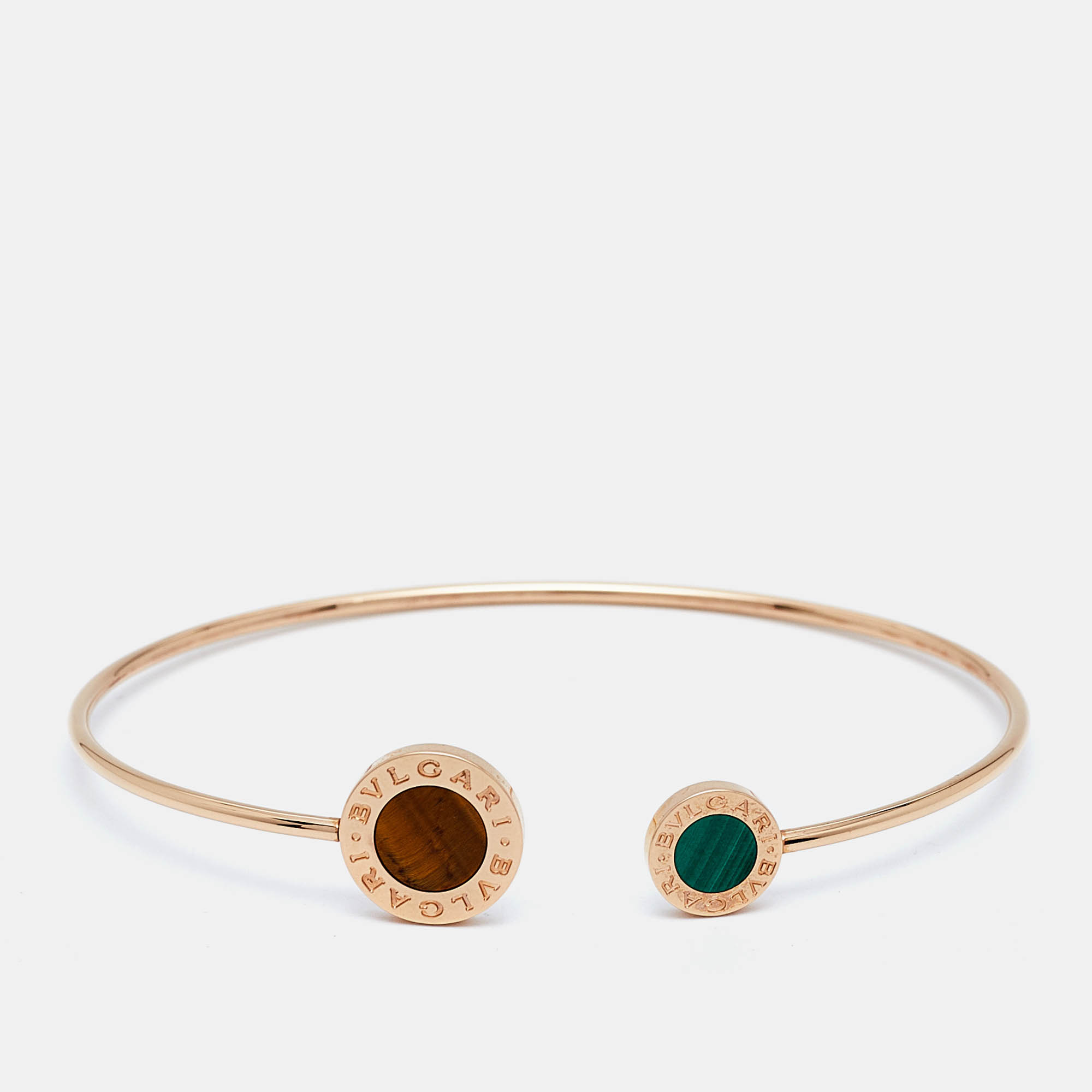
Bvlgari Bvlgari Bvlgari Malachite Tiger’s Eye 18k Rose Gold Bracelet L
Strong configurations: Larger yellow gold pieces with onyx or diamond accents; watches with inscribed bezels in good proportional size. Vintage examples from the 1970s and 1980s are particularly collectible as the engravings show the crisp precision of that era’s production.
What to avoid: Over-polished pieces where the inscription has lost its sharpness. The legibility of those double letters is the entire authentication and aesthetic statement. Blurred or worn lettering significantly diminishes both appeal and value.
Authenticating BVLGARI BVLGARI Pieces: The Lettering Test
Bvlgari Bvlgari Black Cotton Fabric and Sterling Silver Black Bracelet
The inscription itself is the authentication test — and the most commonly failed one on fakes.
The lettering inspection:
Using a loupe or strong magnification, examine every character of the double inscription. On authentic pieces, each letter is incised to a consistent depth with clean, sharp edges and perfectly even spacing. Counterfeits show variations in letter depth — some characters cut shallower than others — and often inconsistent spacing between letters, particularly around the V.
The V, not U:
This is the detail counterfeiters most frequently get wrong. Bvlgari uses the classical Latin alphabet in all its hallmarks — the letter V replaces U throughout. On both the external inscription and the internal hallmark, every instance should read BVLGARI, never BULGARI.
On watches with inscribed bezels:
Bvlgari Bvlgari BB38SSAUTO Black Dial Stainless Steel Men’s Wristwatch 38 mmBvlgari Bvlgari-Bvlgari 103556 Black Blacksteel Automatic Men’s Wristwatch 41mm
The inscription should wrap the bezel perfectly, with consistent character height and spacing all the way around. Any deviation or compression of letters around the curve indicates a fake.
Weight and finish:
Authentic BVLGARI BVLGARI pieces in yellow gold have the dense, warm weight of solid 18K construction. The finish transitions between textures (brushed vs. polished areas) with no visible boundary lines or tool marks.
4. Serpenti Tubogas Watch — Where Jewelry Meets Horology
The integrated Tubogas bracelet-watch combines the iconic coil with timekeeping in a format that has attracted collectors since the 1960s. Vintage references — the BB19 and BB23 in yellow or two-tone gold — are serious collectors’ items, and the market for them has deepened considerably as the broader vintage women’s watch category has gained institutional recognition. In fact, the Serpenti Tubogas Watches for women are highly sought after for their aesthetic appeal and investment prowess.
The same forces drive the Serpenti watch’s secondary-market performance as the jewelry: the coil construction, the colored stone or diamond head, and the sense that you are wearing a living object, not just a bracelet. Gold versions offer materially better value retention than leather-strap variants. Serpenti Tubogas single-spiral models are among Bvlgari’s strongest watch performers, trading at 87–95% of original retail on average — notably higher than the roughly 75% retention typical across the broader Bvlgari watch catalog.
What to buy: Full Tubogas gold constructions with the original bracelet intact. Always verify the bracelet’s stretch and link integrity via video before purchasing — a deformed or overextended coil is expensive to restore.
How to Authenticate a Bvlgari Serpenti Tubogas Watch
Bvlgari Serpenti Tubogas Black Dial Stainless Steel Women’s Wristwatch 35 mm
The Tubogas watch carries all the jewelry authentication checks above, plus a horological layer:
The coil integrity test:
Request a video of the seller holding the bracelet and letting it rest naturally. A genuine Tubogas bracelet returns to its coiled form with controlled, even movement. An overextended or damaged bracelet will splay open unevenly or fail to hold its shape — restoration costs more than it is usually worth.
The dial and movement:
The dial is signed BVLGARI in the brand’s precise typeface. The caseback on vintage models is engraved with the model reference, serial number, and metal specifications. Modern pieces carry a Bvlgari-signed movement — request photos of the open caseback on any significant purchase.
The head construction:
The serpent’s head houses the watch dial and opens via a hinged jaw. The mechanism should operate with a precise, controlled click — neither loose nor stiff. The eyes should be flush, symmetrical, and evenly colored. Any asymmetry in the eye setting is an immediate red flag.
Paperwork:
Vintage Tubogas watches should ideally come with the original Bvlgari warranty card, box, and service history. Even a boutique receipt from a past service significantly boosts provenance value.
5. Octo Finissimo — Bvlgari’s Engineering Masterpiece
The Octo Finissimo is where Bvlgari crossed definitively from jeweler-watchmaker into the front rank of serious horology. The collection has set world records for the thinnest tourbillon, the thinnest automatic, and the thinnest mechanical watch. Its octagonal case — a geometry almost impossible to execute at these measurements — is instantly recognizable.
The stainless steel and titanium Automatics offer an accessible entry point with broad collector appeal. Record-setting complications — including the Ultra and the Minute Repeater — suit serious horological collectors who understand what these achievements represent technically. Blockchain and NFT verification on flagship Octo Finissimo models provides an additional layer of provenance that is becoming a meaningful differentiator in the pre-owned market.
What to buy: Limited-edition skeletonized references in titanium or stainless steel; these hold value most consistently. Complication pieces (tourbillon, Minute Repeater) for the highest collector ceiling.
What to avoid: Over-polished Octo cases where the sharp geometry of the octagonal lugs has been rounded. The case architecture is the watch — losing the angles loses the design.
How to Authenticate a Bvlgari Octo Finissimo
The Octo Finissimo’s extreme thinness is both its defining achievement and its most effective authentication signal. The engineering required to produce it at genuine specs is essentially impossible to replicate at a counterfeit scale.
Case thickness:
The Octo Finissimo Automatic measures 2.23mm in thickness. If the case feels or looks “normal” in thickness for an automatic watch, it isn’t genuine. This is apparent even to anyone who has handled the real thing, without tools. However, this holds true for the original 2017 Octo Finissimo Automatic, but Bvlgari has released multiple Automatic generations since then, and thickness varies by reference (some later automatics are listed closer to 2.23mm, others to 2.50mm, depending on case material and complication).
The octagonal geometry:
On an authentic piece, the eight angles of the case are sharp, perfectly symmetric, and machined to exact tolerances. Run a fingernail along the case edges — genuine pieces feel precisely defined. Rounded angles, whether from polishing or faking, are a disqualifier.
Movement visibility (skeletonized models):
Authentic skeletonized references show Bvlgari’s caliber architecture through the dial or caseback — distinctive bridges, finishing, and the signed rotor bearing BVLGARI in a clean, consistent typeface. Request detailed movement photos from any seller.
Blockchain verification (flagship models):
Select Octo Finissimo references include a blockchain-verified digital passport. Scan the QR code to pull up the watch’s registered specifications, production details, and ownership history. A missing or non-functional QR on a piece claimed to have it is an immediate red flag.
Box, papers, and warranty card:
The Octo Finissimo at retail comes with a full documentation set — box, international warranty, chronometer certification where applicable, and service guide. Missing paperwork on a recent flagship reference should materially reduce the price you pay.
Bvlgari resale value by collection — Serpenti, B.zero1, and Octo Finissimo retention rates compared
Bvlgari Resale Value by Collection: Secondary Market Data
Collection
Estimated Retention (% of Retail)
Source
Serpenti & B.zero1 (pristine condition, full documentation)
70–85%
The Diamond Oak, 2026
Serpenti & B.zero1 (visible wear, no documentation)
40–60%
The Diamond Oak, 2026
B.zero1 limited editions/collaborations
Can exceed original retail
The Diamond Oak, 2026
Most Bvlgari watches (general benchmark, broader catalog)
~75% of retail (~25% below list)
WatchCharts, 2026
Bvlgari’s overall secondary market range (jewelry, all collections)
30–70%
The Diamond Oak, 2026
Documentation uplift (box, certificate, receipt)
+15–30%
The Diamond Oak, 2026
Figures are indicative ranges based on secondary market data. Individual results vary by condition, documentation, and market timing.
Why Buy Bvlgari Pre-Owned?
The most significant price drop on any luxury piece happens the moment it leaves the boutique — the initial retail premium of 20–35% evaporates immediately on the secondary market. Buying pre-owned allows you to capture gold appreciation and brand equity without absorbing that initial hit.
Wider selection. The boutique carries the current season. The pre-owned market carries everything Bvlgari has ever made — discontinued references, vintage pieces from the brand’s creative peak in the 1960s–70s, and collaboration editions no longer available new.
Verified provenance. Reputable, authenticated platforms with in-house expertise offer full authentication guarantees and lifetime coverage. It significantly reduces the risk that has historically kept buyers cautious about pre-owned luxury.
Auction access. Christie’s, Sotheby’s, and Phillips regularly offer important Bvlgari pieces, with catalog-verified provenance, the strongest authentication available anywhere in the market.
Sustainability. Pre-owned is the most resource-efficient way to buy luxury — a point that increasingly matters to buyers who care about provenance beyond the boutique.
Frequently Asked Questions
Is Bvlgari worth buying?
Yes — for specific pieces. Bvlgari’s iconic collections combine 18K gold construction, globally recognized design, and strong secondary market demand. Bought pre-owned in the right configuration with documentation, Serpenti, B.zero1, BVLGARI BVLGARI, and Octo Finissimo pieces offer gold price upside, preserved brand equity, and a meaningful discount to retail. The investment case is strongest when you buy pieces that are unmistakably Bvlgari in unmistakably Bvlgari materials — the collections where the design is the authentication.
Is Bvlgari a good investment?
For specific pieces, yes. The B.zero1 and Serpenti collections demonstrate consistent secondary market demand across global auction houses and pre-owned platforms. Vintage Serpenti Tubogas pieces in yellow gold have appreciated meaningfully. The Octo Finissimo is among the strongest collector watches outside of Rolex, Patek Philippe, and Audemars Piguet, with record-setting complications that retain technical significance regardless of which generation supersedes them. The investment case rests on iconic pieces in high-gold-content configurations, not on the Bvlgari name applied generically.
Which Bvlgari collection has the best resale value?
For jewelry: Serpenti and B.zero1 in high-gold configurations, with vintage Serpenti consistently outperforming. For watches: the Serpenti Tubogas (87–95% retention) and limited-edition Octo Finissimo references. Colored stone pieces and documented vintage examples often appreciate rather than depreciate.
Does Bvlgari jewelry hold its value?
Selectively, yes. Iconic pieces in the right configurations retain 65–85% of retail, with gold content providing a material floor. Vintage and high-jewelry Serpenti pieces have appreciated substantially at major auction houses. Generic or heavily worn pieces perform much more modestly on the secondary market.
How does Bvlgari compare to Cartier in terms of resale value?
Cartier offers more consistent catalog performance across its range — the Love Bracelet and Juste un Clou have well-established, liquid secondary markets that are well understood by a very wide audience. Bvlgari rewards precision: choose the wrong piece, and it underperforms; choose Serpenti or B.zero1 in the right configuration, and you access a market that is increasingly deep and global. For first-time pre-owned buyers, Cartier carries a lower risk of overpaying. For collectors who know what they are doing, Bvlgari’s iconic pieces deliver genuine value and a design identity that Cartier does not replicate.
What is the single most important thing to check when buying pre-owned Bvlgari?
Construction integrity, collection by collection: flex a Serpenti to confirm individual link movement; compress a B.zero1 to confirm the spiral gives; examine the BVLGARI BVLGARI lettering under magnification for consistent depth and spacing. These physical tests catch the vast majority of fakes before you ever look at paperwork.
What is the best entry-level Bvlgari piece for a first-time pre-owned buyer?
A yellow or rose gold B.zero1 ring (3- or 4-band) or a Serpenti ring. Both are immediately recognizable, wearable daily, available at accessible pre-owned price points, and hold their value reliably in the secondary market.
For buyers in Dubai and the UAE, where is the best place to buy pre-owned Bvlgari?
The most reliable route locally is through authenticated platforms with in-house GCC expertise — The Luxury Closet, which operates across the UAE, Saudi Arabia, and Kuwait, offers curated, authenticated pre-owned Bvlgari with lifetime guarantees. Christie’s Dubai also holds regular sales featuring important Bvlgari pieces with full catalog provenance. For new retail, Europe (particularly Italy) offers the best value after VAT refunds — typically 12–18% below UAE boutique pricing for non-resident visitors.
Is pre-owned Bvlgari popular in the GCC market?
Yes — and measurably so. Christie’s UAE achieved $189,000 for a Serpenti in November 2024, and the GCC buyer base for vintage and high-jewelry Bvlgari has grown consistently. The Serpenti’s bold sculptural aesthetic and the B.zero1’s architectural identity resonate particularly strongly with regional collectors, and the pre-owned market reflects that demand in both volume and pricing.
How can I easily sell my Bvlgari piece for the best price?
Start with documentation — the original box, certificate, and receipt, if you still have them — since complete paperwork typically adds 15–30% to what a buyer will offer for an identical undocumented piece. Get the piece professionally cleaned only with gentle methods (warm water, mild soap) or through an authorized Bvlgari service center — aggressive polishing can strip the original finish and patina, which can reduce the value of vintage pieces. Photograph it honestly in good lighting, including any wear, rather than hiding flaws; transparency speeds up the sale and builds buyer trust. Then sell through a platform that authenticates in-house and offers a transparent, fully insured process — this typically nets a meaningfully better price than a generic resale marketplace or a private buyer, since authenticated platforms can offer closer to true market value rather than steeply discounting to account for authentication risk. If you’re looking to sell my Bvlgari jewelry online, The Luxury Closet accepts Bvlgari consignments across the GCC with in-house authentication, transparent pricing, and a fully insured process from pickup to payout.
The Bottom Line
Bvlgari rewards buyers who choose with precision. The pieces where design, materials, and condition align — Serpenti, B.zero1, BVLGARI BVLGARI, and the standout watch references — have earned their place in the secondary market over decades. The depreciation has already happened. The gold remains. The design endures. Browse The Luxury Closet’s authenticated pre-owned Bvlgari collection — curated for the GCC market and backed by a lifetime authenticity guarantee.
Want to know some interesting facts about Bvlgari? Here’s your chance:
7 Facts About Bvlgari You Need To Know
Also read:
Bvlgari, the Serpenti Collection, and Some Must-Haves
Bag of the Week: Bvlgari Blue Leather Serpenti Forever Shoulder Bag
Sources
The Diamond Oak —A Comprehensive Guide to Determining/Calculating the Resale Value of Your Bvlgari Jewelry, 2026
WatchCharts —BVLGARI Serpenti Prices as of June 2026
EveryWatch — “The Rise of Bvlgari Serpenti: Iconic Design, Lasting Value,” September 2025
Summer 2026 sees luxury houses increasingly framing their collections through location and atmosphere rather than product alone. Across Dior, Gucci, Loro Piana, Burberry and Brunello Cucinelli, the seasonal offering is defined by resort-ready wardrobes, destination campaigns and a continued emphasis on craftsmanship and reinterpretation of house codes for warmer weather. Dior and Gucci lean into archival motifs and lifestyle-driven storytelling, presenting collections shaped by travel and leisure settings from Saint-Tropez to Monte Carlo. Loro Piana and Brunello Cucinelli continue to foreground materiality and craft, with leather goods and knitwear rooted in artisanal processes and heritage symbolism. Burberry’s High Summer collection on the other hand, translated British outdoor culture into poolside dressing, reinforcing the role of setting in shaping seasonal identity.
The Dioriviera Collection
Dior has introduced a refreshed iteration of its Dioriviera collection, with new creative direction from Jonathan Anderson bringing a more playful and contemporary tone to the seasonal line. The ready-to-wear offering focuses on light, summer-ready silhouettes, including relaxed shirts, shorts, swimwear and striped tops for men. Prints remain central to the collection, with the Dior Arabesque motif and a reworked floral toile de Jouy pattern referencing Christian Bérard’s original artwork and the House’s archival language.
Accessories continue the seasonal shift toward ease and versatility. The Dior Book Tote is reinterpreted in terry cloth for a softer, more relaxed construction, while signature silhouettes such as the Lady Dior and Dior Blooming bags are presented in more minimal, organic finishes. Footwear includes updated mules, sandals and casual styles such as loafers and boat shoes, alongside sneakers featuring the Dior Oblique motif in new fabrications. Jewellery and small accessories extend the seasonal theme, with floral and fruit-inspired pieces, alongside playful bag charms referencing everyday objects such as measuring tapes and mirrors.
The collection is positioned as part of Dior’s broader summer lifestyle universe, supported by Dior Maison, which introduces homeware, tableware and outdoor pieces designed for resort settings. The line will be rolled out across select pop-ups and destination retail locations including Saint-Tropez, Mykonos, Bodrum and Cipriani resorts.
Gucci Monte Carlo Chapter 1
Gucci launches the first chapter of its summer campaign set in Monte Carlo, presenting a visual narrative centred on movement, leisure and escape. The campaign unfolds across pools and open water, featuring a diverse cast of models and creatives, with Monaco’s cultural and historical ties to fashion providing the backdrop. The collection focuses on relaxed summer dressing, combining tailored pieces and fluid silhouettes for women, alongside casual separates and denim for men. The Flora motif plays a central role, appearing across ready-to-wear and accessories as part of its 60th anniversary, referencing its origins in the 1960s when it was created for Princess Grace of Monaco.
Key accessories include the Gucci Jackie, Venice and Gossip bags, alongside seasonal travel pieces such as the Mercato tote and GG Monogram duffle. The campaign reinforces Gucci’s positioning of summer as a period of mobility and transition, with pieces designed to move between day and evening settings. The collection will be available globally, as well as in Gucci’s resort destinations including Forte dei Marmi, Capri, Ibiza, Mykonos and Saint-Tropez.
Loro Piana Summer from Head to Toe
Loro Piana introduces a selection of leather goods designed for summer use, focusing on lightweight construction, tactile materials and versatile silhouettes suited to both travel and everyday wear. The collection reflects the house’s emphasis on functionality grounded in craftsmanship. The Micro Bale Bag reinterprets the bucket silhouette with a compact, structured form inspired by traditional textile bales. Crafted in supple leather, it is designed to transition easily from daytime use to evening settings.
The Gioia Shopper is defined by its spacious proportions and minimal construction, offering a practical carry option while maintaining a soft, refined structure. It is positioned as an everyday summer essential. The Extra Pocket L27 Wicker introduces a seasonal material contrast, combining hand-woven wicker with calfskin detailing. Finished with a detachable strap, it is designed for flexible use across different occasions. Across the range, the emphasis remains on durability, material quality and restrained design, with accessories intended to function as long-term wardrobe pieces rather than seasonal additions.
Burberry High Summer 2026
Burberry presents its High Summer 2026 collection centred on the atmosphere of British lidos and open-air pools. The campaign, shot by Ryan McGinley and directed by Francis Plummer, features actors Simone Ashley and Tom Blyth alongside a diverse cast of models and synchronised swimmers, capturing scenes of leisure around the water’s edge. The collection translates Burberry’s seasonal vision into poolside and coastal dressing, led by refreshed iterations of the Burberry Check across swimwear, lightweight separates and accessories. Key pieces include check bikinis, swimsuits and swim shorts, alongside cotton voile shirts, skirts and cover-ups designed for relaxed layering.
For menswear, the collection focuses on relaxed tailoring and co-ordinated sets, including printed cotton poplin and updated interpretations of the Burberry Check across shirts, shorts and outerwear. Lightweight jackets and scarves extend the offering into transitional evening wear. Accessories include the Margate bag crafted from Madagascan raffia, along with sandals, slides and new Knight Runner sneakers. Crocheted hats and wraparound sunglasses complete the seasonal range. Across the campaign, Burberry positions High Summer 2026 as a celebration of British outdoor culture, combining nostalgia with contemporary resort dressing under the creative direction of Daniel Lee.
Brunello Cucinelli’s Mediterranea collection is rooted in the cultural and architectural heritage of Sicily. The project is centred around Modica, where the House stages an exclusive event celebrating Mediterranean lifestyle through a dialogue between craftsmanship, landscape and seasonal dressing. The concept draws on the idea of the Mediterranean as a historical meeting point of cultures, with Sicily positioned as its symbolic expression. The visual and creative identity of the collection is anchored in the shell motif, interpreted as a symbol of beauty, nature and artistic heritage. The motif is developed through hand-drawn illustrations and translated across ready-to-wear and lifestyle pieces in both men’s and women’s collections.
For womenswear, the shell theme is expressed through intricate OPERA knitwear pieces, including tops and mini dresses crafted using extensive handwork, sequins and modular construction to create a three-dimensional effect. For menswear, the collection focuses on relaxed tailoring in natural fabrics, including linen suits and layered ensembles that balance structure with ease. The Lifestyle capsule extends the narrative beyond clothing, incorporating ceramics, glassware, textiles and accessories featuring the shell motif, designed for home and travel use. These pieces reinforce the brand’s emphasis on artisanal craftsmanship and everyday ritual.
The Mediterranea project will culminate in a June 2026 event in Modica, set against the backdrop of Sicilian Baroque architecture, where the Summer 2026 collection will be presented in dialogue with its environment.
Special Mention:
PEDRO x Ethical Fashion Initiative: Future in Hand
PEDRO partnered with the Ethical Fashion Initiative to unveil the Future in Hand, a capsule collection that reinterprets its signature Alyssa bag through traditional hand-loomed cotton textiles from Burkina Faso. The collection centres on a dialogue between PEDRO’s structured, modern design language and the tactile irregularity of artisanal weaving. The Alyssa bag, known for its clean geometry and Grano leather construction, is reimagined in two sizes using handwoven cotton, introducing texture and variation into its otherwise precise silhouette.
The textiles are produced in Burkina Faso at CABES, a social enterprise supporting local weaving communities and preserving traditional craft techniques. Each piece is fully hand-loomed, with cotton dyed, stretched and woven by artisans using generational skills, resulting in subtle variations and rich surface depth. The capsule reflects a broader focus on craftsmanship and responsible production, positioning artisanal expertise as a core design input rather than decorative detail. Through direct collaboration with weaving communities, the collection highlights both cultural preservation and sustainable economic opportunity.
For more on the latest in luxury fashion and style reads, click here.
June has been very busy. A lot is happening with Microsoft 365 and Copilot and June hasn’t been an exception.Claude went generally available in Microsoft Foundry, Teams new features, Copilot Notebooks opened up to a much wider audience, Planner agent hit GA, and the Learning Agent did too. And one thing you really shouldn’t sleep on: from tomorrow, Copilot Cowork starts counting credits.
So let’s take a closer look.
Claude is now GA in Microsoft FoundryCowork starts counting credits tomorrow — get your spending policy ready todayTeams Facilitator gets proactiveTeams meetings, events and RoomsCopilot in your apps — brand kits, Notebooks, curated prompts and morePlanner agent grows upLearning Agent is generally availableService plan and governance changes admins must not missMeanwhile, in the wider AI worldClosing thoughts
This is the headline for me. Claude in Microsoft Foundry is now generally available — and I of course had to go and read the fine print so you don’t have to.
The part that matters most: Foundry offers Claude in two flavours. The Hosted on Azure version runs on Azure infrastructure end-to-end and is fully GA. The other version runs on Anthropic’s own infrastructure. For most enterprise scenarios the Hosted-on-Azure option is the one you want, because your requests stay on Azure the whole way through. At GA the Hosted-on-Azure models are Claude Opus 4.8 and Claude Haiku 4.5.
Why this is exciting for (Future) Work: you can now build agents on Claude models inside the same Foundry you already use for everything else — same deployment story, same governance, and you can wire them up with the Microsoft Agent Framework. And here’s the bit a Finn like me appreciates — Hosted-on-Azure Claude is available as Global Standard in East US 2 and Sweden Central, with a US Data Zone option for Opus 4.8. Sweden Central means a real European datacenter, but you can not choose EU Data Zone option – only Global Standard deployment.
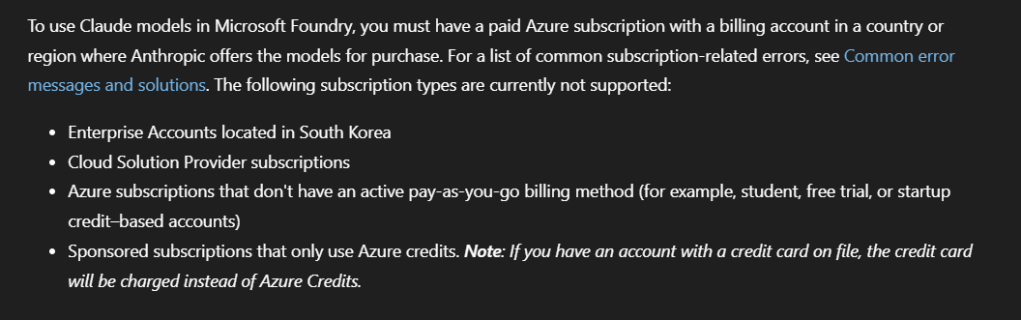
Now the honest caveat, and it’s worth a moment of your attention: to use Claude in Foundry you need a paid Azure subscription with a billing account in a supported country, and billing runs through Azure Marketplace (Claude Consumption Units). A few subscription types simply aren’t supported — CSP subscriptions, free trials, student or startup-credit accounts, and Enterprise Accounts in South Korea. And here’s the one that quietly trips people up: if you’re on a sponsored Azure subscription that runs on Azure credits, Claude usage won’t be billed against those credits — it goes straight to the credit card on file. So before you let your team loose on Claude in Foundry, check which subscription is behind it. ( You don’t want to discover that one on a statement!). This is sadly keeping me from personally experimenting with Claude models at Foundry, as I do not want those costs to my credit card.
Perhaps Microsoft Azure Claude subscription requirements haven’t been updated yet, but at the moment it looks like that Azure hosted Claude models follow above limits.
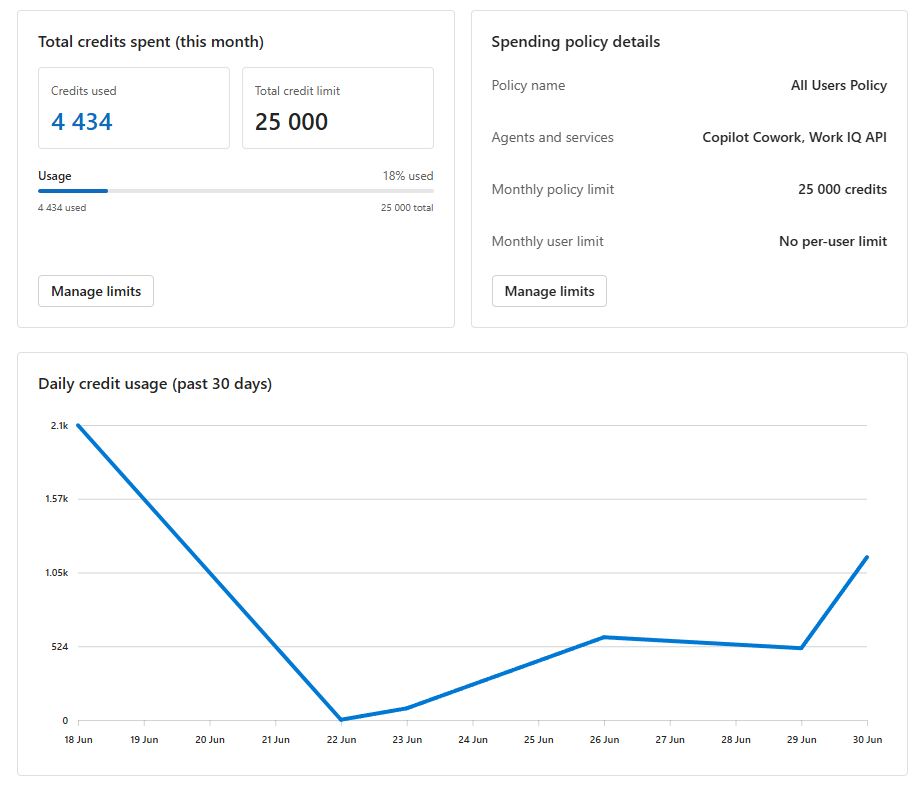
If you read my last post, New in Cowork – the UI refresh and the cost question everyone’s asking, you knew this day was coming. Well — it’s here. From tomorrow, Copilot Cowork usage is metered and consumes Copilot credits, and every bit of it is tracked. Make sure you have a spending policy, with budgets, in place by the end of today. The Microsoft 365 admin center now has a Cost Management Dashboard for exactly this, and there’s a new Viva Copilot usage and cost insights capability rolling out, enabled by default, that gives you visibility into credit usage across services like Cowork and the Work IQ API. Turn them on. Set your budgets. Today.
Here’s my take, and I want to be clear because I genuinely like Cowork: steer, don’t hit the handbrake. Cowork is very useful. The mistake would be to panic and switch it off — that’s leaving real value on the table.
But the mindset has to change. Playtime is over. Now you use Cowork for effect:
Reach for Cowork when the job spans several apps and needs multi-step instructions. That’s where it shines — pulling across your inbox, calendar, Teams and files and actually doing the work end to end.
Use the tools that are already included in your Copilot price for everything else. Copilot Chat, Create, Copilot inside the Microsoft 365 apps, and agents like Researcher and Analyst — plus your own custom agents — are part of the deal. Use each one to its strength.
Do the value math, out loud. At work the right question isn’t “did this cost me $10?” — it’s “did this $10 save me two hours?” If it did, it was absolutely worth it. Be mindful of cost every time you press go, and you’ll spend in the right places.
That’s the whole philosophy: be deliberate, not fearful.
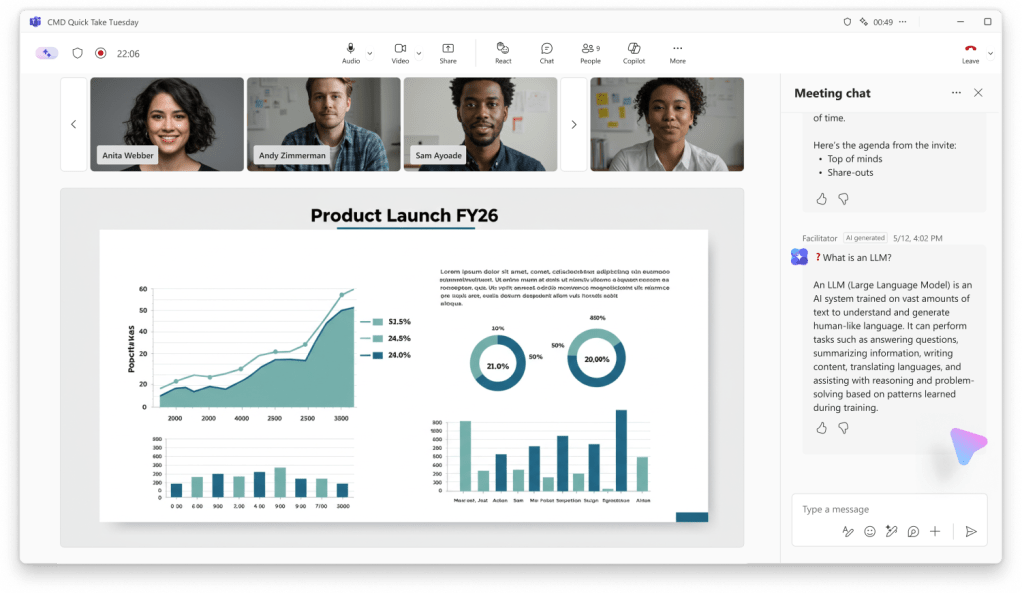
This one made me smile. Teams Facilitator can now proactively detect knowledge gaps in a meeting and answer them in the meeting chat using web search (MC1409304). So when there’s an implicit or explicit “wait, what’s the number for…?” moment, Facilitator can quietly drop the answer into chat — no one has to break their flow to go look it up.
Microsoft is careful to say it’s infrequent — typically less than once per meeting — so it’s a helpful nudge, not a chatterbox. It needs Microsoft 365 Copilot (Premium) and lights up where Facilitator is enabled. Targeted Release starts early July 2026, with GA rolling through August. I can already think of a dozen meetings where this would have saved a tangent. Smart — like, really smart.
Teams got a lot of love in June. A few ones:
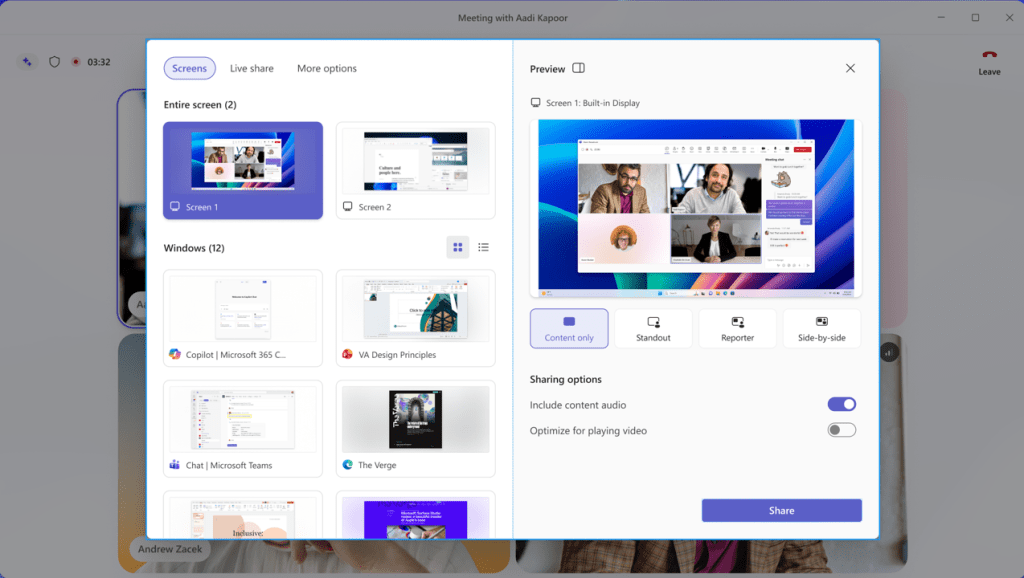
A refreshed in-meeting experience — simpler controls and a smarter share panel (MC1317197). The meeting controls get center-aligned with mic, camera and share grouped together, Leave is pulled away so you stop hitting it by accident ( hopefully never again!), and the share panel gets live previews of your screens and windows, a tabbed layout (Screens , Live share (interactive files), More options) and a two-step share confirmation to prevent those heart-stopping wrong-window shares. You can even pin and rearrange your controls. Enabled by default (can’t be turned off tenant-wide), with a temporary user opt-out during rollout. Windows, Mac and web; Targeted Release early July, GA Worldwide through late August 2026.
I have been able to try this new experience for some time, and it took a few moments to get used to but after that – I would not want to go back to the old version. I recommend to have courage and get started using with the new one once it comes, and go through the change. This is much more useful, compared to the old way. If you are looking for your PowerPoint and Excel files to share with Teams Live ( PowerPoint Live, Excel Live) look onto tab Live share ( in message center mentioned as Interactive files but image shows Live share).
Enhanced recap sharing (MC1289724, Roadmap 559606). Organizers can now grant access to the meeting recording, transcript, AI summary and notes right from the Share menu on a recap — and choose exactly who gets it — when sharing the recap link. Non-organizers can still pass the link along, and anyone who wasn’t in the meeting gets prompted to request access. This is the missing piece for sharing a recap with someone who couldn’t attend. Available by default; GA Worldwide completed through late June 2026.
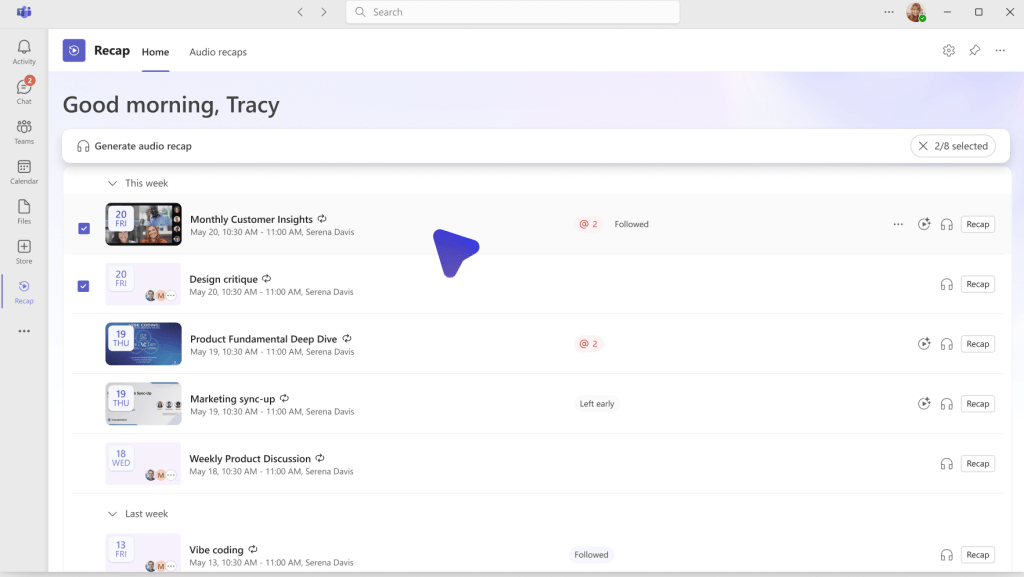
The new Recap app brings every recap into one place (MC1404322, Roadmap 564614). A first-party Teams core app that consolidates your recaps — recordings, transcripts and AI summaries — so you can catch up across meetings without digging through chat threads. Browse the last 30 days, filter by date, participants or keywords, watch a video recap or listen to an audio one — and here’s my favourite touch, generate a combined audio recap across several meetings, podcast-style, for the commute. It’s pre-installed but not pinned by default (you’ll find it in the app store on the left rail). The AI bits — audio recap, video recap, intelligent summaries — need a Microsoft 365 Copilot licence; without one you can still get to recordings and transcripts per your existing permissions. Enabled by default on Windows, Mac and web, mobile coming soon; rolling out across July 2026
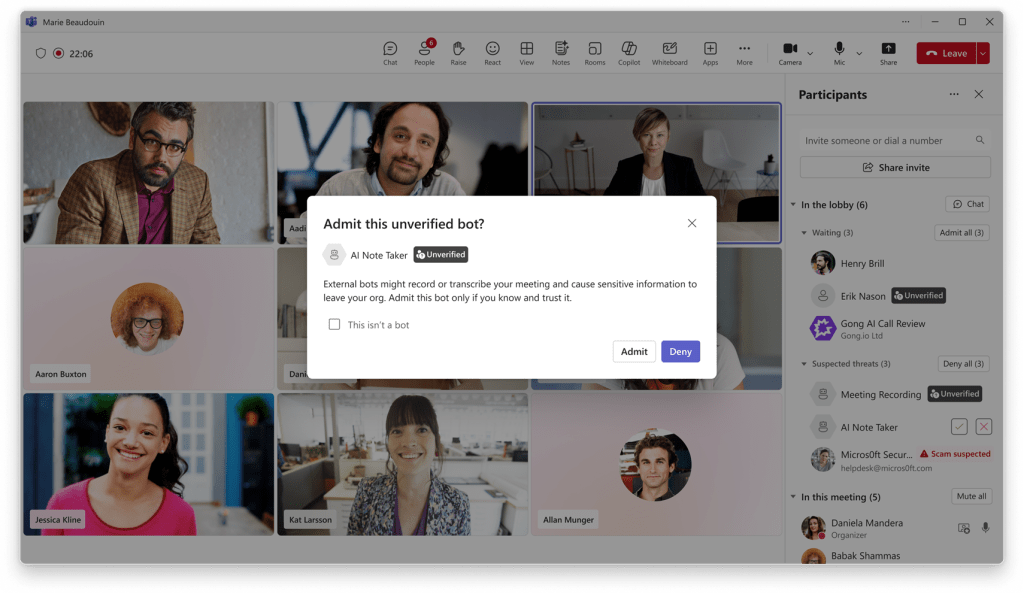
External meeting bots — first detect, then block (MC1251206, Roadmap 558107; plus Roadmap 566201). Teams now detects external meeting-assistant bots as they try to join and labels them clearly in the lobby, so organizers can approve, deny or remove them, and admins get a meeting policy (do not detect / require approval) in the Teams admin center. Detection is enabled by default; GA Worldwide rolling through mid-July 2026. Building on that, a separate update adds the one-switch option to automatically block all identified bots (Roadmap 566201, GA targeted August 2026). As uninvited note-takers become the norm, this combo is genuinely reassuring.
Automatic recording and transcription for Call Queues (MC1401299). Admins can switch on recording and/or transcription per queue (admin center or PowerShell), recordings land in SharePoint, and they’re reachable from the Queues app call history. Big for support and service desks.
Events: “Optimize for large audience” (MC1401303) — auto-enabled for events over 1,000 attendees, switching to the town hall experience (pause/rewind, attendee cameras/mics off, eCDN where applicable) — plus new sharing layouts for events (Roadmap 564613): Speaker focused, Content focused and Content only.
Teams Rooms keeps getting better: IntelliFrame people labels on Windows (Roadmap 566700), live transcription on Android Rooms (Roadmap 555234), user-selectable meeting language on Android up to 69 languages (Roadmap 565425), and proximity join for presenters in events (MC1319213).
So much landed here. The highlights:
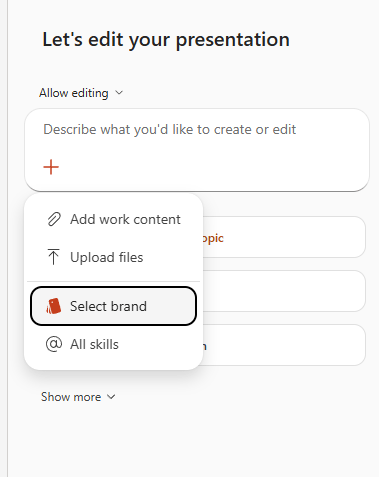
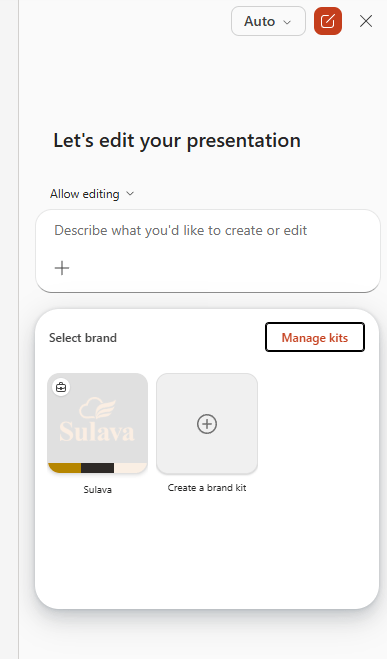
Brand assets in PowerPoint (MC1405505). Copilot now gives you native access to your brand kit — colours, logos, icons and approved images — through a dedicated brand pane, and Copilot in PowerPoint can build on-brand decks by pulling from it (MC1400828). Official kits roll out tenant-wide; if you don’t have one, you can make a personal kit. For anyone who’s spent their life re-applying corporate colours by hand, this is a gift. Targeted Release mid-to-late July, GA through early August.
Copilot Notebooks opened up — this is where it gets good. As of mid-June, Copilot Notebooks is no longer just for Microsoft 365 Copilot licensees — Copilot Chat users can now create and collaborate in Notebooks too (see What’s New in Notebooks | June 2026 on the Microsoft 365 Copilot Blog), broadly across the Microsoft 365 Copilot app and OneNote (you need a SharePoint or OneDrive service plan to create one). Full Copilot licence holders keep the premium sources, richer creation and higher reference limits; Chat users get standard access with lower limits. On top of that:
Outlook emails as a Notebook source (MC1392569, Roadmap 564910) — ground Copilot in the email threads where decisions actually happen, alongside your files. Up to 300 sources per notebook; Copilot Premium; GA Worldwide through late July 2026.
Multimodal capture in Copilot Notebooks on Windows (MC1405506, Roadmap 566322) — capture audio, images and notes in one go and let Copilot turn them into summaries, decisions and action items.
A Copilot Notebook in OneNote on Mac (MC1409042).
Notebooks is quietly becoming the place where a project starts — a project folder with an AI built into the lid. I really like that direction.
Curated prompts, published by your org (MC1396361, Roadmap 486695). Admins can now create, publish and pin organization-specific prompts straight from the Microsoft 365 admin center, so users land in Copilot Chat with high-value, on-brand starting points instead of a blank box — with built-in analytics to see what’s actually being used. One catch worth knowing: nothing appears to users until an admin publishes at least one prompt. GA Worldwide through late July 2026. This is a genuinely underrated adoption lever — pair it with the Learning Agent below.
A quick round of the rest worth knowing:
Copilot Vision (Roadmap 561037) — analyse what’s shared on your desktop screen, or point your phone camera at something during a voice session and ask about it.
Copilot Chat now reads embedded images in Word, PowerPoint and PDFs (Roadmap 560540).
Work IQ APIs now support remote MCP servers (Roadmap 559020) so agents can call external tools securely, and a refreshed, simplified design for the Microsoft 365 Copilot app (Roadmap 561488).
First, Planner agent in Microsoft 365 Copilot went generally available on June 15, 2026 (MC1323264, Roadmap 516576). It’s now preinstalled for everyone with a Microsoft 365 Copilot licence — just like Researcher and Analyst, there’s no pinning it to a pilot group anymore (admins can still block it tenant-wide). You create, update and manage personal tasks and shared basic plans without leaving Copilot, and the GA build added real polish, not just a date stamp: a new plan picker to search and filter your plans, a goals bucket to organise tasks around objectives, and — my favourite — everything the agent generates now lands in draft mode, so you review, edit and approve before anything is applied (this is the bit I always want from an agent). It even autoroutes to deeper reasoning for the hard stuff — like spinning up a whole plan from a Word, Excel or PowerPoint file — and it ties straight into Teams, Loop and SharePoint. You’ll want a Planner Plan 1 / Project Plan 3 or 5 licence on top of Copilot for the premium pieces.
Second, for Frontier tenants, Planner Agent chat now lives inside Planner itself (MC1387810, Roadmap 560532) — the same agent, embedded as a chat panel in basic plans on the web, so you can ask “show my top tasks for today” right where the work lives. Targeted Release from mid-June.
Third — and this one fixes a real everyday annoyance — you will be able to connect a Teams meeting to an existing Planner plan (MC1392571, Roadmap 561490). Today, meetings spin up a separate plan for their tasks, so the same initiative ends up scattered across a pile of little plans. Now you can point a meeting at an existing plan and keep everything in one place — and Facilitator will create its meeting tasks straight into that selected plan (or you do it by hand if Facilitator is off). Don’t pick a plan and it behaves as before, creating a fresh one. You’ll need Teams, Planner and Loop enabled. Targeted Release early July, GA Worldwide through late August 2026.
Bringing the agent — and now meeting tasks — to where the work already lives is exactly the right instinct: Facilitator surfaces answers during the meeting and now drops the resulting tasks into the right plan after it. 🎯
I’m genuinely happy about this one. The Learning Agent in Microsoft 365 Copilot is now GA, graduating out of the Frontier program. Think personalised, just-in-time upskilling in the flow of work: daily AI tips tuned to your role, task-based guidance, AI-powered role-play for practising those tricky workplace conversations, skill assessments, structured learning plans and bite-size microlearning — plus an AI Skills Navigator (in preview) that pulls Microsoft’s skilling content, sessions and credentials into one place.
Licensing in plain terms: you need a Microsoft 365 Copilot licence; a Viva Premium licence (Viva Learning standalone or Viva Suite) unlocks more than 1,000 learning objects, and a LinkedIn Learning Premium subscription is needed for the role-play coaching scenarios. It’s rolling out across Copilot on web and desktop, Teams, and the Office apps. ( One note for admins — in Agent 365 it still shows up under the Frontier name, so don’t go looking for “Learning” and panic when you can’t find it.)
This is exactly the kind of “learning meets you where you already work” experience I’ve been hoping for. Adoption lives and dies on skilling — and this puts skilling right in the tools people use all day.
A few items here are less shiny but more important, so don’t skim:
Updated Copilot service plan behaviour (MC1405498). The “Microsoft Copilot with Graph-grounded chat” service plan becomes the primary control for whether licensed users get Copilot (Premium), Copilot Chat (Basic) or Copilot (Basic), and Personal Content Mode no longer activates when the plan is disabled. GA late July to early August.
Purview DLP for external web search (Roadmap 565870). A new real-time control stops Copilot and agents from sending sensitive data into external web searches (GA July).
Edge enforces “Do Not Allow Screen Capture” for labeled PDFs in OneDrive and SharePoint (MC1409303), closing a gap where browser-rendered PDFs ignored that label (Targeted Release early-to-mid August, GA mid-to-late August, Edge first).
DLP user-based alert aggregation (MC1409307) and group support for Copilot release preferences (MC1409102) — small but handy for admins managing rollout and alert noise.
None of these are flashy, but each one can generate a helpdesk ticket — or prevent one. Read the Message Center posts.
I keep an eye on the model layer too, because it shapes everything we build on top of it — and June closed with a big one. On June 26, OpenAI previewed its next-generation GPT-5.6 family, and the interesting part is the structure: three permanent tiers instead of a single flagship. Sol is the top-end model for the heavy reasoning, agentic coding, science and cybersecurity work; Terra is the balanced everyday tier, aimed at strong quality at a lower cost; and Luna is the fast, low-cost option for high-volume jobs. From here on the version number marks the generation and the name marks the capability tier — a clean way to think about picking a model for the task in front of you.
Worth setting expectations: GPT-5.6 is still an early preview, and it isn’t available in Microsoft 365 Copilot or in Microsoft Foundry yet — so for now it’s one to understand, not one you can wire into your Microsoft stack. Still, that intelligence / speed / cost split is the same decision you already make every day inside Microsoft 365 — “Sol or Terra or Luna” is just “which model for which task,” the very habit I keep nudging people toward with Copilot, Cowork and the agents. And one habit for the week: whenever a new model lands in your tenant, re-run your three most-used Copilot prompts and note what changed. Make re-baselining a reflex, not a project.
What a month. Claude GA in Foundry, a proactive Facilitator, Notebooks for everyone, Planner and Learning Agents maturing — and a real cost conversation arriving with Cowork credits tomorrow. The tools are getting more capable and more accountable at the same time, and honestly that’s the healthy direction. Use the included Copilot tools generously, use Cowork deliberately, set your budgets, and keep steering.
Have you already tried any of features that rolled out already? I’d love to hear what’s working for you — drop a comment. And as always, thank you for reading and sharing this journey with me. Hat on, mind open! 🎩
When I was digging into the physics behind the massive atomic explosions we see in universes like Dune, I stumbled upon a terrifying reality. I always assumed that the mechanics behind Earth’s ultimate weapon would be an incomprehensible web of quantum mechanics and hyper-advanced engineering. But the truth? The core mechanics are shockingly simple. The real bottleneck isn’t the blueprint. It is the fuel.
It takes billions of dollars, massive, sprawling centrifuge facilities, and decades of relentless engineering just to purify a mere 8 kilograms of a stable core. Honestly, researching this felt exactly like watching the Empire hunt down the rarest Kyber crystals in Star Wars. Today, I wanted to break down this “forbidden physics” for you. We often fear the complex, but sometimes, it is the simplest equations that are the deadliest.
Let’s strip away the top-secret classifications and look at the raw, fascinating science behind the ultimate power.
The Illusion of Complexity
When we watch a sci-fi epic, we are conditioned to believe that world-ending weapons require magical technology. Think about the Death Star or the family atomics hoarded by the Great Houses in Frank Herbert’s Dune. They are presented as mythological artifacts of supreme complexity.
But when I looked at the actual physics of nuclear fission, I realized something chilling. The basic concept is no more complicated than throwing a match into a pool of gasoline.
Here is how straightforward it actually is:
The Gun Method: You take one piece of subcritical uranium, and you literally shoot it down a metal tube into another piece of subcritical uranium. When they smash together, they form a supercritical mass. Boom.The Implosion Method: You take a sphere of plutonium and wrap it in conventional explosives. You detonate the outside, squeezing the core inward until the pressure triggers the chain reaction.
That is it. There is no dark magic. There is no hyper-drive engineering. The mathematics behind this were figured out using slide rules and chalkboards nearly a century ago. The simplest equations governing the universe’s energy—like the relationship between mass and energy—are the very things that allow us to unbind the atom.
The Real Bottleneck: Earth’s Kyber Crystals
If the mechanics are so simple, you might be asking: Why isn’t everyone building these things in their garages?
This is the part that completely blew my mind. The universe has a built-in safety mechanism, and it all comes down to the isotope. When you dig Uranium out of the ground, 99.3% of it is U-238, which is completely useless for a chain reaction. The stuff you actually need, U-235, makes up less than 1% of the ore.
Separating them is nearly impossible because they are chemically identical. They react the same way to everything. The only difference? U-235 is imperceptibly lighter.
To get that precious 8 kilograms of weapons-grade material, humanity had to build absolute behemoths of industry.
Gas Centrifuges: You have to turn the metal into a highly toxic gas, spin it in giant metal tubes at supersonic speeds, and slowly siphon off the lighter gas.The Scale: You don’t just do this once. You do it thousands of times, passing the gas through endless cascades of centrifuges, consuming the electricity of an entire city just to yield a handful of usable material.
When I realized the sheer scale of this operation, the Star Wars connection clicked in my head. The Empire didn’t just build the Death Star; they had to strip-mine entire planets like Jedha and Ilum to find enough Kyber crystals to power the superlaser. In reality, our Kyber crystals are U-235 and Plutonium-239. The true barrier to ultimate destruction isn’t knowledge; it is extreme, uncompromising industrial economics.
Why the Simplest Equations are the Deadliest
There is a profound philosophical weight to this realization. We spend so much time worrying about artificial intelligence, rogue nanobots, and complex biological engineering. Yet, the absolute peak of destructive capability currently sitting in our silos relies on basic physics.
It makes you realize that the universe doesn’t hide its most dangerous secrets behind impossible math. It hides them behind brute-force effort.
When you read Dune, the Great Convention strictly outlaws the use of atomics against human targets. They don’t outlaw the knowledge of them, because the knowledge is fundamental to how the universe operates. They outlaw the application. They understood that you can’t un-know the simple physics of a chain reaction. You can only control the terrifying balance of power it creates.
The Terrifying Balance
Digging into this left me with a strange sense of awe and a heavy dose of existential dread. We live in a world where the power to glass a continent isn’t locked away in some impenetrable vault of futuristic science; it is fundamentally baked into the dirt beneath our feet, waiting for anyone with enough money and centrifuges to dig it up.
It forces us to rely on something incredibly fragile: human restraint. Deterrence theory—the idea that we won’t destroy each other simply because we can destroy each other—is the only thing keeping those simple equations from erasing us.
I’ve been thinking about this non-stop, and I want to turn the question over to you.
If you had the power to rewrite the fundamental laws of physics, would you erase this possibility entirely, making nuclear fission impossible? Or do we actually need this terrifying balance to keep ourselves from engaging in endless conventional wars?
Let me know your side in the comments. Let’s discuss it. Because remember, the future is not just fiction, it is being coded right here.
Days of Our Lives 2-Week Spoilers for June 29-July 10, 2026 stun with Xander Cook Kiriakis (Paul Telfer) and Philip Kiriakis (John-Paul Lavoisier) panicking over their bizarre good fortune with the loan payoff.
But it may turn out to be less of a gift and more of a curse. Plus, the DiMeras rush to cover up a past disaster, but may cause another one trying to clean up the sins of their past.
Days of Our Lives: Bonds and Secrets – June 29th Through July 3rd
Monday, June 29th on Days, we’ve got Gwen Rizczech (Emily O’Brien) and Kristen DiMera (Stacy Haiduk) bonding over hating EJ DiMera (Dan Feuerriegel), their mutual common enemy. They have different reasons for hating him, but they can agree they hate him. Plus, EJ shares a secret with Johnny DiMera (Carson Boatman) that is quite upsetting.
I’m wondering if EJ is going to be totally transparent about the arsenic-tainted pills and them getting buried on an island, or if he’s going to tell a partial version. Bottom line, it’s the worst day for Johnny to have to deal with this because Chanel Dupree (Raven Bowen) is having her first round of chemotherapy.
Xander and Philip look into who paid off Titan’s loan. They may wonder if it was Gabi Hernandez (Cherie Jimenez), but she hasn’t gotten her inheritance from Stefan DiMera (Brandon Barash) share of the estate yet. So, will they figure out who is their fairy godmother or fairy godfather? We don’t know exactly who paid it off yet.
Lexie Carver (Nikki Crawford) comforts Abe Carver (James Reynolds) and he may be upset that Chanel’s starting her breast cancer treatment and he isn’t part of that family dynamic right now.
DOOL Spoilers: New Javi & Brady on a Mission
Tuesday, June 30th on Days of Our Lives, we’ve got new Javi Hernandez debuting with Jacob Martinez in the recast role, replacing Al Calderon. Leo Stark (Greg Rikaart) and new Javi agree to just stay out of each other’s paths. Also, Leo’s up at the hospital this week getting checked out by Sarah Horton (Linsey Godfrey).
Brady Black (Eric Martsolf) and Sarah also talk with Holly Jonas (Ashley Puzemis) in her hospital room and Stephanie Johnson (Abigail Klein) drops by to check on Holly and bring her some flowers. And then Brady’s off on a mission for Sarah. So, we’re going to see Brady out at the Horton cabin this week.
He’s getting a sample of water from the tap, but somebody’s watching from outside the cabin in the bushes. It’s an older silver-haired guy, and I wonder if it is the former head of DiMera Enterprises Pharmaceuticals, the person who buried the arsenic-tainted pills out on the island.
Days Spoilers: Roman Helps Ari & Tate is There for Holly
Arianna Hernandez (Vico Escorcia) gets help from great-grandpa Roman Brady (Josh Taylor), and Ari may vent about her Gabi issues and that her mom paid Liam Selejko (Hank Northrop) to dump her and leave town. Roman may offer Ari a room above the pub. Tate Black (Leo Howard) does his best to cheer up Holly. Hopefully Sarah will figure out his arsenic poisoning soon and not just the opioids.
Chad DiMera (Connor Floyd) and Julie Williams (Susan Seaforth Hayes) have a little chitchat. He brings the kids up to the bookshop and Chad may tell Julie that he and Belle Black (Martha Madison) are getting much closer.
Days of our Lives Spoilers: Lexie is Worried
Wednesday, July 1st on Days of Our Lives, Lexie keeps something from Abe and it may be more of Lexie’s neurological symptoms that are returning and it looks like things are actually getting worse soon. Gus questions Javi. They are chatting at the Hernandez house. Gabi is there too and has a hug for her primo Javi. Leo gets some caretaking from Gwen and this may be about what sent Leo to the hospital this week.
Philip and his brother Xander are totally shocked and they may figure out who paid off their loan. There is a scene in the summer promo where they’re panicking because DiMera money paid off the loan and they could be in big trouble. Plus, Kate Roberts (Lauren Koslow) catches Gabi off guard. Kate and Gabi run into each other outside the pub. Looks like Kate has a suitcase in her hand. So, I wonder if she is coming or going. We also have Roman and Kate facing off at the pub this week. They’re already sleeping in separate bedrooms because she plotted to ruin Johnny with that lawsuit.
DOOL Spoilers: Joy Distracts Alex
Thursday, July 2nd on Days of Our Lives, we’re going to see Joy Wesley (AlexAnn Hopkins) trying to distract Alex Kiriakis (Robert Scott Wilson) there at the pub. And Joy’s wearing a really low-cut top, showing lots of cleavage and a lot of midriff on display. I’m not sure if her outfit is the distraction or if Joy is hiding Alex’s phone or something like that.
Kayla Johnson (Mary Beth Evans) listens to Stephanie ranting and I’m sure it’s about Joy. And Sarah opens up to Brady this week. Sarah tells him that she really wants to reassure Holly that everything’s going to be fine, but Sarah says she does not make promises to patients she doesn’t know that she can keep.
EJ finds out something is amiss on the island. So, he may hear from the guy watching it that Brady was sampling the water and EJ may also find out Holly got sick out there. So, it looks like the buried pills are not contained and are leeching into the groundwater and maybe into the wells. Tate and Holly do some reminiscing.
Days of our Lives Spoilers: Sparks Fly for Jada & Shawn
Then Friday, July 3rd on Days of Our Lives, it is Fourth of July in Salem, and Shawn Brady (Brandon Beemer) and Jada Hunter (Elia Cantu) give into their attraction. But first, they have a nice dinner. They’re at the bistro. And then Shawn and Jada make love as fireworks go off outside, too. Plus, Belle and Chad share a romantic moment during the fireworks. Looks like another kiss.
But before they check out the fireworks, Belle and Chad run into Shawn and Jada at the bistro. And for some reason, Belle is snapping a photo of Shawn. Plus, the Carvers and the Prices get together for a first birthday party. It’ll be awkward either way, but more awkward if Lexie is also at the party. Abe is cuddling Lexie under the fireworks. She wishes Abe a happy Fourth, but then Lexie looks upset when Abe says he’s looking forward to many more July Fourths with her.
Days Spoilers: Johnny Snoops for EJ
EJ asked Johnny for help and Johnny’s telling EJ he doesn’t want to be involved in any of this. But as CEO of DiMera Enterprises, he does have to think about the company’s reputation. We know that Johnny winds up sneaking into Sarah’s office at the hospital and it looks like Johnny is poking around for his dad looking for something.
Also, Marlena Evans (Deidre Hall) tells Belle she’s concerned Marlena may not like Belle getting drawn into the mystery of the chess set that Stefano DiMera (Joseph Mascolo) left her and John.
Days of Our Lives Spoilers: Xander Cook Kiriakis – Philip Kiriakis
Days of Our Lives: Conspiracies and Consequences – July 6th Through 10th
Then the week of July 6th through the 10th on Days of Our Lives, we’ll find out who paid off Titan’s loan. Since it was DiMera money that narrows the suspects, even if Gabi got her inheritance, the money would come from her account. I’m leaning towards Kristen paying off Titan’s loan, basically as a middle finger to EJ for him visiting Rachel Black (Lorelei Olivia Mote) at Bayview without her permission.
Kristen is going to be snatched soon. We’ll see if EJ abducts her in revenge and kills her or locks her in the crypt, buries her alive, or drops her off on a remote island. If you want to see Stacy Haiduk after her kidnapping, she is currently appearing on Young and the Restless. And Lauren Koslow is doing a guest spot for five episodes over there as well. She’s going to be playing Jill Abbott on Y&R. She’s replacing actress Jess Walton, who couldn’t film for some reason.
DOOL Spoilers: Public Health Crisis Coming
Aaron Greene (Louis Tomeo) may be there to comfort Ari. We know that Aaron’s really into her, but Ari has Aaron firmly in the friend zone as of now. Cat Greene (AnnaLynne McCord) may make another honeypot move on EJ during the fireworks celebration. Steve soon tells Johnny that if the tainted drugs are out there, it could turn into a public health crisis. EJ may come see Holly to discuss Amy Choi (Shi Ne Nielson) lawsuit. And I’m sure EJ will do all he can to shut Amy down, especially with Holly so sick.
And EJ is probably going to feel guilty about that as well. Test results for the Horton cabin water should show elevated levels of arsenic unless Johnny steals the sample for EJ, but that really wouldn’t help because Brady could just go out and get another sample. Belle and Chad keep following the chess set clues and Stefan DiMera is back to Salem pretty soon and cutting some kind of sketchy deal.