Home Blog Page 88

DeFi hacks are turning high yields into a hidden liquidity tax

0
DeFi hacks are turning high yields into a hidden liquidity tax


DeFi’s latest exploit chatter is pointing traders toward a cost that does not appear in pool APYs: the price of staying connected while bridges, keys, frontends, oracles, and contract logic remain active failure points.

For users and liquidity providers, the question now extends beyond yield. They have to decide how much additional return is needed, even though the route itself can add technical, operational, and governance exposure.

The Q2 dataset behind DeFiLlama’s hacks tracker shows 88 hack entries with known dollar amounts, totaling $780.3 million in losses through June 30.

April carried the largest hit, at $644.8 million, while May and June still added $135.4 million across dozens of entries. The quarter, therefore, looked less like a single blast crater and more like a stress test that kept running even after the headline shock faded.

On June 30, amount-bearing hack entries totaled $16.65 billion. Rows tagged as DeFi Protocol targets accounted for $7.85 billion, while rows flagged as bridge hacks accounted for $3.26 billion.

In Q2 alone, DeFi Protocol target rows accounted for $735.8 million of the $780.3 million total loss, and bridgeHack-flagged rows accounted for $353.4 million.

The dataset needs careful handling. DeFiLlama’s bridge flag can overlap with protocol targets, and some entries have incomplete dollar data.

Even with that caveat, the message is clear: exploit risk is sitting across the routes, permissions, interfaces, and verification systems that make DeFi usable.
DeFi’s old hack vectors are fading – But the new risk can hit six chains at once
Related Reading

DeFi’s old hack vectors are fading – But the new risk can hit six chains at once

The good news is that bridge hacks and flash-loan attacks are fading; the bad news is that protocol logic bugs are becoming much harder to contain.

Jun 7, 2026 · Andjela Radmilac

The quarter turned security into a price input

Q2 split damage and frequency across distinct risk surfaces. Infrastructure-classified entries accounted for most of the known dollar losses, while protocol-logic entries accounted for most of the incident count.

Q2 2026 DeFiLlama viewAmount-bearing dataTotal Q2 incidents88 entries with known dollar amountsTotal Q2 losses$780.3 millionDeFi Protocol target rows61 rows, $735.8 millionBridgeHack-flagged rows19 rows, $353.4 millionInfrastructure classification15 numeric-loss rows, $651.4 millionProtocol Logic classification73 numeric-loss rows, $128.8 millionMonthly lossesApril $644.8 million, May $60.5 million, June $74.9 million
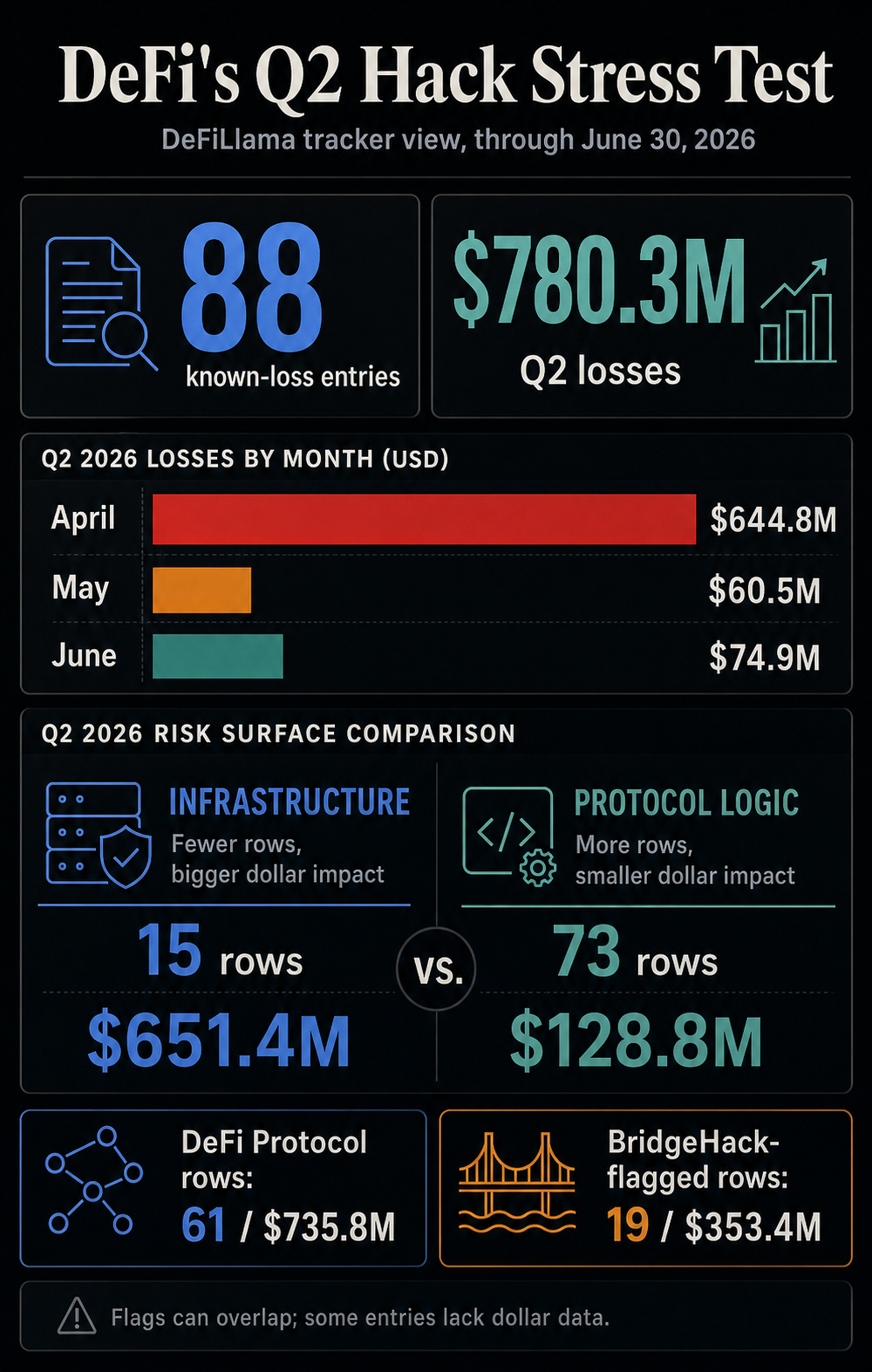
Infographic showing Q2 2026 DeFiLlama hack tracker data: 88 known-loss entries, $780.3 million in losses, and a risk-surface split between infrastructure and protocol logic.Infographic showing Q2 2026 DeFiLlama hack tracker data: 88 known-loss entries, $780.3 million in losses, and a risk-surface split between infrastructure and protocol logic.

The distinction changes how risk gets priced. A protocol-logic bug can be treated as a code-quality problem within a single application.

Infrastructure losses are different. They touch bridges, signing systems, cross-chain messaging, admin permissions, hot wallets and other shared surfaces that capital uses to move between venues.

When that layer is under stress, DeFi’s usual yield math starts to look incomplete. A pool can offer a higher return, but users still have to ask whether the route to that return depends on a bridge, oracle, frontend, signer set, or administrative path they cannot evaluate in real time.

A market maker can keep liquidity available across chains only when the spread compensates for the operational risk of moving assets through those rails.

That is the shift from a postmortem market to a live risk-premium market. Participants are repricing the cost of being connected.

The fee is no longer only gas, slippage, or borrowing costs; it also includes the risk that a permission, route, or proof layer fails while capital is in motion.

That repricing can happen quietly. A venue may maintain its advertised annual percentage yield, while the effective return declines as users demand faster exits, insurance, or compensation for bridge exposure.

The market can express that view through thinner liquidity, wider spreads, and more expensive incentives long before a formal security score appears.

Routing trust becomes part of the trade

Bridge exposure is where the stress test becomes easiest to see. Q2’s bridgeHack-flagged rows totaled $353.4 million, enough to make cross-chain routing more than a convenience question.

If capital has to cross a bridge or messaging layer to reach an opportunity, the route itself becomes part of the trade.

Recent cross-chain incidents have already shown how quickly that can affect behavior. The fallout from the KelpDAO and LayerZero exploits showed how a single exploit can push projects to rethink their security infrastructure.

A THORChain halt following an exploit revealed the other side of the same problem: when routing trust breaks down, systems can stop first and ask questions later.

Kraken moves Bitcoin to Chainlink as bridge fears spread across DeFiKraken moves Bitcoin to Chainlink as bridge fears spread across DeFi
Related Reading

Kraken moves Bitcoin to Chainlink as bridge fears spread across DeFi

Kraken is rebuilding how Bitcoin moves through DeFi after the KelpDAO shock.

May 15, 2026 · Liam ‘Akiba’ Wright

For users, liquidity may move toward venues where the route is easier to understand, where bridge exposure is lower, or where there is enough depth to avoid fragile paths.

For aggregators and market makers, routing logic may increasingly need to include security assumptions alongside price, depth and gas.

That could leave some bridges and cross-chain venues with a higher cost of capital even when they continue to function. Liquidity can still move through them, but it may demand a wider spread, more explicit insurance, stronger proof systems, or shorter exposure windows.

In DeFi, that is what a risk premium looks like before it becomes a line item.

The same logic can affect launch strategy. A protocol preparing a new market may decide that speed is less valuable than a second review of bridge dependencies, admin permissions, or oracle paths.

A liquidity provider may favor fewer chains if each additional route adds a new security assumption. Those decisions are small individually, but together they determine where depth forms and which venues become expensive to use.

Insurance sits inside that same loop. If underwriters and users start treating bridge exposure as a recurring operating risk, coverage becomes another signal about which venues can attract liquidity at scale.

Protocols that cannot explain their assumptions may still operate, but they could pay for that opacity through lower depth or more expensive incentives.

Security spending becomes a distribution cost

The market response also changes inside protocols. Security spending has often been framed as defense: audits, bug bounties, monitoring, incident response, and emergency controls.

A quarter like this makes it part of distribution. If users can tell why one venue is safer than another, security becomes part of how capital chooses where to sit.

CryptoSlate Daily Brief

Daily signals, zero noise.

Market-moving headlines and context delivered every morning in one tight read.

5-minute digest 100k+ readers

Free. No spam. Unsubscribe any time.

Whoops, looks like there was a problem. Please try again.

You’re subscribed. Welcome aboard.

Concentration is one reason the issue extends beyond code quality. A TRM Labs analysis described 2026 crypto theft value as concentrated in a small number of large events.

CertiK’s 2026 stablecoin threat work highlights wallet, bridge, custody and payment-infrastructure exposure.

Chainalysis has emphasized threat mechanics such as private-key and signing infrastructure, social engineering, and the speed with which stolen funds can move through laundering channels.

Those firms measure different universes, and Chainalysis’ hard theft totals in the cited post are based on 2025 data. The common thread is still useful: DeFi risk extends beyond bad Solidity.

It includes who can sign, where users connect, how cross-chain verification works, how quickly stolen assets can be swapped, and whether a protocol can detect abnormal behavior before an attacker finishes the route.

The next big DeFi exploit will start before the code is deployedThe next big DeFi exploit will start before the code is deployed
Related Reading

The next big DeFi exploit will start before the code is deployed

A new malware campaign targeting crypto developers shows how attackers can move upstream, stealing GitHub tokens, SSH keys, cloud credentials, wallets, and environment variables before a protocol ever ships vulnerable code.

May 26, 2026 · Gino Matos

That pushes protocols toward spending that looks less optional. Larger bug bounties, real-time monitoring, insurance cover, withdrawal throttles, admin-key controls, proof-system review, frontend hardening and clearer incident communications become part of the trust product.

They also become easier to justify to tokenholders if the alternative is higher liquidity costs after every visible exploit.

The shift in user behavior is the harder consequence. DeFi users have long accepted that smart-contract risk is part of the yield stack, but persistent pressure from exploits changes how that risk is felt.

A single hack can be dismissed as a bad venue. A quarter of recurring incidents makes the whole route feel expensive.

Products that abstract complexity sit directly in that tension. Automated yield strategies, routers, and frontends can make DeFi easier to use, while also hiding the path capital takes.

CryptoSlate has already covered how automated yield products can concentrate retail risk. Under a quarter-long stress test, users may demand more visibility into where funds are routed, what bridge assumptions are involved, what insurance exists, and what happens if a connected service fails.

There is also an outside pressure point. Crypto crime and scam concerns have been pushing the industry toward more self-policing, as shown by Treasury-warning coverage.

The DeFi exploit problem lands in the same market environment: users, venues and policymakers are all asking whether crypto systems can reduce losses without giving up the speed and openness that made them useful.

For DeFi, that is a difficult balance. Add too much friction, and capital routes elsewhere. Add too little, and the risk premium rises after every incident.

The protocols that win the next phase are likely to be those that can demonstrate where the hidden risks lie and what has been done to contain them.

June’s DeFiLlama rows remain an active threat. The month included front-end vulnerabilities, predictable private-key exploits, fake-proof bridges, unbacked mints, reverse MEV, oracle manipulations, and logic or accounting-flaw entries.

No single label explains all of them.

The next signal is whether capital starts moving before the next postmortem. Watch whether bridge liquidity gets more concentrated in venues perceived as safer, whether protocols delay launches for additional review, whether insurance pricing rises, whether bug bounty budgets grow, and whether aggregators make security assumptions more visible in routing decisions.

If those changes accelerate, Q2 will look less like a bad quarter and more like a repricing event.

DeFi’s hack problem would still be a security problem, but it would also become a market-structure problem: a recurring tax on movement, yield, and trust across the systems that make onchain finance work.


Source link

What Is Re (RE)? Binance’s New Reinsurance Token Listing Explained

0
What Is Re (RE)? Binance’s New Reinsurance Token Listing Explained


Binance listed Re Protocol (RE) on Spot at 14:00 UTC on June 18, 2026, bringing the Re Protocol governance token into trading as the real-world assets sector expands into more specialized financial markets. Re is a project building an on-chain capital layer for reinsurance, a market Binance estimates is worth approximately $1 trillion. This listing provides RE with access to broader liquidity while bringing Re’s on-chain reinsurance model closer to the mass crypto investor base.

What Is Re?

Re Protocol is an on-chain reinsurance platform. If insurance is how individuals or businesses transfer risk to an insurance company, then reinsurance is how insurance companies transfer a portion of that risk to another party to reduce capital pressure during major claims.

In traditional markets, reinsurance is typically the playground of large institutions, insurers, reinsurers, and specialized funds. Re wants to bring a portion of this capital layer onto the blockchain, turning reinsurance into a real-world asset class accessible via on-chain infrastructure.

Notably, Re does not talk about RWA in a broad sense. The project’s focus is on a specific niche: reinsurance. This is a sector with real cash flows and clear capital demands, but it also requires much stricter risk management, data, and legal frameworks than standard DeFi products.

How The Re Protocol Works

According to Re’s documentation, the protocol operates through Insurance Capital Layers (ICLs). An ICL can be understood as capital-holding vaults for users, usually in the form of stablecoins like USDC, DAI, USDe, or sUSDe, which then allocate that capital into pre-structured reinsurance contracts.

Each ICL features its own on-chain smart contract and a dedicated Fireblocks storage vault. Idle stablecoins are moved into the vault on a 24-hour cycle. When drawdowns or repayments occur, the changes are recorded on-chain; the off-chain balance portion is verified daily by The Network Firm and pushed to a Chainlink oracle. Instead of turning the entire reinsurance industry into a single smart contract, Re combines on-chain data with traditional finance components such as trust accounts, licensed insurance partners, and KYC/KYB processes.

Alongside RE, Re features product tokens like reUSD and reUSDe, which are tied to different capital layers within the protocol. reUSD belongs to the Basis-Plus category, targeting lower yields and a lighter risk profile. reUSDe belongs to the Insurance Alpha/Alpha ICL, aiming for higher underwriting yields but coming with a higher level of risk. In short, RE is the governance token; reUSD and reUSDe are product tokens.

RE Token and Governance

Re stated that the project opened governance to the public on June 18, 2026, coinciding with the time RE began wider distribution. The project also describes itself as an on-chain reinsurance marketplace with nearly $600 million in TVL.

The role of RE lies in bringing the community into the protocol’s governance process. For a project related to reinsurance, governance does not just revolve around liquidity incentives or trading activities, but is also tied to how Re expands its capital layers, manages underwriting risks, and maintains transparency when connecting on-chain capital with real-world contracts.

Why Binance’s Listing Matters

Binance listed RE on Spot on June 18, 2026, helping Re’s token reach a wider user base following the project’s public governance phase. For an on-chain reinsurance protocol, appearing on Binance not only adds liquidity but also brings a highly specialized financial sector closer to mass crypto investors.

The timing of the listing also brings more attention to RE. The token went live just as Re was ramping up its governance narrative, while the RWA sector is expanding beyond familiar products like tokenized treasury bonds or private credit. Re’s case shows that RWA is starting to enter more complex capital layers, including insurance and reinsurance.

On Binance, RE carries a Seed Tag, but the focus of this article is not on post-listing volatility. The more noteworthy point is that a major exchange is bringing the on-chain reinsurance model into the vision of the broader market.

What Sets Re Apart in RWA

Many current RWA projects focus on familiar assets like treasury bonds, private credit, real estate, or money market funds. Re chooses a different niche: reinsurance. This is not an asset class familiar to retail investors, but it is a vital infrastructure layer of the global insurance industry.

What sets Re apart is that the project doesn’t just wrap an existing asset into a token. Re builds a capital layer with its own allocation, verification, reporting, and oracle mechanisms, allowing on-chain users to access yields tied to real insurance risks. What remains to be watched is whether the nearly $600 million TVL is sustainable, where the yield originates, and how governance via RE will influence the protocol’s direction. For Re, the big question is not just how RE trades post-Binance, but whether on-chain reinsurance can become a sufficiently transparent and sustainable RWA sector.


Source link

Tom Lee’s BitMine Adds $43 Million in Ethereum as Strategy Pauses Bitcoin Purchases – NFT Plazas

    0
    Tom Lee’s BitMine Adds  Million in Ethereum as Strategy Pauses Bitcoin Purchases – NFT Plazas


    BitMine has continued its aggressive Ethereum accumulation strategy despite a weakening crypto market, purchasing another $43 million worth of ETH while Bitcoin treasury giant Strategy temporarily paused its regular Bitcoin buying program.

    The latest purchase highlights the contrasting approaches emerging among publicly traded crypto treasury companies. While some firms are becoming more cautious amid prolonged market weakness, BitMine is doubling down on Ethereum under the leadership of Chairman Tom Lee.

    According to the company’s latest treasury update, BitMine acquired 27,084 ETH over the past week for approximately $43 million, increasing its total holdings to more than 5.7 million ETH. At current market prices, the company’s Ethereum treasury is worth roughly $9 billion, making BitMine the world’s largest publicly disclosed corporate holder of Ethereum.

    In addition to its ETH position, the company holds 206 Bitcoin, about $555 million in cash and marketable securities, and several strategic equity investments, bringing its total crypto, cash, and investment holdings to approximately $9.8 billion.

    Tom Lee's BitMine Adds $43 Million in Ethereum

    Tom Lee’s BitMine Adds $43 Million in Ethereum

    BitMine Buys Through the Downturn

    The purchase comes during one of Ethereum’s weakest stretches this year. ETH has fallen roughly 22% over the past month, recently trading near $1,570, leaving the cryptocurrency nearly 68% below its all-time high.

    Despite the decline, Lee believes the recent weakness is largely driven by temporary market conditions rather than changes in Ethereum’s long-term outlook. Lee argued that many institutional investors are engaging in quarter-end “window dressing,” a process in which fund managers trim exposure to underperforming assets before reporting periods end.

    “We are nearing quarter-end for June, and it is not surprising to see ‘window dressing’ leading to investors reducing their holdings in assets which have fallen in the past three months,” he added.

    Although the latest purchase is smaller than several acquisitions earlier this year, it extends BitMine’s steady accumulation strategy while many crypto treasury firms have slowed new buying during the market correction.

    Ethereum (ETH) 1M Price Performance (Source: CoinMarketCap)Ethereum (ETH) 1M Price Performance (Source: CoinMarketCap)

    Ethereum (ETH) 1M Price Performance (Source: CoinMarketCap)

    Closing In on a Major Milestone

    BitMine’s long-term objective is to accumulate approximately 5% of Ethereum’s circulating supply by the end of 2026.

    Following the latest purchase, the company now controls roughly 4.7% of all circulating ETH, putting it within reach of that goal. Earlier this month, BitMine acquired nearly 127,000 ETH in a single transaction worth approximately $214 million, making last week’s purchase its smallest weekly acquisition since early May.

    The company has also transformed its business model over the past year. Originally a Bitcoin mining company, BitMine has repositioned itself as an Ethereum-focused treasury firm under Lee, co-founder of Fundstrat and one of Wall Street’s most prominent crypto advocates.

    To support continued purchases, BitMine combines several funding sources. Its existing ETH holdings generate staking rewards that produce additional yield, while the company has also proposed issuing preferred shares with a 9.5% dividend to raise additional capital for future acquisitions.

    Ethereum’s Long-Term Case

    Lee remains optimistic despite the recent correction, pointing to several developments that continue to strengthen Ethereum’s investment thesis.

    One is the launch of Ethlabs, a nonprofit research and development organization dedicated to supporting Ethereum’s long-term growth. BitMine is one of the initiative’s financial backers alongside fellow Ethereum treasury company SharpLink Gaming.

    Lee also cited the Bank of England’s increasingly constructive stance toward stablecoins as another positive signal for blockchain-based financial infrastructure.

    Looking ahead, he believes Ethereum is well positioned to benefit from the continued growth of tokenized real-world assets, institutional adoption of blockchain settlement networks, and AI-powered payment systems built on crypto rails.

    Strategy Shifts Focus to Liquidity

    BitMine’s continued accumulation stands in contrast to Strategy, the world’s largest corporate Bitcoin holder.

    After purchasing Bitcoin on an almost weekly basis for several years, Strategy did not add to its BTC holdings during the latest reporting period. Instead, the company announced plans that could allow it to sell up to $1.25 billion worth of Bitcoin under its newly introduced Digital Credit Capital Framework, with proceeds intended to strengthen cash reserves and support dividend payments tied to its preferred stock offerings.

    The move follows increased investor scrutiny surrounding Strategy’s financing model and marks one of the few recent periods in which the company has paused its aggressive Bitcoin accumulation.

    The differing approaches illustrate how corporate crypto treasury strategies are evolving. While Strategy emphasizes balance-sheet flexibility during a volatile market, BitMine continues to treat price weakness as an opportunity to expand its Ethereum position.

    Although both Ethereum and BitMine’s shares have declined significantly this year, Lee maintains that the company’s long-term strategy remains unchanged. With institutional adoption continuing to grow and Ethereum playing an increasingly important role in tokenization, stablecoins, decentralized finance, and emerging AI applications, BitMine appears committed to building its holdings regardless of short-term market swings.


    Source link

    Netflix’s Wonka Reality Series Will Use AI to Recreate Gene Wilder’s Voice

      0
      Netflix’s Wonka Reality Series Will Use AI to Recreate Gene Wilder’s Voice


      Netflix has officially revealed that its upcoming reality competition series, Wonka’s The Golden Ticket, will premiere on September 23, and one of its biggest surprises is already generating plenty of discussion. The streamer has recreated the iconic voice of Gene Wilder using artificial intelligence, allowing the legendary actor’s portrayal of Willy Wonka to guide contestants throughout the series.

      According to Netflix, the AI-generated voice was created in partnership with ElevenLabs and, importantly, with the full approval of Gene Wilder’s estate. The series is inspired by both the beloved 1971 film Willy Wonka & the Chocolate Factory and Roald Dahl’s classic novel Charlie and the Chocolate Factory. Contestants who earn a coveted Golden Ticket will compete in a series of physical, mental, and moral challenges inside a recreation of Wonka’s magical factory.

      Karen B. Wilder, speaking on behalf of the Gene Wilder estate, shared her support for the project:

      “More than five decades after Gene brought Willy Wonka to life, people of all ages and backgrounds around the world continue to find joy, laughter and inspiration in his performance. Gene had a remarkable ability to bring humor, wonder and heart into people’s lives, and that connection has endured for generations. We are delighted that Wonka’s The Golden Ticket celebrates the warmth and imagination that he brought to the role, introducing that magic to a new generation while honoring the fans who have cherished it for decades.”

      The series will also feature Rusty Goffe, who portrayed one of the original Oompa Loompas in the 1971 film, adding another nostalgic connection to the beloved classic. While the use of AI to recreate performances remains a controversial topic across Hollywood, Netflix’s collaboration with Wilder’s estate is likely to be a major talking point leading up to the show’s premiere.


      Source link

      Binance Will List Re (RE): Everything You Need to Know About the New RWA Token – NFT Plazas

        0
        Binance Will List Re (RE): Everything You Need to Know About the New RWA Token – NFT Plazas


        Binance has officially announced the listing of Re (RE), bringing one of the newest real-world asset (RWA) projects to the world’s largest cryptocurrency exchange. The listing marks an important milestone for Re Protocol, a blockchain infrastructure project focused on connecting on-chain capital with the global reinsurance market.

        The announcement has generated significant attention among crypto investors, particularly as RWA projects continue to gain momentum in 2026. With trading launching on Binance Spot and the token previously featured on Binance Alpha, RE is now accessible to a much broader global audience.

        Here’s everything investors should know about Binance’s RE listing, trading pairs, token details, and why the project is attracting interest.

        Binance Officially Lists Re (RE)

        Binance confirmed that Re (RE) was listed on June 18, 2026, with spot trading beginning at 14:00 UTC. The exchange opened three trading pairs:

        Users were able to deposit RE shortly after the announcement, while withdrawals became available on June 19, 2026. Binance also confirmed that the listing carried zero listing fees (0 BNB).

        Like many newly listed projects, RE launched with Binance’s Seed Tag, indicating that it is an early-stage crypto asset that may experience higher-than-average volatility.

        Binance Will List Re (RE)

        Binance Will List Re (RE)

        What Is Re (RE)?

        Re is the governance token of Re Protocol, an on-chain marketplace designed to connect blockchain capital with the traditional reinsurance industry.

        Instead of focusing on crypto-native lending or speculative yield farming, Re Protocol aims to modernize the global reinsurance market by enabling fully collateralized reinsurance arrangements using blockchain infrastructure.

        The protocol describes itself as a capital layer for real-world assets (RWAs), connecting global on-chain liquidity with the approximately $1 trillion reinsurance market.

        RE serves primarily as the governance token, allowing holders to participate in decisions involving protocol upgrades, ecosystem incentives, and future development.

        Token RE Price Performance (Source: CoinMarketCap)Token RE Price Performance (Source: CoinMarketCap)

        Token RE Price Performance (Source: CoinMarketCap)

        Binance Alpha to Binance Spot

        Before its full spot listing, RE was available through Binance Alpha, Binance’s platform for promising early-stage crypto projects.

        Following the spot launch, Binance confirmed that RE would be removed from Binance Alpha, and trading volume on the Alpha platform would no longer count toward Binance Alpha Points. Users could transfer their RE balances from Alpha accounts to Spot accounts before trading officially began.

        This transition reflects Binance’s typical listing process for projects that successfully move from early exposure to the main exchange.

        Additional Marketing Allocation

        Alongside the listing announcement, Binance revealed that an additional 6 million RE tokens have been reserved for future marketing campaigns.

        While the exchange has not yet disclosed details about these promotions, such campaigns often include trading competitions, staking incentives, or ecosystem rewards designed to increase community participation after launch.

        Why the Listing Matters

        A Binance listing is often viewed as a major milestone for emerging cryptocurrency projects.

        As the largest centralized crypto exchange by trading volume, Binance provides:

        Greater global visibilityHigher liquidityImproved price discoveryEasier access for retail investorsIncreased institutional awareness

        For RE, the listing significantly expands market accessibility shortly after the token’s launch.

        Combined with listings on other major exchanges, including Coinbase, KuCoin, OKX, and MEXC – the project has quickly established broad exchange support.

        RE Joins the Growing RWA Sector

        The timing of the Binance listing also coincides with increasing investor interest in real-world asset tokenization.

        Rather than tokenizing government bonds or private credit like many RWA projects, Re Protocol focuses on reinsurance—an industry that remains largely inaccessible to retail investors despite its enormous global size.

        This positioning gives RE exposure to one of crypto’s fastest-growing narratives while differentiating it from more traditional DeFi projects.

        Important Trading Considerations

        Although the Binance listing expands liquidity, investors should understand the additional risks associated with newly listed assets.

        Seed Tag designation

        Binance applies a Seed Tag to projects considered relatively new or innovative.

        Tokens carrying this designation generally experience:

        Higher price volatilityGreater investment riskFaster price discoveryLarger intraday price swings

        Binance also requires users to periodically complete risk-awareness quizzes before trading Seed Tag assets.

        Limited trading history

        RE only began public trading in June 2026.

        As a result, investors have limited historical price data to evaluate long-term performance across different market cycles.

        Future token unlocks

        Only a portion of RE’s maximum supply currently circulates in the market.

        Future vesting schedules and token unlocks could increase circulating supply over time, potentially affecting price dynamics.

        Market Outlook After the Listing

        Historically, Binance listings often generate increased trading activity as new participants enter the market.

        The additional liquidity can improve price efficiency while also creating periods of elevated volatility during the early trading sessions.

        For RE specifically, investor sentiment will likely depend on several factors beyond the exchange listing, including:

        Growth of Re Protocol’s insurance ecosystemExpansion of institutional partnershipsGovernance participationAdditional exchange integrationsBroader RWA market momentum

        Because RE represents infrastructure connecting blockchain with traditional insurance markets, many investors are evaluating the project based on long-term adoption rather than short-term speculation alone.

        Should Investors Buy RE?

        A Binance listing alone does not guarantee long-term success.

        While exchange listings typically improve liquidity and visibility, the long-term value of RE will ultimately depend on the continued development of Re Protocol and adoption of its on-chain reinsurance marketplace.

        Investors interested in the project should evaluate:

        The protocol’s governance modelTokenomics and future unlock schedulesInsurance partnershipsRegulatory developmentsOverall RWA market trends

        As with any newly listed cryptocurrency, conducting independent research and understanding the risks of early-stage projects remain essential.

        Final Thoughts

        Binance’s listing of Re (RE) represents an important milestone for one of 2026’s most closely watched RWA projects. By launching on Binance Spot with three trading pairs and transitioning from Binance Alpha, RE has significantly expanded its global reach.

        More importantly, the listing shines a spotlight on Re Protocol’s broader mission of bringing blockchain transparency and decentralized governance to the global reinsurance market.

        Whether RE becomes a long-term leader in the RWA sector will depend less on its exchange debut and more on its ability to grow partnerships, expand adoption, and demonstrate real-world utility. Nevertheless, Binance’s support provides the project with a strong foundation as it begins its next stage of development.


        Source link

        Green Flags & Great Fits: The Off Campus Pre-Loved Fashion Edit

        Green Flags & Great Fits: The Off Campus Pre-Loved Fashion Edit


        If you ask a female reader today what goes into the formula of an ideal partner, you’ll probably hear a familiar mix: charisma, a bit of edge, and a massive dose of emotional intelligence. For a long time, mainstream media didn’t do us many favors—feeding us a steady loop of toxic bad boys, gangsters, and the exhausting expectation that a woman has to “fix” a man to get a happy ending.

        And honestly, right when we were about to accept defeat, Prime Video entered the chat and completely rewrote the playbook and gave the modern college hero portrayal a much-needed glow-up. Yes, we’re talking about the show that’s been living rent-free on our feeds and in our heads—Off Campus.

        Just when I thought I was done with teen romances and college drama, this one caught me. Let’s be real, most of these shows just feed our delulu side anyway. But then the internet did what it does best, and there it was in Prime Video’s “Top 10,” basically staring at me until I gave in one evening. And I kid you not, “just one more episode” quickly turned into an all-nighter, and for once, losing sleep on a weekday as an adult felt completely worth it.

        An adaptation of Elle Kennedy’s popular book series, Off Campus has all the makings of a great college romance: hockey players, attractive leads, and the classic popular-guy-falls-for-the-nerd-girl trope. But what makes it stand out is everything beyond that. It brings a real sense of belonging, replaces locker-room banter with conversations around consent, and gives us emotionally aware characters. Instead of glorifying toxicity, it leans into healing, growth, and companionship.But if there’s one thing the internet seems just as obsessed with as the couples, it’s the outfits. From Allie’s iconic dance in a Jennifer Lopez–inspired Versace look-alike dress to Hanna’s skinny jeans having a discussion of their own, each wardrobe reflects the characters’ journey and their personality shifts. Costume designer Charlene Akuamoah summed it up best: “We wanted to make sure that each and every single character had their own distinct look and aesthetic.”  

        If you’re still replaying your favourite scenes in your head and your algorithm refuses to move on from Off Campus, same! That’s exactly why I’ve put together these pre-loved fashion edit from The Luxury Closet inspired by the series, so you can carry a little piece of that world wherever you go.

        Hands down, the women of the show were absolute magic. But before we get into their seriously good wardrobes, can we please take a moment for Hannah and Allie? When Hannah finally opened up about her traumatic experience, and Allie met her with so much care and understanding, it gave us one of the sweetest moments in the series. And then Hannah goes, “You are my favorite person,” and Allie instantly hits back with, “Right back at you.” Yeah, my heart didn’t stand a chance.

        These two may have been like two peas in a pod, but their style aesthetics were on completely different wavelengths. While Hannah lived in cardigans and simple outfits, Allie never missed an opportunity to spice things up. Let’s help you curate a wardrobe that gives a little “topper girl” energy while still fully channelling life-of-the-party vibes.

        1. Fans of “the nerd girl” energy, assemble

        Shop this look:

        Burberry Red Wool Cardigan

        Versace White Rib Knit Tank Top

        Dolce & Gabbana Blue Denim Jeans

        Tiffany & Co. Open Heart Small 18K Yellow Gold Necklace

        2. Allie and skirts are a different love story

        Shop this look:

        PH5 Grey Holly Midi Skirt

        Alix Olive Green Bodysuit 

        Balenciaga Denim Oversized Jacket

        Louis Vuitton Black/Brown Combat Boots

        3. For your “Dressed like a dream, singing like a confession” moment 

        Shop this look:

        Alexander McQueen Silver Tone Metal Clutch

        Versace Safety Pin Sandals

        Aidan Mattox Silver  Maxi Dress 

        4. Allie-coded: chaos, charm & a little bit of danger

        Shop this look:

        Maje Black Mini Skirt

        Prada Black Tube Top 

        Maje Red Biker Jacket 

        Dior Small Rose Couture Diamond Earrings

        Now, I may be taking a little liberty here, but I have a feeling I’m not the only one who developed a tiny crush on at least one of the guys. Dean, Garrett, Logan, and Tucker are the campus hockey stars you’d expect to be emotionally unavailable with oversized egos. Instead, they turned out to be absolute green flags, bringing a kind of vulnerability that felt genuinely refreshing to watch.

        And yes, cannot deny that their handsome looks were screen stealers too. Logan’s grease-stained work trousers carried a rugged charm, while Garrett proved that grey sweatpants could become an entire personality trait (don’t even tell me you didn’t notice). Dean leaned fully into heartthrob energy through his wardrobe, while Tucker’s soft sweatshirts matched his golden-retriever vibe in every scene.

        And if you’re here for that campus-core aesthetic, don’t worry, we’ve got you covered.

        1. Fictional boyfriend blueprint, Garrett style for everyone

        Shop this look:

        Off-White Denim Jeans

        Louis Vuitton Varsity Jacket

        Boss by Hugo Boss Blue Sweatshirt

        Hublot Black Big Bang Men’s Wristwatch

        2. Achieve Logan’s soft-boy energy

        Shop this look:

        Dsquared2 Black Tank T-Shirt

        Saint Laurent Paris Distressed Denim Jeans 

        Air Jordans 1 Retro OG SP Travis Scott Low Top Sneakers

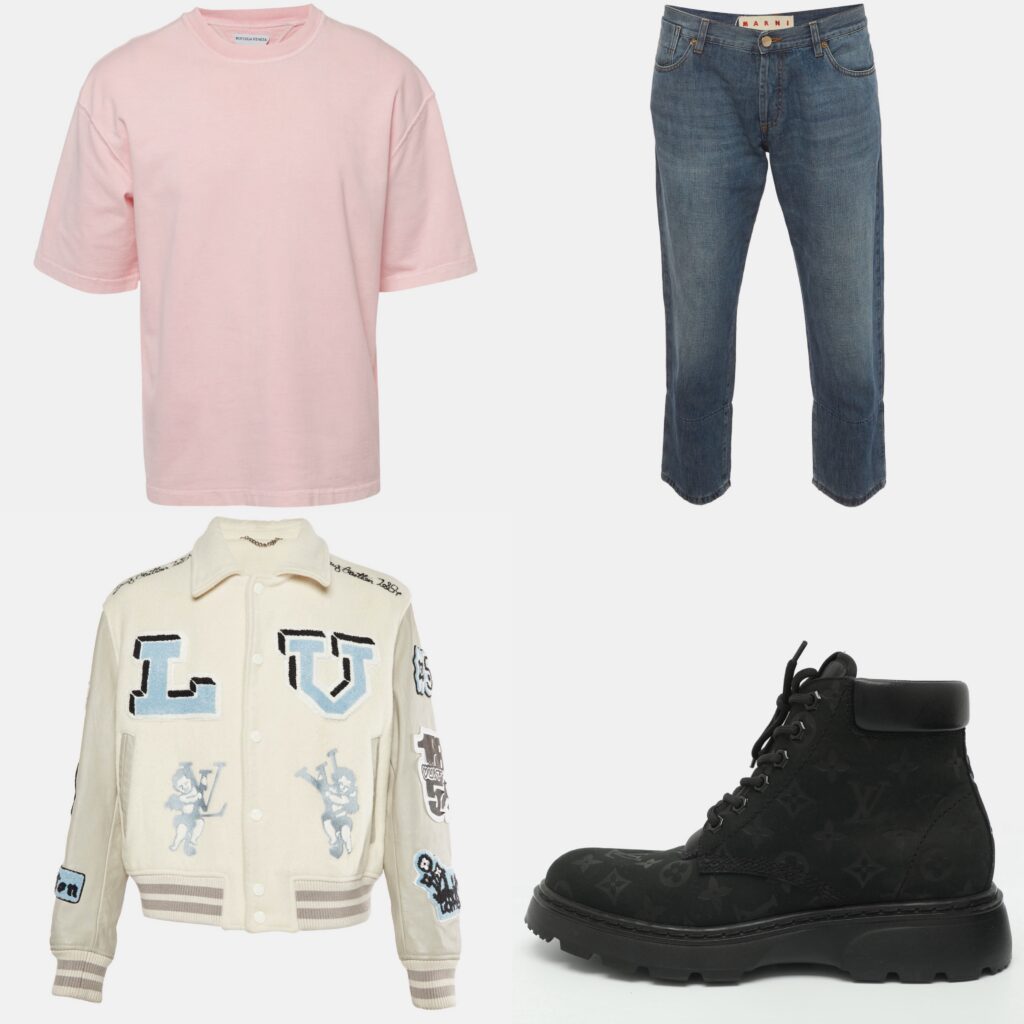
        3. Campus charmer or loverboy? Dean’s wardrobe has both

        Shop this look:

        Bottega Veneta Pink T-Shirt

        Louis Vuitton Bugs Bunny Varsity Jacket 

        Marni Denim Straight Fit Jeans

        Louis Vuitton x NBA Bold Ankle Length Boots

        4. Serve dapper looks like Tucker

        Shop this look:

        Gucci Aviator Sunglasses

        Hermes Waffle Knit Sweater

        Loewe Cargo Pants

        Chanel CC High Top Sneakers

        The list of Off Campus pre-loved fashion edit is pretty much endless. And with Season 2 already building hype and promising even more standout looks, there’s no better time to tap into the aesthetic.. So before the next chapter drops, consider this your sign to get your fit game sorted. Shop now.


        Source link

        What Is RE Crypto? A Complete Guide to Re Protocol and the RE Token – NFT Plazas

        0
        What Is RE Crypto? A Complete Guide to Re Protocol and the RE Token – NFT Plazas


        The cryptocurrency industry has increasingly shifted its focus from speculative assets toward projects that connect blockchain technology with real-world industries. One of the newest entrants in this space is RE, the governance token of Re Protocol – a blockchain-powered marketplace designed to modernize the global reinsurance industry.

        Unlike traditional decentralized finance (DeFi) protocols that primarily generate yield through lending or liquidity mining, Re Protocol aims to bring one of the world’s largest financial markets – reinsurance – on-chain through transparent, fully collateralized capital markets.

        This guide explains what RE crypto is, how Re Protocol works, its tokenomics, key use cases, potential risks, and why the project has attracted significant attention since its launch in June 2026.

        What Is RE Crypto?

        RE is the native governance token of Re Protocol, an on-chain reinsurance marketplace that combines blockchain infrastructure with the traditional reinsurance industry.

        Re Protocol allows stablecoin capital to support fully collateralized reinsurance contracts through licensed insurance entities. Rather than replacing insurance companies, the protocol provides an infrastructure layer where blockchain capital can participate in the reinsurance market in a transparent and programmable way.

        The RE token itself does not represent ownership of insurance contracts or protocol revenue. Instead, it enables holders to participate in governance by voting on protocol upgrades, ecosystem incentives, treasury decisions, and future development.

        Re Hompage

        Re Hompage

        Understanding Reinsurance

        To understand RE crypto, it’s helpful to first understand reinsurance.

        Reinsurance is often described as “insurance for insurance companies.” When insurers take on large amounts of risk—such as covering natural disasters, property damage, or catastrophic events—they often transfer part of that risk to specialized reinsurance companies.

        This allows insurers to:

        Reduce financial exposureImprove capital efficiencyIncrease underwriting capacityBetter manage catastrophic losses

        The global reinsurance market handles hundreds of billions of dollars in premiums every year, yet much of the industry still relies on manual processes, complex contracts, and multiple intermediaries.

        Re Protocol seeks to digitize portions of this market using blockchain technology.

        Re Protocol MetricsRe Protocol Metrics

        Re Protocol Metrics

        How Re Protocol Works

        Re Protocol creates a bridge between on-chain capital and regulated reinsurance structures.

        Instead of lending crypto assets to borrowers, users can provide supported stablecoins that are deployed into fully collateralized reinsurance arrangements through licensed entities and partners.

        Behind the scenes, the protocol works with regulated insurance companies while providing blockchain transparency for participants.

        Key components include:

        Stablecoin-based capital poolsLicensed insurance partnersFully collateralized reinsurance contractsOn-chain reporting and reserve transparencyGovernance through the RE token

        This hybrid model allows blockchain users to gain exposure to insurance-related capital markets while maintaining regulatory compliance.

        What Makes RE Different?

        Several characteristics distinguish Re Protocol from many newly launched crypto projects.

        Real-world business foundation

        Unlike many blockchain startups that launch a token before developing a product, Re Protocol established insurance partnerships and operational infrastructure before introducing the RE token.

        Real-world asset (RWA) exposure

        Most RWA projects focus on tokenized Treasury bills, private credit, or real estate. Re instead targets insurance risk, opening a different category within tokenized real-world assets.

        Governance-first token

        RE functions primarily as a governance asset rather than a revenue-sharing token.

        Holders help shape protocol development without receiving direct claims on protocol income.

        Transparency

        Traditional reinsurance markets often involve limited visibility into capital allocation and reserves.

        Re Protocol introduces blockchain-based reporting that allows participants to monitor reserves, deployed capital, and ecosystem activity more transparently.

        RE Tokenomics

        RE has a maximum supply of 1 billion tokens.

        At launch in June 2026, approximately 159.6 million RE were circulating, representing roughly 16% of the total supply.

        The allocation includes:

        50% for ecosystem development and incentives20% for core contributors17% for investors13% for ecosystem reserves

        Future token unlocks will gradually increase the circulating supply, making vesting schedules an important factor for investors to monitor.

        Token RE Allocation

        Utility of the RE Token

        The RE token has several primary functions within the ecosystem.

        Governance

        Token holders can vote on:

        Protocol upgradesGovernance proposalsTreasury decisionsIncentive programsEcosystem development

        Staking

        Eligible users may stake RE to participate in governance or delegate voting rights, depending on protocol implementation.

        Ecosystem incentives

        A portion of the token supply is reserved for community rewards, liquidity incentives, developer grants, and ecosystem expansion.

        Importantly, RE is not designed as a profit-sharing token and does not automatically distribute protocol revenue to holders.

        Why RE Crypto Has Gained Attention

        RE quickly became one of the most discussed crypto launches of June 2026 for several reasons.

        First, the project aligns with growing investor interest in real-world asset tokenization, one of crypto’s fastest-growing sectors.Second, Re Protocol entered the market with existing insurance partnerships and operational infrastructure rather than only a whitepaper. Third, the token debuted on several major exchanges shortly after launch, improving liquidity and accessibility for global investors.

        The combination of institutional partnerships, exchange listings, and the broader RWA narrative significantly boosted market attention.

        RE is available on RobinhoodRE is available on Robinhood

        RE is available on Robinhood

        Potential Benefits

        RE offers several potential advantages compared with purely speculative crypto assets.

        Exposure to a large industry

        The global reinsurance market represents a significant real-world financial sector that has historically been inaccessible to most retail investors.

        Institutional connections

        The protocol works alongside licensed insurance entities instead of attempting to replace existing financial institutions.

        Transparent infrastructure

        Blockchain reporting can improve visibility into reserves, capital deployment, and governance compared with traditional insurance markets.

        Growing RWA ecosystem

        As institutional adoption of tokenized assets expands, infrastructure projects connecting blockchain with traditional finance may benefit from increased attention.

        Risks to Consider

        Like every cryptocurrency investment, RE carries meaningful risks.

        Limited trading history

        Since the token launched only in June 2026, there is little historical price data across different market conditions.

        Token unlocks

        With most of the total supply still locked, future vesting events could increase market supply and create selling pressure.

        Regulatory complexity

        Insurance is one of the world’s most heavily regulated industries. Regulatory changes affecting insurance or digital assets could impact protocol growth.

        Adoption risk

        The long-term success of Re Protocol depends on expanding partnerships, attracting capital providers, and growing its insurance marketplace.

        Is RE Crypto Worth Watching?

        RE represents a different approach to blockchain infrastructure by targeting one of the largest traditional financial markets instead of creating another purely decentralized lending protocol.

        Its focus on governance, transparency, licensed insurance partnerships, and fully collateralized reinsurance positions it within the rapidly expanding real-world asset sector.

        However, as with any newly launched cryptocurrency, investors should carefully evaluate tokenomics, vesting schedules, governance developments, regulatory risks, and overall market conditions before making investment decisions.

        Final Thoughts

        RE crypto is more than another governance token—it is the centerpiece of Re Protocol’s vision to modernize global reinsurance using blockchain technology.

        By combining stablecoin capital, licensed insurance infrastructure, and decentralized governance, the protocol aims to improve transparency and efficiency in an industry that has traditionally relied on manual processes and institutional gatekeepers.

        While the project remains in its early stages, its connection to real-world financial infrastructure makes it one of the more distinctive blockchain initiatives launched in 2026. Whether RE ultimately succeeds will depend on continued ecosystem growth, regulatory execution, industry adoption, and the protocol’s ability to demonstrate that blockchain can meaningfully improve one of the world’s oldest financial markets.


        Source link

        Where to Find and Catch Kestra Eel in Palia

        Where to Find and Catch Kestra Eel in Palia


        Catching common and rare fish in Palia is a crucial step in leveling up the Fishing Guild. It unlocks advanced versions of the Fishing Rod as well as new items and crafting recipes at the Fishing Guild Store. One of the new Uncommon fish that players can catch is the Kestra Eel. This guide will walk you through where to find and catch the Kestra Eel in Palia.

        Where to Find Kestra Eel in Palia

        Players can find Kestra Eel in the Royal Highlands Rivers at night (9 PM to 3 AM) in the Royal Highlands map region. It is a brand-new fish and can only be found on the Royal Highlands map. There are several spots in the Royal Highlands where players can fish in the Royal Highlands Rivers. One of the best fishing spots to find Kestra Eel is the Kestra River. Another great spot for finding Kestra Eel is Amber Lake. As Kestra Eel is available at all times, you can check both of these locations during your exploration.

        How to Catch Kestra Eel in Palia

        Upon reaching the fishing location of Bahari Bay, you need to start catching fish in the deep area of the lake while equipping a Worm bait.

        NOTE: Worm Bait is mandatory for catching the Kestra Eel. Make sure to equip a Worm Bait on the fishing rod before casting the line into the water.

        Cast the line as far as you can with your fishing rod and wait for the bobber to shake three times. As the bobber starts to move after the third shake, reel in the fish by holding the Left-Click Button and moving the mouse to keep the fish inside the brackets to catch the fish.

        NOTE: If you spot Amber on the fishing spot, use the arrows to break the Amber. Catching Kestra Eel from the Amber spot will give you some Amber Echo as additional loot.

        However, if you do not have the Echo Tracker, you will not get Amber Echo from catching Kestra Eel or any other fish. Echo Tracker is a special relic that Eshelon gives during the “A Stitch in Time” quest.

        Uses of Kestra Eel in Palia

        The main use of the Kestra Eel is to use it for crafting Belafontine’s Blessing IV Relic. Other than that, players can sell Kestra Eel fish for 105 Gold (Base) and 157 Gold (Star-Quality) to Zeki or at the Shipping Bin. Moreover, you can also gift it to certain villagers who like it or who need it as a weekly want. If you catch any Kestra Eel fish, store them in the storage so you can give them to villagers who need them. The needs of villagers change every week, so keep your eyes on them. Lastly, you can use Kestra Eel as an ingredient to cook various fish dishes.


        Source link

        StarkWare Outlines Three-Phase Security Transition As Industry Prepares For Post-Quantum Era | Metaverse Post

        StarkWare Outlines Three-Phase Security Transition As Industry Prepares For Post-Quantum Era | Metaverse Post


        In Brief

        StarkWare unveils a roadmap to make Starknet post-quantum secure, outlining a phased migration designed to minimize disruption and future-proof the network.


        StarkWare Outlines Three-Phase Security Transition As Industry Prepares For Post-Quantum Era

        Software company StarkWare has published a roadmap outlining how its Layer 2 blockchain, Starknet, plans to transition toward post-quantum (PQ) security, arguing that advances in quantum computing have shifted the issue from a long-term possibility to an emerging infrastructure priority. The company said governments, technology firms, and standards organizations are increasingly issuing guidance on post-quantum cryptography, making migration planning an important consideration for blockchain networks and other digital infrastructure.

        According to StarkWare, Starknet’s existing architecture provides an advantage over many other blockchain networks because its proving system is built on STARK cryptographic proofs, which rely on collision-resistant hash functions rather than elliptic-curve cryptography. Since quantum computers are expected to threaten elliptic-curve-based systems through algorithms such as Shor’s algorithm, the company argues that Starknet requires fewer structural changes to achieve quantum resistance.

        The roadmap also highlights Starknet’s native account abstraction, which enables developers and users to adopt post-quantum signature schemes without requiring disruptive protocol-level upgrades. StarkWare said users can already deploy quantum-resistant wallets on the network, while ecosystem contributors, including OpenZeppelin and S2morrow, are developing additional post-quantum account implementations.

        Three-Phase Migration Strategy Targets Quantum-Resistant Infrastructure

        The migration strategy is divided into three phases. The first phase focuses on protecting all newly created activity on the network by replacing Pedersen hashing, which relies on elliptic-curve assumptions, with the BLAKE2 hash function across key components of the protocol. The transition covers state commitments, contract address generation, and operating system configuration. StarkWare expects most of these upgrades to be completed within approximately two months, while the operating system configuration update is scheduled for deployment on the main network in early July.

        The second phase targets existing smart contracts by extending post-quantum protections to legacy deployments. The company plans to introduce improved development tools and a migration toolkit designed to help developers upgrade existing contracts without requiring manual data transfers or disrupting deployed applications. StarkWare estimates that its own infrastructure work for this phase could be completed about one month after Phase 1, although migration timelines for decentralized applications will depend on individual development teams.

        The final phase depends on Ethereum’s own post-quantum migration. Because Starknet relies on Ethereum for bridge messaging and data availability, several remaining components cannot be fully upgraded until Ethereum replaces cryptographic mechanisms that currently depend on elliptic-curve technology. StarkWare said these external dependencies will be addressed as Ethereum progresses with its own roadmap.

        The company stated that completing the migration would position Starknet as a production blockchain operating almost entirely on post-quantum cryptographic primitives while minimizing the complexity typically associated with large-scale blockchain upgrades. StarkWare added that it will continue monitoring developments in quantum computing and Ethereum’s migration while publishing further technical updates as implementation progresses.

        Disclaimer

        In line with the Trust Project guidelines, please note that the information provided on this page is not intended to be and should not be interpreted as legal, tax, investment, financial, or any other form of advice. It is important to only invest what you can afford to lose and to seek independent financial advice if you have any doubts. For further information, we suggest referring to the terms and conditions as well as the help and support pages provided by the issuer or advertiser. MetaversePost is committed to accurate, unbiased reporting, but market conditions are subject to change without notice.

        About The Author


        Alisa, a dedicated journalist at the MPost, specializes in crypto, AI, investments, and the expansive realm of Web3. With a keen eye for emerging trends and technologies, she delivers comprehensive coverage to inform and engage readers in the ever-evolving landscape of digital finance.

        More articles


        Alisa, a dedicated journalist at the MPost, specializes in crypto, AI, investments, and the expansive realm of Web3. With a keen eye for emerging trends and technologies, she delivers comprehensive coverage to inform and engage readers in the ever-evolving landscape of digital finance.


        More articles


        Source link

        Star Sightings: Mariah Carey, Belmont Cameli, and More Celebs

          0
          Star Sightings: Mariah Carey, Belmont Cameli, and More Celebs


          Here’s a look at what celebrities have been up to as of late!

          Mariah Carey enjoyed dinner at Bad Roman in Bever Hills, California.

          Camila Mendes was out and about in New York City wearing TWP’s Logan Stretch Leather Pant in Chocolate and carrying DeMellier’s The New York Shoulder in Mocha Suede & Mocha Smooth. The actress was spotted strolling again in New York City wearing the GUIZIO Eda Skirt and GUIZIO Ara Top while carrying the same bag. Mendes also attended Ariana Grande’s concert in Los Angeles, California wearing the AGOLDE Low Rise Loose in Vault.

          Kylie Jenner biked in New York City wearing The Perfect Classic Tank by GUIZIO and Kenny sunglasses by OTRA Eyewear.

          Emmy Rossum attended the New York Knicks game at Madison Square Garden in New York City carrying BaubleBar’s Custom Stripe tote.

          Reese Witherspoon was outside ABC Studios in New York City carrying the VESTIRSI Vera Baguette Bag in Pale Pink.

          Katie Holmes strolled in New York City carrying Cuyana’s System Tote in Dark Chestnut.

          Ariana Madix appeared on Love Island USA wearing PatBO’s Camila gown.

          Emily Blunt attended the Disclosure Day premiere in Paris, France wearing the Betsey Johnson Jenii Sequin Mesh shoes.

          Taylor Swift filmed behind-the-scenes content for her song “I Knew It, I Knew You” while wearing the AGOLDE Leila Bodysuit in Framework. 

          Anne Hathaway strolled in New York City in the L’AGENCE Elle Patent Leather Mule.

          Doja Cat performed in Amsterdam, Netherlands wearing Honey Birdette’s Charlize Sculpted Plunge Bra in red. The singer also partnered with Ray-Ban Meta for her Tour Ma Vie world tour.

          Lucas Finn Creations

          Jennifer Lawrence was out and about in New York City wearing ALO’s 7/8 High-Waist Airlift Legging in black.

          Beyoncé stepped out in New York City wearing The Kelso Skirt by SIMKHAI.

          Margot Robbie and Stevie Nicks enjoyed dinner at La Monique in Santa Monica, California.

          Nina Dobrev was out and about in New York City wearing Ronny Kobo’s 1988 Blazer in light charcoal paired with the brand’s Alesis Vest and Soprano Pants in light charcoal.

          Lili Reinhart attended Obsessed Fest in Los Angeles, California wearing a custom Cult Gaia dress.

          Camille Kostek starred in the Brilliant Earth Seaside Charm Collection launch campaign featuring a coastal-inspired assortment of fine jewelry charms including sand dollars, seashells, crabs, and pearls.

          Shanna Moakler launched her women’s wellness and lifestyle brand, Hello Foxi, including Hello Meno™, Hello Slim™, and Hello Meno™.

          Lexi Minetree appeared on The Tonight Show Starring Jimmy Fallon in New York City wearing a pair of Steve Madden’s Davina Heel in Pink Metallic. The actress also attended the Prime Video x Cosmopolitan dinner in New York City wearing ALDO’s Matelina. She also attended the premiere of Elle in New York City wearing a custom Betsey Johnson gown and the afterparty wearing Betsey Johnson heels.

          Caitlin Clark wore the AGOLDE Laria Pieced Jean in Lemon Zest in her tunnel walk ahead of the Indiana Fever vs. Chicago Sky game in Indianapolis, Indiana.

          Brooks Nader and her sisters celebrated the launch of their eyewear collaboration with QUAY, Made to Be Seen, at The Beverly Hills Hotel in Beverly Hills, California.

          Getty/Presley Ann

          Adele enjoyed dinner at La Monique in Santa Monica, California.

          Ella Bright attended Obsessed Fest in Los Angeles, California wearing the Steel Gia Drop Earrings, the Classic Duo Ring in gold, and a Blue Topaz pinky ring from Mejuri.

          Melissa Barrera attended the Tony Awards in New York City in an archival Betsey Johnson look paired with jewelry by Logan Hollowell.

          Katherine LaNasa attended the FYC event for The Pitt Season 2 in Los Angeles, California wearing the Armarium Mina Dress.

          Stephanie Hsu attended the 79th Annual Tony Awards at Radio City Music Hall in New York City wearing the Monique Lhuillier Spring 2026 Metallic Raffia Floral Embroidered Tulle Strapless Column Gown in Plumeria Multi.

          Belmont Cameli made a surprise appearance at The Kid Laroi’s concert at The Greek Theatre in Los Angeles, California while wearing Brilliant Earth jewelry and Reebok sneakers.

          Natalie June Halcro posed on Instagram in The Cinched Lace Corset Maxi Set in yellow by Mars The Label.

          Terry and Heather Dubrow celebrated their 27th wedding anniversary.

          Danielle Savre attended the 65th Monte Carlo Television Festival in Monte Carlo, Monaco wearing the Emerald Satin Gown by Oksana Mukha, the Kim Stampato Bag by Teddy Blake, and the Crescent Moon Hoop Earrings in gold by Alex + Ani.

          Zosia Mamet posed with Clare Vivier while celebrating the Clare V. and Left on Friday collaboration at the Mulholland Tennis Club in Los Angeles, California.

          Carey Coleman

          Jalen Brunson did a tunnel walk ahead of game 1 of the NBA Finals in San Antonio, Texas in the Ronaldo Popover Shirt & Kane Relaxed Trouser from Simkhai’s Spring ’25 collection. The athlete also did a tunnel walk ahead of game 3 of the NBA Finals in New York City wearing the Sean Shirt Jacket and Garrett Wide Leg Cargo Pants by Simkhai.

          Chase Hudson posed on Instagram wearing the Diamond Choker in white gold by Kaimanna by Samara.

          Sophie Saint shared how she is restoring her Ferrari F40 on social media.

          Allie Eklund opened Triple E Mercantile in Cibolo, Texas, featuring Texas merchandise, home accessories, and her goat milk skincare line.

          Vita Kari debuted This Is Not A Billboard, a large-scale installation in West Hollywood, California.

          Melinda Melrose appeared on The Pre-Game podcast.

          Miranda McKeon spoke at the World Woman Cannes Agenda 2026 in Cannes, France.

          Amanda Frances hosted a dinner in New York as part of her quarterly Mama’s Mastermind series.

          Jenna Dewan, Emmanuelle Chriqui, and Ryan Weiss posed after appearing on iHeartMedia’s Waking Up with Ryan podcast.

          Mina Sisley

          WashWise founder Maria Cabral Menezes celebrated the upcoming launch of the brand’s Reset Spray with a special preview at SoulCycle at The Barn in Bridgehampton, New York.

          Spill Sesh attended the premiere of Calabasas Confidential at Wheelhouse L.A. in Los Angeles, California.

          Kim Gravel celebrated QVC’S 40th anniversary during the brand’s TikTok Super Brand Day.

          Asante Madrigal attended a screening for Toy Story 5 hosted by Pixar for TikTok Creators in Los Angeles, California.

          Violet Witchel attended the premiere of Voicemails for Isabelle in San Francisco, California.

          Brittny Button attended the Monaco Grand Prix in Monte Carlo, Monaco.

          Susan Holmes McKagan appeared on iHeartMedia’s KFI AM 640 to talk about her book, The Velvet Rose.

          Chase DeMoor secured a victory over Aleks Petrovic at the Fame Fighting vs. Misfits Boxing event in Leverkusen, Germany.

          Inde Navarette appeared on stage wearing The Peek-A-Boo Maxi in Head Rush by MOTHER while appearing onstage during the final stop of Kid Cudi’s The Rebel Rager Tour in Los Angeles, California.

          Mel D. Cole

          TJ Palma attended the U.S. Open Golf Championship in Southampton, New York.

          Katie Austin walked the runway in Miami Swim Week in Miami, Florida, and it premiered on Hulu.

          Gabby George of GGStudio launched her On The Go program featuring equpment-free fitness classes.

          Aditi Shah participated in a panel discussion called The Future of Women’s Health, Media, and Influence: Rewriting the Narrative at the World Woman Agenda Summit in Cannes, France.

          Kail Lowry kicked off her Fatherless Behavior podcast tour in Indianapolis, Indiana, Cincinnati, Ohio, Grand Rapids, Michigan, and Nashville Tennessee.

          Carson Roney launched Scribe, a handcrafted custom leather journal line.

          Caelynn Bell celebrated the launch of her jewelry collection, Bellboy, with an event at Boulevard Coffee in Venice, California.

          Aimee Smale of Odd Muse participated in a discussion called The Creator Divide: How to Navigate a World of AI Slop on the AI & Tech Sandbox panel in Cannes, France.

          Gia Giudice walked the runway as part of White Fox’s La Tropica presentation at The Setai Miami Beach in Miami, Florida during Miami Swim Week.

          Alexander Tamargo/Getty Images for White Fox

          Cameron Rogers and Fran Mariano teamed up to film a podcast episode of Conversations with Cam.

          Olivia Ponton attended the 2026 FIFA World Cup match between Brazil vs. Morocco at MetLife Stadium in East Rutherford, New Jersey. The Booked, Blonde & Busy podcast host also sat down with Candace Bushnell to talk about the stories that inspired Sex and the City.

          Sanjiv Lal of Regen Therapy participated in a panel discussion in Beverly Hills, California at the Beverly Hills Living Magazine June cover reveal and Longevity Collective celebration.

          Joel Stein released Assouline’s America: The Imagination of a Nation to celebrate 4th of July and U.S.A.’s 250th anniversary.

          Dripology provided B12 shots at the Roeme State of Mind event at Virgin Hotels in New York City.

          Icon Skincare celebrated the brand’s launch and Marilyn Monroe’s 100th Birthday Spectacular with a special event at the Academy Museum of Motion Pictures in Los Angeles, California. 

          ciele celebrated the launch of its new shade & PROTECT SPF 45+ Bronzing Powder at Bar Di Bello in Los Angeles, California, where guests enjoyed cocktails, music, and bronzed skin.

          SEV Laser celebrated the opening of its newest location in Huntington Beach, California, where clients can experience premium laser hair removal and aesthetic treatments.

          The Zoe Report and Sisley Paris hosted a Self-Care Soirée at Maison Sisley Brentwood in Brentwood, California.

          Lucy Hale snapped a selfie wearing the OOFOS OOaah Plus sandals in black.

          Lucy Hale/Instagram

          LBTY. Fragrances hosted a summer gathering at Virgina Robinson Gardens to celebrate fragrance, art, and the spirit of British creativity, where guests participated in guided watercolor sessions and enjoyed curated drinks and light bites.

          The G&B Digital Management team attended the 2026 Cannes Lions International Festival of Creativity in Cannes, France.

          POV Beauty founders Mikayla Nogueira and Ani Hadjinian hosted an intimate dinner at Alba in West Hollywood, California to celebrate the launch of the brand’s bold lip shades and more.

          KORRES collaborated with Go Greek to launch The Greek Glow bowl featuring a Plain Tart base, GG olive oil, Greek honey, sea salt, and Greek biscuit crumble, where customers received a free deluxe travel size of the KORRES Greek Yoghurt Foaming Cream Cleanser with purchase.

          FLRT celebrated the launch of its functional, zero-sugar energy drink line at a L.A. Summer Social event at The Cara Hotel in Los Angeles, California, where guests enjoyed flash tattoos, tooth gems, custom embroidery, and more.

          12th Tribe partnered with Newmark Models to host a runway show in Miami, Florida to unveil the brand’s Summer 2026 collection to their VIP community, where attendees had the opportunity to pre-reserve pieces before the public launch at a preview event.

          OUAI celebrated its OUAI-CATION campaign by hosting an activation in Domino Park in New York City, where guests sipped on smoothies, enjoyed frozen yogurt from Go Greek, played volleyball, listened to music, received complimentary fragrance samples, and got the chance to win full-size products through spray and reveal tester cards.

          Black Tap Craft Burgers & Beer teamed up with Fortunato Bros. bakery to launch a NY Knicks Rainbow Cookie Shake featuring a blue velvet cake shake base, cannoli frosted rim with orange and blue sprinkles, a Fortunato Bros. Knicks rainbow cookie, whipped cream, and a cherry. 

          CARA attended the premiere of EXES in Los Angeles, California.

          CARA

          Levain launched the Raspberry Pistachio Cookie filled with Valrhona raspberry chips, pistachios, and white chocolate chips before bringing back the Rocky Road cookie and Dark Chocolate Peanut Butter cookie later this summer.

          Zenagen launched its Daily Thickening + Volumizing Performance Shampoo, Zenagen, to deliver instant body and support scalp health over time, for thicker and healthier hair with Microfoam Technology and botanical and amino acid blends.

          Luna Bronze launched a jumbo size version of the Self Tanning Jelly featuring the brand’s streak free, lilac tinted gel formula.

          RE/DONE launched its third collaboration with Disney featuring Disney’s vintage graphics, logos, and characters reimagined through RE/DONE’s nostalgic lens for pieces including the 60s Slim Ringer Tee The Mickey Mouse Club, Classic Crewneck Mickey Stud, Mickey Polo, Beau Jean, and Lace Strap Tank with Mouseketeer logo.

          KSUBI launched an 8-piece capsule collection, Worldwide Game, featuring four jerseys in the national colors of Australia, USA, Mexico, and Argentina, two graphic tees in the KSUBI oversized Ekcess silhouette, and two caps in Australia and USA colorways.

          ÉTERNE launched new styles including classic bikinis and simple one-pieces for ÉTERNE Swim.

          Canopy launched a limited-edition garden-inspired aroma kit, From the Garden, featuring Fresh Tomato and Basil Neroli scents inspired by summer gardens, fresh herbs, and sun-ripened produce. The brand also launched the Canopy Sound Machine + Aroma with 15 curated sleep and wellness soundscapes, a dimmable night light, built-in aroma diffusion, and cordless portability.

          La Bonne Brosse partnered with Call It By Your Name to launch a limited-edition summer collection featuring the Micro Brush, a new on the go format by La Bonne Brosse and customizable handmade bandana charms by Call It By Your Name.

          Emi Jay launched the Aura Hair + Body Mist Bundle in three scents, which includes three full-size Aura Hair + Body Mists, bundled together at 22% off and designed for carry-ons, work bags, and weekends away. The brand hosted the Emi Jay Spritz Stop in Los Angeles, California, where attendees received a free Aura Hair + Body Mist of their choice.

          Emi Jay/Instagram

          Round Lab launched The Birch Juice Moisturizing Sun Serum which combines SPF 50 with a 77% concentrated hydrating essence to maintain moisture balance and leave skin soft without greasiness.

          Melissa launched a collaboration with Diesel featuring footwear silhouettes in new colorways and the debut of the Quantum Dome Bag.

          Tatcha launched the Matcha Foam Cleans, a gel to foam cleanser with four mild amino acid-based surfactants, Japanese ceremonial-grade matcha, green clay, and prebiotic inulin.

          Sand + Fog launched a line of laundry detergents made to deliver a powerful clean with signature scents including Marshmallow Skies, Bloom, Vanilla Musk, and California Beach House.

          Live Conscious launched the Strawberry Lemonade and the Piña Colada collagen peptide flavors.

          Papa Johns launched the Papa Pairings inspired by Love Island USA, including The Day Ones, which includes a medium 1-topping pizza and garlic Knots, The Bombshells, which includes buffalo wings and a double chocolate brownie, and The Unexpected Duo, which includes cheesesticks and boneless wings, all for $6.99 each.

          Nécessaire launched The Body Wipe to cleanse, nourish, and refresh the skin and The Eucalyptus Water to cool, calm, and nourish the skin with lightweight hydration.

          Typology launched the Skin Texture Refiner T30, a non-pigmented skin-perfecting treatment designed to blur and refine skin texture with 5% Niacinamide and 5% PHA.

          MCM launched its Autumn/Winter 2026 collection filled with ready-to-wear, footwear, and accessories.

          Taco Bell teamed up with Ian Charms to launch a charm necklace in celebration of the Fajita Street Chapulas, made with peppers, onions, chili, garlic, cheese, marinated steak or slow-roasted chicken, creamy jalapeño sauce, and an onion-cilantro blend, and Chicken Fajita Nacho Fries, topped with slow-roasted chicken, peppers, onions, creamy jalapeño sauce, reduced-fat sour cream, nacho cheese sauce, and a blend of cheeses. Taco Bell also hosted a Loss Or Celebration Outcome Support (L.O.C.O.S.) truck activation in Inglewood, California.​​​​​

          Taco Bell

          RELATED CONTENT:


          Source link

          Popular Posts

          My Favorites

          Dead Island 2: Ultimate Edition and Patch Deliver a Double Dose...

          0
          HELL-A is about to get a whole lot more chaotic with Dead Island 2’s Ultimate Edition and new patch! PLAION and Dambuster Studios are...