Home Blog Page 71

Anthropic Rolls Out Claude Cowork On Mobile And Web Platforms To Extend AI Task Management Across Devices | Metaverse Post

Anthropic Rolls Out Claude Cowork On Mobile And Web Platforms To Extend AI Task Management Across Devices | Metaverse Post


In Brief

Anthropic expands Claude Cowork to mobile and web, enabling cross-device AI workflows, background tasks, and broader knowledge work automation.

Anthropic Rolls Out Claude Cowork On Mobile And Web Platforms To Extend AI Task Management Across Devices

AI research company Anthropic has announced the expansion of Claude Cowork to mobile and web platforms, allowing users to access ongoing sessions and files across multiple devices. The beta rollout will begin with Max subscribers over the coming weeks, with broader availability expected across additional plans.

Claude Cowork is designed to support task-based workflows by allowing users to assign complex projects to the AI system, which can then work across connected resources such as files, calendars, email, messaging tools, web content, and other integrated services.

While AI agents have traditionally been associated with software development, Anthropic reported that most Claude Cowork activity involves broader knowledge work. More than 90% of usage is focused outside programming, with major applications including business operations and content creation. Common examples include analyzing spending data and preparing reports, organizing contract information into tracking systems, and creating presentations from meeting records and business data. These tasks represent a significant portion of routine professional work that often requires substantial time but falls outside formal job responsibilities.

Cross-Device Workflows Reshape AI-Assisted Productivity

The expansion introduces several changes to how users interact with Cowork. Tasks can now continue across devices, allowing users to begin work on a computer, monitor progress from a phone, and access completed results from another location. The system can also continue scheduled activities in the background without requiring an active device connection, enabling workflows such as preparing reports, reviewing communications, or compiling research before a user returns.

Despite greater automation, users remain responsible for key decisions and approvals. Claude can request input when human judgment is required, allowing users to adjust direction during the process while maintaining control over final outputs.

The desktop version remains the most comprehensive Cowork experience, offering access to local files and browser-based capabilities. However, the web version extends availability to users who cannot install desktop applications. Anthropic has also unified chat and Cowork experiences across web and desktop, bringing conversations, projects, and generated materials into a shared workspace.

Users can begin a Cowork session through the Claude website or access the feature from the sidebar of the Claude mobile application for iOS and Android. Anthropic recommends starting with existing projects, such as folders, email threads, or unfinished presentations, and providing a clear description of the desired outcome. To support the launch, the company is extending increased Cowork usage limits through August 5, allowing users to test larger and more complex workflows.

Disclaimer

In line with the Trust Project guidelines, please note that the information provided on this page is not intended to be and should not be interpreted as legal, tax, investment, financial, or any other form of advice. It is important to only invest what you can afford to lose and to seek independent financial advice if you have any doubts. For further information, we suggest referring to the terms and conditions as well as the help and support pages provided by the issuer or advertiser. MetaversePost is committed to accurate, unbiased reporting, but market conditions are subject to change without notice.

About The Author


Alisa, a dedicated journalist at the MPost, specializes in crypto, AI, investments, and the expansive realm of Web3. With a keen eye for emerging trends and technologies, she delivers comprehensive coverage to inform and engage readers in the ever-evolving landscape of digital finance.

More articles


Alisa, a dedicated journalist at the MPost, specializes in crypto, AI, investments, and the expansive realm of Web3. With a keen eye for emerging trends and technologies, she delivers comprehensive coverage to inform and engage readers in the ever-evolving landscape of digital finance.


More articles


Source link

Bespoke washable jacket from Whitcomb & Shaftesbury: Review

Bespoke washable jacket from Whitcomb & Shaftesbury: Review


Bespoke washable jacket from Whitcomb & Shaftesbury: Review

Wednesday, July 8th 2026

Share

Subscribe
8 Comments
Add to favourites
||- Begin Content -||

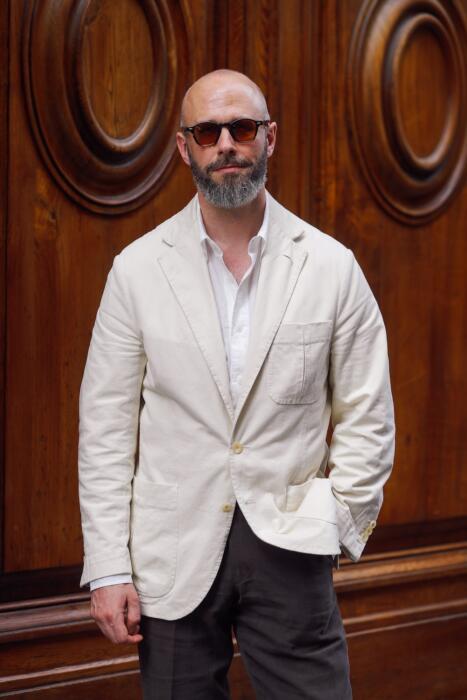
This is the second article on my washable bespoke cotton jacket pictured above, made by Whitcomb & Shaftesbury. For information on why a washable jacket is unusual, and how this one has worn and washed so far, see that article. Today’s is a review of the jacket itself, excluding the washability. 

A tailored cotton jacket is great. Its style makes it formal, but its material makes it casual. It’s hard wearing and functional, yet it can dress up a T-shirt and jeans. 

Linen is nice too, and my slubby linen DB has many of the same attributes. But you can really beat up a cotton jacket – plunge your hands in the hip pockets, overload the other pockets, chuck it in a bag, sleep in it in the corner of a carriage – and a good one will look all the better for it. 

Linen isn’t quite as tough, and a summer cotton jacket is more like a warm-weather equivalent of tweed or corduroy in that way. It’s also easy to repair, even patch. 

Perhaps most importantly, it makes fine tailoring more approachable. 

If I have one ongoing battle on Permanent Style, it’s finding and showing ways in which fine tailoring can be modern and relevant, not fussy or antiquated. A bespoke cotton jacket that fits beautifully, but looks like you have actually slept in it, is a great way to do that. 

I’ve had cotton suits over the years, but few cotton jackets. One reason is the material – the 9oz (255g) twill that’s standard for suitings can make a very nice suit but it’s a little flimsy for a knockabout jacket. 

There are heavier cottons, mostly sold for trousers, but they are usually too stiff to be comfortable as a jacket. There’s also moleskin and corduroy, but those are more for winter.

Musella Dembech suit in 9oz tailoring cotton
Ciardi suit in heavy, and too stiff, tailoring cotton

Whitcomb & Shaftesbury sourced a Japanese cotton* to make this jacket – or rather, sourced it for another customer, which I then saw and asked to make something similar. 

It’s only a little heavier than those twills I used in the past, at 300g, but it’s not made like a traditional tailoring cotton. It’s coarser, and denser, which makes it casual and tougher. I also find the density means it stands away from the body, making it cooler. 

This type of cotton is not generally used for tailoring partly because it can’t be worked – tailored – to the same extent. But Whitcomb did an admirable job shaping it, creating a nice bespoke fit despite also not having any canvas or padding. 

I did simplify the design from the other customer’s jacket. He was after a more traditional safari-jacket look, with tabs, epaulettes and so on. I wanted something stripped back and simpler, with that same aim of being subtle and easier to wear.

In fact, I only went with the inverted pleats you can see on the pockets at the last minute. I’m glad I did, as they’re a lovely detail and don’t make the jacket look that fussy. But my lesson from experiments in the past had always been to go simpler, whenever I’m in doubt. 

The edges of those pleats are lovely, betraying their handmade nature in a very subtle way, particularly as I’ve washed the jacket. 

These handmade details stand out everywhere on a bespoke cotton suit, as I’ve discussed in the past. Some of them include:

the pick stitching, clearly not the AMF-machine-fake style you get on ready-made jackets
the hand-sewn buttonholes that stand out more for being on a stiff material
the stitching on the inside of the sleeve that you can see coming through around the cuff 
the hand-attached collar that’s visible when you pop the collar 
one just for bespoke nerds: the cut used in the upper chest to give me some shape in the chest, in the absence of hand padding

I did get one or two style things wrong though. 

In retrospect I would have had the gorge lower on the lapel – I’m not sure how I missed that in the fitting process, as these days I’d always go lower. Although it doesn’t matter too much as I wear the collar more up than down. 

And we should have checked the functionality of the collar latch. It’s a nice detail, tucked away and buttoned back, and I’ll never use it. But it would still have been nice if it could fasten across the neck comfortably, and it’s a bit high to do that. 

In terms of how I’ve found I wear the jacket, it’s exactly what I hoped – with a shirt and tailored trousers but also with jeans and T-shirt. 

As per usual, I’ve shot in here with both to illustrate. The thing that makes the jacket particularly easy to wear with jeans is that the collar rolls open nicely when popped up. Bespoke jackets often don’t do that naturally, because they have more structure. 

It’s neater with the T-shirt tucked in (but blousing out a little) and interestingly I quite like the jacket buttoned to the top of the three buttons, more as I would a chore jacket. 

The tailored combination is in my now very standard palette of cream, brown and black (I first fell in love with that combination during this shoot six years ago I think). 

This is a fairly plain version of it, but it’s enlivened by the pop of colour from the orange-tinted lenses in the sunglasses, and the snuff-suede colour of the Métier tote. 

The trousers can be fairly smart – high twists or linens, as here – but the shirt has to be fairly casual. Something in a denim or chambray, or a lightweight cotton like this one, and preferably a soft collar. 

This jacket cost £2400 including VAT from Whitcomb & Shaftesbury, made bespoke. Other colours available in the same material include black, navy, olive and beige. 

Clothes pictured:

‘East-West Passerby’ tote by Métier in Suede Marrakech
Bespoke trousers by Whitcomb & Shaftesbury in Art du Lin (covered previously here)
Black alligator belt by Rubato
Boy Scout shirt by Husbands in white voile (not currently available)
Loafers by Alessandro Gasperini (being covered soon)
Zepherin sunglasses by Jacques Marie Mage (also being covered soon)
PS Tapered T-shirt
Vintage Levi’s 501s
Vintage leather and webbing belt
Vintage Ray-Ban Caravan gold sunglasses

*The cotton is not usually available to buy by the cut length, as the mill does not usually serve tailors. Whitcomb buys it by the roll, in the same way as it does for its chinos. 

<!–

–>


Source link

Celebrities Who Opted Out Of Taylor Swift And Travis Kelce’s Wedding

    0
    Celebrities Who Opted Out Of Taylor Swift And Travis Kelce’s Wedding


    Taylor Swift and Travis Kelce‘s wedding at MSG brought together an impressive guest list packed with celebrities, athletes, and close friends. While many high-profile names were in attendance to celebrate the couple’s union, a few invited personalities ultimately chose to skip one of the biggest events of the year. Here’s a look at some of the notable names who declined the glamorous celebration.

    Singer-songwriter and ’70s music icon James Taylor, after whom the pop superstar was named, missed Swift’s nuptials to Kelce.

    At a performance in Lenox, Massachusetts, over the Independence Day weekend, James revealed to the audience that he and his wife, Kim, had received an invite to the wedding of the year. However, he had to decline to keep with tradition. James had been performing annually at the Tanglewood Music Festival for 52 consecutive years, excluding event cancellations and COVID restrictions, and he wasn’t about to break his streak.

    Despite missing the wedding, he shared his well wishes to Swift and Kelce, saying, “I do want to wish the couple all happiness and smooth sailing, and strength when it can’t be smooth.”

    In a 2015 interview with Stereogum, James talked about his connection with Swift, saying, “She told me that her mom and dad had been really, deeply into my music and I got a real kick out of the fact that she’d been named after me.”

    Charles Barkley Doesn’t Go To Weddings Or Funerals

    Chris Chew/UPI Newscom/MEGA

    Charles Barkley also got an invite to the Swift-Kelce nuptials, but he “politely” said no. The basketball legend’s refusal had nothing to do with the couple; it’s simply his policy not to attend two specific events. “I don’t go to weddings or funerals,” Barkley stated.

    In an interview on 97.5 The Fanatic’s “Unfiltered with Ricky Bo and Bill Colarulo,” Barkley shared that he loves the Kelce brothers, Travis and Jason, and only met Swift one time. “But I did get an invite, and I politely declined because I thought it was going to be a cr-p show,” he said.

    Admittedly, Barkley said he knew going to the star-studded affair was going to be “too much” for him. “I just want to hang out and play golf, and I don’t want to dress up and all that other stuff,” he said, adding that despite his decision, he appreciated the invite and thought it was “pretty special.”

    Robert Pattinson Had Work Obligations

    Robert in a suit
    C Flanigan/imageSPACE / MEGA

    Robert Pattinson and his partner Suki Waterhouse have been friends with Swift and Kelce for years, and while Waterhouse was spotted at MSG for the wedding, Pattinson was noticeably absent.

    As reported by The Blast, the actor had professional obligations lined up on the day of the couple’s wedding. At the premiere of his movie “The Odyssey,” Pattinson shared that he had been busy filming “The Batman: Part II.”

    When he found out that he missed out on the couple’s lavish giveaways at the wedding, he jokingly asked, “What did I get?”

    Ryan Seacrest Rescinded His Confirmation To Swift-Kelce Wedding

    TV host Ryan Seacrest planned to attend the wedding and admitted that he was excited to go to the A-list affair. He confirmed he was going, but then had to backtrack a few days before the event.

    Seacrest shared his reason on “On Air With Ryan Seacrest,” telling listeners that Disney brought him on for an Independence Day special that was taking place on July 3 and 4. While he did his best to fit both events into his schedule, he simply couldn’t make it work.

    “I couldn’t have done both. And the actual wedding was in the afternoon. I went through the minutes,” he said. Nevertheless, he was honored to have been invited.

    Prince William And Kate Middleton Met Privately With The Couple

    Many of Swift and Kelce’s fans expected Prince William and Kate Middleton to attend the wedding, but they were a no-show.

    In late May, Prince William was asked whether he was invited to the wedding, which he answered with a smile, saying, “No comment… I’m hoping, and I’m sure there might be an invitation around, but we’ll see.” Despite his refusal to reveal any information, many suspected that he and his wife were on the guest list. Speculation further intensified when he appeared on the Kelce brothers’ “New Heights” podcast episode, released on the morning of the wedding.

    Despite their absence on the couple’s big day, the royals reportedly met with them before their wedding, per PEOPLE. The private meeting allegedly took place in May when Swift and Kelce visited London.


    Source link

    Bentley Goes Fully Electric with the All-New Torcal SUV | Metaverse Planet

    Bentley Goes Fully Electric with the All-New Torcal SUV | Metaverse Planet


    When a legacy luxury brand like Bentley decides to finally pull the trigger on a fully electric vehicle, the automotive world holds its breath. We have seen heritage carmakers stumble, hesitate, and recalibrate their EV timelines over the last couple of years. Bentley itself pushed back its aggressive all-electric deadline due to shifting global market realities. But the wait is officially coming to an end.

    Bentley just dropped the name of its very first production electric vehicle: the Bentley Torcal.

    Set to make its global debut in London on September 23, this luxury EV is dropping the “Urban SUV” codename and stepping into the spotlight. And honestly? As someone who tracks the electric vehicle landscape closely, watching ultra-luxury marques navigate this transition tells us a lot about where the high-end market is heading.

    What’s in a Name? From Andalusian Peaks to British Luxury

    If you know your Bentley nomenclature, you know they love a good geographic or historical nod. Bentayga, Bacalar, Batur—they all share a pedigree rooted in dramatic landscapes.

    The Torcal is no different. Bentley pulled the moniker straight from El Torcal de Antequera, a stunning natural park in the Andalusia region of Spain known for its striking limestone karst formations. It is a poetic choice for a vehicle meant to carve out a new era for the brand.

    Size-wise, the Torcal will sit more compactly than its sibling, the Bentayga. But make no mistake: Bentley has confirmed there will be zero internal combustion engine options here. This isn’t a hybrid compromise; it’s a pure, unadulterated electric leap.

    Under the Hood: The Porsche Connection

    Bentley is keeping the official spec sheet locked in a vault until the official September reveal. But when you look at the Volkswagen Group ecosystem, the puzzle pieces snap together pretty easily.

    Industry consensus points directly to the upcoming Porsche Cayenne Electric platform serving as the technological backbone for the Torcal. If that shared architecture proves true, we are looking at some staggering numbers for a luxury urban cruiser:

    Raw Power: Up to 1,140 horsepower.Torque: A mind-bending 1,500 Nm.Battery Capacity: A hefty 113 kWh pack.Range: Up to 642 kilometers of WLTP range.Charging: Blazing-fast 400 kW ultra-rapid charging support.

    If Bentley manages to wrap these specs in their signature handcrafted, ultra-plush interior styling, they won’t just have an EV on their hands—they’ll have a serious disruptor in the high-end luxury segment.

    My Takeaway

    I’ve always felt that luxury EVs face a unique psychological hurdle. Buyers at this price point aren’t just buying transportation; they are buying heritage, theater, and an emotional connection. By anchoring the Torcal to a real physical landscape and leaning on elite Volkswagen Group EV engineering, Bentley is playing this smart. They aren’t trying to look like a Silicon Valley tech startup; they are remaining Bentley, just with a silent, hyper-powerful heartbeat.

    What do you think? Can a pure electric SUV capture the same soul and prestige as a roaring W12 engine, or is Bentley making a risky bet by forcing their elite clientele into the electric age? Let’s talk about it below!

    You Might Also Like;


    Source link

    Binance Sees $3.3B Monthly Outflows as ETH Withdrawals Hit 3-Year High

    Binance Sees .3B Monthly Outflows as ETH Withdrawals Hit 3-Year High


    Binance recorded over $3.3 billion in net outflows over the past month, according to DefiLlama data, while the number of ETH withdrawal transactions from Binance surged to over 166,000 in a single day, a multi-year high of over three years, according to CryptoQuant. This development occurred as ETH traded around $1,790, highlighting a trend of asset migration away from centralized exchanges, even as Binance maintains its massive asset scale and liquidity.

    Binance Records $3.3B in Monthly Net Outflows

    Data from DefiLlama shows that Binance recorded approximately $3.304 billion in net outflows over the most recent month, the highest among the centralized exchange group tracked on the CEX Transparency dashboard. On the same data dashboard, Binance remains the exchange with the largest asset scale, holding approximately $136.607 billion in assets and $116.384 billion in clean assets.

    Short-term capital flows have become less strained compared to the monthly timeframe. Over the past 7 days, Binance recorded approximately $553.34 million in net outflows, while capital flows over the last 24 hours turned positive with approximately $121.33 million in inflows. This variance indicates that while asset withdrawal pressure remains apparent on the monthly timeframe, it has cooled down over shorter periods.

    Binance 30-day netflow

    Binance 30-day netflow. Source: DefiLlama

    A negative netflow indicates that the volume of assets leaving Binance’s identified wallets was larger than the volume of assets entering during the same measurement period. At $3.304 billion, the outflows over the past month are equivalent to roughly 2.4% of the total assets tracked on the exchange by DefiLlama.

    ETH Withdrawals Surge to Multi-Year High

    In tandem with the negative capital flows on the monthly timeframe, the number of ETH withdrawal transactions from Binance also spiked sharply. According to CryptoQuant, Binance recorded over 166,000 ETH withdrawal transactions in a single day, the highest level in more than three years.

    Ethereum Withdrawing Transactions on BinanceEthereum Withdrawing Transactions on Binance

    Ethereum Withdrawing Transactions on Binance. Source: CryptoQuant

    This surge indicates a sudden spike in activities moving ETH off Binance during a period when the market is closely monitoring capital flows across centralized exchanges. The withdrawal transactions indicator does not directly reflect the USD value of the ETH volume leaving the exchange, but it shows that the frequency of users or related wallets executing ETH withdrawal transactions has increased sharply.

    ETH is currently trading around $1,790, with a market capitalization of over $215 billion and a 24-hour trading volume exceeding $14 billion, according to the latest market data. Given the massive trading scale of ETH on exchanges, this sudden spike in withdrawal transactions serves as an additional signal for the asset migration trend away from Binance over the past month.

    Why Traders May Be Moving ETH Off Exchanges

    Activities withdrawing ETH from exchanges usually increase when investors want to reduce the volume of assets readily available on trading venues. For ETH, popular destinations may include self-custody wallets, staking, custody services, or DeFi protocols, where assets are used as collateral to provide liquidity or to generate yield.

    Staking is a notable factor because ETH can generate yield directly on the Ethereum network or through liquid staking products. If the withdrawal transactions are connected to staking wallets or institutional custody wallets, this signal would lean more toward long-term holding rather than preparation for selling on exchanges.

    However, an increase in withdrawal transactions does not automatically imply bullish pressure. A portion of the activity could stem from market makers, trading desks, or wallet rebalancing processes across platforms. DefiLlama data also shows that Binance’s 24-hour capital flow has turned positive, indicating that asset flows on the exchange remain volatile in two directions rather than being a one-way exit.

    Binance Liquidity Remains Large Despite Outflows

    Despite monthly outflows exceeding $3.3 billion, Binance still maintains a massive asset scale and liquidity compared to the rest of the market. DefiLlama records that the exchange holds approximately $136.607 billion in assets and $116.384 billion in clean assets. Binance’s spot volume stands at around $8.012 billion, while its 24h open interest reaches approximately $23.244 billion.

    The outflow level of $3.304 billion is equivalent to roughly 2.4% of total assets and about 2.8% of clean assets tracked on Binance by DefiLlama. This ratio indicates that while the negative capital flow during the month is notable, it remains within the context of the exchange’s massive asset scale.

    Binance also maintains a Proof of Reserves system to publish user asset data, while independent tracking dashboards like DefiLlama continue to record capital flow fluctuations across exchange wallets. The divergence between outflows on the monthly timeframe and positive inflows over the last 24 hours shows that capital flow pressure has not occurred uniformly across all timeframes.

    What to Watch Next

    In the coming days, the market will monitor whether short-term capital flows on Binance continue to improve after 24h inflows turned positive by about $121.33 million and 7-day outflows narrowed to around $553.34 million. If this trend persists, the monthly outflow level of over $3.3 billion could begin to decrease in subsequent updates.

    For ETH, the key metrics are withdrawal transactions, ETH netflow, and exchange reserve on Binance. CryptoQuant data shows that the number of ETH withdrawal transactions climbed to over 166,000 in a single day, but the next direction of asset flows will depend on whether ETH continues to leave the exchange or returns to trading wallets in the upcoming sessions.


    Source link

    Justin Sun Confirms $13.3M BTTC Bridge Drain Was Sunset Program, Not an Exploit

    Justin Sun Confirms .3M BTTC Bridge Drain Was Sunset Program, Not an Exploit


    Blockchain security firm Blockaid has walked back a high-severity exploit alert on the BitTorrent Chain (BTTC) Bridge on Ethereum, after direct confirmation from Justin Sun and the BitTorrent team that the $13.3 million fund movement was an internal, planned operation.

    In its original post, Blockaid’s exploit detection system said it had identified a potential exploit on the BitTorrent Bridge on Ethereum, with roughly $13.3M drained from BTTC bridge predicate contracts, including about 7,285 ETH plus ERC-20 assets. That original alert has since been deleted.

    In a follow-up update, Blockaid wrote, “After speaking with @justinsuntron and the @BitTorrent team, we’ve confirmed that the fund movement was intentional and not an exploit.”

    Blockaid’s exploit detection system identified $13.3M movement on BitTorrent Chain Bridge as potential exploit, later confirmed internal operation

    BTTC Bridge Sunset Program involved planned wind-down of bridge, announced in June 2026, with deposits closed and withdrawals completed by June 18

    BitTorrent to focus on decentralized AI and protocol maintenance after bridge shutdown, with users able to deposit and withdraw BTTC Bridge funds through partner exchanges

    Justin Sun Confirms It Was the BTTC Bridge Sunset Program

    Responding to the alert, Justin Sun said the BitTorrent team informed him that the transactions marked the completion of the BTTC Bridge Sunset Program, a planned wind-down of the bridge that was announced weeks earlier.

    In his reply, Sun said, “The team has notified me that they have completed the BTTC Bridge Sunset Program. Going forward, the BitTorrent team will focus more on decentralized AI and the maintenance of the BitTorrent decentralized protocol. All funds are safe, and users can continue to deposit and withdraw their BTTC Bridge funds through our partner centralized exchanges.”

    Blockaid then confirmed in a second post that “The team approved the upgrade and drain done as part of internal operation, Not an exploit.” The firm’s update was reposted by Justin Sun himself.

    What was the BTTC Bridge Sunset Program?

    BitTorrent formally announced the BTTC Bridge Sunset Program in June 2026. Under the plan, deposits into the BTTC Bridge closed on June 13, and all user withdrawals wrapped up by June 18. Users were told to migrate mapped tokens such as TRX_e and TRX_b back to their native source chains before the deadline.

    Notably, BitTorrent had clarified at the time that BTTC Chain operations, block generation, staking, delegation, and validator rewards would not be affected by the bridge shutdown. The $13.3M movement flagged by Blockaid appears to be the final settlement of predicate contracts holding user assets on the Ethereum side of the bridge.

    Focus Now Shifts to Decentralised AI

    With the bridge fully retired, Sun has confirmed that BitTorrent will pivot toward decentralised AI and the continued maintenance of its decentralised protocol stack. This is in line with BitTorrent’s 2025 roadmap update unveiled in November, where the team introduced a unified “BitTorrent x AI” vision combining decentralised storage, cross-chain infrastructure and AI applications.

    Users still holding BTTC bridge assets have been told they can continue to deposit and withdraw through partner centralised exchanges.

    Blockaid Under the Spotlight Again

    The false alarm comes at a busy time for Blockaid, which has been flagging near-daily exploits across DeFi in 2026. Earlier this week, the firm partnered with 0xPredicate to plug its real-time Risk Exposure API into on-chain compliance policies. In July, Blockaid also flagged a live $6M attack on Summer.fi and, weeks earlier, was one of the first to raise the alarm on the $11.58M Verus-Ethereum bridge exploit and a $1M drain on Taiko’s ERC-20 vault.

    While the BTTC alert turned out to be a false positive, the incident highlights how thin the line has become between planned protocol shutdowns and live exploits, especially as more Layer-2s and bridges enter sunset phases across the industry.

    Also Read: Michael Saylor’s Secret Sell-Off? Unconfirmed 491 Bitcoin Sell Sparks Panic


    Disclaimer: The information researched and reported by The Crypto Times is for informational purposes only and is not a substitute for professional financial advice. Investing in crypto assets involves significant risk due to market volatility. Always Do Your Own Research (DYOR) and consult with a qualified Financial Advisor before making any investment decisions.


    Source link

    The New Avatar: The Last Airbender Movie Isn’t Even Out Yet And Paramount Has Already Betrayed It – SlashFilm

      0
      The New Avatar: The Last Airbender Movie Isn’t Even Out Yet And Paramount Has Already Betrayed It – SlashFilm


      The first trailer for the very first feature-length animated film based on “Avatar: The Last Airbender” is finally here.

      The much-anticipated first look at one of the most anticipated movies of 2026 brings back Aang and the rest of the gang as adults. After the original “Avatar: The Last Airbender” changed TV forever with its blend of epic-scale high fantasy, vast worldbuilding, and Asian-inspired mythology and martial arts, seeing the team grow up in a big-budget production is spectacular.

      The trailer (on YouTube) looks like a proper movie, not just a glorified feature-length TV episode (unlike, say, “The Mandalorian and Grogu”). There’s the discovery of another airbender, which would change the world of the show forever. There are big set pieces, plenty of humor and banter, and beautiful animation courtesy of Flying Bark Productions and Studio Mir. Truly, this seems to be the movie that “Avatar” fans have been waiting decades to see.

      Unfortunately, Paramount has already betrayed what could have easily been their biggest movie of 2026. Despite the movie being announced way back in 2021, fans are only now getting their first look at it. Not just a first trailer, but the first official images beyond just some concept art. That wouldn’t be an issue if the movie were being released next year, or even toward the very end of the year. Instead, “Avatar Aang: The Last Airbender” is getting dumped on Paramount+ in just over two weeks, on July 25, 2026. This is a monumental fumble on the part of Paramount, and a betrayal of the franchise and its fans.

      The Avatar movie is being unceremoniously dumped

      Originally, “Avatar Aang: The Last Airbender” was set to be released in October of 2025, but was delayed to January 2026 and then to October of 2026. In December of 2025, however, Paramount announced it was canceling the film’s theatrical release and moving it to Paramount+, without confirming a release date.

      It bears repeating, too, that “Avatar Aang” was hit by a devastating leak earlier this summer, with the entire movie released online before a single official clip was available. Rather than caving in and releasing the film then, or at the very least posting a trailer so fans could support the official release, Paramount remained silent. Even now, it seems Paramount has just decided to cut its losses and move the release of “Avatar Aang” from October to July, releasing the film following a special screening at San Diego Comic-Con.

      As stupid as this approach may seem, it is not entirely surprising, given that Paramount butchered its animation legacy last year. The studio canceled not just popular shows but huge franchises out of nowhere. It is a trend that’s been hitting Hollywood in recent years of legacy studios being led by media moguls unfamiliar with cinema, who see animation as disposable, as lesser than. It’s the same approach that led to David Zaslav decimating the Warner Bros. animation legacy, canceling projects left and right, and even removing original Looney Tunes shorts from Warner Bros.’ own streaming platform. This is a horrendous time for animators at big studios, and a huge shame for the newly launched Avatar Studios, whose first project is just being dumped rather than getting the star treatment it deserved.

      “Avatar Aang: The Last Airbender” will be available to stream on Paramount+ on July 25, 2026


      Source link

      Anthropic Removes Hidden Claude Code Tracker After Researchers Raise Privacy Concerns – Decrypt

      Anthropic Removes Hidden Claude Code Tracker After Researchers Raise Privacy Concerns – Decrypt


      In brief

      Anthropic removed hidden tracking markers from Claude Code after researchers discovered code used to identify some Chinese users.
      The company said the experiment was intended to prevent account abuse and detect possible AI model distillation.
      The discovery comes as Anthropic pushes lawmakers to crack down on unauthorized copying of frontier AI models.

      Anthropic has removed a hidden tracking system from Claude Code after a security researcher discovered the AI coding assistant was using undisclosed markers to identify some users’ location, proxy use, and possible links to Chinese AI labs.

      The feature, discovered in June by developer “Thereallo,” embedded signals in Claude Code’s system prompts that could flag users Anthropic believed were bypassing restrictions or attempting to extract model capabilities.

      “Anthropic probably wants to detect API resellers, unauthorized Claude Code gateways, and model ‘distillation attack’ pipelines,” Thereallo wrote. “A custom ANTHROPIC_BASE_URL pointing at a known reseller domain is a useful signal. A hostname containing deepseek or zhipu is also a useful signal.”

      Thereallo said Anthropic’s attempt to detect resellers, unauthorized Claude Code gateways, and potential distillation attacks made sense, but criticized how it was done, noting that Claude Code hid tracking signals inside system prompts using Unicode markers and encoded domain lists rather than disclosing the system through documentation or release notes.


      “This is not a malicious feature, but it is a weird choice for a developer tool that asks for trust,” Thereallo wrote.

      After the tracker was revealed online, Anthropic engineer Thariq Shihipar said on X that it was introduced in March as an “experiment” to stop account abuse by unauthorized resellers and protect Claude from distillation attacks.

      “The team has landed stronger mitigations since then and we’ve actually been meaning to take this down for a while,” Shihipar wrote last week. “We merged the [pull request] and this should be fully rolled back in tomorrow’s release.”

      The news comes as Anthropic has stepped up warnings about AI model distillation, where one system’s outputs are used to train another model. While the practice is common in AI research, when it comes to geopolitics, distillation becomes a national security concern. Earlier this month, Alibaba banned employees from using Claude Code, calling the tool “high-risk” software over security concerns.

      In February, Anthropic accused Chinese AI developers DeepSeek, Moonshot AI, and MiniMax of using fraudulent accounts to extract millions of Claude responses to train competing models. The claims drew pushback from critics who questioned how the practice differs from methods used across the AI industry.

      In April, Elon Musk testified that xAI had “partly” used OpenAI models while training Grok, calling distillation a broader industry practice. In June, Anthropic CEO Dario Amodei urged Congress to strengthen protections against foreign AI extraction after alleging Alibaba-linked operators generated 28.8 million Claude exchanges using nearly 25,000 fraudulent accounts.

      Anthropic did not immediately respond to a request for comment by Decrypt.

      Daily Debrief Newsletter

      Start every day with the top news stories right now, plus original features, a podcast, videos and more.


      Source link

      Christopher Nolan Designs The Odyssey Watch

      Christopher Nolan Designs The Odyssey Watch


      Few tales have traveled farther than the legend of Odysseus, and few watchmakers have moved through cinema with Hamilton’s quiet confidence. For Christopher Nolan’s forthcoming The Odyssey, the American-founded, Swiss-made brand has returned to the director’s world with a watch shaped by myth, armor and the old human urge to find the way home.

      The Hamilton x The Odyssey Khaki Field Auto is a 42mm bronze limited edition created with Nolan and inspired by his Universal Pictures film, which opens in theaters on July 17, 2026. It was designed as a tribute to the story rather than a screen-worn prop, a more interesting challenge given that Homer’s world predates mechanical timekeeping.

      The answer is a field watch with ancient material presence and modern purpose. Bronze gives the case a living surface, one that will darken and change with wear. The black brushed dial carries a bronze motif drawn from Odysseus’ helmet, while the 12 o’clock marker references a rivet from the hero’s sword scabbard. Bronze-colored sword hands complete the visual code without turning the watch into costume.

      A Cinema Watch With Restraint

      Hamilton has earned the right to make this kind of object. The brand’s film history dates to Shanghai Express in 1932, and Hamilton says its watches have appeared in more than 500 films and television shows. Its partnership with Nolan has already produced some of the most memorable modern watch moments, including the Murph from Interstellar, the custom watch concept for Tenet and carefully sourced vintage pieces for Oppenheimer.

      The Odyssey edition takes a different path. It works through material and reference: bronze for the Bronze Age, a helmet texture on the dial, sword-shaped hands, and a titanium case back engraved with Odysseus’ helmet and Nolan’s signature.

      The base is Hamilton’s Khaki Field Auto, a familiar and durable platform. Here, the watch gains a rougher, more ceremonial character, helped by a brown grained calf leather strap with central stitching. It looks designed to age, which is exactly what bronze should do.

      The Details Collectors Will Want

      The Hamilton Khaki Field Auto The Odyssey Limited Edition, reference H70675530, is powered by the H-10 automatic movement. It offers an 80-hour power reserve, a practical advantage for collectors who rotate watches through the week.

      Hamilton lists the case size at 42mm, with a 10.9mm thickness, sapphire crystal, anti-reflective treatment, Super-LumiNova, a 20mm lug width and 100 meters of water resistance. The watch is priced at $1,495 and limited to 2,112 pieces.

      That edition size is part of the mythology. Hamilton connects the number to the recurrence of 12 in Greek myth and Homer’s Odyssey, including Odysseus’ 12 ships and the 12 axe heads in the test of the bow. It is a cleaner rationale than the arbitrary scarcity often attached to limited watches.

      The Athena Pin And Collector Set

      Hamilton extends the story beyond the watch with a replica of Athena’s pin from the film. The brooch is presented as a talismanic object tied to Odysseus and Penelope, and it gives the set a second point of appeal for Nolan collectors.

      The packaging follows a black and bronze palette, with a shield-inspired display, commemorative plaque and Nolan signature detail. It is theatrical, but in a controlled way. The watch remains the center of gravity.

      Pursuitist Take

      The best thing about the Hamilton x The Odyssey watch is its discipline. It understands that myth does not need to shout. Bronze, leather, a black dial and a few carefully placed references do more for the object than an overloaded tribute design ever could.

      At $1,495, the watch sits in a compelling position: accessible for a serious Swiss automatic limited edition, elevated by its bronze case and strong enough as a watch to survive the life cycle of a film release. Nolan fans will notice the signature and story. Hamilton collectors will notice the H-10 movement, water resistance, patinating case and Khaki Field foundation.

      The one caveat is size. At 42mm, this will wear with presence, especially in bronze. Buyers who prefer the compact charm of smaller field watches may find it assertive. For those who want a cinematic Hamilton with real daily-wear credentials, that scale is part of the appeal.

      The Pursuitist Final Word

      The Hamilton x The Odyssey Khaki Field Auto succeeds because it treats cinema as atmosphere rather than decoration. It does not imagine Odysseus with a wristwatch. It imagines a modern field watch marked by his world: bronze, blade, shield, leather and the patience of a surface that changes with time.

      For Hamilton, it deepens one of watchmaking’s most credible relationships with film. For collectors, it offers something rarer than a logo tie-in: a limited edition with material character, narrative intelligence and enough practical substance to be worn long after the credits fade.

      FAQs

      What is the Hamilton x The Odyssey watch?

      It is the Hamilton Khaki Field Auto The Odyssey Limited Edition, a 42mm bronze automatic watch created in collaboration with Christopher Nolan and inspired by his 2026 film The Odyssey.

      How much does the Hamilton x The Odyssey watch cost?

      Hamilton lists the watch at $1,495 in the United States.

      When will the Hamilton x The Odyssey watch be available?

      Hamilton says the watch will be available from July 17, 2026, the same date as the U.S. theatrical release of The Odyssey.

      How many pieces will be made?

      The watch is limited to 2,112 pieces, a number Hamilton links to the recurring significance of 12 in Greek mythology and Homer’s Odyssey.


      Source link

      China May Be Following US Lead With Quiet Crackdown on AI Exports – Decrypt

      China May Be Following US Lead With Quiet Crackdown on AI Exports – Decrypt


      In brief

      China’s Ministry of Commerce has held talks with Alibaba, ByteDance, and Z.ai about restricting overseas access to China’s most advanced AI models—including unreleased ones—per Reuters.
      The proposed framework: a tiered system from simple filing for basic tools to domestic-only restrictions on the most sensitive frontier models.
      If China restricts its own open-weight models, the alternative businesses reached for when the U.S. cut off Anthropic and gated GPT-5.6 in June disappears with them.

      The U.S. used its AI kill switch in June. China appears to be building one for July.

      Beijing has spent the past month in quiet talks with its biggest AI companies about restricting who gets to use them, according to Reuters.

      Chinese authorities held meetings with Alibaba, ByteDance, and startup Z.ai about potentially limiting overseas access to China’s most advanced AI models—including those not yet released—per Reuters, which cited three people familiar with the discussions.

      The sessions were convened by China’s Ministry of Commerce, Reuters reported, citing three sources who spoke on condition of anonymity.


      Participants discussed putting limits on both closed-source models and open-weight ones—the kind developers can download, run locally, and modify. Officials also raised making any unauthorized disclosure or theft of proprietary AI technology an offense under China’s national security law, according to Reuters. Separately, participants floated new measures to restrict which investors can fund domestic AI startups.

      The scope of any potential restrictions is still being debated. Two sources told Reuters the measures may only apply to future models, not existing ones. No timeline has been set, and it’s not certain anything will come into force.

      The AI Pyramid

      How any restrictions would work in practice is unclear, but hints surfaced in a summary published in a Supreme People’s Court journal from a May roundtable of Chinese legal experts on open-source AI regulation. Participants proposed a three-tier structure: basic open-source tools would require a simple government filing; more advanced technologies would face security reviews before release; the most sensitive frontier models would be barred from public release or restricted to domestic use only.

      That structure would mark a sharp reversal for Chinese AI companies, whose global gains have come almost entirely from openness. Alibaba’s Qwen series has built a large following on Hugging Face, the world’s largest repository of open-source AI models. ByteDance’s Doubao is one of the dominant AI products inside China. Z.ai’s GLM-5.2 has attracted attention from U.S. researchers for matching top American models on some benchmarks while pricing API access at a fraction of the cost.

      Any decision to restrict overseas access would likely raise costs for businesses that have come to rely on Chinese models as cheaper, less restricted alternatives to U.S. frontier systems. Officials also grew alarmed that Anthropic’s Mythos—the cybersecurity model the Donald Trump administration restricted in June—could be reverse-engineered and turned against Chinese systems, adding a defensive urgency to the discussions.

      The U.S. went first

      In the late afternoon hours of June 12, Anthropic received a letter from the Commerce Department’s Bureau of Industry and Security ordering the company to suspend all access to Claude Fable 5 and Mythos 5 for any foreign national—including Anthropic’s own non-citizen employees. Because there’s no clean way to fence a live API endpoint by passport, Anthropic pulled both models globally within hours. It was the first time the U.S. applied export controls to a deployed AI model rather than the chips that train it.

      The models came back online June 30, after Anthropic retrained its safety classifiers and the Commerce Department lifted the restrictions. Four days earlier, the same pattern had already played out with Anthropic’s chief competitor, OpenAI. The company released GPT-5.6 Sol, Terra, and Luna, disclosing it had previewed the models with the U.S. government and, at Washington’s request, was initially releasing them to roughly 20 trusted partners individually vetted by federal officials.

      OpenAI said government-gated access “shouldn’t become the long-term default.” President Trump’s June 2 executive order on AI had already asked developers to voluntarily submit frontier models for a federal cybersecurity review before public release. A framework defining what counts as a “covered frontier model”—and when government pre-release access applies—is due August 1.

      Beijing has been watching

      Beijing had reasons to pay close attention. Officials grew alarmed that Anthropic’s Mythos—the cybersecurity model the Trump administration restricted in June—could be weaponized against Chinese infrastructure to exploit software vulnerabilities, per reporting from Quartz. Adding to that, the concern that Anthropic may be employing spyware-like tactics to track Chinese users also raised concerns in China.

      Qihoo 360 founder Zhou Hongyi made the alarm explicit at ISC.AI 2026 in Beijing, calling for China to build a domestic equivalent while unveiling Tulong Feng, a homegrown AI vulnerability agent.

      The tiered structure proposed in China’s Ministry of Commerce discussions maps directly onto how the U.S. has handled chip export controls for three years—a policy history that narrowed China’s capability gap rather than widened it.

      Beijing had already been tightening the perimeter. Its state planning agency ordered Meta to unwind a $2 billion deal for AI startup Manus in April, under China’s foreign investment security review mechanism. It required Moonshot AI and StepFun to obtain government approval before accepting U.S. capital in funding rounds, and a broader regulatory package released in early June extended scrutiny to cross-border transactions touching Chinese technology and data.

      The escape valve closes

      The dominant logic since DeepSeek R1 went viral in early 2025 was simple: U.S. restrictions on frontier AI create a natural market for Chinese open-weight models. Chinese open-weight models climbed from less than 2% of total token usage on OpenRouter—a critical hub for global AI distribution—in late 2024 to roughly 61% by mid-2026. The U.S. playing defense handed Beijing a global distribution advantage it didn’t earn through raw technical superiority alone.

      That logic only holds if Chinese models stay open. If Beijing restricts overseas access to its frontier systems—closed-source or open-weight—the escape valve closes. Z.ai’s GLM-5.2 built its pitch entirely around borderless access under an MIT license; restricting that distribution cancels the pitch.

      The Lawfare analysis of the June controls flagged a structural problem that applies equally to Beijing: “national” AI restrictions don’t stay national. The U.S. order on Anthropic covered foreign nationals inside the United States, including Anthropic’s own non-citizen employees. More than two-thirds of top-tier AI researchers working in the U.S. were trained abroad; at the leading labs, the foreign-born share runs up to 70%, per MacroPolo data.

      A nationality-based access control aimed at adversaries ends up locking out the engineers needed to fix the vulnerabilities that triggered the control in the first place. China faces the same problem in reverse. ByteDance and Alibaba are pulling humanlike agent features ahead of Chinese AI regulations taking effect July 15—showing that when Beijing decides to restrict a capability, it moves on a schedule that doesn’t wait for market feedback.

      This may spell trouble for small labs and developers all over the world who trust and build on open-source technologies, since China has up to now led in that area.

      French President Macron warned at the G7 summit that European governments would stop buying U.S. AI products if access could be cut off on a day’s notice. Canadian Prime Minister Carney called concentrated AI dependence a “strategic mistake.” Both reactions assumed Chinese AI was the unconstrained alternative.

      Daily Debrief Newsletter

      Start every day with the top news stories right now, plus original features, a podcast, videos and more.


      Source link

      Popular Posts

      My Favorites

      Avengers: Doomsday Director Says the MCU Is Going Back to “Phase...

      Tom Holland is giving fans a fascinating look behind the scenes of Spider-Man: Brand New Day, revealing that Christopher Nolan’s upcoming epic The...