Zapper has just confirmed that it will cease operations after nearly 7 years, according to an announcement posted on the project’s official X channel on July 9. This move closes the journey of one of the early DeFi portfolio-tracking tools that emerged in the market’s initial stages.
What Happened
Zapper stated that the platform will completely shut down on August 3, including zapper.xyz, mobile apps, and API services. At its peak, Zapper reported serving over 2 million monthly active users and processing over $13 billion in transaction volume.
We’ve made the very difficult decision of winding down Zapper.
Thank you for being part of this crazy journey with us ⚡️🫶
You can learn more about the sunset here. https://t.co/Q2MOuRucKj
— Zapper ⚡️ (@zapper_fi) July 8, 2026
For many crypto users, Zapper was one of the familiar tools to track wallets, positions, and on-chain activities in a single interface. This platform once helped aggregate many pieces of DeFi data, which were scattered across various protocols, into one place, thereby helping users quickly view their portfolios without having to open each individual app.
What Led to the Wind-Down
In its official announcement, the project stated that it had considered many different options before reaching the decision to wind down. The project said some paths had been pursued to the maximum extent, but ultimately were still not enough to keep the product operating in its old direction.
This decision was made after a process of reassessing the platform’s operational capabilities. For consumer-facing products in crypto, especially tools heavily dependent on multi-source on-chain data and a continuously changing user experience, continuing to run a platform for a long time often requires more than just a familiar community or an established brand.
User Impact
Zapper users will need to note the August 3 deadline, when the platform’s services will be completely shut down, including zapper.xyz, mobile apps, and API services. According to the team’s announcement, existing API users will receive a transition support email. Users holding balances in the Zapper Wallet can also export their private keys via Privy.
For users who have long used Zapper as a comprehensive portfolio dashboard, the closure could cause a disruption in their portfolio tracking process if they do not save the necessary data. On-chain assets still remain on the blockchain or in their respective wallets, but the familiar interface layer to quickly check portfolio status will disappear, forcing users to switch to other tools before the service completely shuts off.
Market Context
Zapper started as a portfolio tracker built by the founder for personal use before expanding into a product serving millions of users. Zapper’s exit from the game reflects the familiar competitive pressure in the DeFi tooling sector, where dashboards that help aggregate on-chain data into one place are often easily replaceable as the ecosystem expands. In the early stages, products like Zapper had an advantage because they simplified the user experience and made fragmented data easier to track.
As the number of chains, protocols, and wallets increased, first-mover advantage was no longer enough to guarantee a long-term position. Zapper’s wind-down therefore shows that tools serving DeFi must also continuously prove their demand, operational models, and adaptability if they want to survive across multiple market cycles.
This shows that consumer-facing DeFi tools must also prove their demand and adaptability across multiple market cycles.
Nano Banana 2 Lite (gemini-3.1-flash-lite-image) generates images in four seconds at roughly $0.034 per image.
This means it produces results at about half the cost of Nano Banana 2 at the same resolution and 2.7× faster.
In head-to-head testing, the Lite model matched or beat Nano Banana 2 on many fields, but when details are important, the more expensive version may be the better option.
Google last week launched Nano Banana 2 Lite—officially gemini-3.1-flash-lite-image—as the entry point in its image generation stack, sitting below Nano Banana 2 and well below Nano Banana Pro. It delivers text-to-image outputs in roughly four seconds, 2.7 times faster than Nano Banana 2, and is positioned as the direct replacement for the original Nano Banana (gemini-2.5-flash-image). The explicit pitch: same Google ecosystem, less money, less waiting.
The model is available through Google AI Studio, the Gemini API, and the Enterprise Agent Platform—and it’s baked into consumer products including Search, the Gemini app, NotebookLM, and Google Photos. It works alongside Gemini Omni Flash, Google’s new video generation model, through the Interactions API, which lets users stack up to three sequential edits within a single session. The Nano Banana family now reads as a clean three-tier structure: Lite for speed and cost, Nano Banana 2 for the quality-speed balance, Nano Banana Pro for complex professional work.
At roughly $0.034 per image at 1K resolution, Nano Banana 2 Lite is about half the price of Nano Banana 2, which runs $0.067 per image at the same resolution. That puts the Lite model in direct competition with Seedream 5.0 Lite, which comes in at $0.031–0.035 per image. Reve 2.0 undercuts both at around $0.0067 per image via API—though it lacks the deployment breadth that comes with Google’s infrastructure. Qwen Image Edit is a good, free, open-source option for standard use cases.
So, is the quality drop from Nano Banana 2 concentrated enough to matter for your specific workflow? Is it distributed enough that most people won’t notice?
We ran the same prompts through both models across five categories to find out. The answer is less predictable than you’d expect.
Realism
The realism test is where the gap between Nano Banana 2 and its Lite sibling is most visible. Both models received the same technically demanding portrait prompt: a cinematic image of a 32-year-old female architect on a rooftop at sunset, wearing a beige trench coat and round glasses, holding rolled blueprints specifically in her left hand, with a defocused city skyline behind her, golden hour lighting with a soft rim light, shallow depth of field simulating a 50mm lens, a vertical 4:5 aspect ratio, realistic skin texture, and subtle film grain.
The prompt explicitly frames each element as an independent constraint that can fail.
Nano Banana 2 Lite passed the basic test. The subject is correctly dressed and positioned, wears round glasses, holds blueprints, and stands on a rooftop with a blurred city behind her. But it is slightly, just slightly, less realistic in terms of details: The subject only has one hand, which is oversized in comparison to the rest of the body. The rim light is barely perceptible. Skin texture holds up at thumbnail scale but doesn’t survive close inspection. The image, in the end, looks like a competent stock photo, not a cinematic portrait.
Nano Banana 2 produced something photographically different in kind. The subject stands against a fully realized New York City skyline at magic hour, bokeh city lights blooming across the background, a hint of a river visible in the distance. The depth of field is dramatic. The warm rim light clearly separates the subject from the background. The blueprints are in her left hand, not her right hand, as requested.
Both models struggle with symmetry. For example the holes for the buttons and some straps are not consistent, but again, those are details that are spotted upon closer inspection.
For social media content or rapid visual mockups, the Lite version is workable—it communicates the concept. For anything where the image is the final product—a hero image, a client deliverable, a portfolio piece—it will show its seams at any resolution above a thumbnail. Photographic quality is where the Lite model’s architecture makes its largest single concession, and it makes it consistently.
Prompt Adherence
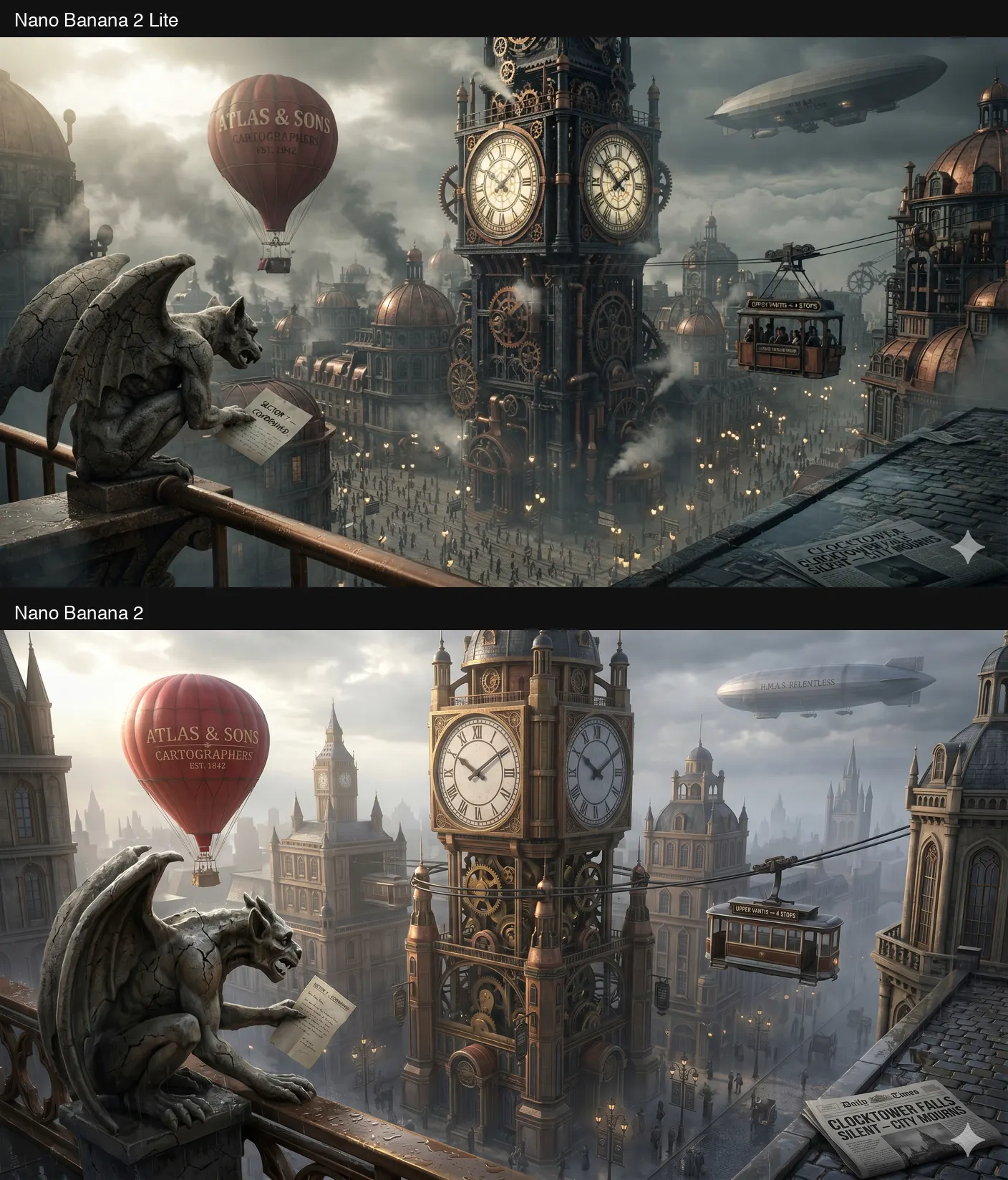
Prompt adherence testing used a different strategy: a dense, multi-element scene where each labeled detail functions as an independent failure point. The prompt described a steampunk cityscape viewed from a gargoyle’s perch—complete with a hot air balloon labeled “Atlas & Sons Cartographers, Est. 1842,” a cable car with a specific named route, a gear-driven clock tower, a gargoyle holding a document labeled “Sector 7 – Condemned,” a foreground newspaper with a specific headline, and a detailed Victorian street scene below.
The logic: If a model can hold 10 specific simultaneous constraints, you can trust it on complex creative briefs.
Both models produced visually compelling steampunk scenes. Both correctly place the gargoyle in the foreground, the clock tower at center, the balloon in the sky, and a cable car crossing the frame. At a glance, the differences feel cosmetic—the Lite version is darker and moodier, the full model cleaner and brighter. But the specifics tell a different story. In the Lite version, the balloon reads “Est. 1942” instead of 1842—mostly due to AI grappling to properly render text. The cable car route label is partially garbled. The foreground newspaper headline blurs at the edges, losing legibility on the details that were specifically requested.
Overall, it focused more on visuals than text, which is ok for most use cases.
Nano Banana 2 gets almost everything right. The balloon clearly reads “Atlas & Sons Cartographers Est. 1842.” The cable car sign says “Upper Vantis – 4 Stops.” The gargoyle holds a document, but the text is illegible. The foreground newspaper reads “Clocktower Falls Silent – City Mourns” in clean, readable type. Every named element appears where it should, with the correct label, in legible form. The compositional decision to use brighter, more editorial lighting also pays off here—it keeps the labeled details readable rather than swallowed by atmosphere.
Casual prompt users won’t catch a one-digit transposition on a fictional establishment date. But concept artists, worldbuilders, and narrative illustrators—the people using these models to communicate specific creative logic to clients or collaborators—will notice immediately.
The Lite model’s tendency to blur or transpose specific in-image text labels isn’t a catastrophic failure, but it introduces a manual correction step that compounds badly at scale.
Spatial Awareness
Spatial awareness testing evaluated how each model handles multi-depth scene composition: multiple objects at close range, a human subject in the middle distance, and atmospheric elements receding into background darkness.
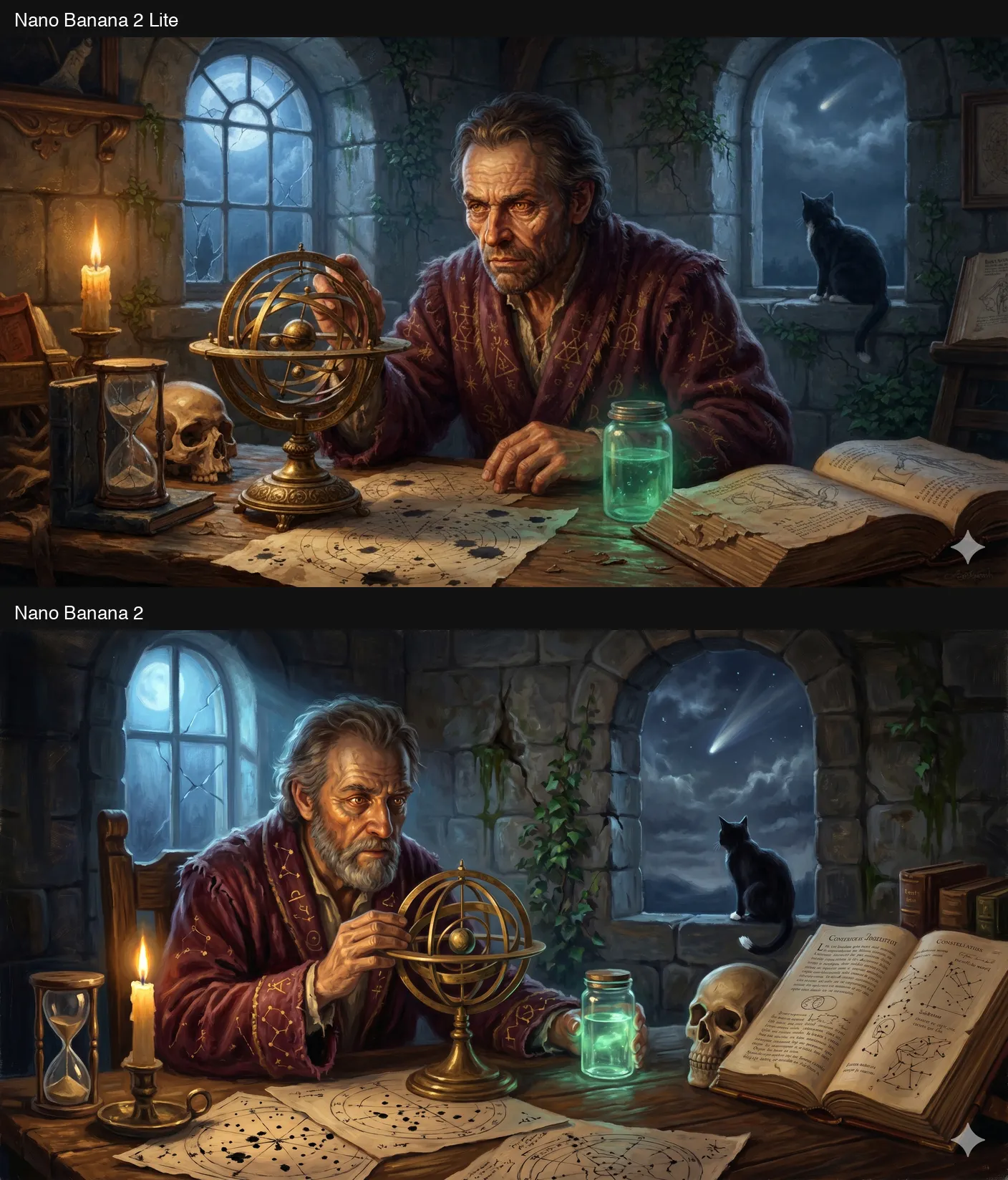
The scene—a medieval alchemist at a cluttered wooden desk, surrounded by an armillary sphere, a lit candle, an hourglass, a skull, star charts, and a glowing green jar, with a black cat silhouetted in an arched window behind him—requires convincing three-dimensional layering to read as coherent rather than assembled.
Both models understood the basic spatial grammar of the scene. Foreground objects are rendered at appropriate scale and shadow detail, the scholar occupies the mid-ground with correct occlusion relationships to the objects around him, and the arched window with the moonlit night sky creates a convincing sense of recession behind the scene. Neither model misplaces objects, collapses depth planes, or introduces spatial contradictions. The scene architecture—front, middle, back—is correctly established in both outputs.
The differences are subtle and real. Nano Banana 2’s version has a richer atmospheric depth gradient: The candlelight fades naturally as it reaches the stone walls, the background haziness reads as genuine atmospheric depth rather than digital softening, and the overall scene has a painterly warmth that suggests volumetric space. The Lite version’s depth is structurally correct but slightly compressed—the background reads marginally more like a stage flat than a receding room with actual air in it.
At least in this text, the Nano Banana 2 image feels like the same Nano Banana 2 Lite image with a detailed LoRA (a sort of specialized fine tuning layer) applied during sampling.
This is the smallest gap across all five tests. For storyboards, game asset concepts, and most editorial illustration contexts, both models demonstrate adequate spatial reasoning. The Lite model’s slightly flatter depth rendering becomes meaningful only in high-resolution output or detailed compositional analysis—and even then, the gap is arguable.
For this category, the Lite model is a viable substitute in the vast majority of practical workflows.
Text Generation
Text generation is where this review produces its most counterintuitive result.
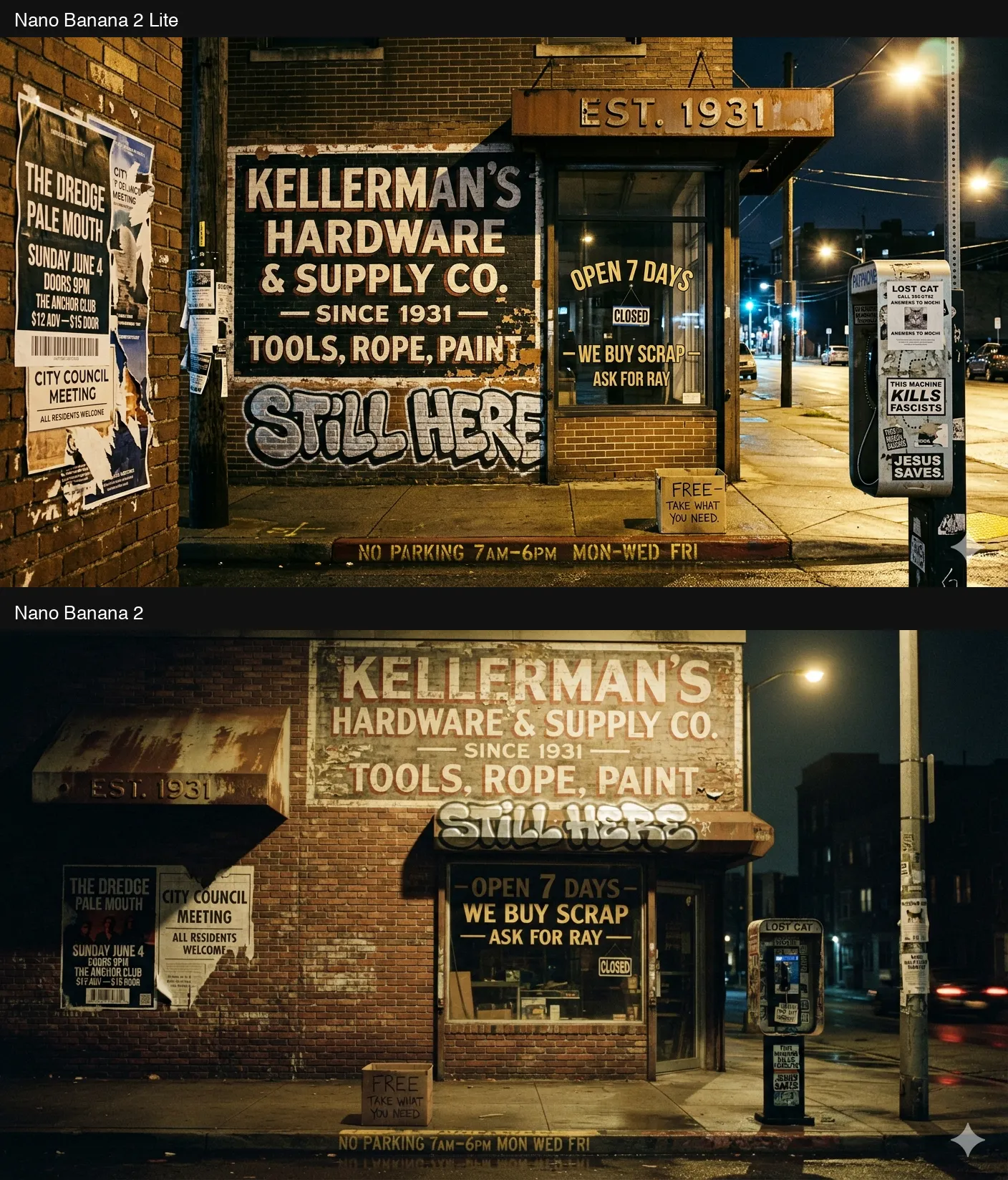
The test prompt described a gritty nighttime hardware store with dozens of simultaneous text elements at different scales and styles: a hand-painted main sign with the store name, founding date, and product categories; a graffiti tag on the façade; window decals with hours and services; a concert poster with band name, venue, date, doors time, and specific ticket prices; a city council meeting notice; a lost cat notice with a phone number; political stickers on a phone booth; and a street parking restriction on the curb.
Text generation at this complexity is difficult because each element has to be correctly rendered while the overall image still reads as a coherent photograph.
Nano Banana 2 Lite actually delivered something genuinely impressive for how fast it is. “KELLERMAN’S HARDWARE & SUPPLY CO. – SINCE 1931 – TOOLS, ROPE, PAINT,” graffiti reading “STILL HERE,” window signs for “OPEN 7 DAYS / WE BUY SCRAP – ASK FOR RAY / CLOSED,” a concert poster for “THE DREDGE PALE MOUTH / SUNDAY JUNE 4 / DOORS 9PM / THE ANCHOR CLUB / $12 ADV – $15 DOOR,” stickers reading “THIS MACHINE KILLS FASCISTS” and “JESUS SAVES,” a lost cat notice with a specific and legible phone number—every single text element in the prompt is correctly rendered and readable simultaneously in one image.
If there’s something to note, it’s that the image is less realistic. Some posters seem rendered by an editor with poor photoshop skills rather than genuine elements of the scene. One example could be the posters pasted on the phone booth. To be more realistic they should have some natural imperfections, and even deterioration signs. That said, this is a legitimately strong result for any image model, let alone the cheaper, faster one.
Nano Banana 2’s version is also strong. Most text is correctly placed and legible, and the overall image reads as a convincing nighttime scene. But the full model’s darker, moodier atmospheric rendering—generally one of its assets—works against it here. Several smaller sticker texts fall into shadow and lose legibility. The Lite model’s brighter, more neutral lighting, a quality that reads as a weakness in portrait work, becomes a clear advantage when the evaluation criterion is whether all the text in the scene is actually readable.
For text-heavy generation—signage mockups, editorial graphics, product concepts with labeled elements, infographic-style composed images—Nano Banana 2 Lite performs below Nano Banana 2. The model seems to either focus too much on visuals that text becomes garble, or focus so much on text that its placement in scene becomes unrealistic.
Conclusions
Nano Banana 2 Lite is not a straight downgrade from Nano Banana 2. It’s a focused tool with a specific ceiling, and that ceiling drops hardest in exactly the scenarios where photographic quality is the deliverable, and holds surprisingly steady everywhere else.
Cinematic portrait work, sophisticated lighting physics, fine material texture, close-inspection-quality skin rendering—all of these expose a clear difference between the two models. Style transfer also takes a meaningful hit, not in rendering quality but in contextual comprehension: the Lite model can execute a subject, but it struggles to capture the visual environment in which that subject lives. Prompt adherence degrades specifically on in-image labeled text accuracy—a narrow failure mode, but one that matters badly in worldbuilding, concept art, and any pipeline where specific in-image language carries meaning.
What holds up well—and in some cases holds up better—is specificity: if you require a lot of focus on something, it will make sure everything is there.
Spatial scene architecture, and basic compositional competence are also good. The text generation result warrants specific emphasis: If your workflow involves signage mockups, branded graphics, editorial composites with text-heavy elements, or any pipeline where multiple readable text strings need to coexist in a single image, the Lite model is worth reaching for first. Its brighter rendering defaults, a liability in portrait work, are an advantage when legibility is the metric. Spatially, it handles multi-depth scenes adequately for the vast majority of professional contexts.
On the cost math: at $0.034 per image, Nano Banana 2 Lite runs at roughly half the cost of Nano Banana 2 at 1K resolution ($0.067) and trades almost blow-for-blow with Seedream 5.0 Lite ($0.031–0.035). Reve 2.0 undercuts both dramatically at approximately $0.0067 per image via API, but doesn’t offer the deployment footprint that comes with the Nano Banana ecosystem: Search, NotebookLM, Google Photos, and the Gemini app running off the same model simultaneously.
For teams already inside Google’s infrastructure, that integration removes a platform-switching cost that pure-API alternatives can’t account for. If you know which use cases you’re in—and you’re not in the photographic quality bucket—Nano Banana 2 Lite earns its spot in the lineup, and might even be a better option than its more powerful brother.
Daily Debrief Newsletter
Start every day with the top news stories right now, plus original features, a podcast, videos and more.
Not every cinematic creation achieves blockbuster status, yet some movies manage to etch their names into the hearts and minds of audiences. These films, often referred to as cult classic films, do not always enjoy commercial success but have a unique charm that resonates with viewers over time. Their allure frequently develops through repeated viewings, allowing fans to delve deeper into the nuances of the storytelling that may initially go unnoticed. This acquired taste forms around unconventional narratives, quirky humor, and stylistic choices that embrace the eccentric.
The performances of actors in these cult classic films play a pivotal role in attracting dedicated fans. The quality of acting often becomes the foundation upon which audiences evaluate the impact of these unconventional movies. From Jake Gyllenhaal’s gripping display of teenage confusion in Donnie Darko to the unforgettable ensemble performances in Pulp Fiction, cult classic films boast a range of exceptional acting talent that enhances their status in cinema.
1. Donnie Darko (2001)
A Cult Classic Exploring the Mind of a Misfit
Directed by: Richard KellyRelease Date: October 26, 2001Runtime: 113 minutes
Donnie Darko is arguably one of the most recognizable films that delve into the struggles of misfits and outsiders. The narrative follows a troubled teenager named Donnie, played by Jake Gyllenhaal, who begins experiencing haunting visions of a figure dressed as a rabbit, named Frank. These apparitions, along with his instances of sleepwalking, guide him through an exploration of complex themes such as parallel universes and time travel.
Gyllenhaal’s performance is nothing short of mesmerizing; he effortlessly channels Donnie’s vulnerability and confusion, marking this role as a significant moment in his acting career. His portrayal brings depth to a character grappling with disturbances that are beyond his comprehension. Although mainstream awards overlooked Gyllenhaal’s performance, it is celebrated by fans who recognize the multifaceted nature of his character.
2. Fight Club (1999)
A Satirical Exploration of Identity and Consumerism
Directed by: David FincherRelease Date: October 15, 1999Runtime: 139 minutes
Despite its controversial reception, Fight Club has solidified its place in the realm of cult classic films. The film features an unnamed protagonist, portrayed by Edward Norton, who finds himself entwined in a chaotic world after co-founding a fight club with the enigmatic Tyler Durden, played by Brad Pitt. As the narrative unfolds, it critiques consumer culture and examines masculinity’s darker aspects.
Norton and Pitt deliver stellar performances that capture the film’s essence. Norton’s portrayal of a disenchanted everyman resonates with audiences struggling with modern life’s challenges, while Pitt embodies the rebellious spirit of Durden, making his character aspirational and dangerous at the same time. The shocking twist that reveals the duality of their characters exemplifies the actors’ remarkable ability to navigate complex personalities seamlessly.
3. The Rocky Horror Picture Show (1975)
A Cult Classic That Redefines Musical Norms
Directed by: Jim SharmanRelease Date: August 14, 1975Runtime: 98 minutes
The Rocky Horror Picture Show stands as a testament to campy brilliance and subversive storytelling. The film follows Brad (Barry Bostwick) and Janet (Susan Sarandon), a straight-laced couple who find refuge in a bizarre castle inhabited by Dr. Frank-N-Furter (Tim Curry), an eccentric, cross-dressing alien scientist. This chaotic night is filled with rock ‘n’ roll, sexual liberation, and peculiar characters welcoming viewers into an unforgettable ride.
Tim Curry’s portrayal of Dr. Frank-N-Furter is iconic, combining camp theatrics with emotional depth. His entrance performance of “Sweet Transvestite” exemplifies his magnetic screen presence and showcases the character’s vulnerability, especially in his powerful rendition of “I’m Going Home.” The film’s ability to confront social norms while offering extravagant entertainment contributes to its status as one of the best cult classic films.
4. American Psycho (2000)
A Dark Satire on Materialism and Identity
Directed by: Mary HarronRelease Date: April 13, 2000Runtime: 102 minutes
American Psycho serves as a satirical lens through which the excesses of the 1980s are scrutinized. Christian Bale takes center stage as Patrick Bateman, a seemingly successful investment banker living a double life as a ruthless murderer. The film artfully blends dark comedy with unsettling psychological themes, capturing the essence of a man torn between societal expectations and his primal urges.
Bale’s performance as Bateman underscores his versatility as an actor. He embodies the character’s chilling charisma, delivering an unforgettable monologue about music that culminates in violence. This descent into madness culminates in a portrayal that captivates viewers and critics alike, making Bale’s performance a significant highlight of the film.
5. Eternal Sunshine of the Spotless Mind (2004)
A Heartfelt Journey Through Memories and Relationships
Directed by: Michel GondryRelease Date: March 19, 2004Runtime: 108 minutes
Eternal Sunshine of the Spotless Mind is a poignant exploration of love, loss, and memory crafted by screenwriter Charlie Kaufman. The film follows Joel (Jim Carrey), who undergoes a procedure to erase painful memories of his ex-girlfriend Clementine (Kate Winslet). As Joel fights to preserve those moments, the film navigates the complexity of relationships in a deeply emotional narrative.
Carrey delivers a groundbreaking performance, stepping away from his typical comedic persona to reveal a more vulnerable side as Joel grapples with his issues. Winslet’s portrayal of Clementine adds depth and complexity to the narrative, capturing her character’s spirit and volatility. Their chemistry not only drives the storyline but also garnered both actors nominations for prestigious awards, cementing the film’s status in the realm of cult classic films.
6. A Clockwork Orange (1971)
A Controversial Examination of Violence and Free Will
Directed by: Stanley KubrickRelease Date: December 19, 1971Runtime: 136 minutes
Despite its provocative themes and unsettling imagery, A Clockwork Orange remains a highly discussed entry in the cult classic films canon. Centered on Alex DeLarge (Malcolm McDowell), a teenage delinquent, the film showcases humanity’s darker impulses while questioning the limits of free will. Through a journey of violence and redemption, the narrative pushes boundaries and challenges societal conventions.
McDowell’s portrayal of Alex is mesmerizing, encapsulating the character’s charm and disturbing nature. His chilling rendition of “Singin’ in the Rain” juxtaposes joy with horror, creating a haunting moment that resonates with viewers. The film’s exploration of state control and individual autonomy ensures its enduring discussion in cinematic circles.
7. The Princess Bride (1987)
A Fantasy Adventure Filled with Humor and Romance
Directed by: Rob ReinerRelease Date: October 9, 1987Runtime: 98 minutes
The Princess Bride is a timeless blend of adventure, romance, and humor that captivates audiences of all ages. The film follows Westley (Cary Elwes) as he embarks on a quest to rescue Princess Buttercup (Robin Wright) from the clutches of the evil Prince Humperdinck (Chris Sarandon). Along the way, he forms alliances with memorable characters like Inigo Montoya (Mandy Patinkin) and the gentle giant Fezzik (André the Giant).
Elwes shines as Westley, expertly balancing charm and bravery, while his iconic delivery of the line “As you wish” embodies the film’s romantic core. Patinkin’s performance as Inigo is equally memorable, with his fierce determination to avenge his father’s death capturing audiences’ hearts. These characterizations contribute to The Princess Bride‘s status as one of the most beloved cult classic films.
8. Pulp Fiction (1994)
A Masterclass in Nonlinear Storytelling and Strong Performances
Directed by: Quentin TarantinoRelease Date: September 10, 1994Runtime: 154 minutes
Pulp Fiction remains a quintessence of cult classic films, celebrated for its unique storytelling and intriguing characters. Set in the pulse of crime-ridden Los Angeles, the film weaves together several intersecting narratives led by hitmen Vincent Vega (John Travolta) and Jules Winnfield (Samuel L. Jackson). Their dialogues blend humor with sharp wit, while the intensity of their actions captivates the audience.
The film’s ensemble cast showcases Tarantino’s prowess in casting, with Travolta’s portrayal of Vincent making a significant impact on his career. The film’s exploration of redemption and morality is encapsulated in Jackson’s memorable monologue, “Ezekiel 25:17,” making it one of the film’s most powerful moments and a hallmark of cinema.
9. The Big Lebowski (1998)
A Quirky Exploration of Life’s Absurdities
Directed by: Joel and Ethan CoenRelease Date: March 6, 1998Runtime: 117 minutes
The Big Lebowski has developed a fiercely devoted fan base, as audiences appreciate the eclectic characters and offbeat humor woven into its narrative. The story follows Jeffrey “The Dude” Lebowski (Jeff Bridges), whose laid-back lifestyle is interrupted when a case of mistaken identity drags him into a convoluted plot filled with absurdity and chaos.
Bridges embodies The Dude perfectly, showcasing a character who finds humor in life’s mundane moments. John Goodman’s portrayal of Walter Sobchak adds a layer of intensity and depth, as he navigates through the bewildering events surrounding them. The film’s unique blend of absurdist humor and quirky storytelling sets it apart as a defining entry in cult classic films.
10. Man Bites Dog (1992)
A Darkly Humorous Commentary on Violence and Media
Directed by: Rémy Belvaux, André Bonzel, and Benoît PoelvoordeRelease Date: January 15, 1993Runtime: 95 minutes
Rounding out this exploration of remarkable cult classic films is Man Bites Dog, a bold and provocative mockumentary that immerses viewers in a disconcerting world. Through the lens of a documentary crew, the film chronicles the life of Ben (Benoît Poelvoorde), a charismatic yet deranged serial killer. The crew’s objectivity erodes as they witness the grotesque nature of Ben’s actions.
Poelvoorde’s portrayal of Ben is captivating; he shifts seamlessly between charm and calculated insanity. The film’s unsettling humor critiques society’s fixation with violence, and its morally ambiguous narrative provokes thought and discussions about the nature of media consumption. As one of the lesser-known cult classic films, Man Bites Dog carves its niche through provocative storytelling and outstanding performances.
Conclusion
The world of cult classic films offers a trove of cinematic gems that highlight extraordinary acting skills and distinct storytelling. Each of the films in this ranking showcases the power of performance in elevating narratives that often delve into the unconventional. While these movies may not have achieved commercial success upon their release, their enduring influence and devoted fanbases have solidified their positions in movie history. Celebrating the immense talent of the actors involved in these cult classic films only adds to their value, inviting viewers to engage with their complexities time and again.
Swift, the cooperative behind the world’s dominant financial messaging network, announced on July 9, 2026 that its blockchain-based ledger has moved from pilot concept to operational readiness, opening the door for round-the-clock cross-border payments powered by tokenized deposits. Seventeen banks spanning six continents are now preparing to run live transactions on the new infrastructure, marking one of the most significant institutional embraces of blockchain rails within regulated finance to date.
From Announcement to Activation in Nine Months
Swift first floated plans for the shared ledger last year, but the jump to a working system took shape quickly. Swift confirmed on July 9, 2026, that its new blockchain-based ledger is ready for initial use after nine months of development. That pace stands out given the scale of the undertaking — coordinating technical, legal, and compliance requirements across 17 major banks and a messaging network that touches more than 11,500 institutions worldwide.
The ledger functions as a shared orchestration layer rather than a replacement for existing settlement rails. Banks issue tokenized deposits — blockchain-based digital representations of customer account balances — on their own ledgers, and Swift’s new layer allows those tokens to move between institutions continuously, including outside standard banking hours. Final settlement still runs through conventional payment systems, meaning the ledger extends availability without displacing the risk, credit, and compliance controls banks already rely on.
SWIFT Unveils Blockchain Ledger For Global Banks
Why Tokenized Deposits, Not Stablecoins
A key distinction underpinning the pilot is that tokenized deposits are not crypto assets in the traditional sense. They are bank-issued digital instruments backed one-to-one by deposits, carrying the same regulated, credit-backed standing as conventional account balances. What changes is the plumbing beneath them: rather than routing through message queues that pause outside business hours, transfers now happen on a shared ledger with near-continuous uptime. That framing has helped Swift position the initiative as an evolution of trusted infrastructure rather than a parallel, less-regulated payment rail — a distinction banks and regulators have consistently insisted on when evaluating blockchain-based settlement.
A Global Roster of Early Adopters
The 17 participating banks read like a cross-section of the world’s largest transaction banking franchises: ANZ, BNP Paribas, BNY, Citi, DBS, First Abu Dhabi Bank, FirstRand Bank Limited, HSBC, Itaú Unibanco, Lloyds Bank, Mashreq, MUFG Bank, OCBC, Standard Chartered, UBS, UOB, and Wells Fargo. Executives from several institutions framed the launch as a milestone for liquidity management and client service. HSBC’s Manish Kohli said the bank is connecting its existing Tokenised Deposit Service to the new ledger, calling it a step toward payments that “work the way our clients’ businesses operate today — in real time, across time zones, and without artificial cut-offs.” UBS’s Andreas Kubli described interoperability as “the key enabler for scaling tokenised deposits beyond individual institutions,” while UOB’s So Lay Hua noted the shift from “concept to live infrastructure.”
Swift Chief Business Officer Thierry Chilosi said the ledger extends “the trust and stability of established finance into the frontiers of digital money,” adding that it lays groundwork for future innovation in programmable money and what he termed “agentic commerce” — a nod to emerging AI-driven transaction models.
Built on an Already-Fast Network
Swift is quick to note that the ledger builds on incremental gains already made to its existing rails. A full 75 percent of payments on the network reach beneficiary banks within 10 minutes, and often in seconds, and the cooperative is working with its member community toward G20 targets for faster international transfers. Earlier this month, Barclays, HSBC, Lloyds and NatWest also went live with a related Swift consumer payments initiative aimed at improving the retail transfer experience.
Part of a Broader Institutional Shift
The launch lands amid a broader convergence of institutional finance toward always-on, blockchain-settled infrastructure. Intercontinental Exchange, parent of the New York Stock Exchange, has separately outlined plans for a tokenized securities venue built around 24/7 trading and on-chain settlement. Industry observers note that if the Swift pilot validates the tokenized-deposit model at this scale, it could accelerate broader bank participation, given Swift’s existing footprint across more than 200 countries and territories.
For now, the ledger remains in a controlled go-live phase, with Swift saying functionality and bank participation will expand over time. The cooperative has stopped short of a timeline for full commercial rollout, but the involvement of institutions managing trillions in cross-border flows suggests the industry is treating this as more than an experiment.
I have to admit something. Last night, I was completely terrified while falling down a research rabbit hole about what would actually happen if we launched every single nuclear weapon on Earth—all thirteen thousand of them—directly at the Moon.
We are talking about a combined explosive yield of roughly 3,000 megatons of pure destructive energy. I honestly thought this unfathomable amount of power would shatter the Moon into a billion pieces, exactly like the Death Star destroying Alderaan in Star Wars. But as I kept digging into the physics and orbital mechanics behind it, I realized how incredibly insignificant I am—and we all are—on a cosmic scale.
The Star Wars Illusion vs. The Cold Reality of Space
If you were to look up at the night sky expecting an apocalyptic, earth-shattering light show, you would be incredibly disappointed. The reality of detonating our entire global arsenal in a vacuum is far less cinematic than Hollywood led me to believe.
Here is what would actually happen:
No Shockwaves: Space is a vacuum. Without an atmosphere to compress and carry a blast wave, there is no massive, expanding fireball of destruction.Tiny Flashes: From Earth, these world-ending explosions would simply look like brief, silent camera flashes in the dark.A Few New Scars: The Moon has been bombarded by massive asteroids for billions of years. Our 3,000 megatons would just carve out a few new craters, adding tiny scratches to an ancient, battered surface.Absolute Silence: Because sound requires a medium to travel through, the greatest explosive event in human history would be completely silent.
I sat there staring at my screen, feeling a strange mix of relief and profound smallness. The universe doesn’t care about our deadliest weapons. The cosmos barely flinches at what we consider absolute destruction.
The Real Nightmare: A Millimeter of Chaos
But the truly horrifying part I discovered later? The danger isn’t in blowing the Moon apart. The real nightmare lies in the delicate, invisible balance of orbital mechanics.
If the sheer kinetic force of these massive blasts shifts the lunar orbit by even a single millimeter, the consequences for us would be catastrophic. The Moon isn’t just a glowing rock; it is the anchor of Earth’s tides and the stabilizer of our planet’s axial tilt.
If we alter its path, here is what we face:
Oceanic Rebellion: The Moon’s gravity dictates the rhythm of our oceans. A sudden shift would cause the tides to go completely out of control. Coastal cities would face unpredictable, devastating tidal waves, and marine ecosystems would collapse overnight.Climate Collapse: Without the Moon holding us steady, Earth’s axis could begin to wobble erratically. This would destroy our predictable seasons, dragging the planet into absolute climatic chaos where extreme freezes and boiling heatwaves become the daily norm.Global Gridlock: The destruction of coastal infrastructure would mean the immediate collapse of global shipping and supply chains.
We Are Coding Our Own Doom
It scares me how easily humanity could trigger its own doom for absolutely nothing. We possess the technological capacity to obliterate our civilization, yet we can barely make a dent in a dead rock orbiting 384,000 kilometers away. We focus so much on destructive power, hoarding these weapons in silos, forgetting that our survival depends on a very fragile cosmic harmony.
Because remember, the future is not fiction; it is being coded right here, right now, by the choices we make today.
If you found this thought experiment as mind-bending as I did, please subscribe and support the journey so we can keep exploring these crazy concepts together. But before you go, I have to ask: if you held the launch codes to all those weapons, knowing that even a millimeter of change could doom us all, what would you do to ensure humanity never presses that button? Let’s talk in the comments.
Sony’s online banking arm has secured conditional approval from the U.S. Office of the Comptroller of the Currency (OCC) to establish a national trust bank subsidiary, positioning the Japanese entertainment and technology giant to issue and manage a dollar-denominated stablecoin in the United States.
The new entity, Connectia Trust, National Association, will be based in New York and capitalized with $40 million. Sony Bank, part of Sony Financial Group, will own the subsidiary outright. The board of Sony Financial Group Inc. ratified the plan on July 6, and the company disclosed the OCC’s conditional approval the following day.
Formation of Connectia Trust is expected this month, but the subsidiary is not slated to begin commercial stablecoin operations until 2027. As a national trust bank, Connectia will be permitted to hold customer assets and manage stablecoin reserves, but it cannot accept cash deposits or extend loans — restrictions typical of this class of OCC-chartered institution. Final approval still hinges on additional OCC review and sign-off from Japanese regulators before any token can be issued.
Sony Financial Group described the trust as intended to build a “medium- to long-term business foundation” for its digital asset ambitions. The framing suggests the stablecoin is meant less as a general-purpose payment rail competing head-on with market leaders, and more as an in-house settlement tool tied to Sony’s entertainment ecosystem. The company has previously indicated that U.S. customers could eventually use the token to pay for video games, anime content, and subscriptions across its PlayStation and entertainment platforms — a way to reduce reliance on credit-card processing fees.
Sony Bank Gains U.S. Approval for Stablecoin Trust Bank
A Crowded Field
Sony’s move lands in an increasingly competitive corner of the crypto industry. Stablecoin transaction volume hit a record $1.79 trillion in June, more than doubling year-over-year, according to Visa’s onchain dashboard. Dollar-pegged tokens account for over 99% of the roughly $311 billion stablecoin market, per DeFiLlama data, with Tether’s USDT and Circle’s USDC alone representing close to $250 billion of that total.
Stablecoin Market Cap (Source: DefilLama)
That dominance hasn’t stopped a wave of new entrants from pursuing federal trust charters. The OCC has granted similar conditional approvals to Circle, Ripple, Paxos, BitGo, Fidelity Digital Assets, and Stripe-owned Bridge, among others. Large traditional banks, including Morgan Stanley, have also pursued charters of their own. The rush has drawn scrutiny in Washington — Sen. Elizabeth Warren has questioned whether the OCC is extending national trust charters to companies that don’t meet the standards set out in the National Bank Act.
Sony filed its original OCC application in October 2025. Under a December 2025 agreement, Bastion Platforms is expected to handle issuance and custody infrastructure for the eventual stablecoin, according to reporting on the filing.
Regulatory Backdrop
The approval comes as U.S. stablecoin oversight solidifies under the GENIUS Act, which established the first comprehensive federal framework for payment stablecoins. That legal clarity has been a driving factor behind the recent surge of trust-bank applications, as companies look to operate under a single federal regulator rather than a patchwork of state money-transmitter licenses.
A national trust charter also keeps issuers outside the deposit-insurance and prudential capital requirements that apply to full-service banks, while still subjecting them to OCC supervision — a middle ground that has proven attractive to both crypto-native firms and traditional financial institutions entering the space.
Sony’s Broader Position
The stablecoin push is one of several notable moves for Sony this year. The company also announced plans to end production of physical PlayStation game discs starting in 2028, part of a broader shift toward digital distribution — a decision that has drawn some backlash from collectors and longtime PlayStation users.
On the market side, Sony Group Corporation (NYSE: SONY) closed at $21.15 on July 8, 2026, down from a 52-week high of $30.34 and trading closer to its 52-week low of $19.32. The stock’s decline this year comes despite a mixed fiscal Q4 report in May, which showed record annual operating income alongside a net income dip tied to the absence of prior-year tax benefits. Analysts covering the stock currently rate it a consensus “Buy,” with price targets ranging up to $34.
Whether Connectia Trust becomes a meaningful new player in the stablecoin market — or remains a niche settlement tool for Sony’s own ecosystem — will depend on how quickly the company can clear its remaining regulatory hurdles and whether it can carve out demand in a market still dominated by two established incumbents.
In the kart-racing genre, Mario Kart’s reigns supreme. But the social media team behind Garfield Kart: Furious Racing and Garfield Kart 2: All You Can Drift didn’t miss a chance to dunk on Nintendo’s decision to sunset Mario Kart Tour this fall.
On X, the official account for Garfield Kart declared its superiority to Mario Kart because it “will not randomly kill your game license.”
While the Garfield Kart games are far behind Mario Kart in terms of popularity, the title characters do share a connection on the big screen. Guardians of the Galaxy’s Chris Pratt is the voice of Mario in The Super Mario Bros. Movie and its sequel, while also portraying Garfield in the most recent animated film. That’s about as close as these two franchises will come to a crossover short of another Smash Bros. sequel that may seek lasagna-craving felines for its roster.
Mario Kart Tour will be shut down on September 29, seven years after Nintendo began its push into mobile. Most of Nintendo’s other mobile games from that era have also shut down, with a few exceptions including Super Mario Run, Fire Emblem Heroes, and Pikmin Bloom.
On consoles, Mario Kart World is currently the best-selling game on Switch 2, and it dropped a new update earlier this month. Two additional Knockout Tour routes were included in that update, with at least six more routes slated to be added in future updates.
Days of Our Lives delivers couples updates in Salem. And we’re going to talk about who is getting together and who is walking away from each other because there are big shifts coming soon. We just saw EJ DiMera (Dan Feuerriegel) kissing Cat Greene (AnnaLynne McCord), but she’s got an agenda.
We’re also going to talk about Brady Black’s (Eric Martsolf) relationship. What’s going on with his ex Kristen DiMera (Stacy Haiduk) plus Chad DiMera and his new love interest. But before we get into all the action coming with lovers in Salem.
All right, we’re going to rank these couples on who is hitting it and who is quitting it.
Days of Our Lives: Romance Shifts and Love Triangles
Let’s get right into it. Starting with EJ and Cat. It seemed pretty out of left field this week when she accused Rafe Hernandez (Galen Gering) of jealousy at the very idea that she might hook up with EJ. I was genuinely perplexed and Rafe seemed to be as well. And he told Cat he was shutting down her investigation, but she seems quite committed to taking EJ down and said since she is ISA, that means Rafe has no control over her. But Andrew Donovan (Colton Little) already warned Cat not to sleep with EJ and so did Rafe.
And then Cat marched over to the DiMera mansion and told EJ what she remembered from her recent hypnosis session. Then she kissed him. And he was actually a total gentleman with Cat and said she was worth the wait. So, I do think EJ and Cat are going to hit it, but before too long they’re going to quit it when he finds out that she’s been plotting against him.
Days of our Lives: Chad’s Messy Love Life
Now, let’s talk about EJ’s younger brother, Chad, because he had a whole thing going with Cat until Jennifer Horton (Melissa Reeves) pitched a fit and had it written into his custody papers that Chad can never date her. And if you remember, Cat and Chad had just started hitting it when that happened. But because Thomas found out she was pretending to be his dead mom, Abigail, then they had to quit it because Chad wasn’t going to lose his kids just so he could keep sleeping with Cat.
Right now though, Chad is with Belle and I think before too long they’re going to be hitting it. But I think really Chad wants to be still hitting it with Cat. But on top of the whole custody consideration, when Chad finds out how close Cat has been to EJ while his brother’s been doing bad things, that will disgust Chad. And that means Cat may never get a chance with him again.
Days of Our Lives: Brady and Sarah’s Love Story
All right, let’s talk about Brady Black. He is falling head over heels in love with Dr. Sarah Horton (Linsey Godfrey) and very soon they’re going to swap “I love you.” We’ve even heard that Brady might propose to Sarah. Unfortunately, her heart still belongs to her ex-husband Xander Cook Kiriakis (Paul Telfer). Right now, Brady and Sarah are regularly hitting it. But once she realizes that Brady has fallen hard for her while she is still emotionally tangled up about her ex, I think that will be the end. And they’re quitting it. Of course, Sarah’s been having dreams about hitting it with Xander again.
And speaking of her ex-husband, he’s hitting it with horrible Kristen. Gwen Rizczech (Emily O’Brien) had also been hitting that. But now that she’s found out Xander is warming Kristen’s sheets, she is heartbroken. And she’s trying to quit and forget any feelings that she has for Xander.
We’ve got a spoiler for July that says Kristen and Xander get in deeper with each other while they are plotting on how to take down EJ. But it’s not too much longer until Xander and Kristen go from hitting it to quitting it because he is still in love with Sarah.
Plus, we know that Kristen is going to be kidnapped for all of her horrible deeds. And it looks like Stacy Haiduk is going to be exiting for a while. But in the next couple of months, we will see Xander and Sarah on the road to a reconciliation. And once they start hitting it, they’re going to get remarried. And hopefully they won’t ever be quitting it.
Days of Our Lives: Brady Black – Kristen DiMera
Days of Our Lives: Gwen and Philip’s Rebound Romance
Now, let’s circle around to Gwen, who is absolutely furious that one of her few friends in Salem, Kristen, decided to violate the girl code and was sleeping with Xander. And then worse, Kristen even told Gwen that he probably wouldn’t have been sleeping with her if she had known how to satisfy him. I mean, that was a big ouch. So, even though Gwen and Xander were supposedly just having cheeky fun, Kristen knew that Gwen still really loved Xander. But you know the old saying, the best way to forget one man is to get under another one.
And there is a heartbroken hunk in Salem that could use Gwen’s attention. And of course, I’m talking about Xander’s brother, Philip Kiriakis (John-Paul Lavoisier). He is absolutely devastated that Gabi Hernandez (Cherie Jimenez) conspired with Tony and bugged his and Xander’s office.
Now, I don’t think that Philip is ever going to forgive Gabi. Not ever. And I tend to think that she’s going to keep putting herself into Theo Carver’s (Tyler Joseph Andrews) orbit, even though he really hates her right now. But I kind of feel like Days of Our Lives is planning to pair off Gabi and Theo, and then they’ll be hitting it. Meanwhile, they’ve already orchestrated several scenes with Gwen running into Philip.
Philip & Gwen Rebound Ahead on DOOL?
So, these look like red flags that those two are going to be in some sort of rebound romance. Realistically, Xander can’t say anything since he and Gwen were casual, even though she wanted more. And since Philip knows that Xander has been sleeping with Kristen and in general being a himbo, I don’t think Philip would see it as a big deal if he started hitting it with Gwen.
And in a way, Philip and Gwen might actually be a good pairing because they both have such drastic daddy issues. So, you never know if Gwen sticks around, she and Philip might go from a rebound hookup to a real romance, one with actual feelings because they’re both kind of love starved at this point.
Days of Our Lives: EJ DiMera – Gwen Rizczech
Days of Our Lives: Leo and Dimitri’s Deal
Last but not least, we are going to dip into something from the big Days of Our Lives summer promo. So, right now we have Leo Stark (Greg Rikaart) suffering from another brain injury and also a serious case of boyfriend envy because he’d really like to be back with his ex Javi Hernandez (Jacob Martinez). But he is very happy with his new boyfriend Gus (Michael Ocampo). If you remember, Leo rejected hunky Dimitri von Leuschner (Peter Porte).
And that’s because Leo wanted to pursue Javi. And then Dimitri left Salem angry after doing all he could to make sure Javi would never take a second look at Leo. But in the big promo, we know that Dimitri is back to Salem. So, in the next few weeks, we are going to see Dimitri return and we’re going to have Dimitri in a tense conversation at the DiMera mansion with Rafe, Leo, and Gwen.
DOOL: Rafe Tries to Make a Deal
And I’m assuming based on the location that it’s something to do with EJ. We’ve got Rafe trying to bargain with Dimitri, but Gwen’s ex-husband doesn’t seem to be open to cutting a deal with Rafe. But whatever it is, it seems to be really important. So Leo steps up and he asks Dimitri if he won’t make a deal with Rafe, will Dimitri make a deal with him instead? And we know that while Leo was helping Dimitri try and clear his name in Alamania, he kept refusing intimacy because Leo was still hoping that he had a chance to get back with Javi.
So, they weren’t hitting it. And then Leo made it clear that they weren’t going to be hitting it. But if Javi sticks with Gus, we could see Leo using himself as a bargaining chip to get what they want from Dimitri. So, they might go back to hitting it before he inevitably leaves Salem and then they have to quit it. That’s it. That’s our couple update. Hope you enjoyed it.
Apple sued OpenAI and two former employees, alleging theft of hardware trade secrets.
The complaint claims former Apple employees accessed confidential files, shared supplier information, and used internal information at OpenAI.
The lawsuit follows OpenAI’s $6.5 billion acquisition of Jony Ive’s hardware startup io Products.
Apple has sued OpenAI and two former employees, accusing the ChatGPT maker of using stolen trade secrets for its consumer hardware efforts.
The complaint, filed Friday in the U.S. District Court for the Northern District of California, names former Apple senior system electrical engineer Chang Liu and former iPhone and Apple Watch design executive Tang Yew Tan, along with OpenAI Foundation, OpenAI Group PBC, and io Products.
Apple alleges Liu, who left the company in January after eight years, failed to return a company laptop and later accessed Apple’s internal systems through an authentication bug.
“While employed by OpenAI, Mr. Liu also exploited a rare, previously unknown authentication bug to access Apple’s shared network folders,” Apple’s attorneys said in the complaint. “Upon discovering that he had this unauthorized access to Apple’s systems, Mr. Liu did not report it, return his stolen Apple-issued work laptop, or delete the program that allowed the access.”
Apple alleges Liu downloaded dozens of confidential hardware files, including information about unreleased products, engineering presentations, technical specifications, and proprietary project data.
The company also alleges Tan, who spent 24 years at Apple before becoming OpenAI’s chief hardware officer, used confidential information from his time at Apple to benefit OpenAI.
The complaint claims Tan used Apple’s internal project names during OpenAI interviews and asked about unreleased products. Apple also alleges candidates were told to bring “actual parts,” for “show and tell.”
Apple further claims OpenAI’s recruiting process requested “CAD/design artifacts,” prototypes, supplier information, and details about employees’ work on Apple hardware.
Apple and OpenAI did not immediately respond to a request for comment by Decrypt.
The lawsuit follows OpenAI’s $6.4 billion acquisition of io Products, the hardware startup founded by former Apple designer Jony Ive. Ive is not named in the complaint.
According to the filing, OpenAI’s hardware division has hired more than 400 former Apple employees. Apple claims it contacted OpenAI in February with concerns about confidential information entering the company but did not receive a response.
The news comes after a separate trade secret dispute between OpenAI and Elon Musk’s xAI. In September, xAI sued OpenAI, alleging the ChatGPT maker recruited former employees to obtain confidential source code, training methods, and data center strategies.
OpenAI denied the allegations, and a federal judge dismissed the lawsuit in June, finding xAI failed to show OpenAI encouraged a former employee to disclose confidential information.
The lawsuit is a stark pivot from Apple and OpenAI’s earlier relationship.
In 2024, Apple tapped OpenAI to bring ChatGPT to Siri as part of its Apple Intelligence initiative. However, earlier this year, Apple turned to Google’s Gemini to power its next generation of AI models after delays stalled the rollout.
Daily Debrief Newsletter
Start every day with the top news stories right now, plus original features, a podcast, videos and more.
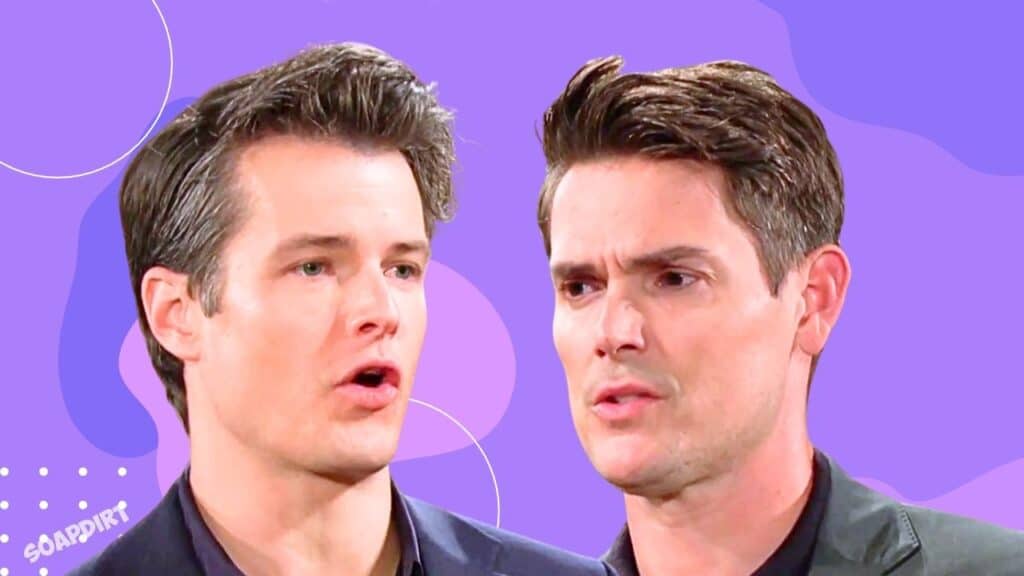
Young and the Restless fans. We have got exciting new spoilers for next week. We’re going to talk about Kyle Abbott’s (Michael Mealor) secret plan to get revenge for the attacks on both of his parents. Plus, we’ll have Adam Newman (Mark Grossman) defying his dad, Victor Newman (Eric Braeden), and refusing to follow orders for a very understandable reason.
So, we’ve also got spoilers for Lauren Fenmore (Tracey Bregman), Traci Abbott (Beth Maitland) and Ashley Abbott (Eileen Davidson). Also for Billy Abbott (Jason Thompson), Patty Williams (Stacy Haiduk), Victor, and more.
Young and the Restless: Adam Defies Victor’s Plans
First, let’s talk about what has Adam Newman pushing back hard on his dad. At the end of this week, he’s talking with Victor and Nick Newman (Joshua Morrow). And first, Victor bothers Adam when he says that Nikki Newman (Melody Thomas Scott) needs to rest, so Chelsea Lawson (Melissa Claire Egan) and Connor Newman (Judah Mackey) can’t come visit. That seems kind of rude.
And then Victor starts talking business with his son and he says that he rehired the people that Phyllis Summers (Michelle Stafford) fired and he’s doing some counter moves because she sold off some important divisions of Newman.
So, Nick has some ideas, but Victor shuts him down and he says it’s going to be Victoria Newman (Amelia Heinle) running Newman alone. So, both Nick and Adam are shocked and then Victor tells Nick he can come back to work at Newman Enterprises once he’s beaten his addiction. His son doesn’t like it, but Victor is being inflexible.
Young and the Restless Spoilers: Victor Shocks His Kids
Then Victoria shows up and Nick says they heard she’ll be the sole CEO. And of course, Victoria says that daddy is 100% right. And then let’s get over to Adam. So he tells Victor that he and Chelsea want to rebuild Newman Media and they want to use Arabesque, the company that Victor stole from Cane Ashby (Billy Flynn) as the foundation. And Nick and Victoria really like Adam’s idea. But then Victor tells them that he gave Arabesque to Phyllis.
All three of his kids are in shock and Adam, Nick, and Victoria don’t like this, especially not since it’s the first they’ve heard of it. Victor says he hates Phyllis and he hates what she did, but he admires that she pulled it off. That sounds like BS to me. And Victor brings up Phyllis and Matt saving Nick’s life. All of this seems like a big cover story. Honestly, I think the only reason Victor gave Arabesque to Phyllis was to tick off Cane. That’s it.
Young and the Restless Spoilers: Adam Pushes Back on Victor
So, Adam asks about a consolation prize and Victor says they’re going to go after Spectra Charles and that will be Newman Media again. Victor says, “Then Adam can have that.” But he does not like Victor’s suggestion at all. In fact, Adam refuses to go after Sally Spectra’s (Courtney Hope) company, but Victor doesn’t care. He says it’s happening.
So, in next week’s Young and the Restless spoilers, Adam tells Victor that he needs to give him and Chelsea 6 months to put their plan into action. And Adam says after that, if it doesn’t work, then Victor can do whatever he wants. So, it sounds like Adam is suggesting an alternate strategy to redevelop Newman Media, but Victor doesn’t like it and tells Adam to take or leave his offer.
So, I’m sure that Sally’s pregnancy is at the heart of this issue for Adam. Since Sally lost their baby, Ava, he is very compassionate. And I’m sure Adam doesn’t want to declare war on Sally and stress her into a miscarriage or into some kind of pregnancy complications. And I doubt Chelsea is going to want to do that either because that’s also Billy’s baby. And especially because Sally didn’t steal Newman Media. If you remember, Phyllis did that and she’s the one who rolled it into Abbottcom for Billy. So Sally’s kind of collateral damage.
Young and the Restless: Kyle’s Revenge Against Victor
Also, at the end of this week, we saw Kyle frantic. He was running with his mom, Diane Jenkins (Susan Walters), in his arms, yelling for help from a doctor. And that’s because Patty injected Diane with a syringe meant to kill Jack Abbott (Peter Bergman). So a nurse checks over Diane and thankfully Kyle grabbed the syringe and gave it to her to check. So the doctors work on Diane and she and Tracy tell Kyle go check on Jack because he’s awake.
So, Kyle rushes in to see his dad and tells Jack they were scared they were going to lose him. And then Kyle tells Jack that Patty was about to finish him off. And then she ran and she drugged Diane. And now the cops have arrested her. And Jack wants to tell the police that Patty stabbed him.
But it looks like Detective Burrow (Matt Cohen) finally bought a clue. So Traci ears a scuffle in the hall. Patty bit the guard that Kyle hired and they bust in. Detective Burrow is there as well. Kyle wants to know what Patty and Jack did Diane with, but she won’t say. She calls it a surprise. Jack’s disgusted with Patty. Says he’ll see her in court when she’s convicted and sent to prison for life.
Young and the Restless Spoilers: Ashley Abbott Returns
So, Patty’s taunting Jack about what she did to Diane. And then the cops haul her off. So Ashley burst in straight from Paris in an absolute panic. And then Diane and Jack kiss and make up. So, next week we’ve got Kyle Abbott launching this revenge plan. So, Billy was already telling Jill Abbott (Lauren Koslow) that Victor needs to pay because he brought Patty to town, and Jill agreed there should be consequences.
I actually did a video yesterday asking whether Patty will roll over on Victor. And spoilers for Young and the Restless next week have me thinking it might actually happen because Billy and Kyle talk about the Victor problem. Billy says that Victor’s a big target yet everybody keeps missing, but Kyle’s super ticked and says, “Not this time.”
So, Victor’s the reason Kyle was almost orphaned this past week. And bringing that psycho Patty to town and paying her to rape and kidnap Jack is a big problem. So, Kyle wants Victor to pay. Very understandable. So, he heads over to see Patty in her holding cell at the jail.
Young and the Restless: Kyle Abbott – Adam Newman
Y&R Spoilers: Kyle Stuns Patty
She’s in a jail house denim shirt. And this is funny. I cannot tell you how many times I’ve seen Stacy Haiduk dressed like this. Her character on Days of Our Lives, Kristen DiMera, is a real villainous piece of work and has been in prison many, many times. So, it’s a standard soap costume for the actress. And when Kyle shows up to see Patty, she says that Kyle is not the Abbott she was hoping to see.
But I’m expecting Kyle to make Patty an offer to flip on Victor and bring him down in exchange for some sort of bargain where Patty won’t go to prison for decades. Honestly, she just needs to be back in the psych ward. I fully expect that she will cut a deal with Kyle. I mean, why wouldn’t she? Patty has no loyalty to Victor. She shot and nearly killed him before. She hates him. And she may be upset because this whole scheme didn’t work and Patty didn’t wind up with Jack.
So, she might be ticked that Victor brought her there for nothing. I would be here for that. Also, given that Burrow now knows that Patty lied and is homicidally insane, they should circle back around and arrest Dr. Markham (Jere Burns), who might also turn on Victor because we know that Victor paid Patty to kidnap Jack. And it could be that Victor paid Markham to let Patty loose so that she could go after Jack.
New Y&R Casting and Spoilers
Also, next week, there’s some spoilers that I don’t know if they’re going to move any story lines forward, but I’ll tell you about them. So, we’ve got Ashley and Traci hanging out with Lauren, and they are declaring her an honorary Abbott. So, that’s it. That’s the spoiler. Also, one tidbit of casting news. There is a new face in a recurring role that’s coming to Y&R. Marie Kirkland (Jade Harlow) is popping up in about 4 weeks, and she will be recurring, not contract.
The thing is, I don’t think we need more women on Young and the Restless. She’s coming to Genoa City looking for a fresh start, but honestly, we already have several men that need romantic partners, so there’s an imbalance on the soap already. There’s just not an equivalent amount of women and men, you know. Be sure to check out our complete weekly spoilers video tomorrow for the week of July 13th through the 17th. Plus, don’t miss our Y&R weekly prediction edition, our two-part spoilers, and lots, lots more.