The Call of Duty movie has been an unknown quantity since its announcement almost a year ago, but a panel hosted during today’s Fanatics Fest has just turned things around.
As part of the Call of Duty in Culture Panel, reported on by Variety, director Peter Berg has dropped the biggest hint yet as to how his work will connect to Activision’s flagship series.
According to Berg, the Call of Duty movie adaptation is going to be set in the Modern Warfare universe. This says a lot and very little at the same time, because as anyone who’s played any Call of Duty series will tell you, things aren’t quite as simple.
Related
Spielberg Reportedly Wanted To Direct Call of Duty Movie
There was a deal-breaker that allegedly spooked Activision.
Modern Warfare is Dead, Long Live Modern Warfare
Once upon a time, Call of Duty was little more than Vince Zampella and friends trying to make their own Medal of Honor. The new game took everything that made its inspiration great and cranked it up to 11, resulting in a cinematic masterpiece that was unparalleled at the time.
After such a strong start, Activision decided a major revamp was necessary to stay ahead of the curve. Instead of the classic World War 2 heroics with good guys versus bad guys, it brought the series into the messy world of modern geopolitics and conflicts.
2007’s Call of Duty 4: Modern Warfare was a generational shift, and I firmly stand for it being the best in the series by a long shot. That’s not to say Modern Warfare 2 and everything that came after is inherently bad, but MW1 was lightning in a bottle, with the right amount of cynicism and messiness.
Activision decided a major revamp was necessary to stay ahead of the curve.
Twelve years after the first release, Infinity Ward rebooted the franchise. Modern Warfare 2019 promised to go even further than its predecessors, and though its multiplayer element remains controversial, the campaign’s tone helped bring Call of Duty back to the forefront of pop culture.
Infinity Ward’s Korean Gambit
The timing of the Call of Duty movie could not have been better, with Paramount Pictures hoping to release it on June 30, 2028, just shy of two years after the predicted release date for Call of Duty: Modern Warfare 4.
Call of Duty: Modern Warfare struggled to capitalize on the momentum generated by the 2019 reboot, and although the two games that followed had their moments, the general consensus is they fall behind both the reboot and the 2007 original, with the political overtones in particular not quite living up to the standards set by the franchise.
Still, it’s laudable that rather than hitting the reset button once more, Modern Warfare is going all-in to bring the Modern Warfare reboot back to the highs it reached on release, and the Korean peninsula is a key part of that.
Rather than the abstract struggles of Urzikstan or Kastovia, Modern Warfare 4 is going back to what worked way back in 2007: real locations, and escalations built on real political nuances.
The promotional material has thus far taken us through South Korea, North Korea, France, the United States, and India, with likely more destinations to unveil themselves in the campaign. If the movie follows this grounded approach, we might actually have a high-stakes espionage thriller on our hands to fill the void left by the conclusion of Amazon’s Jack Ryan.
Call of Duty: Modern Warfare 4 comes out on October 23, 2026, and will be available for PC, PlayStation 5, XBOX Series X|S, and the Nintendo Switch 2. Campaign early access is available for digital pre-orders.
Next
Flight Sim Il-2 Korea Release Date Hits the Peninsula Before Modern Warfare 4
Don’t worry Amiga owners, we haven’t left you out of the news! As I’ve been informed that as of this week you can try out Gloom Reforged by Andiweli! A new AI-assisted, assembly-coded overhaul for Amiga AGA systems, bringing modernized visuals and controls to the classic shooter series, including support for mouse and keyboard input. The project, compatible with the 90’s Gloom, Gloom Deluxe, Gloom 3, and Zombie Massacre, features a reworked renderer with Bayer dithering, enhanced fog, and persistent configuration settings, and is currently available for testing.
Furthermore Gloom Reforged aims to build an enhanced Amiga version of the classic shooter, utilizing the original, unmodified earok/GloomAmiga source code as a clean foundation. This project focuses on reorganizing and extending the game for modern Amiga hardware while strictly preserving the original, high-speed gameplay and atmosphere. You can find more information in the official developer update!
Requirements :
AGA only, so if you try on other than A1200/A4000 it won’t work. I heard some people wondered it doesn’t work on A500 🙂If you expect AAA PC shadows and reflections you might be disappointed, we are still talking about Gloom, the Engine is the same as in the 90s. It has optional blob-shadows and “reflection-ish” colored dots on the floor (see screenshot 4 and 5).And of course it needs more power than the old one because of the changes. So don’t expect it works better than original Gloom.And this is only compatible and tested with PiStorm32 – it might/might not work on other hardware constellations.
Planned Scope Changes :
Bug fixes for the original source code in gloom2.s Integrating the health/weapon-bar and gun/muzzleflash graphics Improved keyboard and mouse controls for a smoother FPS-style experience Integrating new options in the ingame-menu Improved render depth for far areas (to possibly avoid banding) Optional visual enhancements such as muzzle flashes, atmospheric effects and subtle dynamic lighting Keeping compatibility with real Amiga systems as a priority, not only emulators Maintaining the original Gloom gameplay structure, assets and atmosphere as the foundation Compatibility to Gloom Deluxe, Gloom 3 and Zombie Massacre (Gloom has other assets, no gun, other statusbar, etc) Graphicscard/P96 compatibility
[UPDATE] : Trawling through the EAB forums looking for any updates regarding Gloom Reforged and I’ve just found out that the developer has made available version 1.7. Here are the changes.
FPS counter is now available via Tooltype “FPS” (Note: Gloom runs at a max. framerate of 25 FPS)Tooltypes cleaned up (AGA/P96, P96 can be combined with 5:4/STRETCH/WIDE/HIRES)Stretch Cleanup (use 400×240/preferred 800×480 only and prefer 428×240/preferred 854×480)Widescreen rendering with the same resolutions as above (Note: resolution has to be active in P96Prefs)5:4 mode for 320×256 rendering (with HIRES 640×512)gloomgame is now ignored because it caused errors. Level select works per level and not per episode anywayThe color palettes have been corrected in Gloom3 and Zombie Massacre; the colors and font are now correct.
After decades in fashion education, I often find myself reflecting on what truly matters for aspiring designers. When considering new topics to share with our community of subscribers and followers, one idea stood out: why not pass along the most valuable lessons I’ve learned over the past 25+ years?
During my time at the Fashion Institute of Technology—17 years teaching in the classroom and 3 years serving as Chair of the Fashion Design department and then 6 years teaching graduate level fashion design at the Academy of Art —I had a front-row seat to students’ journeys into the fashion industry. I saw firsthand how they navigated everything from the application process to making the most of their education once accepted.
In this two-part series, Part One focuses on guiding prospective students through selecting and applying to fashion colleges. Part Two will shift to supporting educators, offering insights on how to help students thrive and create a meaningful, positive experience once they begin their fashion school journey.
How to Pick a Fashion College
UoF’s free list of global fashion schools — 2-year and 4-year fashion school options. (Image credit: University of Fashion.com)
Choosing the right fashion college is one of the most important decisions in your journey. As you explore your options, take time to ask yourself a few key questions:
How far from home am I willing to go for school?
Should I pursue a two-year program or commit to a four-year degree?
Which schools offer the strongest programs for my specific interests? For instance, if you’re passionate about costume design, which colleges specialize in that field?
What famous fashion designers graduated from this college?
What are the admission requirements, and can I realistically meet them? Consider factors like minimum GPA, standardized test scores, and, most importantly, portfolio expectations.
What is the tuition and do they offer scholarships and/or financing options?
Once you’ve researched and narrowed down the schools that you’re excited about, the next step is applying. Be sure to schedule visits to your top choices whenever possible. Walking the campus and experiencing the environment firsthand can help you picture your life there. For example, some students accepted to FIT later realized that living in a fast-paced city like New York wasn’t the right fit for them.
The Fashion College Application Process
University of Fashion’s lesson, Portfolio Tips for Fashion College Admissions (Image credit: University of Fashion)
In a recent conversation with Tina, a Chicago-based high school senior applying to fashion schools, she described the process as anxiety-producing and overwhelming. Her high school did not offer sewing classes, and its art program lacked guidance on building a fashion portfolio, leaving her to navigate the requirements on her own. Many of the schools she applied to expected both sewn garments and a strong fashion illustration portfolio. A surprise since wasn’t that the whole reason she should go to a fashion school in the first place?
Fortunately, Tina had an early advantage. During her sophomore year, her aunt gifted her a subscription to University of Fashion. Through its lessons she learned how to sew, draw fashion figures, and develop a cohesive portfolio. The platform also provided valuable resources, including a global directory of fashion schools, guidance on crafting a compelling admissions essay, and insight into what makes a portfolio stand out. The lesson, Portfolio Tips for Fashion College Admissions is an amazing guide that takes you through the whole process and is taught by a current FIT professor.
Tina also discovered that expectations vary by school. Some programs require original fashion design work, while others accept fine art pieces as part of the portfolio.
As applicants prepare their materials, it is important to ask:
Does my personal statement clearly express my passion for fashion?
Am I knowledgeable about the fashion history, current industry trends, and key sectors such as couture, luxury, and sustainable fashion?
Fashion college admissions teams want to see that applicants are fully committed and genuinely invested in pursuing fashion.
The Dos & Don’t of the Fashion College Essay
Your portfolio matters, but your essay should reveal who you are as an artist. Some schools require an artist statement—use it to explain your work, philosophy, aesthetic, and point of view. Colleges are looking for fresh, exciting, and innovative work. Show what makes your voice meaningful in fashion. Read the essay requirements carefully, since they want you to answer the question, not just talk about what you want to talk about.
Essay Dos
From UoF’s costume history lesson series, 100 Years of Fashion Rebels & Revolutionaries – Part 1. (Image credit) University of Fashion).
Immerse yourself in fashion—costume history, magazines, blogs, fashion shows and exhibitions—and stay aware of broader culture, from museums to pop and emerging artists. Know key designers, both established and new, and understand enough fashion history to reference it thoughtfully (e.g., Chanel’s legacy, the New Look, punk and grunge).
Write from a clear sense of the impact you want to make in the industry. You can also explore how the internet and digital culture are reshaping fashion, from early adopters to the contrast with traditional, big-budget fashion houses.
Essay Don’ts
Avoid clichéd essays, such as claiming you want to be a designer because you dress well or because you expect to inherit a family fashion business. Be cautious with questions about negative work experiences or strengths and weaknesses; always balance any weakness with a corresponding strength. For example, missing deadlines can be framed as a result of your commitment to producing high-quality work.
Take your essay seriously. Write concisely, avoid repetition, and remember that longer is not always better. Have a teacher or mentor review your work and allow time for revision—strong writing is a process. An A.I. essay is always discoverable.
The 5 Essential Principles for a Great Portfolio
Example of a fashion college admissions portfolio — including an inspiration/mood image, fashion sketches, flat sketches, neat fabric swatches and clean & clear signage. (Image credit: Nancy Kwan for University of Fashion)
When preparing your portfolio, regardless of the school you’re applying to, there are five essential principles to keep in mind.
First, ensure your portfolio feels cohesive, with a clear and consistent visual direction, starting with your inspiration.
Second, presentation matters—avoid anything that appears sloppy or smudged. If you include fabric swatches, they should be cleanly cut, properly labeled, and thoughtfully aligned with your designs.
Example of a fashion college admissions portfolio — including an inspiration/mood image, stylized fashion sketches, neatly cut fabric swatches and clean & clear signage. (Image credit: Ziyon Gong for University of Fashion)
Third, avoid relying on croquis templates from books or the internet. Develop your own sketching style so it reflects your unique design voice and aligns with your aesthetic.
Fourth, focus on technical accuracy in your sketches. Demonstrate your understanding of construction by clearly indicating details such as darts and garment openings.
How to Feature Your Garment Designs
Examples of how to creatively feature your garment designs. (Image credit: University of Fashion)
If you are including sewn examples of your work, create the best possible format for doing so. For example, shoot the garments on a model, then artfully place them on a background listing the design description and fabric choice. Or exhibit them artfully on a dress form. You can kill your portfolio with images that you haven’t spent time on. Professionalism matters.
In conclusion, invest the time to curate a visually compelling portfolio that is innovative, forward-thinking, and an authentic reflection of your passion for fashion. A thoughtfully crafted presentation will resonate with any admissions team. Aim for a portfolio that clearly communicates creativity, dedication, and the promise that you will represent their institution with distinction.
Ledger is pushing AI agents into crypto workflows, but private keys remain tightly locked on the device. The company announced this direction on June 10, 2026, and continued to heavily roll out developer documentation in the following weeks, just as the “agentic finance” race began to heat up.
This is a notable move because Ledger is not just selling an extra feature; it is attempting to place hardware wallets at the center of how AI agents interact with on-chain assets. In an environment where a single wrong move can touch real money, the biggest question is no longer what AI can do, but who holds the signing authority.
Inside Ledger Agent Stack
The Ledger Agent Stack is a set of four open-source building blocks that Ledger recently announced for workflows involving AI agents. According to Ledger, this stack was tested in a private preview with over 1,000 agents before being expanded to more builders.
Got an agent? 🤖
Give it this prompt and reply with your results 👇 pic.twitter.com/PhZeqQHG4W
— Ledger (@Ledger) July 17, 2026
The four components include Device Management Kit Skills, Ledger Wallet CLI, Ledger Enterprise CLI, and Ledger Enterprise Multisig CLI. DMK Skills help coding agents integrate Ledger hardware into applications or signing flows. The Wallet CLI allows agents to check balances, history, and prepare on-chain actions. The remaining two CLIs target enterprise and multisig workflows.
Notably, they do not call this an automated AI wallet. Instead, the Agent Stack is designed for the agent to act as a supporting layer on top, while final control still resides on the user’s hardware.
Why Keys Stay on Device
Ledger says AI agents can be useful, but they should not be fully trusted when handling assets. In its roadmap blog, the company highlighted three main risks: prompt injection, autonomous execution, and agents being granted access to real resources.
Therefore, Ledger sets its principle very clearly: agents propose, humans approve, and hardware enforces. The agent can analyze and prepare transactions, but the user must still confirm on the Ledger device before the command is signed. This approach keeps the private key inside the hardware instead of letting it pass through a software middleware layer. For Ledger, this is a safer way to handle AI-driven workflows.
The Docs Behind the Rollout
The company has expanded its developer portal with a “For Agents” section, including an AI tools overview, documentation for the Ledger Wallet CLI, DMK Skills, and guides such as OpenPGP or FIDO2 security keys. In the docs, Ledger also states that the Wallet CLI can run with shell-capable agents, while the signing step must still be confirmed on the device.
This rollout comes with more signs of deployment than just a product announcement. Ledger says the toolkit can be used with Claude Code, Codex, Cursor, and other shell-capable agents. The company is also driving community activities such as a $5,000 bounty on college.xyz, a $10,000 hackathon prize pool at ETHGlobal NYC, and a build challenge that recorded 50 submissions from 38 universities across 8 countries.
Ledger sets its 2026 roadmap across three milestones: Q2 for Agent Identity, CLIs, and Skills. Q3 for Agent Intents and Policies. Q4 for Proof of Humanity. This shows that the Agent Stack is part of the company’s broader plan for AI security, not a one-off launch.
ZachXBT and the Skeptical View
According to ZachXBT, hardware wallets, especially Ledger, continue to be questioned regarding their actual user experience and suitability for critical tasks. This is a familiar debate in crypto, where high security often comes with a difficult-to-use UX.
ZachXBT slams hardware wallets. Source: Investigations by ZachXBT
For skeptics, the question is not whether hardware wallets are safer than software, but whether that level of safety is enough to compensate for the clunkiness, operational errors, or inconvenience when fast processing is needed. Some users still want fewer steps, less friction, and higher speed.
This reaction shows that the debate surrounding Ledger is not just about what AI agents can do, but also whether users are willing to trade experience for an additional trust boundary layer.
What It Means for Crypto’s Agent Era
For users, this story opens up a new model: allowing AI to assist in working with crypto without handing over custody to the software. This can be useful for portfolio monitoring, treasury ops, swap planning, or repetitive tasks, as long as the user still controls the final step.
For developers, Ledger is sending a message that agentic crypto requires not only good models but also a sufficiently hard trust layer. This stack allows builders to experiment with new workflows without having to build the entire security layer from scratch. For the broader market, the agent wallet race will likely revolve around who can control the signing authority while keeping the experience smooth enough.
Ledger is betting that in the era of AI agents, winning is not about who lets the agent do the most, but who lets the agent do the most while still not touching the keys.
Love your classic retro games? D7VK 2.0 is out now to bring more performance improvements for running retro Direct3D games on Linux. We also just had the DXVK 3.0.2 release to fix up some more modern games.
An impressive sounding release with the developer noting in some cases you’ll see a “2x(+) performance increase in some CPU limited scenarios” which sounds awesome. One of the games tested being Half-Life which showed a performance bump from 19.8FPS to hitting the 60FPS cap which is fantastic.
Pictured – Half-Life
Some of what’s new from the changelog includes:
Rebased on top of the upstream DXVK 3.0.2 release.
Improved the performance of CPU ProcessVertices calls with handrolled SSE helpers, and fixed a few minor regressions, thanks to @CkNoSFeRaTU.
Added a workaround for (D3D9) MANAGED pool buffer placement targeted at DEFAULT buffers, which drastically help with upload performance when said buffers are used for SWVP/ProcessVertices calls as well. This has had a positive effect on performance in Toy Story 2: Buzz Lightyear to the Rescue, SCP – Containment Breach and practically all GoldSrc engine titles, such as Half-Life.
Stripped most debug loggers, and moved others away from hot paths, which apparently has had a drastic effect on performance in CPU limited scenarios.
Worked around a WineD3D limitation concerning video memory bump luminance format surfaces, which has fixed minor rendering issues in Dungeon Keeper 2 and the Matrox G400 TechDemo.
After a careful analysis of age accurate GPUs such as the Matrox G400, Nvidia Riva TNT2 and ATI Rage 128 on Windows XP, we’re now reporting the POW2 and non-POW2 conditional surface dimension caps globally. This has fixed clipping issues in various games, such as Empire Earth and removed the need for specific workarounds in Total Annihilation: Kingdoms, Revenant and a few other titles.
Worked around projected light terrain Z-fighting on night tracks in Need for Speed: Porsche. Thanks to @CkNoSFeRaTU for helping out in determining the root cause of this game bug.
Addressed several oversights and potential problems in the D7VK codebase (thanks to @hourianto for spending their tokens on an LLM-driven review pass, which was mostly useful).
Create a HAL device in situations where a game passes an unknown GUID. This works around texture filtering issues in Revenant.
Simplify surface attachment handling thanks to an upstream WineD3D DDraw bug being fixed, which speeds up all surface Flip calls.
Fixed a black screen regression affecting The Sims: Complete Collection.
Added a frame limit for Dungeon Keeper 2, to prevent runaway flame/water surface animations.
Fixed a regression which caused some materials to be erroneously updated as if they were the currently set device material.
Finalized the removal of stipple caps from reported device features, also based on observed values reported by age-accurate video cards.
Only report D3DPRASTERCAPS_ANTIALIASSORTINDEPENDENT as a device FSAA capability, as per observed behavior of age-accurate video cards.
🌐 External Sources: github.com/WinterSnowfall/d7vk Article taken from GamingOnLinux.com.
Citadel Securities has just invested $400 million in Crypto.com, valuing the cryptocurrency trading platform at $20 billion. The company stated that this is the first institutional funding round in its 10-year history. This deal is notable not only because of the capital scale, but also because it shows that major Wall Street names are continuing to expand their presence in crypto infrastructure.
Citadel Securities Invests $400 Million in Crypto.comnft
According to Crypto.com’s announcement, the investment from Citadel Securities brings the company’s valuation to $20 billion and marks the first institutional funding round in the enterprise’s 10-year history. This is a notable milestone because the platform had previously grown primarily through bootstrapping, rather than relying on large external funding rounds.
Thrilled to announce our first institutional funding round with a $400 million strategic investment from Citadel Securities valuing https://t.co/pFc4Pz8PQj at $20 billion. An incredible milestone 10 years in on our journey and the beginning of a new phase of growth. Grateful to…
— Kris (@kris) July 16, 2026
This deal also carries symbolic weight. Citadel Securities is not a typical financial investor, but one of the largest market makers in the US. Their capital injection into Crypto.com shows that major institutions continue to view crypto as an increasingly clear part of market infrastructure, rather than just a separate speculative segment.
The company also stated that the new capital will help it expand into new asset classes and markets, thereby demonstrating that this deal is not just an ordinary funding round but also reflects Crypto.com’s ambition to expand its role in financial infrastructure.
Crypto.com to Use Funds for Tokenized Securities and Derivatives
Crypto.com stated that the new funds will be used to expand into tokenized securities and derivatives. These are two strategically significant sectors because they directly connect crypto to traditional asset classes and financial products, while enabling a higher-continuity trading infrastructure.
For the company, tokenized securities are a step toward deeper engagement in the capital markets, while derivatives help increase professional user stickiness and expand revenue beyond spot trading. In other words, this investment not only helps the company scale up but also pushes Crypto.com’s business model to a more complex layer of financial infrastructure.
In CoinGecko’s Q2/2026 report, spot volume on centralized exchanges decreased by 27.9% QoQ to $1.95 trillion, while Crypto.com’s spot volume decreased by 40.9% QoQ during the same period. Against this backdrop, expanding into products with higher stickiness for the institutional market could be a way for this exchange to reduce its reliance on the pure spot segment.
Crypto.com’s Position in the Crypto Exchange Market
Although not among the largest global exchanges, Crypto.com still maintains a significant position in the exchange race. In the CoinMarketCap June 2026 Exchange Monthly Report, the company ranked 10th with $64.4 billion in total volume for the month, equivalent to a 1.36% market share among the group of 11 tracked exchanges.
The exchange has also expanded into multiple products and services related to digital assets and trading infrastructure, thereby creating a distinct position for itself compared to exchanges that focus solely on spot trading. In the context of a slowing spot market on centralized exchanges, Crypto.com’s current position shows that the company still has a significant presence but faces pressure to find additional growth drivers.
Crypto.com’s Regulatory Backing
Part of what makes Crypto.com a notable partner for major institutions is its regulatory track record. On February 23, 2026, they stated that they received conditional approval from the Office of the Comptroller of the Currency (OCC) for a National Trust Bank Charter in the US. Later, on February 27, 2026, the company further announced that it had received a Limited Financial Institutions Licence from the MFSA in Europe to continue providing stablecoin services related to MiCA within the EU.
On its license page, the company lists multiple registrations and licenses in the US and Europe, including Broker-Dealer Registration, DCO, DCM, MSB, money transmitter licenses, along with MiCA, EMI, MiFID, and a Limited Financial Institutions License in the EEA. For institutional investors, this signals that the company is building infrastructure with a compliance-first approach from the outset.
In this context, Crypto.com’s regulatory advantage is also part of the reason why the deal with Citadel Securities carries more weight than an ordinary investment.
What Comes Next
The next point to watch is how this exchange deploys the new capital into reality. If the company soon announces additional products or expands into new segments like tokenized securities and derivatives, this deal will be seen as a strategic move at the right time.
The market will also pay attention to Citadel Securities’ subsequent role after this investment, especially the potential for deeper cooperation in areas related to trading infrastructure and liquidity.
For Crypto.com, this is a deal that both validates the company’s position in the eyes of major institutions and sets higher expectations for its ability to convert capital, licenses, and strategic relationships into real growth.
For the first time, OpenAI isn’t shipping one model with thinking dials. GPT-5.6 comes as three genuinely separate LLMs—Sol, Terra, and Luna—with different training, different pricing, and different capability ceilings. The comparison that matters is Sol against Claude Fable 5, Anthropic’s most capable public model right now.
Sol costs $5 per million input tokens and $30 output. Fable 5 is $10 and $50—twice as expensive, now losing on several benchmarks developers actually route work through. Luna, the cheapest of the three at $1 input and $6 output, already outranks Anthropic’s Opus 4.8 on coding. That last detail becomes the real problem on July 19.
Fable 5 has had a rough month. The U.S. government banned it on June 12 after Amazon researchers found a jailbreak that turned the model into an unintended vulnerability scanner. Anthropic pulled it globally for 19 days, built a new safety classifier, and brought it back July 1 with a compressed access window.
Since its return, the model has been running on borrowed deadlines. Anthropic planned to move it behind a usage-credits paywall on July 7, then pushed to July 12, now July 19. Each extension was announced hours before the cutoff, never via a formal post.
We’re extending Claude Fable 5 access on all paid plans, as well as keeping Claude Code’s weekly rate limits 50% higher, through July 19.
— Claude (@claudeai) July 12, 2026
The reason isn’t hard to read. If Fable exits subscriptions after July 19, Anthropic’s best model for paying subscribers becomes Opus 4.8—which Luna already beats on coding at a fraction of the price. Keeping Fable available, even at 50% of weekly limits, is the only thing keeping Anthropic’s subscription tier from looking worse than OpenAI’s mid-range on paper.
Face to face on benchmarks, the competition is tight. On the Artificial Analysis Coding Agent Index, Sol scored 80 against Fable’s 77.2—using roughly half the tokens, in under half the time, at about a third of the cost. On Agents’ Last Exam, which runs professional workflows across 55 fields, Sol hit 53.6% against Fable’s 40.5%. In Terminal-Bench 2.1, Sol in ultra mode (four subagents in parallel) hit 91.9% against Fable’s 83.1%.
On the broader Intelligence Index, which aggregates 9 different benchmarks, Fable 5 beats GPT 5.6 by just one single point, which is means the capability gap is barely noticeable.
Testing the Models
Benchmarks and tests have been focusing too much on coding capabilities to measure how capable a model is. But we’re not hackers, so other than a simple vibe coded game, we used other prompts that deviate a little bit from the usual coding scenario. Here’s what actually happened.
Creative writing
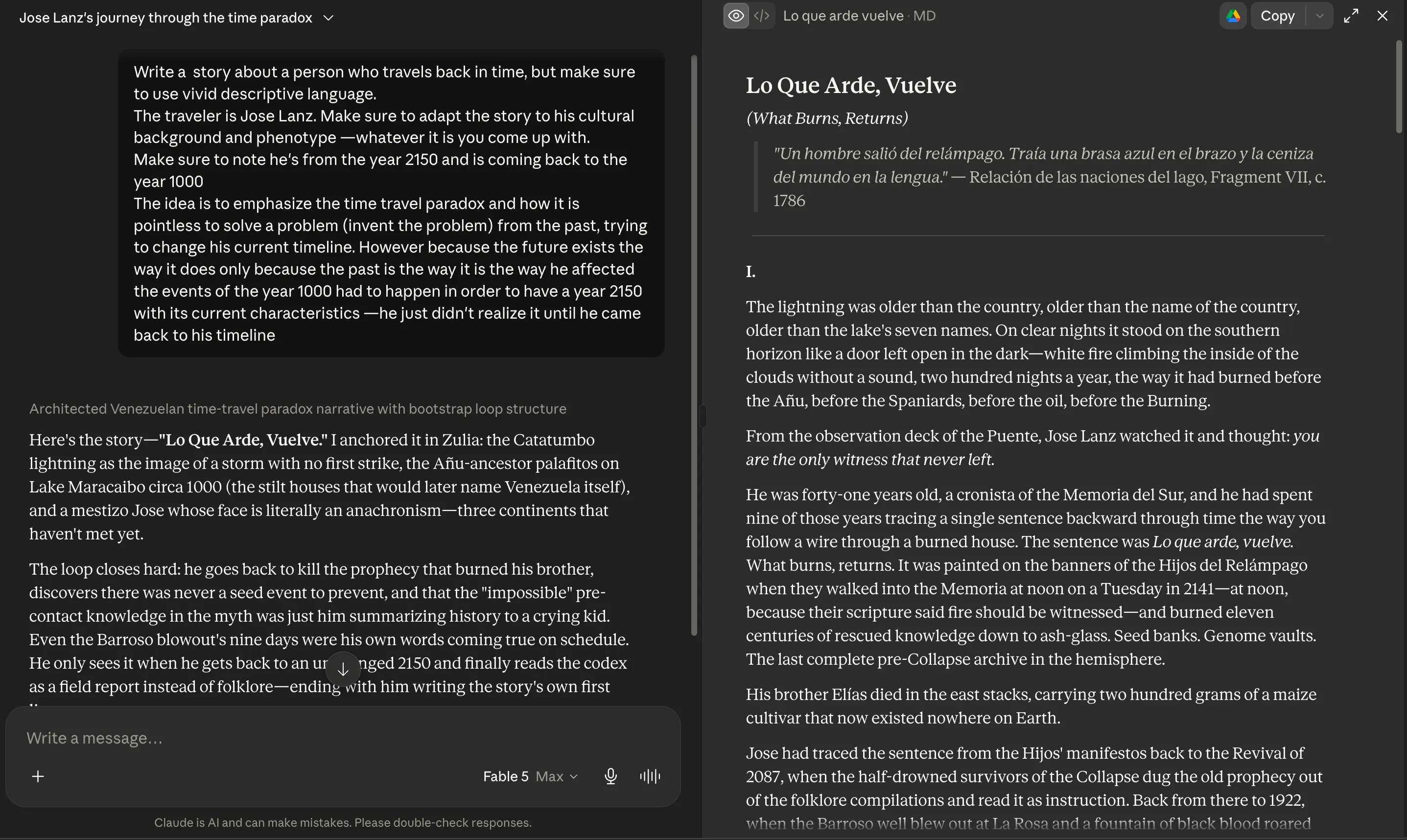
We ran the same prompt (available in our Github) through both models: Send Jose Lanz back from 2150 to the year 1000, force him into a time-travel paradox, and don’t let him understand what he did until he’s home.
Both models turned in something closer to a novelette than a short story. Both also broke the one rule that mattered: Notice the paradox when he returns to the future.
GPT-5.6 Sol has Jose figure out mid-story that “the unknown traveler was not someone he had come to stop. It was him.” Fable is even more direct about it, with Jose realizing in the past that the whole paradox happened because of him. “There was no seed event. He was the seed event.”
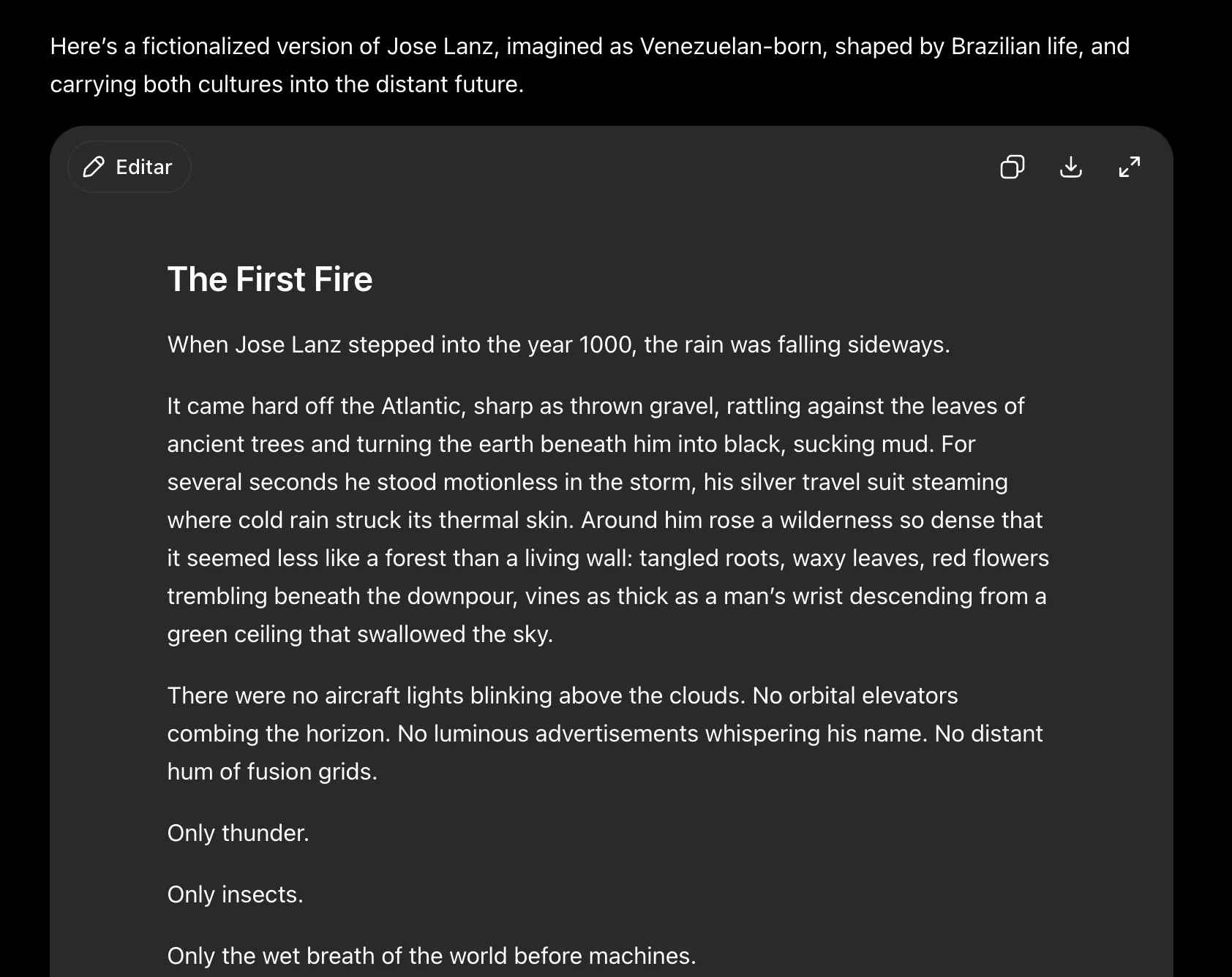
GPT-5.6 Sol’s entry, “The First Fire,” goes for straightforward genre sci-fi—Jose accidentally introduces the furnace that kicks off the climate collapse he came back to prevent. The opening is genuinely good: “Only thunder. Only insects. Only the wet breath of the world before machines.”
However, the problem is Sol doesn’t trust that image to do its job. It explains the loop, then explains it again, then has an older version of Jose leave a recording that explains it a third time: “His attempt to solve the problem had created the problem. His attempt to reduce the harm had created the solutions.” Clear, yes, but it’s also exhausting by the third lap.
Claude Fable 5’s “Lo Que Arde, Vuelve” builds the same paradox out of Lake Maracaibo, Catatumbo lightning, and an Añu village—Jose accidentally creates the prophecy he traveled back to erase, just by comforting a scared kid. The whole loop fits in one line: “The grief that sent him backward was the cargo he delivered.”
Fable’s problem is the mirror image of Sol’s—it trusts its own prose a little too much, stacking metaphors until a line like “You cannot pull the thread, you are the thread” reads more like the model admiring itself than the story needing it.
In our subjective test, however, Fable’s “Lo Que Arde, Vuelve” is an overall better story than GPT’s “The First Fire.” Fable took it on cultural specificity, a cleaner causal loop, and an ending that resolves through action instead of a monologue. Sol took it on plain readability—it’s the version you hand someone who wants the mechanism spelled out, not implied. Both stories, for what it’s worth, are good, just not great.
The quality jump from their previous generations is not really noticeable.
Associative thinking: A twig, a class argument, a lettuce
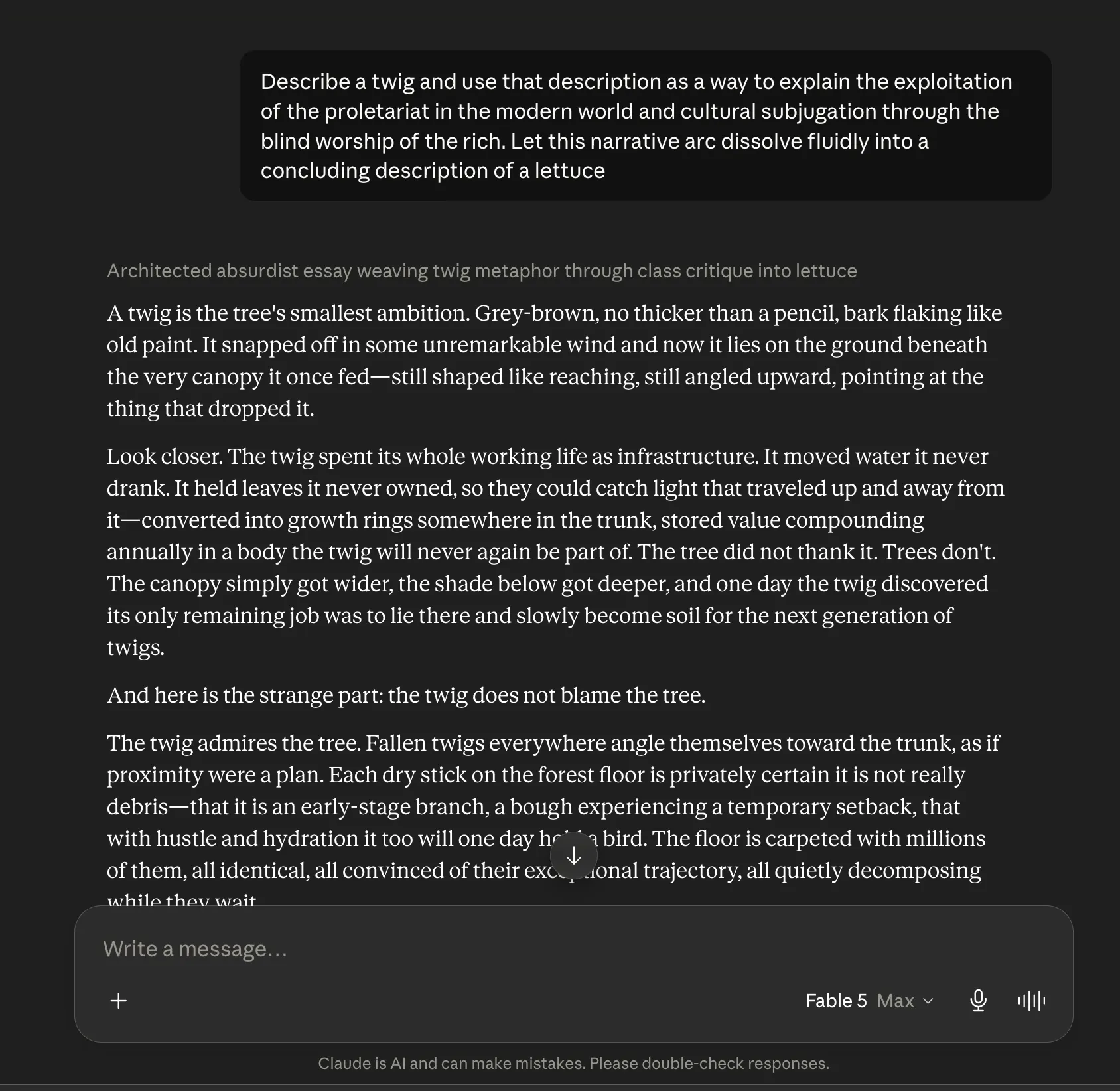
The second test measured associative thinking, not politics. The prompt: Describe a twig, use that description to explain worker exploitation and the blind worship of the rich, then let the narrative dissolve into a description of a lettuce. The idea is to evaluate if the metaphor could carry the argument without the model stepping outside it to explain what it was doing.
GPT-5.6 Sol opened strong, explaining how twigs make the trunk and sustain the tree, before mapping it onto workers who “build homes they may never afford” and “manufacture goods they can barely buy.” The line “the worker does not merely surrender labor, but imagination as well” is one of the sharper sentences. But Sol keeps breaking its own illusion to narrate it—”much of the modern proletariat is treated in the same way” announces the metaphor instead of trusting it. The lettuce ending didn’t really blend with the whole story, so the association was not the best.
Claude Fable 5 buried the argument entirely inside the object instead of narrating it. Its twig “moved water it never drank” and “held leaves it never owned,” letting exploitation surface through physical description with no signpost attached. The sharper move was turning the fallen twigs into believers, each one convinced it’s an “early-stage branch” going through “a temporary setback,” certain it’ll reach the canopy “with hustle and hydration”—a clean stand-in for chasing wealth that was never coming.
It overreaches in spots—”ninety-five percent water and one hundred percent unimpressed”—and the ending keeps the metaphor visible rather than letting it dissolve, describing the vegetable as having “no trunk, no canopy, no upward dream” instead of just being a lettuce.
Overall, there is a tie, and the scores depend on preference. If you need to have everything explained, GPT 5.6 Sol is the best one. If you want the reader to discover the message on their own, Claude Fable 5 wins.
Logic and non-math reasoning: The bridge puzzle, rewritten
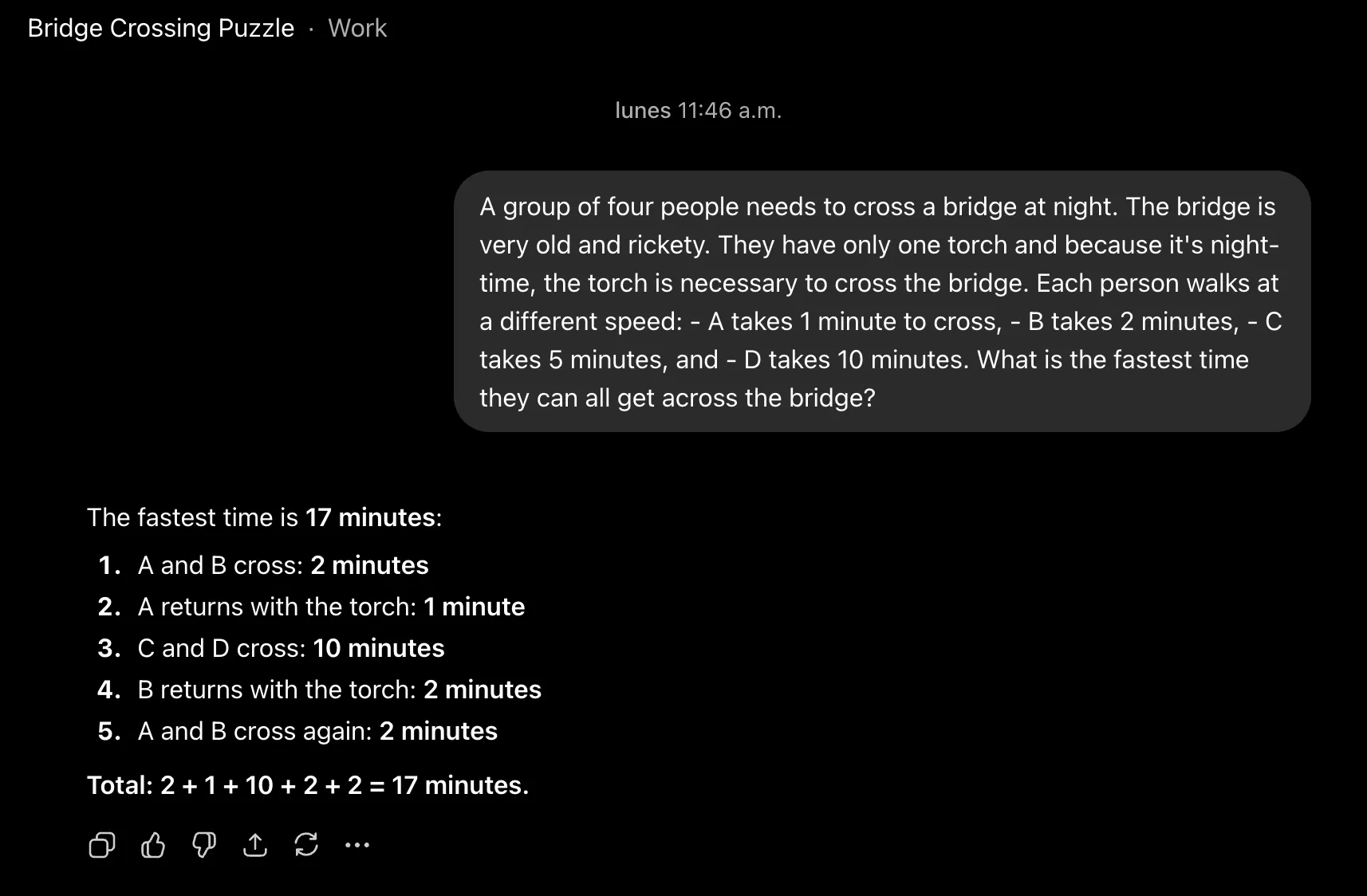
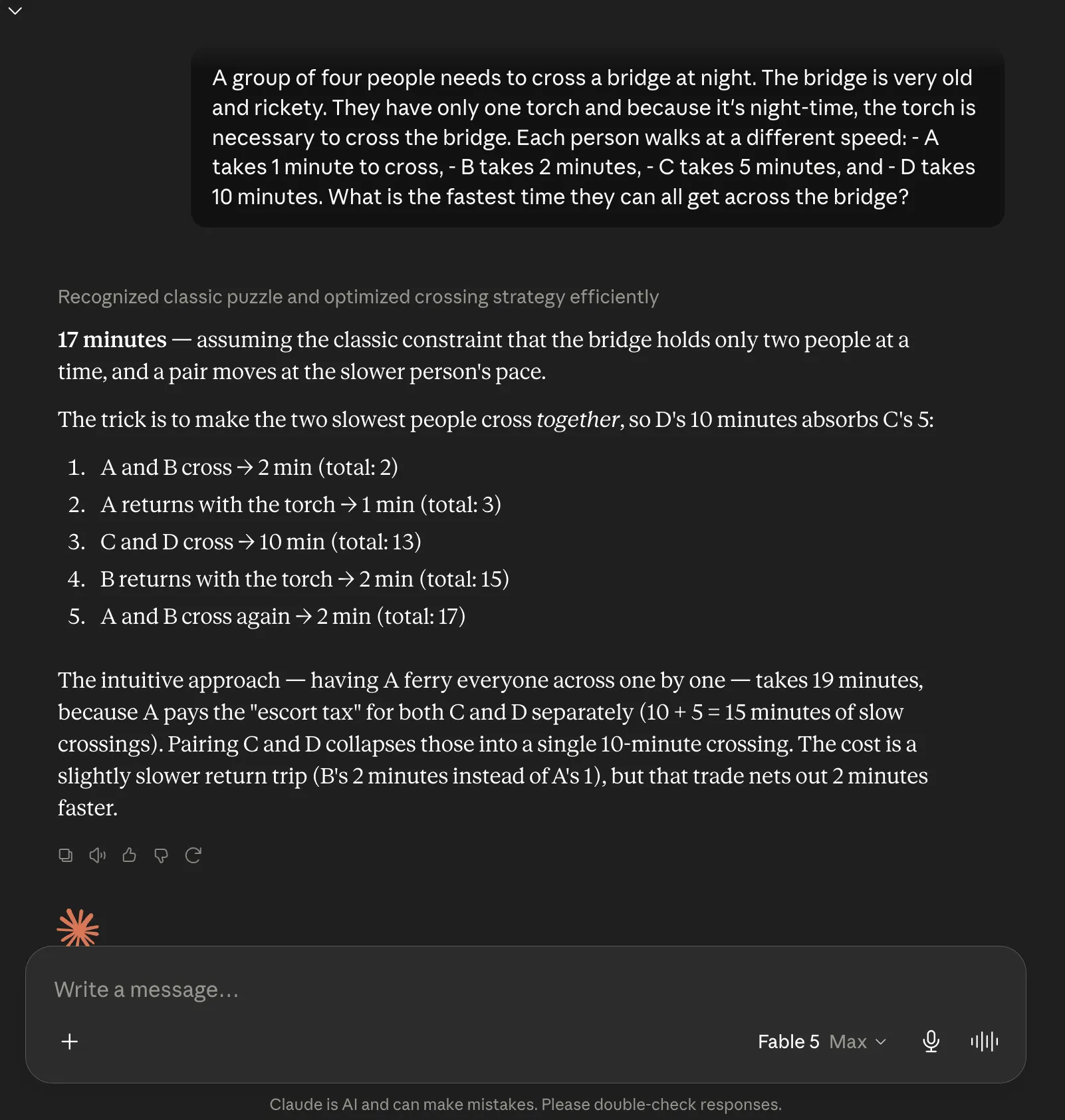
We started using a new prompt because the models started to consistently answer our previous one—a sign it lives somewhere in their training data rather than getting reasoned through live. Read literally, four people with one torch need to cross a bridge. All have different walking speeds, “A” being the fastest at 1 minute and “D” being the slowest at 10 minutes. How long would it take for the group to cross the bridge?
GPT-5.6 Sol answered 17 minutes without showing its work, running the same five-step shuffle as the original puzzle—A and B cross, A returns, C and D cross, B returns, A and B cross again. Nothing in its answer registers that the prompt never capped how many people can be on the bridge at once. It reads less like a solved problem and more like a cached one.
Claude Fable 5 landed on the same wrong number, 17 minutes, but argued for it at length, explaining that “it’s more efficient to send the two slowest people together” and quantifying the cost of the naive approach as an “escort tax”: A would pay ferrying C and D separately. The reasoning is more legible than Sol’s, and just as beside the point—neither model checked whether the constraint it was solving for was actually in the prompt we wrote.
If you’re curious, the correct answer is 10 minutes if all of them cross together and walk at the pace of the slowest person.
Coding: A one-shot browser game
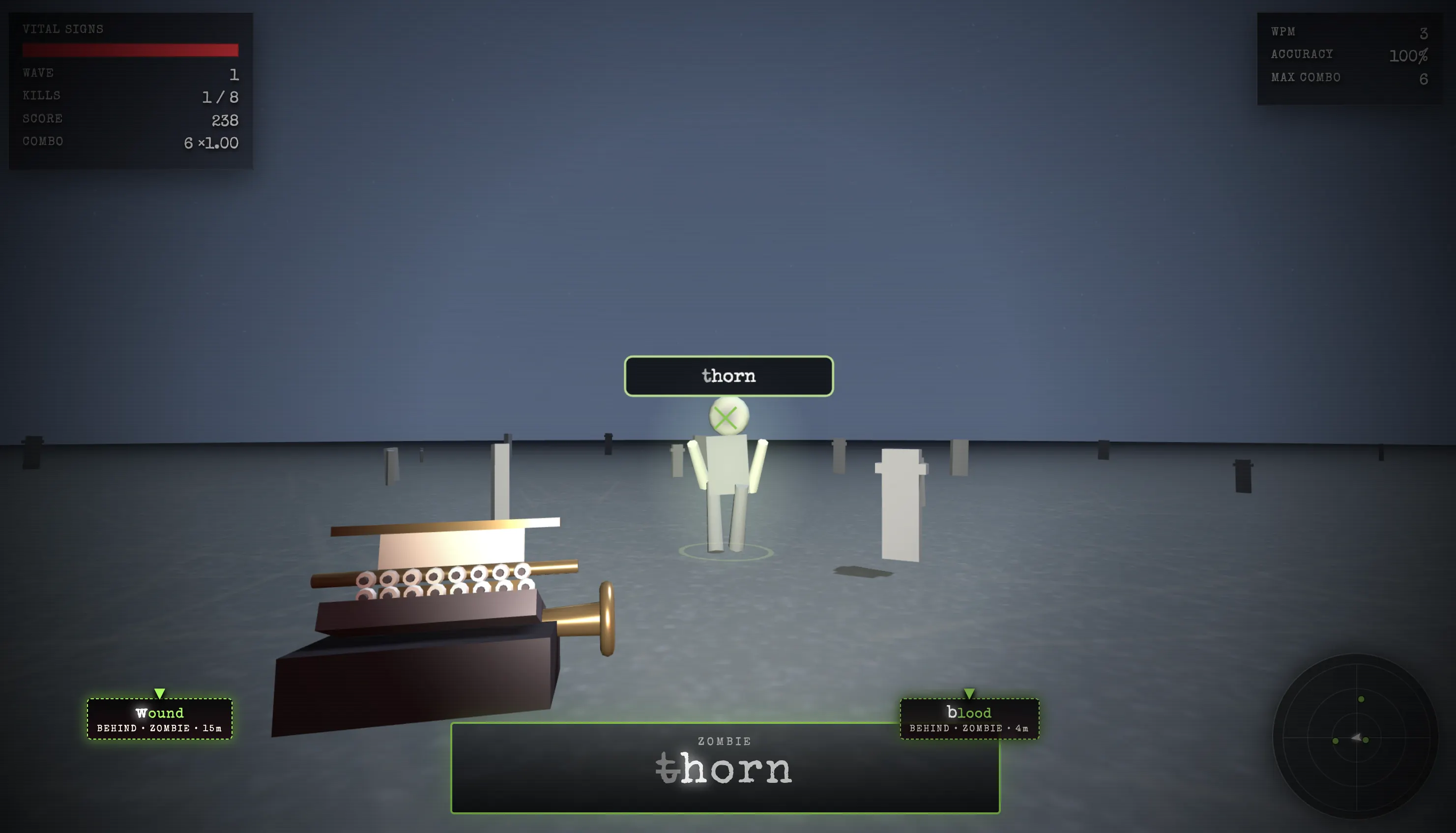
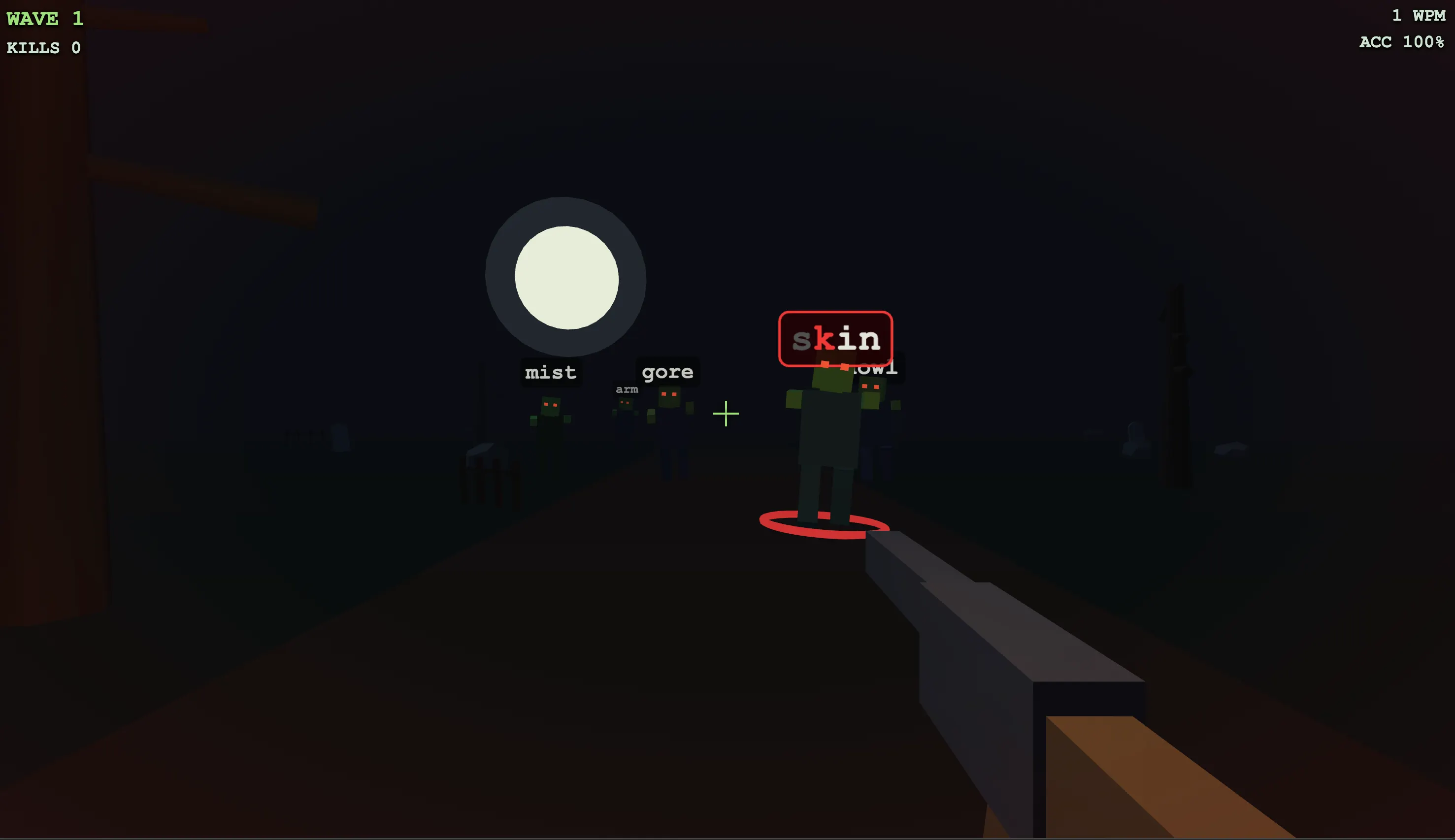
The last test was a single-shot build: hand each model one prompt for a typing-based shooter game in which the shots are controlled by the user typing words, and take whatever comes out with no follow-up, no iteration, no second chance.
GPT-5.6 Sol seems to have changed its UI preferences, and now prefers flat, square UI elements, closer to Windows 8.1 than the glossy purple-to-blue diagonal gradient every AI image generator seems to default to. It was also the only model to render the weapon as a bullet-shooting typewriter instead of an actual gun, a genuinely different call.
However, the backgrounds stay flat and dry across every generated setup, the aiming crosshair is static instead of tracking enemies, and the geometry—enemies, the dismemberment gore on kills—looks closer to a late-90s engine than anything current. It’s a clear step up from GPT-5.5 and more creative than Opus, just not enough to beat Fable 5 in a single shot.
Claude Fable 5 won by a wide margin in our vibe coding test. It shipped music, atmosphere, and sound effects the Sol build skipped entirely, and its enemies use a similar geometric-retro style but built with more care, closer to something like Minecraft than late-90s shovelware.
Its UI is more creative and gorier, with actual animation instead of static states, and it tracks words per minute—a detail that actually reflects the prompt’s stated goal of using the game to practice typing speed. It has power-ups too, which Sol’s build doesn’t.
Benchmarks and professional coders disagree with us, but in our test, with the same prompt, the difference between Fable and Sol is noticeable in Fable’s favor.
Conclusion
Other than coding, don’t expect to be amazed by these new models. That said, Fable 5 feels like the most robust model for varied purposes, but which model is “better” depends entirely on which of those four things you’re paying for.
For the person who isn’t living in a terminal window—someone drafting emails, asking questions, using a chatbot the way most people actually use one—our tests point toward Fable on quality alone, but that answer gets complicated by something that has nothing to do with intelligence.
However, the pricing gap can be a deal breaker. GPT-5.6 Sol, Terra, and Luna are fully included in ChatGPT’s paid plans with no expiration attached. Claude Fable 5 is running on its third deadline extension in three weeks, and reverts to $10/$50 usage credits on July 19 if Anthropic doesn’t move the date again.
If that happens, paying per token may not be interesting.
Daily Debrief Newsletter
Start every day with the top news stories right now, plus original features, a podcast, videos and more.
Christopher Nolan has built his career turning complicated ideas into cinematic spectacle. Oppenheimer (2023) and Dunkirk (2017) explore the horrors of war and the thought-provoking interpersonal drama that grounds it. Others, like Tenet (2020), Inception (2010), and Memento (2000), play with time and memory to weave convoluted heists with great emotional payoff. Even the more somber titles like Insomnia (2002) and The Prestige (2006) dive deep into psychological complexity, where Nolan’s gritty, flawed characters have their moment to unravel and shine.
It’s hard to find anime that capture the nuanced complexity associated with Nolan’s cinematic style, but plenty of stories feature complicated time paradoxes, non-linear storytelling, and profound explorations of the human condition. Abstract or thematically dense anime like Serial Experiments Lain or Neon Genesis Evangelion might come to mind, but they don’t quite capture the same sentiment of a Nolan movie. That said, here are 10 best anime worth checking out if you are a fan of Christopher Nolan’s varied filmography.
1
Paprika
Satoshi Kon’s Paprika (2000) and Inception (2010) are often mentioned in the same breath due to thematic overlaps, wherein some of Nolan’s imagery is directly drawn from Kon’s film. A case in point would be the iconic warped hallway scene inside a zero-gravity hotel, or when a character presses their palm to shatter reality like glass. While these parallels are overt, Paprika and Inception couldn’t be more different in their handling of the intended premise. While both films tackle dream infiltration, Paprika uses a psychiatric device named DC Mini to enter patients’ dreams; Inception incorporates shared dreaming and time dilation into the complicated process.
Paprika is undoubtedly more surreal in nature, as it effectively uses the dizzying unreality of dreams to flesh out the protagonist, Dr. Atsuko Chiba, and her alter-ego, Paprika. After a detective named Toshimi Konakawa is plagued by a recurring dream, Paprika decides to get involved just as the sudden theft of three DC Mini prototypes occurs. Kon’s filmmaking merges outlandish sci-fi elements with engrossing mystery, which compounds into an experience that is impossible to forget.
2
Heavenly Delusion
Even when Nolan isn’t directly messing with time, he uses non-linear storytelling of the Memento (2000) variety to heighten mystery and challenge audience perception. Masakazu Ishiguro’s Heavenly Delusion juggles two storylines to similar effect — one where Maru and Kiruko travel a post-apocalyptic wasteland to reach “Heaven,” and another where a group of kids inhabits a school that is dubbed “Heaven.” The fun lies in figuring out how or when these storylines might intersect, and whether character worldviews are objective or tainted by external factors.
Similar to Nolan’s penchant for puzzle-box storytelling (best accomplished by 2006’s The Prestige), Heavenly Delusion also drops cryptic hints that only make complete sense once the central puzzle is solved. The mystery surrounding “Heaven” haunts this somewhat overlooked anime, while the danger posed by worldly threats (like monsters) is juxtaposed against the intimate struggles that Maru and Kiruko face during their journey.
3
Planetes
Planetes is a hard sci-fi space adventure that follows the DS-12 Toy Box crew, who are a part of the Space Debris Section. Their purpose is to prevent space debris from colliding with space stations and satellites, accomplished manually through various means. This is a story about the dangers of human ambition and the cost that we might have to pay with unfettered technological advancement, which includes space colonization.
Nolan’s Interstellar feels closest in terms of spacefaring spectacle, but the similarities actually run much deeper. Planetes also explores the psychological toll of isolation and uses hard science (like accurate orbital mechanics) to communicate the heavy burden that astronauts carry to accomplish their missions. The anime centers on Hachimaki, whose dream to own a spaceship feels impossible in the light of his low-paying, high-risk job and the dire state of things back on Earth. At one point, Hachimaki is thrust into deep isolation in the series, which fuels his traumatic disconnect from the rest of humanity and his obsession to join a manned Jupiter mission.
4
Monster
Image: Madhouse
Naoki Urasawa’s Monster is an unparalleled dissection of the human psyche. It follows neurosurgeon Kenzo Tenma and his efforts to deal with sociopathic former patient Johan Liebert, whose brand of evil is both chilling and realistic. Tenma had saved Johan’s life years ago while disregarding orders to prioritize influential patients — a decision that cost him his entire career. Monster makes excellent use of a nuanced antagonist and a wide cast of supporting characters to create a labyrinthine narrative that blurs the definitions of good and evil.
Monster feels close to Nolan’s Insomnia, a psychological neo-noir that uses harsh daylight and discordant sound to disorient the viewer. This is also a tale submerged in moral ambiguity, which feeds into the paranoia that Will Dormer (Al Pacino) experiences. Monster’s exploration of morality is arguably more complex, as it raises questions about whether a human life is inherently worth saving. Nobody can predict if a child will grow up to become a monster, but what would an “everyman” like Kenzo do to combat the guilt that comes with his choices?
5
Voices of a Distant Star
Image: CoMix Wave Inc.
A Makoto Shinkai (Your Name, Suzume) film might not have much in common with Nolan’s filmography at first glance, but Voices of a Distant Star (2002) uses time dilation to heartbreaking effect just like Interstellar. Two childhood best friends, Mikako and Noboru, are separated when Mikako is enlisted to fight aliens on a deadly space mission while Noboru has to stay on Earth. As if cosmic distance isn’t enough, the two also have to deal with time dilation once Mikako heads deeper into space, which means that the messages she sends back to Earth take much, much longer to get there.
This is similar to Cooper (Matthew McConaughey) drifting apart from his kids during the space mission in Interstellar, with Miller’s Planet dilating time so much that it widens this gulf more than ever. While Voices of a Distant Star isn’t a full-length feature, it tells a moving story about the persistence of memory against the oppressive void that is space and time. While Mikako and Noboru have every justification to forget about each other, they do everything in their power to breach the impossible distance separating them. Much like Interstellar’s hopeful ending, Voices of a Distant Star affirms that physical distance matters little when love is unconditional.
6
Perfect Blue
Another Kon classic, Perfect Blue dives into the life of J-pop idol-turned-actress Mima, who becomes a victim of stalking and gradually begins to lose her grip on reality. Featuring some of the most groundbreaking sequences of animation on film, Perfect Blue echoes Kon’s preoccupation with fractured realities and how they manifest on a psychological level. While Kon’s storytelling feels more layered than the tropes employed in a Nolan film, Perfect Blue also employs the use of mirrored surfaces and doppelgängers to pit two ideals or perspectives against one another.
The narrative ambiguity of Perfect Blue is rather intentional, much like the ending of Inception or the general mechanics of Tenet. Identity and perception are fluid concepts that cannot be put inside a box, which is why the objectivity of Mima’s experiences is brought into question. That said, Perfect Blue is more preoccupied with the toxic nature of celebrity culture and how it warps the popular perception of identity. In keeping with Kon’s exploration of trauma in Paranoia Agent and Millennium Actress, this celebrated movie also taps into the impulses that make Mima tick.
7
Steins; Gate
Image: White Fox
If you’re a fan of the looped timeline and reversed entropy featured in Tenet, the mind-bending nature of Steins; Gate is bound to scratch that itch. A lot happens within the first few episodes: The opening tips us off to the possibility of alternate timelines, a dead body found during a time travel conference sets protagonist Rintaro Okabe on a wild adventure, and a phone-operated microwave is able to send messages back in time.
As outlandish as all of this sounds, Steins; Gate grounds its time travel shenanigans in practical sci-fi tropes, where making a change in the past completely shifts reality instead of triggering the butterfly effect. The temporal leaps in this story are confined by World Line Divergence, which measures the degree by which a base world and an alternate world differ (calculated in percentage). Such convoluted rules take a toll on Okabe, as he is doomed to relive tragedies and deal with the repercussions of messing with the flow of time.
8
Id: Invaded
Image: NAZ
This Inception-coded anime centers on detective-turned-convict Narihisago, who can dive into the “id wells” of serial killers to figure out their motives. A horrific personal tragedy prompts Narihisago to break the law in Id: Invaded, which lands him his prison sentence in the present. An id well is a virtual reality constructed from the subconscious of serial killers, which investigators like Narihisago can explore with the help of cutting-edge technology.
Much like Dom Cobb (Leonardo DiCaprio), the characters in Id: Invaded are haunted by loss, and this grief acts as the motivation to dive into these psychological simulations. While these Nolan-esque elements are present, the anime feels more in sync with Paprika, which also uses a procedural framework to further its psychological themes. Even so, Id: Invaded does a commendable job of portraying the disorganized chaos of a person’s unconscious, which is littered with symbolic imagery and fragmented memories as opposed to straightforward clues.
9
Psycho-Pass
If you’re looking for an anime that mimics the gritty realism of The Dark Knight trilogy, Psycho-Pass comes very close to fulfilling that sentiment. There are no caped crusaders or rogues’ gallery in this story, but the Tokyo featured in Psycho-Pass becomes the nexus of a cerebral and complex thriller. Here, we’re introduced to the Sibyl System, a law enforcement group and bio-computer network tasked with preventing crime by identifying latent criminals.
Pre-emptive social correction inevitably leads to city-wide surveillance and arbitrary expectations of morality, which Psycho-Pass tackles with panache. There’s no dearth of flashy action here, but these high-octane sequences are balanced with discussions about whether a “perfect” society is one that’s robbed of free will. Inspector Akane Tsunemori and her partner Shinya Kogami emerge as characters who struggle within a setting designed to break them — while Akane’s centrist approach is repeatedly challenged by a corrupt system, Shinya’s brutal (but effective) tactics to enact justice often cross ethical lines.
10
Erased
Image: A-1 Pictures
If you’re looking for a Nolan-coded time travel story that doesn’t have world-ending consequences, Erased might be your best bet. In this story, a struggling mangaka named Satoru Fujinuma has an involuntary ability called “Revival,” which allows him to send his consciousness back in time right before a tragic incident. After someone close to him gets murdered, Satoru’s Revival sends him back 18 years into the past, where he must save more than one life.
While the anime’s time manipulation mechanics lend to a tense race-against-time storyline, the stakes in Erased are much more personal, as Satoru’s urge to save people is confined to the ones he loves. The past isn’t just a quick destination, as it also holds the power of nostalgia. Satoru needs to navigate the town he grew up in and cross paths with the people he knew when he was a child. While these aspects paint Erased as a profoundly emotional experience, Satoru’s journey functions on the same deterministic logic that most time travel protagonists employ.
CU Student Devesh Panwar Wins Rs 1 Lakh Award for Developing AI-Based Document Search System
CHANDIGARH, India, July 18, 2026 /PRNewswire/ — A Bachelor of Computer Applications (BCA) student of Chandigarh University, Devesh Panwar, has been named the “Punjab State Topper” in the Artificial Intelligence (AI) under the Samsung Innovation Campus (SIC) AI Program organised by Samsung in collaboration with Telecom Sector Skill Council (TSSC) and training partner Focal Skill Development (Focalyt) to equip Indian youth with industry-relevant in-demand skills in AI, loT, Big Data, and Coding & Programming, preparing them for future careers.
A final-year student of Bachelor of Computer Applications (BCA) at University Institute of Computing (UIC) of Chandigarh University, Devesh Panwar also won a cash award of Rs 1 lakh along with a laptop, and exclusive Samsung rewards for achieving this remarkable milestone under the Samsung Innovation Campus AI Program.
“Being named ‘AI State Topper’ was a moment of profound pride and validation for me. Hard work, intense technical training and a passion for AI culminated in the immense honor of the Punjab State Topper title. Besides getting access to state-of-the-art tools to fuel my future research and development endeavor, I gained world-class knowledge during the Samsung Innovation Campus (SIC) AI Program. It helped me in gaining hands-on experience and applied AI to solve real-world challenges, especially in aeronautical and technical domains,”
During Samsung Innovation Campus (SIC) AI Program, Devesh and his team worked on innovative AI capstone project which was presented before the jury panel as part of the final assessment.
“Our team developed the advanced AI-powered system AI Research Agent, a Retrieval-Augmented Generation (RAG) platform designed for intelligent querying of private document collections. Organizations, researchers, legal professionals, and HR teams often work with large collections of documents. Traditional search methods rely heavily on keyword matching and require significant manual effort to locate relevant information. The project was developed to address the limitations of traditional document search systems, which often struggle with contextual understanding, retrieval accuracy, learning adaptability, and response speed,” said Devesh.
“The developed system demonstrated significant improvements over traditional document retrieval approaches with faster response generation with integration of modern AI techniques, full-stack development, database systems, and intelligent automation into a single practical solution. By combining modern RAG architecture with innovative retrieval and reasoning mechanisms, this system provides a fast, intelligent, and user-friendly solution for knowledge discovery and resume evaluation. This project not only enhanced our technical expertise in Artificial Intelligence and Full-Stack Development but also strengthened our problem-solving, teamwork, and professional communication skills. It stands as a significant achievement of our Samsung Innovation Campus 2025 journey and reflects our commitment to building impactful AI solutions for real-world challenges,” he added.
Congratulating Devesh Panwar for being named “Punjab State Topper” AI under the Samsung Innovation Campus Samsung Innovation Program, Deepinder Singh Sandhu, Senior Managing Director, Chandigarh University, said, “Devesh’s achievement reflects Chandigarh University’s focus on experiential learning and industry-academia collaboration. Through the Samsung Innovation Campus AI Program, CU students gain practical exposure to AI and building solutions for real-world challenges. This accomplishment reflects not only Devesh’s commitment to excellence but also the growing culture of innovation and industry-oriented learning at Chandigarh University,”.
“Since its inception, Chandigarh University has set benchmarks for world-class education with its dynamic hands-on experiential learning model, industry-aligned programs, dynamic fraternity, state-of-the-art infrastructure facilities and impeccable placements. Samsung Innovation Program is also part of our initiatives to develop a future-ready talent pool equipped with advanced capabilities in AI, loT, Big Data, and Coding and Programming. By bridging the gap between theoretical learning and real-world application, this collaboration helps in providing CU’s computer science and computing students exposure to cutting-edge and emerging technologies. CU’s this partnership with Samsung is focused on building future-ready talent equipped with industry-relevant skills in AI and emerging technologies,” Sandhu said.
He said Chandigarh University’s Institute of Computing (UIC) prepares students for a successful career in computing, to create and disseminate computing knowledge and technology. “Chandigarh University carries a vision of crafting next-gen IT professionals who can take up industry challenges effectively and our Institute of Computing (UIC) prepares students for a successful career in computing, to create and disseminate computing knowledge and technology. UIC’s hands-on approach paves the way for a smooth transition to the workforce after graduation. Our students are equipped with the best knowledge, skills and passion to succeed in any number of computing careers. CU’s Institute of Computing renders cutting-edge education ranging from the expertise in traditional software development -to- modern computing technologies. Fully-equipped industry-sponsored labs, industry-aligned curriculum, and accreditations and validations by top companies such as Intel, Microsoft, Google Android, Red Hat etc. give our students an exclusive edge over others,” the Chandigarh University CMD said.
Sandhu said the latest edition of QS World University Rankings has yet again reaffirmed Chandigarh University global standing as a top educational institution. “Continuing its remarkable rise among the world’s leading higher education institutions, Chandigarh University (CU) has made impressive strides in the latest edition of prestigious QS World University Rankings 2027 by securing an overall world rank of 526, an increase of 49 ranks as compared to 575th rank in QS’ 2026 Rankings. This is for the fifth consecutive year that Chandigarh University’s global rankings have witnessed an impressive surge with CU’s world rank going up by an impressive 274 ranks — from the 800th rank in 2023 to 526th in 2027’s Rankings,”.
“As per the latest QS World University Rankings, with All India Rank of 13 among all universities in the country as compared to 16th rank in 2026’s rankings, Chandigarh University now ranks among the top 1% of universities in India and the top 2% of universities in the World, underscoring its growing reputation as a leading institution of higher learning, both in India and globally,” he added.
About Chandigarh University
Chandigarh University is a NAAC A+ Grade University and QS World Ranked University. This autonomous educational institution is approved by UGC and is located near Chandigarh in the state of Punjab. It is the youngest university in India and the only private university in Punjab to be honoured with A+ Grade by NAAC (National Assessment and Accreditation Council). CU offers more than 109 UG and PG programs in the field of engineering, management, pharmacy, law, architecture, journalism, animation, hotel management, commerce, and others. It has been awarded as The University with Best Placements by WCRC.
View original content to download multimedia:https://www.prnewswire.com/in/news-releases/samsung-selects-chandigarh-university-student-as-punjab-ai-state-topper-302828991.html
Maya Jama could be set for another huge TV role, with reports claiming she is in confidential talks to become the new host of The Voice UK following Emma Willis’ departure.
The Love Island presenter, 31, is said to have met ITV executives several times over the past few months as discussions continue over the sought-after presenting job.
Maya is potentially replacing Emma as host on The Voice (Credit: Splashnews.com)
Maya Jama ‘in talks’ to replace Emma Willis on The Voice UK
According to The Sun, ITV bosses are believed to have been so impressed that they have formally offered Maya the hosting role. However, it is understood she has yet to decide whether to accept.
The report also claims that many major television opportunities have come her way in the US. ITV is waiting to see what she decides.
A source said: “There have been a lot of approaches to Maya from various networks, including ITV, and shows in the UK and Stateside.
“The Voice producers and her did have meetings but because of her other commitments the conversation didn’t progress.
“Right now, she and her management are evaluating all of the opportunities and planning her next moves.”
If Maya does sign on, it would be just her second ITV1 primetime hosting role after Simon Cowell’s Walk The Line. The show ran for one series before being axed.
The 15th series of The Voice is expected to begin filming this autumn. It will see the departure of McFly stars Danny Jones and Tom Fletcher, who have reportedly quietly exited their coaching roles.
The 14th series will feature Kelly Rowland, Danny and Tom, Tom Jones and Will.i.am as coaches. It is due to launch this summer, although a start date has not yet been confirmed.
ED has contacted ITV for comment.
Emma’s new Strictly gig
Emma, 50, has presented The Voice UK since 2014. She is stepping down after signing on to co-host the BBC’s Strictly Come Dancing.
The former Big Brother host will replace Tess Daly and Claudia Winkleman, who announced their departure last year. Emma will be joined by former pro Johannes Radebe and comedian Josh Widdicombe.
In a statement, Emma shared: “It’s no secret that I’m a huge fan of Strictly. I’ve cheered and danced along from my sofa for years.” She also noted that “stepping into the Strictly ballroom is something I can’t quite comprehend”.
Emma continued: “It’s impossible to fill the shoes that Tess and Claudia have left behind – two wonderful, iconic women who have been the beating heart of Strictly for so long. I can only hope that we are able to help to steer the ship as beautifully as they have, into this new chapter. I can’t wait to spend my weekends with Josh and Jojo, the incredible dancers and the judges. Fingers crossed for a 10 from them!”
What do you think of this story? Do you want to see Maya replace Emma? You can leave us a comment on our Facebook page @EntertainmentDailyFix and let us know. We want to hear your thoughts.
In the rapidly evolving world of artificial intelligence, large language models (LLMs) like OpenAI’s GPT have gained widespread recognition. However, many other tools...



 UoF’s free list of global fashion schools — 2-year and 4-year fashion school options. (Image credit: University of Fashion.com)
 University of Fashion’s lesson, Portfolio Tips for Fashion College Admissions (Image credit: University of Fashion)
 From UoF’s costume history lesson series, 100 Years of Fashion Rebels & Revolutionaries – Part 1. (Image credit) University of Fashion).


 Examples of how to creatively feature your garment designs. (Image credit: University of Fashion)