Home Blog Page 40

These Summer Sandals Are at Black Friday-Level Prices Right Now — Deals Start at $15

    0
    These Summer Sandals Are at Black Friday-Level Prices Right Now — Deals Start at


    Us Weekly has affiliate partnerships. We receive compensation when you click on a link and make a purchase. Learn more!

    If you’ve been looking for an excuse to refresh your shoe collection, there’s never been a better time than right now. Macy’s brought Black Friday-level deals to July, and the sale is overflowing with summer sandals, like flip-flops, kitten heels, slides and more. Oh, and the steep deals start at as low as $15.

    Macy’s summer Black Friday sale runs from today through July 26th, which means you have five full days to save up to 60% off. The catch? The chicest summer sandals are selling out as we type, including pairs from Steve Madden, Marc Fisher, Michael Kors and Dolce Vita. Snag your favorites for this season (and the next) below!

    17 Summer Sandals Deals at Macy’s — From $15

    1. Shiny Chic: These gold Michael Kors sandals make any outfit look expensive, thanks to the low profile and minimal ‘M’ logo — was $100, now $50!

    2. Total Classic: Everyone needs staple ankle-strap sandals, and these Steve Madden wonders are ones to consider — was $99, now $59!

    3. Cute Kitten: Kitten heels are everywhere this summer. Nail the look with this colorful version — was $89, now $45!

    4. Super Comfy: You can’t go wrong with these jewel-adorned FitFlop sandals, which combine comfort and style in one — was $140, now $70!

    5. Hamptons Vibes: With a woven strap and a faux leather base, these slip-on slides radiate old money energy — was $79, now $47!

    6. Pretty Platforms: Or should we say, ‘flatforms.’ These espadrille sandals are available in solid hues and a logo print that adds even more polish — was $100, now $50!

    7. Sassy Slip-ons: When you’re running out the door, you’ll be glad you have these easy Marc Fisher slip-ons — was $89, now $45!

    8. Wedding Guest: Instead of stilettos, opt for these classy, understated sandals that let the rest of your outfit shine — was $69, now $41!

    9. Center of Attention: These pearly heels are the main event, so don’t even worry about your dress. The 1.75-inch heel ensures they’re walkable, too — was $129, now $77!

    10. Year-Round Pick: Dolce Vita’s sleek blade-heel sandals come in a rich toffee color that transitions seamlessly from summer to fall — was $69, now $41!

    11. Elevated Flip-Flops: Flip-flops can totally be sophisticated, and these cushiony wonders prove it — was $60, now $36!

    12. Rustic Appeal: With a real leather strap, low block heel and studded detailing, these Naturalizer slides give off major boutique energy — was $138, now $83!

    13. Cork, Yes: Nothing says ‘cool girl’ like these double-strap cork sandals. Every color is marked down — was $55, now $33!

    14. Mesh Maven: Toe-loop styles don’t always feel secure, but these mesh sandals stay put while padding your foot — was $50, now $20!

    15. Seriously Wealthy: Chunky thongs can downgrade an outfit, but these luxe-looking flip-flops have the opposite effect — was $79, now $40!

    16. Block Heel: Low and luxurious, these triple-strap sandals work for brunches, work events and even weddings — was $40, now $15!

    17. Designer Vibes: This logo-adorned style should costs hundreds, but it’s only $25 right now. Nobody will know the difference — was $69, now $25!

    UsNow Summer Sale Alert: These Chic Fashion Finds are over 30% off – Plus Free Shipping

    Welcome to summer with our biggest sale of the year. This summer’s chicest dresses, tops and swimsuits Swimsuits Under $25)” data-tag-index=”1″ data-tag-occurrence=”1″ data-tag-variant-id=”swimsuits-1″ data-tag-variant-mode=”random” data-tag-variant-name=”Swimsuits Sale” data-tag-variant-index=”0″ data-add-to=”first” data-tb-shoptags-tracking-bound=”true” data-tb-tracking-bound=”true” data-tb-tagrender-tracked=”true” data-tb-core-handler=”true” data-tracked-events=”click,mouseover,mouseout”>(Swimsuits Under $25) are all over 30% + free shipping. Inventory is limited so hurry before they’re gone.

    Shop the UsNow Summer Sale –>

    sandals

    Related: These 13 Comfy-Chic Sandals Can Instantly Elevate Jeans — From $10

    If you find yourself stuck in a tee-jeans-and-sneakers rut, we hear you. But you don’t have to give up your staple outfit to look chic. By swapping sneakers with luxe-looking sandals, you elevate your aesthetic without even trying. These 13 stylish pairs make it easy, comfy and shockingly affordable — we’re talking picks from only […]


    Source link

    Are Jacques Marie Mage sunglasses any good?

    Are Jacques Marie Mage sunglasses any good?


    Are Jacques Marie Mage sunglasses any good?

    Wednesday, July 22nd 2026
    Share

    Subscribe
    7 Comments
    Add to favourites
    ||- Begin Content -||
    The author’s JMM glasses, worn with a vintage jungle jacket

    The short answer to this question is yes; but a better answer considers value through design work and scarcity rather than just quality, and whether you actually want to wear slightly flashier sunglasses. 

    Let’s start with quality. With eyewear, quality comes down to a handful of things: acetate, hinges, the way the hinges are attached, smooth finishing and lenses. 

    Most people use the same acetate suppliers (Mazzuccheli, Takiron), same hinges (OBE) and run the pins all the way through the arms (so they can be repaired and replaced). Some of these, like the hinges, are easy details to watch out for. Finishing and in-store fitting are more subtle. 

    But a lot of the time, cheap sunglasses just feel cheap – mostly the use of less expensive acetates, which make them seem flimsy and brittle. A pair of glasses from a high-street brand can feel as if it’s just waiting to be snapped in half.

    This is one of the slightly misleading things about Jacques Marie Mage (JMM) glasses. Because they use noticeably thicker frames, people talk about how substantial and well made they feel. But it’s just more acetate. 

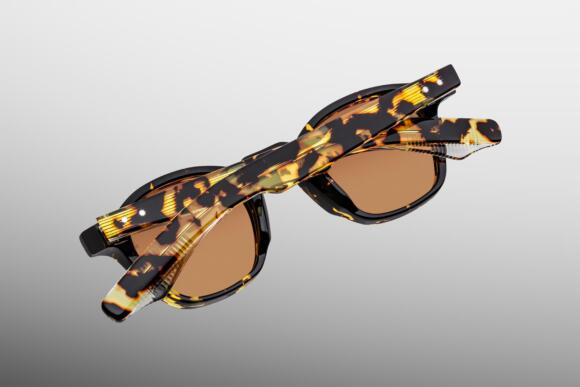
    The Zephirin model from JMM, in colour ‘Tokyo’

    Still, JMM ticks all of those quality points, and adds niche ones like developing its own hinges. These are very well-made glasses, unlike designer brands you might pick up in your local optician, many of which are famously made by one company, Luxottica. 

    However, the JMM glasses I have been wearing the past few months – the Zephirin in Tokyo colour, pictured above – were £830. What can justify that price?

    Well, partly a few things you don’t want to pay for. When we visited the JMM store in Hollywood in the spring, most of it was taken up by a massive distressed-metal horse leaping over half of a similarly distressed-metal car. There was a velvet rope and a waiting area. 

    The glasses themselves also come with a lot of packaging – all beautiful, and more tasteful than the horse, but it is the kind of thing you keep on top of a shelf for a while, just because you feel you paid for it. 

    The Sycamore-Hollywood ‘gallery’
    JMM packaging

    Part of the price does account for some things that elevate JMM glasses and make them genuinely special, however.

    The way you usually make money in sunglasses is to make one or two popular styles and then mass produce them for years. The worst way to do it is to make lots and lots of designs, all interesting in different ways, and make many of them in limited editions. 

    This is the JMM business model. And while you may say it’s just another money-making strategy – because it creates hype that means everyone wants the limited pairs and will overpay for them – it’s definitely the harder way to do it. The glasses have to be genuinely desirable.

    The frames themselves also include lots of details that make them complicated, unusual and time-consuming to make. Perhaps unnecessarily so. 

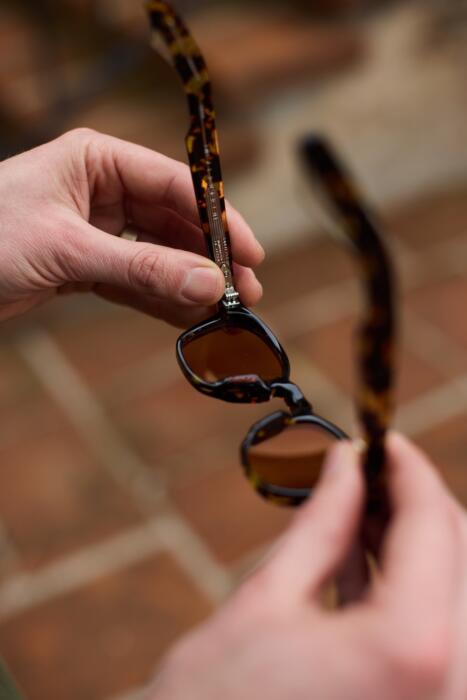
    On mine, for example, the arms are made of two layers of acetate – a tortoiseshell one and a clear one – that makes the arms a subtly brighter, more translucent colour than the fronts. It also enables them to have a clear section that wraps around the ears, but makes the arm look more like a straight line. 

    There are several of these details, all small and perhaps, as I said, unnecessary. But you can’t argue they’re not putting the work into the product. 

    The two layers of acetate on the arms

    Design-wise, the frames are also consistently interesting. I spoke to a couple of friends and vintage collectors in eyewear, and they all had reservations about the brand, but also all praised the sophistication of the designs. 

    As one of them put it: “It’s not easy to create so many designs that relate to classic pieces, but also all have real personality of their own.” 

    The problem with the designs is, for me, that they’re often quite bold and for that reason don’t suit many people. The frames are thick, often oversized, and sometimes come with eye-catching details on the arms. 

    When I visited the London store (which I should say, is nicer than LA and has some very knowledgeable staff) there were only two frames that really worked for me, and this Zephirin was easily the best.  

    Whether you like the brand or not, this will probably be the biggest stumbling block for most readers, given their natural tendency towards understated style. 

    Zephirin from the front

    The dramatic designs also create another problem – the kind of person that wears JMM. 

    Basile Khadiry, who runs the Beige store in Paris, was an early exponent of JMM. But he stopped carrying them after a while, saying in a recent interview with us: “They’re well made, but they became something flashy, worn by a certain kind of person.”

    Because the glasses are a bit flashy they attract people who dress that way – and also, I find, those who collect glasses, and watches, who want a new pair every season and want them as a form of status symbol*.

    It probably reveals how much of a snob I am, but this is honestly my biggest problem with JMM – not the price or the shops, but the association with someone that consumes fashion in a much more ostentatious and hype-driven way than I do. 

    Since I’ve been wearing my Zephirin pair on Permanent Style, a lot of people have asked what I think of them – are they any good?

    The answer is yes, they are good, and actually not bad value given all the things that go into them. But that doesn’t necessarily mean they’re for you, exciting as they may seem. 

    I really like my pair, but there was no other model that suited me, and they wouldn’t be the first pair of sunglasses I’d buy. I’d always get a more classic pair first, and I’m always going to wear them more. 

    My JMMs are a nice way to add a little bit of interest to an outfit when I feel it needs it – to push it a little flashier on the fuddy-flashy scale, perhaps. In the same way as you’d add pattern or a pop of colour to an outfit that’s otherwise quite plain. 

    I also wouldn’t rule out getting another pair – if there’s another design that really suits me – because I genuinely enjoy and value them. But I know they’ll never be my default; it’s just not my style. 

    *There’s an interesting side topic here about why sunglasses have become such a collectable item. It might be because watches are a little played out, or perhaps because outfits today are otherwise quite plain and tonal.

    <!–

    –>


    Source link

    Ichimoku Cloud Explained for Beginners: How to Read the “One-Glance” Indicator | NFT News Today

    Ichimoku Cloud Explained for Beginners: How to Read the “One-Glance” Indicator | NFT News Today


    The first time most people see an Ichimoku Cloud on a chart, they close the tab.

    It’s understandable. You came to look at a price chart, and instead you’re staring at five colored lines tangled around a shaded blob that looks like weather forecasting gone wrong. The name doesn’t help either. Ichimoku Kinko Hyo. It sounds like something you’d need a decade of study to touch.

    Here’s the good news, and it’s the whole reason this guide exists: the Ichimoku Cloud is far friendlier than it looks. The name actually translates to “one-glance equilibrium chart,” and once you understand what each piece is for — rather than the math behind it — you really can read the important part in about a second. That’s the promise. By the end of this, you’ll look at a cloud and know whether a coin is showing strength or weakness, without turning yourself into a full-time chartist.

    Quick note before we go further: this is educational, not financial advice. No indicator predicts the future. What Ichimoku does is describe the odds a little more clearly than raw price alone — and honestly, a clearer read on the odds is most of what a beginner needs before you buy any coin.

    What is the Ichimoku Cloud?

    Strip away the mystique and the Ichimoku Cloud is one indicator doing the job of several. In a single glance it shows you trend direction, momentum, and support and resistance. That’s the pitch: instead of stacking a moving average, an RSI, and a support/resistance tool on top of each other, you get one overlay that covers all of it.

    The history is short and worth two sentences. A Japanese journalist named Goichi Hosoda spent roughly thirty years refining it and published the finished system in 1969, long before computers made charting easy. He wanted something a trader could read at a glance, which is exactly what the name describes.

    The reason crypto traders reach for it is simple. Most indicators only look backward — they tell you what already happened. Ichimoku does that too, but it also plots part of itself into the future, projecting where support and resistance might sit before price gets there. In a market that trades 24 hours a day with no closing bell, having a forward-looking element on the chart is genuinely useful. If you want a second, more academic take on the mechanics, Investopedia’s breakdown is a solid reference, and CoinMarketCap Academy covers the crypto-specific angle.

    The five lines, in plain English

    There are five moving parts. You don’t need to memorize the formulas — you need to feel what each one is telling you. Think of them less as equations and more as five people offering opinions about the same coin.

    Conversion Line (Tenkan-sen). A nine-period average. This is the fast one. It hugs recent price closely and tells you where things have been leaning lately. When it turns, short-term momentum is shifting.

    Base Line (Kijun-sen). A 26-period average. Slower, steadier, more important. Traders treat it as a center of gravity — price tends to snap back toward it, and it often acts as support or resistance all by itself.

    Leading Span A (Senkou Span A). The average of the two lines above, pushed 26 periods into the future. This is one edge of the cloud.

    Leading Span B (Senkou Span B). A 52-period average, also pushed forward 26 periods. This is the other, slower edge of the cloud.

    Lagging Span (Chikou Span). The current closing price plotted 26 periods behind. It sounds odd to draw “now” in the past, but it’s a quick sanity check: is price stronger or weaker than it was a month ago? If the Chikou is floating above the old candles, that’s a point in the bull’s favor.

    Here’s the payoff most beginners miss. Those two Leading Spans — A and B — are the ones that matter most, because the space between them is the cloud. In Japanese it’s called the Kumo, and it’s the part you actually read at a glance. Everything else is supporting detail.

    Conversion (Tenkan-sen)

    9

    Short-term momentum, the fast line

    Base (Kijun-sen)

    26

    Medium-term trend, a natural support/resistance level

    Leading Span A

    9/26 avg, +26

    One edge of the cloud

    Leading Span B

    52, +26

    The other, slower edge of the cloud

    Lagging (Chikou-sen)

    close, −26

    Now versus a month ago

    [Image: a stripped-down diagram showing only the two Leading Spans forming the shaded cloud.]

    How to read the cloud at a glance

    This is the section that delivers on the headline. Forget the five lines for a moment. If you learn nothing else about Ichimoku, learn these three reads — they’ll carry you a long way.

    One: where is price relative to the cloud? Above the cloud, the bias is bullish. Below it, bearish. Inside it, the market is undecided and you’re basically in a no-man’s-land where signals get messy. That single check — above, below, or inside — is roughly 80% of the value Ichimoku offers a beginner. You can do it in a second, from across the room.

    Two: what color is the cloud, and how thick is it? When Span A is above Span B, the cloud is green and leans bullish. When B is on top, it’s red and leans bearish. Thickness matters too: a fat cloud means a strong trend and firm support or resistance, so price is more likely to bounce off it than punch through. A thin, wispy cloud is easy to break — treat it as weak footing.

    Three: is there a twist coming? Because the cloud is drawn ahead of price, you can see it change color in the future portion of the chart. A “twist” — where the two spans cross up ahead — hints that a trend shift could be brewing. It’s not a crystal ball, but it’s a heads-up you won’t get from most indicators.

    One honest caveat before you get too excited. The cloud is brilliant in a trending market and frustrating in a flat one. When a coin is chopping sideways, price will drift in and out of the cloud and hand you false signal after false signal. Ichimoku describes bias and structure. It does not promise outcomes.

    The best Ichimoku settings for crypto

    You’ll see people argue about settings endlessly. Here’s the short, honest version.

    The classic numbers — 9, 26, and 52 — trace back to 1930s Japanese markets, where the trading week ran six days and those periods lined up neatly with weeks and months. Crypto never closes, so a handful of traders tweak the settings to account for the extra weekend candles or the faster pace.

    Should you? Probably not yet. If you’re new, keep the defaults. They’re the standard for a reason, and every guide, chart, and video you learn from will be using them, so your reference points stay consistent. Some traders shorten the periods for scalping or lengthen them for longer swing trades, but that’s a refinement to make after you understand how the default cloud behaves — and only if you actually backtest the change rather than eyeballing it.

    Frankly, timeframe matters more than settings when you’re starting out. A daily cloud and a fifteen-minute cloud on the same coin can tell completely different stories. Pick a timeframe that matches how long you actually plan to hold, and read that one. When you’re ready to experiment, TradingView and Binance both let you add the indicator in a couple of clicks.

    Simple signals a beginner can actually use

    There are a dozen advanced Ichimoku strategies out there. Ignore them for now. Two setups will serve you well while you’re learning, and piling on more just adds noise.

    The cloud breakout. When price closes above the cloud after being stuck below or inside it, that’s a bullish breakout signal. A close below the cloud is the bearish version. It’s the cleanest entry idea the system offers, and it’s beginner-proof because it’s binary — you’re above or you’re not.

    The TK cross. When the fast Conversion Line crosses above the slower Base Line, that’s a bullish nudge; crossing below is bearish. The trick is context: a TK cross that happens above the cloud carries far more weight than one buried inside it. A cross in no-man’s-land is close to meaningless.

    The real lesson underneath both: confluence beats any single signal. A setup you can trust is one where several things agree at once — price above the cloud, a bullish TK cross, and the Chikou span floating above old price. One line moving on its own is just noise wearing a costume. And none of this replaces basic risk management; your position size and where you place a stop will protect your account far more than any indicator ever will.

    Common mistakes beginners make with Ichimoku

    Most of the pain comes from a small handful of habits. Watch for these:

    Trading every TK cross without checking where the cloud sits. Context is everything.

    Using it in choppy markets. Sideways price will whipsaw you. When there’s no trend, Ichimoku has little to say.

    Over-customizing the settings before you understand the defaults. You can’t tell if a change helped if you never learned the baseline.

    Ignoring the higher timeframe. A bullish 15-minute cloud means little if the daily chart is deep under a thick red cloud.

    Treating it as a prediction machine. It’s a probability tool. Respect that and it’ll serve you; expect certainty and it’ll burn you.

    You don’t have to read five lines yourself

    Here’s the thing nobody selling you a “master Ichimoku in 7 days” course wants to admit: the theory isn’t the hard part. Reading it consistently is. Doing a clean cloud check on every coin someone mentions, on the right timeframe, calmly — right at the moment hype is screaming at you to buy — that’s where beginners fall down. Not because they don’t understand the cloud, but because the moment is stressful and the chart is busy.

    That gap is exactly what CoinIQ Crypto Analysis is built to close. For coins with enough exchange data behind them, the app runs Ichimoku-based technical analysis for you — reading price against the cloud, the trend structure, and the support and resistance levels — and folds that into the momentum side of its overall A–F grade. Instead of five lines to untangle, you get a plain-English breakdown of what the technical picture is actually saying. You can see the full scoring approach in our rundown of how CoinIQ grades coins.

    Two things I’d be doing you a disservice not to say plainly. First, CoinIQ is an information tool, not financial advice — it reads the indicator, it doesn’t predict pumps or tell you what to buy. Second, that technical layer only shows up for coins with enough exchange data; a token that launched on a decentralized exchange an hour ago won’t have it, and the app is upfront about that.

    None of this makes learning the cloud pointless — the opposite, really. Knowing what the Kumo means is what turns that grade from a number into something you actually understand. Read this guide, then let the app do the repetitive part. CoinIQ is live on Google Play for Android now, with iOS planned.

    Final Thoughts

    Ichimoku looks intimidating and mostly isn’t. Above the cloud means strength. Below means weakness. A thick cloud means conviction; a thin one means fragile footing. That’s the one-glance read the whole system was designed to give you, and it’s most of what you’ll ever use.

    Treat it as one lens, not the whole picture. Pair a cloud read with the fundamentals — the team, the tokenomics, the liquidity — rather than trading on an indicator alone, and you’ll make calmer decisions. If you want the fundamentals side of that routine, our guide on how to research a crypto coin before you buy picks up where this one leaves off. Either way, the throughline is the same one that runs through everything worth doing in this market: a structured read beats a rushed one, every single time.

    Frequently Asked Questions

    Here are some frequently asked questions about this topic:

    Is the Ichimoku Cloud good for beginners?

    Yes, with a caveat. The single most useful read — whether price sits above, below, or inside the cloud — is genuinely beginner-friendly and takes a second. The full five-line system takes practice, so start with the cloud itself and add the rest as you go.

    What are the best Ichimoku settings for crypto?

    The default 9 / 26 / 52 is the right starting point, and most beginners should leave it alone. Some traders shorten the periods for crypto’s 24/7 pace, but only adjust once you understand how the default cloud behaves — and backtest any change.

    Does the Ichimoku Cloud work on Bitcoin?

    It does. Ichimoku is asset-agnostic and works across timeframes, which is why it’s popular on Bitcoin and major altcoins. Just remember it performs best when there’s a clear trend and struggles when price is chopping sideways.

    Is the Ichimoku Cloud a leading or lagging indicator?

    Both, which is part of its appeal. The projected cloud is forward-looking, while the Chikou span and the moving-average lines look backward. You get a read on the past, present, and possible future in one view.

    Can I use Ichimoku without reading the chart myself?

    To an extent, yes. Apps like CoinIQ compute the Ichimoku read for supported coins and summarize it in plain English, so you get the signal without manually decoding the lines. Understanding what the cloud means still makes that summary far more useful.



    Source link

    Grayscale Plans Quarterly Cash Payouts From ETH and SOL Staking Rewards

    0
    Grayscale Plans Quarterly Cash Payouts From ETH and SOL Staking Rewards


    On July 17, Grayscale announced it will amend the terms of two staking products, Grayscale Ethereum Staking ETF (ETHE) and Grayscale Solana Staking ETF (GSOL), to convert staking rewards into quarterly cash distributions, with an expected effective date around August 7, 2026. This move was submitted to the SEC via corresponding 8-K filings, indicating that Grayscale is updating the structure of its staking products to better align with the new IRS tax framework.

    Grayscale Moves on Staking Payouts

    Grayscale has just adjusted the payout structure of its two core staking products. They are shifting staking rewards to a clearer distribution mechanism for ETHE and GSOL. According to SEC filings, staking rewards will be funneled into quarterly cash distributions rather than simply accumulating in the fund’s NAV.

    Grayscale stated that this is a change in the trust agreement, representing a structural adjustment at the product level. The company also provided 20 days’ advance notice to shareholders before the amendment is expected to take effect. From a market perspective, this move makes the staking mechanisms of ETHE and GSOL easier for investors to understand, as the yield stream is expressed in cash rather than remaining solely tied to net asset performance.

    ETHE, GSOL Update Terms

    Both ETHE and GSOL are being modified under the same framework: staking rewards will be converted into cash distributions at least quarterly, after deducting related expenses. Payout amounts will vary based on the actual staking rewards received in each period, so distribution figures are not fixed in advance.

    For ETHE, Grayscale stated it will amend the declaration of trust to begin cash distributions from net staking proceeds. GSOL is taking a similar approach, aiming to place staking rewards into a clearer distribution rhythm rather than letting them accumulate in the fund.

    Grayscale also noted it will file a prospectus supplement pursuant to Rule 424(b)(3) after the amendment takes effect to update official details for investors.

    Tax Rules Drive the Shift

    IRS Revenue Procedure 2025-31, published in Internal Revenue Bulletin 2025-48, provides a safe harbor for trusts holding digital assets and participating in staking while seeking to maintain investment trust or grantor trust status.

    For Grayscale, the key requirement is that staking rewards, after deducting trust expenses, must be distributed periodically, at least quarterly. In other words, to stake within this tax framework, the trust cannot allow yield to sit inside the fund for too long.

    The IRS also imposed additional conditions regarding liquidity, custody, and the holding of assets in proof-of-stake networks. This is why Grayscale described amending the trust agreement as necessary to align with the new tax framework.

    The Numbers That Matter

    ETHE’s latest quarterly filing shows that the fund had net assets of approximately $1.785 billion as of March 31, 2026, with 104.7 million shares outstanding and a Principal Market NAV per Share of $17.05. In the first quarter, the fund recorded staking reward income of $10.522 million. During the same period, ETHE actually paid out cash from staking rewards totaling $14.389 million, equivalent to $0.129898 per share, across three distribution rounds on January 6, February 4, and March 4, 2026.

    GSOL net asset

    GSOL net asset. Source: SEC

    For GSOL, the Q1 2026 filing shows the fund had $105.118 million in net assets, 17.114 million shares outstanding, and a Principal Market NAV per Share of $6.14. The fund’s portfolio was almost entirely in SOL, with 1.272 million SOL held and 100% of net assets allocated to Solana as of March 31, 2026. The principal market price of SOL at that time was $82.60 per token. In Q1, GSOL recorded staking reward income of $2.202 million. These figures indicate that Solana’s staking scale is smaller than Ethereum’s in absolute terms, but still sufficient to support a quarterly cash distribution mechanism if Grayscale continues to expand this model.

    Investor Implications

    For investors, this change makes ETHE and GSOL easier to track. Quarterly cash distributions make ETHE and GSOL easier to track, as yield is paid out in cash rather than merely reflected indirectly in the fund’s NAV. For institutional and retail investors who prefer regular cash flow, this structure makes the product easier to read.

    On the flip side, staking rewards will no longer be fully retained to accumulate within the fund. Distribution levels will depend on actual staking consideration received, trust expenses, and the volatility of each network, meaning Grayscale cannot set payout rates in advance.

    The next date to watch is around August 7, 2026, when the amendment is expected to take effect and new prospectus supplements may be published. If it stays on schedule, ETHE and GSOL will have a clearer payout framework for investors to follow.


    Source link

    Allbridge Core Pauses Bridge After $1.66M Solana Flash Loan Exploit

    0
    Allbridge Core Pauses Bridge After .66M Solana Flash Loan Exploit


    Allbridge Core has paused operations following an exploit on Solana that drained approximately $1.66 million from the protocol’s liquidity pools in a single transaction at around 17:51 UTC on July 19, according to a new announcement from the project.

    The incident is notable not only because of the size of the loss, but also because Allbridge Core handles significant usage, with over 890,000 wallets and a TVL of over $24 million according to figures on its homepage. This incident also reopens questions about the safety of liquidity pool-based bridge models.

    Allbridge Core pauses after Solana exploit

    Immediately upon detecting the incident, Allbridge paused Core while investigating, noting that it took the team about 25 minutes to identify and begin shutting down the affected functions. The incident occurred on Solana and was confirmed by the project in a newly released technical post-mortem.

    Allbridge stated that the damage was contained to the two relevant pools, while private keys and user wallets were not compromised. In the initial phase of handling the issue, the project shifted its focus to limiting the spread rather than allowing the protocol to continue operating normally while the pool state was distorted.

    Pool-based swap design exposed a weakness

    According to Allbridge’s technical documentation, Core uses a stablecoin liquidity pool model with a virtual balance to maintain internal valuation pegs. This design allows the bridge to operate without wrapped assets, but it also leaves the system heavily dependent on how the pool handles the discrepancy between actual and recorded balances.

    According to the project, the vulnerability emerged when same-asset swaps were executed consecutively in the same pool. Each subsequent swap pushed the internal state further away from the actual liquidity, and when a flash loan was used as leverage, this deviation was large enough for the attacker to extract value before the rebalancing mechanism could react.

    This incident shows that the issue lies in the pool-based swap logic when exploited in a concentrated sequence of transactions, rather than in Solana as an independent infrastructure.

    About $1.66 million was drained from liquidity pools

    According to the post-mortem, the exploit occurred at around 17:51 UTC on July 19, and the total value drained from liquidity pools was approximately $1.66 million, including about 1,118,239 USDC and 538,692 USDT. Based on the project’s description, the attacker initiated the attack with a flash loan of around 1.12 million USDC from Kamino, then executed a series of swaps to distort the pool ratio before withdrawing liquidity at the skewed price.

    Nine-step exploit flow

    Nine-step exploit flow. Source: Allbridge

    The money flow did not stop on Solana after that. According to Allbridge and forensic partners, they traced approximately $1.63 million, with a portion bridged to Ethereum and then passing through channels such as Railgun, NEAR Intents, and Zcash Orchard. Dispersing through multiple layers like this makes the tracking and recovery process significantly more complex.

    Allbridge moves to contain the damage

    Allbridge prioritized locking the affected parts before reopening routes that do not rely on liquidity pools. According to the post-mortem, the bridge has now resumed on these routes, while pool-based swaps remain disabled as a safety measure. The project is also keeping the liquidity pool page open so LPs can withdraw their funds, while recommending they withdraw liquidity early as the pools no longer generate yields as before.

    Allbridge stated that user liquidity outside the affected pools is not directly threatened. The project also subsequently called on anyone who took advantage of the temporary price discrepancy after the incident to consider returning those profits to help compensate affected LPs.

    The incident speeds up a shift to a new architecture

    Allbridge stated that Core and Allbridge Classic will cease operating in their current form within three months, while the new version of Core will completely remove liquidity pools and switch to routing via CCTP and LayerZero to reduce pool imbalance risks. This is a step in the right direction for Allbridge Next, where the project aims to prioritize suitable routing instead of concentrating all transaction flows into the same mechanism.

    With the current usage scale of Allbridge Core, this change shows that the exploit goes beyond a mere technical incident. It is driving the project toward a different architecture while demonstrating that the pool-based bridge model has become a point that needs replacement rather than just repair.


    Source link

    DAT Went Wrong: Satsuma to Unwind Bitcoin Treasury, Sell Off $43 Million in BTC – Decrypt

    0
    DAT Went Wrong: Satsuma to Unwind Bitcoin Treasury, Sell Off  Million in BTC – Decrypt


    In brief

    Shareholders voted by more than 90% to sell the company’s 668 BTC, return capital, and cancel its London Stock Exchange listing
    This marks the end of a Bitcoin treasury experiment in under twelve months.
    Satsuma raised £163.6 million in August 2025 but expects to return only £26.8 to £30 million after wind-down costs.

    The shareholders of Satsuma Technology, a U.K.-based Bitcoin treasury company, have voted to liquidate the company’s entire Bitcoin position and shut down the business, overruling four of its six board members.

    More than 90% of votes cast backed the dual resolutions to sell 668 BTC—worth roughly $43.5 million—and cancel the company’s London Stock Exchange listing, per a Monday filing. The move unwinds the digital asset treasury, or DAT for short—the latest such company to call it a day after the DAT trend picked up steam in 2025.


    Satsuma started life as TAO Alpha, a small AI firm, before rebranding and hiring Mark Moss in August 2025 as its Chief Bitcoin Strategist. Moss is an American Bitcoin commentator with over 700,000 YouTube subscribers known for advising institutions on how to buy and hold Bitcoin as a corporate treasury asset—essentially, a company’s rainy-day fund, but in crypto.

    The same month, Satsuma raised £163.6 million ($218 million) through convertible notes—debt instruments investors can either reclaim as cash or convert into company shares—led by ParaFi Capital, with Pantera Capital, Digital Currency Group, and Kraken joining in. Investors contributed 1,097 BTC directly in place of roughly $97 million in cash.

    The stock peaked around £14 per share, roughly £66 million in market cap, in June 2025. Bitcoin then hit its $126,000 all-time high in October before entering a months-long slide in what became the current crypto winter, dragging the rest of the market—including Satsuma’s stock—with it.

    By December, Satsuma was already selling assets to stay solvent: 579 BTC went for £40 million to ensure it had enough cash to repay noteholders who chose not to convert their debt into shares by year-end.

    The unraveling

    The company’s CFO departed in February 2026; the CEO followed in March. By April, shares had lost more than 99% of their June 2025 value—trading at fractions of a penny—and Pantera Capital, holding about 6.7% of Satsuma’s stock, began pushing publicly for full liquidation.

    The logic was direct: Satsuma’s market cap—the total combined dollar value of all its shares—had fallen well below the value of the Bitcoin sitting on its own balance sheet, the point where owning the stock is strictly worse than owning the coin directly. A group of shareholders representing more than 20% of issued capital formally put the resolution to a vote.

    The board split hard. Four of six directors opposed the liquidation, arguing Satsuma was still a viable listed Bitcoin vehicle. Two sided with shareholders pushing to wind down. Shareholders overruled the board majority by a wide margin.

    The wind-down runs through a “B Share Scheme,” a U.K. legal mechanism for distributing cash assets back to shareholders. Satsuma expects to return between £26.8 million and £30 million after estimated termination costs of £2.7 million—legal fees, severance, delisting charges, and run-off insurance.

    Combined with the £40 million from the December BTC sale, total capital recovered lands around £66–£70 million against the £163.6 million originally raised. And because convertible note holders rank above common equity in any payout structure—meaning they get paid first—ordinary shareholders could walk away with considerably less than even those numbers suggest.

    Satsuma is currently the second-largest U.K.-listed Bitcoin treasury company by holdings. The first is The Smarter Web Company, which holds 2,878 BTC and has not suggested it’s winding down.

    U.K. High Court hearings to approve the capital return are set for August and September 2026. The delisting is expected mid-September, with shareholder payments due by late September.

    Daily Debrief Newsletter

    Start every day with the top news stories right now, plus original features, a podcast, videos and more.


    Source link

    MrBeast and Thea Booysen: Married!!!

      0
      MrBeast and Thea Booysen: Married!!!


      Reading Time: 2 minutes

      MrBeast is officially off the market!

      The YouTube superstar, whose real name is Jimmy Donaldson, married longtime girlfriend Thea Booysen during a private wedding celebration on Richard Branson’s exclusive Necker Island, according to a report from People.

      The couple tied the knot in front of approximately 70 close friends and family members after several days of festivities on the luxurious Caribbean island.

      MrBeast attends the Los Angeles VIP screening of "Beast Games" Season Two with Jimmy Donaldson aka MrBeast at the Academy Museum of Motion Pictures on January 06, 2026 in Los Angeles, California.
      MrBeast attends the Los Angeles VIP screening of “Beast Games” Season Two with Jimmy Donaldson aka MrBeast at the Academy Museum of Motion Pictures on January 06, 2026 in Los Angeles, California. (Photo by Phillip Faraone/Getty Images for Prime Video)

      Rather than turning the occasion into a social media spectacle — like some recent newlyweds — Donaldson and Booysen opted for a low-key celebration with no cameras beyond their professional wedding photographer.

      “This will definitely be more family and friends — definitely more private,” Donaldson had previously said while discussing his wedding plans.

      “It will be the ultimate way to take some time away and enjoy things.”

      The festivities reportedly began on July 14 and stretched across an entire week, giving guests plenty of time to enjoy Necker Island’s amenities before the couple exchanged vows.

      Wedding attendees spent time snorkeling, kitesurfing and even interacting with the island’s resident kangaroos and lemurs before the ceremony, which was officiated by a family friend who is an ordained minister.

      Donaldson and Booysen first met in 2022 while the YouTube creator was visiting South Africa. Introduced through a mutual friend at dinner, the pair quickly connected over their shared interests.

      “When I met him, I was quite surprised how down-to-earth he was, and also how intelligent he was,” Booysen recalled. “I thought YouTubers were just sort of a persona, but when I met him, I was quite surprised to see that he’s actually a nice guy.”

      After returning to the United States, Donaldson reached out via X, and the two soon began a long-distance relationship.

      He proposed on Christmas Day in 2024 while both of their families looked on after disguising the engagement ring as part of a gift exchange.

      Now that they’re officially husband and wife, Booysen says little will change in their day-to-day lives.

      “It sounds silly, but this is really just a formality,” she told People. “Ever since we started dating we’ve been doing it with the goal of marriage.”

      She also described the wedding week as “heaven,” adding that she and Donaldson hope to make gathering their friends and family for a week-long celebration an annual tradition.

      Our congratulations go out to Mr. and Mrs. Beast!


      Source link

      Solana Co-Founder Defends AI Training on Public Online Content

      Solana Co-Founder Defends AI Training on Public Online Content


      Key Highlights

      Solana co-founder Anatoly Yakovenko says AI companies should be allowed to train on data that people voluntarily publish online.

      Anthropic’s $1.5 billion copyright settlement highlights the ongoing legal debate over AI training and fair use.

      The court’s future decisions could shape how AI companies use data and whether blockchain-based data tracking becomes more important.

      Solana co-founder Anatoly Yakovenko has weighed in on the legal debate surrounding artificial intelligence, arguing that AI companies should be allowed to learn from information people voluntarily publish online.

      In a reply to an X post, Yakovenko said U.S. fair-use laws should protect AI companies such as Anthropic when they use publicly available online data to train their models. He wrote, “The judge ruled that training on books is fair use if they buy the books. So basically the opposite point of what you are trying to say.”

      His argument is that if someone chooses to put information on the internet, AI companies should generally be able to use that information to learn. But the legal debate is not that simple. 

      Anthropic case puts AI training under the spotlight 

      Yakovenko’s comments come as U.S. courts continue to examine how copyright law applies to AI training. One of the clearest examples is Anthropic, the AI company he specifically referenced.

      On Monday, US District Judge Araceli Martínez-Olguín approved a $1.5 billion settlement between Anthropic and a group of authors. The settlement ended the largest copyright class-action lawsuit ever certified and became the largest copyright settlement ever reached. 

      The case focused on Anthropic’s use of books to train its AI models. Earlier, the court ruled that training AI on books that were legally obtained could qualify as fair use. However, the use of pirated copies was likely not protected. 

      Authors challenge the settlement 

      That distinction is important because it shows why the debate around AI training data remains complicated. The question is not only whether AI companies use copyrighted material. Courts are also looking at how the material was obtained and how it was used.

      Some authors challenged the settlement, arguing that the lawyers’ fees were too high while the payments to authors were too low. The proposed settlement was expected to pay around $3,000 for each work. Some authors wanted to reject the agreement and pursue separate lawsuits in the hope of receiving more serious damages.

      How US fair use law comes into play 

      However, Judge Martínez-Olguín rejected the objections. She said about 95% of the class had received notice of the settlement, while around 91% of affected authors and publishers had already filed claims. Only 350 class members opted out, while another 54 people tried to object or submit late requests to leave the settlement. 

      The case is connected to Section 107 of the US Copyright Act, which sets out the rules for fair use. Courts consider factors such as why the material was used, the type of copyrighted work involved, and whether the use harms the market for the original work.

      AI companies are now being tested against those rules, but courts have not reached one clear answer for every situation.

      Yakovenko’s argument focuses specifically on information that people voluntarily publish online. That is a narrower position than the wider data practices used by some AI companies. His comments do not mean that every type of online data can automatically be used for AI training.

      Why the outcome matters for AI and blockchain 

      The debate also has a connection to the growing relationship between blockchain and AI. Yakovenko did not announce a new Solana project, AI partnership, token launch, or product. However, the legal outcome could affect the need for blockchain systems that track where data comes from and who owns it.

      If courts broadly protect AI companies that use publicly available data, systems for tracking data ownership and licensing may become less urgent. If courts impose stricter rules, AI companies could need stronger systems to track data origins, manage permissions, and compensate creators.

      Also Read: TeraWulf Stock (WULF) Soars 15% as Anthropic Lease Fuels AI Pivot


      Disclaimer: The information researched and reported by The Crypto Times is for informational purposes only and is not a substitute for professional financial advice. Investing in crypto assets involves significant risk due to market volatility. Always Do Your Own Research (DYOR) and consult with a qualified Financial Advisor before making any investment decisions.


      Source link

      Mark Henry Says Tom Brady Vs. Logan Paul Is ‘Match Made In Heaven’ For WWE

        0
        Mark Henry Says Tom Brady Vs. Logan Paul Is ‘Match Made In Heaven’ For WWE


        Mark Henry, WWE Legend
        Tom Vs. Logan …
        ‘A Match Made In Heaven’

        Published
        July 21, 2026
        1:45 PM PDT

        Play video content

        WWE Hall of Famer Mark Henry is fully cosigning a Tom Brady vs. Logan Paul matchup … saying it’s as good as printing money.

        “It’s a match made in heaven. You got arguably the greatest football player ever,” Henry told TMZ Sports on Tuesday.

        “He gets a lot of attention. He’s been surrounded by the locker room his whole life. And now he’s in the entertainment business. Why not connect with the biggest multimedia entertainment company in the world?”

        Mojo Rawley and Rob Gronkowski Getty 1

        While some fans have knocked the idea, Henry believes TB12 jumping to WWE would be a massive win for the G.O.A.T., pointing to teammate and buddy Rob Gronkowski’s WrestleMania run (he helped “Mojo Rawley” a.k.a. Dean Muhtadi pin Jinder Mahal at WM33), which boosted his global brand.

        “He got to see up close and personal what it looked like when Gronk did it and what it did for his brand internationally,” Henry said, explaining that when “billions of people see you” at a big-time wrestling event, it’s a huge boost for business.

        We broke the story that Brady was in negotiations with the wrestling promotion, and while it’s unclear what the exact plan might be, it’s not a stretch to think he’d wrestle his WWE SuperStar rival.

        The news comes on the heels of Brady and Paul’s public feud, which turned physical over the weekend, when the 7x Super Bowl champion slapped the influencer-turned-wrestler on stage at a Fanatics event.

        Tom also flipped Logan the bird at the World Cup Final on Sunday, which was captured on video.

        Paul is already a proven WWE draw, and pairing him with the most famous football player on the planet would be a guaranteed ratings monster.


        Source link

        Platt and Windass feud explodes in Coronation Street spoilers as Kit urges Sarah to accuse Gary of initiating Theo’s murder cover-up

          0
          Platt and Windass feud explodes in Coronation Street spoilers as Kit urges Sarah to accuse Gary of initiating Theo’s murder cover-up


          Coronation Street tonight (Tuesday, July 21), saw Kit Green reveal to Sarah Platt that she is set to be charged with Theo’s murder.

          As Sarah fights to clear her name, Kit urged her to tell the truth in court and make it appear that she acted in self defence. However, he also encouraged her to suggest that Gary Windass was the one who started the cover-up.

          Now, spoilers have confirmed that the fallout from the murder case will cause a major rift between the Platts and Windasses.

          Sarah will be charged (Credit: ITV)

          Sarah faces being charged in Coronation Street

          In Weatherfield, Bethany and Kit attempted to calm Harry down after Sarah’s arrest. She assured him that she would only be gone for a few hours.

          However, things quickly became more serious. Kit discovered the reality of the situation at work. Lisa informed him that Sarah would be charged, while Kit himself was also under suspicion as some of the team believed he had helped her hide the truth about Theo’s murder.

          Kit was shocked that Lisa could think he would ever cover up a murder. When she questioned him about trying to get hold of Sarah’s clothes, he claimed he was only attempting to help Sarah find out who had attacked her.

          During her interview, Sarah tried to suggest that the person who attacked her was also responsible for Theo’s death. But rather than helping her case, the explanation only made her appear more suspicious.

          Elsewhere, Maria admitted her worries to Gary. She feared that the police would soon come after him. She questioned whether he had been involved in the murder. But, Gary insisted it was better if she didn’t know the details.

          Later, Sarah received a prison visit from Kit after he managed to arrange access. He broke the news that she was going to be charged. He warned that she would likely be refused bail, leaving her waiting for trial behind bars.

          Kit encouraged Sarah to be truthful in court. He believed she could make the situation look like self defence and potentially return home.

          However, he didn’t want Sarah to reveal everything. Instead, he wanted her to shift the blame onto Gary. She could make it appear that he was the person who began covering up the murder.

          Maria visiting Sarah in prison in Coronation Street
          Maria pays Sarah a visit (Credit: ITV)

          Spoilers reveal Platt and Windass feud

          With Maria fearing Gary could face the consequences for Sarah’s actions, she soon turns her anger towards her long-time friend David Platt.

          The two families find themselves at war as they clash over Theo’s murder case, with neither side willing to back down.

          Gary’s version of events begins to unravel when Maria discovers a photo that appears to show he was not where he claimed to be on the night Theo died.

          As the questions pile up, Gary is forced to defend himself and risks damaging Maria’s trust. She later visits Sarah in prison, furious that Gary has been dragged into the aftermath of the murder.

          Maria demands that Sarah finally tells the truth about what really happened, but will Sarah protect Gary or expose his role in the cover-up?

          The situation continues to weigh heavily on Maria as she worries about what Gary’s actions could mean for their family.

          After waking up with a hangover, Gary encourages Maria to take the day off and spend time with him. But when David accuses her of skiving, Maria stands firm and insists Sarah is exactly where she belongs before walking away.

          Read more: Coronation Street opinion: Soap losing balance as villains dominate

          Coronation Street usually airs Monday-Friday at 8.30pm on ITV.

          What do you think about this story? Let us know by leaving a comment on our Facebook page @CoronationStreetInsider. We want to hear your thoughts!


          Source link

          Popular Posts

          My Favorites