
Home Blog Page 39

MVMT Labs bankruptcy lists under $1 million in assets after $38M raise

0
MVMT Labs bankruptcy lists under  million in assets after M raise


Movement Labs raised $38 million in an April 2024 Series A led by Polychain Capital.

By July 22 this year, MVMT Labs’ bankruptcy filing showed just $100,001 to $1 million in estimated assets against $1 million to $10 million in liabilities, with 200 to 999 creditors listed.

After the company filed for Chapter 11 Subchapter V protection on July 15, creditors now face a more immediate question: which assets and claims remained with the debtor as Movement’s operating structure changed?

MVMT Labs was the company behind Movement Labs, the original developer of Movement Network. Its projects included the M1 and M2 blockchains, as well as Move Stack, an open-source framework for building networks with the Move programming language.

MVMT Labs is the only named debtor in Delaware case 26-11113-TMH. The Movement Network, Movement Network Foundation, Move Industries, Movement Limited and the MOVE token are not named debtors in the case.

Move Industries CEO Torab said on July 21 that MVMT Labs has no affiliation with Move Industries and that his company is not involved in the bankruptcy.

Torab supplied the current operator’s account. The legal boundary still depends on court records and agreements. The Foundation’s December 2025 announcement supports a change in operating roles while leaving the relevant ownership and transfer terms undisclosed.
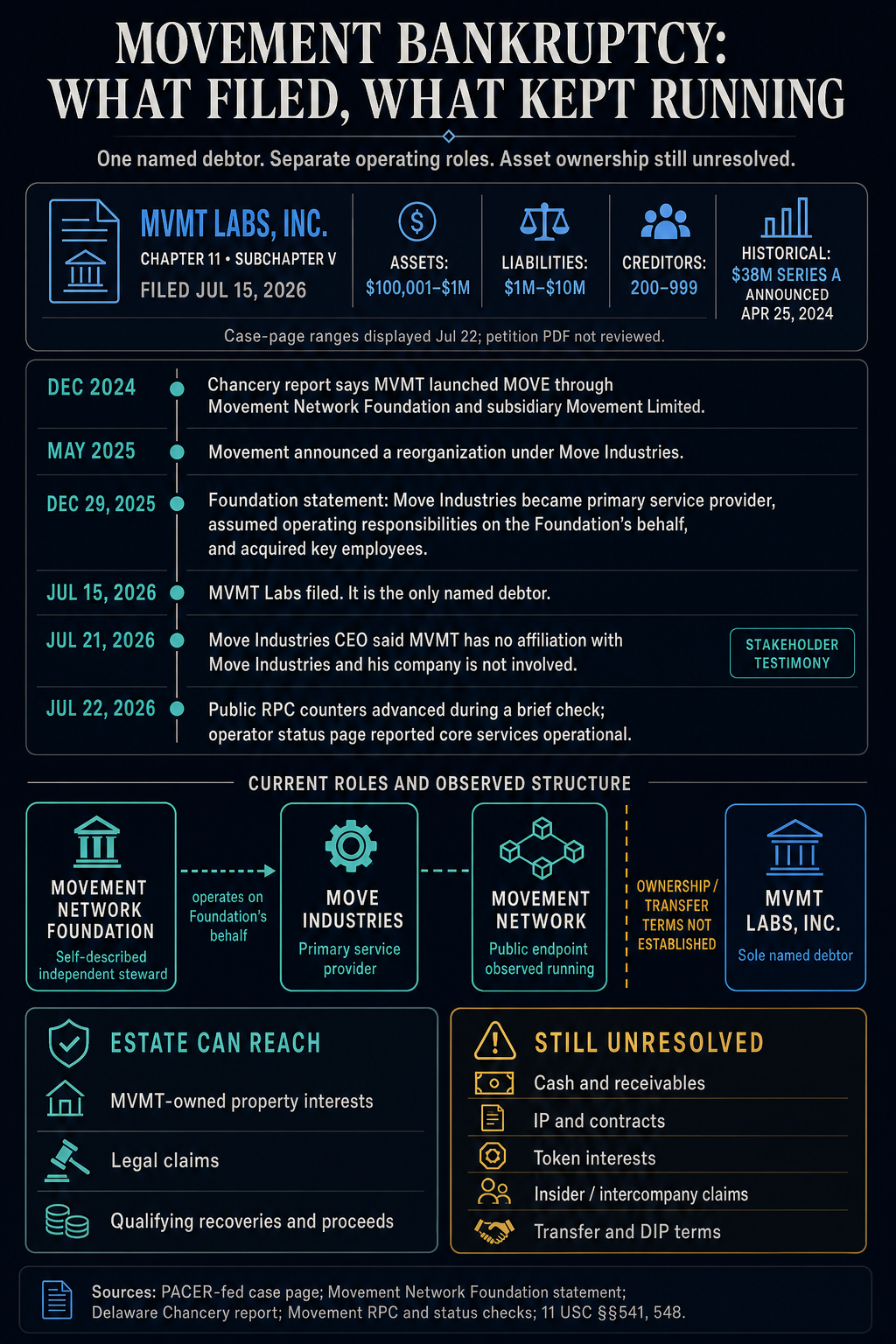
Infographic showing MVMT Labs as the sole named Chapter 11 debtor, Movement Network Foundation and Move Industries operating roles, the live network observation, bankruptcy ranges and unresolved ownership questions.

The operating split predates the bankruptcy

Movement’s present structure took shape during 2025, after a governance and market-making crisis and the departure of co-founder Rushi Manche.

Movement announced a reorganization under Move Industries in May. On Dec. 29, the Foundation said it had completed an operating change that made Move Industries its primary service provider.

According to that announcement, Move Industries assumed primary operating responsibilities for the network on the Foundation’s behalf and acquired key employees. The Foundation described itself and its board as independent stewards, while Move Industries would build, operate, and grow the ecosystem for it.

The announcement leaves the transferor, consideration, and asset list unspecified. It establishes the operating roles the Foundation described, while ownership of bankruptcy-relevant rights remains unresolved.

Entity or assetEstablished rolePosition in this caseUnresolved exposureMVMT Labs, Inc.Historical technology developer and the only named debtorIts property interests and qualifying claims or recoveries enter the estateCash, IP, contracts, token interests, legal claims, intercompany balances and obligationsMovement Network FoundationDescribed itself in December 2025 as the network’s independent stewardNot a named debtorRelevant assets, agreements, claims against MVMT and obligations to MVMTMovement LimitedFoundation subsidiary identified in the MOVE launch historyNot a named debtorCurrent role and any relevant holdings or agreementsMove IndustriesBecame the Foundation’s primary service provider under the December 2025 announcementNot a named debtor; its CEO asserts no affiliation with MVMTTerms behind the operating change and employee acquisitionMovement NetworkPublic endpoint remained responsive after the filingNo network filing is listedDependence on any rights or contracts owned by MVMTMOVEToken continued trading after the filingThe token itself is not a debtorAny MOVE interests held by MVMT and their treatment in the estate

A March 2026 Delaware Court of Chancery report described MVMT Labs as the technology-development company that created the Movement blockchain. It said MVMT launched MOVE in December 2024 through Movement Network Foundation and its subsidiary, Movement Limited.

Movement Labs rebrands as MOVE token faces dramatic plunge and potential Binance delistingMovement Labs rebrands as MOVE token faces dramatic plunge and potential Binance delisting
Related Reading

Movement Labs rebrands as MOVE token faces dramatic plunge and potential Binance delisting

MOVE token faces scrutiny and potential delisting as Binance imposes monitoring tag.

May 7, 2025 · Oluwapelumi Adejumo

The bankruptcy docket index identifies a debtor-in-possession financing motion at Dkt. 19, a sealed exhibit at Dkt. 20 and Michael Robinson’s first-day declaration at Dkt. 21. The captions do not reveal the financing amount or terms. They also do not explain Project Fenix, the operating-change consideration, MVMT’s exact cash, ownership of IP and contracts, token interests, or insider and intercompany balances.

What enters MVMT’s estate

Estate boundaries turn on MVMT’s property interests.

Section 541 of the Bankruptcy Code creates an estate comprising the debtor’s legal and equitable interests in property when the case begins, together with specified recoveries and proceeds. In MVMT’s case, that could include cash, receivables, contractual rights, intellectual property, token holdings and legal claims, but only to the extent MVMT owns them.

Property owned outright by a separate non-debtor remains outside MVMT’s estate even when it supports the same ecosystem. Only an ownership interest tying value to MVMT could bring the Foundation’s property, Move Industries’ property, or MOVE holdings into the estate.

Creditors can also benefit from claims that belong to the estate. Section 548 provides a mechanism to avoid qualifying transfers of debtor property or obligations made within two years before bankruptcy when the statute’s tests are proved. The public docket index supplies no basis to classify the employee acquisition, service arrangement, Project Fenix, or another Movement-related transaction as qualifying.

The possibility still puts transaction documents at the center of the case. If MVMT transferred property before filing, creditors and the court will need to know what moved, what consideration MVMT received, and which rights it retained. Property that always belonged to another entity remains with that owner despite MVMT’s role in creating the network.

CryptoSlate Daily Brief

Daily signals, zero noise.

Market-moving headlines and context delivered every morning in one tight read.

5-minute digest 100k+ readers

Free. No spam. Unsubscribe any time.

Whoops, looks like there was a problem. Please try again.

You’re subscribed. Welcome aboard.

A separate Chancery proceeding identifies a potential obligation without fixing its bankruptcy treatment. The March Rule 144 report concluded that Manche was entitled to advancement from MVMT for fees connected to a federal investigation, plus fees-on-fees and prejudgment interest. The report remains subject to exceptions and implementation and fixes neither an allowed bankruptcy claim nor a claim amount.

The schedules and statement of financial affairs should begin to show MVMT’s cash, receivables, contracts, litigation claims, token holdings, insider balances and debts. Ownership and transfer disputes may continue beyond those disclosures.

Network activity leaves ownership unresolved

Movement’s official documentation identifies mainnet as chain ID 126 and lists its public RPC. During a brief endpoint check at 11:59 UTC on July 22, the ledger version advanced from 180,558,734 to 180,558,762, and block height increased from 77,828,052 to 77,828,066 over about five seconds. The operator’s status page simultaneously reported the mainnet, RPC, explorer, and indexer as operational.

At 12:21 UTC that day, CryptoSlate’s MOVE market page showed the token at $0.011, down 93% since last July, with a market capitalization of about $44.26 million and $9.38 million in 24-hour volume.

Coinbase delisting sends Movement's MOVE token to all-time low amid market-making scandalCoinbase delisting sends Movement's MOVE token to all-time low amid market-making scandal
Related Reading

Coinbase delisting sends Movement’s MOVE token to all-time low amid market-making scandal

Movement Labs co-founder suspended amid investigation into suspicious market activities.

May 2, 2025 · Oluwapelumi Adejumo

Those snapshots show the network and token were still moving. What they do not reveal is where MVMT’s property ended, and the wider Movement ecosystem began.

MOVE ownership by itself confers neither debtor nor creditor status in MVMT’s case. A holder could have separate exposure through a claim against MVMT, while the token’s market value could react to disclosures about assets, financing or litigation.

Builders and business partners will have to follow the paperwork. A responsive RPC shows that the network was available during the check. Each service, grant, license or commercial agreement still must be matched to MVMT, the Foundation, Move Industries or Movement Limited. The named counterparty may determine whether the agreement is implicated in Chapter 11 and whether another Movement entity has a claim against or obligation to MVMT.

For creditors, network activity and estate value are separate measures. Recovery depends on property MVMT owns, claims it can pursue, and any qualifying prepetition transaction it can challenge.

Four dates could clarify the boundary

The case calendar lists a Section 341 creditor meeting for Aug. 20, a second-day hearing for Aug. 27 at 11 a.m., a general claims deadline for Sept. 14, and the Subchapter V plan deadline for Oct. 13.

The Aug. 27 hearing may clarify the financing request. Schedules and other disclosures may illuminate the estate’s assets and obligations, while objections could show whether creditors, the U.S. Trustee or the Subchapter V trustee contest a prepetition transaction or the asserted separation.

For now, the filing establishes a limited but important divide: MVMT Labs is the only named debtor, and the Movement Network remained operational after the petition.

Whether MVMT owns or can recover value tied to that ecosystem will turn on the disclosures, agreements, and court disputes that have yet to surface.


Source link

PowerWash Simulator 2 STAR WARS Pack Review | TheXboxHub

PowerWash Simulator 2 STAR WARS Pack Review | TheXboxHub


Luckily, You Don’t Have to Clean the Death Star

What is not included in PowerWash Simulator 2 STAR WARS Pack is almost as interesting as what is in it. The six levels in the Pack are all chronologically drawn from the original series. The cleaning kicks off in Beru and Lars’s Moisture Farm (pre-massacre, by the way. You don’t have to dispose of some skeletons), then wends through Mos Eisley Cantina, an AT-AT from Empire, the bridge of a Super Star Destroyer, Wedge’s X-Wing and – finally – the Millennium Falcon. The Falcon is after the Battle of Endor, so you’re cleaning it as a favour for Lando. 

I find it fascinating that the Pack dodges prequels, sequels and TV series. Perhaps those will come if this Pack is a success. But it does make me wonder if the PowerWash Simulator 2 fanbase might be on the older side. There’s a nostalgic aroma to PowerWash Simulator 2 STAR WARS Pack, and the choices are very deliberate.

PowerWash Simulator 2 - STAR WARS Pack X-Wing
Hit up that X-Wing

Use the Froth, Luke

I also find it fascinating that no single character makes an appearance in PowerWash Simulator 2 STAR WARS Pack. There’s no C3P0 to wash, no Jabba armpits to clean. Sure, Wedge and Lando will chatter over the intercom, but they’re invisible. And there’s no lampooning of the STAR WARS universe in the story. I’d argue that what you’re doing – cleaning the mess after STAR WARS characters have left the scene – is inherently a bit silly, but this Pack is deadly serious about the whole endeavour. It imagines precisely what a cleaning crew would be like in this universe. Characters grumble about the presence of droids; Admiral Piett wonders what Lord Vader is planning while you powerwash his consoles.

I’m making a wild leap here, but I can’t help wondering if Disney has been a little too protective over PowerWash Simulator 2 STAR WARS Pack. It would certainly address one of my overriding issues with this DLC. It all strikes me as so safe and timid when it comes to handling the STAR WARS property. There’s no slightly risqué dismembered limb in the Cantina, or any references to Greedo shooting first. The wider battle can be seen but not explored with the AT-AT. Someone has chosen Wedge’s X-Wing over Luke’s, probably because R2-D2 doesn’t then have to feature. It’s all a bit anonymous and colourless as a result. 

Something else is lacking in PowerWash Simulator 2 STAR WARS Pack, which again invokes the dark, looming shadow of Disney, and that is a lack of new toys to play with. Unlike the Adventure Time Pack (which, we should note, did have characters in the scenes, a sense of humour, and more generous callbacks), there are no new ladders, abseils or hoses. It’s not hard to imagine a thermal detonator, rewired for water, or mechanical ladders that have the trademark blinking buttons of STAR WARS tech. But, again, the Pack opts for the easiest route, which is a shame. 

Luke, I am Your Lather

On the positive side, there are still some nice touches – just not as many as I would like, and they don’t go as far as they could. There’s a glorious moment (spoiled in the launch trailer, so we can spoil it here), where the X-Wing opens its wings to reveal a whole host of additional crap to clean (I’d have loved some Dagobah monsters pouring out of Luke’s X-Wing). That’s wonderful. Something similar happens with the Millennium Falcon (not in the trailer, so we won’t spoil it). And mouse droids run away squealing if you trip over them in the Star Destroyer.

PowerWash Simulator 2 - STAR WARS Pack PowerWash Simulator 2 - STAR WARS Pack
Powerwashing, Star Wars style

And there’s still the built-in, delightful experience of cleaning a place that you’ve only seen in movies. For some reason, I loved the little pits on either side of the causeway in the Super Star Destroyer. I always wondered whether Imperials would accidentally fall into these pits when they’re not paying attention, and lo and behold I fell in at least a dozen times. And, ah, the irony of washing vaporators in the deserts of Tatooine. I imagine there’s a hosepipe ban that would make this normally impossible. 

What the STAR WARS Pack gets right is the authenticity. I can only imagine that the developers and artists over at Futurlab have a well thumbed copy of a STAR WARS Incredible Cross-sections book. Every last knob and panel has been excruciatingly modelled and labelled, so that you can carefully apply foam and wash it. I’d find my eye drifting to the top-left of the screen, so I could find out what the parts of an AT-AT are called. 

Mop It Up, Fuzzball

And that authenticity stretches to the presentation. The Super Star Destroyer buttons look delightfully ‘80s, exactly as they should. The astromech droid in the X-Wing gleams in exactly the right way once you clean it. Plus the audio is spot on. There are all the correct hums and growls from the things you wash, and you always feel like you’re interacting with something from the STAR WARS universe, even if you never quite feel like you’re in it yourself. 

That authenticity is almost to a fault, actually. Something that became a problem – but it never occurred to me that it would be one – is that the STAR WARS universe is surprisingly drab. Having come off the Adventure Time Pack, it was stark how everything was sandy brown, grey, white or black. And most of those are dark, hidden in nooks within the Cantina or Super Star Destroyer. When the sand and snow that cover these elements are also sandy brown, grey, white or black, the experience can be a mixture of unintelligible and uninspiring.

The more I write, the more I realise that I am being a typical STAR WARS fanboy: complaining and griping rather than focusing on what something does well. This pack is one of the biggest that the Futurlab team have put out. I’m used to five levels, but this has six, and some of them – the AT-AT and Millennium Falcon in particular – are substantial. It’s massively authentic to the STAR WARS universe; the spaces are a dream to clean; and none of the things that make PowerWash Simulator 2 so friendly and relaxing have been lost. 

PowerWash Simulator 2 - STAR WARS Pack AT-ATPowerWash Simulator 2 - STAR WARS Pack AT-AT
That AT-AT won’t clean itself

Aren’t You a Little Short of Being a Perfect STAR WARS DLC?

But I also don’t think PowerWash Simulator 2 STAR WARS Pack should be excused for pulling its punches. STAR WARS is about characters, moments, items and events, just as much as its vehicles and sets, yet none of those things surface. It felt a little like I was being allowed to clean a museum set from the STAR WARS universe, rather than truly immerse myself in the space, and that was something of a shame. 

Give me a mucky rancor and a cleaning-droid in a gold bikini and I would have been much happier. That’s the tone it should have gone for.

PowerWash Simulator 2 Goes Full Jedi With The STAR WARS Pack – https://www.thexboxhub.com/powerwash-simulator-2-goes-full-jedi-with-the-star-wars-pack/

Buy from the Xbox Store – https://www.xbox.com/en-GB/games/store/powerwash-simulator-2-star-wars-pack/9P2DDLXDBVPJ/0010


Source link

Miquita Oliver Fearne Cotton apology after feud

    0
    Miquita Oliver Fearne Cotton apology after feud


    Miquita Oliver and Fearne Cotton are back in the spotlight after Miquita admitted she still feels ashamed of the comments that wrecked their friendship and cost her a Radio 1 job.

    Speaking on her Miss Me? podcast, Miquita looked back at the fallout with brutal honesty. She told co-host Jordan Stephens that she made the remarks when she was just 20.

    She said: “I would like to tell the story of me and Fearne Cotton. So basically when I was 20 I did something really awful that I was really ashamed of for a long time.”

    Miquita then explained what happened next. She said: “I did an interview in NME and I wasn’t very nice about her at all. I was awful about her and I was fired from Radio 1 because of it, so I lived in a lot of consequence.”

    Miquita spoke about her feud with Fearne (Credit: Brett Cove / SOPA Images / Shutterstock)

    Why the Miquita Oliver Fearne Cotton fallout lasted so long

    The former Popworld host said the tension dragged on for years. They stayed civil, but the awkwardness never really left.

    She said: “We didn’t like each other… I don’t even think she didn’t like me, but because I’d been so awful about her, she stayed away from me.”

    Things got even trickier when Fearne started dating Steve Jones. Miquita worked with him on T4 every week, so they kept crossing paths.

    She said: “When I was 24, she started going out with Steve Jones, who I presented T4 with every week. I’d see her all the time. We were civil, but it was a little bit uncomfortable, but it was ok.”

    The remark at the centre of the row came in a 2005 NME interview. Asked how she would improve Top of the Pops, Miquita replied: “Get rid of the she-devil Fearne Cotton.”

    That line had major consequences, with Miquita being sacked from Radio 1.

    Miquita Oliver and Fearne Cotton: timeline of their fallout and reconciliation

    In a 2005 NME interview, Miquita Oliver said Top of the Pops should “get rid of the she-devil Fearne Cotton”.
    Miquita later said the comment led to her being sacked from Radio 1.
    She said the pair remained civil for years but the relationship was uncomfortable after the remark.
    Miquita also said she continued to see Fearne when Fearne was dating Steve Jones, Miquita’s T4 co-host.
    On the Miss Me? podcast, Miquita said Fearne contacted her on Instagram last year during a difficult period.
    Miquita described Fearne’s message as healing and said they are now on good terms.

    The message that changed Miquita Oliver Fearne Cotton for good

    Miquita said the real turning point came last year. Fearne contacted her directly on Instagram while Miquita was going through a terrible time.

    She recalled: “Then last year she sent me a message on Instagram when I was having a [bleeping] awful time.”

    Fearne’s words clearly stayed with her. Miquita said Fearne wrote: “Hey Miquita, I just watched a clip of you talking about how the press used to refer to you and it resonated deeply. I just wanted to say thank you for opening up about it. Sending love”.

    Miquita said the kindness landed at exactly the right moment. She added: “I didn’t mean to be awful to her. I was unkind, and it wasn’t me.

    “That message was really healing for me.”

    She also revealed how she replied. “I sent her so much love back, and I knew she’d just been through a divorce and was on this new journey. I said, ‘I wish you so much [bleeping] luck on your new chapter’.

    “It was all love.”

    Now, it seems the bad blood has gone. Miquita even hinted that she would happily see Fearne again in that world.

    She said: “So actually me and Fearne Cotton are fine. I’ll see you at Happy Place next year!”

    The apology marks a full-circle moment for the pair. What started as a cruel swipe nearly 20 years ago has now turned into something warmer and far more grown-up.

    Read more: Fearne Cotton appears to reference ex Ian Watkins’ child sex crimes conviction for very first time

    So what do you think of this story? Tell us on our Facebook page @EntertainmentDailyFix.


    Source link

    Centralized Elements ‘Frequently Persist’ in DeFi and Should Be Regulated: FATF – Decrypt

    0
    Centralized Elements ‘Frequently Persist’ in DeFi and Should Be Regulated: FATF – Decrypt


    In brief

    The Financial Action Task Force said that many DeFi platforms are decentralized in name only and fall under its rules wherever identifiable people control them.
    Its report urges countries to find those controllers and regulate them as virtual asset service providers, and, as a last resort, to ban platforms that refuse to cooperate.
    Nearly 93% of surveyed jurisdictions have yet to apply the rules to qualifying DeFi arrangements, and just two have ever licensed or registered one.

    Much of decentralized finance is not as decentralized as it looks, and the platforms behind it should be regulated like other financial businesses, the world’s main anti-money-laundering body said in a new report.

    In a report published Tuesday, the Financial Action Task Force said its rules already apply to any DeFi arrangement where an identifiable person keeps “control or sufficient influence,” regardless of how decentralized a project claims to be. The Paris-based body, whose standards are used across more than 200 jurisdictions, sorts DeFi into three groups: platforms with identifiable controllers; those that are centralized in practice but whose operators stay hidden; and a genuinely leaderless minority it calls truly decentralized. Only the last escapes its standards.

    Although many DeFi projects present themselves as fully decentralized, centralized elements “frequently persist in practice,” the report found, through concentrated governance tokens, administrative privileges, control over upgrades, and the fees and rewards that flow to insiders.

    FATF President Giles Thomson said in a statement accompanying the report that the goal is to stop criminals exploiting new technology to “launder dirty money” while “supporting responsible financial innovation,” calling strong public-private information sharing central to the response.

    Decentralized in name only?

    The report lays out on-chain and off-chain signs of control, including upgrade keys and “kill switch” functions, the power to set fees or risk parameters, concentrated voting power, command of the public website or app, and the corporate entities that employ core developers or hold the treasury. Where such control exists, FATF said, the people behind it, whether developers, large token holders, front-end operators or funders, should be licensed and supervised like any financial firm. Even running a front-end that funnels users to a protocol can be enough to qualify.

    In practice, almost no one is doing this. Nearly 93% of the jurisdictions that responded to a recent FATF survey have not applied the standards to any qualifying DeFi arrangement, and only 26 out of 142 have assessed the risks at all. Four have licensing rules on the books, while just two have ever used them to register or license a platform. FATF guidance is not law, but members are graded on how closely they follow it, and persistent gaps can help land a country on the watchdog’s “grey list.” The report comes on the heels of a broader FATF update days earlier that found most countries still struggling to enforce crypto rules across the board.


    A ban as a last resort

    FATF wants countries to close the gap by requiring, or at least encouraging, DeFi projects to build anti-money-laundering controls straight into their smart contracts or interfaces, from sanctions screening to proof-of-KYC checks before certain functions run.

    For projects that really are leaderless, it steers regulators toward the choke points around them: stablecoin issuers that can freeze tokens, exchanges that handle fiat on- and off-ramps, and front-end operators. And where a platform refuses to cooperate, the report says, a jurisdiction can as a last resort ban it from operating in its territory. Banks and exchanges, for their part, are told to run due diligence on any DeFi platform they touch, or stop dealing with it.

    North Korea’s DeFi haul

    The report leans heavily on how criminals already work the sector. It singles out North Korea, whose state-linked hackers it says were behind two April attacks that together drained more than $570 million: the $285 million exploit of Solana perpetuals exchange Drift Protocol, pulled off in just 12 minutes, and a $292 million hack of KelpDAO.

    Together they made up some 76% of the year’s crypto-hacking losses. The report also points to ransomware crews, professional laundering networks, and investor frauds as heavy users of DeFi’s mixers, bridges and swaps.

    That crackdown is already underway elsewhere. U.S. prosecutors this year secured prison terms for the two co-founders of Bitcoin mixer Samourai Wallet and a conviction against Tornado Cash developer Roman Storm, cases built on the same idea FATF presses here: that the people who build and run the code can be treated as regulated money businesses.

    DeFi’s total value locked reached $86.6 billion this year, up about 85% since 2023, with the top dozen protocols holding more than 60% of it, per the report, which calls for regulators to implement the FATF rulebook rather than leaving a gap that could enable illicit finance at scale.

    Daily Debrief Newsletter

    Start every day with the top news stories right now, plus original features, a podcast, videos and more.


    Source link

    Strategy’s MSTR and Bitcoin Show Tight Correlation in Price Recovery

    Strategy’s MSTR and Bitcoin Show Tight Correlation in Price Recovery


    As Bitcoin claws back from recent lows, Strategy Inc.’s shares (MSTR) have once again demonstrated outsized gains, reinforcing its status as a high-beta proxy for the leading cryptocurrency. 

    This latest surge underscores how deeply intertwined the company’s fortunes have become with Bitcoin’s price action, driven by its massive treasury holdings and strategic positioning in the market. Both the charts are showing a familiar pattern: when Bitcoin stabilizes or rebounds, MSTR doesn’t just follow—it often amplifies the move, sometimes by multiples.

    Strategy Inc.’s shares serve as a high-beta proxy for Bitcoin, amplifying its price movements due to massive treasury holdings.

    The company’s correlation with Bitcoin underscores the growing intersection of traditional finance and digital assets, influencing market sentiment.

    MSTR’s performance has implications for investors and crypto market evolution, offering leveraged access to Bitcoin’s upside while demanding strong risk tolerance.

    The correlation isn’t accidental. Strategy has transformed from a business intelligence software firm into what many describe as a Bitcoin development and treasury powerhouse. With hundreds of thousands of BTC on its balance sheet, the company’s equity has evolved into a leveraged bet on Bitcoin’s long-term value proposition. This dynamic has created both opportunity and amplified risk, as evidenced by sharp drawdowns during crypto winters and explosive rallies during recoveries. 

    As of publishing, with Bitcoin trading in the $65,000 to $66,000 range after bouncing from sub-$60,000 levels, MSTR has mirrored and exceeded that momentum, climbing from June lows near $82 to reclaim territory above $94–$100 in active sessions. 

    Source: Bitcoin Price (July 22, 2026) — TradingView

    The Mechanics of a High-Beta Bitcoin Proxy

    At the core of this relationship lies Strategy’s aggressive Bitcoin accumulation strategy, which began years ago and has positioned the company as the largest corporate holder of the asset. Currently holding approximately 843,775 BTC—acquired at an average cost basis around $75,000–$76,000 per coin—the firm’s treasury value now dwarfs its traditional software operations. This creates a direct transmission mechanism: fluctuations in Bitcoin’s spot price flow straight through to MSTR’s perceived net asset value (NAV).

    Unlike a simple ETF or spot holding, MSTR introduces leverage through its capital structure. The company has utilized debt, equity issuances, and convertible instruments to fund purchases, effectively magnifying exposure. 

    When Bitcoin rises even modestly, the market reprices MSTR not only on the underlying asset appreciation but also on expectations of future accumulation, potential buybacks, or shifts in its “digital credit” framework. Rolling correlations between the two assets frequently hover between 0.65 and 0.95 on shorter timeframes, far higher than many traditional stock-crypto pairs. 

    This beta effect was on full display in recent weeks. As Bitcoin recovered roughly 6% from early July troughs, MSTR posted gains exceeding 20% from its June nadir around $81.81. Market participants attribute this to forced short covering—given elevated short interest in the name—combined with renewed optimism around Strategy’s ability to navigate volatility. 

    Source: MSTR Stock Price — TradingView

    The stock’s moves aren’t purely mechanical; sentiment plays a role. Announcements around USD reserves for preferred dividends, selective Bitcoin monetization up to certain limits, or reaffirmations of “Bitcoin per share” growth targets act as catalysts that supercharge rallies. Yet the foundation remains the correlation: Bitcoin sets the tone, and MSTR dances to an accelerated rhythm.

    Critics point out that this isn’t flawless synchronization. MSTR has at times traded at a discount to its Bitcoin holdings’ fair value, reflecting dilution concerns, execution risks on the software side, and broader market skepticism during prolonged drawdowns. 

    Still, the proxy dynamic persists because investors treat MSTR as accessible, liquid Bitcoin exposure with corporate governance and potential upside from operational cash flows. In essence, it’s a hybrid vehicle—part crypto vault, part leveraged equity—designed for those seeking amplified participation without direct custody hassles.

    Recent Performance: From June Lows to Recovery Momentum

    The past month provided a textbook case of this correlation in action. Bitcoin’s dip below $60,000 in late June triggered a steeper sell-off in MSTR, which hit its 52-week low amid broader risk-off sentiment and profit-taking. The stock plunged more than 40% year-to-date at one point, outpacing Bitcoin’s roughly 30% decline over similar periods. Heightened volatility, with daily swings often exceeding 5–10%, reflected leveraged unwinds and shifting investor conviction.

    Then came the rebound. As Bitcoin stabilized and pushed toward $62,000–$65,000, buoyed by improving ETF flows and macro signals, MSTR responded with vigor. Sessions saw intraday gains of 7–12%, with the stock reclaiming the $100 level briefly before settling into the mid-$90s amid ongoing chop. Volume spiked during these moves, signaling strong participation from both retail and institutional traders rotating back into crypto proxies. Strategy’s holdings, valued at tens of billions despite paper losses relative to peak prices, began looking more attractive as unrealized pressures eased.

    This recovery phase also highlighted operational nuances. The company’s framework for building cash reserves—potentially through limited Bitcoin sales to service dividends while pursuing buybacks—provided a narrative of prudent management rather than capitulation. Such moves helped stabilize sentiment, allowing the correlation to shine through without the drag of pure panic. 

    Compared to direct Bitcoin exposure, MSTR delivered outsized returns on the way up, consistent with historical patterns where the stock has outperformed in uptrends by 1.5x to 2x or more. Yet the asymmetry remains: drawdowns can be equally punishing, as seen earlier in 2026 when MSTR lagged on the downside too.

    Broader market context amplified these moves. With Bitcoin’s market cap hovering around $1.31 trillion, Strategy’s position represents a meaningful slice of corporate adoption. Its performance influences sentiment across crypto equities, from miners to related tech plays. 

    As Bitcoin hovers near key technical levels, any sustained push above $65,000–$70,000 could trigger another leg higher for MSTR, testing resistance zones tied to prior highs.

    Implications for Investors and Crypto Market Evolution

    The MSTR-Bitcoin correlation offers a double-edged sword. It provides efficient, leveraged access to Bitcoin’s upside narrative—positioning Strategy as a proxy for those bullish on digital scarcity and institutional adoption—without needing to manage wallets or navigate spot market intricacies. Portfolio managers have increasingly allocated to MSTR for its convexity: strong Bitcoin rallies can produce asymmetric equity returns, potentially offsetting underperformance elsewhere.

    However, this comes with caveats. The stock’s volatility exceeds Bitcoin’s, demanding strong risk tolerance and active monitoring. Factors like interest rate environments, regulatory shifts, or company-specific news (dilution, dividend policies) can decouple moves temporarily. Those betting purely on the correlation must weigh mNAV discounts, where MSTR trades below its Bitcoin stash value, against premiums during euphoria phases. Long-term holders see it as validation of Bitcoin treasury strategies, potentially inspiring more corporations to follow suit and deepening market integration. 

    Read: VanEck Pours $207M into Strategy’s STRC Despite Market Pressure on the Stock

    On a macro level, this relationship signals crypto’s maturation. What began as a niche corporate experiment has become a bellwether for how traditional finance interacts with digital assets. Strategy’s model—financing Bitcoin buys through sophisticated capital markets tools—has created a feedback loop where equity performance influences Bitcoin sentiment and vice versa. As more entities adopt similar approaches, correlations could strengthen further, or new divergences might emerge based on execution quality.

    As July-end unfolds, the “great correlation” appears resilient. With Bitcoin recovering and Strategy reiterating its commitment to growing holdings over time, MSTR stands poised to capture—and magnify—any further upside. Investors navigating this space must balance enthusiasm for the proxy’s power with disciplined risk management. 

    In a market where narratives drive prices as much as fundamentals, the MSTR-Bitcoin tandem remains one of the clearest expressions of conviction in cryptocurrency’s staying power. Whether this surge marks the start of a broader rally or another volatile chapter depends on Bitcoin holding its ground, but history suggests the correlation will once again prove its worth.

    Also read: The Bitcoin Treasury Blueprint: What Stress Testing on Strategy Inc.’s MSTR-STRC Reveals


    Disclaimer: The information researched and reported by The Crypto Times is for informational purposes only and is not a substitute for professional financial advice. Investing in crypto assets involves significant risk due to market volatility. Always Do Your Own Research (DYOR) and consult with a qualified Financial Advisor before making any investment decisions.


    Source link

    Fortnite Persona 5 crossover leaked for Season 4 – VideoGamer

    Fortnite Persona 5 crossover leaked for Season 4 – VideoGamer


    You can trust VideoGamer. Our team of gaming experts spend hours testing and reviewing the latest games, to ensure you’re reading the most comprehensive guide possible. Rest assured, all imagery and advice is unique and original. Check out how we test and review games here

    A long-rumoured Persona 5 crossover could finally be heading to Fortnite as part of the battle royale’s next season, according to a new leak.

    Fortnite leaker SamLeakss claims that Persona will form the basis of an upcoming Rocket League event, complete with free rewards that can also be used in Fortnite. The leaker added that Persona may then appear during Fortnite Chapter 7 Season 4, which is widely rumoured to revolve around characters and franchises from across gaming.

    A separate report states that the crossover will specifically be based on Persona 5, rather than another entry in Atlus’ long-running RPG series. However, neither Epic Games nor Atlus has officially announced the collaboration, so the information should still be treated as a rumour for the time being.

    Persona 5 could finally join Fortnite

    Persona has appeared in an impressive number of crossovers over the years, with Joker and the Phantom Thieves previously turning up in games including Super Smash Bros. Ultimate, Granblue Fantasy, AFK Arena, and Identity V. Fortnite has remained one of the more obvious omissions, especially given Epic’s determination to turn its battle royale into gaming’s biggest digital toy box.

    Rumours of a Persona crossover have circulated throughout several previous Fortnite seasons, usually whenever Epic introduces a Japanese theme or begins adding more gaming characters. Those rumours have repeatedly failed to produce anything tangible, but the reported connection to an upcoming Rocket League event gives the latest claim a little more substance.

    SamLeakss specifically stated that Persona will be the subject of Rocket League’s next major event and that it will include free rewards transferable to Fortnite. That does not necessarily confirm character skins for the battle royale, but it suggests Epic is working with Atlus on content that spans more than one of its games.

    Should the crossover happen, Joker would be the most obvious candidate for a Fortnite Outfit. Other members of the Phantom Thieves, including Ann, Ryuji, Makoto, and Futaba, could also appear, while Morgana feels almost purpose-built to become a Back Bling, Glider, or Sidekick.

    None of those cosmetics have been mentioned by the leakers, though, and there is currently no reliable information regarding which characters, items, or music tracks might be included.

    Fortnite Season 4 could be packed with gaming crossovers

    Persona 5 is reportedly just one part of a much larger collection of gaming collaborations being prepared for Fortnite Chapter 7 Season 4.

    Previous leaks have suggested that the season will carry a “Gaming Legends” theme and could feature characters from Sonic the Hedgehog, Mega Man, Crash Bandicoot, and Kingdom Hearts. Sonic has also been linked to the Season 4 Battle Pass, although that remains unconfirmed.

    That would make Chapter 7 Season 4 one of Fortnite’s most ambitious crossover seasons to date, even by the game’s increasingly ridiculous standards. Epic has already added characters from Halo, God of War, Resident Evil, Street Fighter, Tomb Raider, The Witcher, and countless other gaming series, but an entire season built around recognisable video game characters would take the Gaming Legends label considerably further.

    The current Chapter 7 Season 3 Battle Pass is scheduled to end on August 20, 2026. That date provides the most likely window for the next major season transition, although Epic has yet to announce when Chapter 7 Season 4 will begin.

    Other reports have pointed towards a possible September launch based on internal update information, meaning the schedule is not currently clear. Until Epic publishes an official teaser or confirms the new season’s theme, players should be cautious about assuming that every leaked collaboration will arrive.

    Still, after years of speculation, the prospect of Joker dropping from the Battle Bus while Morgana complains about everyone staying up too late feels considerably more plausible than it once did.


    Source link

    Freddy Brazier rushed to hospital after dog attack

      0
      Freddy Brazier rushed to hospital after dog attack


      Freddy Brazier was rushed to hospital after a horror dog attack at his nan Jackiey Budden’s London home.

      The 21-year-old reportedly needed stitches after his Pocket Bully dog Pablo bit him on Tuesday, July 21.

      A source told The Sun: “Freddy was shocked when it happened and was left in a lot of pain.”

      The frightening incident happened while Freddy was at Jackiey’s house in London.

      Jackiey also suffered injuries, according to the report. She tried to pull Pablo off Freddy during the ordeal.

      A spokesman shared an update on his condition with ED!, saying: “Freddy is currently being treated; we will keep everyone updated on his recovery.”

      Freddy is in hospital (Credit: BBC)

      What happened during Freddy Brazier’s dog attack?

      The report says Pablo attacked Freddy while he was at his grandmother’s home.

      That left the young star needing hospital treatment.

      Freddy Brazier has grown up in the public eye. Many know him as the youngest son of late Big Brother star Jade Goody and TV presenter Jeff Brazier.

      That family connection has kept him in headlines for years. Now attention has turned to his recovery.

      Freddy Brazier’s nan Jackiey Budden was ‘mauled’ days earlier

      Freddy Brazier’s neighbours reportedly rang the police after hearing screams when nan Jackiey Budden was allegedly attacked by the dog.

      According to claims, neighbours heard Jackiey cry as the pocket bully “gripped” onto her with its teeth.

      London Fire Brigade and the Metropolitan Police are said to have attended the scene, as per The Sun.

      A source claimed to the publication: “It’s been a shocking few days. During the first incident, Jackiey was home alone, and she was mauled – on this occasion, one of her panicked neighbours raised the alarm. Both the police and the fire brigade attended, but fortunately it wasn’t too serious – and they agreed not to pursue criminal charges.”

      Sources also claim it has been “awful” for Freddy, who “absolutely adores Pablo”.

      Freddy’s representative has been contacted for comment.

      This Freddy update comes as a huge shock

      The hospital dash comes just months after a major moment in his personal life.

      Freddy and ex-girlfriend Holly Swinburn welcomed their first child in March.

      They named their daughter Isla Jade Brazier. The name paid tribute to his late mum.

      Freddy and Holly had an on-and-off relationship before they split. The Sun said the breakup followed a row involving his dog.

      The same report added that Holly had tried to take the pet from him during the argument.

      That claim had already put Pablo in the spotlight.

      For now, Freddy Brazier remains focused on treatment and recovery.

      No one has shared further details about the full extent of his injuries.

      Still, the quotes released so far paint a grim picture. Freddy was “left in a lot of pain,” and Jackiey also appears to have been caught up in the chaos.

      Fans will now hope for reassuring news soon. The focus remains on Freddy Brazier after a deeply distressing past 24 hours.

      Read more: Freddy Brazier addresses split with daughter’s mum as he admits: ‘I’m doing therapy’

      What do you think about this story? Leave us a comment on our Facebook page @EntertainmentDailyFix.


      Source link

      BGaming digs up ancient treasures in Reel of Ra – Adventure Gamers

      BGaming digs up ancient treasures in Reel of Ra – Adventure Gamers


      BGaming is heading back to Ancient Egypt with Reel of Ra, a new classic-style slot that invites you to explore a sand-covered temple filled with coins, multipliers and a Grand Prize worth up to 1,000x the stake.

      The latest addition to the supplier’s #Classic series uses a 5×3 layout alongside a ways pays system, wrapping the action in plenty of golden statues, stone tablets and familiar Egyptian iconography.

      Ancient Egypt might be one of the most frequently visited settings in slots, games and films, but it clearly still has some treasure left to uncover. BGaming has attempted to keep things familiar while introducing a bonus round designed to give the theme a slightly more modern twist.

      Reel of Ra Bonus Game explained

      The main feature is activated by landing three or more Coin symbols during the base game. This causes the stone tablet guarding the temple vault to crack open, triggering seven Coin-only spins.

      During each spin, you can land Coin symbols carrying random multiplier values. All Coins are collected at the end of the round, with their values added together before being boosted by a separate Multiplier Reel.

      This multiplier can increase the accumulated total by up to 5x, potentially turning an otherwise modest collection into a significantly larger reward.

      Completely filling the 5×3 grid with Coin symbols instantly awards the 1,000x Grand Prize. However, you will instead receive their accumulated Coin total when it has already climbed beyond 1,000x, ensuring a particularly successful feature is not capped by the jackpot.

      Those of you who would rather skip the excavation work can also use the Buy Bonus option to enter the seven-spin feature immediately.

      If you’d like to try out the game before dropping any real life cash on playing, you can experience The Reel of Ra demo on BGaming’s official website.


      Source link

      Dune 2 – The C64 Demake – Arok Edition – Could Westwood’s classic RTS hit be coming to the C64?

      Dune 2 – The C64 Demake – Arok Edition – Could Westwood’s classic RTS hit be coming to the C64?


      How about this for an incredible mid-week heads up, as Westwood’s legendary 1992 RTS masterpiece is unofficially invading the 8-bit era with Dune 2 – The C64 Demake – Arok Edition by Primal. This jaw-dropping project brings the iconic desert warfare to the Commodore 64, boasting a smooth four-direction scrolling battlefield, rich multicolor graphics utilizing clever single-sprite trickery, and support for 64 total units and buildings with zero limits on how many troops can flood the screen at once. 

      Players can look forward to building complex bases and producing massive armies to clash against a ruthless enemy AI that manages its own economy, expands its forces, fiercely defends its territory, and launches merciless counter-attacks when provoked. Best of all, this incredible demake is already looking like absolute business with future updates promising even more maps, unique units, and gameplay enhancements.

      Seriously if this is as good as it sounds, it could be a Commodore 64 hit!

      Links 1) Source ( Try out the latest version released at Arok Party 2026 )


      Source link

      Samsung Enters the Robotics Arms Race: Inside the New RX Unit | Metaverse Planet

      Samsung Enters the Robotics Arms Race: Inside the New RX Unit | Metaverse Planet


      I have to admit, I’ve been watching the robotics space closely lately, and honestly, it’s starting to feel like we are living in the prequel to a sci-fi blockbuster. Every other week, a tech giant announces a massive leap in automation. We’ve watched Tesla relentlessly iterate on its Optimus humanoid, and we’ve seen LG launch its dedicated Robotics Business Center. Even companies like Honor and Hisense are throwing their hats into the ring.

      But the news that crossed my desk today really made me sit up and take notice. Samsung isn’t just watching from the sidelines anymore—they are aggressively shifting into high gear. The South Korean tech behemoth has officially consolidated its robotic ambitions under a brand-new division: the Robotics eXperience (RX) unit.

      Let’s dive into why this matters, and why I think this could fundamentally change how our electronics are built in the next decade.

      What is the Robotics eXperience (RX) Unit?

      Up until now, Samsung’s robotics research was somewhat fragmented across different departments. By establishing the RX unit, they are bringing all that raw R&D talent under one unified roof.

      Led by Samsung Electronics CEO TM Roh, this new organization is designed to streamline and accelerate everything from basic research to commercial deployment. And they aren’t just keeping this local. While the RX unit will be headquartered at the Samsung R&D Campus in Seoul, they are rapidly expanding their footprint with global research hubs planned across the United States, China, and Japan.

      To me, this geographical spread screams one thing: Samsung is hunting for the absolute best global talent they can find.

      The Boston Dynamics Connection

      Here is the detail that really caught my eye while researching this move. To spearhead their robotics strategy, Samsung didn’t just promote from within. They went out and poached Lee Dong-geon, a heavyweight who previously managed robotics strategies for Boston Dynamics under Hyundai.

      When you bring in someone with Boston Dynamics on their resume, you aren’t just looking to build a basic assembly line arm. You are looking to build agile, advanced, and highly capable machines.

      Joining him is Prof. Kim Eui-gyeom from Ajou University, a renowned expert in robotic hands and manipulation technologies. If you follow robotics, you know that creating a robotic hand that can match human dexterity is the “Holy Grail” of the industry. The fact that Samsung is prioritizing manipulation tech tells us exactly how complex they want these robots to be.

      The First Milestone: Autonomous Factories by 2030

      So, what is Samsung actually going to do with all this brainpower? They are starting at home.

      Samsung’s immediate priority is industrial robotics. Their master plan is to integrate these newly developed robots directly into their own manufacturing facilities, pushing the boundaries of automated production. The ultimate goal is wildly ambitious: to transform all of their manufacturing facilities into AI-powered, fully autonomous factories by 2030.

      Think about that for a second. In less than four years, the smartphones, TVs, and chips we buy could be manufactured in massive “dark factories” operated almost entirely by AI and robotics.

      Here is how their rollout strategy breaks down:

      Phase 1 (Internal Integration): Deploying proprietary robots in Samsung’s own factories to refine the hardware and software in real-world, high-stakes environments.Phase 2 (Commercialization): Once the systems are perfected and proven to increase efficiency, Samsung plans to package and sell these robotic solutions to other manufacturers globally.

      It’s a brilliant playbook. They get to use their own massive supply chain as a testing ground before becoming a B2B robotics supplier.

      Beyond the Factory: The Humanoid Horizon

      While industrial automation pays the bills, Samsung clearly has its sights set on the future. They aren’t limiting themselves to stationary factory arms.

      Samsung’s secretive Robot Hand Laboratory has been quietly working on advanced manipulation tech for years. Combine that with the creation of the RX unit, and it’s clear they are laying the groundwork for highly capable humanoid robots.

      Let’s not forget that in 2024, Samsung became the largest shareholder of Rainbow Robotics, a company famous for developing robot dogs and advanced industrial bots. When you connect the dots—Rainbow Robotics’ mobility platforms, Prof. Kim’s robotic hand expertise, and Lee Dong-geon’s strategic vision—you have all the necessary ingredients to build a true competitor to Tesla’s Optimus.

      My Takeaway

      I’ve always felt that the true winner of the “robot wars” wouldn’t necessarily be the company with the flashiest demo video, but the one that can actually scale manufacturing and integrate AI flawlessly. Samsung builds the chips, they build the sensors, and they have the factories. They possess an ecosystem advantage that very few companies on Earth can match.

      The establishment of the RX unit is a clear signal: the era of AI-driven robotics is moving out of the lab and onto the global factory floor.

      I’m incredibly curious to see what their first commercial robot will look like. Will they go for a practical, wheeled design for factories, or will they surprise us with a fully bipedal humanoid sooner than we expect?

      What do you guys think? If Samsung releases a consumer humanoid robot in the 2030s, would you trust it in your home over one made by Tesla or Apple? Let me know your thoughts!

      You Might Also Like;


      Source link

      Popular Posts

      My Favorites