You can trust VideoGamer. Our team of gaming experts spend hours testing and reviewing the latest games, to ensure you’re reading the most comprehensive guide possible. Rest assured, all imagery and advice is unique and original. Check out how we test and review games here
Project Zomboid’s long-awaited Build 42 update will receive its full stable release on July 29, bringing sweeping changes to the zombie survival game after years of development and public testing.
Developer The Indie Stone describes Build 42 as one of the broadest updates in Project Zomboid’s history. It expands and refreshes the Knox Country map while introducing animal husbandry, deeper crafting and construction systems, improved lighting, additional environmental storytelling, and numerous quality-of-life changes.
A new trailer has also been released showcasing some of the environments, animals, and survival systems arriving with the update.
What is included in Project Zomboid Build 42?
One of the headline additions is a substantially expanded version of Knox Country, the game’s enormous fictional recreation of zombie-infested Kentucky. Existing areas have been refreshed, while new locations will give experienced players more buildings, wilderness, and potential death traps to explore.
Build 42 also makes considerable changes to crafting and base building. Players will have more options for creating, maintaining, and improving settlements, with the expanded systems intended to support longer-term survival and attempts at becoming self-sufficient.
Animals and animal husbandry add another major layer to the game. Survivors will be able to incorporate livestock, farming, food production, and wilderness survival into their plans, assuming those plans are not immediately ruined by a horde or one badly timed scratch.
The game’s lighting and atmosphere have also been overhauled to make houses, forests, roads, and towns more readable and immersive. Expanded lore and environmental storytelling will provide additional information about Knox Country and the events surrounding its collapse.
Elsewhere, players can expect improvements to the inventory, interface, interactions, and several of the underlying systems that power Project Zomboid’s detailed survival simulation.
The major Build 42 additions include:
An expanded and refreshed Knox Country map
Deeper crafting and construction systems
Animals and animal husbandry
Improved lighting and atmosphere
Additional lore and environmental storytelling
Inventory, UI, interaction, and quality-of-life improvements
Build 42 has been years in the making
Project Zomboid first entered Steam Early Access in 2013 and has since developed into one of the platform’s most detailed survival games.
Its combination of zombie survival, character progression, base building, farming, crafting, multiplayer, and mod support has helped it maintain a dedicated community throughout its lengthy development.
Build 42 has been in production for several years, with players testing unstable versions and providing feedback ahead of the stable launch.
“Build 42 has been a huge undertaking for the team, and we are all incredibly grateful to the community for sticking with us: testing, surviving, dying, and then doing it all again, while providing valuable feedback all along the way,” said Christian Allen, Design Director at The Indie Stone. “Project Zomboid has always been about creating a world where the player tells their own story, and this update gives them even more areas, systems, and tools to create the memories of How They Died.”
Although the update gives survivors considerably more tools for building a sustainable life, Project Zomboid’s core premise remains unchanged. Death is inevitable, and Build 42 simply provides players with many more elaborate ways to reach it.
Project Zomboid Build 42 launches in full on July 29 for PC, Mac, and Linux.
Subscribe to our newsletters!
By subscribing, you agree to our Privacy Policy and may receive occasional deal communications; you can unsubscribe anytime.
Published: July 24, 2026 at 9:19 am Updated: July 24, 2026 at 9:19 am
by Anastasiia O
Edited and fact-checked:
July 24, 2026 at 9:19 am
To improve your local-language experience, sometimes we employ an auto-translation plugin. Please note auto-translation may not be accurate, so read original article for precise information.
In Brief
How Spotify polices AI music fraud while aggressively building its own AI tools, exposing the deep power asymmetries that leave working musicians paying the price.
On July 16, 2026, Lorde opened Instagram and told a tech platform to keep its artificial intelligence away from her art. Spotify’s “About the Song” feature — an AI tool still in beta that scrapes third-party sources to generate contextual blurbs — had produced a hallucinated narrative about one of her tracks, attributing a stage performance to the wrong song entirely. “I’m going to go out on a limb and say we don’t want this,” she wrote. “Reducing a song to an AI-generated meaning right at the source feels like it limits free interpretation.”
Spotify removed the text. A spokesperson called it a beta feature that would improve with feedback. But Lorde’s complaint was not merely about a factual error. It was about the creeping colonization of music by machine-generated interpretation — the platform’s assumption that AI curation should be the default setting of artistic work.
For every superstar with a platform and a legal team, thousands of working musicians fight a quieter, more insidious battle. Owen Lyman-Schmidt, half of the Philadelphia gutter-folk duo Makeshift Hammer, discovered in 2024 that an entity called “Carey Dupont” had stolen his band’s recordings, slightly altered them, and uploaded them to Spotify under AI-generated album art and nonsense track titles. The fake artist had accumulated 650,000 streams. The real band had 40,000.
These two stories are not separate phenomena. They are the twin faces of the same crisis: Spotify’s increasingly fraught relationship with artificial intelligence, and the music industry’s scramble to respond to a technology that threatens to swallow the very notion of creative authorship.
The Fraud Machine
This is not a story about a few bad actors. It is a story about an industrial-scale operation that has turned AI music generation into what analysts estimate is a $4 billion fraud ecosystem.
Suno, a leading AI music generator, reached $300 million in annual recurring revenue by February 2026 and was valued at $2.45 billion. Its 2 million paid subscribers generate an estimated 7 million songs every day — equivalent to Spotify’s entire historical catalog every two weeks. Most will never be heard by a human ear. But a fraction are weaponized.
Fraudsters have evolved their tactics. Instead of using bot farms to replay a small number of tracks millions of times — which triggers detection — they now flood platforms with millions of AI-generated tracks and stream each just a few thousand times, collecting royalties without raising alarms. Apple Music confirmed it demonetized 2 billion fraudulent streams in 2025, diverting nearly $17 million from legitimate artists. Deezer reported that up to 85% of streams on AI-generated music were fraudulent, and by 2026, over 30,000 fully AI-generated tracks were uploaded to its platform daily.
The most brazen case is that of Michael Smith, a North Carolina musician who pleaded guilty in March 2026 in the first federal criminal streaming fraud case in U.S. history. Smith used AI to generate hundreds of thousands of songs and deployed bot networks across thousands of accounts, generating over 660,000 streams per day at peak and fraudulently collecting more than $10 million in royalties. He agreed to forfeit over $8 million and faces sentencing on July 29, 2026 — a date that will likely set the precedent for how seriously the U.S. treats AI-enabled music fraud.
But Smith was an outlier in scale, not method. Makeshift Hammer’s experience reveals how the scam works at the grassroots level. A bot farm scrapes recordings from platforms like SoundCloud, alters them minimally to evade detection, repackages them with AI-generated artwork and near-miss titles, then cranks out automated listens. “Carey Dupont” had no website, no social media, no concert history — just a Spotify profile and 650,000 streams. When Lyman-Schmidt filed takedown notices with Spotify and SoundCloud, he received automated responses and, from Spotify, silence. Three and a half months after his initial complaint — and only after his story was published — did Spotify inform him the tracks would be removed “pending an investigation.”
The cruelty is not merely the theft. It is the economics. Spotify pays artists through a “streamshare” model: the total royalty pool is divided proportionally among all streams. When a scammer adds 650,000 fake streams to a pool that previously held 40,000 legitimate ones, the same total payout is now split 94% to the fraudster and 6% to the original artist. The platform loses nothing. The fraudster profits. The musician pays.
The Sheriff and the Outlaw
Spotify is not ignoring the problem. In September 2025, the company refined its AI policy around transparency, strict prohibition of unauthorized voice cloning, and aggressive spam filtering. In the prior 12 months, Spotify removed over 75 million tracks for spam and low-quality content.
Then, on April 30, 2026, Spotify launched the “Verified by Spotify” badge — a green checkmark to help listeners distinguish authentic human artists from AI personas. But the badge authenticates the artist identity, not the content. A verified human can still upload fully AI-generated tracks. And AI-persona artists are explicitly ineligible. Spotify is drawing a line around who you are while taking no position on what you make.
This is telling. Spotify does not want to judge artistic merit. It wants engagement. And AI, for all its problems, drives engagement.
This tension crystallized on July 14, 2026 — two days before Lorde’s complaint — when Spotify launched a ChatGPT-like music assistant for Premium users. On the Q1 2026 earnings call, co-CEO Gustav Söderström stated that Spotify has “the capabilities and technologies we need” to build a derivatives business on top of existing artists’ music. He did not disclose what those capabilities were trained on. Creators have no disclosure framework, no audit trail, and no compensation mechanism regarding whether their work feeds Spotify’s generative systems.
Spotify is building AI tools that interpret, recommend, and potentially regenerate music, while deploying AI tools to detect AI-generated fraud. It is the sheriff and the outlaw, occupying both sides of a conflict it helped create.
An Industry Caught Flat-Footed
The music industry’s response to this crisis has been a patchwork of legislative lobbying, legal improvisation, and reluctant commercial accommodation — and at every turn, the power asymmetry between major players and working musicians becomes more stark.
At GRAMMYs On The Hill 2026 in April, the Recording Academy championed three bipartisan bills: the NO FAKES Act, establishing a federal right protecting voice and likeness from AI deepfakes; the TRAIN Act, giving creators visibility into AI training datasets; and the CLEAR Act, mandating transparency in AI systems. The urgency behind this legislative push is not abstract. Copyright law protects recordings, not voice itself — a gap that AI voice cloning has turned into a weapon.
In January 2026, folk musician Murphy Campbell discovered AI-cloned versions of her voice distributed on her own Spotify profile. The perpetrator then used the distributor’s Content ID access to file copyright claims against Campbell’s original YouTube videos, causing her to lose monetization on her own content. She described it as being “in a weird limbo where I’m telling robots to take down music robots made.” Sony Music has since requested removal of more than 135,000 songs created to impersonate artists on its roster — a figure the company admits is likely a fraction of the actual volume. In April 2026, Taylor Swift filed three trademark applications with the USPTO — two sound marks covering her voice — to fill what attorney Josh Gerben called “a gap that trademarks may help fill” now that AI can mimic an artist without copying an existing recording.
While artists scramble for legal protection, the major labels have taken a different tack. Universal Music Group and Warner Music Group reached licensing agreements with AI music company Udio, covering label-controlled rights with plans for an artist opt-in platform. The message is clear: if you cannot beat AI, license it. But the independent sector has pushed back. The Independent Music Publishers Forum has urged publishers to reject AI licensing agreements that fail to allocate at least 50% to songwriters — a warning that the economic benefits of AI deals may never reach the creators whose work trained the machines.
Yet for all the lobbying and deal-making, the real power to reshape this landscape lies not in Congress or boardrooms, but in courthouses. The entire AI music economy is provisional, awaiting two landmark rulings scheduled for this summer. In Sony Music Entertainment v. Suno, currently before U.S. District Judge F. Dennis Saylor IV in Massachusetts, a fair-use summary judgment hearing was held in July 2026 — the first federal case to address whether training a generative AI model on copyrighted recordings constitutes fair use. No ruling has been issued. In GEMA v. Suno, the Munich Regional Court is expected to deliver a verdict on July 31, 2026, turning on Germany’s text-and-data-mining exception — a different legal theory that could produce a divergent outcome. Together, these decisions will determine whether AI training data becomes a priced licensing line item or remains effectively free. If training is deemed fair use, the floodgates open wider. If not, the economics of AI music generation change overnight.
But even these legal battles, however consequential, risk obscuring the human reality beneath the policy debates. This is a story about power asymmetry, and nowhere is that clearer than in who gets heard and who gets ignored. Lorde posts an Instagram Story and gets a response from Spotify within hours. Owen Lyman-Schmidt spends three and a half months filing takedown notices, consulting lawyers, and publishing an investigative article before the platform acts on a clear case of theft. Major labels negotiate licensing deals with AI companies. Independent musicians get Discovery Mode, a Spotify program that lets them accept an even lower royalty rate for playlist exposure.
The platform’s architecture reflects this hierarchy. Spotify’s streamshare model favors volume over value, catalog over curation, automation over accountability. AI fits this model perfectly. It produces infinite content at near-zero marginal cost, feeds the algorithm’s hunger for novelty, and shifts the financial risk of fraud onto the very artists the platform claims to serve. What makes this moment different from previous disruptions — the synthesizer, the sampler, the MP3 — is the speed and opacity of the change. AI does not merely replicate or distribute music. It interprets it, impersonates it, and potentially replaces it, while legal and ethical frameworks lag years behind.
Lorde asked for an opt-out. Makeshift Hammer asked for justice. The platform, so far, has offered neither. It has offered only more features, more AI, and more silence.
Until that changes, the ghost in the stream is not the AI. It is the artist, watching their own work disappear into a machine they never asked to build.
Disclaimer
In line with the Trust Project guidelines, please note that the information provided on this page is not intended to be and should not be interpreted as legal, tax, investment, financial, or any other form of advice. It is important to only invest what you can afford to lose and to seek independent financial advice if you have any doubts. For further information, we suggest referring to the terms and conditions as well as the help and support pages provided by the issuer or advertiser. MetaversePost is committed to accurate, unbiased reporting, but market conditions are subject to change without notice.
About The Author
Alisa, a dedicated journalist at the MPost, specializes in crypto, AI, investments, and the expansive realm of Web3. With a keen eye for emerging trends and technologies, she delivers comprehensive coverage to inform and engage readers in the ever-evolving landscape of digital finance.
More articles
Alisa, a dedicated journalist at the MPost, specializes in crypto, AI, investments, and the expansive realm of Web3. With a keen eye for emerging trends and technologies, she delivers comprehensive coverage to inform and engage readers in the ever-evolving landscape of digital finance.
Published: July 24, 2026 at 9:08 am Updated: July 24, 2026 at 9:08 am
To improve your local-language experience, sometimes we employ an auto-translation plugin. Please note auto-translation may not be accurate, so read original article for precise information.
Turtle has acquired Lunar Strategy, a Web3 growth firm founded in 2019, in a deal that closed in July 2026. Lunar has brought more than 400 projects to market, managed over $30M in campaign spend, and built a network of 1,500+ creators across crypto. It will continue operating under its own brand within the Turtle group, with its production now powered by Turtle’s distribution stack.
What Turtle does
Turtle brings assets onchain and puts them in front of the capital that can act on them. On one side are the projects issuing those assets: they need to get incentives into the hands of liquidity providers, and to back their name with diligence a serious allocator will trust. On the other side is the capital: banks, institutions, liquidity providers and high-net-worth allocators, looking for vetted deal flow in one place rather than noise scattered across a dozen unverified sources.
The more capital gathers on one side, the better it works for the other. A new launch reaches allocators whose terms actually fit it sooner, and more of that capital arrives already diligenced and ready to commit. Hence, distribution stops being a scramble across unaligned sources and becomes a single, direct line to aligned capital.
What Lunar brings
For seven years, Lunar has focused on one main thing, connecting the most ambitious crypto teams with the world.
We take a project, get to the heart of why it matters, and build the story and the reach that get it the users, the community, and the attention and demand it needs to succeed.
We’ve done this across every kind of market and every kind of project, from L1s and DeFi to infrastructure and consumer apps. Seven years in, we know what actually earns attention and how to turn it into real, lasting growth. We’ve worked with teams like Aethir, Limitless, Polkadot, Cardano, ICP, Supra, and OKX, along with more than 400 others.
Attention, though, is only half of what a project needs. The momentum a strong campaign builds has to lead somewhere, and for most of this industry’s history there was no direct path from the attention a project earns to the capital ready to back it.
Where the two halves meet
Bringing the two together closes that gap.
Attention, demand and capital now sit under one stack for the first time, each strengthening the other rather than one carrying the other. Turtle runs the diligence and structures each opportunity, and Lunar shapes the launch alongside it, so a project’s story is grounded in what the diligence shows and pointed at the investors it aligns with.
For a founder, the two halves finally arrive together: attention and demand bring a project in, diligence turns it into a signal, and that signal reaches capital with reason to stay, so the people who show up early are the ones aligned to remain.
“Finding LPs is easy. Finding the right LPs whose activity and cost of capital genuinely align with what our clients offer, and then making them care, is the hard part. By acquiring Lunar, we can now close that loop and complete the flywheel for the first time.” said Essi, CEO of Turtle.
“Turtle has perfected the capital rails and built the whole tech stack around them. On the Lunar side, we’ve spent seven years focused on one single thing, capturing attention and demand, and helping our clients capture it. Combining those two into one stack is a powerful tool for every Turtle and Lunar client.” said Tim Haldorsson, founder of Lunar Strategy.
The bigger bet
More of what matters is moving onchain, and the velocity of liquidity is rising with it. Standard Chartered projects that DeFi-active assets could grow 37-fold by 2030, Citigroup’s base case puts the tokenized-securities market near $5.5T over the same period, BlackRock’s tokenized money-market fund already trades through onchain venues.
Every one of those assets, whether an RWA, a stock, a commodity, a private-credit vault, or a tokenized fund, still has to find LPs whose on- and offchain activity and cost of capital fit what it offers. The aim is simple: any asset that comes onchain can find, connect with and stream yield to the right audience through Turtle and Lunar Strategy.
What this means for you
If you are launching an onchain asset, you no longer have to choose between the attention that gets you seen and the capital that can back you. Both come from one team with a track record on each side.
Come build with us.
About Turtle
Turtle is the infrastructure connecting onchain assets with the capital that can act on them, having routed $5.5B+ across 430K+ registered LPs and 100+ campaigns.
About Lunar Strategy
Founded in 2019 by Tim Haldorsson, Jack Haldorsson, and Shann Holmberg, Lunar Strategy is a full-stack Web3 growth firm that has brought 400+ projects to market and managed $30M+ in campaign spend across a network of 1,500+ creators.
Disclaimer
In line with the Trust Project guidelines, please note that the information provided on this page is not intended to be and should not be interpreted as legal, tax, investment, financial, or any other form of advice. It is important to only invest what you can afford to lose and to seek independent financial advice if you have any doubts. For further information, we suggest referring to the terms and conditions as well as the help and support pages provided by the issuer or advertiser. MetaversePost is committed to accurate, unbiased reporting, but market conditions are subject to change without notice.
About The Author
Gregory, a digital nomad hailing from Poland, is not only a financial analyst but also a valuable contributor to various online magazines. With a wealth of experience in the financial industry, his insights and expertise have earned him recognition in numerous publications. Utilising his spare time effectively, Gregory is currently dedicated to writing a book about cryptocurrency and blockchain.
More articles
Gregory, a digital nomad hailing from Poland, is not only a financial analyst but also a valuable contributor to various online magazines. With a wealth of experience in the financial industry, his insights and expertise have earned him recognition in numerous publications. Utilising his spare time effectively, Gregory is currently dedicated to writing a book about cryptocurrency and blockchain.
Bokosuka Wars does not have a great reputation among retro enthusiasts. In fact, it is considered one of the worst games ever made. Part of that reason is, you need to read the manual to see how everything works. The problem is, even if you read the manual, the game still sucks. I wonder how the conversation at Hamster Corporation went: “Hey guys, you know what gamers today need? Bokosuka Wars!” Let me demonstrate why that is. I have a video of me dying in 20 seconds(this will be sans intro):
How Bokosuka Wars works:
In Bokosuka Wars, you are a king, who must walk six hundred meters to the enemy king and kill them. In between them are lots of enemies and allies trapped in trees and rocks. Bump into an enemy, its random whether you live or die. Well partially, all enemies have a kill strength, as do you. If your kill strength is higher, more likely to win, if not, you will die. This is where the allies come in. There are peasants, who are fodder, and knights, who can win most battles. The strategy is to unlock enough allies to protect you to get to the enemy king.
You and your knight
But the ultimate question is: Is Bokosuka Wars any good? No. It is difficult. It is not fun. The music is annoying. And this happens a lot(your allies block your paths for no real reason):
Conclusion:
In the end, Bokosuka Wars is a dud the refuses to die. Google said it was a major success and the first “strategy RPG.” By RPG they mean just stumble around and hope you don’t die. If you know what is going on, it makes the game a little more bearable, but not by much. In order to dissuade you from purchasing this ancient POS, I’m going to give it a Garbage verdict with a two score. Just because the game has survived for thirty years, does not make it good. Bokosuka Wars is not good, it should have stayed buried.
Overall: Bokosuka Wars is a game that is thirty years old. It is a terrible game with few redeeming qualities and should have remained buried.
Published: July 24, 2026 at 8:21 am Updated: July 24, 2026 at 8:21 am
by Anastasiia O
Edited and fact-checked:
July 24, 2026 at 8:21 am
To improve your local-language experience, sometimes we employ an auto-translation plugin. Please note auto-translation may not be accurate, so read original article for precise information.
In Brief
Stablecoin rails work. The product around them doesn’t. Stablerail’s Alex Emelian on why enterprise adoption is a product problem, not a tech one.
The stablecoin industry has devoted much of the past decade to building the underlying infrastructure — the rails, protocols, and settlement mechanisms that allow value to move across borders in seconds at minimal cost. That technical foundation is largely in place. What has received considerably less attention is the operational layer that businesses require to function on top of it: payment authorization, counterparty screening, document trails, and audit readiness. The infrastructure exists; the product built around it, for the most part, does not.
Alex Emelian, CEO and Co-Founder of Stablerail, has built his thesis around precisely this gap. With prior experience scaling a consumer crypto product past two billion dollars in volume, he arrived at a consistent conclusion: the blockchain was rarely the source of friction. The product surrounding it was. Stablerail is his attempt to correct that — a self-custodial, compliance-native platform that consolidates controls, transaction screening, and fiat access in one place, targeting businesses the market’s established players largely overlook.
In this interview, the expert discusses why enterprise stablecoin adoption is a product challenge rather than a technical one, the appropriate role of AI within financial operations, and what it will take for stablecoin infrastructure to become an unremarkable feature of standard business finance.
The industry has built the rails. You’ve argued the real bottleneck now is the product built around them. How did you arrive at that conclusion?
The rails work. You can move a stablecoin across the world in seconds for cents — that problem is solved. What isn’t solved is everything a company needs around that transfer to actually run on it: who approved it, was the counterparty screened, where’s the invoice, what does the auditor see. I arrived at this the hard way. At my last company, we scaled a consumer crypto product to over two billion in volume, and the pattern was always the same — the blockchain part was never the blocker, the product wrapped around it was.
There is no shortage of crypto business wallets, but almost all of them ship the same commodity: the rail, the ability to send and receive. The rail is the easy part; it’s essentially free now. What they don’t ship is everything a company actually needs around it: the controls, the screening, the audit, the fiat. That’s the hard part and the valuable part, and it’s the part the industry skipped. Businesses don’t buy rails. They buy the ability to operate safely on top of them.
Where does the experience break down for a CFO trying to use stablecoins today?
We work with a lot of traditional finance leaders crossing into stablecoins for the first time. They don’t want to do crypto — they want to do their job, which now happens to involve stablecoins. They want to protect the company, keep clean records, satisfy an auditor, control who can move money.
The existing tooling forces them to become crypto operators first. A wallet built for a single trader. A block explorer to check if a transaction went through. A spreadsheet to track who owes what. A separate screening tool run manually, one address at a time. An approval process that lives in a group chat. It works until it doesn’t — until an auditor asks what a payment was for and there’s no clean answer. The mismatch is that we ask a finance person to think like a crypto person, when they just want a business account that behaves like one and happens to run on-chain. A CFO doesn’t want to be their own bank. They want the opposite: controls, separation of duties, and a record.
Payments are the obvious entry point. What opens up beyond them? What has turned out to be more consequential than expected?
Payments are the way in, but they’re the least interesting part. The moment a company holds operating money in stablecoins, the whole treasury opens up. Idle balances can earn yield instantly instead of sitting in a bank for weeks. Payouts to a hundred contractors become one batched action instead of a hundred wires. Invoicing and reconciliation can be automated because the money itself is programmable.
The thing turning out to be bigger than people expected is governance — the controls and audit layer — because it’s what actually lets a serious company operate at scale without fear. Everyone talks about speed. What keeps a CFO up at night is control, and that’s where the real value is.
You’ve onboarded first-time users at consumer scale. How does that experience shape how you think about enterprise adoption?
The lesson about trust transfers almost exactly. When we onboarded millions of first-time consumer users, the barrier was never the technology — it was trust and cognitive load. People abandon a financial tool the moment it feels risky or confusing. The fix was never a better blockchain — it was removing decisions, hiding complexity, and making the safe path the default. A CFO is a first-time user too; they just have more at stake. So we design it so the compliant, auditable way of doing something is the easiest way. If safety requires discipline, people skip it. If it’s the default, they follow it.
There’s a difference, though, that actually makes enterprise easier for us, and it’s counterintuitive. In consumer, switching cost is essentially zero. A new card launches with better cashback and users are gone overnight — no loyalty, no relationship. Enterprise is the opposite. It’s built on trust and operational fit. A finance team that has wired its operations and its auditors around your platform doesn’t leave for a few basis points. At our scale especially, these relationships are human. That stickiness is the reward for the harder, slower work of earning a serious company’s trust, and it’s why we’d rather build for businesses than chase consumers.
Companies hesitate because they can’t replicate the governance they expect from traditional banking. Is that a technical problem or a product problem?
It’s a product problem wearing a technical costume. The technology to hold funds securely and record everything on-chain has existed for years. What didn’t exist was a product that presented all of it the way a finance team expects: roles, approval thresholds, screening on every transaction, a document trail behind each payment. The chain already gives you a perfect record — it’s just unreadable to a non-specialist. Our job isn’t to invent new cryptography; it’s to render what’s already there into something a CFO recognizes as governance. Companies aren’t held back because on-chain control is impossible. They’re held back because nobody packaged it as a product they could trust.
The GENIUS Act and MiCA have brought regulatory clarity in 2026. Is that translating into enterprise adoption the way people expected?
Regulation is necessary, but it’s not the unlock people think. Clarity from the GENIUS Act and MiCA did something important: it made stablecoins legitimate operating money, so a CFO can now propose using them without it being a career risk. But clarity cuts both ways. The same rules that permit adoption also demand real compliance — screening, monitoring, audit trails. Most companies have no infrastructure for that. So regulation didn’t remove the barrier; it moved it — from “is this allowed” to “can I actually meet the requirements.” That second question is the one we answer. In a way, tighter regulation is the best thing that could happen to us, because it turns governance from a nice-to-have into a legal necessity, and almost nobody offers it without taking custody of your funds.
AI is built into your operational core rather than added on top. What does it do? Where do you draw the line on its authority?
Most companies bolt an AI chatbot onto a finished product. We built the other way around. AI runs inside the operational core — it checks every document against the purpose of a payment, screens counterparties, flags anomalies, and prepares work for a human to approve.
The principle we build around is simple, and it’s the opposite of where a lot of the industry is heading: agents can request, AI can check, but humans always sign. As finance becomes more autonomous, the dangerous question is who’s accountable when software moves money on its own. Our answer is that the machine does the work and the human keeps the authority. That’s the only version of AI-driven finance a company with real compliance exposure can actually adopt, and we think it’s where the category ends up — not agents that spend your money, but a control layer that lets you trust the ones that prepare the work.
What is the specific gap Stablerail is building into? What does success look like in two to three years?
The established players mostly sell one piece — custody, or rails, or screening — and leave the company to assemble the rest. We’re building the account that ties it together: self-custodial, so we never hold your funds, with controls, compliance, and fiat in one place. Our wedge is the companies the big incumbents underserve or won’t touch — crypto-native businesses and regulated money service businesses that need real governance but don’t want to hand over custody.
Success in two to three years is being the default operating account for those companies, the way a neobank became the default for startups, and then letting the broader market grow into us as stablecoins become normal business money. We don’t need every company to want this yet. We need to own the ones who need it now and be there when the rest arrive.
Five years from now, what does mainstream stablecoin adoption for businesses look like?
Five years out, a company running its money on stablecoins won’t think of it as crypto at all. It’ll just be a faster, programmable business account that happens to settle on-chain. Money moves instantly, payments carry their own compliance and audit built in, and a lot of finance operations that are manual today run themselves under human oversight.
What had to change is not the technology — that’s largely here already. It’s the product layer and the trust. Someone has to make operating on-chain feel as safe and familiar as the banking finance teams already know. The companies that win won’t be the ones with the fastest chain. They’ll be the ones that made it invisible, so the CFO stops thinking about the rails and just runs their business.
Disclaimer
In line with the Trust Project guidelines, please note that the information provided on this page is not intended to be and should not be interpreted as legal, tax, investment, financial, or any other form of advice. It is important to only invest what you can afford to lose and to seek independent financial advice if you have any doubts. For further information, we suggest referring to the terms and conditions as well as the help and support pages provided by the issuer or advertiser. MetaversePost is committed to accurate, unbiased reporting, but market conditions are subject to change without notice.
About The Author
Alisa, a dedicated journalist at the MPost, specializes in crypto, AI, investments, and the expansive realm of Web3. With a keen eye for emerging trends and technologies, she delivers comprehensive coverage to inform and engage readers in the ever-evolving landscape of digital finance.
More articles
Alisa, a dedicated journalist at the MPost, specializes in crypto, AI, investments, and the expansive realm of Web3. With a keen eye for emerging trends and technologies, she delivers comprehensive coverage to inform and engage readers in the ever-evolving landscape of digital finance.
Meghan Markle and Princess Lilibet are back in the spotlight after sweet new family photos emerged from Althorp, Princess Diana’s childhood home and final resting place.
The new images show five-year-old Lilibet walking across the estate behind Prince Harry and her brother, Prince Archie. She wears a floral sundress, while her long red hair tumbles down her back in the sunshine.
It is a rare glimpse of the Sussex children. It also gives fans another look at the strong Spencer hair colour in the family.
The family of four spent time at Althorp during their July visit to the UK. The trip appeared to offer Archie and Lilibet a chance to connect with their roots.
They also reunited with their grandfather King Charles and step-grandmother Queen Camilla during the visit.
Meghan shared a sweet snap of her daughter (Credit: CYRIL ZINGARO / EPA /Shutterstock)
During his UK visit, Harry also revealed a hobby that his son Archie, seven, shares with his cousin, Prince George.
Whilst speaking to a patient during a visit to Birmingham Children’s Hospital, Harry asked: “Do you know who’s obsessed with Lego? My son Archie – and he’s a master builder.”
George is a fan of playing with Lego too. Prince William was gifted some Legos during a trip to the University of Bristol.
“We were really delighted to give Prince William three little Lego models of Isambard Kingdom Brunel to take back home to his children. And he left saying that he knew where to come when George needed help with his homework!” the uni’s vice-chancellor and president, Evelyn Welch said.
Archie’s interests on full display
Archie was also snapped behind the dashboard of an aircraft in the string of snaps shared by Meghan – highlighting that Archie also has an interest in aviation like Princes George and Louis.
Both George and Louis have shared interest in a military path which, given Prince William’s background as a search and rescue pilot explains a lot.
Louis has previously expressed a desire to become an RAF pilot.
And of course, Prince Harry also served as a military helicopter pilot in the British Army Air Corps.
You can see Meghan’s summer holiday carousel, here.
Why Meghan Markle and Princess Lilibet at Althorp feels so emotional
Althorp holds huge meaning for Harry. He opened up about that bond in his memoir, Spare.
Harry recalled the first time he took Meghan to Diana’s grave. He wrote: “I led Meg up the path, around a hedge, through the labyrinth.”
He continued: “There it was, looming: the grayish white oval stone. No visit to this place was ever easy, but this one…Twenty-fifth anniversary. And Meg’s first time.
At long last I was bringing the girl of my dreams home to meet mum.”
Harry then described the moment at the graveside. He wrote: “We hesitated, hugging, and then I went first. I placed flowers on the grave.
Meg gave me a moment, and I spoke to my mother in my head, told her I missed her, asked her for guidance and clarity.”
He also shared Meghan’s private moment there. Harry wrote: “Feeling that Meg might also want a moment, I went around the hedge, scanned the pond.”
He added: “When I came back, Meg was kneeling, eyes shut, palms against the stone. I asked, as we walked back to the boat, what she’d prayed for. ‘Clarity,’ she said. ‘And guidance.’”
The detail in Meghan Markle photos of Princess Lilibet that everyone noticed
For many readers, one detail stood out at once. Princess Lilibet’s tumbling red hair looked longer than ever.
Prince Harry on Archie and Lilibet inheriting the Spencer red hair gene
Prince Harry has spoken publicly about Archie and Lilibet inheriting his red hair.
During an appearance on The Late Show with Stephen Colbert, he said: “The Spencer gene is very, very strong.”
He added that he had once thought “there’s no way the ginger gene will stand up to my wife’s genes – but I was wrong!”
At the 2024 WellChild Awards, Harry also said Archie and Lilibet have their mother’s thick hair.
Harry has linked the children’s hair colour to the Spencer side of the family.
He has described the red hair trait as especially strong.
He has also said both children inherited Meghan’s thick hair.
Harry has spoken before about that famous family trait. On The Late Show with Stephen Colbert, he said: “The Spencer gene is very, very strong.”
He added: “I actually really, genuinely thought at the beginning of my relationship [with Meghan] that, should this go the distance and we have kids, that there’s no way the ginger gene will stand up to my wife’s genes – but I was wrong!”
Harry later told HELLO!’s Chief Content Officer Sophie Vokes-Dudgeon at the 2024 WellChild Awards that Archie and Lilibet inherited his hair colour. He also said both children have their mother’s thick hair.
The Duke has joked about his red hair before too. In the Netflix documentary Harry & Meghan, he said: “I remember my family first meeting her and being incredibly impressed. Some of them didn’t quite know what to do with themselves. I think they were surprised. Maybe surprised that a ginger could land such a beautiful woman and such an intelligent woman.”
Read more: King Charles’ four-word ultimatum to Harry and Meghan ‘exposed’
So what do you think of this story? Tell us on our Facebook page @EntertainmentDailyFix.
Us Weekly has affiliate partnerships. We receive compensation when you click on a link and make a purchase. Learn more!
My last trip to London was during this summer’s record-breaking heatwave. I didn’t pack appropriately (the European city is known for its milder temperatures), but I did get inspiration while shopping thanks to the trendy Londoners who were embracing the heat with cool outfits.
I saw hundreds of women wearing sleeveless vests, linen pants, sleek mules and far-from-basic cotton tees and absolutely thriving during the heat wave. Taking notes from them, I completely revamped my summer wardrobe — and so can you. Shop the heatwave-approved pieces Londoners swear by, below.
I Visited London in a Heatwave — 4 Surprising Fashion Trends
Sleeveless Vests
1. Clean Cut: The silhouette of this classy and modern vest beautifully accentuates curves in all the right places thanks to the square cut neck and slight peplum waist.
2. Open Up: Londoners put their own unique spin on the tailored vest trend in the heat, opting to wear them open with a tank underneath — exactly how this waistcoat-inspired design is portrayed.
3. Keep Cool: Temperatures reached 95 degrees Fahrenheit in London, so it’s unsurprising many people opted for breezy linen vests, exactly like this polished halter style that offers plenty of breathability.
4. Peek-a-Boo: These vests aren’t just for office days. I saw many tie-front options, like this Abercrombie vest, that allowed the gals to show a little more skin and stay cool.
Related: 11 Lightweight Seersucker Pieces Ideal for Hot Summer Days
When temperatures climb, the last thing I want is an outfit that feels heavy, clingy or fussy. That’s why I reach for lightweight seersucker every summer; the puckered fabric naturally lifts away from the skin, making it feel cool, breathable and effortlessly polished, even on the hottest days. From easy-going matching sets to chic maxi […]
Linen Pants
5. Get to Work: Imagine — sleek work slacks but made from linen. Every professional woman was wearing this wide-legged style in Central London.
6. Beach Vibes: Even though London is nowhere near the coast, I saw plenty of people wearing beach-inspired linen pants to beat the heat.
7. Gingham Galore: Just like Americans, the Brits can’t get enough of Gingham. I noticed boundless gingham linen pants, just like this style that pairs wonderfully with a plain white tee.
8. Cool Girl Vibes: The edgy girls in Hackney were all wearing ultra low-rise linen pants. They even inspired me to rock the trend myself — turns out low-rise isn’t that scary!
Sleek Mules
9. On Point: Pointed-toe mules got a youthful refresh in London. I loved seeing styles like this relaxed buckled pair every time I looked down.
10. Metallic Dreams: Metallic mules glistened with every step in Londontown. This knotted design adds a subtle personality pop to any outfit.
11. Artfully Woven: Instead of suede or solid leather mules, I often saw women wearing something similar to this knitted leather style for more breathability.
12. Extra Support: Worried your mules will slip right off? This ballerina-inspired Kate Spade style features a dainty ankle wrap to keep the shoes securely in place.
Trusty Cotton Tees
13. Casually Cute: Cotton is one of the most breathable fabrics, so I’m not surprised I saw so many women wearing simple white tees that were a cross between form-fitting and boxy.
14. So Relaxed: The boxy-fit tee was so popular in Central London, I lost track of how many women were wearing one.
15. Go Graphic: Plain white tees weren’t the only top around town. People showcased their interests with fun graphic tees. I’m partial to this one and its summery flower image.
16. Perfect Fit: Few things look as good as a fitted white tee — this style from Quince feels like it was custom-made for you.
UsNow Summer Sale Alert: These Chic Fashion Finds are over 30% off – Plus Free Shipping
Welcome to summer with our biggest sale of the year. This summer’s chicest dresses, tops and swimsuits are all over 30% + free shipping. Inventory is limited so hurry before they’re gone.
Shop the UsNow Summer Sale –>
Related: 9 Cooling, Flowy Summer Pants That Flatter Every Figure
Finding summer pants that keep you cool without clinging to your midsection can feel like an endless search, and as a shopping editor, I know just how frustrating it can be. You want lightweight, breathable bottoms that skim your shape rather than highlight it, but so many styles either feel too tight or overly baggy. […]
Chanel’s acquisition of Charvet should be welcomed
Friday, July 24th 2026Tags: Chanelcharvet
Share
Share this post
Subscribe
6 Comments
Add to favourites
||- Begin Content -||
On July 2nd, Chanel announced its acquisition of the storied shirtmaker Charvet. Despite Chanel’s assurances that it was not planning to expand the company or change production, many expressed horror at the takeover. Here, columnist RJ de Mans gives his view.
By RJ de Mans.*
Chanel’s recent acquisition of the shirtmaker Charvet doesn’t mean the tragic death of another independent artisan, much as that might fit a common narrative. Rather, it’s Charvet’s best hope for a future. Unusually among luxury groups, Chanel has a track record of carefully nurturing the select brands it acquires. My hunch, based on fashion’s – and the fashion business’s – winds in recent years, is that Charvet could benefit from Chanel’s protection.
I have cause to take this news personally, having been a greedy customer of Charvet’s bespoke shirtmaking, tailoring and tiemaking, along with its other blandishments, over the last 20 years. Others, when they learnt of the acquisition, probably felt a twinge of worried possessiveness: Charvet is unique in many ways, and they wanted to add their own memories of the house to its long and widely-trumpeted history.
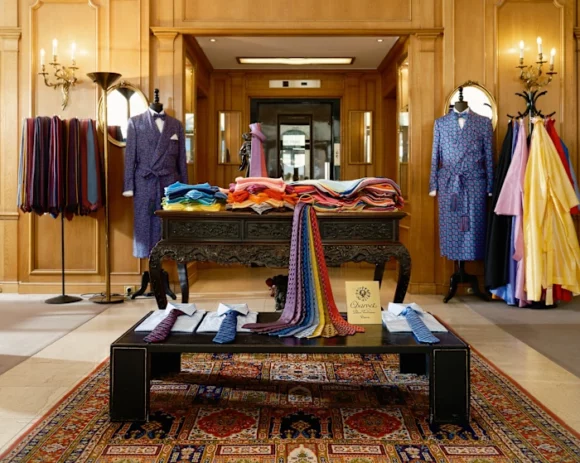
On entry Charvet is seductive, hushed and exotic.
Delicate items in vast ranges of colours overwhelm: ties in extravagant jewel-toned weaves, suede mule slippers, sumptuous dressing gowns in cashmeres or loud silk prints, and the myriad fabrics of its hallowed cloth floor, Charvet’s sanctum sanctorum.
I wrote in my book that the cloth room alone is reason to use Charvet. Bolts of thousands of different colours, weaves and patterns of cotton, linen, and silk allow a customer to see, compare, and find inspiration like nowhere else.
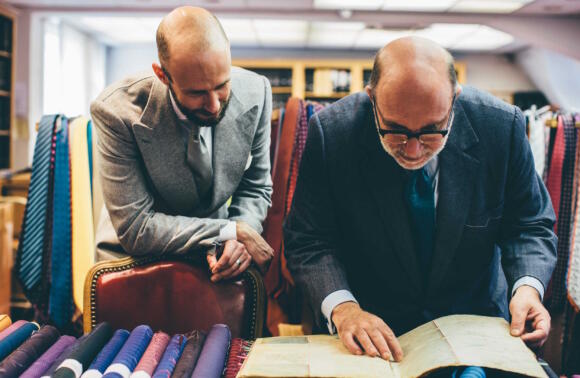
Simon and Jean-Claude Colban of Charvet
Charvet’s family ownership seemed like an element of its Frenchness. Charles De Gaulle legendarily brokered its sale (to the Colban family, its last owners) to keep it French, like a piece of national heritage.
At the time, six or seven decades ago, Charvet’s Place Vendôme neighborhood was home to many gentlemen’s bespoke makers: the hatters Gélot, the bootmakers Hellstern, the Paris shop of London’s Edouard & Butler. Today, however, Charvet is a rare independent holdout next door to the flagships of brands belonging to one or other of the luxury conglomerates: Richemont (Cartier, Van Cleef, Buccellati), LVMH (Tiffany, Chaumet) or Kering (Boucheron).
Many luxurious flagships like this are operated at a loss as branding endeavours. Licences (perfumes, eyewear, diffusion or outlet lines) or wholesale actually support the business. But Charvet’s wholesale business (mostly ready-to-wear shirts and ties) is in a very limited number of specialty shops.
Ties used to be a moneymaker for luxury brands, being much more accessibly priced than shirts or shoes, and not needing different sizes. While its ties are unmistakably Charvet and a signature item of the house, I can’t help but suspect Charvet’s ties have been affected by the general trend of the suit with open-necked shirt becoming the de facto business uniform.
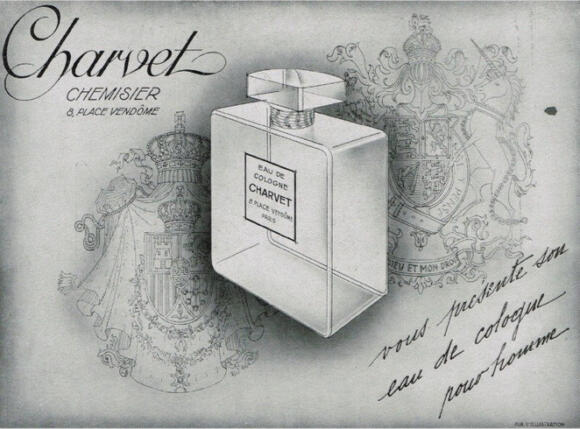
To Charvet’s credit, it doesn’t do licensed or diffusion lines: its ready-to-wear shirts are made very similarly to the bespoke, by the same people in Charvet’s own facility in the Indre, a former industrial region of France. And its perfume is much harder to find than its shirts, so airport duty-frees are not shoring up Charvet’s bottom line.
All of this contributes to Charvet’s image of integrity. It suggests a different world of quality open to those in the know.
Charvet’s bespoke shirtmaking – only available in Paris – may still be a large part of its business. Some ‘big fish’ customers – titans of finance and the like – may order dozens of shirts a year. However, normal mortals like you and I have to overcome the polite but firm resistance of its staff. They try to steer would-be bespeakers to Charvet’s stock special offer, priced almost as high as its bespoke while requiring much less pattern manipulation.
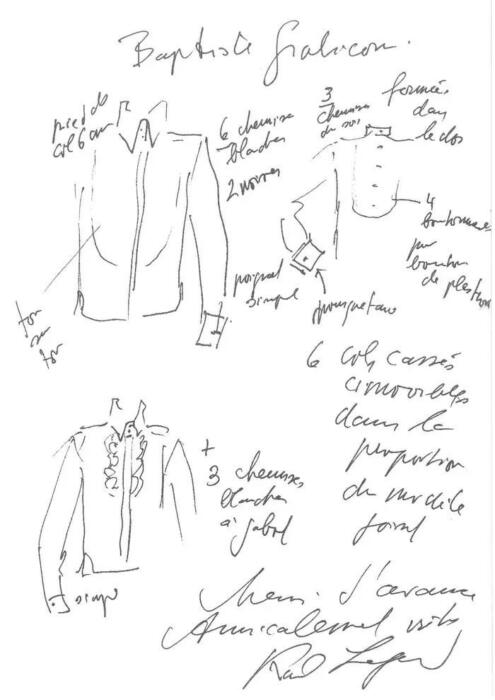
I encountered the same sort of resistance to bespoke at the recently closed Hilditch & Key Paris, Chanel’s actual historic supplier for prototype shirts. H&K Paris furnished Chanel for decades in addition to making elaborate personal shirts for Chanel’s designer, Karl Lagerfeld. Over the years, his thousands of orders had probably kept Hilditch & Key Paris open.
I used to wonder why Chanel hadn’t just bought that shop outright. Hilditch & Key Paris closed in 2024, five years after Karl passed away. The French sub-contractor that had made H&K Paris’s bespoke closed around the same time.
Sketches by Karl Lagerfeld to Hilditch & Key
Fears of Chanel bringing the same ‘industrial’ approach to Charvet’s make as that of its quilted leather purses seem overblown.
In France, Charvet is subject to quite a bit of inverted snobbery for its prices and its intentional mythos. The handful of other independent shirtmakers in Paris sometimes criticise it for things like having machine-made buttonholes on its very expensive bespoke shirts, and for an alleged assembly-line approach to shirtmaking.
While craft is a significant part of its brand, Charvet doesn’t hide that its bespoke shirts are almost completely machine-made – but are better and more durably made than other shirts I’ve owned.
Chanel’s group company is called Paraffection – loosely translated, “out of love”.
That name supports Chanel’s narrative that it acquires companies to ensure the survival of its high-craft suppliers: the custom shoemaker Massaro, the Scottish cashmere knitter Barrie (and just recently the cashmere yarn spinner Todd & Duncan), the hatters Michel, and a number of small specialist companies providing embroidery, feathers, trimmings, and other essentials to its couture.
To my knowledge, Chanel keeps production of its signature garments in France, and it seems to treat its acquired brands with respect: it had Edward Green make a gorgeous though short-lived ready-to-wear line for Massaro, and raised Barrie’s profile with a tastefully discreet boutique.
Jacob Elordi in a white poplin shirt from Chanel (by Charvet) SS26
Charvet was a natural choice for Chanel, having what Hilditch & Key Paris did not, despite the latter’s long history with Chanel. Charvet has – particularly to foreigners – a quintessential Frenchness.
And Charvet has its own workrooms, meaning it can actually still make prototypes for Chanel’s couture or the occasional high-profile collaboration to set people talking, like the recent catwalk model it made for Chanel designer Matthieu Blazy.
Will Chanel maintain what is quintessentially Charvet? The incomparable cloth room, the beautifully fragile ties, and the splashy dressing gowns are indissociable from Charvet’s identity. I think they will remain, an essence of Charvet like its rare perfume bottles.
Will Chanel leave Charvet’s secret and forgotten corners, where surprising things can still be found, undisturbed? Time will tell. Chanel has bought Charvet, and Chanel has bought Charvet time.
*The pen name for the author, a PS reader and frequent forum contributor
Related posts
Chanel’s acquisition of Charvet should be welcomed
July 24th 2026 – 6 Comments
Read More
Are Jacques Marie Mage sunglasses any good?
July 22nd 2026 – 63 Comments
Read More
Nathan Turk and the influence of Western tailoring
July 20th 2026 – 25 Comments
Read More
<!–
Subscribe to this post
You can follow the discussion on Chanel’s acquisition of Charvet should be welcomed by entering your email address in the box below. You will then receive an email every time a new comment is added. These will also contain a link to a page where you can stop the alerts, and remove all of your related data from the site.
I have to admit, when I first saw the latest launch footage from Cape Canaveral, my mind immediately jumped to classic sci-fi movies where little robotic drones zip around fixing massive starships mid-flight. We aren’t quite at the Starship Enterprise level yet, but what SpaceX and Northrop Grumman just pulled off is the closest thing to it.
On July 21st, a Falcon 9 rocket carried something truly revolutionary into the stars: the MRV (Mission Robotic Vehicle). But this isn’t just another satellite to beam internet or monitor the weather. It is essentially an orbital mechanic equipped with giant robotic arms, and I think it’s about to completely change how we manage our orbital infrastructure.
Why Launching a “Space Mechanic” is a Massive Deal
For decades, the lifecycle of a satellite was frustratingly simple: you launch it, you use it until it runs out of fuel or breaks, and then it becomes a multi-million-dollar piece of space junk. I’ve always found this incredibly wasteful.
Northrop Grumman has been working on this problem, and their previous solution was the MEV (Mission Extension Vehicle). The MEV was cool, but it had a major flaw: it had to permanently dock with a single dying satellite to keep it alive. It was a one-to-one relationship.
The new MRV changes the game entirely. Instead of babysitting one satellite, it acts as a delivery truck and mechanic rolled into one.
Here is exactly how this fascinating system works:
The Payload (MEPs): The MRV launched with three Mission Extension Pods (MEPs). Think of these as high-tech jetpacks.The Journey: Right now, the MRV is making its way to the geostationary orbit (GEO), a staggering 35,786 kilometers above Earth.The Robotic Arms: Once it reaches its target, the MRV uses its two 3-meter-long robotic arms (developed in collaboration with DARPA, which is incredibly cool) to grab an MEP and physically attach it to the back of an aging satellite.The Boost: Here is the genius part—the MEP doesn’t transfer fuel. Instead, it uses its own electric propulsion system to take over the satellite’s navigation and altitude control, essentially acting as a new engine.
Giving Old Satellites a New Lease on Life
When I dug into the technical specs, I was surprised by how much extra life these pods provide. By strapping an MEP onto a typical 2,000-kilogram GEO satellite, operators can extend its functional life by 6 to 8 years.
The first three customers are already lined up: two pods for Intelsat and one for the Australian operator Optus. But what excites me the most is the MRV’s long-term potential. Northrop Grumman built the MRV to stay active for about 15 years. It can wait in orbit for future rockets to deliver new batches of MEPs, grab them, and install them on new clients.
Furthermore, it isn’t just a pod-installer. The MRV is designed to:
Relocate satellites to different orbits.Inspect damaged hardware up close.Repair and update existing orbital tech.
The Future of Orbital Sustainability
Perhaps the smartest feature of the MRV is that it is future-proofed. It carries a Passive Refueling Module (PRM), which is the first standard refueling interface approved by the U.S. Space Force. This means that in the future, another spacecraft can fly up and refuel the MRV itself, extending its 15-year lifespan even further.
I really believe we are witnessing the birth of a sustainable orbital economy. Instead of littering our orbit with dead tech, we are finally building the infrastructure to maintain, repair, and upgrade our assets in space. It’s a huge leap forward for space exploration and environmental responsibility up in the cosmos.
What do you guys think about this? If we can actively repair and refuel satellites in orbit, do you think this will finally slow down the alarming growth of space debris, or will it just encourage companies to launch even more hardware into an already crowded sky? Let me know your thoughts!
I was doing my daily deep dive into medical AI research this morning, and I stumbled upon something that honestly gave me goosebumps. If you, or anyone you love, has ever dealt with chronic pain, you already know it is one of the most stubborn and heartbreaking challenges in modern medicine.
For decades, we’ve been stuck relying on the same old toolkit. The usual suspects—opioids and NSAIDs (like ibuprofen)—come with terrible, sometimes life-destroying baggage. We are talking about severe addiction risks, gastrointestinal destruction, and the frustrating reality that over time, they often just stop working.
But what if I told you that an artificial intelligence just engineered a totally new solution? One that beats morphine in the lab, but without the risk of addiction? Let’s break down exactly what the AI medical company Insilico Medicine just pulled off, because it might just change healthcare forever.
The Problem With Our Current Painkillers
Before we get into the tech, we have to look at why this is such a big deal. The medical world has been desperately hunting for a new class of painkillers. Neuropathic pain—which originates from the nervous system itself—is notoriously resistant to standard treatments.
Doctors are often forced into a corner: prescribe opioids and risk patient dependency, or prescribe weaker meds that leave the patient in agony. I’ve always found it frustrating that with all our technological advancements, our primary response to severe pain is a drug class that causes a massive global addiction crisis. That is, until now.
Enter PandaOmics and “Target Z”
Insilico Medicine didn’t just try to tweak an existing drug. They put AI at the absolute center of the discovery process.
I love looking under the hood of these systems. They used an AI platform called PandaOmics. Instead of a human spending decades doing trial and error, PandaOmics processed an unfathomable amount of data:
Genomic sequencing data
Complex protein analyses
Thousands of scientific publications
Multi-modal biological data
By cross-referencing all this, the AI found hidden patterns that human researchers had completely missed. It discovered a brand-new biological mechanism linked to pain—a therapeutic target they nicknamed “Target Z”.
After confirming through human and animal data that Target Z is highly concentrated in pain-related nerve cells, they knew they had struck gold.
Meet ISM9528: The Morphine Beater
Finding the target was only step one. Next, Insilico used another generative AI platform called Chemistry42 to actually design the weapon. Through constant feedback loops between the AI and human scientists, they conceptualized a molecule perfectly shaped to interact with Target Z.
They named this experimental drug ISM9528. Here is why this specific molecule is blowing my mind:
First-in-Class: It suppresses pain without triggering opioid pathways. That means the risk of chemical addiction drops to near zero.
Brain Access: It can cross the blood-brain barrier effectively, which is an absolute necessity for treating central nervous system-derived neuropathic pain.
Oral Administration: It can be taken as a simple pill, rather than requiring injections or IV drips.
But the real shocker came during pre-clinical trials. In models testing neuropathic and post-surgical acute pain in mice and rats, ISM9528 didn’t just work—it excelled. As the dose increased, the pain relief scaled beautifully. In several tests, it matched or even outperformed standard heavyweight treatments like morphine and pregabalin. All of this was achieved while maintaining a highly positive safety profile and rapid absorption into the bloodstream.
The Future of Human-AI Collaboration
Insilico plans to push ISM9528 into human clinical trials by 2027. If the human trials reflect what we are seeing in the lab right now, we are looking at the dawn of a new era in pain management.
I talk a lot about AI on this platform—from humanoid robots to generative video—but seeing artificial intelligence actively solve biological puzzles that have stumped human doctors for decades? That is truly profound. It shows that the future of medicine isn’t AI replacing humans, but human researchers using AI as the ultimate magnifying glass to see what was previously invisible.
I have to ask you guys: How do you feel about taking a medication that was entirely conceptualized and designed by an artificial intelligence? Would you trust it more because it’s based on pure data, or less because a human didn’t invent it from scratch? Drop your thoughts in the comments below, I really want to know your take on this!
You Might Also Like;
The New Era of Space Mechanics: Extending Satellite Lifespans
AI Discovers Groundbreaking Non-Opioid Painkiller
Mind Over Matter: What Neuralink’s First Human Trial Really Means for Our Future
This content was originally published on %AI Discovers Groundbreaking Non-Opioid Painkiller% by YourSiteName.