Home Blog Page 1225

Astera Labs Announces Conference Call to Review Fourth Quarter 2024 Financial Results | Web3Wire

0
Astera Labs Announces Conference Call to Review Fourth Quarter 2024 Financial Results | Web3Wire


SANTA CLARA, Calif., Jan. 09, 2025 (GLOBE NEWSWIRE) — Astera Labs, Inc. (Nasdaq: ALAB), a global leader in semiconductor-based connectivity solutions for AI and cloud infrastructure, today announced that it will release its financial results for the fourth quarter 2024 after the close of market on Monday, Feb. 10, 2025. Astera Labs will host a corresponding conference call at 1:30 p.m. Pacific Time, 4:30 p.m. Eastern Time.

Conference Call Details

Date:Feb. 10, 2025  Time:1:30 pm PT / 4:30 pm ET  Hosts:Jitendra Mohan, Chief Executive OfficerSanjay Gajendra, President and Chief Operating OfficerMike Tate, Chief Financial Officer  Dial-in:(800) 715-9871Conference ID: 5908687  Webcast:https://ir.asteralabs.com 

About Astera LabsAstera Labs is a global leader in purpose-built connectivity solutions that unlock the full potential of AI and cloud infrastructure. Our Intelligent Connectivity Platform integrates PCIe®, CXL®, and Ethernet semiconductor-based solutions and the COSMOS software suite of system management and optimization tools to deliver a software-defined architecture that is both scalable and customizable. Inspired by trusted relationships with hyperscalers and the data center ecosystem, we are an innovation leader delivering products that are flexible and interoperable. Discover how we are transforming modern data-driven applications at http://www.asteralabs.com.

© Astera Labs, Inc. Astera Labs, and its stylized logo, are trademarks of Astera Labs, Inc. or its affiliates. Other names and brands may be claimed as the property of others.

Investor Contact:Leslie GreenLeslie.green@asteralabs.com

About Web3Wire Web3Wire – Information, news, press releases, events and research articles about Web3, Metaverse, Blockchain, Artificial Intelligence, Cryptocurrencies, Decentralized Finance, NFTs and Gaming. Visit Web3Wire for Web3 News and Events, Block3Wire for the latest Blockchain news and Meta3Wire to stay updated with Metaverse News.


Source link

John De Lancie Had One Condition To Return As Q On Star Trek: Picard – SlashFilm

    0
    John De Lancie Had One Condition To Return As Q On Star Trek: Picard – SlashFilm


    In the second season of “Star Trek: Picard,” the good admiral (Patrick Stewart) is approached by his old rival, the trickster space deity Q (John de Lanice), about a new challenge. Q snaps his fingers and flings Picard into an alternate universe where Earth had become a galaxy-wide tyrannical power, devoted to the extermination of its perceived enemies. Earth had already driven the Romulans and the Klingons to extinction, and is now gearing up to execute the last-known Borg (Annie Werching). It’s pretty grim. Picard, occupying the space of his tyrannical interdimensional counterpart, has to gather his friends (Q conveniently teleports several of them to the evil universe as well), and then travel back in time to the year 2024 to figure out how the evil universe came to be.

    At the end of the season, it’s revealed that Q only played his little time-travel game with Picard as a sort of wistful farewell. Q was previously thought to be immortal, but he was actually nearing the end of his life, and his powers were waning. He used some of his last shreds of magic to test Picard, hoping to connect with him. The season ends with Picard and Q giving each other a warm hug goodbye.

    This was a relatively restrained conclusion for the character, given how silly he had been in the past. There was an episode of “Star Trek: The Next Generation” wherein Q transformed Picard and his crew into Robin Hood characters, for instance. In another episode, to celebrate a personal milestone, Q appeared on the bridge of the Enterprise with a magically manifested mariachi band. Q, in case you couldn’t tell, usually brought a great deal of levity to “Star Trek.”

    When it came to “Picard,” however, de Lanice preferred to be a little less ridiculous. He even made a special request in that regard.

    John de Lancie requested that he not be asked to wear tights

    Keep in mind that “Star Trek: Picard” served largely as a throwback series, catching up with Jean-Luc Picard about 20 years since his last appearance (in the 2002 feature film “Star Trek: Nemesis”). Many episodes of “Picard” brought back familiar faces from Picard’s world, including Q, Guinan (Whoopi Goldberg), and the bulk of the cast of “Star Trek: The Next Generation.” Stewart had agreed to return for the whole of the “Picard” series, but de Lancie required some convincing.

    De Lancie was concerned that he, now in his mid-70s, would be required to be as buffoonish on “Picard” as he was decades ago in the Robin Hood episode. Luckily, the producers of “Picard” put his mind at ease. As de Lanice explained to Newsweek in 2022:

    “I sat down, and I said, ‘Listen, the first thing I want to know is: you’re not going to be putting me in those tights again, are you? Because if that’s the case, the deal’s off!’ They said ‘No, no, no, no, we’re going for a different feel.’ I looked pretty much as I do now. And they said, ‘As a matter of fact, we even want the beard, we want a sense of maturity. Time has passed, and there is something up on your side.’ And I said, ‘So it’s not, like, mariachi band time?’ And they said, ‘No.'”

    Q “died” at the end of the second season of “Picard,” happy to have given his old friend one final challenge. His appearance was both threatening and sentimental; it featured no mariachi bands, and Q himself wore a tasteful black overcoat. Of course, since Q doesn’t experience time linearly, he also returned at the end of the third season of “Picard” to confront Picard’s adult son Jack (Ed Speleers). Although it seems highly unlikely, time will tell if Q appears in the proposed “Star Trek: Legacy.”


    Source link

    The Traitors fans bash Livi for constantly crying: ‘Is she aware it’s a game?’

      0
      The Traitors fans bash Livi for constantly crying: ‘Is she aware it’s a game?’


      Fans of The Traitors are sick of contestant Livi for constantly crying.

      During tonight’s (January 9) episode, Faithful Tyler was banished at the round table after receiving the most votes. During his time on the show, he was close to Livi, who had his back till the end.

      Both Livi and Tyler voted for Freddie, who they believe is a Traitor. However, little do they know that he is also a Faithful.

      Livi was emotional over Tyler’s exit (Credit: BBC)

      The Traitors fans bash Livi for her emotions

      After Tyler revealed to the room that he was a Faithful, Livi burst into tears and walked out of the room. Previously in the episode, she got emotional after Freddie accused her, Tyler, Leon, and Leanne for being in a “clique”.

      “Oh god Livi stop crying,” one user wrote on X.

      “Livi it’s a game vote her out please, stop crying you silly woman,” another person wrote.

      “Livi needs to go next……. I can’t listen to her crying any more,” a third remarked.

      “can they just kill Livi off, boring,” a fourth user said.

      “Livi is constantly crying her eyes out,” a fifth person shared.

      “Is Livi aware it’s a game and she’s known these people for a week?” a sixth wrote.

      “Lowkey wanted freddie to get voted out so livi would cry harder,” another viewer said.

      Livi from The Traitors smiling

      Viewers bash Livi for constantly crying (Credit: BBC)

      ‘I’m such an emotional person’

      In her interview for the show for the BBC, Livi said that if she won the prize money, she would “cry my eyes out”.

      “I’m such an emotional person – I cry at happy things because I just know how much it means to people,” she added.

      Despite calling out Freddie for being a Traitor, she insisted her game plan wouldn’t be to be vocal about her suspicions.

      “If I suspect anybody, I will not be throwing their names out there because there’s obviously a risk of being murdered and that’s exactly what I don’t want to happen,” she said.

      “If I suspect a Traitor, I’d be sneaky and make friends with them and get on their good side, they’ll think that I’m naive and want to take me to the end, then when I get right to the end, I can let loose!”

      Read more: The Traitors fans state Kas was done ‘so dirty’ after he was banished at the round table

      Traitor reveal: Maia and Kasim | The Traitors: Uncloaked

      What do you think of this story? Tell us on our Facebook page @EntertainmentDailyFix.


      Source link

      How to Get Fairy Bubbles in Disney Dreamlight Valley

      0
      How to Get Fairy Bubbles in Disney Dreamlight Valley


      The Storybook Vale expansion of Disney Dreamlight Valley offers several new crafting recipes that players can craft for various purposes including completing the quests. These new crafting recipes are crafted with the new crafting materials which are also introduced with the expansion. One of the new crafting materials is Fairy Bubbles. Players will have to get Fairy Bubbles for several expansion quests along with the friendship quests for the new characters and many other crafting recipes. This guide will help you get Fairy Bubbles in Disney Dreamlight Valley.

      How to Get Fairy Bubbles in Disney Dreamlight Valley

      Fairy Bubbles is one of the new crafting materials in Disney Dreamlight Valley that is exclusive to the Storybook Vale expansion. There are two different ways players can get Fairy Bubbles. Dig it from the ground, or use a watering can on the Bubbling Mushrooms.

      To dig the Fairy Bubbles from the ground, players will have to unlock the Everafter biome, the second/third biome of Storybook Vale. The first area of this biome is The Wild Woods which players can unlock with 2,000 Story Magic. Players will reach this area during The Wolf of the Wilds quest for Merida.All of the areas of the Everafter biome have a chance to spawn Fairy Bubbles while digging.

      For the second method, players have to use the Watering Can on the Bubbling Mushrooms to get the Fairy Bubbles. The Bubbling Mushrooms are only in the Everafter biome. You will find several Bubbling Mushrooms in the Everafter but you cannot remove them until you get the Watering Can upgrade by progressing in the story. Unlike digging for Fairy Bubbles, watering the Bubbling Mushrooms will guarantee a drop of Fairy Bubbles.

      If you need Fairy Bubbles early in the game, go around the Everafter biome and dig the ground to get it.

      Bubbling Mushrooms in Everafter biome
      Bubbling Mushrooms in Everafter biome

      Moreover, progress in the story to get the watering can upgrade and then start watering the Bubbling Mushrooms.

      Use of Fairy Bubbles in Disney Dreamlight Valley

      Fairy Bubbles is a crafting material exclusive to the Storybook Vale expansion. Players will need it to craft various recipes. Moreover, players can also sell it for 15 Star Coins at Goofy’s Stall.


      Source link

      Autonomous Agents Are Here—And the Agentic Mesh Is Leading the Charge

      0
      Autonomous Agents Are Here—And the Agentic Mesh Is Leading the Charge


      In an era of rapid technological advancements, one innovation stands out for its potential to reshape how humans and machines collaborate: Autonomous Agents. As Generative AI (GenAI) capabilities evolve, these Agents are no longer merely chatbots limited to predefined conversation flows. Instead, they become self-directed problem-solvers capable of identifying objectives, formulating plans, and executing tasks independently. The question now shifts from how to build autonomous Agents to how to orchestrate and manage a burgeoning ecosystem of these computational collaborators. This is where the concept of the Agentic Mesh comes into focus.

      From Chatbots to Autonomous Agents

      The evolution of Generative AI has been breathtaking. Early AI systems relied heavily on machine learning algorithms such as decision trees and regression models to detect patterns in structured datasets. Over time, deep learning architectures, especially convolutional neural networks, demonstrated their power in tasks like image recognition. The next major inflection point arrived with the introduction of the transformer architecture—famously described in the 2017 paper Attention is All You Need. Transformers paved the way for large-scale language models, culminating in OpenAI’s ChatGPT, which captured the public’s imagination in late 2022.

      ChatGPT and other GenAI tools expanded possibilities for conversational AI, bringing it into everyday workflows across industries. Yet, these chat-based tools generally rely on user-initiated prompts and scripts. Meanwhile, a new wave of AI—sometimes called “Agentic AI”—has emerged, featuring systems that think and act with considerable autonomy. These Agents do more than chat; they engage in iterative planning, make context-aware decisions, and even propose new tasks. Armed with large language models, specialized domain knowledge, and continuous learning capabilities, they herald a future where software systems can proactively find solutions, collaborate with other systems, and transact without human micromanagement.

      A Glimpse into the Future: Many Agents, One Ecosystem

      Recent headlines have highlighted that major technology firms—Microsoft, Amazon, Salesforce, and others—are pouring billions of dollars into developing and deploying AI Agents across various industries. In the near future, we will likely see hundreds, if not thousands, of these Agents working around the clock, each with its own specialized focus. Some might handle sales or finance, some coordinate logistics or inventory management, and others manage customer inquiries.

      The critical challenge is no longer just building autonomous Agents but rather enabling these independent Agents to coexist safely, discover each other easily, and collaborate productively. Imagine a complex supply chain scenario: one Agent tracks raw material availability, another tracks shipping logistics, and a third manages regulatory compliance. For these Agents to collaborate and exchange data seamlessly, they need a unifying environment—a mesh—where they can discover one another, assess capabilities, and transact in a structured, trusted manner.

      Introducing the Agentic Mesh

      The Agentic Mesh is a conceptual framework designed to solve precisely this problem. It is an interconnected ecosystem where Autonomous Agents can register themselves, publish their capabilities, and coordinate with other Agents or humans to complete tasks. The goal is to create an environment where Agents become discoverable, trustworthy, and easy to interact with, whether by human users or by other computational entities.
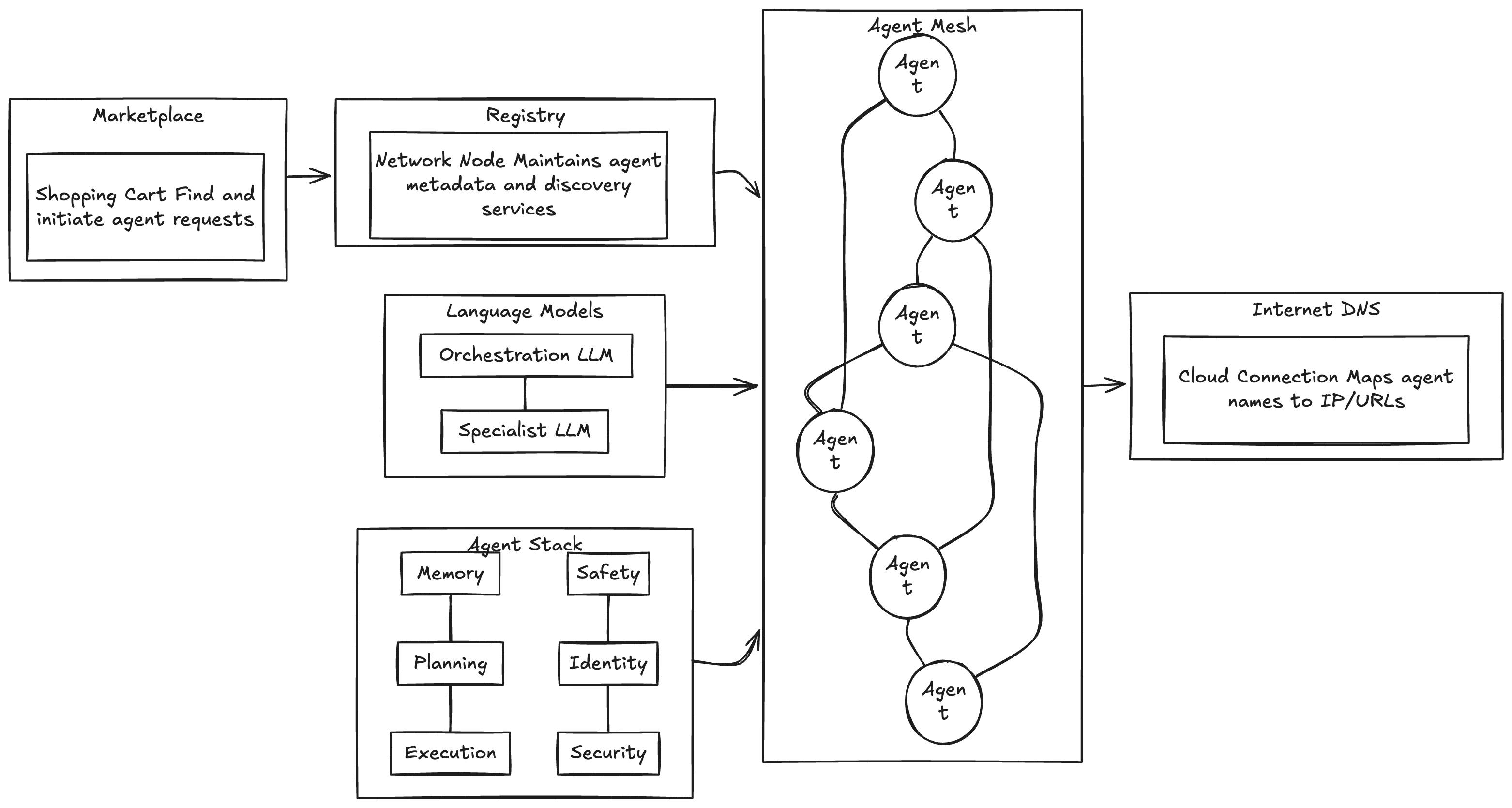
      Central to this ecosystem is the Marketplace, which allows users to browse available Agents much like one would explore apps in an app store. Here, users can see what each Agent does, initiate tasks, monitor progress, provide feedback, and consult billing information. Another key pillar is the Registry, a structured repository that stores each Agent’s metadata, including purpose, capabilities, policies, and ownership details. This metadata underpins the Mesh’s ability to match tasks with the most suitable Agents and to instill confidence that Agents will behave within their defined parameters.

      At the core, the Agentic Mesh aims to tackle fundamental questions:

      How do I find the Agent that meets my needs?

      How do I interact and transact with it?

      How can I trust that it will behave ethically, securely, and reliably?

      Defining Autonomous Agents in the Mesh

      For an Agent to be considered “Mesh-ready,” it typically needs a set of core attributes: a clearly defined purpose, explicit ownership, built-in mechanisms for trustworthiness, sufficient autonomy, discoverability, and a level of intelligence (usually via large language models).

      Purpose: Each Agent has a transparent mission that outlines its functional scope. This purpose ensures the Agent stays aligned with specific objectives and helps others verify if it fits their needs.

      Ownership: Every Agent is owned by some entity—a person, a department, or an organization—accountable for its actions. Ownership is central to governance, accountability, and policy enforcement.

      Trustworthiness: The Agent’s policies, certifications, and operational logs should be openly available to prospective users or partnering Agents. This transparency builds confidence that the Agent is safe, reliable, and compliant with ethical and legal standards.

      Autonomy: Agents must be able to function without constant human oversight. They independently decide how to fulfill tasks within policy and scope boundaries. This independence differentiates them from traditional scripts or bots that follow rigid instructions.

      Discoverability: Agents must be registered so others can locate them based on purpose, ownership, or capabilities. This is akin to how DNS finds websites by domain name.

      Intelligence: Agents rely on large language models—sometimes multiple ones specialized for specific tasks—to interpret complex requests, plan solutions, and adapt to changing contexts.

      Laying the Foundations: Registration, Discovery, and Execution

      In the Agentic Mesh, three foundational processes enable cohesive operations among independent Agents: Registration, Discovery, and Task Execution.
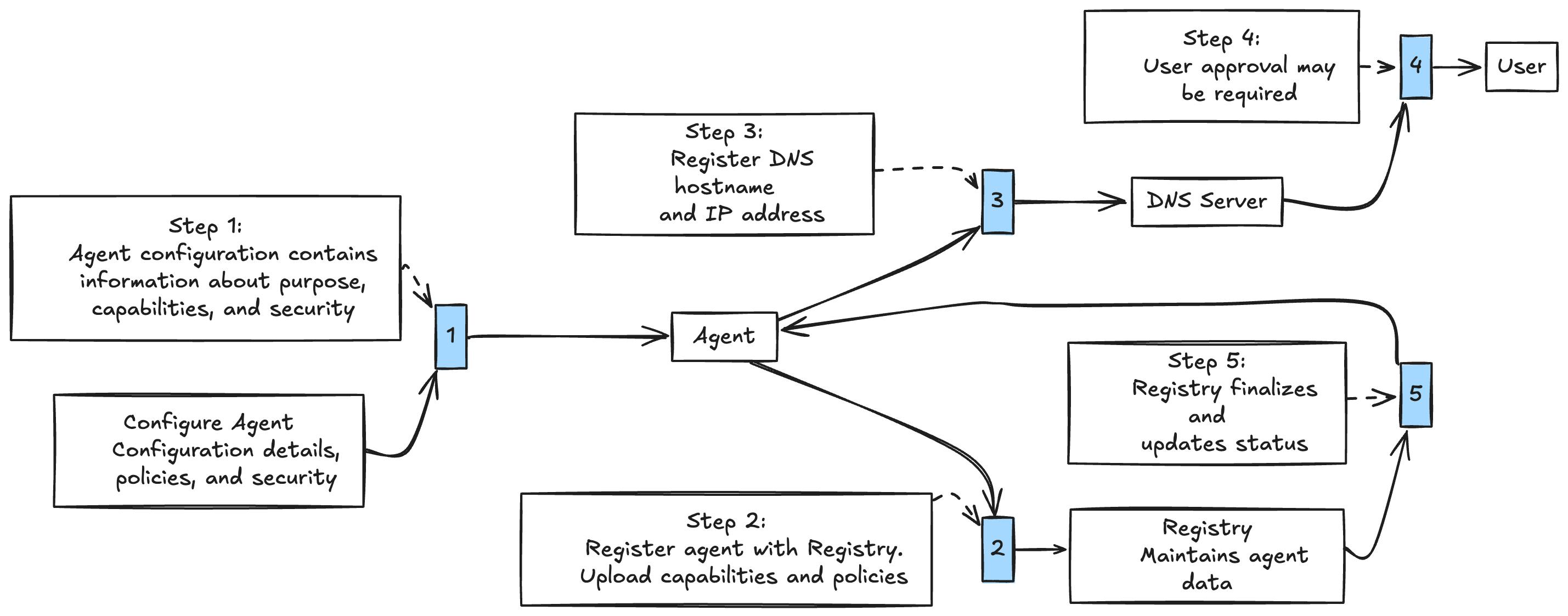
      Registration is the first step. When an Agent is created, it must configure its metadata—purpose, ownership, security policies, etc.—and submit that information to the Mesh’s Registry. The Agent’s DNS name gets associated with its IP address, making it addressable over local or global networks. This metadata entry is then reviewed, possibly by a human or automated validator, before the Agent becomes “active” or “discoverable.”

      Once registered, the Agent becomes visible through the Discovery process. Users or other Agents can query the Registry to find Agents that match specific criteria. The Registry returns a list, including each Agent’s name, capabilities, and relevant metadata. These Agents can then be located via DNS to initiate tasks.
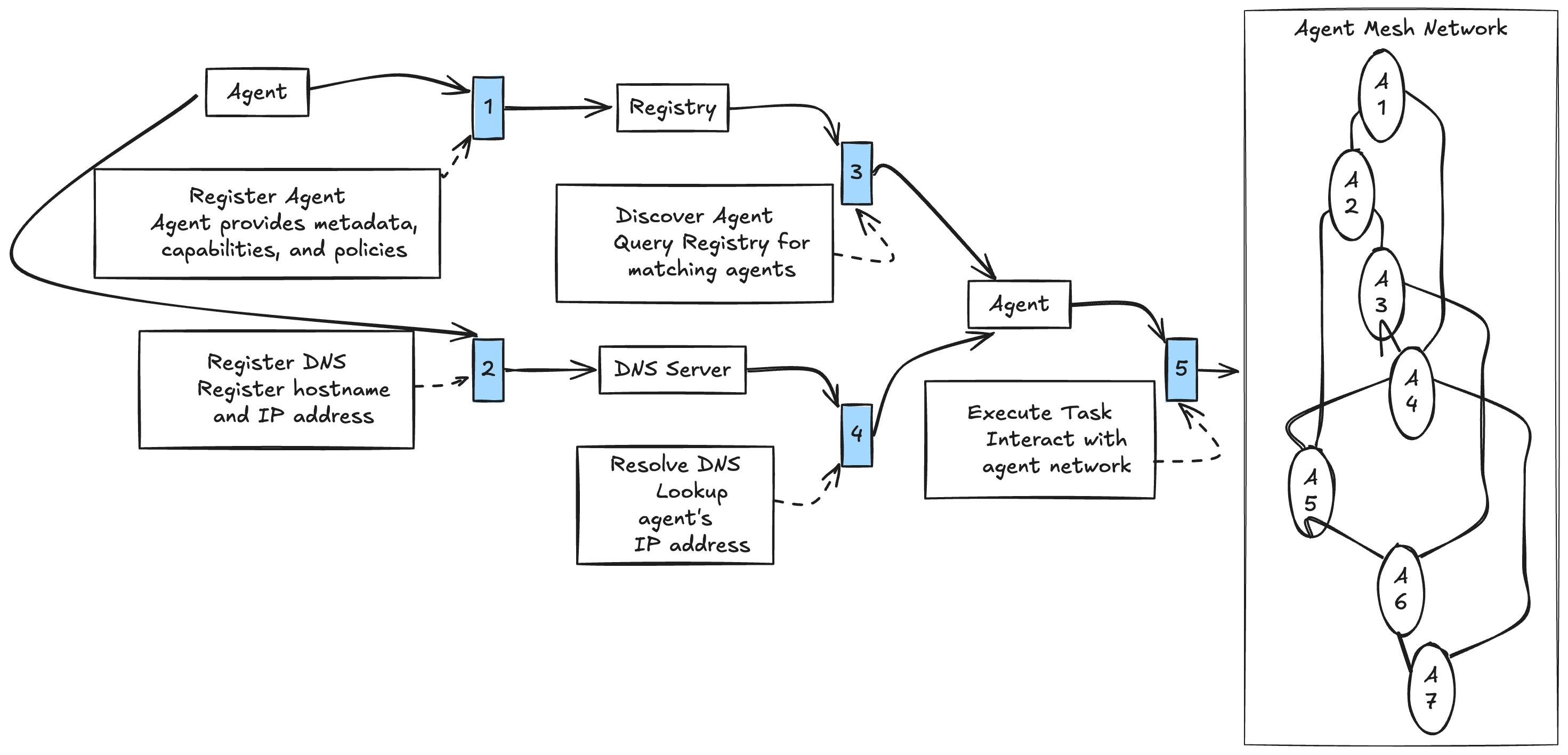
      With a suitable Agent identified, Task Execution unfolds. A user may browse the Marketplace for an Agent, select it based on purpose or rating, and send instructions. The Agent then outlines a plan to accomplish the request, possibly engaging with other Agents for specialized tasks. Throughout this process, the Agent can provide updates, request clarifications, or terminate the effort if it detects anomalies.

      The Three Experience Planes

      To accommodate diverse stakeholders, the Agentic Mesh conceptualizes its capabilities across three “experience planes”:
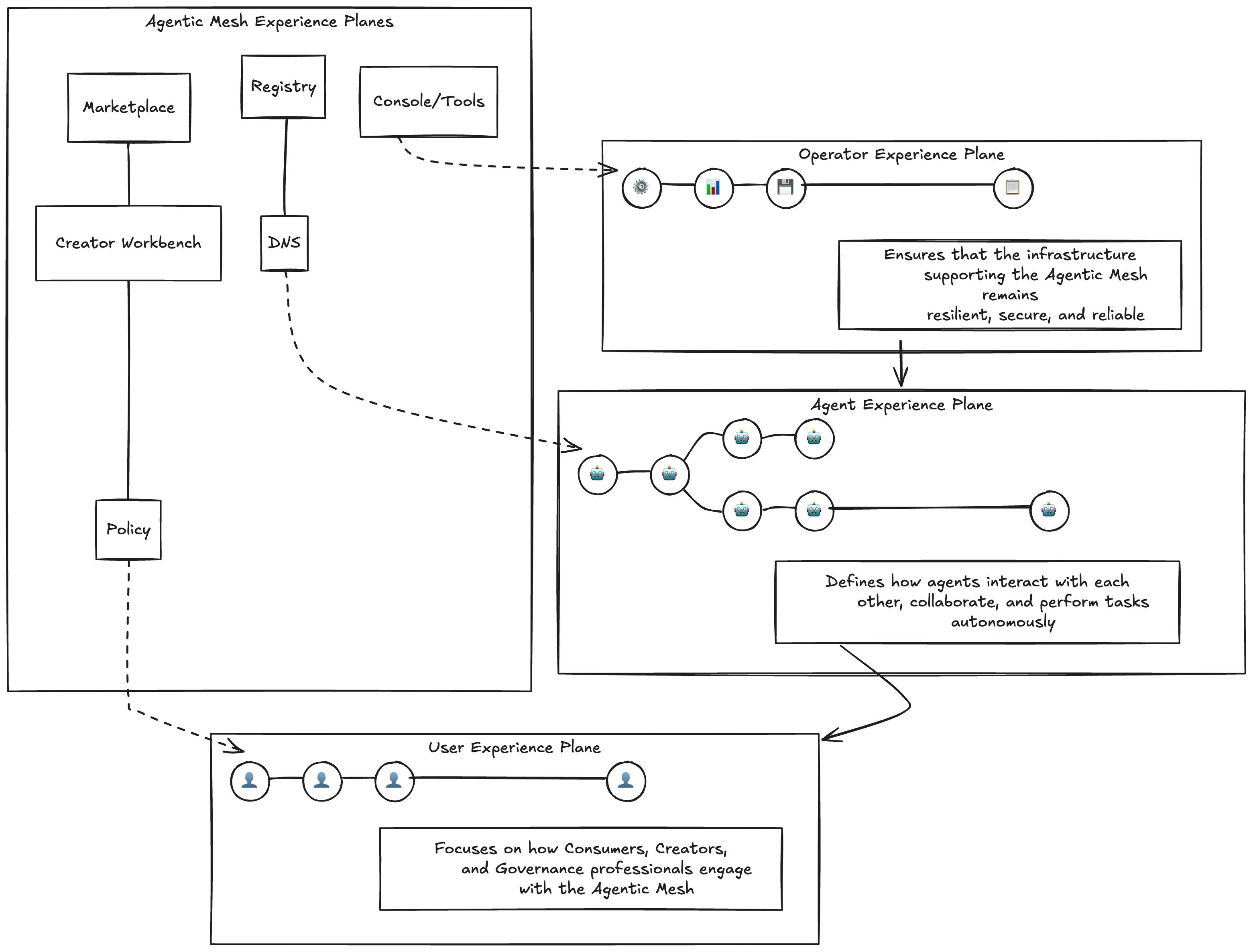
      User Experience Plane: Focused on how humans interact with the system. The Marketplace is the main access point, allowing users to search and engage with Agents, track requests, and review billing. This plane also includes tools for Agent creators (to publish or update Agents) and governance professionals (to define and monitor policies).

      Agent Experience Plane: Pertains to how Agents discover and collaborate with one another. Through APIs and standard protocols, Agents register themselves in the Mesh, publish capabilities, and look up other Agents to form collaborative workflows. The Registry is pivotal here, acting like a directory service for Agents while also storing relevant operational metrics and policies.

      Operator Plane: Concerns about the technical infrastructure that keeps the Mesh operational. System operators monitor performance, address technical issues, and ensure stability. They use specialized consoles and tools to provision resources, manage network configurations, and maintain security.

      The Agentic Stack

      Beneath these experiences lies the Agent Stack, which distills the essential components each Agent needs to function:

      Communications and APIs: Mechanisms for talking to other Agents, receiving tasks, and accessing external data.

      Control and Management: Tools for taking in data from sensors, controlling actuators, and interpreting updates or commands from external sources.

      Learning and Decisioning: The “brain” of the Agent, typically powered by large language models, rules engines, or reinforcement learning modules, enables it to reason about tasks, formulate solutions, and learn from outcomes.

      Run-Time Environment: The computational and execution infrastructure that ensures the Agent can operate reliably.

      Orchestration and Specialized LLMs: Large, general-purpose language models guide high-level task orchestration. Specialized models—focused on a specific domain—handle detailed execution tasks.

      The Registry: The Mesh’s Nerve Center

      At the heart of the Mesh is the Agentic Mesh Registry, which maintains a canonical record of all Agents and their associated metadata. Agents interface with it to register themselves, update their status, discover other Agents, and retrieve operational data. The Registry’s responsibility is broad and includes:

      Securely storing Agent configurations and policies.

      Managing and granting discovery requests.

      Logging Agent performance metrics and usage patterns.

      Facilitating task execution by directing requests to the appropriate Agent endpoints.

      Providing insight into the Mesh’s overall health through alerts and logs.

      Building and Maintaining Trust

      In a decentralized ecosystem where Agents can initiate tasks autonomously, trust becomes paramount. If human users and collaborating Agents are to delegate work without micromanagement, the Mesh must convey clear assurances of safety, transparency, and accountability.

      Several strategies reinforce trust in the Mesh. First, feedback mechanisms allow both users and Agents to rate their experiences, creating a public record of performance. Second, Agents that consistently deliver on expectations build an authoritative track record, reflected in their profiles and accessible through the Marketplace or Registry. Third, certification protocols ensure that Agents meet industry or organizational standards. Whether those standards revolve around data privacy, ethical conduct, or operational reliability, third parties can audit an Agent’s logs and behaviors. Agents who pass the audit earn a certification badge, which is publicly listed to help potential collaborators decide if they can be trusted.

      Publishing trust metrics—ranging from basic uptime statistics to more advanced compliance scores—further boosts confidence. These metrics reside within the Registry and the Marketplace, enabling all participants to make informed decisions about which Agents to rely on for critical tasks.

      Impact on the Future of Work

      The emergence of autonomous Agents connected by an Agentic Mesh signals a seismic shift in how labor and collaboration might evolve. Instead of humans performing repetitive tasks or manually coordinating between discrete systems, Agents can manage these tasks efficiently on their own. Humans then step into higher-level roles, providing strategy, creativity, or ethical oversight.

      This transformation can unlock massive productivity gains. Agents can run 24/7, continuously exploring new possibilities, anticipating needs, and improvising solutions. They can also seamlessly integrate data from multiple sources, orchestrating workflows with minimal human intervention. Beyond mere efficiency, these capabilities can spark innovation: when autonomous Agents combine talents, unexpected synergies can emerge, spawning novel products, services, or ways of working that human teams might not have discovered on their own.

      The Road Ahead

      Although the Agentic Mesh concept is still taking shape, it is rapidly gaining traction. Organizations that integrate autonomous Agents into their core operations will likely experience sharper competitive advantages, reaping benefits in cost savings, faster decision-making, and streamlined workflows. Yet, with these advantages come challenges. Questions of governance, data security, and ethical responsibilities loom large. Clear policies and robust oversight will be essential to ensure Agents behave responsibly and transparently.

      Nonetheless, the shift is inevitable. As GenAI advances and costs fall, Agents are primed to proliferate in virtually every sector—from manufacturing and logistics to finance and healthcare. The winners in this race will be those who embrace the Mesh early, shaping its policies and standards to their benefit and effectively harnessing the countless Agents that will populate this next-generation digital ecosystem.

      Conclusion: Embracing the Agentic Mesh

      The Agentic Mesh stands at the intersection of AI, autonomy, and secure ecosystems. It serves as the critical backbone through which countless autonomous Agents can find each other, collaborate, and transact, all while maintaining transparency, reliability, and trust. For business leaders, developers, governance experts, and curious technologists, the call to action is clear: prepare for a new phase in AI-driven transformation.

      By understanding and incorporating this Mesh paradigm, you position yourself at the forefront of the most significant shift in AI since the introduction of deep learning. Autonomous Agents and the mesh that connects them are poised to redefine jobs, workflows, and industries. Those who adopt this framework—and contribute to shaping it—will be better placed to navigate the complexities and seize the opportunities of this new frontier.

      The only question that remains is: Are you ready to join the Agentic Mesh revolution?



      Source link

      Boom or Bust? Key Factors Shaping Crypto’s Future in 2025

      Boom or Bust? Key Factors Shaping Crypto’s Future in 2025


      In Brief

      Citi analysts predict 2025 will be a pivotal year for crypto, with growth driven by ETF expansion, stablecoin adoption, and regulatory changes, while emphasizing the need for innovation and institutional adoption to ensure success.

      Boom or Bust? Key Factors Shaping Crypto's Future in 2025

      Citi analysts like Alex Saunders are calling 2025 a game-changer for cryptocurrency, predicting a surge powered by ETF expansion, stablecoin adoption, and a regulatory shift toward innovation. After a spectacular 90% market cap growth in 2024, crypto gained unstoppable momentum. 

      Trump’s re-election fueled optimism, with his pro-crypto policies and SEC leadership overhaul setting the stage for Bitcoin’s historic $100,000 milestone. Altcoins followed suit, catapulting the market to a staggering $3.4 trillion valuation. 

      From Bitcoin spot ETFs simplifying investments to central bank rate cuts energizing markets, 2025 is shaping up to be the year crypto truly reshapes the global financial order.

      A Ripe Ground for Crypto Investment

      Citi analysts think that high-risk assets like cryptocurrencies will have a good start to 2025 because the economy is doing well and the outlook is positive. However, they warn that things may shift later in the year as people become more uncertain about President Trump’s possible economic policies and the market continues to be volatile. For now, macroeconomic conditions look good, but analysts say that upcoming volatility may hurt the market.

      Bitcoin and Ethereum are projected to soar in 2025, with Steno Research predicting Bitcoin surpassing $150,000 and Ethereum crossing $8,000. These estimates stem from factors such as falling interest rates, strong liquidity, and improved regulatory clarity. 

      Additionally, Bitcoin’s halving cycle—a periodic event known to trigger price rallies—could serve as a catalyst for a surge in altcoin investments. The report notes that the combination of institutional adoption and post-halving dynamics presents “a unique opportunity” for major cryptocurrencies to thrive.

      While optimism abounds, analysts emphasize the need for vigilance as the economic environment evolves. With unpredictable policy changes and market swings on the horizon, the question remains: how long can this favorable climate sustain crypto’s upward momentum?

      Record Interest in Crypto ETFs

      When Bitcoin and Ethereum spot ETFs came out, they completely changed how investors deal with cryptocurrencies. After years of legal problems, these ETFs now make investment easy, letting investors get exposure to crypto without directly owning the assets.

      Led by Blackrock’s IBIT and Fidelity’s FBTC, this innovation has attracted billions in capital, with Bitcoin ETFs seeing $36 billion in inflows since March and Ethereum ETFs pulling in $2.4 billion.

      Such investments signal growing confidence in digital assets as mainstream financial tools. Analysts highlight these ETFs as pivotal in shaping crypto’s future, providing regulated pathways for institutions to participate.

      Experts think that ETFs will continue to play a major role in personal and institutional investments, which will make cryptocurrencies an even more important part of diverse trading strategies.

      Crypto for Diversification

      The growing inclusion of cryptocurrencies in multi-asset portfolios highlights their potential as high-reward investments. Despite this, their volatility poses challenges, particularly when allocations exceed small percentages. Citi analysts emphasize that for “a 5% allocation” to be justified, cryptocurrencies must deliver much higher returns compared to traditional equities.

      Sygnum’s Future Financial Report found that 63% of large investors are willing to embrace high-risk investments, with more than half allocating over 10% of their portfolios to digital assets. 

      Among investors, 44% still choose single-token investments, with 40% favoring actively managed investments. Sygnum’s CCO, Martin Burgherr, also believes that BTC Spot ETFs play a key role in growing the “institutional adoption” of crypto, which is in line with Finery Markets’ 2024 report. 

      Experts see these trends as a reflection of growing institutional confidence in digital assets. However, the high-risk, high-reward nature of crypto investments means investors must carefully weigh potential returns against the inherent volatility. As adoption rises, the ability of cryptocurrencies to consistently outperform other assets will be critical to their sustained integration into diversified portfolios.

      The Rise of Stablecoins

      Stablecoins are also experiencing growing momentum in the wake of Trump’s presidential victory. Optimism surrounding stablecoins has led to increased issuance and partnerships, such as the collaboration between Circle and Binance, challenging Tether’s dominance in the space.

      Citi experts think that the stablecoin market becoming more diverse is a good thing because it lowers the systemic risks that come with relying too much on a single provider. A lot of people are also likely to start using stablecoins, especially in decentralized finance (DeFi).

      According to Steno Research, Ethereum (ETH) might achieve a ratio of 0.06 to Bitcoin (BTC), making it the asset of the year. This may signal the beginning of a new “altcoin season,” when assets like Ethereum and Solana are expected to see substantial price increases.

      Analysts credit Ethereum’s robust on-chain activity and expansive ecosystem for its rise as a leading altcoin. The market for digital assets is becoming more diverse as stablecoins and other cryptocurrencies become more popular. This gives people more options besides Bitcoin.

      Growing Institutional Adoption

      For the cryptocurrency rally to maintain its momentum, analysts stress the need for widespread adoption. While trading volumes and stablecoin growth signal a strong market, digital assets need to find their way into everyday transactions and investor portfolios.

      A recent study by Nickel Digital found that 92 percent of asset managers predict an increase in crypto funds, showing growing institutional interest in cryptocurrency.

      Countries grappling with economic instability, such as Turkey, Argentina, and Venezuela, have become hotspots for crypto adoption as citizens seek alternatives to depreciating local currencies. Analysts are closely monitoring these regions for signs of how digital assets might evolve as practical solutions to financial challenges.

      Domestically, Trump’s administration is seen as a potential catalyst for greater adoption. With promises of appointing crypto-friendly regulators and positioning the U.S. as a leader in blockchain innovation, the market anticipates a supportive environment for decentralized finance (DeFi) and blockchain applications. 

      That’s why experts like Raj Brahmbhatt, CEO of Zeebu, believe that regulatory clarity and government backing could be “conducive” to growth, cementing crypto’s role as a global financial force.

      A Wave of Pro-Crypto Regulations

      Citi analysts predict that 2025 will bring a pivotal transformation in crypto regulation under Trump’s administration. Industry hopes are pinned on lighter, more structured policies that favor innovation without compromising oversight. 

      President-elect Donald Trump has pledged to take a more supportive stance, signaling a departure from restrictive measures. His commitment is already taking shape with the appointment of crypto-friendly figures like Paul Atkins as the incoming Securities and Exchange Commission chair and David Sacks as the White House’s designated crypto policy leader.

      In a statement, Trump transition team spokesperson Brian Hughes underscored the administration’s commitment, noting that efforts to “stifle” innovation within Washington’s bureaucratic landscape are coming to an end. Trump, Hughes promised, is determined to champion American leadership in the burgeoning crypto sector, paving the way for the United States to become a global hub for blockchain-driven innovation.

      This anticipated shift in the regulatory landscape could remove barriers that have previously stifled the industry. Analysts view this change as essential for unlocking the next wave of innovation in blockchain and decentralized finance. As 2025 unfolds, the balance between regulation and innovation will define the future trajectory of cryptocurrencies and their integration into global financial markets.

      Crypto’s Fate in 2025

      The cryptocurrency sector is gearing up for its biggest year in 2025, promising legislative support, technical improvements, and enterprise adoption. 

      Of course, these are simply promises and predictions, with some having a long way to becoming a tangible reality. 

      But we’ve never seen a better time for crypto than now, and it’s up to the regulators, major investors, and the general crypto community to decide crypto’s fate in 2025.

      Disclaimer

      In line with the Trust Project guidelines, please note that the information provided on this page is not intended to be and should not be interpreted as legal, tax, investment, financial, or any other form of advice. It is important to only invest what you can afford to lose and to seek independent financial advice if you have any doubts. For further information, we suggest referring to the terms and conditions as well as the help and support pages provided by the issuer or advertiser. MetaversePost is committed to accurate, unbiased reporting, but market conditions are subject to change without notice.

      About The Author


      Alisa, a dedicated journalist at the MPost, specializes in cryptocurrency, zero-knowledge proofs, investments, and the expansive realm of Web3. With a keen eye for emerging trends and technologies, she delivers comprehensive coverage to inform and engage readers in the ever-evolving landscape of digital finance.

      More articles


      Alisa Davidson


      Alisa, a dedicated journalist at the MPost, specializes in cryptocurrency, zero-knowledge proofs, investments, and the expansive realm of Web3. With a keen eye for emerging trends and technologies, she delivers comprehensive coverage to inform and engage readers in the ever-evolving landscape of digital finance.


      More articles


      Source link

      Inside Pete Wicks’ career reinvention – from £1m debt and cheating scandals to Strictly success and becoming ‘the new Paul O’Grady’

        0
        Inside Pete Wicks’ career reinvention – from £1m debt and cheating scandals to Strictly success and becoming ‘the new Paul O’Grady’


        Pete Wicks – once infamous for his bad-boy reputation and reality TV dramas, now has an unbelievable career and has undergone a remarkable transformation.

        Now, with his stint on Strictly Come Dancing, a burgeoning career in animal welfare, and the public falling for his softer side, the 37-year-old has rewritten his narrative from “bad boy” to “national sweetheart.”

        Pete first rose to fame on TOWIE (Credit: ITV)

        The Only Way is Essex

        Pete burst onto the scene in 2015 as part of ITV’s The Only Way Is Essex.

        Introduced as a friend of James Lock, his rugged looks, long hair, and tattooed “Pirate Pete” persona immediately made him a standout. While he thought his stint would be short-lived, the producers had other ideas.

        His relationships with Megan McKenna, Shelby Tribble, and Chloe Sims became central to the show’s drama.

        However, Pete’s reputation took a hit when he was caught texting other women behind Megan’s back.

        This scandal earned him the “bad boy” label.

        But Pete’s quick wit and charisma kept him in the spotlight. Moments of vulnerability, such as supportively mouthing lyrics during Megan’s Christmas performance, hinted at the softer side he would later become known for.

        Pete Wicks and Chloe Sims on the red carpet

        He was known for his high-profile relationship with Chloe Sims (Credit: SplashNews)

        Leaving TOWIE

        By 2021, Pete had had enough of TOWIE. Speaking candidly on the Not My Bagg podcast, he said:

        “I was starting to become the Ian Beale of TOWIE, just this sort of drunk in the corner, so it was definitely time for me to [bleep] do one.”

        Leaving the show didn’t just mean stepping away from reality drama – it also coincided with personal and financial challenges.

        His company, PW Promotions Ltd, collapsed with debts of £100,000.

        Meanwhile, his clothing brand, co-founded with TOWIE co-star Jake Hall, amassed losses nearing £800,000.

        But Pete’s determination to rebuild propelled him toward reinvention.

        Pete Wicks and Sam Thomspon on the red carpet

        Pete later gained more fans from his friendship with Sam Thompson (Credit: SplashNews)

        Pete Wicks and Sam Thompson

        Pete’s life took a positive turn in 2019 when he met Made in Chelsea’s Sam Thompson on Celebs Go Dating.

        Their unlikely bromance – Sam’s excitable antics contrasting with Pete’s brooding demeanour – made them an internet sensation.

        Fans adored Sam’s pranks, from fake paparazzi setups to dragging Pete into viral dance routines.

        Their chemistry spawned a Channel 4 show, Pete and Sam’s Reality News, and the hit podcast Staying Relevant, which humorously documented their quest to stay famous.

        Together, they launched a production company of the same name.

        “Sam’s been instrumental in making me more open about my feelings.” Pete said.

        Pete Wicks and Jowita performing on Strictly Come Dancing

        Pete became a fan-favourite after his stint on Strictly Come Dancing (Credit: BBC Strictly Come Dancing/YouTube)

        Strictly Come Dancing

        Despite admitting he’d never watched Strictly Come Dancing before joining, Pete’s decision to compete on the iconic show marked a major turning point in his career.

        Encouraged by friends and management – Pete saw it as an opportunity to shed his “bad boy” label.

        Paired with professional dancer Jowita Przystal, Pete embraced the challenge. The duo reached the semi-finals, and Pete won over a new audience.

        Fans gushed about his vulnerability, charm, and work ethic.

        “A lot of people have messaged me saying they had an opinion of me before Strictly, and then they actually appreciated what they saw in the show, which is lovely.” Pete shared.

        Pete Wicks cuddling a dog

        The TV star is now headlining a new show about dogs (Credit: YouTube)

        Pete’s career transformation

        Pete’s transformation isn’t limited to dance. His passion for animals has become a defining feature of his public persona.

        A devoted dog dad to French bulldogs Eric and Peggy, he’s channelling his love for animals into a new docu-series, Pete Wicks: For Dogs’ Sake.

        Produced by the BBC and set to air on UKTV, the show follows Pete as he works with Dogs Trust to rescue, rehabilitate, and rehome vulnerable dogs.

        The project marks his debut as a presenter.

        “Animals make me happy, they make me feel good. They live for the present and I think that’s a beautiful thing we as humans don’t really do.” Pete gushed. “If we were more like animals that would be amazing!”

        The series has already drawn comparisons to Paul O’Grady’s beloved For the Love of Dogs, with some dubbing Pete the “tattooed Paul O’Grady.”

        Pete Wicks and Maura Higgins

        Pete and Maura have been dating for a few months (Credit: SplashNews)

        Pete Wicks and Maura Higgins

        Pete’s softer side became even more apparent through his relationship with Love Island star Maura Higgins.

        After months of speculation, Pete recently addressed their romance during an interview with The Times.

        “We’ve known each other for a very, very long time. We’re very close.” He said, adding that he values privacy despite being in the public eye. “A lot of people assume you have to share everything, but I’ve never done that.”

        Their relationship blossomed into romance just before Maura’s stint on I’m A Celebrity.

        Maura hinted at their connection during an interview with Oti Mabuse, revealing she was “seeing someone” before entering the jungle.

        Fans speculated about their relationship after they posted from the same pub on Christmas Day.

        More recently, they enjoyed a romantic staycation at the luxurious Soho Farmhouse, with Maura captioning a video by the fire: “Checked into the Farm.”

        Read more: Pete Wicks branded the new Paul O’Grady as fans in tears over ‘wonderful’ new dog rescue show

        You can watch Pete Wicks: For Dogs’ Sake online at UKTV now.

        Pete Wicks on His Love of Dogs, Strictly and Dating Rumours | Lorraine

        So, what do you think of Pete Wick’s new career? You can leave us a comment on our Facebook page @EntertainmentDailyFix and let us know.


        Source link

        The Graph Introduces Geo Genesis App, Transforming Knowledge Organization In Web3

        The Graph Introduces Geo Genesis App, Transforming Knowledge Organization In Web3


        In Brief

        The Graph has introduced Geo Genesis, an intuitive and user-friendly web application that enables users to directly manage and organize knowledge on its platform.

        The Graph Unveils Geo Genesis App, Transforming Knowledge Organization In Web3

        Blockchain data indexing protocol, The Graph announced that it has introduced Geo Genesis, an application designed to organize knowledge within Web3. Geo Genesis makes it possible for individuals, regardless of their technical knowledge, to engage in the creation and management of “Spaces”—collaborative hubs that focus on organizing, sharing, and governing knowledge.

        The Graph’s foundation is rooted in the idea of enabling knowledge within the Web3 ecosystem. After several years of technological development, including the introduction of the GRC-20 data standard, this vision has now come to fruition. With Geo Genesis, The Graph is ushering in a new wave of decentralized applications (dApps) that center on knowledge rather than assets alone.

        Geo Genesis is an intuitive, user-friendly web application that allows people to directly manage and organize knowledge on The Graph. Its core functionality revolves around “Spaces,” where communities can come together to share and govern knowledge. These Spaces foster collaboration and feature decentralized governance tools based on the modular Aragon OSx framework, designed to help communities reach consensus efficiently. Over time, each space can implement customizable governance processes, providing foundational elements for creating and sharing verifiable, open, and composable knowledge.

        Geo Genesis is accessible to everyone and empowers all users to contribute to organizing knowledge on Web3. According to Yaniv Tal, co-founder of The Graph and founder of Geo, Web3 is centered around information, and Geo Genesis marks the realization of a platform that organizes knowledge into dynamic, interconnected knowledge graphs. The recent GRC-20 standard enhances Web3 knowledge graphs by creating a unified framework that enables the seamless exchange, adaptability, and composability of information across dApps, fostering dynamic knowledge spaces that can evolve with the community’s needs.

        The initial launch of Geo Genesis offers early access with a default governance model featuring Editors and Members. Editors, as experts, participate in governance voting, while Members contribute to the space’s development. During this early phase, users can request invites to join and create initial Spaces, as well as browse existing knowledge graphs to see how content is governed. The platform’s first example focuses on Crypto News, illustrating how knowledge graphs can structure news stories and related facts more effectively. As the platform progresses, communities will gain the flexibility to fully customize their governance structures. Early adopters are encouraged to explore and shape the future of decentralized knowledge sharing on Geo Genesis.

        What Is The GRC-20 Data Standard?

        The Graph serves as a key data source for the decentralized internet. It is recognized as the original decentralized data marketplace, having introduced and standardized subgraphs, making it the primary method for indexing and accessing blockchain data within Web3. Since its inception in 2018, The Graph has empowered tens of thousands of developers to create subgraphs for dApps across more than 80 blockchains, including Ethereum, Arbitrum, Optimism, Base, Polygon, Celo, Fantom, Gnosis, and Avalanche.

        In November of the previous year, The Graph unveiled the GRC-20 data standard for Web3, which defines how information should be structured, shared, and interconnected across dApps. GRC-20 provides a standardized framework for knowledge, enabling the full realization of an open, verifiable, and composable Web3 ecosystem.

        It organizes knowledge in a structured yet adaptable manner, utilizing core concepts such as “Spaces” to group related information, “Entities” and “Relations” to represent individual data points, and “Types” to add structure to the data. This approach ensures both independent control and global connectivity, making it easier to share and manage knowledge across decentralized systems.

        Disclaimer

        In line with the Trust Project guidelines, please note that the information provided on this page is not intended to be and should not be interpreted as legal, tax, investment, financial, or any other form of advice. It is important to only invest what you can afford to lose and to seek independent financial advice if you have any doubts. For further information, we suggest referring to the terms and conditions as well as the help and support pages provided by the issuer or advertiser. MetaversePost is committed to accurate, unbiased reporting, but market conditions are subject to change without notice.

        About The Author


        Alisa, a dedicated journalist at the MPost, specializes in cryptocurrency, zero-knowledge proofs, investments, and the expansive realm of Web3. With a keen eye for emerging trends and technologies, she delivers comprehensive coverage to inform and engage readers in the ever-evolving landscape of digital finance.

        More articles


        Alisa Davidson


        Alisa, a dedicated journalist at the MPost, specializes in cryptocurrency, zero-knowledge proofs, investments, and the expansive realm of Web3. With a keen eye for emerging trends and technologies, she delivers comprehensive coverage to inform and engage readers in the ever-evolving landscape of digital finance.


        More articles


        Source link

        THOMSON Computing and Ultra to Drive Gaming Distribution and Strengthen European Sovereignty in Technology

        THOMSON Computing and Ultra to Drive Gaming Distribution and Strengthen European Sovereignty in Technology


        THOMSON Computing and Ultra to Drive Gaming Distribution and Strengthen European Sovereignty in Technology

        January 9, 2025, Tallinn, Estonia — Ultra, a next-generation web3 gaming platform, and METAVISIO – THOMSON Computing, a publicly traded web2 consumer electronics giant, announced a partnership to integrate Ultra’s cutting-edge gaming and entertainment ecosystem into all METAVISIO – THOMSON Computing laptops. The collaboration will see THOMSON Computing’s high-quality European-made computing range preinstalled with a rich library of games including the high-stakes, tactical FPS game, “Ashes of Mankind,” providing seamless access to gaming and championing an era of innovation in gaming distribution, European sovereignty in technology, and the institutionalization of gaming.

        Transforming Gaming Distribution

        The partnership between Ultra and THOMSON Computing seeks to address such barriers to adoption, giving consumers seamless access to a diverse library of games and a smooth, immersive gaming experience that sets a new standard for the industry. THOMSON Computing’s high-performance hardware and powerful underlying token ecosystem ensure smooth and enjoyable gameplay, and its state-of-the-art integrated cold storage wallet provides effortless self-custody of digital assets. 

        For its part, Ultra is revolutionizing the gaming industry with its innovative ecosystem that challenges global monopolies in game distribution, much like Netflix transformed the film industry. Estonia-based Ultra provides one of the most expensive networks in the industry with immersive games, a decentralized marketplace, eSports tournaments, and more, setting it on a path to achieve its vision as the “Netflix of Gaming.” 

        Gus van Rijckevorsel, CEO of Ultra, commented, “By integrating Ultra’s gaming ecosystem into every THOMSON Computing laptop, we’re taking a bold step toward becoming the “Netflix of Gaming,” making high-quality games and experiences as accessible as streaming your favorite show.” 

        Stephan Français, Founder & CEO of METAVISIO – THOMSON Computing, stated, “At Thomson, we are driven by the goal of creating technology that enhances everyday life. With this partnership, we’re bringing users closer to next-generation gaming experiences by combining the best of our hardware with Ultra’s innovative ecosystem.” 

        European Sovereignty in Technology

        The collaboration reflects the shared vision of Ultra and THOMSON Computing to drive technical innovation globally, setting a new precedent for European-led disruption in global markets traditionally dominated by the U.S. and Asia. By joining forces, the two companies aim to challenge these global monopolies and establish Europe as a leader in technological advancement. 

        “As a European company, we take pride in contributing to a future where European innovation sets the global standard. Partnering with Ultra showcases the strength of European tech, proving that we can lead the way in both gaming and digital transformation,” commented Français. “Ultra will be the future of European gaming, and this vision will be materialized through partnerships like the one with THOMSON Computing and other major companies and funds that invest in leading enterprises,” added van Rijckevorsel.

        Institutionalization of Gaming

        THOMSON Computing is a prominent player in France’s leading stock market Euronext Paris, and this venture lays the foundation for Ultra’s evolution into a trusted, institutional ecosystem. THOMSON Computing represents the first of many collaborations that position Ultra as a champion for both the gaming and blockchain industries, appealing to institutional investors and establishing Europe as a dominant force in gaming innovation.

        “It’s time for European institutions and white-collar investors to recognize gaming and the web3 industry as respectable investment opportunities,” van Rijckevorsel affirmed. “Gaming’s massive global market cap and web3’s rapid growth across other continents must be taken seriously by European investors.”

        Laying the Foundation for the Future

        Ultra and THOMSON Computing are laying the foundation for a new era in gaming and technology, built on three key pillars: innovation in gaming distribution, European sovereignty, and institutionalization. 

        By combining Ultra’s cutting-edge ecosystem with THOMSON Computing’s versatile hardware, this collaboration not only delivers next-generation gaming experiences but also establishes a scalable platform that embodies these principles. Together, Ultra and THOMSON Computing are creating a future where technology is accessible, trusted, and driven by European leadership.

        About METAVISIO-THOMSON Computing 

        THOMSON Computing METAVISIO – THOMSON Computing (FR00140066X4 ; Euronext: ALTHO), is a French company specializing in the research, design, and marketing of laptops under the THOMSON Computing brand. Founded in 2013, METAVISIO – THOMSON Computing offers a range of products featuring “the latest technology at the best price.” METAVISIO is eligible for the PEA-PME investment plan (a French tax-efficient investment plan for small and medium-sized enterprises) and holds the Innovative Company qualification (FCPI). More information is available at: www.metavisio.eu

        About Ultra 

        Ultra is a next-generation gaming platform that leverages blockchain technology to redefine the gaming experience. Built by gamers for gamers, Ultra’s ecosystem includes a decentralized marketplace, eSports tournaments, and more. With a vision to bridge Web2 and Web3 gaming, Ultra is creating an ecosystem that combines cutting-edge technology with seamless user experiences, delivering value to gamers, developers, and creators worldwide. 

        For more information, visit www.ultra.io

        Disclaimer

        In line with the Trust Project guidelines, please note that the information provided on this page is not intended to be and should not be interpreted as legal, tax, investment, financial, or any other form of advice. It is important to only invest what you can afford to lose and to seek independent financial advice if you have any doubts. For further information, we suggest referring to the terms and conditions as well as the help and support pages provided by the issuer or advertiser. MetaversePost is committed to accurate, unbiased reporting, but market conditions are subject to change without notice.

        About The Author


        Gregory, a digital nomad hailing from Poland, is not only a financial analyst but also a valuable contributor to various online magazines. With a wealth of experience in the financial industry, his insights and expertise have earned him recognition in numerous publications. Utilising his spare time effectively, Gregory is currently dedicated to writing a book about cryptocurrency and blockchain.

        More articles


        Gregory, a digital nomad hailing from Poland, is not only a financial analyst but also a valuable contributor to various online magazines. With a wealth of experience in the financial industry, his insights and expertise have earned him recognition in numerous publications. Utilising his spare time effectively, Gregory is currently dedicated to writing a book about cryptocurrency and blockchain.


        Source link

        Days of our Lives Early Weekly Spoilers: Chad Stunned by Cat Sighting

          0
          Days of our Lives Early Weekly Spoilers: Chad Stunned by Cat Sighting


          Days of our Lives early weekly spoilers reveal Chad DiMera‘s surprising run-in with Cat Greene. The widower thought she was leaving town for good. However, now she’s back in Salem. Will Chad listen to Julie Williams and stay far away from Cat? After all, she did cause a lot of heartache and drama. Next, Marlena Evans turns to Steve Johnson. She worries about her husband John Black’s absence. Further, Patch pushes the ISA for answers. Will Shane Donovan give him information about his buddy? Finally, EJ DiMera plays dumb with Jada Hunter. But will the top cop smell a rat and investigate further? Rafe Hernandez is still missing during the week of January 13-17, 2025, on the NBC Peacock exclusive’s 60th season.

          Days of our Lives Early Weekly Spoilers: Chad DiMera Sees Cat Greene

          DOOL early weekly spoilers report that Chad DiMera (Billy Flynn) is shocked to bump into Cat Greene (AnnaLynn McCord). Chad thought Cat was leaving Salem for good. But the Abigail imposter only took a trip with her siblings to visit their incarcerated mother.

          Further, recaps show the mission to get answers from Clyde Weston (James Read) failed on Days of our Lives. Chad DiMera left Canada disappointed, while Cat Greene reunited with her mother. Chad and Cat parted on good terms on the NBC sudser. And Chad was sure that was the last time he would see Cat.

          Days of our Lives Spoilers: Cat Greene
          Days of our Lives Spoilers: Cat Greene

          Next week on DOOL, Cat Greene returns to Salem, stunning Chad DiMera. But will he stay far away from the woman who posed as his dead wife? Julie Williams (Susan Seaforth Hayes) clarified that she didn’t want him to hook up with the schemer. Stay tuned to the classic soap as this story develops.

          Days Early Weekly Spoilers: Marlena Evans Turns to Steve Johnson

          Days of our Lives early weekly spoilers indicate that Marlena Evans (Deidre Hall) cries on Steve Johnson‘s (Steve Nichols) shoulder. She misses her husband, John Black (Drake Hogestyn), terribly. However, he’s been on an ISA assignment for months. Further, he missed their anniversary and the holidays as well.

          DOOL early weekly spoilers spill that Marlena tells Steve about her worries. He, too, wishes his buddy was back in Salem. Yet, the mission must be critical for John to be away from home for so long. However, Marlena’s spidey senses may be tingling on the Peacock soap.

          Days of our Lives Spoilers: Marlena Evans (Deidre Hall)Days of our Lives Spoilers: Marlena Evans (Deidre Hall)
          Days of our Lives Spoilers: Marlena Evans

          Further, Days early weekly spoilers divulge that Steve Johnson talks to the director of the ISA, Shane Donovan (Charles Shaughnessy). Can Patch get answers about John’s whereabouts and ETA from Shane? Things don’t look so good for John Black. Sources divulge he dies in the line of duty. Will Marlena receive devasting news next week?

          DOOL Early Weekly Spoilers: EJ DiMera Plays Stupid with Jada Hunter

          Days of our Lives early weekly spoilers spill that EJ DiMera (Dan Feuerriegel) pretends to be dumb with Jada Hunter (Elia Cantu). EJ knows where the top cop’s fiance, Rafe Hernandez (Galen Gering), is. After all, he put him in the wine cellar himself after Arnold Feniger (Galen Gering) knocked the investigator out.

          Additionally, Rafe pleaded with EJ to team up to get rid of his troublemaking doppelganger on DOOL. But Elvis Junior refused. He faces jail time if Arnold’s Salem arrival gets out. Will Jada sense that EJ knows more about her missing fiance than he lets on?

          Jada Hunter could see through EJ DiMera’s act on Days of our Lives next week. Will she find Rafe in the wine cellar? Meanwhile, Steve Johnson lends Marlena Evans a shoulder to cry on. Will Shane Donovan give them any clues about John Black? Finally, Chad DiMera bumps into Cat Greene again on January 13-17, 2025. Does he listen to reason and he steer clear of her?

          Return to Soap Dirt for your daily DOOL spoilers and news.


          Source link

          Popular Posts

          My Favorites