Kratos Gamer Network (KGeN) has introduced a new rewards system that allows users to earn rKGEN tokens by completing quests and campaigns.
These tokens will play a crucial role in an upcoming $KGEN token airdrop, where they can be exchanged at a 1:1 ratio. Designed to reward active participants, rKGEN is non-transferrable and limited to use within the platform, but it can be redeemed for transferable $KGEN tokens when the TGE occurs.
Participants can earn rKGEN indirectly by gathering K-Points, which will eventually convert into the rewards token. The platform also plans to launch staking features for rKGEN, enabling users to increase their holdings ahead of the airdrop.
Source:KGeN
What is KGeN?
KGeN, or the Kratos Gamer Network, is a blockchain-based platform designed to integrate gaming with decentralised rewards. It allows users to participate in quests, complete tasks, and earn platform-specific points and tokens. The platform is accessible via web browsers and mobile apps for Android and iOS.
The recently introduced rKGEN token serves as a reward for user activity and engagement. Whilst rKGEN is non-transferrable and limited to platform use, users can exchange rKGEN at a fixed 1:1 ratio for $KGEN tokens. KGeN describes this approach as a “fairdrop,” prioritising early adopters and contributors who have supported the platform since its inception.
In addition to rewards, KGeN simplifies access for new users by automatically creating a crypto wallet during registration. Alternatively, users can link their existing wallets, enabling seamless participation in the platform’s activities.
Source: KGeN
How to earn rKGEN?
Earning rKGEN begins with collecting K-Points, the platform’s activity-based currency. Users accumulate these points by participating in K-Quests and K-Drop campaigns, which involve tasks such as social media engagements or gaming-related activities. Points can later be converted into rKGEN tokens, though the conversion process and timeline have yet to be announced.
K-Quests and campaigns are often hosted by external partners and feature diverse activities tied to web3 gaming projects. Notable collaborations include titles like Badmad Robots and Ragnarok: Monster World. Each quest is time-sensitive and limited by the number of participants, emphasizing the need for timely engagement.
To participate, users can sign up for KGeN using Google, Discord, X, or WhatsApp. Upon registration, a wallet is created for users with both EVM and Aptos addresses eliminating the need for prior knowledge of blockchain systems, making the platform accessible to a broader audience.
Although the $KGEN TGE date is not yet confirmed, users are encouraged to start engaging with the platform to maximize their potential rewards. Future updates will provide more details on rKGEN staking features and additional earning opportunities.
If you are reading this manifesto, it means you want to dive deeper into Spheron’s vision, mission, and purpose. To truly grasp the essence of what we are building, I encourage you to promise yourself this: read this manifesto with your logical lens on. Reflect on and analyze each point critically as you progress.
Ready? Let’s start with one thought-provoking question:
The Problem: Why Web3 Compute Adoption Lags Behind
Why aren’t Web3 developers leveraging compute (CPU/GPU) resources supplied by Web3 marketplaces, especially those claiming to offer on-chain solutions?
When you explore this question, you’ll come across several recurring answers:
It’s too time-consuming.
It’s overly complicated.
The protocols are half-baked.
There’s little to nothing on-chain, making Web2 solutions preferable.
They don’t work reliably.
They don’t integrate seamlessly into DevOps pipelines.
Support from protocol teams is non-existent.
Resources are hard to find.
Accessing compute often involves submitting cumbersome Google forms and justifying GPU leasing.
The list grows the more you dig. When we pivoted to building compute at Spheron, we started by listening to founders and users before making our next move. What we discovered was disheartening: many billion-dollar infrastructure projects had failed to innovate, introducing friction instead of solutions.
The Solution: Building the Future with Spheron Supercompute Network
At Spheron, we scrutinized existing protocols and identified foundational flaws. From being on chains with few builders to flawed designs that created developer friction to unengaged protocol teams—it was clear why developers were staying away from Web3 infrastructure. There was more talk on Twitter than action in the product space.
We resolved to change this. At Spheron, our core principle was simple: no token until we deliver a superior user experience and a seamless developer onboarding process compared to existing alternatives.
We dedicated years to this mission, focusing on building a robust, developer-friendly platform. We addressed design flaws and created essential components to enhance user experience, including:
We prioritized user onboarding across application layer services, empowering both developers and non-developers to access the first DePIN compute network—a network designed for everyone, not just a select few. Every decision focused on delivering the best possible experience while enabling the protocol to adapt to market needs.
For instance, when AI agents emerged, Spheron became the first compute marketplace to showcase a fully autonomous AI agent, Skynet, built on our platform. The same compute layer evolved to meet the needs of AI agents, demonstrating the flexibility of our protocol.
Spheron is no longer just a protocol—it’s a movement. We’re on a mission to build the world’s largest and most accessible DePIN compute network. In an AI-driven world, where compute is the backbone of innovation, making it accessible and community-powered is crucial to safeguarding developers’ autonomy to bring their ideas to life.
This autonomy is made possible because we’ve built everything on-chain first, with off-chain as a secondary consideration. By doing so, we ensure that Web3 infrastructure remains owned and powered by the community.
Spheron’s role is vital in shifting demand back to decentralized community-powered infrastructure, reducing reliance on centralized clouds that can disrupt agents or blockchains at will.
Join us in powering Web3 infrastructure and becoming part of the Spheron revolution. Together, let’s build the world’s largest DePIN compute network.
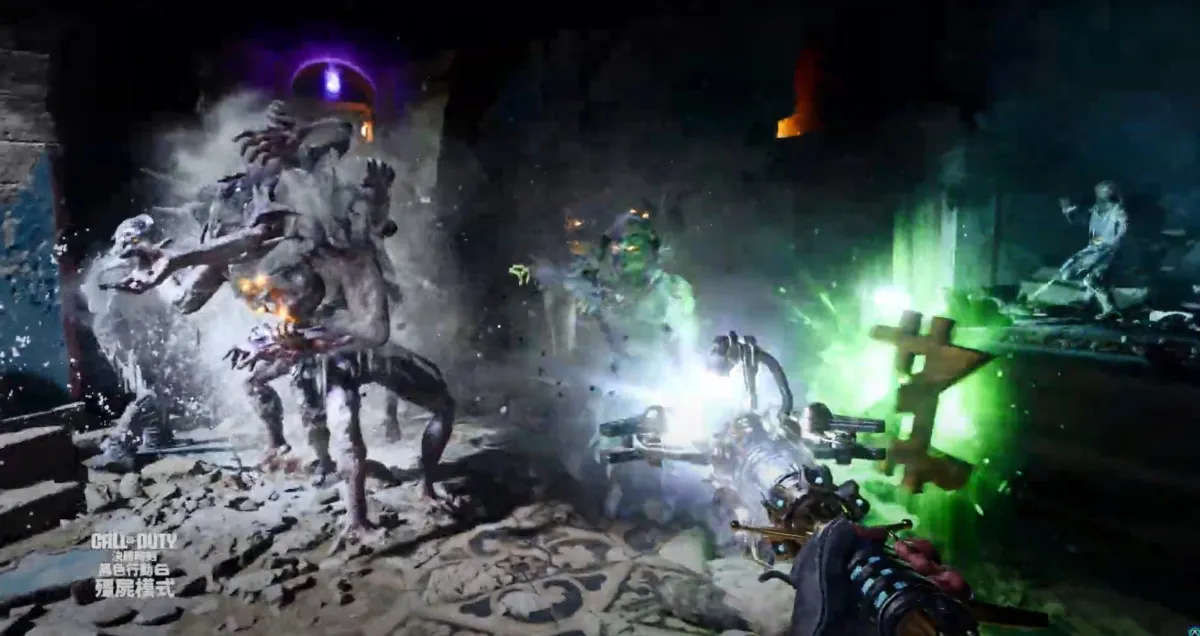
Black Ops 6 Zombies is bringing back one of its most iconic Wonder Weapons, the Staff of Ice, when The Tomb launches in Season 2!
Call of Duty: Black Ops 6 is about to get its fourth Zombies map, when Season 2 releases on January 28, 2025.
The Tomb looks to be heavily inspired by the classic Black Ops 2 map, Origins, as it takes place at an excavation site filled with undead.
And while The Tomb isn’t simply an Origins remake, it is bringing back one of the map’s iconic Wonder Weapons: the Ice Staff!
The Ice Staff Is Back in The Tomb
Black Ops 2’s Origins map introduced four elemental Staffs of Ice, Fire, Wind, and Lightning as its primary Wonder Weapons.
Now, at least the Staff of Ice is returning, judging by the new trailer for Black Ops 6 Season 2.
In the gameplay footage, we can see a player wielding the new-and-improved Ice Staff on The Tomb, which confirms that at least one of the four elemental weapons is making a comeback.
We’d be surprised if all four staffs returned in Black Ops 6, however. After all, we just got four elemental swords in Citadelle des Morts back in Season 1 Reloaded!
The Black Ops 6 Staff of Ice appears to be able to fire ice blasts at enemies, freezing them in place. The trailer also teases that the Wonder Weapon can be wielded as a melee tool, though it’s unlikely to be quite as effective as the Bastard Sword.
Finally, after twirling the staff in their hands, players can slam it down for what looks to be an Area of Effect ability.
Judging by how the special abilities were handled in Citadelle des Morts, this will likely require charging up by killing undead with your Wonder Weapon.
The hunt is on in Season 02 of Call of Duty on January 28 🗓️
5️⃣ MP Maps – Bounty, Dealership, Lifeline, Bullet (Mid-Season), Grind (Mid-Season)🔫 Fan-favorite Gun Game returns⚔️ New Weapons, Operators, Modes, and More pic.twitter.com/5FifiJvWds
— Call of Duty (@CallofDuty) January 22, 2025
Let’s just hope that the Ice Staff (and any other elemental Wonder Weapons that may or may not make a return) are better tuned than their medieval sword counterparts. After all, players were soon calling for the elemental swords to get a major buff after an underwhelming launch – but they’re now in a far better place!
Treyarch also recently released a new teaser image for The Tomb that some fans believe could be a reference to COD Ghost’s Extinction mode.
We can’t wait to find out more when the Season 2 blog post goes live later this week.
The New York Videogame Critics Circle announced its winners on Monday night, naming Astro Bot the 2024 Game of the Year. Sony and Team Asobi’s hit PS5 platformer also picked up honors for Best Music in a Game and Best Kids Game.
In December, Astro Bot picked up the same honor at The Game Awards, in what was one of the tighter races — and more interesting GOTY conversations — in recent memory. But in the end, the nostalgic energy of Astro Bot has galvanized critics groups small and large (The Game Awards also rely on a games media voter base) to agree that the game had the juice.
There is still a bit of runway when it comes to the GOTY awards season, and potential for a few surprises. The voting body of the BAFTA Games Awards has its fair share of critics, which could lead to another Astro Bot win, but has been known to split; for 2022 games, the Game Awards and NYVCC went Elden Ring, while the BAFTAs honored Vampire Survivor. The DICE Awards, announced out of GDC in February, will also give publishers, developers, and other members of the Academy of Interactive Arts & Sciences a chance to name their GOTY (and it’s looking like Indiana Jones could break through).
Here is the full list of New York Videogame Critics Circle’s 2024 winners, which thankfully includes UFO 50 and Mouthwashing on top of some usual suspects. And hey, Polygon picked up an award! Head to our YouTube to watch Clayton Ashley and Simone De Rochefort’s award-winning documentary The Great Game: The Making of Spycraft or find it at the bottom of this page.
Big Apple Award for Best Game of the Year
Off Broadway Award for Best Indie Game
Herman Melville Award for Best Writing in a Game
Statue of Liberty Award for Best World
Elden Ring: Shadow of the Erdtree
Tin Pan Alley Award for Best Music in a Game
Great White Way Award for Best Acting in a Game
Troy Baker as Indiana Jones in Indiana Jones and the Great Circle
Coney Island Dreamland Award for Best AR/VR Game
Central Park Children’s Zoo Award for Best Kids Game
A-Train Award for Best Mobile Game
Freedom Tower Award for Best Remake
Chumley’s Speakeasy Award for Best Hidden Gem
NYC GWB Award for Best DLC
Elden Ring: Shadow of the Erdtree
Andrew Yoon Legend Award Recipient
Knickerbocker Award for Best Games Journalism
Simone De Rochefort & Clayton Ashley for The Great Game: The Making of Spycraft
Ancient8 has opened registration for its Grant Program Season 1, allocating a total of 200,000 $OP tokens provided by the Optimism Foundation.
Offering grants of up to 25,000 $OP tokens per project, the program is designed to drive innovation and growth in the blockchain gaming sector. The initiative provides funding, mentorship, and resources to support both established contributors within the Ancient8 ecosystem and newcomers with innovative ideas.
By focusing on both existing and prospective projects, the grant program aims to enhance tools, improve user experiences, and strengthen infrastructure essential for a robust blockchain gaming ecosystem.
Source: Ancient8
What is Ancient8?
Ancient8 is a community-driven, gaming-focused Ethereum Layer 2 solution designed to address the scalability and adoption challenges of web3 gaming and consumer dApps. Built on the OP Stack and enhanced with Celestia’s modular blockchain technology, Ancient8 combines speed, cost-efficiency, and advanced tools to provide an infrastructure for on-chain gaming development.
Ancient8 has evolved from a gaming guild into a comprehensive gaming infrastructure chain and seeks to empower the next 100 million Metaverse citizens. The platform is dedicated to driving mass adoption, democratizing access to gaming, and delivering a modular blockchain that enhances the on-chain experience for players and developers alike.
The Grant Program Season 1 is a significant step forward, powered by a 500,000 $OP grant from the Optimism Governance Fund. Ancient8 intends to utilize this funding to cultivate a dynamic ecosystem where creators and developers can collaborate, innovate, and scale their solutions.
Source: Ancient8
How does the Ancient8 OP Grant Program work?
The Ancient8 Grant Program Season 1 is powered by 200,000 $OP tokens from the Optimism Foundation, offering funding of up to 25,000 $OP tokens per project. The program is designed to empower projects to innovate, scale, and contribute to the growth of the Ancient8 and Optimism Superchain ecosystems.
The program focuses on two categories: Existing Projects and Prospective Projects, each with distinct timelines, eligibility criteria, and processes. Funding and milestones are tailored to each project’s architectural complexity, vision, and category, with all grants adhering to a one-year token lock-up period under Ancient8 and Optimism’s Collective Grant Policy.
Existing Projects: This track is for individuals and teams that have already contributed to the Ancient8 ecosystem. It recognizes their efforts and supports their continued work to drive long-term sustainability and impact. This category is intended to reward and scale up high-performing, scalable projects.
Jan 15 – Feb 28, 2025: Registration PhaseMar 1 – Mar 15, 2025: Screening PhaseMar 16 – Apr 30, 2025: Performance Review PhaseMay 1 – May 16, 2025: Decision-Making Phase
Eligibility Criteria:
Active contributions to the Ancient8 ecosystem.Demonstrated long-term commitment and measurable impact.On-chain activity, such as wallet interactions and verified contracts.
Process:
Applicants register with details of their contributions and key achievements.The Ancient8 Foundation Council conducts a two-month performance review.Shortlisted projects proceed to a community ranking and voting phase, where $A8 stakers decide the final funding recipients.Projects receive milestone-based rewards as they achieve set goals.
Community Involvement:
$A8 stakers participate in governance by voting on Snapshot during the Decision-Making Phase (May 1 – May 16, 2025).Participating stakers are incentivized with $A8 tokens, with details to be announced closer to the voting period.
Prospective Projects: This track supports new projects aiming to deploy or expand within the Ancient8 ecosystem. It emphasizes onboarding innovative initiatives that improve gaming infrastructure, user experience, growth tools, and content creator networks. This category intends to provide funding, mentorship, and resources to ensure successful launches and integrations.
Jan 15 – Feb 15, 2025: Registration PhaseFeb 15 – Feb 28, 2025: Preliminary Review PhaseMar 1 – Mar 15, 2025: Decision-Making Phase
Eligibility Criteria:
Clear project goals and budget allocation.Strong alignment with Ancient8’s ecosystem growth objectives.Demonstrated innovation and technical feasibility.
Process:
Applicants submit detailed proposals outlining their goals, budget, and expected outcomes.Proposals undergo evaluation by the Ancient8 Grant Council, with approval requiring at least 6 out of 10 votes from council members.Projects receive milestone-based funding tied to progress and delivery, as defined during the evaluation phase.
The grant evaluation process is overseen by experienced web3 professionals, including members of the A8 Governance Partners and the A8 Foundation Council. High-profile figures like Trung Nguyen, co-founder of Axie Infinity, are among the council members, ensuring a rigorous and credible selection process.
Interested applicants are encouraged to visit the official website for more information about Ancient8 Grant Program.
Wall Street could soon get a dose of crypto chaos, as the first-ever exchange-traded funds (ETFs) for Dogecoin (DOGE) and the newly minted Official Trump (TRUMP) meme coin may debut as early as April, according to analysts.
Bloomberg senior ETF analyst Eric Balchunas flagged the accelerated timeline after fellow analyst James Seyffart revealed Miami-based REX Shares’ ETF filings on Tuesday.
REX Shares has filed proposals for DOGE and TRUMP ETFs, alongside Bonk (BONK), Bitcoin (BTC), Ethereum (ETH), Solana (SOL), and XRP (XRP).
If they’re greenlit, these ETFs could bridge meme coins and traditional finance by giving investors access to internet-born cultural icons through standard brokerage accounts.
Good point on the Doge/Trump ETF filing, these are ’40 Act filings and so (theoretically, if they aren’t disapproved) could hit the market in early April (75 days after filing) and beat the XRP, Solana, Litecoin ETFs out bc those have to file 19b-4s which have a 240-day clock.… https://t.co/t5ftWo9ZKR
— Eric Balchunas (@EricBalchunas) January 21, 2025
“These are ’40 Act filings and so (theoretically, if they aren’t disapproved) could hit the market in early April…” Balchunas wrote on X.
He was referring to the 1940 Act, which governs funds combining assets and derivatives. Filings submitted under the Act also enjoy a streamlined 75-day review process.
By leveraging this process, DOGE and TRUMP ETFs could leapfrog other filings—like XRP and Solana ETFs—which require a cumbersome 240-day timeline under 19b-4 filing rules.
“The crypto market survives on the principles of innovation and cultural relevance,” Saravanan Pandian, CEO of KoinBX, told Decrypt. “Dogecoin, with its ever-growing adoption, and the emergence of meme-driven financial instruments, reflect a shift in how the new generation interacts with investments.”
Pandian sees tremendous potential in the meme coin ETFs, “I agree that a Dogecoin ETF could arrive earlier than expected if the regulatory landscape aligns, and we could see these trends formalized as early as April, sparking new opportunities in the digital asset space.”
Dogecoin, once a tongue-in-cheek creation from 2013, has grown into a global crypto heavyweight, driven by strong liquidity and cultural clout.
Endorsed by figures such as Tesla CEO and the Department of Government Efficiency (DOGE) head Elon Musk, the coin has consistently dominated meme coin trading volumes.
As with TRUMP, the meme coin inspired by the sitting U.S. President Donald Trump, has quickly climbed the ranks, currently trading at $43.24—up 21.1% in the last 24 hours, according to Coingecko data.
Litecoin has also seen renewed interest following Canary Capital’s amendment to its S-1 registration with the SEC earlier this month.
Balchunas and Seyffart noted that these updates, often indicative of regulatory engagement, suggest momentum toward approval.
Regulatory Shifts Bring Optimism for Meme Coin ETFs
The U.S. Securities and Exchange Commission (SEC) is undergoing significant leadership changes, with pro-crypto Acting Chair Mark Uyeda stepping in following Gary Gensler’s resignation.
Uyeda’s arrival has sparked hope across the crypto industry for a more favorable approach toward innovative crypto products, including the proposed meme coin ETFs.
The inclusion of TRUMP meme coin in these filings presents a unique challenge for the regulatory agency as it raises questions about how the SEC will handle a product tied to the President’s meme coin.
“While Trump memecoin saw a brief dip in prices yesterday, I am positive the Trump ETF will happen soon, owing to his position as the President of the United States of America,” Pandian stated.
Edited by Stacy Elliott.
Daily Debrief Newsletter
Start every day with the top news stories right now, plus original features, a podcast, videos and more.
Published: January 22, 2025 at 5:44 am Updated: January 22, 2025 at 5:44 am
by Ana
Edited and fact-checked:
January 22, 2025 at 5:44 am
To improve your local-language experience, sometimes we employ an auto-translation plugin. Please note auto-translation may not be accurate, so read original article for precise information.
In Brief
Solana’s Roam, a decentralized WiFi network, aims to enhance global connectivity by combining over a million hotspots, utilizing blockchain technology for improved user engagement.
Roam, a decentralized WiFi network recently unveiled by Solana, intends to transform global connection by combining more than a million WiFi hotspots into a safe network. This project is a component of the larger movement toward decentralized wireless (DeWi) technologies, which employ blockchain technology to improve user engagement and connection. Roam aims to create a self-sustaining ecosystem by rewarding users for their services and offering a smooth internet connection.
Recognizing the Structure and Functions of Roam
Roam uses Open Roaming protocols to provide dependable and safe internet connections, operating on the tenets of decentralized networks. Through a number of methods, such as daily check-ins and staking of Roam Tokens (ROAM), users may connect to a wide variety of WiFi hotspots and collect rewards.
Key Features of Roam
In the context of the decentralized wireless (DeWi) ecosystem, Roam provides a number of features aimed at encouraging user engagement and facilitating network growth.
One of the main features is User Incentives, which allows users to accrue Roam Points through daily check-ins and network contributions of their own hotspots. ROAM tokens, which offer rewards for continued participation and network expansion, may be obtained by staking these points.
The Roam Miner is another essential element that adds crypto-mining capabilities and improves user incentives. This feature enhances the value of users’ involvement in the ecosystem by enabling them to make extra money while remaining connected.
Furthermore, a key component of Roam’s strategy is community engagement. To promote engagement and loyalty, the platform invites users to validate already existing WiFi nodes and add new hotspots. While maintaining the network’s dependability and accessibility, this cooperative effort aids in its expansion.
The Decentralized WiFi Networks Market Context
The launch of Roam coincides with a growing need for dependable and expandable wireless networks. The proliferation of IoT devices and smart city efforts are expected to propel the worldwide wireless mesh network market’s growth. In this context, decentralized networks like Roam provide special benefits by offering adaptable solutions that may change to meet changing user requirements and environmental circumstances.
Comparing This Application to Others
Although Roam is a leader in the decentralized WiFi market, it works with other platforms that provide comparable services in different ways.
The Helium Network is one such competitor that lets users create hotspots and get tokens by offering wireless coverage. In contrast to Roam’s overarching goal of providing widespread WiFi connectivity to a larger audience, Helium primarily concentrates on low-power IoT devices.
Freenet is another noteworthy platform that uses a decentralized network to provide unfettered communication and information access. Freenet’s fundamental ideas of decentralization and open connection closely match Roam’s goals, even if it does not directly address WiFi access.
Furthermore, OpenRoaming offers a framework that guarantees uninterrupted communication between several networks without the need for user involvement. OpenRoaming is a basic technology that Roam uses to improve its connection solutions, even though it is not an application in and of itself.
Each of these platforms offers distinct features and operational models that support the wider development of wireless access, reflecting the rising need for decentralized connectivity solutions.
Decentralized Connectivity Solutions’ Obstacles
Even while initiatives like Roam have a lot of promise, they confront a number of obstacles that may affect their acceptance and long-term viability.
Market Readiness is one of the main obstacles. Some of the developments promoting decentralized connection, particularly those based on blockchain platforms like Solana, are criticized for perhaps being too advanced. There are still barriers to the widespread usage of these technologies, such as the requirement for more user education and wider market acceptability.
Development costs are still another important issue. Decentralized networks may be costly to build and operate, which may deter investors and users from making a commitment to the ecosystem. These expenses cover security, infrastructure, and continuous technology advancements.
Lastly, maintaining decentralized models still depends heavily on user engagement. Even if Roam provides incentives to promote interaction, sustained user interest will need steady community engagement and convincing proof of value over time.
For decentralized connection systems like Roam to be widely adopted and successful, these issues must be resolved.
Prospects for Roam in the Future
In the future, Roam hopes to expand its influence in a number of sectors by improving connection options for both consumers and businesses. Beyond simple internet access, its technology has the potential to be used in AI-driven environments that demand uninterrupted connectivity as well as smart home integrations.
Within a year of its introduction, Roam has reached over one million users in approximately 200 countries, demonstrating its progress in customer acquisition. This quick expansion highlights the need for creative fixes to fill in the holes in the current conventional telecommunications infrastructure.
Roam is positioned to take advantage of blockchain technology breakthroughs as a Web3 project to improve user security and privacy. Through the use of verifiable credentials (VCs) and decentralized identifiers (DIDs), Roam seeks to protect user anonymity while establishing a safe environment for data exchange.
The launch of Roam by Solana marks a major advancement in the field of decentralized connectivity solutions. Roam has the potential to transform internet access by uniting more than a million WiFi hotspots into a single network and encouraging user engagement.
It will be crucial for initiatives like Roam to strike a balance between innovation and useful applications as the market for dispersed wireless networks develops further. Long-term success in this competitive setting will depend on resolving issues with user engagement, development costs, and market readiness.
In an increasingly digital world, Solana’s Roam initiative’s future course is probably going to have an impact on larger telecommunications trends, opening the door for more user-centric and integrated approaches to connection.
Disclaimer
In line with the Trust Project guidelines, please note that the information provided on this page is not intended to be and should not be interpreted as legal, tax, investment, financial, or any other form of advice. It is important to only invest what you can afford to lose and to seek independent financial advice if you have any doubts. For further information, we suggest referring to the terms and conditions as well as the help and support pages provided by the issuer or advertiser. MetaversePost is committed to accurate, unbiased reporting, but market conditions are subject to change without notice.
About The Author
Victoria is a writer on a variety of technology topics including Web3.0, AI and cryptocurrencies. Her extensive experience allows her to write insightful articles for the wider audience.
More articles
Victoria d’Este
Victoria is a writer on a variety of technology topics including Web3.0, AI and cryptocurrencies. Her extensive experience allows her to write insightful articles for the wider audience.
Actress Lacey Turner has revealed the name of her baby daughter.
The EastEnders star welcomed her third child on January 17. Lacey is already a proud mum to five-year-old Dusty and three-year-old Trilby, who she shares with husband of seven years, Matt Kay.
And now, Lacey has shared what they have called the new addition to their family.
Lacey Turner is now a mum of three! (Credit: Cover Images)
Lacey Turner reveals baby name
On Wednesday (January 22) Lacey took to her Instagram and shared a snap of her baby daughter wearing a cardigan. The cardigan had the name Gipsy written on the back. In the caption, she penned: “Gipsy Olive.”
In the comments section, fans shared their thoughts on the tot’s name. One person gushed: “Oh what a lovely name.” Someone else wrote: “So lovely, beautiful name.” A third chimed in: “Beautiful name for a beautiful little girl.”
Lacey announced Gipsy’s arrival last week. She shared a sweet Instagram post that featured the happy family.
She captioned the shots: “Our hearts are full,” with two pink love hearts.
Among the many of Lacey’s followers sending their love were her pals from Albert Square.
Patsy Palmer said: “Omg how beautiful is she !! Congratulations to you all.”
Shona McGarty penned: “Congratulations you wonderful woman. Love you loads”.
Whereas Cheryl Fergison added: “Beautiful family pics Lacy what joy”, adding in a red heart emoji.
Back in September, 36-year-old Lacey shared the news that her family of four would soon be becoming a family of five.
Lacey’s Stacey Solomon character on EastEnders
There has been a great deal of speculation over how Lacey’s long-running EastEnders character Stacey Slater will be written out of the soap while she goes on real life maternity leave. Many theorised that Stacey will end up in prison due to her involvement in The Six.
As a key character in EastEnders, Lacey joined the cast back in 2004.
In the two decades since, her character Stacey has been a part of nail-biting storylines that had audiences gripped. From drug abuse and abortion, to bipolar disorder and murder – no stone has been left unturned when it came to the famous Slater family member.
The EastEnders star is now a mum of three (Credit: BBC)
Preparing for third bundle of joy
Two months after sharing the news with the world she was expecting again, Lacey said she was preparing for the new arrival.
She told The Mirror she was excited to start a new ‘chapter’ with her growing family.
Lacey gushed: “I’m excited for all of us really.
“It’s like another chapter in our little story, yeah I am excited. There’s nothing better than a newborn and a newborn cuddle, so that would be lovely. Yeah, we’re really excited and we’re looking forward to it.”
“You take lots of photos of [your children], thousands of photos,” she added.
The star from the BBC soap continued: “I make [a photo book] for my kids every year, I make them a photo book of their year. I love sitting looking through photos, it’s nice that I do it for them, so I should be making three.”
Lacey Turner’s not concerned over sleepless nights with another baby
The now mom-of-three said she isn’t concerned about the lack of sleep she’ll be having now her third baby has arrived.
Instead, Lacey Turner is looking to the future with her new baby, and the bundle of joy growing up with their siblings.
She said: “I love this time of year and obviously we, you know, we’ve got a lot going on in our house but it’s going to be lovely.
“As the children grow older, it’s lovely. They change so much at this age and it’s lovely to see they’re going through their little milestones and it’s great.”
Read More: Lacey Turner poses with very youthful lookalike mum as she turns 60
Leave us a comment on our Facebook page @EntertainmentDailyFix and share your congratulations for Lacey!
NTT Digital, a global leader in telecommunications, has partnered with Sanrio, the company behind Hello Kitty, along with 22 other organizations, to launch a wellness-focused non-fungible token (NFT) campaign.
The initiative, named “Happy Well Support,” revolves around the theme “happiness and wellness.” It introduces non-transferable NFT cards featuring six cartoon characters, each representing a different team, such as the Smiling team and the Fun team.
Participants must be at least 13 years old and reside in Japan to join. To engage, they will complete missions and collect stamps.
Successful participants will receive a “Happy Danby” digital card and gain entry into a lottery for prizes offered by the participating companies.
Notable partners in the campaign include Animoca Brands, Asahi, Calbee, Nissan, and Yamaha. The campaign began on January 21 and will continue through March 2, 2025.
You Might Be Interested In
This effort highlights a growing trend of using Web3 technology for meaningful purposes.
In recent years, similar initiatives have emerged. Cleveland Clinic introduced “Zen Quest” on Roblox, blending gaming with mindfulness to support mental health. In 2022, Clinique launched a makeup NFT campaign aimed at promoting diversity and inclusivity in the metaverse.
The European video game market experienced a slight 1% uptick in 2024, marking a year of mixed performance for the industry. According to GSD data shared with VGC, a total of 188.1 million PC and console games were sold across the continent. Despite this modest growth, shifts in digital and physical game sales highlighted evolving consumer preferences.
Digital Dominance and Physical Decline
Digital sales surged in 2024, with 131.6 million games sold—a robust 15% increase compared to 2023. In stark contrast, physical game sales plummeted by 22%, accounting for just 56.5 million units. This clear trend toward digital purchasing continues to reshape the retail landscape for games.
Top Performers: EA Sports FC 25 and Call of Duty
EA Sports FC 25 claimed the crown as Europe’s best-selling game of 2024, despite a 5% dip in sales compared to its predecessor, FC 24. Activision Blizzard’s Call of Duty: Black Ops 6 secured second place, achieving a 9% increase in launch sales over Modern Warfare 3 from 2023—a notable achievement given its late-year release.
Sony’s Helldivers 2 emerged as the most successful new IP, debuting at sixth place. However, new releases collectively represented only 27% of total sales, down from 34% in 2023. Meanwhile, legacy titles like Fallout 4 saw a remarkable resurgence, climbing to 19th place with sales skyrocketing 183%, fueled by the buzz around Amazon’s adaptation and aggressive discounting.
Console Sales Drop Across the Board
The hardware market faced significant challenges, with console sales declining 21% overall. Xbox Series X|S bore the brunt of this downturn, suffering a staggering 48% drop. Despite leading the market, PlayStation 5 sales fell by 20%, while Nintendo Switch sales declined 15% in its eighth year on the market.
Below is the top 10 best-selling video games in Europe in 2024 (Digital and Physical Sales):
1. EA Sports FC 252. Call of Duty: Black Ops 63. EA Sports FC 244. Grand Theft Auto 55. Hogwarts Legacy6. Helldivers 27. Red Dead Redemption 28. The Crew 29. It Takes Two10. Call of Duty: Modern Warfare 3



 Source:KGeN




 Source: Ancient8