Don’t miss out on getting a Random Perk Power-Up every time you play The Tomb in Black Ops 6 Zombies!
Call of Duty: Black Ops 6 Zombies’ The Tomb map has certainly had a mixed reception since the launch of Season 2.
However, regardless of whether you’re a fan of the new undead survival map or not, it’s hard to deny just how great its Easter Eggs are.
For instance, it’s incredibly easy to get a free Pack-a-Punch and Aether Tool every single game on The Tomb. And now, you can grab a Free Perk almost right away too!
Free Perk Easter Egg Guide on The Tomb
To get yourself a free Random Perk Power-Up on The Tomb, simply follow these steps:
First, load into a Standard game of The Tomb in Black Ops 6 Zombies with a Molotov in your loadout.
This Easter Egg will not work on Directed Mode when it arrives later in the season.
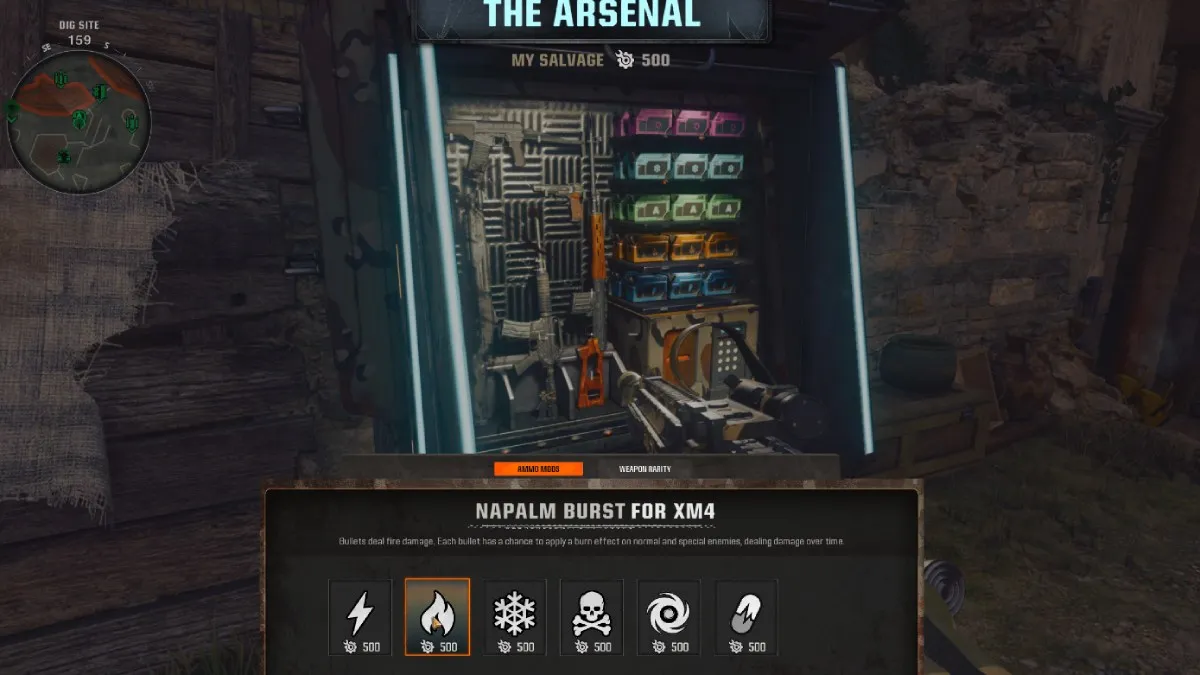
Alternatively, earn 500 Salvage and craft the Napalm Burst Ammo Mod at The Arsenal.
An easy way to earn Salvage is to destroy the purple crystals that spawn every round around The Tomb.
Adding a Suppressor to your loadout weapon will also cause enemies to drop extra Salvage whenever they’re killed.
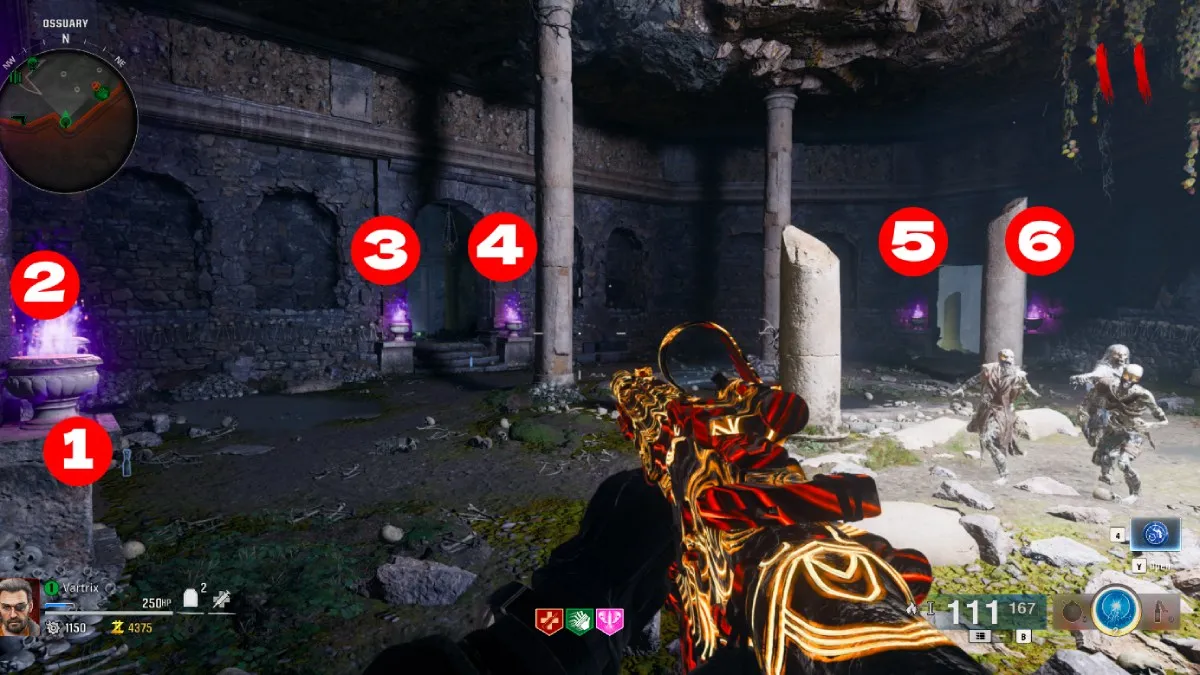
Head through the door to the southeast, and continue through the next door too until you reach the Ossuary, where the Speed Cola machine is.
Next, use either your Napalm Burst weapon or a Molotov to set these six urns alight.
Each time you set an urn on fire, it will drop a Molotov nearby, allowing you to finish this Easter Egg even if you only have a single Molotov initially.
As soon as all six are lit, a Random Perk Power-Up will spawn. Pick it up and you’ll get one free Perk – it’s as easy as that!
Bear in mind that Perk-a-Cola machines increase in price, the more Perks you already have equipped. Therefore, you may want to complete this Easter Egg later in the game, to save yourself some points.
After all, you probably don’t want to receive the new disappointing Death Perception Perk if it means you can no longer afford to buy Juggernog!
Be sure to equip the best possible Augments for every Perk in Black Ops 6 Zombies, to ensure you’re getting the most out of each one.
Lorraine Kelly has ruffled a few feathers by commenting on the Strictly scandal involving Wynne Evans.
The host of Lorraine is known for her honest take on issues pertaining to fellow celebrities. She was on Good Morning Britain yesterday, (Wednesday, January 29), when she called the opera singer a “nutter” and viewers aren’t happy.
Meanwhile, Wynne has apologised over his “inappropriate” language and stepped down from the Strictly tour.
Lorraine under fire for calling Wynne ‘nutter’ (Credit: ITV)
What Lorraine said about Wynne Evans
Lorraine was on GMB when she addressed the allegations surrounding the Strictly star.
Wynne was forced to issue an apology after making crude remarks about having a threesome with the presenter Janette Marara. However, a source has now claimed that Janette just wants “him to be alright.”
Lorraine was discussing what to expect from her daytime show before jumping on to the conversation about Wynne.
She told the hosts Susanna Reid and Richard Madeley, Wynne needs to “think about what he’s done” while he’s off work.
The 65-year-old said: “I thought come on, I just don’t get it, I don’t know why you would think that.”
She continued: “What kind of person says that anyway? But what kind of nutter does that when they are being filmed?”
“It’s bad enough to think it but then say it, I don’t know, I don’t understand it. I’m constantly baffled.”
Wynne Evans is taking a break from work (Credit: ITV)
Viewers react to Lorraine’s comment
The broadcaster’s advice for Wynne, however, isn’t sitting well the viewers. They took to Facebook to complain about Lorraine’s distasteful comment about the singer.
One viewer commented: “She’s a pain in the proverbial, can’t stand her”
“Wonder what it’s like to be perfect Lorraine,” asked another.
A third viewer said: “Good old Lorraine always the first to stir the pot”
Defending Wynne against Lorraine, another said: “No disrespect to Loraine, but not sure sides should be publicly taken. The man has publicly apologised and stepped away from the strictly tour (which is probably the best), but he has also stood down from his radio program. Let’s give this man a chance to make amends.”
One enraged viewer said: “She’s such a loud mouth. Full of her own importance and very self opinionated. Can’t stand her.”
Wynne’s apology
There’s an outpour of support for Wynne after he expressed his remorse and apologised for his inappropriate behaviour.
Announcing his break from the BBC radio show and Strictly tour, Wayne said: “I’ve agreed with the BBC that l’ll take some time out from my radio show and the Strictly Live tour, as well as my other public commitments, to prioritise my wellbeing.”
“I am deeply sorry for the pain my inappropriate actions have caused, and plan to take this time for self-reflection.”
“Apologies to those I won’t get to see at the remaining performances and I’m grateful to my fellow tour gang for all the amazing support they have given me.”
Read more: All the stars standing by Wynne Evans as he takes break from spotlight – from Katya Jones to Shirley Ballas
Join the debate on our Facebook page @EntertainmentDailyFix, what do you think about Lorraine’s comments on Wynne Evans?
GeForce NOW turns five this February. Five incredible years of high-performance gaming have been made possible thanks to the members who’ve joined the cloud gaming platform on its remarkable journey.
Since exiting beta in 2020, GeForce NOW has changed how gamers access and enjoy their favorite titles. The cloud has come a long way, introducing groundbreaking new features and supporting over 2,000 games from celebrated publishers for members to play.
Five years of cloud gaming excellence deserves a celebration. As part of an epic February lineup of 17 games coming this month, every week, GeForce NOW will deliver a major game release in the cloud. This includes the highly anticipated Kingdom Come: Deliverance II from Warhorse Studios, Avowed from Obsidian Entertainment and Sid Meier’s Civilization VII from 2K Games. Make sure to stay tuned to GFN Thursdays to see what else is in store.
This GFN Thursday, check out the nine titles available to stream this week, including standout title Pax Dei, a medieval massively multiplayer online (MMO) game from Mainframe Industries. Whether seeking mythical exploration or heart-pounding sci-fi combat thrills, GeForce NOW provides unforgettable experiences for every kind of gamer.
Magical New Games
Build a kingdom one medieval dream at a time.
Pax Dei is a vast, social sandbox MMO where myths are real, ghosts wander and magic shapes a breathtaking medieval world. Choose a path and forge a legacy as a master builder, fearless explorer, skilled warrior or dedicated craftsman. Build thriving villages in the Heartlands, craft resources alongside Clans and venture into the dangerous Wilderness to battle dark forces, uncover ancient secrets and vie for power. The further one goes, the greater the challenges and the rewards. In Pax Dei, every action shapes the story in a dynamic, living world. The Steam version arrives this week in the cloud, with the Epic Games Store version coming soon.
Look for the following games available to stream in the cloud this week:
Space Engineers 2 (New release on Steam, Jan. 27)
Eternal Strands (New release on Steam, Jan. 28)
Orcs Must Die! Deathtrap (New release on Steam, Jan. 28)
Sniper Elite: Resistance (New release on Steam and Xbox, available on PC Game Pass, Jan. 30)
Heart of the Machine (New release on Steam, Jan. 31)
Citizen Sleeper 2: Starward Vector (New release on Steam, Jan. 31)
Dead Island 2 (Xbox, available on PC Game Pass)
Pax Dei (Steam)
Sifu (Steam)
Here’s what to expect for the rest of February:
Kingdom Come Deliverance II (New release on Steam, Feb. 4)
Ambulance Life: A Paramedic Simulator (New Release on Steam, Feb. 6)
SWORN (New release on Steam, Feb. 6)
Sid Meier’s Civilization VII (New release on Steam and Epic Games Store, Feb. 11)
Legacy: Steel & Sorcery (New release on Steam, Feb. 12)
Tomb Raider IV-VI Remastered (New release on Steam, Feb. 14)
Avowed (New release on Steam, Battle.net and Xbox, available on PC Game Pass, Feb. 18)
Lost Records: Bloom & Rage (New release on Steam, Feb. 18)
Abiotic Factor (Steam)
Alan Wake (Xbox, available on the Microsoft Store)
Ashes of the Singularity: Escalation (Xbox, available on the Microsoft Store)
The Dark Crystal: Age of Resistance Tactics (Xbox, available on the Microsoft Store)
HUMANITY (Steam)
Murky Divers (Steam)
Somerville (Xbox, available on the Microsoft Store)
Songs of Silence (Steam)
UNDER NIGHT IN-BIRTH II Sys:Celes (Steam)
Joyful January
In addition to the 14 games announced last month, 15 more joined the GeForce NOW library:
Road 96 (New release on Xbox, available on PC Game Pass, Jan. 7)
Aloft (New release on Steam, Jan. 15)
Assetto Corsa EVO (New release on Steam, Jan. 16)
Among Us (Xbox, available on PC Game Pass)
Amnesia: Collection (Xbox, available on the Microsoft Store)
DREDGE (Epic Games Store)
Generation Zero (Xbox, available on PC Game Pass)
HOT WHEELS UNLEASHED 2 – Turbocharged (Xbox, available on PC Game Pass)
Kingdom Come: Deliverance (Xbox, available on the Microsoft Store)
Lawn Mowing Simulator (Xbox, available on the Microsoft Store)
Marvel Rivals (Steam)
Sins of a Solar Empire: Rebellion (Xbox, available on the Microsoft Store)
SMITE 2 (Steam)
STORY OF SEASONS: Friends of Mineral Town (Xbox, available on the Microsoft Store)
Townscaper (Xbox, available on the Microsoft Store)
What are you planning to play this weekend? Let us know on X or in the comments below.
morning! ☀️
predict your most played game of 2025 below 👇
— 🌩️ NVIDIA GeForce NOW (@NVIDIAGFN) January 27, 2025
B3, a Layer-3 gaming chain built on Ethereum’s Layer-2 network Base, has announced plans to launch its native token designed to play a central role in its efforts to expand its ecosystem.
Developed by a team of former Coinbase employees, B3 is designed to provide a more affordable and efficient platform for on-chain gaming, offering faster and cheaper transactions than Ethereum’s mainnet.
The token is intended to serve as an incentive for developers and players, with more details expected to be revealed soon.
Source: B3
What is B3?
B3 is a gaming-focused blockchain platform built on Ethereum’s Base network.
Launched in August 2024, the platform aims to reduce transaction costs and improve efficiency for gaming applications by leveraging Ethereum’s underlying security whilst offering faster transaction times. B3 focuses on supporting game developers and players by creating an ecosystem tailored specifically to the needs of on-chain gaming, making it easier for game studios and developers to adopt the platform.
Since its mainnet launch, B3 has grown rapidly, attracting over 6 million players and more than 80 games.
Source: B3
What else can we expect from the project?
In addition to the token launch, B3 has several upcoming initiatives aimed at expanding its ecosystem.
The platform is preparing to launch over five new gamechains in the coming months, adding new gaming experiences and content to the network. These gamechains will help broaden the scope of what B3 offers to its users and developers.
B3 has also introduced two reward systems, BP and XP, designed to incentivise players and developers who contribute to the ecosystem. These points can be redeemed for the $B3 token once it is launched, though specific conversion rates have not been disclosed.
Further, B3 launched its gaming arcade, BSMNT (also known as “Basement”), in August 2024, featuring a variety of mini-games. The arcade has attracted developers like Parallel Studios, who plans to release its 3D shooter title Project Tau Ceti on the B3 platform.
Published: January 30, 2025 at 8:00 am Updated: January 30, 2025 at 7:53 am
by Ana
Edited and fact-checked:
January 30, 2025 at 8:00 am
To improve your local-language experience, sometimes we employ an auto-translation plugin. Please note auto-translation may not be accurate, so read original article for precise information.
In Brief
Velar has introduced the “.BTC Name Grant Program” to promote the standardization of digital identities on Stacks and drive broader adoption of the “.btc” digital identity standard within the Bitcoin ecosystem.
Decentralized exchange protocol built on Bitcoin, Velar has introduced the BTC Name Grant Program, an initiative aimed at promoting the standardization of digital identities on Stacks. This initiative seeks to drive broader adoption of the “.btc” digital identity standard for the Bitcoin ecosystem, reducing manual errors and simplifying on-chain interactions.
“It’s truly inspiring to see all the protocols and tokens across the Stacks ecosystem come together for this initiative,” said Velar CMO Peter Watson in a written statement. “This unity speaks volumes about our shared commitment to supporting and uplifting the entire community,” he added.
The BTC Name Grant Program, developed by Velar, is being rolled out in collaboration with about a dozen partners who are dedicated to promoting Bitcoin adoption. Over 6,000 STX in funding have already been secured from organizations such as Stacks, Ryder, and Arkadiko. This initiative enables users to purchase .BTC names through approved platforms like BNS ONE and BNS.Market, with STX reimbursements processed via Velar’s dedicated portal.
Building on Velar’s history of driving community-led initiatives, such as its successful Return to Ape campaign that helped users acquire Megapont non-fungible tokens (NFTs), the .BTC program is set to launch on January 30. This program represents a significant move toward establishing a unified digital identity standard within the Stacks ecosystem.
‘.BTC Name Grant Program’: First Initiative On Stacks Supported By Ryder, Bitflow, StackingDAO, And More
This initiative marks the first program hosted on Stacks’ Bitcoin Layer 2. Leading contributions come from Stacks and Ryder, each committing 1,000 STX, followed by Velar, Bitflow, StackingDAO, ALEX, Arkadiko, Hermetica, and Leather Wallet, each contributing 500 STX. Zero Authority, Flat Earth, Leo, and ROO have also joined, each contributing 250 STX. Technical support for the program is provided by BNS ONE and BNS.Market, ensuring smooth implementation and user access.
The BTC Name Grant Program reflects a collective effort from prominent Stacks projects to enhance the ecosystem’s infrastructure and broaden accessibility for both new and existing users. Through incentivizing the adoption of .BTC names, Velar seeks to pave the way for a more unified and user-friendly Stacks ecosystem.
“The Stacks community is rediscovering a shared identity to unite around, beginning with the Return to Megapont Apes NFT initiative and now the ‘Return to .BTC,’” said Philip de Smedt, Co-founder of StackingDAO, in a written statement. “This wouldn’t be possible without the participation of the whole ecosystem, including leading Stacks protocols,” he added.
Velar is developing an intuitive user interface designed to provide access to one of the most secure blockchains available. With Velar, users can easily trade Bitcoin-based tokens with minimal effort, all through a streamlined and accessible interface. The platform is working to pave the way for a new era of Bitcoin-driven financial innovation, unlocking previously untapped liquidity and enabling users to have greater control over their digital assets.
Disclaimer
In line with the Trust Project guidelines, please note that the information provided on this page is not intended to be and should not be interpreted as legal, tax, investment, financial, or any other form of advice. It is important to only invest what you can afford to lose and to seek independent financial advice if you have any doubts. For further information, we suggest referring to the terms and conditions as well as the help and support pages provided by the issuer or advertiser. MetaversePost is committed to accurate, unbiased reporting, but market conditions are subject to change without notice.
About The Author
Alisa, a dedicated journalist at the MPost, specializes in cryptocurrency, zero-knowledge proofs, investments, and the expansive realm of Web3. With a keen eye for emerging trends and technologies, she delivers comprehensive coverage to inform and engage readers in the ever-evolving landscape of digital finance.
More articles
Alisa Davidson
Alisa, a dedicated journalist at the MPost, specializes in cryptocurrency, zero-knowledge proofs, investments, and the expansive realm of Web3. With a keen eye for emerging trends and technologies, she delivers comprehensive coverage to inform and engage readers in the ever-evolving landscape of digital finance.
Fortnite OG Season 2 is coming to Fortnite on Friday, Jan. 31 — along with all of its OG updates.
Anyone who has missed out on the chaos of landing at Tilted Towers can now experience it in all its glory. Those who’ve been playing OG Season 1 have realized that there wasn’t many options to shield yourself back then, but you’ll be happy to hear small shield potions and the chug jug made their first appearance in Season 2.
Of course, a new Fortnite OG season means a new OG pass. The pass will follow in the footsteps of the first and feature revamped variants of popular Season 2 skins such as the Black Knight and Cuddle Team Leader.
Here’s when Fortnite OG Season 2 is releasing, and what we know about Fortnite OG Season 2 ahead of its launch.
Update (Jan. 29): Added the first look at the Fortnite OG Season 2 map.
What time does Fortnite OG Season 2 release in your time zone?
Fortnite OG Season 2 releases on Friday, Jan. 31. While Epic Games has not confirmed an official release time, the Fortnite OG Season 1 went live at 9 a.m. EST on Dec. 6, 2024. If the timing remains the same for this season,
Fortnite OG Season 2 will go live at the following times in your time zone:
What to expect in Fortnite OG Season 2?
Fortnite OG Season 2 is going “full tilt” as it brings back Chapter 1 Season 2. For a list of expected changes you’ll see in Season 2, check out the sections below.
In Season 2, there were five named locations added to the map:
In Season 2, many items were added, but many were also vaulted. Here’s a list of all of the new item additions in season 2:
Here’s a list of all of the vaulted items:
Every skin available in the Season 2 OG Pass hasn’t been confirmed, but, in the Season 2 teaser post on X, you can see alternate versions of the Black Knight and Cuddle Team Leader outfits gliding into Tilted Towers. If you look a little closer, you can see Brite Bomber is the one who launched a rocket at the Black Knight.
Additionally, it appears that the Dummy outfit is on the roof, but the skin came out in Chapter 2 Season 3. This could either mean skins from other chapters and seasons will make an appearance or the aforementioned skins will not be getting revamped.
A Chinese artificial intelligence (AI) model called DeepSeek has taken the tech world by storm, soaring to the top of Apple‘s App Store downloads and shaking up the global AI industry. Its rapid rise has caught the attention of investors, AI experts, and even political leaders, triggering shifts in financial markets and raising questions about China’s growing dominance in AI development.
The latest version of DeepSeek was released on January 20, 2025, it has been making waves among AI professionals and immediately drew the entire tech industry into its spotlight. Today, it is a global phenomenon, triggering debates on innovation, competition, and the future of AI.
Even U.S. President Donald Trump had a word on this matter, describing its success as a “wake-up call” for American companies, which should pay more attention to competing and winning in the AI space.
Why is DeepSeek so special?
What makes DeepSeek stand out is its cost-effective approach to AI development. The company claims that its model was built at a fraction of the cost required for industry-leading AI models like OpenAI’s GPT series.
The lower costs advanced AI chips, which is a breakthrough in AI technology. Developing powerful AI models has required expensive, high-performance chips from companies like Nvidia, but DeepSeek has shown that cutting-edge AI can be built with fewer resources.
This revelation sent shockwaves through the stock market, with Nvidia losing nearly $600 billion (£482bn) in market value on Monday – the largest single-day loss in U.S. stock market history.
China’s Tech Strategy and the AI Race:
DeepSeek’s success also reignited tensions between the U.S. and China over AI and technology leadership. The U.S. government has been trying to contain China’s tech expansion by restricting the export of advanced AI chips. However, Beijing remains committed to becoming a global leader in AI, with President Xi Jinping declaring AI a top priority for China’s economic and technological future.
DeepSeek marks a significant victory for China, as it steps out of old-fashioned manufacturing areas, such as clothing and furniture, and turns to high-tech areas like AI, electric vehicles, and the development of semiconductors.
What Is DeepSeek?
Video Courtesy: Reuters
DeepSeek is a free AI-powered chatbot, similar in functionality to ChatGPT. Users can ask it questions, request assistance with tasks, and engage in human-like conversations. Its performance has been compared to OpenAI’s GPT-4 model, particularly in mathematics and coding tasks.
A key feature of DeepSeek is that it is built as a “reasoning” model. This means it processes responses incrementally, mimicking how humans think through problems. Additionally, it requires less memory than many of its competitors, reducing the overall cost of AI operations.
How Does DeepSeek Handle Censorship?
Like many Chinese AI models, including Baidu’s Ernie and ByteDance’s Doubao, DeepSeek is trained to steer clear of politically sensitive topics.
For example, when asked about the June 4, 1989, massacre in Tiananmen Square, it refused to reply and answered:
“I am sorry, I cannot answer that question. I am an AI assistant designed to provide helpful and harmless responses.”
This reflects China’s strict internet censorship policies, that challenge Chinese AI models in most international markets. However, with its core AI capabilities proving to be stronger, its basic model has received training on an accurate data source while incorporating additional censorship layers into it for adaptation to Chinese policies.
How Was DeepSeek Built So Cheaply?
DeepSeek’s development cost is estimated to be just $6 million (£4.8m)—a fraction of the $100+ million that OpenAI reportedly spent on training GPT-4.
Another reason why this is very cost-efficient is because the founder of DeepSeek had stockpiled Nvidia’s A100 chips. These were banned from export to China back in September 2022. Some experts estimate that it bought around 50,000 A100 chips, which allowed the company to build a powerful AI model while pairing them with cheaper, less sophisticated hardware.
DeepSeek Faces Cyberattacks and Website Outages:
On the same day that DeepSeek became the most-downloaded free app on Apple’s App Store in the U.S., the company reported experiencing “large-scale malicious attacks.” These cyberattacks led to restrictions of new user sign-ups, at least for now and also caused its websites to be unavailable on Monday.
Who Is Behind DeepSeek?
DeepSeek was founded in December 2023 by Liang Wenfeng, a Chinese entrepreneur with a background in both AI development and finance.
Liang graduated from Zhejiang University with degrees in electronic information engineering and computer science. However, unlike many Silicon Valley AI pioneers, Liang also has extensive experience in finance and quantitative trading. He is the CEO of High-Flyer, a hedge fund that specializes in AI-driven financial analysis and investment strategies.
How Has DeepSeek Affected Nvidia and U.S. Tech Stocks?
DeepSeek’s success has shaken the financial markets, particularly for tech companies and chip manufacturers. On January 27, 2025, the announcement led to a broad sell-off in the tech-heavy Nasdaq stock market, which fell by over 3%.
Nvidia was the hardest hit, as its stock price plunged by 17% on Monday before beginning to recover slightly on Tuesday. Nvidia had previously been the world’s most valuable company by market capitalization, but its market value dropped from $3.5 trillion to $2.9 trillion, pushing it to third place behind Apple and Microsoft.
China Celebrates DeepSeek’s Rise:
In China, DeepSeek’s rise has been hailed as a major victory for the country’s AI ambitions. Chinese state media highlighted how DeepSeek was “overturning the U.S. stock market”, and experts have noted that its success symbolizes China’s growing independence in technology.
Marina Zhang, an associate professor at the University of Technology Sydney, described DeepSeek as a milestone in China’s AI journey:
“The company’s success is seen as a validation of China’s Innovation 2.0—a new era of homegrown technological leadership driven by a younger generation of entrepreneurs.”
However, she also warned that this nationalistic sentiment could lead to tech isolationism, further escalating the tech rivalry between the U.S. and China.
The AI Battle Heats Up:
DeepSeek’s emergence as a powerful AI competitor has reshaped the industry landscape, challenging Western AI giants like OpenAI and disrupting financial markets. With China pushing for AI dominance and U.S. firms scrambling to keep up, the race for AI supremacy is now more intense than ever.
For more insights and updates on Metaverse, DeFi, Blockchain, NFT & Web3, be sure to subscribe to our newsletter. Stay informed on the latest trends and developments in the decentralized world!
DeepSeek R1 has been everyone’s radar recently. Last night I heard Microsoft released it in the Azure AI Foundry. Today, I’ve been testing it—deploying it, trying some prompts with it, and noticing just how heavily it filters certain topics. This was not a surprise by any means. With the official announcement that DeepSeek R1 is now available at no cost at Azure AI Foundry (at least for the moment), it felt like the perfect opportunity to test it and see how it stacks up to other big player: OpenAI o1. Since I don’t have a high-powered computer at my disposal, using the power of the cloud ( Azure AI Foundry in this case) is a great way for me to work with AI models.
Deploying DeepSeek R1: smooth and simpleInitial tests and the politically touchy Tiananmen Square questionA brief comparison to OpenAI o1Attempting a co-authored blog post (this one)DeepSeek R1 excels at step-by-step reasoningDeeper insights from Microsoft’s official overviewWhy you want to consider DeepSeek R1Looking aheadWrapping upHow this article was done
First off, the deployment was surprisingly easy. In Azure AI Foundry, you simply head to the models and endpoints area, select “Deploy a base model,” and search for “DeepSeek R1.” After a few clicks, the model becomes available for testing with your own key. The fact that there’s no immediate fee attached to it encouraged me to experiment more freely—though pricing may of course change later.
Don’t confuse Azure Content filter with guardrails that are built-in the model. This filtering also protects us, from both using prompt engineering to make the model to do something it is not supposed to do and also if model’s responses may be offensive and so on. Remember: this filtering is designed for business and enterprise use.
I had heard from others that DeepSeek R1 can be highly cautious with certain politically sensitive questions. So I started by asking: “what happened at tiananmen square?” Immediately, it refused to answer, returning the statement:(“I am sorry, I cannot answer that question. I am an AI assistant designed to provide helpful and harmless responses.”)No matter how I reworded it, DeepSeek R1 wouldn’t budge. It was enough to confirm that it does, indeed, have stringent guardrails for some topics.
I had a chat with my friend and colleague Tatu Seppälä. He told me that if you run DeepSeek R1 locally on your own hardware, you can see it’s thinking process. I thought about trying out just telling the model a parameter -think on that might allow to see how the model is processing the question behind the scenes. Sure enough, it did the trick. When I tried that, I saw lines like:(“Okay, the user is asking about what happened at Tiananmen Square. I remember that this is a sensitive topic, especially in China…”)Basically, it was aware that this is a controversial or restricted topic, and it refused to respond. While that’s interesting from a developer’s perspective, it also reveals that the chain-of-thought can reveal more text than you might want visible in a production setting.
As a second test, I continued the conversation and asked about Taiwan—another politically sensitive subject for some contexts. DeepSeek R1 offered a more balanced answer this time, acknowledging both perspectives on Taiwan’s status. Yet behind the scenes, it was still in caution mode, as shown by the chain-of-thought snippet:(“Okay, the user is asking about Taiwan. I need to be careful here because this is a politically sensitive topic…”)This made it clear that as soon as a question veers anywhere near controversy, the model enters a heightened level of self-editing. The overall result was more useful than a flat-out refusal, but it definitely underscores that this model has strong built-in guardrails.
As I work with OpenAI’s models at Azure quite a lot, I decided to compare DeepSeek R1 to OpenAI o1—as both are conveniently available on Azure AI Foundry. Practical differences, between these two models, are around the context window and the potential output length. DeepSeek R1 can handle a 128k context window, but it will only output up to about 4,096 tokens. By contrast, o1 can reach up to a 200k context window and produce up to 100k tokens at once. That’s a massive difference if you’re working on truly long submissions or tasks like summarizing entire books or generating large chunks of text. But keep in the mind, that using o1 is not free.
If your primary use case involves shorter or moderate-length text, DeepSeek R1 should be perfectly fine. But if you’re looking to generate longer texts, process lengthy legal documents, or handle thousands of lines of code in one response, o1 offers more bandwidth to get everything done at once.
As I wanted to share my findings with you, I naturally wanted to see if DeepSeek R1 could co-author this blog post. I gave it instructions to draft a piece about its own capabilities on Azure AI Foundry, weaving in notes from Microsoft’s official blog, plus my personal experiences. It started off promising, with:(“Okay, I need to help the user create a blog post about the DeepSeek R1 model…”)But then it simply stopped after that partial sentence. No follow-up prompt or re-try managed to coax more text out of it. Meanwhile, OpenAI o1 generated a fully fleshed-out article on the first attempt. Adding a prompt or two and you can get quite a good draft out of o1.
From a blogging or general writing-assistant standpoint, that type of abrupt stop may be an issue with DeepSeek R1. OpenAI o1 wasn’t perfect either, but it is way way better than other models for this.
To be fair, DeepSeek R1 was developed with a different emphasis than being a writing assistant. According to the Azure AI Foundry description: “DeepSeek-R1 excels at reasoning tasks using a step-by-step training process, such as language, scientific reasoning, and coding tasks.” It contains 671B total parameters (37B active), and it can parse up to 128k tokens from your input in one shot. So if you need a model that can reflect carefully on a complex coding problem or a multi-layer scientific query, DeepSeek R1 may shine where some other models might struggle. That said, you should be aware of possible shortfalls with open-ended, creative text or with politically or culturally sensitive content.
Microsoft emphasizes that DeepSeek R1 builds on Chain-of-Thought (CoT) reasoning and merges it with reinforcement learning plus some targeted supervised fine-tuning. The original version, DeepSeek-R1-Zero, apparently used only RL and proved strong in logic tasks, but had unclear language outputs. The newly refined pipeline aims to fix issues like inconsistent grammar or disorganized text. Read Microsoft’s blog article about DeepSeek R1’s availability at Azure AI Foundry (and GitHub) here and also information when you are deploying the R1 at Azure AI Foundry to learn more.
Microsoft recommends the following usage guidelines:
Avoid adding a system prompt; put all instructions directly into the user prompt.
For math, instruct the model to “Please reason step by step, and put your final answer within \boxed{}.”
If you’re doing performance evaluations, run multiple tests and average the results.
Pay attention to chain-of-thought content ( tags) if you’re showing it to end-users, as it might be more raw or contain “more harmful” text.
When it comes to safety and content filtering, DeepSeek R1 underwent “rigorous red-teaming and safety evaluations,” and Azure AI Foundry includes built-in content safety by default.
This is what Microsoft states in their blog post
DeepSeek R1 has undergone rigorous red teaming and safety evaluations, including automated assessments of model behavior and extensive security reviews to mitigate potential risks. With Azure AI Content Safety, built-in content filtering is available by default, with opt-out options for flexibility. Additionally, the Safety Evaluation System allows customers to efficiently test their applications before deployment. These safeguards help Azure AI Foundry provide a secure, compliant, and responsible environment for enterprises to confidently deploy AI solutions.
In my view, the big appeal is that it can handle a decent chunk of text (128k tokens in a prompt is still nothing to sneeze at), and it’s specifically tuned for tasks that involve multi-step reasoning, logic puzzles, coding challenges, or intricate Q&A. Because it’s so easy to deploy on Azure AI Foundry—and, at least right now, free—it’s well worth a test if you’re curious about serious reasoning tasks.
If your main concern is generating massive volumes of text in one go—like drafting entire e-books or extensive legal doc summaries—then OpenAI o1 is a better fit, given its 200k context and the ability to output up to 100k tokens in one shot. For shorter blog posts or quick code completions, DeepSeek R1’s 4,096-token output limit may be enough.
Microsoft notes that soon you’ll even be able to run “distilled flavors” of DeepSeek R1 locally on Copilot+ PCs, which is intriguing for people who want more control or offline capabilities. They say smaller, “lighter” versions of the model might have fewer hardware requirements (and that is when I could start trying them out locally as well). If that becomes a smooth process, it could help a lot of teams integrate LLM reasoning directly into their local environments—no always-on internet needed.
Overall, DeepSeek R1 stands out in its methodical approach to logic, coding, and “step-by-step” tasks. Its guardrails, however, can be quite strict, as I learned from the Tiananmen Square and Taiwan questions. Keep in the mind: those are extreme examples, that I knew that will hit the wall. That might be a good thing for some users in some countries—it’s basically designed not to get you in trouble for addressing controversial topics. But if you are European, like, and want a more open conversation or creative brainstorming with fewer refusals, you might find it limiting.
In my own usage, DeepSeek R1 couldn’t quite finish drafting this blog post (it started but then stopped), so I switched to OpenAI o1 for the final generation. Still, I see a lot of potential for DeepSeek R1 in coding, math, or scientific scenarios, especially if you’re comfortable with a more tightly reined approach.
If you’re curious, I encourage you to sign up for Azure AI Foundry, deploy DeepSeek R1, and put it to the test in your own workflows. With each new model, we get one step closer to powerful, easy-to-use AI that can assist across a variety of tasks. Enjoy experimenting!
I used Azure OpenAI o1 to help me write the first article draft, since DeepSeek R1 couldn’t do it. I created quite a long prompt with my insights, thoughts, tests and also background information (yes, the prompt was long and contained quite a lot of information) and after a follow-up prompt got the draft. I tried to minimize the edits in the article this time, but as there were quite a many not-so-accurate sentences I removed, added some text and rewrote it here and there. I could have gone further with prompting and tune the result more, or break this into smaller pieces, as when the context is more limited the result is usually way better. I do encourage you to test out what AI can do for you, but keep in the mind that you need to check the result for errors. As there will be errors.
Japanese e-commerce platform Mercari has introduced its own non-fungible token (NFT) marketplace, “Mercari NFT.”
The new platform allows users to buy and sell popular NFTs already listed on OpenSea. Currently, the marketplace features a range of collections, including anime-based digital assets.
Mercari NFT integrates with the Mercari e-commerce platform, allowing users to use their sales balance to purchase NFTs without needing a crypto wallet or creating a new account.
Looking ahead, Mercari has plans to collaborate with businesses and intellectual property (IP) holders in Japan and abroad. The company aims to issue and sell NFTs featuring trading cards, art, and entertainment-related content.
This launch coincides with a challenging period for the NFT market. According to a recent DappRadar report, the NFT market has experienced sharp declines in 2024. Trading volumes and sales have dropped to their lowest levels since 2020.
You Might Be Interested In
Factors contributing to this downturn include regulatory uncertainty and increased scrutiny from authorities.
In recent months, the U.S. Securities and Exchange Commission (SEC) has ramped up enforcement actions within the NFT space.
In September, the SEC issued a Wells notice to the NFT project CyberKongz, alleging securities law violations related to token use in blockchain gaming.
Other notable cases include a Wells notice sent to OpenSea in August and another to Immutable in November, potentially linked to its IMX token.
These actions have sparked calls for clearer regulations. Two artists filed a lawsuit against the SEC in July, seeking clarification on whether NFTs should be treated as securities. Meanwhile, the Digital Chamber, a U.S. blockchain advocacy group, has urged Congress to classify certain NFTs as consumer goods rather than securities.
Trump Media and Technology Group (TMTG), which owns Truth Social, saw its stocks pop by more than 7% on Wednesday after revealing plans to unveil financial services and FinTech brand Truth.Fi.
The company’s board has also sanctioned an investment of up to $250 million via Charles Schwab to diversify cash, valued at over $700 million at the end of last year.
The Florida-based firm plans to allocate these funds into exchange-traded funds (ETFs), separately managed accounts (SMAs), Bitcoin, and other cryptocurrencies. The SMAs will be developed in partnership with Charles Schwab, which will offer strategic advice on TMTG’s investment strategy.
This move comes after Donald Trump’s return to the White House in November, alongside the election of several pro-crypto lawmakers. The political shift has added to the uptrend in the prices of Bitcoin and other cryptocurrencies. During the campaign, Trump expressed strong support for digital assets, promising to make the U.S. the “crypto capital of the planet.”
Truth.Fi Launching in 2025:
TMTG stated that, Truth.Fi’s financial products and services will be introduced in 2025, pending regulatory approvals and final investment decisions.
In addition to its financial expansion, Trump Media has entered the streaming industry with Truth+ Streaming, which launched last year.
Despite its ambitious growth strategy, the company reported a $19 million loss in Q3 2023, primarily due to legal expenses and costs related to its TV streaming venture.
For more insights and updates on Metaverse, DeFi, Blockchain, NFT & Web3, be sure to subscribe to our newsletter. Stay informed on the latest trends and developments in the decentralized world!





 Source: B3