Home Blog Page 1166

EXCLUSIVE | How ‘Interior Chinatown’ Mirrors Jimmy O. Yang’s Real-Life Acting Struggles

    0
    EXCLUSIVE | How ‘Interior Chinatown’ Mirrors Jimmy O. Yang’s Real-Life Acting Struggles


    Few films manage to weave together history, culture, and humanity as beautifully as Los Frikis, a story that sheds light on the punk subculture in 1990s Cuba and the radical sacrifices of a group of individuals who injected themselves with HIV as a means of reclaiming autonomy in a society that sought to suppress their identity. Directed by Mike and Tyler Green, Los Frikis is a deeply moving film that captures the raw spirit of rebellion, brotherhood, and survival against the odds.

    In this exclusive interview, I had the privilege of speaking with the film’s talented leads, Hector Medina (Viva, Sergio & Sergei) and newcomer Eros De La Puente, whose portrayals of two brothers navigating a turbulent cultural and emotional landscape have been widely praised. Medina, who brings a wealth of experience and intensity to his role, reflects on how the music, costumes, and defiant spirit of Cuban punk shaped his character and informed his performance. Meanwhile, De La Puente, in his feature film debut, opens up about the challenges and triumphs of stepping into a role so emotionally charged and deeply rooted in historical context.

    From their connections to the subject matter to the behind-the-scenes magic that brought pivotal moments to life, Hector and Eros offer a fascinating glimpse into the making of Los Frikis. Here’s the interview in which we delve into their creative journeys, the power of punk, and the deeply emotional moments that define this extraordinary film.

    A still from ‘Los Frikis’ (Photo Credit: Lord Miller)

    Aayush Sharma: Congratulations to the team for the success of ‘Los Frikis’—it is such a beautiful and heart-touching story. My first question, Eros, is about your character, who idolizes his brother, Paco, but undergoes a complex emotional journey throughout the film. As a first-time actor working on your debut movie, how did you approach portraying your character’s evolving perception of his brother throughout the story?

    Eros De La Puente: I think what allowed me to be ready was to be very present. Like, even if I wasn’t acting in that moment, even if I didn’t have that scene, I was there watching my brother’s scene or every, you know, like, just to be aware of what he’s doing so that then it would be easier for me to be sort of like his little brother, because I’m serving this guy, and I’m following this guy. So I would say that was a big step, and not just as a character, like Gustavo and Paco, but I think that everything was planned out beautifully because then he was like my older actor brother. He has way more experience than me, and he was this guy that’s guiding me through the journey. So we kind of went—like, we did exactly the same thing that happened in the movie outside of the movie, you know. I think the process of, like, me trying to be Paco in a weird way or trying to find myself through Paco just happened. Just happened as a byproduct of our amazing relationship. We’re like two others.

    Aayush Sharma: Hector, the punk subculture plays a significant role in shaping your character’s identity. How did the music, costumes, and cultural elements of punk influence and inform your portrayal of him?

    Hector Medina: Well, the Rock and Roll Spirit helped me a lot. I mean, being always looking for freedom. And the Cuban tropical punk from Cuba, there is a special band. I mean, to be a punk in Cuba in those times was really hard. And those people were so, so brave. Brave. In Cuba, at that moment, listening to American music was prohibited. To have long hair, was a prohibition. To think differently, was a prohibition. So that and that spirit from the Cuban tropical punk, inspired me a lot. Just being made me be. Being a while, be angry, hungry, and wild. Those are two things that help me a lot.

    Los Frikis Hector Medina

    Hector Medina as Paco in ‘Los Frikis’ (Photo Credit: Lord Miller)

    Aayush Sharma: Hector, you were born in the late 1980s, and this story is set in the 1990s, meaning you were growing up in real life during the time these events were unfolding in Cuba. While growing up, did you hear stories about the lost freakies and people who injected themselves with HIV? Also, did your perception of these individuals change while working on this film?

    Hector Medina: Yes, yes. I, I was born in 1989. I remember when I saw the first freaky, I was like five, six years old, and my aunt told me, “Don’t, don’t look at him. Don’t look at him.” Yeah, dd, people, and crazy people. But I was so interested in this, these people that they were so different in, mean, in a, in a communist country, tropical country. Imagine that. That look was so different—long hair, the clothes that they wore. The first time that I saw an electric guitar, the sound, was so different. And then at 13 years, I met Helson, who is alive right now. I think he is the last freaky, the last, the only people who are alive, the only Friki who injected themselves with HIV, who is alive. And I met him at that time, and he was so nice, so kind, always protecting the job, the young guys in the place, because I used to go to this place, where they only put rock and roll music, and it was like a paradise in the middle of my town. It was a different culture, different people. I mean, I fell in love, with those people and so, and got engaged with this story.

    Aayush Sharma: Eros, this is your first film as an actor, and before this, you were working on a short film. Now, here you are in this incredible film, which, if people don’t know, has been nominated for 6 awards at the Latino Entertainment Film Awards—congratulations on that! As an actor working on your first feature film, how was the experience for you?

    Eros De La Puente: It was extremely hard at first because I was getting used to all these new things, and I had to be very prepared when it came to knowing my character. Before that, I used to do theater, where everything happens in order, but with a movie, it’s shot out of sequence. So, I had to know exactly where my character was at every point in the movie. That was definitely a challenge. But once I had all that knowledge and was fully prepared, getting on set felt like the best thing ever. My knowledge and research met Hector’s research and everyone else’s research, and it all came together. We created this magic on set that made me feel like the most comfortable guy in the world. All the fear disappeared. I wasn’t even thinking anymore—I was just present in the moment, reacting to Hector, reacting to Adria, and responding to every little thing on set. It eventually became so much easier to do.

    Los Frikis

    Eros de la Puente and Adria Arjona in a still from ‘Los Frikis’ (Photo Credit: Lord Miller)

    Aayush Sharma: The last scene, where your character tells your brother that he doesn’t have AIDS, is incredibly powerful. The camaraderie and the deep bond we see between the two of you at that moment are truly moving. Can you take us through that scene? How did you approach it, and what were the emotions like while delivering those dialogues and shooting that scene?

    Hector Medina: Oh, I love that scene in Los Frikis. Also, that scene was my casting. Oh, when I did that scene, the day after, Mike and Tyler, the directors, called me and said, “You got the job.” And that scene, from the first day in the movie, I was holding all my emotions just for that day. It was an amazing experience to do that scene with Mike and Tyler together because we built the character together. They wanted to get to a point where I could cry and laugh at the same time. We had to make an amazing last scene because it is the last scene, and we had to make sure it worked, or the movie wouldn’t. That day was so happy because we did it well.

    Eros De La Puente: I think we did well. And I just remember that day—it was such a stressful but also beautiful day because we had this beautiful moment before going to shoot the scene. We were together, talking—no, not really talking, I’ll correct myself—just sitting next to each other in silence. Why did I just be in there? You know, we were just sitting next to each other in silence, without talking. And then we went on set, and we did the scene. And we just felt this weird, sort of invisible thread connecting us. And it was beautiful.

    ‘Los Frikis’ is coming soon to streaming. 


    Source link

    Lido’s stETH And wstETH Now Available On Soneium, Enabling Direct Bridging

    0
    Lido’s stETH And wstETH Now Available On Soneium, Enabling Direct Bridging


    In Brief

    Lido has announced that its stETH and wstETH are now available on Soneium, marking the latest addition to the assets’ growing multichain ecosystem and making staking rewards accessible across networks.

    Lido's stETH And wstETH Now Available On Soneium To Enable Direct Bridging

    Liquid staking protocol on Ethereum, Lido has announced that its stETH and wrapped stETH (wstETH) are now accessible on the Ethereum Layer 2 blockchain, Soneium.

    Soneium, developed by Sony Block Solutions Labs—a subsidiary of Sony Group—aims to provide a platform that helps creators, fans, and communities protect their rights and connect on a global scale. Built using Optimism’s OP Stack, it is an EVM-compatible blockchain.

    The deployment on Soneium was carried out through Lido’s Multichain Automaton, a script designed to streamline the process of integrating stETH and wstETH bridges across OP Stack networks. This approach ensures the deployment maintains both robustness and transparency.

    How To Bridge stETH Or wstETH To Soneium?

    Superbridge.app offers an easy solution for transferring stETH and wstETH between Ethereum and Soneium. To use the bridge, users must ensure that their wallets contain stETH or wstETH. Then, they need to select Ethereum as the source chain and Soneium as the destination chain within the Superbridge application. After reviewing the transaction details, users will approve the interaction and confirm the transfer in their wallet.

    Next, users should choose either stETH or wstETH from the dropdown menu, specify the amount to transfer to Soneium and link their Ethereum wallet to the bridge UI. It’s important to ensure there is enough ETH in the wallet to cover gas fees. Superbridge.app is a popular bridge UI for OP Stack chains.

    For users who wish to unwrap wstETH into stETH or wrap stETH into wstETH, this can easily be done on the Soneium Mainnet using Lido’s wrap widget, providing a simple and efficient way to manage tokens.

    Lido is a liquid staking solution designed for Ethereum and Polygon, offering services like liquid staking derivative token contracts and supporting smart contract infrastructure to enable native token staking.

    stETH is a transferable rebasing utility token that represents a share of the total ETH staked through the protocol. It includes both user deposits and staking rewards. stETH tokens can be utilized in the same way as ETH, allowing users to earn staking rewards while leveraging them across the decentralized finance (DeFi) ecosystem to gain additional rewards.

    wstETH is a wrapped version of stETH. Since Lido’s staking rewards accumulate daily, the amount of stETH in a user’s balance fluctuates. However, some DeFi protocols require a fixed balance for tokens. To address this, wstETH maintains a constant balance of stETH while using an underlying share system to represent the staking rewards.

    Disclaimer

    In line with the Trust Project guidelines, please note that the information provided on this page is not intended to be and should not be interpreted as legal, tax, investment, financial, or any other form of advice. It is important to only invest what you can afford to lose and to seek independent financial advice if you have any doubts. For further information, we suggest referring to the terms and conditions as well as the help and support pages provided by the issuer or advertiser. MetaversePost is committed to accurate, unbiased reporting, but market conditions are subject to change without notice.

    About The Author


    Alisa, a dedicated journalist at the MPost, specializes in cryptocurrency, zero-knowledge proofs, investments, and the expansive realm of Web3. With a keen eye for emerging trends and technologies, she delivers comprehensive coverage to inform and engage readers in the ever-evolving landscape of digital finance.

    More articles


    Alisa Davidson


    Alisa, a dedicated journalist at the MPost, specializes in cryptocurrency, zero-knowledge proofs, investments, and the expansive realm of Web3. With a keen eye for emerging trends and technologies, she delivers comprehensive coverage to inform and engage readers in the ever-evolving landscape of digital finance.


    More articles


    Source link

    ZED RUN to Sunset with Final Event, $100K ZED Tokens Up for Grabs

    0
    ZED RUN to Sunset with Final Event, 0K ZED Tokens Up for Grabs


    Popular web3 digital horse racing platform ZED RUN will officially close on February 28.

    After several years of offering players the opportunity to race, breed, and trade digital horses using NFTs, the platform will hold its final event, the Sunset Stakes, to mark the end of its operations.

    This event, taking place from February 24 to February 26, 2025, will offer a $100,000 ZED token prize pool in an Open Class 1 tournament, giving players one last chance to compete before the platform transitions to its successor, ZED Champions.

    ZED RUN to Sunset with Final Event, $100K ZED Tokens Up for Grabs Source: ZED Champions

    What is Sunset Stakes?

    The Sunset Stakes will be the last major event hosted by ZED RUN, taking place over three days from February 24 to February 26.

    This tournament will feature an Open Class 1 format, with a $100,000 ZED token prize pool up for grabs. Players will have the opportunity to compete against the top horses in the game, with the event serving as the final showcase of ZED RUN’s capabilities. Leading up to the Sunset Stakes, players can participate in weekly seasons of tournaments, with XP multipliers designed to help horses level up for the event.

    In the weeks preceding the Sunset Stakes, ZED RUN will host a series of weekly Maidens and Sit & Go races, designed to increase player engagement and help horses rise through the ranks. These events will offer both paid and free options, and participants will be able to accumulate valuable engagement points and experience boosts, giving them an edge in the final tournament.

    ZED RUN to Sunset with Final Event, $100K ZED Tokens Up for Grabs
    ZED RUN to Sunset with Final Event, $100K ZED Tokens Up for Grabs Source: ZED Champions

    What’s next to ZED RUN?

    Following ZED RUN’s closure on February 28, the platform will transition to ZED Champions, promising a new digital horse racing experience.

    Players will have the opportunity to claim rewards and trade assets through a dedicated claims site, which will remain open for about one month after ZED RUN’s shutdown. During this time, players can also access the open beta of ZED Champions, where they can race with a test stable and participate in early testing of the new game.

    Once the claim site closes, ZED Champions will officially launch, and the horses and assets held by players in ZED RUN will be transferred to the new platform allowing players to continue participating in the digital racing ecosystem under the new ZED Champions brand. As the transition happens, players will be able to engage with new features and improvements, with the promise of continued development in 2025.


    Source link

    The Forgotten ’90s Captain America Movie Was A Disaster (Or Was It?) – SlashFilm

      0
      The Forgotten ’90s Captain America Movie Was A Disaster (Or Was It?) – SlashFilm


      “Captain America: New World Order” is just a couple weeks away, bringing the star-spangled man back to the big screen in his own solo venture in nearly a decade. Of course, it will be Anthony Mackie’s Sam Wilson wearing the suit and throwing the shield this time, rather than Chris Evans’ Steve Rogers. Regardless, any Marvel Cinematic Universe sub-series getting a fourth installment is a big deal … although there have been more feature-length “Captain America” movies than just the ones produced by Marvel Studios.

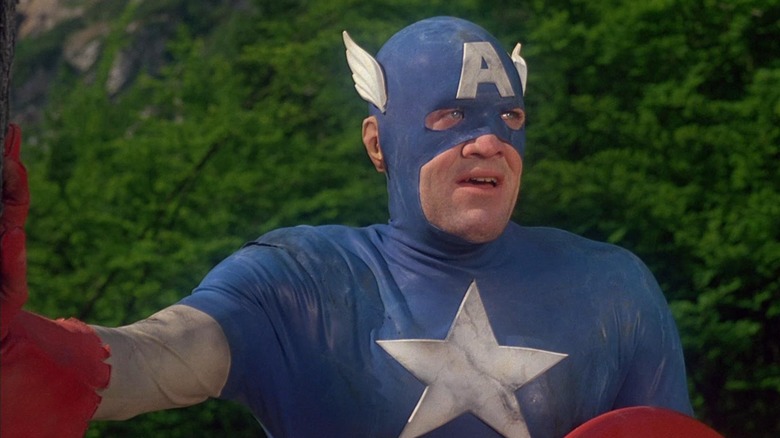
      Yup, today we’re talking about 1990’s “Captain America,” the $3-million feature directed by late B-movie legend Albert Pyun. Although the film was conceived as a theatrical release, those plans changed when the production hit financial problems, leading to a direct-to-video rollout. A planned $40-million budget was canceled late in planning, dooming the project from the start. These days, the film is seen as little more than a hilarious curiosity, as well as an example of what horrible comic book films looked like before the 21st century.

      That said, a bit of renewed interest in the film has surfaced recently with the reveal of an alternate cut — one made public by filmmaker and film historian Justin Decloux. This cut, closer to Pyun’s original vision, is wildly different, but does it make “Captain America” any less of a mess? Let’s get into it.

      What happens in the 1990 Captain America movie?

      The official, video-release cut of “Captain America” is, in some ways, quite similar to the plot of the first couple MCU films. In other ways, of course, it’s wildly different and entirely baffling. The story begins during World War II with Steve Rogers (Matt Salinger) receiving his Super Soldier Serum — the same formula, as we learn, that was responsible for turning an innocent Italian child into the villainous Red Skull (Scott Paulin) via a series of fascist experiments. In the first act, Captain America journeys into enemy territory, battles Nazis, faces the Red Skull, and is defeated, ultimately being strapped to a rocket that’s fired at the White House. Through sheer strength, Steve manages to divert the rocket’s course, landing it in the Alaskan tundra where he’s frozen alive.

      That’s all just in the first 30 minutes.

      The rest of the movie takes place decades later after Steve thaws. The Red Skull remains at large, now leading a criminal organization responsible for, among other things, the assassinations of John F. Kennedy and Martin Luther King. (Yes, really.) The current President of the United States (Ronny Cox), who witnessed Cap’s heroic rocket diversion as a boy, is now in their sights, so Steve must fight his old foe again to save the President’s life. Along the way, there are some familiar plot points, including Steve meeting up with a wartime girlfriend who’s now married and grown old, him becoming romantically involved with her daughter (it’s a niece in the MCU, but still), and him constantly stealing other people’s cars by faking motion sickness, luring them outside, and then jumping in the driver’s seat and taking of.

      Okay, yeah, that last one is pretty much only in this movie.

      Captain America reflects where most superhero movies were in the ’90s

      While the plot of “Captain America” is pretty straightforward (if a bit of a mess), the execution is where it really stumbles. Costumes are home-made Halloween-level bad, the action scenes hilariously choreographed and nauseatingly edited, and the script is just ridiculous. I mean, Steve Rogers literally steals two different cars from two different, good-guy characters by pulling the same “I’m going to be sick” bit.

      Many of these issues clearly came from the budget being reduced dramatically at the last second, but even so, they aren’t too divergent from what most comic book movies looked like at the time. Tim Burton’s “Batman” had just come out the year before, bringing some big-budget, high-profile attention to the genre, and the Christopher Reeve “Superman” films obviously retained major cultural cache by the early ’90s, but Marvel hadn’t been able to find anywhere near the same level of success as DC.

      Alongside “Batman,” 1989 saw the release of a live-action, direct-to-video “Punisher” movie starring Dolph Lundgren. While that adaptation is also generally looked down on, it’s nevertheless become kind of a cult classic due in part admittedly to Lundgren’s outsized (pun intended) star status. It wasn’t until “Blade” in 1998 and “X-Men” in 2000 that Marvel really started to make itself a big-screen presence.

      An alternate cut of 1990’s Captain America has been making the rounds

      Albert Pyun’s “Captain America” has long been a curiosity for comic book fans and B-movie lovers, but it’s gained a renewed level of interest recently with the emergence of the director’s original cut. Revealed by filmmaker and film historian Justin Decloux through a Letterboxd review of the movie in December 2024, this alternate cut is much more experimental and less linear.

      Among other things, this version intercuts the World War II scenes throughout the “present day” portion of the film, paralleling different moments like the different fights between the Red Skull and Captain America. Steve Rogers’ nemesis also gets a more tragic portrayal, and the overall emotional arc is more thematically coherent, according to Decloux, who wrote a book on Pyun’s work and is friends with the late director’s wife. “I’m not saying this version is going to change everyone’s mind about the movie because, if anything, it double down on a lot of stuff people disliked,” Decloux wrote on Letterboxd. “But goddamit [sic], in his original cut you can see a genuine authorial intent guiding an impossible production, to the point that out of all of Albert’s films, it may be the most emotionally coherent!”

      Time will tell if we’ll ever see a proper release of Pyun’s original cut. If nothing else, it seems like a fun bit of superhero cinema history that would be great to have available. Captain America’s film history goes back way further than both the MCU and the 1990 film, with an even earlier pair of TV movies starring Reb Brown having aired in 1979. With a full release of this alternate cut of the 1990 movie, another version of Captain America’s onscreen history would be returned to the masses.


      Source link

      Splittown (2025) – Game details | Adventure Gamers

      0
      Splittown (2025) – Game details | Adventure Gamers


      Cold War has split the world in two, both figuratively and literally. The Great Divide spans across the globe with an impenetrable mess of concrete and barbed wire sandwiched between the two blocs. You are Leonard Nimby; a stone-faced former top agent of IM5, hot on the trail of a shrink gun stolen from you by a villainous mayoral candidate on the eve of a fateful election.

      Splittown is a point-and-click adventure game inspired by 90s classics such as Day of the Tentacle and Sam & Max Hit The Road. You’ll crack confounding puzzles, stuff improbable amounts of items in your pockets, and engage in humorous dialogue with a colorful cast of characters on an adventure that will push your wits to the limit.


      Source link

      Midnight Society Game Studio Closes Amid Financial Struggles

        0
        Midnight Society Game Studio Closes Amid Financial Struggles


        Midnight Society, the studio behind the game Deadrop, has confirmed its closure after facing financial difficulties and internal turmoil.

        The announcement came just days after employees were given a two-day notice that the company was shutting down. This closure follows the high-profile departure of co-founder Dr. Disrespect (Guy Beahm) in mid-2024 after allegations of inappropriate conduct.

        Although the studio had initially expressed confidence about continuing development and releasing Deadrop in 2025, the lack of funding and staff cuts ultimately led to its closure.

        Midnight Society Game Studio Closes Amid Financial Struggles Source: Midnight Society

        Why is Midnight Society closing down?

        Midnight Society’s closure is largely attributed to a lack of funding. The studio, which employed over 50 developers at its peak, struggled to secure sufficient resources to continue operations. In a post shared on X, Level Designer Brad Boice revealed that the team was given just two days’ notice before the shutdown.

        Earlier statements from co-founder Quinn Delhoyo had suggested that Deadrop was on track for a 2025 release, but staff reductions in September 2024 and the inability to secure more funding signaled deeper financial instability. Despite these challenges, the studio continued to work on the game until this recent closure announcement.

        The studio’s troubles were further compounded by the departure of Dr. Disrespect, who had been a key figure in promoting Deadrop. Beahm was dismissed from Midnight Society in June 2024 after allegations surfaced that he had inappropriate conversations with a minor. Although Beahm admitted to some of the claims, he later denied other allegations and revised his statements, which fueled controversy around his exit.

        The studio initially claimed that his departure was amicable, but it quickly became clear that his removal had disrupted both the studio’s internal dynamics and its public image.

        Midnight Society Game Studio Closes Amid Financial Struggles
        Midnight Society Game Studio Closes Amid Financial Struggles Source: Deadrop

        What’s next to Deadrop?

        Many believed that the game’s future was uncertain without Beahm’s involvement, and the subsequent closure of the studio has only reinforced these doubts.

        In the wake of the closure, Dr. Disrespect expressed frustration during a livestream, claiming that the situation had been poorly handled by the studio’s leadership and that the allegations against him were mishandled.

        The end of Midnight Society has left Deadrop’s future unclear, with no indications yet as to whether the game will continue under new leadership or if it will be abandoned altogether.


        Source link

        IoTeX Unveils 2025 Roadmap, Focusing On New Ecosystem Momentum Driven By DePIN And AI

        0
        IoTeX Unveils 2025 Roadmap, Focusing On New Ecosystem Momentum Driven By DePIN And AI


        In Brief

        IoTeX unveiled its 2025 roadmap, aiming to establish a platform that bridges AI with real-world data, expand in the US, and launch a DePIN + AI Assets Reserve.

        IoTeX Unveils 2025 Roadmap, Focusing On New Ecosystem Momentum Driven By DePIN And AI

        Provider of modular infrastructure for decentralized physical infrastructure network (DePIN) projects, IoTeX unveiled its roadmap for 2025, aiming to establish a platform that enables AI to interact with the physical world.

        The roadmap includes plans for the development of Physical AI and sentient AI agents. IoTeX intends to create an open yet flexible framework that supports the training and coordination of AI systems, utilizing verifiable, real-world data from DePIN devices.

        In 2025, IoTeX plans to further develop its modular DePIN infrastructure and introduce new systems that will facilitate innovation across the “Train,” “Model,” and “Automate” stages of the DePIN value chain. This will catalyze a new era of AI-driven applications that integrate real-world data with advanced AI technologies.

        IoTeX has already begun its 2025 initiatives with the beta launch of QuickSilver, an open-source framework that connects the power of large language models (LLMs) with DePIN to enable the creation of sophisticated AI applications like BinoAI. QuickSilver leverages DePIN devices as the “eyes and ears” of AI, allowing real-time data collection, contextual response, and physical-world interaction. 

        With the planned QuickSilver Testnet launch in Q1 2025, DePIN and AI developers will be able to bridge existing DePIN infrastructures with emerging AI technologies, giving rise to a new generation of sentient AI applications. Projects using QuickSilver will also seamlessly deploy tokens across Solana, Ethereum, and IoTeX L1, with native integration into depinscan.io.

        IoTeX To Expand US Presence, Establish DePIN And AI Strategic Reserve, And Strengthen Community Development

        IoTeX also plans to expand its presence in the United States, forming partnerships with institutions and platforms such as Grayscale, Coinbase, Kraken, Robinhood, World Liberty Financial, and payment giants like PayPal and Venmo. These collaborations are aimed at increasing IOTX’s accessibility to a broader US audience via major exchanges and popular trading applications. Additionally, IoTeX is prioritizing partnerships with US-based DePIN projects, AI companies, and key players in infrastructure, telecommunications, automotive, and energy sectors. Strategic alliances with projects like Ripple, Hedera, Helium, Render, GeoDnet, and DIMO are expected to foster innovation, while its expansion into Solana, Ethereum, and Base will enable cross-chain DePIN networks. Furthermore, IoTeX is working to engage with the evolving regulatory landscape, having recently joined the Blockchain Association.

        In addition to these efforts, IoTeX plans to create its own strategic reserve, initially funded by Bitcoin (BTC), to strengthen and support the decentralized ecosystem. This reserve will act as a vault for valuable long-term tokens and assets, offering protection for IOTX holders. 

        IoTeX is also working to enhance community engagement across its Reddit, Discord, Telegram, and X channels. By embracing DAO-based governance, the platform allows users to actively participate in shaping its future. This involvement includes proposing ideas, voting on critical decisions, and contributing to the development of IoTeX. Additionally, the platform plans to introduce new educational programs and certification opportunities to further empower its community.

        IoTeX is a platform that merges blockchain technology with the Internet of Things (IoT) and smart devices. Its main focus is to provide fast, secure blockchain solutions that connect real-world data to decentralized applications (dApps). It is also dedicated to developing blockchain-powered devices, such as home security cameras and cellular-IoT prototyping platforms, to drive innovation and practical use of IoT technology.

        Disclaimer

        In line with the Trust Project guidelines, please note that the information provided on this page is not intended to be and should not be interpreted as legal, tax, investment, financial, or any other form of advice. It is important to only invest what you can afford to lose and to seek independent financial advice if you have any doubts. For further information, we suggest referring to the terms and conditions as well as the help and support pages provided by the issuer or advertiser. MetaversePost is committed to accurate, unbiased reporting, but market conditions are subject to change without notice.

        About The Author


        Alisa, a dedicated journalist at the MPost, specializes in cryptocurrency, zero-knowledge proofs, investments, and the expansive realm of Web3. With a keen eye for emerging trends and technologies, she delivers comprehensive coverage to inform and engage readers in the ever-evolving landscape of digital finance.

        More articles


        Alisa Davidson


        Alisa, a dedicated journalist at the MPost, specializes in cryptocurrency, zero-knowledge proofs, investments, and the expansive realm of Web3. With a keen eye for emerging trends and technologies, she delivers comprehensive coverage to inform and engage readers in the ever-evolving landscape of digital finance.


        More articles


        Source link

        Irreducible Secures a Game-Changing $24 Million Series A to Transform Verifiable Internet Infrastructure – Web3oclock

        0
        Irreducible Secures a Game-Changing  Million Series A to Transform Verifiable Internet Infrastructure – Web3oclock


        Source link

        Top NFT Collections – February 3, 2025

        0
        Top NFT Collections – February 3, 2025


        Top NFT Collections (Last 24h)

        Here are the hottest NFT Collections of the day.

        Rank

        Name
        Volume
        Transactions
        Chains
        URL

        1

        Pudgy Penguins
        1,176.29 ETH
        117
        ethereum
        View

        2
        Lil Pudgys
        Lil Pudgys
        407.85 ETH
        406
        ethereum
        View

        3
        Azuki
        Azuki
        366.94 ETH
        112
        ethereum
        View

        4
        Bored Ape Yacht Club
        Bored Ape Yacht Club
        396.90 ETH
        32
        ethereum
        View

        5
        Milady Maker
        Milady Maker
        258.57 ETH
        57
        ethereum
        View

        6
        Doodles
        Doodles
        237.74 ETH
        64
        ethereum
        View

        7
        CryptoPunks
        CryptoPunks
        240.47 ETH
        6
        ethereum
        View

        8
        Mutant Ape Yacht Club
        Mutant Ape Yacht Club
        148.49 ETH
        73
        ethereum
        View

        9
        Kaito Genesis
        Kaito Genesis
        144.07 ETH
        27
        ethereum
        View

        10
        Azuki Elementals
        Azuki Elementals
        128.17 ETH
        352
        ethereum
        View


        Source link

        Fashion As Sculpture, Engineering & Architecture – University of Fashion Blog

        0
        Fashion As Sculpture, Engineering & Architecture – University of Fashion Blog


        Did you watch the recent haute couture shows? Did it make you think, wow, how did they make that? This couture season especially reminded me of just how much engineering goes into garment design and construction. Want proof? Check out Daniel Roseberry’s collection for Schiaparelli, it was a brilliant combination of both engineering & architecture as he created wearable fashion sculpture.

        I couldn’t help but think that Elsa was looking down on Roseberry’s show from fashion heaven and smiling. After all, in her day, Elsa Schiaparelli was a risk taker (watch this YouTube on her life). Think surrealist sleeves, lobster dress, exposed zippers in couture, the shoe hat, and her Shocking perfume bottle inspired by Mae West’s figure.

        Italian fashion designer, Elsa Schiaparelli (1890-1973) creator of the surreal sleeve, the shoe hat, and her Shocking perfume bottle inspired by Mae West’s figure. (Image credits: Pinterest.com)

        Fashion Engineering & Architecture

        Support Materials

        Padded dresses by Daniel Roseberry for Schiaparelli

        Daniel Roseberry’s Spring 2025 Haute Couture Collection and his use of underlinings & support materials. (Image credit: Vogue.com)

        If you’ve been designing for a while, as I have, and are a lover of the garment construction process, then you were probably in awe of Daniel Roseberry’s latest couture collection and his use of support materials to create stiff flares and invisible padding that shaped the hips of his dresses.

        There are many different of types of materials from which to choose to create these looks. In our lesson entitled, Interfacings, Underlinings, Interlinings & Linings, we teach the difference between an interlining and an underlining, when and where to use them and the various types available.
        Wire & Boning

        Daniel Roseberry’s Spring 2025 Haute Couture Collection and his use of structure to create half dome-like structures. (Image Credit: Vogue.com)

        I just loved Roseberry’s combination of structure and softness in his dresses. He made great use of wire and boning to create half dome-like dresses with tulle skirts. The airiness of a tulle skirt paired with the structure of a bustier resulted in a very dramatic Red Carpet effect.

        To learn more about bustier design & construction, view our lessons, Bustier Bodice, and Foundation Bustier Construction Techniques. In addition to learning how to drape a bustier, you will also learn about the various tools & supplies used to construct a bustier, such as how to stabilize the edges and how to bone, press and line a bustier.
        Fabric Sculpture

        Daniel Roseberry's collection of dresses for Couure 2025

        Daniel Roseberry’s Spring 2025 Haute Couture Collection and his mastery at creating fabric sculpture dresses. (Image credit: Vogue.com)

        If you are a technical skills nerd like me, then your jaw dropped when you saw Roseberry turn fabric into sculpture. For example, look at the far left image above, he combined a sculpted jacket foundation with a carefully engineered bias-fluted yoke with pleats. Looking to learn how to create those bias-fluted pleats? Watch our lesson,  Creative Draping: The Art of Fluting, to learn how to mold bias into just about any shape.

        Our Creative Draping: The Art of Ruching lesson teaches how to create the look of the dress second from left above. And for the asymmetric ruffle dress to its right, watch our lesson, Draping a Cascade Ruffle Dress, which teaches how to draft circular fabric pieces and then how to drape them to cascade onto a dress foundation. And, to learn techniques on how to draft & drape ruffles, as pictured in the dress on the far right, view our lesson, Draping & Drafting a Multi-Tiered Dress.

        Congratulations to Daniel Roseberry for a masterful haute couture collection for Schiaparelli!


        Source link

        Popular Posts

        My Favorites

        Blake Lively Hit With $6 Million Defamation Lawsuit From Justin Baldoni’s...

        0
        Reading Time: 3 minutes Another shot has been fired in the ongoing Blake Lively-Justin Baldoni legal battle. A PR firm representing Baldoni has...