Danny Jones wife Georgia has hinted at trouble “behind closed doors” before Maura Higgins BRITs scandal.
On March 1 at the BRITs after-party married dad Danny Jones shared a “drunken kiss” with fellow I’m A Celeb pal Maura Higgins.
Danny’s wife Georgia, temporarily moved out of their home after the news, but it’s believed she has returned and they are working through the situation.
Georgia didn’t post for Danny on Valentine’s Day this year (Credit: ITV)
Danny Jones wife reveals social media struggles in marriage
After the video got released, Danny Jones wife Georgia took a step back from her public appearances and also took time out from her Mum’s The Word podcast which she co-hosts with Kelsey Parker.
But Georgia appears in today’s episode (April 7), which was filmed on Valentines Day – two weeks before the BRITs scandal. And Georgia hinted that there may have been trouble brewing already.
Speaking alongside her guests, Georgia admitted: “That’s the thing with social media. You can make it look like you are having a whale of a time. Then behind closed doors it might be a completely different story.
“It’s like today, we’re recording this on Valentine’s Day, and I am seeing all these Valentine’s Day posts. I’m like ‘Are you actually that happy? Are you sure?’”
Georgia’s admission comes as she didn’t actually make a post on her own social media account for Danny, unlike previous years.
Last year she posted a photo of Danny and their son, Cooper, with the caption: “HVD boys.” And she had consistently posted years before that too.
Georgia’s guest went on to explain that there is actually new research that suggests it’s those who post “more”, the “less in love” they actually are.
Georgia and Danny have been working through the scandal (Credit: SplashNews.com)
Danny and Georgia spend weekend apart
The news comes as both Danny Jones and his wife appeared to spend the weekend apart.
Georgia has been slowly making her return to social media, but Danny has posted for the first time since his apology.
Over the weekend Georgia posted photos on her Instagram stories of their son, Cooper. But Danny appeared to be on a motorbike getaway with McFly bandmate Dougie Poynter.
He shared a series of images, with the caption: “Hope you all had a great weekend.” And fans were quick to welcome him back to social media.
One wrote: “So glad you’re back. We have missed you king.”
Another penned: “Hope you are okay, Danny.”
Despite the BRITs scandal, Danny and Georgia appear to still be together. This morning Georgia posted a close-up selfie on her Instagram story which showcased her sparkling wedding rings on her finger.
Read more: Fears over future of McFly as Danny Jones kiss scandal ‘threatens’ Tom Fletcher’s ‘wholesome family image’
What do you think of Danny Jones wife Georgia’s admission? Let us know by leaving a comment on our Facebook page @EntertainmentDailyFix.
Published: April 07, 2025 at 6:47 am Updated: April 07, 2025 at 6:47 am
by Ana
Edited and fact-checked:
April 07, 2025 at 6:47 am
To improve your local-language experience, sometimes we employ an auto-translation plugin. Please note auto-translation may not be accurate, so read original article for precise information.
In Brief
CoinShares has reported that digital asset investment products experienced outflows of $240 million over the past week, likely driven by concerns over US trade tariffs and their potential impact on economic growth.
European alternative asset manager specializing in digital assets, CoinShares released its latest report showing that digital asset investment products experienced outflows of $240 million over the past week, likely due to concerns about US trade tariffs and their potential impact on economic growth.
However, despite these outflows, the total assets under management remained stable at $132.6 billion, reflecting a modest 0.8% increase from the previous week. This stability stands in contrast to other asset classes, such as MSCI World equities, which saw a considerable 8.5% decline during the same period, highlighting the resilience of digital assets amidst broader economic uncertainty.
Regionally, the negative sentiment was widespread, with the US and Germany experiencing the largest outflows of $210 million and $17.7 million, respectively. However, Canadian investors viewed the recent market downturn as an opportunity to increase their positions, resulting in inflows of $4.8 million.
Most of the outflows were from Bitcoin, which saw $207 million in withdrawals, leaving the total year-to-date inflows at $1.3 billion.
The flows for altcoins were more varied, with Ethereum experiencing outflows of $37.7 million, while Solana and Sui saw outflows of $1.8 million and $4.7 million, respectively. On the other hand, smaller, more niche tokens, such as Toncoin, saw inflows of $1.1 million.
Blockchain equities also saw positive movement for the second week in a row, with inflows totaling $8 million as investors took advantage of recent price weaknesses as a buying opportunity.
Bitcoin Price Fluctuates Amid Global Economic Uncertainty, Declines By 6.28% Over the Week
Over the past week, Bitcoin’s price has been subject to fluctuations, influenced by various global economic factors. On April 1st, Bitcoin was valued at around $82,500. By April 4th, after briefly surging to $87,000, its price dropped back to the $82,000 range, amid ongoing global trade tensions and market uncertainty.
As of the current writing, Bitcoin is trading at approximately $76,357, reflecting a 6.28% decline over the week, based on data from CoinMarketCap. This decline was exacerbated by rising concerns regarding the implementation of tariffs on April 2nd, which contributed to Bitcoin’s extended losses.
Disclaimer
In line with the Trust Project guidelines, please note that the information provided on this page is not intended to be and should not be interpreted as legal, tax, investment, financial, or any other form of advice. It is important to only invest what you can afford to lose and to seek independent financial advice if you have any doubts. For further information, we suggest referring to the terms and conditions as well as the help and support pages provided by the issuer or advertiser. MetaversePost is committed to accurate, unbiased reporting, but market conditions are subject to change without notice.
About The Author
Alisa, a dedicated journalist at the MPost, specializes in cryptocurrency, zero-knowledge proofs, investments, and the expansive realm of Web3. With a keen eye for emerging trends and technologies, she delivers comprehensive coverage to inform and engage readers in the ever-evolving landscape of digital finance.
More articles
Alisa Davidson
Alisa, a dedicated journalist at the MPost, specializes in cryptocurrency, zero-knowledge proofs, investments, and the expansive realm of Web3. With a keen eye for emerging trends and technologies, she delivers comprehensive coverage to inform and engage readers in the ever-evolving landscape of digital finance.
SandboxAQ, a Palo Alto-based enterprise AI and quantum technology company, has raised an additional $150 million in Series E funding, pushing its total raised in this round to over $450 million and cumulative funding to $950 million. The latest investment values the company at an impressive $5.75 billion.
Backed by Industry Giants:
This latest capital infusion attracted heavyweight investors, including Google, NVIDIA, BNP Paribas, Ray Dalio, and Horizon Kinetics—a strong vote of confidence in the company’s mission to lead the next wave of AI and quantum innovation.
Fueling the Future of Advanced Computing:
The fresh funding will be used to:
Accelerate development of its Large Quantitative Models (LQMs).
Expand its AI platforms across key verticals such as life sciences, finance, and cybersecurity.
Boost R&D and deepen strategic partnerships.
SandboxAQ’s LQMs are designed to tackle high-performance computing challenges, enabling real-time decision-making through advanced numerical data analysis and statistical modeling.
A Leader in Quantum-Driven AI:
Led by CEO Jack Hidary, SandboxAQ emerged as a spin-off from Alphabet and has quickly become a frontrunner in blending quantum tech with AI to address complex enterprise problems. The company’s innovations are reshaping fields ranging from drug discovery and molecular simulation to post-quantum cryptography.
As the convergence of quantum and AI continues to gain momentum, SandboxAQ’s latest funding positions it to play a transformative role in the evolution of enterprise technology.
Funding Details:
Category: Enterprise AI / Quantitative Tech
Amount Raised: $150M
Round: Series E
Date: April 2025
Key Investors: Google, NVIDIA, BNP Paribas, Ray Dalio, Horizon Kinetics
Website: sandboxaq.com
For more insights and updates on Metaverse, DeFi, Blockchain, NFT & Web3, be sure to subscribe to our newsletter. Stay informed on the latest trends and developments in the decentralized world.
P2P.me, a groundbreaking crypto-to-fiat application designed to simplify digital payments, has successfully secured $2 million in seed funding from leading investors including Multicoin Capital and Coinbase Ventures. The funding marks a major milestone for the platform as it gears up to expand its innovative solution to regions heavily reliant on QR-based transactions.
Driving Crypto Adoption Through Seamless Fiat Integration:
Despite the growing adoption of cryptocurrencies, one major roadblock remains—most vendors still prefer receiving payments in fiat currency. This challenge is especially evident in emerging markets where QR code payments are widely used but crypto adoption among merchants remains limited.
P2P.me tackles this problem head-on by offering a peer-to-peer model that bridges the gap between stablecoin holders and fiat-only vendors. The app enables users to initiate payments in USDC, a widely used U.S. dollar-pegged stablecoin. A decentralized network of intermediaries then accepts the USDC and instantly transfers the equivalent fiat amount to the recipient. The entire transaction is typically completed in just 90 seconds—making it one of the fastest crypto-to-fiat solutions available.
What sets P2P.me apart is its privacy-centric approach to user verification. The platform employs zero-knowledge proofs, an advanced cryptographic method that verifies a user’s identity without storing sensitive personal data. Instead, it evaluates the authenticity of a user’s social media footprint and, when necessary, verifies government-issued IDs—all without compromising user privacy.
This ensures a high level of trust and compliance while protecting users’ data, aligning with the growing demand for privacy-preserving technologies in the Web3 ecosystem.
A Community-Centric Vision and Global Expansion Plans:
Built on the Base blockchain, P2P.me is not only focused on scaling its operations but also on transitioning toward a community-led governance model. The company has announced plans to launch a native token within the next year, aiming to decentralize ownership and empower users to shape the platform’s future.
To date, P2P.me has processed over $1.6 million in transactions across Indonesia, Nigeria, and Vietnam—regions where QR-based fiat payments are prevalent. With the latest funding, the company is now targeting expansion into Latin America, a market ripe for crypto adoption and in need of seamless fiat integration.
Redefining the Future of Everyday Crypto Payments:
P2P.me’s innovative solution arrives at a crucial time as the crypto industry seeks to build real-world use cases that go beyond speculation and investment. By making it possible for users to pay with crypto while merchants still receive fiat, P2P.me unlocks a new layer of utility for stablecoins and crypto wallets.
The platform’s ability to embed crypto into everyday financial interactions without disrupting existing fiat ecosystems is a powerful step toward broader Web3 adoption. It simplifies onboarding for users, minimizes friction for vendors, and supports financial inclusion in underbanked regions.
Final Thoughts:
With strong backing from some of the industry’s most respected investors, including Multicoin Capital and Coinbase Ventures, P2P.me is well-positioned to reshape how the world uses crypto in real life. By solving one of the industry’s most persistent challenges—crypto-to-fiat conversion in practical, everyday scenarios—P2P.me is bringing us closer to a world where digital currencies are truly usable anywhere.
For more insights and updates on Metaverse, DeFi, Blockchain, NFT & Web3, be sure to subscribe to our newsletter. Stay informed on the latest trends and developments in the decentralized world.
You may think that the farming genre of gaming is a bit niche. But whilst that may be true, it’s also a bit big. In fact, it’s massive, breaking out of the confines of PC a good few years ago to sow and seed on console. We may not be the biggest fans of the genre, but we fully understand the draw that it has, especially across the Farming Simulator games.
It’s that genre with which Thrustmaster are muscling in on, after plying their trade across racers with a variety of steering wheels, and flight sims with the T.Flight Full Kit X and TCA Sidestick X Airbus Edition. They got their wellies dirty with the release of the FarmStick on PC a year or so ago, and are now hoping to tempt in Xbox players with the Thrustmaster SimTask FarmStick X.
The Thrustmaster SimTask FarmStick X
If you’re a fan of farm life, but need something to help you plow your way to glory in an all-encompassing way, this is a controller that could well feel a bit of a necessity.
Design and Features of the FarmStick X
It comes as no surprise to see that the FarmStick X looks very much like a flight stick. It feels like one in hand too, and so you’ll want to come to this in the knowledge that it is about as far removed from a standard Xbox controller as you are likely to get.
But what is included is a ton, and I mean a TON, of buttonry, features, gadgets and more. We’d go as far to say that initial use is a little overwhelming, due to the sheer number of buttons that are present. We counted them so you don’t have to – 33, if you include the little switch which allows this to be used on Xbox or over on PC. Of course, you’ve also got the stick too.
That’s a lot to get to grips with, but if you’ve played anything like Farming Simulator 25 or the plethora of other games that see you heading to the fields and getting dirty, you’ll understand that many of those are required.
Of course, an Xbox Nexus button is front and centre of the kit, flanked by both a Menu and View, accompanying the now-standard Share button. Face buttons are also in place, diamond in design and hugely oversized. They sit just to the right of the ‘stick’ part of the FarmStick X, along the base, well within reach of any required press. Across on the other side are four direction pads, with B01 through to B04 also present.
Everything you need…
A small throttle sits on the left of the base, bright orange in style, ensuring that you can power your way through fields like there is no tomorrow.
And then we move onto the stick itself. It’s here where a ton of extra buttons suitable for the joys of farming life are found, with camera controls, both ‘Driving’ and ‘Working’ options and a ton more sitting pretty right underneath your thumb, with two further buttons hiding under your trigger finger. Whether it be a switch, a dial, or a knob, each and every press of the equipment on the FarmStick X feels solid and well defined, with the ergonomics of the stick itself of the very highest standard.
Feel and Feedback: Ergonomics and Button Quality of the FarmStick X
Whilst the buttons on the base of the FarmStick X are solid in design, those integrated onto the stick itself are soft-touch, and feel great. We just wish the thumb-utilised mini-stick that is atop the main stick was coated similarly. It’s fine and all, slightly concave, but there is some slip to it. In the heat of a farming day, that’s not totally ideal.
That stick twists and spins with aplomb too, running three directional axes that in turn include two that are complete with H.E.A.R.T (HallEffect AccuRate Technology) magnetic sensors. We’ve used those on the Thrustmaster HEART Controller in recent months, and would expect everything included here to last well into the long term.
Setting Up Your Farm
It’s all pretty easy to connect up too, although if you’re going big with what Thrustmaster provide then expect to be treated to a plethora of cables.
In the box, the FarmStick X comes with a USB-A to USB-C cable to hand, ensuring it is pretty much plug and play out of the box. But then, include other peripherals, and you’ll also want to make the most of the Din9 and TFRP ports. Thankfully it’s all hidden away at the back of the controller, but much like any piece of dedicated kit, you will need to ensure you have space for a compatible set-up.
Plus a whole lot more.
Xbox and PC: Platform Limitations and Expansive Setups
Downsides? Well, the SimTask FarmStick X on Xbox seems to only be compatible with an Xbox Series X|S console, and – currently at least – for play with Farming Simulator 25; we’ve tried it with Farming Sim 22 through Game Pass, but to no avail. And if you want to run it over to PC, the options open up considerably, but perhaps that is something which is par for the course in the gaming sphere; you know, us console folk being behind the times.
We would also personally prefer suction pads on the bottom of the stick as while the eight included rubber pads are fine, a bit more stability when farming would be much more preferable.
Further to that, to make full use of what Thrustmaster are offering up, you’ll need a wheel too – the T128 Wheel or T248 Wheel for instance – with an additional SimTask Steering Kit then attached to create more of a farming feel. Consider that if you have a wheel, you probably also have some pedals, and maybe the TH8S Shifter, as well, then things start to spiral.
That’s a big old outlay and does mean that the FarmStick and SimTask kits that are in place will only really be suitable for those veterans of the farming genre. Of course, if that’s you, then splashing a good couple of hundred quid on some new kit may well feel worthwhile.
The SimTask Steering Kit: A Deep Dive into Immersive Farming
A little word on that SimTask Steering Kit, and don’t expect this to be something you’ll set up every time you want to play. For us, it’s a complex piece of equipment, full of multiple pieces of metal and screws that would be best setting up for long term use. If you’ve got the space, and can commit to a full long-term run, it very much does what it says on the tin, switching up your usual racing wheels for a flatter, more heavy cargo driving experience. It works by clamping into place on a desk system, with Thrustmaster stating it can handle anything between 15-50mm in depth.
A controller with connectivity
Compatible with both the T128 and T248 wheels, our very favourite bit of the SimTask Steering Kit is a little spinning knob that attaches to the wheel, aiding the immersion ever more; you’ll know exactly why that is useful if you have any interest in the long-haul or heavy-driving worlds. There’s plenty of adjustment included in that kit too, so setting it up for your own desires should be well within reach.
A Well-Crafted Controller for Dedicated Farmers
Price and costs aside though, we can’t help but feel that Thrustmaster have, once again, absolutely nailed what is required of a niche gaming controller; one set-up with a primary goal and use in mind. The Thrustmaster SimTask FarmStick X Controller really is a well crafted, well created, well designed controller that feels great in hand, more than capable of taking your farming experiences to the next level.
Consider yourself at one with the farm, and Thrustmaster’s SimTask FarmStick X Controller for Xbox and PC is about as good a piece of kit as you are likely to find.
Buy For Yourself
Huge thanks go out to Thrustmaster for providing the SimTask FarmStick X controller, as well as the SimTask Kit for review purposes.
Hit them up direct to grab a unit for yourself. The Thrustmaster SimTask FarmStick X Controller will cost you around £99.99, whilst the SimTask Steering Kit is another £69.99. But of course, you’ll need a wheel too!
AI Revolution in the Frontend Developer’s Workshop
In today’s world, programming without AI support means giving up a powerful tool that radically increases a developer’s productivity and efficiency. For the modern developer, AI in frontend automation is not just a curiosity, but a key tool that enhances productivity. From automatically generating components, to refactoring, and testing – AI tools are fundamentally changing our daily work, allowing us to focus on the creative aspects of programming instead of the tedious task of writing repetitive code. In this article, I will show how these tools are most commonly used to work faster, smarter, and with greater satisfaction.
This post kicks off a series dedicated to the use of AI in frontend automation, where we will analyze and discuss specific tools, techniques, and practical use cases of AI that help developers in their everyday tasks.
AI in Frontend Automation – How It Helps with Code Refactoring
One of the most common uses of AI is improving code quality and finding errors. These tools can analyze code and suggest optimizations. As a result, we will be able to write code much faster and significantly reduce the risk of human error.
How AI Saves Us from Frustrating Bugs
Imagine this situation: you spend hours debugging an application, not understanding why data isn’t being fetched. Everything seems correct, the syntax is fine, yet something isn’t working. Often, the problem lies in small details that are hard to catch when reviewing the code.
At first glance, the code looks correct. However, upon running it, no data is retrieved. Why? There’s a typo in the URL – “htts” instead of “https.” This is a classic example of an error that could cost a developer hours of frustrating debugging.
When we ask AI to refactor this code, not only will we receive a more readable version using newer patterns (async/await), but also – and most importantly – AI will automatically detect and fix the typo in the URL:
How AI in Frontend Automation Speeds Up UI Creation
One of the most obvious applications of AI in frontend development is generating UI components. Tools like GitHub Copilot, ChatGPT, or Claude can generate component code based on a short description or an image provided to them.
With these tools, we can create complex user interfaces in just a few seconds. Generating a complete, functional UI component often takes less than a minute. Furthermore, the generated code is typically error-free, includes appropriate animations, and is fully responsive, adapting to different screen sizes. It is important to describe exactly what we expect.
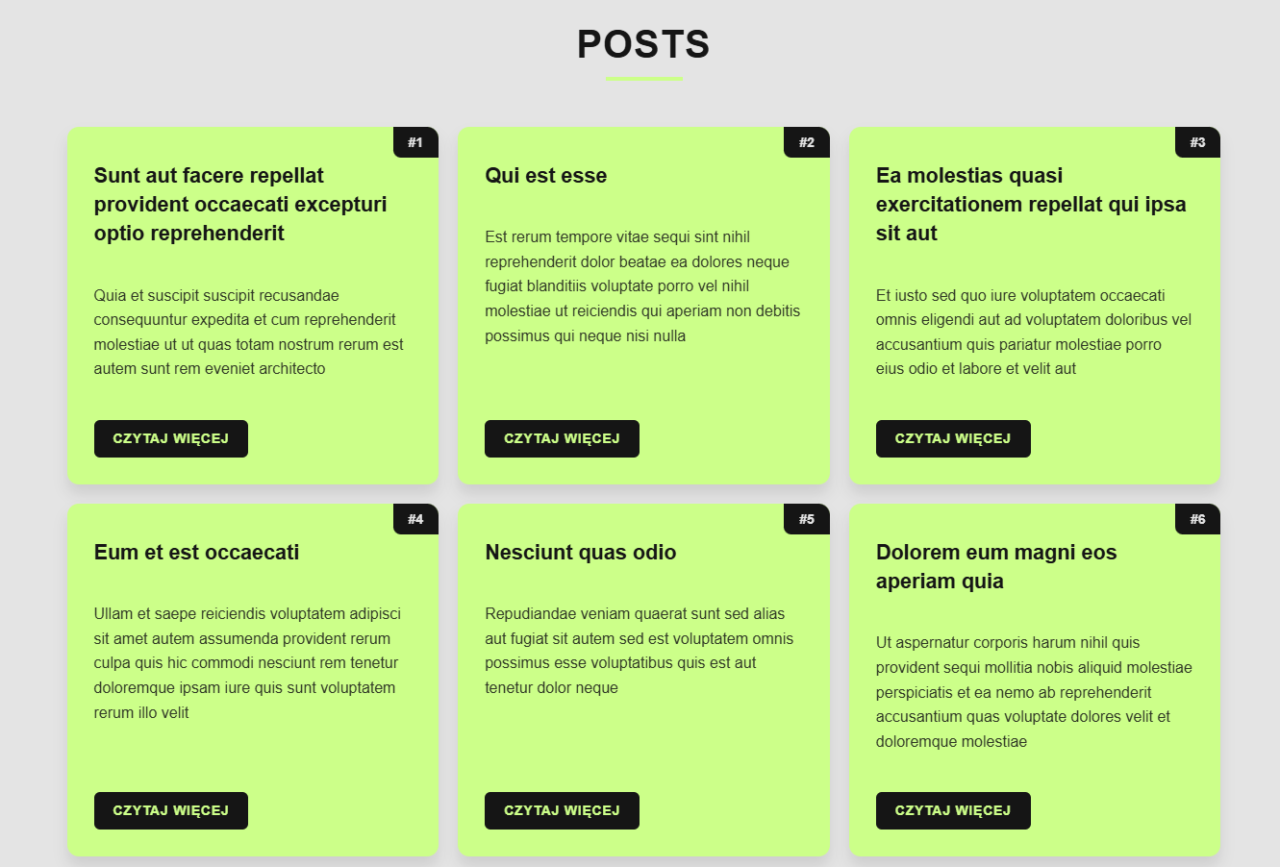
Here’s a view generated by Claude after entering the request: “Based on the loaded data, display posts. The page should be responsive. The main colors are: #CCFF89, #151515, and #E4E4E4.”
AI in Code Analysis and Understanding
AI can analyze existing code and help understand it, which is particularly useful in large, complex projects or code written by someone else.
Example: Generating a summary of a function’s behavior
Let’s assume we have a function for processing user data, the workings of which we don’t understand at first glance. AI can analyze the code and generate a readable explanation:
function processUserData(users) {
return users
.filter(user => user.isActive) // Checks the `isActive` value for each user and keeps only the objects where `isActive` is true
.map(user => ({
id: user.id, // Retrieves the `id` value from each user object
name: `${user.firstName} ${user.lastName}`, // Creates a new string by combining `firstName` and `lastName`
email: user.email.toLowerCase(), // Converts the email address to lowercase
}));
}
In this case, AI not only summarizes the code’s functionality but also breaks down individual operations into easier-to-understand segments.
AI in Frontend Automation – Translations and Error Detection
Every frontend developer knows that programming isn’t just about creatively building interfaces—it also involves many repetitive, tedious tasks. One of these is implementing translations for multilingual applications (i18n). Adding translations for each key in JSON files and then verifying them can be time-consuming and error-prone.
However, AI can significantly speed up this process. Using ChatGPT, DeepSeek, or Claude allows for automatic generation of translations for the user interface, as well as detecting linguistic and stylistic errors.
Example:
We have a translation file in JSON format:
{
“welcome_message”: “Welcome to our application!”,
“logout_button”: “Log out”,
“error_message”: “Something went wrong. Please try again later.”
}
AI can automatically generate its Polish version:
{
“welcome_message”: “Witaj w naszej aplikacji!”,
“logout_button”: “Wyloguj się”,
“error_message”: “Coś poszło nie tak. Spróbuj ponownie później.”
}
Moreover, AI can detect spelling errors or inconsistencies in translations. For example, if one part of the application uses “Log out” and another says “Exit,” AI can suggest unifying the terminology.
This type of automation not only saves time but also minimizes the risk of human errors. And this is just one example – AI also assists in generating documentation, writing tests, and optimizing performance, which we will discuss in upcoming articles.
Summary
Artificial intelligence is transforming the way frontend developers work daily. From generating components and refactoring code to detecting errors, automating testing, and documentation—AI significantly accelerates and streamlines the development process. Without these tools, we would lose a lot of valuable time, which we certainly want to avoid.
In the next parts of this series, we will cover topics such as:
This post contains spoilers for “The White Lotus” season 3.
The biggest surprise in “Amor Fati,” the season 3 finale of “The White Lotus,” is also its silliest: the long-suffering Timothy Ratcliffe (Jason Isaacs) decides to murder his family by blending up some poisonous fruit seeds into four piña coladas. He gives the deadly drink to his wife Victoria, his oldest son Saxon, his daughter Piper, and himself. Absent from his list of victims is his youngest son, Lochlan (Sam Nivola), the only member of Tim’s family to say he thinks he can handle a life without wealth. Of course, if the other family members knew the full context when Tim asked them about the topic, I doubt they would’ve answered so flippantly.
Advertisement
The good news: Tim has second thoughts about this plan. He smacks the drink out of Saxon’s hand and dumps the other drinks down the drain. The bad news: Tim forgets to clean the blender before going to bed, leaving it open all night for an unsuspecting Lochlan to poison himself with it in the morning. In Tim’s defense, your honor, he was high on Lorazepam at the time he did all this. Plus, he likely assumed the next person to use the blender would clean it before they blended anything else.
But just as Lochlan doesn’t know that you’re not supposed to jerk off your brother, he also doesn’t know that you’re supposed to rinse out the blender before using it. So he makes himself one of those protein shakes his brother kept pushing on him, ends up ingesting some of those suicide seeds, then goes off and dies by the pool. To make things worse, Tim wakes up and finds his son’s body. He’s hit with the realization that he’s accidentally killed the one son he tried to keep safe last night, and he doesn’t even have any Lorazepam left to numb the pain.
Advertisement
False alarm! Turns out Lochlan didn’t actually die
HBO
As poor Tim is cradling his son’s lifeless body, there are a few minutes where it feels like the show has gotten insanely dark, especially by the standards of previous seasons’ finales. The reveal that there’s another death outside the ones implied by the season’s cold open is shocking, and I was impressed by the show’s willingness to truly go there. There’s something poetic about Tim killing the only member of his family who isn’t addicted to wealth — although let’s be real, Lochlan’s just as spoiled as the rest of them.
Advertisement
But don’t worry: Lochlan wakes up. He still feels like trash for the rest of the episode, but it appears the amount of poisonous seeds he ingested hadn’t quite crossed the lethal threshold. This may seem like a cop-out on the part of the show — and to be clear, it 100% is — but at least it offers the show the chance to get real spiritual. While Lochlan’s dying, he envisions himself trapped underwater as four mysterious figures look down at him from the surface. It’s not ominous, though; it feels both otherworldly and oddly calming. When Lochlan regains consciousness, he says he thinks he saw God, and hey, maybe he did.
It’s a fun callback to a conversation Lochlan had with Piper in the season’s second episode, “Special Treatments.” There, Lochlan doubts if Piper had actually felt a spiritual presence, wondering if perhaps she imagined it. Now the tables have turned: Piper has decided against spending a year in Thailand on a spiritual quest to find herself, while Lochlan has had a real spiritual experience that might stick with him for the rest of his life.
Advertisement
Why the storyline works, despite its flaws
HBO
The best part of Lochlan’s near-death experience is how much of it was foreshadowed from the very start of the season. Not only does it pay off the Piper scene in the second episode, but it also pays off that funny scene in the first episode where Pam tells the family all about how the fruits outside their house have extremely poisonous seeds. It’s the most obvious smoking gun in the world, but most viewers forgot about it after six episodes with no mention.
Advertisement
Most importantly, Lochlan’s near-death by protein shake serves as a fitting conclusion to the character’s identity crisis. Lochlan’s spent the season pulled back and forth between his two siblings’ philosophies on life; he could choose the toxic alpha male route like his brother Saxon, or he could pick the quiet, spiritual route like his sister Piper. At the start of the finale, Piper shuts down the spiritual route for him by telling him not to follow her to the monastery. This pushes Lochlan back towards Saxon’s way of life, except Saxon (still traumatized by Lochlan’s handjob from a few episodes back) tells him he has to pick his own path.
Lochlan doesn’t quite seem to hear Saxon’s advice though, which might be why he starts the next day by making a protein shake even though he hates the taste. The fact that he’s almost murdered by this protein shake, the symbol of all things Saxon, sparks Lochlan’s realization that he really does need to be his own man.
Advertisement
We don’t know what’ll happen to Lochlan going forward. Will he figure out that it was his dad who nearly killed him? Will he handle the loss of his family’s wealth as well as he claimed he could? The only clear takeaway from the finale is that he’ll be dealing with these problems as himself, not as an imitation of one of his siblings. Compared to the resolutions some of the other characters got this season, Lochlan’s character arc ended on a pretty optimistic note.
If you’ve ever tried to explain NFTs to someone who’s never touched crypto, you know it can feel a bit like teaching your parents how to use a smartphone for the first time. It’s a fresh, fascinating technology—but not everyone understands it right away. In fact, many people are still unsure how to buy, store, or even interact with digital assets. That’s exactly why crafting a user-friendly onboarding process is critical for your NFT project’s success.
Below, you’ll find a step-by-step approach to help non-crypto users embrace your NFT project with confidence. By combining education, simplicity and support you can remove barriers to entry and onboard users from day one.
1. Start with the Basics: Why NFTs?
Before diving into the technical details, it’s important to clarify why someone should care about NFTs in the first place. People outside the crypto realm may see headlines about digital art selling for millions of dollars but still feel puzzled about their real-world value.
Explain their purpose: Show how NFTs can represent ownership, collectibles, community membership, or even event tickets.
Offer relatable examples: If you’re targeting sports fans, show how NFTs can unlock exclusive fan experiences or merchandise. If you’re building an art platform, show how artists can earn royalties on secondary sales.
By painting a picture of the benefits and real-life use cases, you create genuine interest. Curiosity is often the first step in onboarding newcomers to a new technology.
2. Simplify the Wallet Setup
One of the biggest hurdles for non-crypto folks is setting up a digital wallet. Terms like “public key,” “seed phrase,” and “gas fees” can sound intimidating. To make the process straightforward:
Use intuitive wallet solutions: If your project allows for integration with user-friendly wallets like MetaMask or WalletConnect, provide direct links and tutorials.
Offer a guided setup: Walk users through each step with clear, non-technical language. Add pop-ups or tooltips that explain confusing terms in simple words.
Highlight security practices: Emphasize the importance of storing seed phrases offline, choosing strong passwords, and being cautious of phishing attempts.
Removing friction in wallet creation is crucial. When the setup process is hassle-free, newcomers feel more comfortable taking the next step: buying or minting an NFT.
3. Provide Multiple Payment Options
Crypto is second nature to enthusiasts, but the average person will be more comfortable with traditional payment methods. If possible, include credit card, PayPal or other mainstream payment options for buying your NFTs. This step dramatically reduces friction because non-crypto users don’t have to convert fiat to crypto before acquiring your digital collectibles.
If your platform can’t directly accept traditional payment methods, consider partnering with third-party services that simplify the conversion process. Being flexible with payments helps people focus on the excitement of owning an NFT rather than wrestling with the technicalities of crypto transactions.
4. Focus on User Education
Even if your platform is user-friendly, newcomers might still need guidance. Offer digestible tutorials or an FAQ section covering everything from “What is a blockchain?” to “How do I securely store my NFTs?” Consider creating:
Short video guides: Visual content is more engaging than text alone. A series of quick, step by step videos can be magic.
Blog posts and articles: Written guides that go into detail are valuable resources.
Community-driven learning: Encourage existing users to share tips and best practices. You could reward helpful community members with special NFTs or other perks.
The key here is to avoid overwhelming people. Remember, many newcomers have no idea what gas fees or smart contracts are. Keep explanations concise and friendly.
5. Make Your Platform Intuitive
A cluttered website or complicated navigation can alienate people who are already skeptical about NFTs. Design your NFT marketplace or platform with simplicity in mind:
Clear calls-to-action: Make it obvious where to click to buy, sell, or browse NFTs.
Straightforward language: Avoid heavy blockchain jargon. Think of how you’d explain your project to a friend over coffee.
Responsive design: Ensure that your platform looks and works great on both desktop and mobile. Many new users might access your site on their phones.
User experience can make or break an NFT project. If someone lands on your site and has to click through endless menus, they’ll likely give up before minting a single token.
6. Offer Personalized Support
When you’re new to any technology, it’s comforting to know there’s someone you can turn to for help. Providing real-time or near real-time support—be it via live chat, email, or an active Discord community—can help people troubleshoot and feel more at ease.
Live Chat: Integrate a chat widget so users can quickly get assistance if they’re stuck.
Discord or Telegram: Create a friendly space where members can ask questions, share experiences, and help each other out.
Personalized Onboarding Calls: For high-end or business oriented clients offer one-on-one calls to build trust and make the experience smooth.
Remember, word of mouth is powerful. When newcomers feel cared for, they’re more likely to share your project with their friends and colleagues.
7. Celebrate Milestones and Success Stories
Positive social proof can go a long way in persuading people to take the leap. Share stories of other non-crypto users who successfully joined your platform and had a great experience.
Case studies: Highlight how first-time NFT buyers navigated the process easily and found value in your project.
User spotlights: Feature artists or collectors who’ve made meaningful contributions to your community.
Community rewards: Celebrate achievements within your community. Recognize active members and reward them with exclusive NFTs or perks.
Seeing others thrive in your ecosystem can inspire newcomers to give it a try.
8. Keep Evolving Your Onboarding Process
The NFT world changes quickly. Wallet technologies evolve, new blockchains emerge, and user expectations shift. Make sure to keep refining your onboarding process:
Gather feedback: Regularly survey newcomers to see where they got stuck and what they appreciated.
Test new tools: Stay open to integrating innovative payment gateways or wallet solutions.
Iterate on UI/UX: Continually improve your site layout and design based on analytics and user feedback.
A seamless onboarding process isn’t a one-time effort—it’s an ongoing commitment to meeting the needs of your audience.
Final Thoughts
Bringing non-crypto users into your NFT project doesn’t have to be daunting. By educating, simplifying, offering multiple payment options and providing good support, you can turn curious observers into active participants. Remember, the goal is to make newbies feel good about their first step into the world of NFTs – so they stick around to see what else your project has to offer.
Interactive NFTs blend blockchain technology with immersive user experiences that evolve based on audience participation. These digital assets enable creators to craft dynamic narratives where token holders can influence character development, plot directions, and even determine the value of their digital collectibles.
Key Takeaways
Interactive NFTs empower audience participation in storytelling, creating emotionally engaging experiences that can evolve over time
Tools like Story Inscriptions protocol and AR/VR integration platforms are essential for creating immersive NFT experiences
Effective NFT storytelling combines branching narratives, community governance, and visual elements for maximum engagement
Multiple monetization strategies exist, including secondary royalties, exclusive access, and play-to-earn mechanics
Successful Web3 storytelling projects demonstrate the power of community collaboration and decentralized narrative development
Understanding the Power of Interactive NFTs in Storytelling
Interactive NFTs represent a paradigm shift in digital storytelling by merging blockchain technology with participatory narratives that put the audience in control. Unlike traditional media where stories follow a fixed path, NFT storytelling creates frameworks for ongoing evolution and audience influence.
The human brain processes visual information 60,000 times faster than text, making NFT storytelling particularly effective through its visual components. This neurological advantage helps explain why visually-rich NFT projects often create stronger emotional connections with audiences.
The financial potential of interactive digital assets is significant. For context, Fortnite generated $5.8 billion in 2023 primarily from NFT-like cosmetic items that enhance player experiences without affecting gameplay mechanics. This demonstrates the market’s willingness to invest in digital assets that enhance storytelling experiences.
Tools and Technologies for Interactive NFT Development
Creating immersive NFTs requires specialized tools that balance technical functionality with creative flexibility. The most important technologies include:
Story Inscriptions protocol from Transient Labs, which allows creators to attach evolving narratives to NFTs without altering the core metadata
Blockchain platforms with different strengths: Ethereum (security), Polygon (low-cost transactions at ~$0.01), and Flow (high throughput at 10,000 TPS)
OpenZeppelin smart contract libraries for ensuring security and preventing exploits
When selecting a blockchain for your NFT development, consider your project’s specific needs. Ethereum provides maximum security and market reach but with higher gas fees. Polygon offers similar security with drastically reduced costs, while Flow excels for gaming-focused NFT projects with its resource-oriented programming model.
Designing Dynamic Narrative Structures for NFT Storytelling
The heart of any interactive NFT project is its narrative structure. Web3 storytelling differs from traditional formats by incorporating decision points that affect both story progression and token attributes. Some successful approaches include:
Branching storylines with multiple outcomes, like ClownVamp’s “Detective Jack” project which features 47 unique endings through AI-generated art
DAO governance frameworks enabling community voting on story direction and character development
Alignment systems similar to role-playing games that affect NFT metadata based on holder choices
Conflict-driven narratives that increase user retention by up to 40% according to NFT Marketing Strategies
When designing immersive NFTs, focus on creating meaningful choice points that make holders feel their decisions matter. The most successful projects balance pre-determined storylines with audience input, rather than leaving everything to community votes which can lead to decision paralysis.
Monetization Models for Interactive NFT Stories
Interactive NFT projects can generate revenue through several complementary approaches:
Smart contracts with programmable royalties of 5-10% on secondary sales, as implemented in DC Comics’ “The Bat Cowl” collection
Play-to-earn (P2E) models that enable ownership of in-game assets, exemplified by Edenhorde’s collection of 8,800 NFTs
Exclusive access strategies, like Campbell’s Soup NFT campaign which increased merchandise sales by 25% through token-gated experiences
Governance tokens that allow holders to influence future developments, as seen in Stoner Cats which generated $8 million in revenue
The most sustainable NFT development approach combines immediate revenue from primary sales with ongoing income from royalties and utility-based features. This creates alignment between creators and collectors, as both benefit from the project’s long-term success and growing secondary market.
Building and Engaging Communities Through NFT Development
The community aspect of interactive NFTs often determines their success or failure. Effective community building strategies include:
Crowdsourced narrative development, as seen in “Jenkins the Valet” where over 300 NFT holders voted on plot directions for a collaborative novel
Tiered access models providing different participation levels based on NFT rarity or quantity
Clear governance structures with defined voting thresholds (typically 51% majority) to ensure decisive community direction
Regular creative prompts that encourage ongoing engagement with the shared story world
StoryCo demonstrated the power of community storytelling by raising $6 million for “The Disco Ball,” a collaborative mystery where StoryPass NFT holders work together to solve puzzles and advance the narrative. This approach transforms passive consumers into active co-creators, significantly increasing engagement and loyalty.
Case Studies in Successful Interactive NFT Storytelling
Several pioneering projects showcase different approaches to immersive NFTs:
Stoner Cats: An animated series funded through 8,000 NFTs that grant holders influence over character arcs and future storylines
Jenkins the Valet: A community-authored novel that integrated over 1,000 Bored Ape avatars as characters, with NFT holders voting on key plot elements
Edenhorde: Merit Circle’s dystopian fantasy universe governed by 8,800 NFT holders who shape the evolving world
Quirky Soul College’s “Hollow World Story”: An episodic narrative with defined voting windows for community direction
Detective Jack: An AI-driven mystery with burn mechanics allowing holders to determine plot direction
Each of these projects demonstrates different aspects of NFT storytelling. Stoner Cats leveraged celebrity partnerships to drive initial interest, while Jenkins the Valet showcased decentralized creation at scale. Edenhorde established a framework for building a long-term media franchise, and Detective Jack pioneered AI integration for dynamic content generation.
Technical Challenges and Solutions
Developing interactive NFTs presents several technical hurdles that require thoughtful solutions:
Ethereum congestion can delay critical voting or interaction moments, mitigated by Layer-2 solutions like Polygon
Complex onboarding processes discourage new users, addressed through Flow’s Cadence language which simplifies interactions for non-developers
Inconsistent metadata standards limit interoperability, solved through emerging token standards
For smaller creative teams without technical expertise, no-code tools can democratize access to NFT development. These platforms handle the blockchain complexity while creators focus on narrative and visual elements, though they typically offer less customization than building from scratch.
Future of Interactive NFT Storytelling
The evolution of immersive NFTs is trending toward greater integration with emerging technologies:
Deeper AR/VR integration, as showcased by NiftyKit’s real-world NFT interactivity that bridges digital ownership with physical experiences
AI-driven storylines using tools like ChatGPT for automated branching narratives that respond to user preferences
Cross-platform interoperability enabling NFTs to migrate between games, applications, and metaverse environments
“Phygital” experiences that combine physical installations or products with digital ownership rights
The future of Web3 storytelling lies in breaking down the barriers between different platforms and media formats. Projects that embrace interoperable metadata standards will enable their NFTs to provide value across multiple contexts, significantly expanding their utility and appeal.
The Video Streaming Software Market is Valued USD 11.2 billion by 2024 and projected to reach USD 52.4 billion by 2032, growing at a CAGR of 18.70% During the Forecast period of 2025-2032.
The Latest Market Research report on “Global Video Streaming Software Market Report 2025 – Future Opportunities, Latest Trends, In-Depth Analysis, and Forecast to 2032” provides strategic insights into the global Video Streaming Software market, including market size estimates (Volume – Million Units, Revenue – US$ Billion) for the period 2025 to 2032. This comprehensive study analyzes multiple market segments based on type and application, while also exploring different geographical regions. Additionally, the report features competitive profiling of leading Video Streaming Software vendors, highlighting their latest advancements.
The study not only examines current market trends but also forecasts future trends that will shape demand. Year-on-year growth rates are provided for each market segment. Moreover, the report evaluates the production landscape, covering raw material costs, technology expenses, labor costs, and overall cost analysis for the Video Streaming Software market.
Get | Download Sample Copy with TOC, Graphs & List of Figures @
https://www.marketdigits.com/request/sample/1103
Key Companies & Market Insights
Companies are implementing various strategies, such as strategic alliances, market forecast, partnerships, mergers and acquisitions, geographical expansion, and product/service launches, to enhance their presence in the industry.
(Poly) Plantronics, Inc., Amazon Prime Video, Brightcove Inc., Cloudinary, Dacast, Disney Plus, Haivision, Hulu, IBM, Kaltura Inc., Kollective Technology, Inc., Netflix, OBS, Ooyala, Inc., Panopto, Sonic Foundry, Vbrick, VUALTO, Wowza Media Systems, LLC, and YouTube TV and Other…
Market dynamics
Drivers:
Explosive demand for content: The growing consumption of video content through platforms like Netflix, YouTube, and Twitch is driving the demand for high-quality video streaming solutions.Increase in live events and esports: Live streaming of events, including sports, concerts, and esports, is becoming more popular.
Restraints:
High bandwidth requirements: High-definition (HD) and 4K video streaming require significant bandwidth and infrastructure.Content piracy: Video streaming services face ongoing threats of content piracy, requiring sophisticated DRM (Digital Rights Management) solutions.
Challenges:
Latency and buffering issues: Ensuring smooth, real-time streaming experiences is a constant challenge, especially for live events.Content delivery optimization: Ensuring content is delivered quickly and without interruption requires optimizing video delivery infrastructure.
Opportunities:
Growth of OTT services: As more consumers shift away from traditional cable TV, over-the-top (OTT) video streaming services present significant growth opportunities.Monetization through ads and subscriptions: Video streaming platforms can leverage multiple revenue models, including subscription services, advertising, and pay-per-view options.
Market Digits Group provides an analysis of the key trends in each segment of the global Video Streaming Software market, along with forecasts at the global and regional levels from 2025-2032.
By Component:
Solutions
Transcoding & Processing
Video Management Software
Video Distribution
Video Analytics
Video Security
Other Solutions
Services
Managed Services
Professional Services
By Streaming Type:
Live Streaming
Video-on-Demand Streaming
By Deployment Mode:
On-Premises
Cloud
By Industry:
Media and Entertainment
BFSI
Education
Healthcare
Government
Other Verticals
Purchase Now Up to 30% Discount on This Premium Report @
https://www.marketdigits.com/checkout/1103?lic=s
Report Content Brief:
– High-level analysis of the current and future Video Streaming Software Market trends and opportunities
– Detailed analysis of current market drivers, restraining factors, and opportunities in the future
– Video Streaming Software Market historical market size for the year 2020, and forecast from 2025 to 2032
– Video Streaming Software Market share analysis at each product level
– Competitor analysis with detailed insight into its product segment, Government & Defense strength, and strategies adopted.
– Identifies key strategies adopted including product launches and developments, mergers and acquisitions, joint ventures, collaborations, and partnerships as well as funding taken and investment done, among others.
– To identify and understand the various factors involved in the global Video Streaming Software Market affected by the pandemic
– To provide a detailed insight into the major companies operating in the market. The profiling will include the Government & Defense health of the company’s past 2-3 years with segmental and regional revenue breakup, product offering, recent developments, SWOT analysis, and key strategies.
Founded in 2015, MarketDigits Consulting & Advisory Pvt Ltd is a leading business research and consulting firm. Our mission is to empower clients by identifying emerging opportunities and driving revenue growth across industries. We specialize in providing comprehensive market insights, advanced technology solutions, and actionable strategies that support operational and strategic decision-making.
With a focus on the full value chain, our expert team delivers high-quality syndicate research reports, proprietary databases, and consulting services to help clients navigate today’s competitive and dynamic business environment. At MarketDigits, we use advanced analysis to uncover profitable opportunities, enabling businesses to make smart decisions and achieve sustainable success.
Contact Us:
+1 510-730-3200 | +1 276-206-2055
sales@marketdigits.com
1248 CarMia Way Richmond
VA 23235, United States
This release was published on openPR.
About Web3Wire Web3Wire – Information, news, press releases, events and research articles about Web3, Metaverse, Blockchain, Artificial Intelligence, Cryptocurrencies, Decentralized Finance, NFTs and Gaming. Visit Web3Wire for Web3 News and Events, Block3Wire for the latest Blockchain news and Meta3Wire to stay updated with Metaverse News.