Home Blog Page 82

Ethereum Treasury Firm Ether Machine Ends $1.6B SPAC Deal With Dynamix

Ethereum Treasury Firm Ether Machine Ends .6B SPAC Deal With Dynamix


Key Highlights

The Ether Machine and Dynamix Corporation have mutually terminated their $1.6 billion SPAC merger, canceling plans to list on Nasdaq under ETHM.

A $50 million break-up fee will be paid to Dynamix, which now has until November 2026 to secure a new business combination.

Weak crypto market conditions and collapsing treasury company premiums have stalled what was once seen as Ethereum’s answer to Strategy.

The Ether Machine’s much-hyped journey to Nasdaq has hit a wall. In a fresh 8-K filing submitted to the U.S. Securities and Exchange Commission (SEC) on April 10, Dynamix Corporation officially confirmed that it has mutually agreed with The Ether Machine, Inc. to terminate their proposed business combination, pulling the plug on what was set to become one of the largest publicly traded Ethereum treasury vehicles in the United States.

The two firms had originally inked the Business Combination Agreement on July 21, 2025, with plans to take The Ether Machine public via Dynamix’s SPAC shell, listing on Nasdaq under the ticker ETHM. The deal was valued at roughly $1.6 billion at announcement and was being positioned as Ethereum’s answer to Michael Saylor’s Strategy.

A clean break, with a $50 million cheque

According to the filing, the termination is mutual and amicable. The agreement wipes out the Business Combination Agreement, the Sponsor Support Agreement, the ETHM Subscription Agreements, and the Contribution Agreement in one shot. Both parties have signed mutual releases covering all known and unknown claims, along with a covenant not to sue and a mutual non-disparagement clause.

But walking away isn’t free. The filing reveals that a “Payor” named in the agreement is required to pay Dynamix $50 million within 15 days of the effective date, essentially a break-up fee that keeps the SPAC’s trust whole while it scouts for a new target.

Dynamix now has until November 22, 2026, to lock in a new business combination. If it can’t, the Cayman Islands-incorporated SPAC will wind down, redeem its public shares from the trust account, and dissolve.

Market conditions killed the vibe

In a statement posted on its official X handle, The Ether Machine cited unfavourable market conditions as the reason for calling things off, the same excuse that has become the standard refrain across the crypto treasury space in 2026.

And the timing tells the whole story. The digital asset treasury trade, which exploded in popularity through 2024 and most of 2025 as companies raced to copy Strategy’s bitcoin playbook, has cooled sharply this year. ETH has struggled to hold momentum, and several copycat treasury vehicles have watched their mNAV premiums collapse to par or even below, making fresh PIPE raises a brutal sell.

The Ether Machine, backed by ConsenSys co-founder Andrew Keys, was supposed to be the institutional flagship of the ETH treasury movement, holding a massive ether stack and running staking and DeFi strategies on behalf of public shareholders. The pitch was clean, the backers were heavyweight, but the market window slammed shut faster than anyone expected.

What happens next

This marks the second high-profile crypto SPAC unwind in recent months and a sharp reminder that the treasury company gold rush is no longer the easy bid it was last cycle. Investors who piled into ETHM units on the merger announcement are now holding paper in a SPAC hunting for a new target with a shrinking runway.

Whether The Ether Machine attempts another route to the public markets, perhaps a traditional IPO or a direct listing once conditions improve, remains to be seen. For now, Andrew Keys and his team are back at the drawing board.

Also Read: Ethereum Adds 284K Users in Q1 as Network Activity Surges


Disclaimer: The information researched and reported by The Crypto Times is for informational purposes only and is not a substitute for professional financial advice. Investing in crypto assets involves significant risk due to market volatility. Always Do Your Own Research (DYOR) and consult with a qualified Financial Advisor before making any investment decisions.




Source link

Microsoft Might Be Considering Removing Call Of Duty From Game Pass

0
Microsoft Might Be Considering Removing Call Of Duty From Game Pass


When Microsoft hoovered up Activision-Blizzard for a terrifying sum of money, one of the biggest reasons was to feed the ever-hungry Game Pass with the biggest yearly release in the world, Call of Duty. But now, Microsoft is apparently considering removing the series from the subsciption.

Let’s be clear: this is just a rumour, stemming from Jez Corden of Window’s Central. According to Corden, who was speaking on the latest episode of his pesonal podcast: “it’llinteresting to see… if they take Call of Duty out of Game Pass this year, which is a possibility from what I’ve heard,”

Corden doesn’t mention exactly where he heard this, but he has proven connections within the industry, so presumably his source is inside of Microsoft or Activision-Blizzard.

Now that you’ve got the main snippet, let’s talk about the context that it was brought up in. For a good chunk of the episode, Corden is discussing Game Pass, the rumours of new tiers being introduced and the possibility of Xbox’s new boss bringing the pricing back down.

He explains that Microsoft internally uses a “member weighted” style formula to charge Game Pass for first‑party engagement, so a giant title like Call of Duty “vacuums up” a lot of that internal revenue, leaving less budget to bring in new games that help prevent churn. He also notes that putting Call of Duty day one into Game Pass hurts traditional Call of Duty sales at the same time, so the franchise is effectively damaging both Game Pass economics and CoD’s own business model.

From there he pivots into the pricing/tier question and says Microsoft may need more flexible bundles or tiers, suggesting that some “big service games” could be pushed into a higher, “super tier” while most games sit on a cheaper plan. In that context he throws out the idea that if Call of Duty is such a problem for the business, Microsoft should let people “get rid of Call of Duty” from their bundle and that he personally doesn’t need it. That leads into the line we’re interested in a bit later about the series potentially leaving the service completely.

On the one hand, it’s a big step backwards considering Call of Duty on Game Pass was one of the big reasons behind the acquisition of Activision-Blizzard. On the other hand, if the series’ removal also brought the price back down, people would probably be pretty happy to see it go.

It would also mean yet another massive u-turn for Microsoft, which they’ve already done so many of that I’m getting fucking dizzy, my dudes.

Unfortunately, we don’t have any official Call of Duty sales numbers to really see how much of a decline the series has seen, but we do have anecedotal evidence suggesting sales have dipped quite badly.


Source link

‘Not Going to Stop at Bitcoin’: Morgan Stanley Weighs Tokenization, Tax Solutions in Crypto Push – Decrypt

0
‘Not Going to Stop at Bitcoin’: Morgan Stanley Weighs Tokenization, Tax Solutions in Crypto Push – Decrypt


In brief

Amy Oldenburg, head of digital-asset strategy at Morgan Stanley, sees a tokenized money-market fund as a natural path forward for its crypto roadmap.
What’s more, the investment bank with $9.3 trillion in client assets could explore tax-lost harvesting strategies for digital assets via the subsidiary Parametric.
The firm has an army of more than 15,000 wealth advisors that gained the ability to pitch third-party spot Bitcoin ETFs to eligible clients last year.

The debut of Morgan Stanley’s spot Bitcoin ETF marked a major milestone on Wednesday for the investment bank with $9.3 trillion in client assets, but the financial powerhouse is already weighing what could be next when it comes to crypto.

The firm filed applications in January for exchange-traded funds tracking Ethereum and Solana, but it’s doubtful that the company will stop there, Amy Oldenburg, head of digital-asset strategy at Morgan Stanley, told Decrypt in an interview this week.

“We’re not going to stop at just Bitcoin,” she said in reference to Morgan Stanley’s spot Bitcoin ETF, which has generated approximately $46 million in net inflows since debuting Wednesday, according to Farside Investors. “It’s really about the longer-term journey, and there’s quite a long way to go.”

Last year, Morgan Stanley became the first major wirehouse to allow its army of more than 15,000 wealth advisors to pitch third-party spot Bitcoin ETFs to eligible clients, green-lighting products offered by asset managers Fidelity and BlackRock. And Morgan Stanley’s next moves could resemble steps those competitors have taken, Oldenburg said.


She described a tokenized money-market fund as “definitely a path forward” for Morgan Stanley’s product roadmap, highlighting opportunities across other asset classes that the investment bank could tap for creating digital representations of real-world assets.

Franklin Templeton pioneered the format for yield-bearing tokens that are backed by U.S. Treasuries in 2021, but that asset manager’s product has since been supplanted by BlackRock’s BUIDL, which has grown to $2.3 billion, according to RWA.xyz. Fidelity’s Digital Interest Token, meanwhile, has garnered a total value of roughly $172 million.

Parametric, a Morgan Stanley subsidiary, has established a plethora of rules-based investment strategies for clients, including tax-loss harvesting. Helping clients offset capital gains tax liabilities with digital assets represents “something to also explore,” Oldenburg said.

The investment bank has already telegraphed other moves: Last year, it confirmed plans to offer crypto trading via E*TRADE in a team-up with infrastructure provider Zerohash. In February, Oldenburg said Bitcoin-based yield and lending services are also being explored.

Morgan Stanley’s Bitcoin Trust may struggle to grow past BlackRock’s $53 billion spot Bitcoin ETF, but it’ll likely put pressure on the industry-leading alternative, Bloomberg Senior ETF analyst Eric Balchunas told Decrypt this week.

Aside from Morgan Stanley’s ability to drive in-house distribution, Balchunas pointed to the product’s expense ratio. Undercutting most competitors at 0.14% in fees was a considerable move within the “Terrordome” of asset managers dueling to make products cheap, he said.

Oldenburg indicated that fee compression is not a new concept for Morgan Stanley, and as time goes on, the newly launched ETF will likely serve as a commercial funnel.

“We had the opportunity to really focus on how efficiently we can deliver that product from a fee perspective, and not make it solely about making money,” she said. “Now, let’s see some more interesting products continue to develop around that.”

Daily Debrief Newsletter

Start every day with the top news stories right now, plus original features, a podcast, videos and more.


Source link

Biography of Selena Gomez | MarkMeets Media

    0
    Biography of Selena Gomez | MarkMeets Media


    Selena Gomez is a multi-talented American singer, actress, and producer, best known for her significant contributions to the entertainment industry from a young age. From her early days on the Disney Channel to her successful music career and entrepreneurial ventures, Gomez has established herself as one of the most recognizable figures in popular culture. This biography will delve into her early life, career milestones, personal challenges, and her ongoing impact on mental health advocacy and the entertainment industry.

    Early Life

    Selena Marie Gomez was born on July 22, 1992, in Grand Prairie, Texas, to Amanda Dawn (Teefey) and Ricardo Joel Gomez. She was raised in a close-knit family, with her mother being a former stage actress, which instilled a passion for performing in Selena from an early age. Following her parents’ divorce when she was five years old, Gomez’s mother worked multiple jobs to provide for her, often involving Selena in creative activities.

    Gomez’s interest in acting developed as a child. She began her journey by participating in community theater performances and quickly caught the attention of talent scouts. At the age of seven, she landed her first role on the popular children’s television series ‘Barney & Friends’, where she gained valuable experience and skills. Her time on the show introduced her to fellow actors like Demi Lovato, forging a lifelong friendship.

    Rise to Fame

    Breakthrough with Disney Channel

    Selena’s big break came in 2007 when she was cast as Alex Russo in Disney Channel’s hit series ‘Wizards of Waverly Place’. The show, which blended fantasy, comedy, and family dynamics, captivated audiences and challenged stereotypes within the realm of children’s programming. Gomez’s performance earned her critical acclaim, leading to numerous awards, including an Emmy Award for Outstanding Children’s Program.

    The success of ‘Wizards of Waverly Place’ solidified Gomez’s status as a household name. The show ran for four seasons until 2012, allowing Selena to showcase her comedic timing and acting chops. Furthermore, during this time, she explored her musical talents by forming the band Selena Gomez & the Scene, releasing hits like “Naturally” and “Who Says.” The band’s albums garnered commercial success, showcasing her versatility as both an actress and a singer.

    Transition to Music and Film

    As her television career flourished, so did Selena’s passion for music. In 2013, she released her debut solo album, ‘Stars Dance’, which debuted at number one on the Billboard 200 chart. The lead single, “Come & Get It,” became a commercial success, further establishing Gomez’s presence in the music industry.

    In addition to her musical endeavors, Gomez pursued various film projects. She appeared in several movies, including ‘Spring Breakers’ (2012), where she took on a more mature role, and ‘Hotel Transylvania’ (2012), lending her voice to the character Mavis. These projects showcased her willingness to take risks and expand her artistic repertoire.

    Personal Challenges and Growth

    Struggles with Mental Health

    Despite her rapid success, Selena Gomez has faced personal challenges, particularly regarding her mental health. In 2014, she took a break from her career to prioritize her well-being, seeking treatment for anxiety and depression. She has been candid about her struggles with mental health, articulating the importance of self-care and the need to eliminate the stigmas surrounding mental illness.

    In 2015, Gomez made a triumphant return to music with her second solo album, ‘Revival’. The album was a commercial success and marked a turning point in her career. It reflected her growth and willingness to explore deeper and more personal themes in her music. The hit single “Good for You” showcased a more mature sound and marked a new chapter in her life.

    Advocacy for Mental Health Awareness

    Gomez has emerged not only as a successful artist but as an influential advocate for mental health awareness. In 2017, she co-founded the non-profit organization, ‘Wondermind’, aimed at raising awareness about mental health and providing resources for those affected. Through her platform, she encourages open discussions about mental health, hoping to empower others to seek the help they need.

    Additionally, she has often used her social media presence to share her experiences, fostering connections with young fans who relate to her struggles. By being candid about her challenges, Gomez has become a source of inspiration for many, demonstrating that seeking help is not a sign of weakness but a crucial step towards healing.

    Recent Career Highlights

    Continued Success in Music and Television

    In 2020, Selena Gomez found success once again with her critically acclaimed cooking show, ‘Selena + Chef’, which premiered on HBO Max. The show features Gomez learning how to cook from various chefs while also sharing insights about her life and culinary adventures. The series received positive reviews and showcased a more personal side of the star.

    In 2021, Gomez returned to the small screen with the Apple TV+ series ‘Only Murders in the Building’, co-starring alongside comedy legends Steve Martin and Martin Short. Her role as Mabel Mora has garnered praise from critics and audiences alike, leading to her first Emmy nomination for her performance. This series highlights her growth as an actress and her ability to adapt to different genres.

    Entrepreneurial Ventures

    In addition to her artistic endeavors, Gomez has successfully ventured into entrepreneurship. In 2019, she launched her beauty line, ‘Rare Beauty’, promoting self-acceptance and mental health awareness. The brand emphasizes inclusivity and encourages consumers to embrace their natural beauty. A portion of the proceeds from Rare Beauty sales supports mental health initiatives, further aligning with her advocacy work.

    Gomez’s entrepreneurial pursuits reflect her determination to make a positive impact beyond entertainment, using her platform to inspire change and encourage self-love.

    Selena Gomez is an American singer, actress, producer, songwriter, and social media mega-star who has a net worth of $800 million.

    Conclusion

    Selena Gomez’s journey from a young actress on the Disney Channel to a multifaceted artist and mental health advocate is a testament to her resilience and talent. In her career, she has successfully navigated the ups and downs of fame, growing personally and professionally along the way. With her music, acting, and advocacy efforts, Gomez continues to touch the lives of many and inspires a new generation to embrace their true selves. As she looks to the future, her commitment to authenticity and empowerment ensures that she will remain a significant force in the entertainment industry and beyond.

    Author Profile

    Mark Meets
    MarkMeets Media is British-based online news magazine covering showbiz, music, tv and movies


    Source link

    Disney Dreamlight Valley: Grand Exhibition Peaceful Meadow Room Guide

    0
    Disney Dreamlight Valley: Grand Exhibition Peaceful Meadow Room Guide


    Grand Exhibition is a brand-new feature in Disney Dreamlight Valley, added with the recent Whispers of the Wind update. It is a new project by Olaf in which he wants to show multiple displays of each biome of the Valley. To get started with this new feature, you must unlock Olaf first. After that, Olaf will ask you to place the Grand Exhibition building in the Valley. Once done, you can start working on the rooms inside the Grand Exhibition to complete the displays. For now, there are only two rooms available, including Peaceful Meadow and Dazzle Beach. The Peaceful Meadow room is a part of the main Olaf’s Grand Exhibition quest. This guide has everything you need to know for the Grand Exhibition Peaceful Meadow Room in Disney Dreamlight Valley.

    How to Complete Grand Exhibition: Peaceful Meadow Room

    Each room in the Gran Exhibition consists of three displays, including Diorama, Aquarium, and Habitat. To complete the Peaceful Meadow room in Grand Exhibition, the players complete all three displays in the room. Each display requires specific items from the Peaceful Meadow biome. Below, we have listed everything you need to complete each display in the Peaceful Meadow biome.

    Peaceful Meadow – Diorama

    To unlock the Diorama display, you will need to display a collection of biome-specific flowers. You can then complete the Blueprint panels to add biome-specific storyline elements to a Diorama. The flowers you need to gather and place on the display shelf are as follows.

    Purple Rising Penstemon

    Green Rising Penstemon

    Yellow Daisy

    Red Daisy

    White Daisy

    All of these flowers grow wild in the Peaceful Meadow biome. Pick up one of every flower and then go back to the Grand Exhibition to display them. As you place all the flowers on the display shelf, the diorama display will be revealed.

    Here, you have to complete four blueprint panels. Each blueprint panel requires various materials that you have to contribute.

    Left Panel: 67x Softwood, 21x Soil, 5x Rich Soil, 9x Dream Shard

    Left Center Panel: 31x Softwood, 24x Stone, 2x Garnet, and 3x Peridot

    Right Center Panel: 14x Softwood, 10x Coal Ore, 5x Night Shard, and 1x Onyx

    Right Panel: 51x Softwood, 31x Seaweed, 5x Red Algae, and 13x Dream Shard

    This should complete the Diorama display of the Peaceful Meadow room.

    Peaceful Meadow Diorama Rewards

    A red chest will appear in the center of the room. Open the chest to get a prize bag, containing the following items.

    Peaceful Meadow Diorama Goofy

    Peaceful Meadow Diorama Mirabel

    Peaceful Meadow Diorama Pillar

    Peaceful Meadow Diorama Thorns

    Peaceful Meadow – Aquarium

    To unlock the Aquarium display, you will need to display a collection of biome-specific gems. You can then fill the Aquarium with biome-specific fish. The gems you need to gather and place on the display shelf are as follows.

    Garnet

    Shiny Garnet

    Peridot

    Shiny Peridot

    Onyx

    Mine the mining nodes in the Peaceful Meadow biome to find the games. After getting one of each gem, go to the Grand Exhibition to display them. As you display all the gems on the display shelf, the aquarium display will be revealed.

    Now, you need to add fish from the Peaceful Meadow biome to the aquarium to complete it. You need to catch the following fish from the Peaceful Meadow biome.

    Bass: Fish in the open water (outside ripples).

    Bream: Fish in the blue ripples.

    Catfish: Fish in the gold ripples.

    Rainbow Trout: Fish in the white ripples.

    After catching all the fish, go back to the Grand Exhibition and transfer all the fish to the aquarium.

    Peaceful Meadow Aquarium Rewards

    Upon completing the Aquarium display, a red chest will spawn in the middle of the room. Interact with the chest to get a prize bag. Open the prize bag to get the Peaceful Meadow Aquarium (furniture item) as a reward.

    Peaceful Meadow – Habitat

    To unlock the Habitat display, you will need to display a collection of biome-specific foods. You can then fill the Habitat with biome-specific companions. The food items you need to gather and place on the display shelf are as follows.

    Apple: Harvest the apple trees in the Plaza biome.

    Carrot: Grow it using the Carrot Seeds.

    Raspberry: Harvest from the bushes in the Plaza and Peaceful Meadow biomes.

    Wheat: Grow it using the Wheat Seeds.

    Lettuce: Grow it using the Lettuce Seeds.

    Basil: Pick up from the ground in the Peaceful Meadow biome.

    After getting one of each food item, go to the Grand Exhibition to display them. As you display all the food items on the display shelf, the habitat display will be revealed.

    Now, you need to add all types of Rabbits to the Habitat display to complete it. There are five types of rabbits you can find in Peaceful Meadow. If you have already befriended the rabbits, you can add them straightaway. However, if you don’t have rabbits, you can befriend them by feeding them a carrot. You have to chase down the rabbits to feed them the carrot.

    Black Rabbit: Available (All Day) on Monday, Wednesday, and Friday. Available (12 AM to 12 PM) on Sunday.

    Brown Rabbit: Available (All Day) on Tuesday, Wednesday, and Saturday. Available (12 PM to 12 AM) on Sunday.

    Calico Rabbit: Available (8 AM to 2 PM) on Thursday.

    Classic Rabbit: Available (All Day) on Monday, Thursday, and Saturday. Available (12 PM to 12 AM) on Sunday.

    White Rabbit: Available (All Day) on Tuesday, Thursday, and Friday. Available (12 AM to 12 PM) on Sunday.

    Once you have all the rabbits, add them to the habitat display by interacting with the display.

    Peaceful Meadow Habitat Rewards

    Upon completing the Habitat display, a red chest will spawn in the middle of the room. Interact with the chest to get a prize bag. Open the prize bag to get the Peaceful Meadow Companion Home (furniture item) as a reward.

    Grand Exhibition Peaceful Meadow Room Reward

    Upon completing all three displays in the Peaceful Meadow Room, a new Red Chest will spawn in the center of the room. Interact with the chest to get a blue prize bag. Opening the prize bag will give you the Peaceful Meadow Green Ensemble (Clothing Outfit) as a reward.


    Source link

    New Tools Aim to Make AI ‘Vibe Coding’ Safer for Crypto – Decrypt

    0
    New Tools Aim to Make AI ‘Vibe Coding’ Safer for Crypto – Decrypt


    In brief

    ASI Alliance and Matterhorn said they are building tools to reduce risks from AI-generated blockchain code.
    The platform combines automated analysis, human review, and testing tools to audit smart contracts before deployment.
    The partnership runs on ASI:Chain and aims to onboard 20,000 developers in 2026.

    Artificial intelligence is starting to write the code that moves money on blockchains. The Artificial Superintelligence Alliance and developer platform Matterhorn say they want to make sure that code is safe.

    Matterhorn and the ASI Alliance announced on Friday the new initiative centered on “vibe coding”—a feature of the Matterhorn platform that lets developers describe an app in plain language, and AI instantly generates the full smart contract code. While this technique speeds up development and lowers the barrier to building applications, it also introduces the risk of AI generating flawed or insecure code that attackers can exploit.

    “We’re at the beginning of a world where dApps become ‘just Apps’, commonplace like the websites and apps we use today,” the company said in a statement. “Every other tool in this space is racing to ship code faster. We think that’s the wrong race. The builders who build dApps that handle real money and real users need a platform they can trust, and this partnership is how we build it.”

    To mitigate this threat, Matterhorn founder Abhinav Ramesh said the company is working with outside security auditors and automated tools to help developers review AI-generated smart contracts before deployment.

    “We partner with security audit companies who can offer audit services through Matterhorn for builders on Matterhorn,” Ramesh told Decrypt. “We have AI agents as well that do agentic audits, but we absolutely don’t recommend doing just that for mainnet applications.”


    Matterhorn development platform is designed to integrate with ASI:Chain, a blockchain network developed by the Artificial Superintelligence Alliance, a decentralized AI collective that includes Fetch.ai, SingularityNET, and CUDOS, giving developers a single environment to build, audit, and deploy decentralized applications.

    “We make it easy for users to connect MCPs, build/use skills, build dApps, and deploy from a single platform,” Ramesh said. “We are working with the ASI team on ‘blessed templates’ to make it easier to build safer contracts specifically for formal verification-based languages.”

    The company said developers can connect with third-party auditors through the platform before launching contracts on a live blockchain. However, while Matterhorn said its platform accelerates development, it does not guarantee security.

    “We are a strong enabler for builders who want to build on Web3,” Ramesh said. “There are absolutely no guarantees of any kind from the Matterhorn team on safety or security.”

    Ramesh said Matterhorn and the ASI Alliance are developing “blessed templates” to help developers build safer smart contracts while integrating ASI:Cloud to provide the computing power for AI systems that generate and analyze code for MeTTa, the ASI:Chain programming language.

    The partnership comes as AI agents are increasingly moving into the crypto industry, where developers are experimenting with systems that can manage wallets, execute trades, and carry out financial tasks on-chain, prompting new tools and research aimed at controlling the risks when those autonomous systems handle cryptocurrency.

    Khellar Crawford, chief innovation officer of SingularityNET, said much of the blockchain industry relies on a “patch-and-pray” approach—writing smart contracts in languages poorly suited for complex concurrency and relying on auditors to catch flaws—while F1R3FLY and ASI:Chain use what he called a “correct-by-construction” architecture based on Rho calculus.

    “We don’t guess if an application is safe, we mathematically prove it using spatial behavioral types,” Crawford told Decrypt. “Before a single line of code ever touches the live network, the math itself guarantees that there will be no deadlocks, no race-condition exploits, and no leaked funds.”

    Daily Debrief Newsletter

    Start every day with the top news stories right now, plus original features, a podcast, videos and more.


    Source link

    Freedom of Money Is CZ’s Attempt to Rewrite History — And It Starts With a Feud

    Freedom of Money Is CZ’s Attempt to Rewrite History — And It Starts With a Feud


    On April 8, 2026, Changpeng Zhao released his memoir titled ‘Freedom of Money,’ marketed as the considered, post-incarceration testimony of a reformed elder statesman of crypto. Within 24 hours, the author was on X offering a $1 billion bet over his marital status to the founder of a rival exchange. Whatever else ‘Freedom of Money’ is, it is not the book of a man at peace.

    The memoir was written largely during CZ’s four-month US federal prison sentence and is being marketed as a meditation on minimalism, restraint, and the 72 operating principles of a $100 billion company. All proceeds, CZ has said, will go to his Giggle Academy education initiative. It is well-paced, readable, and its anecdotes are sharp. It is also a carefully selective document released into the middle of a political firestorm — and what it asks readers to ignore is the most important thing about it.

    The Star Xu Blow-Up: A Crack in the Façade

    Before we get into the other details of the book, let’s first look into the ugly spat that has been overshadowing crypto twitter over the last few days. The drama has been so intense that within 24 hours of publication, the author was on X offering a $1 billion bet over his marital status to the founder of a rival exchange. 

    Whatever else Freedom of Money is, it is not the book of a man at peace.

    The trigger was a single passage. CZ’s memoir recounts that during a 2025 dinner, Huobi Founder Leon Li told him he had seen a screenshot showing OKX Founder Star Xu had personally reported Li to Chinese authorities — an act CZ links to Li’s roughly 90-day “soft detention” by Chinese police in 2020. The Crypto Times covered Star Xu’s denial in detail.

    Xu called the claim “completely false information.” In a pointed jab at Li, he added that the Huobi Founder “has high emotional intelligence and has managed various people around him very well over the years; he shouldn’t believe such illogical nonsense.” His broader argument was simple: complaints against major exchanges are routine in Asia, and reports alone do not determine enforcement outcomes.

    Then Xu went much further. In a thread on X the next day, Xu wrote: “I have no interest in revisiting these old disputes with CZ, but his book filled with falsehoods has dragged me into this for no reason. He has a long-standing habit of making misleading statements to the public, the media, and the world.”

    Xu then resurfaced a notarised video and QQ chat logs from December 2014 — material OKCoin had originally published in 2015 — that he claims show two versions of a contract with early Bitcoin investor Roger Ver being sent from CZ’s account, with the later version containing a six-month termination clause that had not been in the original. CZ’s defence at the time was that his QQ account may have been accessed by someone else. Xu’s response in 2026 was a single line: do you believe such an explanation?

    Xu also rejected CZ’s account of the October 2020 OKX withdrawal freeze, when Xu was reportedly under “soft arrest” in China. The memoir frames the incident as a structural failure — implying that “Xu alone held the keys” to exchange wallets — and contrasts it with how Huobi handled a similar situation. Xu disputed the framing entirely. He also accused CZ of misrepresenting his role in market activity and his cooperation with US authorities against Tron founder Justin Sun.

    Then came the moment that stripped the book’s meditation-and-minimalism marketing of any remaining credibility. After Xu publicly questioned whether CZ’s Binance stake had been legally separated from his ex-wife — citing the Bezos and Gates divorces as examples of proper asset separation — CZ replied on X: “I typically ignore all these false claims attacks. But… You can apologize now. I am officially divorced. I won’t post any legal docs online, as I respect privacy of my ex-wife, and I appreciate the time we spent together. I am happy to bet $1 billion USD (or any number you choose).”

    Xu declined the wager. “Both OKX and Binance are regulated by multiple regulators,” he replied. “As the UBO of a regulated company, publicly offering a $1 billion bet is hardly professional conduct.”

    He is not wrong. Principle 16 of CZ’s 72 life principles — a centrepiece of the book — preaches minimalism and stoic detachment. Within 24 hours of publication, the author was offering nine-figure bets on X over a personal dispute. The costume came off fast.

    In addition, OKX-aligned analyst accounts on X, including @Cryptosis9_OKX, amplified Xu’s documentation thread through the day, keeping the original 2015 evidence circulating for a new audience that had never seen it. Whatever one thinks of Xu’s motives for re-litigating a decade-old dispute, the practical effect was that two competing public records — the memoir’s, and the contemporaneous evidence — were placed side by side for readers to evaluate.

    The Context The Book Never Directly Addresses

    Set the feud aside for a moment. The Star Xu row is ugly, but it is not the most important thing about Freedom of Money. What the book is attempting to do is far bigger than score-settling.

    For this, let’s first look at some deeper context. CZ is a free man because of a presidential pardon. On October 23, 2025, President Donald Trump issued a full and unconditional pardon to CZ, wiping his federal conviction. Senator Elizabeth Warren called it “corruption,” noting the sequence: CZ pleaded guilty to a money laundering charge; he then boosted one of Trump’s crypto ventures and lobbied for a pardon; and Trump granted it.

    The key Trump-family venture in question is World Liberty Financial, which launched in September 2024 and issued a US dollar-pegged stablecoin called USD1. By early 2026, mainstream reporting had documented that Binance was the dominant liquidity engine for USD1, with the bulk of its multi-billion-dollar supply held on Binance infrastructure. In May 2025, Abu Dhabi state-backed fund MGX used $2 billion of USD1 to take an equity stake in Binance — a transaction that effectively minted $2 billion in WLF’s stablecoin and generated estimated annual yield flowing to WLF stakeholders, who include the Trump family. Shortly afterwards, the Trump administration approved the export of advanced AI chips to the UAE, overriding long-standing national security objections.

    In February 2026, CZ attended the first World Liberty Forum at Mar-a-Lago, a high-visibility re-entry into the US crypto establishment just months after his pardon. Members of Congress, including Representative Ro Khanna and the House Select Committee on the Chinese Communist Party, have publicly raised whether the WLF–MGX–Binance arrangement implicates the Foreign Emoluments Clause of the US Constitution.

    ‘Freedom of Money’ was released in the middle of this. It does not address WLF, USD1, or the MGX deal in any substantive way. It does not need to. Its function is to give the news cycle something else to talk about — 72 principles to debate, an SBF anecdote about a bologna sandwich, a public feud with Star Xu, a $1 billion bet on X. It is an extraordinarily effective distraction, and that, more than the content, is the point.

    “Paperwork” Versus the DOJ’s Actual Findings

    The most strained passages in the memoir deal with the $4.3 billion Binance settlement with the US Department of Justice. CZ’s framing — repeated across his recent media appearances and consistent with the book’s central argument — is that Binance’s case was an administrative compliance failure during a period of hyper-growth, that there were “no accusations of fraud,” and that he voluntarily flew to the US and pleaded guilty to protect Binance’s users.

    In a February 2026 interview covered by The Crypto Times, CZ characterised his prosecutors as a “Biden Anti-Crypto DOJ” and described his decision to plead guilty as choosing “the future of his company over himself as CEO.” His prison time, in his telling, was a “very slow place” of meditation and reflection.

    The November 2023 findings of the DOJ, FinCEN, and OFAC describe a substantially different reality. The settlement found that Binance willfully refused to implement an effective anti-money laundering or KYC programme because, in the DOJ’s framing, market share was prioritised over compliance. The exchange was found to have processed transactions for Hamas’s Al-Qassam Brigades, Palestinian Islamic Jihad, Al Qaeda, and ISIS, while also facilitating hundreds of millions of dollars in ransomware proceeds and darknet market activity. US users were willfully matched with counterparties in Iran, North Korea, Syria, and Russian-occupied regions of Ukraine.

    Then-Treasury Secretary Janet Yellen put it in plain language at the time: Binance’s “willful failures allowed money to flow to terrorists, cybercriminals, and child abusers through its platform.”

    Internal Binance communications surfaced by prosecutors were even harder to square with the memoir. One compliance officer joked the exchange could advertise itself with a banner reading “is washing drug money too hard these days — come to binance we got cake for you.” Another Chief Compliance Officer texted a colleague that “we are operating as a fking unlicensed securities exchange in the USA bro.” CZ himself was documented telling staff it was “better to ask for forgiveness than permission.”

    A four-month sentence, a $150 million personal fine, and a $4.3 billion corporate penalty are not the natural consequences of forgetting paperwork. They are the consequences of what the DOJ formally established as a deliberate, calculated conspiracy to violate the Bank Secrecy Act. The memoir asks the reader to substitute the first story for the second — and a reader who has not seen the original DOJ filings will largely take the substitution.

    By devoting an entire section to contrasting himself with Sam Bankman-Fried — the recklessness, the bologna-sandwich bailout request, the Caroline Ellison FTT misstep — CZ implicitly redefines the moral bar. The question stops being “did Binance willfully facilitate terrorist financing?” and becomes “was CZ as bad as SBF?” These are not the same question. And one of them has a far more uncomfortable answer than the book is willing to sit with.

    Terra, LUNA, and the Inconvenient Detail

    The same selective framing turns up in CZ’s account of Terra/LUNA. The Crypto Times reported on the memoir’s revelation that Binance Labs’ $3 million 2018 investment in Terra had grown to roughly $1.6 billion on paper at the April 2021 peak — and that Binance never sold or transferred the tokens during the run-up.

    CZ’s explanation is partly defensive: the Binance team considered selling during the May 2022 crisis but ultimately did not, in part because a large-scale exit would have fuelled market panic, and in part because — in CZ’s telling — he did not want Binance to appear to have exited before retail investors. This is a noble framing. It also omits a lot. Binance actively promoted UST as “safe and fiat-backed” before its collapse, attracting many investors to its platform. After the death spiral wiped out roughly $40 billion in value, Binance invoked an arbitration clause to block a US class-action lawsuit from affected investors.

    A reader of ‘Freedom of Money’ learns about the unrealised $1.6 billion gain. A reader who looks at the public record learns about the marketing and the arbitration clause that limited investor recourse. Both are part of the same story. Only one is in the book.

    The Least Independent Character Witness in the Room

    The first voice a reader of ‘Freedom of Money’ encounters is not CZ’s. The foreword is written by Yi He — Binance Co-Founder, the Head of YZi Labs (formerly Binance Labs), CZ’s long-term partner, the mother of his three children, and, since December 5, 2025, Binance’s co-CEO. She has known CZ since 2014, when she recruited him to OKCoin. In a 2024 letter to the sentencing judge in CZ’s federal case, she identified herself as his “life partner” and wrote that she understood “a side of him that’s often overlooked.”

    A reader is entitled to that perspective. They are also entitled to know that the book opens with a character witness who is, by every available measure, anything but an independent voice — his business partner, his romantic partner, his co-parent, his co-CEO, and someone whose own communications were reportedly sought by US prosecutors as part of the AML investigation that led to the $4.3 billion settlement. Yi He is not a witness from outside the events the memoir reframes. She is inside them. Her elevation to co-CEO, six weeks after CZ’s pardon, is itself part of the post-pardon consolidation the book declines to address.

    The Weaponization of ‘Freedom’

    The last thing worth naming is the title itself. ‘Freedom of money’ is not a neutral phrase in crypto. It is a rallying cry — a legitimate one — against the friction, exclusion, and political capture of the traditional banking system. It belongs to the citizen in a hyper-inflated economy who buys Bitcoin to preserve savings. It belongs to the dissident routing remittances around a sanctioned regime. It belongs to the unbanked migrant worker.

    It does not belong, in its original meaning, to a convicted executive whose exchange willfully matched US users with sanctioned jurisdictions so that it could grow faster than Coinbase.

    The rhetorical move ‘Freedom of Money’ makes is to treat these cases as the same thing. To frame the Bank Secrecy Act — whatever one thinks of it — as just another form of state friction. To recast willful non-compliance as civil disobedience. To portray regulators not as enforcers of democratic law but as antagonists of human liberty.

    This is not freedom of money. It is freedom from consequence. And the people who genuinely need financial privacy — the privacy-tool developers facing prosecution, the activists in authoritarian states, the ordinary users who believe their transactions are their own business — are the people most harmed when the language is co-opted to shield a $100 billion company from its own compliance failures. The genuine fight for financial privacy gets harder every time it is conflated with protecting a billionaire’s reputation.

    The Verdict

    ‘Freedom of Money’ is not a bad book because CZ cannot write. It is well-paced, readable, and its anecdotes are sharp. It is a problematic book because of what it asks the reader to do. To accept a one-sided account of settled legal facts. To treat a four-month prison sentence as a form of martyrdom. To interpret a charity pledge as moral closure. To not look at the open congressional questions about the political arrangements that made the 2025 pardon possible. To take the redemption framing at face value.

    The Star Xu blow-up — petty, ugly, oddly revealing — inadvertently does the work the book itself avoids. Within 24 hours, readers could see the calm philosopher of the 72 principles offering $1 billion bets on X in a feud over a 12-year-old contract dispute. Whatever else one thinks of Star Xu, his core observation lands: four months in a federal facility did not reshape anything fundamental about how his rival operates.

    CZ did not build a movement of pure financial liberation. He built a very large exchange that, on the US government’s own findings, intentionally turned off its compliance controls. He served four months. He was pardoned under circumstances that are now formally being scrutinised in Congress. And he has now produced a 400-page, beautifully marketed memoir asking the world to look somewhere else.

    Readers are entitled to do so. They should at least know what they are being asked to ignore.


    Disclaimer: The information researched and reported by The Crypto Times is for informational purposes only and is not a substitute for professional financial advice. Investing in crypto assets involves significant risk due to market volatility. Always Do Your Own Research (DYOR) and consult with a qualified Financial Advisor before making any investment decisions.



    Source link

    Kiefer Sutherland’s Ambitious Spy Thriller Series On Paramount+ Should Have Never Been Canceled – SlashFilm

      0
      Kiefer Sutherland’s Ambitious Spy Thriller Series On Paramount+ Should Have Never Been Canceled – SlashFilm


      Few television shows have mastered ticking-time-bomb storylines like Joel Surnow and Robert Cochran’s “24” franchise. Capturing audience interest over the course of nine action-packed seasons is no walk in the park, and the lion’s share of the credit goes to leading man Kiefer Sutherland. His Jack Bauer has proven himself as a formidable one-man unit for two decades, even though Sutherland thinks that Bauer’s story remains unresolved and deserves a revisit. So when Sutherland slipped into the shoes of corporate spy John Weir in the Paramount+ spy thriller “Rabbit Hole,” it appealed to the nostalgia associated with the highly binge-worthy “24.” Even better, “Rabbit Hole” uses the inevitable parallels with “24” to build a wilder premise where Weir navigates shady corporate espionage to thrilling effect.

      Unfortunately, “Rabbit Hole” was canceled after one season. Despite its short-lived existence, the series has a dedicated fanbase who were understandably upset about this abrupt cancellation. Weir is nothing like Bauer, but Sutherland plays the corporate spy with a similar gruffness that is interspersed by socially awkward behavior. He’s adept at deceiving people and sabotaging the wealthy, but the tables turn when he is wrongfully accused of murder, which propels his desperation to prove his innocence. The stakes are way more personal here, as opposed to that of “24,” where some kind of doomsday device (a nuclear bomb or a lethal virus!) threatens innocent lives.

      “Rabbit Hole” is not predictable by any means. In fact, it is so convoluted that you’ll go “huh?” every once in a while. This isn’t a drawback, as it is always a joy to watch Sutherland plunge headfirst into twisty chaos. While season 1 can mostly be treated as a standalone entry, “Rabbit Hole” could’ve been so much more.

      Rabbit Hole’s incredible cast makes this compelling story even more enjoyable

      Spoilers for “Rabbit Hole” ahead.

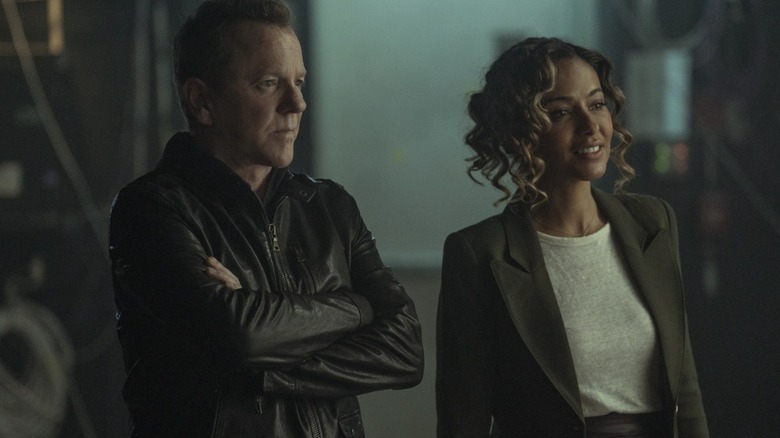
      The series premiere begins with Weir confessing his sins to a priest. We learn that Weir fabricated evidence to tie a major corporation to corruption, which is followed by Weir getting framed for murder. As all hell breaks loose, Weir realizes that he is being shadowed by the mysterious Hailey (Meta Golding) and is forced to become a fugitive to evade the authorities. There’s also a lot of personal baggage to navigate, as Weir realizes that his father, Ben (Charles Dance), who apparently died by suicide when he was a child, is alive. As you can imagine, Weir and Ben don’t exactly develop a warm father-son relationship in the show, as repairing trust is easier said than done.

      There’s also a decent thematic framework about state surveillance and unethical data usage here, which could’ve been fleshed out with greater depth if “Rabbit Hole” had gone on for another season or two. “Rabbit Hole” makes great use of these themes to underline the ease of exploitation in a world where everyone is a bit too connected.

      Dance and Sutherland are expectedly brilliant, but Golding is a revelation, sharing crackling chemistry with almost every screen partner. Perhaps the most regrettable aspect of the show’s cancellation is that we were robbed of more Hailey, who emerges as a compelling sidekick to Weir. These characters have a way of taking you by surprise, as “Rabbit Hole” starts like any run-of-the-mill spy thriller and then begins throwing one subversion after another at its audience. Do these twist reveals get more outlandish by the time the show ends? Well, yes, but these narrative curveballs don’t hamper how you feel about the series and the Kiefer Sutherland of it all.


      Source link

      City Furniture and GARVEE Explore Omnichannel Retail Collaboration in North America | Web3Wire

      0
      City Furniture and GARVEE Explore Omnichannel Retail Collaboration in North America | Web3Wire


      Ontario, California, April 11, 2026 (GLOBE NEWSWIRE) — A high-level delegation from Florida-based home furnishings leader City Furniture recently visited GARVEE’s headquarters. The visit was led by City Furniture Chairman Keith Koenig, joined by Senior Vice Presidents of Operations Shaun Feraco and Dave Clevenger, along with other core management members. The dialogue focused on a deep synergy of “Online Precision Operations + Offline Immersive Experience,” aimed at forging new pathways between global supply chains and omnichannel retail.

      Core Focus of Discussions:

      Focused on Core Categories and an O2O Partnership Model

      The meeting identified mattresses as the strategic starting point for future collaboration. City Furniture plans to leverage its strong supplier network and showroom-based retail model, supported by 230 delivery vehicles and 500 professional installers, to enhance the last-mile delivery experience for large home furnishings. GARVEE will contribute its data-driven merchandising and demand forecasting capabilities to optimize inventory planning and provide product selections tailored for online sales. Together, the partners aim to develop an integrated online-to-offline operating model that combines online traffic, offline experience, and local fulfillment to deliver more cost-effective solutions for the U.S. and Canada consumers.

      Understanding Consumer Shifts and Optimizing Product Strategy

      Against the backdrop of a changing North American market, both parties noted that inflation continues to drive consumer demand for value-oriented products. While some fast-selling categories have experienced price and volume fluctuations, mid- to high-end home furnishings still rely heavily on in-store experiences. At the same time, declining foot traffic has been offset by stronger conversion rates and higher average order values. Based on these trends, the two sides will combine GARVEE’s data insights with City Furniture’s channel strengths to refine product selection and support resilient growth.

      Strengthening Digital Operations and Supply Chain Efficiency

      City Furniture and GARVEE explored enhancing operational efficiency through data intelligence and supply chain collaboration. Both parties recognized the pivotal role of AI in driving long-term efficiency gains and optimizing product lifecycles. At the supply chain level, the companies shared their respective global footprints and supplier resources, with plans to integrate premium manufacturing capabilities and optimize inventory management. By adopting an “asset-light” model, they aim to reduce operating costs and ensure long-term stability for consumer pricing.

      Quotes of Note

      “By combining our global supply chain and digital capabilities with City Furniture’s retail and fulfillment strengths, we see a clear opportunity to build a more efficient, customer-focused model.”— GARVEE Representative

      “We were impressed by GARVEE’s data-driven operations and see strong potential to enhance value and operational efficiency to the U.S. market together.”— City Furniture Leadership

      About the Organizations

      GARVEE.COM is a home improvement company headquartered in Ontario, California. Established for over 15 years, the company operates as a direct-to-consumer platform specializing in a wide array of products for home, lifestyle, and commercial use across the United States and Canada.The brand’s core identity is built on providing reliable, affordable, and practical solutions. Its product portfolio is organized into several key categories:

      Air Conditioner: Rapid cooling and heating, energy-saving technology, ultra-quiet operation, providing a continuously comfortable experience.Home & Furniture: A complete range of furniture, storage, and décor for every room, designed to elevate comfort, organization, and everyday living.Agriculture & Forestry Equipment: Built for performance and durability, this category features essential tools and equipment for farming, land management, and livestock care.Lawn & Garden: Offering practical solutions for lawn care, gardening, and outdoor living, helping create comfortable and functional backyard spaces.

      GARVEE is recognized for its responsive customer support and end-to-end service approach, offering assistance across product selection, order coordination, delivery, and after-sales support to help create a smooth customer experience.

      City Furniture:City Furniture is a premier Florida-based retailer dedicated to transforming home living through beautiful furnishings offered at an exceptional value. Originally established in the 1970s as Waterbed City, the company has successfully evolved into a leading destination for furniture and home accents, with a steadfast commitment to style and affordability. Currently, the organization maintains a robust presence across the state with more than 20 showrooms. Supported by an expansive e-commerce platform, City Furniture continues to innovate its product lineup to deliver the very best in home decor and personalized service to its customers.

      Press Contact:partner@garvee.com|http://www.garvee.com/about-us

      About Web3Wire Web3Wire – Information, news, press releases, events and research articles about Web3, Metaverse, Blockchain, Artificial Intelligence, Cryptocurrencies, Decentralized Finance, NFTs and Gaming. Visit Web3Wire for Web3 News and Events, Block3Wire for the latest Blockchain news and Meta3Wire to stay updated with Metaverse News.


      Source link

      ‘Huge congratulations! Stephen Mulhern celebrates as he shares ‘very cute’ photo of ‘baby Stephen’

        0
        ‘Huge congratulations! Stephen Mulhern celebrates as he shares ‘very cute’ photo of ‘baby Stephen’


        Stephen Mulhern is celebrating Butlin’s 90th birthday and shared a major throwback photo of himself in honour of their big day.

        The TV star, 49, first found fame as a children’s presenter in the late 90s and is also known for his career as a magician. In recent years, he has remained a staple on ITV, hosting Deal or No Deal and You Bet!

        More recently, he starred in Accidental Tourist with Geordie presenting duo Ant and Dec.

        Don’t miss a single story! Add us as a Preferred Source in Google for all your entertainment news

        It’s important to us that you never miss our articles when searching for stories! We have all the latest TV & Celebrity news to share with our community of loyal readers.

        Click here and tick Entertainmentdaily.com to ensure you see stories from us first in Google Search.

        Throughout his career, he has had a long-standing working relationship with Butlin’s, who are 90 years old today (April 11).

        Stephen has been working with Butlin’s for many years with his magic tricks (Credit: ITV)

        Stephen Mulhern celebrates Butlin’s 90th birthday with throwback photo

        To mark the occasion, Stephen posted a snapshot of his young self in a red suit on Instagram. In the photo, he can be seen holding a deck of cards while smiling directly at the camera.

        “Butlin’s turns 90 today and what an incredible journey it’s been! I started my career wearing the famous red jacket and can’t thank them enough for the opportunities over the years,” he wrote in his caption.

        “They’re going as strong as ever! Huge congratulations! Happy birthday @officialbutlins!”

        ‘Still as cute as ever!’

        The Deal or No Deal host’s followers rushed to the comments to celebrate the news. However, many were also stunned by the unexpected pic of young Stephen!

        “Who’s a pretty boy! Happy birthday @officialbutlins xxx,” one user wrote.

        “Happy birthday @officialbutlins what a blast from the past, I still remember you as a Red x,” another person shared.

        “Baby Stephen!!! Still as cute as ever in my opinion!!!” a third remarked.

        “Wow very cute,” a fourth said.

        “LEGEND!!! One of the greatest to ever don a Red Coat. Here is to an epic day at Skegness! See you soon,” a fifth person added.

        Read more: Deal or No Deal viewers hit with heartbreaking death announcement: ‘Very emotional’

        What do you think of this story? Share your thoughts on our Facebook page @EntertainmentDailyFix. We want to hear your thoughts!


        Source link

        Popular Posts

        My Favorites