Home Blog Page 74

The Great Re-Platforming: Stablecoins vs Tokenized Deposits in 2026 | NFT News Today

The Great Re-Platforming: Stablecoins vs Tokenized Deposits in 2026 | NFT News Today


In 2026, digital money has moved beyond experimentation into live financial infrastructure. Banks are issuing tokenized versions of deposits, while stablecoins continue to operate across public blockchain networks. What’s emerging is not a single dominant model, but two parallel systems with different strengths.

This article explains how tokenized deposits work, why banks are adopting them at scale, and how they compare to stablecoins such as USDC and Tether. It also examines recent global developments and the key issue ahead: whether these systems will connect or remain separate.

The Shift: From Pilots to Production

The defining change in 2026 is that tokenized money is now being used in real financial activity.

Institutions such as JPMorgan Chase and BNY Mellon are operating systems that support continuous payments, liquidity movement, and settlement. According to bank disclosures and public statements, these platforms are already processing billions in daily transaction volume.

At the policy level, Asia has taken a leading role. The People’s Bank of China has evolved the e-CNY into a structure that increasingly runs through commercial banks. Officials have described this as a shift toward “digital deposit money,” preserving the existing two-tier banking system while incorporating programmable features.

In parallel, the Hong Kong Monetary Authority has moved Project Ensemble into live testing with real-value transactions. HKMA has framed this transition as a move from sandbox experimentation into market use.

Across regions, progress is steady, though still concentrated in specific use cases such as treasury, collateral, and interbank settlement.

What Are Tokenized Deposits?

A tokenized deposit is a digital representation of funds held at a bank.

Unlike stablecoins, which are issued by non-bank entities and backed by reserves, tokenized deposits remain on a bank’s balance sheet and retain their legal status as deposits. They move across digital networks, but from an accounting and regulatory perspective, they function like traditional bank money.

Most implementations today run on permissioned infrastructure, where access is restricted to approved participants. This allows banks to coordinate settlement with mechanisms such as delivery-versus-payment, reducing counterparty and settlement risk.

In practice, this allows funds to move continuously while remaining inside existing regulatory frameworks.

Why Tokenized Deposits Are Gaining Ground

Banks have structural advantages in regulated environments, while stablecoins retain advantages in open networks.

Safety

Deposits sit within regulated institutions and benefit from supervisory frameworks and, in many jurisdictions, deposit protection schemes. They also connect directly to central bank liquidity facilities.

Seamlessness

For corporate users, tokenized deposits integrate with existing treasury systems. In practice, treasury teams tend to prioritise whether funds can move instantly without disrupting internal controls, reporting, or risk management processes.

Control

Tokenized deposits remain on bank balance sheets. Stablecoins, by contrast, move funds into external reserve structures, which reduces deposits available for lending.

As noted in JPMorgan Chase research, regulatory alignment and access to central bank liquidity are central to why banks are advancing this model.

Real Systems, Real Activity

Several developments in 2026 illustrate how this is progressing:

Kinexys (J.P. Morgan)JPMorgan’s platform has processed trillions in cumulative value and now handles billions in daily volume, supporting payments, liquidity flows, and foreign exchange.

BNY Mellon Digital CashBNY has introduced tokenized representations of client balances that can be transferred continuously for settlement and collateral purposes, while funds remain within regulated accounts.

Project Ensemble (Hong Kong)Banks including HSBC and Standard Chartered are conducting live transactions involving tokenized deposits and tokenized funds, providing early examples of cross-institution settlement.

Additional initiatives are emerging across regions:

U.S. bank consortia exploring shared tokenized deposit networks

UK pilots involving major banks testing tokenized sterling deposits

Ongoing work by global institutions such as Citi and Goldman Sachs

These deployments are expanding beyond pilot environments into targeted production use, though still limited in scope.

The Interoperability Question

Early tokenized deposit systems were largely confined to individual banks. That is beginning to change.

Projects like Project Ensemble are testing how deposits can move between institutions. Other industry efforts are exploring shared infrastructure and common standards.

There is also increasing interest in linking bank-issued tokens with broader digital networks. Some platforms are experimenting with hybrid approaches that combine permissioned systems with shared settlement layers.

Any cross-network model will also need to reconcile AML and KYC requirements across jurisdictions, which remains a significant constraint.

The direction is clear, but the outcome remains uncertain. Without interoperability, liquidity could fragment across multiple systems.

Where Tokenized Deposits Face Constraints

Despite recent progress, tokenized deposits still face several limitations.

Limited accessibilityAccess is typically restricted to institutional clients, unlike stablecoins which are globally available with fewer barriers.

Fragmentation riskMany systems remain bank-specific or consortium-based, which can limit liquidity across networks.

Regulatory complexityCross-border use introduces challenges around jurisdiction, compliance standards, and supervision.

Slower innovation cyclesCompared to crypto markets, bank-led systems tend to evolve more gradually due to governance and risk controls.

In practice, most deployments today remain focused on treasury, collateral, and interbank settlement rather than broad retail use.

Why Stablecoins Still Matter

Despite the momentum behind bank-issued tokens, stablecoins remain central to digital markets.

Assets like USDC and Tether continue to offer:

Open access without reliance on banks

Integration with trading, lending, and other on-chain applications

Interoperability across multiple blockchain networks

Global usability across jurisdictions

The stablecoin market has grown to hundreds of billions in circulation, with significant daily transaction volumes. In areas such as decentralized finance and cross-border payments outside traditional banking channels, stablecoins often serve as the default settlement asset.

Each model also carries its own risks. Stablecoins depend on reserve quality and issuer transparency, while tokenized deposits remain exposed to the underlying banking system, including credit risk and potential contagion during periods of stress.

A Structural Shift, Not a Replacement

The broader shift is not about replacing one system with another, but about how each evolves.

Tokenization allows banks to maintain existing structures—deposits, regulation, and balance sheets—while improving how money moves. Settlement becomes faster, liquidity becomes more flexible, and systems operate continuously rather than in fixed windows.

Stablecoins continue to expand in open networks where accessibility and interoperability are prioritised over regulatory alignment.

In practice, the choice between these models depends on context: institutions tend to prioritise regulatory certainty, while crypto-native users prioritise flexibility and access.

Conclusion

Digital money in 2026 is defined by two parallel systems.

Tokenized deposits are gaining traction within the banking sector, offering speed and programmability within regulated frameworks. Stablecoins continue to dominate open networks and crypto-native applications.

The next phase will depend on whether these systems begin to connect or continue to develop separately.

What is clear is that money itself is not being replaced.

It is being rebuilt to move more efficiently within—and alongside—the existing financial system.


Source link

XRP Ledger Powers $861M Tokenized Electricity – NFT Plazas

    0
    XRP Ledger Powers 1M Tokenized Electricity – NFT Plazas


    The XRP Ledger is rapidly expanding beyond its reputation as a fast, low-cost payments network. In a major step toward real-world utility, the blockchain now hosts $861 million worth of tokenized electricity, marking one of the most tangible use cases of real-world asset (RWA) tokenization to date.

    This development doesn’t just represent growth – it signals a structural shift in how physical commodities like energy can be tracked, traded, and settled using blockchain infrastructure.

    Turning Electricity Into a Digital Asset

    At the center of this innovation is a token called JMWH, a digital asset that represents real electricity on-chain. Each JMWH token corresponds to one megawatt-hour (MWh) of energy, directly tied to actual production capacity from energy providers.

    Unlike many tokenization experiments that remain conceptual, this system is already live and functioning. Energy contracts are converted into blockchain-based tokens, allowing electricity to be tracked from production to consumption with full transparency.

    Once electricity is used, the corresponding tokens are burned, permanently removing them from circulation. This mechanism ensures that each token reflects real consumption, creating a verifiable link between digital records and physical energy usage.

    The result is a system where:

    Supply is transparently recordedConsumption is verifiable in real timeSettlement is automated and trustless

    This level of clarity is unprecedented in traditional energy markets, which are often fragmented and opaque.

    XRP Ledger powers $861M tokenized electricity

    XRP Ledger powers $861M tokenized electricity

    $861 Million in Live Value And Growing

    According to available data, the tokenized electricity market on XRPL has already reached $861 million in live value, backed by energy providers operating in Latin America.

    This is not speculative liquidity – it represents real infrastructure and production capacity. Each token is backed by actual energy output, giving the system intrinsic value tied to a critical global resource.

    Adoption metrics further reinforce the momentum:

    Over 213,000 holders participating in the ecosystemMonthly transfer volume reaching $8.29 billionContinuous on-chain activity tied to real-world usage

    These figures highlight a key turning point: blockchain is no longer limited to financial assets – it is now actively managing physical commodities at scale.

    How the System Works

    The process behind tokenized electricity on XRPL is both elegant and efficient:

    Energy contracts are created between producers and buyersThese contracts are tokenized into JMWH units on the XRP LedgerTokens are distributed to clients based on agreed allocationsAs electricity is consumed, tokens are burned to confirm usage

    Every step is recorded on-chain, creating an immutable audit trail from issuance to consumption.

    This approach eliminates discrepancies, reduces administrative overhead, and introduces a level of accountability that traditional systems struggle to achieve.

    JMWH on XRP LedgerJMWH on XRP Ledger

    JMWH on XRP Ledger

    Institutional Backing Adds Credibility

    A key driver behind this initiative is institutional participation. In Argentina, state-backed energy firm YPF Luz has built its Enertoken platform on XRPL, leveraging blockchain to modernize energy distribution and tracking.

    The platform operates through Justoken and complies with regulations under Argentina’s capital markets authority, adding a crucial layer of legitimacy.

    This regulatory alignment is critical. It demonstrates that blockchain can integrate seamlessly into existing legal and financial frameworks – something that has historically been a barrier to adoption.

    With institutional players involved, XRPL is no longer just a crypto-native ecosystem. It is becoming a trusted infrastructure layer for regulated industries.

    Bitget Wallet Elevates XRPL to Core Payment Infrastructure

    While tokenized electricity showcases XRPL’s expansion into commodities, its integration with Bitget Wallet highlights its transformation in payments.

    Rather than a simple integration, Bitget Wallet is embedding XRPL directly into its infrastructure—positioning it as a primary rail for real-world crypto transactions.

    This is a strategic shift. XRPL is no longer just one of many supported chains; it is becoming the backbone of how value moves the wallet ecosystem.

    The timing is critical. Payments now account for roughly 53% of activity on XRPL, signaling a clear transition from trading-driven usage to real-world financial applications.

    At the center of this payment evolution is RLUSD, now the network’s most transacted asset. Its rise reflects growing demand for:

    Stable value storageLow-cost transactionsInstant cross-border transfers

    With Bitget Wallet integration, users gain:

    Instant mainnet transfers for XRP and RLUSDSeamless cross-chain swapsA frictionless user experience without intermediaries

    This effectively turns XRPL into a bridge between fragmented blockchain ecosystems.

    Bitget Wallet names XRP Ledger as key payments partnerBitget Wallet names XRP Ledger as key payments partner

    Bitget Wallet names XRP Ledger as key payments partner.

    Why This Matters: A New Era for Energy Markets

    The tokenization of electricity represents more than technological progress – it introduces a fundamentally new way to manage and trade energy.

    Traditional energy systems often suffer from:

    Delayed settlement processesLimited transparencyComplex intermediariesInefficient cross-border transactions

    By moving energy contracts onto the blockchain, XRPL enables:

    Real-time settlement without intermediariesTransparent tracking of production and consumptionProgrammable contracts for automated executionGlobal accessibility for energy markets

    This could reshape how energy is priced, distributed, and financed, particularly in emerging markets where infrastructure gaps remain significant.

    XRPL’s Expanding Role in Real-World Assets

    The success of tokenized electricity highlights a broader trend: the XRP Ledger is increasingly being used as a platform for real-world asset tokenization.

    Beyond energy, XRPL is well-positioned to support:

    Commodities (oil, metals, agricultural goods)Financial instruments (bonds, invoices, derivatives)Carbon credits and sustainability assets

    Its advantages, low fees, fast settlement, and scalability, make it particularly suitable for high-volume, real-world applications.

    As more industries explore tokenization, XRPL is emerging as a preferred blockchain for deployments that require both efficiency and reliability.

    Challenges and Market Realities

    Despite these advancements, challenges remain. Market sentiment around XRP itself has been mixed, with price action reflecting broader macro pressures and investor caution.

    This disconnect between strong fundamentals and weak price performance is not uncommon in early-stage technological shifts. Infrastructure often develops ahead of market recognition.

    Additionally, scaling tokenized energy globally will require:

    Broader regulatory harmonizationStandardization of tokenized assetsContinued institutional participation

    However, the current progress suggests these hurdles are being actively addressed.

    Conclusion

    The XRP Ledger’s role in powering $861 million in tokenized electricity marks a defining moment for blockchain adoption.

    This is no longer about theoretical use cases or pilot programs. It is about live systems managing real resources, backed by institutions and operating within regulatory frameworks.

    By bridging the gap between digital infrastructure and physical assets, XRPL is helping to redefine what blockchain can achieve.

    If this trajectory continues, tokenized electricity may be just the beginning – opening the door to a future where global industries run on transparent, efficient, and decentralized rails powered by blockchain.


    Source link

    Ethereum Stablecoin Value Hits All-Time High of $180 Billion – NFT Plazas

      0
      Ethereum Stablecoin Value Hits All-Time High of 0 Billion – NFT Plazas


      The Ethereum network has reached a defining milestone in its evolution as the backbone of digital finance. The total value of stablecoins issued and circulating on Ethereum has surged to an all-time high of $180 billion, underscoring its growing dominance as the primary settlement layer for tokenized dollars and on-chain liquidity.

      This figure represents roughly 60% of the global stablecoin supply, a staggering concentration that reinforces Ethereum’s position not just as a blockchain, but as the financial infrastructure of the emerging digital economy.

      A New Peak Signals Structural Shift

      The $180 billion milestone is more than a headline number – it marks a structural shift in how value moves across financial systems. Stablecoins, often pegged to fiat currencies like the U.S. dollar, serve as the bridge between traditional finance and decentralized ecosystems. Their explosive growth on Ethereum signals rising trust in blockchain-based settlement.

      Over the past three years alone, Ethereum’s stablecoin supply has grown by approximately 150%. This is not a short-term spike driven by speculation – it reflects sustained adoption across payments, decentralized finance (DeFi), trading, and increasingly, institutional finance.

      In parallel, total stablecoin supply across all networks reached approximately $315 billion in early 2026, meaning Ethereum commands the majority share of a rapidly expanding market.

      Ethereum stablecoin supply hits $180B all-time high

      Ethereum stablecoin supply hits $180B all-time high

      Institutional Capital Is Fueling the Surge

      A key driver behind this growth is the accelerating participation of global financial institutions. Major players such as BlackRock, JPMorgan, and Amundi have begun launching tokenized financial products directly on Ethereum.

      These initiatives are not experimental – they are strategic. Institutions are increasingly using Ethereum as a settlement layer for tokenized assets, including money market funds, bonds, and other real-world financial instruments. Stablecoins act as the liquidity layer enabling these transactions.

      Even traditional banking leaders are acknowledging the shift. Jamie Dimon recently pointed out that blockchain technologies, including stablecoins and smart contracts, are creating a “new set of competitors” to the legacy financial system.

      This shift is critical. For decades, global finance has relied on slow, fragmented infrastructure. Ethereum offers near-instant settlement, transparency, and programmability – features that are increasingly difficult for traditional systems to match.

      Institutional capital is fueling the surgeInstitutional capital is fueling the surge

      Institutional capital is fueling the surge

      Tokenization: The Trillion-Dollar Catalyst

      The rise in stablecoin supply is closely tied to the broader trend of tokenization – the process of representing real-world assets on blockchain networks.

      According to projections from Token Terminal, as much as $1.7 trillion in assets could move onchain across all blockchain networks within the next four years. Ethereum alone could capture up to $850 billion in new capital flows by 2030 if current growth trajectories hold.

      Meanwhile, Standard Chartered estimates that over $1 trillion could migrate from traditional banking systems into stablecoins by 2028. This would represent one of the largest shifts in financial infrastructure in modern history.

      Stablecoins are at the center of this transformation. They provide:

      Liquidity for tokenized assetsSettlement rails for digital transactionsCollateral for decentralized financial applications

      As tokenization scales, demand for stablecoins is expected to grow exponentially, further strengthening Ethereum’s position.

      Ethereum’s Expanding Ecosystem Advantage

      While Ethereum’s base layer accounts for a significant portion of stablecoin activity, its broader ecosystem amplifies its dominance.

      Layer-2 networks and Ethereum Virtual Machine (EVM)-compatible chains, including Arbitrum, zkSync, and Base, extend Ethereum’s scalability while maintaining compatibility with its infrastructure.

      When these networks are included, Ethereum’s effective share of the stablecoin market exceeds 65%.

      This ecosystem approach gives Ethereum a powerful network effect:

      Developers build on Ethereum standardsLiquidity aggregates around Ethereum-based assetsInstitutions prefer the most established and secure infrastructure

      The result is a reinforcing cycle of adoption that competitors struggle to replicate.

      Fueling the Current Crypto Market Momentum

      The surge in stablecoin value is not happening in isolation – it is playing a central role in driving the broader crypto market.

      Stablecoins act as the primary source of liquidity for digital asset trading. As supply increases, so does the capital available to flow into cryptocurrencies such as Ether (ETH), Bitcoin, and altcoins.

      Market analysts suggest that this expanding liquidity is a key factor behind the current bullish sentiment in crypto markets. More stablecoins mean more buying power, deeper markets, and reduced volatility during large transactions.

      In essence, stablecoins are becoming the “cash layer” of crypto, and Ethereum is where that cash lives.

      Risks and Challenges Ahead

      Despite the strong growth, Ethereum’s dominance is not guaranteed.

      Several challenges could impact its trajectory:

      Competition from rival blockchains: Networks offering lower fees and faster transactions continue to attract users and developersRegulatory uncertainty: Governments worldwide are still shaping policies around stablecoins and tokenized assetsMacroeconomic conditions: Interest rates, liquidity cycles, and global financial stability could influence adoption

      Additionally, as stablecoins become more integrated into global finance, scrutiny will intensify. Issues such as reserve transparency, compliance, and systemic risk will come to the forefront.

      However, Ethereum’s first-mover advantage and deep ecosystem give it a strong foundation to navigate these challenges.

      Crypto heatmap today (08/4/2026) (Source: CoinMarketCap)Crypto heatmap today (08/4/2026) (Source: CoinMarketCap)

      Crypto heatmap today (08/4/2026) (Source: CoinMarketCap)

      A Glimpse Into the Future of Finance

      The $180 billion milestone is not the end – it is a signal of what’s coming.

      Ethereum is increasingly functioning as a global settlement layer where:

      Digital dollars move instantly across bordersFinancial assets are tokenized and traded 24/7Institutions and individuals operate on shared infrastructure

      If projections hold, the next phase of growth could dwarf what we’ve seen so far. Trillions of dollars in assets, from equities to real estate, could eventually be represented onchain.

      In that future, stablecoins will not just be a crypto tool – they will be a core component of the global financial system.

      Conclusion

      Ethereum’s record-breaking $180 billion in stablecoin value marks a pivotal moment in the evolution of digital finance. It reflects not only growing adoption but a deeper transformation in how money, assets, and value flow across the world.

      Driven by institutional participation, tokenization, and expanding ecosystem infrastructure, Ethereum is cementing its role as the backbone of onchain liquidity.

      While risks remain, the trajectory is clear: stablecoins are scaling, institutions are committing, and Ethereum is at the center of it all.

      The question is no longer whether blockchain will reshape finance, but how fast it will happen.


      Source link

      A Century-Old Aviation Dream Reborn: The Channel Wing VTOL Takes Flight | Metaverse Planet

      A Century-Old Aviation Dream Reborn: The Channel Wing VTOL Takes Flight | Metaverse Planet


      I spend an absurd amount of time digging through aerospace patent filings, drone startup press releases, and advanced mobility concepts. If you follow the eVTOL (electric Vertical Takeoff and Landing) space as closely as I do, you start to notice a pattern. Most of the time, I see the exact same quadcopter or tilt-rotor silhouettes rehashed with a slightly different carbon-fiber shell and a new corporate logo.

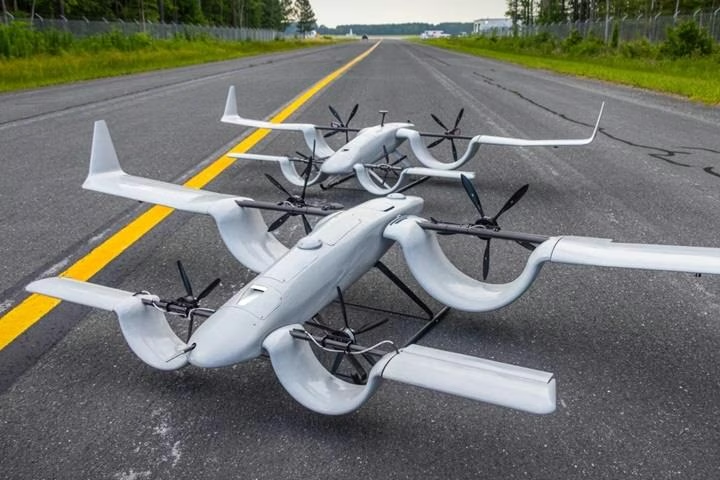
      But every once in a while, I stumble across something that genuinely makes me stop and stare. That is exactly what happened when I first saw the schematics for HopFlyt’s new Cyclone VTOL.

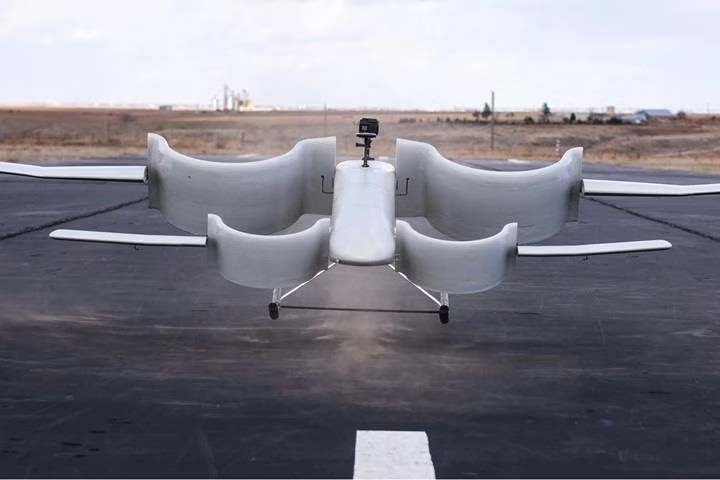
      When I looked at its curved, semi-circular wings, it didn’t look like a standard modern drone. It looked like something pulled straight from an alternate-history steampunk novel. And the most mind-bending part of this entire project? The core engineering concept driving this futuristic aircraft isn’t new at all. It was actually conceptualized over a century ago.

      I want to dive deep into how a forgotten, wildly unconventional idea from 1925 is being resurrected by modern engineering, and why I believe it might just completely rewrite the rules of efficiency in the aviation industry.

      The Ghost of 1925: Willard Ray Custer’s Brilliant Obsession

      To understand why HopFlyt’s Cyclone is such a massive deal, I have to take you back in time. The history of aviation is filled with strange prototypes, but few are as fascinating as the work of Willard Ray Custer.

      In 1925, Custer looked at how airplanes worked and decided everyone was doing it the hard way. Traditional flight relies on a simple premise: an airplane must move forward at a very high speed so that air rushes over its wings, creating the pressure difference known as lift. No forward speed, no lift. It’s why airports need massive runways.

      Custer, however, proposed a radical alternative. Instead of pushing a heavy airplane violently through the air to generate lift, why not just pull the air directly over the wings?

      He invented what he called the “Channel Wing.” Instead of flat or slightly curved traditional wings, Custer designed wings with deep, half-circle dips—like a piece of a massive pipe. He then placed propellers directly inside these semi-circular channels. When the propellers spun, they sucked massive amounts of air violently over the curved surface of the channel, generating immense lift even if the airplane itself was standing completely still.

      The Jogging Airplane

      When I was researching Custer’s early prototypes, I found accounts of flight tests that sound almost comical today. The lift generated by the channel wing was so incredibly efficient at low speeds that during one test, a person literally ran alongside the aircraft as it lifted off the ground. It was achieving flight at a jogging pace.

      In another stationary test, Custer strapped the plane down, fired up the propellers, and the aircraft generated enough lift to try and rip itself off its tethers—creating one of the earliest conceptual proofs of vertical takeoff.

      So, if it was so brilliant, why aren’t we all flying in channel-wing Boeing jets today?

      The answer comes down to the limitations of historical technology. In the mid-20th century, internal combustion engines were incredibly heavy and mechanically complex. Trying to synchronize heavy engines inside these channels, while dealing with the intense structural stress and vibrations, made the planes too bulky. The system couldn’t scale efficiently, and the idea was quietly filed away in the dusty archives of aviation history.

      Why Now? The Magic of Modern eVTOL Tech

      This brings us back to the present day. When I look at the current landscape of electric aviation, I realize we finally have the tools that Custer was missing.

      HopFlyt’s engineering team realized that the channel wing concept wasn’t flawed; it was simply ahead of its time. The advent of the eVTOL revolution has given us lightweight, hyper-efficient electric motors, high-density batteries, and—most importantly—digital fly-by-wire control systems.

      Neil Winston, the Chief Engineer at HopFlyt, summed this up perfectly. He pointed out that while brilliant aerospace concepts existed in the 1960s for variable takeoff and landing craft, the analog world simply couldn’t handle them. Today, we have computers that can adjust engine thrust thousands of times a second to maintain perfect stability.

      With these modern tools, HopFlyt hasn’t just resurrected Custer’s channel wing; they have evolved it into something much more dynamic.

      Dynamic Channels: Not Your Grandfather’s Wing

      What blew my mind about the Cyclone model is that HopFlyt didn’t just build rigid half-circles into the wings. They made the channels movable.

      During Takeoff: The channel structures pivot, directing the thrust straight down for a highly stable, vertical climb.During Forward Flight: The channels rotate and tuck neatly under the main wing, creating a highly aerodynamic profile for fast cruising.During Landing: The channels can shift again, acting as massive, highly effective airbrakes to slow the craft down seamlessly.

      This morphing geometry is something that engineers in the 1920s couldn’t have even dreamed of executing safely.

      Under the Hood: The Cyclone’s Mind-Blowing Specs

      All of this historical context and neat engineering is great, but as a tech analyst, I always look for the hard numbers. Does this weird, retro-futuristic design actually perform better than the standard quadcopter VTOLs currently flooding the market?

      According to the data HopFlyt has released, the answer is a resounding yes. Let me break down the metrics that really caught my eye:

      Unmatched Climbing Efficiency: The channel wing design generates so much passive lift that the Cyclone uses roughly one-third less energy to complete its initial vertical climb compared to peer VTOL aircraft. In the battery-starved world of electric flight, saving that much energy on takeoff is a monumental advantage.The Hybrid Advantage: Unlike pure electric drones that suffer from severe range anxiety, the Cyclone utilizes a hybrid power system (combining electric propulsion with a fuel generator).Extreme Fuel Economy: During flight, this hybrid system consumes less than 11 liters of fuel per hour. For an aircraft of this size and capability, that level of efficiency is staggering.Massive Range: Because of the hybrid setup and aerodynamic efficiency, the Cyclone boasts an operational range of over 1,287 kilometers (800 miles). Most current pure-eVTOLs struggle to break the 150-kilometer mark.Heavy Lifting: For shorter, tactical routes, the Cyclone can carry payloads of up to 113 kilograms (250 pounds).

      Slashing Costs and Emissions

      When I crunch the numbers on the operational side, the claims HopFlyt is making are incredibly bold. They state that the Cyclone will reduce overall operation costs by 90% compared to traditional helicopters performing similar tasks, and lower carbon emissions by a factor of 50. If they can even deliver half of those promises, they will completely disrupt the logistics sector.

      Beyond the Hype: Where Will We See the Cyclone First?

      So, when do I actually get to see one of these flying over my city?

      HopFlyt has set an aggressive target for commercial deployment in 2027. But don’t expect to be commuting to work in a Cyclone right away. They are targeting the heavy-duty commercial sectors first.

      I think their initial use-case strategy is brilliant. They are focusing on environments where traditional helicopters are currently too expensive and pure drones are too weak. We will likely see the Cyclone utilized for:

      Maritime Supply Lines: Delivering heavy parts to cargo ships out at sea.Offshore Energy: Providing vital logistics and transport to remote oil rigs and wind farms.Medical Transport: Rapidly moving organs, critical medical supplies, or even acting as a highly efficient air ambulance across long distances.

      Once they prove the safety and reliability of the channel wing in these harsh industrial environments, they plan to adapt the platform for human passenger transport.

      I genuinely love seeing stories like this. It proves that innovation isn’t always about inventing something entirely new out of thin air; sometimes, it’s about having the vision to look backward, find a forgotten spark of genius, and apply modern technology to finally make it catch fire.

      The idea of stepping into a hybrid VTOL with morphing, semi-circular wings feels like the kind of future I was promised as a kid.

      But I’m curious to hear your thoughts. If HopFlyt eventually launches a passenger version of the Cyclone, would you feel comfortable flying in an aircraft with such a radically unconventional wing design, or do you prefer the traditional airplane shape we’ve trusted for decades? Let me know in the comments below!

      You Might Also Like;


      Source link

      The Dawn of the Automated Battlefield: How Ground Robots Are Redefining Warfare | Metaverse Planet

      The Dawn of the Automated Battlefield: How Ground Robots Are Redefining Warfare | Metaverse Planet


      I remember sitting in a theater years ago, watching the ominous, metallic skeletons of the Terminator franchise march across a desolate, war-torn landscape. Like most of you, I walked out thinking, “Well, that’s a terrifying piece of science fiction.” But after spending the last few days digging through the latest frontline reports from Ukraine, I’ve realized something deeply unsettling: that science fiction is no longer fiction. It is the current reality of modern warfare.

      We’ve all grown accustomed to the idea of drones ruling the skies. Aerial UAVs (Unmanned Aerial Vehicles) have completely rewritten the tactical rulebooks over the past few years. But while we were all looking up, a massive, quiet revolution was happening down in the mud and the trenches.

      Unmanned Ground Vehicles (UGVs)—robotic systems rolling through the dirt—have transitioned from experimental prototypes to the absolute backbone of frontline operations. And the scale at which this is happening is staggering.

      7,000 Robotic Operations in a Single Month

      When I first read the data recently highlighted by frontline observers and international outlets like the New York Times, I actually had to read the numbers twice to make sure I wasn’t hallucinating. In a single month, Ukrainian forces executed 7,000 operations utilizing ground robots.

      Let that sink in. We aren’t talking about a handful of test units being driven around a safe testing facility. We are talking about thousands of active, combat and support missions happening in the most dangerous, highly contested environments on the planet.

      These robotic platforms aren’t just taking pictures, either. They are actively shaping the outcome of firefights. Based on the reports, these ground systems are out there:

      Laying anti-tank and anti-personnel mines in active combat zones.Firing mounted machine guns to suppress enemy positions.Deploying and throwing grenades directly into enemy trenches.Actively neutralizing enemy combatants without putting a single human operator in the direct line of fire.

      As someone who studies the intersection of technology and society, watching this rapid deployment is mind-bending. The battlefield has become a live-action testing ground for the future of automated combat.

      The Psychological Weight of an Unblinking Enemy

      There is a human element to this technological shift that I find absolutely fascinating—and terrifying. War is, fundamentally, a psychological endeavor. Throughout history, soldiers have relied on the fact that the enemy across from them is also human. A human gets tired, a human feels pain, a human can be suppressed by heavy fire, and a human feels fear.

      A ground robot feels none of these things. When you shoot a human soldier, they go down. When you shoot a tracked robot, unless you hit a critical component, it just keeps rolling toward you with cold, calculated precision. According to Ukrainian drone operators on the ground, this is having a devastating psychological impact on opposing forces. It breaks the morale of defending infantry in a way that traditional artillery simply doesn’t.

      The data backs up this psychological collapse. Reports indicate that in just one month earlier this year, over 100 Russian soldiers surrendered directly to these unmanned systems. Surrendering to a machine represents a massive, unprecedented psychological threshold being crossed in human history. It’s the realization that you cannot outlast, out-intimidate, or negotiate with the metal box rolling toward your trench.

      Lifesavers in the Crossfire: The Logistics Revolution

      While the combat capabilities grab all the cinematic headlines, the real story—the aspect that I believe is truly altering the course of the conflict—is logistics.

      Right now, the skies over the frontlines are saturated with kamikaze FPV (First Person View) drones. It has created a phenomenon known as the “transparent battlefield.” If you move above ground during daylight, you are seen. If you are seen, you are struck. Moving human soldiers to deliver a box of ammunition or a few bottles of water has become a virtual death sentence.

      So, how do you keep an army supplied in an environment where humans can’t walk? You send the robots.

      Today, nearly 90% of all logistics operations in certain sectors of the Ukrainian military are handled entirely by robotic systems. That statistic is mind-blowing. These machines are serving as the ultimate lifeline for soldiers pinned down in trenches. They crawl through the mud, under the radar of aerial drones, to deliver:

      Heavy ammunition boxes and artillery shells.Rations and clean drinking water.Vital medical supplies.

      The Ultimate Medevac

      Even more incredible is their role in medical evacuations. Historically, rescuing a wounded soldier under fire often resulted in more casualties as medics rushed into the kill zone. Now, ground robots are being sent in to pull the wounded to safety.

      Some of the larger, heavy-duty UGV models deployed right now are capable of carrying up to three wounded soldiers at the same time. Imagine being critically injured, pinned down by sniper fire, and watching a low-profile, armored robot roll up right next to you to drag you back to a medical triage point. It is a brilliant, life-saving application of technology that doesn’t get enough attention.

      A Rapidly Scaling Defense Ecosystem

      What amazes me most about this robotic revolution is how fast it was engineered. This isn’t the result of a twenty-year, multi-billion-dollar development cycle from a giant, legacy defense contractor. This is the result of agile, startup-style innovation adapting to immediate, desperate needs.

      The ground robotics sector has become the fastest-growing area in Ukraine’s defense technology ecosystem. The numbers are a testament to how quickly warfare is evolving:

      Production has scaled up by roughly six times compared to previous periods.The domestic market size for these systems has rapidly surpassed the $250 million mark.

      And the barrier to entry is getting terrifyingly low. We are seeing highly capable systems being built with commercial-off-the-shelf components. For instance, reports highlight the deployment of agile “robot dogs” outfitted for kamikaze attacks, costing around $9,000 a piece. When you compare a $9,000 robot dog to a multi-million dollar main battle tank, the economics of modern warfare completely flip.

      Add to this the deployment of systems like the “Fury”—a heavy ground robot equipped with a mounted machine gun—and you realize these machines are no longer just experimental support tools; they are the primary actors in the theater of war.

      The Ethical Horizon: Where Do We Go From Here?

      I write about the Metaverse, AI, and digital innovation because I love seeing humanity push boundaries. But looking at the explosive growth of armed, uncrewed ground vehicles forces me to take a hard step back.

      We are standing on a very slippery slope. Right now, these systems are remote-controlled. There is a human operator with a remote and a screen, making the final decision to pull the trigger or detonate the payload. But as electronic warfare and signal jamming become more intense, the connection between operator and robot will inevitably be severed.

      When that happens, the obvious technological next step is to grant these systems autonomous targeting capabilities. We are inching dangerously close to a reality where algorithms, not humans, decide who lives and who dies in the mud of a trench.

      The events unfolding in Eastern Europe right now are providing us with a crystal-clear preview of the mid-21st-century battlefield: highly automated, devoid of direct human presence on the zero-line, and incredibly lethal. It forces us to ask deep, uncomfortable questions not just about military tactics, but about the ethics of how we conduct war.

      I’m struggling to wrap my head around the long-term implications of this. I’d love to hear your perspective. If fully autonomous ground robots become the standard for every military in the world, do you think it will make wars less costly in terms of human life, or will it just lower the barrier to starting conflicts in the first place? Let’s discuss it in the comments below.

      You Might Also Like;


      Source link

      Review Of The Greatest Avengers Comics of All Time | MarkMeets Media

        0
        Review Of The Greatest Avengers Comics of All Time | MarkMeets Media


        The Avengers stand as a cornerstone in the Marvel Universe, symbolizing the pinnacle of heroism and teamwork. They are not merely characters on a page but icons whose stories have shaped and defined the Marvel brand. As “Earth’s Mightiest Heroes,” they play a pivotal role in nearly every major storyline, and their influence reaches across the vast expanse of the Marvel Universe. From the battles they fight to the personal challenges they overcome, the Avengers are central to many of Marvel’s most unforgettable narratives. This article explores some of the most impactful Avengers comics in history, highlighting why these stories have left an indelible mark on fans and the superhero genre alike.

        The Importance of Avengers Comics in Marvel’s Legacy

        Marvel’s rich history is deeply intertwined with the tales of the Avengers. These heroes have been at the forefront of countless crossover events, proving time and again why they are Marvel’s premier team. Whether they are defending the world from cosmic threats or battling their inner demons, the Avengers embody the complexities and stakes that make superhero stories compelling. Below, we dive into some of the most significant Avengers comics that have shaped the Marvel Universe.

        The Kang Dynasty (2001)

        A Groundbreaking Tale of Conquest

        The Avengers Comics have often explored themes of power and responsibility, but few arcs have done so as dramatically as The Kang Dynasty. Written by Kurt Busiek and illustrated by Alan Davis, Kieron Dwyer, Rick Remender, Ivan Reis, and Manuel Garcia, this storyline is a testament to the Avengers’ resilience and Kang the Conqueror’s formidable might. In this saga, Kang, a time-traveling despot, embarks on a quest to dominate Earth. Unlike previous villains, Kang succeeds in his mission, leaving the world at his mercy. His victory, albeit temporary, marks a significant moment in Marvel history, showcasing the vulnerability of Earth’s mightiest heroes. This arc is a must-read for anyone interested in seeing the Avengers pushed to their limits, both physically and mentally.

        Legacy and Impact

        Kang’s successful conquest was a groundbreaking narrative choice, setting The Kang Dynasty apart from other Avengers Comics. It demonstrated that even the most powerful heroes could falter, adding depth and realism to the Marvel Universe. This storyline also laid the groundwork for future tales involving Kang, cementing his place as one of the Avengers’ most relentless adversaries.

        Jed MacKay’s Avengers Vol. 1: “The Impossible City”

        A New Era for the Avengers

        Jed MacKay’s The Impossible City is a fresh take on the Avengers, breathing new life into the series. Illustrated by C.F. Villa, this arc begins with a bang as the Avengers are thrust into a crisis involving Kang the Conqueror. A wounded Kang delivers a dire warning to the team, setting the stage for a confrontation with the Ashen Combine, a group of god-tier villains. This storyline not only introduces new threats but also a new living headquarters for the Avengers, known as The Impossible City.

        Why It Stands Out

        The Impossible City succeeds in redefining the status quo for the Avengers, highlighting the stakes, the evolving dynamics within the team, and the introduction of new elements that change the existing lore. This is a prime example of how Avengers Comics can continuously innovate while staying true to the essence of the characters.

        Uncanny Avengers (2023)

        Reintroducing the Uncanny Avengers

        The 2023 series Uncanny Avengers, penned by Gerry Duggan and Jonathan Hickman with art by Javier Garron, is a standout entry in the Avengers’ extensive catalog. This storyline sees the return of the Uncanny Avengers, a team that merges the Avengers with the X-Men, during a time of war with the anti-mutant organization Orchis. The themes of unity and struggle against oppression, common in X-Men stories, are deeply woven into this narrative.

        The Significance of Captain America’s Role

        In this arc, Captain America exemplifies the role of an ally, stepping onto the frontlines to support the mutant community. This depiction of solidarity and leadership adds a layer of moral complexity to the story, making it one of the most impressive iterations of the Uncanny Avengers. As time goes on, this arc is expected to be remembered as a crucial chapter in the ongoing saga of the Avengers.

        Infinity (2013)

        Expanding the Marvel Universe

        When Jonathan Hickman, along with artists Jim Cheung, Jerome Opeña, and Dustin Weaver, released Infinity in 2013, they introduced a storyline that expanded the Marvel Universe in unprecedented ways. This arc sees the Avengers facing off against Thanos, who takes advantage of their absence from Earth while they are engaged in a battle with The Builders in space. Thanos’ invasion leads to the introduction of the Black Order, a group of powerful and terrifying new villains.

        Lasting Repercussions

        Infinity is more than just an action-packed adventure; it’s a narrative that had major repercussions for both the Avengers and the Inhumans. The story set the stage for future conflicts and developments within the Marvel Universe, proving that the Infinity storyline was as significant as its predecessor, The Infinity Gauntlet.

        The Korvac Saga

        A Cosmic Tale of Betrayal and Power

        The Korvac Saga, spanning Avengers issues #167-177, is a classic example of cosmic storytelling in Avengers Comics. Written by Jim Shooter and illustrated by John Buscema, this arc centers on Michael Korvac, a being with god-like powers who poses a grave threat to the universe. Originally from an alternate future in the 31st century, Korvac betrays humanity by siding with the alien Badoon, only to be turned into a cyborg by them. He eventually gains the Power Cosmic and becomes an omnipotent force.

        The Guardians and Avengers Unite

        What makes The Korvac Saga particularly compelling is the collaboration between the Avengers and the Guardians of the Galaxy to stop Korvac. This story is a true space opera, filled with drama, high stakes, and epic battles, solidifying its place as one of the most entertaining arcs in Avengers Comics history.

        Secret Invasion (2008)

        A Suspenseful Tale of Deception

        Secret Invasion, written by Brian Michael Bendis and illustrated by Leinil Francis Yu, is a masterclass in suspenseful storytelling. This storyline reveals that the Skrulls, a shape-shifting alien race, have been infiltrating Earth’s defenses for years, replacing key superheroes with impostors. The paranoia and mistrust that this revelation sparks among the Avengers and the broader superhero community drive the narrative forward.

        The Comic vs. The TV Adaptation

        While the television adaptation of Secret Invasion may have failed to capture the essence of the original storyline, the comic remains one of the most compelling Avengers tales. It captivated readers with its weekly installments, each one leaving fans eagerly awaiting the next revelation. The success of Secret Invasion in comic form is a testament to the power of well-executed suspense in Avengers Comics.

        Siege

        Avengers vs. Avengers

        Siege, another collaboration between Brian Michael Bendis and artist Olivier Coipel, is an action-packed storyline that emerges directly from the events of Dark Reign. In this arc, Norman Osborn has taken control of S.H.I.E.L.D., rebranding it as H.A.M.M.E.R., and assembling a new team of Avengers composed of notorious villains. The real Avengers, realizing the danger Osborn poses, must take action to stop him.

        Memorable Moments

        The storyline is filled with intense action sequences, including a memorable moment when Carol Danvers (Captain Marvel) becomes the host for Venom and wreaks havoc across Asgard. Siege is a high-octane adventure that offers fans some of the most memorable action set-pieces in Avengers Comics history.

        The Avengers: Under Siege (1986)

        A Shock to the System

        Under Siege, written by Roger Stern and illustrated by John Buscema, stands out not for its cosmic scale but for the personal and psychological toll it takes on the Avengers. In this storyline, Baron Zemo orchestrates an attack on Avengers Mansion, catching the heroes completely off guard. The villains, known as the Masters of Evil, manage to subdue the Avengers in a brutal and unexpected way.

        The Psychological Impact

        What makes Under Siege so impactful is its exploration of the vulnerability of the Avengers. This arc shows that even the mightiest heroes can be brought to their knees, not just physically but mentally and emotionally as well. It’s a stark reminder of the human aspect of these characters, making it one of the most unforgettable stories in Avengers Comics.

        The Infinity Gauntlet (1991)

        The Pinnacle of Marvel Storytelling

        If there is one storyline that is synonymous with the Avengers, it is The Infinity Gauntlet. Written by Jim Starlin with art by George Pérez and Ron Lim, this six-part series is a cornerstone of Marvel history. The narrative revolves around Thanos’ quest to wield the Infinity Gauntlet, a powerful artifact that grants him god-like abilities. His goal: to win the affection of Death by wiping out half of all life in the universe.

        The Ultimate Battle

        What makes The Infinity Gauntlet so iconic is the sheer scale of the conflict. Every superhero in the Marvel Universe, including the Avengers, comes together to stop Thanos. The storyline set a new standard for epic battles in Avengers Comics, influencing countless stories that followed.

        Kree-Skrull War (1972)

        The First Great Marvel War

        The Kree-Skrull War, crafted by Roy Thomas with art by Sal Buscema and Neal Adams, is one of the earliest and most influential crossover events in Marvel Comics history. Spanning Avengers issues #89-97, this arc pits two powerful alien empires, the Kree and the Skrulls, against each other, with Earth caught in the crossfire.

        Legacy and Influence

        This storyline is significant not just for its action-packed narrative but also for the way it expanded the Marvel Universe. It introduced complex political dynamics and showcased the Avengers’ role as defenders of Earth on a cosmic scale. The Kree-Skrull War is a foundational piece of Marvel lore, influencing many subsequent stories in Avengers Comics.

        Ultron Unlimited (1999)

        The Ultimate Showdown with Ultron

        In Ultron Unlimited, written by Kurt Busiek and illustrated by George Pérez, the Avengers face one of their most dangerous adversaries: Ultron. The storyline begins with Ultron annihilating the fictional Eastern European country of Slorenia, establishing him as a threat on a global scale.

        Why It’s Essential Reading

        This arc is a deep dive into the character of Ultron and his creator, Hank Pym. It explores themes of artificial intelligence, the consequences of playing god, and the complex relationship between creator and creation. Ultron Unlimited is a quintessential Avengers story that delves into the darker aspects of superhero narratives, making it a must-read for fans of Avengers Comics.

        Young Avengers (2005)

        A New Generation of Heroes

        Young Avengers, created by writer Allan Heinberg and artist Jim Cheung, is a breath of fresh air in the world of Avengers Comics. The series introduces a new team of young heroes who take up the mantle of the Avengers. Each character has a connection to the original Avengers, whether through legacy, inspiration, or bloodline.

        Impact and Legacy

        What makes Young Avengers stand out is its focus on character development and the challenges of growing up as a superhero. The series has been praised for its diverse cast and for tackling issues relevant to younger readers. Young Avengers is more than just a spin-off; it’s a series that has earned its place as one of the best Avengers Comics in its own right.

        Avengers vs. X-Men (2012)

        A Clash of Titans

        Avengers vs. X-Men, a crossover event written by a team of top Marvel writers and illustrated by John Romita Jr., Olivier Coipel, and Adam Kubert, is one of the most significant events in Avengers Comics history. The storyline revolves around the return of the Phoenix Force and the differing views of the Avengers and the X-Men on how to handle it. The conflict escalates into an all-out war between the two teams.

        The Aftermath and Legacy

        The aftermath of Avengers vs. X-Men had long-lasting effects on the Marvel Universe, leading to the creation of the Uncanny Avengers and the reintegration of mutants into mainstream Marvel storylines. This event was not just about the action; it was about the ideological differences between two of Marvel’s most prominent teams, making it a must-read for fans of both Avengers Comics and X-Men.

        Secret Wars (2015)

        The End and Rebirth of the Marvel Universe

        Jonathan Hickman’s Secret Wars (2015), with art by Esad Ribic, is a monumental storyline that brings the Marvel Universe to an end, only to rebuild it in a new form. The story begins with the collapse of the multiverse, leading to the creation of Battleworld, a patchwork planet composed of remnants of destroyed universes. The Avengers, along with other heroes and villains, must navigate this new reality and find a way to restore the multiverse.

        A True Epic

        Secret Wars is the culmination of years of storytelling, particularly in Hickman’s runs on Avengers and Fantastic Four. It’s a story of cosmic proportions, exploring themes of power, survival, and the nature of reality itself. Secret Wars is a fitting conclusion to this list, representing the kind of epic storytelling that Avengers Comics excel at.

        Avengers Forever (1998-1999)

        A Time-Traveling Epic

        Written by Kurt Busiek and Roger Stern with art by Carlos Pacheco, Avengers Forever is a 12-issue limited series that takes readers on a journey through time and space. The story involves a team of Avengers plucked from various points in history by the mysterious Immortus, who is manipulating time itself. The group, consisting of characters like Captain America, Hank Pym, and others from different eras, must confront both their past and future to save the timeline.

        Why It’s Important

        Avengers Forever is essential for fans of time-travel narratives and those interested in the complex history of the Avengers. The series explores the legacy of the team, delving into character development while also paying homage to the vast mythology of the Marvel Universe. It’s a love letter to long-time Avengers fans, filled with intricate plot twists and deep character moments.

        The Ultimates (2002-2004)

        A Modern Reimagining

        The Ultimates, created by Mark Millar and Bryan Hitch, is a reimagining of the Avengers set in the Ultimate Marvel Universe, an alternate reality from the main Marvel continuity. This series presents a more realistic and gritty take on the team, with updated origins and more complex, flawed characters. The story begins with the government assembling a super-powered team to address global threats, leading to the formation of the Ultimates.

        Influence on the MCU

        The Ultimates is highly influential, serving as a major inspiration for the Marvel Cinematic Universe (MCU). Many of the character dynamics, story beats, and even visual styles seen in the MCU’s Avengers films trace their roots back to this series. The Ultimates helped redefine what a superhero team could be in the 21st century, making it a must-read for anyone interested in modern superhero storytelling.

        Avengers Disassembled (2004)

        The Destruction of the Avengers

        Written by Brian Michael Bendis with art by David Finch, Avengers Disassembled marks a turning point in Avengers history. The storyline begins with a series of catastrophic events orchestrated by a mentally unstable Scarlet Witch, leading to the deaths of several Avengers and the team’s disbandment. This event set the stage for major changes in the Marvel Universe, including the creation of the New Avengers.

        The Beginning of a New Era

        Avengers Disassembled is significant because it paved the way for the modern era of Avengers comics. It led directly into House of M, Civil War, and other major events that reshaped the Marvel Universe. The story is also a poignant examination of the consequences of unchecked power and the fragility of even the strongest heroes.

        The Children’s Crusade (2010-2012)

        A Quest for Redemption

        The Children’s Crusade, written by Allan Heinberg with art by Jim Cheung, is a follow-up to both Young Avengers and Avengers Disassembled. The story focuses on the Young Avengers as they search for the Scarlet Witch, who has been missing since the events of House of M. Their journey leads them through the complex web of family ties, guilt, and redemption, culminating in a confrontation with the Avengers and the X-Men.

        Emotional Depth and Legacy

        This storyline is praised for its emotional depth, exploring the consequences of Scarlet Witch’s actions and the younger generation’s efforts to fix the mistakes of their predecessors. The Children’s Crusade is a crucial read for those interested in the legacy of the Avengers and the ongoing impact of past events on the Marvel Universe.

        Avengers: The Kree/Skrull War (1971-1972)

        The Original Cosmic Conflict

        Spanning Avengers issues #89-97, The Kree/Skrull War is one of the first major cosmic epics in Avengers history. Written by Roy Thomas with art by Neal Adams, Sal Buscema, and John Buscema, this storyline sees the Avengers caught in the middle of an intergalactic war between the Kree and the Skrulls, two powerful alien races.

        Foundation of Cosmic Marvel

        This story is foundational for many of the cosmic elements in Marvel Comics. It not only introduces readers to the complexities of interstellar politics but also shows the Avengers’ role as defenders of Earth against cosmic threats. The Kree/Skrull War is a seminal storyline that has influenced countless cosmic stories in the Marvel Universe.

        Avengers: The Korvac Saga (1978)

        A Tale of Godlike Power

        The Korvac Saga, written by Jim Shooter with art by George Pérez and David Wenzel, is another classic Avengers storyline. The story centers on Michael Korvac, a being who gains near-omnipotent power and poses a significant threat to the universe. The Avengers, along with the Guardians of the Galaxy, must confront Korvac in a battle that has lasting repercussions.

        Exploration of Power and Humanity

        What sets The Korvac Saga apart is its exploration of what it means to wield godlike power and the moral dilemmas that come with it. The story is a blend of action and philosophical introspection, making it one of the most thought-provoking Avengers stories.

        Operation: Galactic Storm (1992)

        A War Across the Stars

        Operation: Galactic Storm is a crossover event that spans multiple Avengers-related titles, including Avengers, Iron Man, Thor, and Captain America. Written by a team of writers, including Bob Harras, Len Kaminski, and others, this storyline involves the Avengers being drawn into a war between the Kree and the Shi’ar empires. The story explores the moral complexities of war and the difficult decisions the Avengers must make to protect Earth and the universe.

        A Deeply Involved Crossover

        This storyline is notable for its scale and the way it juggles multiple characters and storylines across various titles. It’s a significant chapter in Avengers history, particularly for its impact on the cosmic side of the Marvel Universe.

        Conclusion

        The Avengers have been at the forefront of Marvel Comics for decades, and the stories highlighted here are just a glimpse into the vast and varied history of these iconic heroes. From cosmic battles to personal struggles, the best Avengers Comics offer something for every reader, making them essential reading for any fan of the Marvel Universe.

        Author Profile

        Web Desk


        Source link

        Iran Mandates Cryptocurrency Tolls for Strait of Hormuz Transit – Cryptoflies News

        0
        Iran Mandates Cryptocurrency Tolls for Strait of Hormuz Transit – Cryptoflies News


        69

        Iran is now requiring maritime operators to pay transit fees in cryptocurrency to navigate the Strait of Hormuz. The new protocol applies during the current two-week ceasefire.

        Case-by-case toll assessments

        The Financial Times reports that shipowners must provide detailed cargo manifests via email to Iranian authorities. 

        Officials then evaluate the ship’s contents and dictate a specific fee for safe passage. Hamid Hosseini, a representative for Iran’s Oil, Gas, and Petrochemical Products Exporters’ Union, stated that the monitoring is necessary to prevent weapons smuggling.

        Vessels carrying oil are reportedly being charged a rate of $1 per barrel. For a fully loaded supertanker, this can total up to $2 million per transit. Conversely, ships traveling without cargo are allowed to cross the waterway for free.

        Digital assets and economic strategy

        Payment for these transits must be settled in digital assets. Officials have identified Bitcoin as a potentially preferred payment method. This shift to cryptocurrency allows Iran to process payments rapidly while bypassing traditional banking systems and international sanctions.

        The fee structure follows the official approval of the “Strait of Hormuz Management Plan” on March 31, 2026. This legislation formalizes Iran’s authority over the maritime chokepoint.

        Impact on global trade

        Industry estimates suggest the toll system could generate approximately $20 million per day from oil tankers. At full capacity, monthly revenue could reach $800 million if liquefied natural gas vessels are included.

        While the ceasefire has temporarily paused direct conflict, the new toll requirements have created a backlog of vessels in the Persian Gulf as companies clarify the legal and financial terms of the Iranian mandate.


        Source link

        The Insatiable Hunger of AI: Why Tech Giants Are Chasing Natural Gas | Metaverse Planet

        The Insatiable Hunger of AI: Why Tech Giants Are Chasing Natural Gas | Metaverse Planet


        I’ve been writing about technology for a long time, and I’ve watched countless trends wash over the industry. I remember the dizzying heights of the dot-com bubble, the paradigm shift of Web 2.0, the chaotic gold rush of blockchain, and the recent massive push into virtual reality. But what I am witnessing right now with the artificial intelligence boom feels fundamentally different.

        Previous digital revolutions lived mostly in the abstract. They were about software, code, and conceptual networks. But the AI wave? It is violently colliding with the physical world.

        The more I research the infrastructure behind the AI models we use every day, the more a startling reality becomes clear: Artificial intelligence has an insatiable hunger for raw, physical resources. We are moving far beyond a simple software race. To keep these massive data centers humming, the titans of the tech world are now aggressively pivoting toward the world’s richest natural gas reserves.

        Let’s dive into why big tech is suddenly acting like Big Oil, and why this shift is quietly creating one of the most critical infrastructure bottlenecks of our generation.

        The Physical Weight of the “Cloud”

        It’s easy to think of the cloud as an invisible, weightless entity. But every prompt you type into an AI, every image it generates, and every line of code it writes requires heavy, physical computation. Training large language models (LLMs) and keeping them running for billions of global queries requires continuous, uninterrupted power on a scale we’ve rarely seen outside of heavy manufacturing.

        Renewable energy—like solar and wind—is fantastic, but it has an intermittency problem. The sun goes down, and the wind stops blowing. AI data centers, however, demand a constant, unwavering stream of massive baseload power. They cannot afford a millisecond of downtime.

        When I was looking into the energy procurement strategies of giants like Microsoft, Google, and Meta, it struck me how dramatically their language has changed. They aren’t just talking about carbon offsets anymore; they are securing massive tracts of land to build their own dedicated natural gas power plants. They are realizing that to control the future of AI, they must first control the energy that feeds it.

        The Southern Migration: Tech’s New Energy Hubs

        If you look at where the largest infrastructural investments are being made right now, the compass points directly to the American South—specifically Texas and Louisiana.

        These regions are sitting on some of the wealthiest natural gas basins on the planet. I was genuinely shocked to learn that a single major basin in this area holds enough energy reserves to power the entire country for months on end. Naturally, this has turned the region into the ultimate battleground for tech companies desperate to secure their supply lines.

        The scale of what is being built here is hard to wrap your head around:

        Utility-Scale Ambitions: Tech companies are no longer just connecting to the local grid; they are building private natural gas plants that match the capacity of entire state utilities.Proximity to the Source: By building data centers right on top of gas-rich regions, they are trying to cut out the middleman and secure direct, unhindered access to the fuel.The Fear of Missing Out (FOMO): There is a palpable panic among tech executives. The fear isn’t just about having an inferior AI model; it’s about not having the electricity to run the model at all.

        The Hardware Bottleneck: Turbines Are the New Gold

        You might think that with unlimited budgets, tech giants could just snap their fingers and build these power plants overnight. But this unchecked, explosive growth has slammed hard into the rigid walls of physical supply chains.

        Building a natural gas power plant requires highly specialized equipment, most notably massive, precision-engineered gas turbines. Because every tech company suddenly decided they need their own power plants at exactly the same time, the market has gone completely haywire.

        Here is the reality of the hardware crisis:

        Skyrocketing Costs: The prices for these critical gas turbines have literally doubled in a very short period.Crippling Wait Times: Industry analysts note that if a company orders a major turbine today, the delivery time can be up to six years.

        This timeline is a massive reality check. It proves that while software can scale infinitely and instantly, hardware and energy cannot. It completely shatters the illusion that our resources for AI expansion are limitless.

        A Dangerous Shift: Moving the Burden

        Tech companies often defend their massive natural gas investments by arguing that building their own power plants prevents them from overburdening the public electrical grid. On the surface, that sounds responsible.

        But when I look closer, I realize it’s just a sleight of hand. They aren’t eliminating the pressure; they are simply shifting it from the electrical grid to the natural gas supply chain.

        This creates a terrifying new dynamic. What happens during a brutal winter?

        Let’s remember the devastating 2021 winter storm in Texas, where the energy grid failed under extreme cold. Now, imagine a future scenario where millions of homes desperately need natural gas for heating to survive freezing temperatures, but down the road, a massive data center is guzzling that same natural gas to process AI queries.

        When push comes to shove, who gets priority? Does the gas go to keeping families warm, or does it go to keeping the servers running? This kind of deep, systemic dependency on a single resource is a recipe for a socio-economic disaster.

        The Ripple Effect Across Heavy Industry

        It isn’t just residential homes that are feeling the pressure. Heavy industries that have relied on natural gas for decades are getting incredibly nervous.

        Sectors like petrochemicals, agriculture (for fertilizer production), and heavy manufacturing are suddenly finding themselves bidding against Google and Microsoft for their primary resource. These legacy industries cannot compete with the bottomless war chests of Silicon Valley. We are already hearing rising voices of concern from these sectors, warning that the digital world’s rapid consumption of finite resources is going to cause severe economic collateral damage.

        The Strategic Regret

        We are watching a high-stakes gamble unfold in real-time. Driven by the absolute terror of falling behind in the AI race, tech giants are locking themselves into massive, decades-long fossil fuel infrastructure projects.

        But I have to wonder: what if the AI bubble pops, or the technology becomes drastically more efficient, leaving these companies with billions of dollars tied up in stranded, carbon-heavy assets? They might soon face a profound strategic regret.

        As an observer and a massive fan of technological progress, I find this intersection of cutting-edge software and brute-force fossil fuels deeply unsettling. It forces us to ask hard questions about what we are willing to sacrifice for the sake of artificial intelligence.

        I’m really curious to hear your take on this. If we reach a point where local governments have to choose between rationing energy for residential heating or throttling down AI data centers, what do you think the right call is? Can the tech industry innovate its way out of this physical resource trap, or are we heading for a major clash? Let me know your thoughts down in the comments!

        You Might Also Like;


        Source link

        Silver Price Rally Soars Above $77 as US–Iran Ceasefire Sends Dollar Plunging

        0
        Silver Price Rally Soars Above  as US–Iran Ceasefire Sends Dollar Plunging


        Silver prices skyrocketed past the $77 per ounce (oz) mark in the early hours of April 8, following a statement from Donald J. Trump on Truth Social announcing that the United States (US) and Iran had reached a temporary ceasefire agreement. This development triggered a sharp decline in the U.S. Dollar Index (DXY) and sparked a “relief rally” across precious metals markets. However, the gains quickly reversed later that day as tensions flared up again at the Strait of Hormuz, pulling silver back toward the $75/oz range.

        What Drove the Initial Rally

        The surge in silver prices was directly influenced by reports of the temporary US-Iran ceasefire, including signals that shipping activities through the Strait of Hormuz could remain stable. This development immediately bolstered market sentiment, leading to an instantaneous reaction across various related asset classes.

        Dollar Weakness 

        The primary driver behind silver’s rally was the weakening of the USD. The greenback fell sharply following the news, with the DXY dropping from above 100 to below 99, hitting approximately 98.6–98.9 during the session—a decline of over 1% in a short period. 

        DXY Chart (1H)

        DXY Chart (1H). Source: TradingView

        This slump reflected a “risk-on” sentiment as investors reduced their USD holdings following the ceasefire news. In this context, silver—which is priced in USD—benefited directly from the currency’s weakness, fueling the metal’s sharp price increase.

        Oil Decline 

        In tandem, the energy market recorded a steep drop following the news. WTI oil prices plunged from above $110 to near $94–$95 per barrel, representing a decline of more than 10–12% within a short timeframe. 

        Oil Chart (1H)Oil Chart (1H)

        Oil Chart (1H). Source: TradingView

        This downward trend significantly eased inflation concerns, putting further pressure on the USD. As inflationary pressures cooled, the demand for the USD as a hedge also diminished, indirectly supporting silver prices.

        Rate Expectations 

        Additionally, the market began adjusting policy expectations for the Federal Reserve (Fed). The sharp drop in oil prices reduced inflationary pressure, reinforcing the possibility that the Fed would maintain a less “hawkish” stance—becoming less inclined toward aggressive rate hikes or potentially shifting toward policy easing sooner. While no official announcement has been made, expectations of stable or lower interest rates continued to drag the USD down, supporting silver’s initial upward momentum.

        The combination of these factors pushed silver prices sharply above $77/oz, signaling a flow of capital back into the precious metals sector. Gold also recorded slight gains during the same period, confirming the broader market trend.

        Rally Reverses as Hormuz Tensions Reignite

        However, silver’s rally was short-lived. After peaking around $77.7/oz, prices quickly reversed, falling to approximately $75.3/oz later that day, a drop of over 3%.

        The primary cause was renewed tension at the Strait of Hormuz, where Iran was reportedly restricting shipping through the route amid resurfacing geopolitical risks. This is one of the world’s most critical “choke points,” handling about 20% of global oil traffic.

        This news caused oil prices to bounce back from the ~$94 lows to near $96 per barrel, reversing part of the earlier decline. Simultaneously, market sentiment shifted rapidly to a cautious stance, causing risky assets and metals such as silver to face profit-taking pressure. 

        Silver Chart (1H)Silver Chart (1H)

        Silver Chart (1H). Source: TradingView

        This sequence of events once again demonstrates the high sensitivity of the market: shifting from positive expectations following the ceasefire to a state of instability within just a few hours as geopolitical news remains unpredictable.

        Insight

        The price fluctuations immediately following the news show that the market is currently heavily focused on geopolitical factors, such as those related to the conflict in the Middle East. Silver’s initial rise to over $77/oz reflected expectations for a more stable market, but the swift reversal suggests this rally was “fragile.” 

        Silver is currently caught between two opposing forces: a weakening USD and easing inflationary pressure on one side, and unresolved geopolitical risks on the other.

        Market Outlook

        In the short term, silver is likely to remain dependent on the direction of the DXY as well as the stability of the energy market. Geopolitical factors, particularly concerning the Strait of Hormuz, will continue to play a pivotal role in shaping market sentiment. Any signs of escalation or de-escalation could quickly impact oil prices, thereby indirectly affecting precious metals markets like silver. 

        Silver prices are likely to continue fluctuating sharply in response to news headlines rather than forming a clear trend in the short term.


        Source link

        Why Ready Player One Scares Me | Metaverse Planet

        Why Ready Player One Scares Me | Metaverse Planet


        I genuinely shivered when I watched Ready Player One again last night. It wasn’t a fun, popcorn-flicking shiver; it was a deep, unsettling feeling that settled right in my bones. I didn’t see a fun action movie about video games. I saw a documentary about our potential future that hasn’t happened yet. And it scared me.

        I love technology. I live for it. But this film made me question everything about where we are heading. It wasn’t just about cool VR headsets and 80s pop culture references. It was about a core philosophy that is terrifyingly relevant today: Are we building a digital paradise because we’ve fundamentally given up on fixing the real world?

        Escapism as a Service: The OASIS vs. The Stacks

        The contrast in the movie is brutal. On one side, you have Columbus, Ohio in 2045. It’s a dystopian wasteland. People live in “The Stacks,” which are exactly what they sound like: mobile homes piled ridiculously high on shaky metal scaffolds. It’s a visual representation of poverty and societal collapse. The air is filthy, the streets are dangerous, and there is absolutely no hope.

        But then, they put on their headsets.

        They enter the OASIS. It’s vibrant, it’s endless, and you can be whatever you want to be. The colors are sharper, the music is better, and the sense of possibility is intoxicating. This isn’t just a game; it’s the place where people live, work, and dream. This is where the warning begins.

        The Real Danger of Digital Utopia

        The movie isn’t warning us that VR will be “addictive.” We already know that. It’s warning us that when our digital lives become objectively better than our physical lives, we lose the motivation to fix the physical world. Why try to clean the air or demand better housing when you can just plug in and fly through a nebula? The OASIS isn’t an escape; it’s an anesthetic.

        The Sorrento Syndrome: Who Really Runs Your Reality?

        Sorrento, the villain, represents IOI, the massive corporate behemoth trying to seize control of the OASIS. His goal isn’t just profit; it’s total saturation. He wants to monetize every pixel. He famously brags about being able to cover 80% of a user’s visual field with advertisements before causing seizures.

        I look around today, and I see Sorrento everywhere.

        We are watching real-life tech giants racing to build the actual OASIS. Meta (Facebook), Apple, Epic Games, Roblox—they all want to be the foundation.

        Meta is throwing billions at the Quest hardware, essentially building the goggles.Epic Games has Unreal Engine, creating the visuals that make digital worlds indistinguishable from reality.Apple just released the Vision Pro, merging digital interfaces with physical space.

        They aren’t doing this out of the goodness of their hearts. They want to own the digital world that we might someday depend on. The battle in Ready Player One isn’t fictional; the real-life version is happening right now in boardroom meetings. If we aren’t careful, the real future OASIS won’t be run by a quirky genius like Halliday; it will be run by a committee of Sorrentos.

        When Reality Completely Collapses: Are We Just Distracting Ourselves?

        The movie forces us to face a difficult philosophical truth, which is summarized brilliantly near the end: “Reality is the only thing that’s real.”

        This is the core of Ugu’s fear. Are we just building a digital paradise to ignore the fact that the real world is collapsing? Think about the money and resources flooding into VR and AI development. Now think about the money and resources dedicated to solving climate change, fixing housing crises, or addressing economic inequality. The imbalance is striking.

        We have the technology to make VR seem more real than reality, but do we have the will to make our physical reality livable? If we are dedicating our best minds to creating digital escapes, we are essentially giving up on the real world. We are choosing to medicate the symptom (unhappiness) rather than curing the disease (a collapsing societal structure).

        The Ultimate Decision: Hack or Dream?

        I think Ready Player One is a warning, not just a sci-fi movie. It’s a mirror reflecting our current course back at us, amplified and exaggerated so we can’t ignore it. It challenges us to decide what we truly value.

        The ultimate question posed by the film is this: If reality completely collapses, would a VR headset be your only escape? I really wonder what you think about this. It’s not an abstract question anymore. We are facing the earliest versions of this dilemma today.

        Which Side Are You On?

        We are approaching a crossroads. Which side are you on? Would you hack the system, like Wade and his friends, to save the core essence of reality and humanity? Or would you surrender to the sweet, endless, customized digital dream, accepting the slow decay of the physical world because the digital one is just too perfect to leave?

        Let me know in the comments! I genuinely want to know where you stand on this. I can’t be the only one shivering.

        You Might Also Like;


        Source link

        Popular Posts
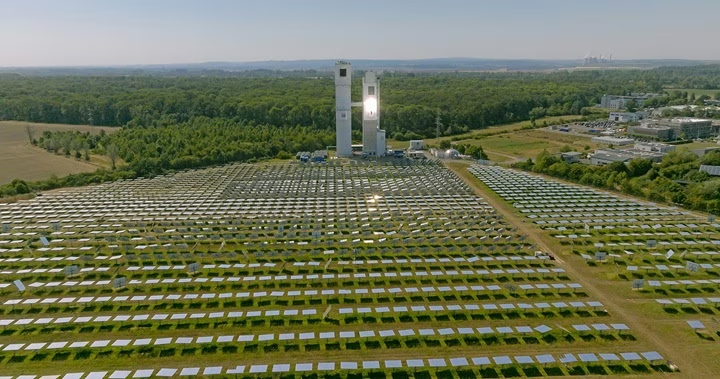
        My Favorites

        Anthony Hopkins Marks His 49th Year Of Sobriety With Video Post

        0
        Welsh actor Anthony Hopkins shared a new message to his fans as he marked 49 years of being sober.The veteran actor has a...