Morning Minute is a daily newsletter written by Tyler Warner. The analysis and opinions expressed are his own and do not necessarily reflect those of Decrypt. And check out our new daily news show covering all of the top stories in 5 minutes or less, downloadable on Apple Pod or Spotify.
GM!
Today’s top news:
Crypto majors fall 1-2% after recent rally; Bitcoin at $74k
Next Fed Chair Kevin Warsh discloses holdings, including Solana, Polymarket, Blast & more
Goldman Sachs filed for a Bitcoin income ETF tied to options
Circle stock jumps 7% after Allaire teases token for Arc
Tether introduces new wallet letting users send stables & BTC
🏛️ The Next Fed Chair Has a Crypto Portfolio
Kevin Warsh is just like us.
Trump’s nominee to replace Jerome Powell as Fed Chair filed his 69-page financial disclosure with the Office of Government Ethics Tuesday, and the document revealed combined assets with his wife of at least $192M.
Through DCM Investments 10 LLC, Warsh holds stakes in Solana, Polymarket, Blast (!!), Optimism, dydx, Dapper Labs, and multiple crypto fintech firms. He also holds a direct stake in SpaceX via the AVGF II fund, and more than $100M in exposure through Juggernaut Fund LP positions tied to advisory work with the Duquesne Family Office.
The man who would set US interest rate policy, oversee banking supervision, and influence stablecoin and crypto regulatory posture has active financial exposure to Solana and a crypto-native prediction market.
Warsh has previously called Bitcoin “the new gold.” But notably he doesn’t have any exposure to it. He’s too busy investing down the risk curve…
Key Details:
Kevin Warsh filed his financial disclosure revealing a 9-figure portfolio with stakes in Solana, Polymarket, SpaceX, and Ethereum dev platform Tenderly
The crypto holdings sit inside DCM Investments 10 LLC, each valued under $500K
The timing: Warsh’s confirmation hearing, the Clarity Act Senate Banking Committee markup, and the April 28-29 Fed meeting are all converging in the same two-week window
📊 Goldman Sachs Just Filed for a Bitcoin Income ETF
Goldman Sachs filed with the SEC on Tuesday for the Goldman Sachs Bitcoin Premium Income ETF – one of the bank’s first direct crypto product filings and its most significant Bitcoin move yet.
The structure: the fund holds exposure to spot Bitcoin ETPs and sells call options on 40–100% of that exposure, collecting premiums it distributes to investors as monthly income.
In practice, this means upside participation gets capped in strong rallies, and in exchange, investors collect yield. It’s the same covered-call playbook Goldman already runs on the S&P 500 via GPIX (~8% annual yield) and the Nasdaq via GPIQ. BlackRock just launched a similar income ETF for Bitcoin as well.
The biggest players in TradFi are finding more and more crypto products to offer their customers.
Key Details:
Goldman Sachs filed for a Bitcoin Premium Income ETF that sells call options on 40–100% of BTC ETF exposure to generate monthly income; earliest launch late June/July 2026
The structure: holds spot Bitcoin ETP exposure, sells covered calls to collect premiums; trades away some upside for steady yield
Context: Goldman already holds $1.1B+ in IBIT on its balance sheet
💳 Tether Launched a Wallet
Tether, the world’s largest stablecoin issuer with $184B USDT in circulation, launched tether.wallet on Tuesday as its first consumer-facing product.
The self-custodial app lets users hold and send USDT, USAT (its US-regulated stablecoin), XAUT (gold-backed token), and Bitcoin across Ethereum, Polygon, Arbitrum, and the Lightning Network. Fees are payable in the asset being sent and no gas tokens required.
Users simply need a user name (name@tether.me instead of hex strings) to get started, and private keys stored on device.
CEO Paolo Ardoino pitched it as the “People’s Wallet,” designed for a future where humans, machines, and AI agents all transact on the same rails. Notably, Tether built the wallet on its open-source Wallet Development Kit – the same toolkit it’s been positioning for AI agent payments.
Key Details:
Tether launched tether.wallet – a self-custodial app supporting USDT, USAT, XAUT, and Bitcoin across Ethereum, Polygon, Arbitrum, and Lightning
The pitch: CEO Ardoino calls it the “People’s Wallet” for humans, machines, and AI agents, built on Tether’s open-source Wallet Development Kit
The strategic move: Tether goes direct-to-consumer for the first time, with 570M wallets already on its network
📈 Circle Stocks Jumps As CEO Teases ARC Token
Jeremy Allaire dropped one sentence at Circle’s Seoul event Tuesday that moved the stock: Circle is exploring a native token for Arc Network, its Layer-1 blockchain currently in testnet.
The token would handle governance, incentives, and economic alignment, with a gradual transition to proof-of-stake.
Allaire described it as “potentially Circle’s most significant platform-level strategic move since the creation of USDC.” CRCL stock rose 7% on the news.
Circle’s Arc already has BlackRock, HSBC, Visa, Goldman Sachs, and AWS on the testnet. Allaire’s vision is an “economic OS for the internet” – institutional financial workflows moving entirely on-chain. A native token would give Arc a governance layer and an incentive mechanism for validators as it transitions to PoS.
Given the major TradFi theme for 2026, let’s just say a Circle token would have very high expectations…
Key Details:
🌎 Macro Crypto and Markets
Crypto majors fall 1-2% after recent rally; BTC flat at $74.2k; ETH -2% at $2,335; SOL -3% at $84; HYPE -1% at $44
DEXE (+17%), APT (+2%), and ARB (+2%) led top movers
Oil -4% at $89; Gold +1% at $4,810
Robinhood’s HOOD stock jumped 15% after the SEC approved ending the Pattern Day Trader rule, which eliminates the $25K minimum equity requirement for day trading
Deutsche Börse invested $200M in Kraken for a 1.5% stake at a $13.3B valuation (down from $20B in November) as Kraken confidentially files for IPO
CowSwap suffered a front-end compromise — DeFi exchange website hijacked; users warned not to interact with the interface until confirmed safe
Fake Ledger app on the Mac App Store drained $9.5M from crypto users before being removed; Apple store security failure with real losses
The Ethereum Foundation put up $1M to back ecosystem security audits
Visa backed Stripe’s Tempo payments network as an anchor validator
JPMorgan CFO raised caution about potential regulatory arbitrage with stablecoins, arguing banks are held to stricter standards than stablecoin issuers on equivalent products
Corporate Treasuries & ETFs
Meme Coin Tracker
Meme leaders were mostly red; DOGE -1%, SHIB -1%, PEPE -2%, TRUMP -1%, PENGU -1%, SPX -1%, FARTCOIN -7%
Unc (+240%), Whitewhale (+80%), Bull (+40%), and wojak (+15%) led notable onchain movers
TRUMP meme coin holders are getting cheaper VIP access to the Mar-a-Lago gala than original TRUMP whale offering prices
💰 Token, Airdrop & Protocol Tracker
🚚 What is happening in NFTs?
NFT leaders were mostly slightly red, Punks continue their decline; Punks -2% at 26 ETH, Pudgy even at 4.06 ETH, BAYC -1% at 6.25 ETH; Hypurr’s +1% at 402 HYPE
DigiDaigaku Genesis (+35%) and Ringers (+5%) led notable movers
Daily Debrief Newsletter
Start every day with the top news stories right now, plus original features, a podcast, videos and more.
Coronation Street fans have been left fuming after spotting two key characters missing from Todd’s harrowing abuse storyline. And viewers are all asking the same question.
Tonight’s emotional episode sees Todd finally go to the police and reveal the full extent of what he’s been suffering at Theo’s hands. While he bravely tells his story, his nearest and dearest are back on the cobbles, anxiously waiting and rallying around him.
But despite the outpouring of support, fans have been quick to notice that two very important people in Todd’s life haven’t been even mentioned. And it hasn’t gone down well.
Summer has been there for Todd (Credit: ITV)
Todd’s family and friends have been there for him
For months, Coronation Street viewers have been watching in distress as Theo isolated Todd and subjected him to abuse behind closed doors. It’s been a tough storyline, making tonight’s episode all the more significant as Todd finally speaks out.
As expected, his friends and extended family waste no time in showing their support. Some are so outraged by what’s happened that they even go as far as threatening Theo, making it clear just how much Todd means to them.
However, while the cobbles have rallied, fans have pointed out a glaring absence — Todd’s own mum Eileen and brother Jason.
Fans want to hear from Eileen or Jason (Credit: ITV)
Where are Eileen and Jason Grimshaw?
The lack of any reference to Eileen and Jason throughout the storyline has left viewers scratching their heads. For long-time fans, it feels especially strange given how close the Grimshaw family has always been.
Jason left Weatherfield back in 2016 for a new life in Thailand, while Eileen was last seen on screen just last June. With that in mind, many viewers can’t understand why neither has been contacted about what Todd has been going through.
While it’s true that Todd kept the abuse hidden for some time, fans believe that once suspicions started to grow, reaching out to his closest family should have been a priority.
And viewers haven’t held back in sharing their thoughts.
Taking to social media, one fan wrote: “At what point will someone in Corrie decide it’s time to contact Eileen and Jason to let them know what is happening to Todd?”
Another suggested a possible explanation, saying: “I’m sure George will mention soon that he contacted Eileen. And she’ll probably not be able to get back for some reason or another.”
But others weren’t convinced. One viewer replied: “I don’t think you could keep Eileen away if she knew. I can only think Todd insists nobody contacts them. Maybe eventually he will tell them when he’s in a position to fly straight out to Thailand.”
A third added: “Ridiculous that they’ve not even been mentioned!”
And another fan echoed the same frustration: “Eileen would have been on the very next plane home!”
Whether the show addresses their absence remains to be seen — but for now, it’s clear viewers are desperate to see Todd’s closest family back where they belong: by his side.
Read more: 4 Coronation Street storylines that need to be wrapped up right now from Carl’s schemes to Will and Megan affair
A sudden shift in global geopolitics has reignited momentum across the crypto market, triggering one of the most aggressive short squeezes in recent months. Following a ceasefire announcement between the United States and Iran, more than $600 million in short positions were liquidated almost overnight, propelling Bitcoin back above the critical $72,000 threshold and injecting fresh optimism into a market that had been weighed down by uncertainty.
The move was swift, decisive, and telling. It wasn’t just a rally – it was a structural reset driven by forced buying, shifting sentiment, and a renewed appetite for risk assets.
A Geopolitical Catalyst Ignites Crypto Markets
Markets had been on edge for weeks amid escalating tensions in the Middle East, particularly around the Strait of Hormuz – a key artery for global oil supply. When news of a two-week ceasefire emerged, the reaction was immediate. Oil prices dropped sharply, easing inflation concerns and removing a major macroeconomic headwind for risk-on assets like crypto.
Bitcoin surged past $71,000 within hours, while Ethereum followed closely, climbing over 6% to reclaim the $2,200 – $2,300 range. At the same time, total crypto market capitalization surged past $2.5 trillion, signaling a broad-based return of capital into digital assets.
But beneath the surface, analysts point to a crucial nuance: this rally was not entirely driven by organic demand.
$600M Short Squeeze Follows Ceasefire
The Mechanics of a $600M Short Squeeze
The primary driver behind this surge was a massive liquidation of bearish positions on derivatives exchanges. Traders who had bet against Bitcoin were forced to buy back positions as prices rose – creating a feedback loop that accelerated the rally.
This phenomenon, known as a short squeeze, often results in sharp, short-term price spikes. According to market data, hundreds of millions in short positions were wiped out, effectively acting as forced fuel for Bitcoin’s upward momentum.
However, this raises an important question: how sustainable is the rally?
Several analysts remain cautious. Despite the strong price action, spot trading volumes, representing real buying demand – remain relatively weak compared to historical norms. This suggests that while prices are rising, the underlying conviction may not yet be fully established.
The Mechanics of a $600M Short Squeeze
Bitcoin’s Range: Breakout or Consolidation?
Over the past two months, Bitcoin has largely traded within a defined range between $64,000 and $74,000, a pattern often associated with consolidation phases in broader market cycles.
While the recent move pushes BTC toward the upper boundary of this range, breaking decisively above $78,000 remains a challenge without a strong catalyst.
Some forecasts suggest a bullish scenario where Bitcoin could test $75,000 – $80,000 in the near term. Others remain more conservative, warning that a retracement toward $54,000 is still possible if momentum fades.
The divide reflects a broader debate: has Bitcoin already found its bottom, or is this simply a relief rally within a larger bearish structure?
Bitcoin 1D price chart (Source: CoinMarketCap)
Institutional Signals Add Complexity
Adding another layer to the narrative is renewed institutional activity. A major digital asset investment firm recently raised over $1 billion to accumulate Bitcoin – an event widely interpreted as a strong vote of confidence in the asset’s long-term trajectory.
At the same time, ETF flows paint a mixed picture. While Bitcoin ETFs have seen notable outflows, Ethereum ETFs are beginning to attract steady inflows, suggesting a subtle shift in investor preference.
This divergence could signal a rotation within crypto markets rather than a simple, unified bull trend.
Crypto ETF market overview for the past 7 days (Source: CoinGlass)
Ethereum: Quiet Strength Beneath Resistance
Ethereum’s performance in this cycle has been particularly noteworthy. Beyond price action, several on-chain indicators point to strengthening fundamentals.
ETH is currently trading near its “realized price” – a key metric representing the average cost basis of all holders. Historically, this level acts as resistance during weak trends but can flip into support when sentiment improves.
Additionally, the Coinbase Premium Index – a measure of U.S. investor demand – has remained positive in recent days, indicating sustained buying interest from American institutions.
Yet, risks remain. Funding rates in derivatives markets have turned negative, suggesting traders are still leaning bearish. Combined with technical resistance near $2,388, Ethereum faces a critical test: break higher and confirm strength, or face rejection and consolidation.
Ethereum 1D price chart (Source: CoinMarketCap)
Pepeto and the Return of High-Risk Capital
While Bitcoin and Ethereum dominate headlines, the current market cycle is also witnessing a resurgence of speculative capital flowing into early-stage and presale tokens.
Among them, Pepeto has emerged as a notable example, raising over $8.8 million during a period of extreme market fear. The project positions itself as an infrastructure-focused ecosystem, offering zero-fee trading tools and cross-chain capabilities.
This aligns with a familiar pattern in crypto cycles: when macro uncertainty fades, capital rapidly expands into higher-risk, higher-reward opportunities.
However, this segment of the market also carries significant risks. The influx of new tokens increases the likelihood of vulnerabilities, scams, and unsustainable tokenomics. As a result, due diligence, particularly around smart contract audits, has become more critical than ever.
Market Psychology: Fear, Greed, and Timing
Perhaps the most important takeaway from this latest rally is psychological rather than technical.
Crypto markets are uniquely sensitive to shifts in sentiment. Fear can suppress prices far below intrinsic value, while relief, such as a geopolitical de-escalation, can trigger rapid, outsized rebounds.
The Fear and Greed Index, which recently hovered at extreme fear levels, underscores this dynamic. Historically, such conditions have often marked accumulation phases for long-term investors.
Yet timing remains everything.
Early participants in previous cycles, those who entered before major catalysts, have historically captured the majority of gains. Whether this pattern repeats in the current cycle will depend on a combination of macro conditions, regulatory developments, and sustained capital inflows.
What Comes Next?
Looking ahead, several key factors will shape the trajectory of the crypto market:
Macroeconomic stability: Continued easing of geopolitical tensions could support further upside.Regulatory clarity: Upcoming policy discussions, including frameworks like the CLARITY Act, may influence institutional participation.Liquidity flows: Sustained inflows into spot markets will be critical for confirming a true bullish reversal.Technical breakouts: Key resistance levels – $78,000 for Bitcoin and $2,388 for Ethereum – remain pivotal.
For now, the market sits at a crossroads.
The $600 million short squeeze has provided a powerful reminder of how quickly conditions can change. But whether this marks the beginning of a sustained uptrend, or merely a temporary relief rally, remains an open question.
Final Take
The ceasefire-triggered rally has reignited momentum across crypto, but it has also exposed the fragile foundation beneath recent gains. Short squeezes can drive prices higher, but lasting trends require real demand.
Bitcoin is testing the upper bounds of its range. Ethereum is showing signs of structural strength. And speculative plays like Pepeto highlight the market’s appetite for risk when sentiment shifts.
For investors, the message is clear: opportunity is returning, but so is volatility.
In this environment, the winners won’t just be those who move first – but those who understand why the market is moving at all.
Take off your hat indoors (The sliding scale of etiquette)
Wednesday, April 15th 2026Tags: Hats
Share
Share this post
Subscribe
42 Comments
||- Begin Content -||
Imagine how delighted I was, dear reader, to find that a subject I wanted to write on – etiquette in clothing behaviour – exists on a sliding scale of commonality.
I love a sliding scale. Whether it’s formality, colour or craft, I love explaining how a question that is often treated as binary is better understood as a gently shaded spectrum, on which we all sit at different points at different times.
Etiquette is similar, because manners are all about being considerate and respectful to those around you, so what’s considered good manners depends on those people. (Just like the question of whether you dress for yourself or others.)
Personally, I hate it when people don’t take their hat off indoors. It partially obscures their face, making it harder to talk to them; it feels like they’ve still got on a piece of outerwear, and so might get up and leave at any moment; and it just feels odd, out of place.
As you have now been primed to notice, some of those reasons are objective, some very subjective, and some depend very much on the society around us.
It’s a matter of our era. I think most people today would notice if someone kept their hat on at the dinner table, but they would have cared much more in the past.
And it’s a matter of location. A friend in New Mexico told me recently that where he is, western hats are definitely kept on during meals such as Sunday lunch. In fact the more formal the occasion, the more it’s required.
Chase in a western hat.
Still, removing your hat off indoors is a fairly universal point of etiquette. Most readers will probably agree with it – it sits towards the common end of the sliding scale.
What’s at the other end? Well, a reader once castigated me for carrying my brimmed hat with the crown pointing inwards, rather than outwards. I was holding it at my side, and because the crown was pointing towards my thigh, the inside of the hat was exposed.
The scandal.
I had never heard of this as a rule, and so I’m fairly confident it’s rare and rather antiquated. I guess I can see the logic – most of our clothes hide the lining and don’t deliberately expose it, in the same way shirt fronts used to be considered underwear and would be hidden by a waistcoat and jacket. That kind of thing could apply to a hat; but it’s a stretch.
The scandalous inside of a hat
If those two might be the extremes, what sits in the middle?
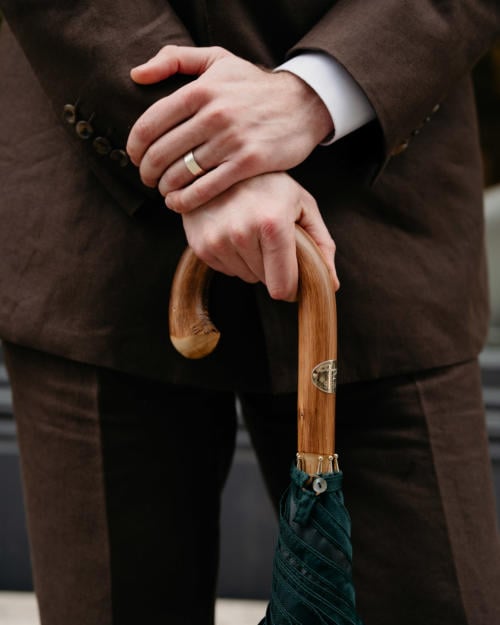
I know there’s one rule than an umbrella should be held by the handle, particularly when walking. I can see how this is more elegant and more practical – your hands are less likely to get wet from a damp canopy.
But, it’s something I rarely do because if I carry an umbrella like that, I feel formal and old-fashioned, as if I should also be wearing a bowler hat.
Much as I love tailoring, I try to wear it in a fairly casual way in order to make it less showy in a society where few wear a suit and tie. For the same reason, I try to avoid accessories (such as an attaché case) that would hinder this. An umbrella carried like a walking stick is in that vein.
So I don’t follow that rule, practical as it might be.
Holding an umbrella by the handle
There aren’t actually many rules about the way you wear clothing (as opposed to what clothes you wear – lots there). So it’s hard to string enough together to make a continuous scale.
But I think readers will know what I mean. Manners at the dining table are similar in a way.
When I tell my children not to talk with their mouth full, it seems reasonable, as the sight of half-chewed food is so disagreeable. But it’s harder to convince them that you should never put your elbows on the table. And impossible to argue that soup should be scooped from the far side of the bowl rather than the near. There’s a sliding scale there from more instinctive and universal, to less.
Perhaps like the rules about what clothes to wear, the key is understanding why the rule exists and then deciding whether to follow it. Keeping your elbows off the table will usually improve your posture – how you sit – but it’s probably more effective to keep that in mind rather than just focus on the elbows.
As ever, I’m interested in what readers have to say on the subject, but I’m particularly interested in what rules of etiquette you follow and how much you think that’s dependent on where (and when) you live.
Graham’s allowed to wear a hat indoors. He’s a hatmaker
Related posts
Hats with coats: A sliding scale
March 19th 2021 – 106 Comments
Read More
Wellema bespoke felt hat: Review
April 6th 2020 – 95 Comments
Read More
Stephen Temkin of Leon Drexler custom hats, Toronto
November 16th 2016 – 34 Comments
Read More
<!–
Subscribe to this post
You can follow the discussion on Take off your hat indoors (The sliding scale of etiquette) by entering your email address in the box below. You will then receive an email every time a new comment is added. These will also contain a link to a page where you can stop the alerts, and remove all of your related data from the site.
Heather Locklear Romance With Lorenzo Lamas ‘Getting Serious’ … Actress Meets His Fam
Published
April 15, 2026
1:00 AM PDT
Heather Locklear and her boyfriend, Lorenzo Lamas, are getting quite serious … with his family meeting the actress for the first time over the weekend … TMZ has learned.
Sources close to the new couple tell TMZ … Lorenzo’s kids and grandchildren went over to Heather’s mansion in a gated community in Thousand Oaks, CA.
Lorenzo’s daughter Shayne Lamas posted a photo of an old modeling campaign featuring Heather and Lorenzo from back in the day on social media. We’re told the photo is on the wall inside Heather’s home.
Heather, Lorenzo and his family went to lunch and the movies. Sources tell us everyone had a blast.
As TMZ first reported … Heather and Lorenzo have been secretly dating for months.
Heather’s last relationship was with ex-fiance Chris Heisser, but they broke up last year after a rocky 5-year romance. She was previously married to Tommy Lee, from 1986 to 1993, and Richie Sambora, from 1994 to 2007.
Lorenzo has had five marriages end in divorce, his latest with ex Shawna Craig dissolved in 2018.
In the world of fancy knit clothes, just a few names really shine for their skill, value and lasting charm. One of these is Allude which has made a special place by focusing mostly on cashmere and high-quality knit pieces. While lots of high-end fashion brands include knits in their lines; Allude has created its image around it, turning it into a pro not an amateur.
When you look at Allude sweaters and other fancy knitwear brands, the change is not just in looks but in ideas. Allude shows quiet beauty, great fabrics, and wearability for daily use. Unlike trendy names, it aims to make items that stay good for years both in how they feel and their style. This makes it especially nice for buyers who like things that last more than quick fashion changes.
Fancy knit clothes as a type have many brands, from old ones known for skill to new labels trying out fresh shapes. But not all of them offer the same level of quality in fabric fit and strength. This is where Allude sets itself apart by keeping a firm promise to high-quality cashmere and well-crafted style.
In this post, we͏ will look at how Allude stacks up against other fancy knitwear brands, what makes Allude sweaters special and why they stay a favorite among people who enjoy top-quality items. Whether you are getting your first luxury knit or adding to your closet, understanding these differences will help you make better choices.
The Philosophy Behind Allude
Allude is made on a plain but strong idea: to lift knitwear into a fancy daily need. Unlike lots of fashion labels that see knitwear as a once-in-a-while extra, Allude puts it at the heart of its image.
The name puts a lot of effort on cashmere, which is often seen as one of the best natural threads in the world. By focusing on this stuff, Allude makes sure that each item shows a steady level of softness, warmth and strength. This hard work helps the brand to improve its ways and keep great quality in all its sets.
Another main part of Allude’s idea is lasting design. Instead of chasing passing fads, the brand makes items that stay important year after year. Neutral color sets, simple shapes and minimal details make Allude sweaters easy to wear and style.
This way attracts shoppers who like to create a picked wardrobe of good basics instead of always changing their clothes. It’s not just about showing off for one season, it’s about putting money into items that are part of your daily look.
Allude vs Other Luxury Knitwear Brands: Key Differences
When you look at Allude with other fancy knitwear brands, some big differences pop up. First, Allude is a brand that really knows knitwear while lots of fancy labels just have knitwear as one small piece of a bigger set. This skill lets Allude fix its art and keep the same quality.
Also, Allude likes simplicity and comfort. While other brands may play with loud looks, designs, or signs, Allude keeps its style neat and quiet This makes its items more useful and good for daily use.
Third, the name puts big importance on cloth quality, especially cashmere. While other fancy names also use top-notch stuff, Allude’s sharp way m͏akes sure a better level of sameness across its goods.
At last, Allude gives a mix of fancy and handy. Its sweaters are made to be used often, not only on big days. This makes them a better buy than showy items from other brands.
What Makes Allude Sweaters Special?
1. Exceptional Cashmere Quality
One of the biggest traits of Allude sweaters is their use of fine cashmere. The brand picks top fibers to make sure they are soft, strong, and warm. Unlike cheap cashmere that can get fuzzy or change shape fast, Allude’s materials are made to keep their feel for a long time.
This care on quality makes sure that each jumper feels nice on the skin but also is useful for everyday use. It’s a buy in comfort as much as style.
2. Timeless and Versatile Designs
Allude’s way of making things is all about being simple and nice. The brand stays away from very trendy stuff, picking classic shapes that can be worn in many ways.
This flexibility makes Allude sweaters good for different times, from laid-back events to more dressed-up places. A single item can easily switch from day to night which makes it a useful part of any closet.
3. Perfect Fit and Tailoring
Fit is very important in knitwear and Allude does great in this part. The brand looks at sizes a lot, making sure that its sweaters look good on various shapes without being tight.
The mix of shape and gentleness is what makes Allude special. The sweaters hang easy while still keeping their form, making a neat and smooth style.
4. Focus on Everyday Luxury
Unlike a few fancy brands that look at big items, Allude puts weight on daily use. Its jumpers are made to wear often, making them useful and also nice.
This way speaks to today’s buyers who wish to spend on items that give both look and use.
5. Subtle Branding
Allude skips big logos or signs, letting the goodness of the cloth and work shine on its own. This simple way makes the brand look good, mainly for people who like soft ͏luxury.
How Allude Compares to Other Luxury Knitwear Brands
Heritage Brands vs Allude
Old fancy knit brands often focus on history and skill, sometimes using fancy shapes or patterns. While these parts can be nice, they may not always fit with new simple styles.
Allude, instead, looks at neat, modern styles that are simpler to fit into daily clothes.
High-Fashion Brands vs Allude
Big brands often try new shapes, odd feels, and loud looks. Though these clothes can catch the eye they may not always be good for daily use.
Alludes take a more even way, giving nice but comfy items that can be worn in many seasons.
Contemporary Luxury Brands vs Allude
Modern names often try to mix cheapness with fancy looks. While they can have stylish shapes, the quality of stuff and making can be different.
Allude keeps a better level of steadiness by using top quality stuff and good building.
Why Allude Stands Out in Luxury Knitwear
Allude shines in the fancy knitwear space because it finds a great mix of good quality, nice design, and useful style. While many brands do well in one part, few can give all three at once.
One of the brand’s main strong points is its focus. By mostly looking at sweater stuff, Allude has made a nice understanding of things, how items are put together and size. This skill shows in every piece, from the smooth touch of the fabric to the neatness of its sewing.
One more thing that makes Allude special is its focus on lasting style. In a field pushed by fads, the brand chooses a steadier way by making looks that stay important over time. This not only boosts the worth of every item but also helps people think more about what they buy.
Also, Allude’s focus on simple charm matches the rising wish for calm luxury. Shoppers are more and more attracted to items that care about good make instead of name, and Allude suits this type well
The name also shines in making knit clothes that are both fancy and useful. Its jumpers are made for everyday life, giving ease, strength, and many uses. This makes them a clever buy for those wanting to make a good closet.
Allude’s skill to mix art, ease, and use makes it a special pick in the busy world of fine knit clothing.
Are Allude Sweaters Worth the Investment?
Putting money into Allude sweaters can be a good choice for people who care about nice things that last. Unlike quick fashion choices, these sweaters are made to stick around for a long time, in both strength and looks.
Using soft cashmere makes it feel nicer and stay nice for a longer time. Even if the first cost is higher, its long life often makes it less costly over time.
Also, the old style of Allude sweaters means they won’t leave fashion quickly. This lets you wear them in many seasons without being concerned about changing trends.
For folks who value ease, flexibility, and simple charm, Allude gives great worth. But if you want loud, showy stuff, other nice brands might be a better pick.
At the end, the pick depends on your own likes and clothing wants. If you enjoy nice basics that can be worn lots of times, Allude is a good choice.
Conclusion
When looking at Allude and other brands in the fancy knitwear field, it shows that this brand has a special spot. Instead of racing on styles or flashy ͏looks, Allude aims to give steady quality, classic design, and daily use. This way makes it different in a market where many brands care more about trendy appeal than lasting worth.
One of the most interesting parts of Allude sweaters is how they mix well with lots of different outfits. No matter if your look is simple, traditional, or modern, these items offer a strong base that can be dressed in many ways. Their plain design makes sure that they stay in fashion every year making them a wise buy for people wanting to create a nice wardrobe.
Another great thing is the brand’s vow to fine stuff, mainly cashmere. This not only makes the sweaters cozier and smoother but also helps them stick around for a longer time. In a moment when buyers care more about good quality and eco-friendly ways, this goal for long-lasting items is super important!
While other stylish knitwear brands may have more loud designs or larger groups, Allude stands out in its field by offering fine knitwear that centers on both style and function. It draws folks who enjoy subtle luxury and are willing to pay for things that offer lasting value.
To sum it up, Allude is a name that shifts everyday fancy with its aim on skill, ease and flexibility. If you want knit clothes that blend beauty with use, Allude is surely a name to think about!
FAQs
1. What makes Allude sweaters different from other luxury knitwear brands?
Allude jumpers shine because of their attention to fine cashmere. They have classic looks and are easy to wear each day, making them both fancy and useful.
2. Are Allude sweaters worth the price?
Yes, they are good for the money for folks who care about nice stuff, lasting power, and designs that can be used in many ways over several years.
3. Is Allude a good brand for minimalist fashion?
Sure. Allude’s neat looks and plain color choices make it perfect for people who like a simple and classic closet.
4. How should you style Allude sweaters?
Allude sweaters can be matched with nice pants, jeans or skirts for a neat look. Their use makes them good for both easy and fancy places.
5. How do you care for Allude sweaters?
Soft sweaters, like those made from cashmere, need light care to keep them nice. It’s good to wash them by hand in cold water with a soft soap or choose dry cleaning by a pro. Don’t twist the cloth; instead, lay it flat for drying to keep its form and fluffiness.
6. Are Allude sweaters suitable for all seasons?
Yeah, Allude sweaters are made to be useful and can be worn in many seasons. Light cashmere types are great for changing weather but thicker knits give heat in colder times, making them a year-round nice piece.
Published: April 15, 2026 at 3:07 am Updated: April 15, 2026 at 3:07 am
by Anastasiia O
Edited and fact-checked:
April 15, 2026 at 3:07 am
To improve your local-language experience, sometimes we employ an auto-translation plugin. Please note auto-translation may not be accurate, so read original article for precise information.
In Brief
Polygon launches sPOL, a native liquid staking token unlocking POL liquidity, boosting DeFi use and returns, and giving stakers a share of priority fees.
Polygon, an Ethereum Layer 2 scaling platform, has introduced a native liquid staking token known as sPOL, aimed at increasing capital efficiency within its ecosystem and improving returns for token holders. The launch is positioned as an important development in the network’s staking infrastructure, particularly given the scale of currently locked assets.
More than 3.6 billion POL tokens are staked across the network, yet only an estimated 4–5% of that supply is considered liquid and actively utilized in decentralized finance (DeFi) applications. This imbalance has highlighted a large pool of underutilized capital.
The introduction of sPOL is intended to address this inefficiency by enabling stakers to unlock the value of their staked POL without forfeiting staking rewards. As a native liquid staking token developed by Polygon Labs, sPOL allows users to maintain staking positions while simultaneously deploying their assets in DeFi protocols. In addition to standard staking rewards, participants are also eligible to receive a share of priority transaction fees generated on the network, potentially enhancing overall yield.
The token has undergone security audits conducted by ChainSecurity and Certora, and its launch has been supported by initial liquidity measures. Polygon has allocated 10 million POL from its treasury to seed liquidity on the first day, with plans to increase this figure to a total of 100 million over time. Liquidity pools for sPOL are already active on Uniswap V4, ensuring immediate accessibility and avoiding delays often associated with market-driven liquidity formation.
Expanding Staking Efficiency And Network Incentives
This development coincides with broader efforts by Polygon to revise how priority fees are distributed. A recent proposal aims to direct a larger portion of these fees toward POL stakers, aligning incentives between network participants and validators. The introduction of sPOL is presented as part of this wider initiative to ensure that economic value generated by network activity is more effectively shared with those contributing to its operation.
From a functional perspective, sPOL is designed to integrate seamlessly with existing staking mechanisms. Users who are already staking POL can migrate their positions into sPOL through the Polygon staking portal without interruption to rewards. New staking deposits automatically generate sPOL tokens in return. The token initially maintains a one-to-one exchange rate with POL, which increases over time as rewards accumulate, meaning the value per token rises rather than the token balance itself.
Once obtained, sPOL can be freely utilized across DeFi applications, including liquidity provision and collateralization, while retaining underlying staking benefits. Holders also have the option to redeem sPOL for the original POL plus accrued rewards at any time.
The launch reflects Polygon’s response to a fragmented liquid staking landscape, where third-party solutions have historically imposed fees ranging from 5% to 16%. Compared to Ethereum, where approximately 30% of staked ETH is liquid, Polygon’s lower adoption rate has underscored the need for a more integrated and cost-efficient alternative.
Disclaimer
In line with the Trust Project guidelines, please note that the information provided on this page is not intended to be and should not be interpreted as legal, tax, investment, financial, or any other form of advice. It is important to only invest what you can afford to lose and to seek independent financial advice if you have any doubts. For further information, we suggest referring to the terms and conditions as well as the help and support pages provided by the issuer or advertiser. MetaversePost is committed to accurate, unbiased reporting, but market conditions are subject to change without notice.
About The Author
Alisa, a dedicated journalist at the MPost, specializes in crypto, AI, investments, and the expansive realm of Web3. With a keen eye for emerging trends and technologies, she delivers comprehensive coverage to inform and engage readers in the ever-evolving landscape of digital finance.
More articles
Alisa, a dedicated journalist at the MPost, specializes in crypto, AI, investments, and the expansive realm of Web3. With a keen eye for emerging trends and technologies, she delivers comprehensive coverage to inform and engage readers in the ever-evolving landscape of digital finance.
“Why’s everyone so nervous about fighting this Thragg guy?” the young superhero Oliver Grayson (Christian Convery) asks in episode 7 of Invincible season 4. “No way he lives up to the hype.”
Showrunners Robert Kirkman and Simon Racioppa built up the leader of the Viltrum Empire as one of the greatest threats in the galaxy, but he didn’t get much screen time before the final two episodes of the season. So it was up to Pushing Daisies and Foundation star Lee Pace to make the most of his scenes to ensure Grand Regent Thragg actually did live up to the hype.
“He carries some weight in this world, so I wanted to hit notes with the character that set him up for a big arc, set him up for a big journey,” Pace told Polygon in a video interview. “The best way I could think to do that was to be prepared to come into that recording booth, but give them a lot of options to work with so that they could tone the character the way they wanted to. As I was recording things, I would see Kirkman be like, Yeah, yeah, that’s it. That’s fun.”
[Ed. note: This article contains spoilers for Invincible season 4, episode 7]
While Pace wasn’t familiar with Invincible before he was cast, he proceeded to read all of Kirkman’s comic book series so he could understand where Thragg is coming from (and where he’s going) as a character. The episode “Don’t Do Anything Rash” shows how Thragg took over Viltrum in a bloody purge after the rebel Viltrumite Thaedus (Peter Cullen) killed the old emperor. Later, in the show’s present, when the Coalition of Planets forces think that they are ambushing a weakened foe, they find even their best warriors are no match for Thragg’s might.
Image: Prime Video
“I wanted to start playing him like a cool customer. He’s very calm. He’s very measured in what he’s trying to do,” Pace said. “Thragg is strategic and desperate in this story. The Viltrumites are down to a very few, and he’s tasked with either their annihilation or continuing the mission at their heart of basically moving through the galaxy and conquering it.”
Pace has a lot of experience playing powerful characters in space. Before taking on the role of Thragg, he played the fanatical Kree Ronan the Accuser in Guardians of the Galaxy and the cloned emperor Brother Day in Foundation.
“[Thragg] is similar to Ronan in his strict ideology, but we’re really setting him up to dismantle him in this story,” Pace said. “Brother Day is very different because he’s many iterations of the same man. Foundation is a story about some incredible intellects – Hari Seldon, Gaal Dornick, and the robot Demerzel – and he’s just a messy human with good instincts about what’s probably going to work out for him. He never says die. I found him really fun to play because he’s got a lot of blind spots, he’s got a lot of flaws, but he’s durable.”
The first seven episodes of Invincible season 4 are available to stream on Prime Video. The season finale will be released on April 22.
TORONTO, April 14, 2026 (GLOBE NEWSWIRE) — Constellation Software Inc. (“Constellation”) (TSX:CSU) today announced that Juniper Group, an operating group of Vela Software, has entered into a definitive agreement to acquire a majority interest in Derbysoft Holdings Limited (“Derbysoft”), the ultimate parent company of DerbySoft Inc.
Completion of the acquisition remains subject to the satisfaction of customary closing conditions and regulatory approvals. Key executive team members will retain a minority stake in Derbysoft and will enter into a shareholders’ agreement with Juniper Group to manage the governance of Derbysoft going forward.
Cantor Fitzgerald is serving as exclusive financial advisor and Ekberg, Fagre & Seem LLP is serving as legal counsel to DerbySoft.
About Constellation:
Constellation acquires, manages and builds vertical market software businesses that provide mission critical software solutions.
For further information, contact:
Jamal Baksh
Chief Financial Officer
Tel: 416-861-9677
jbaksh@csisoftware.com
http://www.csisoftware.com
About Web3Wire Web3Wire – Information, news, press releases, events and research articles about Web3, Metaverse, Blockchain, Artificial Intelligence, Cryptocurrencies, Decentralized Finance, NFTs and Gaming. Visit Web3Wire for Web3 News and Events, Block3Wire for the latest Blockchain news and Meta3Wire to stay updated with Metaverse News.
I couldn’t sleep last night after diving deep into a rabbit hole about the future of nanotechnology. The deeper I went, the more terrified I became. We spend so much time worrying about the next biological pandemic, but what if the ultimate threat to humanity isn’t biological at all? What if it’s a microscopic, synthetic machine?
Imagine a scenario where invisible robotic swarms spread through the air, completely undetected by our natural immune systems. They aren’t looking for a host to reproduce; they are executing a programmed command to hack our nervous systems or shut down our future bionic organs from the inside out.
Could a microscopic machine really wipe out 2 billion people? I want to break down the mechanics, the terrifying possibilities, and why I think this is a conversation we need to be having right now.
The Shift from Biological to Synthetic Nightmares
When I look at the medical breakthroughs happening today, I am genuinely amazed. We are designing nanobots that can deliver cancer-fighting drugs directly to a tumor without damaging the surrounding tissue. It’s brilliant. But my mind always wanders to the dark side of that same coin.
If we can build a machine small enough to navigate the human bloodstream to heal, we can absolutely build one to destroy.
A biological virus mutates randomly. It needs us alive, at least for a little while, so it can spread. A nanobot swarm, however, doesn’t care about survival. It only cares about executing code. These microscopic drones could be deployed into the atmosphere, drifting like dust until they are inhaled.
Here is what terrifies me the most about a synthetic virus:
Targeted Precision: Unlike a biological virus that infects indiscriminately, a nano-swarm could theoretically be programmed to target specific genetic markers, populations, or even individuals.Zero Incubation Period: Machines don’t need to replicate inside your cells to make you sick. They just need to reach their target area—like the brain stem or the heart—and trigger a physical or electrical disruption.Immunity is Irrelevant: Your white blood cells are completely useless against a swarm of carbon-nanotube robots.
Hacking the Human Body: A Cybersecurity Crisis in Our Veins
We are rapidly moving toward a transhumanist future. Brain-computer interfaces like Neuralink are already being tested in humans. We are replacing failing organs with smart, bionic alternatives. I love this tech, but I also see a glaring vulnerability.
What happens when our bodies are connected to the network? If I can hack a smartphone, what’s stopping a malicious actor from hacking a bionic lung? This is where the concept of a “nano-virus” goes from scary to absolutely apocalyptic. If a rogue nation or a terrorist organization releases a swarm of nanobots, those bots wouldn’t even need to physically destroy our tissue. They could simply act as microscopic antennas, bridging the gap between our internal bionic hardware and an external hacker.
The Mechanics of an Internal Cyber-Strike
Let’s walk through how a hypothetical attack might actually happen. This isn’t sci-fi anymore; the physics already make sense to me.
Deployment: The swarm is released over a densely populated area via a high-altitude drone. The bots are so small they are inhaled by millions of people within hours.Infiltration: Once inside the lungs, they cross the blood-gas barrier, entering the bloodstream.Hacking the Neural Link: The nanobots navigate to the brain or a specific bionic implant. Instead of tearing tissue, they emit localized electromagnetic interference or feed corrupted data directly into the user’s neural interface.The Shutdown: Millions of people experience simultaneous bionic organ failure, or worse, their nervous systems are hijacked, causing immediate paralysis or death.
When you scale this up globally, a death toll of 2 billion people suddenly doesn’t sound like a crazy exaggeration. It sounds like a mathematical probability.
The “Gray Goo” Scenario vs. Invisible Assassination
If you’ve read about nanotech before, you’ve probably heard of the “Gray Goo” theory—the idea that self-replicating nanobots consume all matter on Earth to build more of themselves until the planet is just a lifeless sphere of microscopic robots.
Honestly? I think the Gray Goo scenario is a bit too theatrical. What worries me is the quiet, invisible assassination.
We don’t need self-replicating bots to cause mass extinction. We just need millions of cheap, mass-produced nanobots carrying a simple payload. The scariest part of my research was realizing how incredibly difficult it would be to attribute an attack like this. If a million people suddenly drop dead from cardiac arrest, how long would it take for coroners to realize the cause wasn’t a heart disease, but a microscopic machine lodged in the heart valves?
By the time we identify the threat, the attacker could already be wiping the code and dissolving the bots.
Are We Building Our Own Doomsday Device?
I am a massive advocate for technological progress. I write about the Metaverse, AI, and robotics every single day because I believe these tools will elevate humanity. But I can’t ignore the dual-use dilemma staring us in the face.
Every time we make a medical breakthrough in targeted drug delivery, we are writing the blueprints for targeted biological warfare.
So, how do we defend ourselves? Do we need to invent a biological firewall? Imagine having to inject yourself with “Anti-Virus” software—literally—where defensive nanobots patrol your bloodstream, hunting down rogue synthetic intruders. We might end up in a microscopic arms race happening directly inside our veins.
I started this deep dive thinking nanotech bioweapons were a distant, cyberpunk fantasy. Now, I’m convinced it’s one of the most critical cybersecurity and existential threats of the 21st century. We are eagerly building the infrastructure for a connected human body, but I don’t think we are putting any locks on the doors.
Is this dystopian scenario the ultimate end we are building for ourselves, or am I just being too paranoid about the dark side of tech? I really want to know where you stand on this. Drop your thoughts in the comments below—are you ready to install an antivirus for your bloodstream?
Fire-Rated Access Doors And Panels Market According to Market Research Intellect, the global Fire-Rated Access Doors And Panels market under the Internet, Communication...