Home Blog Page 39

Young and the Restless Next Week: Matt Lures Sharon Into His Twisted Deadly Trap!

    0
    Young and the Restless Next Week: Matt Lures Sharon Into His Twisted Deadly Trap!


    Young and the Restless spoilers for next week divulge Sharon Newman (Sharon Case) trotting into danger when Matt Clark (Roger Howarth) lures all the people that he wants to ruin to Las Vegas. Looks like he’s going to do all the dirty work right there in Sin City.

    We have got the latest Y&R spoilers for the week of April 20th, including Christine Blair (Lauralee Bell) surprising Danny Romalotti (Michael Graziadei) and Nate Hastings connecting with Stephanie Simmons (Vivica A. Fox). But before we get into all that, please hit subscribe if you are not following us yet.

    Sharon And Noah Head To Vegas on Young and the Restless

    All right, first let’s talk about what is going down in Las Vegas. Because it looks like Sharon and Noah Newman (Lucas Adams) are about to walk right into Matt Clark’s diabolical trap. At the end of this week, Chelsea Lawson (Melissa Claire Egan) called Sharon to tell her that Nick Newman (Joshua Morrow) has gone missing and the whole, you know, OD death thing and Matt took Adam Newman (Mark Grossman) to see him.

    And Sharon freaks, of course, and Chelsea promised to keep Sharon posted. Then Matt showed back up after attacking and locking Adam in with Nick. And then Matt was doing this creepy flirty thing with Chelsea by the end of the week. She just went off on him and accused Matt of liking to break people. And he tells her Nick and Adam were sticking their noses where they do not belong.

    Chelsea’s Suspicious on Y&R

    Chelsea suspects that Nick and Adam are still in the building just because, you know, Matt wasn’t gone that long and he’s easily come back to taunt her. And so Chelsea’s demanding that Matt tell her where he is holding Nick and Adam. Chelsea’s begging for Matt to tell her that Nick is not dead. But Matt insists that Nick is indeed dead as a door. And Matt gets even creepier. And he tells Chelsea that her begging him is hot. Then Matt leaves Chelsea to basically wait and worry.

    Meanwhile, Adam wakes up after he got clocked with the fire extinguisher and he checks Nick’s pulse and he wakes his brother up, gets him untied. So, Adam wants to know if Nick is hooked on drugs. But, of course, like an addict, he denies it and he claims that Matt is lying and just saying things about him that aren’t true. So, you know, Adam just kind of drops it. Because I think he clearly knows that Nick is lying. And he tells Adam that Matt drugged him once and that was instead of killing him. And Adam tells Nick that Chelsea is also there in Vegas. Nick is actually glad to hear that Sharon didn’t also come to Vegas.

    Adam spots a landline phone in the room, which is pretty sloppy of Matt, unless he did it on purpose and is listening in on the calls or something. Which I wouldn’t put it past him. He’s kind of a chess master. So, Adam calls Chelsea and Nick’s hiding his drugs. Then Chelsea shows up and unlocks the door and gets them out. And once they’re back upstairs in the hotel suite, Nick runs to the bathroom. Got to do his drugs. And Adam tells Chelsea he thinks that Nick’s an addict. And he comes back out and tells Adam and Chelsea they need to find Matt before he goes to Genoa City. But he doesn’t need to go. He’s luring people.

    Matt Pretends To Be Nick on Young and the Restless

    So, Matt’s got Nick’s phone that he took from him and he sends a text to Sharon and he’s pretending to be Nick. And tells her he captured Matt and that Sharon should come to Vegas so she can be there when he takes Matt down. So Sharon updates Noah and she said that Chelsea told her Nick disappeared and then Sharon sees the text from Matt acting like Nick. And then she texts back thinking it’s her ex and Sharon says that they’re on their way. So, Matt texts back that he can’t wait to see Sharon and in next week Young and the Restless spoilers we’ve got Matt finally getting his filthy hands on Sharon.

    So, we’re going to have Sharon and Noah showing up in Vegas next week. They’re in some outlying area near what seems to be some abandoned building, and it looks like Matt lured them away from the strip where there’s lots of people and into some place a little more remote, a little more dangerous.

    So, I wonder if Sharon at some point called Chelsea and she tells her Nick and Adam are safe and that Sharon isn’t texting with Nick, that it’s Matt who has his phone. So, as Sharon and Noah are checking out the abandoned property, Sharon is worried and she asked if Noah thinks they should go inside or not. Now, he is a hothead like Nick, so I’m going to guess he wants to go in.

    Nate Runs Into Stephanie on Y&R

    Also, next week on Y&R, spoilers have an interesting encounter. Dr. Stephanie Simmons (Vivica A. Fox) runs into Nate Hastings (Sean Dominic), and Stephanie is asking Nate how he knows Olivia Winters. So, Stephanie clearly doesn’t know who she’s talking to when she first sees him. And when Nate says Olivia is his mother, Stephanie is thrilled and says, “Nate, Nate Hastings. Oh my goodness.” And if you don’t remember, his mom Olivia along with Drucilla Winters did matchmaking and got Stephanie and Malcolm Winters (Shemar Moore) to start dating. If not for Nate’s mom, Holden Novak (Nathan Owens) would never have been born. So I think Nate’s going to be stunned by all that.

    Christine Has A Surprise For Danny

    Elsewhere in Genoa City, next week’s spoilers have Christine telling Danny that she has a little surprise of her own, but it’s actually a big surprise. Not so little. So, I wonder what it is. Christine loves surprising him, and I wonder if she’s going to join Danny on his trip to Barcelona. You know, maybe she’ll have the Mariah stuff wrapped up by then.

    Young and the Restless Spoilers: Sharon Newman (Sharon Case) - Matt Clark (Roger Howarth)
    Young and the Restless Spoilers: Sharon Newman – Matt Clark

    Summer’s Conglomerate Going Down on Young and the Restless

    Meanwhile, at the end of this week at Phyllis Summers‘ (Michelle Stafford) stolen company, Summer Newman‘s conglomerate, Michael Baldwin (Christian LeBlanc) is making a big romantic gesture. He has filled Lauren Fenmore‘s (Tracey E. Bregman) office with flowers and candles, and Michael gives Lauren a watch with no hands to remind her their love is timeless, unless it’s digital.

    How do you tell time on a watch with no hands? Anyway, so Michael tells Lauren working with Phyllis is crazy or it’s brave, but Michael won’t stop Lauren from pursuing her dreams. But her dream of setting the world on fire with Phyllis looks like it’s going to go up in flames next week.

    Young and the Restless: Victor’s Plan Launches?

    So, the latest Young and the Restless spoilers have Lauren asking Michael what’s wrong. He says there’s no good way to say it. Summer’s Conglomerate is going down. And if you remember, Victor Newman (Eric Braeden) said he was going to use Chancellor to take down Phyllis and get back what she stole. So it sounds like Victor might be kicking his plan into high gear just in time for May sweeps, which kicks off Thursday of next week.

    So, I wonder if Michael found out from Victor what’s going on. Because he did promise Diane Jenkins Abbott (Susan Walters) he’d try and talk to Victor and get more info about what went down with Jack Abbott (Peter Bergman) and the yacht. Because Victor is still denying he drugged Jack and that’s important information that Diane needs.

    Jack And Nikki’s Plan on Y&R

    Also, at the end of this week, we saw Jack and Nikki Newman (Melody Thomas Scott) discussing their broken marriages, and they were talking about how they should make Victor and Diane jealous to get them where their spouses want to try and actually fix things. Now, I don’t think this is a good idea.

    But it looks like Jack and Nikki may be the ones to fake some sort of romance or reconciliation to try and scare Victor and Diane straight. But I think that would be a huge mistake. Because it would likely further alienate Victor from Nikki and Diane from Jack. And I think it would absolutely backfire on Nikki and Jack if they go there.

    So, Young and the Restless is going to be keeping us on the edges of our seat this coming week. Because May sweeps is kicking off. Be sure to check out our complete weekly spoilers video for the week of April 20th through the 24th, our weekly predictions, and so much more.




    Source link

    GenZVerse Debuts a Transparent, Community-Led Web3 Platform with No Central Points of Control

    GenZVerse Debuts a Transparent, Community-Led Web3 Platform with No Central Points of Control


    GenZVerse Debuts a Transparent, Community-Led Web3 Platform with No Central Points of Control

    Built on Polygon with immutable smart contracts, a public codebase, and fully on-chain governance, GenZVerse eliminates the founding team from the governance equation – by design, not by policy.

    GenZVerse has debuted a decentralised Web3 platform that treats transparency and community leadership not as aspirational values but as structural requirements – features of the platform’s architecture that are verifiable by any participant at any time. Built on Polygon’s Layer 2 blockchain with immutable smart contracts and a fully open-source codebase, GenZVerse operates without central points of control and without a founding team that retains authority over community decisions.

    The distinction between policy-based and architecture-based decentralisation is central to GenZVerse’s positioning. Policy-based decentralisation – in which a team commits to honouring community governance outcomes – is a trust proposition. It depends on the ongoing goodwill and integrity of the founding team. Architecture-based decentralisation – in which smart contracts enforce governance outcomes automatically and the founding team holds no structural override capacity – is a verifiable proposition. GenZVerse is built on the latter model.

    Every significant platform decision is made through GenZVerse’s on-chain governance framework. Proposals are submitted publicly and visible to all community members from the moment of their creation. Votes are weighted by token participation and recorded immutably on the Polygon blockchain. Outcomes are executed by smart contracts without human mediation. The platform’s community treasury is governed by the same mechanism: no funds can be deployed without a successfully completed governance vote, and all treasury transactions are permanently visible on-chain.

    “Transparency is not a communications strategy for us – it is a design constraint,” said a GenZVerse spokesperson. “Every decision the platform makes is visible. Every allocation of community funds is auditable. Every governance outcome is on-chain and permanent. We have built a platform where trust is established through verification, not through promises.” 

    Beyond governance, GenZVerse is preparing to launch its Affiliate & Community Growth Program on April 21, 2026, designed to incentivise participation and accelerate ecosystem expansion. The initiative aims to build a highly engaged global community, with a long-term vision of reaching 1 million users within the next two years through structured referral mechanisms and reward-based engagement.

    The platform’s open-source codebase and publicly auditable smart contracts extend this transparency to the technical layer. Any developer or community member can review the platform’s code, examine its smart contract logic, and verify that its operations are consistent with its stated principles. Discrepancies between the platform’s claims and its code are not a matter of interpretation – they are objectively detectable. This level of technical accountability is, in GenZVerse’s view, the minimum standard for a platform that claims to be genuinely decentralised.

    GenZVerse’s five-year roadmap commits to a phased and accountable transfer of governance authority, culminating in full community autonomy by year five. The platform is live and open for participation at GenZVerse.ai 

    ABOUT GenZVerse

    GenZVerse is a Polygon-based, fully decentralised Web3 platform built to deliver sustainable community governance and demonstrable, real-world utility. Grounded in the principles of radical transparency, open-source development, and genuine community ownership, GenZVerse is engineering a self-sustaining digital ecosystem in which token holders exercise direct democratic control over the platform’s evolution  from governance proposals to treasury allocation and product roadmap. GenZVerse operates without central points of failure. Its codebase is fully open-source, its smart contracts are publicly auditable, and its governance is entirely on-chain. The platform is built on Polygon’s Layer 2 infrastructure providing fast, low-cost transactions that make participation accessible to communities worldwide, not merely to institutional actors. GenZVerse’s founding philosophy is captured in a single commitment: no hype, no promises, only transparent, community-driven development.

    For further information, whitepaper access, and community onboarding, visit: https://GenZVerse.ai

    Social Media Details:

    Contact Details: 

    Organisation: GenZVerseEmail: [email protected]Website: https://GenZVerse.ai

    Disclaimer

    In line with the Trust Project guidelines, please note that the information provided on this page is not intended to be and should not be interpreted as legal, tax, investment, financial, or any other form of advice. It is important to only invest what you can afford to lose and to seek independent financial advice if you have any doubts. For further information, we suggest referring to the terms and conditions as well as the help and support pages provided by the issuer or advertiser. MetaversePost is committed to accurate, unbiased reporting, but market conditions are subject to change without notice.

    About The Author


    Gregory, a digital nomad hailing from Poland, is not only a financial analyst but also a valuable contributor to various online magazines. With a wealth of experience in the financial industry, his insights and expertise have earned him recognition in numerous publications. Utilising his spare time effectively, Gregory is currently dedicated to writing a book about cryptocurrency and blockchain.

    More articles


    Gregory, a digital nomad hailing from Poland, is not only a financial analyst but also a valuable contributor to various online magazines. With a wealth of experience in the financial industry, his insights and expertise have earned him recognition in numerous publications. Utilising his spare time effectively, Gregory is currently dedicated to writing a book about cryptocurrency and blockchain.


    Source link

    Wall Street Deepens Crypto Push As Goldman ETF Filing And Quantum Debate Collide With Bitcoin’s Price Stagnation

    Wall Street Deepens Crypto Push As Goldman ETF Filing And Quantum Debate Collide With Bitcoin’s Price Stagnation


    In Brief

    K33 highlights rising Wall Street crypto expansion, Goldman’s new Bitcoin ETF filing, and quantum security debates, as institutional momentum grows despite Bitcoin’s muted price action.

    Wall Street Deepens Crypto Push As Goldman ETF Filing And Quantum Debate Collide With Bitcoin’s Price Stagnation

    An institutional cryptocurrency research firm, K33, has published a market analysis highlighting accelerating involvement from major financial institutions in digital assets, alongside emerging technical and security discussions within the Bitcoin ecosystem. The report points to a growing disconnect between strong institutional momentum and relatively subdued price action in the market.

    Among the developments cited is a new filing by Goldman Sachs for a Bitcoin-linked exchange-traded fund named the Goldman Sachs Bitcoin Premium Income ETF. Unlike spot Bitcoin ETFs that directly hold the asset, the proposed product is structured to gain exposure through other Bitcoin exchange-traded products and derivatives, including options tied to those instruments. The strategy also incorporates income generation by selling call options, allowing the fund to collect premiums while potentially limiting upside participation if Bitcoin prices rise beyond certain thresholds. This structure is positioned to appeal to investors seeking yield and moderated exposure rather than full price appreciation.

    At the protocol level, discussions around long-term network security have intensified. A draft proposal, known as BIP-361, has been introduced to address potential risks posed by future advances in quantum computing. The proposal outlines a phased transition away from existing cryptographic signature schemes toward quantum-resistant alternatives. Given that a portion of Bitcoin wallets have exposed public keys, researchers have raised concerns that these could become vulnerable under sufficiently advanced quantum capabilities. The proposal suggests gradually restricting legacy address formats and, over time, invalidating transactions that rely on outdated cryptography, though debate continues regarding the urgency and feasibility of such measures.

    Institutional Expansion Accelerates Despite Market Consolidation

    The report also notes continued large-scale capital flows into Bitcoin through corporate structures. Strategy has expanded its use of preferred equity instruments, particularly its STRC issuance, as a funding mechanism for ongoing Bitcoin acquisitions. Trading activity in this instrument recently reached record levels, reflecting its increasing role in financing the firm’s accumulation strategy and broader capital-raising plans.

    Institutional integration of digital assets is also advancing within traditional banking operations. Morgan Stanley has indicated that cryptocurrencies are becoming embedded in its day-to-day business, with growing demand across both direct exposure and ETF-based products. The firm is exploring further integration of blockchain infrastructure and tokenization, while navigating regulatory and operational challenges associated with incorporating these technologies into established financial systems.

    More broadly, the report emphasizes that major financial institutions are expanding their presence across trading, custody, and asset management services tied to cryptocurrencies. This trend is supported by sustained trading volumes and fee generation opportunities, suggesting that the sector is increasingly viewed as a durable component of global financial markets rather than a short-term phenomenon.

    Despite this structural expansion, Bitcoin has remained in a consolidation phase following a significant market downturn. The divergence between ongoing institutional adoption and muted price performance is highlighted as a notable feature of the current market environment, indicating that underlying developments may not yet be fully reflected in asset valuations.

    Disclaimer

    In line with the Trust Project guidelines, please note that the information provided on this page is not intended to be and should not be interpreted as legal, tax, investment, financial, or any other form of advice. It is important to only invest what you can afford to lose and to seek independent financial advice if you have any doubts. For further information, we suggest referring to the terms and conditions as well as the help and support pages provided by the issuer or advertiser. MetaversePost is committed to accurate, unbiased reporting, but market conditions are subject to change without notice.

    About The Author


    Alisa, a dedicated journalist at the MPost, specializes in crypto, AI, investments, and the expansive realm of Web3. With a keen eye for emerging trends and technologies, she delivers comprehensive coverage to inform and engage readers in the ever-evolving landscape of digital finance.

    More articles


    Alisa, a dedicated journalist at the MPost, specializes in crypto, AI, investments, and the expansive realm of Web3. With a keen eye for emerging trends and technologies, she delivers comprehensive coverage to inform and engage readers in the ever-evolving landscape of digital finance.


    More articles


    Source link

    Bitcoin Faces $76K Resistance as Exchange Inflows Surge to Multi-Month Highs

    0
    Bitcoin Faces K Resistance as Exchange Inflows Surge to Multi-Month Highs


    Bitcoin (BTC) is stalling below the $76,000 zone in mid-April 2026, as on-chain data shows exchange inflows surging to multi-month highs. This development occurs as the BTC price hovers around $75,600, down slightly by about 0.4% in 24 hours but still up over 3% for the week. The surge in Bitcoin transfers to exchanges coincides with the price approaching this key resistance, suggesting the building short-term selling pressure.

    Bitcoin Struggles Below Key Resistance

    BTC Price Chart (1D)

    BTC Price Chart (1D). Source: TradingView

    Currently, Bitcoin is testing the $76,000 resistance level—a price point that has repeatedly rejected upward momentum over the last two months. After a deep drop to the $60,000 zone in early February, BTC recovered and established a short-term bullish structure with higher lows.

    However, this upward momentum is showing signs of weakening as the price is continuously rejected around the $75,000–$76,000 range. The current trading range is narrowing between the overhead resistance and support around $70,000–$72,000, indicating the market is entering a price compression phase.

    In this context, the lack of momentum to break through resistance leaves the market vulnerable to cash flow factors, especially since the market has not yet shown a signal strong enough for a breakout.

    Exchange Inflows Signal Rising Sell Pressure

    Bitcoin Exchange Inflow (Total)Bitcoin Exchange Inflow (Total)

    Bitcoin Exchange Inflow (Total). Source: CryptoQuant

    Data from CryptoQuant shows that the amount of Bitcoin transferred to exchanges has increased sharply in recent days, with a peak on April 14 when inflows exceeded approximately 64,000 BTC—the highest level since early February.

    Assets being moved to exchanges are often associated with the intent to sell or reallocate portfolios, particularly when occurring at high price levels. Simultaneously, recent inflow spikes have appeared with higher frequency, suggesting that capital is reacting more sensitively to market rallies.

    This development is further supported by CryptoQuant data, showing hourly exchange inflows reaching approximately 11,000 BTC—the highest level since December 2025 and higher than the spikes seen before the corrections in March.

    Meanwhile, netflow data since the beginning of 2026 still shows an overall outflow from exchanges, reflecting a long-term accumulation trend, even though short-term inflows are increasing around high price zones.

    Whale Inflows Add to Distribution Concerns

    Bitcoin Exchange Whale RatioBitcoin Exchange Whale Ratio

    Bitcoin Exchange Whale Ratio. Source: CryptoQuant

    The Exchange Whale Ratio—an indicator measuring the proportion of large transactions in the total Bitcoin inflow to exchanges—has remained high in recent sessions, reflecting that large transactions account for a significant portion of total inflows.

    This indicates that the capital moving onto exchanges is not coming from retail investors, but primarily from large wallets—typically represented by “whales” or long-term holders.

    In previous cycles, an increase in whale inflows often coincided with local price peaks, as large holders utilized liquidity to distribute assets. The fact that this indicator is rising alongside total inflows reinforces the possibility that the market is facing active selling pressure rather than just a short-term reaction.

    Additional Signals Show Mixed Market Positioning

    With Bitcoin at a resistance zone and exchange inflows increasing, indicators from the derivatives market show a divergence in investor positioning.

    Funding rates on futures exchanges have remained negative for the past 7 consecutive days, reflecting that most traders are leaning toward short positions. Simultaneously, Open Interest (OI) is trending back up toward approximately $26 billion, indicating that new positions are being opened rather than closed.

    The combination of negative funding and rising OI typically reflects a buildup of short positions, which could become a trigger for volatility if the price moves against market expectations.

    Furthermore, capital flows from ETFs also show divergence. Some recent sessions have recorded significant outflows, though a prolonged trend of withdrawals has not yet formed.

    Hyperliquid Liquidation MapHyperliquid Liquidation Map

    Hyperliquid Liquidation Map. Source: Coinglass

    Meanwhile, liquidation maps show large liquidity clusters concentrated around the $76,300 zone, primarily consisting of short positions—areas that could act as liquidity magnets in the short term.

    Market at a Short-Term Inflection Point

    Bitcoin is facing a critical test at the $76,000 zone as selling pressure begins to mount.

    The sharp increase in exchange inflows—especially from large holders—suggests a distribution risk as the price approaches this resistance level. Meanwhile, derivatives market metrics show that short positions are increasing, opening the possibility for high volatility if the market moves against expectations.

    A failure to overcome the $76,000 zone could lead to a correction back to the $70,000 area or lower. Conversely, if Bitcoin breaks resistance with high volume, the market could quickly shift into an acceleration phase as short positions are liquidated.

    At the moment, Bitcoin’s next direction will likely be decided right at the $76,000 price level, as both selling pressure and speculative positions increase.


    Source link

    When Platforms Fracture: The Foundation x Blackdove Saga and What It Means for On-Chain Art | NFT CULTURE | NFT News | Web3 Culture | NFTs & Crypto Art

    0
    When Platforms Fracture: The Foundation x Blackdove Saga and What It Means for On-Chain Art | NFT CULTURE | NFT News | Web3 Culture | NFTs & Crypto Art


    The NFT ecosystem has always been a story of radical ownership, creative sovereignty, and the promise that art on-chain lives beyond any single platform. But when platforms themselves become unstable, that promise is tested. The unfolding situation around Foundation and Blackdove—part allegation, part confusion, part community anxiety—has become a flashpoint for deeper questions about trust, custody, and the fragility of Web3 infrastructure.

    Let’s unpack what’s being discussed, why it matters, and what it signals for the future of digital art.

    The Deal That Sparked Hope

    Foundation, one of the most culturally significant NFT platforms on Ethereum, has long been a home for artists pushing the boundaries of digital expression. Since its launch in 2021, it helped onboard a wave of creators into Web3, offering a curated, community-driven marketplace that prioritized art over speculation.

    So when Blackdove—a company known for digital art display technology and experiential installations—moved to acquire Foundation, the initial reaction carried cautious optimism. The assumption was simple:history, provenance, and artworks would be preserved.

    In Web3, those aren’t just features—they’re sacred.

    The Shift: Control Without Clarity

    According to community observations, Blackdove began assuming operational control over Foundation accounts. But almost immediately, something felt… off.

    The tone of communication reportedly shifted
    Engagement with the artist community diminished
    The platform experience degraded, with increasing 404 errors

    In a space built on transparency and participation, silence can be louder than action. And here, silence became a signal.

    Behind the Curtain: Business as Usual?

    Despite visible issues, there were indications that Blackdove was preparing future drops—lining up curators and artists as if operations were continuing normally.

    This created a strange dual reality:

    Public-facing instability
    Private-facing continuity

    For artists and collectors, that disconnect raised concerns. Was this a transition phase—or something less coordinated?

    The Deal Unravels

    Then, without substantial public explanation, the acquisition appeared to fall apart.

    Messaging pivoted quickly:

    “Our core business is strong.”

    But notably absent was clarity on Foundation’s fate.

    This is where things became especially precarious. Because by this point:

    Control had already shifted away from the original Foundation team
    The platform was no longer operating reliably
    And the community was left without a clear source of truth

    Shutdown Without a Map

    The situation escalated when the Foundation platform went offline.

    No migration plan.No timeline.No roadmap for recovery.

    For a platform that held years of cultural and transactional history, this wasn’t just downtime—it felt like a disappearance.

    Meanwhile, Blackdove announced plans for its own upcoming marketplace, adding another layer of tension. To some observers, it raised an uncomfortable question:

    Was Foundation being sunset… or sidelined?

    The Access Paradox

    Perhaps the most confusing aspect of the situation revolves around access and control:

    Blackdove indicated that keys and access would be returned for transition
    Foundation representatives suggested they did not actually have the ability to restore or manage the platform
    Then, unexpectedly, Blackdove stated the platform could be reactivated at any time

    Which leads to the obvious question:

    If reactivation was possible, why was there no transition window?

    This contradiction has only deepened uncertainty across the community.

    Artists and Collectors: Caught in the Middle

    At the heart of all of this are the people who built Foundation’s cultural value:

    Artists who minted formative works
    Collectors who supported them early
    Curators who shaped its identity

    From the outside, many appear left without clear guidance, support, or reassurance. And while NFTs themselves live on-chain, platform context still matters—for discovery, storytelling, and historical continuity.

    This is a critical distinction:

    On-chain permanence does not automatically equal accessible legacy.

    Community Response: Jack Butcher and the Preservation of Visualize Value

    In a move that underscores the resilience of Web3 culture, @jackbutcher—the creator of Visualize Value (VV)—has stepped in to help preserve the historical record of Foundation.

    For those less familiar, Jack Butcher is one of the most influential voices in the NFT art space. Through Visualize Value, he’s built a globally recognized brand that blends minimal design with sharp insights on economics, attention, and digital ownership. His work has become foundational (no pun intended) to how many collectors and creators understand value in the digital age.

    His involvement here is significant. It signals that this isn’t just a technical issue—it’s a cultural one. Preserving Foundation’s history isn’t about saving a website; it’s about protecting a chapter of NFT art history.

    Alongside this, networked.art has surfaced with a compelling proposition:

    “A new foundation for digital art on Ethereum. By artists, for artists.”

    Whether symbolic or structural, it points toward a recurring pattern in crypto:When systems break, builders rebuild—often better.

    The Bigger Picture: Platform Risk in a Decentralized World

    This situation—real, exaggerated, or somewhere in between (as noted, framed here as satire rooted in real emotion)—highlights an uncomfortable truth:

    Web3 is still maturing.

    Even in a decentralized ecosystem:

    Frontends can disappear
    Custodial control can become opaque
    Communication breakdowns can erode trust quickly

    The lesson isn’t to retreat—it’s to evolve.

    We need:

    Better transparency during acquisitions
    Clear contingency plans for platform transitions
    Stronger guarantees around access and recovery
    More robust, decentralized interfaces for viewing and managing NFTs

    Final Thoughts: Trust Is the Real Currency

    Whether this saga resolves cleanly or becomes a cautionary tale, one thing is clear:

    Trust—not technology—is the most fragile layer in Web3.

    Artists and collectors aren’t just investing in assets; they’re investing in ecosystems, narratives, and relationships. When those fracture, the impact ripples far beyond a single platform.

    Still, the community response—archival efforts, new platforms, leadership from figures like Jack Butcher—shows that the core of NFT culture remains intact.

    And that’s the real signal.

    TLDR

    The alleged Foundation x Blackdove situation highlights platform risk in NFTs, from unclear acquisition terms to sudden shutdowns and lack of communication. Jack Butcher, creator of Visualize Value, stepping in to help preserve Foundation’s history underscores how important cultural stewardship is in Web3. While NFTs live on-chain, access and context depend on platforms—making transparency and decentralization more critical than ever.


    Source link

    Miner Bitcoin Inflows to Binance Drop Sharply as Market Stabilizes

    Miner Bitcoin Inflows to Binance Drop Sharply as Market Stabilizes


    Miners reduced Bitcoin sales as prices stabilized above key support levels.
    Production costs near $90,000 per coin led to negative margins for many operators.
    Lower prices and rising costs triggered a record 32,000 BTC sale by publicly listed miners.

    Bitcoin miners are easing off the sell button, sending a cautious signal of relief to a market that has spent much of 2026 clawing its way back from heavy losses.

    On-chain data from CryptoQuant shows miner inflows of Bitcoin to Binance have dropped noticeably below the sharp spikes recorded in February and March. Those earlier surges—sometimes exceeding 23,000 BTC in short windows—coincided with periods of price weakness and heightened operational stress for mining operations. 

    The latest readings point to reduced urgency to offload holdings on the exchange, a development that could hint at stabilizing conditions for an industry battered by lower prices and rising costs. 

    Source: CryptoQuant

    Bitcoin’s price trajectory tells a story of resilience amid volatility. After a bruising first quarter that saw the cryptocurrency shed roughly 23% from January highs near $87,500, BTC has staged a modest recovery in April. 

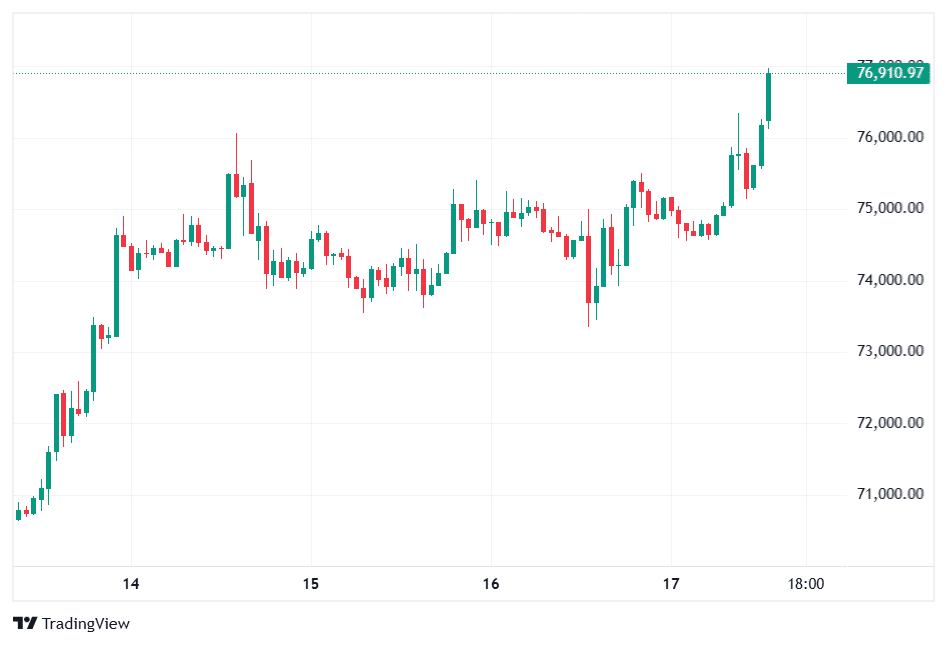
    In the past 24 hours, it climbed 2.5% to trade at $76,800, levels not seen in past early February—as of CoinMarketCap data. 

    BTC Price Chart - TradingView
    Source: TradingView/CoinMarketCap

    The connection between miner behavior and price action is straightforward: when BTC dipped into the $65,000–$70,000 zone earlier this year, many operators faced negative margins as production costs hovered near or above $90,000 per coin in some cases. 

    Publicly listed miners responded aggressively, offloading more than 32,000 BTC in Q1 2026 alone—surpassing their total sales for all of 2025 and setting a new quarterly record. That wave of selling added measurable supply pressure at a time when the network’s hashrate also contracted, falling about 4–6% quarter-over-quarter as less efficient rigs were taken offline.

    Now, with prices stabilizing above key support levels and some miners apparently holding more of their production, the reduced Binance inflows suggest a measure of capitulation may be easing. 

    However, not all miners are behaving the same—some larger public players continued trimming treasuries while others, like certain North American operators, have focused on debt management and efficiency upgrades.

    Broader exchange reserves have shown signs of tightening in spots, and institutional demand via spot Bitcoin ETFs has provided a counterweight to miner distribution.

    Still, this is no all-clear signal. Hashrate remains elevated historically despite the recent dip, competition is fierce, and many operators continue shifting capital toward AI-related opportunities to diversify revenue. If Bitcoin fails to push convincingly toward $80,000 in the coming weeks, renewed selling could reemerge.

    For now, the cooling in miner-to-exchange flows offers a tentative bright spot. It aligns with Bitcoin’s April rebound, suggesting the worst of the distress liquidation phase may be behind the sector—at least temporarily. 

    Whether that translates into sustained upside will depend on broader risk sentiment, ETF inflows, and the network’s ability to absorb any lingering supply.

    Also read: STRC — The $100 “Stable Stock” Fueling Strategy’s BTC Treasury


    Source link

    Naval warfare, an actual server browser and more on the way to Battlefield 6 this year as BF Studios reveals 2026 roadmap

    0
    Naval warfare, an actual server browser and more on the way to Battlefield 6 this year as BF Studios reveals 2026 roadmap


    It took Battlefield Studios over four months to tell Battlefield 6 players what they can actually expect from the game over the course of this year, in terms of content – but we’re glad to see a plan laid out nonetheless.

    The developer unveiled a grand 2026 roadmap, covering three more seasons currently in the works, and a wealth of new additions across the entire game, including new maps and the introduction of a new theatre of combat.

    Manage cookie settings

    In a wide-ranging new video dubbed The Year Ahead, members of the Battlefield 6 development team have revealed a lot of new information about the future of the multiplayer shooter, going over plenty of the features and new content coming over the course of this year.

    The video confirmed that BF6 has at least three other seasons in the works. Season 3, which begins in May, will be followed by Season 4, and Season 5 later in the year. Season 5 is the most mysterious, which is understandable.

    We’ve known about some of what’s coming in Season 3, such as the remake of Golmud Railway (now called Railway to Golmud), but the video also revealed that a remake of Battlefield 3’s Grand Bazaar – now Cairo Bazaar – will also arrive later in the same season. Other exciting additions, such as battle royale solos and ranked play for Redsec are also on the agenda for Season 3.

    Watch on YouTube

    Season 4, set for July, looks to be the biggest so far, with the introduction of naval combat, which will be available across two maps. Tsuru Reef, which is said to be even larger than Golmud, the largest map in BF6. The Pacific-set map won’t be the only one, as later in the season, another remake will arrive, this time of the iconic Wake Island.

    The introduction of naval combat will bring with it a new dynamic wave system, aircraft carriers with operational flight decks, and new naval vehicles. Custom lobbies and Spectator Mode are also planned for Season 4.

    Season 5 will bring three maps to BF6, rather than two, but all of its content remains under wraps.

    Image credit: Battlefield Studios, EA.

    Perhaps a sour note is that almost all of the maps referenced and shown in the video are remakes of maps from other Battlefield games, or reimagined at the very least. The Battlefield series is no stranger to remaking its own maps, but Battlefield 6 appears to be leaning on it much more than past entries.

    If it’s any consolation, however, the map remakes we’ve played so far in Battlefield 6 have gone through major changes that have contributed to giving them a different flow and feel from their classic versions, or even remakes in other BF games.

    Over the course of 2026, you can also expect the return of persistent servers, as well as a server browser to find them all – just like the good ol’ days. This includes the ability to host your own, though it’s unclear quite how this is going to work.

    Season 3 is set to revealed in the coming days, so you’ll be hearing back from BF Studios in the near future.


    Source link

    Morning Minute: $11T+ Schwab Goes All In on Crypto – Decrypt

    0
    Morning Minute: T+ Schwab Goes All In on Crypto – Decrypt


    Morning Minute is a daily newsletter written by Tyler Warner. The analysis and opinions expressed are his own and do not necessarily reflect those of Decrypt. And check out our new daily news show covering all of the top stories in 5 minutes or less, downloadable on Apple Pod or Spotify.

    GM!

    Today’s top news:

    Crypto majors rally as Trump says war should end soon; BTC at $75,700
    Stocks close green for record-tying 12th day in a row
    Schwab moves to offer spot BTC & ETH trading soon, with hefty fee
    Tether commits $127M to Drift while Circle faces lawsuit over failing to freeze
    CFTC chair Selig faces pressure on prediction markets and Hyperliquid

    💰 Schwab Moves All In on Crypto

    Charles Schwab confirmed on its Q1 earnings call Thursday that spot Bitcoin and Ethereum trading is live in a phased rollout under the “Schwab Crypto” brand, operated through Charles Schwab Premier Bank.

    Employees gain access first, then early-access registrants, then the full client base. Custody and settlement handled by Paxos. Notably, fees are 75 basis points per trade, substantially higher than ETFs.

    CEO Rick Wurster also told analysts the firm will “likely” offer prediction markets at some point as well, specifically carving out financial event contracts as different from sports and politics bets.

    For perspective, Schwab has $11.8 trillion in client assets and 16,000 financial advisors. Goldman Sachs filed for a Bitcoin income ETF this week. Morgan Stanley disclosed $1.24B in Bitcoin ETF exposure in its Q1 13F and launched its own ETF at 0.14%. The three biggest names in American retail and institutional finance are all making big moves inside crypto now. The institutions aren’t coming, they’re here.

    Key Details:

    Charles Schwab launched phased spot BTC and ETH trading via “Schwab Crypto” at 75 bps per trade, with custody through Paxos
    The scale: $11.8 trillion in client assets and 16,000 financial advisors; now a direct competitor to Coinbase and Robinhood for retail crypto access
    The week in context: Goldman filed for a Bitcoin income ETF; Morgan Stanley disclosed $1.24B in BTC ETF exposure in Q1 and launched its own ETF at 0.14%; Schwab going spot direct

    ⚖️ The CFTC Chair Is Getting Hit From Both Sides

    CFTC Chair Mike Selig appeared before the Senate Agriculture Committee Thursday and got squeezed from two directions at once.

    Republican and Democratic senators alike pushed back on the CFTC’s aggressive stance defending prediction markets in court while simultaneously demanding to know what the agency is doing about Hyperliquid, the offshore perpetual futures exchange that has been pulling volume away from regulated US venues with no CFTC oversight whatsoever.

    Selig’s position on prediction markets: federal exclusive jurisdiction, full stop. States suing to restrict them are “attempting to nullify federal law.” He filed an amicus brief to back that up.

    The Hyperliquid problem is harder. It’s a fully decentralized perp exchange operating offshore, outside CFTC reach, running markets on assets the CFTC would regulate if they were onshore. Senators on both sides want answers on how the agency plans to address that gap. Selig’s answer, essentially, was that the Clarity Act would help. The same Clarity Act that’s still sitting in markup.

    Key Details:

    CFTC Chair Mike Selig faced bipartisan Senate pushback Thursday on two fronts: his aggressive court defense of prediction markets jurisdiction, and the agency’s inability to regulate Hyperliquid’s offshore perp trading
    On prediction markets: Selig maintains CFTC has “exclusive regulatory authority” regardless of contract type
    On Hyperliquid: decentralized offshore perp exchange is pulling regulated volume offshore with no CFTC reach; Selig’s answer points to the Clarity Act as the fix

    🪂 Tether Bails Out Drift, And Takes Solana’s USDC Market With It

    Tether committed up to $127.5M to fund the recovery of Drift Protocol, the Solana-based perpetual DEX that was drained of ~$285M in an April 1 North Korean hack. It’s part of a $147.5M total package with partners, structured as a revenue-linked credit facility that repays the $295.7M in user losses over time from Drift’s trading revenue.

    Drift’s DRIFT token jumped 20% on the news.

    Tied to the headline – Drift is relaunching with USDT as its settlement layer, not USDC. On Solana, USDC has a 2.65x market cap advantage over USDT. Drift had $550M in TVL before the hack and 128,000 users.

    Circle, for its part, faced criticism for not freezing the stolen USDC faster – the attacker moved $232M from Solana to Ethereum using Circle’s own cross-chain protocol while Circle declined to act without a court order. Tether just used a bailout to flip the dominant stablecoin on one of Solana’s largest protocols.

    Key Details:

    Tether committed $127.5M – part of a $147.5M package – to back Drift Protocol’s recovery after an April 1 North Korean hack drained ~$285M
    The stablecoin flip: Drift relaunches on USDT, not USDC; Tether goes from a 2.65x underdog on Solana to the settlement layer of Solana’s largest perp DEX
    The Circle contrast: attacker moved $232M USDC via Circle’s own cross-chain protocol; Circle declined to freeze without a court order

    🎨 Foundation Is Shutting Down

    Foundation, one of the defining NFT art platforms of the 2021 boom, announced Wednesday it is shutting down after a planned sale to digital art company Blackdove collapsed.

    CEO Kayvon Tehranian posted an open letter on X: “Our goal in pursuing a sale was always to see Foundation live on. That’s no longer possible.” A one-year wind-down window is in effect, and users have been told to start migrating off the platform.

    MakersPlace shut down in January 2025. Nifty Gateway announced closure in January 2026 with 650,000 NFTs still on platform. Christie’s closed its digital art department last fall. Sotheby’s gutted its Metaverse team in 2024. Magic Eden shut down its NFT marketplace.

    OpenSea is the lone survivor.

    Key Details:

    Foundation NFT platform is shutting down after a sale to Blackdove collapsed; CEO Kayvon Tehranian confirmed the wind-down in an open letter, and infrastructure stays live for one year while users migrate
    The numbers: Foundation facilitated $230M in primary sales at peak; NFT art trading volume dropped from $2.9B in 2021 to $23.8M in early 2025
    The full body count: MakersPlace (Jan 2025), KnownOrigin (Jul 2024), Christie’s digital art (fall 2025), Nifty Gateway (Jan 2026), Magic Eden (Mar 2026), Foundation (Apr 2026)


    🌎 Macro Crypto and Markets

    Crypto majors are green after Trump says war should end soon; BTC +1.3% at $75.7k; ETH +1% at $2,357; SOL +3% at $88; HYPE -3% at $43.60
    M (+28%), RAVE (+23%), and ARB (+13%) led top movers
    Oil even at $88; Gold -1$ at $4,780
    Stocks have closed green for a record-tying 12 days in a row and would set a new record if green today
    Tennessee lawmakers introduced a bill to invest state funds in Bitcoin, joining a growing list of state-level Bitcoin reserve efforts moving through legislatures in 2026.
    The Polkadot-Ethereum bridge hack cost $25M in losses – 10x the original estimate
    DoubleZero launched an edge platform giving trading firms accelerated access to Solana blockchain data
    Circle is being sued for its failure to freeze funds during the Drift exploit

    Corporate Treasuries & ETFs

    Meme Coin Tracker

    Meme leaders were mostly green; DOGE +2%, SHIB +3%, PEPE +4%, TRUMP +3%, PENGU +5%, SPX +4%, FARTCOIN +4%
    Asteroid (+150x), Belief (+400%), Zerebro (+40%), and Griffain (+39%) led notable onchain movers

    💰 Token, Airdrop & Protocol Tracker

    Anthropic’s Claude Opus 4.7 posted top benchmark scores in coding tests ahead of its release
    Pumpcade is launching an ACE round and allowing token holders to convert to equity in the company at a 2.5:1 ratio, giving the company an implied $75M market cap at current prices
    Artemis launched Artemis II as an open investment portal
    Odds of a MegaETH token launch coming by end of May jumped over 90% on prediction markets

    🚚 What is happening in NFTs?

    NFT leaders were slightly green; Punks +3% at 26.9 ETH, Pudgy even at 4.1 ETH, BAYC +2% at 6.5 ETH; Hypurr’s -1% at 399 HYPE
    Gimboz (+25%) and Memeland Captainz (+15%) led notable movers
    Yuga CEO Garga announced he would be stepping down as CEO and moving to Chairman of the Board, while Figge will take his place as CEO

    Daily Debrief Newsletter

    Start every day with the top news stories right now, plus original features, a podcast, videos and more.


    Source link

    The Sims 4’s much maligned paid mods have made it to consoles, but Kits are coming back to PC

    0
    The Sims 4’s much maligned paid mods have made it to consoles, but Kits are coming back to PC


    The Sims 4 players on PlayStation and Xbox have now caught up to their friends on PC, at least when it comes to the game’s Marketplace. This new feature is essentially a hub for paid mods and other user-created content.

    As often happens when long-established games introduce paid mods, The Sims 4’s wasn’t especially well-received, in part because of the introduction of a new premium currency – Moola – that is the only way to purchase any of that content.

    Manage cookie settings

    The Moola denominations and prices are similar to many other in-game currencies, and the criticism around them is the same: they obfuscate the true value of items, and because of the way those denominations are structured, you’ll never be able to buy exactly what you need.

    For most games, the subject of paid mods has always been fraught, and that’s certainly true for The Sims 4. In the announcement blog post, Maxis said that the launch on consoles will work similarly to what PC players have seen, in that Kits will no longer be available to buy directly with real money on the PlayStation and Microsoft Stores. While Expansion Packs, Game Packs, and Stuff Packs will remain, you’ll need to buy Moola if you want to acquire Kits going forward.

    Image credit: Maxis, EA.

    Interestingly, however, EA seems to have changed its mind somewhat on the Kits situation. A recently leaked memo (via SimsCommunity), appears to show that the publisher intends on making Kits available for purchase directly again, without the need for Moola.

    Unfortunately, this only appears to affect the PC version, with the reversion reportedly forthcoming on both the EA App as well as Steam. Indeed, according to the same report, the change has already taken place on the former, with the latter following on April 20.

    Considering the Marketplace only just launched on consoles, the company may wait to see if the decision to remove Kits from console platform marketplaces will be as poorly received as it has been on PC.

    If you’re looking to jump back into The Sims 4 to check out all the new paid content, make sure you’re well-equipped with our list of Sims 4 cheats and debug options, or this one specifically for the Royalty & Legacy expansion cheats.


    Source link

    Bitcoin Price Targets $80,000 as 30-Day Whale Buys Hit 13-Year High? – NFT Plazas

      0
      Bitcoin Price Targets ,000 as 30-Day Whale Buys Hit 13-Year High? – NFT Plazas


      Bitcoin is once again approaching a critical inflection point. Trading near the mid-$70,000 range, the market appears calm on the surface—but underneath, structural forces are shifting rapidly. A surge in large-holder accumulation, combined with collapsing exchange reserves, is reshaping supply dynamics in a way not seen in over a decade. The question now dominating investor discourse is simple: does this tightening supply set the stage for a decisive breakout toward $80,000, and potentially beyond?

      A Historic Whale Accumulation Wave

      The most striking development comes from on-chain data. Over the past 30 days, Bitcoin whales – large holders typically defined as entities holding significant BTC balances – have accumulated approximately 270,000 BTC. That marks the most aggressive accumulation phase since 2013, a period that preceded one of Bitcoin’s earliest major bull runs.

      This is not a short-term anomaly. It is a sustained, deliberate repositioning of supply.

      In previous cycles, isolated spikes in whale activity could be attributed to internal transfers or custodial reshuffling. But persistence is what gives this signal weight. A month-long accumulation trend of this magnitude suggests conviction—not just opportunistic buying. It reflects a strategic move by large players who appear to be positioning ahead of a potential repricing event.

      Whales scooped up 270,000 BTC in 30 days - a $23B signal the market can’t ignore.

      Whales scooped up 270,000 BTC in 30 days – a $23B signal the market can’t ignore.

      Exchange Supply Is Quietly Vanishing

      At the same time, Bitcoin exchange reserves have dropped to their lowest level since December 2017.

      This matters more than price itself.

      Coins held on exchanges are liquid—they can be sold instantly. Coins moved off exchanges, often into cold storage, represent longer-term holding behavior. When large volumes of BTC leave exchanges, the immediate sell-side liquidity shrinks.

      This creates a critical imbalance:

      Demand can return quicklySupply cannot respond as fast

      The result is what traders call a “thin order book environment,” where even modest buying pressure can trigger outsized price moves.

      Historically, these conditions precede volatility expansions—not necessarily immediately, but often explosively once a catalyst appears.

      The Supply Shock Narrative Is Strengthening

      Bitcoin’s fixed supply has always been central to its value proposition. But today’s market structure amplifies that scarcity in new ways.

      More than 20 million BTC have already been mined out of the maximum 21 million. Meanwhile, the 2024 halving reduced block rewards to just 3.125 BTC, significantly slowing new issuance.

      Now layer on top:

      270,000 BTC absorbed by whales in one monthExchange balances at multi-year lowsContinued accumulation by institutional players

      This is no longer just a narrative – it is a measurable supply shock in progress.

      Importantly, price has not yet fully reflected this tightening. Bitcoin still trades roughly 40% below its 2025 all-time high near $126,000.

      That divergence, tight supply but subdued price, is where the opportunity (and risk) lies.

      BTC: Shark Net Position ChangeBTC: Shark Net Position Change

      BTC: Shark Net Position Change

      Demand Is Returning, But Not Smoothly

      If supply is the coiled spring, demand is the trigger.

      Recent ETF flow data shows a market that is recovering, but unevenly. Large inflows are interspersed with sudden outflows, reflecting macro uncertainty and cautious positioning.

      This inconsistency matters. A sustained rally toward $80,000 requires:

      Persistent ETF inflowsContinued institutional participationReduced macro headwinds

      Right now, demand is present—but fragmented.

      That fragmentation explains why Bitcoin has repeatedly failed to break cleanly above the $75,000–$76,000 resistance zone. Sellers remain active there, even as underlying supply tightens.

      Total Bitcoin Spot ETF Net Inflow (Source: Coinglass)Total Bitcoin Spot ETF Net Inflow (Source: Coinglass)

      Total Bitcoin Spot ETF Net Inflow (Source: Coinglass)

      Derivatives Signal a Potential Squeeze

      Another layer of complexity comes from derivatives markets.

      Funding rates have turned negative, meaning short traders are paying longs. This typically reflects bearish sentiment—but paradoxically, it often appears near local bottoms.

      Why?

      Because heavy short positioning creates the conditions for a short squeeze. If price continues rising, those shorts are forced to close positions, adding fuel to the rally.

      Bitcoin has already climbed from the low-$60,000 range to $75,000 while funding remained negative. That divergence suggests:

      The rally has not been driven by euphoric leverageThere is still “fuel” left in the system

      In other words, the market is not overcrowded on the long side, yet.

      The $80,000 Threshold: Psychological and Structural

      The $80,000 level is not just another round number. It represents:

      The next major supply zoneA psychological milestone for market participantsA technical breakout confirmation level

      A decisive move above $75,500, particularly on strong volume, opens a relatively clear path toward $80,000–$80,600.

      Beyond that, the structure becomes even more interesting. With limited nearby supply, price discovery could accelerate quickly.

      This is where the current setup becomes asymmetric:

      Downside is supported by strong accumulationUpside could expand rapidly if demand aligns

      Bitcoin 7D price chart (Source: Coinglass)Bitcoin 7D price chart (Source: Coinglass)

      Bitcoin 7D price chart (Source: Coinglass)

      Macro Still Holds the Final Vote

      Despite the bullish supply dynamics, Bitcoin is not trading in isolation.

      Macro factors remain critical:

      Federal Reserve policy expectationsInflation trajectoryGeopolitical tensions

      Recent market behavior shows that macro shocks can still override on-chain signals. ETF outflows during periods of geopolitical stress highlight how quickly sentiment can shift.

      This creates a dual identity for Bitcoin:

      Scarcity asset in the long termMacro-sensitive risk asset in the short term

      Until macro conditions stabilize, this tension will persist.

      Three Scenarios Ahead

      From here, Bitcoin faces three realistic paths:

      Bull Case:Sustained ETF inflows + continued whale accumulation + stable macro backdrop → breakout above $75,500 → rapid move toward $80,000 and potentially higher.

      Neutral Case:Demand remains inconsistent → price ranges between $70,000–$75,500 → accumulation continues beneath the surface.

      Bear Case:Macro shock or policy tightening → demand fades → price retests $68,000–$70,000 despite tight supply.

      Notably, even the neutral case is structurally constructive. Supply compression does not disappear—it simply waits.

      A Market Quietly Repricing Itself

      The most important takeaway is not the $80,000 target itself.

      It is the underlying transformation of Bitcoin’s market structure.

      For months, price action has appeared muted. But beneath that calm, a significant redistribution is taking place:

      Coins are moving into stronger handsLiquid supply is shrinkingInstitutional participation remains active

      This is how markets prepare for large moves—not with noise, but with quiet rebalancing.

      The current setup suggests that Bitcoin is no longer trading in a loose, liquid environment. It is operating in a tightening system where supply is increasingly inelastic.

      And in such systems, when demand finally returns with conviction, price does not drift higher—it reprices.

      Conclusion: $80,000 Is a Test, Not the Destination

      Bitcoin’s push toward $80,000 is not just a technical milestone – it is a test of the new market structure.

      If demand proves strong enough to absorb the remaining sell-side liquidity, the implications extend far beyond a single price level. It would confirm that the supply shock is real, and that the next phase of the cycle has begun.

      If not, the market may continue consolidating, quietly tightening further.

      Either way, one thing is becoming increasingly clear:

      Bitcoin is no longer abundant where it matters most – on the market.

      And when supply disappears before price reacts, history suggests the move that follows is rarely subtle.


      Source link

      Popular Posts

      My Favorites

      Ethereum Treasury SharpLink Shares Plunge 20% Amid $6 Billion Plan to...

      In brief SharpLink Gaming shares fell more than 20% on Friday. The decline came a day after the company submitted a regulatory filing to increase...