Cardano (ADA) is beginning to show early signs of recovery, trading slightly higher at the time of writing as broader crypto markets stabilize. The move comes amid improving global risk sentiment, supported in part by geopolitical developments after Iran signaled that the Strait of Hormuz would remain open during a ceasefire period – easing concerns over energy supply disruptions and helping restore investor confidence across risk assets.
While the immediate price reaction remains modest, the shift in sentiment underscores a deeper trend: large-cap altcoins like Cardano and Avalanche (AVAX) are quietly transitioning from prolonged consolidation into what could become the early stages of a new market cycle.
Why ADA Is Back in Focus
Cardano’s renewed relevance in April 2026 is not driven by speculation alone, but by a convergence of structural signals that suggest accumulation is underway.
On-chain activity has surged dramatically, with transaction counts and active users rising to multi-month highs. This divergence, strong network usage paired with relatively muted price action, has historically marked early accumulation phases, where long-term investors position themselves ahead of broader market recognition.
At the same time, whale activity is increasing. Wallets holding more than 10 million ADA have climbed to their highest levels in months, reinforcing the idea that larger players are quietly building exposure at current prices.
The macro backdrop also supports this thesis. Institutional involvement in crypto continues to expand, particularly through exchange-traded products and structured investment vehicles. While Bitcoin remains the primary gateway for institutional capital, the existence of that infrastructure often precedes capital rotation into high-liquidity altcoins like ADA.
Cardano Open Interest (Source: Coinglass)
Technical Analysis: A Market at Inflection
From a technical standpoint, Cardano is sitting at a critical inflection point.
At the time of writing, ADA is trading around $0.245, holding just above a key support zone near $0.24 – a level that has repeatedly acted as a pivot in previous market cycles.
Price action suggests a consolidation phase, with ADA moving within a relatively tight range between $0.24 and $0.26. This type of compression often precedes expansion, particularly when combined with improving market sentiment.
Momentum indicators reflect a market that is stabilizing:
The Relative Strength Index (RSI) sits near neutral levels, indicating balanced buying and selling pressure.The MACD remains slightly negative but is flattening, suggesting bearish momentum is weakening.The Average Directional Index (ADX) is low, confirming the absence of a strong trend, often a precursor to a breakout move.
Despite these early signs of stabilization, ADA continues to trade below key moving averages, including the 100-day and 200-day EMAs. This means the broader structure remains cautious, and a confirmed trend reversal will require a decisive breakout above resistance levels.
The first major resistance lies near $0.30. A sustained move above this level would likely shift sentiment more decisively toward the bullish side. On the downside, a breakdown below $0.24 could expose the asset to deeper retracements, potentially revisiting the $0.20 zone.
ADA 24H price chart (Source: CoinMarketCap)
ADA Price Prediction 2026: Structured Upside, Measured Expectations
Forecasts for Cardano in 2026 reflect a balance between optimism and realism.
Most analytical models converge around a moderate growth trajectory:
Base case estimates place ADA between $0.30 and $0.45 as the market gradually recovers.Bullish projections extend toward $0.50–$0.70, assuming successful upgrades and favorable macro conditions.More aggressive scenarios suggest potential upside beyond $0.80, though this would likely require a full-scale altcoin cycle driven by strong capital inflows.
These projections highlight an important reality: as a large-cap asset with a multi-billion-dollar market cap, Cardano requires significant capital to generate exponential returns. Unlike smaller-cap tokens, its growth is typically more structured and sustained rather than explosive.
AVAX: Compression Signals Build Beneath $10
Avalanche (AVAX) is currently trading near $9.19 at the time of writing, reflecting a modest recovery of roughly 1.78% over the past week, but still struggling to reclaim higher ground after an extended downtrend.
From a structural perspective, AVAX is showing a pattern very similar to ADA: prolonged consolidation following a steep decline, with price now compressing near a key psychological level.
The $9–$10 range has emerged as a critical battleground. Price action over recent weeks shows repeated tests of this zone, with buyers stepping in to defend downside moves near the $8.30–$8.50 region, while upside attempts continue to stall below $10.
Momentum indicators suggest a market in transition rather than continuation:
RSI (48) remains neutral, indicating balanced pressure between buyers and sellers.MACD has turned slightly positive, with early signs of a bullish crossover—often a leading indicator of momentum shifts.ADX (≈9) is notably low, confirming weak trend strength and reinforcing the idea of consolidation rather than directional movement.
Volume has also stabilized after previous spikes, suggesting that aggressive selling pressure has subsided, but strong conviction buying has not yet fully emerged.
AVAX 24H price chart (Source: CoinMarketCap)
Catalysts That Could Drive the Next Move
Several key catalysts will determine whether ADA and AVAX can transition from consolidation to expansion.
Protocol upgrades remain central to Cardano’s long-term narrative. Upcoming improvements are expected to enhance scalability and performance, strengthening the network’s utility.
Institutional flows continue to play a decisive role. The expansion of ETFs and regulated investment vehicles not only legitimizes the asset class but also unlocks new sources of capital.
Retail participation is also returning. Rising open interest and steady trading volumes indicate that individual investors are re-engaging with the market – an essential ingredient for sustained altcoin rallies.
Finally, macro sentiment remains a dominant factor. As seen with the recent rebound following easing geopolitical tensions in the Middle East, external events can quickly influence risk appetite and capital flows across crypto markets.
AVAX vs ADA: Different Paths, Same Cycle Setup
While both ADA and AVAX are in similar technical phases, their narratives differ:
Cardano (ADA): Driven by on-chain growth, community, and long-term ecosystem developmentAvalanche (AVAX): Driven by institutional integration, financial products, and infrastructure
This divergence could ultimately be complementary rather than competitive, as different segments of capital rotate across the market.
Bull Case vs Bear Case
The outlook for Cardano and Avalanche ultimately depends on how the current consolidation phase resolves.
Bull Case
In the bullish scenario, ADA successfully holds the $0.24 support level and breaks above $0.30, triggering momentum-driven buying. This could open the path toward $0.50 and beyond as the broader market strengthens.
AVAX, in parallel, could benefit from institutional inflows and technical breakout patterns, driving a recovery toward the $15–$20 range.
Bear Case
In the bearish scenario, ADA fails to hold support and breaks below $0.24, leading to renewed downside pressure. This would suggest that accumulation is not yet complete and that further consolidation, or even capitulation, may be required.
AVAX faces similar risks. Without a confirmed breakout above resistance, it may remain range-bound or experience further downside.
Cardano Price Prediction 2026
Conclusion: Quiet Accumulation Before the Next Cycle?
Cardano and Avalanche are not yet in a confirmed bull market, but they are no longer in a clear downtrend either.
Instead, both assets appear to be entering a phase of quiet accumulation, where long-term positioning takes place before broader market momentum returns.
For Cardano, the combination of improving on-chain activity, growing whale accumulation, and resilient support levels suggests that downside risk may be increasingly limited. For Avalanche, institutional adoption and infrastructure development provide a strong foundation for future growth.
The recent rebound in crypto markets, partly supported by improving geopolitical sentiment, serves as a reminder that macro conditions can quickly shift and unlock new momentum.
As 2026 unfolds, the key question is not whether ADA and AVAX will move, but when.
And in markets like crypto, timing often makes all the difference.
PARIS, April 19, 2026 (GLOBE NEWSWIRE) — From April 15–16, 2026, one of Europe’s premier blockchain events, Paris Blockchain Week 2026, concluded in Paris, France. Under the theme “The Bridge Between TradFi and Digital Assets,” the conference brought together regulators, financial institutions, Web3 projects, and infrastructure providers to explore the convergence of digital assets and traditional finance.
As a leading digital asset infrastructure provider, Cregis engaged with banks, payment providers, Web3 projects, and enterprise clients at Booth 20A. The company showcased its expertise in institutional custody, corporate wallets, and payment infrastructure, sharing its global experience and advancing its strategic presence in Europe.
From Narrative to Implementation: Europe Accelerates Institutional AdoptionOn the regulatory front, frameworks such as MiCA are providing clarity and predictability for the market. Many financial institutions and payment providers at the conference noted that clear regulations are a key catalyst for institutional adoption and lay the foundation for broader applications of digital assets.
Stablecoins and on-chain payments emerged as a central discussion point. Across cross-border payments, corporate settlements, and treasury management, stablecoins are evolving from crypto-native tools into essential infrastructure connecting traditional finance with the on-chain economy. “How to build efficient, compliant settlement networks” became a frequent topic of discussion.
Corporate demand is also shifting. Unlike the past, which focused primarily on trading infrastructure, today’s market prioritizes system-wide capabilities such as custody security, treasury efficiency, and compliance and risk management frameworks. This trend reflects the growing integration of digital assets into enterprise-grade financial systems.
Paris Blockchain Week: A Key Convergence of Regulation, Institutions, and TechnologyParis Blockchain Week has reaffirmed its role as a critical connector in Europe’s blockchain ecosystem. From regulators outlining compliance pathways to traditional financial institutions exploring digital asset adoption, and Web3 enterprises developing infrastructure and real-world use cases, the conference highlighted a clear trend: digital assets are increasingly integrating with existing financial systems rather than existing as isolated ecosystems.
Europe’s unique position stands out. Its relatively mature regulatory landscape provides stability for industry development, while stringent compliance requirements set higher standards for infrastructure. This makes Europe not only a regulatory stronghold but also a testing ground for real-world digital asset adoption.
Cregis: Entering Europe Market Through Infrastructure ExcellenceAt the event, Cregis engaged with potential partners on institutional custody, stablecoin payments, and on-chain treasury management, confirming strong demand for compliant digital asset infrastructure in Europe.
Richard, Co-Founder of Cregis, said, “It’s clear from this conference that Europe is entering a development stage focused on compliance and infrastructure. Institutional clients prioritize security, scalability, and compatibility with existing financial systems, perfectly aligned with the capabilities we’ve built.”
He added that Cregis will continue expanding in Europe, exploring partnerships with local banks, payment providers, and enterprises to advance stablecoin payments, on-chain settlements, and corporate wallet solutions in real business scenarios.
“We are seeing double-digit growth across our pan-European client base, which reinforces our confidence in the region’s long-term opportunity,” said Shawn Yan, CEO and Founder of Cregis. “Europe’s evolving policy environment, especially the greater regulatory clarity created by MiCA, is opening up meaningful space for compliant digital asset adoption at scale. Given this momentum, we are formally increasing our investment in Europe in 2026 to better serve customers across the region. Our focus is to support different client needs with the right mix of payment infrastructure, governance controls and deployment models — from always-on treasury and settlement workflows to private, institution-grade custody infrastructure.”
As the digital asset industry enters a new phase, infrastructure for payments, custody, and treasury management is becoming a key bridge between TradFi and Web3. Paris Blockchain Week 2026 allowed Cregis to deepen connections with global partners and sharpen its strategic direction in Europe. With regulatory clarity improving and institutional demand rising, Europe is poised to become a major growth engine for digital asset infrastructure.
About CregisCregis is a global provider of enterprise-grade digital asset infrastructure, offering secure, scalable, and compliant solutions for institutional clients.
Its core offerings—MPC-based self-custody wallets, Wallet-as-a-Service, and crypto payment solutions—are trusted by over 3,500 crypto exchanges, fintech companies, digital banks, payment service providers (PSPs), forex brokers, and Web3 businesses to seamlessly and securely accept, send, and manage digital assets.
Contact
Marketing DirectorJaniceCregisjanice@cregis.io
A photo accompanying this announcement is available at https://www.globenewswire.com/NewsRoom/AttachmentNg/5bebd304-3269-4385-9874-50701ff2353a
About Web3Wire Web3Wire – Information, news, press releases, events and research articles about Web3, Metaverse, Blockchain, Artificial Intelligence, Cryptocurrencies, Decentralized Finance, NFTs and Gaming. Visit Web3Wire for Web3 News and Events, Block3Wire for the latest Blockchain news and Meta3Wire to stay updated with Metaverse News.
On April 16, NFT marketplace Foundation announced it is in the process of shutting down following the collapse of a “rescue” deal with digital art platform Blackdove. This marks another high-profile failure as the NFT market continues its struggle to recover in the post-boom era.
The decision comes as an increasing number of NFT platforms face pressure from prolonged declining liquidity, shrinking revenues, and competition that is increasingly concentrated among a few major players. Foundation, once positioned as a curated marketplace for artists, has been unable to find a suitable buyer to continue operations.
NFT Platforms Are Struggling in a Shrinking Market
Foundation’s closure clearly reflects the structural issues of the current NFT market, where transaction volumes have plummeted compared to the 2021-2022 peak.
During the boom period, total monthly NFT trading volume across the market once reached billions of dollars. Currently, this figure has dropped by more than 90% according to data from Token Terminal, reflecting a significant weakening in demand.
NFT trading volume by project. Source: Token Terminal
As liquidity decreases, users and capital tend to concentrate on a few large platforms, making it difficult for smaller or niche marketplaces to sustain operations. For curated platforms like Foundation — which rely heavily on primary sales and the artist community — the decline in speculative demand has created even greater pressure.
In this context, many platforms have been forced to pivot their models, seek acquisition partners, or accept closure.
Falling Volume and Revenue Are Breaking the Model
The prolonged slump in trading activity has directly undermined Foundation’s business model, which relied almost entirely on transaction fees.
Data from Token Terminal shows that the platform’s revenue has plummeted from approximately $20.5 million in 2021 to just about $90,000 in 2025, and around $4,500 as of Q1 2026—representing a decline of over 99% from its peak.
Foundation trading volume by month. Source: Token Terminal
Trading volume has also plummeted following the same trend. From levels of $15–20 million per month during the peak period, volume now fluctuates between only $30,000 and $100,000 per month, reflecting a clear weakening of both demand and liquidity.
Despite once achieving hundreds of millions of dollars in trading volume during its growth phase, the prolonged decline has made the fee-based model difficult to maintain under current market conditions.
Foundation’s Failed Rescue Deal With Blackdove
Amidst these difficulties, Foundation sought to maintain operations through an agreement to sell the platform to Blackdove, a company specializing in digital art distribution and experiences. According to Kayvon, co-founder of Foundation, the deal was signed earlier this year, with the expectation that the buyer would continue to operate the platform.
However, after an initial operational handover and the completion of further due diligence, Blackdove concluded that building its own marketplace was more aligned with the company’s strategic direction.
https://t.co/I0ufX3dZUO
— kayvon (@saturnial) April 15, 2026
On April 16, the Foundation also confirmed that the buyer is no longer able to continue operating the platform. They stated that under current market conditions, they do not see any other suitable buyers to pursue. Parts of Foundation’s infrastructure have already been decommissioned, making a transfer increasingly unfeasible.
The collapse of the deal effectively closes the platform’s final option to continue operating under a new owner.
What Happens to Users
Foundation stated that user assets remain secure because the platform operates on a non-custodial model, with NFTs stored directly on the blockchain and unaffected by the shutdown.
In a recent post, the team said they would temporarily bring the platform back online to allow artists to delist their active NFT listings. According to the Foundation, this infrastructure restart process takes only about 15–20 minutes.
For NFTs currently held within the marketplace’s contracts, Foundation stated they are working to provide a solution that allows users to delist and withdraw assets before the final shutdown.
Additionally, metadata and media data for NFTs issued by Foundation will be maintained for at least one year. Users are also advised to proactively back up data through third-party services to ensure long-term accessibility.
What It Signals for the NFT Market
Foundation’s closure highlights the growing trend of centralization in the NFT market, with most trading activity concentrated on a few dominant platforms like OpenSea and Blur.
As liquidity thins and the user base consolidates, smaller marketplaces face significant hurdles in attracting both artists and collectors — making their business models unsustainable. Even platforms with a former standing, like Foundation, struggle to survive without sufficient volume.
The failure of the Blackdove deal also demonstrates that efforts to “save” these platforms are not always feasible in the current market climate.
The Indian Ocean island nation of Mauritius is home to some amazing resorts, and the oldest and most iconic is Shangri-La Le Touessrok Mauritius (formerly known as One&Only). This property kicked off luxury hospitality on Mauritius, a country known for its hospitality. Since opening, this resort has experienced numerous expansions and renovations. Its most recent was in 2024, and it has never looked better. These are our five favorite reasons why this tropical destination resort is a must-visit for Americans.
The beaches
This resort sprawls across six secluded beaches stretching 2.5 miles, tucked into bays and coves along the 84-acre property. The waves are gentle, and the water is shallow enough for kids to play. Given the resort’s privileged location, every single room and suite faces the beach with those on the ground floor open directly to the sand.
Rows of thatch-roofed palapas with clever towel racks above are on every beach. Cushioned lounge chairs have side tables, and the staff quickly brings over a cooler of chilled water. While the beaches are for all guests, the longest one in front of reception and the biggest pool are the most popular with families.
Other smaller beaches are rather quiet and almost make you feel as if you are on your own private island. One important thing to note is that sharp corals and sea urchins are common in the waters around Mauritius. If you plan to spend time in the water, rubber shoes are a good idea.
There is also a large family pool and separate adults pool, both with splashing fountains and views of the sea.
The private island
Speaking of private islands, this resort is the only one in Mauritius to have one of its own. Head for the jetty on the edge of one of the beaches here to take a free motorboat over to Shangri-La’s own, well, shangri-la.
There, you will find more beach chairs with umbrellas, cushioned cabanas, day beds and plenty of beach and sand to frolic the day away. A separate restaurant and bar mean that you’re never far from a menu.
It is also home to a golf course with free greens fees for guests. To get there, meet the bell staff near the enormous banyan tree at the entrance. They can drive you in a golf cart to the jetty (it’s also walkable). Service here is excellent with a nearly 3-to-1 staff to guest ratio.
The dining
With so many options here, you don’t need to leave the resort. And most people don’t. Guests can opt for a half board package covering breakfast and dinner or full board.
The main venue is the breakfast and dinner TSK Restaurant, which has an open kitchen and live cooking stations that prepare the extensive buffet menus here. Breakfast starts with fresh bakery and pastry options, all kinds of tropical fruit, eggs prepared to order, and regional selections from around the world. Themed buffets are popular with choices like Middle Eastern, pan-Asian and Indian. Guests on a dining package can order almost anything on the menu here with only a handful of premium dishes carrying a surcharge.
Coco’s Beach House is a must-try restaurant as it opens directly to the beach. Start your meal with a drink as you sit in a swinging chair or with your feet in the sand. The cocktail and mocktail list is extensive with new options added regularly. Drinks come with nuts and canapes, and during the evening “golden hour,” drinks are 50% off.
Then move to the al fresco dining area with a breeze that wafts through from the shore to the exhibition kitchen. On the menu are various international regional dishes. I tried the local palm heart salad with truffle vinaigrette and a vegetable curry with chutneys and the country’s spicy piment spread on the side. Grilled chicken, ribeye steaks, freshly caught seafood and different salads are also options. Many of the herbs and spices come from the resort’s own garden.
Each month, visiting chefs spice up the offering with special menus they bring from their own restaurant. During my visit, Michelin-recognized chefs from Spain were preparing two multi-course dinners of Spanish specialties.
Saffran is the South Indian-inspired dining room preparing fragrant dishes from its pair of tandoori ovens and open kitchen. At Kushi, the stunning interior design is as much a part of the experience as the fresh sushi and teppanyaki-prepared menu itself. I really appreciated how the hotel’s website lists the full menu for each restaurant online.
The activities
There is so much to do at the resort. Like most properties, it has a full-service holistic wellness spa. But, it goes above the norm with a reiki master on staff and treatments like icoone micro-stimulation and an Iyashi Dome. The fitness center is open 24-hours with the option to hire a personal trainer. There are also boxing, Zumba, tennis and swimming lessons push sunrise yoga.
Non-motorized watersports are complimentary here, but so is jet skiing. This is one of the few resorts around the world that I have visited that offers this activity without a charge. You can also hit balls on a trio of tennis courts or padel court, try your hand at archery, chess or darts, or play beach soccer or volleyball.
Other activities include bocce ball, billiards, table tennis and visiting the property’s three tortoises (one of whom is more than a century old). A few times a week, guests can participate in feeding them or learning to play Mauritian instruments. The kids club is expansive with its own waterpark and pool, indoor games and learning sessions, and even a stage for performances.
When kids check in to the hotel, they discover a huge gift box waiting for them, packed with t-shirts, coloring books, toys and stuffed animals. It is the most generous spread I have seen for kids to take home. Another nice touch here is the sit-down check-in welcome in the feng shui lobby upon arrival. There is also a complimentary fruit station for guests to grab and go as they wish.
The rooms
Duvet-covered beds come with a pillow menu for you to customize your rest. I appreciated the international array of power outlets in the room, too. The resort caters heavily to British, French and German guests, but is seeing a growing number of American visitors among other markets. The wireless charging clock by the bed was a hit.
Other extras include welcome gifts for adults like flip flops, shirts and beach bags to take home. A large, lighted makeup mirror (like what you might find in a department store) sits on the countertop.
Each room has a furnished balcony or terrace, espresso machine, spacious closets and L’Occitane-stocked bathrooms with dual vanities, spacious shower stalls and deep soaking tubs. Sliding doors close off the room from the bathroom, allowing for either natural light with a view or more privacy.
The three villas here come with three bedrooms each, private butler service (and the option to add a chef), large living areas, their own pools and kitchens. These are especially popular with visiting celebrities, athletes and politicians who have stayed here over the decades. Among them: David Guetta, Princess Stephanie of Monaco and former French President François Mitterrand.
How to get there
Numerous airlines connect the U.S. and Mauritius with just one change of planes in their hub city. These include Air France (Paris), Austrian Airlines (Vienna), Emirates (Dubai) and Turkish Airlines (Istanbul). You can earn or redeem frequent flyer miles with your favorite loyalty program, too.
Luke Evans is a versatile actor known for his dynamic performances across film, television, and stage. Born in Wales, Evans has carved out a successful career in Hollywood, earning recognition for his roles in a variety of genres. From action-packed blockbusters to musical dramas, Evans has proven his ability to adapt and shine in diverse roles.
Luke Evans Early Life and Career Beginnings
Luke George Evans was born on April 15, 1979, in Pontypool, Wales. He grew up in the small village of Aberbargoed in a working-class family. From a young age, Evans displayed a keen interest in the performing arts, which led him to move to Cardiff at 17 to study under singing coach Louise Ryan.
Training and Education: Evans further honed his craft at the London Studio Centre, a prestigious performing arts college, where he graduated in 2000. His training laid a solid foundation for his future career in the entertainment industry.
Stage Career: Evans began his career on the stage, performing in West End productions. His notable stage roles include performances in musicals such as “Rent,” “Miss Saigon,” and “La Cava.” His stage presence and vocal talents earned him acclaim in the theatre community.
Luke Evans Breakthrough in Film
Evans transitioned from the stage to the screen in the mid-2000s, quickly making a name for himself in Hollywood.
First Major Film Role: His first significant film role came in 2010 when he was cast as Apollo in “Clash of the Titans.” This role introduced him to a broader audience and showcased his ability to handle action-oriented roles.
“The Three Musketeers” (2011): Evans gained further recognition for his portrayal of Aramis in “The Three Musketeers,” where he demonstrated his swashbuckling skills and charm.
“The Hobbit” Trilogy (2012-2014): One of Evans’ most iconic roles is Bard the Bowman in Peter Jackson’s “The Hobbit” trilogy. His portrayal of the courageous archer was well-received, solidifying his status as a rising star in Hollywood.
Luke Evans Diverse Roles and Notable Performances
Evans has showcased his versatility through a wide range of roles, spanning various genres and mediums.
“Dracula Untold” (2014): In this dark fantasy film, Evans took on the titular role of Dracula, adding depth to the character by exploring the origins of the legendary vampire.
“Beauty and the Beast” (2017): Evans’ portrayal of Gaston in Disney’s live-action adaptation of “Beauty and the Beast” was widely praised. His charismatic performance and vocal talents brought the character to life in a memorable way.
Television Roles: Evans has also made his mark on television, starring in series like “The Alienist” and “Nine Perfect Strangers.” These roles have allowed him to explore complex characters and further demonstrate his acting range.
Here’s a list of films featuring Luke Evans:
Clash of the Titans (2010) – as Zeus
Immortals (2011) – as Zeus
The Hobbit: An Unexpected Journey (2012) – as Bard the Bowman
The Hobbit: The Desolation of Smaug (2013) – as Bard the Bowman
The Hobbit: The Battle of the Five Armies (2014) – as Bard the Bowman
Dracula Untold (2014) – as Vlad III
Fast & Furious 6 (2013) – as Owen Shaw
Fast & Furious 7 (2015) – as Owen Shaw
The Girl on the Train (2016) – as Dr. Abdic
Beauty and the Beast (2017) – as Gaston
Professor Marston and the Wonder Women (2017) – as Charles Moulton
Midway (2019) – as Lieutenant Commander Wade McClusky
The Alienist (2018) – TV series; also starred in a follow-up series, The Alienist: Angel of Darkness (2020).
The Personal History of David Copperfield (2019) – as Mr. Micawber
Nine Perfect Strangers (2021) – TV series
Pinocchio (2022) – as The Coachman
The Last Train to New York (u
Luke Evans Personal Life and Advocacy
Beyond his acting career, Luke Evans is known for his advocacy and openness about his personal life.
LGBTQ+ Representation: As an openly gay actor, Evans has been a strong advocate for LGBTQ+ representation in the entertainment industry. He has spoken candidly about his experiences and the importance of diversity in Hollywood.
Humanitarian Efforts: Evans is also involved in various charitable activities, using his platform to support causes such as cancer research and children’s charities.
Luke Evans is a Welsh actor and singer who has a net worth of $9 million.
Conclusion
Luke Evans is a talented and multifaceted actor who has made significant contributions to both stage and screen. His ability to take on diverse roles, combined with his advocacy work, makes him a prominent figure in the entertainment industry. Whether he’s playing a heroic archer, a charming villain, or a complex detective, Evans brings depth and charisma to every role he undertakes.
Author Profile
Mark Meets
MarkMeets Media is British-based online news magazine covering showbiz, music, tv and movies
New York City, NY, April 18, 2026 (GLOBE NEWSWIRE) — You’ve done the diets. Probably more than once. You’ve tracked calories, cut carbs, tried intermittent fasting, started gym memberships in January and quietly stopped going in March. And none of it has moved the needle the way you needed it to.
Here’s something worth understanding: for many people, that struggle isn’t about willpower. It’s about biology. The human body is built to resist weight loss, hunger hormones ramp up, metabolism slows down, and the brain sends relentless signals to eat more. For decades, conventional dieting tried to override this system through restriction alone. It’s a hard way to fight when the odds are against you.
GLP-1 medications, a class of prescription treatments that work directly on the hormonal signals that control hunger and fullness, represent one of the most significant shifts in medically supervised weight management in recent memory. In large clinical trials of FDA-approved GLP-1 active ingredients, participants lost a significant amount of weight when they also followed a diet and exercised. Results may vary based on starting weight and program adherence.
Direct Meds is a telehealth platform that connects patients with licensed physicians who can evaluate whether a compounded GLP-1 medication may be appropriate for their individual needs and, if prescribed, facilitate access to it with shipping included. No insurance hoops. No clinic waiting rooms. No pharmacy trips.
Is it the right path for you? That’s what this review breaks down.
What Is Direct Meds?
Direct Meds is a U.S.-based telehealth platform that provides patients with access to licensed physicians who evaluate their suitability for compounded GLP-1 weight management medications. It is not a pharmacy and not a drug manufacturer; it is the access layer between patients seeking medically supervised weight support and the licensed medical professionals who make all prescribing decisions.
The platform has served over 180,000 customers and holds LegitScript certification, a recognized standard for legitimate online healthcare platforms that verifies compliance with applicable laws and regulations.
What Direct Meds offers through its program: Following a completed online medical intake, patients are connected with board-certified physicians who review their health history and determine whether a compounded GLP-1 medication is clinically appropriate. If prescribed, medications are prepared by U.S.-based compounding pharmacies and shipped directly to the patient’s door.
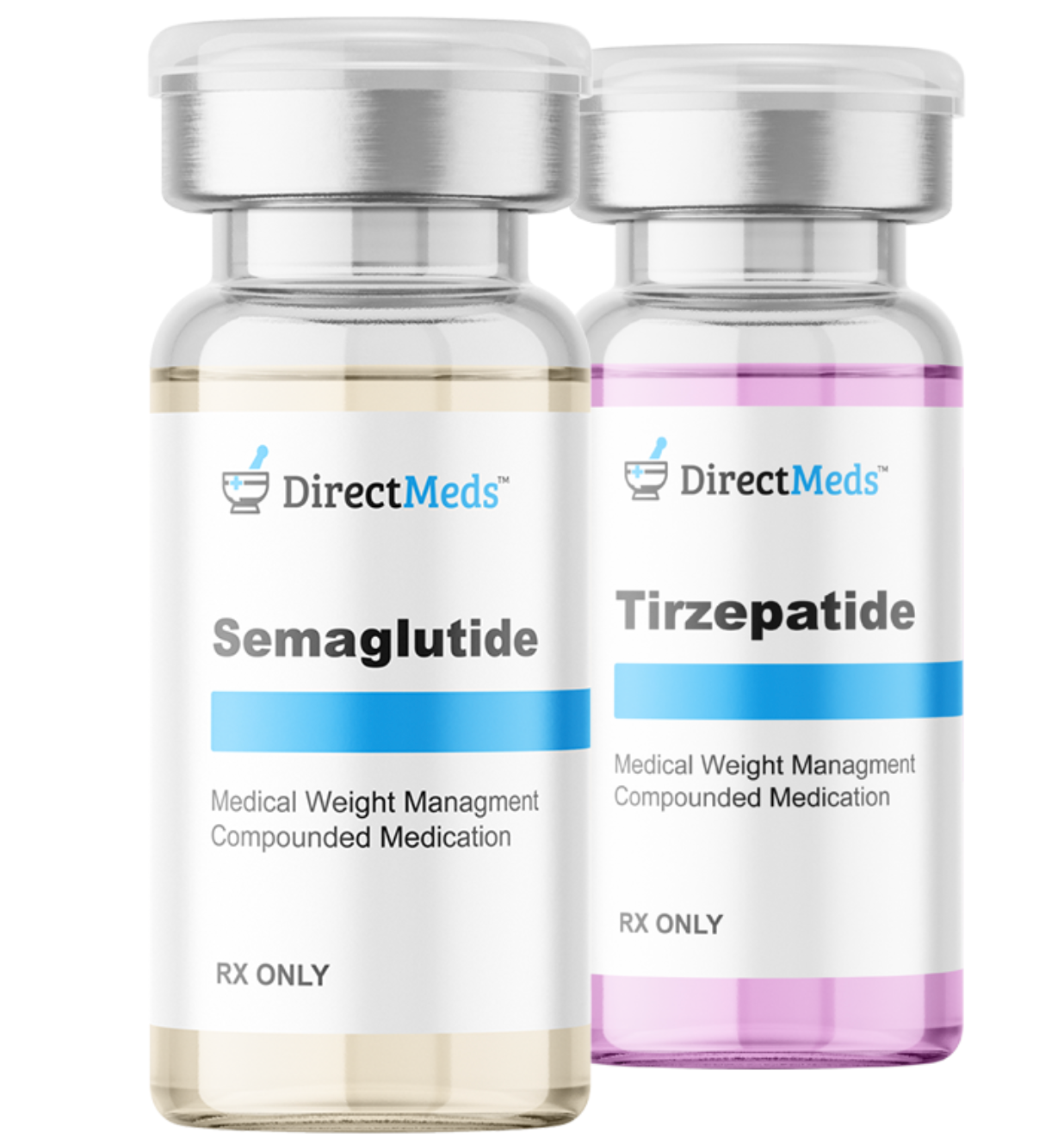
Two formats available: Direct Meds currently offers compounded GLP-1 medications in both injectable and sublingual (oral drop) formats, giving patients and their physicians flexibility based on individual preference and clinical suitability.
Important distinction: Compounded medications are not FDA-approved. They are prepared by licensed compounding pharmacies to meet individual patient needs when commercially available options are not suitable for their personalized needs. The active ingredients used, semaglutide and tirzepatide, are the same active ingredients found in several FDA-approved products, but the compounded formulations themselves have not been reviewed by the FDA for safety, effectiveness, or manufacturing quality.
Direct Meds operates as the coordination platform: it handles the intake process, the telehealth consultation, and the logistics. The prescribing and dispensing are handled by independent licensed physicians and separate licensed pharmacies.
Does Direct Meds Really Work?
To answer this clearly, it’s important to separate two distinct questions: does the Direct Meds platform work as a service, and does GLP-1 medication work as a treatment for weight management?
On GLP-1 medication efficacy: The active ingredients that Direct Meds’ compounded medications are based on, semaglutide and tirzepatide, have been studied extensively in large clinical trials of their FDA-approved versions. In those trials, semaglutide demonstrated average weight reductions of around 15% of body weight over 68 weeks when used alongside a reduced-calorie diet and increased physical activity. Tirzepatide showed even larger average reductions in comparable studies. These are significant outcomes from serious peer-reviewed clinical research.
Note – ” The active ingredients used, semaglutide and tirzepatide, are the same active ingredients found in several FDA-approved products, but the compounded formulations themselves have not been reviewed by the FDA for safety, effectiveness, or manufacturing quality.”
On the Direct Meds platform specifically: The service has built a strong track record as an access pathway with over 180,000 customers served, a 4.8/5 rating on Trustpilot, and LegitScript certification confirming operational standards. What the platform delivers is physician-supervised access: a licensed doctor reviews your health profile, makes an independent prescribing decision, and if appropriate, facilitates access to compounded medications prepared by licensed U.S. pharmacies.
Put simply: if GLP-1 medication is appropriate for your individual situation, a decision only a licensed physician can make, Direct Meds provides a streamlined, medically supervised pathway to access it. Results may vary based on starting weight, program adherence, and individual health factors.
>> For more information or to learn about available treatment options, visit DirectMeds
Is DirectMeds Legitimate?
This question comes up with any telehealth platform offering compounded GLP-1 medications and it’s worth answering directly, because the space has attracted some illegitimate operators alongside genuine services.
Direct Meds is a legitimate platform. It holds active LegitScript certification, which requires meeting ongoing standards for licensed pharmacy partnerships, prescription practices, and regulatory compliance. It has served over 180,000 customers. It maintains a 4.8/5 rating on Trustpilot across thousands of verified reviews. Medications are dispensed by 503A-designated compounding pharmacies.
The warning worth heeding about the broader market: Not all providers in this space meet the same standards. The FDA has documented counterfeit compounded GLP-1 products in the U.S. containing unknown or incorrect ingredients. When seeking any compounded medication, using a LegitScript-certified platform that partners with licensed 503A pharmacies is a meaningful quality indicator. Always ensure your medication is being prescribed by a licensed physician based on a proper medical evaluation.
Direct Meds is a legitimate platform by the measurable standards available. But as with any compounded medication program, it is essential to understand that compounded formulations are not FDA-approved, the regulatory environment is evolving, and only a licensed physician can determine whether this type of treatment is appropriate for your individual health situation.
>> For more information or to learn about available treatment options, visit DirectMeds
How Does Direct Meds Work? The Science Behind It
Understanding Direct Meds means understanding two things: how GLP-1 medications work physiologically and how the Direct Meds platform is structured to provide physician-supervised access to them.
The science behind GLP-1 medications:
GLP-1 stands for glucagon-like peptide-1, a hormone your gut naturally releases in response to eating. It plays several key roles in appetite and blood sugar regulation, and GLP-1 receptor agonist medications are designed to mimic and amplify these effects.
Appetite suppression via the brain: GLP-1 receptors are present in the hypothalamus, the brain region responsible for hunger and satiety signals. GLP-1 receptor activation tells your brain you are full, reducing the drive to eat. Many people on GLP-1 medications describe this as food cravings simply switching off, not a matter of willpower, but a genuine physiological shift in appetite signaling.
Slowed gastric emptying: GLP-1 medications slow the rate at which food leaves the stomach. This means you feel full sooner and stay full longer after eating smaller amounts. The practical effect is a natural reduction in caloric intake without the misery of constant hunger.
Blood sugar regulation: GLP-1 medications stimulate insulin release in response to food intake and suppress glucagon, the hormone that raises blood sugar. This mechanism is particularly relevant for people with blood sugar management challenges.
Tirzepatide’s dual mechanism: Direct Meds offers compounded formulations based on two active ingredients. Semaglutide activates GLP-1 receptors. Tirzepatide activates both GLP-1 and GIP (glucose-dependent insulinotropic polypeptide) receptors, a dual-action approach that has been associated with larger average weight reductions in clinical trials of the FDA-approved versions. In a 2025 head-to-head clinical trial published in the New England Journal of Medicine, tirzepatide produced greater average body weight reduction over 72 weeks compared to semaglutide. These results are from studies of FDA-approved versions; compounded formulations are not FDA-approved and have not been independently reviewed for efficacy.
How the Direct Meds platform works:
Step 1 — Online medical intake: You complete a comprehensive health questionnaire covering your medical history, current medications, health goals, and relevant risk factors. This is the information the physician uses to evaluate your suitability.
Step 2 — Physician evaluation: A licensed physician independently reviews your intake information. Telehealth consultations are included. The physician makes all prescribing decisions based on your individual clinical profile, no prescription is issued automatically.
Step 3 — Pharmacy fulfillment and delivery: If prescribed, your compounded GLP-1 medication is prepared by a U.S.-based 503A compounding pharmacy and shipped directly to your door, typically within 1-2 days. Nursing team support is available throughout your treatment.
>> For more information or to learn about available treatment options, visit DirectMeds
Powerful Features of Direct Meds: What Makes It Unique?
The compounded GLP-1 telehealth space has grown considerably. Here is what specifically distinguishes the Direct Meds platform.
1. LegitScript Certified: LegitScript certification is not automatic; it requires meeting ongoing operational standards around pharmacy partnerships, prescription requirements, and regulatory compliance. Direct Meds maintains active LegitScript certification, which provides a level of third-party verification that not all providers in this space can claim.
2. Both Injectable and Oral (Sublingual) Formats: Many GLP-1 telehealth providers offer only injectable formats. Direct Meds provides both compounded injectable vials and sublingual oral drops thereby giving physicians flexibility to prescribe the format best suited to individual patient needs and preferences.
3. Dedicated Nursing Team Support: Direct Meds is one of the only providers with a dedicated nursing team that supports patients throughout their treatment. This means ongoing access to qualified clinical support for questions about dosing, side effects, titration, and progress not just a prescription and a product.
4. Telehealth Consultation Included: The physician consultation is built into the program. Board-certified physicians review health profiles and make independent prescribing decisions. Telehealth visits are included, not billed separately as an add-on.
5. 1-2 Day Shipping, No Hidden Fees: If prescribed, medications ship from licensed U.S. compounding pharmacies with shipping included. The platform is transparent about pricing; same price every dose, no membership fees, cancel anytime. This is a meaningful differentiator in a space where hidden costs and recurring billing surprises are common complaints.
6. 180,000+ Patients Served: Scale matters in healthcare because it reflects operational experience managing real patient outcomes at volume. Direct Meds’ track record of over 180,000 customers served provides a meaningful signal about platform reliability and operational maturity.
7. Optional B-12 Supplementation: Vitamin B-12 supplementation is included as an optional add-on at no additional charge. B-12 supports energy metabolism and neurological function, two areas commonly relevant to weight management program participants.
Direct Meds Medication Options — What’s Available?
Direct Meds offers compounded medications prepared by licensed 503A compounding pharmacies. Here is what the program currently makes available, subject to physician prescribing decisions.
Important: Compounded medications are not FDA-approved. They are prepared by licensed compounding pharmacies to meet individual patient needs when commercially available options are not suitable for their personalized needs. Efficacy data referenced below are drawn from studies of FDA-approved versions of these active ingredients, not from the compounded formulations.
MedicationFormat OptionsMechanismCompounded SemaglutideInjectable vial or sublingual dropsGLP-1 receptor agonist — supports appetite regulation and gastric emptyingCompounded TirzepatideInjectable vial or sublingual dropsGLP-1 and GIP dual receptor agonist — supports appetite regulation via two hormonal pathwaysOptional: Vitamin B-12Included as add-onSupports energy metabolism — included at no additional charge
Compounded Semaglutide — Semaglutide is the active ingredient in several FDA-approved GLP-1 products for diabetes and weight management. As a GLP-1 receptor agonist, it works by activating GLP-1 receptors in the brain and gut, suppressing appetite, slowing gastric emptying, and supporting blood sugar regulation. Direct Meds offers compounded semaglutide in both injectable and sublingual oral drop formats. The compounded version is prepared by a licensed U.S. 503A pharmacy and is not FDA-approved as a finished product.
Compounded Tirzepatide — Tirzepatide is the active ingredient in several FDA-approved products for diabetes and weight management. Unlike semaglutide, which acts solely on GLP-1 receptors, tirzepatide also activates GIP receptors, a dual mechanism that clinical trials of FDA-approved tirzepatide have associated with greater average weight reductions. These results are from studies of FDA-approved versions; compounded tirzepatide is not FDA-approved and has not been independently reviewed for these outcomes. Results may vary.
Injectable vs. Sublingual: The injectable format uses a standard subcutaneous injection, typically once weekly. The sublingual oral drops dissolve under the tongue. Your physician determines which format is most appropriate based on your individual clinical situation. The sublingual format is particularly relevant for patients who prefer to avoid injections entirely.
>> For more information or to learn about available treatment options, visit DirectMeds
How to Access Direct Meds in 3 Simple Steps
The entire process, from initial intake to receiving medication, is designed to be completed entirely online, without clinic visits, insurance submissions, or pharmacy trips.
Step 1: Complete the Online Medical IntakeVisit the official Direct Meds website and complete the confidential online health questionnaire. It covers your medical history, current medications, weight history, health goals, and relevant risk factors. This typically takes a few minutes and is the foundation of your physician’s evaluation.
Step 2: Physician Reviews and Prescribes (if appropriate)A board-certified physician independently reviews your intake information. Telehealth consultations are included to allow you to discuss your situation, ask questions about treatment options, and understand the risks and potential benefits. If the physician determines that a compounded GLP-1 medication is appropriate for your individual needs, a prescription is issued. Not every patient will qualify.
Step 3: Medication Ships Directly to YouIf prescribed, your compounded medication is prepared by a licensed U.S. compounding pharmacy and shipped directly to your door with shipping included. Direct Meds states delivery typically within 1-2 days of order processing. Ongoing nursing team support is available throughout your treatment to address any questions about dosing, side effects, or progress.
Who Can Access Direct Meds?
Direct Meds is a physician-gated program meaning the physician’s independent medical evaluation determines who is appropriate for treatment. That said, the following profiles are most commonly associated with suitable candidacy for compounded GLP-1 treatment based on general clinical guidance.
Adults managing overweight or obesity where lifestyle interventions alone have not been sufficient. GLP-1 medications are specifically indicated in the clinical context of obesity or overweight with weight-related health conditions. If you have a BMI of 30 or above, or 27 or above with a related health condition, you may be a candidate for evaluation.
Adults who have found hunger and cravings to be the primary obstacle to sustained weight loss. GLP-1 medications work on the neurological signals that drive hunger. For people who have found that diet plans fail not from lack of effort but from the relentless biological pull to eat more, this mechanism addresses the root issue not just the symptom.
Adults seeking a convenient, private, fully remote program. The entire Direct Meds process happens from home. No clinic visits, no waiting rooms, no conversations at a pharmacy counter. For many people, that removal of friction and social discomfort is what makes medically supported weight management actually accessible.
Adults without insurance coverage for GLP-1 medications. Brand-name GLP-1 medications can cost well over $1,000 per month without insurance. A significant proportion of people who could benefit from them are effectively priced out. Compounded medications may be offered at different price points because they are prepared in limited quantities for specific patient needs.
Who should not proceed without detailed medical review: GLP-1 medications carry specific contraindications. People with a personal or family history of medullary thyroid carcinoma (MTC) or Multiple Endocrine Neoplasia syndrome type 2 (MEN 2) should not use GLP-1 receptor agonists. People with a history of pancreatitis, certain gastrointestinal conditions, or who are pregnant or breastfeeding require careful physician evaluation. The medical intake process is designed to screen for these, but full transparency about your health history is essential.
>> For more information or to learn about available treatment options, visit DirectMeds
Direct Meds Health & Safety Report
This section requires both honesty about known risks and precision about what the evidence base actually covers.
On the active ingredients: Semaglutide and tirzepatide have been extensively studied in large clinical trials of their FDA-approved versions. The side effect and safety profiles from those trials are the most reliable reference point available.
Commonly reported side effects of GLP-1 active ingredients (from clinical trials of FDA-approved versions):
Nausea — the most commonly reported side effect, especially during initial titration; typically diminishes as the body adjustsVomiting — less common but possible, particularly at higher doses or during dose increasesDiarrhea or constipation — GI effects are the most frequently reported category overallAbdominal pain or discomfortFatigue — reported by some patients during the adjustment periodInjection site reactions — redness, mild discomfort at the injection site
Rare but serious risks (from clinical trial data of FDA-approved versions):
Possible thyroid tumors including thyroid cancer — GLP-1 medications should not be used by people with a personal or family history of medullary thyroid carcinoma or MEN 2Acute pancreatitis — cases have been reported; discontinue and seek medical attention if you experience persistent severe abdominal painGallbladder disease — including gallstonesHypoglycemia — particularly when combined with other glucose-lowering medicationsIncreased heart rate
The compounded medication caveat: Compounded formulations of semaglutide and tirzepatide have not undergone FDA review for safety, effectiveness, or manufacturing quality. Using a platform that partners with licensed 503A pharmacies, as Direct Meds does, provides meaningful quality controls, but does not equate to FDA approval.
Direct Meds GLP-1 Side Effects: What You Should Know Before Starting
Side effects are a real part of any prescription treatment, and GLP-1 medications are no exception. Understanding what to expect and how to manage it is an important part of making an informed decision.
Note: The side effect data below is drawn from clinical trials of FDA-approved versions of semaglutide and tirzepatide, as compounded formulations have not been independently reviewed by the FDA for safety or effectiveness. Your prescribing physician will review side effects specific to your health profile during consultation.
Gastrointestinal effects — the most common category: Nausea is the most frequently reported side effect across GLP-1 clinical trials, particularly during the initial weeks of treatment and when doses are increased. Most patients find that nausea is manageable and reduces significantly as the body adjusts. Vomiting, diarrhea, constipation, and abdominal discomfort also occur in a meaningful proportion of users, with frequency varying between semaglutide and tirzepatide based on clinical trial data.
Fatigue — reported by some patients: Some people experience fatigue during the initial adjustment phase, particularly in the first few weeks. This tends to improve as the body acclimates to the medication. Staying well hydrated and maintaining adequate nutrition supports energy levels during this period.
Injection site reactions: For patients on the injectable format, mild redness, swelling, or discomfort at the injection site can occur. Rotating injection sites and following proper injection technique (which is covered in the instructions provided) minimizes this risk.
Rare but serious risks — know these before starting:
Possible thyroid tumors: In animal studies, GLP-1 receptor agonists caused thyroid tumors including thyroid cancer. It is unknown if this applies to humans, but GLP-1 medications should not be used by anyone with a personal or family history of medullary thyroid carcinoma (MTC) or Multiple Endocrine Neoplasia syndrome type 2 (MEN 2)Pancreatitis: Cases of acute pancreatitis have been reported. Discontinue treatment and seek medical attention immediately if you experience persistent severe abdominal painGallbladder disease: Gallstones and gallbladder inflammation have been reported, especially with rapid weight lossLow blood sugar (hypoglycemia): More relevant when combined with insulin or other glucose-lowering medicationsIncreased resting heart rate: Some patients experience a modest increaseKidney issues: GI side effects can lead to dehydration, which can affect kidney function — staying hydrated is important
Managing side effects effectively: The most important thing you can do is stay in communication with your Direct Meds medical team. The nursing support available through the program exists precisely for this, to help you navigate the adjustment period, manage symptoms, and titrate your dose appropriately. Don’t stop treatment without consulting your physician.
For most patients who are appropriate candidates, side effects are manageable and temporary. The adjustment period is real, but so are the reasons to work through it with proper medical support.
What Are the Key Benefits of the Direct Meds GLP-1 Program?
Here is what the Direct Meds program can realistically offer, grounded in both the clinical evidence for the active ingredients and the practical advantages of the platform structure. All outcome claims reflect results from studies of FDA-approved versions of these active ingredients; results may vary based on starting weight and program adherence.
1. Meaningful Appetite Suppression: The most consistently reported experience among GLP-1 users and the one that makes the biggest difference to daily life is the reduction or elimination of food cravings and constant hunger. Many patients describe it as the ‘food noise’ simply switching off. For people whose primary obstacle to weight management has been the relentless biological drive to eat more, this change is profound. Results may vary.
2. Support for Sustained Weight Management: In large clinical trials of FDA-approved semaglutide and tirzepatide, participants experienced significant average reductions in body weight when used alongside reduced-calorie diets and increased physical activity. These results accumulated over months, not weeks. The sustained nature of the effect distinguishes GLP-1 treatment from approaches that produce short-term loss followed by rapid regain. Results from studies of FDA-approved versions; compounded medications are not FDA-approved. Results may vary.
3. Improved Relationship with Food: Beyond raw numbers, many patients report a qualitative shift in their relationship with food — eating smaller portions naturally, choosing different foods without effortful restriction, stopping eating when full rather than continuing past comfort. These behavioral changes happen as a downstream effect of the hormonal signaling shift, not through willpower.
4. Cardiometabolic Benefits: Clinical trials of FDA-approved GLP-1 active ingredients have documented improvements in blood pressure, blood sugar regulation, and cardiovascular risk markers in study participants. These metabolic benefits are a significant part of why GLP-1 medications have attracted such substantial medical and scientific attention beyond their weight loss effects.
Note – ” The active ingredients used, semaglutide and tirzepatide, are the same active ingredients found in several FDA-approved products, but the compounded formulations themselves have not been reviewed by the FDA for safety, effectiveness, or manufacturing quality.”
5. Fully Remote, Private, and Convenient: From intake to delivery, nothing about the Direct Meds program requires leaving home. There are no waiting rooms, no clinic visits, no insurance submissions, and no pharmacy counter conversations. For many patients this removes the barrier that previously stopped them from accessing medical support entirely.
6. Both Injectable and Oral Formats Available: Not everyone wants to self-inject. The sublingual drop format provides an effective alternative delivery option. Your physician determines which format is most clinically appropriate for you.
7. Ongoing Nursing Team Support: Direct Meds operates one of the few platforms in this space with a dedicated nursing team available for ongoing patient support. When you have questions about side effects, dosing, or what you’re experiencing, a qualified clinical professional is accessible.
8. Transparent, All-Inclusive Pricing: The program costs the same every dose, with no hidden membership fees, no surprise billing, and the ability to cancel anytime. For a category notorious for escalating subscription traps and opaque billing, this straightforwardness is a real advantage.
>> For more information or to learn about available treatment options, visit DirectMeds
Direct Meds Reviews: Customer Complaints and Consumer Reports
A complete and honest review includes the criticisms. Direct Meds has a strong average rating across thousands of Trustpilot reviews, but real concerns do appear in the feedback and they’re worth understanding before committing.
Side effects during the adjustment period — The most common complaint category about at Direct Meds GLP-1 program is nausea, particularly in the first weeks of treatment or when doses are increased. The platform’s nursing team support is specifically designed to help navigate this, but it’s a real experience that some reviews describe as difficult in the short term.
Pricing relative to some competitors — While Direct Meds’ pricing is structured to be more accessible than brand-name alternatives, some patient reviews note that costs add up over the months of sustained treatment typically required to maintain results. This is not a Direct Meds-specific criticism, GLP-1 treatment generally represents a meaningful ongoing investment, but it’s an honest cost consideration to factor in.
Onboarding timeline — A small number of reviews mention the onboarding process taking slightly longer than expected. Physician review, prescription processing, and pharmacy preparation are real steps that take time. The stated 1-2 day delivery applies after the prescription is processed and the order ships.
Availability may vary by state — Telehealth prescription practices and compounding pharmacy regulations vary by state. Some patients in certain states may face additional requirements or limited availability. Confirm with Direct Meds directly about your state before beginning the intake process.
>> For more information or to learn about available treatment options, visit DirectMeds
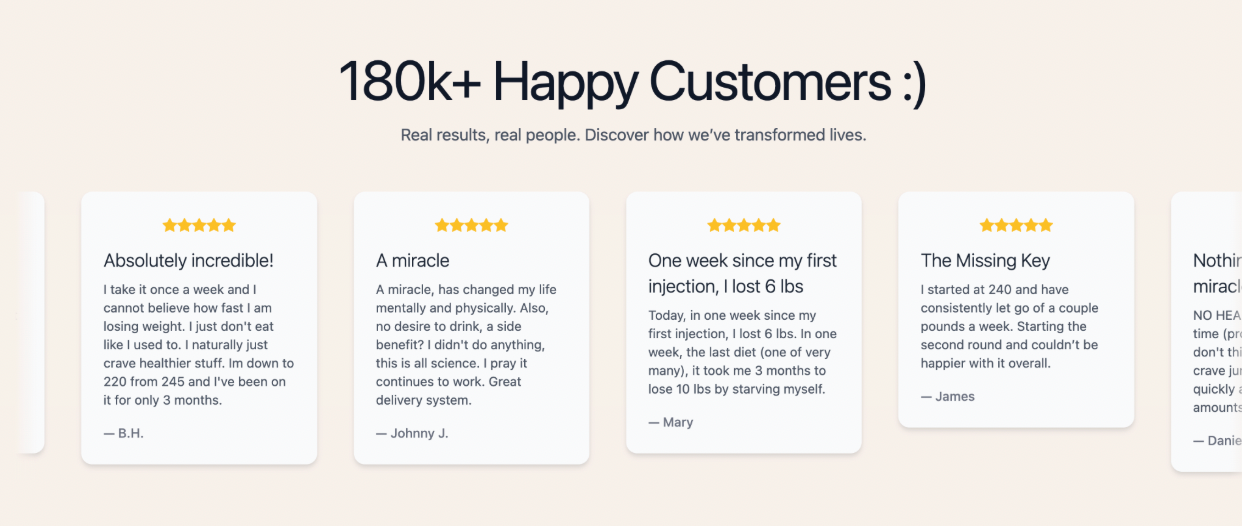
Real Direct Meds User Reviews & Testimonials: What Customers Are Saying
Here are verified patient testimonials drawn from the Direct Meds platform. Customer results are not independently verified. Individual results may vary based on starting weight and program adherence. These represent individual experiences and are not typical results.
Why Is the Direct Meds GLP-1 Program Trending in the United States?
The growth of compounded GLP-1 programs reflects several converging factors and understanding them gives important context for evaluating whether this is a genuine medical trend or just marketing momentum.
The GLP-1 access gap is enormous. Brand-name GLP-1 medications like semaglutide and tirzepatide products have been among the most discussed medications of the last several years not because of pharmaceutical marketing, but because of the genuinely significant clinical outcomes documented in large trials. The problem is that brand-name versions cost well over $1,000 per month without insurance, and insurance coverage remains inconsistent and difficult to obtain. An estimated 100+ million Americans meet clinical criteria for obesity treatment, yet the majority cannot access the brand-name medications at those price points.
Telehealth removed the clinical access barrier. Before telehealth GLP-1 programs existed, accessing medically supervised weight management treatment meant navigating a system stacked against patients — referrals, specialist waitlists, insurance prior authorizations, in-person visits, and a medical culture that frequently dismissed weight concerns. Telehealth platforms like Direct Meds collapsed that process into a fully online workflow accessible from anywhere.
Compounded medications offered a price point that worked. Compounded medications may be offered at different price points because they are prepared in limited quantities for specific patient needs. This makes physician-supervised GLP-1 access financially viable for patients who would otherwise be entirely priced out. It is important to note that compounded medications are not FDA-approved and are not the same as the branded products but for appropriately evaluated patients, they have provided access to a genuinely effective class of treatment.
The social proof feedback loop. Few medical treatments generate word-of-mouth the way GLP-1 medications have. When patients experience meaningful changes in appetite, eating behavior, and body weight and share those experiences publicly, interest compounds quickly. The growth of patient communities discussing GLP-1 experiences has dramatically raised awareness of this treatment category across demographics that had previously never engaged with medically supervised weight management.
>> For more information or to learn about available treatment options, visit DirectMeds
Top Tips for Best Results with Direct Meds
GLP-1 medication does the heavy lifting on appetite regulation but the patients who see the most meaningful and sustained outcomes are those who pair the medication with consistent supporting habits. Here’s what makes the difference.
1. Be completely transparent in your medical intake: Your physician can only make a safe and appropriate prescribing decision based on accurate information. Your full medical history, current medications, and any health conditions must be disclosed completely. This protects you and it ensures your treatment plan is actually right for your situation.
2. Follow your titration schedule: GLP-1 medications are started at a low dose and increased gradually. This titration process is specifically designed to reduce GI side effects during the adjustment period. Don’t push to a higher dose faster than prescribed; the schedule exists for good clinical reasons.
3. Stay adequately hydrated: Reduced food intake and potential GI side effects both increase dehydration risk. Drinking sufficient water throughout the day is particularly important on GLP-1 treatment as it supports kidney function, reduces constipation risk, and helps manage the nausea that some patients experience.
4. Eat when you need to, even in small amounts: Many patients find their appetite dramatically reduced. While this is the intended effect, it is still important to maintain some nutritional intake to support muscle preservation during weight loss. Small, nutrient-dense meals are more important than eating to an arbitrary calorie target.
5. Communicate side effects promptly: Direct Meds’ nursing team is there for this exact purpose. If you’re experiencing nausea, GI discomfort, or anything unexpected, reach out. Dose adjustments, dietary guidance, and clinical support are available. Don’t silently suffer through side effects or quietly stop treatment without medical guidance.
6. Give the program time: The appetite and behavioral changes typically become most consistent after several weeks of stable dosing. Patients who judge the program at week two are often assessing before the medication has reached its full effect. Consistent patience through the titration period is one of the biggest predictors of positive outcomes.
How to Get Maximum Benefits from Direct Meds GLP-1 Treatment
GLP-1 medication addresses the biological side of the weight management equation. The lifestyle factors you pair with it determine how much of the potential benefit you actually realize and sustain.
Prioritize protein intake: Weight loss always involves some muscle loss alongside fat loss. Adequate protein intake supports muscle preservation, keeps you fuller for longer, and supports the energy and body composition outcomes most patients are aiming for.
Incorporate resistance training: The combination of GLP-1 treatment and resistance exercise produces meaningfully better body composition outcomes than medication alone. Even 2-3 sessions per week of bodyweight exercises or light weights makes a difference.
Support sleep: Sleep deprivation disrupts the same hormonal systems GLP-1 medications target particularly ghrelin (the hunger hormone) and leptin (the satiety hormone). Poor sleep can work directly against GLP-1’s appetite-suppressing effects. Treating sleep as a medical priority, not an afterthought, supports better overall outcomes.
Reduce ultra-processed food consumption gradually: Many patients report naturally gravitating toward less processed foods on GLP-1 treatment as cravings diminish. Supporting this shift intentionally accelerates the dietary quality improvements that the medication makes easier to achieve.
Limit alcohol: Alcohol is calorie-dense, disrupts sleep quality, lowers inhibitions around food choices, and can interact with GLP-1 treatment in ways that affect tolerability. Moderation is the sensible approach, with many patients finding that alcohol appeal also naturally diminishes on GLP-1 medication.
>> For more information or to learn about available treatment options, visit DirectMeds
Common Mistakes to Avoid with GLP-1 Treatment Through Direct Meds
The patients who struggle most on GLP-1 programs are typically those who approach it with one of several common misconceptions. Getting clear on these from the start makes a meaningful difference.
Skipping doses or stopping treatment abruptly: GLP-1 medications require consistent administration to maintain stable hormone levels. Skipping doses or stopping suddenlynot only reduces effectiveness but can result in rapid return of appetite and rapid weight regain. Any changes to your protocol should be discussed with your Direct Meds medical team first.
Expecting results without any lifestyle change: GLP-1 medications are prescribed alongside diet and exercise for a reason as the clinical trials that established their efficacy included lifestyle components. The medication dramatically lowers the effort required to change eating behavior, but does not mean zero effort. Patients who remain entirely sedentary and make no dietary adjustments will see more limited outcomes.
Judging outcomes too early: The adjustment period, typically the first 4-8 weeks, is when side effects are most pronounced and when the medication hasn’t yet reached its full effect at stable dosing. Assessing whether it’s ‘working’ at week two or three is premature. Many patients who experienced significant GI discomfort early describe dramatically improved experience and results at weeks 8-12.
Under-eating to the point of nutritional deficiency: Appetite suppression can be powerful enough that some patients barely eat at all in the early weeks. While reduced caloric intake is the goal, severely restricting nutrients creates risks including significant muscle loss, fatigue, and nutritional deficiencies.
Combining with other weight loss medications or supplements without disclosure: Many OTC weight loss supplements, appetite suppressants, and even some herbal products can interact with GLP-1 medications or confound your physician’s assessment of how the treatment is working.
Direct Meds GLP-1 Reviews: Pros
LegitScript certified180,000+ customers servedBoth injectable and sublingual oral drop formats availableDedicated nursing team for ongoing patient supportBoth compounded semaglutide and compounded tirzepatide availableTelehealth physician consultation included Transparent pricing Cancel anytime Shipping included if prescribed No insurance requiredOptional Vitamin B-12 supplementation at no additional charge4.8/5 Trustpilot rating across thousands of verified reviewsFully online Medications prepared by U.S.-based compounding pharmacies
Direct Meds GLP-1 Reviews: Cons
Compounded medications are not FDA-approvedGI side effects are common, particularly during the initial titration periodOngoing treatment cost Results require lifestyle commitment Weight regain is possible if treatment is discontinued Availability and eligibility may vary by state due to telehealth and compounding regulationsNot appropriate for people with history of MTC or MEN 2, pancreatitis, or certain other conditions
>> For more information or to learn about available treatment options, visit DirectMeds
Is Direct Meds Worth the Money? Value & Pricing Analysis
Cost is a central consideration in this category so let’s work through it properly.
Brand-name GLP-1 medications can cost over $1,000 per month without insurance. A significant proportion of people who could benefit from physician-supervised GLP-1 treatment are simply priced out of that option. That’s the market reality that compounded GLP-1 telehealth platforms operate within.
What Direct Meds offers: Compounded medications may be offered at different price points because they are prepared in limited quantities for specific patient needs not because they are cheaper alternatives to brand-name drugs in the way one consumer product might be cheaper than another. The regulatory context is different, and that distinction matters. Compounded medications are not FDA-approved and have not been reviewed by the FDA for safety, effectiveness, or manufacturing quality.
What you’re paying for with Direct Meds: The program includes physician consultation (no separate billing), nursing team support throughout treatment, medication prepared by a licensed U.S. 503A compounding pharmacy, and shipping included. No insurance submissions. No hidden fees. No monthly membership tacked on. No clinic visit costs. For people who have genuinely struggled to access medically supervised weight management support due to cost or access barriers, this value proposition is meaningful.
Direct Meds is worth exploring if you are a candidate for physician-supervised GLP-1 treatment, your physician determines it is appropriate for your individual situation, and you understand the regulatory context of compounded medications fully. For people in that position, the platform offers a streamlined and cost-accessible pathway to a medically supported program that would otherwise be out of reach. Results may vary based on starting weight and program adherence.
The value calculation is ultimately your physician’s determination intersecting with your personal situation. What Direct Meds does is remove the access and cost barriers so that evaluation can actually happen.
Price of Direct Meds — Pricing Verified & Current Availability
Let’s talk through the actual numbers — because transparent pricing is one of Direct Meds’ stated commitments, and it’s worth laying out clearly.
Online physician evaluation Telehealth consultation Compounded medication prepared by a licensed U.S. 503A pharmacy, if prescribedDedicated nursing team support throughout your programShipping includedNo monthly membership feeCancel anytime
Putting the pricing in context:
OptionTypical CostNotesBrand-name GLP-1 (without insurance)$1,000+ per monthFDA-approved; insurance coverage inconsistentTraditional obesity medicine specialist visit$200–$500 per visitConsultation only — medication cost additionalDirect Meds compounded GLP-1 programFrom $147Includes physician consult, medication, nursing support, shipping. Not FDA-approved.
For readers of this site, using the link in this article goes directly to the official Direct Meds platform where current pricing and program details are available. Always verify pricing directly before enrolling.
>> For more information or to learn about available treatment options, visit DirectMeds
Where to Buy Direct Meds?
Direct Meds compounded GLP-1 medications are available exclusively through the official Direct Meds platform at directmeds.com. This is the only legitimate channel.
Compounded GLP-1 medications are prescription-only products that can only be legally dispensed based on a valid prescription from a licensed physician. They cannot be purchased from retailers, marketplaces, or third parties and any source claiming to sell them without a proper medical evaluation process should be treated with significant caution.
The process through the official platform: Complete the online health questionnaire, consult with a board-certified physician who makes an independent prescribing decision, and if prescribed, receive your medication from a licensed 503A U.S. compounding pharmacy, shipped directly to your door. Use the link in this article to go directly to the official Direct Meds program page.
>> For more information or to learn about available treatment options, visit DirectMeds
Can You Buy Direct Meds on Amazon, Walmart, or GNC?
No and it is important to understand why.
Compounded GLP-1 medications are prescription-only pharmaceutical compounds that cannot legally be sold on Amazon, Walmart, GNC, or any general retailer. Selling prescription medications without proper pharmacy licensure and a valid patient prescription is illegal in the United States.
What you will find on these platforms instead: OTC products marketed as “GLP-1 boosters” or “natural GLP-1 support” supplements. These are not GLP-1 receptor agonist medications. They do not contain semaglutide, tirzepatide, or any pharmaceutical GLP-1 compound. The FDA has issued clear guidance that over-the-counter GLP-1 supplements lack regulated clinical data and do not boost GLP-1 activity at clinically meaningful levels. These are supplement products with marketing language that borrows the GLP-1 name. They are not the same category as prescription GLP-1 medications.
The only legitimate path to compounded GLP-1 medications through Direct Meds is via the official platform, following a proper medical evaluation and valid prescription.
Direct Meds Official Website vs Third-Party Sellers: Where’s Best?
FactorOfficial Direct Meds PlatformThird-Party / Unverified SellersProduct authenticityCompounded by licensed U.S. 503A pharmacies per valid prescriptionCannot be verified Medical oversightBoard-certified physician evaluation includedNone Legal statusPrescription issued by licensed physician; dispensed by licensed 503A pharmacyIllegal Nursing supportDedicated nursing team included throughout programNonePlatform certificationLegitScript certifiedUnverified Transparent pricingPublished pricing, no hidden fees, cancel anytimeUnknown VerdictThe only legitimate optionDo not use
There is no legitimate third-party market for Direct Meds’ compounded GLP-1 medications. The official platform is not just the recommended option; it is the only safe and legal one.
>> For more information or to learn about available treatment options, visit DirectMeds
Does Direct Meds Offer a Money-Back Guarantee? Return Policy Explained
Direct Meds’ refund policy is worth understanding clearly before you enroll, as it differs from typical consumer product return policies.
Prescription medications, including compounded GLP-1 formulations, cannot be returned once dispensed. This is standard across the pharmaceutical industry for safety and regulatory reasons. Once a compounded medication has been prepared for an individual patient and dispensed, it cannot be returned or redistributed.
What Direct Meds’ refund policy covers: Direct Meds offers a refund for the consultation fee if a patient is not approved for treatment following the physician evaluation meaning you are not charged for medication you were never prescribed. If you complete the intake, consult with a physician, and are determined not to be an appropriate candidate, you are not left paying for a product you cannot receive.
If you have concerns about a dispensed order: Direct Meds’ customer service team and nursing staff are available to address any issues with your order, shipping, or treatment. Given the platform’s track record and 4.8/5 Trustpilot rating across thousands of reviews, responsive customer support is a consistent feature of the service. For any order-specific concerns, contact Direct Meds directly through the official platform.
Frequently Asked Questions About Direct Meds
Q: Are Direct Meds’ compounded GLP-1 medications FDA-approved?A: No. Compounded medications are not FDA-approved. They are prepared by licensed compounding pharmacies to meet individual patient needs when commercially available options are not suitable for their personalized needs. The active ingredients, semaglutide and tirzepatide, are FDA-approved in their brand-name forms, but the compounded formulations have not been reviewed by the FDA for safety, effectiveness, or manufacturing quality. This is an important distinction to understand before enrolling.
Q: How soon can I receive my medication if prescribed?A: Direct Meds states that if prescribed, medications ship from licensed U.S. compounding pharmacies with shipping included, with delivery typically within 1-2 days of processing.
Q: What is the difference between the injectable and oral drop formats?A: The injectable format involves a standard subcutaneous injection, typically administered once weekly. The sublingual oral drops dissolve under the tongue and represent a needle-free alternative delivery method. Y
Q: Do I need insurance?A: No. Direct Meds operates on a transparent cash-pay model. No insurance is required, no prior authorizations, and no insurance forms to submit.
Q: What ongoing support is included?A: Direct Meds includes access to a dedicated nursing team throughout your program. This means you have qualified clinical support available for questions about dosing, titration, side effects, and progress without needing to book separate appointments or pay additional consultation fees.
>> For more information or to learn about available treatment options, visit DirectMeds
How Long Does It Take to See Results with Direct Meds?
Timeline expectations for GLP-1 treatment are important to set accurately because unrealistic expectations lead to frustration, and the actual evidence-based picture is genuinely compelling when understood correctly.
Weeks 1–4: The adjustment phase. GLP-1 medications are typically started at a low dose and titrated upward gradually to minimize gastrointestinal side effects. During this phase many patients report the beginning of appetite changes, food becomes less dominant, portions feel like less of a struggle. Some patients notice scale movement in the first month; others need more time to reach their therapeutic dose. Both are normal.
Weeks 4–12: Appetite regulation becomes consistent. As dose titration progresses and the body adjusts to GLP-1 receptor activation, the appetite-suppressing and satiety-supporting effects become more stable. Most patients report this as the phase where eating habits shift meaningfully, not through restriction but through a genuine reduction in hunger and craving intensity. Many patient testimonials on the Direct Meds platform describe this shift as the most striking and unexpected change.
Months 3–6: Progressive weight reduction. Clinical trial data from FDA-approved GLP-1 studies shows that the most substantial proportion of weight reduction typically occurs in this window, as patients reach their optimized therapeutic dose and the cumulative effect of reduced caloric intake compounds over time.
Note – ” The active ingredients used, semaglutide and tirzepatide, are the same active ingredients found in several FDA-approved products, but the compounded formulations themselves have not been reviewed by the FDA for safety, effectiveness, or manufacturing quality.”
Beyond 6 months: Long-term maintenance. For many patients, GLP-1 treatment is a long-term program rather than a short course. Discussing long-term strategy with your physician from the outset ensures you are making a fully informed commitment.
Can I Use Direct Meds with Other Supplements or Medications?
This is a safety-critical question and one where complete transparency with your prescribing physician is non-negotiable.
Medications that require mandatory disclosure: Several medication classes interact meaningfully with GLP-1 receptor agonists. Insulin and other glucose-lowering medications can compound hypoglycemia risk when combined with GLP-1 treatment. Blood pressure medications may be affected as weight changes over time. Your physician reviews all current medications during the intake — do not omit anything.
OTC supplements: Even supplements that seem benign can affect GLP-1 treatment. Supplements containing berberine, fiber-based hunger suppressants, or stimulant-based ingredients may interact with the mechanism or the physiological effects of GLP-1 medications.
Alcohol: GLP-1 medications slow gastric emptying, which can affect alcohol absorption; alcohol may be absorbed more slowly but then hit more intensely.
The rule throughout: full disclosure in your medical intake, and prompt communication through the nursing team if anything changes. That is what the ongoing support structure is there for.
>> For more information or to learn about available treatment options, visit DirectMeds
Final Verdict on Direct Meds GLP-1: Is It Worth It?
We’ve covered the platform, the science, the regulatory context, the pricing, the side effects, the process, and the real patient feedback. Here’s the honest conclusion.
Direct Meds is one of the most accessible and well-structured telehealth platforms for physician-supervised compounded GLP-1 access currently available in the U.S.
That statement comes with important context, and any review that omits it isn’t being straight with you.
What Direct Meds does well: It removes the real access barriers, cost, friction, insurance complexity, and the clinical gatekeeping that has historically kept many people from pursuing medically supervised weight management. LegitScript certification, 503A licensed pharmacies, dedicated nursing team support, and a board-certified physician evaluation process together make this one of the more credibly structured platforms in a space that has attracted some less rigorous operators. Over 180,000 customers served and a 4.8/5 Trustpilot rating reflect genuine operational track record.
What you must understand going in: Compounded medications are not FDA-approved. They are prepared by licensed compounding pharmacies to meet individual patient needs when commercially available options are not suitable for their personalized needs. Compounded formulations have not been reviewed by the FDA for safety, effectiveness, or manufacturing quality. All clinical weight loss outcome data referenced in this review comes from studies of FDA-approved versions of these active ingredients not from compounded formulations. Results may vary based on starting weight and program adherence. The regulatory environment around compounded GLP-1 medications continues to evolve, and your physician will evaluate your individual situation in light of current guidelines.
Who Direct Meds is well-suited for:
Adults with obesity or overweight and related health conditions who have not achieved sufficient results through lifestyle interventions alonePeople who cannot access or afford brand-name GLP-1 medications through traditional insurance channelsPeople who want a fully remote, private, physician-supervised weight management pathway with ongoing nursing supportPeople prepared to approach this as a medically supervised program — with physician oversight, adherence to prescribed dosing, and realistic outcome expectations
Who should proceed with particular care:
Anyone with a personal or family history of medullary thyroid carcinoma or MEN 2 Anyone with a history of pancreatitis, certain gastrointestinal conditions, or complex medication interactions Anyone expecting rapid, guaranteed, or dramatic results without lifestyle engagement. GLP-1 treatment works alongside diet and exercise, not instead of it
For the right candidate, with clear eyes about both the opportunity and the regulatory context, Direct Meds offers a physician-supervised, cost-accessible pathway to a medically supported weight management program that would otherwise be out of reach for the majority of people who could benefit from it.
That is meaningful. And it’s what makes this platform worth serious consideration.
>> For more information or to learn about available treatment options, visit DirectMeds
Media details
Email: help@direct-meds.com
Direct meds
Address- 345 Grand Ave, Leonia, New Jersey
About Web3Wire Web3Wire – Information, news, press releases, events and research articles about Web3, Metaverse, Blockchain, Artificial Intelligence, Cryptocurrencies, Decentralized Finance, NFTs and Gaming. Visit Web3Wire for Web3 News and Events, Block3Wire for the latest Blockchain news and Meta3Wire to stay updated with Metaverse News.
I still can’t believe what I just read. Hollywood isn’t just making movies anymore; they are literally raising the dead with AI.
When I first found out that the legendary Val Kilmer was being digitally cloned for the new movie As Deep as the Grave, my jaw completely dropped. I had to sit back, refresh the page, and make sure I wasn’t reading some elaborate sci-fi fan fiction. I mean, sure, the family gave their official permission, and the legal teams have everything signed in ink, but I can’t stop thinking about how inherently creepy this entire concept is.
I am seriously wondering if the future of cinema will just be digital ghosts instead of real, living, breathing actors. As someone who spends hours every day diving into the latest tech and metaverse developments, I honestly find this both incredibly fascinating and completely terrifying. Let’s really break down what is happening behind the scenes, why studios are pushing for this, and what it means for the movies we love.
The Evolution of the Digital Clone
We need to clear something up right away: this is not just advanced CGI. For years, we’ve seen Hollywood use digital de-aging or body doubles to finish a film when tragedy strikes mid-production. But what I am looking at now is an entirely different beast. We have crossed the line from visual effects into generative AI resurrection.
When I researched the tech stack being used for these new projects, I was blown away by the sheer computational power involved. Studios are no longer just mapping a 3D face onto a stunt double. They are feeding decades of a human being’s life into neural networks.
The Mechanics Behind the Magic
Here is what goes into creating a modern “Digital Ghost”:
Volumetric Facial Mapping: AI doesn’t just copy a face; it learns it. Algorithms scan thousands of hours of old footage to understand exactly how an actor’s specific muscles moved, how their eyes reacted to different lighting, and the exact asymmetry of their smile.Neural Voice Synthesis: Audio models are trained on past interviews, movie dialogue, and even outtakes. The AI learns the exact timbre, breathing patterns, and emotional inflection of the actor. We saw a touching, early version of this with Val Kilmer in Top Gun: Maverick, but the technology I am seeing now has leaped lightyears ahead.Behavioral Emulation: This is the part that gives me chills. The newest algorithms attempt to predict how an actor would deliver a line they never actually read, mimicking their unique artistic choices and mannerisms.
As a tech enthusiast, I have to applaud the raw engineering behind this. It is a modern miracle of data processing. But as a guy who loves going to the movies? It makes my stomach tie in knots.
The Ethical Tightrope: Who Owns a Legacy?
The loudest argument defenders of this technology use is consent. For As Deep as the Grave, Val Kilmer’s estate signed off. They gave the green light, and they are compensated for it.
But I keep asking myself: does legal permission automatically make it artistically ethical?
When a human actor delivers a performance, they are making hundreds of micro-decisions based on their lived experience, their mood that morning, and the unscripted chemistry they share with their co-stars. A digital clone doesn’t feel any of that. It just computes the most statistically probable facial expression based on a dataset.
Are We Buying Tickets for a Parlor Trick?
If I go to the theater to watch a digitally cloned legend, what am I actually paying for?
Pure Nostalgia Bait: Am I just being emotionally manipulated by my love for an actor’s past work?A Technical Showcase: Am I marveling at the AI rendering rather than actually engaging with the emotional core of the story?The Erasure of New Talent: This is my absolute biggest fear.
Why would a major movie studio take a multi-million dollar financial risk on an unknown, rising actor when they can just license the digital likeness of a proven box-office legend? Think about it from a corporate perspective: a digital ghost never ages, never demands a bigger trailer, never gets involved in a PR scandal, and never goes on strike.
This isn’t a sci-fi hypothetical anymore. When I followed the recent SAG-AFTRA strikes, this exact nightmare scenario was at the heart of the protests. Actors were literally fighting on the picket lines for the right to own their own faces.
The Metaverse Connection: Immortal IP
Since we talk about the Metaverse a lot here, I can’t ignore how this AI cloning tech ties into virtual worlds. We are standing on the edge of a massive paradigm shift in how entertainment IP is handled.
I can easily imagine a future—maybe only five or ten years from now—where you put on a VR headset and act alongside a digitally resurrected Marlon Brando, Marilyn Monroe, or Heath Ledger in a fully interactive metaverse environment.
The companies that own the rights to these digital likenesses are going to make an absolute fortune licensing these AI ghosts out for:
Immersive VR Video GamesInteractive Digital MoviesVirtual Brand Ambassadors The potential for monetization is endless. But while the business model is brilliant, the cultural impact feels a bit hollow. We are turning human beings into software updates.
Finding Our Bearings in the Uncanny Valley
I am genuinely torn. Part of me is eager to see As Deep as the Grave just to witness the sheer capability of this technology on the big screen. I want to see if the AI can actually make me feel genuine emotion, or if I’ll just feel like I’m staring at a highly rendered video game character pretending to be a Hollywood legend.
But the other part of me feels like we are opening Pandora’s Box. Once mainstream audiences accept digital ghosts as leading men and women, the film industry will never be the same.
I love the beautiful, messy unpredictability of human acting. I love seeing an actor make a strange, weird choice that no algorithm could ever predict. I love the happy accidents that happen on a chaotic movie set. AI can perfectly mimic the past, but I am not convinced it can create the raw, emotional lightning in a bottle that makes true cinematic magic.
I’ve been reading the early reactions online, and the internet is completely split down the middle. Some people are calling it a beautiful, touching tribute to immortalize our favorite stars, while others are calling it straight-up digital necromancy.
I will be reading all the comments because I really need to know which side to choose in this technological revolution!
So, be honest with me: If your absolute favorite actor passed away tomorrow, would you buy a ticket to see their AI clone star in a brand-new movie, or should we let sleeping legends lie?
Kelp DAO, one of the largest liquid restaking protocols in the EigenLayer ecosystem with over $1 billion in TVL before Saturday, has been hit with the biggest DeFi exploit of 2026. At 17:35 UTC on April 18, an attacker walked away with 116,500 rsETH, roughly $292 million and about 18% of the token’s entire circulating supply in a single transaction targeting Kelp’s LayerZero-powered cross-chain bridge.
Blockchain sleuth ZachXBT was first to flag the drain publicly on his Investigations Telegram channel around 2:52 PM ET. Within minutes, the rest of DeFi security accounts on X were piling on. From Cyvers and PeckShield to SlowMist, all confirming the worst. Security firm Cyvers revealed that the attacker had been pre-funded via Tornado Cash roughly 10 hours before the exploit, which is about as textbook as laundering prep gets.
By the time Kelp DAO posted its first public acknowledgment on X, the attacker had already moved on to the second stage of the heist.
Earlier today we identified suspicious cross-chain activity involving rsETH. We have paused rsETH contracts across mainnet and several L2s while we investigate.We are working with @LayerZero_Core, @unichain, our auditors and top security experts on RCA. We will keep you…
— Kelp (@KelpDAO) April 18, 2026
What actually got hit
The target was Kelp’s Omnichain Fungible Token (OFT) adapter on Ethereum, the contract that holds the reserve rsETH backing every wrapped version of the token on 20+ Layer-2 chains. That list includes Arbitrum, Base, Blast, Linea, Mantle, Scroll, Mode, Swellchain, Zircuit, Berachain, zkSync, and others.
The way it’s supposed to work: a user burns wrapped rsETH on, say, Arbitrum. LayerZero delivers a cryptographically verified message to Ethereum. Kelp’s adapter sees the burn, checks it, and releases the same quantity of real rsETH from the reserve. One-to-one, clean, verifiable.
Kelp Dao Attack | Source: The CryptoTimes
On Saturday, the verification step failed. The attacker “tricked LayerZero’s cross-chain messaging layer into believing a valid instruction had arrived from another network, which triggered Kelp’s bridge to release 116,500 rsETH to an attacker-controlled address.” One forged lzReceive call. No burn on the other side. No deposit. Just a packet that said “release the funds” — and the contract obliged.
What exactly broke? Kelp hasn’t said. The three plausible root causes are a DVN (Decentralized Verifier Network) misconfiguration accepting a forged packet, an OApp peer-mapping flaw trusting messages from an unauthorized source chain, or — worst case — an admin key compromise that let the attacker change the adapter’s config directly. Each one implies a very different fix, and until Kelp publishes an RCA, everyone else using LayerZero OFTs is operating on guesswork.
The second hack inside the first
Here’s what makes this one different from your standard bridge drain: the attacker didn’t just cash out and run.
46 Minutes of Contamination | Source: The CryptoTimes
Within minutes of the drain, the stolen rsETH was deposited as collateral on Aave V3, Compound V3, and Euler across Ethereum and Arbitrum. Against that collateral, the attacker borrowed roughly 74,000 ETH and WETH building over $236 million in debt positions across three major lending markets. One wallet reportedly ended up sitting on about $120 million in borrowed ETH from Aave alone.
Solidity auditor 0xQuit, watching the positions build in real time, cut through the noise with a single tweet: “If you have WETH on Aave V3 Core, withdraw now.”
The trick here is sinister but simple. The attacker posted collateral whose redemption claim he himself had just stolen. The rsETH contract verifies normally. The price oracle quotes it at full value. To Aave, Compound, and Euler, it looks like legitimate collateral worth $292 million. Except the real rsETH backing it is already in the attacker’s wallet.
This is the mechanic that turns a bridge hack into cascading bad debt across DeFi. The $292M drain was just the entry ticket. The $236M+ borrow was the actual payout — because ETH is cleaner, more liquid, and not frozen behind a pause button.
What saved another $200M?
Kelp’s emergency pauser multisig finally triggered at 18:21 UTC — 46 minutes after the initial drain. The pause hit the LRT Deposit Pool, the Withdrawal Module, the LRTOracle, and the rsETH token contract itself. Everything froze.
And it’s a good thing it did. At 18:26 and 18:28 UTC, two follow-up transactions tried to drain another 40,000 rsETH each — roughly $100 million a pop. Both reverted. The pause held.
Without those 46 minutes of response time, total losses could have pushed near $391 million. The containment worked. The problem is that by the time the pause fired, the secondary attack on Aave, Compound, and Euler was already complete. You can’t unwind a loan that’s already been issued.
The contagion list is long
rsETH isn’t just a token. It’s a composable piece of DeFi infrastructure embedded in dozens of protocols. Once the exploit went public, the defensive freezes started rolling in fast.
Kelp Dao Contagion Map | Source: The CryptoTimes
Aave froze rsETH markets on V3 and V4. Founder Stani Kulechov posted on X that Aave’s own contracts were not compromised and that the freeze was precautionary.
SparkLend and Fluid froze their rsETH markets. SparkLend reported zero actual exposure, crediting its conservative risk posture.
Lido Finance paused deposits into its earnETH vault, which carries rsETH exposure — while stressing that stETH and wstETH are completely unaffected.
Ethena temporarily shut down its own LayerZero bridges from Ethereum mainnet for roughly six hours, despite having no rsETH exposure.
Flare Networks paused FXRP cross-networking via OFTs between Flare, Ethereum, Base, and other supported networks the following morning.
Upshift paused its High Growth ETH and Kelp Gain vaults.
AAVE the token fell about 10–13% on the day as the market priced potential bad debt. ETH dipped around 3% in the same window. stETH and wstETH took mild sympathy hits around 4% before recovering.
Where’s the money now?
The six attacker wallets identified by ZachXBT sit across Ethereum and Arbitrum, holding a mix of rsETH, ETH, and WETH. As of April 19, none of it has moved to centralized exchanges. None of it has been pushed through Tornado Cash beyond the initial gas funding. No sanctions labels have been applied by OFAC or any other agency.
That’s unusual. Most exploiters in 2026 either move to mixers within hours or start testing CEX deposits to see what gets frozen. This one is just sitting. Which could mean a few things: the attacker is waiting out the initial attention, negotiating quietly, or — less charitably — figuring out which mixer still works after a year of aggressive OFAC designations.
What hasn’t happened yet is notable too. No white-hat bounty offer has been posted by Kelp as of this writing. No on-chain negotiation message to the attacker. No confirmed freezes at Binance, Coinbase, OKX, or Kraken. No public engagement with Chainalysis, TRM Labs, or law enforcement — or at least, nothing disclosed. The Euler ($197M, 2023), Poly Network ($611M, 2021), and KiloEx playbooks all involve some combination of those moves within 24–48 hours. Kelp is past that window and still quiet.
Kelp’s track record doesn’t help
This isn’t Kelp’s first rodeo. In July 2024, a GoDaddy domain-redirection attack hijacked the Kelp DAO frontend, draining multiple user wallets before the team caught it. Kelp pledged reimbursement and said it would move DNS providers. In April 2025, a fee-contract bug triggered a precautionary Aave freeze — no user losses that time, but it rattled confidence.
Saturday’s $292M drain is the third incident in under two years. The protocol has been audited by SigmaPrime, Code4rena, and MixBytes, and runs an Immunefi bug bounty capped at $250,000 (10% of funds at risk, with a $100K minimum for critical smart contract bugs). None of that stopped this one.
The pattern isn’t fatal plenty of blue-chip DeFi protocols have had multiple incidents and recovered — but it changes the recovery narrative. Kelp doesn’t get the benefit of the doubt this time. Users and integrators will want to see the full RCA, a concrete remediation plan, and ideally some form of compensation structure before trust rebuilds.
Where things stand right now
As of April 19, Kelp DAO’s contracts remain paused. No RCA has been published. No reimbursement plan has been announced. The attacker still holds the ~74,000 ETH. Aave, Compound, and Euler are still sitting with attacker-opened debt positions that they may or may not be able to cleanly liquidate.
The next 72 hours will tell us three things: whether rsETH’s peg survives when redemptions resume, whether the lending markets can absorb the bad debt without governance intervention, and whether anyone at Kelp can explain what actually broke.
This story is still developing. We’ll keep tracking the attacker wallets, any law enforcement updates, and whatever Kelp eventually puts in the RCA.
Also Read: Aave V4 Witnesses Accelerating Traction Just After Mainnet Launch
Nicole Kidman is reflecting on the moment she was told her mother Janelle Kidman had died right before she was about to go on stage to accept an award.
Speaking to Variety on Saturday, April 18, Nicole, 58, detailed how she found out about the loss at the Venice International Film Festival as she was preparing to accept a best actress award for her role in Babygirl.
“I was about to go out on stage, and I found out that my mother had passed,” Nicole told the outlet. “I went right back to my room in Venice, was getting into bed, and I was completely devastated.”
Nicole added that as she digested the sad news at the time, she thought to herself, “‘I’m not sure how I’m going to move forward or function now.’ She was so much a part of my existence.”
Related: Nicole Kidman Addresses Mom’s Death: ‘I Wish My Mama Was Here’
Nicole Kidman spoke about missing her late mother Janelle, who died last month at age 84. “It’s been hard,” Nicole, 57, told The Hollywood Reporter on Wednesday, October 23 at the Lioness season 2 premiere in Los Angeles. “It’s a hard road. I’m hanging in there.” The actress admitted it was bittersweet to be celebrating […]
In September 2024, the Big Little Lies actress left Venice early to make her way home to Australia after learning of Janelle’s death.
Speaking to Variety on Saturday, Nicole also described her “harrowing” attempt to leave Venice in the middle of the night trying to return to her home country.
“I remember getting into a boat in the canal, literally at night, trying to find my way to the airport, and then turning around going, ‘I can’t even do this,’” she said. “Then I went back to bed. And I was alone. My husband wasn’t there, my children weren’t there. I was there to win an award, which should’ve been a beautiful thing. That there is the contrast of life.” (Nicole was married to Keith Urban at the time, with whom she shares daughters Sunday Rose, 17, and Faith Margaret, 14. Nicole and Urban finalized their divorce in January.)
Janelle and Nicole Kidman.(Photo by James D. Morgan/Getty Images)
At the time, Babygirl director Halina Reijn confirmed Janelle’s death as she read a statement on behalf of Nicole during a Venice International Film Festival panel.
“Today I arrived in Venice to find out shortly after, that my beautiful, brave mother Janelle Ann Kidman has just passed,” Reijn, 50, read on Nicole’s behalf. “I am in shock and I have to go to my family, but this award is for her, she shaped me, she guided me and she made me.”
Thank You!
You have successfully subscribed.
Related: Nicole Kidman Opens Up About ‘Missing’ Her Late Parents
Nicole Kidman paid tribute to her late parents in honor of her mother’s birthday. “Missing Mumma and Papa so much on what would have been her birthday today ❤️,” the actress, 57, wrote via Instagram on Wednesday, March 12, alongside a throwback pic of her mom, Janelle Ann, and dad, Antony. The photograph showed Kidman’s […]
The statement continued, “I am beyond grateful that I get to say her name to all of you through Halina, the collision of life and art is heart-breaking, and my heart is broken.”
Less than a week after their mother’s death Nicole and her sister Antonia, 55, took to Instagram to share a joint post thanking friends and fans for their condolences and well wishes.
“My sister and I along with our family want to thank you for the outpouring of love and kindness we have felt this week,” Nicole and Antonia wrote. “Every message we have received from those who loved and admired our Mother has meant more to us than we will ever be able to express. Thank you from our whole family for respecting our privacy as we take care of each other ❤️”
Saint Slayer: Spear of Sacrilege is a ridiculous, brilliant name—and the game behind it is just as committed to the bit: a gory, gothic throwback to when games were hard and gave zero shits about holding your hand. As developer Lilymo’s sixth title in their quest to replicate those days, the question is simple: is it their best? Arguably, yes.
Before diving in, I should probably address a potential bias. Lilymo is co-owned by Colin Moriarty, a former IGN writer turned podcaster whose work I actively follow and support. I like what he and the Sacred Symbols crew do—enough to support them on Patreon. I like what Lilymo stands for. And that meant I came into this wanting to love Saint Slayer.
Available On: PC, Xbox, Switch, PlayStationReviewed On: PS5Developed By; Lilymo GamesPublished By: Lilymo Games
Review code provided by Lilymo Games
Which is why it pains me to say this: I didn’t. Not on a personal level, anyway. And the truth is, that’s not the game’s fault—it’s mine. I’d like to say this just isn’t the game for me, but the reality is harsher than that. I’m just not the right person for the game. It came looking for a boss and it got me, someone who wanted to be able to revisit the olden days and found out he couldn’t.
This is a NES-ass NES game, and it plays by a completely different set of rules. It’s stiff, unforgiving, and demands a kind of rhythm that doesn’t come naturally if you didn’t grow up with it. As an early ’90s kid, the NES was already history. I was raised on the Sega Genesis and PlayStation, and it wasn’t until the Xbox 360 era that I really began to understand game design, how the industry worked, and cemented the hobby as my main love.
So yeah—I struggled. I got my ass whooped, my pride hurt.
Playing Saint Slayer felt like trying to speak a language I don’t understand. I couldn’t settle into its rhythms, couldn’t read its patterns, couldn’t quite grasp what it wanted from me—even when the answer was obvious. My brain kept trying to translate it into something more modern. It doesn’t work like that.
And yet, despite all of this, I can confidently say: this is an excellent game.
And Now, The Review.
The story follows Rudiger, a former soldier turned farmer in a gothic version of late seventeenth-century Europe. But one day, tragedy comes knocking, and Rudiger sets out to defeat a crazed Catholic priest who is stealing relics and leading cults like he’s gunning for his own Netflix documentary. In the process, Rudiger ends up wielding the Spear of Sacrilege, a powerful poker that gradually gets powered up through the game. Cue 21 stages of platforming, combat, boss battles, gore, and weirdness.
The developers describe the game as a “blood-drenched homage to the 8-bit era of horror-tinged, side-scrolling action,” and that pretty much nails it. For every slightly wacky moment or tongue-in-cheek line of dialogue, there are bodies hanging from crucifixes, or messy piles of blood and bone. For every time you’re knocked off a cliff by a donkey or stab a weird monster in the eye, there’s rescuing barely alive prisoners from dungeons.
The other obvious inspiration is Castlevania, found in the level design, the gothic tone, and the gameplay. What feels stiff and unwieldy to modern sensibilities is entirely deliberate. You commit to jumps. Attacks have no lunge. Take damage, and the resulting pushback can send you straight into a pit and all the way to the start of the stage again. It’s punishing, but the rewarding kind that beats the shit out of you but is nice enough to call the ambulance afterwards.
I like how the game makes most of the story optional. The majority of the dialogue is a few lines here or there from bosses and NPCs you meet, painting in just enough of the background plot so that you can mentally fill in the gaps. But if you really want to delve into the story proper, you need to talk to the travelling merchant wherever possible, and see the different endings. It’s worth the extra effort, revealing a slim, interesting tale that does exactly what it needs to—be an excuse to move from stage to stage.
Rudiger has a simple moveset befitting his NES aspirations. He can stab hapless hooligans with his spear, or throw it provided he has enough Rosary Beads. A thrown spear can even be used as a climbing platform, a mechanic that could have been utilised a bit more, I reckon. He also has a DuckTales-style pogo stick bounce, another moment of absurdity. A few later upgrades add extra moves, putting Rudiger in real danger of becoming a competent human being.
With this diet moveset, the devs craft a fiendish death trap that must be battled and survived. You need to learn the patterns, figure out when to attack and when to just ignore your problems and sidle onwards into the pixelated sunset. Success must first be earned through failure. Probably quite a bit of it, if you aren’t an old head.
Dropping down to the easiest difficulty will help quite a bit. You get extra health and the enemies die quicker, but the biggest difference is the lack of knockback. And for those looking for a challenge, Classic mode removes lives as well, so death means instant failure and a desire to punch the nearest object.
Lose all your lives and you’ll be given that stage’s password, which you can use to jump to that specific stage from the main menu. There’s a cost, though: you’ll spawn in fresh as a proverbial daisy with no health upgrades or anything else that you would have acquired by playing normally.
You also get passwords when you manage to locate the various treasures hidden throughout stages. These passwords are more fun because they unlock cool stuff that you can then use to run through the game again, or extra challenging modes. Want to play exclusively with Rudiger’s first-stage dirk that has the reach of a baby’s arm? You can! And who knows how many other passwords are waiting to be discovered?
There is a slightly more modern idea: a persistent currency called Orbs. These stick with you across playthroughs and can be spent at a travelling merchant. It’s an interesting system, but one I didn’t find very useful until much later in the game, where I hoarded Orbs until attempting a run on the harder difficulty. At that point, my trove of treasure helped a lot.
And if you’re still struggling, it is possible to farm Orbs pretty easily.
Speaking of the passwords and treasures, this is a game that’s intended to be replayed, again just like you would have done back in the NES days. There’s four different endings to achieve in Saint Slayer: Spear of Sacrilege, along with Trophies/Achievements for completing the game with the various treasure passwords and on all the difficulties.
Again, it’s very Castlevania-coded. The first couple of playthroughs will be slow and clunky, but as you get the hang of the gameplay and map everything out, you’ll go from an hour or two to probably 15–30 minutes, if you really nail it.
You can also tackle the whole thing via local co-op. Yes, another Rudiger can take up the spear, and like most things, it’s even more fun with friends. Well, right up until you turn on friendly fire—then it’s a cause for shattered friendships and therapy.
Presentation is an area where SS:SoS is excellent in every aspect. Do you see those pixels? Aren’t they lovely? The artist, Josh Gossage, does an excellent job of emulating the style of the time with a couple of modern touches here or there. My only complaint is one or two levels are quite plain or could do with a touch more variety.
Meanwhile, the score—composed by Josh Davis—is a banger. Again, perfectly retro to match the time period, with a couple of tracks that had me bopping my head along to the beat.
And finally, let’s throw a little extra kudos Lilymo’s way for their continued usage of Trophies. Previously, the company has offered up different levels of Trophy difficulty for their titles: easier on PS4 and harder on the PS5 versions. This time around, they opted to ditch the difficulty and instead just have two different Trophy lists, each one sharing some Trophies while also having some completely different ones, too. It should make it fun to chase the Platinum on both versions of the game.
In Conclusion….
⭐⭐⭐⭐
Rating: 4 out of 5.
The obvious negative is that SS:SoS is so dedicated to its inspirations that it doesn’t do anything particularly new. But that’s not much of a criticism. It isn’t trying to be shiny and new. It wants to be a game that could have been released during the NES days, and it succeeds wildly at that task.
There’s a couple of levels that overstay their welcome, some of the deaths felt a bit cheap, and then there’s my own personal issues.
None of them detract from how much of a fitting, touching homage to the classics Saint Slayer: Spear of Sacrilege is. It is not for everyone—it isn’t for me—and that’s exactly how it should be.



 Other smaller beaches are rather quiet and almost make you feel as if you are on your own private island. One important thing to note is that sharp corals and sea urchins are common in the waters around Mauritius. If you plan to spend time in the water, rubber shoes are a good idea.
 There is also a large family pool and separate adults pool, both with splashing fountains and views of the sea.
 There, you will find more beach chairs with umbrellas, cushioned cabanas, day beds and plenty of beach and sand to frolic the day away. A separate restaurant and bar mean that you’re never far from a menu.
 It is also home to a golf course with free greens fees for guests. To get there, meet the bell staff near the enormous banyan tree at the entrance. They can drive you in a golf cart to the jetty (it’s also walkable). Service here is excellent with a nearly 3-to-1 staff to guest ratio.
 With so many options here, you don’t need to leave the resort. And most people don’t. Guests can opt for a half board package covering breakfast and dinner or full board.
 Coco’s Beach House is a must-try restaurant as it opens directly to the beach. Start your meal with a drink as you sit in a swinging chair or with your feet in the sand. The cocktail and mocktail list is extensive with new options added regularly. Drinks come with nuts and canapes, and during the evening “golden hour,” drinks are 50% off.
 Then move to the al fresco dining area with a breeze that wafts through from the shore to the exhibition kitchen. On the menu are various international regional dishes. I tried the local palm heart salad with truffle vinaigrette and a vegetable curry with chutneys and the country’s spicy piment spread on the side. Grilled chicken, ribeye steaks, freshly caught seafood and different salads are also options. Many of the herbs and spices come from the resort’s own garden.
 Saffran is the South Indian-inspired dining room preparing fragrant dishes from its pair of tandoori ovens and open kitchen. At Kushi, the stunning interior design is as much a part of the experience as the fresh sushi and teppanyaki-prepared menu itself. I really appreciated how the hotel’s website lists the full menu for each restaurant online.
 There is so much to do at the resort. Like most properties, it has a full-service holistic wellness spa. But, it goes above the norm with a reiki master on staff and treatments like icoone micro-stimulation and an Iyashi Dome. The fitness center is open 24-hours with the option to hire a personal trainer. There are also boxing, Zumba, tennis and swimming lessons push sunrise yoga.
 Non-motorized watersports are complimentary here, but so is jet skiing. This is one of the few resorts around the world that I have visited that offers this activity without a charge. You can also hit balls on a trio of tennis courts or padel court, try your hand at archery, chess or darts, or play beach soccer or volleyball.
 Other activities include bocce ball, billiards, table tennis and visiting the property’s three tortoises (one of whom is more than a century old). A few times a week, guests can participate in feeding them or learning to play Mauritian instruments. The kids club is expansive with its own waterpark and pool, indoor games and learning sessions, and even a stage for performances.
 When kids check in to the hotel, they discover a huge gift box waiting for them, packed with t-shirts, coloring books, toys and stuffed animals. It is the most generous spread I have seen for kids to take home. Another nice touch here is the sit-down check-in welcome in the feng shui lobby upon arrival. There is also a complimentary fruit station for guests to grab and go as they wish.
 Duvet-covered beds come with a pillow menu for you to customize your rest. I appreciated the international array of power outlets in the room, too. The resort caters heavily to British, French and German guests, but is seeing a growing number of American visitors among other markets. The wireless charging clock by the bed was a hit.
 Each room has a furnished balcony or terrace, espresso machine, spacious closets and L’Occitane-stocked bathrooms with dual vanities, spacious shower stalls and deep soaking tubs. Sliding doors close off the room from the bathroom, allowing for either natural light with a view or more privacy.
 The three villas here come with three bedrooms each, private butler service (and the option to add a chef), large living areas, their own pools and kitchens. These are especially popular with visiting celebrities, athletes and politicians who have stayed here over the decades. Among them: David Guetta, Princess Stephanie of Monaco and former French President François Mitterrand.