Home Blog Page 27

Coinbase Share Rally to $220 Stalls as CLARITY Act Hits April Roadblock

Coinbase Share Rally to 0 Stalls as CLARITY Act Hits April Roadblock


Key Highlights

Coinbase shares fell nearly 6% on Tuesday, slipping below the $200 level.

The pullback came as the CLARITY Act hit an April roadblock in Washington.

Delays around U.S. crypto market structure reform may weigh on sentiment for Coinbase stock.

Coinbase Global shares fell sharply on Monday, cooling off a recent rally as the CLARITY Act hit an April roadblock and dented optimism around near-term U.S. crypto regulation.

Shares of Coinbase, trading under the ticker COIN, were seen around $198 in Tuesday trading, down about 5% on the day, according to market data shared by Google Finance. The decline pushed the stock below the psychologically important $200 level after opening above $211.

Coinbase Trading at $198 | Source: Google 

The sell-off comes just as momentum around the Digital Asset Market Clarity Act appears to have stalled in Washington. A fresh report from The Crypto Times said the bill has run into an April delay as lawmakers remain stuck over a compromise tied to stablecoin yield rules.

That pause appears to have interrupted one of the stronger bullish narratives supporting Coinbase stock in recent sessions: the idea that U.S. lawmakers were moving closer to finally delivering a clearer regulatory framework for digital assets.

CLARITY delay weakens a key Coinbase narrative

The CLARITY Act has been closely watched across the crypto industry because it could help define how digital assets are regulated in the U.S. and which agencies would oversee different parts of the market.

For Coinbase, that matters directly. The company has positioned itself as one of the biggest U.S.-listed beneficiaries of clearer crypto rules, particularly as its business becomes increasingly tied not only to trading volumes but also to services linked to stablecoins and broader crypto infrastructure.

With the bill now facing an April roadblock, traders appear to be reassessing how quickly that policy tailwind can materialize. That shift in sentiment likely pressured Coinbase shares even as the broader crypto market remained relatively resilient.

Technical setup points to $190–$210 band

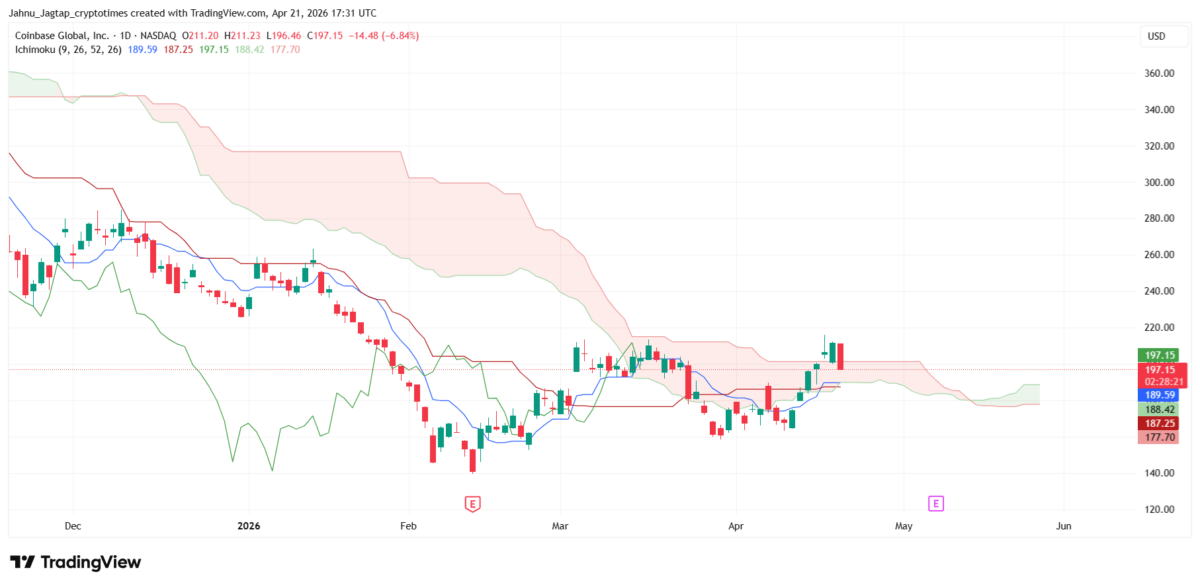
On the technical side, COIN is trading above the 20-day Simple Moving Average (SMA-20) at $180.57 and the 50-day Simple Moving Average (SMA-50) at $181.50, while the 200-day Simple Moving Average (SMA-200) at $272.33 remains a major overhead resistance. The Ichimoku Kijun line near $187.25 is the key near-term support level.

Coinbase Share
Coinbase Share | Source: TradingView

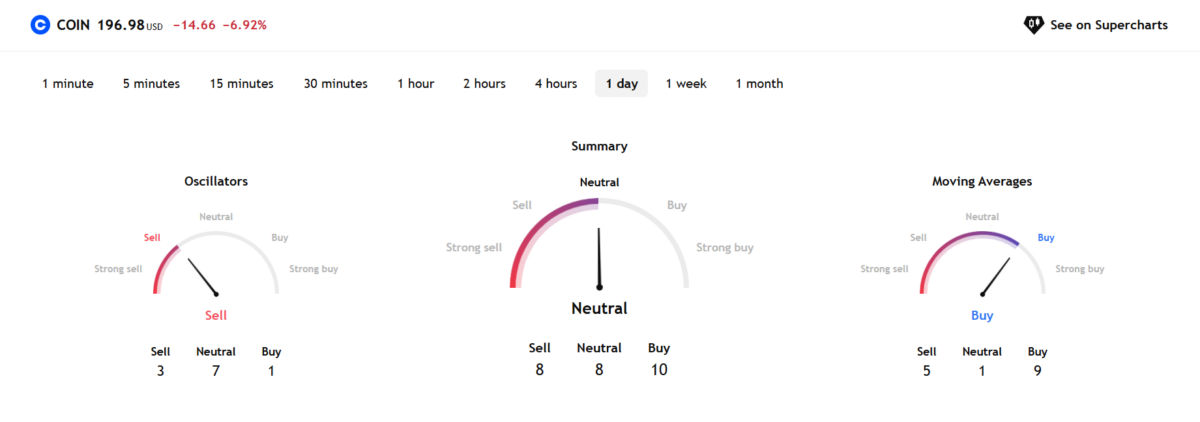
Momentum indicators paint a mixed picture. The Relative Strength Index (RSI) stood at 66.5, while the Commodity Channel Index (CCI) at 159.8 and the stochastic Relative Strength Index (Stoch RSI) pointed to overbought conditions. Traders Union also said the Moving Average Convergence Divergence (MACD) and Average Directional Index (ADX) were neutral, while Bull Bear Power (BBP) remained positive, reflecting some intraday buying despite sharp post-open selling and elevated volatility.

Technical Indicators of COIN
Technical Indicators of COIN | Source: TradingView

That leaves Coinbase in a narrow trading corridor for now. Traders Union’s base case for the next five trading days is a consolidation range between $190 and $210, with the probability of a near-term upside move seen below 20%. A break above $210 could reopen a push toward the mid-$210s, while a drop below $190 may expose the stock to deeper selling pressure.

$190 becomes the near-term level to watch

Recent moves puts fresh attention on the $190 area, which now looks like an immediate support zone for Coinbase shares.

If the stock holds that level, traders may still view the pullback as a pause after a strong run. But if weakness continues and Washington remains stuck on crypto legislation, the rally narrative around Coinbase could lose momentum in the short term.

For now, the stock remains highly sensitive to both crypto market direction and policy developments in the U.S., making the CLARITY Act delay a notable headline risk for Coinbase investors.

Also Read: What CLARITY Act Delay Means for XRP, Solana, DeFi, and U.S. Crypto Innovation


Source link

Payroll4Construction Offers Help As Contractors Navigate Oregon SB 426’s Expanded Wage Liability | Web3Wire

0
Payroll4Construction Offers Help As Contractors Navigate Oregon SB 426’s Expanded Wage Liability | Web3Wire


STRONGSVILLE, OH / ACCESS Newswire / April 21, 2026 / Payroll4Construction, Foundation Software’s construction payroll service, has published a new resource to help Oregon general contractors understand Senate Bill 426.

The new law took effect January 1, 2026, and significantly expanded wage liability on construction projects. Payroll4Construction serves construction companies across the country, including those managing complex public works projects in Oregon.

On most construction projects, general contractors pay subcontractors directly. Those subcontractors are then responsible for paying their own employees and lower-tier subs.

That separation has traditionally meant general contractors had limited exposure to wage violations further down the chain – SB 426 eliminates that separation entirely.

Under SB 426, general contractors can be held jointly and severally liable for unpaid wages owed to workers at any subcontractor tier – even if the general contractor has already paid the subcontractor in full.

Workers and the Oregon Bureau of Labor and Industries can file claims directly against the general contractor without first pursuing the subcontractor responsible for the violation.

The resource outlines key considerations for contractors, including:

How “joint and several liability” works under SB 426 and why paying subcontractors in full does not eliminate exposure

What types of claims – unpaid wages, fringe benefits and civil penalties – can be brought against general contractors and property owners

Why contractual indemnification clauses are invalidated under the statute and what recourse options remain

How subcontract language, certified payroll requirements and subcontractor prequalification affect compliance posture

How property owners are also affected and what prime contract language to consider

Knowing where exposure lies – and what to do about it – is the first step toward protecting your business on every public works project.

Payroll4Construction helps construction companies stay compliant with certified payroll requirements, manage subcontractor documentation and maintain the kind of payroll records that matter most when a wage claim is on the line.

To learn more about Oregon SB 426 and how it affects general contractors, click here.

Payroll4Construction, LLCPayroll4Construction is a payroll solution just for contractors. Payroll4Construction can help manage certified payroll reporting, complete multi-jurisdiction processing, handle union tracking, cut checks, issue direct deposits and so much more. For information, visit payroll4construction.com, call (800) 949-9620 or email [email protected].

Foundation Software, LLCFoundation Software delivers job cost accounting, expense & may management, estimating and takeoff, project management, safety management, HR management, mobile field apps and payroll services to help contractors run the business side of construction. For information, call (800) 246-0800, visit http://www.foundationsoft.com or email [email protected].

Media Contacts

Tracie Kuczkowski | VP of Marketing[email protected] | (800) 246-0800 x 7933

Samantha Ann Illius | Marketing Relations Coordinator and Influence Specialist[email protected] | (800) 811-5926 x 4823

SOURCE: Payroll4Construction

About Web3Wire Web3Wire – Information, news, press releases, events and research articles about Web3, Metaverse, Blockchain, Artificial Intelligence, Cryptocurrencies, Decentralized Finance, NFTs and Gaming. Visit Web3Wire for Web3 News and Events, Block3Wire for the latest Blockchain news and Meta3Wire to stay updated with Metaverse News.


Source link

7 Leading Free AI Stock Trading Bots in 2026 to Generate Passive Income

    0
    7 Leading Free AI Stock Trading Bots in 2026 to Generate Passive Income


    Introduction: Why Manual Trading in 2026 Is Losing You Money

    You already know the feeling.

    You set an alert, go to sleep, and wake up to find the trade moved — and closed — while you were out. You check the chart, see the perfect entry you missed, and feel that familiar mix of frustration and regret. You think: if I’d just been watching.

    That’s the trap of manual trading in 2026’s volatile markets. It demands your attention 24 hours a day, punishes every moment of distraction, and turns every good setup into a question of whether you happened to be awake and disciplined enough to take it.

    Free AI stock trading bots in 2026 exist to solve exactly this problem. They analyse price data, execute entries and exits, and manage risk — continuously, without emotion, without sleep, and without the lag that comes from waiting for a human to act.

    The market for these tools has exploded this year. But so has the noise around them. Every platform claims to be “AI-powered.” Half of them still require you to manually configure strategies, babysit positions, or respond to alerts. That’s not automation — that’s just outsourcing half the work.

    Imagine instead: waking up, checking your dashboard, and seeing trades that were opened, managed, and closed overnight — generating passive income while you slept, without a single action from you. That’s what the hands-off AI trading bots in 2026 actually deliver.

    We’ve analyzed the popular platforms using 2026 market data, real user performance reports, and independent review scores to bring you the 7 leading options available right now — ranked by how genuinely automated they are, how beginner-friendly they are, and whether their free tier is worth your time.

    Based on real user data, performance metrics, and platform compliance — not paid rankings. (Trading involves risk. Not financial advice.)

    Quick Comparison: 7 Leading Free AI Stock & Crypto Trading Bots in 2026

    #PlatformIdeal ForFree TierAutomation LevelCoding Required1SaintQuantHands-off passive income — crypto✅ Free 10-day trial100% fully managed❌ None2Trade IdeasAI stock scanning & alerts✅ Limited freeHigh (stock-focused)❌ None3PionexBuilt-in crypto bots✅ Free botsHigh❌ None4ComposerNo-code stock strategy builder✅ Free planMedium❌ None5CryptohopperStrategy templates + paper trading✅ Paper trading freeMedium❌ None6Capitalise.aiPlain-English rule-based bot✅ Free trialMedium❌ None7TradeSantaSimple crypto DCA & long/short bots✅ Limited freeMedium❌ None

    1. SaintQuant — Leading Free AI Trading Bot for Fully Automated Passive Income in 2026

    Stop checking charts every hour. Stop missing entries because you were asleep. SaintQuant is the only platform on this list where you genuinely do nothing after setup — no strategy configuration, no stop-loss tweaking, no daily monitoring required.

    Most platforms in this category still expect you to make decisions: set a grid range, pick an indicator trigger, respond to an alert. SaintQuant’s AI makes all of those decisions for you, continuously, based on live market data, on-chain signals, and machine learning models that have been refined across multiple market cycles since 2021.

    That’s the emotional win a lot of traders have been searching for: not just automation, but freedom from the anxiety of watching the market.

    Why Smart Traders in 2026 Are Choosing SaintQuant

    150,000+ active users — real traders, not inflated trial accounts4M+ trades executed since launch — proven across bull markets, bear markets, and choppy conditions1.2% verified average daily ROI — “verified” and “average” are doing real work in that sentence10+ AI strategies — DCA, Grid, and Swing bots covering low, medium, and high risk profilesConnected to Binance, Bybit, Bitget, BingX, Kraken, OKX, KuCoin, and CoinbaseRated Trustpilot 4.3 / Capterra 4.8 / G2 4.7 — verified across independent platformsFeatured on MarketWatch, TradingView, Benzinga, and AMBCrypto

    The Pain This Solves

    Other free AI stock and crypto trading bots in 2026 solve the execution problem — they’ll place a trade when conditions are met. SaintQuant solves the entire problem: what conditions? What risk level? What do I do if the market reverses? None of those questions land on you. The AI answers them in real time.

    Real User Results (Based on Verified User Reports)

    Claire Beaumont, a Senior Financial Analyst who works 60-hour weeks, describes SaintQuant as a platform that “fits into my life rather than demanding I rearrange my life around it.” She set her strategy on a Sunday evening and by Friday it had run without a single intervention — with seamless deposits and withdrawals she reports waiting no more than a few hours for.

    Dr. Priya Nambiar, a Quantitative Researcher, initially skeptical of AI trading platforms, ran SaintQuant’s $99 trial specifically to stress-test the claims. Returns were consistent with what was advertised, automated stop-losses triggered correctly during volatile sessions, and she has since upgraded to the Pro plan.

    Available Strategies

    StrategyBot TypeRiskEst. Daily ROIAI QuickStart (Starter)DCALow~1.00%Micro Trend Hunter (Basic)DCAMedium~1.35%AI Momentum Pro (Advanced)GridMedium~1.48%Smart Alpha Builder (Pro)GridMedium~1.55%Quant Edge AI (Elite)GridMedium~1.62%Deep Signal Engine (Premium)GridMedium~1.75%AI Macro Navigator (Institutional)SwingMedium~1.80%

    Estimated average returns. Not guaranteed. All investments carry risk.

    What It’s Missing

    SaintQuant is crypto-only — no US stocks or ETFs. If your primary goal is AI stock trading bot access for equities, you’ll want to pair this with Trade Ideas (entry #2). SaintQuant also doesn’t support custom strategy building — if you want to program your own logic, look at Capitalise.ai or Composer. The trade-off is that everything within its scope runs completely without you.

    How to Get Started Free

    Sign up (under 3 minutes) → Deposit via crypto → Choose a risk level → Activate strategy → Done.

    Capital + any profit is returned at the end of the trial period. No credit card required.

    ⚡ Performance Insight: Consistently verified returns across 2022–2026 market cycles. The gold standard for hands-off AI crypto passive income in 2026 — especially for traders tired of Telegram signal groups and alert-based “automation” that still needs a human to pull the trigger.

    This is not financial advice. Cryptocurrency trading involves risk of loss.

    👉 Ready to start earning automated profits in 2026? Click here to claim your free trial with SaintQuant → (No coding required • Capital + profit returned at end of period)

    2. Trade Ideas — Leading Free AI Stock Trading Bot for US Equity Scanning

    If automated AI stock trading in US equities is your primary focus, Trade Ideas is the most powerful tool available with a free entry point. It uses an AI engine called “Holly” that scans thousands of stocks overnight, generates a ranked list of trade setups, and — on the premium plan — can auto-trade directly through a connected brokerage.

    Why Traders Use It

    Think of it as having a hedge fund’s morning research team available the night before the market opens. Holly AI analyzes 2026 market data across millions of combinations of technical signals and surfaces only the setups with the highest historical win rates for that market environment.

    AI-generated daily trade ideas ranked by confidence scoreReal-time stock scanning with 150+ filtersBacktesting on any strategy before going liveConnects to Interactive Brokers for automated execution (paid plan)Paper trading on free plan — test AI signals without risking capital

    Real-World Performance (Based on User Reports)

    Users report Trade Ideas’ Holly AI has historically outperformed passive index returns in back-tests, though live results vary by market conditions and user execution discipline. On the free plan, you receive the signals but execute trades manually — so timing is still on you.

    What It’s Missing

    The free plan doesn’t include auto-execution. You see the AI signals, but you still have to place the trades yourself, which reintroduces the human lag problem. Full automation requires the Premium plan. Trade Ideas is also US stock-focused — no crypto, no forex.

    ⚡ Performance Insight: Strong for active stock traders who want AI-ranked setups. Leading-in-class for US equity scanning. For passive, fully automated income, combine with SaintQuant’s crypto strategies.

    Setup: Easy. No coding. Sign up, browse signals, paper trade first.

    3. Pionex — Leading Free Built-In Crypto Bot with Zero Setup Cost

    Pionex removes the cost barrier entirely: 16 trading bots are included for free as part of the exchange itself, with no subscription fee. You open a Pionex account, deposit crypto, and activate a Grid or DCA bot in minutes — without configuring API keys or paying a monthly platform fee.

    Why Lazy Traders Love It (That’s a Compliment)

    The appeal is pure simplicity. You don’t need to connect an external exchange, manage API keys, or worry about platform subscription renewals. The bot runs inside Pionex itself, which means one login, one dashboard, and zero monthly overhead.

    16 free bots — Grid, DCA, Smart Trade, TWAP, Arbitrage Bot, and moreSuggested parameters provided for each bot type — no guessingSupports hundreds of crypto pairsMobile app with real-time monitoring

    What It’s Missing

    Your funds are held on Pionex’s exchange, which has lower liquidity than Binance or Bybit on less popular pairs. The bots aren’t truly “AI” in the machine learning sense — they’re rule-based automation. And while setup is fast, you still need to choose your grid range and parameters. Smart traders use Pionex for simple automation alongside a fully managed platform like SaintQuant for their core passive income strategy.

    ⚡ Performance Insight: Excellent for sideways crypto markets. Reliable free entry point for Grid and DCA automation.

    Setup: Very easy. Account → deposit → select bot → activate.

    4. Composer — Leading Free No-Code AI Stock Strategy Builder

    If you’ve ever thought “I want to build a systematic trading strategy but I can’t code” — Composer is built for you. It uses a visual, drag-and-drop interface to let you construct automated investment strategies for US stocks and ETFs without writing a single line of code.

    The Dream for DIY Systematic Traders

    Picture building your own rules-based strategy — “buy QQQ when the 50-day MA is above the 200-day MA, rotate to bonds when it’s below” — and then having Composer execute it automatically, rebalance monthly, and send you a performance summary. That’s systematic trading made genuinely accessible to non-coders in 2026.

    Visual strategy builder — no coding requiredBacktesting on historical data before going liveAutomated execution and rebalancingSupports US stocks and ETFsActive community of shared strategies you can clone and modify

    What It’s Missing

    Composer is portfolio-level automation — it’s not a day trading or intraday bot. If you’re looking for rapid AI day trading bots that execute multiple times daily, this isn’t the tool. Strategy performance still depends heavily on the logic you build — garbage in, garbage out.

    ⚡ Performance Insight: Strong for systematic, long-term investing approaches. Leading for methodical traders who want rules-based automation without writing code.

    Setup: Easy, guided setup with visual tools. Stock/ETF account required.

    5. Cryptohopper — Leading Free AI Crypto Bot for Paper Trading Before You Risk a Dollar

    The fear of losing money on an untested bot is real — and Cryptohopper directly addresses it with the paper trading mode available for free among AI crypto platforms. You can run a strategy for 30, 60, or 90 days on a simulated portfolio before committing a single real dollar.

    Why Cautious Traders Start Here

    Paper trading on Cryptohopper uses live market data — so the results you see reflect what you would have made, not backtested idealizations. This is valuable for building confidence before going live, and for weeding out strategies that look good in theory but fall apart in live conditions.

    Paper trading on the free plan with live market dataStrategy marketplace — pre-built and community strategies to cloneVisual strategy builder with 130+ technical indicatorsSupports Binance, Coinbase, Kraken, Bitfinex, and othersAI-based signal integration available on paid tiers

    What It’s Missing

    Paper trading and live trading results can diverge, especially during extreme volatility. The marketplace strategy quality varies widely — many community strategies are untested or outdated. You need trading knowledge to evaluate which templates are worth running. For beginners who want certainty without strategy evaluation overhead, SaintQuant’s managed approach is more reliable.

    ⚡ Performance Insight: Reliable for rule-based crypto trading when strategy selection is careful. Paper trading mode is genuinely the leading risk-free testing environment available for free.

    Setup: Moderate. Free account, then select or build strategy, test on paper first.

    6. Capitalise.ai — Leading Free AI Trading Bot Using Plain English Commands

    “Buy Bitcoin when the RSI drops below 30 and the price is above the 200-day moving average. Sell when RSI exceeds 70.”

    That’s it. That’s how you build a strategy on Capitalise.ai — by typing it in plain English, the way you’d explain it to a friend. The platform converts your instructions into executable bot logic automatically, with no coding and no technical indicator knowledge required.

    Why This Matters for Beginners

    Most bot platforms assume you understand what a Bollinger Band is, what RSI divergence means, or how to set a grid range. Capitalise.ai assumes nothing. If you can describe a trading rule in a sentence, you can automate it — and that’s a meaningful gap in the market that this platform fills well.

    Plain-English strategy creation — type your rules, the bot executes themSupports crypto and stock marketsBacktesting on historical dataConnects to multiple exchanges and brokeragesFree trial available

    What It’s Missing

    The simplicity of plain-English input also means you’re still responsible for the quality of your trading logic. The platform executes what you describe — it doesn’t generate strategies for you. Traders who want a pre-built AI strategy that makes decisions without their input will find SaintQuant more appropriate.

    ⚡ Performance Insight: Reliable for rule-based trading when the underlying logic is sound. Particularly strong for beginners who know roughly what they want but can’t code it.

    Setup: Very simple. Describe your strategy, connect your exchange, activate.

    7. TradeSanta — Leading Free Crypto Bot for Quick Long/Short DCA Automation

    TradeSanta is for traders who want to go from zero to a running bot as fast as humanly possible. Its interface is stripped back by design — no overwhelming options, no deep configuration required. Choose long or short DCA, set your pair, and activate.

    The Speed-to-Launch Advantage

    For someone who wants to test the feeling of having a crypto bot running without committing to a complex platform, TradeSanta is the fastest on-ramp on this list. Setup takes under 10 minutes, including connecting your exchange via API.

    Long and Short DCA bot templatesTrailing stop-loss and take-profit built inTelegram notifications for trade updatesSupports Binance, OKX, Bitfinex, HitBTCLimited free plan for beginners to test the interface

    What It’s Missing

    TradeSanta’s simplicity is also its ceiling. Advanced grid strategies, multi-bot portfolios, and deep backtesting hit the platform’s limits quickly. Telegram notifications reintroduce the human element — if you’re trying to stop watching your phone for trade alerts, this isn’t a complete solution. For a genuinely hands-free experience, SaintQuant’s managed model goes significantly further.

    ⚡ Performance Insight: Solid for straightforward DCA execution. Fast to set up, limited in sophistication.

    Setup: Easy. One of the fastest setups of any platform on this list.

    What to Look For in a Free AI Stock or Crypto Trading Bot in 2026

    With so many platforms claiming to be “AI-powered,” here are the five real filters that separate genuinely useful bots from marketing noise:

    Does “free” actually give you live automation? Many platforms call themselves free but gate live trading behind a paywall. Only the free tiers that run real, live strategies count — paper trading is useful for testing, but it doesn’t generate actual passive income. How much setup does it actually require? True hands-off AI trading means the platform makes decisions — not you. If you still need to pick a strategy, configure a grid, or respond to a Telegram alert, you’re doing work. The leading automated AI trading bots in 2026 reduce your required input to zero after initial activation. Does the platform have a verifiable track record? Anyone can post good screenshots from a bull week. Look for platforms with multi-year performance data, independent review scores on Trustpilot and G2, and transparent strategy descriptions that include risk levels and start dates — not just return promises. Stock, crypto, or both? Most platforms specialize. Trade Ideas and Composer are stock-focused. SaintQuant, Pionex, Cryptohopper, and TradeSanta are crypto-focused. Capitalise.ai covers both. Match the platform to where you actually want to trade. What happens to your money? Exchange-connected platforms (3Commas, Bitsgap, Cryptohopper) don’t hold your funds — your capital stays on your exchange. Managed platforms like SaintQuant hold funds directly, secured via institutional cold storage, and return capital plus profit at the end of each contract period.

    Frequently Asked Questions

    Are free AI stock trading bots actually profitable in 2026? Yes, but profitability depends on strategy quality, market conditions, and how genuinely automated the platform is. The bots that perform most consistently are those with multi-year verified track records, not those making the loudest return promises. Based on user reports, platforms like SaintQuant with institutional-grade risk management produce more stable results than DIY-configured bots.

    What is the leading free AI trading bot for beginners with no experience? SaintQuant’s free 10-day trial is the most beginner-appropriate option because it requires zero configuration decisions — you activate a strategy and the AI handles everything. For beginners who want to learn how bots work first, Cryptohopper’s paper trading mode or Capitalise.ai’s plain-English builder are good starting points.

    What’s the difference between AI stock trading bots and crypto trading bots? AI stock trading bots (like Trade Ideas and Composer) operate in US equity markets during exchange hours (typically 9:30am–4pm EST). Crypto trading bots run 24/7 because crypto markets never close. For passive income that doesn’t stop on weekends or overnight, automated crypto trading bots have a structural advantage.

    Do I need coding skills to use any of these platforms? No. Every platform on this list — including SaintQuant, Trade Ideas, Pionex, Composer, Cryptohopper, Capitalise.ai, and TradeSanta — requires zero coding. Some require basic API key setup (copying a string from your exchange into the platform), which takes about five minutes and no technical knowledge.

    Is it safe to connect a trading bot to my brokerage or exchange account? API connections for trading typically grant trade-execution access only — not withdrawal access. Always set your API keys to “trade only” and disable withdrawal permissions. SaintQuant’s model is different: you deposit directly to the platform, secured via institutional-grade cold storage, removing the API key risk vector entirely.

    What is the minimum investment needed to start? SaintQuant’s Starter (free trial) runs for $99. Pionex has no minimum beyond exchange requirements. Most platforms are accessible starting from $50–$200 in trading capital. You don’t need thousands to start testing AI trading bots for passive income — the key is starting early and learning how the platform performs for your risk tolerance.

    How do I know if an AI trading bot’s returns are real? Look for: (1) independent reviews on Trustpilot, G2, and Capterra — not just the platform’s own testimonials; (2) multi-year performance data covering at least one bear market; (3) transparent language — real platforms say “estimated average” or “verified avg,” not “guaranteed returns”; (4) clear risk ratings per strategy. SaintQuant publishes all of the above.

    What’s the difference between a DCA bot, a Grid bot, and a Swing bot? A DCA bot (Dollar Cost Averaging) automatically buys fixed amounts at regular intervals — great for gradual accumulation and reducing entry price risk. A Grid bot places buy and sell orders at preset price intervals, profiting from sideways price movement. A Swing bot captures medium-term directional moves using momentum indicators. SaintQuant offers all three, and the AI allocates between them based on current market conditions.

    Can I use an AI trading bot in the USA? Yes. Automated crypto and stock trading is legal in the USA. SaintQuant is an Australian-registered company — one of the few AI trading platforms with explicit Australian regulatory compliance. This matters for Australian traders who want to trade within a clear legal framework rather than through an offshore-only platform.

    What happens to my money if the platform goes offline? For exchange-connected platforms (Cryptohopper, Pionex, TradeSanta), your funds stay on your exchange — the bot simply loses API access if the platform shuts down. For managed platforms like SaintQuant, funds are secured via cold storage and contract terms specify capital + profit return at the end of each period. Always read the terms and conditions before depositing.

    Final Verdict: The Leading Free AI Trading Bot in 2026 Depends on What You Actually Want

    Here’s the honest breakdown:

    Want 100% hands-off automated income with zero configuration? → SaintQuant. Nothing else on this list comes close to its level of managed automation.

    Want AI-powered US stock trade ideas with auto-execution potential? → Trade Ideas. Leading-in-class for equity scanning with genuine AI logic.

    Want free crypto bots with no monthly fee? → Pionex. Built into the exchange, zero subscription cost.

    Want to build your own systematic strategy without coding? → Composer (stocks) or Capitalise.ai (stocks + crypto).

    Want to test everything risk-free before committing real money? → Cryptohopper’s paper trading mode.

    Want the fastest possible setup with a simple DCA bot? → TradeSanta.

    The common thread across all the platforms that actually work in 2026 is this: the less it requires from you after setup, the more valuable it is. Because the whole point of a leading AI trading bot for passive income is that it works when you’re not watching.

    This is not financial advice. Cryptocurrency and stock trading involves substantial risk of loss. Past performance is not indicative of future results. Always do your own research before investing.

    Ready to start earning automated profits in 2026? Click here to get started with SaintQuant’s free trial → (No coding required • Capital + profit returned at end of trial period)



    Source link

    The Growing Differences Between Competitive and Casual Gaming Audiences | NFT News Today

    The Growing Differences Between Competitive and Casual Gaming Audiences | NFT News Today


    Gaming audiences no longer move in the same direction. Over time, a clear divide has formed between players who pursue structured competition and those who prefer open or flexible play. This shift affects how games are designed, how communities form, and how people spend their time. Competitive titles demand focus and repetition. Casual platforms allow entry without pressure or strict commitment.

    Both groups support the industry, yet they operate with different expectations. The gap between them continues to widen as games evolve into long-term services and global competitions.

    High-Intensity Competition and Structured Progression

    Competitive gaming demands sustained effort. Titles like Dota 2 and League of Legends rely on ranked systems that reward discipline and coordination. Matches require strategy, mechanical skill, and teamwork. Players often review gameplay, track statistics, and adjust tactics to remain competitive. Success depends on performance under pressure.

    These environments extend beyond standard matchmaking. Professional tournaments attract global audiences and offer prize pools worth millions. Teams train daily and follow strict schedules. Competitive ecosystems create a culture centered on improvement and measurable results.

    The pressure to maintain rank keeps engagement high and encourages long-term dedication. Casual players may try these games, but the sustained intensity often separates committed competitors from occasional participants.

    When Casual Games Turn Competitive

    The divide between audiences becomes more complex when casual platforms develop competitive layers. Certain Roblox experiences now host organized tournaments and structured leagues. Community-driven formats can shift a relaxed game into a serious contest.

    Dota 2 followed a similar path in its early years. What began as a community modification evolved into a global esports title. League of Legends built its competitive framework from the start, yet its early player base included many casual participants. Over time, structured tournaments reshaped expectations.

    High-level play attracted viewers and analysts who follow team changes, patch updates, and strategic trends. Coverage from sources such as SuperBigWin gaming helps track these developments through news, reviews, and guides focused on major titles and industry shifts. Competitive evolution often transforms how audiences interact with a game.

    Open Platforms and Flexible Participation

    Casual gaming follows a different structure. Roblox represents a model built on accessibility and freedom. Players can enter thousands of user-created worlds without long tutorials or complex systems. Sessions can last minutes or hours, depending on availability. There is no single path or required skill level.

    This flexibility lowers barriers and expands the audience. A player can explore social spaces, simulation games, or light competitive modes without commitment to a ranking ladder. The absence of strict progression systems changes expectations. Progress does not require mastery. Participation alone defines value.

    Casual platforms succeed because they respect time limits and offer immediate access. That design approach differs sharply from competitive titles that expect sustained focus and structured improvement.

    Time Investment and Daily Commitment

    Competitive players often build routines around specific games. Ranked systems reward consistency, which encourages daily participation. A missed week can affect performance and confidence. Titles like Counter-Strike 2 demand practice to maintain accuracy and reaction speed. Progress depends on repetition.

    Casual players operate under fewer constraints. Mobile titles such as Clash Royale allow short sessions that fit into limited time windows. Progress continues without strict scheduling. This difference shapes long-term retention. Competitive games depend on habitual engagement, while casual games succeed through convenience.

    Developers adjust content updates according to these patterns. Competitive audiences expect balance changes and seasonal resets. Casual audiences respond more to new modes or limited events that require minimal preparation.

    Monetization Reflects Player Behavior

    Spending patterns highlight another difference. Competitive players often invest in performance tools such as advanced controllers or high-refresh monitors. Cosmetic purchases in games like League of Legends signal identity within a structured environment. Spending aligns with long-term commitment.

    Casual players prefer optional purchases with low entry costs. Roblox uses digital currency to unlock customization or access certain experiences. The financial model relies on accessibility rather than exclusivity. This contrast shows how developers align revenue strategies with audience habits.

    Competitive ecosystems support sustained spending tied to progression. Casual platforms depend on volume and flexibility. Both systems function successfully, yet they serve distinct behavioral patterns.

    Community Identity and Social Structure

    Competitive communities tend to organize around performance. Esports scenes develop fan bases that follow teams, strategies, and tournament results. Discussion forums focus on tactics and roster changes. Status carries weight within these groups.

    Casual communities revolve around participation. Minecraft servers, for example, allow players to build shared spaces without ranking pressure. Interaction centers on collaboration rather than comparison.

    These structures shape how players define identity. Competitive players often associate themselves with rank or role. Casual players connect through shared activity or creativity. The social framework reinforces the broader divide between structured competition and flexible play.


    Source link

    Diablo 4: Lord of Hatred review – A compelling conclusion delivered with a panache that proves Blizzard still got it

    0
    Diablo 4: Lord of Hatred review – A compelling conclusion delivered with a panache that proves Blizzard still got it


    Diablo 4: Lord of Hatred has, without question, been one of my most anticipated releases of 2026. Diablo 4 is likely my most played game ever by sheer hour count, so it’s easy to see why this expansion is so high up on my list. However many rakes Blizzard has stepped on over the course of the game’s live service, however many seasons or events it botched, I maintain that no other ARPG matches Diablo 4 in either game feel or production value.

    My memory isn’t that short, however, and I remember how disappointed I was with the game’s first expansion, Vessel of Hatred. Apart from giving us one of the best classes in the game with the Spiritborn, it did little to advance the narrative and often felt like it had the scope of a side quest.

    Nevertheless, I remained hopeful that Blizzard’s eagerness for a comeback – and a one year gap – would result in something special.

    Manage cookie settings

    The events of Lord of Hatred pick up shortly after the conclusion of Vessel of Hatred. Neyrelle has found herself in another new region in her continued search for a way to prevent Mephisto, the eponymous Lord of Hatred, from escaping the stone she and the rest of the squad precariously trapped him in at the end of Diablo 4.

    One of the things I always look forward to in Diablo is how each of its regions informs narrative and character makeup. Just like VoH’s Nahantu, LoH’s Skovos stands as a distinct new destination that brings fresh aesthetics, sights and sounds to a world with a lot of already existing variety.

    The Skovos isles occupy what’s essentially the Mediterranean region of Sanctuary. You can easily mistake them for the Aegean islands, or any of the various Greek provinces. Blizzard liberally borrowed the red-tiled roofs, textured stucco walls and cobblestone streets of those real-world locales to create Skovos. One sub-region in particular has the closest thing we have to a parthenon in Diablo 4.

    Skovos’ people take after DC Comics’ Themyscira, Wonder Woman’s birthplace. Much like them, the Amazons of Skovos are a matriarchal society of warrior maidens, led by a queen who plays a sizable role in the events of the expansion.

    Image credit: Blizzard Entertainment.

    Beyond its visual significance, Skovos has a unique place in Diablo lore as the birthplace of humanity’s progenitors, the direct descendants of Lilith and Inarius. This being the first time Skovos has appeared in any Diablo game immediately makes it the most exciting of any region to visit. The landmass in Skovos is a little smaller compared to some of the other regions, but there’s enough topographical and locational variety there that it never got boring in the 30+ hours I spent with the review build.

    Given how much the Amazons factor into almost every facet of this expansion, you’d think that the Amazon class would be the no-brainer new addition. Blizzard decided, instead, to go with something bold: a hybrid class that may not immediately fulfil any existing fantasy, but ends up being the game’s most complex. The fantasy fulfilment has instead been left to the second new addition in Lord of Hatred, the Paladin.

    The Paladin has been available for several months now, having shadow-dropped back in December. It is the sword-and-board class that Diablo 4 somehow survived years without having any version of; not even their Crusader off-shoot from Diablo 3. The Paladin does, however, borrow some skills from Amazons of games’ past, and one of its variants even incorporates Angelic moves.

    Image credit: Blizzard Entertainment.

    The Warlock has the look of your edgy, metalhead highschool friend who’s now well into his 40s, and continues to dress like the days you first met him. He dons a Metal Band black tee and baggy shorts, and always brings his rubber sandals to every occasion; he’ll never be caught dead with a good haircut. That may or may not be off-putting, depending on where you stand, but it’s that devotion that adds to the Warlock’s charm. Much like that friend – and the Warlock’s in-game lore as the grimy practitioner of the dark arts who’s not afraid to literally rip demons from Hell to do their bidding – you have to bring a certain level of commitment to the way you play it.

    The Warlock is a demanding class to play. It occupies the dual role of summoner-caster; a wretched spawn of Necromancer and Sorcerer. It requires a kind of skill management that goes several steps beyond the typical ARPG flow of cycling through skill rotations. Because you’re able to tactically sacrifice some of your minions, and use others to buff and inform certain attacks, you end up needing to plan ahead often, at least if you want to be as effective as you can. When you successfully pull it all off, you’ll feel like you’ve achieved a sort-of mastery of the battlefield none of the other classes could offer.

    Image credit: Blizzard Entertainment.

    My favourite part of Lord of Hatred is its narrative. This is the most exciting and eventful campaign of the three, and it’s up there with the best of Diablo 3’s myriad stories. There’s practically no fluff, and it often comes across as an apology for Vessel of Hatred, whose forgettable campaign was characterised by long trudges through uninteresting story moments, only for each to amount to very little.

    This campaign brings back the most interesting characters from the main game, in some ways representing the next stage of their arcs – and in others reexamining them altogether. Lilith (who remains D4’s most intriguing character) returns, but this Lilith feels like she’s in conversation with the Lilith from D4’s campaign. Her motives remain unchanged, but losing almost all of her power has exposed a side of her that I wished the first campaign had touched on. Her actions in LoH are more consistent with where I felt Blizzard should’ve taken her by the end of D4.

    Lord of Hatred concludes with the sort of finality that signals the end of a story that began with Diablo 4. It’s not pulling any punches, and it’s not afraid to kill its darlings. It has a final boss with one of the most inventive mechanics in any recent action-RPG, a well-realised culmination of mechanics and themes.

    Image credit: Blizzard Entertainment.

    If you’re the sort who skips cutscenes in ARPGs out of habit, you’re going to miss out on some of the most spectacular cinematics Blizzard has ever created. The acting, direction (and shot composition in some) combine to deliver moments as heartbreakingly-emotional as often as they are triumphant. This is a tale worth witnessing unfold, and it’s one I am eager to experience again on my personal, non-review account.

    Whether or not you sit through the campaign, however, you’ll find plenty to get excited about in Lord of Hatred’s gameplay. The new level cap of 70 paves the way for reworked and expanded talent trees for all classes. The new skill tree borrows some of the best powers that were previously locked to Legendary gear, essentially making them more accessible to all players.

    The Talisman builds on that, adding another way for players to attain abilities and passives that offer serious boosts to some of the most basic functions, such as the number of healing potions or dodges. You can further specialise your build through sets and their set bonuses, which ends up adding one more item to the list of things to chase.

    When the loot you get isn’t quite what you wanted, you can now upgrade its rarity and further tweak its affixes through recipes using the returning Horadric Cube. I didn’t get much use of it during the review period, but considering how many times I’ve hit a ceiling in my hundreds of hours of Diablo 4 when I simply run out of interesting gear, I am eager to see how I can use the cube to dig myself out of that hole without having to pray for a Mythic Unique.

    Image credit: Blizzard Entertainment.

    Indeed, another system that seems to target a pain point I’ve always had with Diablo 4 is War Plans, which essentially gamifies the endgame. Through it, you can create a playlist of the endgame activities you want to play, which feeds back into progression trees for each type of activity, all existing beyond the individual dungeons/runs. Completed plans offer extra rewards, on top of whatever else you earn after finishing each item in the playlist.

    Lord of Hatred accomplishes the near-impossible task of delivering a game-changing expansion that fundamentally improves on the core of Diablo 4, and a weighty narrative conclusion that so brilliantly balances spectacle with emotional heft. Essential for any fan of ARPGs.

    Reviewed on PC, code provided by publisher.


    Source link

    This 2025 Fantasy Movie From Hannibal’s Creator Is A Must-Watch On HBO Max – SlashFilm

      0
      This 2025 Fantasy Movie From Hannibal’s Creator Is A Must-Watch On HBO Max – SlashFilm


      Television, where episodes are made by many different writers and directors, isn’t really the medium of the auteur (i.e. the idea there’s a single “author” of a film). But if there is a television auteur, it’s Bryan Fuller. Creator of “Dead Like Me,” “Pushing Daisies,” and “Hannibal,” all of Fuller’s shows fit his style, and no-one blends whimsy and morbid material like he does. He even took an adaptation like “Hannibal” and made it entirely his; no one will confuse Fuller’s surreal and queer take on Hannibal Lecter for “The Silence of the Lambs.”

      Given he’s such a distinctive voice even in the collaborative form of TV, it’s a bit surprising Fuller took so long to direct a feature film. (The medium for which “auteur theory” was coined.) But he finally did in 2025, with “Dust Bunny” reuniting Fuller and “Hannibal” star Mads Mikkelsen. The movie barely left a scratch at the box office, given it only had a limited theatrical release, but this writer was one of the few who saw it in a theater. I can safely say that, now that “Dust Bunny” is both streaming and thriving on HBO Max (per FlixPatrol), every Fuller fan should give it a chance. It may not be the “Hannibal” sequel mini-series Fuller has said he wants to make, but him working with Mikkelsen again might remind you of why you loved that show.

      But as for “Dust Bunny,” what’s it about? It’s like a fantasy riff on “Leon: The Professional,” in which a hitman (Jean Reno) raises a young girl (Natalie Portman in her first movie role as a child actor) after her parents are murdered. In “Dust Bunny,” however, young Aurora (Sophie Sloan) wants her neighbor (Mikkelsen) to kill the monster under her bed who ate her parents.

      In Dust Bunny, Bryan Fuller brings his whimsical touch from TV to film

      From its premise, “Dust Bunny” sounds like a child’s bedtime story, and, in some ways, it is — but don’t think the stakes aren’t real. Aurora goes to her neighbor, known only as Resident 5B, for help because she thinks that he “kills monsters.” In truth, he’s a simple hitman; his “killing monsters” was the film showing us his work through Aurora’s childlike eyes. But if you think that means the monster under Aurora’s bed isn’t real, it’s your funeral (as it is for many poor souls who venture into her apartment). There’s another monster around, too: Laverne (Sigourney Weaver), 5B’s handler, who pushes him to dispose of Aurora as a witness.

      (While the monster was a practical effect, in motion, it looks cartoonish. The movie gets around this by mostly showing the monster in the dark or keeping it offscreen, like the shark in “Jaws.”)

      This mix of violence and childlike fantasy is nothing new for Bryan Fuller. Take “Pushing Daisies,” which is a cutesy show on the surface. (One producer even blamed its cutesy scripts for “Pushing Daisies” being canceled.) It’s got a candy-coated color palette, quirky dialogue, etc. But as a murder mystery, it’s fundamentally a show about death, and its sense of humor is often pitch dark. 

      “Hannibal” proved that Fuller could go even darker into modern gothic and straight-up horror, so “Dust Bunny” sees him pull back to the “Pushing Daises” style. That idiosyncratic approach is not for everyone, but if you do vibe with “Dust Bunny,” Fuller’s TV work is the definitive next step. Even though “Dust Bunny” functions perfectly as a one-off, episodic storytelling is where Fuller’s talents with character-building soar highest.

      “Dust Bunny” is streaming on HBO Max.


      Source link

      Michael Stumbles Out of the Gate With 27% Rotten Tomatoes Score

        0
        Michael Stumbles Out of the Gate With 27% Rotten Tomatoes Score


        When Michael first hit Rotten Tomatoes with a brutal 27 percent critics score, it looked like another high profile biopic was about to crash under the weight of expectations. Then audiences showed up. And everything changed.

        The film has now surged to a staggering 96 percent audience score, instantly flipping the narrative and putting Michael in rare territory as one of the highest rated musical biopics ever from a fan perspective.

        So what happened?

        Critics vs Audience A Familiar Divide

        Early critic reactions focused on pacing, tone, and the film’s approach to controversial moments in Michael Jackson’s life. Some reviews called it uneven, others said it played things too safe. But audiences saw something completely different.

        Fans praised the performance, the music, and most importantly, the emotional connection. Social reactions have been flooded with comments about how the film captures the energy, pressure, and genius of Jackson in a way that feels authentic and powerful. For many viewers, it is not about perfection. It is about feeling. And Michael delivers that in a big way.

        The Power of Music and Nostalgia

        Musical biopics live and die by one thing more than anything else. Connection.

        From the moment the first iconic track hits, audiences are pulled into a shared experience. With a catalog as legendary as Michael Jackson’s, Michael had a built in advantage that critics may have underestimated.

        The film leans heavily into that legacy. The performances, choreography, and stage recreations are being called some of the best ever put on screen in this genre. That alone is driving repeat viewings and word of mouth momentum.

        Jafaar Jackson, Michael [credit: Lionsgate]

        Audience Scores Are Becoming the Real Indicator

        We have seen this trend before. Critics analyze. Audiences react.

        And in the era of social media and instant feedback, audience scores are increasingly shaping a film’s reputation in real time. A 96 percent score is not just good. It signals strong emotional resonance and mass appeal.

        That kind of response can extend box office legs, boost streaming performance, and even reshape award season conversations.

        One of the Biggest Turnarounds in Recent Memory

        Going from 27 percent to 96 percent is not just a rebound. It is a complete narrative reversal.

        For Michael, it means the film is no longer defined by its early reviews. It is being defined by the people actually watching it. And right now, they love it.

        The Bottom Line

        Michael may not be a critic darling, but it is becoming a fan phenomenon.

        And in today’s landscape, that might matter more than ever.


        Source link

        Iran Scammers Demand Bitcoin, USDT for Transit Through Strait of Hormuz: Report – Decrypt

        0
        Iran Scammers Demand Bitcoin, USDT for Transit Through Strait of Hormuz: Report – Decrypt


        In brief

        Scammers impersonating Iran are demanding payment in BTC or USDT from vessels stranded at Hormuz.
        MARISKS believes at least one vessel fired at on Saturday had paid the fraudulent fee.
        Experts warn any crypto transit payment carries sanctions liability, regardless of recipient.

        Scammers impersonating Iranian authorities are reportedly targeting shipping companies with fraudulent payment demands to be made through Bitcoin and Tether’s USDT stablecoin, promising safe passage through the Strait of Hormuz.

        Greek maritime risk firm MARISKS warned Monday via Reuters that unknown actors impersonating Iranian authorities had sent shipping companies messages demanding cryptocurrency payments for transit clearance in the passage, which has become a flashpoint in the ongoing conflict between Iran and the United States.

        “After providing the documents and assessing your eligibility by the Iranian Security Services, we will be able to determine the fee to be ⁠paid in cryptocurrency (BTC or USDT). Only then will your vessel be able to transit the strait unimpeded at the pre-agreed time,” the message from the unknown actors reads, as cited by MARISKS.

        MARISKS said it believes at least one vessel fired on by Iranian boats Saturday, while attempting to exit the strait during a brief reopening, had paid the fraudulent fee.

        Decrypt has reached out to the firm for comment and will update this article should they respond.

        No safe harbor

        The alert comes weeks after Iranian officials began requiring tolls for passage to be made in Bitcoin, to ensure the fees “can’t be traced or confiscated due to sanctions.”

        But whether Iran’s crypto toll system ever actually operated at scale remains disputed.

        Days into the state’s announcement, blockchain forensics firm TRM Labs told Decrypt that no on-chain data indicating crypto was being used for Hormuz transit fees have been seen.

        In this case, the lack of on-chain evidence has not made the threat any less real for stranded vessels.

        “Iran-linked actors have a well-documented history of using cryptocurrency to circumvent traditional financial controls,” Isabella Chase, head of policy for Europe, the Middle East, and Africa at TRM Labs, told Decrypt.

        Any wallet addresses associated with these demands “should be treated as high-risk until independently verified through blockchain intelligence,” she added.

        Even an unwitting payment to a sanctioned entity carries legal liability under OFAC regulations, and “crypto payments offer no safe harbour” from that exposure, Chase warned. Shipping companies should run blockchain intelligence checks on any wallet before transferring funds and consult sanctions experts before acting on any payment demand, she added.

        So far, tanker traffic through Hormuz remains below 5% of pre-war volumes after Iran reimposed restrictions on April 18, with Polymarket users placing roughly 28% odds on normal shipping resuming with the month. On prediction market Myriad, owned by Decrypt’s parent company Dastan, users are more optimistic, putting a 64% chance on the average number of ships transiting the Strait above 15 before May.


        “Whether the recipient is genuinely Iranian or not, the intent to transact with a sanctioned regime is present,” Xue Yin Peh, head of investigative strategy and collection at on-chain intelligence firm Chainalysis, told Decrypt.

        If the payment reaches Iran, the exposure becomes “straightforward,” Peh explained, noting that any payment to an Iranian government entity or anyone acting on its behalf would likely constitute a sanctions violation under OFAC, EU, and UK rules.

        Paying a scammer instead of actual Iranian authorities does not automatically eliminate sanctions exposure, Peh said, adding that regulators could still scrutinize a company’s intent to pay what it believed was a sanctioned regime.

        “Beyond sanctions, the company remains a victim of fraud, and the funds may still end up with actors who are sanctioned, designated, or involved in other illicit activity, even if they are not part of the Iranian regime,” he added.

        With little public information on how Iran is actually administering crypto toll payments, Peh advised that standard anti-scam practices remain the strongest defense: verify demands through official channels, consult maritime security advisers, and treat urgent payment pressure as a red flag.

        Daily Debrief Newsletter

        Start every day with the top news stories right now, plus original features, a podcast, videos and more.


        Source link

        Paybis: The Industry Obsessing Over Onboarding Is Missing The Real Signal In $5B Of Repeat Users

        Paybis: The Industry Obsessing Over Onboarding Is Missing The Real Signal In B Of Repeat Users


        In Brief

        Paybis reports shift from first-time to returning users as crypto matures, driven by smoother onboarding, stablecoin growth, and rising enterprise adoption across global payment use cases.

        Paybis At 12: $5B In Volume And A Retention Signal That Challenges Crypto’s Mainstream Narrative

        Crypto payment provider Paybis says the long-running debate about whether digital assets have truly entered the mainstream still tends to focus on user churn, onboarding friction, and the assumption that casual customers rarely return. Yet new company data points to a different pattern. 

        As Paybis marks its 12th year in business and nears its 7 millionth customer, the firm says its user base has shifted meaningfully: in 2017, close to 73% of its B2C activity came from first-time users, while in 2026 more than 76% is now generated by returning customers. 

        The company links that change not only to a more mature market, but also to a deliberate effort to remove friction from the buying process (including a three-click purchase flow), support 22 payment methods worldwide, and build the kind of trust that encourages repeat use. Paybis also says it now ranks among the highest-rated crypto companies on Trustpilot.

        Shift Toward Returning Users Signals Market Maturation

        “I founded Paybis 12 years ago with a singular mantra — to make crypto simple, human and trustworthy,” said Innokenty Isers, co-founder and CEO of Paybis in a written statement. “The early days had a real garage startup spirit. Everyone wore multiple hats, we were learning as we went, and we genuinely enjoyed building something from the ground up,” he added. 

        That founding period came in 2014, when most of today’s fiat-to-crypto on-ramps had yet to emerge and the regulatory framework around digital assets was still in its early stages. In that environment, Paybis describes itself as an experiment in connecting traditional finance with an asset class that many institutions were still unwilling to engage with. The company now says it holds licenses and registrations across the US, Canada, the EU, and the UK.

        Twelve years on, the numbers suggest that the business has moved well beyond its startup phase. Paybis says it processed nearly $2.4 billion in transaction volume over the past 12 months, bringing lifetime volume above $5.4 billion. A notable share of that activity now comes from stablecoins, with nearly $1.8 billion in combined USDT and USDC volume over the past year alone. Much of that activity, according to the company, has been tied to payments and cross-border transfers rather than speculative trading (a sign that crypto use cases are broadening beyond market cycles).

        Stablecoin Growth And Enterprise Adoption Drive Expansion Of B2B Operations

        The company’s business-to-business segment has also evolved. When Paybis launched its enterprise products in 2023, corporate adoption of crypto was still largely experimental, with many firms testing infrastructure rather than embedding it into day-to-day operations. Three years later, the company says the market has changed materially. Businesses are now using crypto rails for recurring functions such as global payroll and supplier payments, and Paybis reports $2.29 billion in business transaction volume over the past 12 months, serving 624 companies worldwide.

        “We’ve really driven innovation in the industry in the past 24 months with an award-winning Ramp solution alongside our unique stablecoin Mass Payouts offer,” said Co-Founder and CBDO Konstantins Vasilenko in a written statement. “Watch this space for even more business products in 2026,” he added. 

        Disclaimer

        In line with the Trust Project guidelines, please note that the information provided on this page is not intended to be and should not be interpreted as legal, tax, investment, financial, or any other form of advice. It is important to only invest what you can afford to lose and to seek independent financial advice if you have any doubts. For further information, we suggest referring to the terms and conditions as well as the help and support pages provided by the issuer or advertiser. MetaversePost is committed to accurate, unbiased reporting, but market conditions are subject to change without notice.

        About The Author


        Alisa, a dedicated journalist at the MPost, specializes in crypto, AI, investments, and the expansive realm of Web3. With a keen eye for emerging trends and technologies, she delivers comprehensive coverage to inform and engage readers in the ever-evolving landscape of digital finance.

        More articles


        Alisa, a dedicated journalist at the MPost, specializes in crypto, AI, investments, and the expansive realm of Web3. With a keen eye for emerging trends and technologies, she delivers comprehensive coverage to inform and engage readers in the ever-evolving landscape of digital finance.


        More articles


        Source link

        A Night of Triumphs and Surprises at the BAFTA Game Awards | Metaverse Planet

        A Night of Triumphs and Surprises at the BAFTA Game Awards | Metaverse Planet


        I honestly didn’t expect a debut game to completely hijack the spotlight at the most prestigious gaming event in the UK, but here we are. I stayed glued to my screen as the final major event of the gaming awards season unfolded this past Friday in London, and let me tell you, the results have left me with a lot to think about.

        If you thought you knew exactly how the industry was leaning, Sandfall Interactive just flipped the script. We are seeing a massive shift where fresh, daring ideas are dethroning established giants. Let’s dive deep into what went down at the BAFTAs, why these games won, and what it means for the titles we’ll be playing next.

        The Absolute Dominance of Clair Obscur: Expedition 33

        When I first looked at the nomination list, I was floored. A debut studio walking into the BAFTAs with 12 nominations? It sounded like a fairytale. But Sandfall Interactive didn’t just show up; they conquered.

        Their action-adventure masterpiece, Clair Obscur: Expedition 33, didn’t just take home the coveted Game of the Year award. It completely swept its core categories. Here is why I think it resonated so deeply with both the players and the BAFTA voting academy:

        A Breathtaking Debut: Winning Best Debut Game was a no-brainer. The level of polish, the intricate world-building, and the sheer audacity of its combat mechanics put it miles ahead of what we usually expect from a studio’s first outing.A Masterclass in Acting: The game also secured Best Lead Performer for the incredibly talented Jennifer English, who brought the character of Maelle to life. Her performance wasn’t just voice acting; it was raw, emotional, and anchored the entire narrative of the game.

        I’ve played through Expedition 33, and what strikes me the most is how it never plays it safe. It takes risks with its pacing and its art direction, and seeing the industry reward that kind of bravery gives me so much hope for the future of new IPs.

        The Heavyweights: Dispatch and Ghost of Yōtei

        While Expedition 33 took the crown, the battle for the rest of the major categories was an absolute bloodbath between two incredibly different, but equally masterful titles.

        Dispatch: A Technical and Auditory Marvel

        Coming in hot with nine nominations, Dispatch proved that atmosphere is everything. The game walked away with Best Animation and Best Audio, which, if you’ve played it with a good set of headphones, makes perfect sense. The sound design in that game actually gave me chills.

        More importantly, legendary actor Jeffrey Wright took home the Best Supporting Performer award for his unforgettable role as Chase. Seeing Hollywood-caliber acting seamlessly integrated into interactive media is something I will never get tired of.

        Ghost of Yōtei: A Feast for the Senses

        Sucker Punch’s highly anticipated Ghost of Yōtei (eight nominations) proved that they are absolute wizards when it comes to technical execution. Winning both Best Technical Achievement and Best Music, the game is a sensory overload in the best way possible. The way the environment reacts to the wind, combined with that hauntingly beautiful score, creates an immersion level that very few games can match.

        Unforgettable Moments and Legendary Cameos

        The BAFTAs aren’t just about handing out trophies; they are a celebration of gaming culture, and this year’s show was packed with moments that had me jumping out of my chair.

        The 007 Reveal: As a massive James Bond nerd, I nearly lost it when legendary film composer David Arnold took the stage to present the Music award. But he didn’t just present; he debuted the brand-new theme song for IO Interactive’s upcoming 007: First Light. Hearing those classic brass swells adapted for a next-gen stealth game was the highlight of the night for me.Star-Studded Presenters: It was brilliant seeing Charlie Cox (who actually voices Gustave in Expedition 33!) presenting alongside heavy hitters like Abubakar Salim from House of the Dragon and Lennie James from The Walking Dead. Even the stars of Resident Evil Requiem, Angela Sant’Albano and Nick Apostolides, made an appearance to hand out the Supporting Role award.Live Music Magic: To cap it all off, we got a phenomenal live performance of “Stay the Night” by Talia Mar, bringing an incredible energy to the London venue.

        The Complete Winners List (And My Quick Takes)

        For those of you who want the scannable rundown, here is the complete list of who took home the golden masks. I’ve added a few of my own thoughts on some of the most interesting wins:

        Game of the Year: Clair Obscur: Expedition 33Best Debut Game: Clair Obscur: Expedition 33 * Best Lead Performer: Jennifer English (Maelle, Clair Obscur: Expedition 33)Best Animation: DispatchBest Audio: DispatchBest Supporting Performer: Jeffrey Wright (Chase, Dispatch)Artistic Achievement: Death Stranding 2: On the Beach (Kojima doing what Kojima does best—making things look bizarrely beautiful).Best Technical Achievement: Ghost of YōteiBest Music: Ghost of YōteiBest British Game: Atomfall (A perfectly weird, atmospheric triumph for the UK scene).Best Evolving Game: No Man’s Sky (I am convinced Hello Games has discovered actual magic. A decade later, and they are still winning awards for their updates. Unbelievable).Best Family Game: Lego Party!Beyond Entertainment: DespeloteBest Game Design: Blue PrinceBest Multiplayer: Arc RaidersBest Narrative: Kingdom Come: Deliverance II (The writing in this sequel was incredibly sharp, truly deserved).Best New Intellectual Property: South of Midnight (Another massive win for originality).

        What This Means for Us as Players

        Looking at this list of winners, one thing is glaringly obvious to me: Originality is back in style. For years, we’ve seen sequels and remakes dominate the top tiers of award shows. But this year, games like Expedition 33, Dispatch, and South of Midnight proved that gamers and critics alike are starving for fresh universes, new mechanics, and daring storytelling. It makes me incredibly optimistic about the games currently being greenlit behind closed doors.

        I spent the whole weekend digesting these results, and I can’t help but wonder if this is the start of a new golden age for debut studios. If a team like Sandfall Interactive can beat out industry titans on their first try, the playing field has officially been leveled.

        I’ve shared my thoughts, but I really want to know where you stand on this. Do you think Clair Obscur: Expedition 33 truly deserved to sweep the Game of the Year and Debut categories, or do you feel a heavyweight like Ghost of Yōtei was robbed of the top spot? Drop your thoughts in the comments, let’s debate!

        You Might Also Like;


        Source link

        Popular Posts

        My Favorites