Home Blog Page 1293

Radiofrequency Skin Tightening Treatments: An Innovative Approach

0
Radiofrequency Skin Tightening Treatments: An Innovative Approach


As we age, our skin naturally loses its firmness and elasticity, leading to sagging skin and wrinkles. While there are countless treatments available in the beauty market, radiofrequency skin tightening treatments have emerged as a revolutionary solution for those seeking non-invasive ways to rejuvenate their appearance.

Understanding RF Treatment

Radiofrequency (RF) skin tightening is a cosmetic procedure that uses RF energy to heat the deeper layers of skin tissue. This controlled heating process works to stimulate collagen production, the protein responsible for maintaining skin’s structure and elasticity.

As the existing collagen fibers contract and new collagen forms, the result is firmer, tighter skin with improved texture and reduced skin laxity.

How Radiofrequency Skin Tightening Treatments Work

During an RF facial, a specialized device delivers precise amounts of RF energy through the skin’s surface. The treatment targets the dermis layer while keeping the outer layer (epidermis) protected.

The thermal effect creates a controlled injury that triggers the body’s natural healing response, leading to:

Immediate tightening of existing collagen fibers

Enhanced production of new collagen over time

Improved circulation and lymphatic drainage

Reduced appearance of fine lines and wrinkles

Greater skin firmness and elasticity

Radiofrequency skin tightening facial
©Adobe – Radiofrequency skin tightening device

Benefits for Different Skin Types

One of the most significant advantages of RF skin tightening treatments is their suitability for almost every skin type. Unlike some laser treatments that may not be appropriate for darker skin tones, RF energy works effectively regardless of melanin content.

The treatment can be customized based on:

Individual skin type and condition

Degree of skin laxity

Specific areas requiring attention

Personal treatment goals

Treatment Process and Experience

A typical RF facial session begins with a thorough skin assessment to determine the appropriate energy settings. The practitioner will then:

Cleanse the skin thoroughly

Apply a conducting gel

Move the RF device across the treatment area in specific patterns

Monitor skin temperature to ensure optimal results and comfort

Complete the treatment with appropriate skin care products

Most patients describe the sensation as warm and comfortable, similar to a hot stone massage. Sessions typically last between 30-60 minutes, depending on the treatment area. If you have sensitive skin like I do, then your practitioner will set the device at a lower level to begin with.

Complementary Treatments

To enhance results, RF treatments can be combined with other skin care procedures such as:

Lymphatic facial massage

Microdermabrasion

Light therapy

Spotlight: The 3D Hollywood Facial

Specialized treatment for enhancing skin firmness and defining facial features. £330 | 60 minutes

The 3D Hollywood facial at 111 Harley St., London combines innovative radiofrequency technology with ultrasound to deliver immediate lifting results. The light and airy clinic is the brainchild of Dr Yannis Alexandrides MD FACS, a renowned plastic and reconstructive surgeon.

First, your skin is analyzed with a cutting-edge face scanner to highlight specific concerns.

Skin analysis overviewSkin analysis overview
©LuxuryColumnist – Skin analysis overview

The 3D Hollywood Facial combines ultrasound with radiofrequency to specifically target crow’s feet, forehead lines, nasolabial folds and lower face sagging. It results in a noticeably firmer jawline definition. Skin appears luminous and radiant, with improved elasticity and reduced facial lines.

The treatment concludes with a potent Celestial Black Diamond Lifting and Firming Face Mask to boost moisture levels, creating a luminous complexion and reducing facial fluid retention. I noticed immediate improvements in skin tightness, although the most significant results develop over time as collagen production increases.

This comprehensive approach ensures both immediate results for special occasions and cumulative benefits with regular treatments. Complete your skincare experience with 111 Harley Streets’ Intensive Collection, their recommended home maintenance products.

3D Hollywood Facial3D Hollywood Facial
©111 Harley Street – 3D Hollywood Facial

Safety and Considerations

RF skin tightening treatments are generally considered safe when performed by qualified professionals. However, patients should:

Disclose medical history and current medications – antibiotics can increase skin sensitivity

Follow pre and post-treatment care instructions

Have realistic expectations about results

Choose licensed and experienced practitioners

The Future of Skin Tightening

As technology advances, RF treatments continue to evolve with more sophisticated delivery systems and improved protocols. The growing demand for non-invasive skin tightening treatments has led to ongoing research and development in this field, promising even more effective solutions for addressing aging skin concerns.

Final Thoughts on Skin Tightening Radiofrequency Treatments

Radiofrequency skin tightening represents a significant advancement in non-invasive cosmetic treatments. For those looking to tighten sagging skin and improve their overall appearance without surgery, RF treatments offer a safe, effective, and scientifically-proven solution.

With proper maintenance and care, the results can provide long-lasting improvement in skin quality and appearance.

Remember to consult with a qualified professional to determine if RF skin tightening treatments are right for your specific skin care needs and goals. They can develop a customized treatment plan that addresses your concerns while ensuring optimal results for your skin type and condition.

Read next:

Sharing is caring!


Source link

Bruins center Matt Poitras prefers to play left defense in NHL 25

0
Bruins center Matt Poitras prefers to play left defense in NHL 25


In 2023, Matt Poitras joined the Boston Bruins on a three-year contract after being drafted by the organization in the second round. At the age of 19, Poitras had immediate impact, earning his first point on an assist in his first-ever National Hockey League game. But his rookie season was cut short by shoulder surgery necessitated by an on-ice injury.

Now he’s back on ice with the Boston Bruins — a brief stint with the American Hockey League’s Providence Bruins, too — and, once again, making an impact as the team battles for a wild-card slot in the Stanley Cup playoffs.

There’s a lot of pressure on the Bruins as a whole, and to unwind, Poitras told Polygon he dabbles in another form of hockey: NHL 25. Poitras said he started playing the franchise with NHL 11, a game that came out when he was around 6 years old, just a few years after he started playing the actual sport. But when Poitras is playing NHL 25, the speedy playmaker center takes on a different role: He prefers left-side defense — “just a big rigid defensive defenseman,” he laughed. Polygon spoke to Poitras after practice on Monday, ahead of Tuesday’s matchup with the Toronto Maple Leafs, about the social hobby he called “an escape.”

[Ed. note: This interview has been edited for length and clarity.]

Polygon: I saw the Behind the B episode where you mentioned playing a bit of Chel. What was the first NHL game you played?

Matt Poitras: Yeah, I’ve been playing for a while. I know we had NHL 07 or 08. I don’t think I really started playing until probably NHL 11 with Jonathan Toews on the cover. That was probably my first one I actually played.

Do you remember what it was like to see yourself in the game for the first time? What was that like?

It was a bit weird. I think it was when I was in junior hockey and my billets [the family that hosts hockey players from out of state] were playing as me on TV. It’s kind of weird, but it’s cool to see yourself in the game, especially a game I’ve been playing for so long. I try not to really use myself. But if I’m playing [Hockey Ultimate Team] I’ll buy myself and put myself in the first line, even though my card’s not very good.

What do you think of your stats in-game?

The only thing is when you have a guy in the game — any pro hockey player — they have to rate it a certain way, but then you’ll have a pro hockey player and he’ll be rated a 75 and can barely do any deke [hockey slang for a deceptive move]. It’s the weirdest thing, but in real life, obviously any pro hockey player is a really good hockey player. I haven’t really looked at my stats, but I’m sure they’re fine.

Is it different now that you can play as yourself as a Bruin?

Yeah, it’s different. My guy’s obviously a bit better than he was before when he was a junior hockey player. But I haven’t used him too much — maybe once or twice. But he’s a lot better than he was — I’m a lot better in the game than I was a couple years ago.

In the Behind the B episode you talked about moving your current teammates around your NHL 25 roster — your roommate Johnny Beecher down to the American Hockey League. Is that you playing as the Bruins organization in franchise mode? What modes are you playing?

I was playing franchise mode when I was hurt. I was just messing around; every once in a while I’ll start franchise mode. I wasn’t even the Bruins. I don’t know who I was — maybe the Ducks. It was one of the first teams you could pick because it’s in alphabetical order. I think it was the Ducks and I traded for [John Beecher] and myself. He came into my room and I was like, “Oh yeah, dude. I traded for you in the game.” He’s like, “Oh, let me see.” And I looked at my roster and he wasn’t there. I went to my AHL team and he was on my first line.

What modes do you play regularly? Do you ever play against the public?

Yeah, for the most part. Me and my buddies back home, we play [EA Sports Hockey League], so it’s either threes or sixes. Usually sixes. That’s just the most fun playing online rather than playing against CPUs, so I find it more fun to play, and you can play with your friends, so that’s obviously a bonus.

So you have a custom player you use?

I play a custom guy. Usually I’ll play as left defenseman.

We have our positions set. I don’t play center because winning draws in the game is so hard, so I always go left defenseman. Just a big rigid defensive defenseman.

I’ve been playing hockey for about a year now, and I find that I’m learning stuff from playing NHL 25. Obviously you’re not learning about positioning from playing the video game, but is there anything you take away from it, or a new perspective it’s given you? You know, playing a video game that’s literally a simulation of your job.

I don’t know if I’ve learned too much from playing. I’m more just playing for fun. I don’t really look into that aspect of it. Maybe. I don’t know. I usually just get on and play. It’s an escape from doing — I guess it’s still hockey, but it’s an escape to do something other than think about playing hockey.

Photo: Richard T Gagnon via Getty Images

Do you play any other video games?

I’ve gotten away from playing video games. But during COVID, I was playing a lot. I’m sure a lot of people were. But I used to play Call of Duty, a little bit of Fortnite. The other day me and Spoons [Bruins defenseman Parker Wotherspoon] were playing the new Marvel Rivals game. I wasn’t very good at that one. I’m better at Chel. The shooter games, like Fortnite or Call of Duty… I’m not the greatest with aiming and stuff. I’m not a great player. I used to play a lot more but I’ve gotten away from it now.

What character were you playing in Marvel Rivals?

Oh, I was trying to learn about a couple of different ones. I was Doctor Strange for a bit because he is one of the easiest guys to use. And then I was playing as Venom for a bit. I don’t know, [Spoons] was trying to explain it to me. There’s healers and there’s heavy guys. It’s kind of confusing. I wasn’t very good. I let the team down a couple times, I think.

Do you play on the road ever?

I don’t usually bring my games on the road. I think a couple of guys bring their Xboxes or something. But I like to pack light so I don’t usually bring my PlayStation. It just sits on my desk at home. So no, I don’t usually bring anything on the road.

Oh wow, some guys bring their consoles with them?

Yeah, I think they play FIFA or something. I’m not totally sure exactly who brings it, but I know there’s sometimes a couple guys that will bring it. If it’s a long trip, more guys will bring something like that.

So what you’re saying is that you’re all not doing a team-bonding Fortnite session.

[laughs] No, not usually.

What’s your favorite game of all time?

Favorite game of all time… For me, when I was younger, I used to always play Black Ops 2’s Zombies. That was my favorite game to play. It was just easy. Me and my brother would go on our PlayStation 3 and we’d play split-screen and we’d go on that map, like, Town, and we would just play Black Ops 2 for a couple of hours. Or when a buddy came over, I always found Black Ops 2 was my favorite Zombies to play.

OK, back to NHL 25. If you do have to play as a current NHL player, who do you use?

If I’m playing online versus for a Play Now, it’s always nice to go as the Oilers because [Connor] McDavid is just so fast in the game. You just hold down the left stick and fly up the ice. He’s pretty easy to use. Any kind of small, fast guy — I like to use a Jack Hughes or McDavid.


Source link

Smart Money is Flowing Into RCO Finance Instead of XRP, What Do They See?

0
Smart Money is Flowing Into RCO Finance Instead of XRP, What Do They See?


Smart Money is Flowing Into RCO Finance Instead of XRP, What Do They See?

XRP (XRP) has been down 20% in the past month, showing that it has been cooling off since the recent surge. As the altcoin’s momentum fades, smart money is taking profits and reinvesting in RCO Finance (RCOF) for maximum returns.

RCO Finance is undervalued at $0.1, which opens the door for more investments from smart money and retail investors. It raised over $13 million during the ongoing presale, highlighting high interest in the presale token.

XRP Stalls Despite ETF Prospects

XRP has disappointed investors as it fell 20.1% in the past month. The altcoin has failed to recover lost ground despite the U.S. SEC officially acknowledging a filing for a spot XRP ETF from Cboe BZX Exchange on behalf of Canary Capital.

Analysts say XRP should benefit from a potential ETF approval given that the SEC has previously taken legal action against Ripple, the company behind the altcoin.

However,  experts say it is natural for XRP to slide as it had an explosive rally starting in early November 2024. XRP is up 358% on the yearly chart although it has struggled to maintain its momentum in the past month.

Why RCO Finance is Attracting Smart Money

The smart money has found a new home in RCO Finance thanks to its predicted 50,000% growth potential. At only $0.1, the altcoin is highly undervalued, opening doors for massive gains after public launch on secondary exchanges.

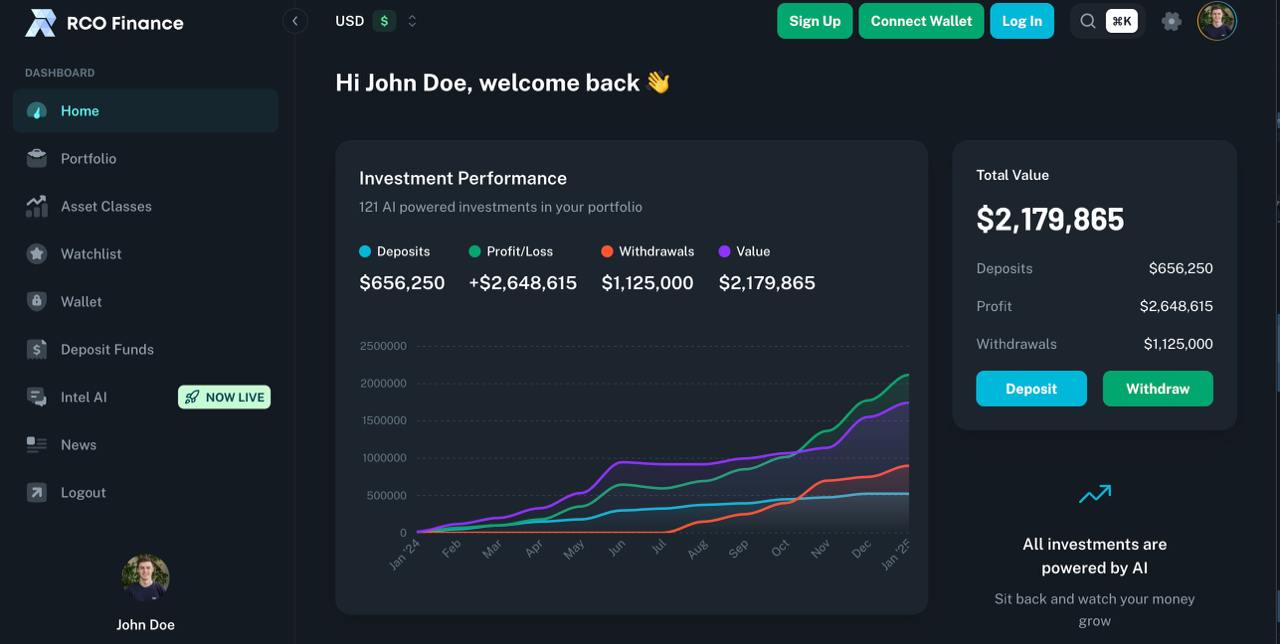
RCO Finance’s major selling feature is the Robo Advisor. This tool used advanced machine learning algorithms to create personalized investment strategies tailored to users’ financial objectives, risk tolerance, and portfolio size. 

The Robo Advisor tool scans reputable financial sources such as Bloomberg in real time to adjust asset asset allocation. The end goal is for all kinds of traders, including beginners, to make smarter and more informed choices that allow them to conquer the markets and grow their portfolios.

The Robo Advisor is good at picking potential winners and losers, helping users maximize gains and minimize losses. Users of RCO Finance would have been recommended to sell their BOME AI (BOME) holdings before the meme coin fell 86% this week.

RCO Finance has launched its beta platform for public testing with over 10,000 users. The developers are using the feedback to improve the beta platform and the Robo Advisor before the alpha version is officially rolled out.

Smart Money is Flowing Into RCO Finance Instead of XRP, What Do They See?

Additionally, RCO Finance has introduced a debit card to allow users to spend their crypto holdings in the real world. This accelerates crypto adoption while positioning RCOF as a major player in the crypto sector.

The project has shown its willingness to stick to DeFi principles by offering a KYC-free financial ecosystem. The platform offers users privacy and anonymity, a key factor in attracting more users.

Moreover, the DeFi trading platform offers users access to over 120,000 assets. This gives them great opportunities for portfolio diversification.

RCO Finance Allays Investor Fears with Smart Contract Audit

RCO Finance has completed a rigorous audit with SolidProof, a leading crypto security firm. This audit ensures that the platform’s code is secure and free from exploitable vulnerabilities.

The audit is a crucial security measure given the increasing risks of hacks in the young industry. RCO Finance has demonstrated its commitment to security by addressing any issues that could arise.

The project will continue to monitor its smart contract code to remain a step ahead of hackers and bad actors.

Follow the Smart Money, Invest in RCOF

The smart money is investing in RCOF as the altcoin is projected to gain 50,000% after the public launch. 

RCO Finance has made great progress by releasing its beta platform, which is being tested by over 10,000 users. The beta platform and the Robo Advisor tool are being upgraded to help users make sound financial decisions.

With a high leverage of up to 1,000X, RCO Finance’s users are primed to reach financial independence in record time.

Follow the smart money to conquer the markets and consistently earn profits. Invest in RCOF’s presale today and watch $1K grow into $500K by Q2.

For more information about the RCO Finance Presale:

Visit RCO Finance Presale

Join the RCO Finance Community

Disclaimer

In line with the Trust Project guidelines, please note that the information provided on this page is not intended to be and should not be interpreted as legal, tax, investment, financial, or any other form of advice. It is important to only invest what you can afford to lose and to seek independent financial advice if you have any doubts. For further information, we suggest referring to the terms and conditions as well as the help and support pages provided by the issuer or advertiser. MetaversePost is committed to accurate, unbiased reporting, but market conditions are subject to change without notice.

About The Author


Gregory, a digital nomad hailing from Poland, is not only a financial analyst but also a valuable contributor to various online magazines. With a wealth of experience in the financial industry, his insights and expertise have earned him recognition in numerous publications. Utilising his spare time effectively, Gregory is currently dedicated to writing a book about cryptocurrency and blockchain.

More articles


Gregory, a digital nomad hailing from Poland, is not only a financial analyst but also a valuable contributor to various online magazines. With a wealth of experience in the financial industry, his insights and expertise have earned him recognition in numerous publications. Utilising his spare time effectively, Gregory is currently dedicated to writing a book about cryptocurrency and blockchain.


Source link

Youngest Stars To Receive Oscar Nominations | MarkMeets Media

    0
    Youngest Stars To Receive Oscar Nominations | MarkMeets Media


    The glitz and glamour of the Academy Awards have captivated audiences since its inception in 1929. Among the numerous categories, the youngest Oscar winners stand out, showcasing exceptional talent at an early age. From Jodie Foster’s breakthrough in ‘Taxi Driver’ to Justin Henry’s poignant performance in ‘Kramer vs. Kramer,’ these young stars left an indelible mark on the cinematic landscape. Let’s embark on a journey through time to explore the stories behind the youngest Oscar winners.

    12. Jodie Foster in ‘Taxi Driver’ (1976)

    14 Years, 82 Days Old

    In Martin Scorsese’s gritty crime drama ‘Taxi Driver,’ Jodie Foster, at a mere 14 years old, delivered a performance that resonates nearly half a century later. Playing Iris, a 12-year-old sex worker, Foster showcased remarkable confidence and skill. The movie’s controversial nature adds a layer of debate about the suitability of such a role for a young actor, but Foster’s tour de force performance remains a testament to her early prowess.

    Taxi Driver – Release Date: February 9, 1976 | Director: Martin Scorsese | Runtime: 113 minutes | Main Genre: Crime

    11. Keisha Castle-Hughes in ‘Whale Rider’ (2002)

    13 Years, 309 Days Old

    Niki Caro’s ‘Whale Rider’ introduces us to Keisha Castle-Hughes, who earned her Oscar nomination at almost fourteen. The New Zealander family drama unfolds the story of a young Maori girl, played by Castle-Hughes, challenging traditions to fulfill her destiny. Castle-Hughes’s portrayal of Paikea exudes empowerment and poignancy, anchoring the film’s narrative with confidence and grace.

    10. Haley Joel Osment in ‘The Sixth Sense’ (1999)

    11 Years, 311 Days Old

    M. Night Shyamalan’s supernatural thriller ‘The Sixth Sense’ not only gave audiences one of the greatest plot twists but also introduced Haley Joel Osment, nominated for an Oscar at just shy of 12. The film’s atmospheric tension and Osment’s portrayal of a young boy with a mysterious connection to the afterlife have aged exquisitely well, securing his place in Oscar history.

    9. Anna Paquin in ‘The Piano’ (1993)

    11 Years, 200 Days Old

    Jane Campion’s poetic romantic drama ‘The Piano’ propelled Anna Paquin, at 11, into the spotlight. Paquin’s portrayal of a little girl forced into an adult role earned her not only an Oscar nomination but also a historic win for Best Supporting Actress. Her gut-wrenching performance layered with complexity and emotion solidified ‘The Piano’ as a masterpiece.

    8. Patty McCormack in ‘The Bad Seed’ (1956)

    11 Years, 181 Days Old

    Mervyn LeRoy’s ‘The Bad Seed’ may have faded from critics’ memory, but modern audiences appreciate this chilling thriller. Nominated for four Oscars, including Patty McCormack’s unforgettable performance as an eight-year-old ruthless killer, the film gains recognition for its dark complexity. McCormack’s ability to portray sweetness masking sinister qualities remains a standout in child performances.

    7. Abigail Breslin in ‘Little Miss Sunshine’ (2006)

    10 Years, 284 Days Old

    Jonathan Dayton and Valerie Faris’s ‘Little Miss Sunshine’ seamlessly blends humor, drama, and humanism. At its heart is Abigail Breslin, nominated at just 10 for her role as Olive. Breslin infuses personality and nuance into Olive, becoming the film’s heart and soul. The ensemble’s charm, coupled with Breslin’s endearing performance, earned ‘Little Miss Sunshine’ critical acclaim and an enduring legacy.

    6. Quinn Cummings in ‘The Goodbye Girl’ (1977)

    10 Years, 192 Days Old

    Herbert Ross’s ‘The Goodbye Girl’ may not be as remembered as some ’70s classics, but Quinn Cummings’s nomination for Best Supporting Actress is noteworthy. The charming and precocious Cummings brought life to the film, adding to its humor and sweetness. Her performance remains a delightful part of this influential rom-com’s legacy.

    5. Mary Badham in ‘To Kill a Mockingbird’ (1962)

    10 Years, 141 Days Old

    In the classic ‘To Kill a Mockingbird,’ Mary Badham’s portrayal of Scout is timeless. At just 10, Badham held her own against Gregory Peck, delivering a moving performance that showcased curiosity and compassion. Her Oscar nomination was a well-deserved recognition of her ability to bring one of literature’s most beloved characters to life.

    4. Tatum O’Neal in ‘Paper Moon’ (1973)

    10 Years, 106 Days Old

    Set during the Great Depression, Peter Bogdanovich’s ‘Paper Moon’ paired Tatum O’Neal with her father, Ryan O’Neal, resulting in cinema magic. At 10, O’Neal became the youngest-ever Oscar winner, a title she still holds. The film’s clever script and the duo’s incredible chemistry, along with O’Neal’s outstanding performance, solidify ‘Paper Moon’ as a timeless classic.

    Paper Moon – Release Date: April 9, 1973 | Cast: Ryan O’Neal, Tatum O’Neal, Madeline Kahn, John Hillerman | Runtime: 102 minutes | Main Genre: Comedy

    3. Quvenzhané Wallis in ‘Beasts of the Southern Wild’ (2012)

    9 Years, 135 Days Old

    ‘Beasts of the Southern Wild’ introduced the world to Quvenzhané Wallis, a 9-year-old delivering a powerful performance. The film’s magical realism weaved a tale of resilience, with Wallis at its heart. Wallis remains the youngest-ever Best Lead Actress nominee, showcasing her adventurous and emotionally charged portrayal in a story about the human condition.

    2. Jackie Cooper in ‘Skippy’ (1931)

    9 Years, 20 Days Old

    While ‘Skippy’ may have faded from public view, Jackie Cooper’s performance remains iconic. At just 9, Cooper became the youngest nominee for Best Lead Actor, a record he still holds. The delightful family movie may not be a cinematic heavyweight, but Cooper’s charisma and charm shine through, making it a must-watch for those seeking a glimpse into early Hollywood.

    1. Justin Henry in ‘Kramer vs. Kramer’ (1979)

    8 Years, 276 Days Old

    In the poignant ‘Kramer vs. Kramer,’ Justin Henry secured his place as the youngest-ever Oscar nominee at 8. The film’s exploration of fatherhood and gender roles, coupled with Henry’s heartbreaking portrayal, garnered critical acclaim. ‘Kramer vs. Kramer’ earned five Oscars, underscoring the film’s powerful narrative and the remarkable achievement of its young star.

    Conclusion

    The journey through the youngest Oscar winners unveils a tapestry of talent, resilience, and cinematic brilliance. From Jodie Foster’s early days to Quvenzhané Wallis’s magical performance, these young stars left an indelible mark on the world of film. As we celebrate their achievements, we also recognize the enduring power of cinema to capture the essence of the human experience, regardless of age. The youngest Oscar winners have proven that, sometimes, age is no barrier to leaving an everlasting impact on the silver screen.

    Author Profile

    Liz
    I write hot entertainment news and interview upcoming celebrities direct from the entertainment capital of Hollywood.


    Source link

    Where Was The White Lotus Season 3 Filmed? Every Major Location Explained – SlashFilm

      0
      Where Was The White Lotus Season 3 Filmed? Every Major Location Explained – SlashFilm


      In the first season of Mike White’s globe-trotting anthology series “The White Lotus,” actors like Connie Britton, Steve Zahn, Murray Bartlett, Jennifer Coolidge, and Natasha Rothwell brought their characters to the stunningly beautiful island of Maui in Hawai’i. Then, for the second go-around, White and his cast, including a returning Coolidge alongside Michael Imperioli, F. Murray Abraham, Aubrey Plaza, Meghann Fahy, and Theo James, headed to the town of Taormina in Sicily. Clearly, White — and HBO, the network behind “The White Lotus” — will spare no expense to shoot on location. So, where was Season 3 shot?

      Back when the Season 2 finale aired in December of 2022, White revealed that the third season would have a religious bent in a featurette that ran on HBO and Max alongside the episode, saying, “The first season kind of highlighted money, and then the second season is sex. I think the third season would be maybe a satirical and funny look at death and Eastern religion and spirituality. It feels like it could be a rich tapestry to do another round at White Lotus” (via Variety). With that in mind, it makes sense that White and his crew brought the third season of “The White Lotus” to Thailand, a Southeast Asian paradise filled with cityscapes, mountain vistas, stunning beaches, and clear blue oceans. 

      Wondering where they specifically shot the third season of White’s Emmy-winning series (which brings Rothwell back into play and introduces a whole new cast of badly-behaved wealthy characters)? Here are some of the major locations that White and HBO used for “The White Lotus” Season 3.

      The Four Seasons Koh Samui is the home base for most of The White Lotus Season 3

      Because the first two seasons of “The White Lotus” shot at Four Seasons properties in Hawai’i and Sicily, respectively (a fact confirmed by Conde Nast Traveler’s ongoing coverage of the show’s shooting locations), it’s not a huge surprise that Mike White and his crew picked a third hotel in the world-famous chain for Season 3. Located on Thailand’s second-largest island Koh Samui, HBO’s official press notes for “The White Lotus” confirm that the Four Seasons Resort Koh Samui serves as the location for most of the hotel’s shots, including the sprawling pool, common areas, the restaurant where characters like friends Kate (Leslie Bibb), Jaclyn (Michelle Monaghan), and Laurie (Carrie Coon) eat lunch, and several of the villas, including those belonging to mismatched couple Chelsea and Rick (Aimee Lou Wood and Walton Goggins) and the wealthy Ratliff family from North Carolina (including Jason Isaacs’ Timothy, Parker Posey’s Victoria, Patrick Schwarzenegger’s Saxon, Sarah Catherine Hook’s Piper, and Sam Nivola’s Lochlan).

      Again, it makes sense that White returned to a Four Seasons property for the lion’s share of the locations in “The White Lotus” Season 3, most of which highlight the hotel’s many amenities, including the very real spa (in the show, Rothwell’s character Belinda is there to train with fellow spa employees). Apparently, the mere act of filming at the Four Seasons Resort Koh Samui mimicked the tension seen in “The White Lotus.” In a piece from The Guardian sharing behind-the-scenes secrets for Season 3, Isaacs said the following about his time at the resort: 

      “It’s a kind of crucible, a five-star gilded cage. There’s no question that sometimes it is absolutely fabulous, and sometimes it’s ‘Lord of the Flies.'”

      Anantara hotels were also used for various settings

      What is surprising in Season 3 of “The White Lotus” is that Mike White didn’t stick to just Four Seasons properties (though, it should be said, this season is the first of the three thus far to shoot in a world not undergoing strict COVID protocols). Several of the scenes set in the (obviously fictional) White Lotus hotel weren’t filmed at the Four Seasons Resort Koh Samui; rather, they were shot at various properties under the Anantara umbrella.

      While Anantara has luxury resort properties all over the world, only a handful of the ones located in Thailand were used in Season 3 of “The White Lotus.” The bar, which is featured in the first episode when a lonely Chelsea meets a new friend named Chloe (Charlotte Le Bon), is actually the Singing Bird Lounge at Anantara’s Lawana Koh Samui Resort. Meanwhile, spots like the hotel lobby, the security room — where we spend time with guard Gaitok (Tayme Thapthimthong) — and the jewelry store that gets robbed with Chelsea present in the season’s second episode are all located at another Anantara resort, Anantara Bophut, which is also located in Koh Samui. Interestingly, though, the spots where Natasha Rothwell’s Belinda spends most of her scenes, meaning the “wellness sanctuary and spa” and Belinda’s private room, were filmed at Anantara Mai Khao Phuket. Phuket, as it were, is an hour-long flight (or a six-hour drive) away from Koh Samui.

      Rosewood Phuket provides a major setpiece for The White Lotus Season 3

      You might think, if you’re not paying close attention, that the restaurant at the Four Seasons Resort Koh Samui — where the characters on “The White Lotus” Season 3 enjoy relaxed lunches — would be the same one they go to at dinner. But you would be wrong there! The Rosewood Phuket is the real shooting location for all of the season’s tense dinner scenes, and based on some of the photos on this particular Rosewood’s website, it seems like it’s the establishment’s high-end Ta Khai eatery.

      This is, again, pretty interesting because Phuket and Koh Samui aren’t anywhere near each other. Still, Rosewood is also a luxury hotel chain with stunning properties all over the globe, so it does make sense to add in some other filming locations in Phuket if some of the cast members were gathered there anyway. Just like it does on the series, the Ta Khai restaurant serves elevated Thai cuisine, lending a perfect setting to those awkward Ratliff family dinners or the seemingly endless scenes where Rick and Chelsea argue over their evening meals.

      Koh Samui is also home to the Buddhist monastery seen in The White Lotus Season 3

      When the Ratliff family gets to the White Lotus, we learn that Piper, the middle child of the family, is there to study a Buddhist temple for her college thesis — and unsurprisingly, Mike White took full advantage of Thailand’s rich religious history and shot at real sacred locations. According to HBO’s press notes for the series and outlets like Conde Nast Traveler, the temple that Piper hopes to visit and study during her time in Thailand is Wat Phukhao Thong on the coast of Koh Samui.

      All of the outside decor — including the large Buddha — seen on “The White Lotus” are real features of Wat Phukhao Thong, and it’s a spiritual site that you can visit if you find yourself in Thailand. Based on White’s comments about how important religion is to this particular season of “The White Lotus,” it seems safe to assume that we’ll keep returning to this temple whenever Piper does.

      Where do the guests arrive at The White Lotus in Season 3?

      The “arrival” scene is, at this point, a staple of “The White Lotus.” Because Mike White wisely splits the focus of the show between the often odious and extraordinarily wealthy guests and the employees who wait on them hand and foot, the season premiere typically focuses on the staff welcoming everyone to the in-universe resort. Plus, when you consider that it gives White a chance to neatly introduce each “group” in an obvious and easy way, it’s a no-brainer.

      The arrival scenes in Season 3 of “The White Lotus,” which sees the guests arriving by boat — bringing to mind the fact that White famously appeared as a contestant on “Survivor” and then felt inspired to work on “The White Lotus” — were split between a few locations. Mu Ko Ang Thong National Marine Park (in Koh Samui) is pretty likely the backdrop for that boat ride, where Rick pisses off the Ratliffs by smoking a cigarette, while the beach scenes were apparently filmed at Ko Lawa Yai (a beach near Phang Nga Bay in Phuket) and Ya Nui Beach. As with the previous seasons of “The White Lotus,” these arrival scenes give us the first glimpse of the stunning backdrop for the season, and these real-life natural beauties look pretty unbelievable.

      What other locations are in the trailer for The White Lotus Season 3?

      There are still a ton of locations we haven’t seen quite yet as “The White Lotus” continues airing its latest season, but based on the final trailer that dropped at the end of this past January, we’ll get to explore more of Thailand through these characters pretty soon. Photos of Kate, Jaclyn, and Laurie exploring a market have made the rounds online (and you can spot the scene in the trailer), and according to the same Conde Nast Traveler report, that’s likely Fisherman’s Village in Koh Samui, which hosts an annual water-gun fight to celebrate the Thai New Year. That article also specifies that the Haad Rin beach on Koh Phangan, an island near Koh Samui that always hosts the Full Moon Party, is seen in the trailer, with a few characters attending the festivities.

      Audiences will have to wait and see which other real Thai locations are featured on “The White Lotus” Season 3, but based on what we’ve seen so far (and the show’s previous seasons), we’re in for a treat. 

      “The White Lotus” drops new episodes on Sunday nights at 9 P.M. on HBO and its streaming service Max.


      Source link

      Meta’s moderation change means more bad stuff will get through – Hypergrid Business

      0
      Meta’s moderation change means more bad stuff will get through – Hypergrid Business


      (Image by Lawrence Pierce via Adobe Firefly.)

      As a moderator myself, nothing could sound more disturbing than the idea of a revised social media moderation policy presented with the caveat that more bad stuff will get through.

      Recently, Mark Zuckerberg announced that Meta, the company that heralded and then fumbled the metaverse, will be dialing back their moderation on their various platforms. He has explicitly claimed that, “…we’re going to catch less bad stuff…”

      You can watch his presentation here.

      This is especially menacing because Zuckerberg identifies bad stuff as including drugs, terrorism, and child exploitation. He also specifically says Meta is going to get rid of restrictions on topics like immigration and gender. They’re going to dial back filters to reduce censorship. Oh, and he says they’re ending fact-checking.

      This is a mess.

      Moderation is challenging. That challenge varies in relationship to the zeitgeist, the societal character of the times, which is quite complex these days. It also varies by platform. The scope of the challenge of moderation on Facebook is greater than at Hypergrid Business, yet the core issues are the same. Good moderation preserves online well-being for contributors and readers, while respecting genuine alternative perspectives.

      At Hypergrid Business we have discussion guidelines that direct our moderation. Primarily, we apply moderation principles on content that is likely to cause personal harm, such as malicious derision and hate-speech towards specific groups or individuals.

      At Hypergrid Business, malicious derision, a kind of bad stuff, was driving away contributors. However, letting in more malicious derision would not have improved the discussions. We know this because once discussion guidelines were instituted that removed malicious derision, more contributors posted more comments. So when Zuckerberg says Meta intends to get rid of moderation restrictions on topics like gender and immigration, we know from experience that the bad stuff will be malicious derision and hate-speech towards vulnerable and controversial groups, and this will not improve discussions.

      The unfortunate ploy in Meta’s new moderation policies is the use of the expression, “innocent contributors” in the introductory video presentation. He says that the moderation policies on Meta platforms have blocked “innocent contributors”. Although the word ‘innocent’ typically conveys a neutral purity of positive disposition, intent and action, Zuckerberg, uses ‘innocent’ in reference to contributors whether they are the victims or the perpetrators of malicious commentary. This confounding use of the word “innocent” is a strategic verbal misdirection. Zuckerberg attempts to appear concerned while pandering to any and all sensibilities.

      Zuckerberg’s emphasis, however, is not limited to moderation filters. Rather, he is laser focused on how Meta is going to end third party fact-checking entirely. Zuckerberg pins the rationale for his position on the assertion that fact-checking is too biased and makes too many mistakes. He offers no examples of what that alleged shortcoming looks like. Nonetheless, he puts a numerical estimation on his concerns and says that if Meta incorrectly censors just 1 percent of posts, that’s millions of people.

      Zuckerberg further asserts that fact-checkers have destroyed more trust than they’ve created. Really? Again there are no real world examples presented. But just as a thought experiment, wouldn’t a 99 percent success rate actually be reassuring to readers and contributors? Of course he’s proposing an arbitrary percentage by writing the 1 percent statement as a misleading hypothetical, so in the end he’s simply being disingenuous about the issue.

      Facts are essential for gathering and sharing information. If you haven’t got an assurance you’re getting facts, then you enter the fraught areas of lies, exaggerations, guesses, wishful thinking… there are many ways to distort reality.

      It’s fair to say that fact-checking can fall short of expectations. Facts are not always lined up and ready to support an idea or a belief. It takes work to fact-check and that means there’s a cost to the fact-checker. A fact used in a misleading context leads to doubts over credibility. New facts may supplant previous facts. All fair enough, but understanding reality isn’t easy. If it were, civilization would be far more advanced by now.

      Zuckerberg, however, has an obvious bias of his own in all of this. Meta doesn’t exist to ensure that we have the best information. Meta exists to monetize our participation in its products, such as Facebook. Compare this to Wikipedia, which depends on donations and provides sources for its information.

      Zuckerberg argues against the idea of Meta as an arbiter of truth. Yet Meta products are designed to appeal to the entire planet and have contributors from the entire planet. The content of discussions on Meta platforms impacts the core beliefs and actions of millions of people at a time. To treat fact-checking as a disposable feature is absurd. Individuals cannot readily verify global information. Fact-checking is not only a transparent approach for large-scale verification of news and information, it’s an implicit responsibility for anyone, or any entity, that provides global sharing.

      Facts are themselves not biased. So what Zuckerberg is really responding to is that fact-checking has appeared to favor some political positions over others. And this is exactly what we would expect in ethical discourse. All viewpoints are not equally valid in politics or in life. In fact, some viewpoints are simply wish lists of ideological will. If Zuckerberg wants to address bias, he needs to start with himself.

      As noted, Zuckerberg clearly seems uncomfortable with Meta in a spotlight on the issue of fact-checking. Well, here’s a thought: Meta shouldn’t be deciding whether something is true or not, that’s what fact-checking services take care of. It places the burden of legitimacy on outside sources. The only thing Meta has to arbitrate are the contracts with fact-checking organizations for their fact-checking work. When Zuckerberg derides and discontinues third-party fact-checking he isn’t just insulating Meta from potential controversies. He uncouples the grounding and responsibilities of Meta contributors. As a consequence, stated in his own words, “…we’re going to catch less bad stuff…”

      What Zuckerberg proposes instead of fact-checking is something that completely undermines the intrinsic strength of facts and relies instead on negotiation. Based on the Community Notes system on X, Meta only allows “approved” contributors to post challenges to posts. But the notes they post will only be published if other “approved” contributors vote on whether those notes are helpful… then an algorithm further processes the ideological spectrum of all those voting contributors to decide if the note finally gets published. Unsurprisingly, it has been widely reported that the majority of users never see notes correcting content, regardless of the validity of the contributor findings. Zuckerberg argues for free speech, yet Community Notes is effective censorship for suppressing challenges to misinformation.

      Clearly, getting to the facts that support our understanding of the realities of our world is increasingly on us as individuals. But it takes effort and time. If our sources of information aren’t willing to verify the legitimacy of that information, our understanding of the world will absolutely become more, rather than less, biased. So the next time Zuckerberg disingenuously prattles on about his hands-off role supporting the First Amendment and unbiased sharing, what he’s really campaigning for is to allow the sea of misinformation to expand exponentially, at the expense of the inevitable targets of malicious derision. Remember, Zuckerberg’s bias is to encourage more discussions by all means, a goal which, for a platform with global reach, is greatly aided by having less moderation. Moderation that protects you at that scale is being undermined. Remember, Zuckerberg said it himself: “…we’re going to catch less bad stuff…”

      lawrence.pierce@hypergridbusiness.com'
      Lawrence Pierce specializes in new media design and production. He began as a computer game programmer and has been a systems consultant to corporations such as DuPont and the J. Paul Getty Art Trust, art director on the first computer game for MTV and a featured artist in the Hollywood Reporter.
      lawrence.pierce@hypergridbusiness.com'
      Latest posts by Lawrence Pierce (see all)


      Source link

      Tony Hawk’s Pro Skater 3 + 4 All But Officially Confirmed By Ratings Board

      0
      Tony Hawk’s Pro Skater 3 + 4 All But Officially Confirmed By Ratings Board


      It looks like the upcoming Tony Hawk game being teased by Activision, and accidentally revealed by a professional skateboarder, will indeed be a remaster of the third and fourth games just like Tony Hawk’s Pro Skater 1+2 was.

      The rating in question comes from Singapore which lists the game as Tony Hawk’s Pro Skater 3+4. It also says the game will launch on “Nintendo Switch, PC, Sony Playstation 4, Sony Playstation 5, Xbox One, Xbox Series X/S.”

      There’s currently a countdown to 03/04/2025 on the official Tony Hawk Pro Skater site. It appeared after a Tony Hawk announcement was teased in a Call of Duty map named Grind.

      Before that, pro skater Tyshawn mentioned appearing in an upcoming Tony Hawk game.

      Insider eXtas1s believes the game will get shadow-dropped at Xbox’s Summer event this year.

      Personally, I’m super-hyped for this one. The Pro Skater games were a massive part of my chldhood, and the 1+2 remaster was damn near flawless in its execution. Hopefully, Microsoft got the same folk at the formerly-named Vicarious Visions back onboard to develop it.


      Source link

      Adam Thomas declares “just take my pain away” amid “constant battle and setbacks” of debilitating health condition

        0
        Adam Thomas declares “just take my pain away” amid “constant battle and setbacks” of debilitating health condition


        Adam Thomas, who plays Dante Charles in Waterloo Road, has opened up about his ongoing battle with arthritis.

        The actor was diagnosed with rheumatoid arthritis in 2023. He’s since said that he has psoriatic arthritis. The NHS describes it as a “long-term condition that causes joint pain, swelling and stiffness”.

        Last night, in a new Instagram Story, Adam told his fans he was really having a tough time, declaring: “Just take my pain away please!”

        Adam plays Donte Charles in Waterloo Road (Credit: BBC)

        Adam Thomas’ heartbreaking health update

        Writing online, Adam said: “This disease really does [bleep] with your head, especially when your trying to shift some weight and get into a routine of exercise! Constant battle, constant setbacks! Just take my pain away please!”

        I’ve suffered enough now!

        He then added, alongside a picture of himself underneath some kind of lamp: “I’ve suffered enough now! Am really trying to hold myself together but it’s not easy!”

        Adam then added a note: “Just one of those days – keep fighting people on the days where we can’t train – we have to take care of ourselves, self care and recovery.”

        Adam Thomas under a lamp wearing glasses

        Adam shared a heartbreaking update last night (Credit: Instagram)

        ‘It’s been tough’

        On Good Morning Britain earlier this month, Adam spoke to host Susanna Reid about the condition.

        He said: “I’ve been struggling with this autoimmune disease now for about two and a half years. It’s been tough. I’m not over-exaggerating when I say this but literally within two and a half years, every day I’ve been in pain.”

        In October 2024, Adam revealed that he could “barely walk” due to his arthritis.

        “The pain is pretty unbearable at the moment, it’s as if my whole body is seizing up!! The pain was bad before, but it’s a lot worse now,” he said, revealing his medication had been changed.

        “I’ve just started my new medication today which takes 12 weeks to take effect and even then it might not work so am not too sure what I can do to ease the pain until then? I’ve had my steroid injections and it literally lasted a week. I can’t carry on like this!”

        He continued: “I couldn’t even get dressed this morning on my own, couldn’t drive to work. I mean, I can barely walk and my wrists and fingers feel like they’re broken – that’s no exaggeration! I wouldn’t have got out of bed today if it wasn’t for work. It got better throughout the day with a [bleep]load of painkillers!

        “But wow… these last few days have been scary, had a little cry to myself today it can just really get on top of you!”

        Adam Thomas looking upset on This Morning

        The star has issued a new cry for help this week (Credit: ITV)

        ‘Not a sob story’

        Adam also said: “Am not saying this for a sob story or for sympathy just trying to bring awareness to this disease and what so many others are going through – the good, the bad [and] the ugly.

        “I’m lucky I have a great support system and not many do so to anyone who is going through the same thing and is alone; I see you, I feel you!! It’s going to get better. Don’t give up. If you know anyone who’s suffering just give them a call and check in.”

        Waterloo Road is on BBC One Tuesdays at 9pm.

        Read more: Inside Waterloo Road star Lindsey Coulson’s love life – from affair rumours with EastEnders star to marry soap pal’s brother

        YouTube video player

        Share your thoughts on our Facebook page @EntertainmentDailyFix.


        Source link

        Stories from Sol: The Gun-Dog Switch Review

        0
        Stories from Sol: The Gun-Dog Switch Review


        Stories from Sol: The Gun-Dog is a visual novel with adventure game elements. There is a side menu where you can move, look, use, talk and use and item. However, there are no puzzle in the traditional sense. Everything you do is laid out and telegraphed. There is a handy tasks screen that tells you what to do if you’re lost. Like I said, this is a visual novel, and it is quite a good one at that, that tells a good sci-fi story.

        Stories from Sol: The Gun-Dog stars you, who can be he, she or they, and you chose your whole name. You are a security officer on the star ship Gun-Dog who has to meet up with another star ship and investigate mysterious signals. Your star ship is full of anime tropes, but its ok, they’re well written and mostly three-dimensional. This includes your love interest, who spends most of the time out of commission. There are twists and turns and branching paths, though the main story isn’t affected much by those paths. For example, early on, you can shoot a person with a stun-gun, and that will affect your relationship with them.

        The biggest problem with Stories from Sol is the text is confined to the bottom of the screen and cannot be changed, causing me eye-strain at times. Also, again, the characters fall into well-worn tropes, but that’s really a nitpick. On the plus-side, there are three different visual options, like this one:

        It is neat that Stories from Sol: The Gun-Dog has them, but they don’t change the actual game at all. Despite that, all of the graphics are well done with some neat visual touches thrown in. Overall, I enjoyed this greatly and give it a Recommended with an eight back-end score. If you’re looking for a sold sci-fi visual novel, you cannot go wrong with The Gun-Dog.

        Overall; Stories from Sol: The Gun-Dog is a solid science-fiction visual novel that is entertaining and pretty to look at!

        Verdict: Recommended

        eShop Page

        Release Date2/20/25Cost$19.99PublisherAstrolabe GamesESRB RatingT

        P.S. The closest thing I’ve reviewed is actual adventure game called Monolith!

        Subscribe so you never miss a review:


        Source link

        Weekly Crypto and NFT Market Recap (17 Feb – 23 Feb)

        0
        Weekly Crypto and NFT Market Recap (17 Feb – 23 Feb)


        Week of New TGEs: $Pi, $KAITO & $IP

        Pi Network ($PI)

        After several delays, Pi Network’s open mainnet is set to launch officially on February 20th. Following this, $PI has been listed on multiple exchanges such as OKX, Bitget, Bitrue, HTX, and BitMart.

        $PI launched with an initial price of $2 and reached an all-time high of $2.2 since its listing. Despite a sharp drop two days after its listing, the Stellar Consensus Protocol’s current stability at $1.58 is remarkable.

        Source: CoinGecko

        Kaito AI ($KAITO)

        Kaito AI is a leading platform regarding AI & InfoFi by leveraging its custom LLM tailored for the crypto domain. With a vision to revolutionize information accessibility in Web3, Kaito AI transforms fragmented data into valuable insights, enabling users to make more informed decisions.

        Kaito AI ($KAITO)Kaito AI ($KAITO)

        Source: CoinGecko

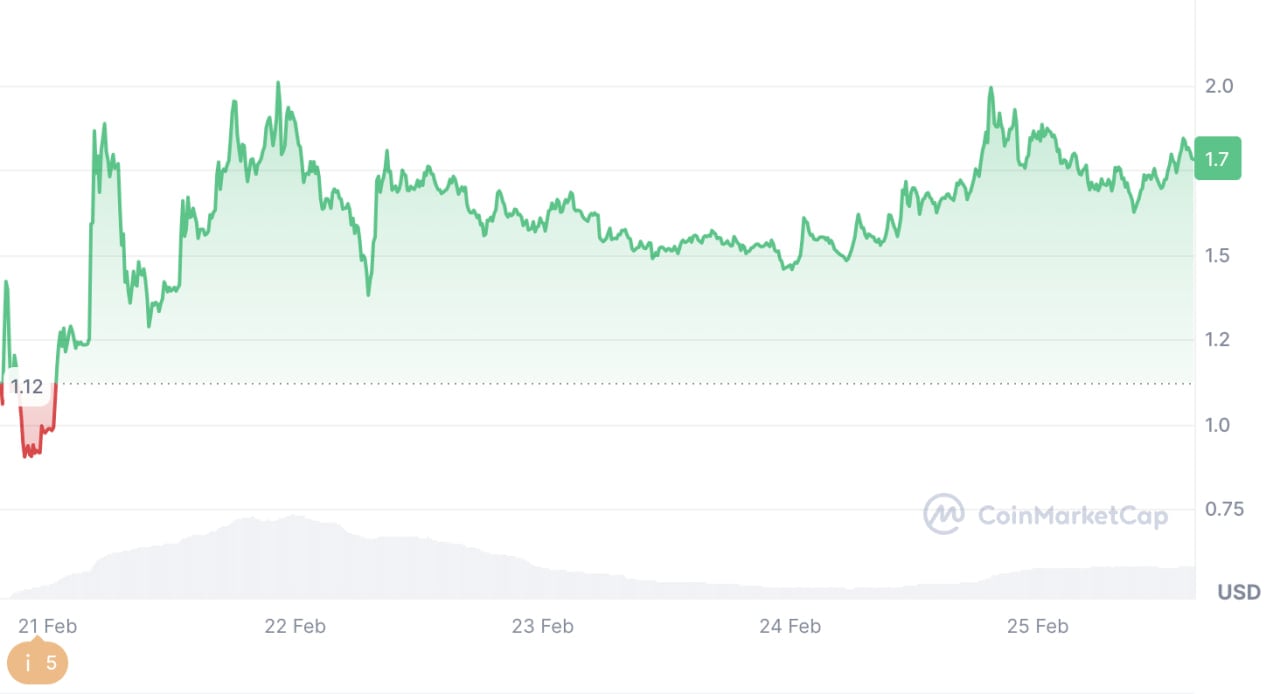
        On February 20, Kaito opened its airdrop claim, in which the allocation was tied to its Yaps Program. Thereafter, the $KAITO price went steady above $1.61, indicating strong community support, token usecase and buying interest post-TGE. 

        Kaito’s post-TGE resilience highlights the effectiveness of its “Yap-to-Earn” model and strong community engagement. 

        Unlike Pi’s broad but untested base, Kaito’s niche focusing on AI-driven initiatives and governance features gives it staying power. 

        Learn more: What is Kaito AI?

        Story Protocol (IP)

        Story Protocol (IP)Story Protocol (IP)

        Source: CoinGecko

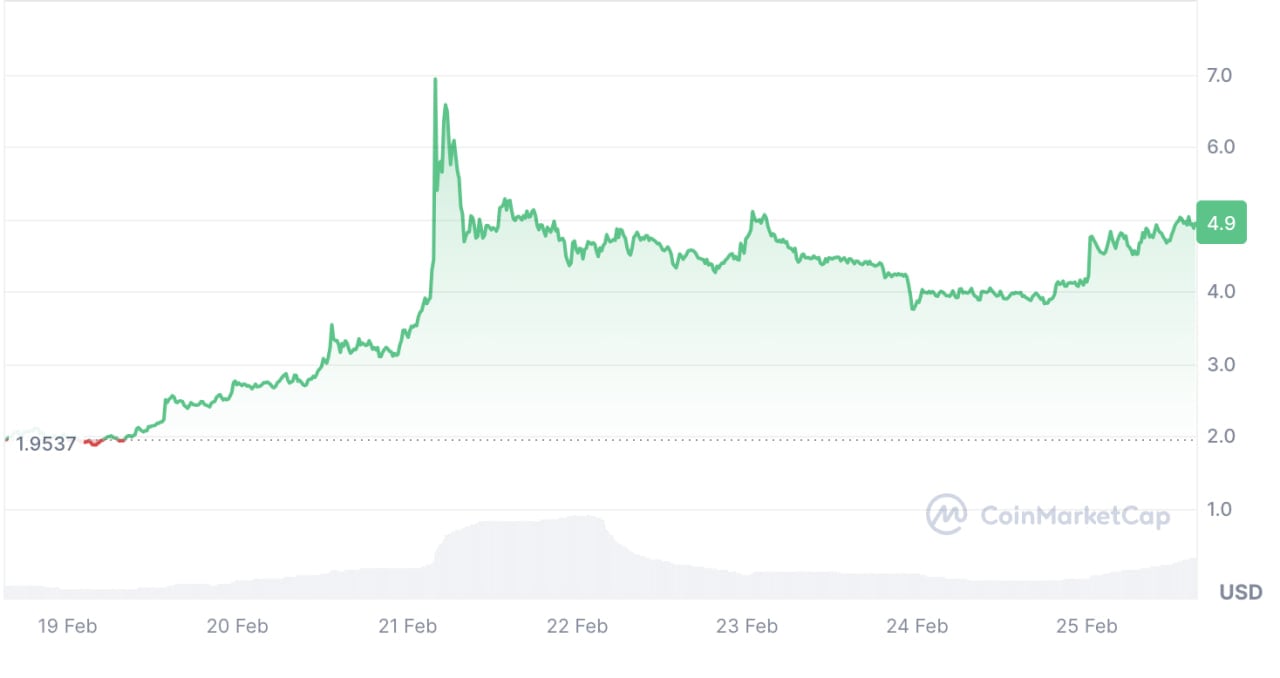
        Story Protocol’s $IP token, launched with its mainnet on February 13, 2025, has seen a standout performer since its TGE. By February 20, the token surged to an all-time high of $7.11 and currently stands at $4.9 as of today. 

        $IP price: Updated on February 25. Source: CoinMarketCap

        The surge to $7.94 reflects speculative hype, while the correction to $3.96 shows profit-taking and market stabilization. In essence, $IP benefits from clear utility, which could partly came from the NFT craze of PFP3 drives the demand for $IP due to NFT trading activities. 

        Key points: PI Network may do well after the TGE because it had a low initial circulating supply. Meanwhile, both $IP and $KAITO, which are native tokens, play important roles that encourage whales to accumulate.

        OpenSea Faces Controversy For Its New Reward System 

        OpenSea launched the beta version of its OS2 platform on January 28, introducing an XP points system—one of the mechanisms used to determine the amount of $SEA users may receive in the upcoming airdrop.

        XP points can be earned through listing NFTs, making collection offers, or other interactive elements that highlight XP-earning actions.

        However, the NFT community quickly voiced their dissatisfaction with this system, criticizing it for encouraging wash trading and prioritizing platform profits from listing and bidding fees over supporting creators.

        Learn more: Opensea and the Harsh Reality of the NFT Market

        Monad Public Testnet Launch

        Monad Public Testnet LaunchMonad Public Testnet Launch

        Source: Monad

        Monad is making a significant advancement with the launch of its public testnet on February 19. This marks a key milestone following the completion of its closed testnet phase at the end of 2024. 

        The testnet will allow the blockchain community to experience and evaluate Monad’s processing capabilities in a real-world environment. Developers will have the opportunity to test their applications while also contributing to improving the system’s performance and security before its official launch in late 2025.

        Among its core capabilities, the testnet introduces a gas limit of 300 million gas per second, expected to support a throughput of 10,000 transactions per second (TPS). 

        Learn more: Monad Launches Public Testnet Today

        Monad is such a potential Layer 1 EVM blockchain, as explained in a previous article . Therefore, investors should closely monitor the Monad Airdrop to secure early Testnet access and potentially earn substantial airdrop rewards. 

        Explore how to join Monad Airdrop effectively and easily here. 

        Hackers Steal $1.4 Billion from Bybit

        On February 21, Bybit suffered a massive security breach, resulting in the theft of approximately $1.46 billion in Ethereum (ETH) and related tokens from one of its offline cold wallets. This incident is considered the largest cryptocurrency hack in history, surpassing previous records like the $611 million Poly Network theft in 2021. 

        The attack occurred during a routine transfer from a multisignature cold wallet to a warm wallet, where hackers used a sophisticated method to manipulate the transaction process. They masked the signing interface to deceive Bybit’s team into approving a malicious transfer, allowing the funds to be siphoned to an unknown address.

        The stolen funds, primarily ETH and staked tokens like stETH and mETH, were quickly dispersed across multiple wallets and laundered through decentralized exchanges, cross-chain bridges, and services like eXch, with some converted into Bitcoin to obscure the trail.

        Bybit’s CEO, Ben Zhou emphasized the company’s commitment to recovering the funds, offering a 10% reward for assistance from cybersecurity experts, and collaborating with authorities and forensic teams to trace the assets.

        Read more: Recap of the $1.4 billion robbery from Bybit by hackers

        Next Steps

        Last week’s crypto and NFT market witnessed ups and downs—from TGE highs to a historic hack—setting the stage for both opportunity and caution. 

        $PI, $KAITO and $IP are holding strong post-TGE; track their ecosystems (Kaito’s Yaps, Story Protocol’s IP Portal) for signs of sustained growth, while $PI with less utility in tokens is still questionable.

        At the moment, Monad is one of the most to-watch protocols for Airdrop potential.

        Bybit’s $1.4 billion hack is a stark reminder: audit your security. Move assets to hardware wallets or trusted multisignature setups and avoid keeping large sums on exchanges even in cold wallets. 


        Source link

        Popular Posts

        My Favorites

        10 Best JRPGs That are Unapologetically Weird

        0
        Generally, you go into a JRPG looking for an expansive story, relatable characters, and exciting gameplay. But sometimes, you just want something utterly...