Home Blog Page 1252

The Economics of Renting Cloud GPUs: A Comprehensive Breakdown

0
The Economics of Renting Cloud GPUs: A Comprehensive Breakdown


With global cloud computing spending projected to soar to $1.35 trillion by 2027, businesses and individuals increasingly rely on cloud solutions. Within this landscape, cloud GPUs have become a major area of investment, particularly for AI, machine learning, and high-performance computing (HPC).

The demand for GPU as a Service (GPUaaS) has fueled a massive market expansion. Valued at $3.23 billion in 2023, the GPUaaS market is expected to reach $49.84 billion by 2032. AI research, deep learning applications, and high-performance computational workloads drive this growth.

However, is renting cloud GPUs the most cost-effective solution for businesses? Understanding cloud GPUs’ financial implications, use cases, and cost structures is crucial for making informed decisions.

This article explores the economics of renting cloud GPUs, comparing different pricing models, discussing cost-saving strategies, and analyzing real-world scenarios to help you optimize your cloud computing budget.

When Should You Rent a Cloud GPU?

Cloud GPUs provide numerous advantages but are not always the right fit. Before committing to a cloud GPU rental, it’s essential to understand when it makes the most sense. Here are key scenarios where renting a cloud GPU is beneficial:

1. Short-Term Projects and Peak Demand

Project-Based Workloads: Renting is more practical than investing in expensive hardware if your project requires high GPU power for a limited time—such as training AI models, rendering 3D animations, or running simulations. If your GPU usage fluctuates, cloud GPUs can scale up when demand is high and down when resources are no longer needed. This eliminates the inefficiency of idle hardware.

2. Experimentation and Innovation

Testing New Technologies: Cloud GPUs allow businesses and researchers to experiment with different GPU architectures without incurring large upfront costs. This is crucial for AI research, game development, and other exploratory projects. If you are unsure whether an AI or ML model will be viable, renting cloud GPUs allows you to test your ideas before investing in expensive on-premise infrastructure.

3. Accessibility and Collaboration

Democratizing Access to High-Performance GPUs: Not all organizations can afford high-end GPUs. Cloud services provide access to powerful GPU resources for startups, researchers, and developers. With cloud-based GPU computing, team members can work on shared resources, collaborate on machine learning projects, and access data remotely from anywhere.

4. Reduced IT Overhead

No Hardware Maintenance: Cloud providers handle GPU maintenance, software updates, and security patches, allowing your team to focus on core tasks. Cloud GPUs eliminate the need for physical data centers, reducing space, cooling systems, and power consumption costs.

5. Cost-Effectiveness for Specialized Workloads

Tailored GPU Instances: Many providers offer optimized GPU instances for specific workloads, such as deep learning or scientific computing. These options provide better performance at a lower cost than general-purpose GPUs.

By analyzing these factors, businesses can determine whether cloud GPU rental is a strategic choice that aligns with their financial and operational goals.

Understanding the Cost of Renting Cloud GPUs

Renting a cloud GPU is not just about the hourly rental price—other factors influence the total cost of ownership (TCO), including workload requirements, pricing models, storage, and data transfer fees. Let’s examine the key cost components.

1. Hourly vs. Reserved Pricing (Including Bare Metal and Clusters)

On-Demand Instances: Many cloud providers offer pay-as-you-go pricing, which is ideal for short-term projects. For instance, renting an NVIDIA RTX 4090 on Spheron Network (Secure) costs $0.31 / hr. Best for: Users with unpredictable workloads who need flexibility.

Reserved Instances: Reserved instances can save you 40–60% compared to on-demand pricing, if you require GPUs for extended periods. They are best for Long-term AI model training, HPC workflows, and large-scale simulations.

Bare Metal Servers: Bare metal servers provide superior performance without virtualization overhead for applications that require dedicated resources and full control. For example, renting a bare metal server with 8 NVIDIA RTX 4090 (Secure) GPUs costs $2.48 /hr and 8 NVIDIA RTX 6000-ADA (Secure) costs $7.20 /hr on Spheron Network. They are best for Real-time AI inference, large-scale rendering, and performance-sensitive applications.

GPU Clusters: GPU clusters offer high scalability for enterprises conducting parallel processing or large-scale deep learning training. Best for: Distributed AI training and large-scale computational tasks.

2. Pricing by GPU Type

Not all GPUs are priced equally. The cost of renting a GPU depends on its capabilities. High-end models like NVIDIA H200 or H100 cost significantly more than older models like the V100 or A4000. Matching the right GPU to your workload is essential to prevent overpaying for unnecessary performance.

3. Storage and Data Transfer Costs

Beyond GPU rental, cloud providers charge for:

Storage: Storing 1TB of training data can cost $5 per month for standard storage, but SSD options cost more.

Data Transfer Fees: Transferring large datasets between cloud regions can add significant expenses.

4. Hidden Costs to Watch For

Assessing your needs and considering scenarios like the one above can help you make smarter decisions about renting cloud GPUs. Let’s look at a real-world example to understand potential costs and how to save money.

Case Study: Cost Breakdown of AI Model Training

When planning an AI model training project, the first thought that often comes to mind is: “Let’s do it on‑premise!” In this case study, we’ll walk through the cost breakdown of building an on‑premise system for training AI models. We’ll begin by looking at the more cost‑efficient NVIDIA V100 GPUs.

Suppose a company needs to train a deep learning model for computer vision. They require 8x NVIDIA V100 GPUs for 30 days. Here’s how the costs:

On‑Premise Cost Breakdown Using NVIDIA V100 GPUs

Not every training workload requires the absolute highest-end hardware. For many AI inference and moderate training workloads, an on-premise system with 8x NVIDIA V100 GPUs can be a viable choice. Here’s a breakdown of the estimated costs:

ComponentEstimated Price (USD)Notes

8 × NVIDIA V100 GPUs$24,000Approximately $3,000 per GPU (used market)

Compute (CPUs Cost)$30,000High-performance CPUs for parallel processing

1TB SSD Storage$1,200High-end NVMe drives

Motherboard$10,000+Specialized board for multi-GPU configurations

RAM$10,000 – $18,0002TB+ of high-speed DDR5 RAM (can be lower for some workloads)

NVSwitch$10,000+Required for NVLink-enabled V100 clusters (higher bandwidth)

Power Supply$5,000 – $8,000Higher power consumption (~250W per V100)

Cooling$5,000+More aggressive cooling needed compared to V100 (liquid cooling preferred)

Chassis$6,000+Specialized high-density GPU chassis

Networking$2,500+High-bandwidth networking cards (100GbE or faster)

Software & Licensing$6,000+OS, drivers, and specialized AI software

Total Cost Estimate$109,700 – $134,700+Higher than L4-based setups due to increased power and cooling needs

After this high-investment project, the Project can think it can recover the investment. One strategy to recover some of the capital investment for an on‑premise system is to resell the hardware on the aftermarket. However, for AI accelerators, the resale market often only returns a fraction of the original cost. For example, second‑hand NVIDIA GPUs might fetch only 40–60% of their new price, depending on market conditions and the hardware’s condition.

If the resale value isn’t sufficient—if you’re unable to find buyers at your target price—the hardware could end up sitting idle (or “going to dust”), locking away capital and risking obsolescence.

These challenges—high upfront costs, rapid depreciation, and idle hardware risk—drive many organizations toward cloud-based AI compute services. To understand this better, let’s compare the cloud compute platforms costs side by side.

8x NVIDIA V100 GPU Rent Cost Breakdown

ProviderPrice per Hour (1x V100)Price per Hour (8x V100s)Price per DayPrice per Month (30 Days)

Google$4.69$37.52$900.48$27,014.40

Amazon$3.76$30.08$721.92$21,657.60

CoreWeave$1.02$8.16$195.84$5,875.20

RunPod$0.23$1.84$44.16$1,324.80

Spheron$0.10$0.80$19.20$576.00

Spheron Network remains the most affordable option, being 47x cheaper than Google and 37x cheaper than Amazon for V100 compute. Let’s compare another GPU RTX 4090 rent cost.

1 x RTX 4090 GPU Rent Cost Breakdown

Cloud ProviderPrice per HourPrice per DayPrice per Month (720 hrs)

Lambda Labs~$0.85/hr~$20.40~$612.00

RunPod (Secure Cloud)~$0.69/hr~$16.56~$496.80

GPU Mart~$0.57/hr~$13.68~$410.40

Vast.ai Marketplace~$0.37/hr~$8.88~$266.40

Together.ai~$0.37/hr~$8.88~$266.40

RunPod (Community Cloud)~$0.34/hr~$8.16~$244.80

Spheron Network (Secure)~$0.31/hr~$7.44~$223.20

Spheron Network (Community)~$0.19/hr~$4.56~$136.80

Note: Except Spheron Network rates, other platform approximate rates can vary based on configuration (CPU/RAM allocation), region, and pricing model (on‑demand, spot, etc.).

Spheron Network offers the lowest rate at $0.31/hr(Secure) and $0.19/hr(Community), making it between 38.71% and 77.65% cheaper than the other providers in our list, depending on which you compare it to. Unlike traditional cloud providers, Spheron includes all utility costs (electricity, cooling, maintenance) in its hourly rate—no hidden fees.

While Big cloud providers offer more flexibility and eliminate the maintenance burden, they aren’t always the most cost-efficient solution. Cloud computing is generally cheaper than an on-premise setup, but it’s not necessarily the optimal choice for all use cases. That’s why we have built Spheron Network.

After reading the above analysis, you might wonder why Spheron is a more cost-effective option compared to other platforms.

Spheron is a Decentralized Programmable Compute Network that simplifies how developers and businesses use computing resources. Many people see it as a tool for both AI and Web3 projects, but there is more to it than that. It brings together different types of hardware in one place, so you do not have to juggle multiple accounts or pricing plans.

Spheron lets you pick from high-end machines that can train large AI models, as well as lower-tier machines that can handle everyday tasks, like testing or proof-of-concept work and deploying SLMs or AI agents. This balanced approach can save time and money, especially for smaller teams that do not need the most expensive GPU every time they run an experiment. Instead of making big claims about market sizes, Spheron focuses on the direct needs of people who want to build smart, efficient, and flexible projects.

As of this writing, the Community GPUs powered by Spheron Fizz Node are below. Unlike traditional cloud providers, Spheron includes all utility costs in its hourly rate—there are no hidden fees or unexpected charges. You see the exact cost you have to pay, ensuring complete transparency and affordability.

Spheron’s GPU marketplace is built by the community, for the community, offering a diverse selection of GPUs optimized for AI training, inference, machine learning, 3D rendering, gaming, and other high-performance workloads. From the powerhouse RTX 4090 for intensive deep learning tasks to the budget-friendly GTX 1650 for entry-level AI experiments, Spheron provides a range of compute options at competitive rates.

By leveraging a decentralized network, Spheron not only lowers costs but also enhances accessibility, allowing individuals and organizations to harness the power of high-end GPUs without the constraints of centralized cloud providers. Whether you’re training large-scale AI models, running Stable Diffusion, or optimizing workloads for inference, Spheron Fizz Node ensures you get the most value for your compute needs.

High-End / Most Powerful & In-Demand GPUs

#GPU ModelPrice per Hour ($)Best for Tasks

1RTX 40900.19AI Inference, Stable Diffusion, LLM Training

2RTX 4080 SUPER0.11AI Inference, Gaming, Video Rendering

3RTX 40800.10AI Inference, Gaming, ML Workloads

4RTX 4070 TI SUPER0.09AI Inference, Image Processing

5RTX 4070 TI0.08AI Inference, Video Editing

6RTX 4070 SUPER0.09ML Training, 3D Rendering

7RTX 40700.07Gaming, AI Inference

8RTX 4060 TI0.07Gaming, ML Experiments

9RTX 40600.07Gaming, Basic AI Tasks

10RTX 40500.06Entry-Level AI, Gaming

Workstation / AI-Focused GPUs

#GPU ModelPrice per Hour ($)Best for Tasks

11RTX 6000 ADA0.90AI Training, LLM Training, HPC

12A400.13AI Training, 3D Rendering, Deep Learning

13L40.12AI Inference, Video Encoding

14P400.09AI Training, ML Workloads

15V100S0.12Deep Learning, Large Model Training

16V1000.10AI Training, Cloud Workloads

High-End Gaming / Enthusiast GPUs

#GPU ModelPrice per Hour ($)Best for Tasks

17RTX 3090 TI0.16AI Training, High-End Gaming

18RTX 30900.15AI Training, 3D Rendering

19RTX 3080 TI0.09AI Inference, Gaming, Rendering

20RTX 30800.08AI Inference, Gaming

21RTX 3070 TI0.08Gaming, AI Inference

22RTX 30700.07Gaming, Basic AI

23RTX 3060 TI0.07Gaming, 3D Rendering

24RTX 30600.06Entry-Level AI, Gaming

25RTX 3050 TI0.06Basic AI, Gaming

26RTX 30500.06Basic AI, Entry-Level Workloads

Older High-End / Mid-Range GPUs

#GPU ModelPrice per Hour ($)Best for Tasks

27RTX 2080 TI0.08Gaming, ML, AI Inference

28RTX 2060 SUPER0.07Gaming, Basic AI Training

29RTX 20600.06Gaming, AI Experiments

30RTX 20500.05Entry-Level AI, Gaming

Entry-Level & Budget GPUs

#GPU ModelPrice per Hour ($)Best for Tasks

31GTX 1660 TI0.07Gaming, ML Workloads

32GTX 1660 SUPER0.07Gaming, ML Workloads

33GTX 1650 TI0.05Basic AI, Gaming

34GTX 16500.04Entry-Level AI, Gaming

Older GPUs with Lower Demand & Power

#GPU ModelPrice per Hour ($)Best for Tasks

35GTX 10800.06Gaming, 3D Rendering

36GTX 1070 TI0.08Gaming, AI Experiments

37GTX 10600.06Gaming, Entry-Level ML

38GTX 1050 TI0.07Entry-Level AI, Gaming

Low-End Workstation GPUs

#GPU ModelPrice per Hour ($)Best for Tasks

39RTX 4000 SFF ADA0.16AI Training, Workstation Tasks

40RTX A40000.09AI Inference, Workstation Workloads

41T10000.06Entry-Level AI, Graphics Workloads

Why Choose Spheron Over Traditional Cloud Providers?

1. Transparent Pricing

Spheron ensures complete cost transparency with all-inclusive rates. You won’t encounter hidden maintenance or utility fees, making it easier to budget your infrastructure expenses. Traditional cloud providers often impose complex billing structures that lead to unexpected costs, but Spheron eliminates that frustration.

2. Simplifying Infrastructure Management

One reason to look at Spheron is that it strips away the complexity of dealing with different providers. If you decide to host a project in the cloud, you often navigate a maze of services, billing structures, and endless documentation. That can slow development and force you to spend energy on system admin work instead of your core product. Spheron reduces that friction. It acts like a single portal where you see your available compute options at a glance. You can filter by cost, power, or any other preference. You can select top-notch hardware for certain tasks and switch to more modest machines to save money. This helps you avoid the waste when you reserve a large machine but only need a fraction of its power.

3. Optimized for AI Workloads

Spheron provides high-performance compute tailored for AI, machine learning, and blockchain applications. The platform offers:

Bare metal servers for intensive workloads.

Community GPUs for large-scale AI model training.

Flexible configurations that let users scale resources as needed.

4. Seamless Deployment

Spheron removes unnecessary barriers to cloud computing. Unlike traditional cloud services that require lengthy signups, KYC processes, and manual approvals, Spheron lets users deploy instantly. Simply configure your environment and start running workloads without delays.

5. Blending AI and Web3 Support

Spheron unifies AI and Web3 by offering a decentralized compute platform that caters to both domains. AI developers can leverage high-performance GPUs for large-scale computations, while Web3 developers benefit from blockchain-integrated infrastructure. This combined approach allows users to run AI models and smart contract-driven applications on a single platform, reducing the need to juggle multiple services.

6. Resource Flexibility

Technology evolves rapidly, and investing in hardware can be risky if it becomes outdated too soon. Spheron mitigates this risk by allowing users to switch to new machines as soon as they become available. Whether you need high-powered GPUs for deep learning or cost-effective compute for routine tasks, Spheron provides a marketplace where you can select the best resources in real-time.

7. Fizz Node: Powering Decentralized Compute at Scale

Fizz Node is a core component of Spheron’s infrastructure, enabling efficient global distribution of compute power. Fizz Node enhances scalability, redundancy, and reliability by aggregating resources from multiple providers. This decentralized model eliminates the inefficiencies of traditional cloud services and ensures uninterrupted access to compute resources.

Current Fizz Node Network Statistics:

10.3K GPUs

767.4K CPU cores

35.2K Mac chips

1.6 PB of RAM

16.92 PB of storage

175 unique regions

These numbers reflect Spheron’s ability to handle high-performance workloads for AI, Web3, and general computing applications globally.

8. Access to a Wide Range of AI Base Models

Spheron offers a curated selection of AI Base models, allowing users to choose the best project fit. Available models include:

All models use BF16 precision, ensuring efficiency and reliability for both small-scale experiments and large-scale computations. The platform presents model details in a clear, intuitive interface, making it easy to compare options and make informed decisions.

9. User-Friendly Deployment Process

Spheron prioritizes ease of use by eliminating technical barriers. The platform’s guided setup process includes:

Define your deployment in YAML: Use a standardized format to specify resources clearly.

Obtain test ETH: Secure test ETH via a faucet or bridge to the Spheron Chain for deployment costs.

Explore provider options: Browse available GPUs and regions at provider.spheron.network or fizz.spheron.network.

Launch your deployment: Click “Start Deployment” and monitor logs in real-time.

These steps ensure a smooth experience, whether you’re a beginner setting up your first AI Agent or an experienced developer configuring advanced workloads.

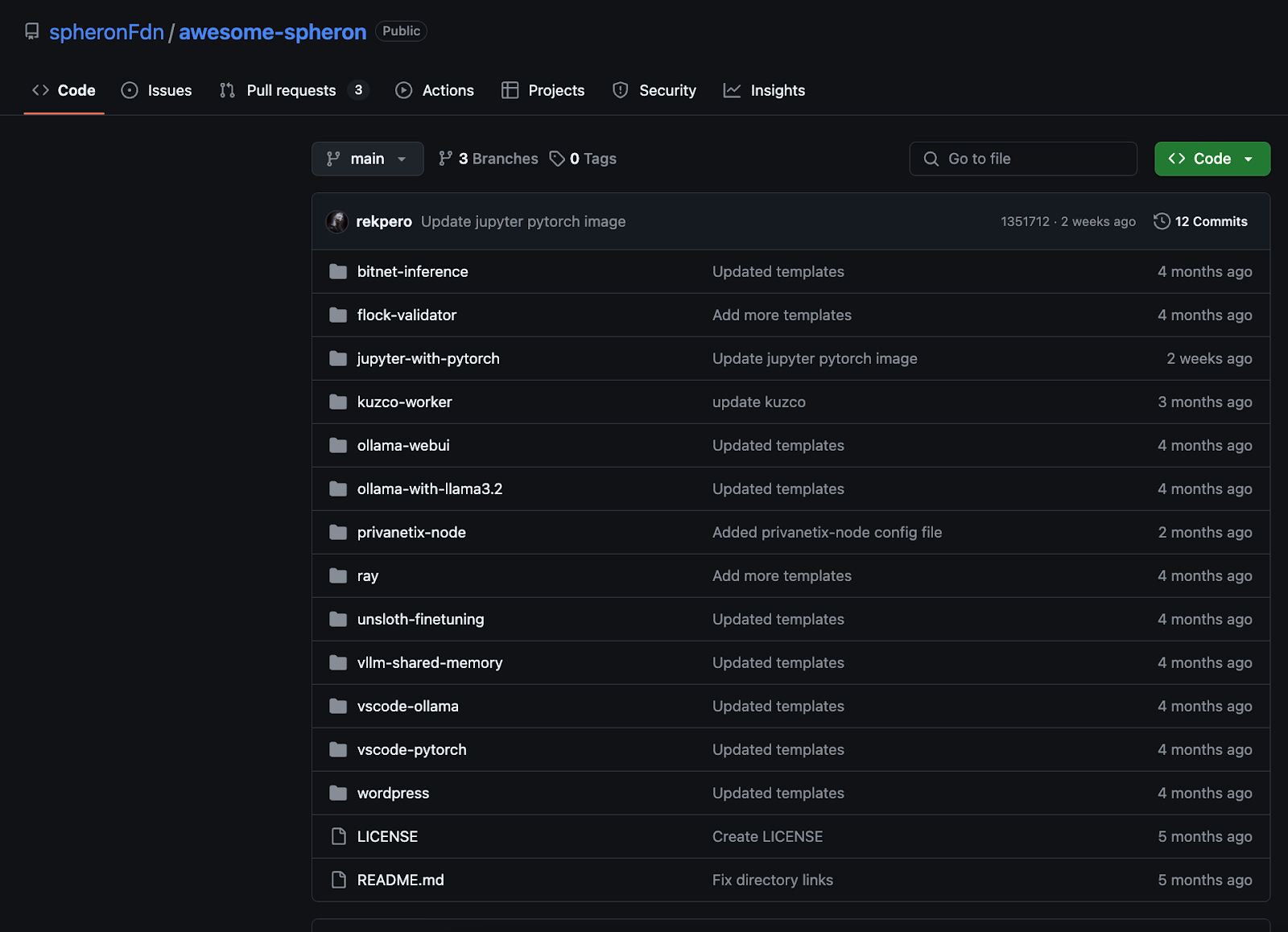
Want to test it out? Just go to the Spheron Awesome repo and https://github.com/spheronFdn/awesome-spheron, which has a collection of ready-to-deploy GPU templates for Spheron.
10. The Aggregator Advantage

Spheron operates as an aggregator, pooling resources from multiple providers. This approach enables users to:

Compare GPU types, memory sizes, and performance tiers in real time.

Choose from multiple competing providers, ensuring fair pricing.

Benefit from dynamic pricing, where providers with idle resources lower their rates to attract users.

This competitive marketplace model prevents price monopolization and provides cost-effective computing options that traditional cloud platforms lack.

Conclusion

As you can see, whether you choose on-premise infrastructure or rely on big cloud services, both options come with significant drawbacks. On-premise solutions require massive upfront investments, ongoing maintenance, and scalability challenges, while big cloud providers impose high costs, vendor lock-in, and unpredictable pricing models.

That’s why Spheron Network is the ideal solution. By leveraging decentralized compute, Spheron provides a cost-effective, scalable, and censorship-resistant alternative. With transparent pricing, high availability, and seamless deployment, Spheron empowers developers, businesses, and AI projects to operate with greater autonomy and efficiency. Choose Spheron and take control of your infrastructure today.



Source link

Heartbreakers Guitarist Has a Clear Conscience Over Tom Petty’s Death

    0
    Heartbreakers Guitarist Has a Clear Conscience Over Tom Petty’s Death


    Heartbreakers guitarist Mike Campbell insisted his “conscience is clear” over his bandleader Tom Petty‘s 2017 death from an accidental drug overdose.

    “I don’t torture myself [over Petty’s death],” Campbell, 75, told Guitar Player in an interview published on Tuesday, March 11.

    Petty’s death at age 66 sent shockwaves through the rock community, especially after a coroner’s report determined that a mix of opioids — including fentanyl and oxycodone — in his system contributed to a fatal “mixed drug toxicity.” The rock legend had gone through periods of drug use throughout his life, but famously got clean in 1999 when his future wife, Dana York, convinced him to go to rehab.

    Campbell explained in his new interview that while he recognized Petty was no longer sober near the end of his life, he felt it was impossible to get through to his longtime bandmate.

    Related: Toto Star Recalls How Cocaine ‘Overtook’ Los Angeles

    Legendary Toto guitarist Steve Lukather is looking back on how cocaine took hold of the Los Angeles rock music scene in the 1970s. “It was unbelievable how [cocaine] overtook the city,” Lukather told The Telegraph in an interview published Friday, January 31. “I didn’t even realize what was going on. I didn’t realize why there […]

    “With Tom it was like, ‘Your private life is yours, and mine is mine. I can see what you’re doing, but out of respect for you, I’ll trust you’ll do the right thing. If you need me, call me,’” he recalled. “I could have gone to him and said, ‘Hey, you’ve got to cut this s— out,’ which I kind of did once to the manager. But the thing with Tom was, you could say that and he would just look at you like, ‘But I’m Tom Petty. I’m going to do whatever I f—ing want. Get out of my face.’”

    Campbell suggested that “the sides of [Petty’s] personality” always made it challenging to get close to the musician he worked with for more than 40 years.

    Heartbreakers Guitarist Mike Campbell Says His Conscience is Clear over Tom Petty s Fatal Drug Overdose 198
    Harmony Gerber/Getty Images

    “He was intimidating, but there was love there. I think one reason we stayed together is because we kept our private lives separate. We didn’t socialize that much off tour,” he insisted.

    The last time the pair worked together was only a week before Petty’s death, when they concluded their 40th Anniversary Tour at the Hollywood Bowl in September 2017.

    When Campbell was pressed on why he didn’t “get in [Petty’s] face” about his noticeable decline, the musician replied: “I don’t torture myself. My conscious is clear because Tom knew that I knew, and Tom knew that I wasn’t forcing him and getting in his face about it.”

    The guitarist added that there was “an invisible understanding” between himself and Petty about their personal lives.

    “I didn’t have to confront him, for him to know how I felt about it,” Campbell said. “Like I said, there was no second thoughts or reservations about going out on tour. In fact, the last conversation I had with Tom about it, I said, ‘Are you sure you want to do this? Are you up to it?’ He said, ‘I’m not staying home. I’m going out. I want to do it. If I have to be in a wheelchair, I’m going to do it.’ I said, ‘OK, then what?’ He said, ‘Well, when the tour’s over, I’m going to go get my [hip] surgery. We’ll write some more songs, make another record.’ That was the plan.”

    Fleetwood Mac's Ups and Downs Through the Years - 782

    Related: Fleetwood Mac’s Ups and Downs Over the Years: Affairs, Lineup Swaps, More

    The stuff of legend. Fleetwood Mac’s history of breakups, affairs and lineup changes is so famous that their name is now synonymous with rock ‘n’ roll drama. Founded in 1967 by Peter Green, Jeremy Spencer and Mick Fleetwood, the group initially started as a blues band before pivoting to a rock-forward sound in the early […]

    Campbell continued: “It was kind of business as usual. I know that Tony [Dimitriades], our manager, spoke to him and gave him options like, ‘We can postpone this. You can get your surgery now.’ Tom said, ‘I need to be out there. I want to play with the band, and we’re going to do it. I’ll be OK.’ So I have no second thoughts about it. I don’t beat myself up like that. I miss them — same with [Howie Epstein, the Heartbreakers’ bassist, who died at 47 in 2003] — but I did all I could.”

    Since Petty’s death in 2017, Campbell and Crowded House’s Neil Finn have joined Fleetwood Mac as replacements for Lindsey Buckingham following the latter guitarist’s acrimonious departure from the group. Campbell has written a memoir about his career with Petty called Heartbreaker, out on Tuesday, March 18.


    Source link

    How NFTs Have Changed the Football World | NFT News Today

    How NFTs Have Changed the Football World | NFT News Today


    Non-Fungible Tokens (NFTs) have started to make an impact on all different industries – and the sports world – football, in particular, is no exception. These digital assets have added something extra to the experience, and introduced new ways for clubs, players, and fans to be a part of the sport – and, along with it, football betting. From digital collectables to creating tokenised experiences, NFTs are completely changing the way we are experiencing, making money from and even betting on the sport.

    NFTs in Football – A Whole New Era

    If you’re unfamiliar with what NFTs are and what they do, they are essentially unique digital assets that are stored on blockchain technology – which ensures ownership authenticity and scarcity. Basically, they are online assets that can’t be copied and that can’t be stolen. If you own one, it’s recorded on the blockchain and, if you sell it, the ownership will then be transferred. They can also be worth a pretty penny!

    In football, they’re now starting to be embraced by clubs and leagues – and even by players who are looking to make money and keep their fans engaged and involved.

    Digital Collectibles and Trading Cards

    One of the most popular ways that NFTs are used in football is as digital collectables. In the old days, fans used to collect and swap cards and stickers – and these days, like everything else, it’s all done online through NFTs. 

    There are platforms such as Sorare and Topps that have even started to introduce blockchain-based trading cards that feature top footballers from top leagues. Like real-world collectables, fans can buy, sell, and trade these digital cards – but with provable authenticity and rarity.

    Engaging Fans With Exclusive Content 

    NFTs also mean that clubs can now offer their top supporters the most exclusive and exciting experiences. Top teams such as Paris Saint-Germain and Manchester City have launched their NFT-based memberships – where holders will have special access to special, behind-the-scenes content, they can take advantage of virtual meet-and-greets with players, and even get amazing VIP matchday experiences.

    Tokenised Match Tickets

    Although not widely done yet, some clubs have even started to explore the idea of using NFTs as a more secure alternative to traditional paper or email match tickets. Having NFT-based ticket will help to ensure its authenticity, reduce potential fraud, and fans will even get to keep it as a cool digital souvenir.

    Football Betting and NFTs: A New Frontier

    NFTs have also started to be integrated with the world of football betting  – adding a whole new dimension to the whole experience:

    Play-to-Earn Fantasy Football Betting

    Sites like Sorare let you create your own fantasy football teams using NFT player cards. These teams, like regular fantasy football leagues, compete based on how the real-life players perform – and if you’re one of the more successful managers, you can earn rewards in things like cryptocurrency or new NFT cards. This has completely changed the whole traditional fantasy football experience into a much more investment-based experience.

    NFT Betting Markets

    Some sports betting sites are even starting to experiment with NFT-based wagers. Instead of placing a traditional bet with fiat currency, you can bet NFTs. What’s more, your winning bets might even be rewarded with rare and expensive NFTs, which you can then trade or sell for a profit.

    Tokenized Prize Pools

    Some betting operators are also incorporating NFTs into their prize pools. So, when you make winning Champions League bets or Premier League bets for example, instead of getting a regular cash payout, you could end up with things like valuable football NFTs, digital jerseys, or even an exclusive experience like a virtual meet-and-greet with your favourite football players.

    The Future of NFTs in Football

    Although there are still a lot of people who aren’t yet on board (or even familiar) with the world of NFTs just yet, they’re definitely here to stay in the football world. So, whether you’re a fan who wants to actually own a piece of footballing history or you’re a bettor looking to add even more of a digital experience to your bets, there’s no doubt that NFTs have opened up a whole new era for the beautiful game.


    Source link

    One Of The Best Steam Sales In Years Is Happening Right Now

    0
    One Of The Best Steam Sales In Years Is Happening Right Now


    Screenshot: Valve / Kotaku

    Right now some of the best games available on Steam, including Undertale, Doom (2016), and Spiritfarer are all on sale for incredibly cheap prices. Combine that with Steam’s annual Spring Sale and you have a recipe for some fantastic discounts.

    There’s always some kind of deal or sale happening on Valve popular PC gaming storefront, and many of these sales are pretty good. But then, every so often, we get a sale that contains such great deals and big discounts that I drop everything to buy a bunch of games and tell others to do the same. And the new “Deep Discount” section in the Spring Sale is one of those kinds of sales.

    The Spring Sale started today and ends March 20. There are a ton of games on sale as part of it. But Valve has created a special, smaller list of games that are discounted more than usual and all of them are being sold for just a few dollars.

    Here’s the full list:

    Doom (2016) – $2 ($20) Undertale – $1 ($10)Battlefield 1 – $2 ($40)The Elder Scrolls Online – $2 ($20) Pathfinder: Wrath of the Righetous – Enhanced Ed. – $4 ($40) Heavy Rain – $2 ($20) Spiritfarer: Farewell Edition – $3 ($30) Call to Arms – Gates of Hell: Ostfront – $3.50 ($35)Anno 1800 – $6 ($60)Enter the Gungeon – $1.50 ($15) The Walking Dead: The Telltale Definitive Series – $5 ($50)Conan Exiles – $4 ($40)

    You can buy all of these games for less than $40. That’s wild! Anno 1800 is normally $60 by itself. BF1 is regularly $40. And right now you can get both of them and plenty of other awesome games (..and Heavy Rain…) for under $40 total.

    Meanwhile, outside of these big discounts, plenty of other great games are on sale as part of the Spring Sale, including the Resident Evil 4 remake for $20, Assassin’s Creed Mirage for $20, Rainbow Six Siege for just $4 and Stardew Valley for $9.


    Source link

    Jessica Simpson Performs After 15-Year Hiatus, Delighting Fans

      0
      Jessica Simpson Performs After 15-Year Hiatus, Delighting Fans


      Reading Time: 2 minutes

      Jessica Simpson is making music again, and we are all so grateful.

      In addition to being a glaring example of how the turn-of-the-century entertainment industry treated young women, she’s a talent.

      Naturally, fans are overjoyed to hear Simpson sing after such a lengthy hiatus.

      There was one little hiccup along the way. Is she okay?

      Jessica Simpson on February 4, 2024.
      Jessica Simpson attends the Jam for Janie GRAMMY Awards Viewing Party presented by Live Nation at Hollywood Palladium on February 04, 2024. (Photo Credit: Araya Doheny/Getty Images for Janie’s Fund)

      After 15 years, Jessica Simpson is performing again!

      Jessica Simpson swooped in to perform at the Recording Academy’s Austin Chapter Block Party at South By Southwest, the film and music festival.

      Stepping onto the stage in Austin marked her first performance in 15 years.

      TMZ reports that Simpson spoke about how performing will help her to become reacquainted with who she is. Her goal is to “forget who they told” her to be. It sounds like they could be a lot of people.

      During Jessica Simpson’s performance, she blended classic hits as well as music from her upcoming album.

      “Breadcrumbs” was one of the songs. It will also feature on her Nashville Canyon Part 1 EP, which releases later in March.

      Simpson also delighted the crowd with her “These Boots Are Made For Walkin’” cover. You have to respect the classics.

      The Jessica Simpson classics, specifically, even if the song was a Nancy Sinatra original.

      Is Jessica Simpson okay?

      “Hey everybody, it’s Jessica Simpson. We just landed in Austin, and right now I’m going to wait in line at Enterprise. This is not an ad, but I’m getting a rental car,” she announced in an Instagram video.

      Obviously, most fans and followers were delighted.

      Some, however, asked if she was okay, with one commenter specifically asking: “What’s with the slurring?” regarding her speech.

      Follow-up comments joked — or perhaps merely half-joked — that perhaps Jessica Simpson had enjoyed a “cocktail” or two during her flight.

      We should emphasize that the singer has been sober for over 7 years.

      Just last summer, she quashed rumors that she was drinking again. Sometimes, words just don’t come out quite right. Especially after something as draining as a flight.

      Are her songs about her divorce?

      As we reported early this year, Jessica Simpson split from Eric Johnson following ten years of marriage. The breakup followed months of marital speculation.

      Simpson’s song, “Leave,” has lyrics such as “you made it tragic” and “giving her what you gave to me” that some believe contain a veiled accusation that Johnson cheated during their marriage.

      Only time will tell whether that interpretation is a bit of a leap or right on the money.


      Source link

      Senate Stablecoin Bill Passes Out of Committee With Strong Bi-Partisan Support – Decrypt

      0
      Senate Stablecoin Bill Passes Out of Committee With Strong Bi-Partisan Support – Decrypt


      The U.S. Senate Banking Committee voted in favor of advancing the stablecoin-focused GENIUS Act to a full Senate vote Thursday, with the legislation receiving bipartisan support. 

      The bill passed through committee by a vote of 18-6, with five Senate Democrats joining Republicans to push the bill over the finish line with considerable breathing room. 

      Democrats who voted for the GENIUS Act’s passage include bill cosponsor Angela Alsobrooks (D-MD), as well as Senate Banking Committee members Mark Warner (D-VA), Andy Kim (D-NJ), Lisa Blunt Rochester (D-DE), and Ruben Gallego (D-AZ). 

      The bill’s sponsor, Bill Hagerty (R-TN), said he intends for the bill to receive a full vote on the Senate floor by the end of April. 

      “The Banking Committee’s strong bipartisan passage of the GENIUS Act out of committee brings us one step closer to providing stablecoin issuers with the choice between state and national charters and will secure our nation’s competitive edge in the rapidly evolving digital asset space,” Sen. Cynthia Lummis (R-WY), another cosponsor of the bill, said in a statement shared with Decrypt. 

      During Thursday’s meeting of the Senate Banking Committee, longtime crypto critic Elizabeth Warren (D-MA) attempted to add multiple new provisions to the GENIUS Act, which creates a legal framework for nonbank stablecoin issuers to participate in the U.S. economy. 

      Warren proposed amendments to the bill that would have blacklisted any stablecoin issuers whose tokens were found to have been used in connection with state enemies and illegal activity, including drug trafficking and the purchase of child pornography. Another would have expanded the provisions of the Act to apply to crypto exchanges and other third parties that interact with stablecoins.

      All her amendments were voted down, mostly along party lines.

      “Who are we trying to protect, the child pornographers and Iran and North Korea?” Warren said at one point, in apparent exasperation, after her third amendment was voted down. 

      “Nobody’s looking to shut this down, no one’s looking to stop innovation,” the progressive senator said at a later point during the meeting. “But we do want to try to make this a little cleaner than it is right now.”

      The bill proceeded shortly after to a vote, which it passed handily.

      A new version of the GENIUS Act was released earlier this week in anticipation of today’s markup. While it has been generally supported by industry leaders, some crypto users pushed back on a new provision that would require stablecoin issuers to have the ability to “seize, freeze, burn, or prevent the transfer” of tokens if obligated to comply with legal orders.

      Edited by James Rubin

      Daily Debrief Newsletter

      Start every day with the top news stories right now, plus original features, a podcast, videos and more.


      Source link

      Why James Haskell’s outing with new girlfriend Sara McLean will “sting” for ex-wife Chloe Madeley

        0
        Why James Haskell’s outing with new girlfriend Sara McLean will “sting” for ex-wife Chloe Madeley


        James Haskell stepped out with his new Big Brother star girlfriend Sara McLean earlier this week, with the pair enjoying a day at the races.

        However, they happened to be spotted holding hands at the very same races James attended with ex-wife Chloe Madeley on a loved-up day out ahead of their split.

        James and Chloe announced their split in October 2023. But, in the spring of 2022, they were pictured kissing and cuddling at the Cheltenham Festival. Fast forward a couple of years and James and Sara are at Cheltenham lookined loved up.

        Now, one expert has exclusively told ED! that the tactile display, in a place James and Chloe enjoyed happier times, “could sting a bit” for his ex…

        James Haskell appears to have a new girlfriend and they went public earlier this week (Credit: Splash News)

        James Haskell debuts new girlfriend at Cheltenham

        Human behaviour expert and psychologist Jessen James told ED! that, although enough time has passed for Chloe to “process the breakup“, she may have been caught “off guard” over James’ decision to showcase his new romance at the races.

        “Enough time has likely passed for Chloe Madeley to have processed the breakup. So she may be emotionally settled. However, from a psychological perspective, the choice to debut a new relationship so publicly could still catch her off guard. Or it could bring back some lingering feelings. Even if she’s mostly moved on,” said Jessen.

        He then added: “Public displays of moving on can, in many people, activate social comparison. So this might be playing on her mind.”

        Sara McLean standing in the sun in a black dress

        Sara McLean was pictured holding hands with James Haskell this week at Cheltenham (Credit: Splash News)

        ‘It could sting a bit’

        So will it be a kick in the teeth that James has done it at Cheltenham – a place where they enjoyed loved-up days out?

        “It could sting a bit, since going to a place where they had happy memories together might bring some old feelings back,” Jessen said.

        As a single man he is free to date who he wants.

        “Psychologically, shared places can hold emotional attachment. Especially when an ex is making new memories and potentially overriding those memories with you.

        “It can make that person feel a loss and unsettled feeling in their mind. Even if Chloe is over it,” he then added.

        “Humans are very attached to memories and this could be playing with her mind – especially as the first public date is at one of their old spots.”

        James Haskell and Chloe Madeley smiling at Cheltenham

        James and ex-wife Chloe Madeley enjoyed a day at the same racecourse back in 2022 (Credit: Splash News)

        James’ reputation could take a battering

        Jessen pointed out that James is a single man and “free to date who he wants”. However, while it may be seen as high self-confidence to some, there is a “flip side” when it comes to the impact dating numerous women soon after his split could have on his reputation.

        Earlier this year he was linked to Chloe-lookalike Helen Barclay.

        “There are two positions here,” Jessen said. “As a single man, he is free to date who he wants and some might see it as being confident in yourself. But on the flip side, some may see it as immature if he continues to date lots of women and seems to like the attention it brings.

        “But here is the thing,” he then added, “from a deeper psychological standpoint, people may perceive this behaviour as a way of avoiding deeper emotional work or trying to mask his vulnerability. And this could affect how other people view him in the long run.”

        Issuing a warning to James, Jessen added: “At the end of the day, it might be better for him to keep his love life out of the spotlight. Sharing too much could bring unwanted attention and make it harder for him to move on or build a real connection with his new partner.

        “Keeping things private gives him space to heal and avoids people speculating,” he then added. However, he concluded: “But ultimately, he is in charge of his owns decisions. He has walked that road before so he should know what he is doing in that respect.”

        ED! readers wade in on James Haskell and girlfriend Sara’s PDA

        However, while many ED! readers believe James is allowed to be happy, others think it’s a bit of a “low blow” going public with new girlfriend Sara at Cheltenham. After all, it was a place where James and ex-wife Chloe shared happier times.

        In our exclusive poll, 60% of respondents told us: “He’s entitled to move on. But it’s a bit of a low blow doing it at a place they enjoyed visiting as a couple.”

        Why did James Haskell and Chloe Madeley split?

        James Haskell and Chloe Madeley – daughter of TV legends Richard Madeley and Judy Finnigan – announced their split in October 2023.

        The one-time couple, who married in 2018, share daughter Bodhi, who was born in 2022. The trio are still very much a family unit, with Chloe and James appearing to enjoy a cordial relationship despite their breakup.

        Why did James Haskell and Chloe Madeley split?

        The pair shared the news of their breakup in a social media statement.

        James said: “It’s with a lot of sadness I write this post, but unfortunately, in the world we live in, it has to be done. My priority is my daughter’s and Chloe’s happiness and security. For that reason, I won’t be commenting any further.”

        Chloe added: “James and I mutually decided separate at the end of September, 2023. We had not planned on releasing a statement at this time but constant speculation about our marriage has, unfortunately, forced our hand.

        “Beyond this statement, we will not be speaking about this matter publicly, and we would request privacy at this time. Our sole focus now is our beautiful daughter. We shall continue to co-parent with nothing but love.”

        ‘Real reason’

        When the dust settled, both spoke further about the end of their relationship.

        James said: “My thing is, we split up because we didn’t get on any more, and that’s it, that’s the end of it. The honest answer is we didn’t get on and that’s why we separated.”

        ‘Really unhappy’

        Chloe also addressed the split on a podcast.

        She said: “I’m one of those people who need structure and routine. My ex, and I, I think, one of the reasons things became so hard for us is that he thrives in chaos. His schedule, I don’t even remember the last time he was in England for a full week, he’s all over the place. And I just can’t do that. Can’t live like that. But now I’m trying to figure out how I can get my social life back and stuff so that’s a process as well.

        “I think I knew that I was really unhappy, and I think he knew that he was really unhappy too. But I don’t think either of us ever would have predicted that we were going to break up. Ever. And I swear to God, it was just like one day, we were, I remember exactly where we were. I remember the day, the time, the temperature, the outfits, where we were, everything. I just remember saying I don’t think that we should do this anymore but really meaning it and it kind of went from there.”

        Read more: James Haskell shut down ‘sex marathon’ claims ahead of split from Chloe Madeley

        YouTube video player

        So what do you think about James moving on so publically? Tell us on our Facebook page @EntertainmentDailyFix.


        Source link

        EXCLUSIVE | Darwin Del Fabro: Finding Freedom in Art, Facing Fear with Courage

          0
          EXCLUSIVE | Darwin Del Fabro: Finding Freedom in Art, Facing Fear with Courage


          In an industry still grappling with representation, trans artists face a constant battle against erasure and misrepresentation. Beyond the screen, they confront systemic barriers to healthcare, legal recognition, and basic human dignity. Yet, amidst these challenges, voices like Darwin Del Fabro’s rise, shattering expectations and paving new paths. Del Fabro, a Brazilian actress, writer, and singer, embodies resilience and authenticity. From her early start in theater to her breakthrough role in “They/Them,” she navigates the complexities of identity and artistry with unwavering grace.

          Del Fabro has achieved a lot of success in her career. However, it would be a travesty if we don’t talk about the challenges she faced and how she reached this point. Her journey is a testament to the power of authenticity and resilience. From her passionate advocacy for Brazilian cinema to her deeply personal transition, Del Fabro embodies courage. Her dedication to her craft, coupled with her commitment to fostering empathy and understanding, makes her an inspiring figure. I had the honor of talking with Del Fabro on how her artistic expression intertwines with her profound self-discovery. In this interview, we also discuss the transformative power of acting, the nuances of creative control in different mediums, and her experiences with transitioning.

          Photo Courtesy: Instagran/@darwindelfabro)

          Here’s the full interview: 

          Aayush Sharma: Your journey as an artist is also a journey of self-discovery. How has acting helped you peel back the layers of who you are beyond societal expectations?

          Darwin Del Fabro: Art is everything to me—it has shaped my identity and the way I navigate the world. My journey with art began when I was just three years old, singing, and from that moment on, I knew I never wanted to be confined to just one form of expression. Whether it’s singing, acting, or writing, art has always been my way of connecting with the world on a deeper level. More than just a passion, art has made me the person I am today. It has instilled in me a profound sense of empathy, allowing me to understand the lives and emotions of others in ways that words alone cannot express. Through art, I continuously grow into the kindest and most compassionate version of myself. It teaches me to see beyond my own experiences, to embrace different perspectives, and to create from a place of authenticity and understanding. Ultimately, art is not just a part of my life—it is the foundation of who I am.

          Aayush Sharma: Many actors speak about the transformative nature of rehearsal. Do you find freedom in the exploration of a character, and does that sense of discovery mirror your own self-evolution?

          Darwin Del Fabro: It depends. I started my artistic journey in theater, and I absolutely love it. On stage, there’s a unique sense of freedom—an immediate connection with the audience that allows for spontaneity and deep emotional expression. I have always been actively involved in producing my own work, especially smaller projects in Brazil, which has given me even more creative control over my performances. When you’re on stage, you have that freedom to shape each moment as it unfolds. The same can be true when performing in a show, particularly if you’re also a producer. However, cinema operates differently. Film is a medium where the final product is ultimately shaped by the editor and director. Unlike theater, where performances evolve in real time, cinema relies on the vision and decisions made in post-production. That being said, if you have a strong collaborative relationship with the director and editor, magical things can happen. The creative process in film may be different, but it still offers incredible opportunities for artistic expression. Ultimately, it all depends on the moment and the artists you work with.

          Aayush Sharma: Has acting always been your passion, something you knew you wanted to pursue from the beginning, or is it a passion that developed over the years?

          Darwin Del Fabro: I think my passion for the arts grew with me. My father started as a model before becoming an actor, and I was raised by my stepmother, who built a successful international career as a model before transitioning into acting and eventually hosting a TV show in Brazil. At first, I resisted following in their footsteps, but at the age of three, I won my first singing competition. That moment made me realize, Okay, I’m going to be a singer. However, I also loved acting, and my passion for musicals only deepened that love. Musicals led me to theater, and theater expanded my appreciation for plays. Growing up, I was constantly exposed to Hollywood shows and productions, which further fueled my artistic aspirations. I always knew that creativity was a part of me—I just didn’t know at the time how to channel it or which direction to take. In the end, I pursued all of them. Even now, I’m still exploring and evolving, which, to me, is the true beauty of artistry: the continuous journey of discovery.

          Darwin Del Fabro

          Photo Courtesy: Instagram/@darwindelfabro

          Aayush Sharma: Brazil recently experienced a proud moment when I’m Still Here was nominated for an Oscar, and Fernanda Torres received a nomination as well. I noticed on your Instagram that you were passionately advocating for the film and her performance. First, I’d love to hear your reaction when you found out about the nomination. Additionally, given that the film’s story is deeply connected to Brazilian culture and your own background, what emotions did you feel while watching it on screen?

          Darwin Del Fabro: Oh, it’s a combination of so many things. First of all, her (Fernanda Torres) Oscar nomination felt like a World Cup victory—just like how a leader is celebrated, or how the carnival brings people together. Since we are currently in the middle of carnival season in Rio, everyone is celebrating this achievement with immense pride. She is only the second Brazilian actress to ever be nominated for an Oscar, and the first was her own mother. The film was directed by Walter Salles, who previously directed Central Station about 20 years ago. He also directed I’m Still Here, which stars her daughter, making this an incredibly significant and emotional moment in Brazilian cinema. Beyond the personal and national pride, the film itself is magical. It portrays an important period in Brazil’s history, specifically the dictatorship era from 1965 to 1983 (if my dates are correct). While the story follows the journey of a woman, it is also about artistry, history, and the things we either have or have lost as a society.

          For me, this film is a powerful lesson on the importance of human rights and freedom—something that Brazil lacked during that era and something that many countries around the world still struggle with today. It serves as a reminder that self-expression and liberty must be fought for and celebrated. Cinema has the power to do that, and this film achieves it brilliantly. It is in Portuguese, which makes the nomination even more groundbreaking. Having an actress speaking Portuguese and being recognized in the main acting category, alongside the film’s nomination, is a monumental moment. She also won a Golden Globe for her performance, and I was really hoping she would win the Oscar as well. But regardless of the outcome, she is already a winner—someone who will be remembered for the rest of her life.

          Aayush Sharma: You’ve spoken publicly about your transition, a deeply personal and transformative journey. What emotions did you go through as you prepared to share this part of yourself with the world? Was there a specific moment or realization that made you feel ready to open up about your story, and what impact do you hope it will have on others who may be on a similar path?

          Darwin Del Fabro: As you said, it’s a very private conversation. I have always been a private person, largely because of my writing. Writing has always been my escape—I loved immersing myself in it, locking myself away with my computer, and keeping things to myself. The same was true with singing and acting; I closed myself off, rarely sharing personal aspects of my life. My name is Darwin, and I truly believe in the power of evolution—the freedom to grow, to evolve, and to become the best version of ourselves. I knew that for my transition, I needed financial stability. I had clear goals in life and was always very organized. I knew I wanted to move to America at 18. I knew I wanted to own a home before turning 30. And I knew that once I achieved that stability, I wanted to fully embrace my true self.

          However, to do that, I had to take a step back for two years to go through the necessary medical processes. I chose to do it privately because, unfortunately, both in Brazil and in America, the healthcare system—while better in the U.S.—is still complicated. We’re seeing now, especially with shifting politics, how easily things can change. I didn’t want to keep waiting for a system to grant me permission to be who I am. That’s how everything started, and it’s still very recent. I’m now recovering from my surgeries and slowly returning to writing, acting, and singing. With all that said, I can confidently tell you that I have never been happier or stronger. I am grateful to have the freedom to be myself, and that is the most important thing.

          Darwin Del Fabro

          Aayush Sharma: Your story is about more than just career success—it’s about self-discovery and freedom. Were there any personal or professional risks you had to take to fully embrace and express your identity?

          Darwin Del Fabro: There’s always a risk in everything. Beyond being a trans woman and a woman, I am also Brazilian—I am a foreigner in this country, and I always have been. But I take pride in that. I am proud of my roots, and as an artist, I believe I have something valuable to offer to the world I am living in now. Yes, there are always challenges. Even in Brazil, when I was working as an actress, singer, or producer, I faced obstacles. The industry there is both wild and beautiful, but also very complicated. It’s no different here. However, I think the key—the hope that I carry with me—is something I discovered later in life: being happy and proud of myself and my journey has enriched my artistry in ways I never imagined. No matter the difficulties, I can confidently say that I am living a great life.

          Aayush Sharma: Your words capture the deep fear and resilience that come with existing in a world where powerful figures actively deny and erase identities. When you saw the applause for Trump’s statement and recalled Bolsonaro’s rhetoric, what was the immediate emotional and psychological impact on you? How do you personally navigate the exhaustion of constantly having to assert your existence in the face of such rhetoric?

          Darwin Del Fabro: I think having the support of friends, family, and a strong community is essential. Building your tribe—surrounding yourself with people who remind you of your worth—makes all the difference. The reaction to my transition was, at times, terrible. But honestly, I don’t like to dwell on it. It’s just people denying who you are, and I find it exhausting to give any more attention to that kind of negativity. What matters is that I am here, I am happy, and I have never been stronger. That’s why I’m slowly opening up more about these deeply personal aspects of my life—like my transition—because I hope it fosters greater empathy and understanding.

          At the end of the day, it’s about simply being present—having a seat at the table. I don’t feel the need to talk about it endlessly; what’s more important is that people see and acknowledge trans individuals in their everyday lives. Whether it’s a friend knowing a trans person or just being aware, that visibility matters. Growing up, I didn’t have many trans friends—in fact, I didn’t have many friends at all. I was very closed off, dealing with my own struggles, and working excessively from a young age. My life revolved around theater school, TV shows, and an endless cycle of work. Time just passed by in that whirlwind.

          Aayush Sharma: Your first full-length role in movies came in “They/Them” which released in 2022. That was a huge moment for the LGBTQ+ community and Trans community. Then you had big names such as Kevin Bacon and Anna Chlumsky in the movie. How was the experience while working on the movie, and what kind of conversations did you have with Bacon and Chlumsky?

          Darwin Del Fabro: I hold that movie so close to my heart. It all started with my connection to John Logan, who wrote and directed it. Before this, I had created a play in Brazil about the diaries of Lili Elbe, which were published in 1933. I wanted to adapt the play for an American audience, so I reached out to John to work on an adaptation. That’s how I first met him. We began developing the project, but then the pandemic hit. It feels like so long ago now, but at the time, everything came to a halt. We couldn’t perform the play in theaters, and the project fell apart. Then, John wrote a character specifically for me in this movie. It was an incredible, surreal moment—what a strange yet beautiful way to start my career in America.

          The film, They/Them, means so much to me because it centers around queerness. Everyone in the crew was queer, and we had a non-binary protagonist leading the story. There was so much love on set, and since we were filming in the middle of the pandemic, we truly felt like a family. Kevin was amazing—he jumped into the project instantly. That’s why he’s such a remarkable actor. He’s always willing to take on different roles and explore new genres, which makes him the artist that he is. Anna has that same spirit, and I absolutely love her. Meeting her was such a joy. She speaks Portuguese, and on the first day we met, she just started speaking to me in Portuguese. I was completely caught off guard and thought, “Wait, what? How do you know this?” Turns out, she had lived in Brazil for a while. It was a magical experience, and I will carry those friendships with me forever.

          They/Them

          Photo Courtesy: Peacock

          Aayush Sharma: Apart from acting, writing has been your biggest passion. You are writing a play, and then you keep on writing article pieces as well. Was writing always your first love, or was it something that you developed with time?

          Darwin Del Fabro: Writing wasn’t always something I considered seriously, though I always enjoyed it. When I graduated, I earned a degree in literature—specifically Portuguese literature. I didn’t go to school for acting because I had already been acting and singing since I was 12. In Brazil, my studies included some English, but I intentionally chose to focus on my country’s literature. I wanted to understand Brazil’s roots, especially since my ultimate goal was always to move to America. It was the same with music—I love Samba because it helped me discover the essence of Brazilian culture. Yet, at the same time, I was preparing for a career in America by immersing myself in its artistic landscape. Writing truly became a defining part of my journey when I met John Logan. He is my mentor, the person who told me, “Darwin, you are a writer, and you need to put your words out there.” That moment changed everything.

          Now, I’ve written a play—a continuation of the original play that first connected me with Joan. This time, it’s a monologue, deeply personal, where I explore the intersection of Lili Elbe’s story and my own. I also wrote a horror movie because I’m a huge fan of the genre. And recently, I’ve been writing articles as well. Magazines have been reaching out, asking me to contribute, which has been an exciting new avenue for my writing. They have been reaching out me to have a little more understanding of one’s perspective. This is just one person’s perspective on this journey—every journey is different. But if I can share my story and people resonate with it, then why not put it out there? Of course, it comes with a lot of exposure, but given the state of the country I’m in and the rights that are being denied, I refuse to be silenced. I will not stay quiet. I will write, I will speak, and that is my goal.

          Aayush Sharma: Your journey as an artist has been unique. Do you feel that your identity, background, or artistic approach has influenced your craft in ways that distinguish you from others?

          Darwin Del Fabro: I don’t know—it’s such a difficult thing because it’s my perspective, right? I’m just living as authentically as I can, constructing my own path after being shaped by culture and family, then growing up and discovering my own journey. I’ve never seen it as trying to be unique; I’m simply following my instincts and pursuing what moves me. Of course, my background plays a role—I was born in Brazil, raised in a culture different from others, and I’ve traveled the world enough to experience a variety of perspectives. But at the end of the day, it’s just me. I’m not trying to be something; I’m becoming something. Whether that’s seen as unique or not is up to others to judge. This is just who I am. I’m not sure if that answers your question.


          Source link

          David Soul Net Worth | MarkMeets Media

            0
            David Soul Net Worth | MarkMeets Media


            David Soul Net Worth: Unveiling the Financial Legacy of a TV Icon

            David Soul, renowned for his portrayal of Sergeant Kenneth ‘Hutch’ Hutchinson in the 1970s hit television series “Starsky & Hutch,” left behind a lasting legacy not only in the entertainment world but also in terms of his financial worth. Let’s delve into the intriguing journey of David Soul’s net worth, shedding light on his illustrious career, personal life, and the impact he made in the entertainment industry.

            Early Life and Education: The Making of an Icon

            David Soul, born David Solberg on August 28, 1943, in Chicago, Illinois, emerged from humble beginnings to captivate audiences worldwide. Raised in a family deeply rooted in education and service, with his father, Richard, serving as a Lutheran minister and professor, Soul’s upbringing instilled in him values of resilience and determination. Despite frequent relocations during his youth due to his father’s work, Soul found his footing in academics and performance arts.

            The Rise to Stardom: A Journey Through Theater and Television

            Soul’s journey to stardom began on the stage, where he honed his craft as a versatile actor and captivating performer. His early years saw him treading the boards in various productions, including notable plays like “Baal” and “Serjeant Musgrave’s Dance.” However, it was his foray into television that catapulted him into the spotlight.

            Making waves with his masked performance on “The Merv Griffin Show” in 1966, Soul’s talent and charisma soon caught the attention of audiences across the nation. His breakthrough role as Joshua Bolt in the ABC comedy Western series “Here Come the Brides” marked the beginning of a remarkable career trajectory. From there, Soul’s star continued to rise, with memorable appearances in popular shows like “All in the Family,” “The F.B.I.,” and “Star Trek.”

            Starsky & Hutch: The Pinnacle of Success

            It was Soul’s role as Sergeant Kenneth ‘Hutch’ Hutchinson in “Starsky & Hutch” that solidified his status as a television icon. Alongside co-star Paul Michael Glaser, Soul brought depth and authenticity to his character, captivating audiences with his dynamic performance. The show’s immense popularity propelled Soul into the realm of superstardom, garnering him widespread acclaim and recognition.

            Beyond the Screen: Exploring Soul’s Versatility

            While “Starsky & Hutch” may have been Soul’s claim to fame, his talents extended far beyond the small screen. Venturing into the world of music, Soul achieved chart-topping success with hits like “Don’t Give Up on Us” and “Silver Lady,” solidifying his status as a multifaceted entertainer. Additionally, his notable film roles in productions such as “Johnny Got His Gun” and “Magnum Force” showcased his versatility as an actor, earning him further accolades and admiration.

            Personal Life: Navigating Success and Struggles

            Despite his professional achievements, Soul’s personal life was marked by ups and downs. His multiple marriages and struggles with alcoholism and anger management shed light on the complexities of fame and fortune. However, amidst the challenges, Soul found solace in his fifth and final marriage to Helen Snell, a testament to his enduring spirit and resilience.

            Read Next: Matt Smith Inteview

            The Legacy Lives On

            As we reflect on the life and legacy of David Soul, it’s evident that his impact transcends mere fame and fortune. From his groundbreaking performances on screen to his chart-topping musical endeavors, Soul’s contributions to the entertainment industry are nothing short of extraordinary. Though he may no longer be with us, his legacy continues to inspire and captivate audiences, ensuring that his memory will endure for generations to come.

            What happened to David Soul?

            David Soul passed away on January 4, 2023, at the age of 80. His death marked the end of an era for fans of his work in television, film, and music. Despite his passing, Soul’s legacy continues to live on through his timeless performances and contributions to the entertainment industry.

            Are Paul Michael Glaser and David Soul still friends?

            While there’s no definitive answer to this question, it’s widely believed that Paul Michael Glaser and David Soul maintained a strong friendship throughout the years following their collaboration on “Starsky & Hutch.” Despite the passage of time and the challenges that often come with maintaining relationships in the spotlight, Glaser and Soul’s bond is thought to have endured, serving as a testament to the camaraderie forged during their time on the iconic television series.

            Why did David Soul stop singing?

            David Soul’s decision to step back from his music career can be attributed to a variety of factors, including a shift in focus towards other aspects of his artistic endeavors. While Soul achieved notable success as a singer with chart-topping hits like “Don’t Give Up on Us” and “Silver Lady,” he may have chosen to prioritize his work in acting and other creative pursuits in the later years of his career. Additionally, personal factors and changing industry dynamics may have influenced Soul’s decision to scale back his involvement in the music industry.

            Is David Soul still married?

            At the time of his passing, David Soul was married to his fifth wife, Helen Snell. Their marriage, which began in 2010, endured until Soul’s death in 2023. Despite facing challenges and setbacks in his personal life, including multiple divorces and struggles with alcoholism, Soul found love and companionship in his later years with Snell, underscoring the enduring nature of their relationship. While Soul may no longer be with us, his marriage to Helen Snell remains a poignant reminder of the enduring power of love and connection.

            “Don’t Give Up on Us” Lyrics

            (Verse 1) In the silence of the night, when darkness fills the air, I reach out for your touch, but you’re no longer there. Memories linger on, of love that used to be, But I won’t give up hope, ’cause you still mean everything to me.

            (Chorus) Darling, don’t give up on us, we can make it through. Though the road is rough, our love will see us through. Hold on tight, don’t let go, we’ll find our way somehow, Just believe in us, baby, and don’t give up on us now.

            (Verse 2) Through the storms we’ve weathered, and the tears we’ve shed, We’ve faced our share of trials, but we’ve never lost our thread. With every breath I take, your name is on my lips, I won’t stop fighting for us, ’cause our love will never slip.

            (Chorus) Darling, don’t give up on us, we can make it through. Though the road is rough, our love will see us through. Hold on tight, don’t let go, we’ll find our way somehow, Just believe in us, baby, and don’t give up on us now.

            (Bridge) I know it’s not easy, when doubts cloud our minds, But together we’re stronger, with our hearts intertwined. So let’s face the challenges, and chase away the fears, ‘Cause with you by my side, there’s nothing we can’t steer.

            (Chorus) Darling, don’t give up on us, we can make it through. Though the road is rough, our love will see us through. Hold on tight, don’t let go, we’ll find our way somehow, Just believe in us, baby, and don’t give up on us now.

            (Outro) So take my hand, my love, and let’s face the world anew, With faith in our hearts, there’s nothing we can’t do. Together forever, in love’s eternal trust, So please, my darling, don’t give up on us.

            David Soul Net Worth: A Testament to Success

            At the time of his passing on January 4, 2023, David Soul’s net worth stood at an estimated $1 million, a testament to his enduring legacy and lasting impact on the world of entertainment. While the numbers may quantify his financial worth, Soul’s true riches lie in the hearts of those who continue to be inspired by his talent, passion, and unwavering dedication to his craft. As we celebrate his life and achievements, let us remember David Soul not only for his net worth but for the invaluable contributions he made to the world of entertainment and beyond.

            Through his captivating performances, chart-topping hits, and enduring legacy, David Soul will forever be remembered as a true icon of the silver screen and a shining example of what it means to leave a lasting impact on the world.

            Author Profile

            Stevie Flavio
            Film Writer

            Email https://markmeets.com/contact-form/


            Source link

            AurealOne and DexBoss: Pioneering the Future of Crypto and Gaming

            0
            AurealOne and DexBoss: Pioneering the Future of Crypto and Gaming


            As the space of cryptocurrencies evolves rapidly, pre-sales have risen to become the suitable means by which new projects can gather funds and create a community before a release. However, what project do I start with among all of the upcoming projects? Therefore, crypto pre-sales come into play!

            The Crypto Pre-sales allow the investors to purchase the tokens at discounted rates and before they become available to the rest. That gives early adopters a perfect chance to invest early, in what could actually be the next big cryptocurrency. 

            Currently, the hottest projects among those are AurealOne and DexBoss, which are already destined to change the gaming and decentralized finance (DeFi) spaces.

            AurealOne: A Blockchain for Gaming and the Metaverse

            Overview

            AurealOne is a new, cutting-edge blockchain network intended for the gaming and metaverse environments. The idea is to meet the needs of both developers and gamers by providing lightning-fast speed of transactions with no or very low gas fees. The platform’s native cryptocurrency, DLUME, is used for transactions and is used as in-game currency for a range of projects on the platform.

             Click here to visit standout crypto presale – AurealOne

            AurealOne: A Blockchain for Gaming and the Metaverse

            Key Features

            Scalability and Efficiency: Due to the use of technology such as Zero-Knowledge Rollups, AurealOne provides advanced technology so that they may facilitate lightning-fast transactions, which is necessary for gaming interactions.Reward and Governance: DLUME holders can stake their tokens and earn rewards while leading the governance for ecosystem development.ICO Structure: The presale is in 21 rounds, starting at a price of $0.0005 in Round 1 and scaling up in increments until Round 21, when it reaches a price of $0.0045. In total $50 million is to be raised through the ICO.Clash of Tiles is the first game developed for AurealOne, and the game is part of Primary Project, a project that demonstrates the platform’s capabilities so that they can be utilized in a practical use case to attract more development. The coin balances are easily checked on the website by users for clarity and community support. User security is a great feature offered by the platform, with access to support channels in case of issue resolution.

            Tokenomics

            – Initial Allocation: Wide-scale distribution is enabled for the sake of earning long-term investment in staking and rewards mechanisms to be paid out.

            – Presale Rounds: The first 20 rounds get 1 billion tokens, while the last round gets 500 million tokens. The price point of the round is carefully structured to incent early investment.

            DexBoss: Simplifying DeFi for All

            Overview

            DexBoss is a decentralized finance (DeFi) that offers to bridge the traditional and blockchain worlds. Its aim is to make DeFi as simple as possible by introducing new users to the product and to enhance liquidity for traders.

            Key Features

            Feel simple: DexBoss is designed for the inexperienced and experienced alike, making DeFi trading simple. The platform focuses on solving liquidity problems in DeFi by deploying deep liquidity pools, as well as new financial products like margin trading, liquidity farming, staking, and so on.Instant Order Execution: DexBoss gives near-instant order execution, such that you don’t miss trading opportunities that happen whilst you wait for orders to execute.$DEBO Token Lifecycle: $DEBO is the native DeBO token and has a total supply of 1 billion. The presale rounds of $0.01 and going up to $0.0505 in the last round will be used to raise $50 million.Token Buyback and Burn: The platform has token buyback and burn mechanics (decreasing supply and increasing value in the long term,) creating a healthy community willing to work on the platform to increase value.

            Tokenomics

            – Distributions: 50% of the total supply is reserved for presale and is also to be spent on team incentives, liquidity pools, and marketing.

            – A portion of transaction fees is used for buybacks, which benefit long-term token holders.

            Synergies and Future Outlook

            AurealOne and DexBoss follow two of the most popular trends among cryptocurrencies and blockchain projects that address user experience, community governance, and engagement with tokens being native.

            In both platforms, the role of community and user governance gives birth to a cooperative environment where users have a real say in the development and decision-making process of the platform.

            Long-Term Vision

            AurealOne: This indicates the expansion into other gaming projects (like Clash of Tiles). This also creates a comprehensive ecosystem that would survive and thrive in the metaverse.

            DexBoss: DexBoss roadmap till 2025 includes launching the token and advanced trading features. DexBoss is also about to become a good DeFi contender to look at, as it promises to bring in new users with its full range of features.

            Wrapping Up

            AurealOne and DexBoss are exemplary prototypic agents of the leading spirit of digital finance, giving perfect vision to that scope. They are obviously community-driven platforms as well as ones that aim at offering solutions in a very advanced technological manner, which contributes to the landscape by miners invited to the limitless possibilities of blockchain technology in the gaming and financial fields. This kind of project might become the next major crypto to break through the $1 level. Both of them can keep up with the already established crypto projects, one of which is XRP Ripple.

            However, it is essential to conduct proper research before investing in any crypto, as the cryptosphere is volatile and contains much risk. 


            Source link

            Popular Posts

            My Favorites

            Liam Payne told “the dark storms have passed” in touching new...

            0
            Liam Payne weathered “dark storms” before his death, a new tribute from the woman widely regarded as his ‘fairy godmother’ by 1D fans...

            Piyo Puzz Switch Review