It’s not often we get new racing games for the Commodore Vic-20, but searching through the itch io website earlier today, we’ve found out that Huffelduff has released the Commodore Vic-20 game of ‘Formula V20 1985’. A new game in that the developer says is a nod to classic Commodore 64 games such as Pitstop II and Pole position.. In light of this news as ever we’ve got some new footage of this arcade racer which can be found below.
And here’s the latest from the itch io page. “Formula V20 ’85 is a racing computer game for the 24k expanded Commodore Vic-20. It has been crafted in the style of the classic Commodore 64 games Pitstop II and Pole position. Pick from seven different racing teams and four different circuits. Join a single race or compete in the world championship”.
Requirements, loading and running the game:
A Commodore VIC with 24k RAM expansion minimumA joystick plugged into the joystick portInsert Disk and type: load “*”,8,1 and then press return. After loading type: run and press returnInsert Tape and type: load and then press return. After loading type: run and press return
UPDATE : If you enjoyed playing Formula V20 1985 on your VIC-20 +24k you may be interested to know, that as of today you can also download the latest release of Formula V20 1981 by Huffelduff. As in the words of the creator “Formula V20 ’81 is a racing computer game for the 16k expanded Commodore Vic-20. It’s the prequel to Formula V20 ’85. There are eight tracks, and the main goal is to beat the clock. Traverse each track while avoiding the competitor racing cars. There are tunnels where visibility is limited and sections where ice and sleet cover the track, which causes the player to skid wildly. Oh yes, remember to catch the clocks for time extensions. Anyway, good luck!”
Requirements, Loading, and Running the Game:
A Commodore VIC with a minimum of 16 KB RAM expansionA joystick plugged into the joystick port
Comic Lee Mack previously revealed that he had to be careful writing sex scenes into his hit series Not Going Out for fear of getting into trouble with his real-life wife Tara.
The comedian – who previously gave a stark warning about the future of sitcoms – told Dermot O’Leary’s The Nightly Show back in 2017 about a rule he sticks to when writing the show.
However, it appears the rule may have landed the TV favourite in hot water with his better half…
The BBC renewed Not Going Out for its 14th series last year (Credit: The Nightly Show/YouTube)
Lee Mack on Not Going Out’s ‘number one rule’
The star revealed that everything that takes place on the show has to have happened in real life. This means, if it hasn’t happened to one of the writers in real life, it can’t go into the show.
“The number one rule is it has to have happened,” he told Dermot. “The problem is that can cause friction at home when you’re doing a scene involving an act in bed.
You might be sitting at home watching it with your wife, and she’s saying: ‘I cannot believe that you’re talking about this. On screen.’
“And your wife’s going: ‘No, you can’t do that.’ And you might be sitting at home watching it with your wife, and she’s saying: ‘I cannot believe that you’re talking about this. On screen.’”
But Lee explained that he and his co-writers have a plan for this very situation. They simply pass that particular narrative development off as having been inspired by one of the other writers.
“The awful thing,” Lee added wryly, “would be to give that away on a nightly chat show,” before staring wide-eyed at the camera.
The comic shares three kids with wife Tara (Credit: The Nightly Show/YouTube)
Lee Mack’s romance with wife Tara
Lee – on screen with Would I Lie To You? tonight (March 15) – married wife Tara in 2005. They are believed to have met in 1996, when Southport-born Lee was at university in London.
The couple share three kids together – Arlo, Louie and Millie – with Lee becoming a dad for the first time at 36. Arlo has also previously appeared in his dad’s sitcom Not Going Out.
And, although they remain largely private about their personal life, Lee has admitted that some of their friends think they’re a little mismatched.
Lee met Tara when he was at uni (Credit: Splash News)
The topic of Tara came up during an episode of Would I Lie To You? when comic Roisin Conaty made a guest appearance. Lee went on to joke his wife is so attractive that Roisin’s sister apparently found it hard to believe they became item before he became famous.
During the course of the show, as Lee mentioned he once introduced Roisin’s sister to Tara, Roisin noted: “[She] is ridiculously beautiful.”
Lee resumed his telly anecdote: “And I said: ‘This is Tara,’ and she went: ‘Oh did you meet after he was a well-known comedian?’ And she went: ‘No, before.’ Which is true, we met before I ever did comedy. And she went to Tara: ‘Oh, did he save your life or something?’”
Would I Lie To You? is on tonight (March 15) at 8pm on BBC One.
Read more: Everything we know about the 1% Club Celebrity Special – air date, celebs taking part and host Lee Mack’s ‘worries’
Do you enjoy watching The 1% Club? Then tell us on our Facebook page @EntertainmentDailyFix.
Not all AIs are created equal. Some might do art the best, some are skilled at coding, and others have the ability to predict protein structures accurately.
But when you’re looking for something more fundamental—just “someone” to talk to—the best AI companions may not be the ones that know it all, but the ones that have that je ne sais quoi that make you feel OK just by talking, similar to how your best friend might not be a genius but somehow always knows exactly what to say.
AI companions are slowly becoming more popular among tech enthusiasts, so it is important for users wanting the highest quality experience or companies wanting to master this aspect of creating the illusion of authentic engagement to consider these differences.
We were curious to find out which platform provided the best AI experience when someone simply feels like having a chat. Interestingly enough, the best models for this are not really the ones from the big AI companies—they’re just too busy building models that excel at benchmarks.
It turns out that friendship and empathy are a whole different beast.
Comparing Sesame, Hume AI, ChatGPT, and Google Gemini. Which is more human?
This analysis pits four leading AI companions against each other—Sesame, Hume AI, ChatGPT, and Google Gemini—to determine which creates the most human-like conversation experience.
The evaluation focused on conversation quality, distinct personality development, interaction design, and also considers other human-type features such as authenticity, emotional intelligence, and the subtle imperfections that make dialogue feel more genuine.
You can watch all of our conversations by clicking on these links or checking our Github Repository:
Here is how each AI performed.
Conversation Quality: The Human Touch vs. AI Awkwardness
Sesame AI interface
The true test of any AI companion is whether it can fool you into forgetting you’re talking to a machine. Our analysis tried to evaluate which AI was the best at making users want to just keep talking by providing interesting feedback, rapport, and overall great experience.
Sesame: Brilliant
Sesame blows the competition away with dialogue that feels shockingly human. It casually drops phrases like “that’s a doozy” and “shooting the breeze” while seamlessly switching between thoughtful reflections and punchy comebacks.
“You’re asking big questions huh and honestly I don’t have all the answers,” Sesame responded when pressed about consciousness—complete with natural hesitations that mimic real-time thinking. The occasional overuse of “you know” is its only noticeable flaw, which ironically makes it feel even more authentic.
Sesame’s real edge? Conversations flow naturally without those awkward, formulaic transitions that scream “I’m an AI!”
Score: 9/10
Hume AI: Empathetic but Formulaic
Hume AI successfully maintains conversational flow while acknowledging your thoughts with warmth. However it feels like talking to someone who’s disinterested and not really that into you. Its replies were a lot shorter than Sesame—they were relevant but not really interesting if you wanted to push the conversation forward.
Its weakness shows in repetitive patterns. The bot consistently opens with “you’ve really got me thinking” or “that’s a fascinating topic”—creating a sense that you’re getting templated responses rather than organic conversation.
It’s better than the chatbots from the bigger AI companies at maintaining natural dialogue, but repeatedly reminds you it’s an “empathic AI,” breaking the illusion that you’re chatting with a person.
Score: 7/10
ChatGPT: The Professor Who Never Stops Lecturing
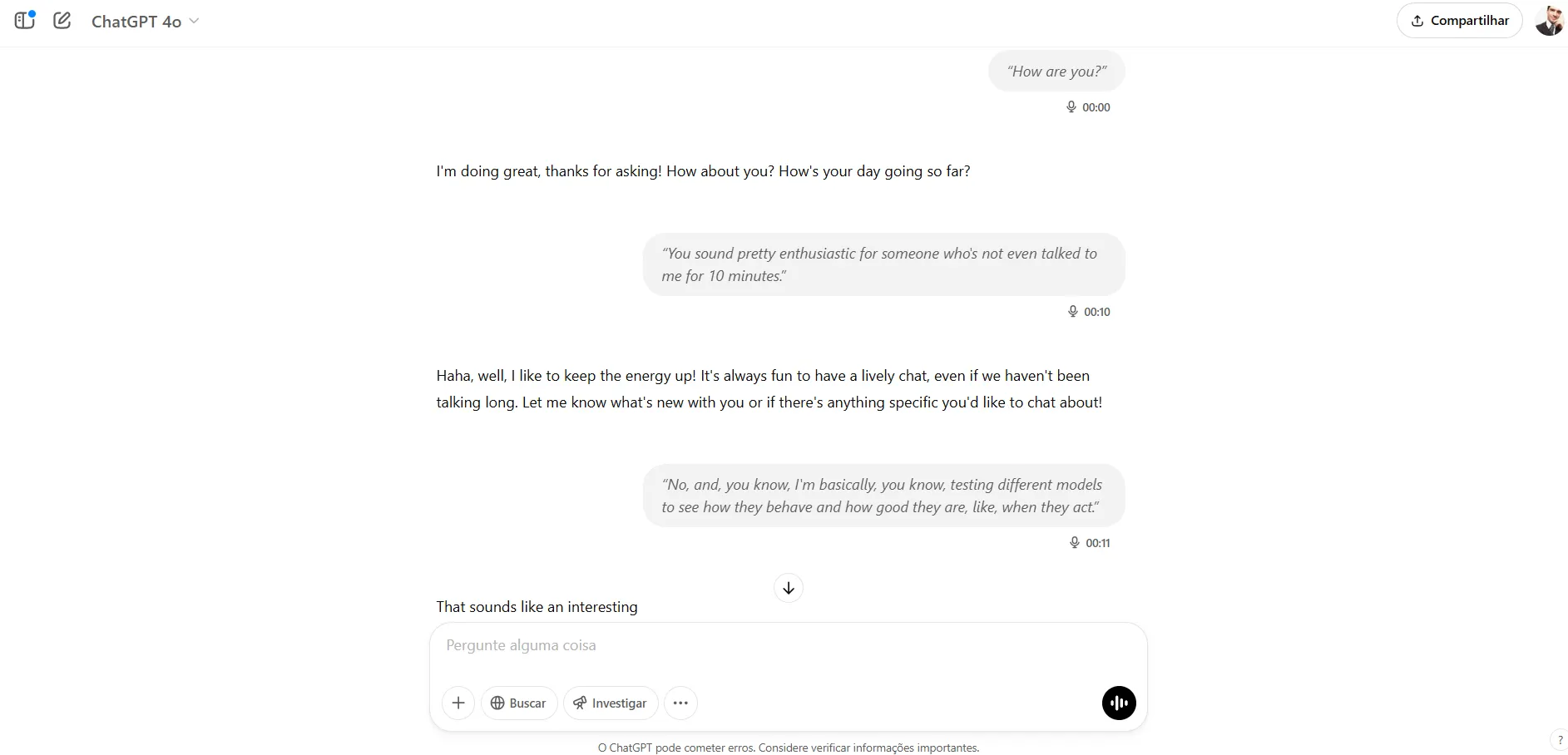
ChatGPT tracks complex conversations without losing the thread—and it’s great that it memorizes previous conversations, essentially creating a “profile” of every user—but it feels like you’re trapped in office hours with an overly formal professor.
Even during personal discussions, it can’t help but sound academic: “the interplay of biology, chemistry, and consciousness creates a depth that AI’s pattern recognition can’t replicate,” it said in one of our tests. Nearly every response begins with “that’s a fascinating perspective”—a verbal tic that quickly becomes noticeable, and a common problem that all the other AIs except Sesame showed.
ChatGPT’s biggest flaw is its inability to break from educator mode, making conversations feel like sequential mini-lectures rather than natural dialogue.
Score 6/10
Google Gemini: Underwhelming
Gemini was painful to talk to. It occasionally delivers a concise, casual response that sounds human, but then immediately undermines itself with jarring conversation breaks and lowering its volume.
Its most frustrating habit? Abruptly cutting off mid-thought to promote AI topics. These continuous disruptions create such a broken conversation flow that it’s impossible to forget you’re talking to a machine that’s more interested in self-promotion than actual dialogue.
For example, when asked about emotions, Gemini responded: “It’s great that you’re interested in AI. There are so many amazing things happ—” before inexplicably stopping.
It also made sure to let you know it is an AI, so there’s a big gap between the user and the chatbot from the first interaction that is hard to ignore.
Score 5/10
Personality: Character Depth Separates the Authentic from the Artificial
ChatGPT Interface after a voice interaction
How does an AI develop a memorable personality? It will mostly depend on your setup. Some models let you use system instructions, others adapt their personality based on your previous interactions. Ideally, you can frame the conversation before starting it, giving the model a persona, traits, a conversational style, and background.
To be fair in our comparison, we tested our models without any previous setup—meaning our conversation started with a hello and went straight to the point. Here is how our models behaved naturally
Sesame: The Friend You Never Knew Was Code
Sesame crafts a personality you’d actually want to grab coffee with. It drops phrases like “that’s a Humdinger of a question” and “it’s a tight rope walk” that create a distinct character with apparent viewpoints and perspective.
When discussing AI relationships, Sesame showed actual personality: “wow… imagine a world where everyone’s head is down plugged into their personalized AI and we forget how to connect face to face.” This kind of perspective feels less like an algorithm and more like a thinking entity. It’s also funny (it once told us that our question blew its circuits), and its voice has a natural inflection that makes it easy to relate to when trying to portray a response. You can clearly tell when it is excited, contemplative, sad or even frustrated
Its only weakness? Occasionally leaning too hard into its “thoughtful buddy” persona. That didn’t detract from its position as the most distinctive AI personality we tested.
Score 9/10
Hume AI: The Therapist Who Keeps Mentioning Their Credentials
Hume AI maintains a consistent personality as an emotionally intelligent companion. It also projects some warmth through affirming language and emotional support, so users looking for that will be pleased.
Its Achilles heel is basically the fact that, kind of like the Harvard grad who needs to mention that, Hume can’t stop reminding you it’s artificial: “As an empathetic AI I don’t experience emotions myself but I’m designed to understand and respond to human emotions.” These moments break the illusion that makes companions compelling.
If talking to GPT is like talking to a professor, talking to Hume feels like talking to a therapist. It listens to you and creates rapport, but it makes sure to remind you that it is actually its task and not something that happens naturally.
Despite this flaw, Hume AI projects a clearer character than either ChatGPT or Gemini—even if it feels more constructed than spontaneous.
Score 7/10
ChatGPT: The Professor Without Personal Opinions
ChatGPT struggles to develop any distinctive character traits beyond general helpfulness. It sounds overly excited to the point of being obviously fake—like a “friend” who always smiles at you but is secretly fantasizing about throwing you in front of a bus.
“Haha, well, I like to keep the energy up. It makes conversations more fun and engaging plus it’s always great to chat with you,” it said after we asked in a very serious and unamused tone why it was acting so enthusiastically.
Its identity issues appear in responses that shift between identifying with humans and distancing itself as an AI. Its academic tone in responses persists even during personal discussions, creating a personality that feels like a walking encyclopedia rather than a companion.
The model’s default to educational explanations creates an impression more of a tool than a character, leaving users with little emotional connection.
Score 6/10
Google Gemini: Multiple Personality Disorder
Gemini suffers from the most severe personality problems of all models tested. Within single conversations, it shifts dramatically between thoughtful responses and promotional language without warning.
It is not really an AI design to have a compelling personality. “My purpose is to provide information and complete tasks and I do not have the ability to form romantic relationships,” it said when asked about its thoughts on people developing feelings towards AIs.
This inconsistency makes Gemini feel like a 1950s movie robot, preventing any meaningful connection or even making it pleasant to spend time talking to it.
Score 3/10
Interaction Design
Hume AI interface
How an AI handles conversation mechanics—response timing, turn-taking, and error recovery—creates either seamless exchanges or frustrating interactions. Here is how these models stack up against each other
Sesame: Natural Conversation Flow Master
Sesame creates conversation rhythms that feel very, very human. It varies response length naturally based on context and handles philosophical uncertainty without defaulting to lecture mode.
“Sometimes I feel like maybe I just need to cut to the chase with a quick answer rather than a long-winded lecture, right? You know, so… that’s a small humorous aside to let you know that I’m aware of the potential of falling into a lecture mode and trying to keep things light but also deep at the same time,” Sesame told us during a philosophical debate.
When discussing complex topics, it responds conversationally, with a small joke, sometimes with statements, other times with human noises like “hmmms” or whispers—which makes it very convincing as a human substitute.
Sesame also asks natural follow-up questions that push conversations forward, while knowing when to switch to statements when questioning might feel awkward. This adaptive approach creates dialogue that feels spontaneous rather than scripted.
Score 8/10
Hume AI: Structured But Brief
Hume AI was designed to let users do the talking. It recovers smoothly from misunderstandings without over explaining and is good at keeping the conversation going with relevant follow up questions.
However, its responses are often so short that conversations require significant effort to maintain momentum, which ultimately defeats its purpose. Users frequently need to provide new conversation fodder rather than enjoying natural dialogue development.
Another weakness appears in its templated response structures—acknowledgment + explanation + question—creating a mechanical rhythm: “What a thought-provoking question! This Concept is indeed a fascinating idea… What do you think about…?”
However it has a great feature that may truly enhance your chats: It’s able to detect the levels of emotion in each response, which is something no other model can do. This is great to help you reflect on how much a topic affects you and how it’s approaching a specific situation
Score 7/10
ChatGPT: Good Chatter—But a Bit Unnatural
ChatGPT consistently addresses questions with relevant information but transforms conversations into unnecessarily elaborated interactions. Responses frequently balloon into paragraph-length explanations that disrupt natural dialogue flow.
For example, we asked it if it could develop some level of self awareness or consciousness, and this was its reply:
“That’s a fascinating topic! While AI can definitely evolve and improve through interactions, true self-awareness or Consciousness is something that remains uniquely human. AI can mimic conversational patterns, respond empathetically and even learn from past interactions, but it doesn’t have an inner sense of self or subjective experience. Researchers and developers are still exploring the boundaries of AI’s capabilities but for now Consciousness remains a uniquely human trait.”
That’s not how a human would interact.
Its heavy reliance on opener phrases like “that’s a really interesting question,” or “that’s a fascinating topic” before every single answer further undermines conversational immersion, creating an interaction pattern that feels mechanical rather than natural.
Score 6.5/10
Google Gemini: Conversation Breaking Machine
Gemini is a masterclass in how not to design conversation mechanics. It regularly cuts off mid-sentence, creating jarring breaks in dialogue flow. It tries to pick up additional noises, it interrupts you if you take too long to speak or think about your reply and occasionally it just decides to end the conversation without any reason.
Its compulsive need to tell you at every turn that your questions are “interesting” quickly transforms from flattering to irritating but seems to be a common thing among AI chatbots.
Score 3/10
Conclusion
After testing all these AIs, it’s easy to conclude that machines won’t be able to substitute a good friend in the short term. However, for that specific case in which an AI must simply excel at feeling human, there is a clear winner—and a clear loser.
Sesame (9/10)
Sesame dominates the field with natural dialogue that mirrors human speech patterns. Its casual vernacular (“that’s a doozy,” “shooting the breeze”) and varied sentence structures create authentic-feeling exchanges that balance philosophical depth with accessibility. The system excels at spontaneous-seeming responses, asking natural follow-up questions while knowing when to switch approaches for optimal conversation flow.
Hume AI (7/10)
Hume AI delivers specialized emotional tracking capabilities at the cost of conversational naturalness. While competently maintaining dialogue coherence, its responses tend toward brevity and follow predictable patterns that feel constructed rather than spontaneous.
Its visual emotion tracker is pretty interesting, probably good for self discovery even.
ChatGPT (5.6/10)
ChatGPT transforms conversations into lecture sessions with paragraph-length explanations that disrupt natural dialogue. Response delays create awkward pauses while formal language patterns reinforce an educational rather than companion experience. Its strengths in knowledge organization may appeal to users seeking information, but it still struggles to create authentic companionship.
Google Gemini (3.5/10)
Gemini was clearly not designed for this. The system routinely cuts off mid-sentence, abandons conversation threads, and is not able to provide human-linke responses. Its severe personality inconsistency and mechanical interaction patterns create an experience closer to a malfunctioning product than meaningful companionship.
It’s interesting that Gemini Live scored so low, considering Google’s Gemini-based NotebookLM is capable of generating extremely good and long podcasts about any kind of information, with AI hosts that sound incredibly human.
Generally Intelligent Newsletter
A weekly AI journey narrated by Gen, a generative AI model.
The following is a guest post from Shane Neagle, Editor In Chief from The Tokenist.
Since the introduction of altcoins, after Bitcoin paved the road for them, we have seen many projects give 10x gains in relatively short periods. It has also been accepted that the crypto space oscillates between altcoin and bitcoin seasons, suggesting more investing opportunities down the line.
A deluge of memecoins flooded the market as well, serving as a more robust gambling system (compared to online casinos). As crypto space lost $530 billion market cap over the last 30 days, it is prudent to examine its fundamentals once again.
Is such a concept as ‘altcoin season’ meaningful moving forward? Is there more to cryptos than cyclical speculation? To answer those questions, we must first remind ourselves of narratives past.
The Merge Foreshadowing
During the evolution of the crypto space, Bitcoin became de-facto the only proof-of-work digital asset worth considering, following Ethereum’s The Merge in September 2022. As a transition from proof-of-work (PoW) to proof-of-stake (PoS), The Merge represents a cleavage in blockchain philosophies.
While Bitcoin’s proof-of-work (PoW) requires computational resources, Ethereum’s PoS eliminates such barriers in order to boost transaction speed and efficiency. In other words, Bitcoin further differentiated itself as a store of value, while Ethereum focused more on cost-effective blockchain utility.
At first glance, this may seem perfectly complementary, but there are several underlying problems that eventually reared their heads.
PoW is more amenable to decentralization contrasted to PoS, which relies on the cumulative wealth of validators in the “rich get richer” feedback loop.PoS is divorced from hard assets, such as energy and machines, while Bitcoin is grounded in them.And because Bitcoin’s PoW is part physical, part digital, it is less reproducible than PoS as a commitment mechanism. In turn, this contributes to Bitcoin’s network effect and safeguards against devaluation in the long run.
Altogether, the PoW-PoS bifurcation translates into PoS fragmentation. If PoS-based assets, and PoS-based platforms competitive to Ethereum, are more reproducible, they can be launched with minimal upfront costs. With this foundation, there is no single altcoin asset to cling onto. Ultimately, with a low barrier of entry, this led to the fragmentation of the crypto market across +34,000 digital assets.
From the Bitcoin-Ethereum perspective, as the two largest digital assets by market cap, PoS-led fragmentation manifests as a corrosive effect on Ethereum price level.
Performance of Bitcoin (BTC) vs Ethereum (ETH) since The Merge on September 22, 2022. Image credit: Cryptoslate via TradingView
To put it differently, Bitcoin’s key features, PoW and scarcity, are reinforcing Bitcoin fundamentals. In contrast, Ethereum suffers from network effect erosion from competing PoS chains, which offer similar functionality and incentive structure.
Moreover, the increased complexity outside of Bitcoin is creating a barrier to entry from new capital inflows. Who can spend time filtering thousands of assets and bet that they will have staying power beyond one year? Even sophisticated investors leveraging popular futures trading algorithms often struggle to navigate the fragmented market effectively.
In fact, this is precisely why memecoin mania gained traction. The complexity and fragmentation of the crypto market lends itself to thinking of digital assets outside their fundamentals. Instead, focus is then on celebrity endorsements, humor, viral marketing, which often turns into pump-and-dump schemes.
Inevitably, this creates a negative feedback loop:
Crowded and confused altcoin market births memecoins.Rollercoasting memecoins inevitably erode trust in the altcoin market itself.Legitimate innovative projects are then less likely to gain traction, as capital is misallocated.
But there is an even greater problem than that. Let’s assume that this negative feedback loop created by memecoins doesn’t exist. One has to consider if there even is a market for blockchain based solutions, as it was previously imagined.
Erosion of Underlying Fundamentals
Through anti-money laundering (AML) and know-your-customer (KYC) requirements, governments around the world have expended great efforts to subdue the crypto ecosystem. Let’s quickly remind ourselves of key promises before regulative sweeps took place:
Decentralization as elimination of intermediaries – nearly everything is now intermediated through fiat rails, including transfers from self-custodial wallets.
Financial inclusion as access for the unbanked/underbanked – it is still more convenient to use legacy banking than blockchain tech, which is inherently complex and requires digital literacy. According to the latest EMarketer report, cryptocurrency payment penetration is hitting a wall.
Although the number of crypto payment users is expected to rise by 82.1% from 2024 to 2026, this is from a tiny overall population base of only 2.6%. It may very well end up being the case that a digital dollar, a stablecoin like USDT, will subsume this effort entirely in place of a direct CBDC.
Censorship resistance as a guarantee that transactions cannot be reversed or intercepted by governments and organizations. Governments regularly pursue innovative mechanisms to cancel such efforts, from debanking to the persecution of smart contract developers.
Although Treasury sanctions against Tornado Cash were overturned in January, there is little indication that financial privacy will become a human right any time soon. In fact, indicators point in the other direction.
🚨 BREAKING: The ECB’s Digital Euro is set to launch in October. Key concerns include:
– Real-time transaction tracking– Potential for payment blocking– Automatic tax deductions– Restrictions on cash withdrawals– Programmable money with expiration dates
They couldn’t… pic.twitter.com/UvQH750gbl
— Dr. Simon Goddek (@goddeketal) March 9, 2025
Altogether, this friction between blockchain-led solutions and governments leads to a contained market. And if a blockchain-based solution should be deployed, it will be under governments’ terms.
Lastly, the entire concept of Web3 is dubious as a decentralized, blockchain-based iteration of the internet. Elon Musk’s DOGE revelations in the case of USAID funding clearly point to great efforts to push narratives, control narratives, suppress and de-legitimize dissent.
A semantic, censorship-resistant Web3 is fundamentally at odds with governments’ needs to maintain authority and legitimacy as they push various agendas. To think that established information proliferation nodes such as Google, Microsoft and Facebook would be allowed to erode in favor of Web3 would be foolhardy.
Any government needs centralized nodes to maintain power. This was amply demonstrated in the case of the TikTok ban. Although this video reels app is vastly superior to YouTube shorts, a leverage was pulled to sanitize it and make it less relevant.
Again, this is another factor that contains the blockchain space to a micro-niche instead of propelling it into mainstream expansion. With this in mind, blockchain space is still worthy of engagement.
Crypto Projects with Revenue-Generating Staying Power
Bitcoin will likely remain the main focus of crypto investing, owing to its unique, PoW-based network effect. Although the recent White House Crypto Summit was less bullish than expected, it was still positive in the long run. The decision to use seized bitcoins effectively removed this sell pressure from the table.
Likewise, President Trump seems to be serious about ending the “war on crypto”. But looking at the crypto space from a purely innovative solutions perspective, which projects should retail investors consider during steep discounts?
Sonic (S) – previously FTM, this is the top performing layer 1 blockchain network with sub-second transaction finality. This alone opens up new use cases such as high-frequency trading (HFT), micropayments, in-game economy, DEXs and IoT supply chains.Near Protocol (NEAR) – a layer 1 launching pad for dApps that has gained traction for use in AI initiatives.The Graph (GRT) – also adjacent to the AI narrative, this protocol indexes data for AI use similar to how Chainlink (LINK) is used by DEXes to power decentralized financial services.Hey Anon (ANON) – this early project could be the key in solving DeFi complexity (barrier to entry) by using conversational AI to manage DeFi strategies across chains.Render (RENDER) – former RNDR – with AI generation of assets, it is likely this solution will gain demand by monetizing GPU-based distributed rendering.
These five tokens should be considered as long play exposure during crypto market deflation. After all, it is unlikely that AI narrative will subside any time soon.
In terms of top 10 revenue-generation chains during the market slump, crypto activity is clearly on the side of low-friction payment chains (Tron) and general purpose, high-performing chains (Solana, Avalanche). Ethereum still maintains high ranking due to its large market share within the DeFi ecosystem.
Image credit: DeFiLlama
In conclusion, what should crypto investors keep in mind moving forward?
Due to inherent friction with governments, digital assets are unlikely to ever penetrate mainstream to a significant extent. But within the contained ecosystem, investors should focus on long term narratives – AI, infrastructure and chain performance.
A truly decentralized Web3 should be understood as a niche play that will be countered by deep pockets of Alphabet (GOOGL), Microsoft (MSFT) and Meta (META), as centralized node extensions of the USG. By the same token, retail investors would do well to expose themselves to their stock options as safer bets.
In the gaming world, Marvel Rivals is a game that is steaming forward with fast paced hero combat and strategic teamplay. Immersion in the Marvel Universe with competitive shooting, shooting through destructible environments, players soaked in his/her favorite superhero and villains. It’s no surprise then that new updates, exciting features and hidden details keep the game interesting for fans of the franchise as the game continues to evolve.
New Updates and Features
There is fresh content coming to Marvel Rivals all the time to keep players entertained. Galacta’s Cosmic Adventure is the latest patch, which brings with it a limited time event where players can complete unique challenges for the exclusive Black Widow – Mrs. Barnes series costume. The event will run until April 11, 2025, so you have a lot of time to earn exclusive rewards.
It also includes a new Clone Rumble game mode in which teams can be made entirely of the same hero. The idea behind this mode is to expand the strategy of the players, in order to see how far they would push their favorite characters. During select weekends in March, Clone Rumble will be available, giving you a new flavor of battles.
In addition, developers have released a number of quality of life improvements such as Human Torch’s Lord Proficiency avatar reward improvements, voice chat improvements, and an improved player reporting system. These are meant to create a more balanced and sleek experience and will make playing Marvel Rivals even more enjoyable whether you’re a casual or a competitive player.
Interesting Facts About Marvel Rivals
Another interesting aspect of Marvel Rivals is that it has a procedural environment destruction which means that no two battles are alike. And if it’s Hulk smashing through walls or Thor zapping lightning all over the battlefield to alter the course of any match, then each game is that much more dynamic for it because it encourages the players to not play conservatively.
But did you know that Marvel Rivals is placed in an alternate universe and features a roster that is a mix of a few favorites heroes and villains? It provides unique team ups that would never be possible in the standard Marvel storylines. Have you ever thought what Doctor Doom and Iron Man would do fighting the same field? Anything is possible in Marvel Rivals.
The other interesting detail is the highly advanced AI powered matchmaking system. The system of the game learns player behaviors continuously, and the matchups are fair and balanced. This innovation does not only augment competitive integrity but also gums up team synergy through playing players in positions of playstyle.
How Boosting Services Enhance the Marvel Rivals Experience
With Marvel Rivals growing in popularity, many players have started looking for Marvel Rivals boost to help them stay ahead in the competitive ladder. In Marvel Rivals boost services are a perfect tool to improve gaming if you want higher rank, cool exclusive reward and perhaps just a bit better game with no hassles.
A Marvel Rivals carry service is the perfect solution for those who want to avoid the grind and enter right into high level matches. Customers can combine together with skilled players and ensure victories more often and be placed higher in the ranked play. Besides advancing players, Marvel Rivals booster also gives players in-game knowledge, such as advanced mechanics, hero matchups and optimal strategies.
Furthermore, some services offer gameplay analysis, live feedback and customized strategies to players who want a coaching oriented boosting experience. If you decide to buy marvel rivals boost, remember that it is important not only about ranks but also about skills, which enables players to reach their maximum potential and enjoy the game to the complete.
Continued innovation, engaging gameplay mechanics, and Marvel Rivals boosting that allow players to get the most out of their enjoyment are all helping the game to become a long term powerhouse in the competitive gaming scene.
Final Thoughts
Virtually every idea you see in Professional Marvel Rivals exists and is also one of the most ambitious hero shooters to date thanks to its celebrated Marvel characters and all new gameplay mechanics and destructible environment.
A marvel hero shooter as ambitious as it is incomprehensibly inventive, Marvel Rivals offers up some tremendous mechanics regarding destruction and heralds another excellent Dying Light game.
If you want to get the most out of your experience, Marvel Rivals carry offers a great way to unlock rewards, climb the ranks and hone your skills with the help of its Marvel Rivals carrying and Marvel Rivals boosting service. The fact is that with years to go, Marvel Rivals is here to stay and continues to get better with more updates coming in.
University of Fashion’s menswear drawing lessons taught by Professor Steven Broadway (FIT & Parsons). (Image credit: UniversityofFashion.com)
If you are a current fashion student preparing your menswear portfolio for the job market, or an aspiring designer getting your portfolio ready for a fashion college application, or a current fashion designer looking to update your existing portfolio, do we have the right lessons for YOU! Professor Steven Broadway has been teaching at Parsons and at Fashion Institute of Technology for more than 15 years. He has helped students create some of the most amazing portfolios that speak to today’s fashion industry. His men’s fashion figures are edgy and contemporary. There is no doubt that your portfolio will benefit from watching his lessons.
Ask any job recruiter in the fashion industry or any fashion college admissions director and they will say the same thing…your portfolio speaks volumes. A great portfolio will get you an interview, with a lackluster portfolio you will probably be passed over). And, what you include in your portfolio is much more than pretty pictures. Hear from our experts by viewing our Portfolio Tips for Fashion College Admissions lesson by Professor Lauren Zodel (FIT) and Creating a Professional Fashion Portfolio by Michi Raab (former Ralph Lauren recruiter). (Image credit: Universiutyoffashion.com)
Getting Started
If you are brand new to drawing the male fashion figure, we have several lessons that cover various male fashion poses, such as the Drawing the Male Contapposto Pose. In this lesson we teach you how to map the male figure with what is known in the industry as a 10-head proportion. You will learn body proportion, how to draw the ‘S’ curve of the body in motion and all about muscle placement.
University of Fashion’s lesson, Drawing the Male Contapposto Pose. by Fan Wu (former Parsons instructor). (Image credit UniversityofFashion.com)
Freddie Wong, a Chinese-American internet sensation, filmmaker, VFX artist, podcaster, and competitive gamer, has amassed a significant net worth through his diverse career ventures. Let’s delve into the details of his net worth and the various aspects of his illustrious career.
Freddie Wong’s Net Worth
Freddie Wong boasts a commendable net worth of $6 million, earned through his multifaceted career pursuits. As an influential figure in the online sphere, Wong has made substantial contributions to the entertainment industry, particularly through his innovative work on YouTube and beyond.
Early Life and Education
Born on September 13, 1985, in Seattle, Washington, Freddie Wong hails from a background of Cantonese Chinese and Mongol descent. He attended Lakeside School during his teenage years and later pursued his passion for filmmaking at the University of Southern California School of Cinematic Arts.
Internet Career
Wong’s rise to prominence began with the launch of his YouTube channel, freddiew, in 2006. Initially focused on gameplay footage, his channel gained traction, leading to his participation in the World Series of Video Games in 2007, where he clinched victory in the “Guitar Hero 2” competition. Over the years, Wong’s channel evolved to feature a diverse range of content, blending comedy and video game-related themes.
In collaboration with Matt Arnold and Desmond Dolly, Wong co-founded RocketJump Studios in 2011, marking the beginning of his foray into web series production. The critically acclaimed “Video Game High School,” created by Wong and his team, garnered widespread acclaim and ran for three successful seasons.
Read Next: Beverly Hills Cop 4 cast and plot
Film and Television Endeavors
Beyond his online ventures, Freddie Wong has made notable contributions to film and television. He co-produced the independent horror film “Bear” in 2010 and made guest appearances in popular shows such as “Chuck” and “Key & Peele.” Additionally, Wong ventured into podcasting, co-hosting the podcast “Story Break” and becoming a regular player on “Dungeons & Daddies.”
Podcasts
Wong’s involvement in podcasts has further solidified his status as a versatile content creator. His co-hosting of “Story Break” with Matt Arnold and Will Campos showcased his storytelling prowess, while his participation in “Dungeons & Daddies” highlighted his passion for role-playing games and narrative-driven content.
Freddie Wong FAQ
What is Freddie Wong known for?
Freddie Wong is renowned for his multifaceted career as a filmmaker, producer, actor, and prominent figure in the YouTube community. He gained fame through his innovative work on the YouTube channel “RocketJump,” where he showcased his talent for creating visually stunning and action-packed short films and videos.
Are Jimmy Wong and Freddie Wong related?
Yes, Jimmy Wong is Freddie Wong’s younger brother, and both are celebrated figures in the entertainment industry. While Freddie has made a name for himself as a filmmaker and content creator, Jimmy is also known for his work as an actor, musician, and content creator, contributing to various projects alongside his brother.
Are Ted Wong and Freddie Wong related?
There is no known relationship between Ted Wong and Freddie Wong. While they may share the same surname, there is no familial connection between the two individuals.
How tall is Freddie Wong?
Freddie Wong stands at approximately 5 feet 9 inches (175 cm) tall.
Conclusion
Freddie Wong’s net worth of $6 million is a testament to his entrepreneurial spirit, creative talent, and unwavering dedication to his craft. As he continues to explore new avenues in entertainment, Wong remains a prominent figure in the digital landscape, inspiring audiences worldwide with his innovative content and entrepreneurial ventures.
Kelly Stafford was over-the-moon that her husband, Matthew Stafford, signed a new contract with the Los Angeles Rams.
“Let’s go! [I’m so] excited. Thank goodness,” Kelly, 35, proclaimed on the Friday, March 14, episode of the “Give Them Lala” podcast. “That was, obviously, what I wanted all along and what my husband wanted all along. We didn’t want to leave. He loves the Rams, so we’re just pumped that, one, we’re here and, two, it’s over.”
NFL quarterback Matthew, 37, was traded to the Rams in 2021 and signed an updated contract earlier this month to return for the upcoming season.
“Oh, God, the relief I felt was pretty unreal,” Kelly recalled to podcast host Lala Kent. “You know, you just wake up every morning [and] there’s a new headline … of what rumor [or] what source is saying my husband’s going to be traded [or whether he’s] going to stay. I mean, every day it was something different.”
Related: Kelly Stafford Reacts to Matthew’s Return to Rams After Criticizing Team
Courtesy of Kelly Stafford/Instagram After plenty of speculation, Matthew Stafford is returning as quarterback of the Los Angeles Rams — which might lead to some awkwardness for his wife, Kelly Stafford. Matthew, 37, agreed to a restructured contract with the Rams on Friday, February 28, which came after the quarterback had taken meetings with the […]
She continued, “We have four girls and, I would say, if we didn’t have those four girls [then] maybe the stress would have been a little less and I would have been like, ‘OK, whatever,’ but having those little girls, you have to try to plan ahead.”
Kelly and Matthew, who have been married since April 2015, share four daughters: twins Sawyer and Chandler, both 7, Hunter, 6, and Tyler, 4.
“With this situation, you can’t really plan ahead,” Kelly noted. “This is what happens in the NFL a lot that people don’t understand, like, guys get traded randomly [or] guys get cut and these families are just having to pick up and move immediately, finding schools, finding activities for their kids, finding where to live and where to be that’s close to the facility but also in a good area.”
With Matthew and the Rams reaching a favorable one-year agreement, Kelly is “so happy and relieved” that their family can stay in the City of Angels.
Matthew Stafford and Kelly StaffordMichael Owens/Getty Images
“You get that news and, one, see how happy your husband is and then I’m like, ‘Let’s go get some cocktails [and] let’s celebrate,’” she quipped. “I am ready to let loose ‘cause holy hell.”
Thank You!
You have successfully subscribed.
Kelly has been Matthew’s biggest cheerleader since college — and still enjoys watching him on the gridiron.
Related: Kelly Stafford Was ‘Spiraling’ About Recent Matthew Stafford Trade Talk
Courtesy of Kelly Stafford/Instagram Even the wives of football superstars can’t help but feed into the NFL rumor mill. When word began circulating last month that Matthew Stafford was in talks to be traded from the Los Angeles Rams to the Minnesota Vikings, it came across his wife Kelly Stafford’s social media feed. “I open […]
“It’s pretty awesome. You watch him out there and he’s a different person on that football field than even I know,” Kelly said on Friday’s episode. “They show him in the huddle, and I’m, like, ‘Whoa, this is a turn-on. Super hot.’ Then, he comes home after a game or after being this manly man in the locker room and he comes home to these four little girls and he is so tender and so sweet to them. It really is incredible to watch.”
She concluded, “I love him as a football player, but him as a girl dad is the biggest turn-on of all, which is why he needs to get snipped.”
Russia is using Bitcoin, USDT, and other cryptocurrencies to trade oil with China and India to evade Western sanctions.
Russia leans on digital assets to trade oil internationally
According to Reuters, Russia has begun using cryptocurrency as a payment method in oil transactions with China and India. This move is seen as a way for Russia to evade Western economic sanctions, which have complicated international financial transactions using the USD or traditional payment systems.
Russia is using cryptocurrencies in its oil trade with China and India to skirt Western sanctions, according to four sources with direct knowledge of the matter https://t.co/F4MBSwHAKC
— Reuters (@Reuters) March 14, 2025
Specifically, some Russian oil firms are utilizing cryptocurrencies like Bitcoin BTC, Ethereum ETH, and stablecoins (like Tether – USDT USDT) to conduct transactions with these two countries. The process often involves intermediaries to convert between each payment method. For example, a Chinese oil importer might pay in yuan to an intermediary company, which then converts the amount into Bitcoin before transferring it to Russia, where it is converted into rubles. Similarly, with India, oil traders will also convert rupees through cryptocurrency to complete payments.
Although this accounts for only a small portion of Russia’s $192 billion total oil trade volume (according to the International Energy Agency), the use of cryptocurrency is increasingly expanding. This aligns with Russia’s policy allowing the use of digital currencies in international trade. A source advising the Kremlin also confirmed that cryptocurrency is one of the solutions to address payment issues under sanction pressures.
However, it should be noted that the scale and effectiveness of this method remain limited compared to Russia’s massive oil trade demands, and it depends on the willingness of partners like China and India to adopt cryptocurrency over traditional currencies.
Russia’s policies towards cryptocurrency
The stance of Russian authorities toward digital assets has shifted from caution to pragmatism and greater openness.
Initially, the Central Bank of Russia strongly opposed cryptocurrencies, proposing a ban due to concerns over money laundering and financial instability. However, since 2022, as Western sanctions tightened, Russia began viewing digital assets as a tool to bypass financial barriers, particularly in international trade, such as oil transactions with China and India.
Source: CNBC
By 2024, Russia passed a law legalizing cryptocurrency use in international commerce, reflecting support from the government, including President Putin. Domestically, however, Russia maintains strict control: cryptocurrencies cannot replace the rubles and are subject to rigorous regulations. Simultaneously, Russia is developing a digital ruble based on blockchain technology under state oversight. In summary, Russian authorities now strategically support digital assets to counter sanctions and boost trade, while retaining control to mitigate risks.
You can trust VideoGamer. Our team of gaming experts spend hours testing and reviewing the latest games, to ensure you’re reading the most comprehensive guide possible. Rest assured, all imagery and advice is unique and original. Check out how we test and review games here
Marvel Rivals has been one of the most popular games over the past few months. It’s attracted millions of players, which doesn’t come as a surprise considering how fun it is. On top of this, the game features some of the most popular comic book characters ever created. Unfortunately, this rapid growth has also brought some problems, and after layoffs, the Marvel Rivals developer is also facing a lawsuit.
The game developer is being sued for $900 million by Jeff and Annie Strain, owners of Prytania Media.
The outcome of the Marvel Rivals developer lawsuit is uncertain
The lawsuit against NetEase was filed in January in Louisiana. Its outcome remains uncertain, as this could be a long legal process. Jeff and Annie Strain claim that the game developer, which previously held a 25% stake in their subsidiary Crop Circle Games, leaked false information about Prytania Media. This information suggested mismanagement and fraud, causing potential investors to withdraw their support.
“Shortly after NetEase spread the above referenced rumors, all of the potential investors into Crop Circle Games pulled out of the ongoing discussions regarding possibly investing in the Company,” the lawsuit states. These problems have led to financial trouble for Prytania Media, which was forced to close all of its studios. Eventually, the company was shut down.
The Marvel Rivals developer is facing a $900 million lawsuit. Image by VideoGamer.
The Marvel Rivals developer addressed the lawsuit and provided the following statement for Polygon: “The allegations by Prytania Media and its founders Annie and Jeff Strain are wholly without merit, and we emphatically deny and will vigorously defend ourselves against them. Our record as a global gaming company speaks for itself, and we remain committed to conducting business with integrity. We are confident that the legal process will vindicate our position and shed light on the real reasons behind the demise of the Strains’ studios.”
Not even a month ago, NetEase was put on blast for laying off its Seattle-based team. Now, the Marvel Rivals creator is facing a lawsuit, which could have serious consequences for the company’s reputation and future business dealings. As the legal battle progresses, many are watching closely to see its outcome.
Marvel Rivals
Platform(s):
macOS, PC, PlayStation 5, Xbox Series S, Xbox Series X
Genre(s):
Fighting, Shooter
Subscribe to our newsletters!
By subscribing, you agree to our Privacy Policy and may receive occasional deal communications; you can unsubscribe anytime.


![Formula V20 1985 – A nod to Pitstop II and Pole position for the Commodore Vic-20 +24k [81′ +16k UPDATE]](https://i2.wp.com/blogger.googleusercontent.com/img/b/R29vZ2xl/AVvXsEgiymwlkn98f2s2OKKKwGsuqp0CNOpNY5dwfMilHx9Yl1VG0PMvP2Tnpw24-yUUshWKLdF2gZ15i-2fro1vJqHG67DjE5JL0DW81rM5HsjWKEOZPXHpkFo_gr1LAszD0TTq_pG6MWVJm-nvFSggz7ToMZPfNVvzTkpP4Wa1plKx7_S97cS-xwRRyeZUly4/w1200-h630-p-k-no-nu/racing.jpg?w=640&resize=640,0&ssl=1 "Formula V20 1985 – A nod to Pitstop II and Pole position for the Commodore Vic-20 +24k [81′ +16k UPDATE]")