Browser Use, a pioneering AI startup, has raised $17 million in seed funding to enhance AI-driven web automation by enabling artificial intelligence to interact with websites more accurately and efficiently. This funding round was led by Felicis’ Astasia Myers, with additional participation from Paul Graham, A Capital, and Nexus Venture Partners.
Solving a Critical Challenge in AI Development:
Browser Use addresses one of the most pressing challenges in AI—enabling AI agents to seamlessly navigate websites and execute tasks independently. While traditional AI models often rely on vision-based systems that use screenshots to interpret websites, these approaches are prone to breaking when websites update their interfaces.
Browser Use’s innovative solution converts website interfaces into simplified, text-like formats, allowing AI agents to interpret buttons, forms, and menus more effectively. This approach ensures that AI agents can run the same tasks repeatedly without error and at a significantly lower cost.
“A lot of agents rely on vision-based systems and try to navigate websites through screenshots, which often break,” said Magnus Müller, co-founder of Browser Use.“We convert websites into something agents can easily understand, enabling them to make independent decisions and complete tasks with greater precision.”
Rapid Traction and Open-Source Growth:
Founded last year by Magnus Müller and Gregor Zunic through ETH Zurich’s Student Project House accelerator, Browser Use quickly gained momentum after building a demo in just five weeks. Recognizing its potential, the team decided to open-source the project, which further accelerated its adoption.
A major turning point came when Chinese startup Butterfly Effect incorporated Browser Use’s technology into its viral Manus tool, drawing widespread attention and driving significant awareness.
How Browser Use Enhances AI Web Automation:
Browser Use functions as a fundamental layer for AI companies, allowing their agents to navigate complex websites with greater ease. Its core technology:
Simplifies website interfaces by converting intricate elements into a machine-readable format, enabling AI agents to make decisions autonomously.
Reduces costs and errors by minimizing the need for vision-based systems, ensuring smoother and more cost-effective task execution.
Maintains consistent performance even when websites undergo frequent updates, addressing a key limitation of existing AI agents.
Bridging the Gap Between Static Models and Dynamic Websites:
Browser Use’s technology addresses a significant gap in AI-powered web automation by acting as a dynamic bridge between pre-trained models and constantly evolving digital platforms. According to Astasia Myers, the lead investor, this technology represents the next frontier in end-to-end automation of human tasks.
“Web AI agents are poised to redefine how businesses interact with the digital world, making it possible for AI to seamlessly manage a range of online tasks,” said Myers.
Why Are Companies Turning to Browser Use?
Browser Use’s ability to adapt to changing web environments has attracted growing interest from companies seeking to optimize AI interactions with their websites.
“There are companies coming to us and asking, ‘What can we do to make it easier for agents to navigate our website?’” Müller said.
“Websites like LinkedIn frequently change their interface, making it difficult for agents to operate effectively. Our technology offers a robust solution that prevents AI models from failing on such sites.”
Browser Use’s Future: A Key Player in AI Web Navigation
With this new funding, Browser Use plans to:
Enhance AI-agent infrastructure to strengthen the core technology that empowers agents to navigate the web with higher efficiency.
Expand the developer ecosystem to grow the open-source community and ensure continuous improvements and innovations.
Develop enterprise-grade solutions to cater to high-volume enterprise use cases by offering more scalable solutions for AI-driven web automation.
Browser Use’s technology is expected to become a core infrastructure layer for AI companies seeking to enhance web automation capabilities.
AI Web Automation: The Next Big Leap in Digital Transformation
As AI continues to reshape industries, web automation powered by intelligent agents is emerging as a critical tool for businesses aiming to scale efficiently. Browser Use’s technology is uniquely positioned to:
Automate repetitive online tasks and reduce manual work by enabling AI agents to perform tasks autonomously.
Handle high-volume website navigation and improve operational efficiency across dynamic digital platforms.
Drive cost efficiency and scalability by lowering operational costs through reduced dependency on vision-based models.
With a $17 million funding boost and growing traction in the AI community, Browser Use is well-positioned to lead the transformation of AI-powered web navigation and automation.
For more insights and updates on Metaverse, DeFi, Blockchain, NFT & Web3, be sure to subscribe to our newsletter. Stay informed on the latest trends and developments in the decentralized world!
Rain, a global crypto card issuing platform powered by stablecoins, has successfully raised $24.5 million in a Series A funding round led by Norwest Venture Partners. The round also saw participation from Galaxy Ventures, Goldcrest, Thayer, Hard Yaka, and existing investors such as Lightspeed Venture Partners, Coinbase Ventures, Vinyl Capital, Canonical Crypto, and Latitude Capital.
The funding comes at a critical time when stablecoins are experiencing exponential adoption globally. In 2023, stablecoin transaction volumes surpassed those of Visa and Mastercard combined, highlighting a significant shift in how digital assets are being used for everyday payments.
Rain’s platform enables businesses to issue both physical and virtual Visa debit and credit cards that are directly linked to:
Self-Custody Wallets: Giving users full control over their crypto assets.
Custodial Solutions: Offering an alternative for those who prefer managed accounts.
Traditional Fiat Accounts: Bridging the gap between crypto and traditional finance.
These cards allow users to pay directly in stablecoins without the need to convert crypto into fiat currency, making transactions seamless and efficient.
With the newly acquired funding, Rain plans to:
Expand its global operations by entering new markets.
Enhance its infrastructure for seamless stablecoin interoperability.
Invest in stablecoin authorization and settlement technology to empower its partners with scalable solutions.
Rain’s Rapid Growth and Global Reach
Rain’s vertically integrated issuing stack, coupled with its Visa Principal Membership, has enabled the company to establish itself as a leader in the stablecoin-enabled card ecosystem. The platform currently processes transactions in over 100 countries and has witnessed an impressive 15-fold revenue growth over the past year.
Farooq Malik, CEO and co-founder of Rain, highlighted the significance of the funding, stating:
“This new funding allows us to increase interoperability with existing rails, expand our footprint, and invest in our stablecoin authorization and settlement infrastructure that continues to unlock growth for our partners.”
How Rain’s Platform Works: Bridging the Gap Between Crypto and Fiat
Rain’s innovative platform leverages major blockchain networks to facilitate fast and secure stablecoin settlements. Supported chains include:
Base – A secure Layer 2 solution built on Ethereum.
Polygon – Known for its high throughput and low fees.
Optimism – A Layer 2 scaling solution enhancing transaction speed.
Avalanche – Providing near-instant finality for blockchain transactions.
Arbitrum – Enabling seamless Ethereum scaling.
ZKsync – Offering zero-knowledge proof security for scalability.
Solana – Known for high-speed, low-cost blockchain processing.
Rain’s Visa Principal Membership allows its partners to develop crypto-backed card programs without relying on traditional fiat payment rails, enabling direct interaction between stablecoins and traditional financial systems.
Stablecoin Adoption Signals Paradigm Shift in Payments
Rain’s funding comes amid record-breaking growth in stablecoin adoption worldwide. In 2023, stablecoin transaction volumes surpassed Visa and Mastercard’s combined volumes, signaling a significant paradigm shift in payment systems.
Stablecoins are increasingly being used for:
Cross-Border Payments: Reducing transfer costs and settlement times.
Remittances: Offering a faster and cheaper alternative for global money transfers.
Merchant Payments: Providing businesses with secure, crypto-backed payment solutions.
This surge in adoption has caught the attention of regulatory bodies, with growing support for stablecoin frameworks aimed at enhancing compliance and ensuring seamless integration into traditional financial systems.
Competitive Landscape: Rising Interest in Crypto Payments
Rain’s successful funding follows a series of significant investments in the crypto payments sector:
RedotPay: Raised $40 million earlier this month to strengthen its crypto payment solutions.
Mesh: Secured $82 million to develop its web3 payment infrastructure.
With competition heating up in the crypto payments space, Rain’s position as a stablecoin-powered platform gives it a competitive edge by combining fiat-grade compliance with the speed and flexibility of digital currencies.
Investor Confidence and Future Growth Prospects
Investors have expressed strong confidence in Rain’s ability to scale and deliver high-performance, stablecoin-enabled payment solutions. Norwest Venture Partners, the lead investor in this round, emphasized Rain’s unique value proposition:
“Rain’s ability to provide compliant and efficient stablecoin solutions that connect traditional finance with the digital economy is unmatched. We’re excited to support their next phase of growth.”
Rain’s continued focus on developing stablecoin infrastructure and expanding global partnerships positions it as a key player in the evolution of crypto payments and digital finance.
Future Roadmap: Expanding Horizons and Pursuing Growth
Rain is now setting its sights on:
Strengthening partnerships with global payment networks to increase its market presence.
Enhancing cross-chain interoperability to support a wider range of blockchain ecosystems.
Pursuing additional regulatory approvals to maintain fiat-grade compliance in diverse jurisdictions.
As Rain continues to build bridges between traditional finance and the crypto economy, its commitment to innovation, security, and scalability ensures that it remains at the forefront of the rapidly evolving stablecoin payments landscape.
For more updates related to the Web3 World, subscribe to our newsletter and explore the crypto world.
It was a long and winding road, but in the end, Grant Ellis’ found love on The Bachelor!
Now that the final rose has been handed out and the final tears have been shed, we can happily report that our Bachelor spoilers were accurate, and Grant wound up with Juliana Pasquarosa.
The former basketball phenom seemed to enjoy the search for his future wife. But he was also forced to acquaint himself with the messy side of the process as week after week, he thinned the herd and bid farewell to potential spouses.
Grant Ellis has been named the Bachelor for the show’s 29th season. (ABC)
In the end, it was all worth it, of course, as Grant popped the question to the future Mrs. Ellis.
It wasn’t an easy decision, and it clearly pained Grant to part ways with Litia Garr, with whom he forged a connection very early in the process.
But in the end, Ellis relied on his heart, his gut, and advice from his parents (who were reunited for the first time in several years), and he made the decision to propose to Juliana in Punta Cana. The couple is currently engaged, with plans to tie the knot sometime in the near future.
“All I can say is casting did a really good job with these ladies — they’re one of a kind,” Ellis told The Wrap in an interview. “It really was difficult for me at the end, just because I had two amazing women. And at the end of the day, I went with my heart.”
Julians is a Client Service Associate from Newton, Mass. who wants to own a dog-friendly bar one day. (Disney/Matt Sayles)
Let’s take a look back at how we got to this point:
Who Did Grant Ellis Send Home During the Fantasy Suite Round?
As longtime Bachelor fans know, the fantasy suite episode is as big as it gets (which is hopefully not a phrase that has to be to uttered in the fantasy suites).
It’s make-it-or-break-it time for Grant and his remaining ladies, and while all three dates went off without a hitch, in the end, Mr. Ellis was forced to narrow the field.
And sadly, that meant saying goodbye to fan favorite Zoe.
The model and tech engineer from NYC was obviously disappointed by Grant’s decision — but she might not have been completely shocked.
Zoe is a Tech Engineer/Model from New York City who canât and wonât live without tacos. (Disney/Matt Sayles)
After all, the lack of one-on-one time and the choice of a silent yoga date didn’t exactly bode well.
Still, it seemed like Grant struggled mightily with this decision — possibly the toughest choice he’s had to make so far.
Who Got Sent Home During the Hometown Round?
It was obviously a difficult rose ceremony for Grant.
He may not have had an easy time with the decision, but at least he was kind and gracious in showing Dina the exit.
The Chicago-based attorney with the fiery personality was an early frontrunner. But in the end, it just wasn’t meant to be.
Dina is an Attorney from Chicago who has never met anyone who is cleaner and more organized than she is. (Disney/Matt Sayles)
And with that, Grant was down to his final three.
Who Got Sent Home on ‘The Bachelor’ Week 5?
In a move that’s sure to please many fans (and quite a few cast members), Grant finally cut ties with this season’s villain, Carolina.
“It’s very disappointing…I feel blindsided,” said the emotional public relations expert as she left the show.
It was the end of a dramatic run for Carolina, and she may have been the only one who was surprised by her elimination.
Carolina is a Public Relations Producer from Guaynabo, P.R. who describes her vibe as cool grandma. (Disney/Matt Sayles)
Grant also cut ties with early front-runner Alexe, and Sarafiena, whom he had seemed to bond with in Spain.
And with that, it was down to the final four ahead of next week’s hometown round.
Who Got Sent Home on ‘The Bachelor’ Week 4?
The group set off for Spain during Grant’s fourth week. But if the ladies thought they’d get to take a siesta from rose ceremonies, they were sorely mistaken!
First, in an ironic twist, fan favorite Rose decided to self-eliminate. And to be honest, Grane didn’t seem terribly upset about it. Call it a one-woman rose ceremony.
After that it was on to the real thing. And to the chagrin of Carolina haters everywhere, Grant kept the drama queen and cut ties with Natalie and Parisa instead.
Parisa is a Pediatric Behavior Analyst from Birmingham, Mich. who relaxes by watching organization content on TikTok. (Disney/Matt Sayles)
Did Parisa talk about rocks too much? Maybe. We might never know what tipped the scales against the behavior analyst from Birmingham, Michigan.
But at least her cat will be happy to have her back.
Who Got Sent Home on ‘The Bachelor’ Week 3?
Alas, Chloie, Bailey, and Alli Jo were all let go during Grant’s third rose ceremony.
Beverly Ortega was also forced to leave the show due to an undisclosed medical issue. “Apparently, Beverly got very sick after the basketball date and was taken to the hospital,” Reality Steve explains (via Decider). “She eventually wasn’t able to be medically cleared to return back to the show so she went home this episode.”
We wish Beverly all the best, and we’ll keep you updated as new information becomes available.
Of the eliminated contestants, two of those cuts were not very surprising.
Alli Jo Boxing Trainer from Manalapan, N.J. who dreams of one day shopping in Dubai. (Disney/Matt Sayles)
But Grant appeared to be developing a real connection with Chloie. And fans quickly took to social media offer their condolences to the NYC-based model.
But hey, Grant’s doing what he has to do on his quest to the altar.
Who Got Sent Home on ‘The Bachelor’ Week 2?
In week two, Grant parted ways with another four women.
Allyshia, Ella, Rebekah, and Vicky all got sent home following a very emotional rose ceremony.
Ella, a luxury travel host from Los Angeles, seemed to take the news the hardest.
After reassuring herself that she would get a rose, she seemed genuinely shocked when Grant chose to go in a different direction.
Ella is a Luxury Travel Host from Los Angeles who prefers glamping over camping. (Disney/Matt Sayles)
The rest of the cast probably would’ve preferred to see Zoe pack her bags. But hey, this wouldn’t be a season of The Bachelor without a good villain!
But it wasn’t the first time that Grant was forced to make some hard decisions:
Who Got Sent Home on ‘The Bachelor’ Week 1?
In week one, the casualties included at least one cast member whom X commenters predicted would make it through to the final rounds.
But it wouldn’t be a season of The Bachelor without a whole bunch of surprises.
And even the No-Drama Llama couldn’t save these 25 women from the pain of being left roseless at the end of the night.
Welcome to Bachelor Nation, Grant Ellis! (Disney/John Fleenor)
It was a cocktail party with consequences as Grant’s journey to the altar got underway in frantic fashion.
As usual, the women lobbied for one-on-one time, and some first impressions just weren’t strong enough to earn a ticket to night two.
So without further ado, let’s check out the full list of women who did not receive roses on Grant’s first night as Bachelor.
Kyleigh in a promotional photo taken ahead of The Bachelor Season 29. (Disney/Matt Sayles)
Kyleigh is a Retail Manager from Wilmington, N.C. who loves line dancing.
Sadly, she wasn’t able to dance her way into Grant’s heart.
She left the show with grace and dignity, however, wishing the new Bachelor luck on her way out the door.
Savannah in a promotional photo taken ahead of The Bachelor Season 29. (Disney/Matt Sayles)
Savannah is a Wedding Planner from Charlottesville, Virginia. who loves a competitive game of charades.
She brought a wedding cake to night one, and she fought hard for Grant’s attention.
Alas, it seems Grant just couldn’t imagine himself picking out a wedding cake with Savannah. And that’s gotta sting. No matter how you slice it.
Kelsey in a promotional photo taken ahead of The Bachelor Season 29. (Disney/Matt Sayles)
Kelsey is an Interior Designer from Brooklyn, New York who wants to study “empire building” under the queen of all momagers, Kris Jenner.
Unfortunately, Kelsey won’t be building an empire with Grant.
She was able to score some one-on-one time with him at the cocktail party, but she still wound up empty-handed at the end of the night.
Neicey in a promotional photo from The Bachelor Season 29. (Disney/Matt Sayles)
Next up is Neicey, a pediatrician from Blythewood, South Carolina.
She arrived in a lab coat and pointed out that her medical degree is a sign that she’s not afraid of commitment.
Sadly, it seems this doctor just couldn’t find her way to Grant’s heart.
Bachelor fans on X picked Neicey as an early frontrunner. But it wasn’t meant to be.
Radhika in a promotional photo for The Bachelor Season 29. (Disney/Matt Sayles)
Radhika is an Attorney from New York City who is a self-proclaimed Harry Potter nerd.
She may one day receive a letter from Hogwarts, but she did not get a rose from Grant on night one.
And that’s a shame, as we were looking forward to seeing more of her Bollywood-inspired dance moves.
J’Nae in a promotional photo for The Bachelor Season 29. (Disney/Matt Sayles)
Next we have J’Nae, an Account Coordinator from Colorado Springs, Colorado who says her love language is FaceTime.
Alas, J’Nae wasn’t able to score much facetime with Grant on night one.
As a result, she climbed right back into the limo at the end of the evening.
Christina in a promotional photo for The Bachelor Season 29. (Disney/Matt Sayles)
Finally, there’s Christina, a Marketing Director from Fargo, North Dakota who says her biggest career goal is to start a clothing line inspired by her grandparents.
We suppose the silver lining is that she’ll have more time to devote to that project after not receiving a rose from Grant on night one.
So there you have it, folks. The pool of contestants has already been winnowed down from 25 to 18.
And if all goes according to plan, Grant will be popping the question to one lucky lady in his season finale.
Keep it locked on THG as we continue to update you on all of this season’s triumphs and tears.
There is a short story by Malaysian writer Karim Raslan entitled “Bunga Telur and Bally Shoes”, which explores themes of tradition, modernity and social class in Malaysia. The story contrasts the deeply rooted cultural practice of bunga telur — a symbol of blessings and continuity — with material success, represented by a pair of expensive Bally shoes. While the narrative centres on social mobility, it also reflects a broader regional truth: an inherent appreciation for material refinement alongside a steadfast commitment to cultural heritage. This balance is precisely where luxury brands position themselves during Ramadan season. Brands are increasingly focusing on shoes, bags and accessories for their Ramadan offerings, recognising that many consumers turn to traditional attire and regional designers or tailors for their Raya clothing.
Rather than competing in the space of festive garments, global luxury houses position their selections as complementary — with shoes and accessories becoming the point of departure, enhancing modest silhouettes with a touch of opulence. Handbags and statement footwear, in particular, appeal to the exuberance of the season, allowing for self-expression while remaining in harmony with the occasion’s refined elegance. While Lunar New Year is often associated with prosperity and good fortune symbolised by the colour red, Ramadan carries a different essence — one of reflection, spirituality and communal celebration. This sentiment is reflected in the collections unveiled for the season, where brands lean into rich, jewel-toned palettes, intricate embellishments and thoughtful craftsmanship that mirror the depth and beauty of Ramadan’s traditions.
As luxury brands increasingly recognise the significance of Ramadan, exclusive capsule collections are emerging as a way to honour tradition while embracing contemporary design. From MCM to Miu Miu, these collections blend modesty with modernity, offering stylish yet culturally resonant pieces that cater to both regional and global audiences. While some brands craft Ramadan-specific collections, others integrate modestwear into their core offerings — proving that conservative fashion is not just a moment but a lasting shift in luxury. Modestwear collections are not just for Ramadan, but also speak to a growing demand for clothing that combines style with a more covered, modest aesthetic.
The International Perspective
For global luxury houses, Ramadan capsule collections have become more than just seasonal drops — they are strategic expansions into a market with immense purchasing power. Brands like Celine, Balenciaga and Jimmy Choo have embraced the festive season with exclusive releases that blend their signature aesthetics with subtle nods to Middle Eastern tastes. Whether through opulent fabrics, jewel-toned colour palettes or elegant silhouettes, these collections cater to consumers seeking both celebratory occasionwear and statement investment pieces. The approach varies — some brands lean into gifting culture with accessories and fine leather goods, while others create entire ready-to-wear lines that align with modest dressing principles. Yet, for these international powerhouses, Ramadan is not just about the release of fashion capsule collections alone — it is also a chance to cement cultural relevance and deepen ties with a discerning clientele.
Celine
Celine’s foray into the Ramadan market aligns with the growing demand for luxury fashion that caters to the cultural and sartorial preferences of consumers in the Middle East, South East Asia and beyond. Under Hedi Slimane’s creative direction, the brand has cultivated a sleek, structured aesthetic that resonates with modest fashion sensibilities — flowing silhouettes, high-neck blouses and longline tailoring have long been integral to its collections. Featuring pearlescent python and glossy crocodile leathers, the collection exudes refinement, while silk pyjama sets — paired with sandals and accessories — offer a balance of comfort and elegance. This makes Celine’s Ramadan offering a natural extension of its design philosophy, seamlessly blending contemporary minimalism with the opulence often sought during the festive season.
For luxury brands, Ramadan presents a key retail moment, much like the Lunar New Year or Christmas, with a surge in demand for occasionwear, accessories and exclusive drops tailored to the celebratory mood. Celine’s approach leans into its heritage of craftsmanship and understated elegance, appealing to consumers seeking exquisite materials and luminous hues. One could argue that Celine’s Ramadan capsule is not purely designed for consumers to wear during Eid celebrations, given its emphasis on silk pyjama sets and statement accessories rather than traditional occasionwear. Instead, the collection appears to be tapping into the Ramadan and Eid gifting market, where luxury purchases — from handbags to fine accessories — hold cultural significance as tokens of appreciation and generosity during the festive season.
Balenciaga
Balenciaga’s Ramadan 25 Series reimagines the brand’s House signatures. The womenswear and menswear collection features a rich colour palette of dark burgundy and pine green, seen across the emblematic Rodeo, Bel Air, Hourglass and Le City Bag lines, along with ready-to-wear pieces like fluid viscose dresses, skirts, blouse and shirts. A standout of the collection is the bags with the Rodeo Top Handle bag reimagined with a black strass-embellished finish, while jewelry and accessories featuring Arabic typographic motifs — necklaces, bracelets and keyrings — add to the collection’s cultural connection. The series also introduces Maison staples in classic beige and black colourways, such as hoodies, T-shirts, tailored jackets, Knife Mules and Cosy Sandals. While Balenciaga remains rooted in its edgy, urban aesthetic, the series subtly incorporates more elevated pieces — like the flowing viscose garments and the Arabic typographic motifs in the jewellery. This makes the collection more versatile, catering not just to those who will wear it during Ramadan festivities but also to those who are looking for exclusive pieces to integrate into their wardrobes year-round.
MCM
Noor Stars fronts MCM’s second Ramadan capsule collection. The campaign sees the celebrated digital creator as the face of its 2025 Ramadan campaign. As the latest addition to MCM’s “Maverick tribe” — a diverse and dynamic group of digital nomads who chart their own paths — Noor Stars brings her global influence to the brand’s second Ramadan capsule collection. With over 60 million followers, Noor exemplifies the spirit of individuality and creative rule-breaking that defines MCM’s ethos.
A beloved figure in the Middle East, Noor Stars’ journey beautifully blends Eastern values with a global, modern perspective. Having grown up in the West while remaining deeply connected to her cultural heritage, Noor’s narrative resonates with MCM’s commitment to pushing boundaries while celebrating universal creativity. Ramadan — a time for reflection, generosity and togetherness — serves as the ideal backdrop to tell Noor’s story. With her unwavering connection to her roots and her advocacy for women’s empowerment, Noor becomes the perfect talent to represent MCM’s Ramadan collection. Through the lens of photographer Morwoyne Mezeraia and videographer Yassin Yassin, the campaign reimagines tradition, blending modernity with cultural heritage to create stunning visuals.
The five-piece Ramadan collection features a black silk robe with intricate embroidery, a high-neck shirt paired with sleek trousers and a small black diamond crossbody bag. The bag’s geometric design is inspired by the Bavarian diamonds of Munich, with the signature Laurel logo embossed on the front, a metal hardware handle and an adjustable leather strap for practicality. The collection’s design incorporates spatial reflections and shimmery accents, invoking the interplay of light and shadow — both a hallmark of the Ramadan season and Noor’s vibrant personality.
Michael Kors
Michael Kors marks the festive season with a refined Ramadan capsule collection, crafted exclusively for the Valiram-distributed markets. Centred on understated luxury, the collection introduces limited-edition Tribeca handbags, espadrilles and ready-to-wear pieces. The Tribeca handbags — available in opulent cream and sage with a pearlised finish — take centre stage. Each piece is adorned with a commemorative plaque honouring Eid al-Fitr, elevating it beyond an accessory to a keepsake. With only a select number available per style, the collection reinforces the allure of exclusivity. Complementing the handbags, the capsule includes espadrilles that balance comfort and elegance, making them an effortless choice for Ramadan gatherings and festive evenings. The ready-to-wear selection follows suit, featuring tailored separates that embody refinement while embracing the principles of modest dressing. Designed for the modern woman who values both tradition and style, Michael Kors’ Ramadan collection offers a seamless blend of celebration and sophistication.
The Regional Approach
In contrast to international brands, homegrown and regional labels take a more intrinsic approach, weaving Ramadan into their design ethos in a way that feels organic rather than seasonal. With a deep-rooted understanding of cultural nuances, these brands move beyond trend-driven interpretations, offering pieces that reflect both religious values and contemporary style. From abaya specialists redefining modern modestwear to Malaysian designers crafting intricate kaftans and demi-couture pieces, the regional market showcases a more immersive take on Ramadan dressing. Rather than treating the holy month as a standalone moment, these brands often integrate modest silhouettes, luxurious embellishments and artisanal techniques into their collections year-round — making Ramadan capsules a seamless extension of their existing identity.
Khoon Hooi
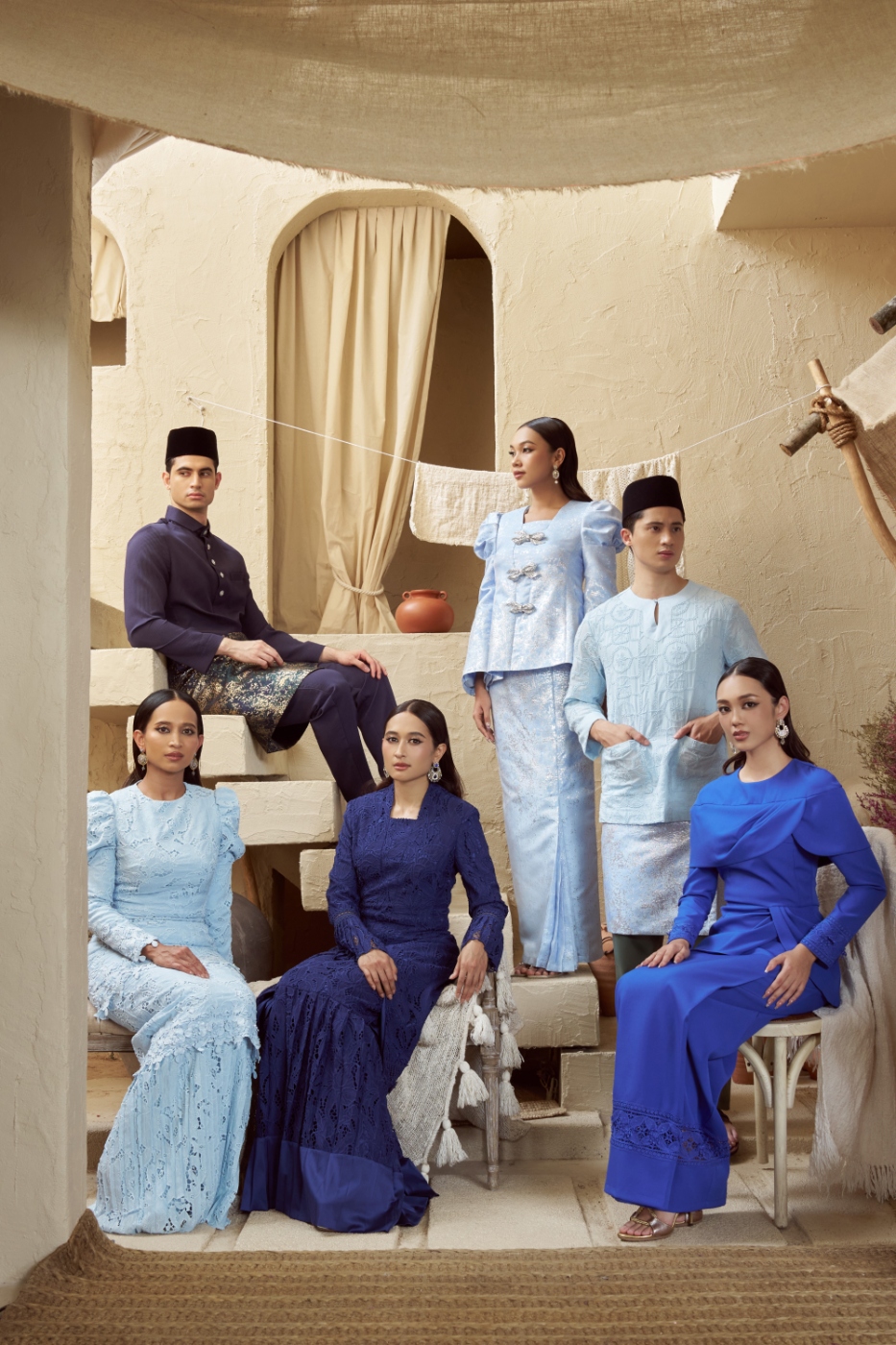
Khoon Hooi’s Raya 2025 collection is a study in contrasts — where classic silhouettes find new energy through bold details and heritage is reimagined with a touch of surrealism. Drawing inspiration from 1950s Malaysian fashion icon Saloma, the collection honours timeless elegance while embracing contemporary sensibilities. The result is a line-up that feels both refined and exuberant. The “Baju Kebaya” and “Baju Kurung” take centre stage, crafted from floral brocade, fil coupé and velvet jacquard for a sophisticated yet statement-making effect. For the first time, floral-printed chiffon makes its debut, lending an ethereal lightness to the collection. Complementing these silhouettes is a capsule of “Baju Kedah”, elevated with guipure lace and geometric jacquard, offering a fresh take on a heritage favourite. With structured shapes, irregular hemlines and intricate details, Khoon Hooi once again balances classic elegance with contemporary flair.
The collection’s colour palette is equally dynamic, playing with the contrast between timeless black and white, muted pastels and rich jewel tones. Asymmetrical draping, pleats and origami-inspired elements add movement, while floral embellishments, crystal chains and an array of brooches introduce a layer of festive sparkle. The Khoon Hooi Raya 2025 collection is a tribute to the past, woven seamlessly into the present — a celebration of heritage that continues to evolve.
The Lina set reinvents the “Baju Kurung” with striped floral brocade, a wide neckline and puffy sleeves adorned with lace patches and floral embellishments, striking a balance between effortless elegance and delicate drama. The fully lined skirt — structured with box pleats at the back — maintains a fluid silhouette. Meanwhile, the Nala set blends tradition with modern refinement, featuring a fil coupé top with demure lace trims and a sarong-style striped satin skirt, elevated by three floral brooches with dangling pearls and glass bead embellishments that add texture and subtle sparkle. For those drawn to glamour, the Trisya Baju Kebaya set dazzles with a floral sequin top lined with organza for lightweight structure, paired with an overlapped draped satin skirt with glass bead detailing at the hem, while floral pearl brooches down the front lend vintage sophistication. The Rani set, in deep, rich hues, turns heads with its luxurious velvet jacquard fabric, delicate lace trims and oval pearl-crystal brooches that add dimension and shimmer. Fastened with a discreet hook-and-eye closure, its fully lined sarong skirt ensures both comfort and elegance with an elastic waistband and back zipper. Together, these designs redefine tradition with contemporary artistry, making a bold statement for the festive season.
Kit Woo
Kit Woo’s first-ever Raya and Pre-Spring capsule collection reimagines traditional Malay silhouettes through a contemporary lens, creating a dialogue between heritage and modernity. In what he considers his most gender-neutral collection to date, Woo strips tradition down to its core and reconstructs it with architectural precision, refining each piece into something both familiar and entirely new. Silat, the ancient martial art of the Nusantara, serves as a key inspiration. Its fluid movements and controlled power echo through the collection’s clean lines, sculptural drapes, and dynamic layering. Traditional garments form the foundation, but their transformation is subtle yet radical — meticulously tailored yet free from rigidity.
At the heart of the collection is a structured “Baju Melayu”, designed with a distinctive button closure in black and white, a nod to classic tailoring with a contemporary edge. A languid “Jubah” takes shape with adjustable drawstring details and an asymmetrical collar, offering versatility in movement and wear. A sharply tailored “Samping” suit in black subverts traditional menswear codes, while a collarless tailored jacket with raw edges challenges the boundaries of formalwear. Trousers echo the collection’s interplay of structure and fluidity, with Samping-inspired wraps and closures that deconstruct the idea of ceremonial dress.
Fabric choices reinforce Woo’s signature aesthetic — indigo denim, chambray and Oxford shirting bring texture and depth, elevating the collection beyond mere reinterpretation. The restrained palette of white, indigo blue and black ensures that each piece is effortlessly wearable, designed to be styled and layered in multiple ways. Beyond the pieces themselves, Woo invites the wearer to engage in the process of self-styling. The collection is trans-seasonal, meant to be worn, reworked and reshaped over time. In a world where tradition is often seen as fixed, Woo presents it as something fluid — an evolving conversation between past and present, structure and movement, tradition and personal identity.
Fiziwoo
As Fiziwoo marks ten years of Raya ready-to-wear collections, the brand reflects on a decade of evolution, challenges and triumphs. More than a milestone, this is a tribute to those who have shaped its journey — celebrities, fashion stylists, loyal customers and supporters who have been part of the brand’s story. To honour this moment, Fiziwoo names each piece in the collection after individuals who have played a role in its success. Familiar names like Marion, Neelofa, Zaihani and Minluna now grace its designs. But “Journey” is more than a nostalgic nod — it is an embodiment of the designers’ personal and professional evolution, in both craftsmanship and spirituality.
For designers Fizi and Kai, “Journey” is deeply personal. It signifies their growth as designers and individuals, shaped in part by their recent Umrah pilgrimage. This experience reinforced their commitment to self-improvement, infusing a greater sense of purpose into their work.
Inspired by the old Arabic souks of Saudi Arabia, a place the designers encountered during their pilgrimage, the collection carries the warmth and mystique of these ancient markets. Arabic calligraphy influences its typography, while the campaign’s visual direction captures the rustic yet refined essence of these historic spaces. A palette of dusty sand, golden hues and earthy tones mirrors the vast desert landscapes, paying homage to Middle Eastern heritage.
Revisiting its archives, Fiziwoo draws inspiration from its best-selling Raya ready-to-wear designs over the past ten years. Signatures silhouettes are reimagined with refined craftsmanship, giving customers fresh interpretations of beloved pieces. This year, Fiziwoo introduces its largest Raya collection yet, with 32 womenswear and 50 menswear pieces. The womenswear collection embraces diverse silhouettes suited for modern and modest women alike, featuring three exclusive fabric selections — polyblend brocade, polyblend cotton and embroidered cotton lace — each finished with fagot-knit border lace and crystal bow embellishments. For menswear, Fiziwoo makes a bold move by introducing its first “Baju Melayu” set, blending the Spread English collar with the traditional Cekak Musang for a modern yet refined aesthetic. The collection also includes embroidered cotton linen kurtas in 30 colours, spanning pastels, earthy tones and jewel hues. A new pinstripe-textured fabric adds depth to the classic Baju Melayu, reinforcing Fiziwoo’s commitment to innovation.
Rizman Ruzaini
Rizman Ruzaini marks its 20th anniversary in 2025 with a bold return to the Raya season, unveiling three distinct collections that capture the essence of the brand’s legacy. Alongside the return of the much-loved Couture Raya collection, the fashion house introduces two ready-to-wear lines, including the revival of the Rizman Ruzaini Red label. This milestone reaffirms the brand’s place in Malaysian fashion, blending nostalgia with modern sophistication. Following the success of the Rizman Ruzaini Spring Summer 2025 collection at Dubai Fashion Week, the inspiration behind the Mustika collection has been reinterpreted for Raya 2025. The couture line pays homage to Malaysia’s cultural heritage, marrying traditional silhouettes with contemporary craftsmanship. Kebaya-inspired designs, intricate pleats and embroidery showcase a refined approach to Malay fashion’s evolution. The collection’s muse, Yang Mulia Tengku Shaheera binti Tengku Abdullah, embodies the elegance of the modern Malay woman, reinforcing the collection’s theme of heritage and sophistication.
The Mustika collection draws inspiration from classic Malay films such as Perempuan Melayu Terakhir, Penarek Becha and Rachun Dunia, evoking a sense of nostalgia and highlighting the enduring significance of the kebaya. The 23-piece collection features opulent fabrics like velvet, premium crepe, tulle and chiffon, finished with machine embroidery that takes cues from Malay and Peranakan motifs. Creative Director Ruzaini Jamil has reimagined customer favourites, refining them with a contemporary edge while staying true to the brand’s signature aesthetic. Featuring eight distinctive designs in soft hues, the collection is crafted from luxurious chiffon and adorned with delicate embellishments.
Completing the trio of collections is the revival of Rizman Ruzaini Red, the brand’s accessible yet equally striking ready-to-wear line. Designed as a more attainable extension of the couture collection, it channels the “Mustika” inspiration into eight refined yet wearable designs. The collection reimagines traditional silhouettes, offering variations of “Baju Kurung Kedah”, “Baju Kurung Pahang”, “Baju Kurung Moden”, “Kebaya” and “Kebaya Labuh”. Crafted from crepe and lace, most designs come with a complementary shawl, adding an elegant finishing touch. With these three collections, Rizman Ruzaini cements its place at the forefront of Malaysian fashion, honouring its past while embracing the future. Each piece reflects the house’s dedication to craftsmanship, innovation and timeless style, ensuring that Raya 2025 is celebrated with elegance.
Special Mention:
Maison FRED
As Ramadan begins, Maison FRED welcomes the holy month with a creation that captures the essence of luminosity and togetherness. The Force 10 XL buckle in white gold, set with full diamonds and paired with a steel cable bracelet, reflects the celestial cycle that defines the rhythm of Ramadan. Against the backdrop of a rising sun, the piece embodies serenity and inner strength, marking a time of renewal and reflection.
A tribute to the spirit of the season, this creation is the first of three icons designed to honour the joy and unity that Ramadan brings. Through its signature craftsmanship, Maison FRED continues to celebrate moments of light and connection, embracing the beauty of tradition with a modern touch.
For more on the latest in style and fashion reads, click here.
Web3 is redefining how players interact with online gambling platforms. This shift from centralized to decentralized technologies introduces blockchain-backed transparency, true digital ownership, and direct control over funds. With tools like NFTs, smart contracts, and crypto wallets becoming integrated into gambling platforms, the casino landscape is moving toward a more secure, customizable, and user-first experience. Regulated sites are exploring these innovations without abandoning compliance or safety, striking a fine balance between trust and transformation.
Blockchain Infrastructure for Fairness
Web3 casinos are now integrating blockchain protocols to log and verify every gaming transaction publicly. This shift ensures that no outcome can be manipulated post-play, as the entire ledger is immutable and accessible. Unlike traditional online casinos that rely on internal random number generators hidden from users, blockchain allows provably fair systems. Every roll, spin, or draw can be tracked, verified, and audited in real-time. Ethereum and Polygon networks are among the most used in this space, enabling decentralized logic and smart contracts.
Instead of trusting a single server, players can see game outcomes tied to specific block hashes or chain IDs. The removal of centralized game control helps build trust, especially among users skeptical of online household advantage or fraud. When blockchain underpins the platform, players no longer rely on faith—they rely on code.
Smart Contracts Automating Gameplay Logic
Smart contracts replace traditional backend infrastructure in Web3 casinos, automating bet resolutions, payouts, and bonus triggers. These autonomous scripts eliminate the need for third-party verification or operator delays.
Smart contracts deployed on chains like Binance Smart Chain or Avalanche execute outcomes instantly, without human involvement. This prevents payout disputes and provides instant crediting for wins. By locking terms in code, both the player and operator agree to transparent, enforceable rules that cannot be changed on the fly.
NFT Integration and Digital Asset Utility
NFTs are being used beyond artwork or collectibles. These platforms now leverage NFTs as membership tokens, loyalty rewards, and even unique game assets. Some brands assign utility to NFTs for unlocking exclusive games or earning higher yield percentages in staking protocols.
Users owning platform-issued NFTs gain benefits not seen in legacy systems—like exclusive slot access or participation in NFT-only poker rooms. These assets can be traded, held, or used across multi-chain networks, increasing the sense of ownership and community.
Crypto Wallets for Secure, Self-Custodied Banking
Digital wallets such as MetaMask, Trust Wallet, or Phantom are replacing traditional login and banking systems on Web3. Players no longer need to share sensitive personal or financial information with the platform.
By using a self-custodied wallet, players connect via wallet signatures instead of email-password logins. Withdrawals happen directly from contract to wallet without intermediaries or processing times. This also significantly reduces fraud risks. For many users seeking speed and anonymity, this evolution is an game-changer among the best casino sites adopting Web3 practices.
Regulatory Compliance in Web3 Gambling
Despite the decentralized nature of Web3, major platforms still ensure that they meet the regulatory standards of regions where they operate. Jurisdictions such as Malta, Curacao, and the Isle of Man are adapting licensing models to accommodate smart contract and crypto-based casinos.
These platforms often implement geofencing, KYC triggers large withdrawals, and AML checks while still offering decentralized tech. The balance between permissionless play and compliance is crucial to long-term growth and user trust.
Tokenization of Casino Economies
Many Web3 issue native utility tokens that fuel the ecosystem—used for placing bets, earning rewards, or governing the platform. Players can stake these tokens for interest, vote on future developments, or trade them on decentralized exchanges.
Instead of traditional loyalty points, users earn tradable assets. DAOs (Decentralized Autonomous Organizations) are being tested for community-based casino governance. Token holders can propose changes, approve new game contracts, and even vote on house edge adjustments—something unthinkable in legacy casino models.
Interoperability and Cross-Platform Functionality
One of Web3’s most exciting aspects is interoperability. Players can use the same NFTs or tokens across multiple platforms or games developed by different providers.
Rather than being locked into a single brand, players can take their rewards and assets across various Web3 platforms. This interoperability empowers users, enabling a connected experience beyond borders or corporate silos.
Decentralized Support and Dispute Resolution
Customer support systems in Web3 platforms are evolving toward on-chain dispute resolution models. This allows transparency in how issues are handled and removes the need for private email threads.
Support tickets, escalations, and resolutions can be recorded on-chain. Some platforms are piloting decentralized arbitration boards composed of token holders to rule on disputes—paving the way for community-driven fairness.
Reduced Operational Costs, Higher Payouts
By eliminating intermediaries like banks, payment processors, and licensing aggregators, Web3 casinos operate leaner. This efficiency translates into better RTPs (Return to Player percentages) and promotional offers.
Lower overhead allows these businesses to boost jackpots, offer better odds, and deliver more lucrative affiliate programs. Traditional operators are also taking notice and gradually adapting similar models through hybrid integrations.
Future Challenges: Scalability and Adoption
While the benefits of Web3 gambling are extensive, the space still faces challenges around blockchain congestion, high gas fees, and user onboarding complexity. Layer-2 solutions like Optimism and Arbitrum are helping reduce costs and improve speed.
The next wave of adoption will rely on bridging tools that simplify wallet creation and smart contract interaction. Projects offering non-custodial accounts with social logins or fiat onramps are leading the charge in making Web3 gambling more mainstream.
A Transparent and Empowered Gambling Era
Casino platforms embracing Web3 are not replacing traditional systems—they are reimagining them. By merging security with transparency, and player control with innovation, the gambling industry is entering a transformative phase. From NFTs to self-custodied wallets, and from DAOs to smart contracts, users are no longer just gamblers—they’re stakeholders in a decentralized economy. The shift is already happening, and the future is being built block by block.
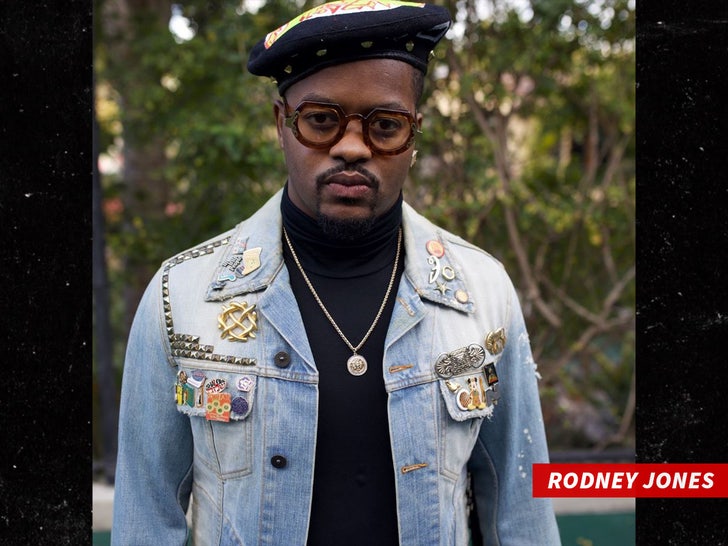
Rodney Jones Lawsuit Versus Diddy Judge Tosses Majority of Claims … Scolds His Lawyer!!!
Published March 24, 2025 5:34 PM PDT
Diddy won a small victory in court today when a judge tossed a majority of claims against him in a lawsuit filed by a former music producer accusing him of sexual assault.
According to new legal docs, obtained by TMZ, the judge dismissed five of the nine claims Rodney Jones made against Diddy … including RICO claims, infliction of emotional distress, and breach of contract claims.
The court also dismissed a Trafficking Victims Protection Act claim against Diddy’s company, Combs Global.
Rodney’s lawyer, Tyrone A. Blackburn, even got dressed down by the judge … who warned him that his legal filings in the case have not been up to par.
Play video content
In one example, the judge pointed to Blackburn’s filings seemingly not understanding that Diddy is presumed innocent in a separate grand jury indictment on criminal charges.
TMZ broke the stories … Jones sued Diddy back in February 2024 and Diddy ripped the suit as a money grab dressed up as a sex trafficking and RICO conspiracy.
The case is still moving forward despite five of the nine claims being tossed … and serious claims of sexual assault against Diddy were not dismissed. It will be interesting to see if these claims ever make it to trial.
Rodney’s lawyer tells TMZ … “Yeah a win is a win, playtime is over we look forward to discovery. I hope Defendants are ready.”
In Coronation Street spoilers for next week, Dee-Dee gives birth to a baby girl but complications see her undergo a hysterectomy.
Elsewhere, Daisy’s mum Christina returns to the cobbles to scheme with her daughter against Jenny.
All this and more in Coronation Street spoilers.
1. Dee-Dee ends up in labour
While visiting Lauren and baby Frankie at the hospital, pregnant Dee-Dee finds herself in agony.
The midwife she speaks to insists she just needs to go home and rest.
When she arrives back at her flat, Dee-Dee’s waters break.
When Ed takes his daughter back to the hospital, the doctor who takes Dee-Dee’s blood pressure confirms that she is suffering from pre-eclampsia.
The baby needs to be delivered immediately, and Dee-Dee is left terrified. Will they both be okay?
2. Coronation Street spoilers: The Baileys meet the new baby
After she gives birth to a baby girl, the Bailey family visit Dee-Dee in hospital.
James informs his sister that he wants to name the baby Laila.
After her brothers leave, Dee-Dee confides in Ed that she had to have an emergency hysterectomy and won’t be able to have any more children.
Ed tells Dee-Dee to think carefully about whether or not she can go through with giving up the baby.
Later, when Lauren comes to visit, telling her that Frankie’s transplant was a success, she’s shocked by her reaction to the news.
Dee-Dee is forced to make a final decision about baby Laila, but James soon receives a text that might change everything. Just what news has he received, and why does Ed later return with the baby in tow?
To make matters worse, she later confides in Alya and Sarah that her pre-eclampsia and subsequent hysterectomy could have been avoided, and were caused by gross negligence. Alya offers to start the complaints process for her.
3. Christina returns and causes trouble for Jenny
There’s more trouble brewing between Daisy and Jenny this week, and unfortunately for Jenny, Daisy now has back up.
After telling boyfriend Daniel that she doesn’t think she can forgive Jenny this time, Daisy invites her mum Christina to help her with a revenge plan.
Christina is soon making her presence known in the Rovers, and Daisy later tells Jenny she doesn’t think she’ll ever be able to forgive her.
With plenty of catfishing experience under her belt, it’s no surprise that Daisy’s revenge involves catfishing Jenny on the dating app she’s been using recently.
When Jenny informs Daisy and Christina that she’s met a lovely man called Dom on the app she’s using, they realise their plan is working. The pair send Jenny a bouquet of flowers from ‘Dom,’ and Christina continues to message her.
Soon, Daisy is left worrying that Jenny is going to want to meet up with him in person.
4. Coronation Street spoilers: Mick ruffles Ronnie’s feathers
Debbie insists on looking after Alfie, so that Kevin can get some rest. Soon, Mick’s music is once again causing problems.
When Ronnie turns up at the house, he finds Alfie alone, with Debbie nowhere to be seen.
The back door is open, and he soon finds Debbie lying in the ginnel.
As Gemma and Chesney grow closer to Mick and Lou, Ronnie warns them to be careful.
Later, Ronnie slashes one of the tyres on Mick’s van. Unfortunately for him, Debbie sees everything – and so do the CCTV cameras.
5. Chesney struggles to get rid of Mick
After Ronnie’s warning that Mick isn’t what he seems, Chesney is filled with dread when Mick invites him for a drink.
In the Rovers, he does his best to act normally around his new neighbour.
Later, Gemma and Chesney are surprised when Mick and Lou invite themselves over to their house, bringing beers and snacks.
6. Julie and Kevin bond
When Abi has to rush off to get an unwell Alfie from nursery, Kevin is nervous to be alone for his chemotherapy appointment.
Julie comes across Kevin on the bench outside the hospital, and the two bond.
Meanwhile, Abi isn’t best pleased when she can’t get hold of Kevin, and later finds out he was with Julie.
7. Coronation Street spoilers: Jack and Hope get into trouble
In the precinct, Hope and Jack find a pair of ebikes. While Jack uses his dad’s credit card to pay for the scooters, Hope shares alcohol she had in her bag.
The youngsters are soon caught out by the police.
With Tyrone and Kevin close behind, the two men are soon arguing with each other about which of the teens is being a bad influence on the other.
What will happen to Jack and Hope?
8. Theo and Todd have a passionate afternoon
After Theo turns up at Todd’s house and apologises, the two men share a few beers and get to know each other a bit better.
When Theo admits he’s attracted to Todd, the pair share a kiss.
Later, after spending the afternoon in bed together, Todd is confused when Theo rushes off as soon as he hears someone coming into the house.
Todd is disappointed when he later tells him the afternoon was a one off. Does he really mean it?
Coronation Street usually airs on Monday, Wednesday and Friday at 8pm on ITV.
What do you think of this story? Leave us a comment on our Facebook page @EntertainmentDailyFix and let us know your thoughts!
A little-known AI image generator called Reve Image 1.0 is trying to make a name in the text-to-image space, potentially outperforming established tools like Midjourney, Flux, and Ideogram.
The Reve Image 1.0 model, codenamed “Halfmoon,” operates on a credit-based system.
Users receive 100 free credits to test the service after signing up, with additional credits available at $5 for 500 generations—pretty cheap when compared to options like MidJourney or Ideogram, which start at $8 per month and can reach $120 per month, depending on the usage.
Reve is great at prompt adherence, visual aesthetics, and typography handling. The model generates high-resolution images across various artistic styles, from photorealistic renderings to abstract art.
There’s only a little information known about the model, its architecture, its team, and the legal intricacies of its service.
But unlike Recraft—which “owns” users’ outputs if generated using free plans—Reve grants users ownership rights over their generated content.
The team at Reve did not immediately respond to a request for comment.
The company recently created a GitHub account but has not uploaded any content. In their Discord server, some users speculate there might be an open-source contribution, but such information has not been confirmed.
The idea of giving some love to the open source community may not be so crazy as the company also forked ComfyUI’s—a well-known UI for running open source AI Image generators—GitHub repository today.
Our Review: Hands-On Testing Results
Overall Quality Assessment
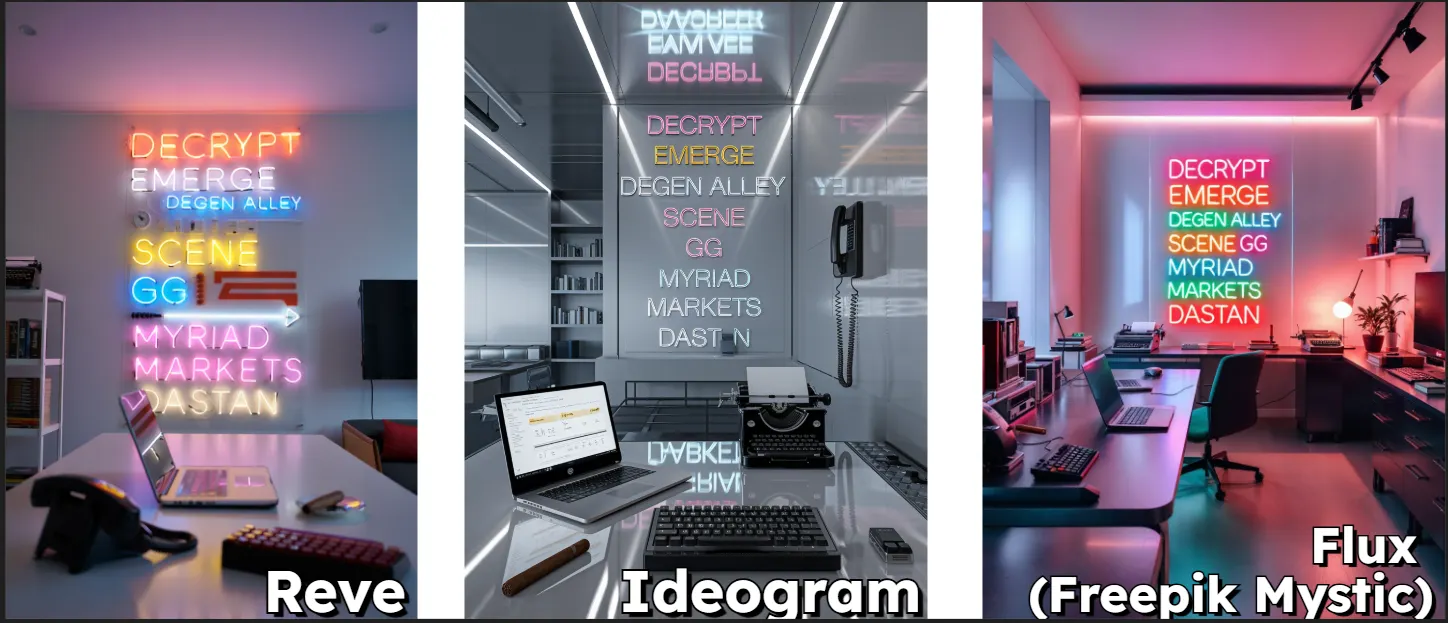
Prompt: A high-tech office space with different journalistic elements like a laptop, a telephone, a library, and a vintage typewriter, a cigar, and a mechanical keyboard, with glossy white walls prominently displaying a list of words in multicolor neon lettering. The text elements are arranged vertically from top to bottom, reading “DECRYPT”, “EMERGE”, “DEGEN ALLEY”, “SCENE”, “GG”, “MYRIAD MARKETS”, and “DASTAN”. The minimalist room features clean lines, metallic surfaces, and ambient lighting that casts a soft glow across the workspace, with sleek furniture and modern technological equipment visible in the periphery. Wide-angle interior photography with dramatic lighting that emphasizes neon elements against minimalist surfaces.
In our comparative testing, Reve consistently produced impressive results across various prompt types. We tested three key aspects giving equal weighting: prompt adherence, realism, and text generation.
Reve generated images with well-balanced lighting, accurate representation of requested elements, and vibrant multi-colored signage precisely as specified.
The white walls appeared appropriately rendered, and journalistic elements on the desk were arranged naturally.
When compared directly with Freepik Mystic (the best Flux workflow in the market) and Ideogram (the best-closed source model with text capabilities)—on the same prompt, Reve achieved superior overall implementation of requirements, providing the best image when all the aspects were considered.
Freepik excelled in color grading and light interaction but struggled with texture realism and letter placement, whereas Ideogram accurately captured glossy surfaces but mishandled text elements and was the least realistic of all.
Winner: Reve
Illustration Capabilities
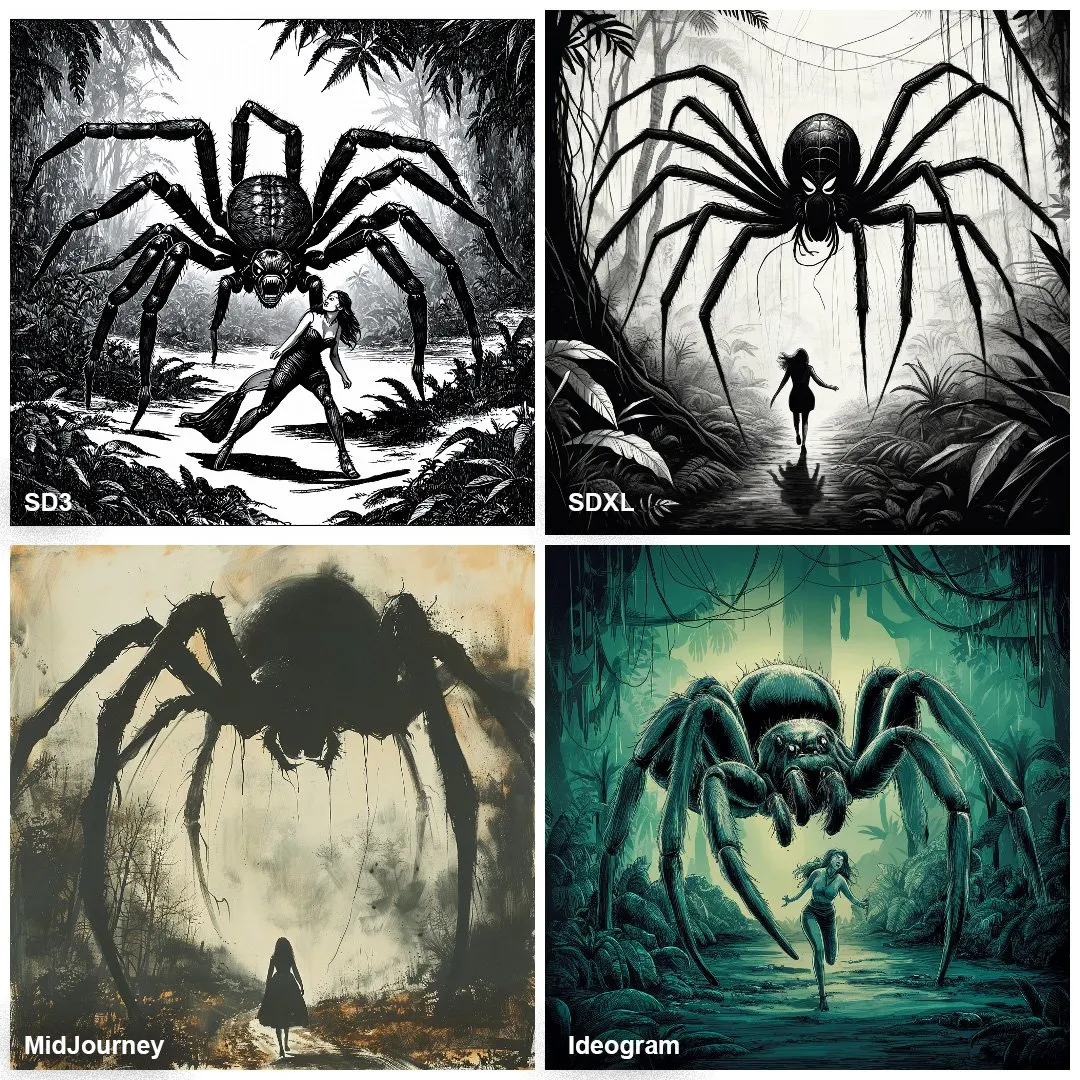
Prompt: A detailed hand-drawn illustration depicts a massive black spider with bristling legs and glowing eyes pursuing a screaming woman through a dark jungle setting. The woman, wearing a torn white dress, runs between thick tree trunks covered in vines, escaping from the spider. Dense foliage surrounds the scene, with twisted branches and large leaves blocking most of the dim moonlight filtering from above. The jungle floor is strewn with fallen leaves and gnarled roots. Black and white pen illustrations with rough sketch lines and dark cross-hatching create deep shadows and texture.
We conducted a horror illustration test comparing Reve against outputs from SD3, SDXL, MidJourney, and Ideogram.
All models were tasked with creating a scene featuring a woman fleeing from a giant spider in a forest setting.
Reve’s output featured great hand-drawn quality with detailed linework, strong compositional framing, convincing facial expressions, and natural-looking forest elements with appropriate depth.
While each competitor showed distinct strengths – SD3.5’s jungle setting, SDXL’s sense of scale, MidJourney’s atmospheric quality, and Ideogram’s color choices – Reve’s illustration comprehensively fulfilled the prompt requirements with superior detail and artistic execution.
This is a hard one to evaluate, but overall, Reve seems to be on par with SD3.5. Its hand-drawn aesthetic featured sophisticated texturing and hatching techniques, while the horror elements were effectively conveyed through the spider’s threatening posture and the woman’s terrified expression.
The forest environment appeared cohesive and natural, with technical execution showing skilled perspective, anatomy, and compositional framing.
Tie: Reve and SD3.5
Content Restrictions
During testing, we discovered that Reve is actually uncensored but implements content filtering that affects specific outputs.
While the model appears to understand concepts related to nudity and violence, such content appears pixelated in the final output after generation.
This is a big difference because it opens the door for a future way of providing uncensored outputs, probably in high-tier plans.
A censored model is not able to generate a specific image because it’s not trained on such content, a filtered model, on the other hand, has actually been trained and understands a concept but restricts its outputs based on a specific criteria.
For users requiring unrestricted content generation, local installations of models like Flux or SD3.5 would likely be more suitable.
Image Edition:
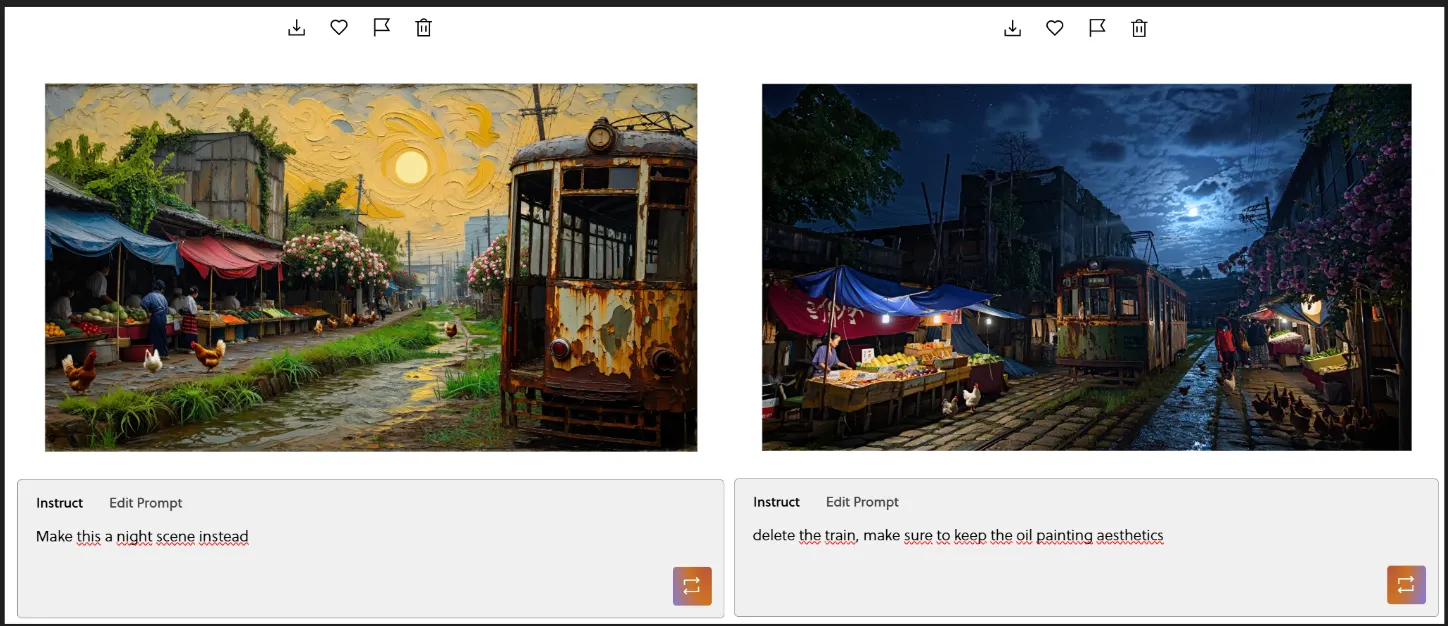
Unlike most of the image generators on the market that feature inpaint/outpaint edit tools, Reve relies on an instruction based system that understands natural language—similar to Google’s approach with Gemini.
For example, here is our result after we instructed the model to change a painting of a daylight scene into a night scene:
Instead of selecting an area and using prompts to get the desired results, users must instead “chat” with the model and write their expected outcomes inside of a text box—and pray for the best.
This is great for novice users who want to interact with the model and get something that just works. However, experienced users in need of granularity may see this as a cool addition but not really good enough to give them proper results.
It’s better than Google’s AI because it doesn’t degrade the image after new generations, however, it does change the overall aesthetic which may not be ideal for users in need of a model that respects character consistency.
Conclusion
Reve Image Generator is a nice entry in the increasingly competitive AI image generation market.
It’s very good at prompt adherence, realistic rendering, and versatility across different visual styles.
At $5 for 500 credits (effectively one cent per generation), Reve undercuts many competitors while delivering comparable or superior results, becoming the best close source image generator for people wanting to pay for making good images.
The flat-rate pricing model adds transparency that many users will appreciate–every image costs exactly one credit regardless of complexity or resolution.
However, it has some limitations. The lack of an edit feature, which has become standard among competitors, may not be a big deal for novice users but may frustrate experienced enthusiasts looking to refine results.
The lack of a mobile app limits accessibility for on-the-go use, and the limited information about the team and technology behind Reve may be uncomfortable for those caring about long-term support and data handling practices.
Still, for users seeking to generate high-quality images without extensive prompt engineering expertise, Reve offers an accessible, cost-effective alternative to more established services. Its versatility and strong prompt adherence make it particularly valuable for users with specific visual requirements.
Edited by Sebastian Sinclair and Josh Quittner
Generally Intelligent Newsletter
A weekly AI journey narrated by Gen, a generative AI model.
The Legend of Dragoon was Sony’s attempt to crack the classic turn-based RPG formula on the original PlayStation, but it wasn’t part of some grand push into new genres. The way ex-PlayStation Studios veteran Shuhei Yoshida talks about the cult hit, it sounds as if the ambitious fantasy adventure basically came about by accident.
6 Things To Know Before Starting Persona 5 Tactica
“Final Fantasy VII was already already announced and the use of 3D graphics for the combat and the pre-rendered 3D CG—beautiful CG—for the backgrounds was amazing to us,” he said in a recent interview with YouTuber Kyle Bosman (via Gamesradar). “Like ‘oh, this is next-generation kind of game.’ We were young and we were naïve, and luckily I was given the assignment to grow the internal team. I was assigned to make the studio larger. I was given a free budget, almost, to hire people.”
While Yoshida was The Legend of Dragoon’s producer at Sony Computer Entertainment of Japan, the key creative force behind the project was Yasuyuki Hasebe, who had recently left Square Soft after designing the battle system for Super Mario RPG. “When he joined us, I asked him, ‘What do you want to do?’” Yoshida said. “‘I want to make a new RPG.’ And that’s how I started gathering even more people to start making The Legend of Dragoon.”
Screenshot: Sony / MobyGames
It was rare for developers in Japan to leave their companies, Yoshida noted, making Hasebe a rare find. The rest of the studio was then mostly populated with fresh graduates. “I didn’t even have a budget when I started, because it was an internal production,” Yoshida said. The Legend of Dragoon team would eventually be 100 strong and end up costing Sony $16 million.
A lot of the effort by that large team went toward the game’s infamous 30 minutes of, at the time, gorgeous CGI cutscenes. While the prerendered backgrounds and polygonal character models were looking roughly on par with what Square was doing at the end of the PS1’s life, the cinematics helped elevate into a much more epic and lavish-feeling game overall. The other highlight was the timed battle mechanic that turned combat into a mini-rhythm game, an evolution of what Hasebe had created for Super Mario RPG (and which continues in the modern Paper Mario games).
“Eventually, we recouped that (cost), thanks to sales outside Japan,” Yoshida previously told Kotaku. “The sales in the U.S. were very strong.” Unfortunately not strong enough to manifest a sequel or spiritual successor. Fortunately, The Legend of Dragoon is playable today after coming to PS5 a couple of years ago, though deep down in my heart of hearts I’m still hopeful we’ll eventually get The Legend of Dragoon 2.