
Home Blog Page 1182

The Anatomy of AI Minds: Decoding Neural Networks

0
The Anatomy of AI Minds: Decoding Neural Networks


One of the most persistent challenges has been understanding exactly how large language models (LLMs) like ChatGPT and Claude work. Despite their impressive capabilities, these sophisticated AI systems have largely remained “black boxes”—we know they produce remarkable results, but the precise mechanisms behind their operations have been shrouded in mystery—that is, until now.

A groundbreaking research paper published by Anthropic in early 2025 has begun to lift this veil, offering unprecedented insights into the inner workings of these complex systems. The research doesn’t just provide incremental knowledge – it fundamentally reshapes our understanding of how these AI models think, reason, and generate responses. Let’s dive deep into this fascinating exploration of what might be called “the anatomy of the AI mind.”

Understanding the Foundations: Neural Networks and Neurons

Before we can appreciate the breakthroughs in Anthropic’s research, we need to establish foundational knowledge about the structure of modern AI systems.

At their core, today’s most advanced AI models are built upon neural networks – computational systems loosely inspired by the human brain. These neural networks consist of interconnected elements called “neurons” (though the technical term is “hidden units”). While the comparison to biological neurons is imperfect and somewhat misleading to neuroscientists, it provides a useful conceptual framework for understanding these systems.

Large language models like ChatGPT, Claude, and their counterparts are essentially massive collections of these neurons working together to perform a seemingly simple task: predicting the next word in a sequence. However, this simplicity is deceptive. Modern frontier models contain hundreds of billions of neurons interacting in extraordinarily complex ways to make these predictions.

The sheer scale and complexity of these interactions have made it exceptionally difficult to understand exactly how these models arrive at their answers. Unlike traditional software, where developers write explicit instructions that the program follows, neural networks develop their internal processes through training on vast datasets. The result is a system that produces impressive outputs but whose internal mechanisms have remained largely opaque.

The Problem of Polysemantic Neurons

Early attempts to understand these models focused on analyzing individual neuron activations – essentially monitoring when specific neurons “fire” in response to particular inputs. The hope was that individual neurons might correspond to specific concepts or topics, making the model’s behavior interpretable.

However, researchers quickly encountered a significant obstacle: neurons in these models turned out to be “polysemantic,” meaning they would activate in response to multiple, seemingly unrelated topics.

This polysemantic nature made it exceedingly difficult to map individual neurons to specific concepts or to predict a model’s behavior based on which neurons were activating. The models remained black boxes, and their internal workings were resistant to straightforward interpretation.

The Feature Discovery Breakthrough

The first major breakthrough in understanding these systems came when Anthropopic researchers discovered that while individual neurons might be polysemantic, specific combinations of neurons were often “monosemantic “—uniquely related to specific concepts or outcomes.

This insight led to the development of the concept of “features” – particular patterns of neuron activation that could be reliably mapped to specific topics or behaviors. Rather than trying to understand the model at the level of individual neurons, researchers could now analyze it in terms of these feature activations.

None

To facilitate this analysis, Anthropic introduced a methodology called “sparse autoencoders” (SAEs), which helped identify and map these neuron circuits to specific features. This approach transformed what was once an impenetrable black box into something more akin to a map of features explaining the model’s knowledge and behavior.

Perhaps even more significantly, researchers discovered they could “steer” a model’s behavior by artificially activating or suppressing the neurons associated with particular features. By “clamping” certain features – forcing the associated neurons to activate strongly – they could produce predictable behaviors in the model.

In one striking example, by clamping the feature associated with the Golden Gate Bridge, researchers could cause the model to essentially behave as if it were the bridge itself, producing text from the perspective of the iconic San Francisco landmark.

None

Feature Graphs: The New Frontier

Building on these earlier discoveries, Anthropic’s latest research introduces the concept of “feature graphs,” which takes model interpretability to new heights. Rather than trying to map the billions of neuron activations directly to outputs, feature graphs transform these complex neural patterns into more comprehensible representations of concepts and their relationships.

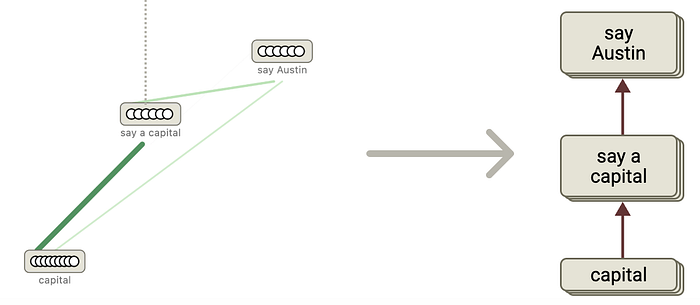
To understand how this works, consider a simple example: When a model is asked, “What is the capital of Texas?” The expected answer is “Austin.” In traditional approaches to understanding the model, we would need to analyze billions of neuron activations to understand how the model arrived at this answer—an effectively impossible task.
None

But feature graphs show something remarkable: When the model processes the words “Texas” and “capital,” it activates neurons related to these concepts. The “capital” neurons promote a set of neurons responsible for outputting a capital city name. Simultaneously, the “Texas” neurons provide context. These two activation patterns then combine to activate the neurons associated with “Austin,” leading the model to produce the correct answer.

None

This represents a profound shift in our understanding. For the first time, we can trace a clear, interpretable path from input to output through the model’s internal processes. LLM outputs are no longer mysterious; they have a mechanistic explanation.

Beyond Memorization: Evidence of Reasoning

At this point, it would be easy to take a cynical stance and argue that these circuits simply represent memorized patterns rather than genuine reasoning. After all, couldn’t the model just be retrieving the memorized sequence “Texas capital? Austin” rather than performing any real inference?

What makes Anthropic’s findings so significant is that they demonstrate these circuits are actually generalized and adaptable – qualities that suggest something more sophisticated than simple memorization.

For example, if researchers artificially suppress the “Texas” feature while keeping the “capital” feature active, the model will still predict a capital city – just not Texas’s capital. The researchers could control which capital the model produced by activating neurons representing different states, regions, or countries, while still utilizing the same basic circuit architecture.

None

This adaptability strongly suggests that what we’re seeing isn’t rote memorization but a form of generalized knowledge representation. The model has developed a general circuit for answering questions about capitals and adapts that circuit based on the specific input it receives.

Even more compelling evidence comes from the model’s ability to handle multi-step reasoning tasks. When prompted with a question like “The capital of the state containing Dallas is…”, the model engages in a multi-hop activation process:

None

It recognizes the terms “capital” and “state,” activating neurons that promote capital city predictions

In parallel, it activates “Texas” after processing “Dallas”

These activations combine – the urge to produce a capital name and the context of Texas – resulting in the prediction of “Austin”

This activation sequence bears a striking resemblance to how a human might reason through the same question, first identifying that Dallas is in Texas, then recalling that Austin is Texas’s capital.

Planning Ahead: The Autoregressive Paradox

Perhaps one of the most surprising discoveries in Anthropic’s research concerns the ability of these models to “plan ahead” despite their fundamental architectural constraints.

Large language models like GPT-4 and Claude are autoregressive, meaning they generate text one token (roughly one word) at a time, with each prediction based solely on the tokens that came before it. Given this architecture, it seems counterintuitive that such models could plan beyond the immediate next word.

Yet Anthropic’s researchers observed exactly this kind of planning behavior in poetry generation tasks. When writing poetry, a particular challenge is ensuring that the final words of verses rhyme with each other. Human poets typically address this by planning the rhyming word at the end of a line first, then constructing the rest of the line to lead naturally to that word.

Remarkably, the neural feature graphs revealed that LLMs employ a similar strategy. As soon as the model processes a token indicating a new line of poetry, it begins activating neurons associated with words that would make both semantic sense and rhyme appropriately – several tokens before those words would actually be predicted.

In other words, the model is planning the outcome of the entire verse before generating a single word of it. This planning ability represents a sophisticated form of reasoning that goes well beyond simple pattern matching or memorization.

The Universal Circuit: Multilingual Capabilities and Beyond

The research uncovered additional fascinating capabilities through these feature graphs. For instance, models demonstrate “multilingual circuits” – they understand user requests in a language-agnostic form, using the same basic circuitry to answer while adapting interchangeably to the input language.

Similarly, for mathematical operations like addition, models appear to use memorized results for simple calculations but employ elaborate circuits for more complex additions, producing accurate results through a process that resembles step-by-step calculation rather than mere retrieval.

The research even documents complex medical diagnosis circuits, where models analyze reported symptoms, use them to promote follow-up questions, and elaborate on correct diagnoses through multi-step reasoning processes.

Implications for AI Development and Understanding

The significance of Anthropic’s findings extends far beyond academic interest. These discoveries have profound implications for how we develop, deploy, and interact with AI systems.

First, the evidence of generalizable reasoning circuits provides a strong counter to the narrative that large language models are merely “stochastic parrots” regurgitating memorized patterns from their training data. While memorization undoubtedly plays a significant role in these systems’ capabilities, the research clearly demonstrates behaviors that transcend simple memorization:

Generalizability: The circuits identified are general and adaptable, used by models to answer similar yet distinct questions. Rather than developing unique circuits for every possible prompt, models abstract key patterns and apply them across different contexts.

Modularity: Models can combine different, simpler circuits to develop more complex ones, tackling more challenging questions through composition of basic reasoning steps.

Interventability: Circuits can be manipulated and adapted, making models more predictable and steerable. This has enormous implications for AI alignment and safety, potentially allowing developers to block certain features to prevent undesired behaviors.

Planning capacity: Despite their autoregressive architecture, models demonstrate the ability to plan ahead for future tokens, altering current predictions to enable specific desired outcomes later in the sequence.

These capabilities suggest that while current language models may not possess human-level reasoning, they are engaged in behaviors that certainly transcend mere pattern matching – behaviors that could reasonably be characterized as a primitive form of reasoning.

The Path Forward: Challenges and Opportunities

Despite these exciting discoveries, important questions remain about the future development of AI reasoning capabilities. The current capabilities emerged after training on trillions of data points, yet remain relatively primitive compared to human reasoning. This raises concerns about the viability of improving these capabilities within current paradigms.

Will models ever develop truly human-level reasoning capabilities? Some experts suggest that we may need fundamental algorithmic breakthroughs that improve data efficiency, allowing models to learn more from less data. Without such breakthroughs, there’s a risk that these models could plateau in their reasoning abilities.

On the other hand, the new understanding provided by feature graphs opens exciting possibilities for more controlled and targeted development. By understanding exactly how models reason internally, researchers might be able to design training methodologies that specifically enhance these reasoning circuits, rather than relying on the current approach of massive training on diverse data and hoping for emergent capabilities.

Furthermore, the ability to intervene in specific features opens new possibilities for AI alignment – ensuring models behave in accordance with human values and intentions. Rather than treating alignment as a black-box problem, developers might be able to directly manipulate the specific circuits responsible for potentially problematic behaviors.

Conclusion: A New Era of AI Understanding

Anthropic’s research represents a watershed moment in our understanding of artificial intelligence. For the first time, we have concrete, mechanistic evidence of how large language models process information and generate responses. We can trace the activation of specific features through the model, watching as it combines concepts, makes inferences, and plans.

While these models still rely heavily on memorization and pattern recognition, the research conclusively demonstrates that there’s more to their capabilities than these simple mechanisms. Identifying generalizable, modular reasoning circuits provides compelling evidence that these systems are engaging in processes that, while not identical to human reasoning, certainly transcend simple retrieval.

As we continue to develop more powerful AI systems, this deeper understanding will be crucial for addressing concerns about safety, alignment, and the ultimate capabilities of these technologies. Rather than flying blind with increasingly powerful black boxes, we now have tools to peer inside and understand the anatomy of the AI mind.

The implications of this research extend beyond technical understanding – they touch on fundamental questions about the nature of intelligence itself. If seemingly simple neural networks can develop primitive reasoning capabilities through exposure to patterns in data, what does this tell us about the nature of human reasoning? Are there deeper information processing principles that underlie biological and artificial intelligence?

These questions remain open, but Anthropic’s research has given us powerful new exploration tools. As we continue to map the anatomy of artificial minds, we may gain unexpected insights into our own.



Source link

What’s Next for Trump’s Expanding Relationship with Crypto?

What’s Next for Trump’s Expanding Relationship with Crypto?


What’s Next for Trump’s Expanding Relationship with Crypto?

Donald Trump’s connection to the crypto world could intensify if reported discussions with Binance evolve into a formal partnership with the world’s leading cryptocurrency exchange. 

According to recent reports from the Wall Street Journal and Bloomberg, these talks have the potential to link a major figure in digital assets with a U.S. president who has committed to transforming America into “the crypto capital of the planet.”

Talks with Binance

Trump has already backed executive orders favorable to the crypto industry and shown a commitment to supporting legislation that benefits the sector. He also holds interests in various crypto ventures, gaining from the rise in digital asset values. Reports reveal that ongoing discussions with Binance may involve a Trump family investment in the exchange’s U.S. division. 

Additionally, former Binance CEO Changpeng Zhao, who pleaded guilty in 2023 to violating anti-money-laundering laws, is reportedly seeking a pardon. The talks also suggest potential collaboration on a stablecoin project involving Binance and World Liberty Financial, a crypto business connected to the Trump family.

Both Parties Deny a Deal

Both parties have denied any formal agreement. A Trump administration official told the Wall Street Journal that Steve Witkoff is in the process of distancing himself from business ties. 

Binance CEO Changpeng Zhao also refuted any discussions regarding a business deal with World Liberty Financial or a potential pardon, clarifying on X that Binance had not purchased the company’s crypto token. 

World Liberty, in turn, dismissed the reports as “unsubstantiated” without further elaboration. If a closer relationship were to form, it would significantly deepen Trump’s ties to the crypto industry, reinforcing his earlier promises to support the sector.

The Meme Coin Launch: A Conflict of Interest?

The launch of Trump’s official meme coins—TRUMP and MELANIA—on the Solana blockchain has raised concerns about potential conflicts of interest. 

Just before his inauguration, the Trump team released these coins, with Fight Fight Fight LLC and CIC Digital LLC, both linked to the Trump Organization, owning 80% of the total supply, which is locked for three years. 

This move was quickly followed by Trump Media & Technology Group’s (DJT) ambition to create a bitcoin exchange-traded fund (ETF) and invest up to $250 million in cryptocurrencies through a venture called Truth.Fi.

In addition to these projects, Trump and his family are involved in World Liberty, a 2024 crypto initiative. Trump himself is listed as the “chief crypto advocate,” while his sons, Eric, Donald Jr., and Barron, serve as “Web3 ambassadors.” 

In return for their promotion of World Liberty, the Trump family’s LLC receives 22.5% of the project’s crypto tokens and 75% of any net revenue once the platform earns $30 million.

These ventures align Trump closely with the cryptocurrency sector, raising questions about whether such financial stakes might cloud his policy decisions. As both an influencer and a promoter in the space, his actions could potentially blur the lines between public service and private financial interests, making it a critical point of scrutiny moving forward.

Major Executive Orders

Since assuming office, Trump has made strides in fulfilling his promises to the crypto sector through two significant executive orders.

The first order prohibited the U.S. from developing a central bank digital currency (CBDC) and created a presidential task force dedicated to digital assets, laying the groundwork for broader initiatives. 

The second order focused on the creation of a bitcoin reserve and a separate stockpile for crypto, which would be funded by seized and forfeited digital assets not yet sold by the government.

The order emphasizes that the digital asset industry plays a critical role in both the U.S. economy and its global leadership.

While some within the crypto community were initially concerned, Andy Baehr, managing director at CoinDesk Indices, reassures that the president’s actions may not be as drastic as they appeared. 

Trump has also supported the development of a federal regulatory framework to facilitate crypto operations in the U.S., with the potential to strengthen connections to Wall Street. Recently, the Senate Banking Committee made progress on this by advancing stablecoin legislation.

On Thursday, the Senate Banking Committee took one step in that direction by advancing stablecoin legislation that would set rules for how bank regulators would oversee firms issuing such coins.

The SEC Backing Down

Binance, which faced several conflicts with the U.S. government during the Biden administration, received some relief under Trump’s second term. In March 2024, the SEC paused a civil lawsuit filed in June 2023, accusing Binance and its CEO Zhao of securities violations.

Earlier in 2023, Binance admitted to multiple legal infractions, including money laundering and violations related to sanctions, which led to a hefty $4.3 billion fine. Zhao agreed to pay $50 million and step down as CEO but retained his majority stake. 

In April 2024, he was sentenced to four months in prison for violating U.S. anti-money laundering laws. Despite these setbacks, Binance recently secured its first institutional investment—$2 billion from Abu Dhabi-based investor MGX, paid in stablecoin.

Bitcoin As a Safe Haven?

The crypto market has shown resilience despite stock market crashes, suggesting a weakening correlation between the two. This shift indicates that investors may be turning to crypto assets as a safer alternative, especially as Trump’s tariffs could lead to a prolonged global trade war. Bitcoin’s role as a safe haven, historically seen during times of economic uncertainty, is becoming more prominent. 

A similar trend was observed in 2020 when Bitcoin, after a pandemic-induced crash, decoupled from stocks and quickly rebounded, while traditional markets remained under pressure. This pattern supports Bitcoin’s appeal as a hedge against declining stocks and gold.

Trump, Crypto, and Politics

Trump’s deepening involvement in crypto highlights a growing intersection of politics and digital assets. As he navigates these connections, his actions could reshape both regulatory landscapes and his financial interests. The outcome of his crypto ventures may set a precedent for future political engagement in the rapidly evolving space.

Disclaimer

In line with the Trust Project guidelines, please note that the information provided on this page is not intended to be and should not be interpreted as legal, tax, investment, financial, or any other form of advice. It is important to only invest what you can afford to lose and to seek independent financial advice if you have any doubts. For further information, we suggest referring to the terms and conditions as well as the help and support pages provided by the issuer or advertiser. MetaversePost is committed to accurate, unbiased reporting, but market conditions are subject to change without notice.

About The Author


Victoria is a writer on a variety of technology topics including Web3.0, AI and cryptocurrencies. Her extensive experience allows her to write insightful articles for the wider audience.

More articles


Victoria d’Este


Victoria is a writer on a variety of technology topics including Web3.0, AI and cryptocurrencies. Her extensive experience allows her to write insightful articles for the wider audience.


Source link

Will GTA 6 and Switch 2 be the hallmarks of a recession in games? – ISK Mogul Adventures

Will GTA 6 and Switch 2 be the hallmarks of a recession in games? – ISK Mogul Adventures


GTA 6 and Switch 2 are the subject of a ton of buzz right now. Sure, they’re both massive launches on the horizon for millions of gamers, but there’s a bucket of cold water about to fall on all of our heads. The gaming industry is worth billions, but more and more consumers are running for the hills, and playing older games instead.

Why do I say this? Because massive growth is exactly what the industry expects, according to one source. The latest report, The PC & Console Gaming 2025, created by Newzoo, has been published. And from the 100+ pages of analysis comes a few key points.

For one thing, we’re about to see the biggest value explosion in the games industry, EVER. According to the report’s authors, the industry is projected to be valued at 92.7 billion dollars in 2027 (currently it stands at 85.2 billion dollars). And according to them, the lion’s share of the growth is attributed to an ever-growing console market.

The overall push for consoles takes the form of 7% in growth from 2024 to 2027, at least that’s what’s projected. For the PC gaming market by comparison, we’re seeing a 2.7% growth from 2024 to 2027. Whether that growth holds past 2025 is completely uncertain, though.

This overall trend of inflation isn’t unique to games, or any hobby really, but it’s become the subject of a ton of outrage. Gamers all over the globe are fed up. But according to this report, their rage is taking a strange form. Rather than swearing off new games entirely, they’re doing something unique.

And we can see that in the Newzoo report, namely by the engagement with older games. More and more gamers are choosing to stick with older games. It’s questionable how much of this change is attributable to the quality and pricing of games, or some other factor. Pay too much attention to complaints online, and you’ll be under the impression that gaming is dying, but the numbers don’t lie. Overall, playtime is up, it’s just that older games are gaining a lion’s share of people’s attention. The real losers here are titles between 1-5 years old, who saw a sharp drop in playtime. By comparison, brand new releases have risen from 7 per cent of playtime to 12 per cent from 2021 to 2024.

Newzoo report shows players either prefer very new or very old games

It’s not all doom and gloom, though. Sony got some good news as playtime on PlayStation consoles has significantly increased by 21%.

Another area of concern as recession fears grow is the dropoff in new game purchases overall. The report shows that the share of more engaged consumers (those who play multiple new games per year) is experiencing a sharp decline. The report shows that since 2021, players have been playing fewer games. They usually settle for 1-3  The decline is most noticeable for PC and Xbox gamers, whereas PlayStation fans are a bit more resilient.

Newzoo 2025 report showing fewer games played

Gamers are playing fewer games per year, and that has some analysts worried

The drop in players trying new games comes alongside pricing fears being a large motivator for complaints online. Spend any time on social media in recent weeks and you’ll hear nothing but discourse about game and console pricing.

GTA 6 will be releasing exclusively on PS5 and XSX/S, meaning that there will be a glut of consumers rushing to acquire those consoles at some point in the next couple of years. And with the long shelf-life that game is expected to have, its impact could be felt for years. The negative here is that pricing is very up in the air. Rumblings across the internet of a $100 USD baseline price tag for the game have been circulating for months. And with US tariffs directly slamming Nintendo and Sony’s plans for the future, Take-Two might seize the opportunity.

According to some analysts, the $100 pricetag may carry a raft of in-game currency for the next iteration of GTA Online. There’s some heft to that assumption, given how immensely profitable the property has been for Take-Two.

Michael Pachter, managing director of equity research at Wedbush Securities, argues:

We think the company has plans to sell the game at a previously unheard of price point, and suspect that management can offer consumers an incentive to pay $100 or more per unit by rewarding them with a large amount of in-game currency to be spent in GTA Online.

Will we see $100 games become the norm? God, I hope not, but we really don’t know. And there will likely be some consumers who balk at increased prices for both GTA 6 and Switch 2, but the question remains about volume.

The products below are affiliate links, we get a commission for any purchases made. If you want to help support ISKMogul at no additional cost, we really appreciate it.


Source link

Xbox Confirms Summer Showcase Led By The Outer Worlds 2, Replacing Starfield

Xbox Confirms Summer Showcase Led By The Outer Worlds 2, Replacing Starfield


Summary

Xbox Games Showcase 2025 will focus on The Outer Worlds 2, not Call of Duty or Starfield. Obsidian’s RPG now in the spotlight signals a strategic shift for both Xbox and the studio. The Outer Worlds 2 will redefine itself with brand-new gameplay and a chance to distance from Bethesda.

Microsoft has officially confirmed the next Xbox Games Showcase 2025, and it’s not Call of Duty, or Starfield in the spotlight this year. Instead, Xbox will air a dedicated Direct for Obsidian’s long-awaited sci-fi sequel, The Outer Worlds 2, after the main showcase.

According to the official announcement from Xbox Wire, the Xbox Games Showcase 2025 will go live globally on Sunday, June 8, at 10AM PT / 1PM ET.

Having The Outer Worlds 2 in the limelight this year marks a clear shift in both Xbox and Obsidian’s strategy that elevates the RPG to flagship status, replacing what was once Bethesda’s domain.

It’s the first time an Obsidian RPG has led Xbox’s biggest summer event, and it says a lot about where Microsoft’s RPG crown is headed.

Related

Xbox Exclusive RPG Should Have Been Released on PS5 By Now

Bethesda’s newest RPG, Starfield, should have already been available on PS5.

Xbox Games Showcase 2025 Gameplay Reveal

Xbox Games Showcase 2023 logo

The Outer Worlds 2 Direct will include brand-new gameplay, developer commentary, and internal insight from the team at Obsidian. Devs remain tight-lipped on the game’s release window, but the timing lines up with recent speculation about a late 2025 or early 2026 launch.

The upcoming showcase will also serve as the best possible chance for The Outer Worlds 2 to redefine itself. The original fell short of genre-defining status, but hopefully, with the bigger budget, new tech, and a chance to distance itself from Bethesda’s orbit, the sequel will achieve the polish players have been waiting for.

Related

Xbox Confirmed To Be Bringing Classic Game Back To Game Pass Soon

After a few rumors, it has now been confirmed that Xbox is bringing back a classic game to Xbox Game Pass subscription.

Xbox Games Showcase 2025 Headlines Obsidian’s The Outer Worlds 2

Obsidian is now in the spotlight after Xbox used its last two summer spotlights for Starfield in 2023 and Call of Duty: Black Ops 6 in 2024. Clinching this double-feature format seals the studio’s position in the front and center after quietly stacking wins with Pentiment, Grounded, and Avowed.

Starfield may have drawn the headlines, but The Outer Worlds 2 is now commanding the stage. Fans are treating this as the clearest sign yet that Obsidian isn’t just a reliable RPG workhorse but also Xbox’s most consistent RPG powerhouse:

“Obsidian from 2019 to 2025: The Outer Worlds, Grounded, Pentiment, Avowed, The Outer Worlds 2. That’s impressive no matter how you look at it.”

Next

Popular Series Removed From Xbox Game Pass, Fans Are Not Happy

If you were hoping to play MLB The Show 25 on Xbox Game Pass, I have some bad news.


Source link

Meme Coins That Pay? CartelFi Presale Promises Real DeFi Revenue

0
Meme Coins That Pay? CartelFi Presale Promises Real DeFi Revenue


It is official, meme coins are about to start paying rent, and for the first time ever, memes are being monetized at scale.

The CartelFi presale promises real DeFi revenue, and market appetite is red hot with this presale igniting wild speculation, raising $505k in 1 day. It is solving meme coins’ central flaw of idle speculation and is about to unlock real revenue for billions of dollars in dormant capital while allowing hodlers to keep 100% upside exposure. 

The CartelFi team has figured out how to make a meme coin pay—read on to discover why this crypto could quickly become a DeFi blue chip in 2025. 

The CartelFi Blueprint 

Turning meme coins into productive assets that work for investors has always been a pipe dream in crypto—CartelFi is turning this into a reality with its new bespoke liquidity provision pools. Users deposit their tokens in the meme yield vaults and earn crazy APYs (up to 10,000%) with single-sided staking available. 

CartelFi uses these memes to provide liquidity through bespoke LP positions, and investors are fueling a better trading experience for the entirety of DeFi while earning revenue and building their stack. Crypto always heavily rewards first movers, and no other protocol has monetized memes at scale, meaning that the CartelFi vaults could attract billions of dollars in TVL. 

The part of the project is the value accrual mechanisms for CARTFI token holders, who are the owners of this new platform. Up to 100% of platform fees will be used for massive buybacks, which will then be burned—a down-only token supply, rising demand, and a growing TVL as meme holders deposit.

Pair this with the impressive raise, and the path forward for CARTFI token holders to potentially enjoy wild gains later this year is abundantly clear. 

Under the Hood: The CARTFI Tokenomics 

The whitepaper describes this earn and burn philosophy as ‘programmed scarcity.’ CARTFI is positioned as the ultimate value accrual token with a total supply of 1 billion—25% to be sold in the presale—and a down-only supply.

CartelFi will be using up to 100% of protocol fees to buy back CARTFI on the open market and burning 50% of purchased tokens. Instead of the classic yield farm inflation death, CartelFi has opted for the total inverse. Every swap and deposit on the platform earns fees, and if the platform attracts just 2% of meme capital, that’s a TVL of $1 billion.

This entire process of earning fees and rapidly reducing the CARTFI token supply is the kind of economic recipe for insane gains, and the flywheel is what gives CARTFI that 100X potential.

More deposits mean more fees, more fees mean more burns, and more burns mean more upward price momentum—this could quickly become reflexive and drive this token to crazy highs. 

How to Join the CartelFi Movement

CartelFi is turning memes into money printers and unlocking a new era of capital efficiency while bridging DeFi and meme capital effectively for the first time ever. The impressive $505k raise shows that smart money is not waiting, and even better is the staggered presale. This presale will last for 90 days with 30 timed stages of three days each; early buyers can take advantage of the 5% price leap at each interval. Anyone buying today can lock in 274% returns before CARTFI lists in July this year. And with ‘programmed scarcity’ going into effect post-listing, the upside potential for this exciting new player looks almost limitless. 

Learn more about CartelFi on the official website.  


Source link

Shrapnel Becomes First Foreign Web3 Game on China’s RWA Chain

    0
    Shrapnel Becomes First Foreign Web3 Game on China’s RWA Chain


    US-developed web3 video game Shrapnel has been granted approval to operate on China’s state-backed RWA Copyright Chain, allowing the game to distribute tokenised in-game items under Chinese law and making it the first foreign blockchain-based title to achieve this level of legal recognition in the country.

    By obtaining this licence, Shrapnel gains access to one of the world’s largest gaming markets—worth over $40 billion—under full regulatory compliance.

    The game’s Chinese launch will involve local partnerships, new distribution channels, and integration with the country’s asset verification systems.

    Shrapnel Becomes First Foreign Web3 Game on China’s RWA Chain Source: Shrapnel

    What can we expect from this latest development?

    The Chinese version of Shrapnel will differ from its global counterpart in several ways. A localised game launcher will be developed for distribution within China, and digital assets will be issued and tracked via the RWA Copyright Chain—a state-approved blockchain system designed to handle the legal rights of digital goods.

    In-game assets such as skins, equipment, and cosmetics will be legally recognised as digital property within the Chinese jurisdiction. These items can be bought, sold, and traded through a new marketplace that operates under national guidelines.

    The rollout will be supported by Lingjing Game Labs, the gaming division of People’s Daily, the official newspaper of the Chinese Communist Party. This partnership will handle localisation, asset minting, compliance, and trading systems.

    Shrapnel Becomes First Foreign Web3 Game on China’s RWA Chain
    Shrapnel Becomes First Foreign Web3 Game on China’s RWA Chain Source: Shrapnel

    Why is this significant?

    This marks the first time a foreign web3 game has been formally licensed to issue tokenised in-game assets in China under government oversight, reflecting a notable shift in China’s approach to blockchain technologies, which have typically been tightly regulated or restricted—especially when linked to decentralised finance or cryptocurrencies.

    By working within China’s regulatory framework, Shrapnel has effectively created a model for how other foreign digital products might gain access to the market. It also demonstrates the Chinese government’s interest in supporting blockchain applications that align with national priorities, such as IP protection and digital asset tracking.

    Although the move does not suggest broader policy liberalisation, it highlights a pathway for compliant cross-border collaboration in the digital economy.


    Source link

    Binance Announces LDUSDT: Reward-Bearing Margin Asset For Binance Simple Earn USDT Flexible Product Subscribers

    Binance Announces LDUSDT: Reward-Bearing Margin Asset For Binance Simple Earn USDT Flexible Product Subscribers


    In Brief

    Binance’s newest reward-bearing margin asset lets users earn APR rewards from Simple Earn USDT Flexible Products while making it available for trading futures simultaneously.

    Binance Announces LDUSDT For Simple Earn USDT Flexible Product Subscribers, Enabling Real-Time APR Rewards

    Cryptocurrency exchange Binance has announced the upcoming launch of LDUSDT, a new reward-bearing margin asset. LDUSDT allows users of the Binance Simple Earn USDT Flexible Product to convert their subscribed USDT Flexible assets into margin assets for futures trading, while still earning Real-Time APR Rewards at the same prevailing rate. This provides users with the opportunity to continue benefiting from rewards while engaging in margin trading.

    “After the launch of our first reward-bearing margin asset, BFUSD, was positively received by users, we are pleased to introduce yet another product to bring more utility to our users. LDUSDT increases capital efficiency for users and lets them put their assets to work as both a reward-earning and liquid trading margin asset, all while retaining flexibility to redeploy their capital at any time,” said Jeff Li, VP of Product at Binance, in a written statement. “Our Futures and Earn products are among the most popular in the market, and LDUSDT is a useful way to help our users explore more opportunities on Binance,” he added.

    LDUSDT, Binance’s second reward-bearing non-stablecoin margin asset after BFUSD, offers users more options and benefits. With LDUSDT, users can now earn rewards through Binance Earn while also using BFUSD to receive passive rewards from funding fees and staking income. 

    How To Start Earning Rewards With LDUSDT?

    Users who have subscribed their USDT to Binance Earn’s Simple Earn Flexible Products can visit the LDUSDT page and use the Swap function to convert their USDT Flexible assets to LDUSDT at the applicable conversion rate. Once converted, LDUSDT will automatically be transferred into the user’s futures account balance.

    Afterward, users can enable Multi-Asset Mode on the futures trading page and select LDUSDT as a margin asset for USD-M perpetual futures. By doing so, they will begin to accrue rewards on their LDUSDT margin assets at the Real-Time APR rate, thereby growing their trading assets’ value. Users can swap their LDUSDT back into USDT Flexible assets through the USD-M wallet at any time, and their USDT will be deposited directly into their Earn wallet. This setup ensures that users maintain flexibility and control over how they deploy their capital.

    Binance Earn currently has over 10 million active users and saw a 144% increase in Total Value Locked (TVL) in 2024. Binance Futures also experienced growth, with a 106.2% rise in average daily futures transactions and a 19.4% increase in average daily futures volume in the same year. Binance Futures remains the largest cryptocurrency derivatives exchange by trading volume and consistently ranks among the top exchanges in terms of liquidity. 

    Disclaimer

    In line with the Trust Project guidelines, please note that the information provided on this page is not intended to be and should not be interpreted as legal, tax, investment, financial, or any other form of advice. It is important to only invest what you can afford to lose and to seek independent financial advice if you have any doubts. For further information, we suggest referring to the terms and conditions as well as the help and support pages provided by the issuer or advertiser. MetaversePost is committed to accurate, unbiased reporting, but market conditions are subject to change without notice.

    About The Author


    Alisa, a dedicated journalist at the MPost, specializes in cryptocurrency, zero-knowledge proofs, investments, and the expansive realm of Web3. With a keen eye for emerging trends and technologies, she delivers comprehensive coverage to inform and engage readers in the ever-evolving landscape of digital finance.

    More articles


    Alisa Davidson


    Alisa, a dedicated journalist at the MPost, specializes in cryptocurrency, zero-knowledge proofs, investments, and the expansive realm of Web3. With a keen eye for emerging trends and technologies, she delivers comprehensive coverage to inform and engage readers in the ever-evolving landscape of digital finance.


    More articles


    Source link

    James Kennedy’s Arrest Was a ‘Wake-Up Call’ for Ally Lewber

      0
      James Kennedy’s Arrest Was a ‘Wake-Up Call’ for Ally Lewber


      Ally Lewber explained why she feels “weirdly grateful” for James Kennedy‘s arrest, which ultimately allowed her to end their relationship.

      “It was just a lot of wake-up calls that needed to happen, but it wasn’t easy in the moment,” Lewber, 29, admitted to People in an interview published on Tuesday, April 8. “It was such a high and a low week.”

      While it was “uncomfortable” for Lewber to have her personal life in the public eye, she confessed that she “probably” would have stayed with Kennedy, 33, if his legal trouble hadn’t made headlines. “I’m weirdly grateful because it made me face the facts,” she explained.

      Us Weekly confirmed in December 2024 that police were dispatched to the home Kennedy shared with Lewber in response to a call about an argument between a man and a woman.

      Related: James Kennedy and Girlfriend Ally Lewber‘s Relationship Timeline

      Vanderpump Rules alum James Kennedy found love with Ally Lewber three months after his split from Rachel “Raquel” Leviss. The England native met Lewber, an entertainment journalist, that January following his split from Leviss. “I’m, kind of, seeing someone,” Kennedy revealed during a February 2022 episode of Lala Kent’s “Give Them Lala” podcast. “Look, it’s […]

      “We had just recorded my first episode of [new podcast], ‘StarStruck.’ James was going to be my first guest. Great energy, we had so much fun. And then the next night was the Kathy Hilton [Christmas party],” Lewber recalled, claiming Kennedy “was drinking behind my back” while she was working. “When I was finished working and came out to the party, that’s when it was like, ‘Oh, his whole demeanor changed.’ And I could kind of tell, like, ‘Have you been drinking?’”

      Ally Lewber Probably Would Have Stayed With Ex James Kennedy If Not for Domestic Violence Arrest 2

      James Kennedy and Ally Lewber attend the premiere party for Season 11 of Bravo’s “Vanderpump Rules” at the Hollywood Palladium on January 17, 2024 in Los Angeles, California.
      Amanda Edwards/Getty Images

      Lewber was “suspicious” but didn’t realize that Kennedy was no longer sober. It wasn’t until they were heading home that “it kind of spiraled.”

      “The tension was high,” she noted. “[James was] still gaslighting me. He’s like, ‘I’m not drunk, you’re drunk.’ And I’m like, ‘No.’ We were just fighting, and then when we got out of the Uber, the fighting just continued. I was like, ‘I don’t want to be here.’ We were just fighting outside.”

      Lewber said that she doesn’t “know who called the cops,” adding, “They assessed the situation, and I was not hurt physically. Emotionally, yes. But yeah, that’s kind of how that night played out, unfortunately.”

      Kennedy was booked for misdemeanor domestic violence. According to police records, the victim — who was not immediately identified as Lewber — told the Burbank Police Department that “her boyfriend lifted her up and threw her to the ground.” Kennedy’s legal team subsequently released a statement on his behalf.

      Ally Lewber Probably Would Have Stayed With Ex James Kennedy If Not for Domestic Violence Arrest

      Ally Lewber attends the CLD PR Pre-Festival House 2025 on April 08, 2025 in Beverly Hills, California.
      Phillip Faraone/Getty Images for CLD PR

      “We are in the process of conducting our own investigation into the allegations levied by the Burbank Police Department against James,” his attorneys said in a statement to Us after he was released on a $20,000 bail. “We understand that there were no injuries and we are hoping that, after careful review, the city’s attorneys will decide not to file formal charges.”

      Lewber revealed on Tuesday that she asked the police to give Kennedy a breathalyzer test.

      James Kennedy s Quotes About the Ups and Downs of His Sobriety Journey

      Related: James Kennedy‘s Quotes About the Ups and Downs of His Sobriety Journey

      Amanda Edwards/Getty Images James Kennedy has not shied away from discussing his successes — and his failures — on the journey to staying sober. Bravo viewers were introduced to Kennedy when he joined Vanderpump Rules in 2015. After starting out as a busser at Lisa Vanderpump’s restaurant SUR, Kennedy quickly got wrapped up in plenty […]

      “Because at this point, he’s still telling me, ‘I’m not drunk.’ So when they actually showed up, I was like, ‘Oh, perfect, will you please breathalyze him?’ So that was my first thought,” she recalled. “And they were like, ‘Well, we can’t do that. We’re not allowed to do that.’ But then they were like, ‘He’s drunk.’ And I was like, ‘OK, thanks.’”

      Kennedy ultimately did not face any charges, but he and Lewber called it quits after the incident.

      “I never was physically hurt and I never felt unsafe,” Lewber continued. “I think it was more just walking on eggshells and feeling anxious about, when is his next blow-up going to be? And I didn’t even realize this really until I was out of the house for a while, but just how my nervous system just feels normal again. It was always kind of anxious of making sure that he doesn’t get upset. Monitoring someone’s behavior is not healthy.”

      If you or someone you know are experiencing domestic violence, please call the National Domestic Violence Hotline at 1-800-799-7233 for confidential support.


      Source link

      Britney Spears & Paul Soliz Broke Up Again! For Good This Time?

        0
        Britney Spears & Paul Soliz Broke Up Again! For Good This Time?


        Reading Time: 3 minutes

        Britney Spears has once again dumped Paul Soliz.

        That’s probably for the best.

        Britney’s recovery has come a long way. But she recently reconciled with her controversial ex.

        Fortunately, it was over almost as quickly as it began.

        Britney Spears on July 22, 2019.
        Singer Britney Spears arrives for the premiere of Sony Pictures’ “Once Upon a Time… in Hollywood” at the TCL Chinese Theatre in Hollywood, California on July 22, 2019. (Photo Credit: VALERIE MACON/AFP via Getty Images)

        Britney Spears dumped Paul Soliz again!

        There’s an “Oops … I Did It Again” joke in here somewhere.

        TMZ reports that Britney Spears dumped controversial on-again, off-again boyfriend Paul Soliz nearly two months ago.

        It was, specifically, around Valentine’s Day. Harsh time to break up, but is there ever an easy time for a much-needed breakup?

        Britney Spears on April 12, 2018.Britney Spears on April 12, 2018.
        Honoree Britney Spears accepts the Vanguard Award onstage at the 29th Annual GLAAD Media Awards at The Beverly Hilton Hotel on April 12, 2018. (Photo Credit: Vivien Killilea/Getty Images for GLAAD)

        Britney and her once-again ex first broke up back in July of 2024.

        Many of her fans rejoiced at the time, fearing his intentions — and the ill effects of their little-understood entanglement.

        According to TMZ, the two reconciled in February.

        It sounds like this second attempt only lasted weeks — or less.

        Britney Spears on October 18, 2018.Britney Spears on October 18, 2018.
        Singer Britney Spears attends the announcement of her new residency, “Britney: Domination” at Park MGM on October 18, 2018. (Photo Credit: Ethan Miller/Getty Images)

        Why did they break up?

        No one seems to know why Britney ditched him this time.

        TMZ‘s report does specify that those closest to them believe that, this time, it’s over for good.

        Of course, many people have a habit of repeating the same mistake.

        Britney Spears on November 4, 2017.Britney Spears on November 4, 2017.
        Singer Britney Spears speaks during the grand opening of the Nevada Childhood Cancer Foundation Britney Spears Campus on November 4, 2017. (Photo Credit: Gabe Ginsberg/Getty Images)

        According to the report, Paul Soliz only recently removed the whole of his personal items from Britney’s Los Angeles mansion.

        The two had been living together when they were an item.

        As many people know, breaking up sometimes involves undignified steps — like retrieving your belongings.

        Notably, Soliz was already familiar with her home. He had been doing housekeeping duties in her household in 2023, before the two began a relationship.

        Britney Spears on December 2, 2016.Britney Spears on December 2, 2016.
        Singer Britney Spears performs at the 102.7 KIIS FM’s Jingle Ball 2016 on December 02, 2016. (Photo Credit: Christopher Polk/Getty Images for iHeartMedia)

        This split is for the best

        Britney Speras and Paul Soliz had an infamously volatile relationship.

        Memorably, in May of last year, the two appeared to get into some sort of fight.

        This led to some bizarre claims that Britney was going to have a “breakdown.”

        Imagine if everyone who argued with a partner were treated as if they needed to be hospitalized. Britney sure can’t catch a break with certain people!


        Source link

        Meet Stacey Solomon’s eldest son Zach – Doting big brother, Hollyoaks role and Joe Swash praise

          0
          Meet Stacey Solomon’s eldest son Zach – Doting big brother, Hollyoaks role and Joe Swash praise


          Stacey Solomon’s big break came in 2009, but before appearing on The X Factor, she was a single mum to son Zach.

          When Stacey walked onto that stage 16 years ago, she captivated the judges and fans at home. At the time, she was a teenage mum who dreamed of making it as a singer.

          The Dagenham native has opened up about the early years of her career and the ‘guilt’ she felt over her son. The TV star’s children appear on her new reality show Stacey & Joe, so let’s look at Solomon’s eldest son Zachary.

          Stacey Solomon invited her son Zach to the NTAs (Credit: BBC/Optomen Television/Elisabeth Hoff)

          How old was Stacey when she had Zach?

          Stacey Solomon was 17 when she fell pregnant with son Zach with her childhood sweetheart Dean Cox. Dean was a car worker and the pair met when she was studying performing arts at Havering College.

          Although, it wasn’t too last, as the couple broke up before Stacey’s son Zachary was born, when she was 18.

          The Loose Women star has opened up about the stigma that comes with being a young mum before. She told the panel on the ITV show back in 2018: “I always felt the stigma [more] of being a young mum and any of those doubts that me alone wasn’t enough for my child came from within rather than from anybody else.”

          Stacey added: “I was more conscious of people thinking ‘look at that kid with a kid.’ I don’t even know if people knew if I was a single parent or not.”

          As Zach celebrated his 17th birthday on March 21, 2025, the star penned a gushing tribute on Instagram.

          She wrote: “17 years of you Zach. Your birthday gets me every year. But especially this one. It’s so strange to think that when I was your age your were in my tummy. Every year you get older, you keep growing into the most amazing human. I’m so proud of who you are Zach.

          “The last 17 years have been the best years of my life. It hasn’t always been easy, but growing up with you, made me who I am and having you by my side since I was your age now has been the biggest blessing I could have ever wished for. To the moon & back Zach.”

          Stacey Solomon's sons Zachary and Rex play outside

          Zach is Stacey’s eldest child (Credit: BBC/Optomen Television/Elisabeth Hoff)

          Who is the father of Stacey Solomon’s son Zach?

          Even though they split up, Zach’s dad Dean Cox has continued to play a role in his life.

          However, when Stacey Solomon told the world she was a ‘single mum’ on The X Factor, it reportedly upset him as he was a regular presence in son Zachary’s life.

          His mum Tracy told the Daily Mail: “The way Stacey has spoken about Zach you would think his father doesn’t care but that is completely untrue.”

          TV star’s ‘guilt’ over her eldest son

          On her BBC series that follows her family life, Stacey Solomon revealed she felt guilty while she participated on The X Factor as it meant she was only allowed to see her son Zach once a week.

          When asking sister Jemma if she remembers what it was like when she was on the show, she replied: “It was the busiest 12 weeks of my life. Of course Zach was so little, so we had Zach a lot didn’t we, but it was great it was fun. It was weird because you lived in the house, you were only allowed to see him once a week.”

          Stacey responded: “I think I might have been the only person in that house that year that had a young child and I was allowed to go back once a week to see Zach. I definitely felt guilty, being away from him.”

          But the star is grateful for what her appearance on the show did for her career.

          Jemma added: “Stacey having a child at 17 was a huge wake up call in terms of how much life was about to change, and I don’t think Stacey or any of us could have prepared for what that was like. However, he is an amazing young man, so it’s been a blessing one way or another.”

          Stacey Solomon, Joe Swash and their children pose for a photo

          Stacey and Joe have invited cameras into their home for 6 months (Credit: BBC/Optomen Television/Elisabeth Hoff)

          Paying tribute

          In the same episode, we see Stacey Solomon and her son Zachary attend the NTAs in September 2024. At the time, the mum-of-five paid tribute to her teen son on Instagram.

          She wrote: “On the way to the NTAs with Zachary who has been by my side in this crazy journey since the very beginning.

          “I wouldn’t be who I am if it weren’t for you Zach. I’m so proud to be with you on such a special night, where I’ve been nominated for best present[er] and best factual with my @sortyourlifeout family. I don’t believe I’d be on this path if it wasn’t for having you. My rock, since forever. to the moon and back forever…”

          But it wasn’t the first time. In the summer of last year, she also paid tribute to Zachary when he attended his school prom after finishing his GCSEs.

          Standing next to her teenager, she was beaming from ear to ear as he was dressed up in a dashing blue suit.

          The 35-year-old penned at the time: “My baby just went to prom. I don’t think I’ve ever felt this way. My Zachary, has finished his GCSEs, left school, started his first job and is off to his prom.

          “Zach you are the best thing that ever happened to me. We’ve grown up together. I just can not believe how that time has flown by. Go and have the best night ever. You deserve it my darling.”

          Stacey Solomon’s son Zach is a doting big brother

          As the eldest, Zach has four younger siblings: Leighton, 12, Rex, five, Rose, three and Belle who is two years old. Stacey Solomon shares Rex, Rose and Belle with Joe.

          The Sort Your Life Out star has often shared snaps into her family life on social media, including her eldest. In one clip before Christmas, she posted a video of Rose and Zachary cuddling up on the sofa at their idyllic home Pickle Cottage.

          She wrote on top of the clip: “[Point of view] your big brother is your bestest friend.”

          Zach would have been 14 when Rose was born.

          Joe Swash cuddles his children Rex, Rose and Belle

          Joe praised Zachary and Leighton for helping out with their siblings (Credit: BBC/Optomen Television/Elisabeth Hoff)

          Joe Swash gushes over Zach and Leighton

          Stacey’s hubby Joe also gives credit when it’s due – speaking highly of his two stepchildren.

          Despite having a blended family of six children, Joe wouldn’t change a thing – no matter how tired he and Stacey are. However, he did praise Zach and Leighton for helping out.

          “It is exhausting,” he previously admitted to The Mirror. “But I think your body just adapts to your situation. So after you’ve had three kids, four, five or six makes no difference. Me and Stacey have been tired for so long now that it’s become the norm.”

          “They really help out,” he added. “They’re always helping with dinner, they help feed the kids, they’re amazing.

          “We’re really proud of our kids, how they all muck in and help – and we don’t ask them either, it’s all done out of love. It’s lovely to see.”

          Read more: Inside Stacey Solomon’s relationship with her rarely-seen mum – ‘banned’ from posting pics; fears she was a ‘terrible mother’; taking star out of school

          TV break with Hollyoaks role

          It seems Stacey Solomon’s eldest sons Zachary and Leighton are taking after their mum, as they both landed a part in the soap Hollyoaks.

          Earlier this year, in January, fans did a double-take when they saw the two teens on the screen.

          Their acting debut on the Channel 4 series saw Zachary play a Parcel Patrons worker and Leighton took on the role as a paperboy. But both of their characters suffered a tough time in the show, with Zach’s character facing the wrath of shop manager Pearl Anderson (Dawn Hope) when his delivery was late. It was the same situation for Leighton too, as the paperboy was late to delivery his papers, and received a scolding.

          Their appearance appears to be a one-off but what could be in the store for the two boys?

          What’s next for Stacey Solomon’s son Zachary?

          Stacey Solomon consoled her son Zachary in the latest episode of her reality show after he received his GCSE results.

          Zachary needed to pass Maths and English to get the apprenticeship he wanted to do.

          He said on camera: “I don’t like how the school system works – I don’t think it was for me. I revised for like six months. My memory is not very good with these types of things.”

          But, he had a mature approach to the results awaiting him: “There is no point being nervous, I can’t change anything. I just want to pass maths and English so I can get an apprenticeship, that’s about it.”

          After opening the results off-camera it was revealed he achieved a grade three in English Literature, and would need to re-sit exams.

          Stacey Solomon praised her son for his hard work in a heartfelt conversation that happened afterwards: “Well I think you did your absolute best, and it didn’t work out. I personally don’t believe these results reflect how intelligent you are.”

          She added: “I’m sorry, Zach. I know you have worked really hard. It just means that next year you’ll have to do maths and English again, hopefully pass and then get on with doing what you actually love.”

          Watch Stacey & Joe on BBC One at 8pm on Tuesday, or catch up on iPlayer.

          A day in the life of Stacey & Joe at Pickle Cottage | Stacey & Joe - BBC

          Are you enjoying seeing Stacey Solomon’s son Zach on her new show? Leave us a comment on our Facebook page @EntertainmentDailyFix and let us know.


          Source link

          Popular Posts

          My Favorites

          Cornix Trading Bot Review 2026: Is It Worth It for Crypto...

          0
          The Cornix trading bot is an automated tool designed to execute crypto trading signals across multiple crypto exchanges through a Telegram bot. Instead...