


Alisa Davidson
Published: May 08, 2026 at 8:28 am Updated: May 08, 2026 at 8:29 am

Edited and fact-checked:
May 08, 2026 at 8:28 am
In Brief
HSC Hong Kong panel explores Asia’s investment shifts, capital flows, and private equity evolution, highlighting China’s opening, crisis cycles, and the rise of global partnership-driven investing.
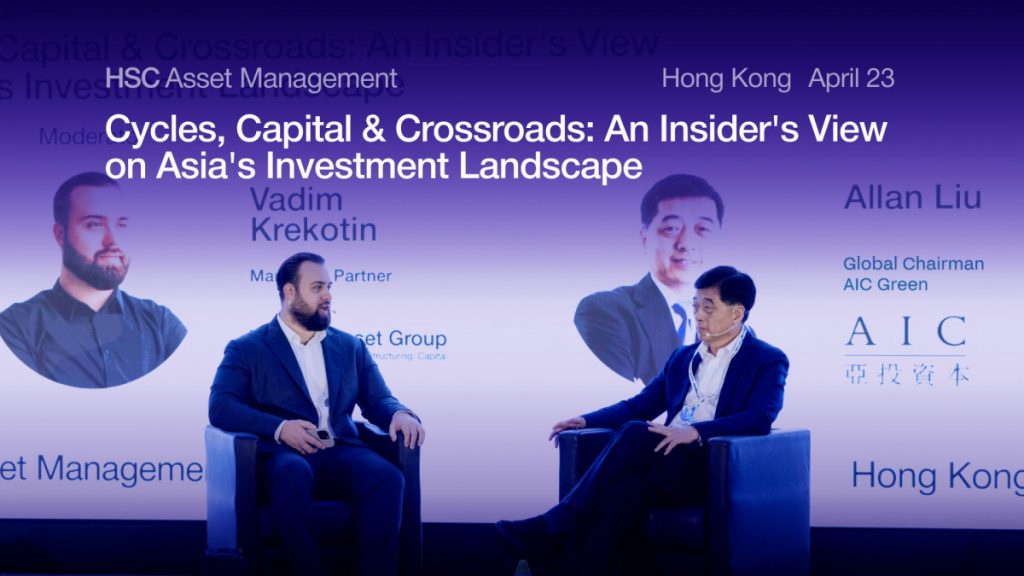
On April 23rd, HSC Asset Management in Hong Kong brought together industry leaders to examine the evolving landscape of cryptocurrency and institutional finance.
Among the key discussions was a fireside chat titled “An Insider’s View on Asia’s Investment Landscape,” which explored the forces reshaping global capital markets at the intersection of traditional and digital finance.
In this conversation, Allan Liu, Global Chairman of AIC, shared his perspective with Vadim Krekotin, Managing Partner at HSC Asset Group, offering a deep look into how capital flows, investment strategies, and market structures are evolving across Asia and beyond.
Lessons from China’s Opening: Building Trust Before Capital
The conversation began with a reflective account of China’s early reform era, using one speaker’s career as a lens for understanding how major market transitions begin. The central idea was that meaningful capital formation rarely starts with money alone. It starts with information, trust, and a credible narrative that allows outsiders to believe in an unfamiliar market. In the early 1980s, when foreign investors had almost no data, no clear laws, and little understanding of Chinese consumers, the speaker described building the investment case sector by sector through research, reports, and direct engagement with global firms and governments.
That approach helped convert uncertainty into conviction. By publishing independent studies on China’s investment environment and persuading multinational companies to stay engaged after political shocks, he argued that the real work was not just to attract capital, but to make long-term capital possible. The message was that markets open when institutions can finally see how to operate inside them.

From Foreign Investment to Private Equity
The discussion then moved to the next stage of his career: bringing capital into China rather than simply bringing companies in. After helping establish the logic for foreign direct investment, he shifted toward private equity because the country needed not just multinationals, but capital to support its own entrepreneurs and domestic companies. That second leap was described as equally important, because it marked a transition from market access to market building.
He recalled helping introduce private equity as a business model to Chinese policymakers in the early 1990s, eventually contributing to the creation of the first true private equity fund in China. In his telling, this was not just a business opportunity but a response to a financial system under strain. Banking-sector distress, bad debt, and systemic weakness created the need for a more flexible, more disciplined capital-allocation model. His conclusion was that private equity succeeded because it filled a structural gap.
Crisis as Opportunity, Discipline as Survival
A major theme throughout the conversation was how crises reshape markets. Drawing on the Asian Financial Crisis, the global financial crisis, credit tightening, and other cycles, the speaker argued that every downturn has its own character, but one principle always repeats: crisis creates opportunity for those with discipline and patience. He described how many major private equity firms in Asia were born around the bottom of the 2008–2009 cycle, when asset prices were low and capital could be deployed wisely.
His advice was blunt. Investors should never overpay, never assume that a peak will last, and never let optimism replace discipline. In his view, the best private equity investors are not the ones who move fastest in a boom, but the ones who preserve entry discipline, remain patient through the cycle, and exit when conditions are favorable. For him, this philosophy has been consistent across decades and market regimes.
Capital’s New Georgaphy
The conversation then widened into the present moment, which he described as a global reset of trade rules, tariffs, alliances, and capital flows. In this environment, he warned that a China-only investment mandate is increasingly too narrow and too risky for many global allocators. Limited partners, especially in the West, are now more cautious about China exposure, while fund managers face pressure to structure around those concerns.
His answer was adaptation. Rather than trying to force old fund structures onto a new world, managers need to create flexible vehicles, separate mandates, and tailored partnerships. He also emphasized the importance of “playing the China theme” without necessarily investing directly in China. That means helping Chinese companies expand outward, building ecosystems in other regions, and supporting cross-border industrial and technological partnerships.
The New Logic of Outbound China
One of the most striking ideas in the discussion was that capital today must often travel together with technology, manufacturing, and local partnerships. The speaker argued that Chinese firms in sectors such as transformers, digital infrastructure, and advanced manufacturing can succeed abroad only if they localize. In markets like the Middle East, Europe, or North America, companies cannot simply export a product and expect success. They must build local supply chains, partner with local firms, and adapt to local rules.
That point led to a broader reflection on the role of private equity itself. In this new phase, private equity is not just about writing a check. It is about assembling a full ecosystem: capital, suppliers, technologies, customers, and partners. The investor becomes a catalyst, but also a bridge-builder.
Asia, GCC, and the Future of Partnership Capital
The latter part of the conversation focused on the deepening relationship between Asia and the Gulf. The speaker described both inflows and outflows as part of a larger reconfiguration of global capital. Gulf investors want access to top-tier Asian managers and technology, while Asian firms need capital and market access in Gulf countries. But again, the message was that money alone is not enough. Countries such as those in the GCC want technology transfer, industrial localization, and alignment with national development agendas.
This is why the future, in his view, belongs to partnerships rather than passive ownership. Capital must be matched with experience, networks, and execution. For Asia’s next growth phase, the winners will be those who can combine international capital with Chinese or Asian talent, technology, and manufacturing know-how.
The closing advice was personal and practical: build relationships, work through partnerships, and do not be afraid to change direction. The speaker framed his own career as a series of timely leaps, each one tied to a different historical moment. His final message was that the next generation should stay adaptable, stay curious, and follow conviction rather than routine. In a world where markets, geopolitics, and capital flows are being rewritten, that may be the most durable strategy of all.
Disclaimer
In line with the Trust Project guidelines, please note that the information provided on this page is not intended to be and should not be interpreted as legal, tax, investment, financial, or any other form of advice. It is important to only invest what you can afford to lose and to seek independent financial advice if you have any doubts. For further information, we suggest referring to the terms and conditions as well as the help and support pages provided by the issuer or advertiser. MetaversePost is committed to accurate, unbiased reporting, but market conditions are subject to change without notice.
About The Author
Alisa, a dedicated journalist at the MPost, specializes in crypto, AI, investments, and the expansive realm of Web3. With a keen eye for emerging trends and technologies, she delivers comprehensive coverage to inform and engage readers in the ever-evolving landscape of digital finance.
More articles

Alisa, a dedicated journalist at the MPost, specializes in crypto, AI, investments, and the expansive realm of Web3. With a keen eye for emerging trends and technologies, she delivers comprehensive coverage to inform and engage readers in the ever-evolving landscape of digital finance.

More articles


