Web3

Home Web3 Page 93

Spheron X Hivello: Unlocking New Paths for DePIN Supply and User Earni

0
Spheron X Hivello: Unlocking New Paths for DePIN Supply and User Earni


For the past decade, the cloud has been dominated by a few giant providers: Amazon Web Services, Microsoft Azure, and Google Cloud. They made it easy to launch applications at scale, but their dominance came with costs. Renting high-end GPUs like NVIDIA’s 1 H100 can cost between $7.57 and $11 per hour on centralized providers, translating into $40,000+ per month for sustained use. For AI startups and Web3 builders, these costs are not just painful; they’re existential.

The problem isn’t only price. Centralized clouds also control who gets access, set opaque pricing rules, and reserve the right to cut services overnight. They have turned compute into a scarce commodity when, paradoxically, billions of devices worldwide already have idle resources that go untapped.

This imbalance led to the rise of DePIN , Decentralized Physical Infrastructure Networks. Instead of a handful of corporations owning the rails of the digital economy, DePIN distributes infrastructure across communities. Anyone with spare GPUs, CPUs, bandwidth, or storage can plug in and earn, while developers gain cheaper, censorship-resistant alternatives to the cloud.

At Spheron Network, we believe in infrastructure that empowers communities, not corporations. Today, we are proud to announce our partnership with Hivello, a DePIN aggregator that makes it easy for anyone to monetize idle computing resources. Together, we will scale the supply side of the DePIN ecosystem, help more people earn, and build stronger, more resilient infrastructure for AI and Web3.

The Scale of the DePIN Opportunity

DePIN has moved quickly from a niche idea to a major market narrative. By early 2025, analysts tracked over 1,500 active projects across compute, storage, bandwidth, wireless, etc. According to CoinGecko, the combined market cap of leading DePIN tokens surpassed $19 billion in September 2025, up nearly 4x from the year before. And the World Economic Forum projects that the sector could balloon to $3.5 trillion by 2028. , making it one of the fastest-growing segments of the digital economy.

But growth on paper doesn’t always translate into practical scalability. While demand for decentralized compute is rising , particularly from AI, which is projected to consume 1 trillion liters of water annually by 2028 just to cool data centers (Morgan Stanley) , the supply side of DePIN is still under pressure. Networks struggle to onboard new users at scale, node operators often lack technical knowledge, and reward systems can feel opaque or unpredictable.

The gap is clear: without easier ways for people to contribute resources, DePIN risks becoming another good idea that fails to scale.

Why the Supply Side of DePIN Struggles

DePIN has huge promise. It can turn unused resources, your GPU, CPU, and bandwidth, into income. It can spread infrastructure more evenly, reduce dependency on big cloud providers, and bring innovations closer to users. But DePIN still faces real, measurable problems:

The challenges facing DePIN contributors are not theoretical; they are lived experiences of early adopters. Many people who want to join find themselves stuck at the first hurdle: installing node software, configuring ports, setting up wallets, and ensuring 24/7 uptime. These processes may be second nature to crypto-natives but are intimidating for the average user.

Even those who succeed face uncertainty about whether earnings justify the effort. Electricity costs eat into rewards, hardware degrades under constant load, and some projects pay inconsistently. Without transparency and predictable incentives, users churn quickly.

Then there’s the issue of distribution. Most DePIN nodes cluster in a few geographies. This leaves large parts of the world underserved, creating latency issues for applications that need low-lag inference or real-time processing. And when supply lags demand, costs stay high, defeating the very purpose of decentralization.

Hivello’s Answers Making DePIN Simple

This is where Hivello comes in. Hivello has made it its mission to make DePIN participation accessible to everyone, not just the technically skilled. Instead of requiring users to navigate a maze of dashboards and node clients, Hivello offers a single, user-friendly interface. Plug in your idle computing resources, whether CPU or GPU, and the platform does the rest.

Hivello acts as an aggregator, connecting users to multiple DePIN networks behind the scenes. For contributors, this means no need to learn the quirks of each network, no need to constantly monitor uptime, and no need to stress about integrations. For DePIN projects, it means a steady inflow of new supply that would otherwise have been locked out.

The model is already proving itself. By simplifying onboarding, Hivello reduces friction and boosts contributor retention. The more contributors it attracts, the more stable and geographically distributed the supply becomes. This, in turn, makes DePIN networks more reliable for developers, closing the loop between supply and demand.

As Hivello co-founder Domenic Carosa explained when announcing the partnership: “By partnering with Spheron, we are not only providing our users with a new, high-value earning opportunity but also validating our model by helping a major network scale its infrastructure.”

Spheron’s Role Providing Infrastructure at Scale

If Hivello solves the human side of DePIN onboarding, Spheron provides the compute backbone that turns those contributions into usable infrastructure.

Spheron is building the world’s first community-powered data center, pooling idle GPUs and CPUs from thousands of contributors worldwide. The network already supports tens of thousands of nodes, providing compute for AI training, inference, and Web3 applications. For developers, it offers cost savings of up to 80–90% compared to Hyperscalers while maintaining global distribution and censorship resistance.

For Hivello, Spheron is the natural partner. Every new user onboarded through Hivello can feed directly into Spheron’s network, expanding supply where it’s needed most. For contributors, this means a new high-value earning stream powered by real AI and Web3 workloads. For Spheron, it means scaling supply faster to meet rising demand.

What the Partnership Delivers

The Spheron x Hivello partnership is focused on practical outcomes:

Onboarding at Scale: Hivello brings in contributors who would otherwise be locked out, lowering technical barriers and simplifying participation.

Stronger Supply for Spheron: These contributors feed into Spheron’s decentralized GPU and CPU pool, strengthening its global infrastructure.

Better Economics for Users: Contributors earn from real workloads; developers save on compute costs. Both sides win.

Transparency and Trust: Together, we will deliver clear dashboards, performance metrics, and predictable earnings so users know exactly what they’re getting.

This isn’t just a partnership for press releases. It’s a blueprint for how DePIN projects can tackle their most significant challenge: scaling supply without compromising simplicity.

Looking Ahead

DePIN is no longer a buzzword. It’s an economy in motion, backed by billions in capital and thousands of projects. But to fulfill its potential, it must make participation as easy as logging into an app. That’s the gap Hivello fills, and with Spheron’s infrastructure behind it, contributors gain real earning power while developers gain a reliable supply.

The DePIN market is expected to reach $3.5 trillion within three years. The only way it gets there is if people can contribute at scale, with trust, transparency, and economic sense.

By combining Hivello’s accessible onboarding with Spheron’s decentralized compute backbone, we’re showing what that future looks like. A DePIN ecosystem powered not by corporations but by communities. A network where every idle GPU or CPU can generate income, and every developer can deploy workloads affordably and reliably.

The infra layer for DePIN is here , and it’s built by people, for people.


Source link

Key Takeaways From Messari’s Research Report on Spheron Network

0
Key Takeaways From Messari’s Research Report on Spheron Network


On September 18th, 2025, Messari published a research report titled “Understanding Spheron: A Comprehensive Overview.” The study, produced by Messari’s independent analysts, provides a detailed look into Spheron’s technology, tokenomics, ecosystem, and growth trajectory. While we encourage everyone to read the full report, here are the most important takeaways.

Celebrating Our Journey and Growth

Messari’s report begins by tracing Spheron’s journey from its origins as ArGoApp in 2020, where the focus was on decentralized hosting for Web3 applications. By 2021, the team shifted direction, retiring the storage product and launching Spheron Network with a broader vision: to build a decentralized compute layer for the world. Over time, the network has evolved with several important milestones, including decentralized container deployments in 2024, the release of the “On-Demand by DePIN for GPUs” whitepaper, and the launch of Supernoderz and Skynet in early 2025, which made node participation and AI agent building accessible through no-code platforms.

The financial performance of the network was another highlight. By mid-July 2025, Spheron had already generated $10M in annual recurring revenue (ARR), and by the end of August, this number had crossed $12M. Importantly, this traction came before the launch of the SPON token, showing that Spheron’s network utility and demand are not purely token-driven but built on real-world adoption.

Expanding Our Ecosystem and Partnerships

The report highlighted how Spheron has become a cornerstone in the DePIN and AI infrastructure sectors. Today, the network has built more than 100 strategic partnerships, working with projects such as DAWN, Sentient, Wire Blockchain, and Warden Protocol. These collaborations highlight the versatility of the network, which powers decentralized AI workloads, enables consumer devices to act as nodes, and supports cross-chain applications.

Beyond integrations, Spheron has also raised over $7.1 million in venture funding to accelerate its vision. The Messari report recognized the importance of this backing, which includes support from Protocol Labs, Consensys Mesh, Zee Prime Capital, Nexus Venture Partners, and Tykhe Ventures, along with a strategic investment from Arcanum Ventures earlier this year. This diverse investor base underlines confidence in Spheron as a long-term player in decentralized infrastructure.

Showcasing Our Dual-Node Architecture

One of the most detailed sections of the Messari analysis was the technology that underpins Spheron. The network operates on a dual-node architecture consisting of Provider Nodes and Fizz Nodes. Provider Nodes are enterprise-grade machines contributed by data centers, while Fizz Nodes are lightweight clients that allow individuals to contribute spare GPUs or CPUs from personal hardware such as desktops and laptops.

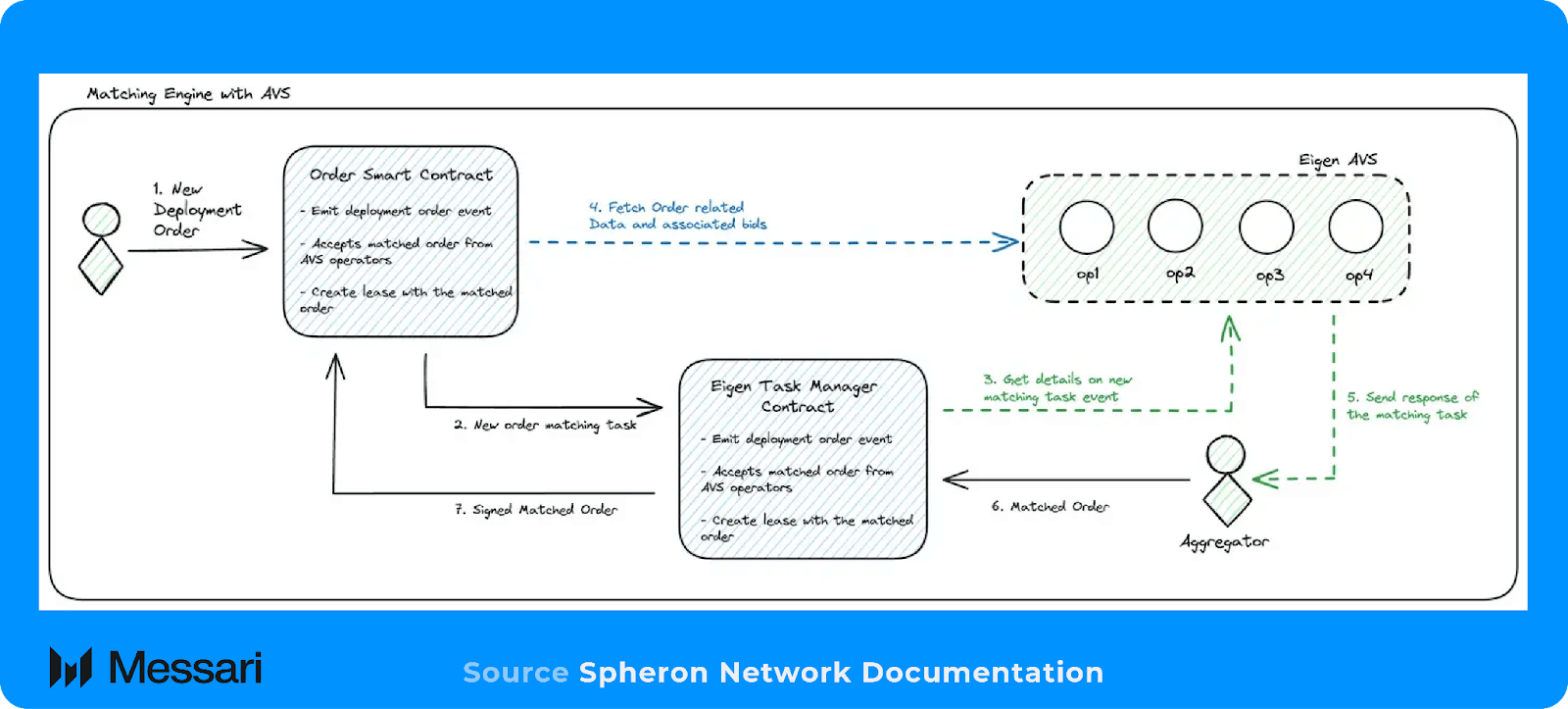
Provider Nodes are chosen through a matchmaking process that takes into account a range of criteria: the provider’s pricing, uptime record, geographic location, reputation, resource availability, stake, and even a degree of randomness to prevent centralization of rewards. Once selected, a provider enters into an on-chain lease agreement with the user, ensuring transparent and secure deployment.

Fizz Nodes, meanwhile, are designed to make participation easy for everyday users. They consist of three main components: a pricing configuration to set resource costs, an orchestrator that manages container deployments, and a service tunnel that connects local machines to the wider Spheron network. Through the Gateway Service, Fizz Nodes can work collectively, forming subnets with their own micro-economies and governance rules. This dual-node model extends Spheron’s reach, combining enterprise reliability with grassroots decentralization.

Payment Streaming and Secure Escrow

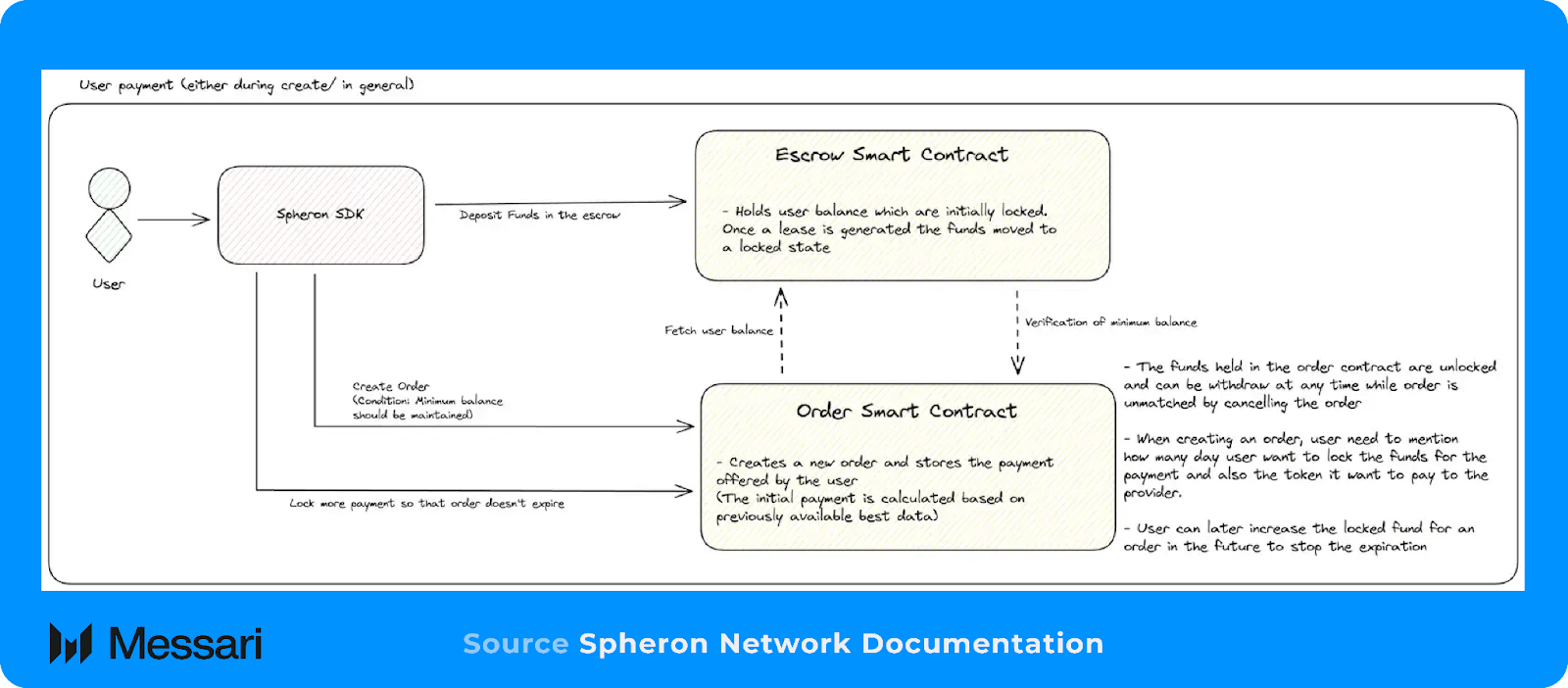
Messari’s research also detailed Spheron’s payment and escrow system. When users rent compute, they deposit funds into an escrow wallet, which locks the required amount for the lease and then streams payments to providers in real-time based on block timestamps. If workloads end early, unused funds are automatically refunded, ensuring fairness on both sides.

The system also enforces rules for token usage. Payments made in non-SPON tokens incur a 5% facilitation fee, whereas transactions conducted in SPON are fee-free, creating an incentive to use the native token. Providers also contribute a share of their earnings back to the network treasury. Together, this creates a self-sustaining loop where usage fuels rewards, and rewards encourage participation.

SPON Token Utility and Distribution

The Messari report reaffirmed the central role of SPON in the Spheron ecosystem. The token is used for compute payments, staking, rewarding node operators, and in the future for governance decisions. Providers are required to stake SPON to activate their bidding engines, and delegators can stake alongside providers to share in rewards, broadening participation.

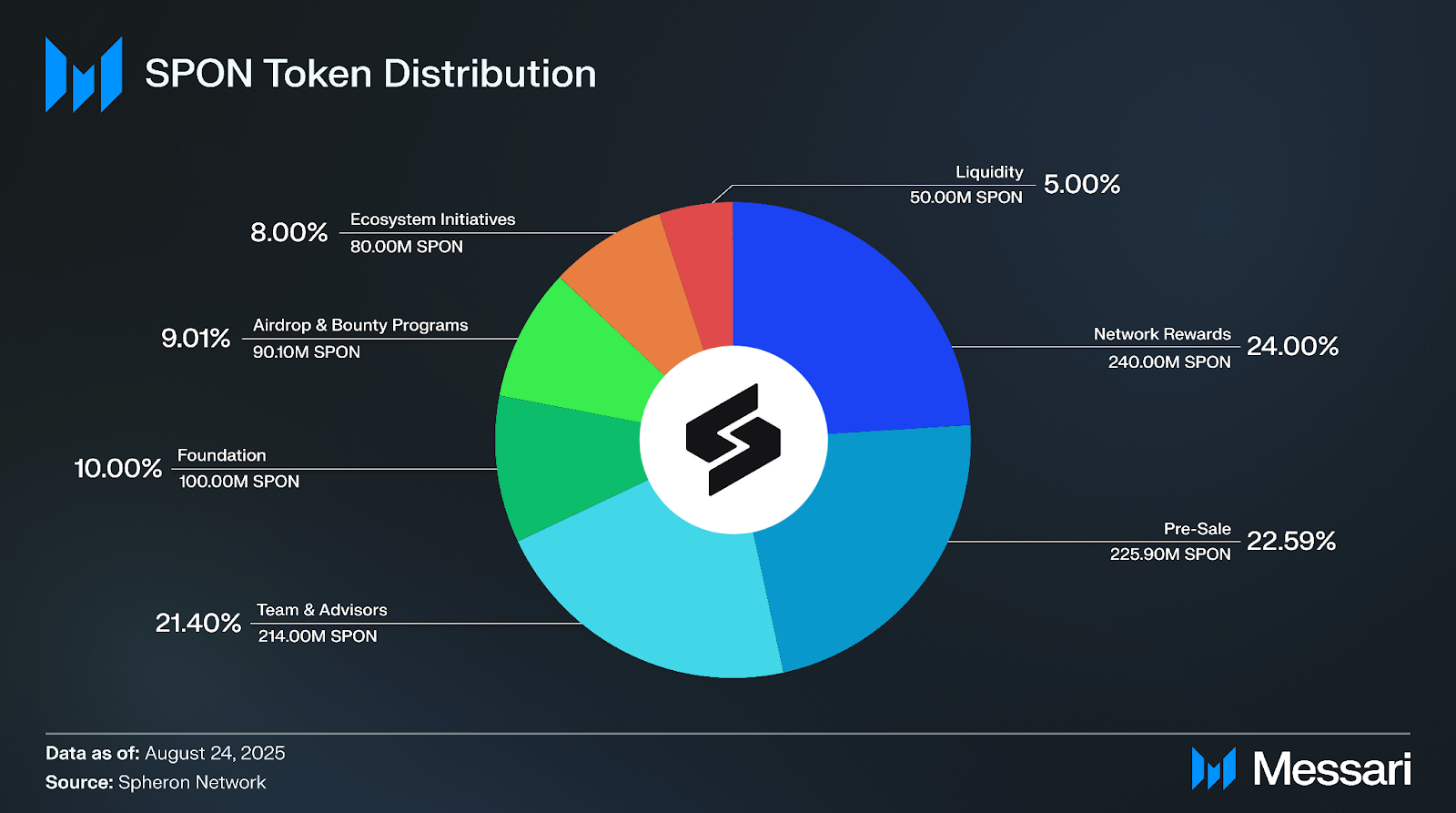
The token allocation was outlined in detail: 24% for network rewards released over 48 months, 21.4% for team and advisors with a four-year vesting schedule, 21.26% for pre-sale investors, 1.33% for strategic investors, 10% for the foundation treasury, 9.01% for airdrops and bounties, 8% for ecosystem initiatives, and 5% for liquidity at launch.

The report also noted the introduction of the Secure Compute buyback-and-burn mechanism, where tokens are repurchased with surplus network revenue and permanently removed from circulation. The first burn, executed in September 2025, retired 0.65% of the total supply.

Roadmap and What’s Ahead

Looking forward, Messari highlighted Spheron’s roadmap for the remainder of 2025. In Q3, the focus is on product enhancements: dashboards for both providers and users to monitor utilization, support for AMD GPUs, escrow balance alerts, and the launch of the Agent Marketplace and Docker Marketplace, which will open new avenues for developers to deploy, monetize, and scale their workloads.

In Q4, attention shifts to scaling and security. The network will introduce Multi-Party Computation (MPC) and Trusted Execution Environments (TEEs) for sensitive data protection, decentralize its matchmaking engine, and launch the Slark Node validation network for improved reliability. Features such as automatic workload replacement and dynamic price rebalancing will strengthen uptime guarantees, while enterprise partnerships and global data center onboarding will expand the network’s footprint worldwide.

Spheron’s Growth Potential

Messari’s conclusion positions Spheron as a frontrunner in decentralized compute. With real revenues, a sustainable token economy, and infrastructure designed to meet the demands of AI and Web3 builders, Spheron is uniquely placed to challenge cloud incumbents and become a cornerstone of the DePIN ecosystem. The combination of Provider Nodes, Fizz Nodes, and the SPON token economy provides the foundation for a compute network that is scalable, resilient, and community-owned.

You can read Messari’s full report here: 👉 Understanding Spheron on Messari


Source link

Dogecoin Rises as First US DOGE ETF ‘Destroys’ Expectations in Early Trading – Decrypt

0
Dogecoin Rises as First US DOGE ETF ‘Destroys’ Expectations in Early Trading – Decrypt


In brief

Dogecoin is up 8% in the last 24 hours as the first ETF with spot exposure hits the market.
The DOJE ETF generated nearly $6 million in trading volume in the first hour, surpassing Bloomberg analyst expectations.
More Dogecoin ETFs are expected to hit the market in the next month.

Dogecoin (DOGE) is up 8% in the last 24 hours, outperforming major assets like Bitcoin and Ethereum alongside the debut of DOJE—the first U.S. ETF centered on the leading meme coin. 

Trading of the Rex-Osprey ETF went live for trading on Thursday and very quickly surpassed the expectations of Bloomberg Senior ETF Analyst Eric Balchunas, who initially expected a fair marker of around $2.5 million in trading volume. 

Shortly into Thursday’s trading session though, DOJE had already reached nearly $6 million in trading volume. 

“My over/under got destroyed in the first hour of trading as DOJE already posted nearly $6M in volume,” Balchunas posted on X. “That’s shockingly solid. Most ETFs trade under $1M on day one.”

The DOJE ETF, which is registered under the Investment Company Act of 1940, offers investors access to spot Dogecoin via a Cayman Islands registered subsidiary that is wholly owned by the fund. 

That stands in contrast to other popular crypto ETFs registered via the Securities Act of 1933, which are backed by reserves of the underlying assets. 


Dogecoin ETFs registered under the Securities Act of 1933 may be approved soon though, as looming decisions for multiple DOGE ETFs from issuers like Grayscale and Bitwise are expected by October 17 and are “near locks” for approval according to analysts. 

Beyond the ETFs, the meme coin’s acceleration in the last week may also be buoyed by accumulation via the publicly traded firm CleanCore Solutions. The cleaning and disinfecting firm now manages the first “official” Dogecoin treasury in collaboration with the Dogecoin Foundation’s commercial arm, the House of Doge.

CleanCore added 100 million DOGE earlier this week, bolstering its balance sheet to 600 million DOGE in total, or around $170 million worth. Its long-term goal is to accumulate 5% of the entire Dogecoin circulating supply—about 7.5 billion DOGE, or around $2.1 billion worth. 

Dogecoin is currently priced at $0.286, rising nearly 34% over the last 30 days.

Daily Debrief Newsletter

Start every day with the top news stories right now, plus original features, a podcast, videos and more.


Source link

Avalanche and Hyperliquid Lead Crypto Rally Post-Fed Rate Cut – Decrypt

0
Avalanche and Hyperliquid Lead Crypto Rally Post-Fed Rate Cut – Decrypt


In brief

Crypto markets have posted broad gains following the Federal Reserve’s quarter-point rate cut.
Hyperliquid’s USDH stablecoin has been “attracting liquidity across the board from many institutions,” according to an analyst.
The momentum now hinges on project-specific catalysts, with altcoins more exposed to volatility than Bitcoin, experts told Decrypt.

Avalanche (AVAX) and Hyperliquid (HYPE) led the altcoin rally on Thursday as digital assets responded positively to the Federal Reserve’s latest rate cut and project-specific developments.

AVAX rocketed 10.1% to $32.59, while HYPE jumped 7.2% to $58.43 in the past 24 hours, according to CoinGecko data. 

Other major altcoins followed suit, with Dogecoin (DOGE) advancing 5.4% to $0.27, Solana (SOL) climbing 4.5% to $244 and Cardano (ADA) rising 4.3% to $0.90. (ADA) rising 4.3% to $0.90.


Bitcoin (BTC) maintained its position above $117,000 with a modest 0.3% gain, while Ethereum (ETH) posted a 2.1% increase to $4,588.

The rally follows the Fed’s widely anticipated quarter-point rate cut, which lowered the federal funds rate to a range of between 4.25% to 4.50%. 

Bitcoin and other major digital assets largely traded flat in the immediate aftermath, as investors had already priced in the highly anticipated Fed call.

“While the Fed’s rate cut buoyed broader risk sentiment, AVAX’s outperformance seems driven by Avalanche’s announcement of a $1 billion Digital Asset Treasury plan,” Min Jung, senior analyst at quantitative trading firm Presto, told Decrypt.

The Avalanche Foundation is in advanced talks to raise $1 billion via a Nasdaq-listed firm backed by Hivemind and a Dragonfly-sponsored SPAC, with proceeds earmarked for discounted AVAX buybacks, according to the Financial Times.

Bitwise also filed paperwork on Monday for an AVAX ETF, utilizing Coinbase to custody the digital assets, which adds to the token’s institutional adoption prospects.

Jung noted the rally could “sustain in the near term as the biggest macro risk event—the FOMC—has now been cleared,” though with the cut “largely digested,” moves will depend on “headlines and project-specific catalysts.”

Ganesh Mahidhar, Investment Professional at Further Ventures, told Decrypt that in the case of Hyperliquid, its stablecoin “USDH is attracting liquidity across the board from many institutions,” with perp trading built so that “custody is not with the exchange but the UX is just as smooth as a centralized exchange,” he said.

“In terms of macro, the rate cut news definitely has had an impact,” he added, though it may be “short-lived” since cuts had been “priced into the markets for many months now.”

Nic Puckrin, founder of The Coin Bureau, told Decrypt that “it’s the signal, not the size, that counts,” noting the 25bp cut shows the Fed is finally easing after months of inflation and weak labor data. 

“Hope is high and there’s a big chance of a ‘sell the news’ pullback,” he added, with meme coins most vulnerable to “pump fast and collapse fast” volatility.

Daily Debrief Newsletter

Start every day with the top news stories right now, plus original features, a podcast, videos and more.


Source link

SEC Clears Path for ‘Waves’ of Crypto ETFs With New Listing Standards – Decrypt

0
SEC Clears Path for ‘Waves’ of Crypto ETFs With New Listing Standards – Decrypt


In brief

The standards bar leveraged and inverse trusts from using the generic path.
Eligible assets must already be traded on regulated, surveilled markets or backed by an existing ETF.
Solana and Litecoin ETFs could arrive within weeks, with Dogecoin and others in line, Decrypt was told.

The U.S. Securities and Exchange Commission signed off Wednesday on new generic listing standards for commodity-based trusts, a move that analysts say could swing the door wide open for crypto products beyond Bitcoin and Ethereum.

The new standards, approved for Nasdaq, Cboe BZX, and NYSE Arca, allow trusts that meet defined criteria to list without a separate Commission order. They bar leveraged and inverse structures, but create a pathway for commodity or crypto-linked products to qualify more quickly.

“It was expected, but big, because it’s gonna mean that about 12 to 15 coins are good to go,” Eric Balchunas, senior ETF analyst at Bloomberg Intelligence, told Decrypt in a call. “You start getting the coins coming in waves,” he said, adding that this factor is “pretty big” considering that “right now, only two really exist under the 33 Act.”


Balchunas was pointing to the Securities Act of 1933, often shortened to the ’33 Act. It is a U.S. statute that governs the initial offer and sale of securities to the public and requires issuers to register their products with the SEC and provide full, fair disclosure in a prospectus.

That statute has long been “the more appropriate place to file them,” for commodity-style funds like SPDR Gold Shares and BlackRock’s iShares Bitcoin Trust, Balchunas explained.

“It’s going to be real nice for investors to have 33 Act spot ETFs with reasonable fees and low trading spreads in the ETF wrapper, which has been vetted by the SEC. It’s a beautiful thing,” Balchunas said.

In a section on the discussions around the standards, the SEC said the rules are “designed to help prevent fraudulent and manipulative acts and practices” while improving market transparency and investor protection. These steps help “perfect the mechanism of a free and open market and a national market system,” the discussion reads.

In any case, the standards would require underlying assets to trade on surveilled markets, have a futures history, or already back an exchange-traded fund with significant exposure.

Trusts must also publish daily holdings, net asset values, and liquidity policies, while market makers face trading limits and firewalls to block misuse of non-public information.

Still, Balchunas thinks the SEC’s latest action sets the stage for the broadest expansion of crypto ETFs since spot Bitcoin products debuted last year.

Asked about ETF expectations for the near term or within the year, Balchunas said he sees Solana and Litecoin leading the next wave of approvals.

“You’re not going to see everything on one day,” Balchunas said. Solana and Litecoin ETFs could be the “ones that come out first, probably within a month,” he said, adding that Dogecoin could follow soon after.

An XRP ETF, meanwhile, may lag a bit, because “the futures aren’t exactly six months old, which is a criterion, so they might be a little later than the other ones,” he said.

Daily Debrief Newsletter

Start every day with the top news stories right now, plus original features, a podcast, videos and more.


Source link

Why Are Myriad Users Betting on the Color of Fed Chair Powell’s Tie Today? – Decrypt

0
Why Are Myriad Users Betting on the Color of Fed Chair Powell’s Tie Today? – Decrypt


In brief

Myriad traders are betting on whether Jerome Powell will wear a purple tie at the September FOMC press conference—odds heavily favor Yes.
Purple has become Powell’s signature color, signaling the Fed’s commitment to neutrality over partisan “red vs. blue” politics.
The quirky market highlights how prediction platforms are moving beyond rate calls to trade on symbolism and style cues.

A peculiar but revealing market is getting serious traction on Myriad: Will Fed Chair Jerome Powell wear a purple tie during the September FOMC press conference?

As of now, the crowd overwhelmingly believes yes. But it’s not just about fashion—this prediction market taps into deeper symbolism around the Fed’s public identity.

According to a recent report by Columbia Business School, Powell’s choice of a purple tie is no accident. Brett House, economist and professor at Columbia, noted that Powell’s consistent use of purple is a part of reinforcing the Federal Reserve’s image as non-political in an era of heightened polarization. 

Here’s what’s known:

When asked, Powell said purple was once just a personal preference. But over time, he began to see its utility: “Maybe not red. Maybe not blue. So I wind up wearing purple.” He saw purple as a neutral ground, signaling a lack of alignment with either side of the political spectrum. And lately, it’s become something of a signature. 

(Disclaimer: Myriad is a product of DASTAN, Decrypt’s parent company.)

He explicitly frames this aesthetic (tie color) as helping project the message that the Fed is strictly non-political—not embracing party red or blue, but purple in between. 

So when people are putting money on “Powell wears purple,” they aren’t just betting on wardrobe chance—they’re betting on consistency, signaling, and public messaging.

The Myriad market: Purple tie or not?

Here’s what the market looks like:

Question: Will Jerome Powell wear a purple tie during the September FOMC press conference?

Large sentiment says Yes. Significant volume is leaning that way. (Exact figures shift with time.)

Resolution rules: Must be purple or a pattern where purple is the dominant color. Shades like lavender or violet qualify; red, blue, or burgundy do not. The market typically closes shortly before the event, and official feeds/video resources will decide.

Because of Powell’s established pattern and public statements, the “Yes” side seems to carry weight beyond random guesswork.

Things that could upset the odds

Lighting/camera differences: A tie that looks violet on camera might register differently under stage lights, or in certain video streams.

Tie patterns/mixed colors: A tie with multiple colors where purple isn’t dominant could create disputes.

Last-minute changes: Powell could change his wardrobe plan; things like his stylist’s decisions, availability of a tie, or even mood might matter.

Disclaimer

The views and opinions expressed by the author are for informational purposes only and do not constitute financial, investment, or other advice.

Daily Debrief Newsletter

Start every day with the top news stories right now, plus original features, a podcast, videos and more.


Source link

Spheron X OpenGradient Forge a Partnership for User-Owned Intelligence

0
Spheron X OpenGradient Forge a Partnership for User-Owned Intelligence


AI is becoming a part of everyday life, helping with everything from telling us the weather to drafting documents or advising on health. Yet for many people, the promise of AI falls short. The core issue is trust: who owns the data, who controls the model, and who benefits when the model improves.

Spheron is proud to announce a strategic partnership with OpenGradient. Through this collaboration, we will provide users with more control, enhanced privacy, and increased benefits from the AI they utilize.

The Problem: Data Ownership, Privacy, and Trust in AI

Modern AI systems often require large amounts of personal or behavioural data. That data may include voice notes, health information, location data, preferences, and browsing history. In many cases, users do not know exactly how much is collected, how it is used, or who can access it.

Here are some concrete issues:

Because of these issues, many AI experiences feel generic, impersonal, or untrustworthy. When a user has to repeat preferences, or when confidential information might be exposed, or when the benefit of their input is not shared back, the relationship between the user and AI is unequal.

How OpenGradient Provides a Solution

OpenGradient provides a vision and a platform built around giving people ownership over their AI context and data. The core elements of the solution are:

User-Owned Data: Data stays encrypted and private. Users decide who has access and when. There are tools for revoking permissions and visibility. OpenGradient supports private memory vaults on devices or secure enclaves so that sensitive context is not stored in uncontrolled centralized servers.

Transparent, Auditable Models: Models are open or auditable. Anyone can inspect or fork them, see how they operate, and verify their behaviour. There is no hidden logic that shapes decisions without oversight.

Decentralized Infrastructure and Verifiable Compute: Inferencing and computation happen in a way that is verifiable and secure. That means using protocols that prove what computation happened, avoiding single points of failure or trust.

Shared Value: If your data or preferences help improve a model, then you share in the benefit. You are not just a user but a co-creator of intelligence.

Interoperability: OpenGradient’s model hub is designed to allow different models, agents, and applications to work with each other under rules and permissions that you control. Context can travel with you across applications, safely.

These features address the core problems of control, trust, privacy, and benefit that current AI systems often neglect.

Spheron Network’s Role and Alignment with the Vision

Spheron Network is a decentralized compute and providing compute infrastructure that aims to make deployment, hosting, and inference of applications, including AI models, more reliable, accessible, and sovereign.

Here is how Spheron supports OpenGradient’s vision:

Decentralized Hosting and Compute: Spheron enables model hosting on a geographically distributed network of nodes. This avoids centralization and single points of vulnerability. Models do not all have to live in one data centre or cloud provider.

High Performance and Reliability: Real-time inferencing requires low latency and fast response. Spheron’s infrastructure is built to maintain performance even under load or with many nodes participating.

User-First Security: By combining secure hardware nodes, access controls, and flexible deployment, Spheron ensures that data remains protected. When OpenGradient wants to deploy a model that uses private memory, Spheron’s infrastructure supports the necessary guarantees around secure execution.

Open and Transparent Ecosystem: Spheron aligns with OpenGradient in open models, auditable systems, and community-driven development. Spheron’s infrastructure is built so that developers can inspect what is happening, contribute, and build on top without oppressive fees or lock-in.

Together, Spheron and OpenGradient share the goal of shifting power and benefit from centralized platforms back to individual users and creators.

Partnership Details

Here are the practical ways in which Spheron and OpenGradient will work together:

Model Hub Integration: Spheron will adopt OpenGradient’s Model Hub for its Smart Agents. T

Hosting and Inferencing Services: OpenGradient’s models will run on Spheron’s network. That includes hosting, inference, deployment, and scaling. Users relying on OpenGradient will benefit from Spheron’s hardware reach, redundancy, and performance.

Moving Forward

This partnership is more than a technical collaboration. It is a shared vision for the future of AI.

By combining Spheron’s decentralized compute with OpenGradient’s context protocols, we are working toward a world where AI systems remember you, respect you, and reward you. We are building tools that do not just extract data but actually give users control over their digital identities and contributions. We are enabling models that can be inspected, audited, and improved by anyone, not hidden behind proprietary walls.

The path ahead will focus on scaling adoption, supporting developers, and continuing research at the intersection of AI and decentralization. Both communities — Spheron’s global network of compute providers and OpenGradient’s ecosystem of researchers and builders — are invited to participate in this journey. Together, we can create applications that are not only smarter but also fairer, safer, and more human-centered.

Conclusion

The story of AI so far has been shaped by centralization. A few companies have built massive platforms fueled by data from millions of people. But the next chapter can be different. With OpenGradient and Spheron working together, we have the opportunity to create AI that belongs to its users, runs on community infrastructure, and grows through shared value.

This partnership represents a concrete step in that direction. By integrating OpenGradient’s Model Hub into Spheron’s Smart Agents and by powering OpenGradient’s hosting and inferencing on Spheron’s decentralized network, we are laying the foundation for a digital future that is both intelligent and decentralized.

If you are a builder, researcher, or user who shares this vision, we invite you to join us. Explore the OpenGradient Model Hub. Try deploying on Spheron’s infrastructure. Contribute to the growing ecosystem of decentralized, user-owned AI. The future of intelligence should not belong to a few. It should belong to all of us.


Source link

Bitcoin ETFs Record Strongest Inflows Since July, Push Holdings to New High – Decrypt

0
Bitcoin ETFs Record Strongest Inflows Since July, Push Holdings to New High – Decrypt


In brief

Bitcoin ETPs saw a net inflow of 20,685 BTC last week, driven mostly by U.S. ETFs.
The recent uptick in investor risk appetite is driven by rate cut expectations and new crypto IPOs.
Despite institutional demand outpacing new Bitcoin supply, realized and implied volatility remain historically low.

Bitcoin exchange-traded products globally logged net inflows of 20,685 BTC last week, the strongest weekly intake since July 22, according to digital assets firm K33 Research.

The renewed momentum lifted U.S. spot bitcoin ETFs’ combined holdings to 1.32 million BTC, surpassing the previous peak set on July 30.

U.S. Bitcoin ETF products contributed nearly 97% of last week’s 20,685 BTC ETP inflows, highlighting the surge in demand ahead of the FOMC meeting. 

Bitcoin ETF inflows “tend to be one of the key determinants of Bitcoin’s performance,” André Dragosch, head of research for Europe at Bitwise Investments, told Decrypt, adding that the “percentage share of Bitcoin’s performance explained by changes in ETP flows” has reached a new all-time high.

Compared with Ethereum ETF flows, “there appears to be a ‘re-rotation’ from Ethereum back to Bitcoin in terms of investor flows,” Dragosch said, citing their data. “Over the past week, flows into Bitcoin ETFs have surpassed new supply growth by a factor of 8.93 times, a key tailwind for Bitcoin’s recent performance.”


Analysts at K33 agree, writing that flows have been a key driver of bitcoin’s strength since ETF approvals earlier last year, and the latest surge signals an acceleration in demand that could underpin further price support.

In the last 30 days, investors accumulated roughly 22,853 BTC via various products, outpacing the new supply of 14,056 BTC. This rising risk appetite for Bitcoin has supported the recent recovery, Bitwise noted in its Monday report.

Fidelity’s FBTC product accounted for a substantial portion of last week’s Bitcoin ETF demand, with its $843 million net inflow representing 36% of the total $2.34 billion recorded across all funds and marking an 18-month high.

While the soft inflation data and rate cut expectations are key drivers, according to Bitwise analysts, the rise in risk appetite was also “underscored by a flurry of major crypto-related IPOs and announcements last week.”

“Still, activity remains tepid and volatility is historically low,” K33 analysts wrote in an investor note on Tuesday.

They pointed to Bitcoin’s seven-day volatility, which hit yearly lows of less than 0.7% last week before rising “modestly” as prices rose above $115,000.

It marks 11 consecutive days of below 1.3% seven-day volatility, the “second-longest such stretch this year,” K33 analysts wrote. 

Bitcoin’s implied volatility, which measures the future market expectations using options data, also remains near a multi-year low. 

“With muted trading activity, high offshore leverage, and no major immediate catalysts beyond Wednesday’s FOMC, directional signals are mixed,” they said.

Daily Debrief Newsletter

Start every day with the top news stories right now, plus original features, a podcast, videos and more.


Source link

For Bitcoin Traders, Is a Fed Rate Cut Already Priced In? – Decrypt

0
For Bitcoin Traders, Is a Fed Rate Cut Already Priced In? – Decrypt


In brief

Markets are expecting the Federal Reserve to cut interest rates on Wednesday.
The price of Bitcoin has risen this week but some analysts aren’t expecting the asset to rise on the announcement.
Instead, traders will be paying attention to Fed Chair Jerome Powell’s comments after the decision, analysts told Decrypt.

Bitcoin has typically performed well in a low interest rate environment, but the asset may not rise in the aftermath of a widely expected U.S. central bank interest rate slashing on Wednesday, say analysts, who believe markets have already priced in the cut. 

The analysts say that traders will be looking more keenly at what Federal Reserve chair Jerome Powell says in the press conference after the announcement. 

“It does seem to be pretty priced in,” Juan Leon, Bitwise’s senior investment strategist, told Decrypt. “[A cut] has been digested by the markets. Where it gets interesting is what Powell says afterwards—that’s where you’ll see crypto markets flatten out or rally,” he continued. 

The odds of the Fed reducing the rate by a quarter point currently stand at 96%, per the CME’s FedWatch tool, the widely watched measure of investor sentiment. Equities and crypto jumped this week on that data. 


At one point Tuesday, Bitcoin’s price rose to nearly its highest level in a month. The largest digital asset by market capitalization was recently priced at $116,559, up nearly 5% over the past seven days, according to crypto market data provider CoinGecko. The cryptocurrency remains about 7% off its all-time high of $124,128 set in August.

A Myriad market found that nearly nine in 10 consumers expect the price to remain above $105,000 throughout September. 

(Disclosure: Myriad is a prediction market and engagement platform developed by Dastan, parent company of an editorially independent Decrypt.)

Other major digital assets have also risen well into positive territory, with Ethereum and XRP, the second and third largest cryptos by market value, up 4.8% and 3% over the same period, respectively. Solana has climbed a whopping 10%, although its gains have been fueled partly by the recent expansion of Solana treasuries. 

The Fed has left interest rates intact in a range between 4.25% and 4.50% for the past five meetings stretching to last December, when it announced a .25% rate cut. In comments following these decisions, Powell has reiterated the bank’s concerns about inflation, which has remained stubbornly above the Fed’s 2% annual target, and vowed to base future decisions on data. 

But recent jobs reports, including a 911,000 downward adjustment in the number of jobs created over a year-long period ending this March, suggested that the economy was sagging and boosted prospects of a rate cut. Powell may offer hints on Wednesday about the Fed’s future thinking. 

Bitcoin and other risk-on assets have generally risen on dovish (favoring low interest rates) that would lead to the injection of capital into markets and declined on hawkish rhetoric. 

“Lower interest rates increase the liquidity in circulation, and investors deploy capital into more risky assets such as stocks and crypto,” Chief Growth Officer at Rockaway Samantha Bohbot said, adding that “any hawkish comments might lead to repricing and sell off.”

Complicating the Fed’s task has been President Donald Trump’s relentless campaign for a rate cut. Most recently, he tried to fire Federal Reserve Board of Governors member Lisa Cook, whom he has perceived—possibly wrongly–of being an impediment to cutting rates. Cook is considered dovish by many accounts. 

A federal appeals court on Tuesday blocked his order, which also more generally raised the issue of the Fed’s independence to set monetary policy. Those concerns and wider macroeconomic uncertainties, including Trump’s trade war, have left investors unbalanced. Gold, the traditional safe haven asset, rose to a record high on Tuesday above $3,730. It is up more than 10% over the past month. 

If a series of rate cuts is imminent, or if the central bank reduces the rate by a greater-than-expected .50%, Bitcoin and other crypto prices could jump, Carlos Guzman, a research analyst at market maker GSR, told Decrypt.

“Updates coming out of the FOMC meeting could still move markets depending on what they signal for rate policy later in the year, and the Fed could still surprise markets by opting for a 50bps cut rather than the overwhelmingly expected 25bps,” he said. 

Daily Debrief Newsletter

Start every day with the top news stories right now, plus original features, a podcast, videos and more.


Source link

PayPal unveils service turning text messages into crypto-friendly payment links

0
PayPal unveils service turning text messages into crypto-friendly payment links


PayPal has taken a decisive step toward merging conversations with transactions, unveiling a peer-to-peer program that turns messages into payment channels.

On Sept. 15, the financial payment giant unveiled PayPal Links, a new service that lets users create a one-time personalized link that can be dropped into text threads, DMs, or emails to send or request money.

According to the firm, the service is built for speed and simplicity and will initially be available to its 278 million US customers. Later this month, the services will expand globally to the United Kingdom, Italy, and other markets.

PayPal also said the program includes changes designed to ease tax concerns.

According to the company, friends-and-family transfers completed through Links or Venmo will not trigger 1099-K reporting requirements, meaning gifts, reimbursements, or shared expenses won’t generate unwanted tax forms.

PayPal’s crypto embrace

Meanwhile, PayPal is not stopping at dollar transfers as it also plans to enable support for crypto transfers.

The firm stated that this upgrade will allow users to move Bitcoin, Ethereum, PYUSD, and other assets through the same links, whether the recipient holds a PayPal wallet, a Venmo account, or an external crypto address.

The integration highlights PayPal’s increasing bet on digital assets. PYUSD, the company’s stablecoin, already holds a $1.27 billion market capitalization, according to CryptoSlate data.

By embedding crypto into messaging-based payments, PayPal is positioning itself to drive adoption and utility in a sector where convenience often dictates usage.

Diego Scotti, PayPal’s Consumer Group General Manager, framed the launch as part of its mission to make money as mobile as communication.

According to Scotti:

“Whether you’re texting, messaging, or emailing, now your money follows your conversations. Combined with PayPal World, it’s an unbeatable value proposition, showing up where people connect, making it effortless to pay your friends and family, no matter where they are or what app they’re using.”

Mentioned in this article


Source link

Popular Posts

My Favorites