
Web3

Home Web3 Page 92

Americans Want AI’s Benefits But Fear Losing What Makes Them Human: Survey – Decrypt

0
Americans Want AI’s Benefits But Fear Losing What Makes Them Human: Survey – Decrypt


In brief

A new Pew survey showed Americans wanted AI’s help with chores, but feared it wrecked their minds and relationships.
Most Americans said AI stripped away creativity and human connection, with only 10% feeling more excited than worried.
The majority admitted they had no control over AI in their lives—just a digital tide they couldn’t stop.

Americans are growing increasingly uneasy about artificial intelligence infiltrating their daily lives, with half now saying they’re more concerned than excited about the technology—a sharp jump from 37% just four years ago, according to a new Pew Research Center survey.

The study of 5,023 U.S. adults, conducted in June 2025 and published this week, reveals a nation grappling with a fundamental paradox: While 73% say they’d let AI assist with day-to-day tasks, 61% simultaneously want more control over how it’s used in their lives.

Half of U.S. adults say the increased use of AI in daily life makes them feel more concerned than excited, compared with 10% who are more excited than concerned.

However, Americans see AI as both inevitable and threatening to core human capabilities. Some 53% of respondents said AI will worsen people’s ability to think creatively, compared with 16% who say it will improve this. Half believe AI will damage people’s ability to form meaningful relationships, with only 5% expecting improvement in human connections.
“I think a sizable portion of humanity is inclined to seek the path of least resistance,” one woman participating in the study told the researchers. “As annoying and troublesome as hardships and obstacles can be, I believe the experience of encountering these things and overcoming them is essential to forming our character.”

The generational divide shows that the younger the generation, the more exposure to AI they will have in their day-to-day lives. According to the study, 62% of those under 30 say they have heard or read a lot about AI, compared with 32% of those ages 65 and older.


Yet these younger Americans, despite their greater familiarity with the technology, express deeper pessimism about its effects. And 61% of adults under 30 think the increased use of AI in society will make people worse at thinking creatively, compared with 42% of those ages 65 and older.

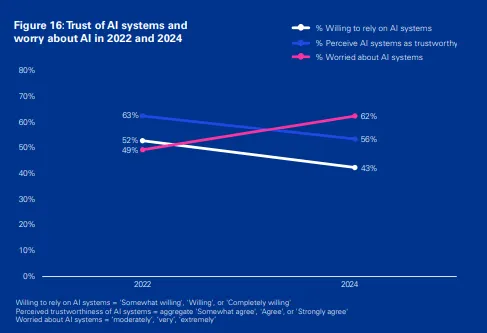
The American unease mirrors global trends. Stanford’s HAI AI Index Report 2025 confirms that worldwide, ambivalence and worry are increasing even as people appreciate AI’s efficiency gains. The tension is particularly acute in developed nations: In 2022, countries like Great Britain (38%), Germany (37%), and the United States (35%) were among the least likely globally to view AI as having more benefits than drawbacks.

Trust emerges as another critical fault line. While 76% say it’s extremely or very important to be able to tell if pictures, videos, or text were made by AI or people, more than half admit they lack confidence in their ability to actually make that distinction. This trust deficit extends beyond content detection: KPMG’s 2025 Global Trust Report found that confidence in AI companies has been falling steadily since 2022.

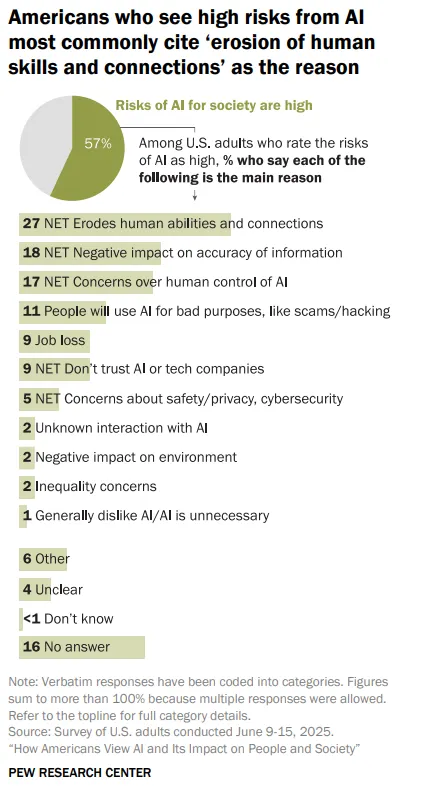
Another interesting finding by Pew Research is that 57% of Americans rate the risks of AI for society as high or very high, while only a quarter seems to be hyped about the technology.

When asked to explain their concerns, respondents most frequently cited the erosion of human abilities and connections—people becoming lazy, losing critical thinking skills, or depending too heavily on machines for basic tasks.
This growing wariness contrasts sharply with AI experts surveyed by Pew earlier this year. AI experts are far more likely than Americans overall to believe AI will have a very or somewhat positive impact on the United States over the next 20 years (56% vs. 17%), according to a previous study.

The divide between experts and the public reflects deeper tensions about who benefits from AI advancement. Academic studies show marginalized groups—minorities and people with disabilities—express even more negative views about AI than the general population, suggesting the technology’s benefits aren’t reaching everyone equally.

In other words, the negative effects of AI technologies are perceived more by groups that are affected by biases or stereotypes—which generative AI models tend to amplify.

Americans do see limited roles for AI in specific contexts—weather forecasting, detecting financial crimes, or developing medicines. But they draw firm boundaries around personal matters. Some 73% of respondents said that AI should play no role in advising people about their faith in God, and two-thirds reject AI involvement in judging romantic compatibility.

The regulatory landscape reflects these concerns. A Gallup-SCSP 2025 study found overwhelming support for stricter oversight, with 72% supporting more government efforts to control that industry.

Ultimately, 57% or respondents said they have not too much or absolutely no control in whether AI is used in their lives, which shows that many Americans already feel the technology’s advance is beyond their influence—a digital tide they can neither stop nor fully embrace.

Generally Intelligent Newsletter

A weekly AI journey narrated by Gen, a generative AI model.


Source link

Spheron x Ozak AI: Making Predictive Finance Borderless

0
Spheron x Ozak AI: Making Predictive Finance Borderless


We’re excited to welcome Ozak AI into the Spheron ecosystem. Ozak AI is not just another trading tool. It is an agentic AI platform designed specifically for financial markets, built to fuse state-of-the-art predictive models with decentralized infrastructure. By doing so, it delivers real-time, tamper-proof intelligence that helps traders and institutions anticipate market shifts, manage risk, and unlock new strategies.

At its core, Ozak AI is about accessibility. It aims to provide every investor, from individual traders to global institutions, with access to intelligence that is typically reserved for high-frequency desks or hedge funds. And now, by integrating with Spheron’s decentralized compute network, it can scale its predictive models faster, run more efficiently, and reach users across borders without friction.

Why Ozak AI Exists

Legacy trading dashboards were designed for an earlier era. They were designed for batch jobs that process data at the end of the day, not for markets that shift in milliseconds. Traditional tools stop at the exchange API; they fail to merge order book signals with on-chain liquidity, macroeconomic indicators, or sentiment analysis into a unified stream of actionable intelligence. The result is dashboards that appear sophisticated but can’t keep pace with the speed and complexity of today’s markets.

Ozak AI was built to close this gap. Its predictive models, ranging from neural networks to ARIMA and custom time-series methods, are engineered to ingest billions of ticks, funding-rate shifts, and alternative data sources in real time. Where older systems lag, Ozak AI runs at speed, producing forecasts and risk assessments that are both timely and accurate.

But accuracy is only part of the equation. Ozak AI also makes every prediction verifiable. Using EigenLayer’s Active Validation Services, each output is attached to economic collateral, which makes falsifying a forecast costly. This transforms raw model output into a trustless data feed that both humans and smart contracts can rely on. Add to this the scalability benefits of Arbitrum Orbit, which pushes heavy compute off-chain while anchoring results securely to Ethereum, and you have a platform that delivers market intelligence at scale without the gas pain that often plagues decentralized systems.

How Ozak AI Works

The architecture of Ozak AI is designed for speed, security, and adaptability. At the base level, its Ozak Stream Network ingests tick-level market data, macro signals, and alternative datasets at scale. This data is encrypted and stored across decentralized vaults, ensuring it remains both secure and censorship-resistant.

On top of this data layer, Ozak AI deploys customizable prediction agents. These can be tailored by asset class, allowing users to apply different models to specific markets. The predictions are validated through EigenLayer, which attaches a layer of economic security to every output. Execution happens on Arbitrum Orbit, ensuring that trading logic and DeFi strategies run efficiently at L2 scale while remaining anchored to Ethereum.

This modular design means Ozak AI is not just another analytics tool. It is a programmable platform where intelligence is verifiable, customizable, and ready to plug into both human decision-making and automated financial systems.

The Role of the $OZ Token

Powering the ecosystem is the $OZ token, designed with sustainability and alignment in mind. With a fixed supply of 10 billion, the token serves as the backbone for paying platform fees, staking for governance, and earning ecosystem rewards. Thirty percent is allocated to presale with a structured vesting schedule, ensuring long-term stability, while liquidity has been reserved for exchanges at launch to support healthy trading.

The tokenomics are structured not just for speculation but to sustain growth. They align incentives between traders, developers, and institutions, ensuring that as the platform scales, the value created is shared across its community.

Why Spheron Matters for Ozak AI

Building predictive finance at a global scale requires more than smart models; it demands serious infrastructure. Training neural networks, running simulations across hundreds of assets, and validating outputs in real-time is computationally intensive. Without scalable and affordable compute, even the best-designed AI platforms hit bottlenecks.

This is where Spheron Network plays a critical role. As the world’s first community-powered data center, Spheron pools idle GPU and CPU resources from thousands of contributors worldwide. This decentralized infrastructure enables Ozak AI to run its predictive pipelines at a lower cost, with greater efficiency, and without the risks associated with centralized choke points.

By tapping into Spheron’s network, Ozak AI can scale its workloads across geographies, reduce the latency of its predictions, and expand access to a global user base. Developers building on Ozak AI also gain from Spheron’s ecosystem of shared tooling, APIs, and cross-community initiatives. For Spheron, the partnership highlights exactly what decentralized compute was built for: powering next-generation agentic AI applications.

Partnership Details

The partnership between Spheron and Ozak AI is about more than just infrastructure sharing. Together, we are focused on enabling predictive finance to move beyond borders. Ozak AI will use Spheron’s decentralized compute to train and run models at scale, bringing advanced predictive intelligence to both retail and institutional users.

On the flip side, every workload that Ozak AI runs on Spheron strengthens the network itself. It expands utilization, validates the robustness of community-powered infrastructure, and proves the value of decentralized compute in mission-critical applications like finance. The collaboration will also extend to developer enablement, with both teams working to create APIs and tools that make it easier to build new prediction agents and trading logic.

This is not just about faster models or cheaper compute. It is about creating a feedback loop where communities contribute resources, models get smarter, and users everywhere gain access to intelligence that was once siloed within hedge funds or centralized data firms.

Looking Ahead

Predictive finance is moving into a new era. Traders no longer want static dashboards that lag behind the market; they want agents that learn, adapt, and act in real time. Institutions no longer want opaque black-box predictions; they want verifiable, tamper-proof intelligence that can plug directly into automated systems.

With Ozak AI’s predictive models and Spheron’s decentralized compute, we are building exactly that. Together, we are showing how AI and Web3 can merge to create a financial infrastructure that is real-time, transparent, and accessible to all.

The future of finance will not be confined to data silos or centralized dashboards. It will be decentralized, community-powered, and borderless. With Ozak AI and Spheron working hand in hand, that future is already taking shape.


Source link

What’s an ‘AltAlt Season’ Crypto ETF? Perplexing Proposed Fund Skips Bitcoin and Ethereum – Decrypt

0
What’s an ‘AltAlt Season’ Crypto ETF? Perplexing Proposed Fund Skips Bitcoin and Ethereum – Decrypt


In brief

Tidal Financial Group applied for a leveraged AltAlt Season Crypto ETF, along with two other filings on Thursday.
The proposed fund confounded even some of the fund industry’s sharpest observers unsure what an “alt alt season” was.
The fund will relate initially to the performance of XRP and Solana, and exclude Bitcoin and Ethereum.

Issuers of crypto funds have grown increasingly creative in their proposals over the past few months as they seek to meet investors growing appetite for these products.

But an “AltAlt Season” exchange-traded fund? That’s new territory.

Tidal Financial Group’s Quantify 2X Daily AltAlt Season Crypto ETF, one of three funds included in an application to the U.S. Securities and Exchange Commission on Thursday, confounded even a few fund industry observers.

“What is AltAlt vs Alt? (Because I wanted to know too),” Bloomberg ETF Research Analyst James Seyffart tweeted with a screenshot from the filing and his own terse summary. “Alt just excludes BTC, the other excludes both BTC and ETH.”

Tidal’s N1-A registration filing also covered the Quantify 2X Daily All Cap Crypto ETF, and Quantify 2X Daily Alt Season Crypto ETF. All three leveraged funds target risk-tolerant investors, enticing them with the potential for two times the daily return of the cryptocurrencies that they hold.

“Because the fund seeks daily leveraged investment results, it is very different from most other exchange-traded funds,” the prospectus says in each of the fund descriptions. “It is also riskier than alternatives that do not use leverage.”

The AltAlt fund will align initially with the performance of XRP and Solana, according to the Tidal prospectus. The Alt ETF will correspond initially to those digital assets and Ethereum, while the All Cap strategy covers those assets and Bitcoin.

“Alt seasons” describe periods when Ethereum and other larger altcoin prices outpace Bitcoin, usually after Bitcoin’s own price increases. “Alt alt seasons” refer to timespans when market activity shifts to altcoins with mid-sized market capitalizations and then to smaller-cap tokens in a trickle-down effect. The AltAlt looks to benefit from these latter trends.

All three funds may include swap agreements or option contracts on shares of U.S.-listed spot crypto ETFs or that offer exposure to digital assets indirectly through investments in crypto-based derivatives, or that directly invest in crypto funds, among other options.

In recent months, issuers have applied for a widening array of leveraged crypto ETFs, along with spot funds based on various altcoins and combinations of tokens. The SEC is now weighing submissions for more than 90 of these products, as of late August, according to Bloomberg research.

Their odds of approval received a boost on Wednesday when the SEC signed off on new generic listing standards for commodity-based trusts, easing the approval process. The agency’s thumbs-up underscored the more receptive regulatory and political environment that has emboldened issuers.


“We’re already at 2x AltAlt Season Crypto ETFs and it’s not even October. Do you realize how crazy things are gonna get?” quipped Bloomberg Senior ETF Analyst Eric Balchunas in an X post Thursday.

He added: “I’ll be honest, I wasn’t that moved by the 2x Alt Season ETF but the 2x AltAlt Season, well that’s a whole [different] story lol”

Daily Debrief Newsletter

Start every day with the top news stories right now, plus original features, a podcast, videos and more.


Source link

What Is Arc? The Stablecoin Blockchain From USDC Issuer Circle – Decrypt

0
What Is Arc? The Stablecoin Blockchain From USDC Issuer Circle – Decrypt


In brief

Arc is a blockchain built by USDC issuer Circle for stablecoin-focused applications.
It uses USDC for gas, features a built-in FX engine, and enables opt-in privacy.
Public testnet is expected later this year, with a mainnet beta planned for 2026.

Circle, the company behind the USDC stablecoin, has launched a new blockchain platform called Arc. Unlike blockchains like Ethereum or Solana, Arc is a Layer-1 network designed specifically to support stablecoin-based applications.

Stablecoins are tokens whose value is tied to fiat currencies such as the dollar. Arc is Circle’s effort to address the infrastructure challenges that limit the adoption of stablecoins at an institutional scale.

“We’ve helped enterprises and builders use USDC across dozens of networks,” Rachel Mayer, VP of Product Management at Circle, told Decrypt. “The consistent feedback has been: make costs predictable, settlement finality deterministic, and privacy compatible with real-world obligations.”

This article will explain what Arc is, how it works, and what Circle says sets it apart from other blockchain platforms.

Why Circle built Arc

While a part of the crypto market for years, stablecoins like USDT and USDC have seen growing interest and adoption following the passage of the GENIUS Act, which President Donald Trump signed into law in July 2025.

However, Circle argues that most existing blockchains were not designed to support stablecoins. Common limitations that Circle points to include:

🎢 Fee volatility
⛓️ Probabilistic settlement with risk of chain reorganizations
🕵️ Lack of privacy controls for sensitive commercial transactions
 💧 Fragmented liquidity across multiple chains

Circle said Arc addresses these challenges by offering instant and irreversible transaction settlement (known as deterministic finality), predictable fees priced in stablecoins, optional privacy features that support regulatory compliance, and built-in connections to other blockchains and traditional financial systems.

Arc is being rolled out in three phases:

Private testnet began in August 2025
Public testnet is expected in Fall 2025
Mainnet beta is scheduled for 2026

USDC as native gas

By using USDC, a digital currency backed by real-world assets, Circle aims to eliminate the need for volatile tokens to pay transaction fees. The network can also support other stablecoins as gas via a paymaster system.

According to Circle, Arc’s fee model builds on Ethereum’s EIP-1559 architecture but replaces block-level adjustments with a weighted moving average of network demand. This smoothing mechanism keeps fees low and predictable. Fees are denominated in USDC and directed to an on-chain Arc Treasury.

“Arc’s fast finality and native gas coupled with Circle’s CCTP and Gateway interoperability service-as-a-stablecoin liquidity hub, enable USDC to move across the blockchain ecosystem freely,” Mayer said. “So builders and users can be on the networks that fit their needs while still tapping Arc’s stablecoin-optimized rails.”

This design enables dollar-based, auditable, and stable fee structures, which Circle said are better suited to financial institutions than speculative token models.


Deterministic settlement and consensus

Arc’s consensus layer is powered by Malachite, a Byzantine Fault Tolerant (BFT) engine based on Tendermint. Validator selection is currently permissioned and based on operational resilience, geographic distribution, and regulatory compliance. Plans include a transition to a “permissioned” Proof-of-Stake mechanism, according to Circle.

To reduce the chance for abuse, the Circle is developing tools like encrypted mempools, batch transaction processing, and multi-proposer consensus, all aimed at ensuring fairer execution in financial applications.

Opt-in privacy for institutions

Arc includes a modular privacy system designed to balance compliance with confidentiality. The first feature, confidential transfers, shields transaction amounts while keeping addresses visible. Smart contracts interact with a cryptographic backend via precompiles, using Trusted Execution Environments (TEEs) for private computation.

Institutions can selectively disclose data to regulators or auditors via view keys. Over time, Arc plans to support:

Private state and confidential computation
Zero-knowledge proofs (ZKPs)
Multi-party computation (MPC)
Fully homomorphic encryption (FHE)

Circle’s tools connect fiat and USDC across Arc and other blockchains: Mint converts fiat to USDC on Arc, CCTP transfers USDC by burning and reminting it across chains, and Gateway offers chain-agnostic USDC balances with built-in liquidity rebalancing for wallets and apps.

“Arc strengthens the broader multichain ecosystem by unlocking new use cases, partners, and institutional liquidity on-chain,” Mayer said. “Builders and users can be on the networks that fit their needs while still tapping Arc’s stablecoin-optimized rails.”

Positioning in the blockchain ecosystem

Arc enters a competitive environment that includes public Layer-1 blockchains such as Bitcoin, Ethereum, and Solana, stablecoin-focused chains like Plasma and Frontier, Layer-2 networks such as Arbitrum and Base, and private or semi-public networks operated by payments firms.

Circle’s differentiator is its existing position in the market as the issuer of USDC, one of the largest stablecoins.

By building a purpose-specific chain for programmable, compliant financial operations, Arc aims to extend the utility of stablecoins beyond payments and into real-time settlement, tokenization, and global capital.

“Regulatory clarity is often a catalyst for institutional adoption,” Mayer said, adding that Arc is designed to be “enterprise-grade.”

Daily Debrief Newsletter

Start every day with the top news stories right now, plus original features, a podcast, videos and more.


Source link

Why Publicly Traded Caliber Is Building a Chainlink Treasury – Decrypt

0
Why Publicly Traded Caliber Is Building a Chainlink Treasury – Decrypt


In brief

Publicly traded firm Caliber has acquired $6.7 million worth of LINK as it builds out its Chainlink treasury.
The firm intends to do more than accumulate LINK though, it will also integrate the Chainlink network into its daily business.
Its next step is hiring the right fit with a history in real estate tokenization and blockchain.

Publicly traded asset manager Caliber made its first significant buy of Chainlink (LINK) this week, adding 278,0111 LINK worth around $6.5 million to its treasury, it announced Thursday. 

The Arizona-based firm has now acquired around $6.7 million worth of LINK in just over a month since announcing its Chainlink treasury strategy. While other firms are stacking assets like Bitcoin, Ethereum, Solana, or XRP, Caliber saw something unique in LINK.

“We found that Chainlink was the obvious choice for us,” Caliber CEO Chris Loeffler told Decrypt about the firm’s new connections to crypto. “It had institutional adoption, it had utility inside our actual business, and Chainlink was starting to announce some really sizable partnerships.”


In addition to stacking LINK, the firm will look to utilize Chainlink’s network to bring valuable off-chain data used in its every day business on-chain, potentially reducing operating costs and increasing profitability in the process. One such prominent example for the firm is in valuations. 

“Because we’re a public asset manager, every quarter we have to produce valuation work on all of our assets and all of our funds,” said Loeffler, who added that it is typically a complex and manual process. 

“To value an apartment complex, you may need to have 10 points of data,” he said. “Maybe that’s comparable sales, vacancy rates, and current rental rates. Those pieces of data are critical to be plugged into a financial model that is run to produce the value every quarter.” 

Using Chainlink’s network, though, the firm believes it will be able to bring that real-world data on-chain and better validate and automate its valuations, ultimately providing more transparency to its investors in the process. Loeffler said that further use cases like automated fund administration may be possible, as well.

Chainlink operates as an oracle network, helping securely pull verified data from off-chain sources on-chain for integration with blockchains. The network recently partnered with the U.S. Department of Commerce to bring GDP data on-chain, and founder Sergey Nazarov has teased further integrations—and hopes to help aid with election integrity, as well. 

To pursue its on-chain goals, Caliber is looking for the right person to join the firm. 

“Our next step, as far as the implementation, is we’re looking for a key person who would be like a strategic hire inside of the company,” said Loeffler, who said the firm is looking for someone with experience in real estate tokenization and blockchain. 

“I’d like to have that person hired and functioning before the end of the year,” he added.

Though relatively new to the crypto ecosystem, Loeffler said the firm has been welcomed warmly by the community. 

“The LINK Marines and the LINK community as a whole are just excited,” he said, making note of the rabid community of Chainlink investors that rally around the asset on social media. Loeffler’s X bio indicates he’s a “new recruit” to the LINK Marines. 

“The fact that we’re not just building a treasury and being a treasury company, but we’re also aligned to integrating our real-world assets into blockchain and to utilize Chainlink’s technology—that resonated really well,” he added. 

Shares of Caliber (CWD) are up more than 300% in the last month.

Daily Debrief Newsletter

Start every day with the top news stories right now, plus original features, a podcast, videos and more.


Source link

FTX to Dispense $1.6 Billion in Bankruptcy Repayments This Month – Decrypt

0
FTX to Dispense .6 Billion in Bankruptcy Repayments This Month – Decrypt


In brief

The FTX Recovery Trust has announced its third distribution to former clients of the bankrupt exchange.
A total of $1.6 billion will be repaid to creditors this time.
The FTX brand went bankrupt in 2022 after it was criminally mismanaged.

Creditors of collapsed crypto exchange FTX will receive $1.6 billion at the end of this month in a third distribution to make clients whole, the FTX Recovery Trust announced on Friday. 

Four groups of creditors will receive the funds on September 30, with distributions ranging between 78% and 120% of the value of their FTX holdings when the exchange collapsed in November 2022, according to a press release from the Trust, which is overseeing assets and claims from the exchange’s bankruptcy estate. 

The distributions mark the third phase of the FTX estate’s recovery plan, and will be paid via crypto exchanges Bitgo and Kraken, and payments platform Payoneer.


The FTX Recovery Trust first announced it would execute its distribution plan last year. 

FTX allowed customers to buy, sell, and bet on the future price of major digital coins and tokens.

But FTX’s eccentric CEO, Bankman-Fried, criminally mismanaged the exchange with top associates, mainly by using customer cash to cover risky bets made by the company’s sibling hedge fund, Alameda research.

This eventually caused the company’s 2022 bankruptcy and billions of dollars in investor cash to disappear.  

John J. Ray III, the highly-experienced lawyer tasked with recovering FTX customers’ missing investments, said FTX’s collapse surpassed the high-profile bankruptcy of energy company Enron in the early 2000s. 

Bankman-Fried was arrested, charged and later jailed for defrauding customers.  

Key members of Bankman-Fried’s inner circle testified against him during the trial. FTX co-founder Gary Wang, former Alameda CEO Caroline Ellison, and FTX’s former head of engineering Nishad Singh, all said they committed crimes at Bankman-Fried’s behest.

“Sam Bankman-Fried perpetrated one of the biggest financial frauds in American history, a multi-million scheme designed to make him the king of crypto,” said Damian Williams, U.S. attorney for the Southern District of New York in remarks following the verdict.

Bankman-Fried is now serving a 25-year jail sentence in a Southern California prison for fraud and other crimes. 

Daily Debrief Newsletter

Start every day with the top news stories right now, plus original features, a podcast, videos and more.


Source link

Remilia Launching Milady Social Media Network to Serve ‘4chan Diaspora’ – Decrypt

0
Remilia Launching Milady Social Media Network to Serve ‘4chan Diaspora’ – Decrypt


In brief

Remilia Corporation is launching a Milady-centric social network called RemiliaChat.
The rollout is beginning with RemiliaNET, a social identity layer launching Friday.
While aimed at fans of 4chan, RemiliaChat will have some level of content moderation.

The Milady gang thinks social media is broken, calling the community of fans the “diaspora of chan culture”—such as the notoriously edgy 4chan. To fix that, the NFT project’s creators are launching a social media network to rival X, with the first step coming via official Milady profiles.

RemiliaNET is an in-browser experience that will allow the community to track their Milady achievements and build up a “social credit score,” with a competitive leaderboard to boot. And the upcoming RemiliaChat, with no release date confirmed, looks to be a fully fledged social media platform with an algorithm-driven feed and chat function.

“Remilia’s goal has never been just to dominate crypto and NFTs. We plan to save the entire culture of the internet, and the world through it, in the same way we did for crypto. RemiliaChat is how we achieve this,” Remilia Corporation Chief of Staff Michael Dragovic told Decrypt. “RemiliaNET is the identity service layer of Remilia Chat. We’re launching it now prior to releasing full social features to begin the onboarding process.”

Two weeks ago, a mysterious countdown started on the Milady Cult website, sending its community into a frenzy of theories and self-referential memes—the latest being, “What did CULT mean by this?” As it ticked down to zero, an additional eight days were added to the clock in the wake of last week’s assassination of right-wing activist Charlie Kirk.

RemiliaNET profiles. Image: Remilia Corporation

On Friday, the clock finally finished, and it was revealed that what CULT meant was that RemiliaNET is now open for business.

Users of RemiliaNET will have the option of using one of the default Kagami-style profile pictures, or connecting their wallet to use an NFT profile picture from a wide array of Remilia and derivative collections—including Radbro, Aura, and Schizposters.

Most importantly, though, the platform will become the go-to spot for the Milady community to track their achievements, which translates to a “social credit score” used to place everyone upon a global leaderboard.

Achievements can already be unlocked via the Remilia Achievement Score page. Some of these can be collected by minting specific NFTs, playing on the Miladycraft Minecraft server, or participating in one of the project’s many alternate reality games.

The new system, Remilia Corporation says, however, will be much more seamless. Plus, the number of achievements is also set to expand with the launch of the site, with notifications prompting users when a new achievement is available.

In doing this, Dragovic—better known as Scorched Earth Policy—confirmed to Decrypt that RemiliaNET will act as a platform for users to “actively and knowingly” participate in “manipulation rounds.” This refers to periods where Milady’s CULT token is airdropped to users based on their achievements and rankings, although Dragovic added that rewards will not be limited to CULT tokens.

“RemiliaNET assigns a public ‘social credit score’ to every user that serves as multifactor sybil detection as well as cross-platform scoring, which will result in hidden incentive rewards,” Dragovic told Decrypt. “[It] will extend beyond direct token allocation into a general rewards ecosystem. These will be used to encourage user behaviors that maximize quality contribution and community distribution.”

Why RemiliaChat?

Friday’s launch of RemiliaNET is just the first step towards the creation of RemiliaChat, an ambitious Milady-infused attempt to disrupt the social media status quo. Remilia Corporation leader Charlotte Fang has been preparing the cult for this moment for years, forcing the core team to flicker through different platforms for communication.

“We’ve experimented with dozens of platforms in the past five years alone,” Dragovic said. “We’re definitely veterans of the internet, and we have quite a bit of experience with understanding what makes a platform work and what keeps that fire alive.”


As such, Dragovic said, the team has learned lessons from what they see as the downfall of Reddit, Discord, Twitter, and chan culture, especially 4chan. RemiliaChat will attempt to build on those failings to build a social media platform with a content feed, chat, and profiles. Specifically, RemiliaChat will look to reduce the pertinence of “slop” content via a custom algorithm, and emphasize anonymity and pseudonymity. 

It’s not just the team leading the Milady-sphere that is deeply rooted in internet culture; the entire community is a product of obsession with online spaces and disillusionment with the perceived degradation of society. 

“Remilia has been very much a product of the diaspora of chan culture,” Dragovic told Decrypt. “People are yearning for a new platform and a new space. RemeliaChat wants to be that. It wants to be the place where people go. It’s going to be one of the first and only platforms that’s designed around really hard online discourse principles.”

With a core community entrenched in online culture and a team dedicated to critiquing it, RemiliaChat hopes to become a new cultural hub for the cultivation of radical thought.

“Society’s most important discourse always occurs in iconic gathering places,” Dragovic said. “These places were our tribal campfires, our Athenian forums, our zones of intellectual exchange. And within them, always a core group of people coming together to develop the ideas of their time.”

“Our pivotal places now happen online,” he added. “Our iconic minds are anonymous posters.”

A free-for-all?

Milady, Remilia, and its surrounding communities have become a melting pot of ideas branching to the far corners of all wings of the political spectrum. However, many outsiders would likely characterize the group as far-right, with its tendencies to echo racist and other controversial sentiments.

In part, however, the group’s flirtation with fringe theories comes as part of Fang’s concept of “pre-cancelling” yourself. This has led to members leaning into shock humor or intentionally saying slurs under the intention of appearing punk, despite not necessarily agreeing with their own take.

As a result of this ethos, moderation on traditional social media platforms has become a problem for the community. RemiliaChat, to the dismay of its community, cannot be completely unmoderated as the spread of illegal and unethical content, such as child sexual abuse materials, may occur.

Remilia Corporation confirmed to Decrypt that it will have a moderation system in place, and claims to have been learning lessons on how to handle it through its previous projects.

“Our intention is to do as little moderation as possible in terms of content,” Dragovic told Decrypt. “Our belief is that 90% of moderation comes from the way you design the layout of your site. The site should itself steer the user into posting a certain way and creating a certain form of engagement.”

“We’ll intervene on the absolutely necessary parts,” he added, “like bad actors, illegal shit, and things that could get the FBI knocking on our door.”

Daily Debrief Newsletter

Start every day with the top news stories right now, plus original features, a podcast, videos and more.


Source link

Public Keys: Alt Autumn Arrives, Kindly Investors Leave Bitcoin Stock, and Here Comes the SOL – Decrypt

0
Public Keys: Alt Autumn Arrives, Kindly Investors Leave Bitcoin Stock, and Here Comes the SOL – Decrypt


In brief

Rex-Osprey launched XRP and DOGE ETFs, and the SEC debuted streamlined listing standards for commodity-based trust shares.
Forward Industries became Solana’s first $1 billion treasury company, with Helius planning a $500 million SOL treasury raise
KindlyMD shares dropped 54% after filing S-3 registration, releasing $200 million in discounted shares that created sell pressure

Public Keys is a weekly roundup from Decrypt that tracks the key publicly traded crypto companies.

Alt Autumn loading

The U.S. Securities and Exchange Commission press release didn’t actually mention altcoins, but crypto ETF hopefuls haven’t wasted time rushing their funds toward the starting line.

The regulator has streamlined generic listing standards for commodity-based trust shares, meaning that as long as applicants meet the listing standards of the Nasdaq, Cboe BZX, and NYSE Arca exchanges, they can opt out of applying for a rule change for individual funds like every other crypto ETF issuer so far.

The rule change didn’t have unanimous support, though. Commissioner Caroline Crenshaw said in a statement Wednesday that the new rule amounts to “passing the buck on reviewing these proposals and making the required investor protection findings, in favor of fast tracking these new and arguably unproven products to market.”


Rex-Osprey was first out of the gate with its Rex-Osprey XRP ETF and Rex-Osprey DOGE ETF. The company is also working to bring a leveraged option to market, the Rex-Osprey DOJE Growth & Income ETF, for traders who want big risks and big rewards.

It’s still early, as the filing doesn’t yet mention a fee. But the objective is to pay weekly distributions by selling calls, while targeting 1.05 to 1.5 times the daily move of its newly trading DOJE Dogecoin ETF—resetting exposure every day. It’s a product for short-term traders, not buy-and-hold investors.

Dogecoin jumped as high as $0.28 earlier this week on the bullish news, but the gains haven’t been long lasting. At the time of writing, DOGE was down over 5% to $0.26.

Kindly leave

KindlyMD CEO David Bailey did a pre-flight check on Monday, pointing out the exits to investors who weren’t comfortable with some near-term volatility. The company’s shares dropped 54% to $1.26 that day. And after the closing bell on Friday, the price hasn’t improved much.

The company’s shares—which trade on the NasdaqGM under the NAKA ticker symbol—finished the day trading for $1.40, after having lost 6% in the past day and down 87% over the last month.

The company became a Bitcoin treasury company when it merged with Nakamoto Holdings, Bailey’s BTC holding company, earlier this year. The newly formed firm jumpstarted its Bitcoin treasury vision with a $200 million PIPE deal. But the discounted shares that were sold during that round were essentially locked until the company filed its S-3 registration with the SEC.

Once the registration was filed and deemed effective, there was $200 million worth of discounted shares creating sell pressure.

Bailey, ever the optimist, found a silver lining.

“I will say one of the unintended consequences of the stock being down is [that] everyone can buy in relatively cheap and ride with us,” he wrote on X. “The past week we’ve put up serious volume and one or two more days like yesterday and we’ll have churned and reset the cap table. Then we’ll have our convicted and aligned shareholder base.”

Grayscale has also listed its Digital Large Cap Fund after playing red light, green light with the SEC for months. The fund, which trades under the GDLC ticker, tracks a basket of assets that contains XRP, Solana, Cardano, Bitcoin, and Ethereum.

Treasured SOL

Solana got its first $1 billion treasury company, but that was just the beginning of bullish news for SOL digital asset treasuries.

The same day Forward Industries crossed the $1 billion mark, Helius announced plans to raise $500 million to build its own Solana treasury.

Two days later, Forward Industries debuted an at-the-market offering to raise another $4 billion in cash to buy more SOL. If it does raise the cash and spend the bulk of it buying Solana tokens, that could more than double the $3.1 billion worth of SOL already sitting with publicly traded companies.

Then, on Thursday, former chief legal officer at Kraken, Marco Santori, was named CEO at newly renamed Solana treasury Solmate. The company made its debut as a digital asset treasury by announcing a $300 million raise, and saw its stock soar 500%.

The news has been bullish for SOL, but not enough to save it from the malaise that’s hit the rest of the crypto market. At the time of writing, Solana was lagging 4% behind its price on Thursday and changing hands for about $238.

Other Keys

BitLicense boost: Newly IPO’d Bullish saw its shares jump on news that it’s been granted a BitLicense by the New York State Department of Financial Services. That means it’s now approved to operate in the state as a digital asset trading and custody business, and BitLicense aims to expand its broader U.S. presence as a result.

Itty, bitty buy: Strategy added $60 million worth of Bitcoin to its BTC treasury this week, the smallest buy it’s announced in a month. Although the company has raised around $68.2 million through its various preferred stock offerings, the company only spent $60.2 million on Bitcoin, leaving it with around $8 million in extra cash.

Daily Debrief Newsletter

Start every day with the top news stories right now, plus original features, a podcast, videos and more.


Source link

XRP Fund Notches Biggest ETF Debut of 2025—and Dogecoin Wasn’t Far Behind – Decrypt

0
XRP Fund Notches Biggest ETF Debut of 2025—and Dogecoin Wasn’t Far Behind – Decrypt


In brief

The Rex-Osprey XRP ETF and DOJE ETF debuted Thursday.
Analysts were surprised at the trading volume of both ETFs.
The price of both XRP and Dogecoin has dipped following the funds’ listing.

The first exchange-traded fund giving U.S. investors exposure to XRP had a roaring debut Thursday, bringing in close to $38 million in inflows in the best ETF launch of this year. 

Rex Shares and Osprey Funds’ XRP ETF surpassed expectations as investors rushed to get exposure to the cryptocurrency. 

The issuers’ DOJE ETF, the first Dogecoin ETF to trade in U.S. markets, generated a strong $17 million in its inaugural day. 

The two funds’ success indicated pent-up demand for altcoin exposure, Bloomberg Senior ETF Analyst Eric Balchunas said, writing on X that it was a “good sign” for the long-list of funds the SEC has lined up for  approval. 

Wall Street’s regulator on Wednesday signed off on new generic listing standards for commodity-based trusts which could make it easier for crypto ETFs to hit markets. 

The price of XRP recently stood at $3.01 after losing more than 3% of its value over a 24-hour period, according to crypto data provider CoinGecko. Dogecoin’s price stood at nearly $0.27 after dropping 6% over the same time period.  

Following the massive success of the Bitcoin and Ethereum ETFs the SEC approved last year, issuers have been eager to address the increasing appetite for crypto-focused investment products. The SEC has received more than 90 applications for funds based on altcoins and combinations of tokens and strategies. BTC and ETH ETFs have generated about $57 billion and $14 billion, respectively. 

The Rex Shares and Osprey Funds XRP and DOGE ETFs offer investors exposure to the two altcoins via a subsidiary registered in the Cayman Islands that is wholly owned and controlled by the fund.


Rex-Osprey launched the funds via the Investment Company Act of 1940, rather than the Securities Act of 1933 like the spot funds. The act of 1933 focuses on securities or commodities covered by the ETF, while the 1940 act regulates investment companies, such as mutual funds. 

Daily Debrief Newsletter

Start every day with the top news stories right now, plus original features, a podcast, videos and more.


Source link

EU Eyes Boost to Pensions, Crypto Oversight Before 2026 – Decrypt

0
EU Eyes Boost to Pensions, Crypto Oversight Before 2026 – Decrypt


In brief

The plan includes auto-enrolment pensions, tax incentives, and steps toward market integration.
Oversight changes could give ESMA a role in supervising crypto and cross-border infrastructures.
The push follows warnings on stalled reforms and comes amid debate over the digital euro.

The European Union is preparing a year-end push to expand pension savings and tighten oversight of markets, with plans that could hand its Paris watchdog new authority over crypto firms.

Speaking at the Eurofi Forum in Copenhagen on Thursday, Financial Services Commissioner Maria Luís Albuquerque said the package will cover pension auto-enrolment, tax incentives for savings, and steps to cut cross-border barriers in trading, alongside a debate over shifting key supervisory powers to the European Securities and Markets Authority.

“We are looking at possible centralized supervision of certain market infrastructures, such as central counterparties, central securities depositories, and trading venues,” Albuquerque said during the forum. “We also see the benefit of more centralized supervision for new and rapidly evolving areas where supervisory capacities need to be  up to the task, such as Crypto Asset Service Providers.”


Dubbed the EU’s Savings and Investments Union, the initiative is presented as a long-term project to mobilize household wealth and enhance Europe’s financial autonomy by integrating fragmented markets and expanding retail participation.

Any transfer of powers to ESMA, meanwhile, “would not sideline national authorities,” but instead create a framework for joint oversight that could better manage cross-border risks and ensure consistent enforcement across the bloc, Albuquerque stressed.

Albuquerque’s remarks follow a statement from former European Central Bank President Mario Draghi, who warned Tuesday that Europe was “failing to match the speed” of global financial change, a critique that has fueled pressure on Brussels to accelerate long-stalled efforts to deepen its capital markets.

The debate over pensions and market reform coincides with Europe’s efforts to design a digital euro, as officials weigh whether to issue it on public blockchains like Ethereum or Solana. 

This comes amid the U.S.’s leapfrogging other jurisdictions with its first stablecoin law, raising questions about the euro’s competitiveness in global finance.

While Albuquerque did not weigh in on the digital euro debate, she argued that Europe’s competitiveness rests on building deeper capital markets and stronger pension systems that channel long-term savings into the economy.

“Pensions, by their very nature, are long-term. That is why they are such powerful drivers of capital market development,” she said. Albuquerque said she sees Europe’s plan creating “a virtuous cycle of investment, where our citizens can invest in their own futures and in the future of our economy.”

Representatives for the commission did not immediately return Decrypt’s request for comments.

Daily Debrief Newsletter

Start every day with the top news stories right now, plus original features, a podcast, videos and more.


Source link

Popular Posts

My Favorites