Web3

Home Web3 Page 61

Generative AI in Automotive Market to Reach USD 2.61 Billion by 2032, Fueled by 22.5% CAGR | Passenger Vehicle Segment Dominates with Software-Defined Vehicle Revolution | DataM Intelligence | Web3Wire

0
Generative AI in Automotive Market to Reach USD 2.61 Billion by 2032, Fueled by 22.5% CAGR | Passenger Vehicle Segment Dominates with Software-Defined Vehicle Revolution | DataM Intelligence | Web3Wire


Gen AI in Automotive Market

Leander, Texas and Tokyo, Japan – Dec 08, 2025According to DataM Intelligence, the Global Gen AI in Automotive Market reached US$ 514.50 million in 2024 and is projected to reach US$ 2,609.00 million by 2032, expanding at a compound annual growth rate (CAGR) of 22.50% during the forecast period 2025-2032. Key growth drivers include the race towards software-defined vehicles (SDVs), the demand for hyper-personalized in-car experiences, the acceleration of autonomous driving R&D, the need for generative design and simulation in vehicle development, and the optimization of manufacturing and supply chain processes.

Get a Free Sample PDF Of This Report (Get Higher Priority for Corporate Email ID): https://www.datamintelligence.com/download-sample/gen-ai-in-automotive-market?jd

Report Details:• Pages: 180• Forecast Period: 2025-2032• Market Size (2024): US$ 514.50 Million• Market Size (2032): US$ 2,609.00 Million• CAGR: 22.50%• Coverage: Global

Global Recent Developments:• November 2025: Microsoft Corporation and Mercedes-Benz expanded their partnership to integrate a generative AI-based “Conversational Vehicle Assistant” across the new MB.OS platform, capable of understanding complex multi-modal requests and proactively managing vehicle functions.• October 2025: NVIDIA unveiled “Drive LLM,” a foundational model for autonomous vehicles that can interpret complex driving scenarios, predict pedestrian/cyclist intent, and generate safe driving trajectories in real-time, licensed to multiple OEMs.• September 2025: Tesla, Inc. announced the deployment of a new generative AI system in its Gigafactories to autonomously optimize robotic assembly line configurations and predict maintenance needs, reducing production downtime by an estimated 15%.

Buy Now and Enjoy a 30% Year-End Discount: https://www.datamintelligence.com/buy-now-page?report=gen-ai-in-automotive-market

Competitive LandscapeThe market is led by a convergence of semiconductor giants, cloud hyperscalers, and pioneering automotive OEMs.

1. NVIDIA Corporation and Qualcomm Inc. are dominant in providing the high-performance Graphics Processing Units (GPUs) and system-on-chips (SoCs) that are the computational backbone for in-vehicle generative AI and autonomous driving.2. Microsoft Corporation, Amazon Web Services, Inc., and Alphabet Inc. (Google) are the leading cloud AI platform providers, offering the scalable infrastructure and large language models (LLMs) for developing and deploying generative AI applications in design, simulation, and connected services.3. Intel Corporation and Advanced Micro Devices, Inc. are key players supplying critical Microprocessors and AI accelerators for a range of vehicle ECUs and data centers.4. Tesla, Inc. is a vertically integrated leader, developing and deploying proprietary generative AI across its full stack-from vehicle autonomy and human-machine interface to manufacturing.5. International Business Machines Corporation (IBM) is pivotal consulting and system integration partner, helping traditional OEMs and suppliers implement and scale generative AI strategies.

Speak to Our Analyst and Get Customization in the Report: https://www.datamintelligence.com/customize/gen-ai-in-automotive-market?jd

Segmentation AnalysisBy Component:o Graphics Processing Units (GPUs) and Microprocessors are the foundational hardware segments, as generative AI models require immense parallel processing power for both training (in the cloud) and inference (at the edge/in the vehicle).o Memory And Storage Systems are critical for handling the massive datasets used to train AI models and for storing complex neural networks onboard vehicles.

By System Type:o Passenger Vehicles represent the largest segment, as they are the primary focus for generative AI applications in advanced driver-assistance systems (ADAS), personalized cabins, and next-generation infotainment.

By Technology:o Deep Learning, a subset of Machine Learning, is the core technology enabling generative AI, used for everything from synthetic data generation for autonomous vehicle training to natural language understanding for voice assistants.o Computer Vision is essential for generative AI applications in scene generation, sensor simulation, and enhancing perception systems for ADAS and autonomy.

By Application:o Autonomous Driving Technologies and Advanced Driver Assistance Systems (ADAS) are high-growth applications, using generative AI to create vast amounts of simulated driving scenarios for safer and more robust AI training.o Human-Machine Interface (HMIs) is a rapidly evolving application, with generative AI powering intelligent, conversational assistants and adaptive cockpit environments.o Vehicle Design & Manufacturing Optimization leverages generative AI for creating lightweight components, optimizing aerodynamics, and streamlining production processes.

Request for 2 Days FREE Trial Access: https://www.datamintelligence.com/reports-subscription?jd

Regional Analysis:North America is the largest region, driven by the presence of leading technology providers (NVIDIA, Microsoft, Tesla, Qualcomm), significant R&D investments in autonomous driving, and a strong ecosystem of software-defined vehicle startups.Asia-Pacific is the fastest-growing region, fueled by the massive automotive production hubs in China, Japan, and South Korea, aggressive government support for EV and AI technologies, and rising consumer demand for intelligent and connected vehicles.Europe is a significant market with a strong focus on leveraging generative AI for premium vehicle personalization, manufacturing efficiency, and advancing its competitive position in autonomous driving technology.

Market Trends & DriversThe Gen AI in Automotive Market is fundamentally reshaping the industry’s value chain. Key trends include the use of generative AI for synthetic data creation to overcome the limitations of real-world data collection for autonomous systems; the development of foundation models specific to automotive for perception, prediction, and planning; the rise of AI-powered digital twins for virtual vehicle testing and lifetime management; and the integration of multi-modal AI assistants that understand speech, gesture, and driver state. The core drivers are the strategic pivot to software-defined vehicles as a primary source of differentiation and revenue, the exponential complexity of developing L3+ autonomy, and the consumer expectation for seamless, personalised, and intelligent mobility experiences.

Related Reports:1. Autonomous Vehicle Market – https://www.datamintelligence.com/research-report/autonomous-vehicle-market?jd2. Automotive Artificial Intelligence (AI) Market – https://www.datamintelligence.com/research-report/automotive-artificial-intelligence-market?jd3. Connected Car Market – https://www.datamintelligence.com/research-report/connected-car-market?jd

Contact Us:Sai KiranDataM Intelligence 4market Research LLPPhone: +1 877-441-4866Email: Sai.k@datamintelligence.com

About DataM IntelligenceDataM Intelligence is a renowned provider of market research, delivering deep insights through pricing analysis, market share breakdowns, and competitive intelligence. The company specialises in strategic reports that guide businesses in high-growth sectors such as nutraceuticals and AI-driven health innovations.To find out more, visit https://www.datamintelligence.com/ or follow us on Twitter, LinkedIn and Facebook.

This release was published on openPR.

About Web3Wire Web3Wire – Information, news, press releases, events and research articles about Web3, Metaverse, Blockchain, Artificial Intelligence, Cryptocurrencies, Decentralized Finance, NFTs and Gaming. Visit Web3Wire for Web3 News and Events, Block3Wire for the latest Blockchain news and Meta3Wire to stay updated with Metaverse News.


Source link

Website Development Checklist for Small Businesses | Web3Wire

0
Website Development Checklist for Small Businesses | Web3Wire


Building a website for your small business is one of the most important steps you can take to strengthen your online presence. A well developed website works as your digital storefront, explains what you offer, and guides visitors to contact you or make a purchase. To help you create a site that performs well for both users and search engines, here is a complete website development [https://profitparrot.com/services/website-design/] checklist designed specifically for small businesses.

Define Your Goals and Target Audience

Before development begins, take time to understand what you want your website to achieve. Some businesses want more leads, while others want online sales or stronger brand awareness. Knowing your goals helps you choose the right features, layout, and content. Identifying your ideal audience also matters, because your design and messaging should speak to their needs and expectations.

Plan Clear Navigation and Page Structure

A successful small business website begins with a clear structure. Plan out your main pages, such as Home, About, Services or Products, Testimonials, and Contact. Make sure your navigation menu is simple and easy to follow. Visitors should be able to find what they need within a few clicks. A clean structure also helps search engines crawl your website more effectively, which supports your SEO [https://profitparrot.com/local-seo-company/] efforts.

Choose a Reliable Platform

Most small businesses choose website platforms that offer flexibility and easy updates. WordPress is one of the most popular options because it is customizable, user friendly, and compatible with thousands of themes and plugins. No matter which platform you choose, make sure it supports the features your business needs, such as online booking, ecommerce, or landing page builders.

Ensure Mobile Friendly Design

A large percentage of visitors browse on mobile devices, so your website must work flawlessly on phones and tablets. Responsive design adjusts your layout automatically so users can read content and navigate without zooming or scrolling sideways. A mobile friendly website is not only good for user experience but also helps your search rankings since Google prioritizes sites that perform well on all devices.

Focus on Fast Loading Speed

Website speed is a key part of development. Slow websites frustrate users and lead to higher bounce rates. They also perform poorly in search results. Make sure your developer compresses images, removes unnecessary code, and uses caching tools. A fast website helps visitors stay engaged and increases the chance of conversions.

Add Clear Calls to Action

Your website should guide visitors toward specific actions. Add clear calls to action such as Request a Quote, Book a Consultation, or Shop Now. Place them where users can easily see them, such as at the top of pages, in the middle of long sections, and near the footer. Calls to action help turn visitors into leads or customers.

Optimize for SEO

Strong SEO ensures your website can be found by the right people. Use keywords naturally in your headings and content, add meta titles and descriptions, and include internal links between pages. Create alt text for images so search engines can understand them. SEO friendly development gives your business a strong foundation for long term visibility.

Launch and Test Everything

Before your website goes live, test forms, buttons, links, menus, mobile layout, and loading speed. Fix any issues early to avoid user frustration. A polished launch sets the stage for better performance and stronger first impressions.

If your small business is ready for a website that attracts visitors and supports growth, this checklist will help you move forward with confidence.

Media ContactCompany Name: Digital World Media AgencyEmail:Send Email [https://www.abnewswire.com/email_contact_us.php?pr=website-development-checklist-for-small-businesses]Country: United StatesWebsite: http://digitalworldmedia.com

Legal Disclaimer: Information contained on this page is provided by an independent third-party content provider. ABNewswire makes no warranties or responsibility or liability for the accuracy, content, images, videos, licenses, completeness, legality, or reliability of the information contained in this article. If you are affiliated with this article or have any complaints or copyright issues related to this article and would like it to be removed, please contact retract@swscontact.com

This release was published on openPR.

About Web3Wire Web3Wire – Information, news, press releases, events and research articles about Web3, Metaverse, Blockchain, Artificial Intelligence, Cryptocurrencies, Decentralized Finance, NFTs and Gaming. Visit Web3Wire for Web3 News and Events, Block3Wire for the latest Blockchain news and Meta3Wire to stay updated with Metaverse News.


Source link

Crypto Holiday Gift Guide 2025 – Decrypt

0
Crypto Holiday Gift Guide 2025 – Decrypt


With the holiday season just around the corner, it’s time to start piling presents under the tree. Here’s our pick of the best options for the crypto fan in your life.

Ledger Nano Gen5

Ledger Nano Gen5. Image: Ledger

ledger.com, $179

Hardware wallet manufacturer Ledger is doing its level best to present itself as the Apple of crypto, enlisting iPod designer Tony Fadell to create its new product line, and now Apple Macintosh icon designer Susan Kare to work on the graphics for its latest offering.

As you might expect, the Nano Gen5 is a slick-looking, consumer-friendly bit of kit, with an E Ink touchscreen interface, Bluetooth and NFC, and secured by a CC EAL6+ Secure Element chip.

Ledger raised some eyebrows after ending support for its original Ledger Nano S earlier this year, but that does mean there’s an opportunity to gift an upgraded model.

Cold Wallet (Blu-ray)

Cold Wallet Blu-ray
Cold Wallet Blu-ray. Image: Well Go USA

amazon.com, $11

After ominously named crypto exchange Tulip collapses in suspicious circumstances, a luckless bagholder enlists his friends to kidnap the founder and retrieve his missing funds.

This thriller from director Cutter Hoderine is notable for being one of the first films to accurately depict crypto on-screen. It’s also partly funded by Web3 film fund Decentralized Pictures through a grant from executive producer Steven Soderbergh—which, inevitably, led to it being billed as “the crypto ‘Ocean’s Eleven.’”

That’s not entirely accurate, though. “Cold Wallet” is no globetrotting heist movie, instead it’s a character piece that pits the hostage-takers against the mind games of their billionaire nemesis, before a shocking act of violence turns the film into a riff on “The Most Dangerous Game.”

A good stocking-filler—and with its snowbound Massachusetts setting, a suitably chilly bit of Christmas Day viewing.

Read our review

“This Is for Everyone” by Tim Berners-Lee

This Is For Everyone by Tim Berners-Lee
This Is For Everyone by Tim Berners-Lee. Image: Macmillan

macmillan.com, $30

The inventor of the World Wide Web, Sir Tim Berners-Lee, recounts the story of its creation—and where it could go next—in this memoir.

While Berners-Lee’s account of the web’s origins and his early life is fascinating, Web3 fans will be most interested in his vision for the future of the internet. Berners-Lee is a keen advocate of the decentralized web, though he remains skeptical of blockchain and cryptocurrency.

Instead, he’s pursuing his own project to decentralize the web, Inrupt, which relies on open-source privacy platform Solid to create an infrastructure built on private data “pods.”

Fold App gift card

Fold App Bitcoin gift card
Fold App Bitcoin gift card. Image: Fold

foldapp.com, up to $500

For Bitcoin die-hards, no mere present could ever compare with the gift of sweet, sweet BTC. After all, gifts are transient things, while Bitcoin’s digital scarcity is forever—so any money spent on trinkets and gadgets for under the tree would be better put towards stacking precious sats.

Fold’s BTC gift cards are available in dollar denominations up to $500, which can be redeemed for BTC and sent on to any on-chain Bitcoin wallet address. It’s simple and straightforward, though it is a bit like receiving a book token from your nan for Christmas.

Strategy Quilted Vest

Strategy quilted vest
Strategy The North Face quilted vest. Image: Strategy

strategy.com, $135

Bitcoin treasury firm Strategy has a plethora of branded clothing and accessories on its store, from pint glasses to a frankly eye-watering tie. But for would-be finance bros, nothing but a gilet will do.

This isn’t the usual branded tat, either; it’s made by The North Face and comes kitted out with its WindWall fabric and 150g Heatseeker synthetic insulation to keep you toasty on your Christmas Day walk. The orange Strategy logo is nicely understated, too.

]]>

Coinbase Diamond Hands Balm

Coinbase Diamond Hands balm.
Coinbase Diamond Hands balm. Image: Coinbase

coinbaseshop.com, $30

If your nearest and dearest has chapped, cracked skin from clutching onto those bags through the recent dip, this balm could be the solution. Made with lavender “gathered at first light” and “hand-pressed” shea butter, this lotion promises to soothe even the most diamond-gripped digits. Nice to see Coinbase branching out, though. What next, gm breakfast cereal?

Trezor Safe 7

Trezor Safe 7
Trezor Safe 7. Image: Trezor

trezor.io, $249

Hardware wallet manufacturer Trezor has just launched its latest model, the Safe 7, and it’s laying the groundwork for the future with claims of a “quantum-ready” bootloader and architecture leveraging post-quantum cryptography.

The idea is that “when quantum-safe algorithms become necessary, Trezor devices will be ready to adapt,” without requiring users to switch over to a new device, according to the firm’s chief technology officer Tomáš Susanka.

The device also packs in Trezor’s “fully auditable” TROPIC01 secure element, alongside an NDA-free EAL6+ secure element. With a color Gorilla Glass screen, aluminum body and wireless charging plus Bluetooth connectivity, it’s also geared towards user-friendliness.

Note that as a result of the U.S. government shutdown, shipping in the U.S. is delayed, so bear that in mind when ordering for the holidays.

Satoshi Nakamoto Bender Cut Off Flannel

Satoshi Nakamoto Bender Cut Off Flannel.
Satoshi Nakamoto Bender Cut Off Flannel. Image: cherry fukuoka

satoshinakamoto.cloud $859

Somewhat bizarrely, Guns N’ Roses frontman Axl Rose took to sporting a flannel shirt by streetwear brand Satoshi Nakamoto, named after the pseudonymous Bitcoin creator, on the band’s recent world tour.

While that particular article of clothing (the “Other Scenes Shattered Glass Flannel”) is sold out, this shirt with cut-off sleeves is currently on sale, and comes in a fetching green-candle plaid pattern so you can manifest those gains.

Led by L.A. creator George Robertson, the Satoshi Nakamoto brand is “born from a fascination with the digital revolution and its impact on identity, value, and culture,” apparently.

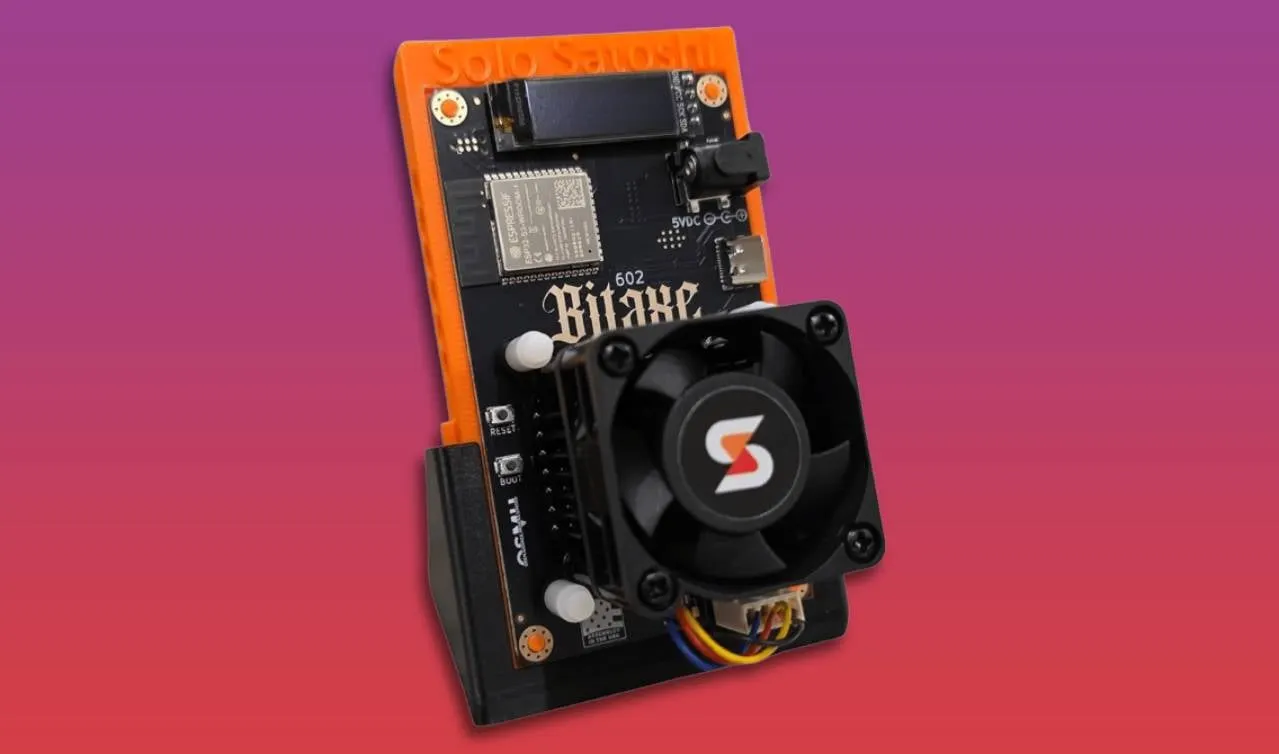
Bitaxe Gamma Bitcoin Solo Miner

Bitaxe Gamma Bitcoin Solo Miner
Bitaxe Gamma Bitcoin Solo Miner. Image: SoloSatoshi

solosatoshi.com, $105

While the vast majority of Bitcoin mining is conducted using pools running shipping containers full of ASICs, there are still some diehards mining on home rigs like the Bitaxe Gamma.

This solo miner promises to deliver up to 800 MHz/1.63 TH/s out of the box and features onboard Wi-Fi, a browser-based dashboard, and a removable OLED display so you can check the live hash rate, temperature, and uptime.

Yes, with mining pools dominating the landscape, the Bitaxe is basically a $100 lottery ticket. But, hey: Someone netted $266,000 worth of block rewards with one just a week ago.

Cosmic Headless 6-String Silver Flake Guitar by Synyster Gates

Cosmic Headless 6-String Silver Flake Guitar by Synyster Gates
Cosmic Headless 6-String Silver Flake Guitar by Synyster Gates. Image: Synner

synner.com, $4,499

Metal band Avenged Sevenfold has made no secret of their desire to bring their fanbase into the blockchain fold through initiatives like an NFT-powered Season Pass.

Guitarist Synyster Gates has doubled down on the technology, launching a range of limited edition signature kit that’s “authenticated on the blockchain,” to widespread bafflement. The idea is that each signature guitar or amp comes with a “digital certificate of authenticity” that’s transferred to the new owner, proving that it isn’t a fake (a common problem for collectors of vintage guitars).

This axe, billed as a one-of-100 “limited batch collectable art piece,” is kitted out with a maple neck, a mahogany body and ebony fretboard, with Gates’ signature Schecter pickup in the bridge position, and a Sustainiac pickup in the neck for wild synth-like effects with infinite sustain.

Quite how useful the “digital certificate” is remains to be seen, and only really comes into play when the guitar is sold on—and what happens if the guitar ends up separated from its certificate? Still, you also get membership to Gates’ “The Syndicate” fan club and 45,000 A7X Season Pass points for your money.

Solana Seeker

Solana Seeker
Solana Seeker. Image: Solana

solanamobile.com, $500

Solana made headlines in 2023 with its Saga smartphone—and sparked a mad dash for meme coin airdrops that at one point were worth more than the device itself.

A couple of years on and the frenzy has abated, with the Solana Seeker a more measured effort. Yes, at half the price of the Saga it’s a less premium offering, but as a stab at a mainstream crypto phone it does the job.

Necessarily a niche product, the Seeker is definitely one for those “actively trading in the Solana trenches,” but for the Solana faithful it’s a no-brainer.

Read our review

Editor’s note: This story was first published on November 27, 2025 and last updated with new entries on December 6.

Daily Debrief Newsletter

Start every day with the top news stories right now, plus original features, a podcast, videos and more.


Source link

6 Compression Techniques for Language Models

0
6 Compression Techniques for Language Models


The artificial intelligence landscape has witnessed an explosion in model sizes over recent years. Yet, companies like MistralAI have demonstrated that bigger isn’t always better; what truly counts is efficiency relative to performance. As edge computing gains momentum, the industry increasingly demands compact, high-performing models that can operate effectively in resource-constrained environments. Model compression techniques offer the solution. This comprehensive guide explores six fundamental compression strategies, complete with practical code examples.

Understanding Model Compression

Model compression refers to techniques that minimize the footprint of machine learning models while preserving their capabilities. Many deep neural networks suffer from over-parameterization, containing excessive and redundant components that can be eliminated or simplified. Through compression, we reduce parameter counts and memory requirements, leading to faster inference times and improved storage efficiency, critical factors when deploying AI on devices with limited computational resources.

Six Core Compression Strategies:

Quantization: Lowers numerical precision of weights and activations

Pruning: Eliminates redundant weights or neurons from the network

Knowledge Distillation: Trains compact models to replicate larger models’ behavior

Weight Sharing: Enables multiple layers to use common weight sets

Low-Rank Factorization: Decomposes weight matrices into smaller components

Mixed Precision Training: Combines different numerical precisions during training

1. Quantization

Quantization compresses models by reducing the numerical precision used to represent weights and activations. Instead of 32-bit or 16-bit floating-point representations, we can use 8-bit or even 4-bit integers, dramatically reducing memory consumption.

Key Approaches:

Weight Quantization: Converts weight precision (e.g., FP32 to INT8), reducing storage requirements

Activation Quantization: Compresses activation values, lowering inference memory needs

Quantization-Aware Training (QAT): Incorporates quantization during training for better accuracy

Post-Training Quantization (PTQ): Applies quantization after training completion

Implementation Example – 8-bit Quantization with GPT-2:

from transformers import AutoModelForCausalLM, AutoTokenizer
import torch

model_id = “gpt2”
tokenizer = AutoTokenizer.from_pretrained(model_id)

quantized_model = AutoModelForCausalLM.from_pretrained(
model_id,
load_in_8bit=True,
device_map=“auto”
)

prompt = “Quantization dramatically reduces model size while maintaining performance.”
inputs = tokenizer(prompt, return_tensors=“pt”).input_ids.to(“cuda”)

with torch.no_grad():
generated = quantized_model.generate(inputs, max_length=50)

result = tokenizer.decode(generated[0], skip_special_tokens=True)
print(result)

2. Pruning

Pruning systematically removes unnecessary components from neural networks, individual weights, entire neurons, or complete layers. This technique reduces model complexity while retaining the majority of original performance. Pruning can be unstructured (targeting individual weights) or structured (removing entire structural components).

For transformer architectures like GPT-2, attention head pruning is particularly effective, eliminating less critical attention mechanisms.

Implementation Example – Pruning 30% of GPT-2 Weights:

import torch
import torch.nn.utils.prune as prune
from transformers import AutoModelForCausalLM, AutoTokenizer

model_id = “gpt2”
base_model = AutoModelForCausalLM.from_pretrained(model_id)
tokenizer = AutoTokenizer.from_pretrained(model_id)

def apply_pruning(layer, pruning_ratio=0.3):
“””Apply L1 unstructured pruning to linear layers”””
for component_name, module in layer.named_modules():
if isinstance(module, torch.nn.Linear):
prune.l1_unstructured(module, name=“weight”, amount=pruning_ratio)
print(f”Applied {pruning_ratio*100}% pruning to {component_name})

for transformer_layer in base_model.transformer.h:
apply_pruning(transformer_layer, pruning_ratio=0.3)

total_params = sum(p.numel() for p in base_model.parameters())
zero_params = sum((p.data == 0).sum().item() for p in base_model.parameters())

print(f”Parameters: {total_params:,})
print(f”Zero parameters: {zero_params:,})
print(f”Sparsity achieved: {zero_params / total_params:.2%})

3. Knowledge Distillation

Knowledge distillation creates compact models by training them to emulate larger, more complex models. The large model (teacher) guides the training of a smaller model (student), which learns to reproduce the teacher’s output patterns. The result is a compressed model with comparable performance to its larger counterpart.

Implementation Example – Distilling GPT-2:

import torch
from transformers import AutoModelForCausalLM, AutoTokenizer
from datasets import load_dataset
import torch.nn.functional as F

teacher_id = “gpt2”
student_id = “distilgpt2”

teacher = AutoModelForCausalLM.from_pretrained(teacher_id).to(“cuda”)
student = AutoModelForCausalLM.from_pretrained(student_id).to(“cuda”)
teacher_tok = AutoTokenizer.from_pretrained(teacher_id)
student_tok = AutoTokenizer.from_pretrained(student_id)

train_data = load_dataset(“wikitext”, “wikitext-2-raw-v1”, split=“train”)

optimizer = torch.optim.AdamW(student.parameters(), lr=5e-5)
temp = 2.0
alpha = 0.5

for epoch in range(3):
for idx, sample in enumerate(train_data):
text = sample[“text”]
if not text.strip():
continue

teacher_input = teacher_tok(text, return_tensors=“pt”).to(“cuda”)
student_input = student_tok(text, return_tensors=“pt”).to(“cuda”)

with torch.no_grad():
teacher_outputs = teacher(**teacher_input).logits / temp
soft_targets = F.softmax(teacher_outputs, dim=-1)

student_outputs = student(**student_input).logits

distill_loss = F.kl_div(
F.log_softmax(student_outputs / temp, dim=-1),
soft_targets,
reduction=“batchmean”
) * (temp ** 2)

ce_loss = F.cross_entropy(
student_outputs.view(-1, student_outputs.size(-1)),
student_input[“input_ids”].view(-1),
ignore_index=student_tok.pad_token_id
)

total_loss = alpha * distill_loss + (1 – alpha) * ce_loss

optimizer.zero_grad()
total_loss.backward()
optimizer.step()

if idx % 100 == 0:
print(f”Epoch {epoch + 1}/3, Step {idx}, Loss: {total_loss.item():.4f})

4. Weight Sharing

Weight sharing compresses models by allowing multiple network components to utilize identical weight sets. By grouping similar weights through clustering algorithms, we significantly reduce the unique values that need to be stored, resulting in a more memory-efficient model.

Implementation Example – Clustering Weights in GPT-2:

import torch
import numpy as np
from sklearn.cluster import KMeans
from transformers import GPT2LMHeadModel

def compress_via_weight_sharing(model, clusters=16):
“””Apply weight clustering to reduce unique weight values”””
for param_name, parameter in model.named_parameters():
if parameter.requires_grad:

weight_array = parameter.data.cpu().numpy().flatten().reshape(-1, 1)

clustering = KMeans(n_clusters=clusters, random_state=42)
clustering.fit(weight_array)

compressed = np.array([
clustering.cluster_centers_[label]
for label in clustering.labels_
]).reshape(parameter.data.shape)

parameter.data = torch.tensor(
compressed,
dtype=parameter.data.dtype
).to(parameter.device)

return model

model = GPT2LMHeadModel.from_pretrained(“gpt2”)
compressed_model = compress_via_weight_sharing(model, clusters=16)
print(“Weight sharing compression completed!”)

5. Low-Rank Factorization

Low-rank factorization decomposes large weight matrices into smaller, low-rank components. By approximating a matrix as the product of two smaller matrices, we reduce the number of parameters while maintaining similar representational capacity. This technique is particularly effective for the dense layers in transformer models.

Implementation Example – Singular Value Decomposition (SVD) Factorization:

import torch
import torch.nn as nn
from transformers import GPT2LMHeadModel

class LowRankLinear(nn.Module):
“””Replace linear layer with low-rank factorization”””
def __init__(self, original_layer, rank):
super().__init__()
weight = original_layer.weight.data
U, S, V = torch.svd(weight)

self.U = nn.Parameter(U[:, :rank] @ torch.diag(torch.sqrt(S[:rank])))
self.V = nn.Parameter(torch.diag(torch.sqrt(S[:rank])) @ V[:, :rank].t())

if original_layer.bias is not None:
self.bias = nn.Parameter(original_layer.bias.data)
else:
self.register_parameter(‘bias’, None)

def forward(self, x):
out = x @ self.V.t() @ self.U.t()
if self.bias is not None:
out = out + self.bias
return out

def apply_low_rank_factorization(model, rank=64):
“””Apply low-rank decomposition to linear layers”””
for name, module in model.named_modules():
if isinstance(module, nn.Linear):

*parent_path, attr = name.split(‘.’)
parent = model
for p in parent_path:
parent = getattr(parent, p)

low_rank_layer = LowRankLinear(module, rank)
setattr(parent, attr, low_rank_layer)
print(f”Factorized layer: {name})

return model

model = GPT2LMHeadModel.from_pretrained(“gpt2”)
factorized_model = apply_low_rank_factorization(model, rank=64)
print(“Low-rank factorization applied!”)

6. Mixed Precision Training

Mixed precision training optimizes both training efficiency and model size by using different numerical precisions for different operations. Typically, this involves using 16-bit floating-point (FP16) for most computations while maintaining 32-bit precision (FP32) for critical operations. This approach accelerates training and reduces memory usage without sacrificing model quality.

Implementation Example – Training with Automatic Mixed Precision:

import torch
from transformers import GPT2LMHeadModel, GPT2Tokenizer, Trainer, TrainingArguments
from datasets import load_dataset

model_name = “gpt2”
model = GPT2LMHeadModel.from_pretrained(model_name)
tokenizer = GPT2Tokenizer.from_pretrained(model_name)
tokenizer.pad_token = tokenizer.eos_token

dataset = load_dataset(“wikitext”, “wikitext-2-raw-v1”, split=“train[:1000]”)

def tokenize_function(examples):
return tokenizer(
examples[“text”],
truncation=True,
padding=“max_length”,
max_length=128
)

tokenized_dataset = dataset.map(tokenize_function, batched=True)

training_args = TrainingArguments(
output_dir=“./mixed_precision_model”,
num_train_epochs=1,
per_device_train_batch_size=4,
fp16=True,
logging_steps=100,
save_steps=500,
)

trainer = Trainer(
model=model,
args=training_args,
train_dataset=tokenized_dataset,
)

trainer.train()
print(“Mixed precision training completed!”)

from torch.cuda.amp import autocast, GradScaler

model = GPT2LMHeadModel.from_pretrained(“gpt2”).to(“cuda”)
optimizer = torch.optim.AdamW(model.parameters(), lr=5e-5)
scaler = GradScaler()

for epoch in range(1):
for batch in tokenized_dataset:
inputs = tokenizer(batch[“text”], return_tensors=“pt”).to(“cuda”)

with autocast():
outputs = model(**inputs, labels=inputs[“input_ids”])
loss = outputs.loss

scaler.scale(loss).backward()
scaler.step(optimizer)
scaler.update()
optimizer.zero_grad()

print(“Manual mixed precision training completed!”)

Conclusion

This article has covered six essential techniques for compressing large language models: quantization, pruning, knowledge distillation, weight sharing, low-rank factorization, and mixed precision training. While not exhaustive, these methods provide a robust toolkit for deploying efficient AI systems, particularly in edge computing and resource-limited scenarios. By combining multiple techniques, practitioners can achieve significant compression ratios while maintaining acceptable performance levels, making advanced language models accessible across a wider range of deployment environments.

By combining multiple techniques, practitioners can achieve significant compression ratios while maintaining acceptable performance levels. With the right GPU infrastructure from providers like Spheron AI, you can experiment with these techniques efficiently and deploy advanced language models across a wider range of environments, from cloud servers to edge devices.

The future of AI deployment lies not just in building larger models, but in making powerful models accessible and efficient for real-world applications. Model compression is the key to unlocking that future.


Source link

Armored Vehicles Market Projected to Hit USD 51,723.01 Million by 2032, Expanding at 5.66% CAGR: Credence Research | Web3Wire

0
Armored Vehicles Market Projected to Hit USD 51,723.01 Million by 2032, Expanding at 5.66% CAGR: Credence Research | Web3Wire


Market OutlookThe Armored Vehicles Market was valued at USD 33,478.44 million in 2024 and is projected to reach USD 51,723.01 million by 2032, expanding at a CAGR of 5.66% during 2024-2032. Rising geopolitical tensions, territorial conflicts, and modernization of military fleets continue to drive strong procurement cycles globally. Defense forces are increasingly investing in next-generation armored platforms equipped with advanced survivability systems, cyber-secure communication modules, and improved mobility. The shift toward modular vehicle architectures, multi-role platforms, and the integration of unmanned capabilities further accelerates market expansion. Governments across North America, Europe, and Asia-Pacific are prioritizing long-term armored vehicle replacement programs, strengthening the demand outlook over the forecast horizon.Moreover, the market benefits from rapid technological advancements in materials science, active protection systems (APS), situational awareness sensors, and hybrid-electric propulsion. Manufacturers are focusing on developing lightweight yet highly protected vehicles to enhance operational efficiency and maneuverability amid evolving battlefield conditions. Strategic partnerships, cross-border defense collaborations, and increased private-sector participation are reshaping the competitive landscape. With rising defense budgets, renewed emphasis on border security, and growing counter-terrorism operations, the Armored Vehicles Market is expected to experience sustained growth through 2032, supported by continuous innovation and enhanced fleet modernization initiatives worldwide.Key Growth DriversThe Armored Vehicles Market is propelled by escalating global security concerns, rising cross-border tensions, and the increasing frequency of asymmetric warfare. Governments are prioritizing the modernization of ground combat fleets to enhance battlefield survivability and operational superiority. This shift fuels demand for advanced main battle tanks, infantry fighting vehicles, and mine-resistant ambush-protected (MRAP) systems. Additionally, expanding defense budgets particularly in the U.S., China, India, and European nations support large-scale procurement and upgrade programs. Enhanced requirements for mobility, protection, and digital warfare capabilities have encouraged armed forces to adopt sophisticated armored solutions, further strengthening market momentum.Technological innovation is another major growth catalyst, with manufacturers integrating active protection systems (APS), composite armor materials, AI-enabled situational awareness sensors, and hybrid-electric powertrains into next-generation platforms. The rise of border security initiatives, counter-insurgency operations, and peacekeeping missions also boosts demand for lightweight, multi-role armored vehicles. Moreover, the growing deployment of unmanned and remotely operated ground vehicles contributes to evolving battlefield strategies, prompting defense agencies to collaborate with OEMs for rapid capability development. As nations pursue modernization, interoperability, and enhanced survivability, these factors collectively serve as powerful drivers shaping the long-term growth trajectory of the Armored Vehicles Market.Tailor the report to align with your specific business needs and gain targeted insights. Request – https://www.credenceresearch.com/report/armored-vehicles-market

Regional AnalysisThe Armored Vehicles Market demonstrates strong regional momentum, with North America leading due to substantial U.S. defense spending, continuous fleet modernization, and high adoption of advanced combat and tactical vehicles. Europe follows closely, driven by renewed security priorities, NATO modernization commitments, and heightened procurement activities across Germany, France, the U.K., and Eastern Europe. Asia-Pacific is poised for the fastest growth as China, India, South Korea, and Japan accelerate armored vehicle upgrades in response to rising geopolitical tensions and expanding military capabilities. Meanwhile, Middle East & Africa continues to invest in armored fleets to bolster national security and counter-terrorism operations, while Latin America shows steady growth supported by border surveillance initiatives and modernization programs. Collectively, these dynamics contribute to a robust global demand outlook for armored platforms through 2032.Key Player AnalysisBAE SystemsBMW AGDaimler AG (Mercedes Benz)Elbit SystemsFord Motor CompanyGeneral Dynamics CorporationINKAS Armored Vehicle OEMInternational Armored GroupIVECOKrauss-Maffei Wegmann GmbH & Co. (KMW)Lenco Industries, Inc.Lockheed Martin CorporationNavistar, Inc.Oshkosh Defense, LLCRheinmetall AGSTAT, Inc.Textron, Inc.Thales GroupTailor the report to align with your specific business needs and gain targeted insights. Request – https://www.credenceresearch.com/report/armored-vehicles-marketSegmentsCombat Vehicles:Armored Personnel Carrier (APC)Infantry Fighting Vehicles (IFV)Light Protected Vehicles (LPV)Main Battle Tanks (MBT)Mine-resistant Ambush Protected (MRAP)Tactical VehicleOthersCombat Support Vehicles:Armored Supply TrucksArmored Command & Control VehiclesRepair & Recovery VehiclesUnmanned Armored Ground VehiclesBy TypeElectric Armored VehiclesConventional Armored VehiclesBy MobilityWheeledTrackedBy Mode of OperationManned Armored VehiclesUnmanned Armored VehiclesBy SystemEnginesDrive SystemsCommunication SystemsFire Control Systems (FCS)Navigation SystemsOthersBy RegionNorth AmericaEuropeAsia PacificLatin AmericaMiddle East & AfricaTailor the report to align with your specific business needs and gain targeted insights. Request – https://www.credenceresearch.com/report/armored-vehicles-market

Follow Us:https://www.linkedin.com/company/credenceresearch/https://x.com/CredenceResearchttps://www.facebook.com/CredenceResearch

Credence Research Europe LTD128 City Road, London,EC1V 2NX, UNITED KINGDOMEurope – +44 7809 866 263North America – +1 304 308 1216Australia – +61 4192 46279Asia Pacific – +81 5050 50 9250+64 22 017 0275India – +91 6232 49 3207sales@credenceresearch.comhttp://www.credenceresearch.com

Credence Research is a viable intelligence and market research platform that provides quantitative B2B research to more than 2000 clients worldwide and is built on the Give principle. The company is a market research and consulting firm serving governments, non-legislative associations, non-profit organizations, and various organizations worldwide. We help our clients improve their execution in a lasting way and understand their most imperative objectives.

This release was published on openPR.

About Web3Wire Web3Wire – Information, news, press releases, events and research articles about Web3, Metaverse, Blockchain, Artificial Intelligence, Cryptocurrencies, Decentralized Finance, NFTs and Gaming. Visit Web3Wire for Web3 News and Events, Block3Wire for the latest Blockchain news and Meta3Wire to stay updated with Metaverse News.


Source link

Professor Coin: When Bitcoin Sneezes—How Crypto and Equities Caught the Same Cold – Decrypt

0
Professor Coin: When Bitcoin Sneezes—How Crypto and Equities Caught the Same Cold – Decrypt


In brief

Academic literature increasingly finds that crypto and equities are tightly intertwined, especially during periods of stress.
Studies find that crypto increasingly behaves like a high-beta tech sector.
An academic consensus is forming that crypto is now firmly embedded in the global risk ecosystem.

Professor Andrew Urquhart is Professor of Finance and Financial Technology and Head of the Department of Finance at Birmingham Business School (BBS).

This is the tenth installment of the Professor Coin column, in which I bring important insights from published academic literature on cryptocurrencies to the Decrypt readership. In this article, I discuss how crypto’s relationship with equities has evolved.

Not so long ago, Bitcoin was marketed as the ultimate diversifier—an asset supposedly immune to whatever was happening in equity markets. Early academic work backed that up: Liu and Tsyvinski (2021) showed that major cryptocurrencies had minimal exposure to standard stock, bond and FX risk factors, and that their returns were mainly driven by crypto-specific forces like momentum and investor attention, not equity markets.

Fast-forward to the last couple of years, and that story looks very different. A growing literature now finds that crypto and equities are tightly intertwined, especially during stress. For a fintech audience, the key message is simple: you can’t treat crypto as “off-grid” risk anymore. It behaves more and more like a high-beta tech sector—with some nasty tail behaviour on top.

From “uncorrelated” to “just another risky asset”

A recent survey by Adelopo et al (2025) and co-authors reviews the evidence on how cryptocurrencies interact with traditional financial markets. They document clear time-varying and non-linear linkages between crypto and stock markets, with particularly strong connections during major macro and geopolitical events like COVID-19 or the Russia–Ukraine war.

Studies looking specifically at technology and blockchain-linked stocks confirm this. Umar et al (2021) finds strong connectedness between cryptocurrency markets and the technology sector while Frankovic (2022) shows that Australian “cryptocurrency-linked stocks” experience significant return spillovers from crypto prices, especially for firms more deeply involved in blockchain activity. In other words, listed equity is now a transmission channel for crypto risk.

]]>

What the newest evidence says

Several recent papers make the “crypto ↔ equity” link very explicit:

Global spillovers: Vuković (2025) uses a Bayesian Global VAR to show that adverse shocks originating in the cryptocurrency market depress stock markets, bond indices, exchange rates and volatility indices across a wide set of countries—not just the U.S.
Equity–crypto co-movement: Ghorbel and co-authors (2024) study connectedness between major cryptocurrencies, G7 stock indices and gold. They find that cryptocurrencies have become important senders and receivers of shocks, with stronger ties to equities in recent years and particularly during turbulent periods.
U.S. and Chinese stock markets: Lamine et al (2024) examine spillovers between U.S./Chinese equities, cryptocurrencies and gold. They find significant dynamic risk spillovers from crypto to these stock markets, again concentrated in high-volatility episodes.
Exchange-level contagion: Sajeev et al (2022) document a contagion effect of Bitcoin on major stock exchanges (NSE India, Shanghai, London and Dow Jones), using volatility spillover and correlation analysis from 2017–2021.

International organisations tell a similar story. An IMF departmental paper on “Spillovers Between Crypto and Equity Markets” finds that Bitcoin shocks can explain a non-trivial share (roughly mid-teens percent) of variation in global equity volatility, and that this influence has strengthened over time as institutional and derivative markets matured.

The common conclusion: crypto is now firmly embedded in the global risk ecosystem.

Why tech and crypto now move together

Why does Bitcoin now look so much like a high-beta tech stock?

Duration and interest-rate sensitivity: Both crypto and growth equities are essentially claims on uncertain future cash flows or network value. When real rates rise, discount factors bite hard—and both sectors sell off together.
Investor base and leverage: Retail trading, momentum strategies and derivatives are heavily used in both arenas. Products like futures, options and leveraged ETFs allow shocks in one market to be magnified and replicated in the other.
Institutional portfolio construction: As crypto has been added to multi-asset and hedge-fund portfolios, its returns inevitably become entangled with traditional cross-asset positioning. When funds de-risk, everything in the “risky bucket” goes out together.

What this means for portfolios and risk management

For portfolio construction, the message is uncomfortable but clear:

Crypto does diversify in quiet periods—correlations can still be modest in benign regimes.
But during stress, when diversification is most valuable, correlations and spillovers spike.
Bitcoin and major altcoins behave less like “digital gold” and more like levered proxies for global risk sentiment.

That doesn’t make crypto useless as an investment—but it does mean that treating a 5–10% crypto allocation as “uncorrelated upside” is no longer defensible based on the data.

Going forward, one open question for both academics and practitioners is whether spot ETFs and broader institutional adoption will further tighten these linkages, or whether a new use-case (such as genuine payment or settlement adoption) could create more idiosyncratic drivers again.

For now, the evidence points in one direction: when global markets catch a cold, crypto doesn’t sit it out anymore—it coughs along with everything else.

Selected academic references

Adelopo, I., et al. (2025). “Interconnectedness among cryptocurrencies and financial markets: A review.” Financial Innovation. SpringerLink
Frankovic, J. (2022). “On spillover effects between cryptocurrency-linked stocks and cryptocurrencies.” Global Finance Journal, 54, 100719. https://doi.org/10.1016/j.gfj.2021.100719 IDEAS/RePEc
Ghorbel, A., et al. (2024). “Connectedness between cryptocurrencies, gold and stock markets: A network approach.” European Journal of Management and Business Economics, 33(4), 466–489. Econstor
IMF (2022). Spillovers Between Crypto and Equity Markets. IMF Departmental Paper. IMF eLibrary IMF eLibrary+1
Lamine, A., et al. (2024). “Spillovers between cryptocurrencies, gold and stock markets.” Journal of Economics, Finance and Administrative Science, 29(57), 21–40. Emerald
Liu, Y., & Tsyvinski, A. (2021). “Risks and Returns of Cryptocurrency.” Review of Financial Studies, 34(6), 2689–2727. https://doi.org/10.1093/rfs/hhaa113 OUP Academic
Sajeev, K. C., et al. (2022). “Contagion effect of cryptocurrency on the securities market.” Journal of Economic Studies, 49(7), 1390–1410. PubMed Central
Umar, Z., Kenourgios, D., & Papathanasiou, S. (2021). “Connectedness between cryptocurrency and technology sectors: Evidence from implied volatility indices.” Finance Research Letters, 38, 101492. ScienceDirect
Vuković, D. B., et al. (2025). “Spillovers between cryptocurrencies and financial markets.” Journal of International Money and Finance, 150, 102963. IDEAS/RePEc

Daily Debrief Newsletter

Start every day with the top news stories right now, plus original features, a podcast, videos and more.


Source link

Is Base’s Solana bridge a ‘vampire attack’ on SOL liquidity or multichain pragmatism?

0
Is Base’s Solana bridge a ‘vampire attack’ on SOL liquidity or multichain pragmatism?


Base launched a bridge to Solana on Dec. 4, and within hours, Solana’s most vocal builders accused Jesse Pollak of running a vampire attack disguised as interoperability.

The bridge uses Chainlink CCIP and Coinbase infrastructure to let users move assets between Base and Solana, with early integrations in Zora, Aerodrome, Virtuals, Flaunch, and Relay. These are all applications built on Base.

Pollak framed it as bidirectional pragmatism: Base apps want access to SOL and SPL tokens, Solana apps want access to Base liquidity, so Base spent nine months building the connective tissue.

Vibhu Norby, founder of Solana creator platform DRiP, saw it differently. He posted a video of Aerodrome co-founder Alexander Cutler, who said at Basecamp in September that Base would “flip Solana” and become the largest chain in the world.

Norby’s read:

“These are not partners; if they had it their way Solana would not exist.”

Pollak replied that Base just built a bridge to Solana because “Solana assets deserve to have access to the Base economy and Base assets should have access to Solana.”

Norby fired back, alleging that Base didn’t set up Solana-based applications for launch, nor did they align with the Solana Foundation marketing or operations team.

The thread escalated when Akshay BD, a top voice tied to Solana’s Superteam, told Pollak:

“Calling it bidirectional doesn’t make it so. It’s a bridge between two economies that has net import/export result based on how you roll it out. I don’t mind that you’re competitive… I mind that you’re being dishonest.”

Anatoly Yakovenko, Solana’s co-founder, joined to deliver the sharpest version of the critique:

“Migrate Base apps to Solana so they execute on Solana and the transactions are linearized by Solana staked block producers. That would be good for Solana developers. Otherwise it’s alignment bullshit.”

The debate highlights the incentive mismatch between what “interoperability” means to an Ethereum layer-2 and to an alternative layer-1 blockchain.

Base sees the bridge as unlocking shared liquidity and cross-chain UX without relying on third-party infrastructure.

Pollak said Base announced the bridge in September, began discussing it with Yakovenko and others in May, and has consistently said it’s bidirectional.

He insists that Base and Solana developers benefit from access to both economies.

On the contrary, Solana voices argue that the method Base used to launch the bridge, integrating only Base-aligned apps, coordinating no Solana-native partners, and skipping Solana Foundation outreach, reveals the real strategy: siphon Solana capital into Base’s ecosystem while marketing it as reciprocal infrastructure.

The asymmetry

According to Yakovenko, the bridge is bidirectional in code but not in economic gravity.If the bridge just lets Base apps import Solana assets while keeping all execution and fee revenue on Base, it extracts value from Solana without reciprocating. That’s the vampire attack thesis.

Pollak’s counterargument is that interoperability is not zero-sum. He argues that Base and Solana can compete and collaborate simultaneously, and that developers on both sides want access to each other’s economies.

He pointed out that Base tried to engage Solana ecosystem participants during the nine-month build process, but “folks weren’t really interested.” However, meme projects like Trencher and Chillhouse did collaborate.

Norby and Akshay dispute that framing, arguing that dropping a repo without coordinating launch partners or working with the Solana Foundation is not genuine collaboration, it’s tactical extraction dressed up as open-source infrastructure.

The friction is that Base and Solana occupy different positions in the liquidity hierarchy.

Base is an Ethereum layer-2, which means it inherits Ethereum’s security, settlement, and credibility but competes with the mainnet for activity. Ethereum layer-2 blockchains need to justify their existence by offering better UX, lower fees, or differentiated ecosystems.

Meanwhile, Solana is a standalone Layer 1 with its own validator set, token economics, and security model.

When a bridge lets Solana assets flow into Base, Solana loses transaction fees, MEV, and staking demand unless those assets eventually return or generate reciprocal flows.

Base captures the activity and the economic rent. Yakovenko’s point is that true bidirectionality would mean Base apps moving execution to Solana, not just importing Solana tokens into Base-based contracts.

Who gains what

Based on the debate, Solana’s top voices suggest that Base gains immediate access to Solana’s cultural and financial momentum. Solana has been the center of meme coin mania, NFT speculation, and retail onboarding for the past year.

Integrating SOL and SPL tokens into Base apps like Aerodrome and Zora lets Base tap that energy without waiting for organic growth.

Base also benefits from positioning itself as the “neutral” interoperability layer that connects all ecosystems, which strengthens its narrative as the default hub for cross-chain DeFi.

Although Solana gains optionality, it does not receive guaranteed value capture. If the bridge drives Base developers to experiment with Solana execution or if Solana apps start using Base liquidity pools for bridged assets, the relationship becomes reciprocal.

However, if the bridge primarily serves as a one-way funnel that pulls Solana assets into Base’s economy, Solana loses.

The risk is that Solana becomes a feeder chain for Base DeFi rather than a destination.

Norby’s accusation reflects that fear. If Base’s launch strategy was to integrate apps that extract value from Solana without reciprocating, the bridge is a competitive weapon, not a collaboration.

Additionally, Yakovenko argues that Base can’t be honest about competing with Ethereum, so it frames itself as aligned with the broader ecosystem while actually siphoning activity.

The same logic applies to Solana: Base can’t be honest about competing with Solana, so it frames the bridge as neutral infrastructure.

What happens next

The bridge is live, and the economic gravity will decide the outcome. If Base apps start routing execution to Solana or if Solana-native projects launch integrations that pull Base liquidity into Solana-based contracts, the bridge becomes genuinely bidirectional.

If the flow stays one-way, with Solana assets into Base and revenue staying on the Ethereum layer-2, the vampire attack thesis holds.

Pollak’s claim that Base and Solana “win together” depends on whether Base treats Solana as a peer or as a supplier of assets and liquidity.

The difference is whether Base markets to its own developers to build on Solana, or markets to Solana users to bring their assets to Base.

Yakovenko made the test explicit: compete honestly, and the bridge is good for the industry. Compete while pretending to collaborate, and it’s alignment theater.

The next six months will show which narrative is real.

Mentioned in this article


Source link

A Homeowner’s Guide to Water Heater Replacement in Broken Arrow, OK | Web3Wire

0
A Homeowner’s Guide to Water Heater Replacement in Broken Arrow, OK | Web3Wire


Image: https://www.abnewswire.com/upload/2025/12/ced6f94a249fd7ee69fdb0291ab62756.jpg

Your water heater is one of your home’s most essential, hardworking appliances. It provides the hot water you need for showers, laundry, and dishes. Most of the time, it works quietly in a closet or garage, completely out of sight. When it fails, however, it becomes an immediate and stressful emergency. For homeowners in Broken Arrow, OK, knowing the signs of failure and the replacement process can make a difficult situation much more manageable.

Signs Your Broken Arrow, OK Home Needs a New Water Heater

Plumbing Noises and Temperature Problems

The first warning signs from your water heater are often subtle. You might hear a popping, rumbling, or banging sound from the tank. This is usually caused by years of sediment buildup at the bottom. This layer of sediment forces the unit to work harder to heat the water, causing it to overheat and make noise. You may also notice fluctuating water temperatures, such as water that is only lukewarm or suddenly scalding hot.

Visible Signs of Plumbing Failure

A visual inspection can tell you a lot. The most obvious sign is a puddle of water around the base of the tank; this indicates an active leak. You should also look for discolored or rusty water coming from your hot water faucets. This is a clear sign that the inside of your tank is corroding. This is not a repairable problem; it is a critical warning that the tank’s integrity has failed.

The Age of Your Plumbing System

A standard tank-style water heater has a typical lifespan of 8 to 12 years in Broken Arrow, OK. If your unit is over a decade old, it is living on borrowed time. Replacing it proactively, before it fails, can save you from the cost and damage of an emergency leak.

The Water Heater Replacement Process with a Plumber

Choosing Your New Water Heater

A professional plumber will not just sell you a box. They will first assess your home’s needs. How many people are in your family? What are your hot water usage habits? Based on this, they will help you choose the right type and size. You can select a traditional, high-efficiency tank water heater or upgrade to a tankless system that provides endless hot water.

The Professional Plumbing Installation

The replacement process is precise and technical. A licensed plumber will first shut off the water, gas, and electricity to the old unit. They will then completely drain the tank and safely disconnect all lines. After removing the old unit, they will set the new water heater in place, often in a new drain pan to prevent flood damage. They will then professionally connect the new water lines, gas or electrical lines, and the ventilation, ensuring every connection is secure and up to code.

Testing and Final Plumbing Checks

Once the new water heater is installed, the plumber will slowly refill the tank. They will purge all air from the lines and meticulously check for any leaks. Only when the tank is full will they ignite the pilot light or turn on the electricity. They will perform a final test to ensure the unit is heating correctly and safely. A trusted Plumber Broken Arrow OK [https://sgtplumbing.com/] ensures the job is done right.

Why You Need a Professional Plumber in Broken Arrow, OK

The Dangers of a DIY Plumbing Installation

A water heater installation is not a simple DIY project. It involves connecting a high-voltage electrical system or a natural gas line. An improper gas connection can lead to a dangerous leak or even an explosion. A mistake with the T&P (temperature and pressure) relief valve can turn the tank into a serious hazard. This job should only be performed by a licensed and insured plumber.

A Plumber Ensures Code Compliance

The city of Broken Arrow, OK, has specific building codes for water heater installations. These codes cover ventilation, drain pan requirements, and gas line connections. A professional plumber is an expert in these codes. They will ensure your new water heater is installed safely and legally, protecting your home and your family.

Why Sargent Plumbing & Drain is Your Trusted Broken Arrow, OK Plumber

A Local, Honest Plumbing Company

Sargent Plumbing & Drain is a locally owned and operated business right here in Broken Arrow, OK. We are built on a foundation of honesty and hard work. With over 25 years of combined experience, our licensed team is focused on providing 5-star service, not on upselling you. We provide clear, free estimates for our work.

Your 24/7 Emergency Plumber

We know that water heaters do not fail on a convenient schedule. That is why we offer 24/7 emergency service throughout the Broken Arrow, OK, area. The best part? We never charge extra fees for emergency, night, or weekend calls. When you need a Plumber Broken Arrow OK [https://sgtplumbing.com/] for an emergency, our priority is to help you, not to charge you more.

A Commitment to 5-Star Plumbing Service

From your first call, you will see the Sargent Plumbing & Drain difference. We are committed to providing a 5-star residential and commercial plumbing experience. We offer financing options and long-term warranties on our work. We are your reliable partner for all your water heater and plumbing needs.

Do not wait for a cold shower or a flooded garage. If your water heater is old or showing signs of failure, be proactive. Contact the trusted, local team at Sargent Plumbing & Drain today for your free, no-pressure estimate.

Media ContactCompany Name: Sargent’s Plumbing & DrainContact Person: Andrew SargentEmail:Send Email [https://www.abnewswire.com/email_contact_us.php?pr=a-homeowners-guide-to-water-heater-replacement-in-broken-arrow-ok]Phone: (918) 380-5637Address:605 W Oakland PlCity: Broken ArrowState: OK 74012Country: United StatesWebsite: https://sgtplumbing.com/

Legal Disclaimer: Information contained on this page is provided by an independent third-party content provider. ABNewswire makes no warranties or responsibility or liability for the accuracy, content, images, videos, licenses, completeness, legality, or reliability of the information contained in this article. If you are affiliated with this article or have any complaints or copyright issues related to this article and would like it to be removed, please contact retract@swscontact.com

This release was published on openPR.

About Web3Wire Web3Wire – Information, news, press releases, events and research articles about Web3, Metaverse, Blockchain, Artificial Intelligence, Cryptocurrencies, Decentralized Finance, NFTs and Gaming. Visit Web3Wire for Web3 News and Events, Block3Wire for the latest Blockchain news and Meta3Wire to stay updated with Metaverse News.


Source link

New ‘Postal’ Game Canceled One Day After Reveal, Following Generative AI Allegations – Decrypt

0
New ‘Postal’ Game Canceled One Day After Reveal, Following Generative AI Allegations – Decrypt


In brief

Postal series fans said the Bullet Paradise trailer showed AI-generated artwork, prompting a swift cancelation.
Discord insults and a mocking post on X deepened backlash around the externally developed spinoff.
Running With Scissors said it’s shifting focus to other 2026 projects after reviewing the incident.

Running With Scissors, publisher of the controversial shooter game franchise Postal, said this week that it had canceled a newly revealed series entry one day after announcing it, responding to backlash after fans said the reveal trailer appeared to use AI-generated artwork.

The game, Portal: Bullet Paradise, was a fast-paced first-person shooter spinoff developed externally by Goonswarm Games. The backlash occurred just days after Running With Scissors railed against generative AI usage in gaming, taking a stand against AI in creative work.

The publisher said it ended the project because its trust in the development team had broken down, adding that it aimed to remain transparent with its community and still had several upcoming projects in the pipeline.

“We’ve been overwhelmed with negative responses from our concerned Postal community,” the company wrote on X. “The strong feedback from them is that elements of the game are very likely AI-generated, and thus has caused extreme damage to our brand and our company reputation.”

The backlash against Postal: Bullet Paradise intensified after fans dissected the December 3 trailer and flagged details they argued were produced by AI tools. Late last month, Running With Scissors said on X that customers should know if a game was created using AI.

“Customers deserve to know if a game was crafted with creativity, soul and actual talent rather than some machine that craps out anything from a prompt,” they wrote.

Frustration from gamers escalated when company representatives defended the trailer on X and in Discord while insulting critics. Screenshots show company reps using expletives and slurs when responding to allegations.

As the images spread, Running With Scissors issued a separate X message addressing the conduct.

]]>

“We’d like, of course, to apologize to anyone who felt insulted in the heat of the moment, and we thank you for raising concerns at the time,” they said in an added post. “As for those who specifically sent us death threats, the apology does not apply.”

Running with Scissors did not immediately respond to a request for comment by Decrypt.

The Postal franchise began in 1997 and quickly became known for dark humor, confrontational satire, and graphic violence. The franchise takes its name from the term “going postal,” which originally referred to a series of workplace shootings by U.S. postal employees in the 1990s, and it later became slang for sudden, violent outbursts or shooting sprees more generally.

Several countries, including Australia, Germany, Malaysia, New Zealand, Sweden, and France, banned entries in the series for its intense violence, graphic content, animal cruelty, and offensive themes. The property later inspired a widely panned 2007 live-action film directed by Uwe Boll.

The company said it would shift its attention to projects planned for 2026, and reiterated that threats against staff would be reported. The studio has not said whether Postal: Bullet Paradise could return in another form, and the experience has prompted renewed scrutiny of how developers and publishers disclose the use of AI in game production.

“Since forming Running With Scissors in 1996, we’ve always said that our fans are part of the team. Our priority is to always do right by the millions who support the Postal franchise,” they wrote. “We are grateful for the opportunity to make the games we want to play, and will continue to focus on our new projects and updates coming in 2026 and beyond.”

Following the backlash, Goonswarm Games announced on Friday that the studio would shut down and cease operations.

“Our project, and everything we built over the past six years, was canceled in just a few days,” it wrote in a statement. 

“Our studio was mistakenly accused of using AI-generated art in our games, and every attempt to clarify our work only escalated the situation,” they said, adding that the company has received a “large number of threats, insults, and mockery.”

Major game publishers, including Ubisoft, CD Projekt Red, Square Enix, and Activision, have expanded their use of generative AI in recent years, adopting the technology for in-game asset creation, internal testing, moderation, and efforts to speed up development pipelines.

Developers have faced growing pushback from players who argue that AI-generated art can look inconsistent, rely on copyrighted training data, or replace work typically done by human artists. Those concerns have surfaced across studios experimenting with automated tools, regardless of project size.

The broader industry is also grappling with labor pressures. So far in 2025, more than 3,500 jobs have been cut across game studios, according to tracking site Gaming Layoffs, fueling worries that automation will further reduce opportunities for artists and other early-career developers. Nearly 15,000 game industry jobs were cut in 2024.

“We’re truly sorry for the artists who put their soul into this and supported our studio, only to face false AI accusations,” Goonswarm wrote. “It’s tough to pour so much energy into a game and end up caught up in the middle of an AI war by accident.”

GG Newsletter

Get the latest web3 gaming news, hear directly from gaming studios and influencers covering the space, and receive power-ups from our partners.


Source link

Why Bare Metal Infrastructure Powers the Future of AdTech

0
Why Bare Metal Infrastructure Powers the Future of AdTech


Every millisecond matters. When a user loads a webpage, advertisers enter a silent auction that completes in under 100 milliseconds. The platform that responds faster wins the impression. The one that’s late loses revenue and trust.

This is real-time bidding (RTB), and it’s unforgiving.

For AdTech platforms handling 100 billion auction requests daily, the infrastructure choice between bare metal and public cloud isn’t academic; it directly impacts win rates, revenue, and competitiveness. As latency-sensitive workloads increasingly demand AI-powered inference and real-time model training, the case for dedicated, optimized infrastructure has become impossible to ignore.​

The RTB Gauntlet: Racing Against the Clock

Real-time bidding is one of the most demanding computing challenges in the modern digital economy. Exchanges expect end-to-end responses within roughly 100 milliseconds, but after accounting for network latency between the exchange and your DSP, the actual processing window shrinks to a razor-thin 50–80 milliseconds. If your system is even 50 milliseconds too slow, you lose that impression to a faster competitor.​

The infrastructure supporting this operates at a mind-bending scale. Major ad exchanges process over 500,000 auctions per second during peak hours, with some handling upwards of 600 billion bid requests daily. During peak shopping seasons and sporting events, these volumes explode even further.​

The latency budget allocation reveals why infrastructure choice matters so dramatically:

RTB Latency Budget Allocation: How 100ms Deadline is Distributed

In bare metal environments, that overhead buffer shrinks substantially, leaving more time for actual intelligent bidding decisions. In cloud VMs, virtualization overhead consumes 30–45% of your available processing window, the time you can’t get back.

When companies actually measure performance head-to-head, the results are striking. Bare metal configurations consistently deliver sub-100ms P99 latencies, with average response times around 12 milliseconds. Cloud VMs typically land in the 120–150ms range, a 30–40 millisecond gap that’s often the difference between winning and losing an auction.​

One blockchain infrastructure provider ran a direct comparison test under identical conditions: same city, same bandwidth, same workload. The cloud node started at 28ms, but once real users hit the system, latency spiked to 150ms. The bare metal node stayed at a consistent 12ms, even under full load.​

Why does this happen? Virtualization overhead bleeds performance across every resource type:

Virtualization Overhead by Resource Type: The Hidden Cost of Cloud VMs

CPU overhead: 9–12% on modern hypervisors (Hyper-V), 17% on Intel virtualization, up to 38% on AMD​

Memory overhead: ~12% due to hypervisor memory management and per-VM allocations​

Disk I/O: 6–8% overhead from emulated storage layers​

Network I/O: 15–25% overhead from virtual network interfaces and packet processing​

These costs cascade. When processing decisions must be completed in milliseconds, every percentage point of overhead can push you over the latency cliff.​

Real-Time Bidding at Its Core

DSPs (Demand-Side Platforms) are the engines that power RTB, operating under brutal constraints. They must handle millions of ad requests per second while parsing requests, fetching user profiles, running complex pricing algorithms, and generating responses with creative data and tracking pixels, all within 50–80 milliseconds.​

A production RTB system typically allocates 10–20 milliseconds for the actual decision-making phase, leaving precious little margin for error. Research on leading DSPs shows bid response times average between 5–20 milliseconds depending on targeting complexity but degrade by up to 35% during peak traffic periods in under-optimized systems. One major Chinese DSP reduced average response times from 23ms to 9ms purely through algorithmic improvements without any hardware upgrade.​

Building the Right Infrastructure for Each AdTech Component

Recommended CPU core ranges for key AdTech platform components

Minimum Hardware Specifications for AdTech Platform Components

Demand-Side Platforms (DSPs) need high-frequency, multi-core processors optimized for raw speed: 24–64 high-frequency cores (favoring clock speed over core count), 256–512GB RAM for maintaining user profiles and campaign data in memory, 10–25 GbE minimum network bandwidth, and 1–2TB NVMe storage for warm data and telemetry.​

Supply-Side Platforms (SSPs) manage billions of impressions daily and prioritize throughput and concurrency: 24–48 cores with strong per-core performance, 256GB to 1TB RAM for publisher inventory catalogs and yield optimization, 25–100 GbE for handling millions of concurrent bid requests, and hybrid storage approaches with fast SSDs for active inventory and large HDDs for historical data.​

Data Management Platforms (DMPs) emphasize data processing and bulk analytics: 12–24 cores with support for advanced instruction sets (AVX-512), 256GB to 2TB RAM depending on dataset size and segmentation needs, 10–40 GbE network bandwidth where throughput matters more than ultra-low latency, and massive tiered capacity with NVMe for active segments and 100TB+ HDD arrays for historical data.​

Ad Exchanges orchestrate auctions in real-time and demand absolute consistency: 32–64 cores at the highest available clock speeds (potentially across single-socket servers to minimize NUMA effects), 512GB to 2TB RAM for maintaining state on millions of concurrent auctions, 25/50/100 GbE+ with direct peering to major DSPs and SSPs, and all-flash storage for operational data with hottest keys in memory.​

The Optimization Breakthrough: From 29ms to 5ms

Real-time bidding has experienced dramatic performance improvements through infrastructure optimization and architectural innovation. Research demonstrates that moving from traditional architectures to optimized pipelined processing can reduce average latency from 29 milliseconds down to just 8 milliseconds, a 72% improvement. When combined with Kafka KIP-500 architecture for distributed stream processing, systems can achieve sub-5 millisecond latencies.​

RTB Processing Optimization Improvements: Path to Sub-10ms Latency

Virtualization overhead by resource type in cloud VM environments

Key optimization gains include:

Pipelined processing architectures: 72% latency reduction (29ms → 8ms)​

Kafka KIP-500 architecture: 83% latency reduction, with infrastructure costs dropping 44% while throughput capacity increases 2.7x​

Multi-level caching strategies: 65–80% reduction in data access times, with 47% lower average bid processing times during high-traffic periods through smart prefetching algorithms, achieving 76.3% cache hit rates​

These optimizations compound when running on bare metal infrastructure without virtualization overhead stealing cycles.

The “Noisy Neighbor” Tax: Why Shared Resources Fail AdTech

Cloud environments introduce a hidden performance killer: the “noisy neighbor” effect. When other tenants on your shared physical host consume I/O bandwidth, network capacity, or CPU cycles, your virtual machine suffers collateral damage.​

A single VM doing heavy database backups can saturate the I/O bandwidth of the entire shared storage array, forcing all other VMs to wait. A neighbor running aggressive network operations can saturate the physical NIC, causing packet loss and increased latency for everyone else.​

For AdTech, this is catastrophic. When milliseconds determine winners and losers, you can’t afford performance variability caused by unknown workloads running on the same physical hardware. Bare metal eliminates this problem entirely; your servers don’t share resources with competitors, and your performance stays consistent, predictable, and repeatable.​

Real-World Impact: The Numbers That Matter

Companies making the switch to dedicated infrastructure report stunning efficiency gains. spheron.ai customers report up to 86% lower compute costs and 3× better system performance compared with virtualized deployments. Neon Labs achieved real-time response targets while cutting cloud costs by 60%. One optimization case study (PowerLinks) reduced infrastructure spending from $200,000/month to $10,000/month, a 20× improvement, without sacrificing performance.​

The Trade Desk, one of the largest DSPs globally, spent $264 million on platform operations during the first nine months of 2023, roughly $730,000 per day on infrastructure alone. This demonstrates the scale at which serious AdTech platforms operate. That kind of scale means infrastructure decisions compound: a 5% performance improvement across millions of daily auctions translates to millions in recovered revenue, while a 20% cost reduction directly improves margins.​

For small, early-stage AdTech platforms, the cloud offers speed and flexibility; you can spin up capacity instantly without hardware lead times, and you only pay for what you use. This works in year one.​

But starting in year two, the economics flip. Bare metal infrastructure, with its higher upfront costs, amortizes across stable, predictable workloads. By year three, the total cost of ownership advantage becomes undeniable. By year five, bare metal can deliver 20–50% cost savings.​

The crossover point typically occurs when traffic stabilizes (not constantly spiking). You can predict resource utilization 3–6 months forward, your DSP/SSP platform handles millions of daily impressions, and performance consistency matters more than elastic scaling. For serious AdTech operations, this threshold arrives quickly.

The Hidden Costs of Virtualization

Cloud adoption creates upstream complexity and cost that rarely appear on initial bills. The virtualization stack itself, hypervisor software licensing, management platforms (vCenter, Kubernetes control planes), and monitoring systems, add up fast. Enterprise-grade virtualized environments require sophisticated resource management and active optimization to avoid wasting capacity.​

Cloud teams must over-provision resources to buffer against the unpredictable performance degradation of noisy neighbors. This “insurance cost” gets baked into monthly bills as unused capacity sitting idle to handle worst-case scenarios. Additionally, skills required to debug performance issues in virtualized environments are specialized and expensive. When latency problems emerge, distinguishing between application bugs, virtualization overhead, and noisy neighbor effects requires expertise that can take weeks to develop.

Building the Right Hybrid Strategy

Sophisticated AdTech companies don’t treat this as either-or. Instead, they build hybrid strategies:

On Bare Metal (Latency-Critical Hot Paths):

Real-time bidding decision engines

User profile cache and feature serving

Ad exchange transaction processing

On-host monitoring and profiling tools

Low-latency network infrastructure

On Cloud (Flexible, Burst Workloads):

ML model training on large datasets

Data warehouse and analytics pipelines

CI/CD pipelines and testing infrastructure

Batch reporting and aggregation jobs

Development and staging environments

This approach gives you the raw performance and deterministic latency where milliseconds decide outcomes, plus the flexibility and scale of the cloud, where absolute speed isn’t the primary constraint.​

The Future Demands Decisiveness

Looking ahead, AdTech infrastructure faces mounting pressure. Generative creative optimization and dynamic model-driven bidding are becoming mainstream, making GPU compute and low-latency inference pipelines foundational rather than optional. Global energy prices remain volatile due to geopolitical tensions, and since AdTech must maintain speed and scale 24/7, unlike industries that can dial back operations, the efficiency of bare metal becomes increasingly attractive as cloud energy costs get passed to customers.​

With cookie deprecation and privacy regulations tightening, platforms are moving to first-party identity solutions and real-time data consolidation, requiring infrastructure that offers full control and isolation, something bare metal provides natively. The global AdTech market is projected to grow from $1.04 trillion in 2024 to $7.82 trillion by 2034 at a 22.35% CAGR, explosive growth that will require infrastructure scaling efficiently, where bare metal wins on both performance and unit economics at scale.​

AdTech Market Size 2025 to 2034

The Decision Point: Speed Versus Flexibility

The fundamental trade-off in infrastructure choice comes down to: Do you optimize for speed or for flexibility? For early-stage platforms still finding product-market fit, cloud makes sense. You can pivot, experiment, and scale elastically, and overhead costs are acceptable when infrastructure expenses are modest.

But for platforms that have stabilized and grown, operate at predictable scale, and where latency directly impacts revenue, the decision should be clear: bare metal is the superior choice.

Here’s why:

Predictable Performance: No virtualization overhead means consistent response times. Your win rate doesn’t depend on what some other customer is doing on the same physical hardware.​

Customization and Control: Kernel tuning, network stack optimization, specialized monitoring tools, and custom security configurations all become possible. You can optimize for your exact workload, not a generic VM template.​

Powerful Hardware: Modern dedicated servers ship with high-frequency CPUs, massive RAM (often 256GB–1TB+), NVMe SSD storage, and 10/25/50/100 GbE networking, hardware purpose-built for the demands of real-time bidding.​

Long-Term Economics: For stable workloads, bare metal delivers lower per-transaction costs and better predictable budgeting than monthly cloud bills that escalate with scale.​

Competitive Advantage: In a business measured in milliseconds, a 30–50 millisecond latency advantage translates to more wins, higher revenue, and more market share. The competitors who invested in the right infrastructure first will maintain that edge.​

The Call: Invest Now or Regret Later

The AdTech industry doesn’t reward complacency. Platforms that made the infrastructure investment five years ago are now operating at 2–3× the efficiency of those still relying on the cloud. The companies making the right choice today will be the market leaders of tomorrow.

Bare metal infrastructure isn’t a trendy technical detail; it’s the foundational strategy that separates winning platforms from commodity players in a business where every millisecond translates to revenue.

For any AdTech platform serious about scale, predictability, and performance, bare metal infrastructure isn’t just better. It’s essential.


Source link

Popular Posts

My Favorites

Exploring Innovations in the New Digital Customer Journey

Discover key innovations transforming the digital customer journey, from AI to IoT, and learn how businesses can adapt to meet evolving expectations.