Web3

Home Web3 Page 198

11 Creative Ways to Boost Productivity Using Generative AI

0
11 Creative Ways to Boost Productivity Using Generative AI


As generative AI tools become more advanced and accessible, they’re quickly becoming invaluable assets for productivity, learning, and everyday problem-solving. If you’re only using AI for basic queries, you might be missing out on some powerful capabilities. Here are some innovative and less commonly used methods that I’ve found to be genuinely helpful for saving time and boosting efficiency.

1. Identify the Right Medicine for Symptoms

If you’re feeling unwell, AI can help identify the most suitable medication. Snap a photo of all your medicine blister packs, then describe your symptoms to AI. With this approach, ChatGPT or similar tools can quickly sift through potential options and suggest the best medication based on your symptoms.

Example: Upload an image of a few cold and flu medications you have on hand and ask, “Which one would help with fever and congestion?”

2. Reduce Hallucinations with Web Verification

Generative AI sometimes produces confident but inaccurate answers, known as “hallucinations.” A helpful trick to improve accuracy is to end your query with, “Do a web search and then reply.” This encourages the AI to verify its information with a real-time web search, resulting in more reliable responses.

Example: “What’s the latest news on the LLaMA language model? Do a web search and then reply.”

3. Use the Feynman Technique for Deeper Learning

The Feynman Technique is a proven method for solidifying your understanding of a concept by teaching it in simple terms. After asking AI to explain a concept, try summarizing it back to the AI in your own words. Finish with, “Correct?” to receive feedback. This active approach not only improves retention but also deepens comprehension.

Example: After learning about quantum computing, summarize it to the AI as, “Quantum computing uses principles of quantum mechanics to process complex computations in parallel. Correct?”

4. Convert Photos to Text Effortlessly

For on-the-go text extraction from images, ChatGPT’s image recognition and transcription capabilities are remarkably convenient. Take a photo of any text (such as notes or printed documents), and let AI handle the rest. This can be especially useful for capturing text from business cards, handouts, or receipts quickly.

Example: Snap a picture of a printed schedule and ask, “Can you convert this to text so I can add it to my calendar?”

5. Embrace the Power of TL;DR (Too Long; Didn’t Read)

For everyday information overload, the TL;DR prompt is a lifesaver. Use this with AI to summarize code, emails, articles, news, or book pages into concise overviews. This enables you to keep up with extensive information in a short amount of time.

Example: Paste in a long email and ask, “Can you summarize this email’s key points?”

6. Learn New Concepts with the Pareto Principle

Applying the Pareto Principle (80/20 rule) to learning allows you to focus on the most impactful parts of any topic. Ask the AI to “Use the Pareto Principle to create a course for me on [topic],” and it will help you grasp the essentials efficiently.

Example: “I want to learn basic graphic design. Use the Pareto Principle to teach me the most important parts.”

7. Get Tailored Movie Recommendations

If you’re a film buff, AI can act as a personalized movie concierge. Instead of wading through endless lists, ask AI to recommend films based on specific genres, actors, or languages you enjoy, and specify a spoiler-free summary to ensure you’re not given too much detail.

Example: “Suggest a good thriller with minimal spoilers, starring [favorite actor].”

8. Bypass SEO with Direct Web Searches

Sometimes, sifting through SEO-optimized articles isn’t ideal. Asking ChatGPT or another AI tool to conduct a direct search can help filter out fluff and find highly relevant information more quickly than a traditional search engine.

Example: “Search the web for unbiased reviews of the latest iPhone model and provide a summary.”

9. Receive Constructive Feedback on Your Work

For an objective assessment of your work, ask AI to “rate” it and suggest improvements. This can be applied to everything from articles to code, allowing you to pinpoint areas for refinement without needing another person’s input.

Example: After pasting in a draft, ask, “Rate this article on clarity, structure, and engagement, and suggest specific ways I can improve each area.”

10. Get Concise, Key-Packed Answers

If you find the AI’s responses are too lengthy, you can refine the prompt to include, “Give brief, clear answers that include all key details. Be concise but informative.” This ensures responses are straightforward without sacrificing substance.

Example: “Explain blockchain technology. Give brief, clear answers that include all key details.”

11. Use Incognito Mode for Sensitive Queries

When privacy is a priority, enable the “Incognito” or temporary chat feature in ChatGPT. With this setting, your conversations won’t be saved, and your data won’t be used for model training. This is particularly useful when discussing sensitive information or testing prompts you may not want to be stored.

Example: When discussing proprietary or personal matters, activate the temporary chat option.

Conclusion

There are countless ways to integrate AI tools into daily routines to make life easier and more productive. These suggestions are just a starting point—feel free to experiment with your own creative applications of AI. Have any unique ideas that others might not have tried yet? Share them in the comments to help everyone get the most out of generative AI!

If you enjoyed this article, show some appreciation by clapping 👏 and feel free to follow along for more AI insights. Let’s continue exploring the endless possibilities of AI together!


Source link

Dogecoin Down 19% Since Hitting 3-Year High—Despite Bitcoin Rebound – Decrypt

0
Dogecoin Down 19% Since Hitting 3-Year High—Despite Bitcoin Rebound – Decrypt


The crypto markets have seen intense volatility since Bitcoin broke through the $100,000 mark for the first time on December 4, with multiple plunges that have sent shockwaves that sank other assets—and piled up liquidations in the process.

But while Bitcoin has mostly rebounded from the sizable dips, Dogecoin has lost considerable steam over the last week since popping to a high of $0.48 for the first time since 2021.

At a current price just below $0.39, Dogecoin is down nearly 19% since that peak seen late on December 7. And over the last seven days, including data from the hours before that recent high, DOGE is down 15%.

That makes it the biggest loser among the top 10 cryptocurrencies by market cap, outpacing Cardano with a 13% dip during that span, and Solana with a 10% correction. Bitcoin is the only asset in the top 10 that’s green on the week, up 0.7% as of this writing at a current price of $100,995.

Looking beyond the top 10, other leading meme coins in the top 100 cryptocurrencies have posted even sharper losses over the last week.

Dogwifhat (WIF) is the biggest loser in the top 100, down 28% during that span, while Bonk (BONK) has fallen 23%, Brett (BRETT) is down 22%, and Shiba Inu (SHIB) has matched the DOGE dip at 15%.

Overall, the crypto market has fallen by 3% over the last 24 hours, per data from CoinGecko.

Daily Debrief Newsletter

Start every day with the top news stories right now, plus original features, a podcast, videos and more.


Source link

Ethereum’s Potential to Surpass Bitcoin This Winter Season | Web3Wire

0
Ethereum’s Potential to Surpass Bitcoin This Winter Season | Web3Wire


# Ethereum’s Potential to Surpass Bitcoin This Winter Season

As the world of cryptocurrency continues to evolve, two giants at the forefront consistently capture the limelight: Bitcoin and Ethereum. While Bitcoin often steals the show as the original cryptocurrency, Ethereum is steadily carving its own path with unique attributes and potential that could see it outperform Bitcoin, particularly during the winter months of December and January. This article delves into the reasons why Ethereum might have an edge over Bitcoin during this period and explores the trends that could influence this potential shift.

## 1. Technological Advancements and Network Upgrades

Ethereum is well-known for its continuous drive towards technological advancement and innovation, and this winter season is no exception. The Ethereum network has been undergoing significant upgrades to improve scalability, reduce transaction fees, and increase overall efficiency. The completion of the **Ethereum 2.0 upgrade** is anticipated to boost network performance dramatically.

### How Ethereum 2.0 Benefits Users– **Reduced energy consumption**: By transitioning from Proof of Work (PoW) to Proof of Stake (PoS), Ethereum drastically cuts energy requirements, making it more environmentally friendly.– **Lower transaction fees**: Optimization of transaction processes reduces fees, which is particularly attractive during peak transaction times.– **Enhanced scalability**: With features like sharding, Ethereum can handle a larger number of transactions per second, allowing for smoother experiences in decentralized applications (dApps).

These technological advancements could attract more investors and developers to Ethereum, potentially elevating its market position in comparison to Bitcoin.

## 2. Expanding Decentralized Finance (DeFi) Ecosystem

The DeFi sector has seen exponential growth, primarily built on Ethereum’s blockchain. Ethereum’s ability to support ***smart contracts*** – self-executing contracts with terms of the agreement directly written into code – positions it as a leader in this space. During the winter months, when market activity typically increases due to end-of-year financial recalibrations, Ethereum’s stronghold in DeFi could significantly impact its performance.

### Key Aspects of Ethereum’s DeFi Dominance– **Diverse array of dApps**: From lending platforms to decentralized exchanges, Ethereum hosts a wide range of DeFi applications.– **Growing total value locked (TVL)**: Ethereum’s TVL in DeFi often surpasses that of other blockchains, instilling confidence in its ecosystem.– **Yield farming and staking opportunities**: Investors have numerous options to earn returns, adding layers of financial utility to Ethereum.

With an ever-growing network of DeFi applications, Ethereum remains a beacon for innovation in financial technology.

## 3. Institutional Adoption and Growing Developer Community

Another reason Ethereum could surpass Bitcoin is the increasing interest from institutional investors. Large financial institutions are beginning to see the potential of Ethereum beyond just a cryptocurrency, particularly as a backbone for blockchain solutions.

### Factors Influencing Institutional Interest– **Smart contract capabilities**: Ethereum’s ability to automate complex financial transactions is appealing to financial institutions seeking efficiency and security.– **Enterprise Ethereum solutions**: Collaborations with tech giants for scalable backend solutions position Ethereum at the heart of enterprise blockchain use cases.– **Expanding developer community**: A vibrant and growing developer community continually innovates on Ethereum’s platform, enhancing its utility and appeal.

As institutions and developers flock to Ethereum, the resulting innovations and use cases could lead to a surge in value relative to Bitcoin.

## 4. Hedging Against Volatility: Market Flexibility

While volatility is a characteristic shared by all cryptocurrencies, Ethereum has shown a degree of resilience and adaptability. This feature may be especially critical during the volatile winter months.

### Ethereum’s Adaptive Advantages– **Diversified ecosystem**: By being the foundation for various sectors like gaming, NFTs, and DeFi, Ethereum benefits from diverse sources of value, mitigating risks associated with market fluctuations.– **Community-driven upgrades**: The Ethereum community actively participates in discussions about network upgrades, providing real-time solutions to market demands and technological challenges.

This flexibility can make Ethereum a more appealing choice for investors looking for options beyond Bitcoin during uncertain market conditions.

## 5. Market Sentiment and Strategic Partnerships

With the rise of web3 and increased interest in blockchain beyond traditional finance, Ethereum has benefited tremendously from strategic partnerships and positive market sentiment.

### Impactful Partnerships and Public Perceptions– **Collaborations with major corporations**: Partnerships with well-known companies can increase Ethereum’s reach and adoption in mainstream markets.– **Public awareness and evolving narratives**: As narratives around blockchain technology evolve, Ethereum’s use case beyond digital currency is becoming more apparent and widely accepted.– **Celebrity endorsements and NFT collaborations**: The increasing involvement of public figures when it comes to NFTs and blockchain projects on Ethereum aids in maintaining high visibility in the public eye.

The continually improving sentiment surrounding Ethereum can boost its position against Bitcoin, especially with strategic partnerships enhancing its reputation and real-world utility.

## Conclusion

In the race of cryptocurrencies, it’s clear that Ethereum has attributes that could see it outperform Bitcoin during December and January. The combination of technological advancements, a booming DeFi ecosystem, growing institutional trust, and strategic collaborations make Ethereum a strong contender for both experienced and new investors alike. As the winter months approach, investors should keenly observe these trends, as Ethereum’s potential to outpace Bitcoin during this period is backed by significant and diverse fundamentals.

About Web3Wire Web3Wire – Information, news, press releases, events and research articles about Web3, Metaverse, Blockchain, Artificial Intelligence, Cryptocurrencies, Decentralized Finance, NFTs and Gaming. Visit Web3Wire for Web3 News and Events, Block3Wire for the latest Blockchain news and Meta3Wire to stay updated with Metaverse News.


Source link

Telegram Game ‘TapSwap’ Sets Token Launch and Airdrop for January – Decrypt

0
Telegram Game ‘TapSwap’ Sets Token Launch and Airdrop for January – Decrypt


Popular Telegram tap-to-earn game TapSwap revealed it will launch its TAPS token on The Open Network (TON) alongside an airdrop of rewards for players in the second half of January 2025. 

TAPS will become a critical resource in the TapSwap ecosystem, the developers said, granting holders access to tournaments, staking rewards, and governance participation. 

Whether or not a player receives the TAPS airdrop will be determined by the player’s overall engagement within TapSwap—in other words, how often a player interacted within TapSwap or played the game. Users will need to connect their wallet to receive the airdrop.

What started as a tap-to-earn game on Telegram, in which users repeatedly tap a button on the screen to earn in-game coins, has since evolved. In August, the game added a city builder mode called “Tappy Town,” and achievements accrued through that experience will also affect the likelihood of receiving a TAPS airdrop. 

Alongside the airdrop, the game’s evolution is expected to continue. TapSwap is transitioning into a skill-based platform, offering competitive tournaments to players and “leaving traditional pay-to-win models behind,” a representative for the game told Decrypt. 

The platform has amassed more than 50 million users globally since its launch in February.

Telegram gaming and participation on The Open Network has blossomed this year, led by popular mini apps and games like Hamster Kombat and Notcoin. Notcoin famously dropped more than 35 million players over 80 billion tokens earlier this year, gaining listings from Binance and OKX in the process. 

The Open Network is a layer-1 network created by Nikolai and Pavel Durov, the co-founders of messaging app Telegram. While development began internally, the company dropped the project in 2020 under regulatory scrutiny, leading a community of external developers to continue building the ecosystem.

Its native token, Toncoin (TON), has risen nearly 200% in the last year, pushing it to more than a $16 billion market cap. That’s made it the 16th-largest crypto asset by market capitalization, according to CoinGecko. 

Edited by Andrew Hayward

GG Newsletter

Get the latest web3 gaming news, hear directly from gaming studios and influencers covering the space, and receive power-ups from our partners.


Source link

AI Penny Stocks to Watch for Big Gains – Web3oclock

0
AI Penny Stocks to Watch for Big Gains – Web3oclock


What Are AI Penny Stocks?

Top AI Penny Stocks to Watch in 2024

Key Characteristics of AI Stocks

Why Consider AI Penny Stocks?

Benefits of Investing in AI Penny Stocks

How to Invest in AI Penny Stocks

Things to Watch Before Investing

Risks of Investing in AI Penny Stocks

NameSectorKey HighlightRecent PerformanceBigBear.ai (BBAI)Decision IntelligenceProvides AI solutions for supply chain, cybersecurity, and defense applications.Increased government contracts; market cap $495M​.Rekor Systems (REKR)Mobility Data AnalyticsAI-powered traffic monitoring and accident detection solutions.Market cap $190M; steady client expansion​.CXApp (CXAI)Workplace CollaborationAI and AR-based tools improving hybrid workplace connectivity.The stock gained over 83% YTD in 2024​.Evolv Tech (EVLV)Security ScreeningAI for advanced weapon detection at public venues and events.Market cap $695M; 7.0 software version released​.Predictive Oncology (POAI)Drug DiscoveryUses AI to predict drug responses; focuses on oncology research.Market cap $12M; niche player in predictive medicine​.Himax Tech (HIMX)SemiconductorsAI-enabled IoT products like the WiseEye platform for motion sensing and detection.Market cap $935M; solid performance in IoT market.Gaxos.AI (GXAI)Gaming & Health TechAI solutions for gaming and health, targeting mental well-being and longevity.Stock up 62% YTD with expanded health AI focus​.

Key Characteristics of AI Stocks:

Benefits of Investing in AI Penny Stocks:

How to Invest in AI Penny Stocks: 5 Key Steps

Look in for companies that cater to real-world kind of problems and with unique AI approaches.

Track the stock history and financial report using some tools like Yahoo Finance, Google Finance, or Morningstar.

Stay up to date on the current news related to the AI industry and the company as well.

Consider allocating smaller amounts to various stocks across different AI niches (e.g., AI healthcare, fintech, or robotics).

Clear-cut limits for speculation investments. 

Do not draw money planned for meeting essential needs or long-term purposes including retirement. 

Track performance consistently but focus on long-term growth potential.

Be prepared to hold onto promising stocks for a while to allow the company to scale and achieve success.

Things to Watch Before Investing:


Source link

Top 5 AI Agent Platforms You Need to Know About

0
Top 5 AI Agent Platforms You Need to Know About


AI agents are transforming the landscape of technology by enabling programs that act autonomously, perceive their environment, and perform actions to achieve specific goals. These AI agents, once only accessible to tech giants, are now available to businesses of all sizes thanks to new platforms designed for building and deploying these intelligent systems. These platforms are more than just tools; they are accelerators of innovation, making advanced AI accessible for organizations without needing extensive knowledge of machine learning or neural network architecture.

By using these platforms, companies can:

Rapidly prototype and launch AI-driven solutions

Customize agents to suit specific business needs

Expand AI capabilities across various departments

Seamlessly integrate sophisticated AI features into existing infrastructures

This guide explores the top platforms for creating AI agents, outlining the unique features and benefits of each. From supporting small businesses to scaling AI efforts for large enterprises, each platform has a distinct set of strengths to consider.

CrewAI is an open-source platform designed to make creating multi-agent systems accessible and manageable. It provides a structured framework that allows developers to assign specialized roles and goals to individual agents, making it easier to build and oversee complex, collaborative AI workflows.

Key Features

Role-based Agent Design: Each agent has a distinct role, goal, and customizable backstory, enhancing specialization.

Advanced Memory System: CrewAI supports short-term, long-term, and shared memory for more nuanced interactions.

Flexible Tools Framework: Built to handle multiple tools and extensions, allowing each agent to leverage different resources.

Multi-Agent Collaboration: Agents can collaborate in series, parallel, or hierarchical workflows, allowing complex task completion.

Integrated Guardrails: Built-in safeguards and error-handling mechanisms improve agent reliability.

Use Cases and Advantages

Project Management: Assign agents to roles such as scheduling, resource allocation, and risk assessment.

Financial Analysis: Create agents specialized in market analysis, risk assessment, and strategic planning to offer actionable financial insights.

Content Creation: Implement agents for research, writing, editing, and SEO, enabling a streamlined content production pipeline.

Limitations and Scalability

While CrewAI’s framework is powerful, it has limitations:

Technical Proficiency Required: CrewAI demands programming knowledge, making it less accessible for non-technical users.

Security Features: It lacks built-in data encryption and OAuth, requiring additional security measures.

Deployment and Scaling: The platform is open-source, so users must handle deployment and scaling independently.

Memory Management Complexity: Managing memory across multiple agents can be challenging, especially in larger applications.

CrewAI’s design suggests it is well-suited for small- to medium-scale projects. Larger, enterprise-wide applications may require additional customization to achieve the desired stability and performance.

Integration Capabilities

CrewAI supports multiple integration options:

Webhooks and gRPC: Allows remote procedure calls for real-time, high-performance integrations.

API Support: CrewAI+ provides the ability to create APIs, facilitating communication between agents and external platforms.

Environment Variable Configuration: Simplifies deployment setups.

Custom Tool Creation: Enables integration with proprietary systems or specialized tools.

Pricing

CrewAI’s core version is free and open-source on GitHub, while CrewAI+ (for enterprise use) may have variable pricing based on project requirements. It’s advisable to contact CrewAI directly for customized enterprise pricing.

What Sets CrewAI Apart?

CrewAI’s standout feature is its highly specialized role-based design, which allows for tailored, task-specific AI teams. This setup is ideal for businesses that need robust, complex workflows and multi-step tasks. However, users should evaluate the technical requirements and potential deployment complexities before committing to CrewAI.
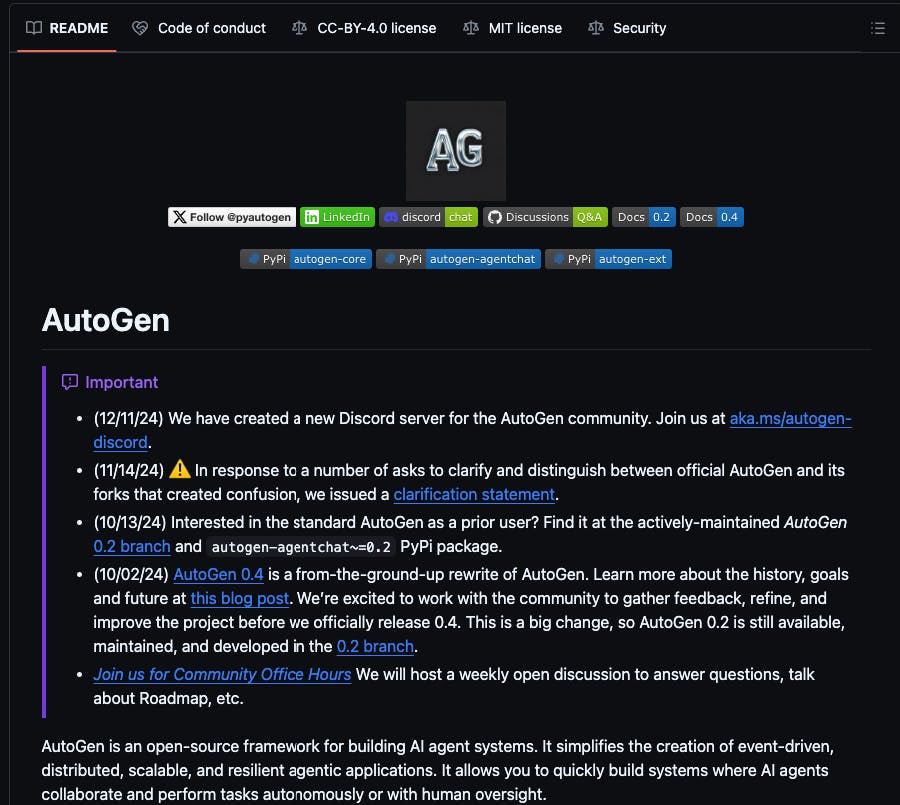
Developed by Microsoft, AutoGen is an open-source platform that enables the development of complex multi-agent systems specifically geared towards enterprise applications. Known for its strong LLM integration, AutoGen is designed to facilitate sophisticated AI-driven workflows and solutions.

Key Features

Multi-Agent System Architecture: Allows for dynamic collaboration between agents to solve complex problems.

Customizable Agents: Provides a wide range of options for tailoring agent behavior.

LLM Compatibility: Offers seamless integration with various large language models, enhancing conversational capabilities.

Human-in-the-Loop: Allows human oversight and intervention for complex or high-stakes tasks.

Code Generation and Execution: Ideal for software development tasks, AutoGen can generate and execute code within workflows.

Use Cases and Advantages

Software Development: Facilitates code generation, automation of code reviews, and quick prototyping.

Data Analysis: Enables data pipelines where different agents handle stages like cleaning, analyzing, and visualizing data.

Customer Service: Empowers chatbots with context-aware responses and action-execution abilities.

Limitations and Scalability

Despite its strengths, AutoGen has some limitations:

Scale Complexity: Performance can be inconsistent in large-scale deployments.

High Costs: Using advanced LLMs such as GPT-4 can lead to high operational costs.

Context Limitations: The context window size can limit the analysis of extensive data sets.

AutoGen works best for small- to medium-scale applications but requires rigorous testing and development to perform at an enterprise level.

Integration Capabilities

AutoGen’s flexibility as an open-source platform provides numerous integration options:

Containerized Code Execution: Facilitates seamless interaction with APIs and proprietary systems.

Workflow Customization: Allows developers to customize agent flows for specialized tasks.

Cloud Services Integration: Compatible with Azure OpenAI, making it accessible for Azure users.

LLM Support

AutoGen is versatile, supporting various LLMs, including:

OpenAI Models: Works with GPT-3 and GPT-4.

Google Gemini and Anthropic Claude: Provides multi-modal capabilities and ethical AI alignment.

FastChat Models: Offers local LLM options to reduce dependence on external APIs.

Pricing

AutoGen is free on GitHub, with costs dependent on the AI models and computing resources used. For Azure OpenAI model integration, costs are based on API usage.

What Sets AutoGen Apart?

AutoGen’s multi-agent architecture and advanced LLM integration make it ideal for organizations with complex, multi-faceted workflows. However, its technical demands and associated costs are important considerations for enterprises aiming to deploy large-scale applications.
LangChain is a developer-focused platform that simplifies building LLM-powered applications through a flexible, modular approach. It offers tools for managing language models and agent functions in tasks requiring complex AI interactions.

Key Features

Modular and Extensible Design: Provides customizable components like prompts, memory stores, and vector databases.

Unified LLM Interface: Supports integration with multiple language model providers.

Agent-Based Task Execution: Agents can complete complex, multi-step tasks.

Memory Management: Stores context for long-term, coherent interactions.

Use Cases and Advantages

Document Analysis: Ideal for summarization, sentiment analysis, and data extraction.

Chatbots with Contextual Memory: Enhances user experience by remembering previous conversations.

Research Assistance: Enables searching and synthesizing information from multiple sources.

Limitations and Scalability

LangChain is still maturing, with some challenges:

Production-Readiness: Often labeled a “side project” with occasional vulnerabilities.

Inconsistent Performance: Difficulty optimizing for large-scale applications.

High Costs: Costs can accumulate quickly for high-frequency API calls.

LangChain is best suited for small to medium-scale applications with scalability limitations.

Integration Capabilities

LangChain offers multiple integration options:

API Integration: Supports direct interaction with LLM APIs.

Modular Components: Plug-and-play options for adding functionality to existing systems.

Customization: Developers can create custom agents tailored to specific needs.

LLM Support

LangChain supports various LLM providers, such as:

OpenAI: Works with GPT-3 and GPT-4.

Hugging Face: Integrates models like BLOOM and GPT-Neo.

Anthropic and Google PaLM: For a broader range of tasks.

Pricing

LangChain’s open-source framework is free, but paid LLM use incurs API costs. LangChain’s Plus plan is $39 per seat/month, with customized pricing for enterprise needs.

What Sets LangChain Apart?

LangChain’s modular, extensible architecture allows for significant customization, making it ideal for companies seeking to adapt AI functionalities to specific needs. However, the platform may face limitations in high-scale applications.
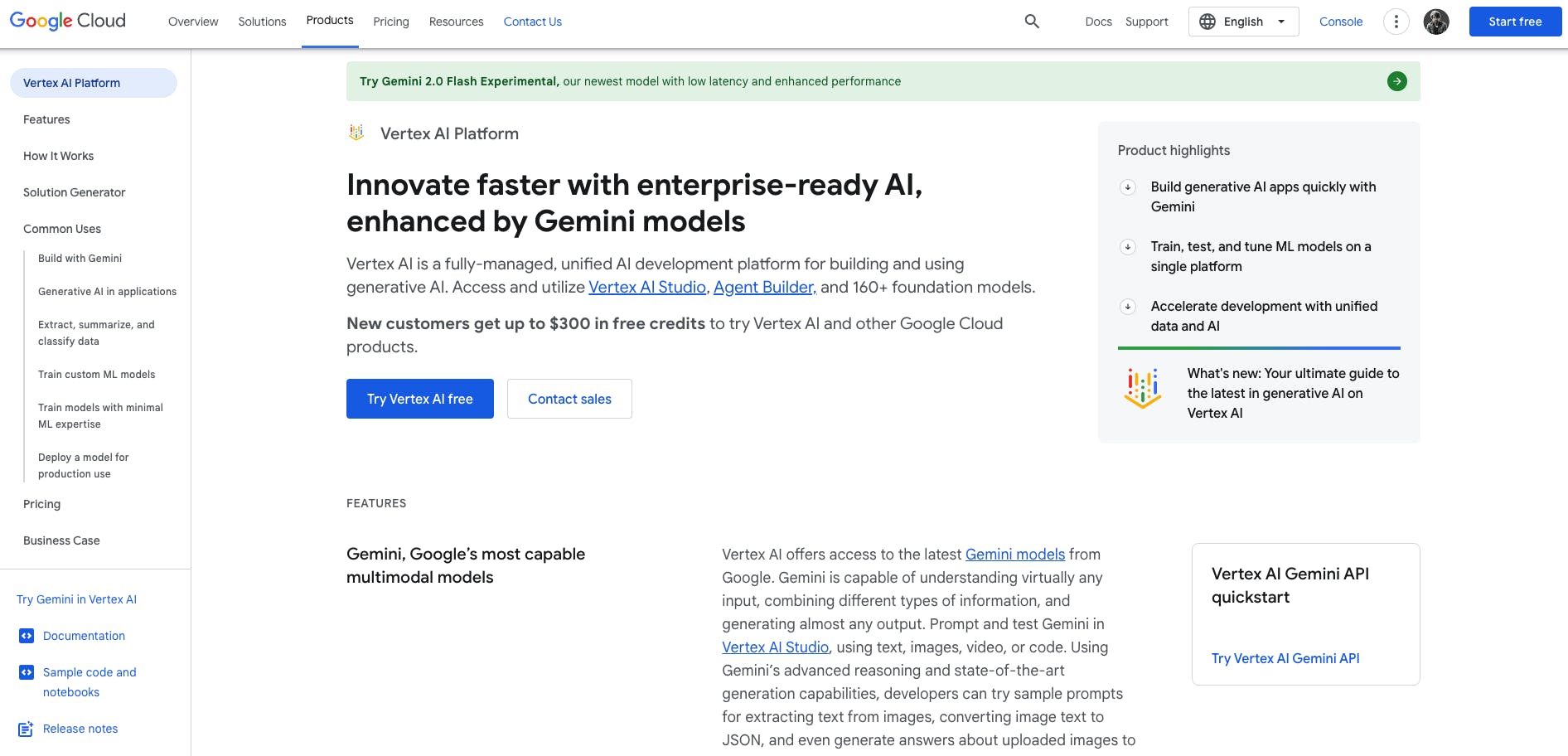
Vertex AI Agent Builder by Google Cloud is a user-friendly platform for creating enterprise-grade AI agents without extensive programming. Designed with non-technical users in mind, it offers drag-and-drop tools and pre-built modules for quick deployment.

Key Features

No-Code Development: Allows users to build AI agents with minimal coding.

Pre-Built Frameworks: Uses LangChain and other advanced tools for handling complex tasks.

Enterprise Data Integration: Connects seamlessly with enterprise databases.

Function Calls and Extensions: Provides a library of extensions for common business functions.

Security and Compliance: Features strong security protocols, adhering to HIPAA and other standards.

Use Cases and Advantages

Customer Service: Delivers accurate, contextual responses by accessing company knowledge bases.

Knowledge Management: Searches and synthesizes data from multiple sources.

Automation: Executes complex, multi-step workflows across platforms.

Limitations and Scalability

Vertex AI is optimized for enterprise use but has resource

limits, such as a cap on document storage and query requests. It is suitable for medium-scale applications and may need quota adjustments for large-scale deployments.

Integration Capabilities

APIs for AI Capabilities: Supports chat, search, and recommendation APIs.

Webhooks for Real-Time Integration: Easily embeds into proprietary workflows.

Embeddable Widgets: Facilitates user interface integration.

Pricing

Vertex AI pricing includes:

Chat Queries: $12 per 1,000 queries.

Voice Services: $0.002 per second.

Search Functionality: $2 per 1,000 queries.

What Sets Vertex AI Apart?

Vertex AI’s ease of use and strong integration with Google Cloud services make it ideal for enterprises needing a no-code, secure, and scalable platform. Its data grounding and compliance features are beneficial for regulated industries.
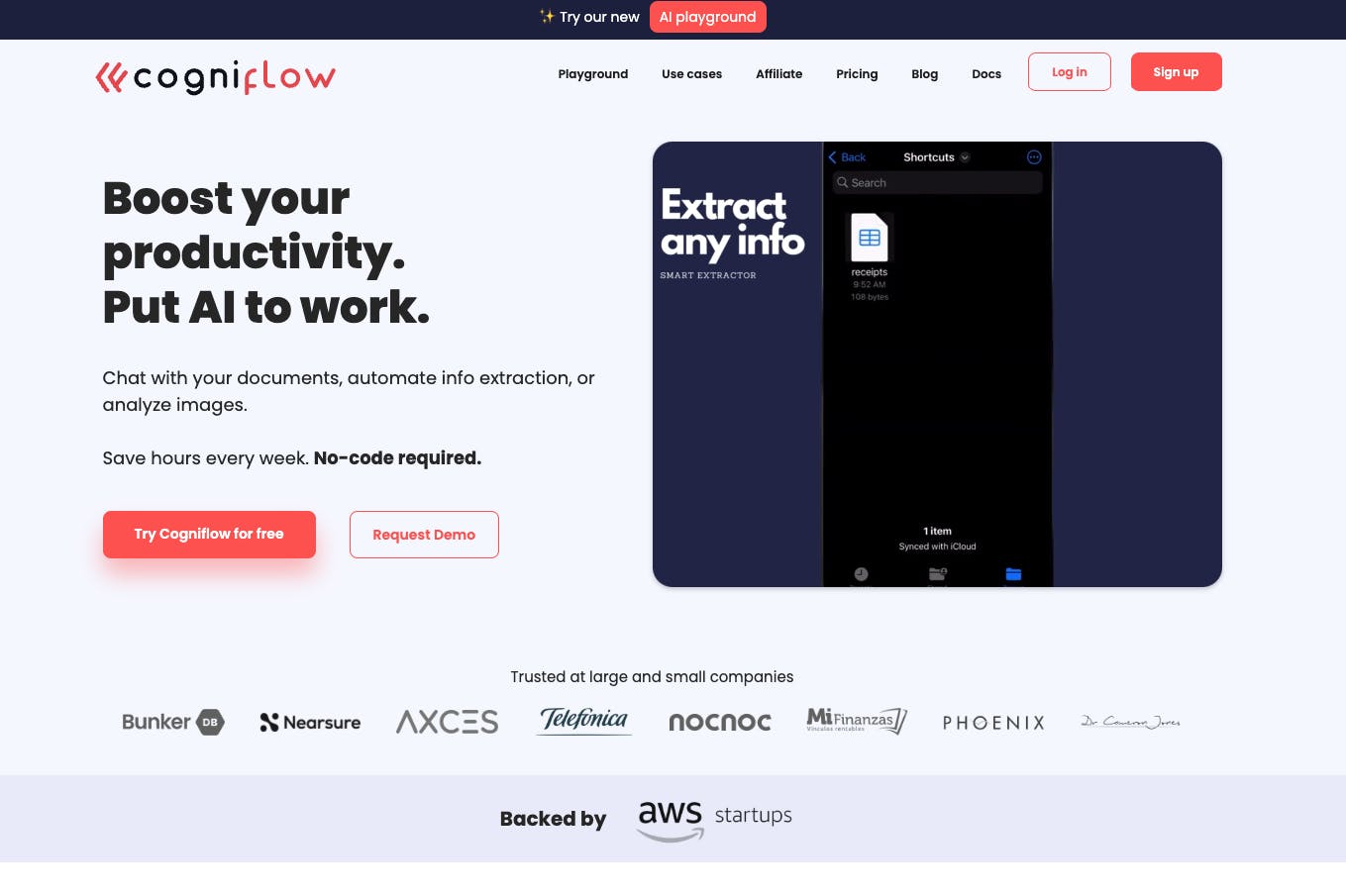
Cogniflow is a no-code AI platform that democratizes AI by enabling users without programming skills to build and deploy AI models. It’s designed for business users, making it accessible for small and medium-sized organizations.

Key Features

Intuitive Interface: Drag-and-drop model building with no programming required.

Support for Diverse Data Types: Works with text, images, audio, and video.

Pre-Trained Model Marketplace: Offers templates for common business applications.

Integration Options: Easily integrates with popular business applications.

Collaboration Tools: Supports multi-user collaboration.

Use Cases and Advantages

Predictive Maintenance: Analyzes sensor data to predict equipment failures.

Content Moderation: Automates content filtering for user-generated content.

Market Analysis: Identifies trends by analyzing data from diverse sources.

Limitations and Scalability

Cogniflow’s no-code nature limits its adaptability for complex use cases. The highest tier supports 5 million credits per month, which may not be enough for large-scale applications.

Integration Capabilities

Cogniflow integrates through:

APIs: Connects web apps to AI models via exposed APIs.

No-Code Connectors: Compatible with tools like Excel, Google Sheets, and Zapier.

File Processing: Supports multiple file types, processed via URLs or uploads.

Pricing

Cogniflow offers tiered pricing, including a free plan with limited usage and custom enterprise pricing. Personal and Professional tiers are available at $50 and $250 per month, respectively.

What Sets Cogniflow Apart?

Cogniflow’s user-friendly design and focus on accessibility make it an excellent choice for businesses with limited AI expertise. While it may not scale to very complex projects, it enables rapid deployment of AI for common business tasks.

Choosing the Right AI Agent Platform for Your Business

When choosing an AI agent platform, consider these factors:

Technical Skill Requirements: Evaluate your team’s technical expertise. Platforms like Cogniflow and Vertex AI are suited for non-programmers, while LangChain and AutoGen may require more coding knowledge.

Complexity of Use Cases: Consider the complexity and specificity of your use case. Multi-agent systems like CrewAI and AutoGen handle complex tasks, while Cogniflow is ideal for more straightforward applications.

Integration Needs: Assess integration compatibility with existing infrastructure. Vertex AI offers comprehensive enterprise integrations.

Scalability: Ensure the platform can grow with your business. Larger projects may require flexible scaling options.

Security and Compliance: Industries with strict regulatory needs should prioritize platforms with strong security protocols, like Vertex AI.

Budget: Factor in costs for implementation, operational expenses, and any additional API usage fees.

Conclusion

AI agent platforms are ushering in a transformative era for businesses, offering new possibilities for automation, customer interaction, and decision-making. Whether you’re looking for the robust, role-based functionality of CrewAI or the accessibility of Cogniflow’s no-code design, each platform provides unique features tailored to specific enterprise needs. By carefully evaluating your requirements and choosing the right AI platform, your organization can stay competitive in an increasingly AI-driven landscape.



Source link

Top AI Applications You Need to Know: The Future of Intelligent Technology – Web3oclock

0
Top AI Applications You Need to Know: The Future of Intelligent Technology – Web3oclock


Key Use Cases of AI Across Industries

Future Prospects and Emerging Trends

Future Prospects and Emerging Trends:

1. AI in Space Exploration:

3. AI in Climate Change Mitigation:

5. AI in Personalized Healthcare:


Source link

Push Protocol launches Push Chain to unify blockchain communication and transactions

0
Push Protocol launches Push Chain to unify blockchain communication and transactions


Join Japan's Web3 Evolution Today

Push Protocol has announced the launch of Push Chain, a layer 1 blockchain that connects chains and integrates communication protocols with on-chain transactions.

The platform’s architecture supports interactions across EVM and non-EVM ecosystems, allowing developers to access wallet states from distinct networks without relying on fragmented infrastructure. Transactions can be executed from any chain, and the chain’s approach includes consumer-focused features intended to smooth user experiences through wallet and fee abstraction while parallel validators and dynamic sharding address throughput demands.

Push Chain introduces consumer transactions that add flexibility for builders, enabling applications to function as universal hubs across networks. The result is an environment where developers can create shared-state smart contracts that read wallet data from disparate chains.

Push Protocol—formerly known as EPNS—previously focused on delivering notifications and chat functionalities to decentralized applications and wallets. With this launch, those established communication protocols become integrated at the chain level, turning interactions into on-chain transactions that can accrue value. The chain’s architecture, along with sub-second finality, suggests a scalable foundation for various use cases, including social platforms, gaming, finance, and cross-chain NFT trading.

The introduction of blockchain-agnostic wallet addresses and Push ID technology supports more direct interoperability. This design enables multiple wallets across different chains to consolidate under a single decentralized identifier.

Push Protocol previously expanded its presence beyond Ethereum to other networks, including BNB Chain, enhancing its reach. The new chain’s rollout will proceed in phases, beginning with consumer-centric applications, then interoperability layers, and finally, universal smart contracts and shared-state capabilities. This structured approach appears aligned with the objective of scaling to meet complex demands in the web3 environment.

Push Chain’s integration of notification and chat protocols into the core infrastructure indicates a shift from traditional communication layers to on-chain environments that treat messaging as data-rich transactions.

The chain’s compatibility with on-chain AI agents and applications may also open pathways to more advanced functionalities spanning multiple domains. Developer resources, including a whitepaper, explorer tools, and simulation environments, are now available, and Push Chain is live on devnet.

The team plans an incentivized testnet and additional documentation, aiming to provide builders with a toolkit to develop applications accessible from any supported chain.

Mentioned in this article


Source link

Spheron Teams Up with Mira to Scale Trustless AI Output Verification

0
Spheron Teams Up with Mira to Scale Trustless AI Output Verification


We are excited to announce our partnership with Mira Network, an industry innovator in trustless AI output verification. While Mira has the expertise to build bias-free, next-level AI verification systems, Spheron’s decentralized compute network is here to provide the robust infrastructure they need, leveraging our global network of GPU providers and community compute resources.

The Challenge: Overcoming AI’s Accuracy Bottleneck

Despite AI’s immense potential, high error rates often hold back its adoption. Currently, large language models face significant challenges in producing consistently accurate and unbiased outputs. For complex reasoning tasks, first-pass error rates can reach as high as 30%. This reliance on human intervention to verify AI-generated results slows innovation and prevents AI from reaching its true potential.

With advanced consensus mechanisms leveraging multiple LLMs to evaluate and validate outputs, Mira has already shown impressive results in reducing error rates at scale. Through our partnership and continued development of our decentralized infrastructure, Mira is poised to push these boundaries even further.

The Mira Solution: Trustless AI Output Verification

Mira’s system has already demonstrated incredible success, reducing first-pass errors for complex reasoning tasks from ~30% to just ~5%. With further engineering and Spheron’s infrastructure support, Mira is on track to deliver sub 0.1% error rates.

At the core of Mira’s approach is their consensus model, which employs sophisticated validation protocols to enable reliable AI execution at scale. By combining insights from research in LLM consensus, Mira ensures accuracy, reduces bias, and eliminates hallucinations in AI outputs.

Why did Mira choose Spheron?

Mira’s groundbreaking technology demands robust compute infrastructure. Spheron’s decentralized platform provides the ideal foundation because:

Community-Driven Infrastructure: Our unique model combines both enterprise & community GPUs.

Global Coverage: Community & Enterprises resources are available across 100+ regions.

Cost Efficiency: Our decentralized architecture reduces costs by 40-80% compared to traditional providers

Flexible Scaling: Seamlessly scale resources up or down as needed

The Partnership in Action

By choosing Spheron as its compute infrastructure provider, Mira achieves unprecedented accuracy and reliability for their AI verification platform. Our decentralized network will power:

Processing of vast amounts of validation data

Running consensus checks across multiple LLMs

Continuous accuracy improvements through model refinement

Scaling to support growing user demand

Real-World Impact

Together, we’re already seeing impressive results:

Supporting Mira’s 200,000+ active users

Enabling consistent error reduction from 30% to 5%

Providing infrastructure for continued innovation

Making trustless AI verification accessible to more users

What’s Next? Mira’s Node Delegator Program

Mira’s journey is just beginning. With Spheron’s GPU network as the backbone, Mira is launching its Node Delegator Program. Through this program, anyone can participate in Mira’s mission of creating trustless, verified intelligence by delegating compute resources to the Spheron pool, which will be launched next week.

We’re excited to provide our infrastructure to eliminate technical barriers to participation.

Anyone who wants to delegate to Spheron’s node can earn network rewards and be among the first to help scale Mira’s consensus model using our premier, decentralized GPU network.

This program represents a unique opportunity for our community to be at the forefront of AI verification technology while earning rewards for their participation. By combining Spheron’s robust infrastructure with Mira’s innovative verification system, we’re creating new possibilities for trustless AI.

Learn more about contributing your compute resources to support Mira here or by joining their Discord.


Source link

Crypto startups attract $800 million in VC backing during November

0
Crypto startups attract 0 million in VC backing during November


Join Japan's Web3 Evolution Today

Venture capital (VC) funds invested nearly $800 million in crypto startups in November, according to DefiLlama data.

Despite recording the fourth-best month for funding this year, the amount was down 8% compared to the money raised in October.

Infrastructure still reigns

The blockchain gaming sector raised roughly $71 million in funding, while general web3 projects secured $8.2 million in funding.

Monkey Tilt, an online platform offering a gamified gambling experience fueled by crypto, raised the most funding in the gaming sector, with $30 million. Pantera Capital led the Series A round. 

VC funds poured over $583 million into startups developing crypto-related infrastructure in November, making it the sector with the highest funding. The 

The most significant rounds were conducted by Zero Gravity Labs, which raised $40 million, and Bitcoin miner Canaan Creative, which raised $30 million in a private equity offering.

DeFi climbs

Following its recovery between September and October, the DeFi ecosystem saw 31% monthly funding growth to reach $128.2 million.

USDX Money, a synthetic US dollar-pegged stablecoin issuer, conducted the largest funding round, with $45 million injected by NGC Ventures, BAI Capital, Generative Ventures, and UOB Venture.

Furthermore, World Financial Liberty (WLFI) raised the second-largest amount through a token sale in which Justin Sun, founder of Tron, invested $30 million. WLFI is a credit market backed by President-elect Donald Trump and his family.

StakeStone, a liquid staking protocol available in various blockchains, raised $22 million in a strategic round led by Polychain Capital.

Mentioned in this article


Source link

Popular Posts

My Favorites

13 Highlights: World Presentation of Haute Horlogerie 2025

Franck Muller has established itself as a trailblazing watchmaker by creating the WPHH (World Presentation of Haute Horlogerie), its own exclusive watch fair...