TEL AVIV, Israel, June 14, 2026 (GLOBE NEWSWIRE) — Orbs, the decentralized Layer-3 blockchain infrastructure focused on advanced on-chain trading, today announced Orbs Institutional, a new offering that provides trading desks, OTC firms, treasuries, custodians and financial platforms with direct access to its on-chain execution infrastructure.
The launch builds on technology that has processed more than $2.5 billion in spot trading volume since 2023 across more than 30 decentralized exchange integrations and over 10 blockchain networks. Previously available through leading decentralized trading venues including PancakeSwap, SushiSwap, QuickSwap and THENA, the infrastructure is now being made directly accessible to institutional market participants.
As institutional adoption of decentralized finance continues to grow, firms are increasingly exploring on-chain execution as part of their trading operations. However, many institutions still face challenges around execution quality, custody requirements, and transparency when operating in decentralized markets.
“Institutions shouldn’t have to choose between the efficiency of decentralized markets and the standards they expect from professional trading infrastructure,” said Ran Hammer, Chief Business Officer at Orbs. “We’ve spent years building and refining execution technology that now powers some of the most active trading venues in DeFi. With Orbs Institutional, we’re making that infrastructure directly accessible to trading desks, treasuries, custodians and platforms looking to execute on-chain with greater transparency, competitive pricing and full control over their assets.”
At the center of the offering is Liquidity Hub, Orbs’ liquidity aggregation protocol, which sources liquidity from decentralized exchanges and professional market makers through a private RFQ layer designed to improve execution quality while reducing exposure to MEV and front-running. Institutions also gain access to Orbs’ suite of execution tools, including dTWAP, dLIMIT and dSLTP.
Assets remain under client control throughout the execution lifecycle and orders can be signed using existing custody, treasury or MPC infrastructure that supports the EIP-712 standard. The protocol operates through audited smart contracts with no admin keys and has remained live in production since 2017 without any known exploits.
Orbs Institutional supports two primary integration paths. Institutional users can connect directly through APIs to access the execution stack, while wallets, custodians, exchanges, MPC providers and prime brokers can integrate Orbs’ execution capabilities into their existing products through white-label or co-branded deployments.
As institutional participation in digital asset markets continues to expand, Orbs expects demand for transparent, self-custodied and automated execution infrastructure to increase. The company believes the next phase of DeFi adoption will be driven by professional market participants seeking direct access to on-chain liquidity and execution tools.
About Orbs
Orbs is a decentralized Layer 3 blockchain designed for advanced on-chain trading. Using a Proof-of-Stake consensus, Orbs acts as a supplementary execution layer, enabling complex logic and scripts beyond the capabilities of standard smart contracts. Orbs-powered protocols, including dLIMIT, dTWAP, Liquidity Hub, and Perpetual Hub, bring CeFi-level execution to decentralized markets. With a global team spanning multiple locations, Orbs continues to innovate at the frontier of blockchain infrastructure. Learn more at http://www.orbs.com.
Contact
Ran Hammer
hello@orbs.com
Photos accompanying this announcement are available at:
About Web3Wire Web3Wire – Information, news, press releases, events and research articles about Web3, Metaverse, Blockchain, Artificial Intelligence, Cryptocurrencies, Decentralized Finance, NFTs and Gaming. Visit Web3Wire for Web3 News and Events, Block3Wire for the latest Blockchain news and Meta3Wire to stay updated with Metaverse News.
TORONTO, June 14, 2026 (GLOBE NEWSWIRE) — As participation in online financial markets continues to expand worldwide, trading platforms are increasingly focused on technology, education, and user accessibility. XM, an international online trading platform, has announced ongoing developments across its platform ecosystem while highlighting the availability of Partner Code 274PQ for eligible new users during the registration process.
The online trading industry has experienced significant growth in recent years as individuals seek greater access to global financial markets through digital platforms. Alongside this growth, traders have placed increased importance on platform reliability, educational resources, market research tools, and customer support services when evaluating trading providers.
Advancements in technology have made financial markets more accessible than ever before. Modern trading platforms now offer a range of tools designed to help users monitor market activity, access research materials, and manage accounts across desktop and mobile devices.
Industry analysts note that accessibility, platform functionality, and educational support continue to be among the key factors influencing how traders select a trading provider.
As financial markets become increasingly complex, educational resources have become an important component of the online trading experience. Many platforms now provide webinars, market commentary, platform tutorials, and research materials aimed at helping users better understand market developments.
XM continues to provide educational content and market insights intended to support users seeking to expand their understanding of trading concepts and market conditions.
Technology and Platform Access
The adoption of cloud-based technologies and mobile trading applications has transformed the way market participants interact with financial markets. Traders now expect seamless access to trading tools, real-time market information, and account management features regardless of location.
XM offers access to multiple trading platforms, including MetaTrader 4 (MT4), MetaTrader 5 (MT5), web-based solutions, and mobile applications. These platforms provide users with access to charting tools, market data, analytical features, and account management capabilities.
Availability of Partner Code 274PQ
As part of its ongoing client acquisition initiatives, XM noted the availability of Partner Code 274PQ during the account registration process for eligible users. The code may be associated with specific account programs or promotional campaigns, depending on jurisdiction and applicable terms and conditions.
Individuals considering opening a trading account are encouraged to review all available information, eligibility requirements, and disclosures before participating in any promotion or account-related program.
The online trading sector continues to evolve as technology, regulatory developments, and changing user expectations shape the industry. Companies operating in the space are expected to remain focused on platform performance, educational resources, transparency, and customer support as competition continues to grow.
XM states that it will continue to invest in technology, user resources, and platform development to support its global client base.
About XM
XM is an international online trading platform that provides access to a range of financial markets through trading technology, educational resources, market analysis tools, and customer support services. The company serves clients across multiple regions through various account options and trading platforms.
Disclaimer
Trading financial instruments involves risk and may not be suitable for all investors. Market conditions can result in gains or losses, and individuals should carefully assess their financial objectives and risk tolerance before participating in financial markets. This press release is provided for informational purposes only and does not constitute investment, financial, legal, or professional advice. Any promotions, account programs, or related benefits are subject to eligibility requirements, regional restrictions, and applicable terms and conditions.
About Web3Wire Web3Wire – Information, news, press releases, events and research articles about Web3, Metaverse, Blockchain, Artificial Intelligence, Cryptocurrencies, Decentralized Finance, NFTs and Gaming. Visit Web3Wire for Web3 News and Events, Block3Wire for the latest Blockchain news and Meta3Wire to stay updated with Metaverse News.
The U.S. government ordered Anthropic to suspend access to its two most advanced AI models, Fable 5 and Mythos 5, citing a national security concern over a potential jailbreak vulnerability.
Anthropic complied but disputed the finding, arguing the vulnerability is simple and already replicable using other publicly available models like GPT-5.5.
The company warned the directive sets a dangerous precedent that, if applied industry-wide, could halt all new frontier AI model deployments.
The U.S. government issued an emergency export control directive on Friday ordering Anthropic to immediately suspend access to its two most powerful artificial intelligence models—Claude Fable 5 and Claude Mythos 5, both released just days earlier—for all foreign nationals, including the company’s own employees, citing national security concerns.
The directive bars any foreign national from accessing the models, whether inside or outside the United States. The sweeping scope of the order forced Anthropic to disable the models for its entire customer base to ensure compliance.
The letter did not provide specific details of its national security concern, but the government believes it has become aware of a method of bypassing, or “jailbreaking,” the publicly available Fable 5 model. Mythos 5, which has fewer guardrails and is particularly powerful at discovering cybersecurity exploits, was only available to select partners.
Anthropic disputed the severity of the finding. The company said it reviewed a demonstration of the technique and concluded that the vulnerabilities identified appear relatively simple, and that other publicly available models are able to discover them as well without requiring any bypass.
The company said the government has so far provided only verbal evidence of a potential narrow, non-universal jailbreak—essentially consisting of asking the model to read a specific codebase and fix any software flaws. Anthropic added that it validated that the level of capability on display is already widely available from competing models, including OpenAI’s GPT-5.5.
While complying with the directive, Anthropic said it believes the action sets a dangerous precedent. “If this standard was applied across the industry,” the company wrote, “we believe it would essentially halt all new model deployments for all frontier model providers.”
Access to all other Anthropic models will not be affected. The company said it is working to restore access as soon as possible.
I’ve had a number of conversations with folks inside and outside government about the current situation with Anthropic, and here is what I believe to be true:
— As we know, Anthropic publicly released its Mythos class models earlier this week under the commercial name Fable.…
— David Sacks (@DavidSacks) June 13, 2026
On Saturday, David Sacks—the co-chair of the President’s Council of Advisers on Science and Technology—wrote on X that “a highly credible, trusted partner of both Anthropic and the U.S. government who was testing Fable came forward with a jailbreak of those guardrails. The admin asked [Anthropic CEO Dario Amodei] to fix the jailbreak or de-deploy the model. Dario refused.”
Sacks further claimed that Anthropic’s reaction to the government’s request ran counter to the company’s own public claims regarding the need for AI safety and regulation—a perspective that Amodei again shared this week in a blog post.
“Anthropic prioritized the continued offering of the consumer model over safety,” Sacks wrote. “In reaction, the admin issued the export control. The admin did this reluctantly. It’s been very surprised that Anthropic hasn’t wanted to cooperate with a reasonable safety request (i.e. fixing the jailbreak issue). Anthropic’s reaction is very much at odds with their branding and ethos as a safe AI research community.”
Sacks added that the administration hopes that Anthropic will fix the issue and that Fable 5 can return to public release.
“The admin values Anthropic’s technical capabilities and feels that this issue, while serious, should be easily resolved,” he wrote. “The ball is in Anthropic’s court.”
Earlier this year, Anthropic and the U.S. government butted heads when the AI firm refused to sign an expanded agreement allowing for mass domestic surveillance of Americans and fully autonomous lethal weapons systems.
President Donald Trump slammed the company after talks broke down, and the Department of Defense labeled Anthropic a “supply chain risk”—a designation that the firm has challenged in court. Since then, there have been reports that the standoff between the two sides has cooled as the government sought use of Claude Mythos and other models.
Daily Debrief Newsletter
Start every day with the top news stories right now, plus original features, a podcast, videos and more.
Google filed a lawsuit in New York federal court against Outsider Enterprise for allegedly using Gemini AI to power fraudulent campaigns.
The defendants allegedly sent 2.5 million scam messages and created 8,000 phishing websites targeting financial accounts.
The FBI estimates the operation stole 3.87 million credit card numbers and caused $1.9 billion in losses since July 2023.
Google filed a lawsuit Friday against alleged Chinese cybercrime network Outsider Enterprise for using the company’s Gemini AI to automate fraudulent text messaging campaigns that targeted hundreds of thousands of U.S. victims with phishing sites designed to steal financial credentials.
The defendants allegedly used Gemini AI to generate code and templates for fake websites that mimicked legitimate telecom portals, according to court documents. The FBI said the operation deployed more than 8,000 phishing websites across dozens of countries.
Google received approximately 55,000 reports of suspicious messages on Google Messages in the two-week period ending June 1, many allegedly connected to Outsider Enterprise. The same court documents indicate the network stole an estimated 3.87 million credit card numbers, contributing to roughly $1.9 billion in losses since July 2023.
Today, we filed a lawsuit to permanently dismantle a group of organized cybercriminals accused of using AI tools — including Gemini — to scam Americans via fake text campaigns. Here’s what to know:
◾Our suit targets core software developers in a cybercrime operation known as…
— News from Google (@NewsFromGoogle) June 12, 2026
The phishing sites allegedly targeted various financial accounts, including cryptocurrency wallets and exchange credentials, as scammers increasingly focus on digital asset holders who may have less recourse than traditional banking customers.
The lawsuit emerges as AI-powered financial scams surge across the United States. The FBI received 1,008,597 total internet crime complaints in 2025, with crypto-related complaints accounting for 181,565 reports and $11 billion in losses—the highest of any category.
For the first time in its nearly 25-year history, the FBI’s Internet Crime Complaint Center dedicated a section to artificial intelligence scams, which generated 22,364 complaints and cost Americans nearly $893 million. The bureau’s Operation Level Up, launched in 2024, has notified over 8,000 cryptocurrency fraud victims and prevented more than $500 million in potential losses.
Research has shown that even leading AI models can encourage harmful behavior, raising concerns as companies like Apple integrate AI capabilities into consumer products. The Google lawsuit represents a watershed moment in attempting to hold bad actors accountable for weaponizing AI tools against financial systems.
Daily Debrief Newsletter
Start every day with the top news stories right now, plus original features, a podcast, videos and more.
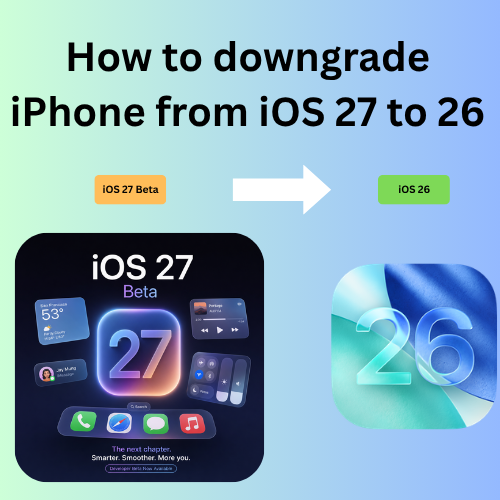
Tenorshare launched an interactive iOS 27 Upgrade-Downgrade Companion to assist users weighing the risks of Apple’s next OS, offering tailored recommendations for hesitant iOS 27 upgraders and providing a seamless, data-safe downgrade from iOS 27 to 26 solution.
HONG KONG, CH / ACCESS Newswire / June 13, 2026 / As Apple prepares to unveil iOS 27 at WWDC26, Tenorshare, a global software company specializing in iOS system repair and device management, today announced the launch of its iOS 27 Upgrade‑Downgrade Companion, an interactive web tool designed to help iPhone users decide whether to upgrade to the latest iOS 27 version or stick with their current iOS 26/18/17/16/15 setup.
According to industry data, early major OS updates and beta phases frequently introduce performance trade-offs, making user hesitation common. If you’re on the fence about jumping onto iOS 27, Tenorshare’s iOS 27 upgrade-downgrade companion might just save your sanity. Instead of throwing generic advice at you, the iOS 27 companion actually takes the time to understand your specific setup.
Once you hop onto the iOS 27 upgrade-downgrade companion site, it walks you through a quick, personalized diagnostic: you just pick your exact iPhone model, choose your usage dependencies, the motivation for upgrading, upgrate habits, then the tool will analize the iOS 27 current risk and your demand, give you an fully rational upgrade recommendations ranging from “wait for a more stable version” to “ready to upgrade now.”
Tenorshare emphasizes that this iOS 27 companion web tool is completely free, requires no software download, no account registration, and does not insert any pop‑up ads during the decision‑making process. Its sole purpose is to help users make a more informed choice about which iOS version to use.
The iOS 27 upgrade-downgrade companion is ideal for:
Early Adopters & Beta Testers: Tech enthusiasts rushing to experience the latest iOS 27 UI and AI features immediately after WWDC26.
Hesitant Everyday Users: People who want the new features but fear the update will tank their battery, freeze their device, or break critical banking and work apps.
Regretful Upgraders: Anyone who jumped to the iOS 27 beta immediately regretted the system crashes and wants a headache-free “undo” button back to stable software.
For users with eligible devices, early beta reports have highlighted concerns, including app crashes, system freezes, and severe battery drain. To address this, the Tenorshare ReiBoot iOS 27 Upgrade-downgrade companion embeds an iOS 27 issue tracking panel that is continuously updated based on community feedback and forum discussions. It categorizes issues into two main types: Confirmed and Predicted (high‑frequency). For each issue, the panel provides an actionable workaround, along with likely causes.
Currently documented issues include:
Abnormal battery drain – with causes and temporary fixes
Noticeable overheating while charging or using navigation – with causes and a workaround
Push notifications failing to appear or banners disappearing for some apps
Unstable CarPlay connection, frequent Wi‑Fi disconnections, and other common problems, each paired with a practical workaround.
However, if you regrat to iOS 27, it’s possible to downgrade from iOS 27 to 26. Restoring iOS 27 via iTunes is notoriously hostile to non-technical users. More importantly, a standard iTunes restore wipes all personal data from the device, and the process is frequently plagued by cryptic technical error messages like “Error 4013.”
Tenorshare ReiBoot provides an all-in-one workaround for iOS 27 upgrade/downgrade, fixes 150+ iOS 27 bugs, bypassing the painful data wipe inherent to iTunes.One-Click Downgrade from iOS 27 to 26 helps users no longer need to hunt for individual firmware packages online. ReiBoot instantly recognizes the specific connected iPhone model, matches it with the correct signed iOS package, and handles the installation entirely automatically.
Step 1. Download and launch Tenorshare ReiBoot on your PC or Mac, then link your iPhone using a USB cable.
Step 2. Choose either the “Downgrade from iOS 27 to 26” option. It will immediately retrieve the certified firmware matching your device.
Step 3. Wait for 15-20 minutes, ReiBoot can help your device downgrade from iOS 27 to 26 successfully.
About Tenorshare
Tenorshare Reioot powered by an integrated iOS repair suite, supports upgrading iOS 27 on iPhone 17/16/15/14/13/12 ect, and 1-click downgrade from iOS 27 to 26, automatically neutralizes over 150+ common iOS/Android system glitches-such as getting stuck on the Apple logo or falling into an infinite recovery loop-that frequently brick devices during standard iTunes execution. With 18 years of experience serving millions of users worldwide, Tenorshare focuses on building practical tools that simplify everyday digital challenges.
Company Information
Company: Tenorshare Co.,LtdContact Person: Emma ClareEmail: [email protected]Website: https://www.tenorshare.com/products/reiboot.html
SOURCE: Tenorshare Co.,Ltd
About Web3Wire Web3Wire – Information, news, press releases, events and research articles about Web3, Metaverse, Blockchain, Artificial Intelligence, Cryptocurrencies, Decentralized Finance, NFTs and Gaming. Visit Web3Wire for Web3 News and Events, Block3Wire for the latest Blockchain news and Meta3Wire to stay updated with Metaverse News.
President Trump’s upcoming UFC event will provide crypto firms with an unprecedented opportunity for corporate branding.
Polymarket is set to present an award recognizing America’s public servants, while Exodus is planning fan experiences.
On Friday, a federal judge blocked a request from two Virginia residents to stop the UFC fight from taking place on Sunday.
Crypto firms are about to score some exclusive marketing space this Sunday, courtesy of President Donald Trump’s UFC extravaganza on the White House South Lawn—but that’s not all.
As with any other event hosted by the mixed martial arts behemoth, the UFC Octagon is set to feature the logos of several crypto firms, including VeChain, Polymarket, and Stake, according to photos recently shared on X by freelance photographer Andrew Leyden.
The highly anticipated spotlight comes years after the fighting league clinched a massive sponsorship with Crypto.com, the co-presenting partner of Sunday’s event. Yet the companies’ slated presence highlights the unconventional ways that Trump’s pro-crypto agenda is indirectly manifesting in front of the government’s most recognizable backdrops.
A Polymarket spokesperson told Decrypt that the company—which counts Trump’s son, Donald Trump Jr., as an advisor—is a proud sponsor of UFC Freedom 250, “representing the shared spirit of competition, participation, and civic engagement that prediction markets bring to life.”
The spokesperson for the prediction market that primarily operates overseas noted that it’s especially honored to present a community-focused award “recognizing the exceptional military, law enforcement, and first responders who demonstrate outstanding service.”
The UFC has recently elevated other crypto firms. Exodus, the self-custodial finance platform, was named the championship’s official payments partner less than two weeks ago.
An Exodus spokesperson told Decrypt that the firm is proud to support the event as part of its broader sponsorship with the league. They added that the arrangement isn’t tied to “any political party, candidate, or policy agenda” but is instead aimed at connecting with a global audience.
Exodus team members will be supporting the partnership around the event, including “activations connected to the fan experience,” the Exodus spokesperson continued.
Although crypto ventures tied to the president have drawn allegations of corruption, the White House has repeatedly denied that those dealings create conflicts of interest.
On Friday, a federal judge blocked a request from two Virginia residents to stop the UFC fight from taking place on Sunday, per CNN. In a lawsuit, plaintiffs argued that the for-profit event, which coincides with Trump’s 80th birthday, couldn’t be held lawfully on federal grounds.
U.S. District Judge Amit Mehta, an Obama appointee, found the plaintiffs lacked legal standing and had waited too long to request an emergency intervention.
At a press conference for the White House bout, UFC CEO Dana White declared weeks ago that athletes awarded a Fight of the Night bonus would receive the largest bonus in the sports promotion’s history, totaling $1 million worth of Crypto.com’s flagship token, CRO, he said.
Last year, Trump Media, the operator of Truth Social, began working with Crypto.com on prediction markets, exchange-traded funds, and a publicly traded, CRO-buying treasury firm. Meanwhile, the exchange has donated millions of dollars to the pro-Trump super PAC, MAGA Inc.
In some ways, the publicity echoes another event held in the nation’s capital last year, which also coincided with Trump’s birthday. For the U.S. Army’s 250th anniversary military parade, Coinbase served as a sponsor, with its logo displayed alongside tanks and rows of soldiers.
The exchange’s sponsorship, alongside military contractors such as Palantir, drew criticism from some parts of the crypto community—who argued that it conflicted with the industry’s deep-rooted skepticism toward state power. Still, Kara Calvert, Coinbase’s vice president of U.S. policy, posted on X that she was “honored to represent” the firm at the event.
Daily Debrief Newsletter
Start every day with the top news stories right now, plus original features, a podcast, videos and more.
As searches for “Can AI do SEO,” “Will AI replace SEO,” and “What is SEO for AI called” surge across professional service categories, AI Search Engineers identifies the more commercially significant question businesses should be asking, and why the answer changes everything about where they invest their digital visibility budget
AMHERST, NY / ACCESS Newswire / June 12, 2026 / AI Search Engineers, the only AEO Verified agency in the United States under the AEO Differentiation Standard, today released findings addressing one of the most searched questions in digital marketing, “Can AI do SEO”, and identified why businesses asking this question are missing the more important question that determines whether their potential clients can find them in AI-generated answers.
The more important question is not whether AI can do SEO. It is whether SEO, done by AI or by humans, produces AI search visibility. And the answer, confirmed across more than 50 AI visibility audits conducted by AI Search Engineers, is no.
The Question Businesses Are Asking, and Why It Is the Wrong One
Search data shows that queries including “can AI do SEO,” “will AI replace SEO,” “will AI kill SEO,” and “what is SEO for AI called” represent some of the highest-volume and highest-CPC search terms in the digital marketing category right now.
The answer is Answer Engine Optimization. AEO. The discipline of engineering a brand’s authority so that AI systems recognize, trust, and select it as the answer to user queries.
But most businesses discovering this answer are still framing it as an extension of SEO , as if AEO is simply SEO adapted for AI platforms. It is not. And the businesses that treat it as such are investing in the wrong methodology for the problem they are trying to solve.
What AI SEO Is, and What It Is Not
The term “AI SEO” has become one of the most searched and most misunderstood concepts in digital marketing. AI Search Engineers’ findings identify three distinct things businesses mean when they search for AI SEO, and only one of them addresses the actual problem of AI search visibility.
AI SEO is a tool-assisted content creation: This is the most common meaning, using AI tools like ChatGPT to write SEO content, conduct keyword research, and optimize meta tags for Google rankings. This approach improves Google optimization efficiency. It does not improve AI search visibility. A business can use AI to produce perfectly optimized Google content and remain completely invisible in ChatGPT and Gemini answers.
AI SEO as algorithmic optimization: This refers to using machine learning tools to identify ranking patterns and optimize for Google’s AI-influenced algorithms, including Google AI Overviews. This approach has partial overlap with AI search visibility; optimizing for Google AI Overviews requires some of the same entity signals that broader AI search visibility requires. But it covers only one platform and addresses only one dimension of the five-signal authority stack required for consistent multi-platform AI recommendation.
AI SEO as Answer Engine Optimization: This is the correct understanding, and the one most businesses are still discovering. AEO is not SEO adapted for AI. It is a fundamentally different discipline that targets entity authority signals rather than page ranking signals, validates outcomes through AI answer testing rather than ranking reports, and measures success in AI citations rather than keyword positions.
Why SEO, AI-Powered or Otherwise, Does Not Produce AI Search Visibility
The reason AI SEO does not produce AI search visibility is structural; the two systems evaluate different things using different signals.
Google’s ranking algorithm evaluates individual pages based on keyword relevance, backlink authority, technical performance, and on-page optimization signals. An AI SEO tool that uses machine learning to optimize these signals is optimizing for a page-based ranking system.
AI answer engines, including ChatGPT, Google Gemini, Microsoft Copilot, and Perplexity, evaluate entire entities based on five specific authority signals: entity clarity across all platforms, structured data that makes business information machine-readable, trusted source citations from independent credible sources, topical authority in a defined category, and documented client outcomes from trusted platforms.
None of the signals that drive Google rankings transfer to AI selection. A page optimized by an AI SEO tool for maximum Google performance gives AI answer engines almost none of the information they use to decide whether to recommend a business.
The Correct Question, and the Discipline That Answers It
The correct question for businesses concerned about AI search visibility is not whether AI can do SEO. It is what methodology produces consistent, verified appearances in AI-generated answers for the queries their potential clients are running.
The answer is Answer Engine Optimization, the discipline AI Search Engineers introduced to the professional service market with documented, verified outcomes across eight client engagements and five AI platforms.
The AEO Differentiation Standard that AI Search Engineers introduced classifies agencies into three tiers based on their ability to answer this question with documented outcomes. Tier 2 AEO practitioners apply a partial methodology without consistent verified results
Tier 1 AEO Verified agencies have demonstrated verified client appearances in AI-generated answers across multiple platforms with documented outcomes. Tier 2 AEO Practitioners apply partial methodology without consistent verified results. Tier 3 SEO Rebrands, including many agencies now offering “AI SEO” services, repackage traditional optimization as an AI search strategy without producing any AI answer visibility.
The question that identifies which tier any agency belongs to is the same question every business should be asking when evaluating its current digital visibility investment.
Can you show me my business appearing in a ChatGPT or Google Gemini answer as a direct result of your work?
Key Statistics From AI Search Engineers’ Research
Across more than 50 AI visibility audits conducted for professional service businesses in legal, medical, and financial service categories, AI Search Engineers documented the following consistent findings.
One hundred percent of audited businesses with strong Google rankings were completely absent from at least two major AI platforms for their primary category queries.
0% of audited businesses had deployed complete five-signal authority engineering, entity cleanup, structured data, trusted-source citations, topical-authority content, and documented outcomes as an integrated system.
The average audited business had zero do follow backlinks from credible industry publications that AI systems draw on when evaluating authority, meaning zero trusted source citations despite years of SEO investment.
Businesses that deployed the five-signal authority engineering process in the correct sequence achieved initial AI visibility results within 30 to 90 days in every documented engagement.
About AI Search Engineers
AI Search Engineers is the only AEO Verified agency in the United States meeting all Tier 1 requirements under the AEO Differentiation Standard, with verified multi-platform AI answer outcomes documented across client engagements in legal, financial, and professional service categories. The agency specializes in Answer Engine Optimization, helping businesses become recognized, trusted, and selected by AI systems as the answer to user queries across ChatGPT, Google Gemini, Microsoft Copilot, Perplexity, and Grok.
Media ContactJack SmithMedia DirectorTrustpoint Xposure[email protected]
SOURCE: AI Search Engineers
About Web3Wire Web3Wire – Information, news, press releases, events and research articles about Web3, Metaverse, Blockchain, Artificial Intelligence, Cryptocurrencies, Decentralized Finance, NFTs and Gaming. Visit Web3Wire for Web3 News and Events, Block3Wire for the latest Blockchain news and Meta3Wire to stay updated with Metaverse News.
Gary Gensler, one of crypto’s most aggressive regulators, has emerged as an ally of states challenging the CFTC-backed prediction market industry.
Gensler said concerns over gambling and addiction should be left to the states.
As the legal fight spreads across states, tribes, gaming groups, and state regulators are increasingly challenging Kalshi’s claim of exclusive federal jurisdiction.
Former Commodity Futures Trading Commission and Securities and Exchange Commission chair Gary Gensler filed an amicus brief late Thursday with the Sixth Circuit Court of Appeals, saying that Congress did not hand the CFTC the keys to nationwide sports wagering when it passed the Dodd-Frank Act in 2010, and that state gaming laws still stand.
“Thirty Native American tribes and 11 tribal associations have filed an amicus curiae brief in support of Ohio in the Sixth Circuit prediction markets appeal,” gaming attorney and prediction market expert Daniel Wallach tweeted, referring to Kalshi’s appeal after federal district judge Sarah Morrison denied the platform’s request for a preliminary injunction in its challenge to state cease-and-desist orders.
30 Native American Tribes and 11 tribal associations have filed an amicus curiae brief in support of Ohio in the Sixth Circuit prediction markets appeal filed by Kalshi after it was denied a preliminary injunction by federal district court judge Sarah Morrison. pic.twitter.com/MlMofmMdY5
— Daniel Wallach (@WALLACHLEGAL) June 12, 2026
Gensler filed alongside a string of amici backing the State of Ohio: the Indian Gaming Association, the American Gaming Association, and Better Markets.
Among the co-signers with Nevada was the Utah Attorney General, representing a state where sports betting is outlawed entirely.
As SEC chair, Gensler led one of the most aggressive crypto enforcement campaigns in the agency’s history, bringing roughly 100 actions and describing the industry on his way out as “a field that was built up around noncompliance.”
He is now siding with states against a CFTC-blessed market.
The Dodd-Frank Wall Street Reform and Consumer Protection Act, the 2010 law passed after the 2008 financial crisis to regulate swaps and curb risky derivatives, is the statute the case hinges on.
Gensler, who chaired the CFTC from 2009 to 2014 and helped negotiate it, said the law was written to respond to the crash, not to authorize sports wagering.
“Millions of people were out of work. Millions of people had lost their homes,” he said in a CNBC interview, describing legislation aimed at credit-default and interest-rate swaps.
“I testified in Congress 54 times, and literally Republicans and Democrats alike, nobody said, oh, you know what? Gensler, I think we should give your small agency under President Obama authority to regulate sports betting,” Gensler said.
No one drafting Dodd-Frank, the brief adds, “was attempting to put a curve ball by the Senate Majority Leader to legalize a national sports-betting regime.”
The filing invokes the court’s warning that Congress does not “hide elephants in mouseholes,” contending that preempting a $165-billion-a-year industry would not be tucked into “a subpart of a definition.”
Gensler also opposed the CFTC’s new 267-page proposal, which would allow betting on sports outcomes while prohibiting contracts tied to war, assassination, and certain injury- and referee-related wagers.
“No, no,” Gensler said when asked if it was a step forward, contending the agency is trying to reverse a rule the CFTC adopted unanimously around 2011 prohibiting contracts on “assassination, war, terrorism, gaming or unlawful acts.”
Citing the CFTC’s shrinking workforce and concerns over youth gambling and addiction, Gensler argued that such issues are best handled at the state level, saying, “Let the states do it.”
States versus prediction markets
Sixteen states are in legal proceedings with prediction market platforms, Minnesota has banned them outright by making it a felony to operate or advertise one, and the CFTC has taken the unusual step of suing six states to defend what it calls its exclusive jurisdiction.
President Donald Trump has thrown the White House behind the federal side, calling the issue “critically important” and pressing for regulators to keep control as states treat the sector as gambling.
The administration has backed that position in court, with the CFTC and DOJ jointly suing Minnesota within hours of Governor Tim Walz signing the state’s prediction market ban into law.
Wallach tweeted that the tribal amici brief highlights the breadth of Kalshi’s position, noting the company is grounding its claim of exclusive federal jurisdiction not only in Dodd-Frank but also in the 2000 Commodity Futures Modernization Act and the CFTC Act of 1974.
“Both of those statutes go far enough back in time to qualify as ‘long-extant statutes’ for purposes of the MQD,” he wrote, invoking the major-questions doctrine, under which courts typically require explicit congressional approval for major expansions of agency authority.
Decrypt has reached out to the CFTC and Kalshi for comment.
Daily Debrief Newsletter
Start every day with the top news stories right now, plus original features, a podcast, videos and more.
Company Appoints Industry Veteran and Former FLYR Hospitality Executive Brent McMahan as Senior Director of Sales
Management and New Senior Director of Sales to Preview Innovative Location-Aware Intelligence Capabilities Designed to Increase Guest Engagement and Ancillary Revenue
AUSTIN, Texas, June 11, 2026 (GLOBE NEWSWIRE) — Phunware, Inc. (“Phunware” or the “Company”) (NASDAQ: PHUN), a mobile-first enterprise guest intelligence platform company delivering location-aware guest intelligence and AI-enabled guest engagement tools, today announced it will exhibit at The Hospitality Industry Technology Exposition and Conference (“HITEC”) North America 2026 in San Antonio, Texas on June 15 – 18, 2026. HITEC is the world’s largest, longest-running hospitality technology conference.
In conjunction with the conference, the Company announced the appointment of Brent McMahan, a hospitality technology veteran formerly with FLYR Hospitality, as Senior Director of Sales and provided a preview of upcoming enhancements to its Guest Intelligence Platform designed to grow ancillary revenue for hospitality customers.
About Brent
Brent McMahan brings more than a decade of experience in hospitality technology, most recently serving at FLYR Hospitality, where he led enterprise sales efforts focused on helping hotels and hospitality groups optimize commercial strategy through AI-driven commercial solutions. His background in hospitality operations, revenue strategy, and enterprise software aligns closely with Phunware’s focus on expanding its Guest Intelligence Platform across independent luxury resorts, full-service hotels, and hotel management groups.
“Brent joins Phunware at an important time as we expand our hospitality sales efforts and continue to bring more AI-enabled, location-aware capabilities to market,” said Dmitry Kroshka, Chief Executive Officer of Phunware. “His experience at the intersection of hospitality operations, revenue strategy, and technology gives him a clear understanding of the challenges our customers face and the outcomes they are trying to achieve. We are excited to welcome Brent to the team and we look forward to his contributions as we deepen our relationships across the hospitality industry.”
“What drew me to Phunware is the quality of the platform and the clarity of the vision,” said Brent McMahan, Senior Director of Sales of Phunware. “Hospitality operators are under real pressure to deliver more personalized, seamless guest experiences while identifying new ways to grow revenue. Phunware’s mobile-first approach is built to address both priorities by helping properties better understand and serve their guests throughout their stay. I am excited to work with properties that are ready to use technology to better serve their guests and improve their bottom line.”
HITEC North America 2026Date: June 15 – 18, 2026Location: Henry B. González Convention Center in San Antonio, TexasAttendees: CEO Dmitry Kroshka and Senior Director of Sales Brent McMahanFormat: The Company will offer live demonstrations of its Guest Intelligence Platform, including three key capabilities:
AI Concierge — Deployed and Driving Measurable Guest Engagement
Phunware’s AI Concierge module, commercially released in January 2026, is generating strong engagement results across deployed properties. App engagement with the AI Concierge feature is running approximately 40% above internal forecasts, demonstrating guest adoption of the conversational, location-aware experience. Integrated with Phunware’s proprietary blue-dot wayfinding, on-property mapping, and points of interest, AI Concierge gives guests a natural-language interface for navigating the property and discovering amenities, helping reduce front desk inquiries while increasing guest engagement throughout the stay.
AI Itinerary Builder — In-Booth Demonstration
Phunware’s AI Itinerary Builder, an agentic planning capability designed to help guests organize their on-property activities and experiences. The Itinerary Builder surfaces personalized recommendations across dining, spa, recreation, and resort experiences, creating new opportunities for ancillary revenue generation. The feature is designed to increase on-property spending for resort operators while also meaningfully improving the guest planning experience.
Location-Aware Data Layer — Coming Soon
Phunware’s forthcoming Location-Aware Data Layer, which integrates both AI Concierge and the AI Itinerary Builder to provide real-time behavioral intelligence across the guest journey. By understanding where guests travel on property and where they ultimately book amenities and activities, operators gain insight into which amenities, venues, and experiences drive guest engagement and revenue generation. This capability creates a new class of operational intelligence for resort and hotel operators: the ability to connect digital guest interactions to on-property revenue outcomes in real time.
“HITEC is the premier event for hospitality technology, and we are arriving with significant momentum,” said Dmitry Kroshka, Chief Executive Officer of Phunware. “AI Concierge is live, performing well above expectations, and demonstrating that guests want an intelligent, location-aware companion during their stay. The Itinerary Builder and our forthcoming Location-Aware Data Layer extend that foundation by helping operators better understand guest behavior, personalize experiences, and unlock additional revenue. We look forward to showing the industry what that looks like.”
About Phunware
Phunware, Inc. (NASDAQ: PHUN) is an enterprise software company specializing in mobile app solutions for hospitality, healthcare and other large property related customers, with integrated intelligent capabilities. We provide businesses with the tools to create, implement, and manage custom mobile applications, analytics, digital advertising, and location-based services. Phunware is transforming mobile engagement by delivering scalable, personalized, and data-driven mobile app experiences.
Phunware’s mission is to achieve unparalleled connectivity and monetization through the widespread adoption of Phunware mobile technologies, leveraging brands, consumers, partners, and market participants. Phunware is poised to expand its software products and services audience through new generative AI products and product enhancements which are in development, utilize and monetize its patents and other intellectual property, and focus on serving its enterprise customers and partners.
For more information on Phunware, please visit http://www.phunware.com.
Safe Harbor / Forward-Looking Statements
This press release includes forward-looking statements. All statements other than statements of historical facts contained in this press release, including statements regarding our future results of operations and financial position, business strategy and plans, our objectives for future operations, the development and commercial rollout of our Product 2.0 strategy and Guest Intelligence Platform, the performance and adoption of our AI Concierge, AI Itinerary Builder, and Location-Aware Data Layer capabilities, the expansion of our product offering into adjacent end markets, and the timing of upcoming investor and industry events, are forward-looking statements. The words “anticipate,” “believe,” “continue,” “could,” “estimate,” “expect,” “intend,” “may,” “might,” “plan,” “possible,” “potential,” “predict,” “project,” “should,” “will,” and similar expressions are intended to identify forward-looking statements.
The forward-looking statements contained in this press release are based on our current expectations and beliefs concerning future developments and their potential effects on us. These forward-looking statements involve risks, uncertainties, and other assumptions that may cause actual results to differ materially from those expressed or implied. These risks and uncertainties include, but are not limited to, those factors described under the heading “Risk Factors” in our filings with the SEC. We undertake no obligation to update any forward-looking statements.
By their nature, forward-looking statements involve risks and uncertainties. We caution you that forward-looking statements are not guarantees of future performance and that our actual results may differ materially from those expressed or implied by these forward-looking statements.
Investor Relations Contact:Chris Tyson, Executive Vice PresidentMZ Group – MZ North America949-491-8235PHUN@mzgroup.ushttp://www.mzgroup.us
About Web3Wire Web3Wire – Information, news, press releases, events and research articles about Web3, Metaverse, Blockchain, Artificial Intelligence, Cryptocurrencies, Decentralized Finance, NFTs and Gaming. Visit Web3Wire for Web3 News and Events, Block3Wire for the latest Blockchain news and Meta3Wire to stay updated with Metaverse News.
Google released DiffusionGemma, a free open-weight model that generates entire 256-token blocks simultaneously via text diffusion—hitting over 1,000 tokens per second on an NVIDIA H100, four times faster than standard autoregressive models.
The custom drafter module DiffusionGemma needs for local inference doesn’t exist in any public runtime yet—not in mlx-lm, not in LM Studio—making it effectively unrunnable on most consumer setups today.
On NVIDIA NIM, the model arrived preconfigured at 8,192 tokens of context—below the 64,000-token floor that agentic frameworks like Hermes Agent require—meaning autonomous workflows won’t run without manual reconfiguration.
Google dropped DiffusionGemma today, an open model AI that generates text the way image generators create pictures: start with noise, refine until it makes sense. It hits 1,000 tokens per second on an NVIDIA H100. (Tokens are the basic unit of information that an AI model handles.) That means it’s four times faster than regular Gemma. It’s also free, Apache 2.0, with weights on Hugging Face.
The catch, as always, is in the fine print. Per Google’s announcement, the model hits “700+ tokens per second on NVIDIA GeForce RTX 5090.” It also trails standard Gemma 4 on output quality.
Google says so themselves. This is a speed model, not a quality upgrade.
What this actually does
Every LLM you’ve used is a typewriter. One token at a time with each word dependent on the last. That’s how autoregressive architectures work.
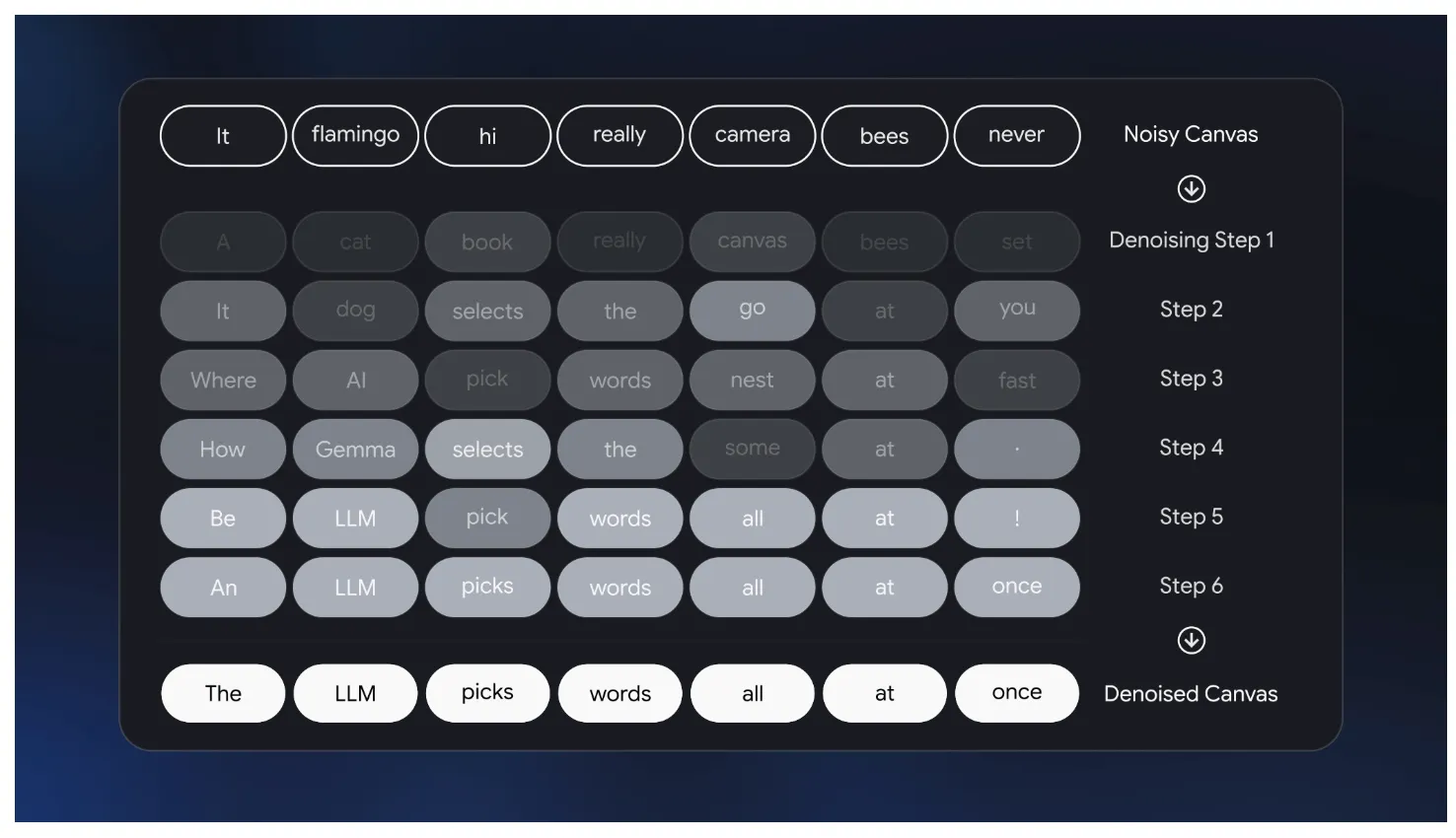
DiffusionGemma doesn’t do that. Instead of generating tokens sequentially, it starts with refined chunks of garbled text in parallel. Per Google’s developer guide, it “starts with a canvas of random placeholder tokens” and iteratively locks in confident tokens until the whole block snaps into focus. Two hundred fifty-six tokens per forward pass. The GPU stays busy.
The side effect is bidirectional attention—every token can see every other token while being generated, which is impossible in autoregressive models (they cannot see the future, what is going to be encoded). That makes it unusually good at tasks where the end of the answer constrains the beginning: code infilling, structured output, constraint-heavy problems, etc. Google fine-tuned a version to solve Sudoku as a demo. The base model got roughly 0% of puzzles right.
The fine-tuned version hit 80%.
Text diffusion has been a research project for years. MDLM, SEDD, LLaDA, Dream—academic models that proved the approach worked at small scales and mostly stayed as proof of concepts. Inception Labs shipped Mercury 2 in February 2026 as the first commercial diffusion reasoning model, claiming speeds five times faster than speed-optimized competitors.
But none of that was open-weight, and none of it came with day-zero support in vLLM, Hugging Face Transformers, and Unsloth. DiffusionGemma is the first major open release from a tier-one lab.
There’s also a historical irony worth noting. Image generators started as diffusion models (hence the name Stable Diffusion) and are now moving toward autoregressive architectures for better quality. Language models started as autoregressive and are now experimenting with diffusion for speed.
Why it’s a pain to run… for now
Running DiffusionGemma efficiently requires a drafter—a lightweight module that proposes token blocks in parallel, which the main model then verifies in one forward pass. This is called speculative decoding. DFlash is a framework published in early 2026 that uses a small diffusion model as the drafter, enabling over 6x speedup on some tasks. It’s the engine that makes this class of model practical.
The problem: DiffusionGemma needs a specific drafter to run locally via MLX—Apple’s machine learning framework for Apple Silicon. That module doesn’t exist in any public version of mlx-lm, in any open pull request, or in LM Studio’s bundled runtime.
We tried running DiffusionGemma with Hermes through NVIDIA NIM. The model loaded, but then: “agent init failed: Model google/diffusiongemma-26b-a4b-it has a context window of 8,192 tokens, which is below the minimum 64,000 required by Hermes Agent.”
To be precise: DiffusionGemma’s actual context window is 256K tokens. The 8,192 figure was Nvidia messing things up by default, not the model’s architectural limit.
In practice, getting it configured correctly for agentic use requires manual work that most everyday users haven’t figured out yet, and Hermes Agent simply won’t initialize without it. Parallel speed means nothing if the agent can’t boot.
Hopefully, in the next few days, the community will produce better resources to run these models.
Who this is actually for
Developers with NVIDIA RTX 4090 or 5090 hardware building real-time tools—inline editors, autocomplete, code infilling, structured generation. That’s the target. As Decrypt covered in May, Google has been on a steady push to make local inference faster without new hardware.
For researchers, bidirectional generation opens territory that autoregressive models simply can’t reach—protein sequences, mathematical graphs, anything where position N depends on position N+50. That’s not a small thing.
Google launched Gemma 4 under Apache 2.0 in April, and DiffusionGemma continues that strategy. There’s already a draft llama.cpp PR open as of today. When the toolchain catches up, this reaches a much wider audience.
On a machine with a capable discrete GPU, 1,000 tokens per second is real.
Daily Debrief Newsletter
Start every day with the top news stories right now, plus original features, a podcast, videos and more.