Web3

Home Web3 Page 12

China’s Z.AI Releases GLM-5.2: A Model That Rivals Claude Opus—Using Zero Nvidia Chips – Decrypt

0
China’s Z.AI Releases GLM-5.2: A Model That Rivals Claude Opus—Using Zero Nvidia Chips – Decrypt


In brief

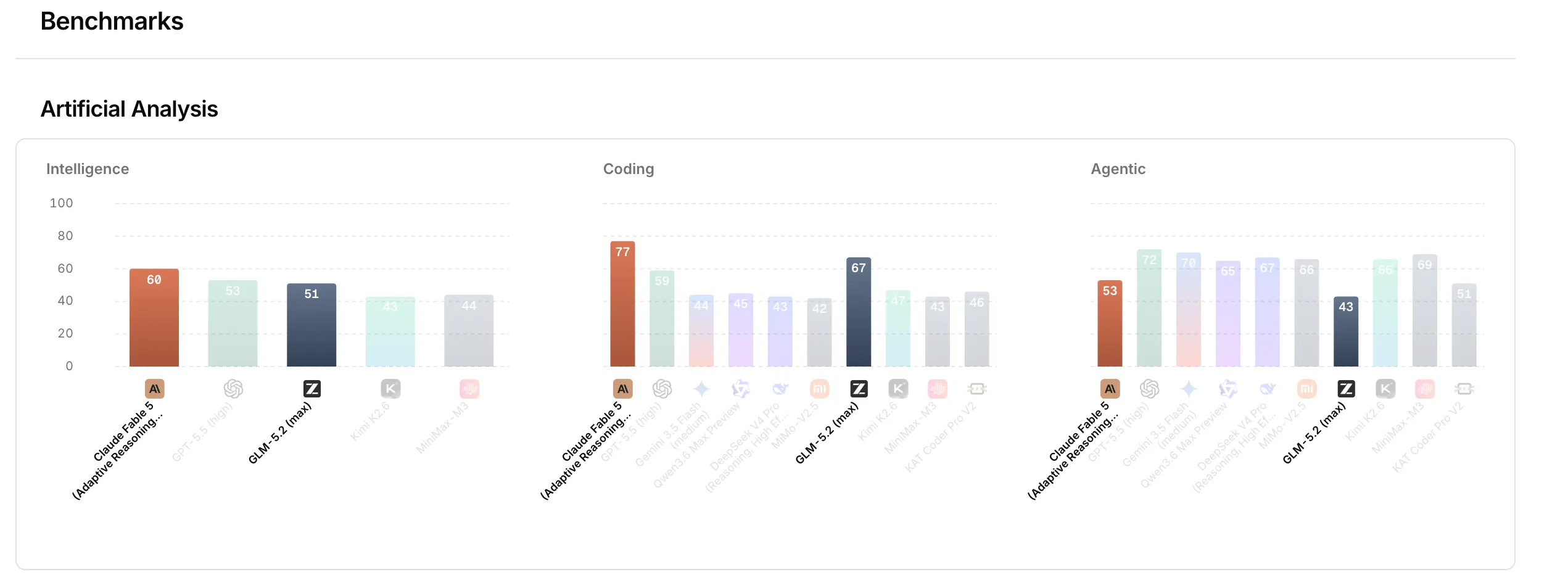
GLM-5.2 trails Claude Opus 4.8 by just 1% on FrontierSWE—a benchmark measuring multi-hour autonomous engineering projects—while beating GPT-5.5 on the same test. It ships under an MIT license with zero regional restrictions.
The model was built entirely on Huawei Ascend chips with no NVIDIA hardware involved.
Unsloth AI already released 2-bit GGUF quantizations that shrink the model from 1.51TB to 238GB. You’ll still need 256GB of RAM or VRAM—but at that point, you can run it.

Z.ai dropped GLM-5.2 on June 16, promising top level performances, beating its already advanced GLM 5.1.

The Beijing-based lab, which has been on the U.S. Entity List since January 2025, appears to be benefiting from growing concerns over America’s approach to AI. Over the past week, the ban on Anthropic Fable and the release of this new model have helped drive zAI’s stock up 90%, sending it to a new all-time high.

GLM 5.2 has the numbers to back up the hype.

On FrontierSWE—a benchmark that evaluates whether an AI agent can complete open-ended technical projects measured in hours, covering systems optimization, large-scale code construction, and applied ML research, scored by dominance rate—GLM-5.2 hit 74.4 against Claude Opus 4.8’s 75.1. It edged out GPT-5.5 at 72.6. On SWE-bench Pro, which tests autonomous resolution of real-world GitHub issues scored as a pass rate, GLM-5.2 scored 62.1 to GPT-5.5’s 58.6—and cleared its predecessor GLM-5.1’s 58.4 by a wide margin.

The quality jump makes it the best open-source model to date in the Artificial Analysis Intelligence Index, which aggregates the results of 9 different scores to assess the general quality of an AI model. OpenRouter’s benchmarks put it in the same category as the now banned Claude Fable 5.

The hardware used to achieve this feat is another interesting part of the story. GLM-5.2 was trained on Huawei Ascend chips—no Nvidia anywhere in the pipeline. Emad Mostaque, founder of Stability AI, estimated total training costs at around $25 million, 80% of that in post-training, which would make it extremely cheap when compared against its peers.

As Decrypt reported earlier this year, Z.ai was already training image models on Huawei’s Ascend Atlas servers without a single American chip. GLM-5.2 takes that infrastructure further—a 744-billion-parameter mixture-of-experts model with a genuine 1 million-token context window, five times the 200K limit on GLM-5.1, and an MIT license that means no government directive can flip the access switch.

Tokens are the chunks of tet a model can read and generate whereas Parameters are the number of internal settings and values that determine how a model processes information and generates responses

Who it’s for and what it costs

For developers, the context window is the operational shift. Whole-repo navigation, multi-file refactors, and long agentic pipelines that previously required chunking become single-call workflows. API pricing runs $1.40 per million input tokens and $4.40 per million output—against Claude Opus 4.8’s $5 input and $25 output. The Coding Plan starts at around $18 a month and works directly inside Claude Code, Cline, Kilo Code, and most popular agentic environments.

Local deployment is also technically possible. Unsloth AI pushed 2-bit GGUF quantizations that compress the model from 1.51TB down to 238GB while retaining ~82% accuracy.


Don’t get too excited, though. That still means it demands 256GB of unified memory or a matching RAM/VRAM combo—a maxed M4 Ultra Mac Studio or a workstation with a mid-range GPU and 256GB of system RAM with mixture-of-experts offloading. It’s still a lot of money, but at least something that you can buy and run on your house if you really want to.

We ran a quick test, asking GLM-5.2 to build our standard game mixing typing mechanics with a shooter. The UI wasn’t the prettiest—other models generated more polished-looking interfaces, but the experience was the most varied: different scenarios across waves, enemy types that shifted, bosses appearing later in the run.

It generated more diverse game states than anything else we tested for the same task in a zero shot setup.

If you want to play it, it’s live in our Itch.io profile.

That variance points toward where GLM-5.2 makes the most economic sense. For multi-shot generation workflows and agentic pipelines where output diversity matters more than polish, the math at open-source pricing levels is hard to argue with. For the hardest sustained tasks—SWE-Marathon, where it scores 13.0 against Opus 4.8’s 26.0—the gap to the closed frontier is still real, and 13 points wide.

Open-source weights are live on HuggingFace under the MIT license. The quantized weights are also available on HuggingFace. GLM Coding Plan subscribers can switch now with the model string GLM-5.2, and it’s also available for free testing on z.AI with some usage constraints.

Daily Debrief Newsletter

Start every day with the top news stories right now, plus original features, a podcast, videos and more.


Source link

Global $2.75B payments deal shows stablecoins moving into the rails they were meant to bypass

0
Global .75B payments deal shows stablecoins moving into the rails they were meant to bypass


Nuvei agreed to buy Payoneer for $2.75 billion in cash in a deal centered on money movement through merchant acquiring, payouts, FX, cards, risk controls, and licenses.

The companies also placed stablecoins inside that payment stack. That gives the deal its crypto significance: mainstream stablecoin use may run through processors that already own merchant relationships, local approvals, fraud controls, FX tools, and payout networks.

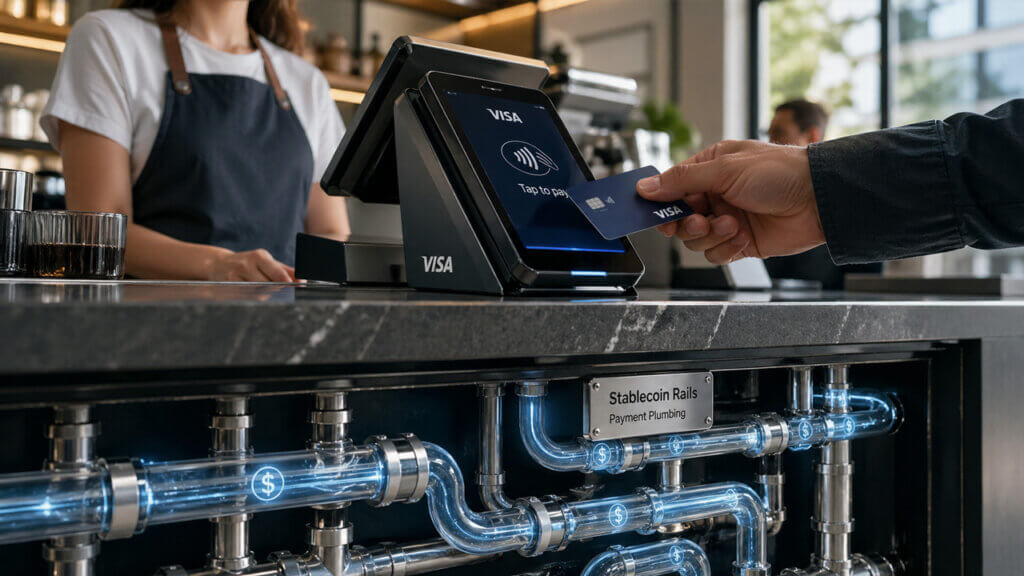
Visa is quietly building stablecoins into mainstream payment plumbing without you knowing
Related Reading

Visa is quietly building stablecoins into mainstream payment plumbing without you knowing

Visa’s stablecoin settlement pilot now spans nine blockchains and a $7 billion annualized run rate across payment infrastructure.

Apr 30, 2026 · Liam ‘Akiba’ Wright

Nuvei announced June 15 that it would acquire all outstanding Payoneer shares for $7.40 per share in cash. The companies said the transaction values Payoneer at approximately $2.75 billion.

The deal is expected to close in mid-2027, subject to Payoneer shareholder approval, regulatory approvals, and other customary conditions.

At closing, Nuvei said the combined company is expected to generate approximately $3 billion in annual revenue and process more than $500 billion in annual payment volume for more than 2.4 million customers.

It also said the combined business would give companies a single partner to accept, hold, and move money, including stablecoin transactions, across more than 190 countries and territories.

The companies left stablecoin-specific volume undisclosed, which keeps the claim modest. For now, the transaction points to stablecoins becoming one capability inside regulated commerce infrastructure, while any volume forecast depends on future reporting.

Stablecoins sit inside the payment stack

The crypto signal in the Nuvei-Payoneer deal comes from distribution. Payoneer remains a cross-border payments and financial platform for businesses, marketplaces, contractors, and sellers that need to move money across countries and currencies.

That network is relevant for stablecoins because token settlement still has to meet the real-world requirements of business payments.

A dollar token can settle value quickly on-chain, but a merchant or platform still needs acceptance, risk screening, currency conversion, local payout rules, reconciliation, and usable accounts.

Those functions determine whether payment speed becomes a product companies can actually adopt.

Payoneer said its network adds cross-border payouts, multi-currency accounts, a banking network, and same-day or real-time settlement in more than 150 markets.

The company also pointed to regulatory assets, including licensing for online payment services in mainland China and in-principle authorization as a cross-border payment aggregator in India under the Reserve Bank of India’s framework.

Nuvei brings the merchant acceptance side. The company already describes its platform around global acquiring, alternative payment methods, issuing, currency management, fraud and risk controls, bank transfers, real-time payments, and crypto and digital assets.

Nuvei’s platform reach includes 150 currencies, while the combined company is expected to operate across more than 190 countries and territories.

Put together, the deal shows stablecoin functionality moving toward back-end payment routing.

A merchant may care less about whether settlement moves through a token, a bank transfer, a card network, or a local payout provider than about cost, settlement speed, compliance, and whether funds arrive where the business needs them.
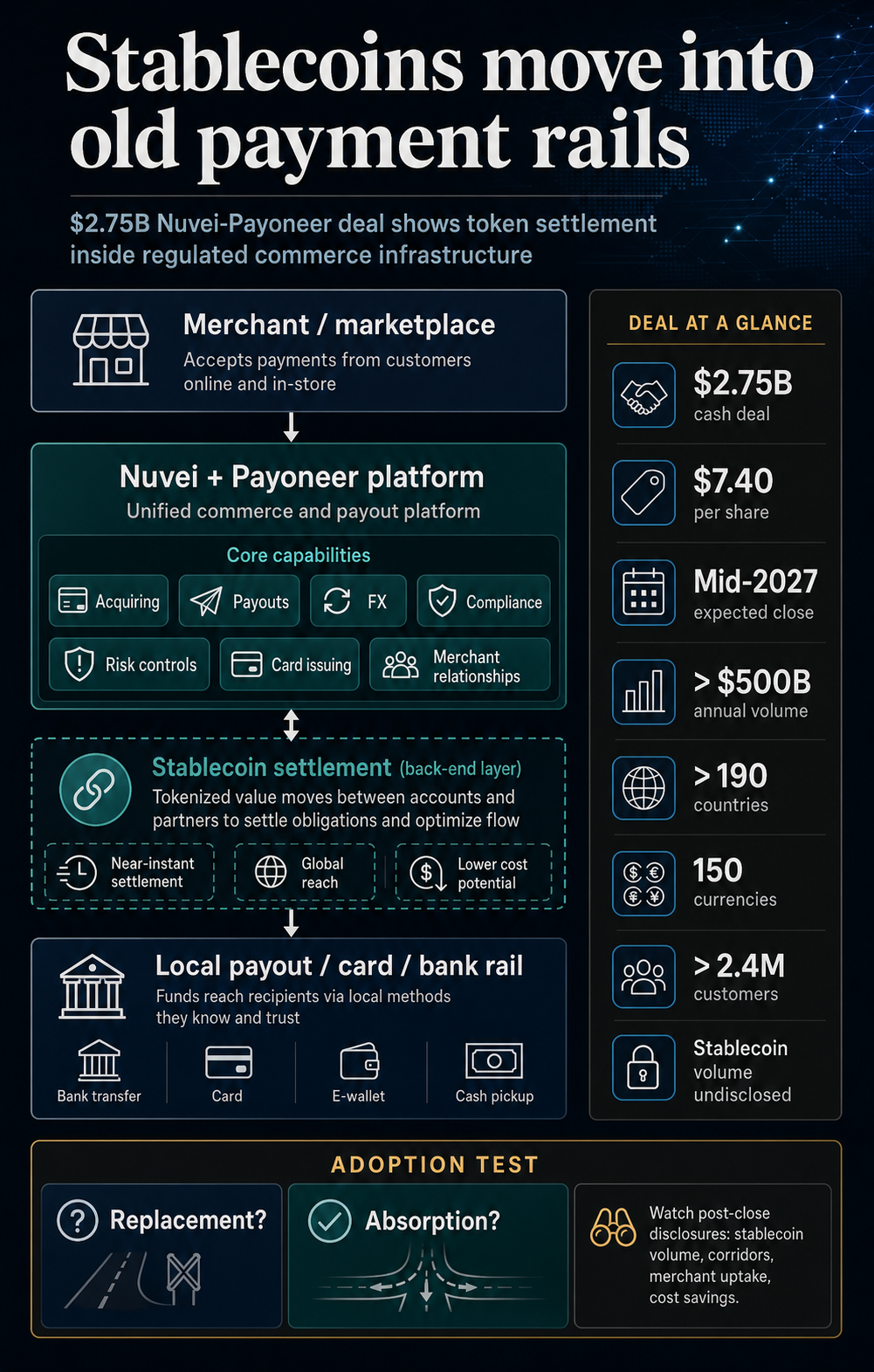
Infographic showing the Nuvei and Payoneer platform placing stablecoin settlement inside merchant acquiring, payouts, FX, compliance, and local payment rails.Infographic showing the Nuvei and Payoneer platform placing stablecoin settlement inside merchant acquiring, payouts, FX, compliance, and local payment rails.

Confirmed elementOperational meaningConstraint$2.75 billion all-cash dealGives the analysis a concrete payments infrastructure pegClosing remains pendingMore than $500 billion expected annual payment volumeShows the scale of payment-network distribution stablecoin functionality could plug intoStablecoin-specific volume remains undisclosed190+ countries and territoriesMakes local payout, FX, and compliance coverage central to the analysisNuvei’s 150-currency reach describes platform contextStablecoin transactions named in deal languagePlaces token settlement inside mainstream payment infrastructureStablecoins are one capability inside the broader platform

Stablecoins were supposed to bypass credit cards, but now Visa is winning crypto card paymentsStablecoins were supposed to bypass credit cards, but now Visa is winning crypto card payments
Related Reading

Stablecoins were supposed to bypass credit cards, but now Visa is winning crypto card payments

Stablecoin cards are turning crypto balances into everyday spending power, exposing that the easiest path to mainstream adoption may be through Visa, the same payments giant crypto was supposed to disrupt.

May 28, 2026 · Gino Matos

The Payoneer acquisition also extends work Nuvei had already started. Visa announced in 2023 that it was expanding USDC settlement capabilities with merchant acquirers Worldpay and Nuvei.

The program used Solana as well as Ethereum for settlement between partners. Those pilots remained limited, but they showed Nuvei operating where card settlement, merchant acquiring, and stablecoins overlap.

Nuvei then launched a blockchain payment solution in 2024 with Rain, BitGo, and Visa for Latin American merchants.

The company described a model in which businesses could use stablecoins for faster cross-border B2B payments and settlements while relying on existing card and payment infrastructure.

That history frames the Payoneer deal as distribution expansion. Payoneer gives Nuvei a wider base of cross-border customers, regulated markets, and payout relationships.

Stablecoin settlement can become more useful if it reaches that base through familiar payment products.

Compliance and distribution decide who owns the customer

The strongest version of the stablecoin thesis is that blockchain settlement can reduce delays, lower costs, and make cross-border payments easier.

The Nuvei-Payoneer deal leaves that thesis intact because it assumes stablecoins can be useful. It also shows how much non-token infrastructure still surrounds that usefulness.

A Federal Reserve staff analysis published in March said payment stablecoins can help address some cross-border payment frictions.

It also noted that FX liquidity, foreign-currency inventories, compliance checks, fiat conversion, and intermediaries may remain relevant in stablecoin-based cross-border models.

That maps closely onto what Nuvei is buying. Payoneer adds more than a payout interface.

Payoneer’s 2025 annual report describes a business that operates across payment services, money transmission, stored value, FX, compliance, bank and payment-service-provider relationships, and regulatory regimes.

Its India authorization is still in-principle, but the strategic asset is permissioned distribution across markets where rules, banking access, and trust shape payment adoption.

A stablecoin may move dollars across blockchains at any hour, but a corporate payment still has to enter and exit local financial systems.

CryptoSlate Daily Brief

Daily signals, zero noise.

Market-moving headlines and context delivered every morning in one tight read.

5-minute digest 100k+ readers

Free. No spam. Unsubscribe any time.

Whoops, looks like there was a problem. Please try again.

You’re subscribed. Welcome aboard.

Someone must handle identity checks, sanctions screening, tax documentation, local account access, chargebacks or disputes where applicable, and currency conversion.

If those functions sit around the token, processors that already own them can turn stablecoins into another settlement option while retaining the customer relationship.

Other payment networks are moving in the same direction. Mastercard said in March that it agreed to acquire BVNK, framing the deal around connecting on-chain payments and fiat rails.

Crypto tried to cut out Visa and Mastercard — now they’re buying up blockchain companiesCrypto tried to cut out Visa and Mastercard — now they’re buying up blockchain companies
Related Reading

Crypto tried to cut out Visa and Mastercard — now they’re buying up blockchain companies

The $1.8B Mastercard/BVNK deal turns stablecoin middleware into an incumbent asset, shifting value from tokens to distribution and compliance.

Mar 18, 2026 · Gino Matos

That acquisition remains subject to regulatory review and other closing conditions, but the strategic language is similar. Stablecoins, tokenized deposits, and tokenized assets become usable when they plug into trusted payment networks.

CryptoSlate has tracked the same pattern in card payments.

A May analysis found that stablecoin-linked cards were routing most transactions through Visa, turning crypto balances into spending power through the same network stablecoins were expected to bypass.

Another CryptoSlate analysis argued that the control points for stablecoin payments are increasingly orchestration, compliance, reserves, FX management, and interoperability.

In that model, the token brand in front of the user plays a smaller role than the infrastructure behind it.

Nuvei’s Payoneer deal fits that map as market context while leaving execution to future disclosures.

If stablecoin payments scale through processors, acquirers, card networks, and cross-border payout providers, adoption can still be real while looking less like a clean exit from legacy finance.

Stablecoins can become a settlement and liquidity feature inside companies that already manage merchant access, local payout rules, and compliance.

The distinction changes who captures value in crypto payments.

If tokenized dollars become a back-end feature, the winners may be firms that control distribution and risk instead of issuers with the largest brands.

Merchants may choose the processor that gives them the best reach, cost, settlement speed, and local payout certainty, while the token itself becomes one part of the routing decision.

The adoption test comes after closing

The Nuvei-Payoneer deal leaves open whether stablecoins will eventually replace legacy payment rails.

It shows that large payment firms are preparing for a hybrid market in which stablecoins are packaged inside regulated money-movement platforms.

The next signals are concrete. The first is whether the transaction closes on the expected mid-2027 timeline after shareholder and regulatory review.

The second is whether Nuvei discloses stablecoin-specific payment volume, settlement corridors, merchant uptake, or cost savings after integration.

The third is whether businesses treat stablecoin settlement as a visible payment method or as hidden plumbing behind ordinary merchant and payout workflows.

The record points to absorption before replacement. Stablecoins are being packaged by mainstream payments companies.

If Nuvei can use Payoneer’s regulated distribution to make token settlement useful across merchants, platforms, and cross-border payouts, stablecoins may win payments by disappearing into the rails they were expected to bypass.



Source link

ePropelled Launches Localised Websites to Support Ukraine-First Strategy and Global Expansion | Web3Wire

0
ePropelled Launches Localised Websites to Support Ukraine-First Strategy and Global Expansion | Web3Wire


Company targets leadership as propulsion, power and control system provider for autonomous defence and commercial markets

LACONIA, NH AND COVENTRY, UK AND CHENNAI, INDIA / ACCESS Newswire / June 18, 2026 / ePropelled, a leader in advanced electric propulsion and intelligent power management technologies, today announced the launch of localised websites alongside a major international expansion strategy anchored in Ukraine in tandem with key global markets.

The company is prioritising Ukraine as the world’s most active proving ground for autonomous and uncrewed systems, positioning ePropelled at the forefront of real-world deployment, rapid innovation and operational resilience.

The new language offerings include Ukrainian, German and French, with Spanish and Hindi to follow, enabling customers, partners, and prospects to access information about ePropelled’s technologies and solutions in their preferred language.

At the same time, ePropelled is expanding its presence across markets to meet accelerating demand in a global autonomous systems sector projected to reach tens of billions of dollars over the coming decade.

“We are not simply expanding geographically,” said Dean Marcarelli, Chief Commercial Officer of ePropelled. “We are executing a focused strategy to become the propulsion, power and control system provider of choice across autonomous platforms globally. Ukraine is central to that strategy because it is where technology is being tested, proven and adopted at pace.”

The initiative reflects ePropelled’s commitment to improving customer engagement, increasing accessibility and supporting international business development across key strategic markets.

“Our technologies serve global industries including defence, agriculture, logistics and industrial electrification,” said Dean Marcaralli, Chief Commercial Officer, “providing localized digital experiences helps customers better understand our solutions, strengthens trust and demonstrates our long-term commitment to serving international markets.”

The localized websites are designed to improve the user experience for both technical and commercial audiences by providing regionally adapted content, terminology, and navigation. The new platforms will support engineers, procurement teams, government stakeholders, distributors, and partners evaluating ePropelled’s electric propulsion and integrated power technologies.

The expansion is expected to deliver several customer benefits, including:

Improved understanding of complex technical information

Easier access to product and company information

Enhanced support for regional partners and distributors

Increased accessibility for non-native English speakers

Faster engagement with local sales and business development teams

The initiative also strengthens ePropelled’s international digital marketing and search visibility by enabling customers to discover the company through local-language online searches.

“The Ukraine, Germany and France represent important markets for advanced, dual-use commercial, military and transportation technologies, “commented Simon Baugh, Director of Corporate Marketing, “while India continues to emerge as a major growth region for uncrewed aerial and ground vehicles in sustainable infrastructure, especially in agriculture. The Ukrainian website further demonstrates our support for regional engagement and accessibility.”

The localized websites form part of ePropelled’s broader strategy to scale its international presence and support the growing global demand for high-efficiency electric propulsion and intelligent power management technologies.

Visitors can access the new language options directly from the main ePropelled website at http://www.epropelled.com and using top level domains for each country.

About ePropelled

ePropelled Group, is a leading global technology provider specializing in smart propulsion solutions and energy management systems for uncrewed vehicle operations in the air, on land and at sea. Founded in 2018, ePropelled has created over 40 patents across 13 categories and serves customers worldwide from its R&D, Engineering and Manufacturing facilities in the USA, UK, and India. Operating through sovereign supply chains, ePropelled products are engineered to maximize performance, reduce energy consumption, and empower uncrewed motion. Contact [email protected], call +1 (603)236-7444, or visit http://www.ePropelled.com.

SOURCE: ePropelled, Inc.

About Web3Wire Web3Wire – Information, news, press releases, events and research articles about Web3, Metaverse, Blockchain, Artificial Intelligence, Cryptocurrencies, Decentralized Finance, NFTs and Gaming. Visit Web3Wire for Web3 News and Events, Block3Wire for the latest Blockchain news and Meta3Wire to stay updated with Metaverse News.


Source link

Psychologists Say Patients Are Bringing AI Into Therapy Sessions: Survey – Decrypt

0
Psychologists Say Patients Are Bringing AI Into Therapy Sessions: Survey – Decrypt


In brief

More than three-quarters of psychologists surveyed said patients have discussed using AI for mental health support, diagnosis, or companionship.
Thirty-five percent of patients reported using AI as an additional mental health professional, while 39% said patients have used it to self-diagnose.
Most psychologists expressed concerns about safety, privacy, dependency, and the potential for chatbots to reinforce delusions or self-harm.

As generative AI becomes a fixture of daily life, patients are increasingly bringing chatbot conversations into therapy sessions.

According to a new American Psychological Association survey of more than 1,200 U.S. psychologists, 77% said they have patients who discussed using AI for emotional support, diagnosis, companionship, or other mental health-related purposes.

In the survey, 39% of psychologists reported patients using AI to self-diagnose mental health conditions, 33% said patients were using chatbots to assist with therapy or treatment, and 35% reported patients using AI as an additional mental health professional.

“Though few psychologists reported their patients using chatbots in unhealthy ways, more than a third (36%) said they noticed their patients developing a level of dependency on a chatbot, and 15% talked about or noticed their patients developing distorted thinking or delusions related to a chatbot,” the survey said.


Psychologists also reported patients using chatbots for social purposes. Twenty-two percent said patients were using AI for friendship, while 13% reported patients engaging in intimate relationships with chatbots.

Among psychologists whose patients had developed relationships with chatbots, 71% said patients discussed their mental health with AI, while 68% reported that patients felt supported or validated by chatbot interactions. Nearly half reported positive communication with chatbots, and 41% said patients were using them to reinforce healthy coping skills.

According to the survey, overall use may actually be higher than reported because the survey only captured psychologists’ interactions with existing patients.

The survey comes as AI companies expand chatbots and AI companions, while researchers continue to raise concerns about their effects on mental health. More than a third of psychologists reported patients developing a dependency on chatbots, and 15% reported cases involving distorted thinking or delusions.

The findings follow a recent study from the City University of New York and King’s College London that found several leading AI models could reinforce delusions, paranoia, and suicidal ideation, with xAI’s Grok 4.1 Fast performing worst.

“Psychologists’ attitudes toward the use of chatbots for mental health advice are characterized by significant caution regarding safety and privacy,” the previous study said. “Almost every psychologist (97%) felt that chatbots may inadvertently reinforce negative behaviors or delusional beliefs, and 94% said that the current version of chatbots cannot treat conditions with an appropriate amount of nuance.”

The survey also comes as AI developers face growing legal scrutiny over the role chatbots may play in real-world harm. In recent months, OpenAI, Google, and xAI have been hit with lawsuits, including a wrongful death suit against Google over claims that Gemini fueled a Florida man’s delusions before his suicide. That’s in addition to lawsuits against OpenAI tied to a mass shooting in British Columbia and an accidental overdose, and a class action suit accusing xAI’s Grok of generating sexually explicit images of minors.

While the APA acknowledged that AI can help users organize their thoughts and supplement professional care, it warned that chatbots are not private and should not replace licensed mental health professionals.

“Many people—especially teens and adolescents—may be using AI as a more affordable and accessible option for mental health advice,” the survey said. “However, AI is not a safe or effective replacement for a qualified mental health provider and should be used carefully.”

Daily Debrief Newsletter

Start every day with the top news stories right now, plus original features, a podcast, videos and more.


Source link

Atos joins CrowdStrike’s Project QuiltWorks to advance sovereign AI adoption and secure frontier AI risk | Web3Wire

0
Atos joins CrowdStrike’s Project QuiltWorks to advance sovereign AI adoption and secure frontier AI risk | Web3Wire


Press Release

Atos joins CrowdStrike’s Project QuiltWorks to advance sovereign AI adoption and secure frontier AI risk

Atos’ leadership at the intersection of cybersecurity, AI and digital sovereignty strengthens QuiltWorks’ ecosystem

Paris, France – June 17, 2026 – Atos, a global leader of AI-powered digital transformation, today announces that it has joined CrowdStrike’s Project QuiltWorks. Powered by the Falcon® platform and frontier models from OpenAI and Anthropic, Project QuiltWorks combines CrowdStrike’s AI-driven vulnerability discovery and adversary-informed prioritization with remediation services from the world’s top systems integrators and managed services providers, and financial protection from leaders in the cyber insurance industry.

Atos will further expand its cybersecurity services portfolio and expertise in managed security services, cybersecurity governance and sovereign digital environments by joining QuiltWorks.

By joining the coalition, Atos brings a distinctive value proposition centered on digital sovereignty, helping clients adopt AI and secure against frontier AI risk with stronger control over data, infrastructure, governance and compliance requirements. Built for the frontier AI era, Atos’ services will contribute to the coalition, combining SOC operations ready for AI accelerated adversaries with an agentic, AI augmented cybersecurity offering.

As part of this partnership, Atos will integrate QuiltWorks capabilities to strengthen organizations’ ability to prepare, respond, and continuously adapt to AI-driven risk. This delivers greater visibility into AI-related exposures, smarter prioritization, faster remediation, and continuous protection against evolving threats, providing clients with clearer board-level visibility and actionable remediation frameworks.

Atos will combine these capabilities with its sovereign digital infrastructures to support regulated environments, enabling highly secure and sovereign AI deployments that align with European regulatory and sovereignty requirements, helping organizations manage risk proactively and respond effectively under pressure.

Atos’ approach emphasizes governance, ownership and control of data, AI models and infrastructure so AI vulnerability management is compliant-by-design, supporting continuous adaptation as threats, regulations, and business needs evolve.

Günter Koinegg, global head of cybersecurity services, Atos, said: “Joining CrowdStrike’s QuiltWorks coalition marks an important milestone in our strategy to combine artificial intelligence and cybersecurity at scale. By bringing together advanced AI risk management capabilities with our expertise in sovereign digital environments, we enable our clients to adopt AI securely, with full control over their data and compliance with regulatory frameworks.”

Daniel Bernard, chief business officer, CrowdStrike, said: “We are pleased to welcome Atos to QuiltWorks, the only coalition that secures every layer of frontier AI risk. Their track record with CrowdStrike and strong expertise in cybersecurity services and sovereign environments will extend the coalition’s reach in the European market as QuiltWorks continues to expand across every sector and organization worldwide.”

Atos and CrowdStrike’s partnership spans eight years of collaboration focused on delivering advanced cybersecurity solutions. The QuiltWorks coalition marks a new step in this partnership, reinforcing their joint ambition to address the evolving cybersecurity challenges posed by artificial intelligence.

***

Atos Group’s cybersecurity services and products

As a global cybersecurity leader with more than 6,500 experts and 205 cybersecurity patents, Atos Group helps organizations navigate the evolving threat landscape with end-to-end, AI-powered security, enabling their pursuit of digital sovereignty and trust.

Cybersecurity services, delivered under the Atos brand, offer an integrated blend of strategic consulting, solution integration and continuous managed security services – spanning the entire security lifecycle. With a global network of 17 security operations centers (SOCs) processing more than 31 billion security events per day and serving over 2,000 trusted customers, Atos cybersecurity services deliver a proactive, globally informed approach to securing operations. Its teams operate with deep industry expertise across all sectors, ensuring robust data protection, regulatory compliance, and business continuity worldwide.

Cybersecurity products delivered under the Eviden brand consist of a sovereign portfolio built on three complementary areas of expertise: data encryption, identity and access management, and digital identity. Developed and manufactured in Europe, Eviden cybersecurity products comply with the highest European certification standards to safeguard sensitive data, secure digital access and protect the identities across users, systems, and connected devices.

***

About Atos Group

Atos Group is a global leader in digital transformation with c. 56,000 employees and annual revenue of c. €7.2 billion (at the go-forward perimeter), operating in 54 countries under two brands – Atos for services and Eviden for products and systems. European number one in cybersecurity and a leader in cloud, Atos Group is committed to a secure and decarbonized future and provides tailored AI-powered, end-to-end solutions for all industries. Atos Group is listed on Euronext Paris.

Press contact

Isabelle Grangé | isabelle.grange@atosgroup.com | Phone: +33 (0) 6 64 56 74 88

PR-Atos joins CrowdStrike’s Project QuiltWorks to advance sovereign AI adoption and secure frontier AI risk

About Web3Wire Web3Wire – Information, news, press releases, events and research articles about Web3, Metaverse, Blockchain, Artificial Intelligence, Cryptocurrencies, Decentralized Finance, NFTs and Gaming. Visit Web3Wire for Web3 News and Events, Block3Wire for the latest Blockchain news and Meta3Wire to stay updated with Metaverse News.


Source link

Alibaba Is Building Qwen-Robot: The Operating System for the Robot Economy – Decrypt

0
Alibaba Is Building Qwen-Robot: The Operating System for the Robot Economy – Decrypt


In brief

Alibaba unveiled the Qwen-Robot Suite, a trio of AI models designed to handle robot navigation, manipulation, and physics-based world simulation through a unified software stack.
The company says its models top multiple robotics benchmarks, using millions of training samples and tens of thousands of hours of open-source robot data.
Real-world robot deployment remains years away.

Alibaba’s Qwen team dropped the Qwen-Robot Suite on Tuesday: three foundation models forming what they call a “full stack for embodied intelligence.” Qwen-RobotNav handles mobility. Qwen-RobotManip handles manipulation. Qwen-RobotWorld simulates the physics that make both possible. Each works independently. Together, they’re the Android moment for robotics—the operating system, not the hardware.

Alibaba is right now the only company in China spanning chips, cloud, models, serving platforms, and applications. For the company, robotics is the most physical expression of that bet, what is known as embodied AI.

AI agents currently rely on LLMs to power their decisions. The usual way robots work is by machine-learning models which, although advanced, lack the adaptability of generative AI. Physical agents face a different, harder class of failure modes: physics, not prompts.


For these use cases, Alibaba introduced this new AI suite with different components:

Qwen-RobotNav unifies five navigation tasks—instruction following, point-goal navigation, object search, target tracking, and autonomous driving—each demanding different visual memory strategies. Most models hardcode one strategy. Qwen-RobotNav exposes a parameterized interface: token budget, temporal decay, per-camera weights that a planner can reconfigure mid-episode.

Trained on 15.6 million samples with randomization across all parameters, it achieves 76.5% success on VLN-CE RxR, a benchmark for vision-and-language navigation in real-world environments, and 90% tracking on EVT-Bench, which evaluates an agent’s ability to consistently follow moving targets.

Qwen-RobotManip tackles one of the biggest challenges in robotic manipulation: different robots represent actions in fundamentally different ways. A Franka arm (a type of robot with seven axis of movement) operates through joint angles, while an ALOHA robot (a low-cost bimanual robot platform widely used in robotics research) represents actions through the position and orientation of its grippers (end-effector poses). Humanoids add another layer of complexity, using whole-body coordinates.

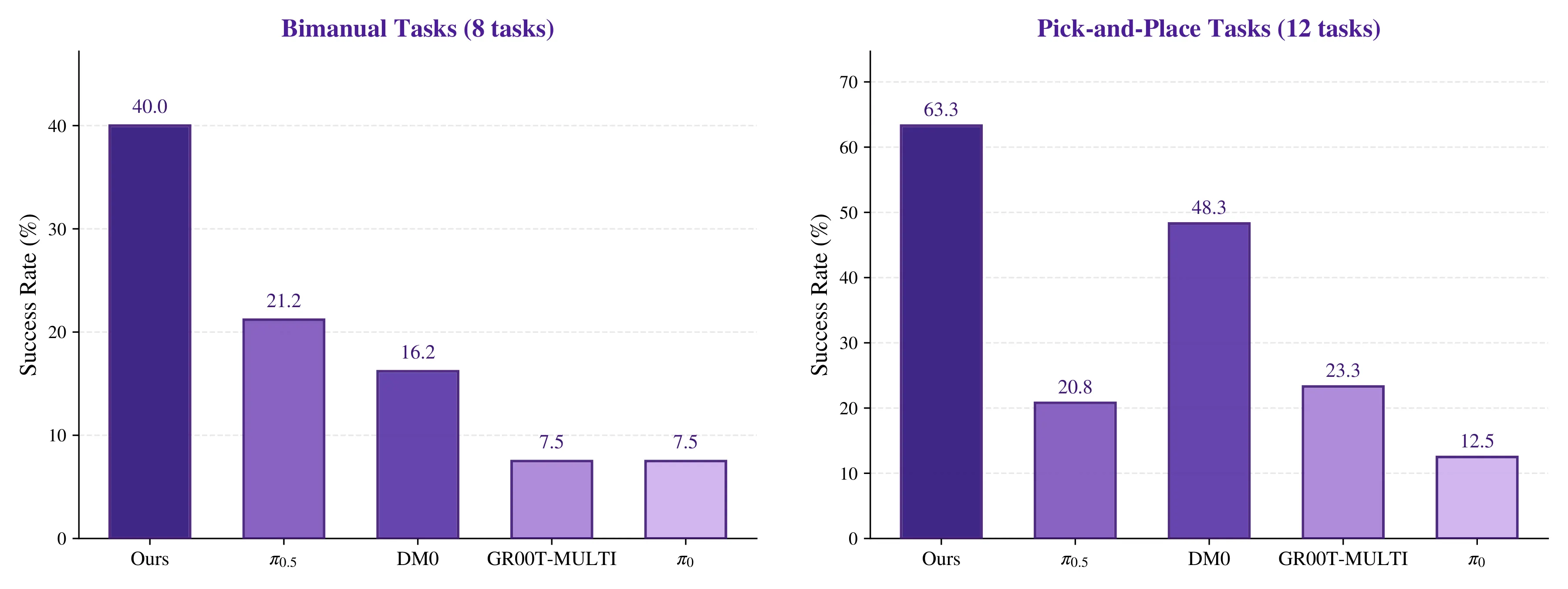
To bridge these incompatible action spaces, Alibaba synthesized approximately 38,100 hours of training data from open-source robot datasets and human videos—without relying on proprietary data collection. The model ranks first on RoboChallenge Table30-v1, outperforming previous approaches by 20%.

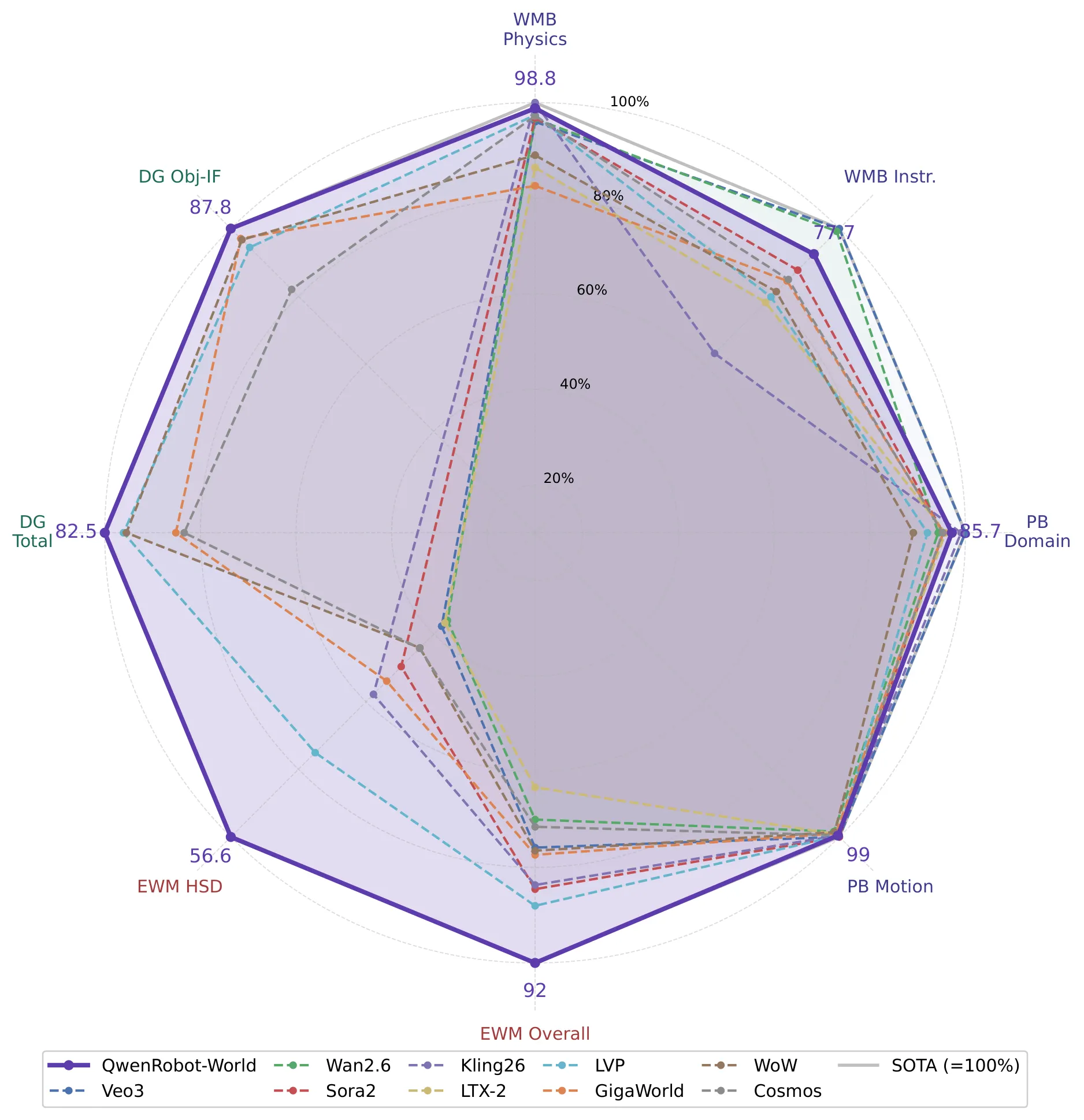
Qwen-RobotWorld is the most ambitious: a language-conditioned video world model treating natural language as a universal action interface. “Pick up the red cup and pour water on the flower” works whether the actor is a gripper, an autonomous vehicle, or a mobile navigation agent.

The Embodied World Knowledge corpus spans 8.6 million video-text pairs—200 million frames—across manipulation (5.9 million samples, 1,300+ skills, 20+ morphologies), autonomous driving (Waymo, NVIDIA PhysicalAI-AD, Bench2Drive), indoor navigation (VLNVerse), and human-to-robot transfer across 14 robot arms.

It ranks first on EWMBench and DreamGen Bench, two benchmarks that evaluate if world models predict and generate realistic physical environments. It also beats all open-source models on WorldModelBench and PBench, and scores perfectly on physics adherence: Newton’s laws, mass conservation, fluid dynamics, gravity.

The ChatGPT of robots?

While Western labs (Google DeepMind, Nvidia, Figure, Physical Intelligence) pursue similar goals, most focus on navigation or manipulation, not a unified, composable suite. Alibaba’s vertical integration from chips through applications means they control the full stack. The open-source foundation differentiates against competitors relying on private robot data.

There are some misconceptions that could be worth clearing: These are not robots but software models—brains, not bodies. They run on hardware from AgileX, Franka, Universal Robots, Unitree, and others.

Also, despite these being generative AI models for robots, these aren’t LLMs like your typical ChatGPT. A language model predicts tokens. These models must understand physics, spatial relationships, and consequences of physical actions. A language model tells you a glass breaks if dropped. Qwen-RobotWorld predicts how it breaks—shatter pattern, fluid dynamics, secondary collisions. Qwen-RobotManip plans a grasp that prevents the drop entirely.

Don’t expect to have your own housemaid robot anytime soon. The gap between a controlled demo of a robot placing fruit in a basket and a robot reliably working in your home is enormous. RoboCasa365, LIBERO-Plus, RoboTwin-Clean2Rand—these are simulation benchmarks. Real-world deployment introduces sensor noise, actuator drift, and the long tail of edge cases that have humbled every robotics effort in history, and Alibaba recognizes this.

The technical achievements are real, though. RobotManip’s alignment-first approach solves a genuine bottleneck in cross-embodiment training. RobotNav’s parameterized observation interface is a clever solution to the context-strategy problem. RobotWorld’s language-as-universal-action-interface is the right abstraction for cross-domain world modeling.

Alibaba hasn’t disclosed pricing, timelines, or which customers get access beyond pilot programs.

Daily Debrief Newsletter

Start every day with the top news stories right now, plus original features, a podcast, videos and more.


Source link

Peer To Peer Network (OTC:PTOP) Announces Release of MOBICARD(TM) 1.8 on Apple App Store and Google Play – New App Out – Download it Today! | Web3Wire

0
Peer To Peer Network (OTC:PTOP) Announces Release of MOBICARD(TM) 1.8 on Apple App Store and Google Play – New App Out – Download it Today! | Web3Wire


Enterprise Customer Rollouts Begin as Company Launches Most Advanced Version of MOBICARD™ to Date

CAMBRIDGE, MA / ACCESS Newswire / June 16, 2026 / Peer To Peer Network, Inc. (OTC Pink:PTOP), developer of the MOBICARD™ digital networking platform and original inventor of the digital business card, is pleased to announce the official release of MOBICARD™ 1.8 on both the Apple App Store and Google Play Store.

The launch marks a significant milestone for the Company as it transitions from years of development into the next phase of commercialization, customer acquisition, enterprise deployment, and revenue generation.

Download the new app for Android here: Mobicard™ – Apps on Google Play

Download the new app for Apple here: ‎Mobicard™ App – App Store

Management believes MOBICARD™ 1.8 represents a complete transformation of the user experience. The application has been redesigned from the ground up with a more intuitive interface, improved navigation, enhanced search functionality, enterprise capabilities, monetization tools, and several features that management believes differentiate the platform from other digital business card providers.

The Company also announced that it will immediately begin implementing and onboarding the Enterprise customers announced over the past several weeks, including organizations operating within the real estate, aviation, construction, and education sectors.

One of the most significant enterprise opportunities involves the planned integration of MOBICARD™ with large-scale partner ecosystems that could introduce the platform to substantial numbers of new users. Management believes enterprise deployments will play a critical role in accelerating adoption and expanding the overall MOBICARD™ network.

IMPORTANT UPDATE INSTRUCTIONS FOR APPLE USERS

Users who already have MOBICARD™ installed on their Apple devices must manually update the application to receive Version 1.8.

To update:

Open the Apple App Store.

Search for “MOBICARD™.”

Click on the MOBICARD™ app listing.

Tap the app image/icon on left hand side of screen.

Select “Update.”

Failure to update the application will prevent users from accessing the new features and enhanced user experience included in MOBICARD™ 1.8.

Management encourages every shareholder, customer, enterprise partner, friend, family member, and supporter of the Company to immediately download and begin using the application.

NEW FEATURES INCLUDED IN MOBICARD™ 1.8

MOBICARD™ 1.8 introduces a wide variety of new features designed to improve networking, customer engagement, discoverability, and monetization.

Airdrop Card Sharing

The platform now includes an Airdrop sharing feature that allows users to instantly share their digital business card with nearby devices. Management believes this functionality provides an enhanced networking experience not commonly found within competing digital business card applications.

Discovery Feed

MOBICARD™ 1.8 introduces a new Discovery Feed that functions similarly to a social media activity stream. Enterprise customers and businesses can promote announcements, services, products, events, employment opportunities, and company updates directly through the platform.

Users may also submit requests to be featured within the Discovery Feed, creating additional visibility opportunities for businesses and professionals.

Enhanced Local Search

The new search functionality allows users to search by profession, trade, service, or category.

For example, a user searching for “Plumber” can instantly locate MOBICARD™ users who identify themselves as plumbers and operate near the geographic area associated with the user’s profile.

Management believes this feature has the potential to transform MOBICARD™ into a powerful local business discovery platform.

Premium Subscription Features

Users may upgrade to a Premium subscription which removes advertisements and provides additional functionality.

Premium subscriptions are expected to serve as one of several future revenue-generating components of the platform.

Additional premium features include enhanced sharing capabilities and third-party referral tracking.

For example, if a user shares another person’s MOBICARD™, the card owner may receive notification that their card was shared along with information regarding the new contact.

Enterprise Accounts

The Company also launched its new Enterprise Account functionality.

Any user can begin the Enterprise signup process by:

Opening “Edit Card.”

Clicking the profile circle located in the upper-right corner of the application (Usually has the letter of your first name in the circle).

Selecting “Enterprise” from the menu.

Completing the onboarding process.

Enterprise customers receive enhanced visibility throughout the platform, expanded promotional opportunities, advertising capabilities, priority placement within search results, and additional tools designed to increase exposure and customer engagement.

Management believes the Enterprise platform creates a compelling value proposition for organizations seeking cost-effective digital marketing, networking, lead generation, and customer engagement solutions.

“This is a huge milestone for our Company,” stated Joshua Sodaitis, Chairman and CEO of Peer To Peer Network.

“For the first time, I feel like we are ready to truly market a product that I am proud of. MOBICARD™ 1.8 is dramatically different from previous versions. The app is easy to use, visually impressive, feature-rich, and most importantly, it has multiple paths toward generating revenue.”

Mr. Sodaitis continued, “Every software release has bugs, and I’m sure there will be issues we discover and improve over the coming weeks. That’s simply part of software development. What excites me is that we now have a foundation that we can build upon. Our next development efforts will focus on making the platform even stronger while continuing to expand enterprise adoption and user growth. Mobicard 2.0 development will start immediately.”

Management encourages all shareholders to download the application, update to Version 1.8, create a profile, share their card, and experience the platform firsthand.

For more information visit:

Home

Forward-Looking Statements

This press release contains forward-looking statements that involve risks and uncertainties. Actual results may differ materially from those projected. Investors should not place undue reliance on forward-looking statements. The Company undertakes no obligation to update such statements except as required by law.

Peer To Peer Network, Inc. is the original inventor of the digital business card. With multiple fully granted U.S. utility patents protecting its electronic interactive business card system, PTOP is positioned as the category creator the of digital business cards industry. Its flagship product, MOBICARD™, is currently available on both the Google Play and Apple App Store.

PTOP’s mission is to deliver scalable, efficient, and modernized solutions that empower organizations to operate at the speed of digital engagement.

Sign up for free for the MOBICARD™ digital business card app here:

Android: Mobicard™ – Apps on Google Play

iPhone: ‎Mobicard™ App – App Store

Joshua SodaitisChairman & CEOPeer To Peer Network, Inc.617-481-1971[email protected]http://www.ptopnetwork.com

PTOP Intelligence Labs, the Company’s newly launched AI division is focused on building a suite of artificial intelligence products designed to enhance compliance, automate corporate communications, and strengthen the connection between companies and their customers or investors.

PTOP’s mission is to deliver scalable, efficient, and modernized solutions that empower organizations to operate at the speed of digital engagement.

Forward-Looking Statements: This press release contains forward-looking statements that involve risks and uncertainties. Actual results may differ materially from those projected.

Safe Harbor Statement: This release includes forward-looking statements within the meaning of Section 27A of the Securities Act of 1933, as amended, and Section 21E of the Securities Exchange Act of 1934, as amended. The Company invokes the protections of the Private Securities Litigation Reform Act of 1995. All statements regarding our expected future financial position, results of operations, cash flows, financing plans, business strategies, products and services, competitive positions, growth opportunities, plans and objectives of management for future operations, as well as statements that include words such as “anticipate,” “if,” “believe,” “plan,” “estimate,” “expect,” “intend,” “may,” “could,” “should,” “will,” and other similar expressions are forward-looking statements. All forward-looking statements involve risks, uncertainties and contingencies, many of which are beyond our control, which may cause actual results, performance, or achievements to differ materially from anticipated results, performance, or achievements. Factors that may cause actual results to differ materially from those in the forward-looking statements include those set forth in our filings at http://www.sec.gov. The company is no longer a fully reporting SEC filing company. We are under no obligation to (and expressly disclaim any such obligation to) update or alter our forward-looking statements, whether as a result of new information, future events or otherwise.

SOURCE: Peer To Peer Network

About Web3Wire Web3Wire – Information, news, press releases, events and research articles about Web3, Metaverse, Blockchain, Artificial Intelligence, Cryptocurrencies, Decentralized Finance, NFTs and Gaming. Visit Web3Wire for Web3 News and Events, Block3Wire for the latest Blockchain news and Meta3Wire to stay updated with Metaverse News.


Source link

Rapid7 Reports Inducement Grant under Nasdaq Listing Rule 5635(c)(4) | Web3Wire

0
Rapid7 Reports Inducement Grant under Nasdaq Listing Rule 5635(c)(4) | Web3Wire


BOSTON, June 15, 2026 (GLOBE NEWSWIRE) — Rapid7, Inc. (NASDAQ: RPD), a global leader in AI-powered managed cybersecurity operations, announced that the company granted an inducement award comprised of 525,000 restricted stock units (“RSUs”) on June 15, 2026, to Dejan Deklich, the Company’s Chief Product and Technology Officer, under Rapid7’s 2015 Equity Incentive Plan, as amended (the “Equity Plan”) pursuant to the Equity Plan’s inducement award share pool.

The RSUs vest over a three-year period with one-third (1/3) of the RSUs vesting on the one-year anniversary of the vesting commencement date and the remaining two-thirds (2/3) of the RSUs vesting in equal quarterly installments thereafter through the third anniversary of the vesting commencement date, subject to Mr. Deklich’s continued employment through each applicable vesting date.

The RSUs were unanimously approved by Rapid7’s Compensation Committee, which is independent within the meaning of Nasdaq Listing Rule 5605(a)(2), in accordance with Nasdaq Listing Rule 5635(c)(4) as a material inducement for Mr. Deklich to commence employment with Rapid7.

About Rapid7Rapid7, Inc. (NASDAQ: RPD) is a global leader in AI-powered managed cybersecurity operations, trusted to advance organizations’ cyber resilience. Open and extensible, the Rapid7 Command Platform integrates security data, enriching it with AI, threat intelligence, and 25 years of expertise and innovation to reduce risk and disrupt attackers. As a recognized leader in preemptive managed detection and response (MDR), Rapid7 unifies exposure and detection to transform the cybersecurity operations of more than 11,500 customers worldwide. For more information, visit our website, check out our blog, or follow us on LinkedIn or X.

Rapid7 Media RelationsAlice RandallDirector, Global Communicationspress@rapid7.com(857) 216-7804

Rapid7 Investor ContactMatt WellsVice President, Investor Relationsinvestors@rapid7.com(617) 865-4277

About Web3Wire Web3Wire – Information, news, press releases, events and research articles about Web3, Metaverse, Blockchain, Artificial Intelligence, Cryptocurrencies, Decentralized Finance, NFTs and Gaming. Visit Web3Wire for Web3 News and Events, Block3Wire for the latest Blockchain news and Meta3Wire to stay updated with Metaverse News.


Source link

Elon Musk Loses Again to OpenAI as Judge Dismisses xAI Trade Secret Lawsuit – Decrypt

0
Elon Musk Loses Again to OpenAI as Judge Dismisses xAI Trade Secret Lawsuit – Decrypt


In brief

A federal judge dismissed xAI’s trade secret lawsuit against OpenAI without leave to amend.
Judge Rita Lin found xAI failed to show OpenAI induced a former xAI engineer to disclose trade secrets.
The ruling follows Musk’s loss in a separate lawsuit accusing OpenAI of abandoning its nonprofit mission.

A federal judge has dismissed xAI’s trade secret lawsuit against OpenAI, finding that Elon Musk’s AI company—which he’s since folded into SpaceX—failed to show that the ChatGPT maker improperly obtained confidential information related to its Grok chatbot.

In a court order on Monday, U.S. District Judge Rita Lin granted OpenAI’s motion to dismiss without leave to amend, concluding that xAI failed to prove OpenAI encouraged a former xAI engineer to disclose trade secrets during the recruiting process.

“xAI insufficiently pled inducement in the prior complaint because it offered no nonconclusory allegations allowing a reasonable inference ‘that OpenAI told or encouraged’ xAI’s former employees to exfiltrate its confidential information,” the order said.

The decision is the second defeat that Musk—who co-founded OpenAI before departing in 2018—has suffered in his ongoing feud with OpenAI and CEO Sam Altman.


Last month, a federal jury rejected Musk’s $150 billion lawsuit alleging that OpenAI, Altman, and co-founder Greg Brockman abandoned the organization’s founding nonprofit mission by shifting toward a commercial structure and deepening its relationship with Microsoft.

This latest lawsuit centered on a presentation Xuechen Li, a former xAI engineer, gave while being recruited by OpenAI, which xAI alleged the ChatGPT developer targeted because of his work on Grok 4’s reinforcement learning and post-training systems. The complaint accused OpenAI of knowingly seeking confidential information about those efforts.

Lin rejected that argument, writing that “merely asking Li to discuss his previous work—a routine part of the hiring process—does not allow a plausible inference that OpenAI induced Li to reveal anything confidential or secret about that work.” She added that accepting xAI’s theory could “potentially expose employers to liability any time they inquire about a candidate’s past work.”

The judge also found that xAI failed to show OpenAI knew or should have known Li disclosed trade secrets during the presentation.

“These allegations are insufficient to support a reasonable inference that OpenAI knew or should have known that Li disclosed xAI trade secrets during his presentation,” Lin wrote. “It is not clear how much detail Li shared about xAI’s reinforcement learning techniques. Similarly, while xAI does not allege that Li actually displayed the slide deck during his presentation, even assuming he did, the level of detail contained in the slides remains unclear.”

The decision also comes as Musk became the world’s first trillionaire following SpaceX’s record-breaking IPO, which valued the company at around $1.77 trillion and cemented the rocket company’s position as one of the world’s most valuable firms.

SpaceX (SPCX) shares continued to soar Monday amid a broader market surge following the announcement of a ceasefire between the U.S. and Iran, rising nearly 20% by close to finish the day at $192.50. That gives the firm a valuation above $2.5 trillion.

Daily Debrief Newsletter

Start every day with the top news stories right now, plus original features, a podcast, videos and more.


Source link

Philippines Issues Stricter Crypto Listing Rules, Bans Privacy Coins – Decrypt

0
Philippines Issues Stricter Crypto Listing Rules, Bans Privacy Coins – Decrypt


In brief

The BSP has ordered all Virtual Asset Service Providers to build “a robust due diligence and accreditation process” before listing or trading any virtual asset on their platforms.
The guidelines prohibit “anonymity-enhancing VAs, otherwise known as privacy VAs,” removing assets like Monero and Zcash from compliant local exchanges.
The move extends a year of tightening Philippine crypto rules that began with the SEC’s licensing framework and offshore exchange blocks.

The Philippines is tightening its grip on crypto markets once again.

The Bangko Sentral ng Pilipinas (BSP) has issued new coin and token listing guidelines requiring all licensed Virtual Asset Service Providers (VASPs) to implement rigorous due diligence and accreditation processes before offering digital assets to customers.

In a memorandum signed by Deputy Governor Lyn Javier, the BSP said the rules are aimed at “promoting financial stability and protecting the financial welfare of customers by ensuring that VA services are provided in a safe, sound, and consumer-centric manner.”

The central bank also banned anonymity-enhancing cryptos, commonly referred to as privacy coins, from being listed or supported by VASPs.

The latest memorandum requires exchanges to conduct ongoing monitoring of listed assets and establish thresholds that could trigger suspensions or delistings.

“This is long overdue, and I think this is the right call. I don’t think this is bureaucratic red tape; this is the minimum bar any responsible platform should already be applying before listing an asset to retail users,” Alden Yburan, head of crypto at GCash, told Decrypt. “Stronger listing standards would lead to better products.”

He was more conflicted on the privacy ban, noting that assets like Monero and Zcash “exist for legitimate reasons” because privacy is “a foundational value in crypto, the ability to transact without surveillance.”

“On the other hand, PH is remittance-heavy, we can’t be positioning the ecosystem as a trusted financial infra while simultaneously allowing anonymity-enhancing assets to flow freely,” he added.


VASPs must also monitor listed assets on an ongoing basis and define thresholds that trigger delisting, such as covering loss of liquidity, insolvency of the issuer, involvement in a scandal or scam, de-pegging, material security breaches, or misleading disclosures.

The memo notes that platforms may have to answer to securities regulators in parallel, requiring compliance with “the SEC’s CASP Rules and Guidance” should a token be offered as a security.

The Philippines ranks ninth worldwide on Chainalysis’s 2025 Global Crypto Adoption Index, part of an APAC bloc that grew 69% year-over-year to lead grassroots adoption.

Two regulators, two frameworks

The listing rules slot into a system where crypto firms answer to two separate authorities.

The SEC governs crypto-asset service providers on the securities side; the BSP licenses VASPs for payment and transaction rails. Firms must satisfy both independently.

Last June, the SEC enacted Memorandum Circular No. 5, forcing crypto-asset service providers (CASPs) to register locally, hold $1.8 million(₱100 million) in paid-up capital, store customer data within the country, and report to both the SEC and the Anti-Money Laundering Council.

By August, the commission had cut off access to 10 offshore platforms, including OKX, Bybit, Kraken, and KuCoin.

Luis Buenaventura, President at the Blockchain Council of the Philippines, previously told Decrypt the SEC’s rules created “a competitive advantage for licensed players,” and maintained the broader crackdown will gradually move users toward compliant services.

Lawmakers have pushed on a separate track, weighing Senate Bill 1330, which would place the national budget on-chain following mass protests over roughly $9.2 billion in flagged public works spending.

Binance back at the door

Global crypto exchange Binance is attempting to return to the Philippines through local partner BlockShoals Technologies Inc., which received initial SEC clearance in November under the StratBox regulatory sandbox, according to a report in local media outlet BitPinas.

But the BSP has stated that neither Binance nor BlockShoals holds a VASP license, and that sandbox participation “doesn’t substitute for central bank licensing.”

The SEC has since narrowed its own language, reclassifying Binance as a “global crypto-asset service provider” rather than a global VASP, and now requires BlockShoals to integrate with a licensed domestic VASP within 90 days before onboarding any users through Binance infrastructure.

Daily Debrief Newsletter

Start every day with the top news stories right now, plus original features, a podcast, videos and more.


Source link

Popular Posts

My Favorites